Friday, June 17, 2022

House passes bills on meatpacking, fertilizer and biofuels; meat measure up for vote in Senate Agriculture Committee

"Democrats, struggling to maintain their tenuous control over the House amid soaring food and fuel prices," sent the Senate a raft of bills Thursday "aimed at promoting competition in the meat sector, reducing fertilizer usage and expanding the use of biofuels," reports Agri-Pulse's Philip Brasher.

"Republicans portrayed the Lower Food and Fuel Costs Act as a 'messaging bill' that would do little to address inflation while attempting to deflect attention from the Biden administration’s policies. But the bill passed, 221-204, with support from seven Midwest Republicans:" Dusty Johnson of South Dakota, Don Bacon of Nebraska, Vicky Hartzler of Missouri, Adam Kinzinger of Illinois and Iowans Randy Feenstra, Ashley Hinson and Mariannette Miller-Meeks, Brasher reports. "Five Democrats voted no: Henry Cuellar and Vicente Gonzalez of Texas, Peter DeFazio of Oregon, Seth Moulton of Massachusetts and Peter Welch of Vermont."

GOP critics focused on a plan to create a special investigator's office in USDA’s Packers and Stockyards Division to probe allegations of unfair trade practices in meatpacking, Brasher reports: "Other provisions are intended to allow year-round sales of E15; fund additional biofuel infrastructure; increase payments under the Environmental Quality Incentives Program for nutrient management practices; increase funding for precision agriculture; establish a USDA-run Agricultural and Food System Supply Chain Resilience and Crisis Response Task Force; and authorize loan guarantees for meat and poultry processing expansion. A Democratic amendment adopted during floor debate would authorize USDA to spend $100 million to increase domestic fertilizer production, an effort Agriculture Secretary Tom Vilsack is already undertaking."

The Senate Agriculture Committee is scheduled to vote Wednesday on the its version of the investigation measure, "along with legislation to mandate minimum levels of cash trading in the cattle sector," Brasher notes. "Both measures have Senate GOP sponsors." House Agriculture Committee Chair David Scott said the need for the probe was illustrated by JBS USA CEO Tim Schellpeper's response when asked at a hearing whether packers had colluded to fix prices: “Not that I'm aware of.”

UPDATE, June 23: The Senate panel approved both bills, Successful Farming reports.

Good journalism is good business, rural editor-publishers testify at National Summit on Journalism in Rural America

Seventh in a series of reports on the National Summit on Journalism in Rural America, held June 3-4 by the Institute for Rural Journalism and the College of Communication and Information at the University of Kentucky. Previous articles were on the state of rural journalism, the Summit-driven effort for sustainability in rural journalism, nonprofit models, help from higher education, philanthropic support for rural news media and how two rural newspapers, a daily and a weekly with identical print circulation, are raising revenue. Summit sessions can be viewed on YouTube.

By Al Cross
Director and Professor, Institute for Rural Journalism and Community Issues, University of Kentucky

The research question posed by our National Summit on Journalism in Rural America was "How do rural communities sustain local journalism that supports local democracy?" We phrased the question that way to make the point that the sustainability of rural journalism depends more than ever on the communities it serves. In other words, it will need to get more of its revenue from its audiences, and that will require engaging more with those audiences and giving them real value for their money. As I said at the Summit, "People aren't going to pay good money for bad journalism."

Doing good journalism in rural areas has always been more difficult than in urban areas, because there are fewer resources and often less willingness to run against the grain. The latter factor has become more common lately, as the divisiveness of national politics changes the character of local politics in some places. But there are ways to turn both challenges into opportunities, and we explored that in several Summit sessions, including one called "Good journalism is good business."

The speakers for that session were two editor-publishers of excellent weekly newspapers that are not the only papers in their communities, but are financially successful: Sharon Burton of the Adair County Community Voice in Columbia, Ky., and Marshall Helmberger of the Timberjay in Tower, Minn. In the hills of Southern Kentucky to the forests of Northern Minnesota, both try to be relevant.

Marshall Helmberger (CJR photo by Stephanie Pearson)
Helmberger said the Timberjay does that with "solid, fearless reporting on local and regional issues," maintaining its independence while showing civic leadership. He said his editorials often "run against the grain" of local opinion, but he doesn't think it has hurt the paper. He said editorials have cost it some subscriptions, but more may have come from people appreciative of campaigns like the one that changed a law on public access to contracting between public bodies and private entities; it's called "the Timberjay law."

"They know when it comes to our investigations we don't play favorites," Helmberger said. "Over time, the light bulb clicks on and they realize newspapers can play an important role in bringing positive change to the community. . . . We don't just have readers. We have engaged readers who can't wait for the next issue." That showed when the Timberjay was the target of a frivolous lawsuit that would still take a big part of its annual cash flow to defend. Crowdfunding for the defense raised $30,000, Helmberger said, and one reader paid for a $35 obituary with a $500 check and said to keep the change.

Both Helmberger and Burton have played unusual – and probably for most journalists, controversial – roles in their communities. Helmberger is the executive of the local economic-development authority, and Burton served on the board of the local hospital that had been driven into bankruptcy by mismanagement. When the new county judge-executive asked her to serve, she had many reservations because journalists are supposed to cover news, not make it. But she agreed "because I could not think of anything more important to do as someone who loves this community and the people who made it great," she wrote, adding that she felt she could make sure the board was more transparent than it had been. She recused herself from reporting or editing any hospital stories, and had an outside professional edit them for publication. For more on Burton's exploits, click here.

Sharon Burton
Burton told the Summit crowd that when she told the judge-executive (the county's elected administrator) that she liked her but that wouldn't affect her watchdog reporting and commentary, the official replied, said "That's why I try to make sure I don't do anything wrong." Burton said, "I don't think that you can get a greater compliment in your town . . . that they'll acknowledge when they make decisions, they think about you. You know? And that's what we should be in our communities. That's what we're supposed to be."

That said, Burton volunteered that today's more contentious political landscape has made her more careful about commentary. "I shy away from hard-hitting editorials now, because there's so much hate" and focus on "local issues that need to be discussed," she said.

Burton concluded with a personal statement that many independent editor-publishers would make, and one that could be useful in reassuring or alerting readers concerned about owners' motives: "I make money so I can be in the newspaper business. I'm not in the newspaper business to make money," as she said most buyers of newspapers are today. "It's obvious by the quality of what they're doing that they're not in it because they love newspapering. I think they're part of our problem, because they hurt our reputation."

Speakers in other sessions gave other ideas for rural journalism that serves the public and helps make money. Penny Abernathy of Northwestern University, who popularized the term "news deserts," said that as the deserts appear, irrigation can come from across the county line: "Successful papers don't think geographically" but are "breaking out of geographic jail" with news coverage and advertising sales, she said.

Abernathy also passed on a line about the value of community journalism that could be a good pitch for subscriptions: "It helps you realize whom you're related to that you didn't know."

Jim Iovino
Burton and Jim Iovino of West Virginia University said it's important to get information to people when they need it most. Iovino said that means publishing advance stories on public meetings, and well in advance, so people can make time to attend. "The audience, in many cases, is a bystander in all this," he said. He noted that Crystal Good of Black by God West Virginian, created a "Citizens Guide to Advocacy," outlining how to attend a meeting and participate.

Iovino also touted electronic newsletters on particular topics, which "can turn weeklies into seven-day brands by creating a daily check-in for readers" and competing with social media. He noted the advice of the Table Stakes program: "Audience first, digital first, print better."

Tom Silvestri of The Relevance Project of the Newspaper Association Managers promoted his central idea of the local newspaper serving as "THE Community Forum."

In today's media landscape, Silvestri said, "I wouldn't launch a newspaper or a website, I'd launch a forum. He said that as publisher of the Richmond Times-Dispatch, he did 78 "public squares," and offered a set of tools for replicating that work, down to the layout of the seating. He said forums on local issues don't cost much to do, but can build audience, and "You can make money off an audience." Also, the experience can help you do paid and sponsored events that generate income.

Dink NeSmith
More than one speaker stressed that rural newspapers can't afford to ignore minorities in their markets, as many have. Dink NeSmith of The Oglethorpe Echo in Georgia said the nonprofit weekly is finally covering the county's Black community, with the help of students at the nearby University of Georgia.

"I cannot praise the students enough," NeSmith said, citing a Black truck driver who made a big donation to the nonprofit and a reader who said, "There's actually something to read in that damn paper now."

NeSmith said the weekly is also engaging readers by asking them to write essays answer the question, "Why do I love Oglethorpe County?" That's uplifting, engaging and inviting, and that's what we need.

Rate of new rural coronavirus infections remain steady; rural death rate higher than metro for 60th week straight

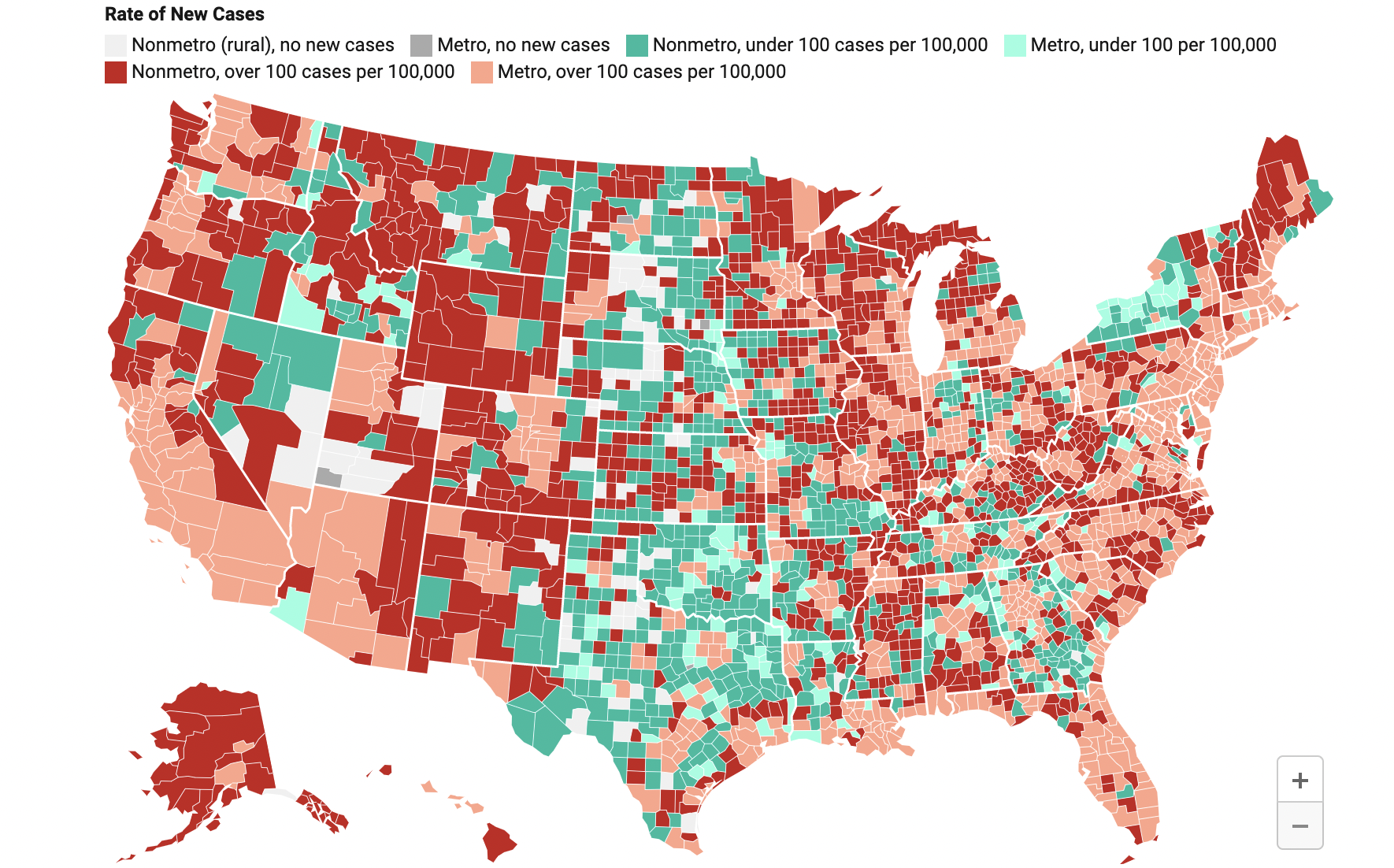
New coronavirus infections, in ranges by county, June 7-13
Map by The Daily Yonder; click on the image to enlarge it or click here for the interactive version.

The rate of new coronavirus infections in rural counties stayed nearly unchanged during the week of June 7-13 while deaths related to Covid-19 climbed slightly, Tim Marema reports for The Daily Yonder. Rural counties reported 65,346 new infections last week, 38 fewer than the week before. Meanwhile, 433 new Covid-related deaths were reported in rural counties, 67 more than the week before, or an 18 percent climb.

"In metropolitan counties, the number of new infections fell while deaths increased by more than 25% compared to two weeks ago," Marema reports. Metro counties reported 647,191 new infections last week, down 60,843, or 8%, from the week before. Covid-related deaths in metro counties totaled 2,184, an increase of 488 from two weeks ago, or nearly 28%.

"For the 60th consecutive week, the rate of Covid-related deaths was higher in rural counties than metropolitan counties last week," Marema reports. "Rural counties had a death rate of 0.94 per 100,000 last week, while metropolitan counties had a death rate of 0.77 per 100,000." Click here for more charts, regional analysis, and county-level interactive maps from the Yonder.

Over 90% of rural heartland bankers surveyed say a recession is more likely than not within the next 12 months

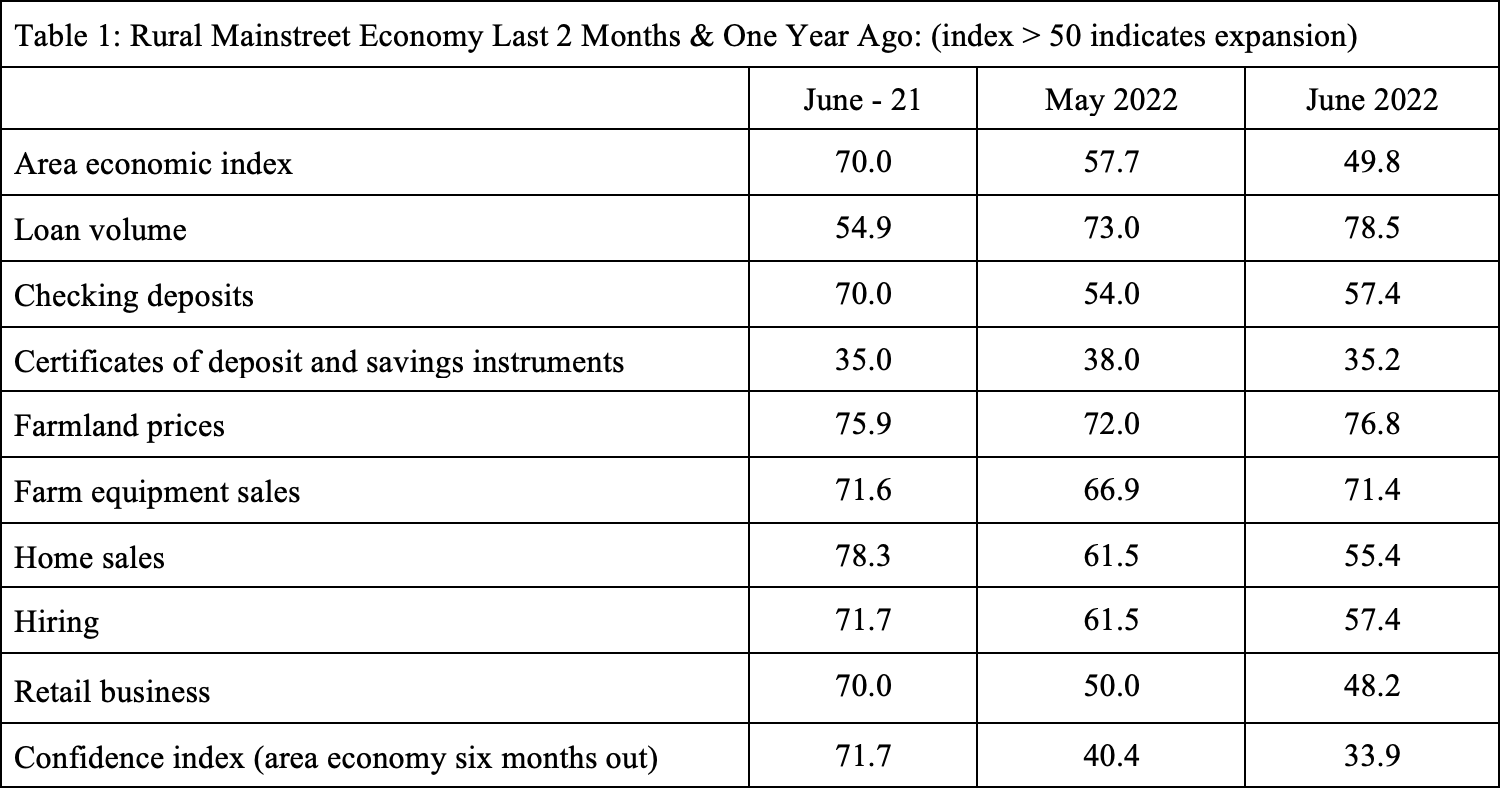
Creighton University chart compares current month to last month and year ago; click here to download it and chart below.

A June survey of rural bankers in 10 heartland states that rely on agriculture and energy found that nearly 93 percent believe a recession is more likely than not within the next year. Accordingly, the Rural Mainstreet Index fell to 49.8 from last month's 57.7, the lowest reading since September 2020. Any number over 50 in the 0-100 index is growth-positive. The index surveys bankers in about 200 rural communities with an average population of 1,300 in Colorado, Illinois, Iowa, Kansas, Minnesota, Missouri, Nebraska, North Dakota, South Dakota and Wyoming.

"Much like the nation, the growth in the Rural Mainstreet economy is slowing. Supply chain disruptions from transportation bottlenecks and labor shortages continue to constrain growth," writes Creighton University economist Ernie Goss, who compiles the index. "Farmers and bankers are bracing for escalating interest rates — both long-term and short-term."


Quick hits: Rural entrepreneurs well-placed to be climate leaders; Kansas faces dire foster-parent shortage

Here's a roundup of stories with rural resonance; if you do or see similar work that should be shared on The Rural Blog, email us at heather.chapman@uky.edu.

Much of rural Kansas has so few foster parents that the loss of just one can leave a huge hole in a county, reports Kansas City's KCUR.

How to prepare for, and react to, storms that knock out your electricity, from The Daily Yonder.

The last line of the paid obituary for a man who was a major paper-company executive in Idaho reads: "The best tribute you can give to Lee [Gill] is to pick up a piece of trash." His funeral is today.

The Guardian digs up a 1977 climate memo to Jimmy Carter "that should have changed the world."

Through simple measures, rural entrepreneurs can become climate leaders, says the Nebraska-based Center for Rural Affairs. Read more here.

Abbott baby formula factory shuts down again after storm flooding; could start production again in a few weeks

Just weeks after the Abbott Nutrition baby formula plant in Sturgis, Mich., got back up and running, production has stalled again after a severe storm caused flooding in parts of the facility. "On Wednesday, the company said that it was assessing damage from the storm and cleaning the plant, which would delay production and distribution for a few weeks, but that it had sufficient supplies of EleCare and most of its specialty and metabolic formulas to meet demand until new formula is available," Christine Hauser reports for The New York Times. 

Food and Drug Administration Commissioner Robert M. Califf "said that the agency had been informed about the stoppage but that it was not expected to have much impact, given increased imports of formula as well as production by Abbott and other manufacturers," Hauser reports. The plant is expected to be up and running again in a few weeks. 


Remote work and cheaper housing lure new rural residents

Remote work opportunities and cheaper housing are drawing many from the nation's biggest cities to smaller, often rural, areas, according to a recent report from the Economic Innovation Group, a bipartisan public-policy think tank.

"Since the pandemic began, there has been a debate about whether the rapid rise of remote work would affect where people live. Some argued that remote work effects would be mostly temporary and local. Others argued that remote work would have significant effects on where people live and the economic geography of the U.S. and elsewhere," says the report. "With the release of 2021 U.S. Census Bureau Population Estimates, we are able to see more conclusive evidence about what has happened so far. The results do not paint a picture of a continuation of recent pre-pandemic trends, but rather a significant change in where people are moving and living. While much research remains to be done, the evidence is consistent with remote work beginning to change economic geography."

Here are some top findings from the report:
  • The report divides counties into six population types: large urban, small urban, suburban, exurban, metro rural, and non-metro rural. Large urban areas have seen the biggest drop in population growth rates during the pandemic, though small urban areas also declined. Population growth rates in the suburbs remained much the same over the pandemic, but exurban, metro rural, and non-metro rural saw increased growth rates.
  • Remote work opportunities, not temporary pandemic policies, have been a major factor in persuading people to move to rural areas from large cities.
  • Rural areas with tourism and recreation-based economies have been more likely to attract urban emigrants. Lower rural population density didn't seem to play much if any role in attracting new residents.
  • Affordable housing has been a big draw for urban residents seeking to relocate.

Thursday, June 16, 2022

If private equity comes for your hospital, check it out; you may need to ask, 'Is a bad hospital better than no hospital?'

Audrain Community Hospital in Mexico, Mo., closed in March. (Photo from Kaiser Health News)

"Private-equity investors, with their focus on buying cheap and reaping quick returns, are moving voraciously into the U.S. health-care system . . . putting vulnerable communities at the mercy of firms whose North Star is profit, rather than patient health," reports Sarah Jane Tribble of Kaiser Health News.

Tribble's object example is Noble Health, which recently closed two rural hospitals in central Missouri: Audrain Community Hospital in Mexico and Callaway Community Hospital in Fulton. The company gave vague reasons, but it "should have had plentiful resources to keep them afloat," Tribble writes. "Noble was launched in late 2019 by Nueterra Capital, a venture capital and private equity firm that has raised millions of dollars to back dozens of health-care companies, according to Nueterra’s portfolio and federal filings. What’s more, in addition to Medicare and Medicaid funds, Noble had received nearly $20 million in federal Covid relief money in the 18 months before it closed the hospitals — funds whose use is still not fully accounted for."

Kaiser Health News chart by Krishna Sharma
Tribble says the story is a cautionary tale for other communities with struggling hospitals: "Noble acquired the hospitals after charming local leaders desperate to save beloved local institutions. And federal regulators did nothing to block or thoroughly vet the acquisition, despite red flags. Noble’s directors had little health-care experience. The one who did was Donald R. Peterson, whose previous foray into the space, an infusion company, ended with charges of Medicare fraud."

After Noble took over, "The hospitals stopped paying their bills, according to lawsuits filed by contract nurses, security guards, and others," Tribble reports. "Inspection reports from the state workers coordinating with the Centers for Medicare & Medicaid Services were alarming, listing 135 pages of deficiencies that put patients “at risk for their health and safety.”

The business model of Noble and other private-equity firms is “all about creating short-term returns for shareholders,” Ambar La Forgia, a Columbia University assistant professor who studies private equity in health care, told Tribble, who says LaForgia raises a hard question for rural America: “Is a bad hospital better than no hospital?” In Audrain County, officials didn't know that was the question, and they "were easy prey for investors," Tribble writes. "Noble was the only bidder for the failing hospital, said Lou Leonatti, the longtime local attorney, and many in Mexico, a town of 11,000 and the county seat, 'believed we were saved'."

Rural hospitals face danger as pandemic funding runs out; 1 in 5 are at significant risk of closure or service reduction

Federal pandemic aid drastically slowed the pace of rural hospital closures. (Bipartisan Policy Center graph)

Federal pandemic aid helped slow the pace of rural hospital closures, but that aid is drying up, and the hospitals are still dealing with pandemic-driven financial problems and staffing shortages, and one-fifth are at significant risk of closure or service reduction, the Bipartisan Policy Center reports.

A new BPC report offers insights on the state of rural health care through interviews with providers, national organizations, federal and state policy experts, and rural hospital leaders in Iowa, Minnesota, Montana, Nebraska, Nevada, North Dakota, South Dakota and Wyoming.

The report focuses mostly on strengthening health-care delivery through Medicare and Medicaid, since those programs play an outsized role in rural America. Here are some highlights from the report:

  • About one-third of Americans are enrolled in Medicare.
  • Nearly one-quarter of Americans under age 65 rely on Medicaid as their primary health insurer.
  • Many rural stakeholders said that, once federal pandemic aid dries up, many rural hospitals will once again be at risk of closure unless additional action is taken to protect them.
  • Hospitals experiencing persistent financial losses (negative total operating margins over three consecutive years) ranged from 6% in Nevada to a high of 38% in Wyoming.
  • Out of 2,176 rural hospitals, 441 (one-fifth) face three or more concurrent signs of financial risk that put them in danger of service reduction or closure, and 909 (42%) face two or more signs of risk. The risk signs include negative total operating margin, negative operating margin on patient services alone, negative current net assets, and negative total net assets.
Based on its interviews, the Bipartisan Policy Center recommends several short-term policies to stabilize and strengthen access to rural hospitals and health clinics:
  • Provide rural hospitals full relief from across-the-board Medicare spending reductions, known as sequestration, until two years after the federal public health emergency ends.
  • Take rural facilities out of the ongoing 'extender' and 'needing to be renewed' budget cycle, including by permanently authorizing the Medicare Dependent Hospital program and making rural low-volume payment adjustments permanent.
  • Update or rebase Sole Community Hospital and Medicare Dependent Hospital payment structures to ensure reimbursement is in line with current costs.
The report also has a raft of recommendations to improve workforce recruitment and retention, and improve access to specific services such as ambulance care, telehealth, behavioral health, and maternal care services. Read the report here.

Rural residents, especially in South, likelier to have medical debt; most Americans have had some in the last five years


More than 100 million Americans, representing 41% of adults in the nation, have medical debt, and they are more likely to live in rural areas, according to a
new data analysis by the Urban Institute. The issue is a "critical challenge to Americans’ financial stability and well-being," says the report, since "people with medical debt are likely to forgo needed medical care, have difficulty meeting other basic needs, and face an increased risk of bankruptcy."

A Kaiser Health News and NPR investigation found that the problem of medical debt is "far more pervasive than previously reported," Noam Levey reports, "because much of the debt that patients accrue is hidden as credit-card balances, loans from family, or payment plans to hospitals and other medical providers." According to a recent Kaiser Family Foundation poll that informed the reporters' investigation, more than half of U.S. adults said they've gone into debt in the past five years because of medical or dental bills. About one in four with medical debt owe more than $5,000 and about one in five said they'll probably never pay it off.

Medical debt "is forcing families to cut spending on food and other essentials. Millions are being driven from their homes or into bankruptcy, the poll found," Levey reports. The issue is also deepening racial disparities, and is preventing many from saving for retirement, buying a home, affording college, and more. It's also making life harder for people already facing cancer and other chronic illnesses. 

The Urban Institute analysis found that people with medical debt in collections are more likely to live in the South; of the 100 counties with the highest levels of medical debt, 79 are in states that didn't expand Medicaid under the Patient Protection and Affordable Care Act. One-off medical emergencies aren't driving medical debt: The prevalence of chronic medical conditions among a county's residents was the strongest predictor of medical debt. Counties with higher shares of uninsured, low-income, younger, or Black or Hispanic residents also have higher rates of medical debt. 

The No Surprises Act, which took effect Jan. 1, aims to protect patients from out-of-network medical bills, but it has some limitations; ground ambulances, for example, can cost thousands of dollars but are not covered under the bill. About half of emergency ground ambulance rides result in out-of-network charges for people with private insurance, according to a recent KFF study.

EPA says PFAS, 'forever chemicals,' riskier than first thought and it will offer $1 billion to help address the problem

The Environmental Protection Agency warned Wednesday that widely used "forever chemicals" in drinking water are more dangerous than previously thought, and advised local governments to install water filters or at least warn residents of contamination, Dino Grandoni reports for The Washington Post. The advisories are non-binding, since the federal government doesn't currently regulate polyfluoroalkyl and perfluoroalkyl substances, or PFAS. However, EPA plans to propose mandatory standards for the two most common types of PFAS this fall. 

"Once finalized, water utilities will face penalties if they neglect to meet them. The advisories will remain in place until the rule comes out," Grandoni reports. "EPA also said Wednesday that it is offering $1 billion in grants to states and tribes through the bipartisan infrastructure law to address drinking-water contamination."

PFAs were invented in the 1940s and are used for nonstick cookware, flame-retardant equipment, water-repellent fabrics, fast-food wrappers and more. The chemicals have been linked to health risks for some time, but recent studies about the most common PFAS show that "lifetime exposure at staggeringly low levels of 0.004 and 0.02 parts per trillion, respectively, can compromise the immune and cardiovascular systems and are linked to decreased birth weights," Grandoni reports.

Sign up for USDA's Census of Agriculture by June 30

Want to stand up and be counted in the U.S. Department of Agriculture's Census of Agriculture? You have until June 30 to sign up. You will need to sign up if you didn't participate in the 2017 Ag Census and you don't get other USDA surveys or censuses. Click here to sign up or for more information.

USDA's National Agricultural Statistics Service holds the Ag Census every five years to provide as complete a count as possible of U.S. farms and ranches and the people who operate them. This year will feature a new web portal meant to make participation easier. Producers who sign up in time can complete the survey securely online in November (NASS will mail out access codes then). In addition, NASS will mail out hard copies of the survey in December.

The survey has been conducted for more than 180 years, and remains the only source of comprehensive and impartial agricultural data for every state and county.

Low-lying rural areas near coasts will bear the brunt of sea-level rise, analysis of Chesapeake Bay maps indicates

Median elevation of Chesapeake Bay watersheds
(Limnology and Oceanography graphic)
"A new analysis using highly detailed elevation maps of the Chesapeake Bay suggests that North America's extensive areas of low-lying rural land will allow coastal marshes to persist or even expand as salty water creeps upward into what are now forests and farmland," Science Daily reports.

According to the study, recently published in Limnology and Oceanography Letters, more than 600 square miles of low-lying land in the Chesapeake region—more than 75% of it rural—will become marshland by 2100. "The challenge for North American landowners and governments will be to equitably manage the conversion of what is now mostly privately owned, income-producing rural uplands into coastal wetland habitats whose value lies mainly in providing publicly valued ecosystem services such as flood protection and the nurture of fish and bird populations." David Malmquist reports for the Virginia Institute of Marine Science.

Rising sea levels will affect more than the Chesapeake. Here's an interactive tool showing which parts of North America could be submerged at different sea levels (presumably, low-lying lands near such areas could also become marshy).

Wednesday, June 15, 2022

Senate's response to school shooting would boost rural mental-health care; Uvalde's GOP representative backs it

The U.S. Senate's response to the massacre of students and teachers in Uvalde, Texas, could include funding for mental-health treatment that will increase access to it in rural America. The framework of the agreement by 10 Democrats and 10 Republicans, and endorsed Tuesday by Republican Leader Mitch McConnell, includes three mental-health measures:
  • Expansion of a key method of funding community behavioral-health clinics
  • Funds to help families and youth access mental health services via telehealth
  • Beefing up school mental-health services, such as early identification and intervention
Other points in the framework include funding to encourage states to implement “red flag” laws that let authorities keep guns away from those deemed by a judge to represent a potential threat. The legislative language of the bill being drafted.

Senate Finance Committee Chair Ron Wyden, D-Ore., wants the legislation to include some mental-health ideas from his committee, whose jurisdiction includes health care. But even if it doesn't, Wyden hopes momentum will remain "for a separate mental health package later, especially since the gun violence prevention framework doesn’t mention substance-use-disorder services," reports Dorothy Mills-Gregg of Inside Health Policy.

Many rural communities lack behavioral-health centers. Mills-Gregg reports, "Telehealth is a cost-effective tool and provides a natural opportunity for young people who are especially adept at using technology, Wyden said."

The framework of the deal was endorsed by Republican U.S. Rep. Tony Gonzales, whose district includes Uvalde. He told Fox News Radio's Guy Benson, "This bill is going to have is going to invest more in mental health than at any other point in our nation’s history. . . . mental health clinics, especially in rural America, that they don’t have the resources."

Omicron wave, twice as deadly in unvaccinated people as its predecessors, hit rural areas harder, killing many people

The omicron variant of the coronavirus, which cause a wave of the Covid-19 infections in late 2021 and early 2022, "spread like a grass fire in America’s densely populated cities, but led to higher rates of death in rural counties where vaccinations are lagging," reports the University of Cincinnati, home to one researcher in a group who recently published a study on the phenomenon.

Their report, in the journal Frontiers in Medicine, "revealed striking disparities in health care between urban and rural America," Michael Miller writes for the university. Researchers "found that counties with vaccination rates of less than 40% had far higher mortality rates than counties with vaccination rates of 60% or more. The study recommended that health policymakers continue to make vaccination coverage a priority."

Looking forward, rural counties "face a higher probability of developing chronic illness from long Covid," said study co-author Claudia Moreno of the University of Washington. She also voiced concern that health officials are less able to track Covid-19 infections because fewer people are reporting new cases: "In the early part of the pandemic, people knew exactly what the infection rates in their counties were day to day—like the weather. And now we have peaks in case loads that are so much higher, but there is less public awareness."

A relative moderate with rural roots is elected president of the Southern Baptist Convention, by a wide margin

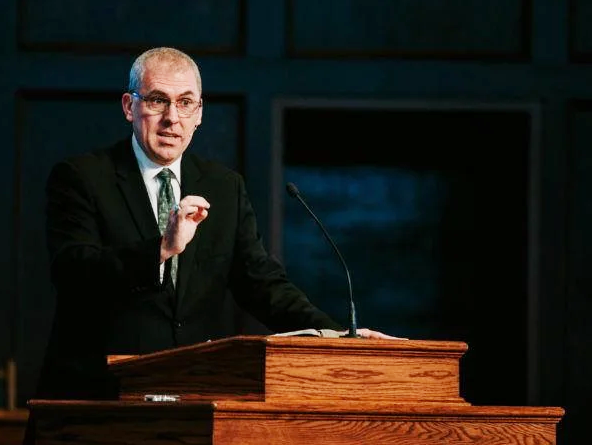
Pastor Bart Barber (Baptist Press photo via Kentucky Today)
An exurban pastor with rural roots and a relatively moderate stance on issues facing the Southern Baptist Convention was elected president of the nation's largest Protestant denomination Tuesday night.

Bart Barber is pastor of First Baptist Church in Farmersville, Texas, population 3,612, an exurb of Dallas. He is from Lake City, Ark., pop. 2,326, just east of Jonesboro.

Barber, who strongly supported conclusions of the SBC's Sexual Abuse Task Force, was elected on the second ballot, defeating Pastor Tom Ascol of Grace Baptist Church in Cape Coral, Fla., by 61 to 39 percent. Barber got almost 48% on the first ballot. Other candidates were "former foreign missionary Robin Hadaway of Oceanside, Calif., and Pastor Frank Cox of North Metro Baptist Church near Atlanta, a last-minute entrant into the race," reports Frank Lockwood of the Arkansas Democrat-Gazette.

"Ascol, favored by Baptists who want to move their denomination further to the right, had adopted the campaign theme 'change the direction.' Barber, on the other hand, urged fellow Baptists to set their differences aside and focus on the gospel, calling on 'an army of peacemakers' to help unify the 13.7 million-member body."

Lockwood gives Barber's Baptist bio: "Barber was 5 years old when he responded to the altar call at Bethabara Baptist Church, a small congregation on the east side of the St. Francis River, roughly four miles north of Lake City. He was 11 when he first felt the call to ministry, a call that was confirmed while attending summer church camp three years later. While still in high school, he was 'licensed to preach the Gospel' by First Baptist Church in Lake City. Barber preached his first sermon while in high school and soon was asked to serve as interim pastor at New Hope Baptist Church near Black Oak, according to [Traci] Smith, his sister. Barber went to Texas to attend Baylor University, preaching at a small country church on the weekends. He's been ministering ever since." For more bio, from Baptist Press, click here.

Association of Health Care Journalists resumes in-person Rural Health Workshops; next one in Chattanooga July 14

The pandemic has kept the Association of Health Care Journalists from having its annual Rural Health Workshop, until now. One will be held July 14 in Chattanooga, Tenn., and registration is open and free.

ACHJ says journalists can get answers at the workshop to such important questions as, "What does it take to keep a rural hospital open in the state with the highest rural hospital closure rate in the country?" It says the health-care and policy experts and researchers at the workshop will include Stephanie Boynton, vice president and CEO of hospitals in North Carolina Hospital and Tennessee, who "will talk about how a hospital just days away from closing its doors found a path to survival and what that has meant to a community."

The program, which may be updated, will also include sessions on finding and interrogating data, judging the quality of programs that will receive opioid settlement funds from state and local governments, and what it takes to build the rural health care pipeline, among others.

To register, go here or call 423-756-5150. Use this link to book your hotel room. Watch AHCJ’s website and social media platforms for important program announcements and updates.

What’s happened to nuts and bolts of public-safety news?

By Jim Pumarlo

Crime and public safety are garnering more headlines across the country. Law enforcement and racial disparities in the criminal justice system are under increasing scrutiny. Newspapers play a key role in examining the dynamics in their own communities.

But what’s happened to police logs, the most basic of public safety reporting? Where are the regular records of traffic citations, thefts, property damage, burglaries and much more?

Police logs easily generated the most calls during my tenure as editor of the Red Wing (Minn.) Republican Eagle. Traffic citations probably topped the list. Nobody likes being linked to a police report, whether it’s something as common as speeding or a citation that carries greater stigma, such as a DWI.

We regularly connected with local law enforcement. We routinely reviewed all initial complaint reports. The documentation was part of the menu of public records that readers expected to see in our newspaper.

We also believed the information was valuable to readers in terms of public safety. Is a neighborhood experiencing a rash of vandalism? Are DWIs on the rise? Should residents be on the lookout for another scam artist? Are certain crosswalks particularly dangerous? Has a neighborhood become a haven for narcotics? Is there a pattern to a rash of business burglaries?

No doubt, traffic citations are among the most worrisome and embarrassing to the violators. A youth is afraid he’ll lose his job. A teacher is concerned how she can explain a speeding ticket to students. An elderly woman is flustered by her first-ever ticket. A coach dreads facing his players after getting ticketed for a DWI.

Adding to the frustration – and often anger – of the accused is the lag time between when a ticket is issued and when the court disposes of a case. The delay can be weeks, or even months, depending on circumstances.

We believed both reports were newsworthy. For example, police might break up a neighborhood disturbance and issue several tickets. The community should be apprised immediately. It’s equally newsworthy to follow a case to see what penalties are assessed.

With the increased level of crime across the country, it’s discouraging to see many newspapers put fewer resources – or, at minimum, less effort – into monitoring police logs. For those reports that are published, one must ask in many instances: What’s the value?

Some newspapers simply copy and paste an agency’s computer printout. It may provide a glimpse of a department’s activity – but little else. No names. No addresses. The reasons for a call are nondescript: driving complaint, narcotics, domestic, traffic stop, noise, suspicious. No indication if arrests were made.

Some newspapers will translate the logs into their own reports, but the vagueness is alarming. A bike theft on Bush Street. A local business reports a padlock broken and items stolen. An employee theft on the 14000 block of Dellwood Drive. Again, what’s the value?

Most glaring is the anonymity of the reports – the lack of the five Ws and H of basic journalism. Reports are meaningless and do nothing to alerting a neighborhood, a community to public-safety issues.

Law enforcement undoubtedly is spoon-feeding information, selectively deciding what they believe is in the best interests of the public. They give little attention to the fact that most of the nuts and bolts of police reports – names, addresses, specifics of call – is classified as public by law. Their rationale? Adhering to their own rules makes their jobs easier; they won’t get the angry phone calls asking why they released the information to the newspaper.

Even more discouraging is that many editors apparently share a similar sentiment. They don’t press for substantive details. Their rationale? "Let’s keep the reports vague and not rile readers."

The dangers to this lack of aggressive reporting are obvious.

First, computer logs likely are transmitted electronically with little or no contact with anyone at the newspaper. Reporters do not develop any relationship with folks at the cop shop. They miss the opportunity to pick up and follow up on spot news, in-depth reports, feature stories and other substantive content for the newspaper.

Second, law enforcement will soon consider it standard operating procedure: Give the newspaper as scant reports as possible. That unfortunately is what many departments are taught. I well recall an officer in my hometown who became the primary contact on our daily rounds. He had just returned from training at the FBI Academy at Quantico, Va. His marching orders were very clear, as he was proud to tell us: Give the newspaper only the information he believed should be shared. We regularly challenged him, reminded him what the law dictated, and we eventually got the information – but it was an ongoing struggle.

Readers frequently asked that a public record be withheld. It might be a marriage license, divorce proceeding or ambulance run, but tickets were most commonly the concern. Some reasons were had more merit than others.

In the end, though, each person was seeking special treatment. Each was asking the impossible because our policy was that we could not pick and choose. Going down that path would place us in the position of being judge and jury – to determine that one person’s plea was more worthy than another’s. And we’d never know all the facts.

The simplest and fairest policy is to treat all public records as just that – public – in the belief that openness serves the greater number of people over the greatest period of time. At its foundation, police logs provide a pulse of public safety in a community.

Jim Pumarlo writes, speaks and provides training on community newsroom success strategies. He is author of Journalism Primer: A Guide to Community News Coverage; Votes and Quotes: A Guide to Outstanding Election Coverage; and Bad News and Good Judgment: A Guide to Reporting on Sensitive Issues in Small-Town Newspapers. He can be reached at www.pumarlo.com and welcomes comments and questions at jim@pumarlo.com.

Armadillos keep moving north; now they're in Virginia

Map shows proven and potential range of armadillos and location of the first one photographed in Virginia.

A nine-banded armadillo (Adobe Stock Photo)
The march of the armadillo, perhaps driven in part by climate change, continues. In Buchanan County, Virginia, which borders Kentucky and West Virginia, Ruby Osborne wondered what had been digging up her flower beds until she saw an armadillo standing on its hind legs, which she called “plumb comical,” reports Carrie Arnold of National Geographic. That was in 2019; several months later wildlife officials finally got their hands on one, killed by a dog near the North Carolina border. Several others have been confirmed.

The nine-banded armadillo, the state animal of Texas, has been in Kentucky so long that it is now considered a native species, Dave Shuffett reports for Kentucky Living magazine: "Its exposed underbelly makes the animal sensitive to harsh winters. Scientists say the northward and eastward expansion will have to stop at some point but they’re not sure where, given climate and habitat changes." Arnold reports: "Several studies suggest that armadillos, which prefer hot weather, could one day thrive as far north as New Jersey and Pennsylvania, aided in part by warmer winters."

Tuesday, June 14, 2022

Many rural counties are still reeling from pandemic-driven increases in murder and other violent crimes

A Searcy, Ark., cemetery. In 10 weeks, six people were killed in White County. (Photo: Andrea Morales, Wall Street Journal) 

Murder rates in rural America "have soared during the pandemic," report Dan Frosch, Kris Maher and Zusha Elinson of The Wall Street Journal. Rebecca McCoy, prosecutor in White County, Arkansas, told the newspaper, “It was like people lost their ever-lovin’ minds.” The county hadn't had a homicide in two years when the pandemic began; in 10 weeks, it had six; by the end of 2020, it had 11.

Homicide rates in non-metropolitan counties rose 25 percent, according to the Centers for Disease Control and Prevention. "It was the largest rural increase since the agency began tracking such data in 1999," the Journal reports. "The rise came close to the 30% spike in homicide rates in metropolitan areas in 2020. The CDC hasn’t analyzed 2021 homicide data yet. In some rural counties, murder rates remained high last year, while in others they have begun to recede along with Covid, data from local law-enforcement agencies shows." But the courts remain burdened: "Small-town prosecutors, unaccustomed to handling numerous homicides cases, find themselves overwhelmed with them."

What drove the increase? Local officials "speculate that the breakdown of deeply rooted social connections that bind together many small communities, coupled with the stress of the pandemic, played a role," the Journal reports. "Pastors point to the suspension of rituals such as in-person church services, town gatherings and everyday exchanges between neighbors. Such interactions can serve as guardrails, helping to prevent conflicts from turning violent."

Also, The psychological and financial stress due to isolation and job loss were especially pronounced in remote areas, where social services were limited even before Covid-19 struck, local leaders say. As the pandemic took hold in the spring of 2020, fights between family members, acquaintances and even strangers escalated more frequently into deadly confrontations, authorities in some rural counties said."

And that kind of violence is harder to prevent, said Brian Wallace, sheriff of Marion County, South Carolina: “It’s not like you got gang members dealing drugs, and you can get boots on the ground, and undercover buys and prosecutions.” The Journal story has many examples of specific cases.

Army Corps starting program to help repair unsafe dams

Eight years ago, Congress created a fund for federally backed loans to repair risky dams. This month, the Army Corps of Engineers finally published proposed regulations for the program, reports David A. Lieb of The Associated Press.

"The Corps’ National Inventory of Dams lists more than 92,000 structures across the U.S., most of which are privately owned," Lieb notes. "The safety of the nation’s dams has garnered increased public scrutiny in recent years, in part because of high-profile failures that forced the evacuation of thousands of residents in Michigan and California."

Lieb notes AP's recent census of more than 2,200 dams in poor or unsatisfactory condition that are classified as high-hazard, meaning failure "likely would unleash a flood killing at least one person," he writes. "That figure was up substantially from a similar AP analysis three years earlier."

The average U.S. dam is 61 years old, and many pose more risk than when they were build because of downstream development. Also, "A changing climate with intense rainstorms has strained some dams beyond their original designs," Lieb reports. "Maintenance also has been deferred, often because dam owners lack the money to pay for it. The Association of State Dam Safety Officials estimates it could cost nearly $76 billion to rehabilitate the almost 89,000 dams owned by individuals, companies, community associations, states, local governments and other entities besides the U.S. government.

The new federal loan program, which makes more than $7 billion in guarantees available, “puts a pretty good dent in the existing need,” Aaron Snyder, interim director of the Corps’ Water Infrastructure Financing Program, told Lieb, who notes, "Most states don’t have grant or loan programs specifically targeted for repairing dams." Congress authorized the Corps program in 2014 but didn't fund it until December 2020, Lieb reports: "It got a big funding boost from the Infrastructure Investment and Jobs Act signed by President Joe Biden last November."

Rural schools adopt four-day week to help recruit teachers

Maps by the Columbia Missourian, part of the Missouri Business Alert consortium

Rural school districts in Missouri are rapidly adopting a four-day week for classes, saying it helps them recruit badly needed teachers, reports DC Benincasa of Missouri Business Alert.

Since 2010, 119 Missouri districts have switched to the four-day week, and at least 18 more are planning to in the next academic year, "adding up to 25% of all districts in Missouri," Benincasa reports. "Some experts argue the policy won’t be enough to solve a teacher shortage problem. . . . The state ranks second to last in the country in teachers’ average starting salary of $33,234 a year, according to a report from the National Education Association."

Last month, the legislature raised the pay to $38,000. "The state is slated to pay for 70% of the wage increase with local funds making up the rest," Benincasa notes. Missouri State University professor Jon Turner "said rural communities might struggle to raise the funds because they don’t have the business-tax revenue that other areas in the state have."

Rural schools face other obstacles recruiting teachers. Sarah Low, a professor of regional economics at the University of Missouri, "said the number of businesses in rural Missouri have shrunk because of significant population declines in rural areas," Benincasa reports. "When there are fewer businesses in rural areas, it makes it harder to find a job if you’re the spouse of a teacher. Low also said while rural areas often provide enough housing to meet demand, the quality of housing isn’t high enough to attract white-collar professionals. ... Missouri’s rural communities also often don’t have the gathering places and opportunities for social interaction compared to suburban and urban areas."

Ellen Weimer, a high-school math teacher in Keytesville, which went to a four-day week in 2019, told Benincasa that was a big reason she's there: “The extra day has been so beneficial for me to work on all the things that a seasoned teacher doesn’t have to do as much because they’re used to it.”

Rising newsprint prices hurt papers' role in local democracy

A press The Seattle Times shut down in 2020 (Photo by Mike Siegel)
The "local journalism crisis is exacerbated by a global plunge in newsprint production. That’s leading to soaring costs for remaining newspapers that are generally hanging on by a thread," writes Brier Dudley, editor of The Seattle Times. "Combined with high fuel prices and delivery labor shortages, this will lead to further cutbacks in distribution, the size of newspapers and potentially newsroom employment."

Dudley reports that newsprint prices have risen more than 30% in the last two years, and "A major factor is mills closing or converting production to packaging materials used by e-commerce companies such as Amazon." Francois Chastanet, director of graphic papers at Numera Analytics, a Montreal research firm affiliated with the Pulp and Paper Products Council, told Dudley, “Mills have been shutting down pretty much everywhere — it’s really a global situation that has been a bit worsened by the pandemic.” Chastanet said North America's newsprint production capacity declined 28% in 2020 and 18% last year, as demand fell 26% in 2020, 6.6% in 2021 and 5.3% in the first four months of 2022.

Noting many newspapers' cutbacks in the number of weekly print editions, Dudley reports on the situation in Washington: "Executives at the state’s largest independent dailies all told me newsprint prices may force cutbacks. Their price increases vary, as each negotiates separately and costs vary by factors such as volume and proximity to mills."

Newsprint prices were once an industry-insider subject, but now they are hurting the effectiveness of newspapers' role in local democracy, Dudley writes: "At a time when democracy is threatened from within and without, one of the last things America needs is to lose even more of its independent, local free press system. Congress has much to do this summer. But it must also recognize this crisis, agree that local journalism is a civic necessity and help the industry stabilize before it’s too late."

Why rural weekly newspapers should care about the Big Lie

By Al Cross
Director and Professor, Institute for Rural Journalism and Community Issues, University of Kentucky

The second hearing of the House committee investigating the Jan. 6 attack on the Capitol focused on the origins, progression, use, and impact of what the panel and a lot of other people call "the Big Lie," the false assertion by Donald Trump that the 2020 election was stolen from him. How Trump developed the tale, how he used it and what it caused are important questions. But so is the persistence of the lie in the minds of millions of Americans.

It remains to be seen whether hearings on national television, even on the Fox News Channel, will dislodge the Big Lie. People are naturally reluctant to acknowledge that they've been conned, many just want to move on, and many more just don't care, especially at a time of economic stress. Most of their local newspapers don't seem to care, either. Some do but don't show it because they have found national politics to be toxic, even dangerous, and certainly too much of a headache and a business risk.

The old maxim "All politics is local" has been turned on its head by Trump's presidency, his domination of news cycles and social media, and the decline of local news media, creating vacuums filled by social media and national news media. Now, our neighbors increasingly are defined by party or attitude toward Trump, and partisan politics is being injected into elections for nonpartisan office, so it is beginning to seem like all politics is national.

From The North Scott Press, May 19, 2021

This is a huge sea change in our country, and too many local newspapers are afraid to say anything about it. More need to follow the example of The North Scott Press in Eldridge, Iowa, where Publisher Bill Tubbs regularly stands up for the truth, national and local. As the hearing was going on Monday, I came across a couple of editorial columns that Bill sent me last year. They are examples of the sort of editorial leadership we need. 

One, written more than a year ago, after House Republicans stripped Rep. Liz Cheney of her leadership position, quoted Cheney's rejection of the Big Lie ("Remaining silent and ignoring the lie, emboldens the liar; I will not participate in this"), recounted Tubbs' difficulty in getting comment from his own congresswoman, asked a good question and delivered a bracing answer:

So why is a country editor writing about this when there is so much else to write about? Simply stated, because I believe the Big Lie will continue to divide this nation I love until it is rooted out at the core. If democracy is stolen based on a lie and I did not speak, I would feel forever shamed. The antiseptic, as always, is truth. Give credit to Rep. Cheney and Republicans like Adam Kinzinger of Illinois, who had the courage to speak truth to power – come where it will, cost what it may. To them, the unity of the nation is more important than the unity of any party. That's why I am disappointed that my congresswoman, Mariannette Miller-Meeks, voted otherwise. I've met her and visited with her on more than one occasion, and expected better. Oh, I understand. She is new and wants to get along with her party. . . . The propaganda machine has been more effective than the voices of scribes like me. Still, I must speak. . . . The peculiar phenomenon of the Big Lie, as I see it, is that members of Congress who buy into Trump's "Stop the Steal" were elected on the very same ballots. Funny they don't question their own victories – even by six votes, which was the case for Rep. Miller-Meeks.

As Liz Cheney said, we can't ignore lies. As Bill Tubbs said, this one must be rooted out, and that has to happen at the grass roots -- from the bottom up, not just the top down. More than 100 winners of Republican primaries this year support Trump's false claims, The Washington Post reports. The Big Lie is built on distrust of elites and the governments they influence, but it so greatly deepens that distrust that citizens feel disconnected from their democratic republic. That can be the beginning of the end of that republic. We all have a duty to keep it going, especially journalists.

Monday, June 13, 2022

In search of 2020 voter fraud: There's not much there, there

By FactCheck.org
A service of the Annenberg Public Policy Center, University of Pennsylvania

As the House committee investigating the Jan. 6, 2021, attack on the U.S. Capitol began its hearings, Deputy Managing Editor Robert Farley did a deep dive on "2000 Mules," a film by conservative activist Dinesh D’Souza.

The film, which is playing in select theaters around the country, uses cell phone data and surveillance video in an attempt to show that there was “coordinated, systematic fraud" in five key states in the 2020 presidential election -- perpetrated by "mules" who allegedly collected and dropped off illegal mail ballots in drop boxes.

But, as Rob explains, the supposed evidence is speculative and does not provide the proof that the filmmakers claim.

So far, the Georgia Board of Elections has investigated and dismissed three cases brought to the board by the filmmakers. In all three cases, the so-called "mules" were dropping off legitimate ballots for immediate family members who live in the same household. That's legal under Georgia's law.

As we have written many times before, election fraud is rare. And as we heard this week, even former President Donald Trump's own attorney general, William Barr, said he doesn't believe the claims of widespread fraud.

In taped testimony played at the committee's June 9 hearing, Barr recalled his conversations with Trump in late 2020: "I did not agree with the idea of saying the election was stolen and putting out this stuff, which I told the President was bullshit. And, you know, I didn't want to be a part of it. And that's one of the reasons that went into me deciding to leave when I did."

For more about the film, see "Evidence Gaps in '2000 Mules'."

A revenue-raising tale of two rural community newspapers from the National Summit on Journalism in Rural America

Sixth in a series of reports on the National Summit on Journalism in Rural America, held June 3-4 by the Institute for Rural Journalism and Community Issues and the College of Communication and Information at the University of Kentucky. Previous articles were on the state of rural journalism, the Summit-driven effort for sustainability in rural journalism, nonprofit models, help from higher-education journalism programs and philanthropic support for rural news media.

At the National Summit on Journalism in Rural America, journalism educator and researcher Clay Carey of Samford University said one way journalists in academia can help the news business is case studies of news outlets. For two and a half years, Buck Ryan of the University of Kentucky has been doing what he calls a "participatory case study" of the Chatham News+Record, a weekly paper in central North Carolina; at the summit, he moderated a discussion between Editor-Publisher Bill Horner and another innovative rural publisher, Terrence Williams of The Keene Sentinel, a daily in southwest New Hampshire. They have the same print circulation: 3,800.

In a report for The Rural Blog, Ryan notes that both are participants in the Knight-Lenfest Table Stakes program to master “the new essentials of sustainable journalism” and the Facebook Membership Accelerator grant program. "They generated ideas for changes in strategy, user experience ('UX'), product development and, mostly, increasing revenues," Ryan reports. "At the Sentinel, to reduce subscriber churn, staff members write letters thanking subscribers for their support and explaining how the paper published stories to help the community."

CHATHAM NEWS-RECORD REVENUE CHART
Horner's and Williams' presentations at the Summit showed some significant differences in the papers and their communities. Chatham County's population is up 17% since 2010 and is more than one-fourth minority; Cheshire County's went down about 1,000. The News+Record's revenue is dominated by advertising, with only 21% from circulation, while the Sentinel gets almost half its revenue from its audience.
KEENE SENTINEL REVENUE CHART

In a written Q and A with Ryan, Horner said his paper will "have to focus on new revenue streams and be reader-driven." It is raising prices and getting "blowback from some readers and even dealers, but it’s a value proposition: sometimes you support the value of your work with higher pricing."

A chronic problem with audience revenue is "churn," the constant addition and departure of subscribers. Williams said requiring six-month commitments and recurring credit-card payments for all new subscription starts that are part of a discount or gift program "significantly cut churn and increased print and digital reader revenue. Our percentage of these EZ-pay subscribers grew from 30% print in 2018 to more than 50% today; and from less than 10% online in 2018 to 82% today. Revenue growth that came with the resulting increased retention rate has been significant."

Asked what partnership has been the most lucrative or profitable, Horner said the News+Record's promotion of nonprofits helped prompt the local Council on Aging, "which is really a county department but mostly funded privately," to use two pandemic-relief grants "to give us $10,000 to provide subscriptions to senior citizens they serve who didn’t subscribe. We also got $18,000 in financial support from Mountaire Farms, a poultry processing company with Spanish-speaking employees, for our La Voz project to bring a Spanish-language publication, La Voz de Chatham (Voice of Chatham), to the community."

Williams noted the Sentinel's partnership with the local Hannah Grimes Center for Entrepreneurship on Radically Rural, a multi-track community development symposium that includes a track on community journalism. The other tracks are entrepreneurship, downtowns, land and community, arts and culture, clean energy and health care. "It has been profitable for both partners and a boost to the local community," Williams wrote We have won numerous regional and national awards for Radically Rural, including third place for Virtual Events from the Local Media Association in 2020. Feel free to join us Sept. 21 and 22, 2022, either virtually or in person."

Ryan's final question: "Now that you’ve gotten to know each other, what’s the best idea you plan to steal from your new friend?" Horner said of Williams, "I particularly like the direct personal appeals he and his staff do by email to readers and contacts; we have already built a plan to replicate that. And I loved his Community Impact Report. What a great way to tell your own story and demonstrate your value to your audience." Williams said, "Bill’s team produces a handsome, helpful community resource guide (Chatham 411) that is heavily supported by advertising. We are looking at producing something similar for our market, and Chatham News+Record’s product is an excellent model for us. It’s very well done."

Sunday, June 12, 2022

Movement started by Trump has created a sort of parallel U.S., where suspicion rules and trust is for the like-minded

Angela Rubino with the shredded records she retrieved
(Photo by Michael S. Williamson, The Washington Post) 
After describing a northwest Georgia activist's dumpster dive for shredded records in search of the elusive villain of voter fraud, Stephanie McCrummen of The Washington Post writes:

"Six years into the grass-roots movement unleashed by Donald Trump in his first presidential campaign, Angela Rubino is a case study in what that movement is becoming. Suspicious of almost everything, trusting of almost nothing, believing in almost no one other than those who share her unease, she has in many ways become a citizen of a parallel America — not just red America, but another America entirely, one she believes to be awash in domestic enemies, stolen elections, immigrant invaders, sexual predators, the machinations of a global elite and other fresh nightmares revealed by the minute on her social media scrolls. She is known online as 'Burnitdown.'

"She is also among the people across the country willing to do whatever they can to ensure that the imagined enemies of the United States are defeated in the 2022 midterm elections and beyond. From school boards to state houses to Congress, their goal is to take political territory, and for evidence that this is possible, they look to northwest Georgia Rep. Marjorie Taylor Greene, whose first-time candidacy two years ago defined the fringe of the Republican Party and who is now running for reelection as one of its standard bearers."

There are people like Angela Rubino in your county. Are you writing about them? Might be a good idea. So far Rubino has "managed to rally enough people to get the county election board ousted, replacing its members with those who believed that the 2020 election was stolen. She was part of a group called the Domestically Terrorized Moms that was pressing the local school board to get rid of a curriculum they believed to be grooming children for sexual predators."

McCrummen spent a lot of time with Angela Rubino, and her story is a deep dive into places many would rather not go. Ignore them at your peril. --Al Cross, Institute for Rural Journalism and Community Issues