![]() |
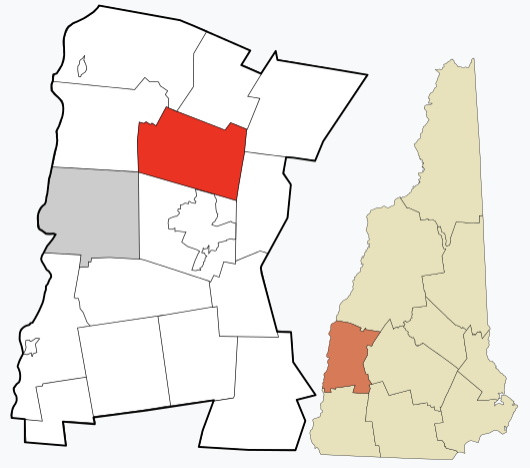
| Croydon, N.H., in Sullivan County (Wikipedia map) |
A digest of events, trends, issues, ideas and journalism from and about rural America, by the Institute for Rural Journalism, based at the University of Kentucky. Links may expire, require subscription or go behind pay walls. Please send news and knowledge you think would be useful to benjy.hamm@uky.edu.
Monday, July 11, 2022
Residents of New Hampshire town rouse from civic slumber, reverse local libertarians' efforts to halve school budget
Tourist towns lack housing for summer workers, hard to get
Lack of available housing has made it harder for tourist towns to attract summer workers.
"Although the summer workforce shortage has been particularly acute this year, the mismatch goes far beyond the national shortage of municipal lifeguards, camp counselors, wildland firefighters and resort housekeepers," Erika Bolstad reports for Stateline. "There are more available jobs in the United States than workers to fill them, and not just in the service or hospitality sector. An estimated 11.5 million job openings exist for 5.5 million eligible workers."'Dry' territory is becoming harder in find in rural Kentucky
Rural Kentucky continues to get wetter, and we're not talking about the weather. Only 10 counties are "dry," meaning that the sale of alcohol is illegal there, and they are all small, rural counties.
"Cole still preaches abstinence from alcohol, but acknowledged some pastors don’t push against alcohol as passionately as they once did, and that many churchgoers no longer see alcohol as evil because of the influence of popular culture and other factors," Estep reports. Nick Catron, director of missions for a regional association of Southern Baptist churches, said some have become complacent about alcohol: “As Baptists, predominantly we frown upon consumption of alcohol. But again, it just seems as if so many people today don’t find any fault in it.”
Friday, July 08, 2022
Rick Romancito of Taos News wins public-notice journalism award for coverage of planned cloud-seeding project
| Rick Romancito |
Many readers of the Taos News in New Mexico were confused and curious when they read a public notice in the paper announcing a plan to seed clouds to produce rain. Editor and reporter Rick Romancito's efforts to explain the phenomenon and coverage of the ensuing controversy earned him first place in the contest.
Romancito's continuing coverage stirred so much local opposition that the project application was soon withdrawn. "In addition to being a fine example of public-notice journalism, Romancito’s initial story was a model of thorough reporting that described the cloud-seeding process and the history behind its use and development," PRNC reports. "It also explained to readers how they could comment on the application."
As rural newspapers confront adaptation to digital, is there a rural model that works? Indianola, Iowa, may help tell us
The future-of-newspapers piece that seems to have had the most circulation in the past week was “There is a model out there that works,” by William Turvill in the Press Gazette, the industry's leading trade publication in the United Kingdom. The headline is a quote from Jay Senter, co-owner of the Shawnee Mission Post, a money-making local-news site for Johnson County, Kansas, pop. 610,000, in the Kansas City suburbs. “There is a consensus model emerging of a way that you can do this,” Senter says, and the Post seems to be proof of it.
It’s an inspiring and instructive success story, but it doesn’t apply to most rural communities. Asked how he and partner Julia Westhoff were able to get 6,000 subscribers, Senter noted the area’s affluence (the median household income is about $92,000). In other words, it has lots of disposable income, making a $77 subscription a relatively easy choice for readers who want reliable local news. “Senter is not sure his model could succeed in a poorer area,” Turvill reports. And the story’s closing quote is telling: “The scary thing is that even in a market as ideal as Johnson County is for a product like this, we barely made it. We had our backs against the wall.”
A better test is being undertaken in a place with a median household income of about $77,000 and a 2020 census population of 52,403. That’s Warren County, Iowa, part of the Des Moines metropolitan statistical area, likely because of commuting patterns; it's still primarily rural.
“People know us.” That’s one key. Duncan and Davitt have worked a combined 50 years at the newspaper. Also, “something worth the money.” In other words, don’t expect people to pay good money for poor journalism. Sustainability will require quality.
Biden going after coal-fired power in different ways following court ruling; renewable-energy tax credits could mean more
"In an interview this week, Joseph Goffman, President Biden’s nominee for EPA’s air chief, said the agency intends to issue a proposed regulation early next year that will curb greenhouse gas emissions from existing coal-burning power plants," and another to "cut emissions from new gas-burning power plants." EPA Administrator Michael Regan "has said those and other rules will have a side-benefit of also reducing greenhouse gas emissions. He also has indicated rule changes such as these might make some coal plants too expensive to continue to operate, resulting in more of them being closed down."
Longer, hotter summers are 'creating inhospitable conditions and endangering lives,' says The Washington Post
| Washington Post map shows temperature changes in the nation's four major climate zones. |
"Though the summer season of 2022 is young, parts of the nation already have experienced punishingly high temperatures, extreme drought, wildfires, severe storms, flooding or some combination. Projections from federal agencies suggest more abnormally hot weather, an expansion of drought and well above average wildfire and hurricane activity in the months ahead," The Washington Post reports. "Summer has always been a turbulent season, a time of checking weather forecasts and watching the skies. And despite the major shifts that have taken place, many people still relish the season. Vacationers still flock to places that now face some degree of wildfire or flood risk. But climate change is increasingly pushing summer to extremes, creating inhospitable conditions and endangering lives."
Quick hits: Gardening through a drought; Delta farmworkers claim discrimination; just how rural is your place?
Thursday, July 07, 2022
Fewer drug companies are participating in federal drug-discount program, posing another threat to rural hospitals
“These are billion-dollar companies. . . . The percent they are taking from us is so small to their bottom line, but it is so significant to us," Dr. Kemi Alli, CEO of the Henry J. Austin Health Center in Trenton, N.J., told Ollove. "It just seems inconceivable why they even put the effort into this to take away from the most vulnerable in our society. It doesn’t make any moral sense."
Rural radio talk-show hosts emphasize info, not ideology
![]() |
| Don Neagle at WRUS-AM/FM in Russellville, Ky. |
Cale Tharp of Hodgenville has also had long a radio career, but dreamed of owning his own station. In 2018 he bought WLCB-AM's license and a year later "the same building on the downtown square that had once been home to the station where Tharp spent time as a kid," Cobb reports. "His 'program' has no name because Tharp says he’s on the air all day long," playing country music and talking.
Think-tank VP returns to rural Ohio hometown, finds growing wariness of Trump but continued support of his policies
![]() |
| Darrell West |
"Yet on the other hand, they didn’t like Trump’s abrasiveness, wondered what to make of the Jan. 6, 2021 insurrection, and preferred someone who would follow Trump’s line but not antagonize so many people. Their ideal candidate seemed to be someone who supported Trumpism but with a nicer persona. In general, many of them told me they hoped Trump would not run, but that someone with his policy views would become the GOP nominee. This is consistent with data compiled by the Brookings Primaries Project based on an analysis of 2022 congressional primary candidates."
The lesson for Republicans, West writes, is "A nicer version of Trump, at least from a personality and public presentation standpoint, clearly would be the strongest GOP nominee for heartland voters. If Trump is the nominee, some Republican voters fear that campaign could reelect Joe Biden."
![]() |
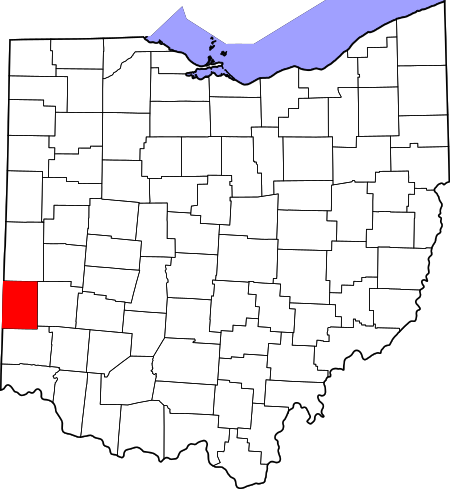
| Preble County (Wikipedia map) |
Report: 33 minors are seriously hurt on farms every day, and one dies from ag-related injuries about every three days
Farming remains the deadliest job for minors in the U.S., according to a newly released fact sheet on childhood farming injuries from the National Children's Center for Rural and Agricultural Health and Safety. Here are some highlights from the report:
- Fatalities among youth working on farms outnumber those from all other industries combined.
- Between 2001 and 2015, 48% of all occupational fatalities to minors were agriculture-related.
- At least 33 minors (those under age 18) are seriously hurt in an agricultural setting every day.
- One minor dies in an ag-related accident about every three days.
- The leading source of such fatalities involve transportation (47%) such as all-terrain vehicles and tractors.
- Another 20% of farming fatalities for youth involve contact with machinery such as skid steers, and 13% involve violent contact with animals and other humans.
- Youth under age 16 are 12 times more likely to sustain an ATV injury (fatal or nonfatal) than adults.
Wednesday, July 06, 2022
Rural-urban digital divide is major obstacle to sustaining local news in rural areas, Report for America chief says
![]() |
| Steven Waldman |
Modern immigrants succeed just like those of Ellis Island era; the main key is living in places with lots of opportunity
The U.S. has seen two major immigration waves since the Civil War. "The first came from Europe in the late 1800s and early 1900s: the Ellis Island era. The second, which continues today, started in 1965 with sweeping changes in immigration law that welcomed people from around the globe, particularly Latin America and Asia," Andrew Van Dam reports for The Washington Post. "In American mythology, the (largely White) huddled masses of the Ellis Island era teemed to our shores, tamed the prairies, powered the Industrial Revolution and became the heroes of the American success story. Today’s (largely non-White) immigrants are portrayed somewhat less charitably, often as people who came without marketable skills, looking for a handout."
But that's not true, according to years of research and analysis of detailed census records. "Thousands of genealogists, toiling anonymously, have shattered that myth and upended our perception of American immigrants," Van Dam reports. "No spoilers, but the data shows that the current wave of immigrants is succeeding and assimilating at virtually the same rate as immigrants did a century ago."
In fact, the children of immigrants have been more likely to climb the economic ladder than native-born Americans, both in the Ellis Island era and now, Van Dam reports. Researchers have determined that the biggest factor was geographic mobility.
"Immigrant kids tended to outperform their peers from similar economic backgrounds because, unencumbered by deep hometown roots, their parents were willing to move to where the jobs were," Van Dam reports. "If you compare immigrants to similar native kids born in the same place, they succeed at similar rates. It’s just that immigrant kids are much more likely to have grown up in one of those high-opportunity places."
Congress keeps some pandemic-era expansions of school-nutrition programs, which could mean more in rural areas
| Screenshot of interactive map by The Daily Yonder; for the interactive version, click here. |
Congress recently passed, and President Biden signed, the Keep Kids Fed Act to extend some special school-nutrition measures taken during the pandemic. "It could offer a summer lifeline for those in rural areas who rely on school-served meals during the vacation season," Sarah Melotte reports for The Daily Yonder. "The act doesn’t keep the provision of universal free meals to students, but it does expand those eligible for free lunches and increases the reimbursement rate for schools, among other things."The first pandemic relief bill created child nutrition waivers because "children could not receive meals at school because of lockdowns," Melotte notes. "The waivers increased federal reimbursements for lunch programs and allowed schools to omit eligibility requirements for free and reduced-price meals. A USDA survey found that 90% of schools took advantage of the increased funding and waivers to provide free meals to students regardless of income. The waivers also allowed schools to establish grab-and-go lunches during the summer" in more than just low-income neighborhoods.
"The Keep Kids Fed Act allows schools to continue to deliver meals and provide grab-and-go options," Melotte notes. That's important for rural families, because food insecurity is greater in rural areas. "Rural students may face other challenges such as transportation to and from meal distribution sites during the summer, especially with increasing fuel prices," Melotte writes. "Some families cannot afford to drive to a daily food pick up site to get a free lunch, a challenge exacerbated if they also live in a rural food desert . . . areas without a grocery store for 10 miles."
The act "does not allow all students to eat school meals free of charge in school year 2022-23," said a news release from the Department of Agriculture, which runs school-nutrition programs. "In most school districts, families will need to complete an application through their school to determine if their household is eligible for free or reduced-price school meals, as was done before the pandemic. USDA is also supporting the expansion of direct certification, which uses existing data to certify children for free or reduced-price meals without an additional application. All states are required to directly certify students for free meals if their household receives SNAP benefits, and some states also directly certify for free and reduced-price meals based on participation in Temporary Assistance for Needy Families, the Food Distribution Program on Indian Reservations or Medicaid."
Register by 5 p.m. CT Thurs. for Rural Health Journalism Workshop in Chattanooga on July 14; registration $50 tops
From the workshop website: "This workshop will bring journalists together with health care and policy experts who focus on the medical challenges of rural areas. Leave with a better understanding of what’s happening – or will be happening – in rural regions, and return to work with dozens of story ideas you can pursue. You don't have to live in a rural area to write great stories about what's happening just beyond the city limits. And think about how much policy is set based on the non-urban population of your state. This special one-day, no-fee workshop will help you find and cover health stories in rural America."
Sessions will cover data resources for reporters, rural health-care resource inequality during the pandemic, the promise and limitations of rural telemedicine, mobile clinics and other creative approaches to bridging rural health-care gaps, how to ask the right questions about opioid settlement money, and how to boost the number of rural doctors and nurses by establishing health-care pipelines in schools. Click here for more information about each session as well as a full list of panelists.
The conference is hosted by the University of Tennessee's Health Science Center, Cempa Community Care and Erlanger Health System, and is sponsored by The Leona M. and Harry B. Helmsley Charitable Trust, the Robert Wood Johnson Foundation, and The Commonwealth Fund.
Midwestern fish farms face marketing, processing obstacles
Food costs are going up, and so is fish and seafood consumption in the U.S. That sounds like a good omen for Midwestern aquaculture farms, but "Many fish producers say they face challenges getting their produce to consumers in the region," reports Casey Smith of The Associated Press.
Experts say the Midwest could be an aquaculture powerhouse, but the number of fish farms in the region fell from 336 to 271 over the past decade. "This could be because the region has historically relied on wild-caught seafood, said Amy Shambach, an aquaculture marketing outreach associate with the Illinois-Indiana Sea Grant. Seafood produced in the Midwest also must compete with cheaper, imported seafood," Smith reports. Higher production costs might also be to blame.
"Stagnant fish farming in the Midwest aquaculture industry has national implications, Shambach said. With global seafood consumption expected to increase by 100-170 billion pounds by 2030, the growing seafood trade deficit means more fish will need to be farm-raised, opening the door for Midwestern farmers to meet demand," Smith reports. There is plenty of local demand, restauranteurs say, but the lack of local fish processors is a problem, Smith reports.A portrait of a rural weekly and its sole employee: the owner, 77, who needs a buyer and wants to keep local coverage
![]() |
| Shirley Dunham (Photo by Nina Baker) |
The Montezuma Record has been a fixture in the town of 1,500 since 1924, but declining revenue and readership have slowly whittled it away. Shirley Dunham became the last employee when the previous executive editor, her husband Charles, died in 2018, Nina Baker reports.
The paper was losing money when Dunham took over, and she has only been able to keep it operating because no one who works for it—including her—takes a paycheck. In 2020 the paper confounded the pandemic phenomenon and began making a profit because businesses bought advertising in search of new customers, Baker reports.
The paper, with a circulation 600, alos gets a lot of support from local nonprofits. Montezuma Lions Club member Roger Allen told Baker that they take out ads in the Record because "We think it's important that our community still has a newspaper ... We try to support it just on that principle." That's not the only local support the Record enjoys, Baker reports:. "Dunham’s subscriber base expanded as well. She said she thinks that with more residents staying at home, some began to gravitate towards the Record to stay up-to-date with local news, but she can’t be certain."
![]() |
| Montezuma in Poweshiek County (Wikipedia map) |
Dunham acknowledges that any new owner will probably combine the Record with another paper, a common move these days, but she has one condition for would-be buyers: "If the newspaper is merged, at least one full page must always be allocated to coverage of Montezuma." But buyers may be scarce. Many small papers owned by families or individuals have closed because they can't find buyers.
Tuesday, July 05, 2022
Struggling rural hospitals can go emergency-only, starting next year; new Medicare agency rule lays out the process
Judge rejects claim by W.Va. community that nation's three largest opioid distributors should pay for public nuisance
![]() |
| Cabell County (Wikipedia map) |
"Finally, he ruled that the plaintiffs failed to devise a detailed abatement plan outlining how the communities would spend any money they received if they did prevail at trial," the Post reports. "In the end, Faber ruled that public nuisance statutes had been wrongly applied in the case."
The plaintiffs showed that company officials "made light of the public health crisis in emails. They questioned AmerisourceBergen executive Chris Zimmerman about a parody song about “pillbillies” addicted to OxyContin when he testified in May. Public outrage over the news of the email spurred death threats, according to the company’s lawyers," the Post reports. Zimmerman testified that he shouldn't have sent the email, "but he added that the exchange was cherry-picked and that the corporate culture at AmerisourceBergen was the 'highest caliber'."
Mountain State Spotlight reports, "Another trial, with dozens of West Virginia cities, towns and counties suing the same three big drug distributors, is scheduled to begin Tuesday in Charleston. Although this trial is in state court and being handled by Mercer Circuit Judge Derek Swope, many of the other participants, including the lawyers, are the same."
Appalachian commission's annual update of county economic status shows 15 more lower-status counties
EPA is putting new restrictions on prestcides malathion, diazinon and chlorpryifos to protect endangered species
The Environmental Protection Agency is putting new restrictions on three widely used pesticides, citing the need to protect threatened and endangered species in critical habitats. The new label changes to malathion, chlorpyrifos and diazinon follow a final opinion issued last week from the National Marine Fisheries Service as part of an Endangered Species Act review, Todd Neeley reports for DTN/The Progressive Farmer. Few of the restrictions will apply to users in the Corn Belt; the new rules are mostly for those on the coasts and in the Northeast.
"Though the agency already has banned ag uses of chlorpyrifos, the EPA announcement could be emblematic of the future of ag chemicals as ESA reviews continue," Neeley reports. "EPA now has 60 days to request from registrants of the insecticides to submit amended labels to the EPA. According to a news release from EPA, the registrants will then have 60 days to submit new labels."
Marc Heller reports for the Energy & Environment Network: "Among the new limits, diazinon can no longer be applied from the air, and chlorpyrifos can’t be applied over wide areas for the control of ants, for instance. Other conservation measures are aimed at keeping pesticides out of water, and reducing the overall load of the chemicals at any time." Neeley has a more detailed run-down of restrictions on each of the three pesticides.
Monday, July 04, 2022
July 4 reflections: If our national divisions run along rural-urban lines, rural news media should pay attention to that
By Al Cross, director and professor
Institute for Rural Journalism and Community Issues, University of Kentucky
Economist and liberal New York Times columnist Paul Krugman, in his effort to figure out what made the Republican Party "so extreme" (and he notes that mainstream analysts called it an "outlier" 10 years ago), writes that he looked for "cases in which right-wing extremism rose even in the face of peace and prosperity, and I think I’ve found one: the rise of the Ku Klux Klan in the 1920s."
![]() |
| July 4 in Boone, N.C. (High Country Press photo) |
Historical analogies can be useful, as George Santanaya reminded us by saying "Those who cannot remember the past are condemned to repeat it." Immigration is again a big issue, but the last century has seen many changes. Skeptics of science are driven not so much by religion (we are approaching the 100th anniversary of the John Scopes trial) as by political motive, a sad legacy of the Covid-19 pandemic. Rural America is now a very small piece of the U.S. population, though it still enjoys over-representation in the Senate and to a lesser degree in the Electoral College. But the biggest change in politics has been that the sharpest lines drawn not by economic concerns but by issues of personal belief and conscience, such as abortion and gender identity, on which there is little room for compromise. The 1973 Supreme Court's Roe v. Wade compromise lasted almost 50 years, but has been abolished by today's court, which a key expert says is the most conservative since 1931.
More broadly, changes in the media landscape have poisoned our politics. The advent of television brought us the widespread use of political money and the cheapening of political debate. The rise of cable TV brought us audience-hungry news channels that are more likely to give viewers what they want to hear rather than what they need to hear. Such misinformation grew exponentially with social media, which have delivered a wave of nationally oriented news and opinion and reduced the time and attention that Americans give to local issues. Those platforms and the internet have destroyed the advertising-based business model for newspapers, the main finders of fact in our society. And as local politics has become nationalized, small-town newspapers have grown even more wary of alienating readers and advertisers by weighing in on national issues.
But if the deepest fault line in our politics runs along the rural-urban divide, such reluctance by small-town newspapers is a disservice to their communities, their states and the nation. Publishers and news staffers who are fully engaged with their communities, and provide reliable news coverage, have the level of trust and respect to cover and comment on divisive issues. And such coverage and commentary can create bridges that make the issues less divisive. In small places where we know each other and want to get along may lie the beginnings of bigger bridges that could heal the nation.
World using more coal, but that doesn't mean a U.S. boom
"An energy-starved world is turning to coal as natural-gas and oil shortages exacerbated by Russia’s war against Ukraine lead countries back to the dirtiest fossil fuel," report Jenny Strasburg and Phred Dvorak of The Wall Street Journal. "From the U.S. to Europe to China, many of the world’s largest economies are increasing short-term coal purchases to ensure sufficient supplies of electricity, despite prior pledges by many countries to reduce their coal consumption to combat climate change. The global competition for coal—also now in short supply after years of declining investment in new mines and resources—has driven benchmark prices to new records this year."
But that doesn't necessarily mean restoration of coal jobs lost in the U.S. Other nations aren't signing long-term contracts with coal producers, unlike those who supply natural gas, which is increasingly being shipped overseas in liquid form, the Journal reports: "The kind of coal production most easily scaled up is lower-quality coal, generally mined close to the surface, that is less efficient and can satisfy only a fraction of Europe’s coal-import needs, said Natalie Biggs, head of thermal-coal market analysis at energy consulting firm Wood Mackenzie."Gannett sells Indianola newspaper; Paxton buys O'Bannon papers; another family-owned Texas weekly needs a buyer
| Amy Duncan and Mark Davitt |
Paxton Media Group, one of the few chains buying newspapers, has purchased The Corydon Democrat and the Clarion News from the O'Bannon family, which had owned the Democrat since 1907 and included the late Frank O'Bannon, Indiana governor in 1997-2003. Paxton, based in Paducah, Ky., owns several other papers in southern Indiana and about half of those in western Kentucky (and about a third of those in the state as a whole).
Last week's State of Local News 2022 report from Northwestern University showed that Texas has lost more newspaper journalists, relative to population, than any state except two that are more urbanized, reports Sewell Chan, editor of The Texas Tribune: "Over the past 17 years, the Lone Star State lost about eight newspaper journalists per 10,000 residents, while California and New Jersey each lost around 10 at that same rate. . . . Over that period, Texas lost about one-third of its newspapers — 211 closed, leaving 423. . . More than one-tenth of Texas counties — 27 of 254 — no longer have a local newspaper, daily or weekly."
One more may be soon be added to that list. Chan reports that O.D. and Carolyn W. Anderson published the last edition of the Rocksprings Record and Texas Mohair Weekly June 30 and are still looking for a buyer. “My husband and I are 78 and 84, we have some health issues,” Carolyn Anderson told Chan last week. “We have two daughters, but they have their very separate lives. . . . We have a little bit of interest, but not enough right now.” Edwards County, in southwest Texas, has 2,000 people.
Here's a report from Gateway Journalism Review on the Western Iowa Journalism Foundation, which "works to target specific counties in Western Iowa to help raise money for publications to fund projects – both big and small." Its part-time executive director, Becky Vonnahme, told Olivia Cohen, “In rural areas especially, our mission right now is that you just need to have a valid news source; so many parts of the country in rural areas have lost their newspaper and we really feel, at the foundation that it is leading to the misinformation and the disinformation, peoples reliance on social media … because there isn’t a valid news source.”
![]() |
| Emily Weaver |
When newspapers fold, polarization rises, CNET reports; here's what you can do about it.
Political newcomer in mostly rural congressional district in Maryland is running as a reasonable-regulations Democrat
![]() |
| Dave Harden (New York Times photo by Matt Roth) |
“The regulations in rural economies are ridiculous,” Harden told Farah Stockman of The New York Times editorial board, who writes: "Democrats have to find a way to reconnect with rural America, Mr. Harden told me. Frank talk about regulations is a good place to start. . . . Nitpicky government rules remain a potent and underappreciated source of populist anger against Democrats, especially in rural areas."
Stockman cites polls showing that Democrats and Republicans had similar views on government regulation of business in 2006, "but the percentage of Republicans who felt [regulation was too heavy] climbed steadily under President Barack Obama, who enacted more economically significant rules than his predecessors. By the end of his first term, 84 percent of Republicans thought that government meddled too much in business, while only 22 percent of Democrats agreed, according to Gallup. Democrats were more likely to say that the government doesn’t regulate businesses enough. With business owners more likely to be Republicans and government workers more likely to be Democrats, you have the makings of a yawning partisan divide."
![]() |
| Wikipedia map, adapted by The Rural Blog |
Enter Harden, who "He hopes to replace Andy Harris, the sole Republican in Maryland’s congressional delegation" and is in a July 19 primary with "Heather Mizeur, a progressive herb farmer who once represented Montgomery County, a much more urban area, in the state legislature," Stickman reports. "Mizeur has more money and name recognition than Mr. Harden, but he believes he has a chance because she seems out of step with the conservative district, which is considered a safe Republican seat. . . . Harden is trying to walk a difficult line, appealing to voters who are angry about government overreach without turning off the Democratic base."
Sunday, July 03, 2022
New report offers short- and long-term solutions to help rural hospitals survive as they move out of the pandemic
| Bipartisan Policy Center graphic; for a larger version, click on it. |
"I think that is a something we're very worried about," said Hall. "We're seeing still sicker patients, patients with different kinds of of needs that typically we've not had to provide care for in rural areas."