![]() |
| Pregnancy-related mortality per 100,000 live births (Daily Yonder graph, adapted by The Rural Blog) |
A digest of events, trends, issues, ideas and journalism from and about rural America, by the Institute for Rural Journalism, based at the University of Kentucky. Links may expire, require subscription or go behind pay walls. Please send news and knowledge you think would be useful to benjy.hamm@uky.edu.
Tuesday, August 16, 2022
Stories from three states show higher risk of pregnancy and childbirth in rural areas, as abortion laws pose complications
Aspen Times is trying to recover from self-censorship flap
Federal funds can help relocate those increasingly in danger of repeated disasters, but help can be hard to come by
Meth use dramatically increases odds of nonfatal overdose among rural drug users, whether used with opioids or alone
Monday, August 15, 2022
Making the case to the community for your news operation
![]() |
| Ernest Yanarella, Ph.D. |
![]() |
| Editor John McGary |
Gannett lays off dozens after losing money in 2nd quarter
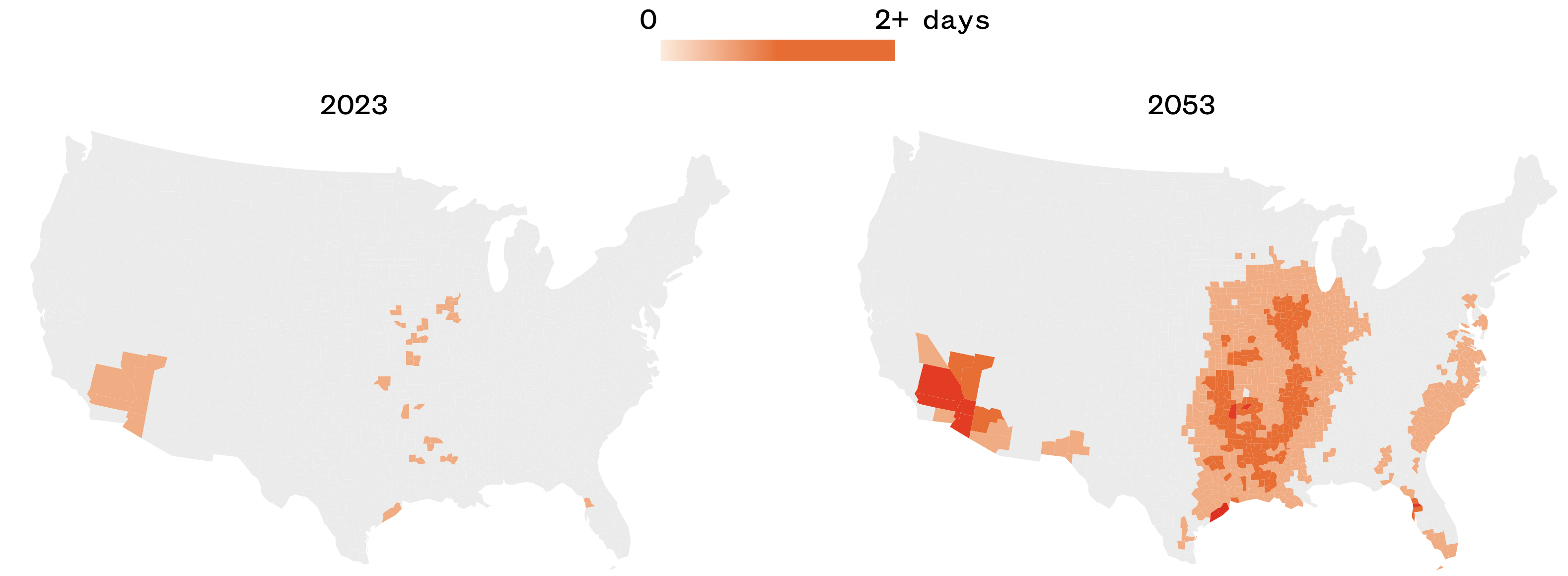
U.S., especially the South, could see heat-index temps above 125 degrees by 2053; see how your area may fare
![]() |
| Predicted days with a heat index of 100° F. (Map by The Washington Post; data from First Street Foundation) |
![]() |
| Counties expected to gain the most days with a heat index above 125° F. (NBC News map) |
Heat will become an increasing threat as climate change worsens. "A Washington Post analysis of the group’s data found that today’s climate conditions have caused an estimated 46 percent of Americans to endure at least three consecutive days of 100-plus degree heat, on average, each year. Over the next 30 years, that will increase to 63 percent of the population," the Post reports. "Nowhere is the danger more widespread than in the South, where global warming is expected to deliver an average of 20 extra days of triple-digit heat per year. In some southern states, such as Texas and Florida, residents could see over 70 consecutive days with the heat index topping 100 degrees Fahrenheit.
W.Va. radio show is often Manchin's first stop because of host's integrity, canny questioning, and broad rural reach
![]() |
| Hoppy Kercheval |
Sunday, August 14, 2022
Rural news outlets need help from colleges and universities and local funders, Center for Community News director says
![]() |
| Richard Watts |
First, "Go where the money is in local foundations. and look for companies that have an interest in seeing local news continue," Watts said. He said an electric utility and the Vermont Humanities Council gave his Community News Service $10,000 each to cover energy and the arts, respectively. "They don’t tell us what to write, just to write more" on those topics, he said.
"An organization focused on Lake Champlain gave us funding to seed more stories about the lake region," Watts added. "Our biggest success, however, has come from individual donors who care about local news, democracy and involving young people. Together we have raised more than $200,000 in the last few years to support community news from individuals." For Ryan's full report, with details about from Watts about working with student and citizen journalists, go here.
Friday, August 12, 2022
Couple who persevere with weekly win Kentucky's Al Smith Award for public service through community journalism
![]() |
| Allison Mick-Evans and Chris Evans at of their newspaper, The Crittenden Press |
Chris Evans and Allison Mick-Evans own The Crittenden Press in Marion, a town of 3,000 and the seat of Crittenden County, pop. 9,000. It is one of Kentucky’s smaller newspaper markets, and is losing population, but the Press shows that a paper doesn’t have to be big to be good, said Al Cross, director of the Institute for Rural Journalism and Community Issues in the University of Kentucky’s School of Journalism and Media. (The Institute publishes The Rural Blog.)
“The Crittenden Press has long been a standout newspaper in West Kentucky, from the days when Allison’s family, the Micks, owned it,” Cross said. “It has always punched above its weight and set an example for others to follow.”
The Institute presents the Smith Award with the Bluegrass Chapter of the Society of Professional Journalists. Chapter President Tom Martin said, “The Press is the embodiment of a vital community newspaper.”
That has been especially evident in the last few months, as the City of Marion has endured a water shortage. The Crittenden Press has been a lifeline of information for citizens, digging into the reasons for the crisis, broadcasting City Council meetings, doing live interviews with emergency responders and giving news updates in real time.
The paper was an early adopter of online journalism, as evidenced by its URL, the-press.com; during a major ice storm in 2009, Editor-Publisher Chris Evans ran it on generator power and published a special news flyer with updates on electricity status and aid stations. The paper's innovations are cited in a Publishers' Auxiliary column by Chip Hutcheson, a retired publisher in the area.
During the pandemic, Evans found discrepancies in data from the district health department and coordinated with it to correct the numbers, and the Press was one of 14 Kentucky papers to publish a special vaccination section sent to all households in the county, in cooperation with the Institute, the Kentucky Press Association and UK’s Cooperative Extension Service.
A 2006 episode is an example of Evans’s investigative reporting. He revealed misuse of more than $200,000 by the local economic development director, who was indicted and forced to repay most of it.
When a drug bust prompted false, online rumors of shootings and murder, Evans countered them with online postings that carried credibility because they were not anonymous, and because people respect him and his newspaper. “Our task is to be in a position to provide credible information in whatever form people want it in,” he said in 2011. “You’ve got to embrace technology, understand where your audience is at, and get there—and the credibility you have will draw people back to you.”
Chris Evans “is everything to this paper, and the paper is everything to him,” Allison wrote. “He insists that content in The Crittenden Press be hyperlocal. No canned news, no state filler. It’s time-consuming, but it’s important to him.” Away from the paper, he has served nearly 30 years on the local park board, where he “essentially serves as the volunteer maintenance man: and orchestrated a major lighting renovation of the park with city, county and school partners to complete the project,” she wrote. “He has also served in various leadership capacities in his church.”
Cited as a community-journalism exemplar in Harvard University’s Nieman Reports in 2011, Chris described his journalism philosophy simply: “We are here to serve people. Then he quoted Bryant Williams, the Tennessee publisher for whom he had worked: “The only higher calling is the ministry.”
At a time when most newspapers are owned by chains that are struggling to meet profit goals and still provide public service, Chris and Allison have continued their local, independent ownership, even as they have had to reduce staff due to declining revenue, a burden for almost all local newspapers.
“We have never had any desire to sell, but I have to admit that with Chris’s retirement not too many years away, we’ve been talking about an exit plan,” said Allison, who is the paper’s advertising manager. “Sadly, seeing the decline of papers in our region that have sold to large conglomerates makes us uneasy. It’s like a parent thinking they, and only they, can adequately take care of their child.”
The sustainability of rural journalism, and the maintenance of local, independent newspaper ownership, are newly adopted goals of the Institute for Rural Journalism, which was founded in the UK College of Communication and Information 20 years ago.
![]() |
| Al Smith, 1927-2021 |
The award will be presented at the Al Smith Awards Dinner Nov. 3 at the Embassy Suites Lexington on Newtown Pike, near Interstate 64/75. Winners of the Institute’s national Tom and Pat Gish Award for courage, tenacity and integrity in rural journalism, to be announced soon, will also be recognized at the event.
Previous winners of the Smith Award, and their affiliations at the time, are:
2011: Al Smith
2012: Jennifer P. Brown, Kentucky New Era; and Max Heath, Landmark Community Newspapers
2013: John Nelson, Danville Advocate-Messenger
2014: Bill Bishop and Julie Ardery, The Daily Yonder
2015: Carl West, The (Frankfort) State Journal
2016: Sharon Burton, Adair County Community Voice and The Farmer’s Pride
2017: Ryan Craig, Todd County Standard, and the late Larry Craig, Green River Republican
2018: Stevie Lowery, The Lebanon Enterprise
2019: David Thompson, Kentucky Press Association
2020: Becky Barnes, The Cynthiana Democrat
2021: WKMS News, Murray State University
Recent Ky. disaster the deadliest non-tropical flash flood since 1977; FEMA criticized for being too stingy with relief
Quick hits: Q&A on Mar-a-Lago search; 'corn sweat' boosts Midwest heat wave; rural German gun culture different
Here's a roundup of stories with rural resonance; if you do or see similar work that should be shared on The Rural Blog, email us at heather.chapman@uky.edu.
FactCheck.org has a Q&A on the search of Mar-a-Lago. Read more here.
Many suspected the story of a 10-year-old rape victim in Ohio who sought an abortion in Indiana was a hoax, but local journalists were the key to proving it wasn't. Read more here.
One more reason for the heatwave in the Midwest: 'corn sweat' is making the air incredibly humid. Read more here.
Westerners struggle to manage booming wild horse populations. Read more here.
Nearly 40% of Americans in a recent poll said they're tired of the two-party political system. Read more here.
A writer who grew up in rural Germany says guns were ubiquitous there but mass shootings weren't. That's because of key differences in gun culture and government regulation, she writes. Read more here.
New rural coronavirus infections down last week; deaths up
![]() |
| New coronavirus infections, in ranges by county, Aug. 2-8 Map by The Daily Yonder; click on the image to enlarge it or click here for the interactive version. |
The number of new coronavirus infections "fell significantly last week, resulting in rural and metropolitan counties have virtually the same rate of new infections over a seven-day period," Sarah Melotte reports for The Daily Yonder. "New infections in rural counties dropped by about 3% last week compared to two weeks ago, while the number of new infections in metropolitan counties fell by about 9%. Rural counties reported 107,000 new infections while metropolitan counties reported 664,000 new infections. The rate of new infections in metropolitan counties has been higher than the rural rate since early April."
As farmland values rise, so do fears of a price bubble
Thursday, August 11, 2022
More Americans are going hungry than last summer, due to inflation, but 16 states have ended pandemic food-aid boost
![]() |
| States in gray opted out. (Stateline map; click to enlarge.) |
This July, food costs rose an average of 10.9 percent from the previous July, the biggest single-year jump since 1979, Molly Smith reports for Bloomberg. Eggs and grain-based foods saw some of the biggest increases, owing to the recent avian-flu epidemic that took out millions of laying hens and the Russian invasion of Ukraine that has stalled grain shipments. Overall food prices rose 1.14% from June to July, the highest month-over-month increase since April 2020.
In July, more than 15 million Americans sometimes went hungry because they couldn't afford food, and nearly 6 million often did, according to the Census Bureau's Household Pulse Survey. In July 2021, nearly 12 million sometimes went hungry because they couldn't afford food and 3.6 million often did.
Election security webinar for Ky., N.C., Tenn., Va. and W.Va. set Aug. 18; agency issues guide to digital election threats
Topics of the webinar will include cybersecurity, cyber safety, disinformation, misinformation, and crisis response. Scheduled speakers are:
- Sarah Mojarad, lecturer, USC Viterbi School of Engineering
- Clifford Neuman, director, USC Center for Computer Systems Security
- Dave Quast, adjunct faculty, USC Annenberg School of Communications and Journalism
- Marie Harf, international elections analyst, USC Election Cybersecurity Initiative
- Maurice Turner, election security analyst, USC Election Cybersecurity Initiative
- Michael Coden, associate director, cybersecurity, MIT Sloan School of Management
Meanwhile, the Cybersecurity and Infrastructure Security Agency has released a guide to digital threats facing election officials and how to mitigate them. The Cybersecurity Toolkit to Protect Elections "aims to help election administrators and their staffs protect themselves against threats including phishing, ransomware, email scams, denial-of-service attacks and other vectors that could potentially disrupt the voting process or confuse voters," StateScoop reports.
More farmers are switching from herbicide dicamba, but that leaves their crops vulnerable to those who still use it
Heat roundup: States help farmers in drought; industries resist mitigation for workers; mountain snowpack shrinks
FCC denies funding to Starlink and LTD, which won rural broadband subsidy auction but don't meet requirements
Wednesday, August 10, 2022
States nationwide face teacher shortages, especially in rural areas, which have a harder time hiring
Schools nationwide are facing teacher shortages, and though no official database keeps track, anecdotal and historical evidence suggests rural areas are harder hit.
"Why are America’s schools so short-staffed? Experts point to a confluence of factors including pandemic-induced teacher exhaustion, low pay and some educators’ sense that politicians and parents — and sometimes their own school board members — have little respect for their profession amid an escalating educational culture war that has seen many districts and states pass policies and laws restricting what teachers can say about U.S. history, race, racism, gender and sexual orientation, as well as LGBTQ issues," Hannah Natanson reports for The Washington Post.Few hospitals have complied with law requiring them to post prices online; is your closest hospital one of them?
Airbnb listings that advertise Southern culture a surprisingly decent way to define the South, data journalist writes
![]() |
| Share of a state's Airbnb listings that mention terms such as "Southern hospitality," "Southern cooking" or "Southern charm," to name a few. (Washington Post map using Airbnb listing data) |
It can be kind of hard to specifically define the South. "The South isn’t just geographic. Plenty of states in the southern half of the United States aren’t even remotely Southern. It’s not entirely historical — it probably goes beyond the boundaries of the Confederate States of America, but doesn’t encompass every former slave state on the Union side. It’s entirely cultural. And culture is notoriously hard to measure," Andrew Van Dam reports for The Washington Post. "Normally, an argument like this would be settled by the Census Bureau, the ultimate arbiter of all things dweeb. But the Census definition of the South seems wildly generous, sweeping up every state from Delaware in the East to Oklahoma in the West."
Data journalists such as himself have been trying—and failing—to find a decent yardstick for some time. But "a final answer remained elusive until we noticed just how many places on Airbnb advertise their 'Southern hospitality' or their 'Midwestern charm,'" Van Dam writes. "All those Airbnb hosts were, we realized, creating a one-of-a-kind map of America’s true cultural boundaries. Airbnb listings represent hundreds of thousands of pages of text capturing exactly how Americans describe their home regions to outsiders, and every single word of it has a geographic location attached."
Black farm leader says USDA should halt farm foreclosures
Tuesday, August 09, 2022
Gun roundup: Rural firearm death rates rose 88% in 2010-2020; a profile of 'good guys with guns' in rural Georgia . . .
![]() |
| Gun homicide rates per 100,000 residents (Washington Post charts sourced from Centers for Disease Control and Prevention data). |
Gun death rates rose in urban, suburban and rural areas of the U.S. from 2010 to 2020, and much more in rural areas, the Post reports. The rural rate rose 88 percent; suburban and urban rates rose 67% and 58%, respectively. States with easier access to firearms tend to show steeper increases in gun deaths, the data show. Rural gun deaths are more likely to be due to suicide than homicide.
Stephanie McCrummen of The Washington Post has an interesting and nuanced profile of two cousins in rural Georgia, ages 23 and 18, who worry about gun violence, but believe a "good guy with a gun" can help in emergencies. Read it here.
Marshall County, in rural North Carolina, is stocking its schools with AR-15s to try to prevent a mass shooting, Joe Marusak reports for The Charlotte Observer. The sheriff said the caches will give deputies quick access to more high-powered firearms in such emergencies. County officials welcomed the notion, which county residents paid for with private donations. However, an education professor who has long studied school safety warns that the presence of the firearms increases the likelihood of accidents and violence.
'Basic physics' of global warming makes rainfall more frequent and more intense; U.S. infrastructure isn't prepared
Strip mining surely worsened the recent flooding in Appalachia, but we don't know how much. The same applies to climate change, and a warming world means it will continue to do so.
Rainfall in many areas is more frequent and intense than in decades past. "An analysis of weather data by the nonprofit group Climate Central found that nearly three-quarters of locations the group examined around the country have experienced an increase in the amount of rain falling on their annual wettest day since 1950 — particularly along the Gulf Coast and Mid-Atlantic. The numbers show that 2021 was a record-setting year for extreme rainfall events, with dozens of places logging their wettest day in generations," Brady Dennis reports for The Washington Post. "A separate Climate Central report this spring found that of 150 locations the group analyzed, 90 percent now experience more average rainfall per hour, compared with 1970. Those increasing bursts of extreme precipitation carry profound economic and human health risks, the likes of which have been on display most recently in Eastern Kentucky."
"Basic physics" explains why climate change causes this increased precipitation, says North Carolina State University atmospheric sciences professor Kenneth Kunkel. "For every degree Fahrenheit that the air temperature increases, the atmosphere can hold about 4 percent more water," Brady reports. "The world already has warmed more than 1.8 degrees Fahrenheit (1 degree Celsius) since pre-industrial times. That increased heat means more moisture in the air — in the United States, much of which comes off the Gulf of Mexico — and more fuel for more intense rainstorms."
The rainfall "is posing serious challenges in a nation where the built environment is not only outdated but increasingly outmatched," Brady reports. "From populated cities to rural outposts, the United States has long struggled with antiquated sewage and wastewater networks, outdated bridges and crumbling roads and culverts. But as more water falls from the sky more quickly in many places, those challenges have become only more urgent."
Kids Count Data Book has data on factors that influence children's well-being; state-level books have county data
2,000 acres of farmland per day was lost or 'compromised' from 2001 to 2016, American Farmland Trust says
CNBC ranks best, worst and so-so states for doing business
Monday, August 08, 2022
Appalachians ask: How do we prepare for floods bound to come as climate change appears to be making them worse?
![]() |
| Flooding aftermath in Neon Junction, Kentucky. (Mountain Eagle photo by Ben Gish) |
What's in the tax and climate-spending bill for agriculture
"The bill would dump $20 billion into various existing oversubscribed USDA agriculture programs to reduce environmental impact," Garrett Downs reports. That includes $8.45 billion for the Environmental Quality Incentives Program, $6.75 billion for the Regional Conservation Partnership Program, $3.25 billion for the Conservation Stewardship Program and $1.4 billion for the Agricultural Conservation Easement Program.
USDA Rural Development will get $14 billion for clean energy and economic growth, including $9.7 billion in grants and loans for renewable energy projects by rural electric cooperatives, $1 billion for forgivable loans for electric generation from renewable sources for resale, and $500 million for biofuels infrastructure. The electric co-ops would also get direct-pay credits for investing in renewables, which would bring them "into parity with for-profit counterparts that have reaped renewable energy tax credits for years," Downs notes.
But Jim Mulhern, CEO of the National Milk Producers Federation, told Politico that the bill is a “game-changer” and “will better position dairy farmers to effectively implement the dairy sector’s Net Zero Initiative and fulfill its 2050 environmental stewardship goals.”
'School choice' and public support of charter schools faces rural resistance even in Republican-controlled statehouses
"School choice," a favorite issue for many conservatives, especially religious ones who want public support for private schools, has had a hard time getting traction in some states because of opposition from rural legislators.
The Kentucky General Assembly authorized privately organized but publicly recognized charter schools years ago, but only this year did it provide funding for them, and by a very narrow margin in the state House. Rural lawmakers saw little if any benefit for their communities, which are unlikely sites for charter schools.
Much the same is happening in Texas, Brian Lopez reports for the Texas Tribune: "Rep. Gary VanDeaver, a Republican whose district includes 30 rural school districts, is still unconvinced. He was one of several lawmakers who helped kill school-choice legislation in 2017. He said one of the concerns he’s hearing from parents is that they’re paying property taxes, which fund public schools, but have opted for either home schooling or sending their kids to private school." He told Lopez, “I prefer to reduce their property taxes, so they have the option of spending that money any way they choose, whether it be alternative education choices, saving for college or purchasing a new car.”
Lopez reports, "Conservative efforts to pass school choice measures have failed largely because there are few private schools or charter schools as alternatives outside the state’s larger urban areas. Also, the public school systems are a large economic and employment driver for most small towns. . . . VanDeaver has been informed that the religious private schools in his area are uninterested in public money. He also worries about the damage to the local public school district a voucher program could cause."
Farmers Market Week begins today; U.S. has over 8,000
This is National Farmers Market Week, an Agriculture Department celebration in its 23nd year.
In his proclamation affirming the observation, Agriculture Secretary Tom Vilsack said the markets "continue to provide access to safe and nutritious food in the face of market disruptions while also shortening supply chains and reinforcing a competitive food system benefitting producers and consumers."
According to the 2019 National Farmers Market Managers survey, the U.S. has more than 8,000 farmers' markets. Farm vendors benefit in a number of ways, including:
- 67% increased overall production.
- 33% increased the number of workers employed on the farm.
- Nearly 40% were able to sell imperfect products that would otherwise go unsold.
- 77% diversified the types of agricultural products they grew.
Rural patients with early-onset Alzheimer's are less likely to get treatment from specialists, who can mitigate disease
Rural Americans with early-onset Alzheimer's disease are less likely to get specialized care, according to a newly published study.
"Ohio State University researchers found rural patients with the disease, which occurs between the ages of 30 and 65, were typically seen exclusively by a primary-care physician and were less likely to undergo testing that would help doctors manage the condition," Adam Barnes reports for The Hill. "Researchers noted that patients with early-onset Alzheimer’s make up only 6 percent of Alzheimer’s diagnoses, but they said this form of the condition is usually more aggressive and leads to accelerated cognitive decline."