Thursday, February 23, 2023

Deaths in rural jails: Stories from Ala. and W.Va. highlight broken systems that seem not to protect the incarcerated

Photo by Walker County Sheriff's Office, Alabama
"Your son died in jail." Alongside the pain of taking that in, the human response is, "How? Why?" Nationwide, an unknown number of people die in jail. Relatives of those who have died in West Virginia jails "have similar stories of languishing in heartache and confusion while desperately seeking answers to what happened to their loved ones behind bars," reports Dan Lawton of Mountain State Spotlight. "Of the 52 people who died in West Virginia’s jails and prisons last year, the state hasn’t finished the investigations into 17 of them, going back as far as March."

Lawton introduces Kimberly Osborne, whose son, Ryan Scott Smith, died in his cell at Southwestern Regional Jail in December. "Over that time, she has pleaded with correctional officials, the Medical Examiner’s Office and the State Police for any scraps of information that shed light on his final moments. . . . They haven’t told her anything, except that the case is under investigation. . . . She doesn’t know when — or if — she’ll get a complete account of what happened in the hours before the jail’s warden called to tell her that her son was dead. Osbourne told Lawton, “I’m just trying to get justice for Ryan."

Like Osbourne, "The families of those who have died in jails have been met with similar responses. They make fruitless calls to agency after agency. They wait in limbo for investigations that never end, are denied records that might provide clarity and receive little to no sympathy from public officials, including Gov. Jim Justice, about their losses," Lawton reports. "While there is pending legislation intended to make what happens in the state’s jails more transparent, it may not be forceful enough to provide many families with the information they need."

In Alabama, the story of Anthony Mitchell echoes jailhouse cruelty and a code of silence, reports Sarah White-Koditschek of AL.com: "Mitchell, 33, alarmed his cousin Steve Mitchell when he showed up at his house, acting psychotic, and insisting he must enter a 'portal to hell' in his mother’s attic to retrieve the body of his long-ago stillborn brother. After a 911 call, Mitchell was picked up by sheriffs’ deputies . . . . The Sheriff’s Office spokesperson, according to the suit, told the family they’d get him medical help in Walker County Jail. Instead, guards tased Mitchell and locked him in a freezer, killing him, the suit alleges. The suit filed Monday also contends jail leadership began a cover up of Mitchell’s death hours before he died. . . 'This case,' the suit says, 'therefore presents an appalling question: how does a man literally freeze to death while incarcerated in a modern climate-controlled jail, in the custody and care of corrections officers?'”

It did not end there, "A former deputy also filed a separate, but related lawsuit. Former Corrections Officer Karen Kelly sued the Walker County Sheriff’s Office and multiple officers for being fired and for retaliation after she shared videos with Mitchell’s family of him being abused in the jail."

"Security footage from 4 a.m. that morning showed Mitchell lying naked on a pile of trash on the cement floor of his cell as officers laughed at him, according to the suit," Whites-Koditschek reports. "Video also showed jail nurse, Alicia Herron, enter the cell and spend a couple of minutes inside, appearing to give no medical treatment, according to the suit."

Whites-Koditschek adds, "Jon Goldfarb, attorney for Mitchell’s estate said the videos show correctional officers laughing as Mitchell lay naked and dying. Goldfarb told Whites-Koditschek, “This is the worst case of inmate abuse I have ever seen . . . . People who have seen these videos think they are watching something in Russia or Abu Ghraib . . . . but this happened in our own backyard in Walker County, Alabama."

Rural schools in forest areas plead for renewal of special federal funding; program helps 742 counties in 41 states

Rep. Jared Huffman, left, meets with rural California superintendents
in his Capitol Hill office. (Photo by Kent Nishimura, Los Angeles Times)
For rural schools, a little can go a long way, and those in national-forest areas again fear a loss of special federal funding. "Anmarie Swanstrom a school superintendent from impoverished Hayfork, Calif. along with three other rural Northern California superintendents went to Washington this month to look their legislators in the eye and tell them just how desperate they are," reports Hailey Branson-Potts of the Los Angeles Times. "In Hayfork, pop. 2,300, where timber crashed and legal marijuana is now doing the same — students have little access to medical care. Mental health support comes through the schools, which are also evacuation centers when the mountains burn." Swanstrom told Branson-Pitts, “We serve as the heart of the town, and if the schools go, the town will go completely."

Historically, "schools like Swanstrom’s, surrounded by national forest land that cannot be taxed, have depended upon modest payments through the U.S. Forest Service to stay afloat. . . .That money has come primarily from logging," Branson-Pitts notes. "Counties with national forests — mostly in the rural West — received 25% of what the federal government made from timber sales off that land. . . . But by the early 1990s, the once-thriving logging industry cratered. So did the school funding. In 2000, Congress enacted the Secure Rural Schools & Community Self-Determination Act. Congress never made the program permanent, instead reauthorizing versions of it by tacking it onto other bills — nine times." Those have used "increasingly bizarre funding sources," saidBill Imbergamo, executive director of the Federal Forest Resource Coalition, a timber trade group that supports increased logging on federal land. 

The funds needed are "what lawmakers call 'budget dust' in a federal budget that is trillions of dollars," Branson-Pitts writes. "Last year, the Secure Rural Schools program gave $238 million to 742 counties in 41 states and Puerto Rico. The latest version of the rural schools program is set to expire in October. . . . Calls for permanent funding abound. From Republicans and Democrats. From environmentalists and the timber industry. A solution inevitably falls victim to partisan bickering. Liberals don’t want to cut down trees. Conservatives want to slash spending."

Atfter meeting privately with the superintendents, Rep. Jared Huffman, D-Calif., said the program has "become a political football . . . kind of been used as a prop for folks with a different agenda, folks who want to roll back environmental protections, who want to do mandatory logging quotas in national forests. . . . I’d like to see the federal government just embrace this as an ongoing financial responsibility."

Ohio derailment and chemical burn 'upended' farm and rural life and businesses, and left big questions about future

Pam Mibuck is thinking about leaving her 14 acres.
(Photo by Brian Kaiser, The New York Times)
What is it like to return your home, your farm, your animals, wildlife and the creek, all perhaps chemically altered by a controlled burn of toxic liquids? The Norfolk Southern train derailment East Palestine, Ohio, "upended an area where generations of families could afford to buy acres of land, raise horses and plant gardens, hunt deer and birds, and build lives undisturbed by the chaos of bigger cities nearby," writes Emily Cochrane of The New York Times. "Although farming provides only a small number of jobs in the immediate area, many residents say that raising livestock and working the land are profoundly important to their way of life."

Farmer Pam Mibuck's land was blanketed by post-burn chemical film. "After the chemicals were released, Tina, the amiable white turkey that Milbuck bought less than a year ago for $3, was put on antibiotics for respiratory problems, and her chickens laid eggs with an unsettling purple hue," Cochrane writes. "Her son in California is urging her to move away, offering to build a barn on his land for her two horses, Samuel and Razor. Mibuck, who works as a custodian at a university, is seriously thinking about leaving the 14 acres that she considers a slice of heaven."

Despite state and federal assessments and testing, "Farmers determined to weather the unknown remain fearful about whether their customers will continue to trust their product," Cochrane reports. Greenhouse operators Dianna and Don Elzer "had predicted that this would be their first normal Valentine’s Day. Even when they were required to evacuate for a few days, driving to Pittsburgh, they came back daily to water and care for their plants — the palms, the herbs, the succulents — and returned as soon as they could. On Feb. 14, they had one customer: a man who bought a single red hibiscus tree. Mr. Elzer, 67, told Cochrane, “No one wants to come here. There’s no way to counterattack the publicity and perception.”

The explosion has permanently altered futures. "Michael McKim had a business dream he shared with his wife: an affordable destination winery in East Palestine. . . . The winery’s grand opening is still set for St. Patrick’s Day. . . .Yet the family business has been rattled by the derailment: Most of the bridal showers, wedding receptions and events scheduled for this year have canceled. Mr. McKim told Cochran, "It’s a tragedy. I could make the best wine in the United States, in the world, and someone could say, ‘Hey, isn’t that where the train derailed?’"

Last night on CNN, in a conversation with a few East Palestine residents, Norfolk Southern CEO Alan Shaw pledged "apologized and vowed to make it right through proper cleanup and reimbursing residents," as well as helping rebuild the town's reputation.

A conservative county in Michigan gives a glimpse of what it's like when ardent social conservatives try to govern

UPDATE, March 1: Michigan Attorney General Dana Nessel has admonished the county board for its "lack of transparency and good governance," The Bulletin of the Michigan Press Association reports. Nessel said the state open-meetings law should be changed to require public bodies to set an agenda 48 hours before the meeting and allow them to modify it only in "exigent circumstances," and include in the definition of "public official" someone who has been elected but not sworn in.

Board meetings have drawn crowds and hours of
public comment. (Photo by David Siders, Politico)
When ardent conservatives took control of a county government in Western Michigan, its meetings were more heavily attended, but the focus strayed from management to ideologies, reports David Siders of Politico: "Ottawa County governing board’s most recent meeting addressed a roof repair and resurfacing contract . . . . but over the course of a meeting that ran over four hours, public speaker after speaker in three-minute increments were debating something else entirely, something far more spiritual — to what extent their government should, or should not, pursue Judeo-Christian values. . . . Lots of people spoke in favor. They warned of the 'tyranny' of mask mandates, the 'sexualization of our children.'"


Since January, the meetings have a new focus, "after an upstart band of far-right Republicans unseated seven more traditionalist Republican incumbents, seizing a majority on the 11-member board," Siders writes. "The hardliners, members of a group called 'Ottawa Impact,' had signed a 'Contract with Ottawa' promising to 'respect the values and faith of the people of Ottawa County.'. . . They’d pledged to 'recognize our nation’s Judeo-Christian heritage.' . . . Roger Bergman, the sole incumbent Republican commissioner the group failed to oust, had attended one of those forums last year, and as he sat in the audience, he grew concerned. But even Bergman, who at 76 has decades in local politics, wasn’t sure what it would all mean when it came time for a new, far-right majority to actually govern."

Given the chance to govern, the new board made sweeping changes."They fired the county administrator and replaced him with John Gibbs, a former Trump administration official, Christian missionary, failed congressional candidate and election denier. They closed the county’s office of diversity, equity and inclusion. They picked for their new public health officer — pending state approval — a safety manager at an HVAC service company. . . And they rewrote the county motto from 'Where You Belong,' to 'Where Freedom Rings.'"

“Oh, my God,” Bergman said to Siders after a commission meeting where a young man in a hoodie, Caden Hembrough, thanked the board majority for standing against 'forces of darkness.' Bergman told Siders, “It’s becoming more and more evident that these people are Christian nationalists. . . .They have chosen to weaponize Christianity."

Ottawa County, Michigan (Wikipedia map)

County government "may not strike you as the likeliest place for a spiritual crusade. It wasn’t in Ottawa County, either, before Covid," Siders writes. "But public health mandates related to the pandemic infuriated a group of parents who complained — and litigated, unsuccessfully — about 'government overreach' in schools. . . . Sylvia Rhodea, a co-founder of Ottawa Impact and, now, vice chair of the county commission, described the election as one that “will decide whether we are going to save America, and that starts local.” America, she said, is a place of opportunity 'built on the Constitution, Christianity and capitalism.' The office of diversity, equity and inclusion, she said, was promoting 'woke ideology.'”

Not everyone agrees with the changes. "The fallout has seemingly come from everywhere. In an email to the board, the county’s outgoing attorney warned that firings of multiple senior county officials would jeopardize the county’s bond rating, saying, 'stable counties don’t fire their corporation counsel and administrator,' Siders reports. "In The Holland Sentinel, it’s been headline after headline, like 'Ottawa County’s prospective health officer has no experience. Here’s why that could be a problem.'. . . then there are the hourslong public comment sessions at the board’s regular meetings. There are supporters, and there are critics — people who call the board members 'fascist,' or 'troglodytic.''

Field Reichardt, a longtime observer of politics in the county, told Siders what he thought was going on: “This is a microcosm of what is happening nationally, the changes that are threatening American democracy. This Christian nationalist movement truly frightens me. . . . They think they are doing God’s work, and they truly believe it. They are beyond right-wing. They are Proud Boys-ian. Clearly, that’s what they are, when they refer to diversity, equity and inclusion as being ‘divisive.’”

Moonshine goes legal, but daughter of famous moonshiner says illegal form of the beverage still exists in Appalachia

Moonshine sample at Ole Smoky Distillery in Pigeon Forge,
Tennessee (Photo by Keith Roysdon, The Daily Yonder)
First-aid kit? Grab some moonshine; it's better than hydrogen peroxide anyway. Home-brewed alcohol, known for its powerful kick, "has always been the stuff of Appalachian legends. For some, it was a way of life," reports Keith Roysdon of The Daily Yonder. "And it’s now a big business. Stills have been brought down from the hills, figuratively speaking, and set up along the Parkway in Pigeon Forge and Gatlinburg, Tennessee," neat the Great Smoky Mountains National Park, once the private land of moonshiners. "But not all the stills are out of the hills. Is moonshine – the unregulated, untaxed 'shine – still made by liquor renegades in hollers throughout the land?"

"Of course it is!" said Sky Sutton, daughter of the late Marvin 'Popcorn' Sutton, who was probably the best-known moonshiner in the region.

"The history of the product of corn distilled into powerful liquor is long and colorful and goes back beyond society’s image of a hillbilly tending a copper still in a thick stand of trees," Raysdon writes. "The Encyclopedia of Appalachia book notes that in the 1700s, immigrants from the British Isles and Northern Ireland imported their knowledge of distilling using copper pots and condensing coils, 'introducing a craft and eventually illegal enterprise that became a central element of the region’s identity.' The Encyclopedia notes that the production of moonshine boomed during the Prohibition years, 1920 to 1933."

The trickle of moonshine into mainstream liquor began when Tennessee "was making changes to its liquor laws, particularly in relation to the production, sales, and service of liquor and what’s branded as moonshine.  . . . With manufacturing overseen by the state, the federal government overseeing taxes and local municipalities deciding through referendums if they want to be dry or wet," Roysdon reports. "In the wake of changes in liquor laws, Ole Smoky Moonshine Distillery entered the scene. In 2010, the distillery became the first federally licensed distillery in East Tennessee. The company’s original distillery opened in 2010 in Gatlinburg and the Pigeon Forge location opened in 2014."

Sky Sutton told Roysdon, “I think that over-the-counter moonshine and mountain-made likker are two different beasts. The over-the-counter kind now has its place on the shelves of liquor stores. The mountain-made kind is still elusive, mysterious, and much stronger. . . . I think the government and the black market – booze, betting, etc. – are both as old as dirt and will both stay around for a long time."

Wednesday, February 22, 2023

Slaughterhouse-cleaning firm paid $1.5 million in fines after feds found minors using chemicals to clean equipment

Department of Labor map
In the fall of 2022, the Labor Department got an injunction from a federal judge in Nebraska requiring Packer Sanitation Services Inc. to stop 'employing oppressive child labor' and to comply with the department's investigation of the firm.

The department has now ended its inquiry saying it found "102 children as young as 13 working hazardous overnight jobs cleaning slaughterhouses in eight states in what it called a 'corporate-wide failure” by one of the largest food sanitation companies in the country," report Laura Strickler and Julia Ainsley of NBC News. "The Labor Department says the children who were working overnight shifts used 'caustic chemicals to clean razor-sharp saws."

Michael Lazzeri, regional administrator for the division in Chicago, told NBC, “Our investigation found Packers Sanitation Services’ systems flagged some young workers as minors, but the company ignored the flags. When the Wage and Hour Division arrived with warrants, the adults — who had recruited, hired and supervised these children — tried to derail our efforts to investigate their employment practices.”     

PSSI has paid a $1.5 million fine for the violations, "dictated by the Fair Labor Standards Act, which allows a penalty of $15,138 for each minor who was employed in violation of the law, according to the Labor Department," NBC explains. "Advocates and lawyers for the children say some of the child workers for PSSI were unaccompanied minors who recently came across the southern border. . . . The company signed a consent decree in December with the Labor Department and agreed to abide by child labor laws after federal investigators documented 50 children working at slaughterhouses for it."

The company issued a statement: "We are pleased to have finalized this settlement figure as part of our previously announced December resolution with the DOL that ends their inquiry. We have been crystal clear from the start: Our company has a zero-tolerance policy against employing anyone under the age of 18 and fully shares the DOL’s objective of ensuring full compliance at all locations."

The company is based in Kieler, Wiscomsin, and contracts with at least 700 facilities and employee over 17,000 people nationwide, its website says.

The East Palestine train: How did it travel through towns without a warning label that it was highly hazardous?

How could a train with at least 20 cars of potentially explosive material not have a warning label? "In a press conference following the catastrophic derailment in East Palestine, Ohio, Gov. Mike DeWine expressed difficulty grasping one particular aspect of federal rail regulations," reports Reid Frazier of The Allegheny Front. DeWine said, “This train … was not considered high-hazardous material train. Frankly, if this is true – and I’m told it’s true – this is absurd, and we need to look at this.”

The reason for the accident is being looked at first. "The National Transportation Safety Board – the federal agency investigating the crash – says it is looking at a damaged wheel bearing on one of the cars in the Norfolk Southern train as a possible cause for the Feb. 3 crash," Frazier writes. "The derailment, which released toxic chemicals into the streams and air around East Palestine, [has left] many wondering how the country’s regulations around rail traffic could have allowed a train with 20 cars of hazardous material not to be considered a 'high hazard.' And could stronger regulations have prevented it from happening? . . .  All four U.S. senators from Ohio and Pennsylvania say they’ll push for new rules to prevent a similar disaster in the future."

"The rules federal regulators wrote a few years ago regarding hazardous train cargo will likely need to be revisited, experts say. These rules were written during a period of high-profile rail accidents involving crude oil trains, including the Lac-Mégantic, Quebec disaster in 2013 that killed 47," Frazier reports. "The final rules, published in 2015, mandated tighter regulations for 'high-hazard flammable trains.' But the government defined these as trains carrying crude oil and other liquid fuels. Flammable gases like vinyl chloride were excluded from the regulations, against the recommendations of the National Transportation Safety Board. . . . Regulators allowed exemptions in the rules that the Norfolk Southern train was operating under when it derailed," Frazier writes. A 2015 regulation defines high-hazard train as one "comprised of 20 or more loaded tank cars of a Class 3 flammable liquid in a continuous block or 35 or more loaded tank cars of a Class 3 flammable liquid across the entire train."

Frazier reports, "The NTSB also recommended these trains have electronically controlled pneumatic braking systems, which studies have shown are better than the kinds of air brakes that were on the Norfolk Southern train. The rules originally mandated that these trains have electronic brakes. But after lobbying by the rail industry, the Trump administration rescinded those rules. So far, the Biden administration has not yet signaled an appetite to revisit them."

Rural homelessness increased over the past two years; addressing the causes takes regional understanding

An emergency tent shelter in Arcata, a town in Northern California, helped unsheltered people get medical and other services early in the pandemic. (Photo from Arcata House Partnership via The Daily Yonder)

Inflation, transportation and affordable housing are troublesome for many Americans right now, and these stresses have a deeper impact on rural residents. "The number of people overall experiencing homelessness in the U.S. rose by less than 1% from 2020 to 2022," reports Kristi Eaton of The Daily Yonder. "But those in rural continuums of care, local planning bodies responsible for coordinating the full range of homelessness services in a geographic area, which may cover a city, county, metropolitan area, or an entire state, saw an increase of nearly 6%, according to the U.S. Department of Housing and Urban Development. . . . Causes of the increase include housing stock shortage, lower wages, and lack of public transit."

Reasons for rural homelessness are regional. “Every community is different. The housing markets are different, the access to health care and behavioral-health services are different. Wages as compared to housing are different," Jeff Olivet, executive director of the U.S. Interagency Council on Homelessness, told Eaton. "So it’s likely that if you go to one rural part of the country, there might be one story to tell about the loss of economic opportunity and jobs to pay a livable wage. In another area, maybe there’s a dramatic increase in the cost of housing."

Because rural homelessness is multifaceted, it requires different safety nets. Eaton writes, "Steve Berg, chief policy officer at the National Alliance to End Homelessness, said rural homelessness is distinct from homelessness in other regions, and it’s imperative to have systems in place to respond to those unique needs." Berg told Eaton, "For example, outreach providers often have to canvas much larger geographic territories, and people will sometimes live in more remote areas where it is more difficult to identify and serve them . . . . It’s also important to know that wages tend to be lower in rural areas and the total inventory of housing also tends to be limited. Even in a region with lower rental prices, this creates enormous strain on people’s abilities to stay in their homes.”

Eaton reports, "Olivet also said transportation barriers can also be a factor in rural areas. He said he’s worked in areas like western Massachusetts or rural Pennsylvania, places that people don’t always think of when they think of vast rural areas like Appalachia or in the West." Olivet told Eaton, "But even in those kind of smaller geographies in the northeast, a transportation barrier of 10 miles, 20 miles to get from a place that’s affordable to live to a job that pays a living wage, if you don’t have a vehicle, there’s just not the public transportation infrastructure, or any way to get there. And so even a 10 or 20 mile distance can be a huge barrier. That could mean the difference between a job and no job for somebody.”

Oil and gas industry has failed to keep pledges to limit methane emissions; 'There's no excuse,' world agency says

Screen grab from thermographic video shows what appears to be
methane leaking from stacks. (James Turitto, Clean Air Task Force handout)
"In 2022, the global energy industry released into the atmosphere some 135 million tons of methane," report Gloria Dickie and Kate Abnett of Reuters. But "The fossil-fuel industry is failing to tackle methane emissions despite its pledges to fix leaking infrastructure, according to a report by the International Energy Agency. 'There is just no excuse,' IEA Executive Director Fatih Birol said, adding that 'emissions are still far too high and not falling fast enough, especially as methane cuts are among the cheapest options to limit near-term global warming.'" Methane has much more greenhouse-gas effect than carbon dioxide, but dissipates in the atmosphere much more quickly.

Methane is the main component of natural gas, so if captured it can be sold as fuel. "The IEA said methane emissions from oil and gas alone could be reduced by three-quarters with existing technologies and modest investment of less than 3% of the $4 trillion windfall income gained by oil and gas companies worldwide last year," Reuters reports. "The economic incentives to make those reductions were huge last year," IEA's Chief Energy Economist Tim Gould told Reuters. "We had record natural-gas prices in many markets around the world. There was an extremely strong economic incentive to bring methane to market."

Over 100 companies "have pledged to cut global methane emissions by at least 30% from 2020 levels by the end of this decade . . . although major emitters, including China and Russia, have not," Reuters notes. "Dozens of oil companies have also voluntarily committed to reduce emissions." Georges Tijbosch, CEO of MIQ, which offers a methane-emissions certification standard, told Reuters, "There are a lot of pledges around, but what you need is a forcing mechanism."

"National Oceanic and Atmospheric Administration physical scientist Lori Bruhwiler said rapid cuts to methane emissions are important, but deep carbon dioxide emission reductions must accompany them if the world is to avoid global warming exceeding 1.5 Celsius (2.7 Fahrenheit) and unleashing more severe impacts," Reuters reports. Should the industry fails to address methane release, Bruhwiler added, "Will this make it tougher for us to meet 1.5? Absolutely."

SNAP benefits will end in 32 states; food pantries aim to fill the gap; it may not be possible to meet the demand

Photo by Erin Schaff, The New York Times
Across 32 states, emergency Supplemental Nutrition Assistance Program benefits will end in March. The drop in assistance has local food pantries gearing up to feed more families and hoping they will have enough. "Food bank managers fear that demand will spike further in March, when officials roll back pandemic-era increases to SNAP benefits," reports Jazmin Orozco Rodriguez of Kaiser Health News. "The program, administered by the Department of Agriculture, provides monthly stipends to people with low incomes to spend on food. Before 2020, those payments averaged a little more than $200 and were hiked by a minimum of $95 during the pandemic."

"Friends in Service Helping food pantry is known in rural northeastern Nevada as FISH," writes Rodriguez. "The food pantry is one of a few in this city of about 20,000 people. In January, FISH provided food boxes to nearly 790 people. . . Officials estimate FISH families will see a 30% to 40% decrease in SNAP payments as emergency allotments tied to the public health emergency halt in 32 states, including Nevada." Georgia, Indiana, Montana, Kentucky, and South Dakota, have already ended the emergency allotments.

Andrew Cheyne, managing director of public policy for GRACE, a nonprofit run by the Daughters of Charity of St. Vincent de Paul, focused on reducing childhood hunger, told Rodriguez, "We have so many households who simply aren’t going to know that this is happening. They’re going to go to the grocery store and expect to have money in their account and not be able to buy the food they need to feed their families. . . .There’s just no comparing the scale of SNAP to the charitable food sector. It’s simply not possible to make up that difference.”

Rodriquez reports, "In Montana, the expanded SNAP benefits were cut in summer 2021. Brent Weisgram, vice president and chief operating officer of the Montana Food Bank Network, said that reporting from the network’s partners shows a 24% increase in the number of households seeking assistance from emergency food pantries from July 2021 to July 2022. Weisgram said food pantries are not prepared to absorb the impact of the cut to the largest federal nutrition assistance program and are strictly a supplemental resource."

Tammy King, a volunteer at FISH, told Rodriquez, “I feel that everybody who has the power to help is doing everything they can to help us. You just gotta look at your food and say, ‘OK, how long can I make this last and make a difference in someone’s life?’”

Tuesday, February 21, 2023

'Staggering increase' in opioid-fentanyl deaths, study finds

Graph from University of Illinois research paper; for a larger version, click on it.

The recent surge in deaths from opioid overdoses has been accompanied by a related increase in deaths caused by methamphetamine. "The U.S. methamphetamine mortality rate increased 50-fold between 1999 and 2021, with most of the added deaths also involving heroin or fentanyl, researchers report in the American Journal of Public Health," reports the University of Illinois, where the research was conducted. 

“We looked at trends from 1999 to 2021 and we saw this staggering increase in methamphetamine mortality accompanied by a proportional increase in those deaths that also involved heroin or fentanyl,” said Rachel Hoopsick, the UI professor who led the research.

The Centers for Disease Control and Prevention says 608 deaths were attributed to methamphetamine use in 1999; "that number increased to 52,397 in 2021," the UI news release says. "Hoopsick and R. Andrew Yockey at the University of Texas found that 61.2% of the methamphetamine overdose deaths in 2021 co-involved heroin or fentanyl."  Much of the increase in meth-related deaths occurred from 2010 to 2021 and shows no sign of abating, Hoopsick said.

"We knew from behavioral studies that the use of stimulants, in general, as well as the use of stimulants with opioids has been increasing over the past decade or two," Hoopsick said. "But we didn’t know how deadly it was becoming. I think what is different now versus 10 years ago is we have a much more toxic unregulated drug supply here in the U.S. . . . Methamphetamine by itself can be deadly, but its toxicity does not appear to have increased in recent years. The potency of illicitly manufactured fentanyl, however, has skyrocketed."

Hoopsick added, “I was really surprised to hear from the folks at the syringe service program that just as many of them were injecting methamphetamine as they were opioids, and many of them were co-using both types of substances. That got me thinking that the increase in methamphetamine mortality might be driven by the co-use of meth with illicitly manufactured fentanyl, in particular, which we’ve seen in the opioid overdose crisis is driving a lot of the deaths in the United States.”

Push for renewable energy gets rural resistance, which is sometimes driven by misinformation from outside activists

UPDATE, March 2: Peter Sinclair of Yale Climate Connections reports on protests and rejections of renewable-energy projects: "Some of these protests appear to have ties to fossil fuel interests. A major player in the renewable energy opposition in rural Michigan is Kevon Martis, who works for E&E Legal, a D.C.-based lobbying firm that gets funding from the fossil fuel industry."

A project site in Virginia (Photo by Ryan Kellman, NPR)
Ten years ago, the price of developing renewable energy was restrictive. Now that technology has caught up, another formidable form of resistance has moved in: people. "Across the country, a big backlash to new renewables is mounting," reports Robert Zullo of Successful Farming. "In Crawford County, Ohio, Apex Clean Energy had been signing leases with locals for a proposed 300-megawatt wind farm. . . .It was the most contentious thing [County Commissioner] Doug Weisenauer had ever seen.”

“The anti-wind people started converging on our weekly commissioners’ meetings and demanding that we do something,” said Weisenauer, who was in the minority when the commission voted 2-1 last year for a 10-year ban on wind projects. “I said all along I am not telling people what they can and can’t do on their property,” he told Zillo. “It got ugly. Our families have been split, friendships broken. It was bad for our community.”

"Crawford County, of course, is far from an isolated case,” Zullo writes. “Across the country — from suburban Virginia, rural Michigan, southern Tennessee, and the sugar-cane fields of Louisiana to the coasts of Maine and New Jersey and the deserts of Nevada — new renewable energy development has drawn heated opposition that has birthed, in many cases, bans, moratoriums, and other restrictions. . . . With states, corporations, utilities, and the federal government setting aggressive renewable energy goals, as well as big tax incentives . . . Wind and solar developers have been pushing projects that are igniting fierce battles over property rights, loss of farmland, climate change, aesthetics, the merits of renewable power, and a host of other concerns."

It isn't just about being told what you can or cannot do on your own land. Zullo reports, "Debates are often happening in a miasma of misinformation and skewed by political polarization. However, some who have seen the backlash to renewable development up close and personal also say developers need to do a better job of being upfront with communities and convincing them of the benefits of their projects."
Page County, Virginia (Wikipedia map)
In Virginia, a misinformation campaign quashed a solar projects in Page County. "Roger Houser's ranching business was getting squeezed. But Houser found another use for his 500 acres. . . . An energy company offered to lease Houser's property to build a solar plant that could power about 25,000 homes," reports Miranda Green of National Public Radio. "It was a good offer, Houser says. . . . But soon after he got the offer, organized opposition began a four-year battle against solar development in the county. A group of locals eventually joined forces with a nonprofit called Citizens for Responsible Solar to stop the project on Houser's land and pass restrictions effectively banning big solar plants from being built in the area."

CRS founder Susan Ralston "told NPR that Citizens for Responsible Solar is a grassroots organization that helps other activists on a volunteer basis," Green reports. "But her group's rhetoric points to a broader agenda of undermining public support for solar. Analysts who follow the industry say Citizens for Responsible Solar stokes opposition to solar projects by spreading misinformation online about health and environmental risks. The group's website says solar requires too much land for 'unreliable energy,' ignoring data showing power grids can run dependably on lots of renewables. And it claims large solar projects in rural areas wreck the land and contribute to climate change, despite evidence to the contrary."

Many rural states face high suicide rates; Montana governor bucks his party to expand student mental-health screening

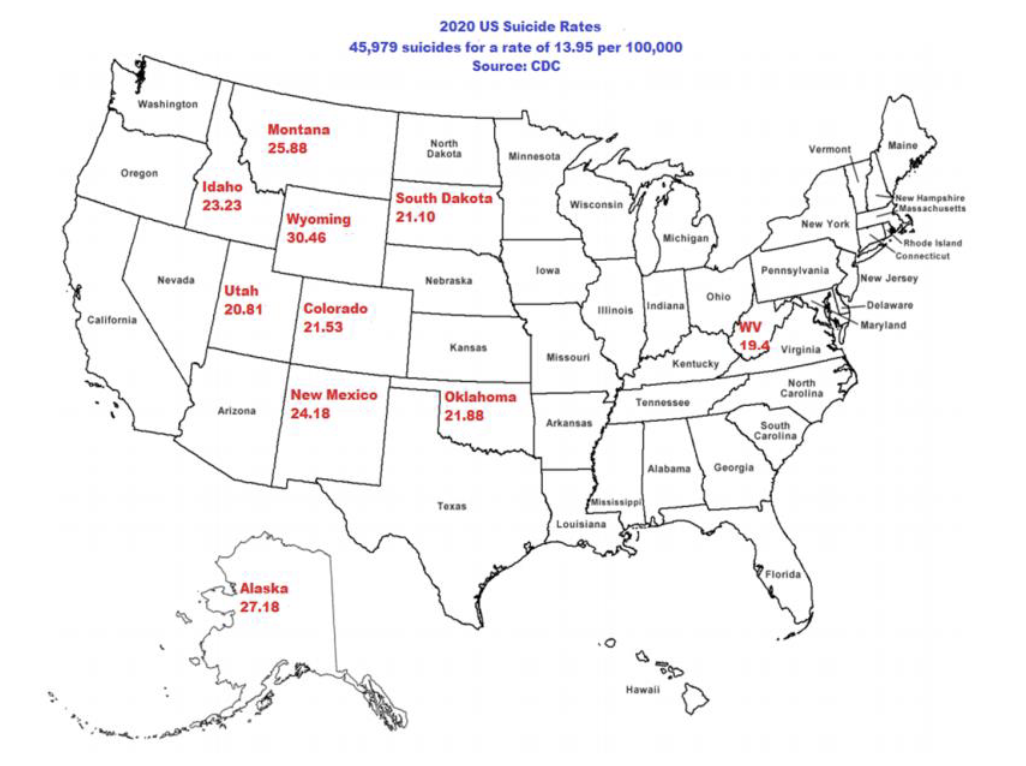
Montana Department of Health and Human Services map highlights states with 10 highest suicide rates. (CDC data)

Preventing child and young-adult suicide is a national, uphill battle; in rural states such as Montana, the climb is particularly arduous, reports Keely Larson of Kaiser Health News. "According to the Centers for Disease Control, in 2020, 581 children ages 10 to 14 completed suicide in the U.S.  Suicide rates for those between the ages of 5-14 increased 60% between 1981 and 2010." In Montana in 2011-20 the youth suicide (ages 11-17) rate was 11.9/100,000, "more than double the national rate for the same age group (4.98).," Larson writes. "In 2020, 62% of the youth suicides were by firearms."

Montana has the country's third highest suicide rate, and advocates are working for change. Larson writes, "Beth Nyman works with the Rural Behavioral Health Institute, a Montana-based organization that aims to reduce youth suicides by improving mental health care in rural places. She recently testified for a bill that has been twice rejected this legislative session by the Montana House to use state money to fund free mental health screenings in schools, like those that Rural Behavioral Health Institute provides."

Youth are particularly vulnerable, "One in 5 students will develop a significant mental health problem during their school years, and roughly 7 in 10 students who need mental health treatment will not get appropriate care, according to the Substance Abuse and Mental Health Services Administration," Larson reports. "Screening for behavioral and mental health issues has become more prevalent in schools and can help identify students at risk or in need of intervention, according to SAMHSA."

Suicide continues to be more frequent in Western states where isolation, vitamin D deficiency and firearms all play a part. Rural dwellers face mental health stigmas and a lack of providers. Funding for programs can stall help. Recently, Montana's legislature rejected additional funding sponsored by a Democrat, but "Republican Gov. Greg Gianforte announced a $2.1 million grant to the Rural Behavioral Health Institute to essentially fund free optional mental health and substance abuse screenings for all schools statewide and same-day care for students flagged as being at high risk for suicide," Larson writes. "Republican Rep. Bob Keenan said suicide prevention has developed into an industry with no results to show for it."

Janet Lindow, executive director of the institute, told Larson that screenings are a key component in identifying students who may be at risk of dying by suicide. “This is a way to find those kids who are basically suffering in silence,” Lindow told Larson. Shawna Hite-Jones, a suicide prevention specialist with the Suicide Prevention Resource Center at the University of Oklahoma, told Larson, it’s important to use screenings as part of a comprehensive approach that includes training teachers to recognize suicide risk." Hite-Jones told Larson, "Screenings are a tool that can be helpful for schools if they have the capacity and relationships with mental health providers to make them useful."

School libraries' content is hotly debated in some places; study finds disputes related to local politcal environments

School libraries are supposed to be quiet oases of reading and study. But when it comes to deciding what books are on the shelves, they have become a hotbed of cultural debate. "School libraries have become a key battleground in contemporary culture wars over public education," reports Kirsten Slungaard Mumma, a postdoctoral fellow at Wheelock Educational Policy Center of the Brookings Institution. "In the 2021-22 school year, PEN America reported a record-setting 2,532 book challenges affecting 1,648 different titles in 138 school districts. Many of the challenged titles contain content related to LGBTQ+ issues or race/racism, topics that have also been the concern of state legislative efforts."

Photo from Brookings Institution
Mumma did a study: "I assembled data on hundreds of titles in public school libraries across the country. The list of titles across controversial topics includes both fictionalized stories and nonfiction titles. . . . My school library sample consists of 5,240 elementary/middle and 1,391 high schools in 48 states. This sample includes schools in rural and urban areas, schools in counties with conservative and liberal political leanings, and schools that serve students of very different backgrounds. I use these data to identify patterns in library resources and content, especially as they relate to political preferences, state laws, and book bans."

She shares some of the main findings from that work:
Finding #1: Libraries in low-income areas have lower staffing levels and less up-to-date collections. Compared to school libraries in low-income areas, school libraries in high-income areas have higher book acquisition rates (2.05 vs. 1.40) and employ more full-time equivalent librarians (1.12 vs. 0.80 per school). School libraries in high-income neighborhoods also have nearly twice as many recent best-sellers in their catalogues for young adults (18.58 vs. 9.44 titles) and middle grades (8.43 vs. 4.02 titles)

Finding #2: Access to controversial content is related to local political environments.
School libraries in the most conservative areas have fewer LGBTQ+ titles and fewer books that deal with race/racism or abortion than libraries in the most liberal areas. Libraries in conservative areas also have more Christian fiction titles and more Dr. Seuss titles that were discontinued from publication in 2021 because of racist imagery.

Controversial content is also associated with state laws that restrict curricular content. Libraries in states with anti-Critical Race Theory laws are 3.5 percentage points (46%) less likely to have The 1619 Project, a particularly contentious publication that reframes American history around slavery and its legacy. 

Finding #3: Book challenges may have chilling effects on the acquisition of LGBTQ+ content.
I find that schools in districts that were subject to book challenges over the last school year were less likely to have added recently published LGBTQ+ titles this fall. Specifically, libraries in districts subject to challenges were 0.55 percentage points less likely to have a recent LGBTQ+ title, a 55% decrease relative to the sample mean. I interpret this as suggestive evidence that book challenges are having “chilling effects” on the acquisition of LGBTQ+ content, leading librarians to avoid purchasing content that parents or politicians could find objectionable. 

Folks in tiny town remember, celebrate and prepare to say goodbye to their friend, neighbor and last rural president

Michael Dominick paints the Smiling Peanut in Plains, Ga. The peanut was
presented to former peanut farmer Jimmy Carter during a campaign event
in Evansville, Ind., in 1976. (Photo by Matt McClain, The Washington Post)

Washington Post map
The 550 residents of Plains, Georgia, are preparing to say goodbye to one of their own, America’s last rural president. Jimmy Carter "could have moved anywhere after leaving the White House. He could have cashed in on six-figure speaking gigs that have piled wealth on his successors," report Danielle Paquette and Mary Jordan of The Washington Post. "Yet the onetime peanut farmer and engineer chose instead to embrace his modest roots, making him all the more beloved in Plains and all the harder to lose."

"To everyone in Plains, he’s 'Mr. Jimmy.' To the rest of the world, he’s 'President Carter' — the Nobel Peace Prize laureate who rocketed to unexpected political heights, installed the first solar panels on the White House, brokered a peace deal between Egypt and Israel, slammed into controversy with gas shortages and the Iran hostage crisis and lost his reelection race to Ronald Reagan before launching decades of humanitarian work," the Post reports.

Plains has kept alive the spirit of the farmer who was president in 1977-81. "Every three years for the last 20, Jimmy Carter’s hometown hired Michael Dominick, a local handyman, to repaint the famous 13-foot peanut from the 1976 campaign," Paquette and Jordan report. "When word broke Saturday that Carter opted to spend his final days in hospice care at home, Dominick rushed out to find a bucket of automotive paint in a shade called 'peanut,' so he could touch up the 'Smiling Peanut.'"

Enthusiasm for the Carters didn't stop with sprucing up a statute. "A red, white and blue banner greets visitors on Main Street: HOME OF JIMMY CARTER. The general store below it sells peanut ice cream, celebrating Carter’s agricultural background," Paquette and Jordan report. "Admirers cram into his former campaign headquarters, a defunct railroad depot turned tiny museum." It's usually closed on Mondays, but not this Monday, NPR reports.

A niece of Carter, LeAnne Smith, told the Post, “I don’t know any life without him. It’s just hard sitting and waiting . . . .You just want it to be peaceful.” Smith, 61, a retired middle-school teacher, "had been crying in bursts since she got the call days ago from another family member," the Post reports. "What he wanted now, Smith said, was to rest at the ranch house he built six decades ago with Rosalynn. Smith visited over the weekend with plates of butter beans and corn muffins. The mood was calm, she said. Carter was asleep, but, his children told her, he was still eating."

Larry Cook, a presidential historian and a longtime friend of the Carters, gave a Presidents' Day talk in Plains. He told the crowd, "To the world, he’s a former president. To many of us in this auditorium, he’s our friend. He’s our family. He’s a neighbor.” Jill Stuckey, superintendent of the National Park Service histotic site in Plains, told reporters, "The town means everything to Jimmy, and Jimmy means everything to the town."

Political-memorabilia retailer Philip Kurland recalled to Maya T. Prabhu of the Atlanta Journal-Constitution how the Carters welcomed him to town and the former president sat with Kurland for an hour when he was ill. “It hasn’t sunk in, but it feels like I’m losing part of me,” he said. When Carter is gone, “It’ll feel awkward and odd to me, anyway, for a while. But I think overall when that’s passed, I think there will be a feeling of joy because every time I think of him it’ll put a smile on my face.”

Monday, February 20, 2023

Dollar store mania: Six in and near a town of 1,400

Daily Mail map
A Dollar General store opened in Olive Hill, Kentucky, pop. 1,400, 50 years ago. Since then five more dollar stores have opened, all but one on the same road, U.S. 60, reports Keith Griffith for the Daily Mail. "In the Appalachian foothills, the town has two Family Dollar locations and four Dollar General stores. . . . leaving some residents wondering: Why so many dollar stores? Dollar General, like other major retailers, uses an algorithm to suggest new store locations. . . . Still, residents greet the recent explosion of dollar stores with a mixture of amusement and bewilderment."

"Just over the past couple years they’ve really started popping up," Jeremy Wells, editor of the Carter County Times, the local weekly, told Griffith. "People aren’t really upset by them, but they are a little puzzled." Griffith writes, "Over the past decade, dollar stores have been the fastest-growing food retailers by share of household expenditure, with growth in rural areas more than doubling, according to a recent study. . . . But critics noted health concerns about their food offerings, which skew toward high-calorie, ultra-processed packaged foods. . . . Dollar General has responded to this criticism by launching fresh produce sections in thousands of its stores, including several in Olive Hill." 

This Dollar General is also known as the ‘Olive Hill
Walmart.' (Photo by Keith Griffith, Daily Mail.com)

Christopher D. Merrett, director of the Illinois Institute for Rural Affairs at Western Illinois University, told Griffith that in some cases, a new dollar store can be a boon to rural areas where local businesses have shuttered; however, "If you are a small town that does have an existing grocery store, it's more complicated. It's not unilaterally positive. . . . We don’t want it to be a zero sum game, where a new store takes business from a longstanding locally owned business. It could force that existing grocery store to close."

Griffith notes, "Dollar General has expanded aggressively in rural areas and small towns, typically seeking out areas that are at least 20 miles from the nearest Walmart or major grocery chain. . . . its biggest footprint is in Southern states, and roughly 75% of Dollar General stores are in towns with populations under 20,000. . . . ‘We serve millions of Americans who may not have affordable food options nearby,’ Dollar General said in a statement."

The first Dollar General in the county was a "totally different experience," Wells said, with "a limited selection of mostly low-end dry goods," Griffith writes. "Olive Hill residents jokingly refer to the Dollar General closest to downtown as the ‘Olive Hill Walmart’ due to its wide variety of goods, including a small produce section stocked with fruits and vegetables." The town also has a Sav-A-Lot discount grocery. It is the birthplace of the late Tom T. Hall, country songwriter.

Opinion: One writer's breaking point with an unusual enemy that is changing the ecology of Eastern forests

The enemy (Photo by Christopher Furlong, Getty Images)
"I can’t take it anymore! I’ve bought a gun — and I intend to use it." That's the sound of a final straw snapping on political columnist Dana Milbank of The Washington Post. "No, I won’t be standing on my roof shooting at UFOs, though apparently that’s a thing. Nor am I prepping for when the deep state sends the IRS, CDC and FBI to force me to take an AP African American Studies course. . . . I do plan to be an armed vigilante. I will be wielding my gun against a brutal foe — one that destroys our forests, kills our wildflowers, sickens humans and threatens the very survival of birds, mammals, insects and amphibians. I am becoming a deer hunter."

Milbank confesses, "I love deer. My views on hunters come primarily from watching "Bambi." When I was a kid, my family put out a salt lick to attract deer. My heart still leaps when I see a spotted fawn. I’ve never seriously considered owning a gun. . . . Alas, peaceful coexistence with the white-tailed deer is no longer an option. Deer are no longer an adorable nuisance, munching our shrubs and flowers but otherwise minding their own business. They are causing an ecological disaster."

Bernd Blossey, a professor of natural resources at Cornell University, told Milbank: "The entire food web is unraveling. I call deer ecological bullies. Taking house and home and the ability to live away from other organisms, whether they’re birds, other mammals, insects or plants." Milbank notes that The Nature Conservancy argued in 2013 that deer might be "a bigger threat to Eastern forests than climate change, and things have only worsened. Doug Tallamy, an entomologist and wildlife ecologist at the University of Delaware, tells me that white-tailed deer in the East are now 'about 14 times over the carrying capacity,' meaning the ability of the ecosystem to sustain the species."

Milbank continues, "I became aware of the great white-tailed menace when researching the threat that invasive plant species pose to the survival of our forests. Deer gobble up native flora so fast that the plants are disappearing, leaving a vacuum for invasive species (that deer don’t enjoy) to fill. . . . Walk into the forest here, past the edge between field and woods where invasive vines now dominate, and you will find a manicured scene: all mature trees and no understory — none of the seedlings, saplings, flowers and shrubs that once covered the forest floor. The insatiable deer have eaten it all. They eat 3 percent to 5 percent of their body weight in leafy greens every day, Virginia state wildlife biologist David Kocka tells me."

Dana Milbank (2016 photo)
If nothing is done, the harm intensifies. Milbank warns, "Perhaps most ominously, the deer overpopulation prevents the growth of new trees, especially oaks, because they eat seedlings and saplings before the trees can mature. When old trees die, there are none to replace them. That means fewer acorns — the staple that allows bears, turkeys, woodpeckers, squirrels, chipmunks, mice and many other species to survive the winter. . . . None of this is the deer’s fault. They’re doing what they’re supposed to do. It’s our fault for removing their predators, leaving them free to multiply to unnatural levels. And now it’s our responsibility to fix the mess we’ve created."

What can humans do? Milbank reviews some semi-helpful options and then lands on the sort-of obvious: "Hunting. A dirty little secret is that even though gun sales are booming (more than 16 million in 2022), precious few of the purchases are for hunters. The number of hunters has been dropping nationwide for years. 'We’re losing about 3 to 4 percent a year over the last 20 years here in Virginia,' Katie Martin, the head deer biologist for the Virginia Department of Wildlife Resources, tells me. . . .There are now about 185,000 licensed deer hunters in Virginia, and they’re bringing in a similar number of deer each year — only about 15 percent of the deer population. 'We’re severely outnumbered,' Martin reports. To compensate for the dwindling number of hunters, Virginia has lengthened hunting seasons (from two weeks to several months in some places), and there are essentially no limits on the number of does a hunter can kill."

Milbank concludes, "So now I’ve got my gun. I’ve got my deer stand, 13 feet up in a tree. All I have to do before deer season opens in the fall is learn how to shoot — and, of course, buy a lot of camo gear. . . . I can’t pretend that my hunting will make a dent in the deer population. Experts, such as Cornell’s Blossey, say the real solution is regulated market hunting — allowing hunters to sell the meat to processors or restaurants. Market hunting worked so well in the 19th century that it nearly drove the white-tailed deer into extinction."

Six Central Arkansas communities share their African American history in an effort to help recover and preserve it

Damita Markes of Little Rock examines one of the displays.
(Photo by Staci Vandagriff, Arkansas Democrat-Gazette)
Arkansas 365 is a state highway that was once part of U.S. 65. It cuts through the heart of the state, from Conway to Little Rock to Pine Bluff, traversing many historic areas, including Black communities whose history has often been obscured or forgotten. To correct that, the Preservation of African American Cemeteries, an Arkansas nonprofit, launched "Project 365" with a grant from the Arkansas Humanities Council. Over the weekend, leaders from six of the communities gathered for "The Big Reveal," reports Ashley Savage of the Arkansas Democrat-Gazette.

"Those leading Project 365 hope to use cemetery transcriptions, slave narratives, oral history, church histories and photographs to better preserve African American history in the communities of Hensley, Woodson, Wrightsville, Higgins, Sweet Home and College Station," Savage reports, quoting Tamala Tenpenny-Lewis, president and co-founder of the cemeteries group: "There's not a lot of written history in these rural areas. Actually, there's really none at all. A collective history of the community is just not there."

Arkansas 365 (Wikipedia map)
Tenpenny-Lewis told Savage that the project is still seeking documentary materials, and the research relates directly to the reason her orgaization was founded: "We thought it was important to form this organization because there are so many cemeteries -- particularly in the rural South -- that are abandoned and in threat of destruction. So much of history is being lost."

The two-day presentation in the Wrightsville City Hall Gymnasium was titled "How cemeteries reveal the history of early Black communities." The event ended with luncheon for seniors who are helping with research and interviews. Ruth Hill, 93, "said she thinks efforts like Project 365 are crucial because it encourages younger people to get involved in learning and preserving the history that exists in their communities," Savage reports, quoting her: "In your past, there is somebody who has been outstanding. People are fascinated by it."

Former mayor of struggling Kansas town would like 'to bring people to town' with goats; not everyone agrees

David Criswell feeding his goats.
(Photo by Elise Kirk, The Wall Street Journal)
Wilson, Kansas, population 859, already has the world’s largest Czech egg — but its Chamber of Commerce is down to five members, and the former mayor has a gimmick for drawing tourists off Interstate 70, reports Shannon Najmabadi of The Wall Street Journal. "David Criswell, the former mayor of Wilson, became convinced he could milk a roadside attraction starring Nigerian dwarf goats clambering up and down a cluster of grain silos." Criswell told Najmabadi, "I’m going to bring people to town with these goats."

Famed for "trip trapping" over bridges, as in the tale "Billy Goats Gruff," Criswell decided another structure would offer more goat-frolicking space. "He paid all of $1 for more than a dozen 40-foot-high cement silos abandoned by former owners," Najmabadi writes. "He has since rounded up 12 Nigerian dwarf goats—two billy goats, Reo and Little Guy, and seven nanny goats. . . . He picked the breed for its compact size, around 24 inches tall, even temperament and relatively easy husbandry."

Not everyone in Wilson agrees on the goats. "The Wilson City Council on four occasions has rejected Criswell’s request to keep more than two goats within city limits," Najmabadi reports. "Some residents worry about goat smell: The silos aren’t far from the town’s only hotel, gas station and grocery store. Others have called the idea divisive and weird. . . . Susan Curtiss, who runs a local bed-and-breakfast, supports the goat project. Niki Mikulecky, one of the owners of Wilson’s gas station and convenience store, isn’t a fan. Mayor Mike Peschka considers the matter closed." Peschka told Najmabadi, “I’m really done talking about goats."

Wikipedia maps, adapted
Wilson is like a hundred or more non-county-seat towns in the Great Plains that are struggling to survive, and the town's economy could use a boost. "Wilson was once a bustling hub with four beer joints, two grocery stores and a bowling alley, Najmabadi writes. "The opera house, which had hosted movies and polka parties, burned down in 2009." Jerry Florian, who is head of the chamber of commerce and owner of Grandma’s Soda Shop, told Najmabadi, “That whole side of the street [Wilson's main drag] used to be full of businesses. There’s nothing over there now."

Najmabadi writes, "One-of-a-kind attractions are a competitive business in Kansas. There is a 24-by-32-foot reproduction of Van Gogh’s Three Sunflowers in a Vase in Goodland, Kan., the North Pole in WaKeeney, Kan., and "Truckhenge" in Topeka, Kan. . . . Criswell held up a T-shirt showing Reo the billy goat to illustrate his proprietary advantage. 'Why did I pick Nigerian dwarf goats?' Criswell asked. 'Nowhere else will have that.'”

Wisconsin Civics Games, created by Wisconsin Newspaper Association Foundation, engage students to be citizens

Students face off at the first Wisconsin Civics Games.
(Photo from Wisconsin Newspaper Association)
The Wisconsin Civics Games guide tells why the exercise exists: "Prior to the 1960s, three courses in civics and government were common in American high schools and encouraged students to explore the role of citizens and discuss current issues. Today, such courses are rare. In 2017, three in five Wisconsin municipalities reported an average of 1 or fewer candidates for each village board or city council seat. A lack of knowledge in civic affairs makes individuals less likely to be active, engaged citizens. It's a result that has been felt by municipalities across Wisconsin."

In response to these knowledge gaps, the Wisconsin Newspaper Association Foundation created the games in 2019, and more than 100 students from 25 schools participated. During the games, students heard from several local officials, newspaper editors, state legislators, the state Supreme Court chief justice and the governor. They even received a congratulatory letter from U.S. Supreme Court Justice Sonia Sotomayor. After all the preparation and two days of competition, the team from Platteville High School was named the first-ever Wisconsin Civics Games champion. Each member of the team was awarded a $2,000 scholarship to a Wisconsin college or university. 

After a pandemic hiatus, the Games are back for 2023, and follow the same format and scholarship offering for the winning team. The Games format can be reproduced by other communities that would like to engage young adults in interactive civics. 

WNAF's program contains the Civics Games Guide, with structure and rules; a website; sample registration for student teams; and a booklet for students to study: The Framework of Your Wisconsin Government.

The set-up is similar to a Scholastic Bowl or College Bowl, with timed questions and a buzzer.

Sample question: City and village governments in Wisconsin have been given wide-ranging powers to deal with providing services. A 1924 constitutional amendment granted them authority known as "home rule." What is "home rule" and what are these locally enacted laws called?
Answer:   Home rule is when a city or village may do things the way it wants unless the state constitution prohibits it - or if it is something of statewide concern that the legislature should handle. These locally enacted laws are called ordinances.

The games have volunteer and sponsorship opportunities for teachers, parents, community members and local businesses.