- In 2017, farmers reported planting 15.4 million acres of cover crops, a 50% increase from 2012.
- 81% of growers with cover crops said the practice improved soil health and crop yields. One in seven said it improved soil health but not crop yields.
- 48% of farmers polled said they abandoned cover crops in the past or have never planted them before.
- Field-level surveys of crop fields found that expanded adoption of cover crops is highest on fields that include corn silage in the rotation and lowest on fields that include wheat.
- In 2018, about one-third of the acreage planted with a cover crop received a financial assistance payment from either federal, state, or other programs that support cover-crop planting.
- Most of the farmers who planted cover crops were fairly new to the practice. Half the farms with cover crops reported doing so for five years or less, and on 25% or less of their land. Only one-fourth of the growers who plant cover crops had done so for more than 10 years.
Wednesday, October 06, 2021
USDA surveys find more big farmers embrace cover crops
Just over half of the nation's largest farms said they planted cover crops in 2017, showing increased acceptance of the practice's benefits for soil health and water retention, according to a newly released Agriculture Department survey of 400 producers with production worth at least $500,000 a year (putting them in the top 7.4 percent of farms). Here are some takeaways from the poll:


October brought the largest permanent increase in SNAP, helping rural residents
On October 1, the largest permanent benefits increase in the Supplemental Nutrition Assistance Program's 60-year history took effect, marking "a significant turning point" in efforts to eliminate hunger in the U.S., writes Jennie Day-Burget of the Robert Wood Johnson Foundation.
The program, which is disproportionately used by rural Americans, has been "extremely effective at increasing food security, improving children’s health and academic performance, supporting economic growth, and lifting people out of poverty," especially during the pandemic, she writes.
Day-Burget sat down with Jamie Bussel, who oversee's RWJF's childhood nutrition work, to discuss the significance of the program increase and how they and other organizations can best leverage the program to maximize its potential to help.
The permanent increase was critical, Bussel explained, because the average SNAP recipient in more than 96% of U.S. counties couldn't afford a modest meal with their benefit. Even after the increase, more than 40% can't afford a meal, but it's still dramatic progress.
The reality of food costs was key to the program's benefit update, Bussel said. USDA calculates benefit payouts using the Thrifty Food Plan, which takes into account metrics such as food costs, dietary guidelines and nutritional content of various foods. But the formula makes a lot of assumptions that haven't been changed since 1975. Updating the formula means the average SNAP benefit is going up by about 25% compared to pre-pandemic averages. Read more here.
Tuesday, October 05, 2021
Rural hospitals that joined chains were more likely to stop maternal and neonatal services, limit mental-health access
 |
| Average number of hospital stays for maternal/neonatal care, surgical services and mental health/substance-use disorder, for merged and independent hospitals (Health Affairs graph; click on the image to enlarge it) |
In essence, the researchers found, a merger might save a hospital from closing, but make it less responsive to community needs. Merged hospitals were also less likely to be critical-access hospitals, and more likely to be privately owned, have more beds than average, and be located in the South.
The study compared 172 rural hospitals that merged with larger systems between 2009 and 2016 and compared them with 549 hospitals that remained independent, using data from annual American Hospital Association surveys. In the year after hospitals were acquired, the average number that provided any maternal or neonatal services fell 6.7 percentage points more than independent hospitals. Two years afterward, that gap increased to 7.2 percentage points, but at three years post-merger and beyond, the gap virtually vanished.
One year after being acquired, merged hospitals were 5 percent less likely like to offer surgical services than independent hospitals. The statistical gap became insignificant two and three years after merger. Analysis showed that locals weren't accessing those services elsewhere nearby, so the data suggests that the merger didn't generally hurt patient access to inpatient care.
Admissions for patients with mental-health issues or substance-use disorders stayed about the same for the first two years after hospitals were acquired, but increased during the same time period for independent hospitals. That and other data suggests that communities with merged hospitals may have reduced access to behavioral health care.
The study is the second from the federal Agency for Healthcare Research and Quality and IBM Watson Health to examine the benefits and consequences to health-care access for people whose local hospital was acquired. The first one found that merged rural hospitals had lower overall lower death rates, especially from heart attacks.
USDA launches $500 million loan guarantee program for small meatpackers in hopes of easing supply-chain woes
The U.S. Department of Agriculture is offering new loan guarantees for small, independent meatpackers, Secretary Tom Vilsack announced Monday. The $500 million program is meant to expand capacity for meat and poultry processors and alleviate supply-chain bottlenecks caused by the pandemic.
New coronavirus vaccinations in rural counties fell 20% last week; rural rate stays 11.8 percentage points below metro
 |
| Vaccination rates as of Sept. 30 compared to the national average, adjusted to account for vaccinations not assigned to specific counties, Map by The Daily Yonder; click the image to enlarge it or click here for the interactive version. |
"After increasing for five out of the last six weeks, the pace of new vaccinations in rural counties fell last week by about 20%. The number of new vaccinations in metropolitan counties was down by nearly a third," Tim Murphy and Tim Marema report for The Daily Yonder. During the week of Sept. 24-30, about 348,000 rural Americans completed their coronavirus vaccinations, down from about 448,000 the week before. About 2.2 million Americans in metropolitan counties completed their vaccinations, down from about 3.1 million the week before.
Click here for more charts, maps and regional analysis from the Yonder, including an interactive map.
Manning-Stone OKd to lead Bureau of Land Management
 |
| Tracy Stone-Manning during Senate testimony (Associated Press photo by Graeme Sloan) |
As part of its mission to protect natural resources, the Interior Department agency manages grazing, logging, drilling and mineral rights on public lands. "It is responsible for balancing oil, gas and coal extraction with recreation and the protection of natural resources," Friedman reports. "It also is key to President Biden’s goal of phasing out oil and gas drilling on federal lands. That plan has been in limbo since a federal judge ruled in June that the administration did not have the authority to suspend leases."
Monday, October 04, 2021
Rural Covid death rate spikes to more than twice urban rate
 |
| University of Iowa College of Public Health graph, adapted by The Rural Blog |
Fred Ullrich and Keith Mueller of the College of Public Health at the University of Iowa tracked Covid-19 mortality rates from the beginning of the pandemic and found that counties outside metro areas began showing higher rates in June, with a wider separation beginning in August.
Over the course of the pandemic, the non-metro mortality rate, 231 deaths per 100,000 residents, has been only moderately higher than the metro rate, 195 per 100,000, Ullrich and Miller report.
The researchers also tracked the rates in micropolitan areas, which are outside metros but have cities with populations between 10,000 and 50,000. Their death rates were usually about the same as those in rural areas until last month, when the rural rate clearly exceeded it.
Ullrich and Mueller's report also tracks the rate of new cases since the start of the pandemic. It shows that on Sept. 15, the seven-day average of new cases in metro areas was 43.3 per 100,000 residents, and in non-metro areas (rural and micropolitan) it was 66.8 per 100,000.
The overall non-metro vaccination rate is 41.4 percent, while the metro rate is 53.3%.
Some rural states that got a fast start on vaccination against the coronavirus have hit a wall of resistance
 |
| Stateline chart, based on Centers for Disease Control and Prevention data |
"Those less populous states outhustled bigger ones using innovative distribution schemes such as flying vaccines on small airplanes to remote areas, tapping into existing rural health systems and eschewing the county-by-county model that slowed larger states’ distribution," Elaine Povich writes., noting Alaska and West Virginia. "The plummet is a combination of the unsustainability of early distribution methods and less demand for vaccines among the remaining, largely rural population, experts say."
Jennifer Tolbert, state health reform director for the Kaiser Family Foundation, told Povich, “More recently, what you are coming up against are ideological issues in more conservative states. Vaccines are available, but absent mandates and requirements for people to get vaccinated, if there is hesitation or reluctance in large sectors of the population, the vaccines are going to plateau.”
William Galston, a senior governance-studies fellow at the Brookings Institution, a nonpartisan think tank, "noted that white people without a college degree, who generally make up more of the vaccine-resistant U.S. population, are a higher share of the rural population." He told Povich, “I won’t say demography is destiny, but when you are looking at vaccines, it’s way up there.”
The wall is also political. Several research reports have noted the negative correlation between states' vaccination rates and their percentage of vote for Donald Trump last year. Here's one graph, from The Washington Post:

U.S. Postal Service is charging more for poorer service; you can look up the predicted effect in your postal area
 |
| Washington Post chart; for a larger version, click on it. |
Just how much more time, where you're concerned? You can find out on an interactive site created by The Washington Post. The contractions and shifts in speedy-delivery areas can be fascinating; this comparison for Pike County, Kentucky, shows that the USPS is making it part of West Virginia, in postal terms. The changes appear to have a disproportionate effect on many rural areas.
 |
| Washington Post maps, based on software by Mapbox; for a larger version of the image, click on it. |
"Seventy percent of first-class mail sent to Nevada will take longer to arrive, according to The Post’s analysis, as will 60 percent of the deliveries to Florida, 58 percent to Washington state, 57 percent to Montana, and 55 percent to Arizona and Oregon," The Post's Jacob Bogage reports. "In all, at least a third of such letters and parcels addressed to 27 states will arrive more slowly under the new standards.
Bogage notes that the changes are "core components of Postmaster General Louis DeJoy’s 10-year plan for the agency, a program designed to cut costs and raise new revenue to fix its many financial problems."
Sunday, October 03, 2021
Reports of anti-vaccine preachers spur weekly to use its 'bully pulpit' and forswear 'neutrality in times of moral crisis'
 |
| Crittenden County, Kentucky (Wikipedia map) |
"The Crittenden Press has published a first-person article from a local M.D. encouraging vaccines; an article about a nurse practitioner whose husband was hospitalized and unvaccinated and she changed her tune on the vaccine in a hurry; and we have had a couple of recent op-ed pieces, too. Allison wrote a very well-received column a couple of weeks ago comparing it to smallpox and polio." (See below.)
 |
| The Crittenden Press spotlighted the Covid-19 deaths of a local couple. |
Evans concludes, "If Covid hasn’t hit your doorstep yet, it’s coming, and we have heard about pastors who are preaching against the vaccine from the pulpit. I told Allison today, they may have a big audience, but ours is bigger. You probably know that I am a church-going conservative, but it’s time to use my bully pulpit. I have been somewhat reluctant until now to stick my nose squarely into the middle of this, but I think it is time. I am reminded of the phrase in Dante’s Furnace that 'The darkest places of hell
are reserved for those who maintain their neutrality in times of
moral crisis.'"
 |
| Allison Mick-Evans |
Evans concluded, "I understand the fear of the unknown. It’s a weakness I share. Being fearful of making the wrong decision is what creates hesitancy, sometimes with serious consequences. But we trusted scientists in the 50s to protect our children from polio. Science worked. And now it’s time to let science protect us again. The rollout of a life-saving vaccine is something we might only see once or twice in our lifetime. Hopefully no more. Folks in the '50s who trusted the process of eradicating polio should be our guide. It’s time we do the same so our kids and grandkids won’t live with Covid-19, but instead will need to Google it."
The Rural Blog invites other editors to share their recent special efforts to battle the pandemic. Email al.cross@uky.edu and heather.chapman@uky.edu.
Friday, October 01, 2021
Weekly editor in Tennessee follows through on his public promise to report on drug addiction, and does it prominently
 |
| Bradley Martin |
Drug overdose deaths in Hickman County nearly doubled from 2019 to 2020, Martin recently reported in an above-the-fold story in the Hickman County Times. In addition to a sensitive, in-depth treatment of the phenomenon, he also showed the increasing danger of fentanyl by running a huge chart with an annual breakdown of what caused all county overdoses from 2017 to 2020.
On the opinion page, Martin's "From the porch" column reported that a local drug detective had heard this chilling scenario, not confirmed locally: "Fentanyl parties, 'where six or seven people get together,' with the lethal drug along with some Narcan and what he described as a 'designated driver.' That’s the person who does not partake but is prepared to apply Narcan 'to bring someone in the group back after an overdose'."
 |
| Hickman County (Wikipedia map) |
Martin has been writing stories and columns on the topic since at least last December. In late January, he told readers that he intended to report on an aspect of drug addiction once a month this year. to download pages with his latest work on the topic, click here.
Census shows rural America becoming more racially diverse
 |
| Second-most prevalent race or ethnicity in U.S. counties, 2010 and 2020 Census Bureau maps for 2010 and 2020, adapted by The Rural Blog; click to enlarge. |
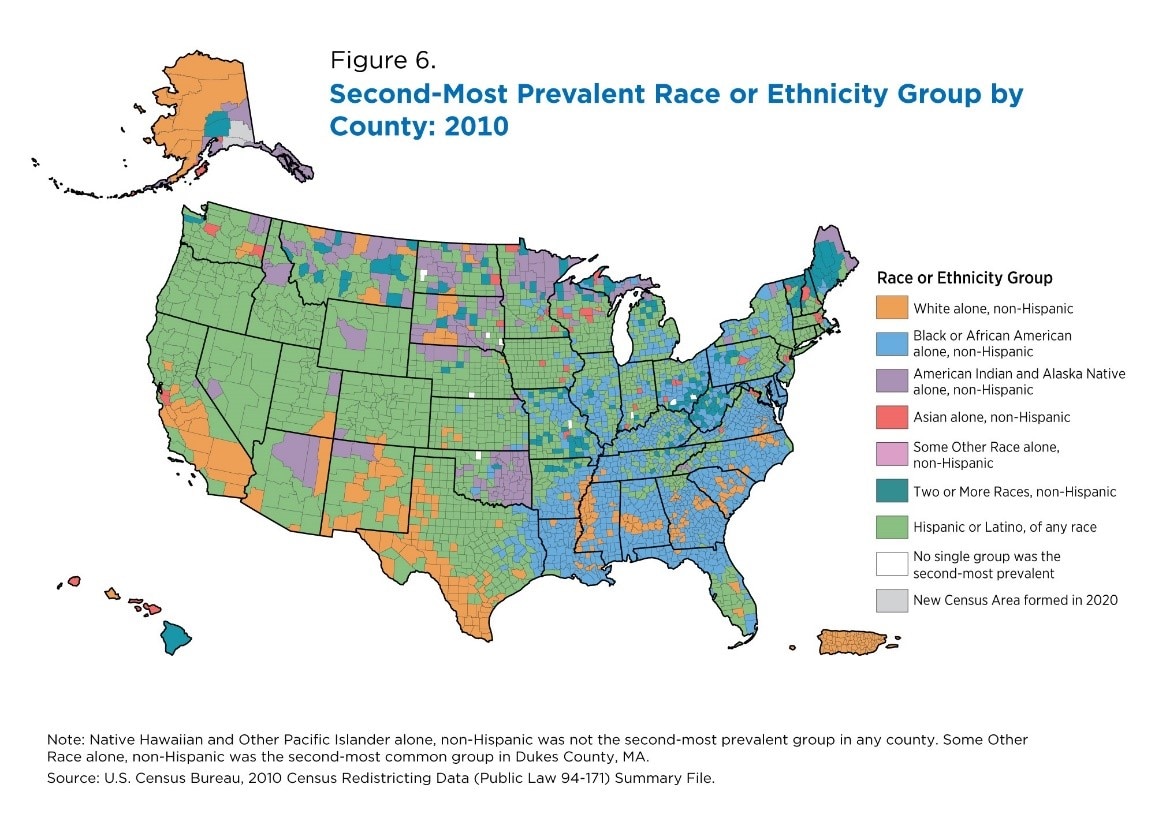
Rural America is becoming more racially and ethnically diverse, and Latinx and multi-ethnic people drove almost all rural population growth, recently released Census Bureau data show.
"Traditionally, rural communities have not been as racially or ethnically diverse as the nation overall. The 2020 Census reported that approximately 74.8% of the rural population is White non-Hispanic, compared to 57.8% for the United States as a whole. Hispanics are the second most prevalent racial or ethnic group in rural America comprising 10.4% of the rural population. It is important to note that Hispanics may be of any race. With a population count of 4.5 million, Black residents make up 7.4% of the rural population, and are the third most prevalent racial or ethnic group in rural areas," Lance George, Natasha Moodie and Keith Wiley report for The Daily Yonder. "Both nationally and in rural areas, some of the largest growth among racial and ethnic groups were among residents who identified themselves as being of two or more races. In rural communities in 2020, approximately 2.4 million or four percent of the rural population were of two or more races. Persons of two or more races surpassed Native Americans as the fourth most prevalent racial or ethnic group in rural areas. Native Americans, identified as American Indians or Alaska Natives, comprised roughly two percent of the rural population in 2020 – which is more than twice the rate of Native Americans nationally."Celebrate News Engagement Day on Tuesday, Oct. 5; you can make it part of National Newspaper Week, Oct. 3-9

Click here for more information, resources or ideas about how to promote News Engagement Day. The program is sponsored by the Association for Education in Journalism and Mass Communication.
Though it's not affiliated with National Newspaper Week, which goes from Oct. 3-9, the two observations can easily be combined.
Quick hits: PG&E charged with wildfire manslaughter; meatpacking workers say their injury reports were ignored
 |
| Grasshoppers in the Field, created by artist Gary Greff in 1999, is one of seven sculptures along the "Enchanted Highway" (which has no road number) near Regent, North Dakota. (Photo provided) |
Here's a roundup of stories with rural resonance; if you do or see similar work that should be shared on The Rural Blog, email heather.chapman@uky.edu.
An artist has single-handedly turned a 32-mile stretch of highway in North Dakota into a tourist mecca of art called the Enchanted Highway. It started in 1990 in Regent, a farming town struggling from economic troubles and a declining population. Local teacher-turned-artist Gary Greff decided to try to make the town into a tourist destination, so he began erecting large metal sculptures by the roadside. See how things are going for Regent now.
A social-justice activist raised in rural Montana has launched a project to train white people who have never thought of themselves as activists to organize and confront racist policies in their communities. It's not an issue of white guilt, he says, but rather because most people don't benefit from our current social structure. Read more here.
California utilities giant Pacific Gas & Electric has been charged with four counts of manslaughter and other felonies for allegedly causing 2020's deadly Zogg Fire. PG&E is accused of not properly maintaining the vegetation around equipment, which allowed a sickly tree to fall onto power lines and start the fire. This isn't the first time PG&E has been found responsible for a wildfire: In 2020, PG&E pleaded guilty of 84 counts of involuntary manslaughter in the 2018 Camp Fire, after it was discovered the company did not maintain electrical equipment in rural areas. Read more here.
Native American tribes demand 'immediate action' from the Biden administration to restore the boundaries for Bears Ears National Monument after Donald Trump shrank it by 85%. Read more here.
At one of the nation's largest meatpacking plants, workers say their complaints of serious injuries were ignored or downplayed, reports the Midwest Center for Investigative Reporting. One man was pushed to work with what turned out to be a fractured vertebra. Read more here.
Pandemic roundup: Covid the leading cause of death among law enforcement; Mississippi hires retired extension agents to get rural areas vaccinated
Here's a roundup of recent news stories about the pandemic and vaccination efforts:
In Mississippi, which has one of the nation's lowest (but also one of the fastest-rising), vaccination rates, the state is hiring retired extension agents to help get rural residents vaccinated. Read more here.
Covid-19 is the leading cause of death among law enforcement. Read more here.
Covid is killing rural Americans at twice the rate of urban residents. Read more here, and read The Daily Yonder's more in-depth coverage here.
The vaccines on the market don't protect as well against the Delta variant, but Pfizer and Moderna have updated Delta-specific vaccines already created and in clinical trials. Read more here.
Meanwhile, Merck says a preliminary trial of their antiviral Covid treatment pill showed promising results. Read more here.
Vaccination misinformation is an epidemic in its own right, especially among Republicans and evangelical Christians. YouTube is banning all anti-vaccine content, but pandemic misinformation groups on Facebook continue to flourish.
Covid patients who refused the vaccine have largely embraced experimental monoclonal antibody treatments. That may seem contradictory, since many refused the vaccine because they believed not enough was known about it. But it's also important to realize that most people who refused the vaccine did not believe they were at a high risk of hospitalization. That's why treatments in general are more widely accepted than preventatives: there's no doubt medical intervention is needed. Read more here.
Despite clinical data indicating the Pfizer vaccine is safe for children, many say they won't get their child vaccinated right away if it becomes available, a recent poll showed. Read more here.
Thursday, September 30, 2021
USDA has $3 billion to help farmers adopt green practices, help school meal programs with supply-chain problems
The Agriculture Department announced Tuesday a $3 billion investment in large-scale pilot projects to create new markets for sustainably produced agricultural products. The programs, set to go into effect next year, would provide incentives for producers who adopt climate-friendly practices. Here's the breakdown:
- $500 million to help farmers recover from drought and encourage the adoption of thriftier water management practices.
- Up to $500 million to prevent the spread of African Swine Fever.
- $500 million in relief from agricultural market disruption such as supply chain difficulties.
- Up to $1.5 billion to help school food programs deal with supply chain disruptions.
The money will be released in a series of pilot projects funded by the Commodity Credit Corp., a Depression-era program that allows the federal government to borrow as much as $30 billion from the federal treasury for programs meant to stabilize farm income.
In a University of Colorado speech, Agriculture Secretary Tom Vilsack stressed that the programs are primarily about increasing commodity production and trade, and were not carbon banks, carbon markets, or conservation programs. Such a distinction allows the CCC to pay for the programs, Chuck Abbott writes for the Food and Environment Reporting Network.
USDA will accept public comments on the funding until Nov. 1.
In rural counties, Covid-19 infections fall, but deaths rise
 |
| New coronavirus infections, in ranges by county, Sept. 19-25 Daily Yonder map; click the image to enlarge it or click here for the interactive version. |
Rural coronavirus infections fell during the week of Sept. 19-25, but Covid-19 deaths rose."New infections fell by 14% last week in rural (nonmetropolitan) counties, from about 210,000 new cases two weeks ago to 181,000 new cases last week. It was the biggest single-week drop in the number of new cases since winter," Tim Murphy and Tim Marema report for The Daily Yonder. "Covid-related deaths increased by 10% last week, to 3,197. That’s the largest number of deaths in nonmetropolitan counties since early February. Deaths are a trailing indicator of Covid-19 and could continue to rise for weeks. This winter, the rural death rate did not begin to fall substantially until about a month after new infections began to wane."
Nearly two-thirds of rural counties had fewer new infections last week than two weeks ago, but 94% remain in the red zone, meaning they had at least 100 new infections per 100,000 residents last week. Click here for an interactive county-level map, regional analysis and charts from the Yonder.
23 species to be declared extinct, including ivory-billed woodpecker, Bachman's warbler and eight mussels
 |
| Bachman's warbler (Whatbird.com) |
 |
| Ivory-billed woodpecker (Getty Images) |
- The ivory-billed woodpecker, one of North America's largest woodpeckers, which briefly brought tourists trying to find it in rural Arkansas.
- Bachman's warbler, a songbird that once lived in the Southeast but fell prey to habitat destruction.
- The San Marcos gambusia, a tiny fish in Central Texas killed off from dry weather, pesticide runoff, and factory pollution.
- A catfish species native to Ohio, thought to be highly intolerant of water pollution.
- Eight freshwater mussels. It's not known why they went extinct, but freshwater mussels are among the most-endangered species in North America, possibly because of habitat destruction or disease.
- Eight Hawaiian bird species due to invasive predators.
The announcement offers a possible "glimpse of the future. It comes amid a worsening global biodiversity crisis that threatens a million species with extinction, many within decades," Einhorn reports. "Human activities like farming, logging, mining and damming take habitat from animals and pollute much of what’s left. People poach and overfish. Climate change adds new peril."
Starting today, FWS will accept public comments on the proposal for 60 days before making a final ruling.
Drought has put U.S. forests into a 'state of emergency,' chief of the Forest Service tells Congress
"The government needs to quicken the pace of its fuel reduction work in public forests at the same time that it marshals enough crews to fight wildfires, said Forest Service Chief Randy Moore at a House hearing on Wednesday," the Food and Environment Reporting Network reports. "So far this year, nearly 46,000 wildfires have burned 5.9 million acres and more than 4,500 homes, commercial properties, and outbuildings."
About 63 million acres in national forests are rated at high hazard or very high hazard for wildfires that would be difficult to contain, he said. That represents a third of national forest land, and includes communities in the forests' proclamation boundaries, where the Forest Service can buy land.
"This is in part a result of 110 years of overly aggressive fire suppression policies as well as climate change," Moore said. "The sobering takeaway: America’s forests are in a state of emergency, and it’s time to treat them like one."
One problem with protecting forests and communities against firefighters: sometimes property owners and agricultural interests are fighting back against proposed wildfire mitigation policies. That's what's happening in Oregon, Cassandra Profita reports for NPR.
Another problem: Moore said firefighters often aren't paid enough, and the turnover rate is high, the FERN reports. "We must ensure a stable, resilient firefighting force," Moore said. "We are in a constant mode of training new employees." The Biden administration gave many full-time federal firefighters a 10% pay bonus this year and tried to ensure all federal firefighters make at least $15 an hour.
Killings were up a record 29.4% in 2020; first-time gun ownership rose from 32% to 39%, biggest rise in decades
 |
| Gun deaths by county type, 2015-21 (Washington Post chart; click image to enlarge) |
"Killings in the United States jumped nearly 30 percent last year, according to Federal Bureau of Investigation data released Monday that indicate a growing number of gun-related slayings amid the pandemic," Devlin Barrett and David Nakamura report for The Washington Post. "While different places saw different rates of increase in killings, the rise was nearly universal across the country, occurring in small towns, big cities, and many places in between."
The 29.4 percent increase in murder and manslaughter is "the largest one-year increase since such the federal government began compiling national figures in the 1960s," Barrett and Nakamura report. "That historic increase has been known for some time, and has sparked concern from police officials and prosecutors. But the FBI release of data compiled from thousands of law enforcement agencies formally confirms the trend. Overall, violent crime rose 5.6 percent in 2020, while property crimes fell 7.8 percent, the FBI said. Assaults increased 12 percent, according to the bureau."
First-time gun ownership jumped from 32% of Americans to 39% last year, the largest such increase in decades. It's unclear how much that trend contributed to the increase in gun violence and deaths, but an analysis "found the higher the jump in gun sales between 2019 and 2020, the higher the jump in gun violence that resulted in at least one death," the Post reports.
Subscribe to:
Posts (Atom)