Saturday, May 28, 2022

Twice-weekly paper in Uvalde found its niche in what rural journalism can provide: context, comfort and community

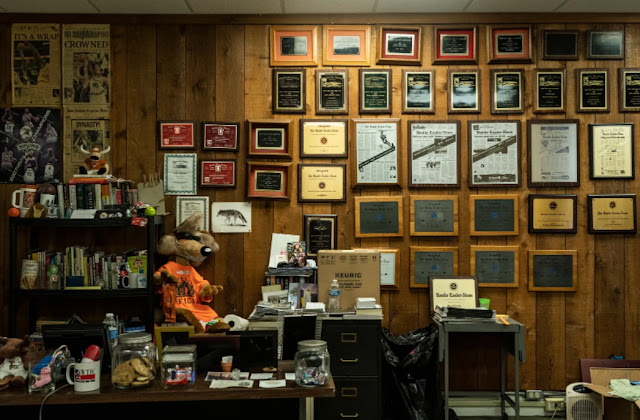
The newsroom of the Uvalde Leader-News; the city has 15,000 people and Uvalde County has 25,000. (The New Yorker)

How does a twice-weekly newspaper handle a tragic evil of national proportions that left one of its reporters with a dead child? By providing “context, a source of understanding, and hand-holding, and healing,” Craig Garnett, owner and publisher of the Uvalde Leader-News, told New Yorker contributing writer Rachel Monroe, who covers Texas and the Southwest for the magazine.

When Monroe arrived at the Leader-News office Wednesday, the day after 19 students and two teachers died in a mass shooting at Robb Elementary School, the staff of 10 "had recently received confirmation that [receptionist-turned-reporter] Kimberly Rubio’s daughter, Lexi, was among the dead," Monroe reports. "The newsroom atmosphere was stricken, and the office phone didn’t stop ringing; the paper was getting calls from media around the world, seeking comment, insight, images. The issue had to go to print in a few hours."

Front page of the May 25 edition
Garnett told Monroe the next day, “I was thinking about the other news outlets being able to beat us in every way. They have resources. They don’t mind asking the hard questions, even if it offends you, and we did. Community journalism is a different animal.” But the paper could provide context, understanding, comfort, and a sense of community.

General Manager-Photographer Pete Luna said he told Garnett that he didn't want the shooter's picture published. Done. "The other looming question was what would go on the front page," Monroe writes. Garnett said, “I wanted to run a traditional front page—six-column picture, seventy-two-point headline,” but there were other ideas. "Luna had been picturing a blank page—no photo, just empty space," Monroe reports. "Staff Writer Melissa Federspill suggested blacking out the entire front page. The idea appealed to Luna and Garcia," and that's what they did. “It’s how we feel right now,” Luna said.

Monroe writes, "Black stood for grief, but also privacy—the things the community was holding back, keeping for itself." Garnett told her, “You’ve got so many people knocking on your door, calling you. And I get that—that’s fine, they have a job to do. But they’ll be gone. We just thought, This is how we’re going to hold this.”

Craig Garnett
Garnett "grew up in a small town in southwest Oklahoma," Monroe reports. "As a teen-ager, he got hired to paint the local newspaper’s office. He went on to work for papers in Fort Worth and Kansas City, but he always longed to return to a small town like the one where he grew up. Forty years ago, he moved to Uvalde to become general manager of the Leader-News, which has a wall full of awards and a storied history." Garnett told Monroe, “It’s a small town, but it has this feeling of—a bit of a sophisticated interest in a bigger world, and that appealed to me.”

Monroe concludes, "Leader-News staffers are gathering themselves for what they’ll have to cover next: more press conferences, funerals, and the long aftermath of what Luna called the worst day of his life. Garnett said that Rubio had texted earlier that day to ask if she could write her daughter’s obituary for the paper."

“She said, ‘Can I have two pictures?’ And I said, ‘You can have a full page.’ ”

Friday, May 27, 2022

Suggestions for localizing this week's big national story, and a look at how effective gun laws have been or might be

Tom Silvestri of The Relevance Project writes:
There is plenty of reporting to be done localizing the massacre in Uvalde, Texas. And Buffalo, N.Y. Consider initially documenting trends in three areas:
Gun ownership and gun purchases: Lots to consider. Start with what percentage of local households and commercial establishments own guns. If you want one focus, analyze statistics on the type of guns -- "assault rifle," long guns, or those that fire large amounts of bullets in short periods -- that were used in the New York and Texas mass shootings. Another focus: Guns being bought by individuals age 21 and under.
Mental health and treatment: If you want one focus, report how many people have been identified as threats and what happened after the initial inquiry. Explain how local authorities treat reports of dangerous individuals, antisocial behavior, or people in danger. Also: Describe in numbers your community's safety net to treat mental illness.
Deaths and injuries involving guns: Compare and contrast with other causes of death and injury.
If possible, analyze over the last 10 years. A narrower range could be the pandemic years as we are learning the dangers of prolonger isolation.
Added starter: Crime reports involving incidents on school properties.
In all efforts, stick to the facts. Run counter to today's "opinion first, facts later." Godspeed on such important, relevant coverage.
As calls for stricter gun control are debated, maybe we should ask, just how effective are gun laws? "Many proposed laws probably would not have much impact on curbing the mass shootings that dominate the news. But they could lessen their severity, and might also bring down overall gun violence," writes Washington Post Fact Checker Glenn Kessler. His analysis starts with a look at President Biden's claim that “When we passed the assault weapons ban, mass shootings went down. When the law expired, mass shootings tripled.” He pokes several holes Biden's claim but cites evidence that the 1994 assault-weapons law "may have been effective in reducing the death toll" by limiting large-capacity magazines.

Southern Baptist Convention publishes full sex-abuse report, including a database of alleged abusers

In a bid for greater transparency, the Southern Baptist Conference's Sexual Abuse Task Force has published online an independent report detailing how its leaders protected pastors and local church staff accused of sexual abuse while ignoring, pressuring and trying to discredit sexual-abuse survivors.

The report includes the database of alleged abusers, along with links to news articles and other details. However, a note at the top cautions that the list is incomplete, has not been proofed or adequately researched, and is not always specific to Southern Baptists. Some names and other details have been censored, possibly to preserve the privacy of minors.

In a press release accompanying the report, the task force called on other Southern Baptists to heed the report's findings and care for abuse victims as well as "provide a culture of accountability, transparency, and safety as we move forward."

The task force called for specific reforms:

  • The next SBC president should create a task force to ensure reforms are implemented.
  • The Executive Committee should hire experts to work with victims and train state conventions on how to respond to abuse allegations.
  • All SBC boards and committees should undergo background checks as part of the selection process, and should and receive training on sexual abuse prevention and survivor care.
  • All SBC-affiliated seminaries should teach staff and students about sexual abuse prevention and survivor care.
  • The Executive Committee should budget for and hire a salaried staffer for the SBC's Credentials Committee, which assesses whether churches are operating within SBC standards of faith and practice.

Groundwater group urges owners of water wells to prepare for drought by getting their systems inspected

Map by University of Nebraska-Lincoln, adapted by The Rural Blog; for details, click here.

Private water well owners should prepare for extreme drought, the National Ground Water Association urged recently

Drought reduces a well's productivity and the quality of its water, so owners should have their systems inspected and water levels tested as soon as possible. NGWA recommends these steps:
  • Have your water well inspected by a certified water well contractor. Wells that are not operating correctly will waste water and are more likely to completely fail during prolonged periods of drought. An inspection can help locate current and potential problems with a system before they become serious issues.
  • Test your well water. There has been growing evidence that lower water tables, deeper wells, and extreme drought have led to higher levels of contaminants in groundwater. These contaminants can typically be easily identified and treated with a simple water quality test.
  • Test your water levels. Declining water levels can impact not only the mechanics of your well but also water quality. A simple water level test can help determine what service may or may not be needed.
  • Conserve water, fix leaks, and utilize water-efficient technology. By properly conserving water, fixing leaks, and utilizing more efficient water technology, you can help ensure your water levels remain healthy for you and your neighbors.
  • Don’t delay. Due to ongoing drought, supply chain issues, and national labor shortages, well owners are seeing longer than usual wait times for service. If it has been more than a year since your last water well inspection, we urge well owners to reach out today to a certified contractor.
Well owners can find more information about drought at WellOwner.org, which is operated by the NGWA with support from the Rural Community Assistance Partnership and the Environmental Protection Agency.

Fact Check explains why and how infant formula is being sent to children of undocumented immigrants at the border

"The baby formula shortage has caused a raft of misleading and false claims, but here's one that is true: The federal government feeds babies detained in immigration facilities at the southwest border," FactCheck.org reports in its latest newsletter. Some Republican politicians have claimed that the government is sending formula at the expense of American consumers and that the action is a result of Biden administration policies. This is not so, Saranac Hale Spencer reports.

A framework of federal laws and regulations, some of which FactCheck details, governs the treatment of detained immigrant minors. Essentially, U.S. Customs and Border Protection is required to give children and babies food and water, access to bathrooms, emergency medical services, and accommodations that are well-ventilated and temperature-controlled. CBP facilities also must have diapers, wipes, unexpired formula, and one to five safe bassinets for infants to sleep in. Every administration for the past quarter-century has followed those legal requirements, including the Trump administration.

FactCheck also notes that detainees aren't supposed to be held for more than 72 hours. "That 72-hour limit isn’t always followed. But to the extent that CBP is providing formula to detained infants, it’s likely not for an extended period of time, which suggests that the amount of formula at the facilities wouldn’t have a measurable impact on the national supply," Spencer reports.

USDA to invest $770 million to help rural businesses in 36 states with job training, technical assistance and more

Agriculture Secretary Tom Vilsack announced that the USDA "is investing $770 million to help create new and better market opportunities for rural businesses and people in 36 states and Puerto Rico. The investments include $640 million for 122 projects to help people living in socially vulnerable communities," Successful Farming reports. "The funding will help a diverse rural America keep resources and wealth right at home through job training, business expansion and technical assistance. It will help companies hire more workers and reach new customers. It will open the door to new economic opportunities for communities and people who historically have lacked access to critical resources and financing. It will also help entrepreneurs and business cooperatives create jobs, grow businesses, and find new and better markets for the items they produce."

The funding will be routed through three programs: the Business and Industry Loan Guarantee Program, the Rural Economic Development Loan and Grant Programs, and the Rural Microentrepreneur Assistance Program. Here's the complete list. Projects receiving the funding are in Alabama, Alaska, Arkansas, Arizona, California, Colorado, Delaware, Florida, Georgia, Idaho, Illinois, Iowa, Kentucky, Louisiana, Michigan, Mississippi, Missouri, Montana, Nebraska, Nevada, New Hampshire, New Mexico, New York, North Carolina, Ohio, Oklahoma, Oregon, South Carolina, South Dakota, Texas, Utah, Vermont, Virginia, Washington, West Virginia, Wyoming and Puerto Rico.

Quick hits: Black farmers' debt-relief controversy illustrated; Sinclair boss says political division is good for his business; FCC chair: school buses should get pandemic funds for wi-fi

Daily Yonder illustration by Nhatt Nichols
Here's a roundup of stories with rural resonance; if you do or see similar work that should be shared on The Rural Blog, email us at heather.chapman@uky.edu.

The Daily Yonder illustrates the controversy around debt relief for Black farmers via a graphic novel-style illustration. Read it here.

Sinclair Broadcast Group CEO Chris Ripley remarked recently that, though he laments the "political environment we're in," a politically divided America is "very good for our business," referring to political candidates' outsized expenditures for television ads. Sinclair's audience is disproportionately rural. Read more here.

Rural students often lack the broadband access to complete homework, making it difficult to complete schoolwork during pandemic shutdowns, or homework in general. To help close the "homework gap," Federal Communications Commission Chair Jessica Rosenworcel has proposed that schools should be able to use federal broadband funding to outfit school buses with wi-fi hubs. Such bus rig-ups have helped many rural students access broadband during the pandemic. Read more here.

A recently published study found that rural counties were much less likely than metropolitan counties to have enough—or any—buprenorphine or methadone treatment programs available for opioid use disorder. Counties with large shares of people with disabilities or without insurance were especially likely to lack enough treatment options. Read more here.

Many municipalities, large and small, that have embraced cryptocurrency for payments and other local commerce are now reeling amid the cryptocurrency crash. Read more here.

Between 1995 and 2000, crop insurance payouts have increased between 300% and 400% for American farmers, and are expected to keep rising as disasters become more frequent and extreme. A thoughtful opinion piece from an environmental group posits that the federal crop insurance program encourages irresponsible environmental practices by insulating farmers from the consequences of climate change to their crops. Read more here.

Thursday, May 26, 2022

75% of rural counties have no or few mental-health care providers, and Texas is worst off; see interactive map

Mental-health care access by county. ABC News map; click the image to enlarge it or click here for the interactive version.
A new analysis details the extent of rural mental-health care disparities. "Seventy-five percent of rural counties across the country have no mental-health providers, or fewer than 50 per 100,000 people," or one per 2,000, the recommended level, Kelly Livingston and Maggie Green of ABC News report on their analysis of Centers for Medicare and Medicaid Services data. "A majority of counties with no or few providers per capita are located in the Midwest and Southeast." Mental-health care deserts are most common in Nebraska, North Dakota, South Dakota, and Texas; nearly half the counties in those states have no mental-health care providers at all.

Saul Levin, CEO and medical director for the American Psychiatric Association, told ABC that local mental-health services can forestall the need for more intensive treatment, which is  often more expensive. Laurie Gill, Cabinet secretary for the South Dakota Department of Social Services, "acknowledged that sometimes a lack of options at the local level has sometimes led to people in the state needing more intensive, inpatient psychiatric care, but said her department has been doing a gap analysis to identify needs in the mental healthcare system and fill them," ABC reports.

One critical demographic that needs better mental-health care access is children and teens, especially in rural areas. As a recent New York Times series shows, the pandemic has exacerbated a growing mental-health crisis among American youth. About 70% of U.S. counties lack a psychiatrist who specializes in children or teens, and it can take months to get an appointment even in counties that do have specialists.

Why does U.S. have a unique problem with guns, and why can't we fix it? Look to our rural history and federal structure

Today's front page of the local twice-weekly newspaper
By Al Cross
Director, Institute for Rural Journalism and Community Issues, University of Kentucky

In the wake of the mass shooting at Robb Elementary School in Uvalde, Texas, President Biden asked when members of Congress would have the "backbone" to "stand up to the gun lobby." But the National Rifle Association and other Second Amendment groups are not the fundamental reason the United States is unable to do much about its unique problem with deaths from firearms. The roots are in America's history and its governing structure.

Our country was forged on a frontier, in which guns were necessary for food and defense -- and also used against Native Americans. That was after they were used against the British, and that's a main reason our Constitution has a Second Amendment saying "A well regulated Militia, being necessary to the security of a free State, the right of the people to keep and bear Arms, shall not be infringed."

In those days, there were no automatic weapons, the militia was able-bodied male citizens, and the amendment was a compromise that assumed two things, according to the National Constitution Center: The new federal government would have "almost total legal authority over the army and militia," but should not have any authority at all to disarm the citizenry." Recent U.S. Supreme Court decisions, both on 5-4 votes, said the amendment creates a limited individual right to keep and bear arms. In those cases, the court may not have been following the law as much as it was following public opinion; well-organized opposition to any sort of gun control, often appealing to the national heritage of firearms, has left almost half of Americans telling a 2021 Pew Research Center poll that gun laws are "about right" or should be less strict. They have grown more gun-friendly since 2018, with the share saying "less strict" in Gallup polls rising to 11% from 4%. That could reflect a growing belief among some Americans that armed conflict among civilians is becoming more likely.

The paper's stories begin on the back page.
Still, the latest Gallup survey on the issue found that 52% of U.S. adults feel that laws governing the sale of guns should be stricter, with 35% saying they should be kept as they are. A majority or a plurality have been in favor of stricter laws since 2012, the year of the most deadly school shooting, in the village of Sandy Hook in Newtown, Conn.

Why hasn't public opinion in the last decade moved Congress on the issue? The main reason is the Senate, where each state has equal representation, giving lightly populated states with largely rural landscapes disproportionate influence. That was a compromise made even before the Bill of Rights, at the convention that wrote the Constitution, which set the structure in stone by writing, "No State, without its consent, shall be deprived of its equal Suffrage in the Senate."

So, if gun laws are to be made stricter, it's not mainly a matter of overcoming "the gun lobby." It's a probably matter of changing opinion in states with large rural populations. States like Texas. And places like Uvalde.

As usual, a mass shooting spawns false rumors; if they get traction in your area, consider debunking them online

"By now it’s as predictable as the calls for thoughts and prayers: A mass shooting leaves many dead, and wild conspiracy theories and misinformation about the carnage soon follow," write David Klepper and Ali Swenson of The Associated Press. "It happened after Sandy Hook, after Parkland, after the Orlando nightclub shooting and after the deadly rampage earlier this month at a Buffalo grocery store. Within hours of Tuesday’s school shooting in Uvalde, Texas, another rash began as internet users spread baseless claims about the man named as the gunman and his possible motives."

Local news media tend to ignore online rumors, often on the logic that repeating misinformation just spreads it. So, The Rural Blog isn't repeating the falsehoods mentioned in the AP story, but we do suggest that if you see particular misinformation gaining traction in your coverage area, you debunk it with material from AP story or other fact-checkers. And do it on social media! It can build your brand as your community's main fact-finder.

The AP reporters note, "In some cases, misinformation about mass shootings or other events are spread by well-intentioned social media users trying to be helpful. In other cases, it can be the work of grifters looking to start fake fundraisers or draw attention to their website or organization. Then there are trolls who seemingly do it for fun. Fringe online communities, including on 4chan, often use mass shootings and other tragedies as opportunities to sow chaos, troll the public and push harmful narratives, according to Ben Decker, founder and CEO of the digital investigations consultancy Memetica."

Rural Assembly Everywhere recorded sessions posted; see sessions on book bans, food security and more

The annual Rural Assembly Everywhere convention was held virtually on May 10-11. If you missed it, not to worry: playbacks are now available. Click here to watch them.

Here's some of what you'll see:
  • A discussion on book bans and intellectual freedom, featuring residents of McMinn County, Tenn. The community was thrust into the national spotlight after its school district banned the graphic novel "Maus."
  • Remarks from Interior Secretary Deb Haaland.
  • Remarks from Agriculture Department Undersecretary for Rural Development Xochitl Torres Small.
  • Small farmers discussing food democratization.
  • A discussion about apprenticeship opportunities for rural and Native American youth.
  • Nonprofit Welcoming America hosting a conversation on building welcoming communities. The discussion will feature three female leaders from diverse backgrounds in Nebraska who will share their journeys to "build stronger connections between immigrant and non-immigrant communities, fight against divisive rhetoric, and ensure that inclusive policy is the norm in their communities."
  • YouTube social and political commentator Justin King of "Beau of the Fifth Column."
  • Neema Avashia, author of "Another Appalachia: Growing up Queer and Indian in a Mountain Place."
The Rural Assembly and The Daily Yonder are programs of The Center for Rural Strategies, which calls the Assembly "a nationwide movement striving to build better policy and more opportunity for rural communities across the country." Click here for details.

Federal Trade Commission probes whether formula makers and distributors illegally limited supplies in rural stores

At President Biden's request, the Federal Trade Commission began investigating formula manufacturers on Tuesday to discover their role in the nationwide shortage. The investigation will focus on whether corporate mergers contributed to the shortage by reducing competition, and whether manufacturers and distributors illegally kept formula from going to smaller retailers in inner-city and rural areas, Spencer Kimball reports for CNBC. "The FTC also asked the public to submit comments to a federal website about whether any state or federal agencies may have accidentally taken actions that contributed to the shortage."

"Discriminatory terms and conditions can exacerbate the inability of some grocers, pharmacies, and other stores to source products in short supply, impacting both rural and inner-city communities in particular," FTC Chair Lina Khan said in a statement Tuesday.

Low-income rural parents are having an especially difficult time with the shortage. "When there are only one or two grocery stores in town, and when filling up the tank to drive from store to store to find formula — as many parents have been doing for weeks — is an economic impossibility, the need reaches a degree of intensity that is potentially life-threatening, Chabeli Carrazana reports for The 19th. "In rural swaths of the country, families are more likely to be living in poverty, more likely to be on WIC, more likely to face transportation barriers and less likely to have access to the retailers that carry baby formula."

Formula maker Abbott is expected to reopen its Sturgis, Mich., plant on June 4 and have some formula ready to ship by June 20. It could take six to eight weeks for formula to reach store shelves after that, Christina Jewett reports for The New York Times. Abbott is working with the Food and Drug Administration to remedy unsanitary conditions that led the FDA to shutter the plant in February.

Wednesday, May 25, 2022

Rural schools are more at risk for mass shootings, and need more mental-health care; Uvalde has been seeking a clinic

Tuesday's shooting in Uvalde, Texas, highlights rural schools' disproportionate risk of suffering a mass shooting (defined as those with four or more deaths). 

Uvalde County, Texas (Wikipedia map)
Salvador Ramos, 18, killed 19 students and two teachers at Robb Elementary School. It was the deadliest shooting at a U.S. school since 2012, when 28 were killed in Sandy Hook, Conn., another small community. Nine of the 16 mass shootings at U.S. schools in the last 100 years have been in rural areas, though rural America now has less than 20% of the nation's population. Most of the shooters, rural and urban, were former or current students. According to a 2020 Government Accountability Office report, rural schools were the most likely to be targeted for shootings.

The Uvalde shooting also highlights disparities in rural mental-health care. Friends and acquaintances of Ramos said he was relentlessly bullied and dealt with mental-health issues and "had a fraught home life as a child," The Washington Post reports. Before going to the school, he shot his grandmother in the face; she called police.

As a recent series by The New York Times highlighted, mental-health care can be difficult for rural teens to access. And though experts don't know whether bullying is more pervasive in rural communities, they say the small size of the community can make it harder for bullied students to cope. Republican U.S. Rep. Tony Gonzales, who represents the area, told CBS News that he has been working with the Republican mayor of the City of Uvalde and the Democratic county judge of Uvalde County to find money to build the city's first mental health clinic.

USDA data: Foreign ownership of rural land has nearly tripled in past decade, to 10.9 million acres from 4.1 million

Acreage of foreign-owned cropland (including forests and pastures) by county. (USDA data mapped by The Daily Yonder for the Midwest Center for Investigative Reporting; click the image to enlarge it or click here for the interactive version.)

"Foreign investment in U.S. cropland has nearly tripled in the past decade, according to U.S. Department of Agriculture data. The total cropland controlled by foreign interests in 2020 was 10.9 million acres, up from 4.1 million acres in 2010," Jonathan Hettinger reports for the Midwest Center for Investigative Journalism. "This increase has been largely driven by foreign-owned wind companies signing long-term leases on a large number of acres, according to the USDA. However, 'the acres actually utilized by said companies are very few due to the small footprint of the wind towers erected on the land,' a USDA report said."

Foreign investors own or lease 2.9% of the nation's overall agricultural land, more than 37 million acres that include forests and pastures. That's up from 24.2 million acres in 2010, says the report. However, the USDA's database of foreign farmland ownership has significant gaps, and more than 3.1 million acres of farmland don't have a listed owner, Hettinger reports.

"While the database has significant errors and often has incomplete information, it still is a strong indicator of the quantity of land being sold or leased to foreign interests," Hettinger reports. "This growing level of investment has sparked legislative action. Currently, three bills before Congress would require additional review of foreign investment. Also, 14 states restrict or prohibit foreign ownership of farmland, though none outright forbid it, according to a November memo by the Congressional Research Service."

Biden police-reform order will create national registry of fired officers, discourage no-knock warrants and more

"President Joe Biden plans to sign a long-awaited executive order to reform policing practices Wednesday, the second anniversary of the death of George Floyd," CBS News reports. "The order will create a national registry of officers fired for misconduct; encourage state and local police to tighten restrictions on chokeholds and so-called no-knock warrants; and restrict the transfer of military equipment to law enforcement agencies, said two sources familiar with the matter."

Records relating to police misconduct are secret or hard to get in 35 states, Gateway Journalism Review reported last year. That can make it easier for misbehaving officers to get hired elsewhere.

Biden began crafting the order last year after a similar bill failed to attract bipartisan support. "The order is expected to be more limited than an earlier, draft version, which infuriated the nation’s largest policing groups when it leaked in January. Since then, the White House has worked more closely with police and Justice Department officials and elevated a more centrist position on criminal justice," Zolan Kanno-Youngs and Charlie Savage report for The New York Times.

"While Biden cannot directly issue mandates to state and local law enforcement agencies, senior administration officials who briefed reporters Tuesday said attorneys general should use their power to award grants that promote and support agencies in getting accredited or those that want to adopt such policies but could use some federal help," CBS reports.

New laws could save Americans from more than 12 million surprise medical bills this year

"In the first two months since a new federal law started blocking unexpected medical bills, consumers have avoided two million would-be surprise medical bills — and it could potentially be over 12 million unanticipated bills this year," Andrew Keshner reports for MarketWatch. "This is according to estimates released Tuesday on the early impact of the 'No Surprises Act' from the Blue Cross Blue Shield Association and AHIP, a health insurers’ trade association."

The law, signed by former President Trump in December 2020, "took effect on Jan. 1 and it prevents patients from getting blindsided by medical bills — and saddled with more medical debt — for out-of-network medical treatment. In recent years, one in five people undergoing elective surgery wound up with unplanned bills, researchers said in February 2020," Keshner reports.

The law is most helpful in emergency situations where patients don't have the time or ability to ensure their health-care plan covers needed doctors and services. However, though the law limits surprise billing for air ambulances—which mostly serve rural areas—ground ambulances are not covered, and unexpected ambulance charges can cost thousands of dollars.

About half of emergency ground ambulance rides result in out-of-network charges for people with private insurance, according to a Kaiser Family Foundation study. But fewer than half of U.S. adults have enough money in the bank to cover a an unexpected expense of $1,000, according to a recent Bankrate survey.

Tuesday, May 24, 2022

Southern Baptists reeling in wake of sex abuse report; it's an opportunity for local action and local coverage

UPDATE: The Executive Committee apologized and its lawyer "said it is working on making the list of sex abusers available to the public once the committee makes sure the names of survivors are not disclosed and ensures the names of abusers are substantiated," The Washington Post reports.

Southern Baptists across the country are reeling in the wake of a new report detailing how Southern Baptist Convention leaders protected pastors and local church staff accused of sexual abuse while ignoring, pressuring and trying to discredit sexual-abuse survivors. It's a topic for local coverage.

Several pastors who spoke to the Times said they plan on using the report as an opportunity to open dialogue with congregants who may be scared, angry, and worried. Philip Meade, pastor of Graefenburg Baptist Church in Kentucky, told The New York Times he will devote part of Sunday's service to "a lament for the mishandling of sexual-abuse claims and for the survivors who have suffered so much." Griffin Gulledge, the pastor of Madison Baptist Church just outside of Atlanta, said it's imperative for him and others to address the scandal. "What all my pastor friends are hearing is we better get this right, and we better fix this."

"The report quickly proved to be another dividing line within the denomination, with some pastors and members seeing it as a call to action for deep cultural and structural changes on abuse, as well as a range of issues around politics and the treatment of women," the Times reports. "Critics say some pastors have focused more on fighting women in leadership and critical race theory than they have on rooting out abuse and the power structure that keeps it under wraps."

The report shows how SBC leaders used the denomination's decentralization to avoid accountability; an alleged abuser could simply pull up stakes and move elsewhere to preach, secure in the knowledge that Baptist leaders couldn't or wouldn't sound the alarm to local churches, which are autonomous and choose their own pastors.

Todd Gray, executive director of the Kentucky Baptist Conventiontold his constituents in a letter today that when he read the report, "The Lord led me to pray for sexual-abuse survivors in a way I never had before." Gray noted that in November, the convention established a Sexual Abuse Task Force that was designed to be preventive "rather than investigatory," but Guidepost Solutions, which wrote the SBC report, "has requested many of our internal policies and will help us discover if there are gaps where we can better guard against sexual abuse."

Fentanyl drove record number of drug-related deaths in 2020; teens often score the pills on social media

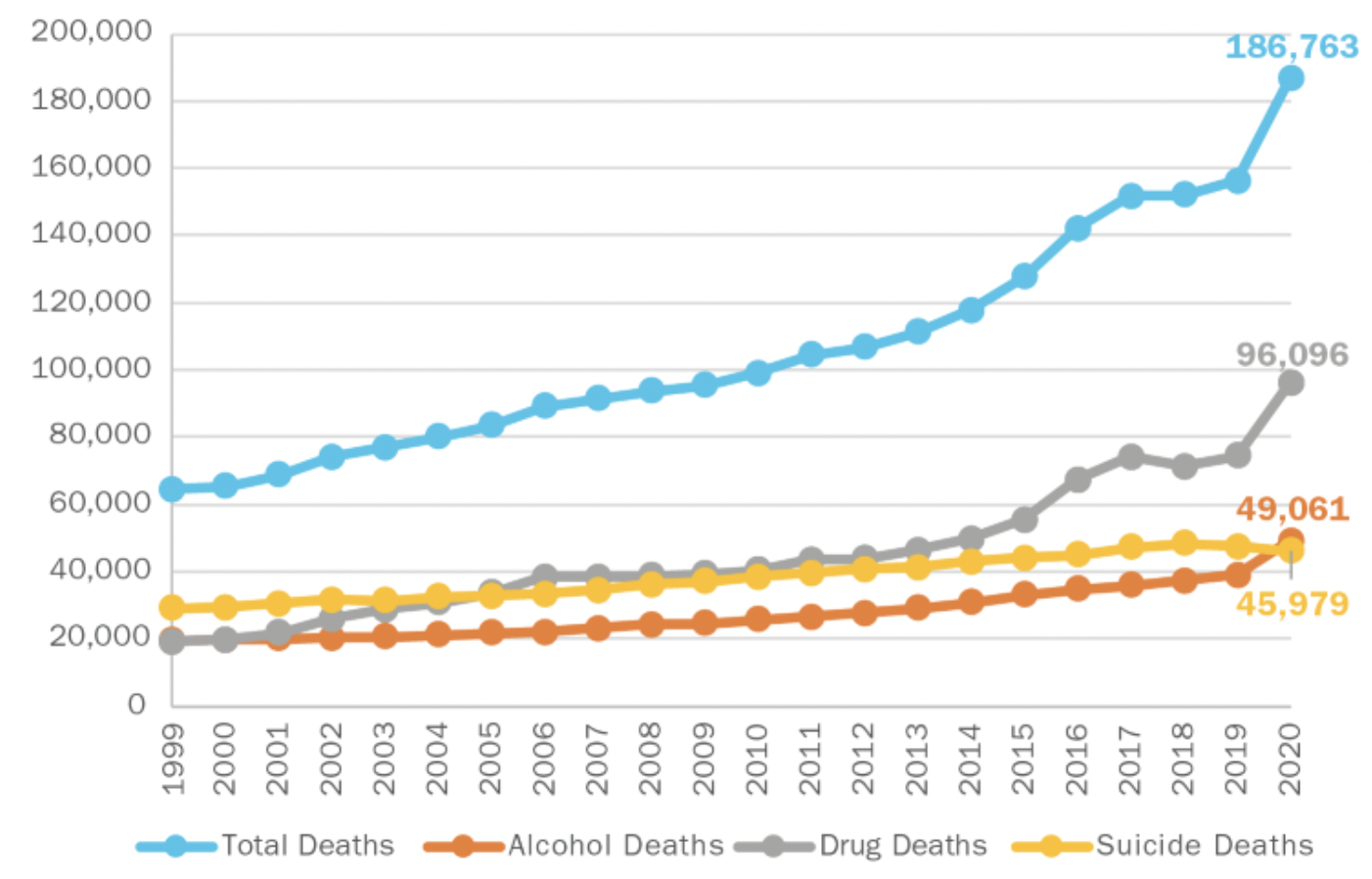
Annual deaths from alcohol, drugs and suicide in the United States, 1999-2020
(Chart by Trust for America's Health and Well Being Trust; click on the image to enlarge it.)

So-called deaths of despair—those related to alcohol, drugs, and suicide—hit an all-time high in 2020, claiming the lives of nearly 182,000 Americans, according to the Trust for America's Health and Well Being Trust. The 2020 total is 20 percent more than 2019, and mark the highest number of substance-misuse-related deaths recorded in any year; 2020 was dominated by the pandemic.

"While alcohol, drug, and suicide deaths have been increasing for decades, the 2020 increase was unprecedented and driven by a 30 percent increase in the rate of drug-induced deaths and a 27 percent increase in the rate of alcohol-induced deaths," Rhea Farberman and Amy Shields report for the Trust. "Combined rates of alcohol, drug, and suicide deaths increased in all 50 states except New Hampshire, and for the first time two states – West Virginia and New Mexico – surpassed 100 deaths per 100,000 state residents from alcohol, drugs, and suicide combined in a single year."

Synthetic opioids such as fentanyl and psychostimulants drove the increase in substance-misuse deaths. Rates for such deaths increased among all population groups except for people over age 75. People of color, youth aged 17 and under, and people 18-34 years old saw particularly high increases, as well as people who live in the South and West, the report says.

Fentanyl-related deaths have at least doubled in every state in the nation during the pandemic, and the report projects that such deaths will continue to rise. One big problem is that most people who overdose from fentanyl had no intention of taking it. Street drugs are often cut with fentanyl to stretch them further and make dealers more money, but the synthetic opioid is so potent that even adding a tiny bit more to a pill can be lethal. Teens often score fentanyl-laced drugs on social media.

The report calls for a comprehensive nationwide strategy that focuses on prevention, early identification of mitigating factors, harm reduction, and effective treatment.

Telehealth is the future of rural health care, CEO of the National Rural Health Association says at telehealth meeting

Telehealth could be the key to rural healthcare's future, but stakeholders must figure out how to remove barriers to access, said Alan Morgan, CEO of the National Rural Health Association, at the Department for Health and Human Services' National Telehealth Conference. 

During a panel discussion, Morgan said many rural health-care providers lack consistent, affordable broadband access, and that many don't know that telehealth services are available or how to use them, Katie Adams reports for MedCity News. He called the rural-urban access gap "beyond frustrating" and called on the health-care industry to stop studying whether telehealth helps rural patients. That question is settled, he said; instead, the industry should focus on identifying and removing barriers to access. 

Morgan "and fellow panelist Ann Mond Johnson, CEO of the American Telemedicine Association, said communication about telehealth can be improved through partnerships with local organizations and community leaders, as patients are more likely to trust these messengers and heed their messages," Adams reports. "This need for programs designed to scale rural patients’ telehealth use is especially dire as healthcare’s workforce crisis intensifies . . . NRHA says the patient-to-primary care physician ratio in rural communities is 39.8 physicians per 100,000 people, compared to 53.3 physicians per 100,000 in urban communities, a disparity that is exacerbated by the country’s ongoing shortage of health-care workers."

Coal prices surge as Europe boycotts Russian gas, but it won't likely help U.S. mining much; Appalachia an example

Coal prices are surging as overseas customers are buying more, but Appalachian mines aren't likely to see much benefit because there aren't enough experienced coal miners at work to keep up with the demand, Justin Hicks reports for Ohio Valley ReSource, a consortium of public radio stations.

European countries have renewed interest in coal as they boycott Russian natural gas. "In traditional economics, high demand usually means suppliers ramp up production to take advantage of rising prices," Hicks reports. "But Erin Bates, communications director for the United Mine Workers of America, says coal companies can’t meet demand with their current labor force. Without workers, the coal in Appalachia isn’t going anywhere fast, Bates said. U.S. Energy Information Administration data shows production in Kentucky is only up about 4% compared to this time last year."

Also, Bates noted, coal companies wouldn't find it economical to boost production for a temporary boom. "The operators still find it to be too expensive to put the machinery back in there and get the employees back in there, even though the price is so high," Bates told Hicks. "They just don’t see the value in it." That's especially true since most coal is purchased years ahead of time; very little is available for sale on the spot market.