A digest of events, trends, issues, ideas and journalism from and about rural America, by the Institute for Rural Journalism, based at the University of Kentucky. Links may expire, require subscription or go behind pay walls. Please send news and knowledge you think would be useful to benjy.hamm@uky.edu.
Tuesday, December 13, 2022
USDA funds 71 climate-related projects at less than $5 million, many of them to 'figure out what works,' Vilsack says
Electric cars threaten future of AM radio and maybe local radio news, but overcoming interference is possible
![]() |
| Rush hour in Chicago. Many AM radio listeners tune in during commutes. (Photo by Alyssa Schukar, The New York Times) |
Amplitude modulation transmissions, or AM radio, may be on its way out, which is bad news for local news in places that still have local radio news. "An increasing number of electric models have dropped AM radio in what broadcasters call a worrisome shift that could spell trouble for the stations and deprive drivers of a crucial source of news in emergencies," reports Michael Levenson of The New York Times.
"Carmakers say that electric vehicles generate more electromagnetic interference than gas-powered cars, which can disrupt the reception of AM signals and cause static, noise and a high-frequency hum," Levenson writes. AM and electricity are similar forms of electromagnetism. "Tesla, Audi, Porsche and Volvo have also removed AM radio from their electric vehicles, as has Volkswagen from its electric S.U.V., ID.4, according to the carmakers and the National Association of Broadcasters."
It is possible to overcome the interference issues, Levenson reports: "Such changes require money and effort, and it’s not clear whether carmakers are willing to spend more in the service of AM radio fans. . . . If more electric vehicles drop AM radio, some broadcasters say they could lose a connection to their core listeners."
AM stations have a healthy percentage of the U.S. radio market. "About 47 million Americans listen to AM radio, representing about 20 percent of the radio-listening public, according to the Nielsen Co., the media tracking firm," Levenson reports.
"Brian Winnekins, the owner of WRDN in Durand, Wis., which has seven hours of farm-related programming every weekday on AM and FM, told Levenson he has been urging listeners to tell carmakers not to drop AM, noting that it can reach farmers in remote areas. “If you can make a vehicle drive by itself,” Mr. Winnekins said to Levenson, referring to the driver-assistance systems in Teslas and other vehicles, “you can make a decent radio receiver."
Monday, December 12, 2022
Substation attacks focus attention on grid's vulnerabilities
![]() |
| A string of attacks with at least two involving gunfire occurred at
substations and other power facilities since mid-October in the U.S. South and Pacific. (Photo by Claudine Hellmuth, E&E News) |
“It remains troubling and highlights how vulnerable is our critical infrastructure,” Richard Mroz, a senior adviser at the grid security advocacy group Protect Our Power, told Willson in an email. Ross Johnson, a security and intelligence specialist at Bridgehead Security Consulting, told Willson, "It’s a signal-to-noise problem: substation incidents are common, gunfire less so but not unheard of, and until arrests are made we are unlikely to know the motivation."
Willson reports, "There are more than 55,000 substations nationwide ... a key component of the power grid. The incidents come at a time when energy regulators and others say that threats to the power system — be they physical or cyber in nature — are becoming more serious and common."
There have been no identified motives or suspects for the recent attacks. "While some of the incidents involved gunfire," Wilson notes. "It’s unclear if guns were involved in all of the events.
In Oregon, two substations near Portland were targeted in what utilities described as deliberate attacks," Willson reports. "At least four substations in Washington have also been vandalized or targeted."
FEMA's flawed hazard maps are unable to predict pluvial flooding driven by climate change, Washington Post reports
![]() |
| Water reached the tops of cars in South Dallas, Texas, in August. (Photo by Dkamreen Jones) |
In July 2022, "Brandon Jones’s St. Louis home was hit by major flooding for the second time since 2008. Cars were barely visible under several feet of turgid storm water, as record rainfall fell on the city. . . . Two days later, the area flooded all over again."
The flooding took Jones by surprise: "Jones’s Penrose neighborhood isn’t designated as a high-risk location on the Federal Emergency Management Agency’s flood maps," the Post reports. "These high-risk zones, which lie in what’s called the Special Flood Hazard Area, cover properties that the agency considers to have at least a 1 percent annual chance of flooding. This 100-year flood plain designation requires property owners with federally backed mortgages to buy flood insurance, and it influences how communities regulate development."
The Post reports that part of the reason Jones was not prepared is that FEMA's maps need an overhaul: "They capture river and coastal flooding, not inundation caused by
intense bursts of rainfall, known as pluvial flooding — a particularly
dangerous problem in cities, where many porous surfaces have been paved
over. This makes FEMA’s designated flood hazard zones a bad match for the intense weather events that scientists say U.S. communities will face."
Daniel Swain, climate scientist at UCLA, told the Post, “It is precisely that type of flooding, urban flooding and flash flooding from shortish duration but very high-intensity downpours, that is expected to increase the most in a warming climate."
For 7 deadly years, feds flubbed fentanyl fight, Post reports, naming DEA, DHS, HHS, CDC, White House drug office
![]() |
| Photos of fentanyl victims in the lobby of DEA headquarters (Photo by Salwan Georges, The Washington Post) |
"Presidents from both parties failed to take effective action in the face of one of the most urgent threats to the nation’s security, one that claims more lives each year than car accidents, suicides or gun violence," Nick Miroff, Scott Higham, Steven Rich, Salwan Georges and Erin Patrick O'Connor write. "Fentanyl is now the leading cause of death for Americans ages 18 to 49, according to a Post analysis."
Fentanyl and other synthetic opioids are primarily the responsibility of the Drug Enforcement Administration, which "stumbled through a series of missteps as it confronted the biggest challenge in its 50-year history," the Post reports. "The agency was slow to respond as Mexican cartels supplanted Chinese producers, creating a massive illicit pharmaceutical industry that is now producing more fentanyl than ever. . . . The DEA said it is now taking direct aim at the Mexican cartels and the fentanyl epidemic" but "acknowledged that the government remained too focused on heroin at the onset of the crisis."
Rural voters stay split on climate change and government action; some in day-to-day trenches can't see big picture
![]() |
| Near the Mississippi River, Tower Rock is now
accessible via foot. Rural voters remain divided on cause of drought. (Photo by Jeff Roberson, AP) |
Raquel Krach is a rice farmer in the Sacramento Valley who told Dolby she planted considerably less rice because of the drought. Dolby reports, "The 53-year-old Democrat said it’s clear to her that climate change is responsible. But she says that notion is a deeply divisive one in her community." Kraus said, "Everyone is very clear on [the fact] that there’s no water and that there’s a drought. Whether they attribute that to climate change is different.”
An AP poll "shows that despite nationwide climate crises — from hurricanes to wildfires to droughts — there’s varying concern among voters about whether climate change is in their backyards," Dolby reports. "About three-quarters of urban voters are at least somewhat worried about the effects of climate change in their communities, compared to about 6 in 10 suburbanites and about half of small-town and rural voters."
While extreme weather has pummeled agriculture, Johnathan Hladik, the policy director at the Nebraska-based Center for Rural Affairs, told Dolby that the nature of much work rural people do makes looking at the global scale difficult: “Farmers are experiencing climate change in a much different way than many more urban people do. It’s in every part of their job. It’s almost like it’s a day-to-day battle. You’re in the trenches every single day and it’s really hard to step back and look at it big-picture-size."
Sarah Jaynes, executive director of the Rural Democracy Initiative, which provides funding to groups that support progressive policies in rural areas, told Dolby that the overarching urban-rural divide has a lot to do with messaging issues: “People in rural areas and small towns are less likely to think that Democrats are fighting for people like them, so there’s a partisan trust issue.”
Pacific Gas & Electric needs $50 billion for rural wildfire prevention, but lacks a clear path to financing it
![]() |
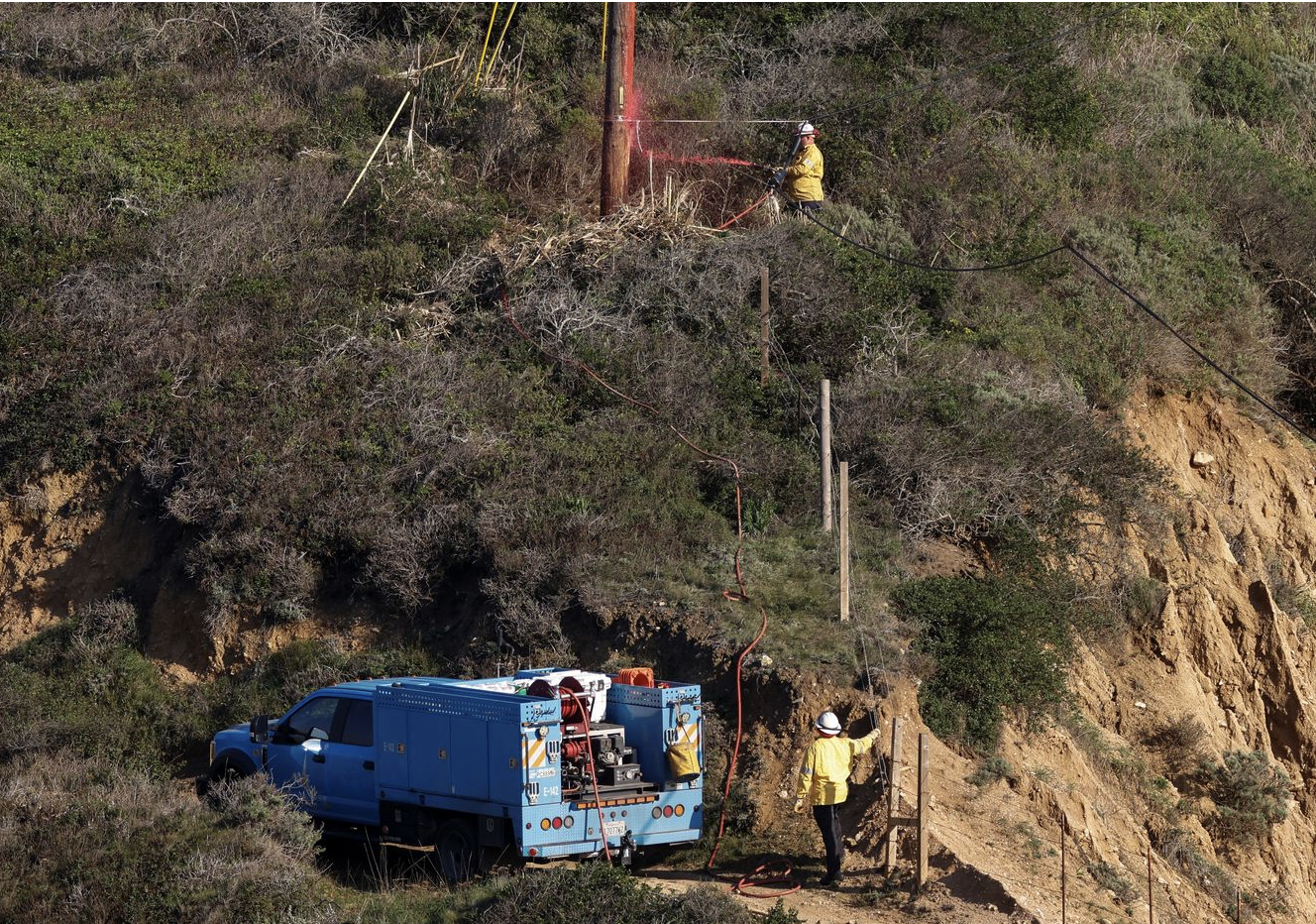
| A PG&E crew sprayed retardant on a power pole near Big Sur, Calif., earlier this year. (Photo by Peter Dasilva, Reuters) |
Northern California's Pacific Gas and Electric needs to address the threat its electrical lines pose in sparking rural wildfires. Its prevention plan will cost billions that the company currently does not have, reports Kathrine Blunt of The Wall Street Journal.
In 2019, the company filed for Chapter 11 bankruptcy protection "to sort through an estimated $30 billion in liability costs stemming from a series of major fires. . . . The company’s lines have ignited more than 20 major fires in recent years, and it pleaded guilty to 84 counts of involuntary manslaughter for its role in sparking the 2018 Camp Fire that destroyed the town of Paradise, Calif.," Blunt notes. "Regulations require it to bolster its system."
PG&E's bankruptcy restructuring has made it difficult for the company to make about $50 billion in investments over the next four years. Its first goal is a "10-year plan to bury 10,000 miles of power lines to safeguard them from sparking on contact with trees and other objects. The company has estimated it will cost roughly $20 billion," Blunt reports. "The company’s options are limited without substantially increasing customer rates, which are among the highest in the nation." PG&E provides electricity and natural gas to about 16 million people.
To address the first goal, the utility is seeking creative financing options. Chief Financial Officer Chris Foster told Blunt, "The company is considering ways to leverage federal funding available for energy and climate investments, including some allocated through the bipartisan infrastructure bill passed late last year. . . . A quantitative constraint in our plan is how quickly we can get back to investment grade because it will make the debt that we have much cheaper for our customers."
Blunt writes, "The company doesn’t need to raise billions of dollars immediately. In the near term, analysts and investors say, it can likely rely on revenue from operations alongside its creative financing efforts." Joe Shaver, managing partner and chief investment officer at Electron Capital, an investment adviser focused on utility and energy companies, told Blunt that he expects PG&E’s share price to keep rising as it makes the investments needed to reduce wildfire risk. Shave said, “They’re not out of the woods yet, and there’s a lot more wood to chop."
Sunday, December 11, 2022
As Democrats turn away from Iowa, some in party see ways to get more rural votes: show up, be humble, value work
![]() |
| Chart shows examples of Third Way analysis that found "most Democratic candidates improved on President Biden's 2020 performance in rural America — with some notable exceptions," such as Black nominees, Josh Kraushaar of Axios reports. |
One step forward, two steps back, rural Democrats might say. The midterm elections showed that Democrats can still win elections with rural votes if they show up and ask for them, but the party's plan to end the Iowa caucuses' first place in the presidential nomination process "is not a great way to mend fences in rural America, where the Democratic brand has become virtually unmarketable," Storm Lake Times Pilot Editor Art Cullen writes in The New York Times, essentially rewriting a column that appeared in his weekly.
![]() |
| Art Cullen |
Becker adds, "RUBI interviewed 50 rural candidates and researched recent studies on what makes candidates successful in rural areas. It distilled the results into 11 recommendations that seem more about respect and common courtesy than political strategy. They include listening more and talking less; respecting the local people’s knowledge and history; being humble and mission-driven rather than ego-driven; focusing on problem-solving; emphasizing involvement in local activities; treating voters of color as individuals rather than voting blocs, as well as not pandering to racism or gratuitously antagonizing white voters."
Friday, December 09, 2022
N.C. county in turmoil over sheriff who made racist remarks, was suspended and re-elected; state investigating election
UPDATE, Dec. 29: "Almost immediately after he was sworn in Thursday morning for what is supposed to be a four-year term, the local district attorney filed a petition in court seeking — for the second time — to have Greene permanently removed from office, the Durham Herald-Sun reports. Greene's swearing-in was "delayed by post-election protests and clouded by state and federal investigations," notes The News Reporter, which published the DA's petition.
![]() |
| Columbus County in North Carolina |
The anger at Greene, the county's first Republican sheriff, is not limited to his racist statement. Jon David, a Republican and prosecutor in Columbus County, "filed an amended petition to the court on Oct. 21 outlining several other allegations against Greene," Schofield writes. "They include having an affair with a detective in the sheriff’s office, firing a Black sergeant, trying to influence county commissioners and failing to ensure proper supervision at the jail." A judge suspended Greene, who resigned but was re-elected shortly thereafter.
The latest grind is the "election board’s ruling to deny two protests" requesting a hearing to determine if Greene was qualified to seek re-election. "Greene, who was suspended and then resigned in October as the county’s first Republican sheriff, won another term with 54% of the vote." The two residents have filed an appeal with the State Board of Elections.
Schofield writes, "The local NAACP held a meeting to discuss next steps. The meeting was advertised as a public event by the Columbus County Democratic Party, but a Border Belt Independent reporter who tried to attend was asked to leave by one of the greeters." She writes that Rev. Andy Anderson, who attended the meeting, told her "that the group discussed strategies to engage Columbus County residents across racial and economic divides."
News-media roundup: Kansas' Hayneses sell their papers; Gannett sells Iowa paper that's challenged by a startup; Cherry Road sells editor paper it bought from Rust in March
![]() |
| Cynthia and Steve Haynes tell their staff about the sale of their newspapers in a video conference call with one of the buyers, Jesse Mullen, at left. (Photo from The Oberlin Herald) |
Brothers Jesse and Lloyd Mullen of Mullen Newspapers have bought six community newspapers in northwestern Kansas from Steve and Cynthia Haynes, longtime industry leaders who are retiring at 74: The Oberlin Herald, the Colby Free Press, the Bird City Times, The Goodland Star-News, The Norton Star-Telegram and The St. Francis Herald, as well as The Country Advocate shopper. Steve Haynes was a nephew of William Allen White, the renowned publisher of The Emporia Gazette. He and Cynthia reflect on 42 years of community newspapering here.
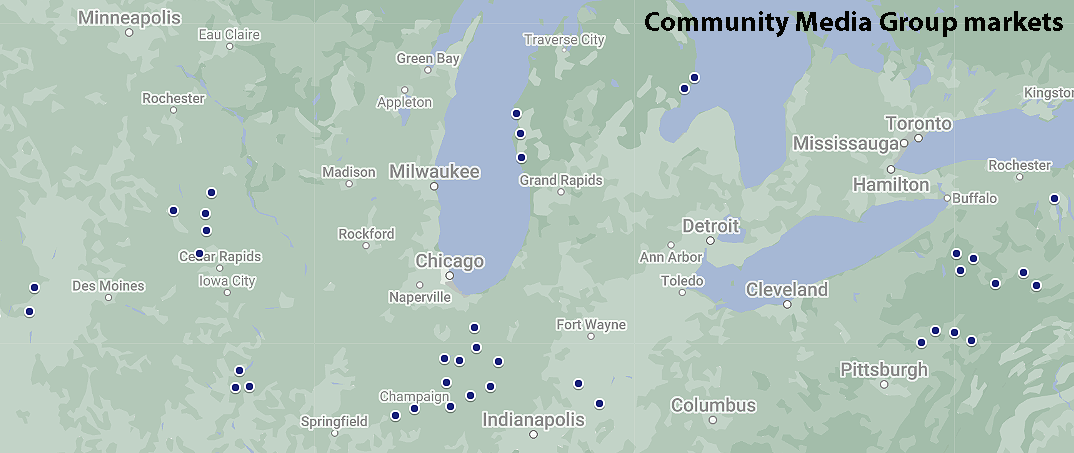
Gannett Co. has sold the Burlington Hawk Eye to an affiliate of Community Media Group of West Frankfort, Ill., which has about 40 papers, stretching from Iowa to western New York, including nearby Fort Madison and Keokuk, Iowa, and Carthage, Ill. As the Hawk Eye declined under Gannett, the Burlington Beacon started up, and owner Jeff Allen tells The Rural Blog that its print circulation "is 2,500 and growing each week. We continue to sell out on the newsstand, and we're looking at adding days of publication." UPDATE, March 4: The Hawk Eye hawks itself.![]() |
| Kyle, Elizabeth, Olivia and Jordan Troutman (Prairie Photography) |
Western Kentucky newspapers are publishing special editions to mark the one-year anniversary of the deadly tornadoes that devastated several towns, the Kentucky Press Association reports. And KPA has scheduled a session at its convention on Jan. 27 on planning for disasters.
Longtime Kentucky sportswriter Keith Taylor became news editor of The Berea Citizen, then the weekly's publisher, and now he's the local volunteer of the year. He reflects on his recent career.
A survey in Great Britain suggests that people don't trust the news industry because they don't understand it. About half said they didn't trust the news media, and only 39% trusted journalists. But that result was correlated with ow levels of news literacy: the ability to critically process, analyze and evaluate news. Respondents were especially unsure about how decisions are made in newsrooms, how editorial standards are applied and how regulation works," Aisha Majid reports for the Press Gazette.
Also from the U.K.: Five tips for increasing reader engagement and loyalty.
If you have a sliver of land, you can build a wildlife habitat
![]() |
| Photo by Andrea Lightfoot, Unsplash |
Jo Ann Baumgarten is director of Wild Farm Alliance, an organization that promotes a healthy, viable agriculture through the protection and restoration of nature. She told Henke that when there’s a lot of biodiversity, the benefits multiply: “Farmers can attract pollinators that help pollinate their crops, and they can attract beneficial insects that help to control pest insects. There are beneficial birds that eat pest insects, weed seeds, and even rodents. Bats are eating insects, and four-footed creatures are eating rodents.”
Before making any changes, take inventory. If you need help figuring out what is good and what isn't, "Extension services, resource conservation districts, and other local groups can offer technical assistance and get you started," Henke writes.
Baumgarten told Henke, "First, you need to look at the climate, the drainage, and soil conditions. If there are problem areas like erosion and invasive species, they should be dealt with first. One of the best things to do is to go someplace wild nearby, look at what’s growing there, and then try to emulate that."
Other substantial tips from Henke include: building a game bird preserve, creating a wild duck habitat, or building brush pile for smaller animals to enjoy.
More women and minorities are hunting, but community support is 'critical' to grow their ranks, study finds
![]() |
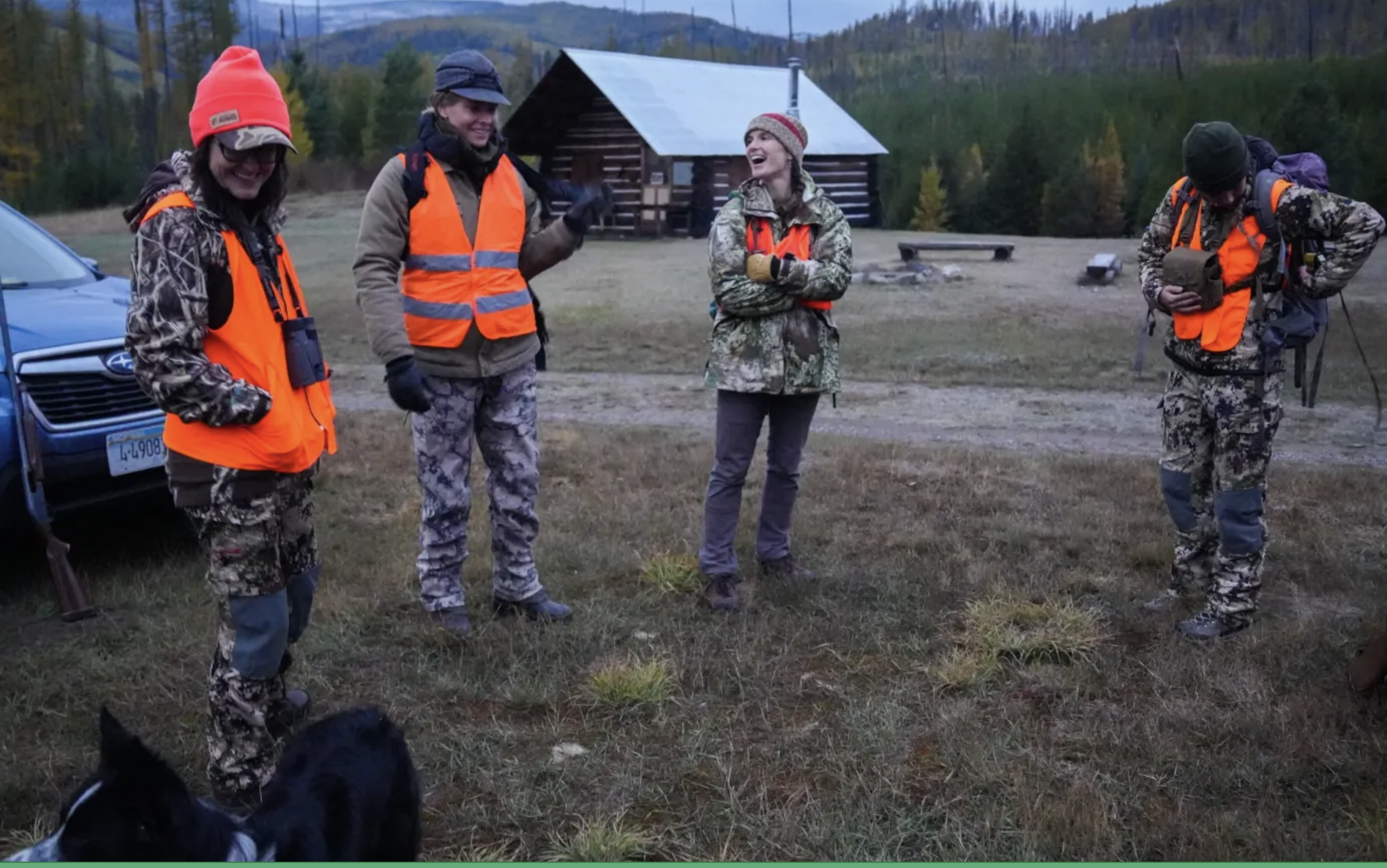
| A women hunting group gathers for 'Ladies Hunting Weekend' in Ninemile, Mont. (Photo by Aj Williams) |
Researcher Ada Smith told Williams that most "hunter recruitment and retention programs have been focused on skill building, but our study shows that it is just as critical for efforts aimed at female hunters to also be geared toward fostering meaningful connections and community.” Women make up only 10% to 11% of all licensed hunters in the U.S.
Smith began hunting in 2019 and is in her third year hosting other female hunters on her family’s land. Williams writes, "Smith hopes to fast-track what many hunters gain through the years: a group of ‘buddies’ that can share hunting tips, resources such as gear and help each other through the process of learning to hunt and harvest."
“I feel equally excited about it [the research] because it resonates with things I’ve been dealing with as a beginner hunter, myself," Smith told Williams. "So, to look at the data then is pretty interesting."
Introducing new groups to hunting helps the sport in two ways: "The majority of federal funding for conservation efforts comes from taxes on guns and ammo. With a long-term trend of decreased hunting across the country, that money is dwindling as well." Williams reports. "For Smith and Metcalf [study researchers], this is why advocacy and outreach efforts have the potential to be impactful even beyond the sport, but to more people who have a stake in sustaining the environments in which they hunt."
Thursday, December 08, 2022
Proponents of journalism-competition bill still voice hope; others say it's probably dead, prefer tax-credit idea
Advocates of the JCPA "remained hopeful that Congress might muster the political will to reintroduce it," Gretchen Peck reports for Editor & Publisher, quoting America’s Newspapers CEO Dean Ridings: "America's Newspapers appreciates the efforts of Senators Amy Klobuchar, John Kennedy and so many others to pass legislation that would enable the family and independently owned newspapers to collectively negotiate for the value of their content. We hope that other members of Congress will reconsider this important legislation that would balance the playing field and compensate our members for the incredible work they do, which is important to virtually every community in the U.S."
Report for America picks several rural newsrooms to get reporters, and some other newsrooms for rural coverage
Among newsrooms selected were the twice-weekly Uvalde Leader-News, serving a Texas town still recovering from a school massacre; the Texas Tribune, for coverage of communities in the Permian Basin, a leading oil and gas field; the Acadiana Advocate, for coverage of rural communities in southern Louisiana; the Mississippi Free Press, for coverage of "educational equity across Mississippi;" The People Sentinel of Barnwell, S.C., for coverage of rural communities in the Low Country; WVIA, the public TV station in Scranton, Pa., for coverage of rural governments; WRMA and Virginia Public Media for coverage of rural health care; and the Cape Gazette of Lewes, Del., for coverage of the town of Milford.
Family cemeteries offer a window into the past, but many if not most are not well tended; who will care for them?
![]() |
| The Swinford Cemetery in Harrison County, Kentucky, is maintained well. (Photo by Michael Swensen) |
![]() |
| Jane Thomas honors her grandfather by tending the family cemetery and beekeeping. (Photo by Jesse Barber) |
Hume tells the story of Jane Thomas, who restored her family cemetery when she moved back to Harrison County "to care for her sick father . . . Thomas remembered her grandfather had once kept bees to make honey. She decided to start the practice again. . . . When she cares for the bees, she sometimes leans down to read the inscriptions on the grave markers."
Family cemeteries may become obsolete, but caring for them may offer solace and grace to some. “There’s a feeling of completion. Like full circle, maybe,” Thomas told Hume. “And I never stop thinking about the fact that I stand on their shoulders. What they went through, and what they endured, and what they did, made it possible for me to be.”
Feds plan to allow addiction-treatment drug to be prescribed via telehealth, since Congress seems unlikely to do so
"Beth Connolly, assistant director of public health at the Office of National Drug Control Policy, said . . . Wednesday evening that the administration is making the move to prevent people from losing access to the drug used to treat opioid use disorder."
The administration has suggested congressional action might be needed "to allow controlled substances to be prescribed via telehealth, lobbyists and research organizations have said it is within the Drug Enforcement Administration’s regulatory power," Smith reports. "A temporary waiver of the in-person prescribing requirements for controlled substances that was put in place during the Covid-19 pandemic expires when the public health emergency ends, expected to be in mid-April," though the Centers for Medicare and Medicaid Services "will reimburse for audio-only initiation of buprenorphine through the end of 2023."
It's cardboard season; ever wonder where it all comes from?
![]() |
| A machine the size of a football field makes paper that becomes boxes. (Photo by Christopher Payne, The New York Times) |
The corrugated-paper industry runs trees through a marathon of steps before a nifty box emerges, writes Matthew Shaer of The New York Times: "Before it was the cardboard on your doorstep, it was coarse brown paper, and before it was paper, it was a river of hot pulp, and before it was a river, it was a tree. Probably a Pinus taeda, or loblolly pine, a slender conifer native to the Southeastern United States."
Shaer met up with Alex Singleton, a manager for International Paper, which produces a third of U.S. boxes. His mission "is to source enough loblollies to help keep IP’s production lines humming." He told Shaer, “You’re sort of always in a race. You learn to get creative.” Singleton manages a group of foresters who "spend much of their time zipping around the Southeast by pickup, using a proprietary smartphone app to monitor tracts of harvestable woodland," Shaer writes.
In the woodyard, the creation begins: "A crane was removing timber from a log truck and feeding it into the bladed mouth of a cylindrical machine known as a debarking drum. . . . It churned and chewed and spit the denuded trees from its rear end," Shaer writes. "Another masticating machine, this one a steel chipper. In went the debarked trees, out came a spray of loblolly pine. . . . chips from the woodyard were entering what’s known as the kraft process (the German word for 'strength')."
Shaer describes the 'paper machine,' which "stretched across almost the entire mill floor and trembled like a space shuttle just before liftoff. . . . Pulp sluiced in and cascaded onto the 'former,' where it was flattened into a paper-like consistency." There are more steps, and the end product is corrugated: "If you’ve stopped to look at an individual panel of corrugate and noticed its resemblance to a deli sandwich. There’s a top and a bottom, and between them is a bunch of ridged or diagonally reinforced filler called 'fluting.' That fluting is what gives a cardboard box its protective quality; without its flutes, corrugate wouldn’t be corrugate at all — it would just be containerboard."
The corrugated cardboard industry is booming, Shaer reports: "In 2021, Amazon shipped $470 billion of goods globally, in an estimated 7.7 billion packages." Happy unpacking!
Income gap between 'Old West' and 'New West' counties grows, as the rich get richer, Brigham Young study shows
![]() |
| Snowbasin Resort in Huntsville, Utah, pop. 700 (TripAdvisor) |
Twenty years ago, two geography professors, "Samuel Otterstrom and Matthew Shumway, conducted an initial study using IRS county-migration data that included income to look at how people and money were moving in and out of counties in the Mountain West. Two decades later, they completed a follow-up study as part of a project for BYU's Charles Redd Center for Western Studies and it was published in Professional Geographer. . . . The data showed that a lot of 'New West' counties had increased numbers of rich people moving in and poor people moving out."
Otterstrom told Wixom, "There were some counties in the study that were considered rural 20 years ago, but because of migration and income change, are now classified as urban counties. . . . Sometimes that rise in cost of living will price out the locals, people who have been there for a while — because they can't afford to live in that town."
Wixom reports, "Other areas, typically the 'Old West' counties, experienced little change in their population and are having to innovate in farming practices to make their economy grow."
The width of the income divide caught the researchers off-guard. Otterstrom told Wixom: "It is surprising just how much these rural communities have grown, compared to other areas. 'New West' income increase by $13 billion from 2012-2019, but 'Old West' counties saw growth up to $342 million, but others lost up to $359 million . . . If you look at the difference, it just totally dwarfs everything. Seeing how migration changed income . . . This data just shows that the rich get richer."
New podcast aims for 'a different discourse' about rural U.S.
![]() |
| (Photo by Judith Prins, Unsplashed) |
The first podcast episode presents Shamokin, Pennsylvania, a coal community where Pipa went to elementary school. He gave Eaton some highlights: “It’s a town that’s been on a long, slow, steady decline since the 1960s when anthracite coal left . . . However, through mine reclamation, they have pieced together 8,000 acres and turned it into a park for motorized vehicles like ATVs and motorcycles. . . . I was really looking for places where there’s forward momentum, and there’s a group of people who are working together to kind of create that vision and move forward. I wanted to show a diversity of places. And show off the diversity of rural America.”
The podcast offers examples of how rural communities can move forward. "Things need to start at the local level," Pipa told Eaton. "We have to be willing to be patient and invest patiently over time . . . include the role of the private sector as well as a theme around the sense of hope for the long haul."
The podcast hopes to catch the ears of policymakers. Pipa said, "I hope that sets us into a different discourse and dialogue, even politically, on what it means to be rural and the value that rural America provides to the United States as a whole."
Black cowboys and cowgirls are not unusual in California
![]() |
|
A touring event for Black cowboys
and cowgirls from across California and the nation. (Photo by Jason Armond, Los Angeles Times) |
Thirty years ago, seeing a Black cowboy was thought 'odd' but "Ron Jennings grew up in Los Angeles, but he’s all country, right down to his cowboy hat and folksy twang," Beason writes. "The 42-year-old smiles when recounting the strange looks he got from fellow passengers during bus rides to his grandfather’s horse stable in Gardena or to participate in rodeos at Griffith Park when he was a teen. The cowboy hat, the bell clanging against the rodeo gear in his bull bag — he came across as an oddity in the city, even more so because he is Black."
In California, there are Black rodeos that attract African Americans from all over the nation: "At the Bill Pickett Invitational Rodeo’s latest stop in Los Angeles, not only are all of the cowboys and cowgirls Black — so are most of the 3,500 spectators," Beason reports. "The air smells of catfish frying and barbecue simmering."
Spectators come from all over to enjoy horses and history. Kairis Chiaji, who belongs to a Black trail riding club outside Sacramento, told Beason, "There’s something special about Black people coming together to revel in this heritage. In these spaces, it’s safe to be us.” Beason writes, "Most of those gathered express a determination to expose Americans to another facet of the West — and the Black experience."
Byron Levy, whose wife also rides, told Beason: “What’s
televised about our culture, it’s always negative — Black-on-Black
murders, but none of this is ever televised — how we get together with
four or five hundred Black cowboys and cowgirls and there’s no incidents. . . . Al Sharpton don’t have to show up."


.jpg)