Tuesday, January 31, 2023

EPA effectively says no to Alaska's huge Pebble Mine, but the 'epic resource battle' is expected to continue in court

Sockeye salmon spawn. (Photo by Loren Holmes, Anchorage Daily News)
To mine
 or not to mine? That has been a 20-year question. Now the Environmental Protection Agency has once again "blocked development of the Pebble Mine project in a corner of the Bristol Bay watershed, a vast and pristine swath of southwest Alaska that sustains the greatest sockeye salmon runs on the planet," reports Hal Bernton of The Seattle Times. "A key portion of land surrounding the Pebble deposit [is now] off-limits for use as a disposal site. . . The decision follows years of legal jousting and regulatory twists and turns . . . in what emerged as an epic Alaska resource battle." And it is likely to continue in court.

Seattle Times maps by Mark Nowlin; top one shows disposal restrictions
"This is fantastic news,” Harry Moore, a lifelong Bristol Bay fisher, told Bernton. “Science prevailed. People prevailed and more importantly salmon prevailed.” Bernton notes, "Moore, largely raised in Seattle and residing in Alaska, joined in protests against the mine in a grassroots organizing effort."

Bernton writes, "The Pebble Limited Partnership, a subsidiary of Canada-based Northern Dynasty Ltd., calls the Bristol Bay deposit 'one of the greatest stores of mineral wealth ever discovered,' including gold, copper, silver and molybdenum. . . officials argued the mine could tap into mineral deposits needed for the transition to cleaner forms of energy, boosting the Alaska economy without harming salmon." CEO John Shively said, “This preemptive action against Pebble is not supported legally, technically or environmentally. As such, the next step will likely be to take legal action to fight against this injustice.”

But the Trump administration also rejected the plan, and “It’s hard for me to imagine a court [overturning] that kind of double shot,” said Bob Perciasepe, a former acting EPA administrator in the Obama administration and head of its air and water divisions in the Clinton administration. He told The Washington Post, “The amount of money that the company would have to continue to be able to put forward to keep the thing active seems difficult.”

The EPA based its decision "on a December recommendation from Seattle-based regional administrator Casey Sixkiller," Bernton reports. "The Seattle EPA regional office, in a document detailing the recommendation, stated that the mine discharges would result in losses and changes to 8.5 miles of streams used by salmon and another 91 miles of waterways that support the salmon streams as well as 2,108 acres of wetlands and other waters."

Appalachian nonprofit's sex education was too sexy for some; sort of harassment that stopped it is seen nationwide

Education group's logo
Sex education in Appalachia has traditionally focused on abstinence and when one group sought to change that approach, it had to stop hosting booths and workshops due to a harassment campaign, reports Maria Godoy of National Public Radio, who says the push against sexual educators is being felt nationwide.

In 2012, a sex-education group called Sexy sex ed began offering workshops to Appalachian youth that focused on a comprehensive sex-education approach. Godoy visited with an educator who was hosting a table at a community art festival in Big Stone Gap, Virginia, pop. 5,206. The table was filled with educational materials and condoms with the group's theme of "CONSENT" emboldened on products. The non-profit group touts a "cheeky, irreverent" approach to sex ed among young people. But this was Sexy sex ed's last event for the foreseeable future:

"The barrage of harassment started in March when conservative activist Christopher Rufo criticized the group on Twitter, among other platforms. He accused the group of offering summer workshop courses for children that discussed graphic sexual practices. Other conservative activists also weighed in." The educator, whom Godoy identified only as Shaylan, said those attacks misrepresented what they taught and to whom: "They put their own spin on it to make it seem as if we were posting an in-person summer camp with five-year-olds, when in reality, the summer camp was virtual. And nobody under the age of 16 attended the summer camp." 

Rufo told NPR in an email that the group was “doing something that was 'way outside the mainstream' and "Sixteen-year-olds are still minors and that the group has a very different definition of age appropriate than most parents."

Nora Gilperin of Advocates for Youth, a national health-rights nonprofit, told Goday that it has seen a surge in harassment and disinformation campaigns against sex education providers since last spring. Gilperin said, “One strategy is to take what is being taught out of context. . . Now many sex educators are afraid to share even basic information like where to get contraception."

Harvard University physician Rebecca Ralston, a native of Appalachian Tennessee who has studied sex education, told Ralston, "The more serious implications here are that people are not going to be using birth control appropriately or at all. . . so for those who do not want to become pregnant. . . they will have very few options."

Monday, January 30, 2023

Paxton Media Group tells at least some local papers to close their offices to the public; target date is Wednesday

One of the nation's leading rural newspaper chains is planning to close at least some of its papers' local offices to the public this week.

In an email to local and area managers, Paxton Media Group said, "To help streamline our efficiencies and processes, and to keep pace with changes in our own industry, we've decided it's best to eliminate our open office hours to the public completely, for the remaining publications in our group."

The meaning of "remaining publications in our group" was unclear. The memo seen by The Rural Blog was sent at least to managers of some papers in Kentucky and southern Indiana, and was a topic of discussion among Kentucky employees last week.

The memo was sent last week and gave a target date of Wednesday, Feb. 1. Paxton managers declined to comment or did not respond to requests for comment on such questions as possible layoffs.

The memo began, "As we all know, the newspaper industry has changed dramatically over the last several years, and especially since the Covid pandemic. Things that we used to see as normal business practices have developed into something completely. We are not unique, as industries all over the globe have changed how they do business."

In recent years Paxton, a family-owned firm based in Paducah, Ky., has become the fifth largest newspaper company in the U.S., in terms of the number of newspapers owned; it has about 125.

The memo anticipated unhappiness: "While we know there are going to be concerns over the inconveniences and perception this might create from a community standpoint, other offices within our company and other newspaper companies have already implemented this practice with nominal fallout, so we know it can be done successfully. Yes, this will be a different approach as to how we run our daily business, but the business world has changed how daily business is conducted."

It made an attempt to limit the fallout: "Ultimately, the community is going to channel the opinions of those in each office, so addressing frustrations internally while being positive externally will be crucial to a more seamless transition."

UPDATE, Feb. 1: The move appears to be the latest in a series. The Kentucky New Era, Paxton's daily in Hopkinsville, Ky., and The Paducah Sun, its headquarters paper, closed to the public during the pandemic and never reopened.

Former CEO of one of largest employee-owned corporations in U.S. dies at 81; business started with one rural grocery

Jimmie Gipson
Jimmie Gipson, who helped transform Kentucky's Houchens Industries from a rural grocery chain into a $3-billion-dollar conglomerate that is one of the largest employee-owned companies in the nation, died Saturday in Bowling Green. He was 81.

Gipson "spent 55 years with Houchens, the last 27 as the chief executive officer. He retired in March 2020, the Bowling Green Daily News reports. He was only the third CEO, following the nephew of the founder: "Ervin Houchens started the company in 1917 with a single grocery store."

Houchens offered stock to its employees long ago, when it was just a grocery chain, and since 1988 they have fully owned it. The company "owns over 25 operating companies in various industries including retail, manufacturing, construction, and insurance," its website says. Its most unusual purchase may have been in 2008, when it acquired the Louisville-based Hilliard Lyons brokerage firm and shared ownership with its employees until 2019.

“We never bought a company just to get bigger, and we never intended to buy a company that wasn’t run by good people,” Gipson told the Daily News in 2020. “If you do that, you’ll generally do well.” He called employee ownership “very gratifying. Years ago, we had a lady who worked in a Houchens store for 40 years. She had more than $480,000 in her retirement account. That’s life-changing for common people.”

Visitation for Gipson will be from 2 p.m. to 8 p.m. Wednesday at J.C. Kirby & Sons Lovers Lane Chapel, and from 10 a.m. to noon Thursday at Hillvue Heights Church, where the funeral will begin at noon. Entombment will follow at Bowling Green Gardens.

Inflation rates omit rural Americans, whom it may hurt more

Data from Bureau of Labor Statistics; chart by The Conversation (click it to enlarge)
This may surprise you: When the Federal Reserve Board meets this week to consider raising interest rates again to fight inflation, rural inflation will not be included in its analysis. "The main indicator of inflation, the Consumer Price Index, is compiled by looking at the changes in price specifically urban Americans pay for a set basket of goods. Those living in rural America are not surveyed," economists Stephan Weiler and Tessa Conroy report for The Conversation, a platform for journalistic writing by academics.

"We believe this poses a problem," Weiler and Conroy write. "People living outside America’s cities represent 14% of the U.S. population, or around 46 million people. They are likely to face different financial pressures and have different consumption habits than urbanites. . . . it may even be masking a rural-urban inflation gap." Weiler and Conroy did their own rural-urban inflation gap research, which outlined some distinctive differences:

Vehicle expenses: "Car ownership is integral to rural life, essential for getting from place to place . . .  Urban residents can more easily choose cheaper options like public transit, walking or bicycling. This has several implications for expenses in rural areas. . . . Longer journeys mean cars and trucks will wear out more quickly. As a result, rural residents have to devote more money to repairing and replacing cars and trucks. . . . Periods of high energy prices, such as the one the U.S. experienced through much of 2022, are likely to disproportionately affect rural residents given the necessity and greater distances of driving."

Food security: "Rural residents already spend a larger amount on eating at home, likely due in part to the slimmer choices available for eating out. This means they have less flexibility as food costs rise, particularly when it comes to essential grocery items for home preparation. And with the annual inflation of the price of groceries outpacing the cost eating out – 11.8% versus 8.3% – dining at home becomes comparably more expensive. . . . Rural Americans also do more driving to get groceries; the     median rural household travels 3.11 miles to go to the nearest grocery store, compared with 0.69 miles for city dwellers."

Health care: Rural residents trend older, "and older people spend more on health insurance and medical services. Medical services overall have been rising in cost too, so those older populations will be spending more for vital doctors visits. . . . On average, rural Americans travel 5 more miles to get to the nearest hospital than those living in cities. And specialists may be hundreds of miles away."

Home energy costs: "Poorer-quality housing leaves rural homeowners and renters vulnerable to rising heating and cooling costs, as well as additional maintenance costs."

Weiler and Conroy note, "While there is no conclusive official quantitative data that shows an urban-rural inflation gap, a review of rural life and consumption habits suggests that rural Americans suffer more as the cost of living goes up. . . . rural inflation may be more pernicious than urban inflation, with price increases likely lingering longer than in cities."

Rural residents, especially Black men, are at increased risk for heart failure, National Institute of Health study finds

Are rural populations at increased risk of heart failure? Yes, and for Black men it's worse. "Adults living in rural areas of the United States have a 19% higher risk of developing heart failure compared to their urban counterparts, and Black men living in rural areas have an especially higher risk – 34%, according to a large observational study supported by the National Institutes of Health," the NIH reports. "Even after adjustment for other cardiovascular risk factors and socioeconomic status."

"We did not expect to find a difference of this magnitude in heart failure among rural communities compared to urban communities, especially among rural-dwelling Black men," said Dr. Véronique L. Roger, the study’s corresponding author and a senior investigator. "This study makes it clear that we need tools or interventions specifically designed to prevent heart failure in rural populations, particularly among Black men living in these areas." Roger is in NIH's National Heart, Lung and Blood Institute.

Study co-author Sarah Turecamo, a fourth-year medical student at New York University Grossman School of Medicine agreed, saying, “It is much easier to prevent heart failure than to reduce its mortality once you have it."

The release outlines broader results: "The study showed white women living in rural areas had a 22% increased risk of heart failure compared to white women in urban areas, and Black women had an 18% higher risk compared to Black women in urban areas. No association was found between rural living and heart failure risk among white men. . . . . Roger, who is also a practicing cardiologist, noted one of the biggest contributors to heart failure is hypertension, or high blood pressure, which Black men experience at disproportionately high levels."

The study, "Rurality and heart failure: The Southern Community Cohort Study," was published in JAMA Cardiology, a publication of the American Medical Association.

Farmer who grew up dirt poor secretly paid for neighbors' prescriptions; he's gone, but legacy of giving is spreading

Hody Childress and daughter Tania Nix (Photo by Ronald Nix)
The kindness of strangers, it seems like a fable . . . or so croon the lyrics of an old Susan Ashton melody.

In Geraldine, Alabama, pop. 910, this fable came to life: "Every month for more than a decade, a local farmer, Hody Childress, had made anonymous cash donations to the pharmacy, Geraldine Drugs, aiming to help neighbors struggling to pay for prescription medication," reports Emily Schmall of The New York Times. "The wider community learned of his good deed only after he died at 80 in January. Now, his family and donors from across the United States have vowed to continue his legacy."

Schmall shares a recent example: "When the doctor saw what a hornet sting had done to Eli Schlageter, 15, causing his mouth and throat to swell, his advice to Eli’s parents was unequivocal: Get an EpiPen. . . . But they were stunned to learn that a single dose of the lifesaving drug cost $800 . . . So, to help the family, the pharmacist, Brooke Walker, turned to an envelope full of carefully folded hundred-dollar bills from an anonymous donor."

Childress's giving often made a difference. "Over the years, Dr. Walker said, the fund had helped at least two people a month who didn’t have insurance or whose benefits didn’t cover their prescription medicine," Schmall reports. Eli Schlageter's mother, Bree Schlageter, told Schmall, “What he doesn’t know, now that he’s in heaven, is that he helped a kid that works on a farm that he started. Look at that circle.”

Geraldine and DeKalb County (Wikipedia)
Now it spawns other circles. "Ms. Nix and her family and Dr. Walker have received calls and messages on social media from people across the United States wanting to donate," Schmall reports. "Last week, Dr. Walker received a check from someone in Tennessee. On Monday, a person called from Miami. He told her that unless she needed the money, he was going to approach his local pharmacy and start his own Hody Childress account."

Childress "grew up poor, surviving with his family on subsistence farming and by hunting small game," Schmall reports. His son said the house had no electricity until his father was about 7. His daughter, Tania Nix, said, “Giving that way, that just got on his heart and he felt like he needed to do it.”

UPDATE, Feb. 3: Nix and her brother told Steve Hartman of CBS that their father was "nearly broke" at his death because he had spent $10,000 or more helping people pay for prescription drugs.

Opinion: Organic farms are paying off as financiers provide the land and tenant farmers cultivate the crops

A twist on organic farming is blooming into profits, opines Peter Coy of The New York Times. The set-up looks like this: Garrett Mussi, a farmer in California's San Joaquin Valley, "doesn’t own any of the acres he tends so carefully. He is a tenant farmer. The owner of the land is Farmland L.P., an investment fund that buys farmland and readies it for certification as organic by the Department of Agriculture: using pesticides sparingly, and only the least harmful kinds; minimizing erosion; sequestering carbon in the soil; rotating crops regularly and providing habitats for butterflies, bees and other pollinators. Some organic farmers use ladybugs to eat aphids and owls to eat rodents. . . . What we have here is finance meeting farming and doing good, not evil."

NYT illustration; images by VectorGoods and Bablab/Getty Images
Federal crop insurance "incentivizes farmers to stick with one crop — typically industrial corn or soybeans — and make heavy use of fertilizers and pesticides," Coy writes. “Companies such as Farmland are thinking further ahead while still keeping financial principles and profit in mind. Farmland bought one 4,000-acre farm that grew mainly low-value alfalfa, feed corn and processing tomatoes, assessed the ideal uses for different sections based on soil conditions and other factors, and chose to go with blueberries, olives, nuts, garden vegetables and pasture in various areas — all grown without heavy-duty pesticides." Craig Wichner, the founder and managing partner of Farmland, told Coy: “At a very simple level, our business model is based on taking high-quality land that’s growing low-value crops and converting it to higher-value crops.”

Coy writes: "Going organic isn’t cheap. Farmland has to stop using industrial-strength pesticides and fertilizers on land for three years before it can meet the Department of Agriculture’s standard for organic farming. . . . The upside is that consumers are willing to pay more for organically grown food. . . . For organic farming to catch on, young people will have to embrace it. But most can’t afford to because of the sky-high cost of agricultural land. . . . It’s as if tech start-ups had to buy their own office buildings before they could go into business, Wichner told Coy. Investors in companies such as Farmland are essentially supplying farmers with the 'office buildings' they need to work their food-producing magic."

Saturday, January 28, 2023

Flora and fauna: Bear under a deck, ants to smell cancer, a vaccine for bees, a mini-horse for joy, Huron microbes . . .

L: Appearing to sport a headdress, a Polish rooster stands tall for his portrait. R: Show chickens like this Polish hen, are bred for external attributes, such as color patterns and feather shapes. (Photos: Alex Ten Napel for National Geographic)

A "totally unfazed" black bear dozes underneath a
comfy deck. (Photo by Vinny Dashukewich)
Why did the chicken cross the road? To get to the catwalk. Eggsperts agree, chickens have it all; and the photographers say the models are much more agreeable to work with than their fussy human counterparts.

When you find a black bear hibernating under your deck, what do you do? A family in Plainville, Connecticut, decided to let the bear snooze on.

Thundersnow is mysterious and rare. It's also being studied as a reliable indicator that a windfall of snow is coming.

What's better than a horse? A mini horse! This 33-inch mini Appaloosa brings joy to children with life-threatening illnesses from rural York County, Pennsylvania, to "anywhere people need a lift."

Gas exploration, cruise ships, and military operations have all made the ocean a lot louder for dolphins. Researches look at how dolphins attempt "shout" to communicate, but it doesn't always work out.

Researcher Rosa Vásquez Espinoza deep dives into oligotrophic Lake Huron to understand how life on Earth evolved through studying microscopic life. She believes this data "is the missing key to better conservation of Earth."

Sea lion, seals and Washington's endangered salmon: What can be done to help salmon return to its once robust numbers?

One day ants may able to replace expensive testing to sniff out cancer tumors. This new study puts the keen-nosed ant to the test with some surprising results.

American honey bee pollination supports more than $18 billion in U.S. crops each year, but bee hives have been struggling. In a bit of good news, a vaccine aimed at protecting honeybees from American foulbrood is being developed.

Thursday, January 26, 2023

The Rural Blog will not be updated tomorrow, unless . . .

. . . we run across a head-slapping, time-sensitive story. We'll be with our friends at the Kentucky Press Association convention. We plan to be at several other state news-media meetings this year! Below, Jay Nolan of Nolan Media Group stands with the display of front pages he produced.


The pandemic and the internet changed how rural seniors exercise; now their 'online classes are here to stay'

Virtual exercise classes offer options to rural or homebound seniors. (Photo by Christina Saint Louis/KHN)
To stay fit no matter where they live, older Americans have put remote fitness options more in play: "After widespread lockdowns began in March 2020, agencies serving seniors across the U.S. reworked health classes to include virtual options," Christina Saint Louis reports for Kaiser Health News. "Isolation has long since ended, but virtual classes remain. For older adults in rural communities who have difficulty getting to exercise facilities, those virtual classes offer opportunities for supervised physical activity that were rare before the pandemic. And advocates say online classes are here to stay."

Jennifer Tripken, associate director of the Center of Healthy Aging at the National Council on Aging, told Saint Louis, “We found that remote programming, particularly for rural areas, expanded the reach of programs, offering opportunities for those who have traditionally not participated in in-person programs to now have the ability to tune in, to leverage technology to participate and receive
the benefits.”

Saint Louis writes: "Since April 2020, the National Council on Aging has organized monthly conference calls for service providers to discuss how to improve virtual programs or begin offering them. . . . In 2022, at least 1,547 seniors participated in an online fitness program through Juniper, part of a Minnesota Area Agency on Aging initiative. More than half were from rural areas. Because of grant funding, participants pay little or nothing. . . . AgeOptions, an Illinois agency serving seniors, said last year that their operations 'may have changed forever' in favor of a hybrid model of virtual and in-person classes."

Options for technologically challenged seniors also exist. "A fall-prevention program licensed by Western Kentucky University combines exercise and health education with bingo — can use a printed copy of the game card mailed to them by AgeOptions if they lack the proficiency to play on the game’s app," writes Saint Louis. "Either way, they’re required to participate on video." Jason Crandell, the creator and international director of Bingocize, told Saint Louis, "From when the pandemic began to now, we’ve come light-years on how that is done, and everybody’s getting more comfortable with it."

'Social investment platform' for Central Appalachia says it has rounded up $19 million and is already funding projects

Invest Appalachia Fund's logo
Central Appalachia has a shortage of many things, but one that doesn't get talked about much is the lack of capital for investment in businesses than can rebuild the local economy now that coal is such a smaller part of it. Now a venture-capital firm that calls itself "a regional social investment platform" says it "has secured $19 million of new investment" and is already investing in projects.

Invest Appalachia CEO Andrew Crosson told The Rural Blog that his fund has invested in real estate for downtown revitalization, "support for consumer and business lending for flood-impacted communities" in Eastern Kentucky, "solar and energy efficient equipment for a rural grocery store, and expansion of rural eye care clinics." He said in an email that he couldn't give specifics because "these deals aren't public yet" but said his priorities are "downtown revitalization/community-focused real estate, solar and energy efficiency for rural businesses and institutions, and community health facilities and social enterprises."

Crosson's press release said Invest Appalachia has involved "six years of in-depth stakeholder planning" and "is connecting local communities to national investors through a cutting-edge impact investment model . . . in an underinvested region with a history of economic exploitation." It defines its region as the Appalachian counties of Kentucky, West Virginia, Virginia, Tennessee, North Carolina and Ohio.

The release says 90% of the $19 million in the Invest Appalacha Fund is "new capital from outside the region, and the IA Fund has a target of $40M total by November 2023. The lead investors for the IA Fund are UnitedHealth Group, the Robert Wood Johnson Foundation, and the Appalachian Regional Commission," a federal agency. "Other first close investors include Sugarbush Valley Impact Investments, Laughing Gull Foundation, and Cassiopeia Foundation."

“We need an economy where everyone can see a place for themselves, and Invest Appalachia will help move the region in that direction,” Crosson said in the release. “IA is rooted in place and designed to meet the needs of Appalachia’s underserved communities. This deeply collaborative model puts impact and community interests first, while also providing a large-scale opportunity for national impact investors.”

The release added, “Central Appalachia is home to hardworking, creative, and resilient communities whose people and natural resources have fueled the economic growth of America for generations. Now, despite chronic underinvestment, persistent poverty, and other entrenched barriers to opportunity, the region has created its own momentum toward economic transformation and community revitalization. To achieve its full potential, the region requires innovative, scalable, and justice-centered investment approaches that create equitable economic opportunity for generations to come. IA is part of a movement to tell a new story about Appalachia that is led by communities and shows what is possible for the region’s future.”

Several tribal schools get help to re-create playgrounds, which are distinctly important to rural communities

(Photo by Joshua Coleman, Unsplash)
Hey, kids! What's more fun than recess? A recess with equipment in the shade! Schoolyard play will now be more engaging at several tribal schools: "The partnership, known as the Tribal Community Schoolyards Pilot Program, will work with nine tribal schools to enhance nature-based spaces to support environmental justice and outdoor learning," reports Kristi Eaton of The Daily Yonder. Tony Dearman, director of the Bureau of Indian Education, told Eaton, “This initiative provides opportunities for nature-based learning that promotes health, community, and the celebration of cultural identity.”

Danielle Denk, the Trust for Public Land's Community Schoolyards Initiative director, notes the importance of rural schoolyards: "The schoolyards in rural places become that civic destination, a place to come together and celebrate, and really have the kinds of facilities that advance healthy play, and group recreation,” she told Eaton. “We see all kinds of celebrations happen in rural communities in our school yards, where we wouldn’t see those happening, necessarily, in an urban schoolyard, because there’s a lot more facilities to support the needs."

Christie Abeyta, superintendent at Santa Fe Indian School, which will participate in the pilot, told Eaton that the school's students got involved, “I think having our students drive some of the conversation and being able to provide input is going to be helpful." Abeyta noted that school officials and students had been partnering the University of New Mexico to create design options.

“We do see these being really wonderful green oases for learning and for playing and for the community to come together,” Denk told Eaton. “And so, there’s not going to be a one-size fits all approach at all. And with the cultural specificity, anytime you work outdoors in the public realm, there’s a real opportunity to make it unique to make it speak to the kind of the essence of that community.”

President Biden is halfway through term, but not halfway through his promises, PolitiFact analysis concludes

Chart by PolitiFact, The Poynter Institute
Promises, promises. As President Biden hit the two-year mark, PolitiFact measures how well he is doing at his job "by examining what he’s accomplished so far: PolitiFact’s Biden Promise Tracker monitors 99 promises Biden made on the campaign trail," amy Sherman writes. "Our latest review shows Biden was able to implement some promises on his own, such as nominating a Black woman for the U.S. Supreme Court. But many promises stalled in Congress because of slim Democratic majorities or, in the case of forgiving some student debt, setbacks in the courts."

Sometimes Biden can't "make good" without Congress. John P. Frendreis, a Loyola University emeritus professor of political science, told PolitiFact, "The change in House control makes it impossible to move any promise forward if it requires congressional action."

PolitiFact's evaluation is "based on outcomes, not intentions. Only full enactment of a promise qualifies for a Promise Kept; partial enactment merits a Compromise rating," PolitiFact says.
 
"So far, Biden earned a Promise Kept rating for about one-quarter of his promises, and a handful of promises received a Compromise rating. About one-third of his promises are rated In the Works, and almost one-third are Stalled. Biden received a Promise Broken rating on his pledge to block hydraulic fracturing on federal land."

Highlights from the findings of PolitiFact, whichn is a service of The Poynter Institute:
  • Biden made progress on job creation and the economy, but not on raising the minimum wage
  • He got Covid-19 under control and scored wins on health care
  • He has struggled to deliver primises on immigration
  • He made progress on some foreign policy promises and got big win on climate

Wednesday, January 25, 2023

Teacher shortage leaves many rural and minority students without teachers, as administrators struggle to fill positions

Teacher shortages leave students learning via software or on their
own in Rosedale, Miss. (Photo by Rory Doyle, The Washington Post)
To raise educated citizens, the U.S. needs good teachers, but from state to state, the system is falling short with rural and minority students, and "rural and Southern states face a crisis," reports The Washington Post.

"The nature and the severity of the teacher crisis differ radically from state to state, district to district and even school to school," Moriah Balingit writes. "Some districts have only recently started experiencing teacher shortages, but in many Southern states, the problem has been long-standing and only gotten worse. . . . In rural Mississippi, the geometry teacher is a recording. The chemistry students often teach themselves."

Balingit uses West Bolivar High School in Mississippi as an example: "The school is 98 percent Black, and 100 percent of children qualify for free or reduced-price meals," and keeping the school staffed is a "high-wire balancing act that relies on long-term substitutes, virtual classes and hiring educators to teach subjects they have no training in. Before Supt. Will Smith arrived, the district had hired so many uncertified educators that it risked losing accreditation." Will Smith asked Balingit, “It’s not fair, but what else do we have?”

Balingit writes: "The importance of teachers cannot be underestimated. Research suggests that they matter more to a child’s learning than any other school-based factor, including the condition of the school building or the principal. Teachers not only affect academic achievement, they can also influence the likelihood a child will graduate from high school and how much they’ll learn over the course of their lives, researchers found. For children whose teachers are underqualified, inexperienced or nonexistent, the stakes are high. . . . Researchers have found that schools that serve high percentages of minority students and students in poverty have more difficulty finding and retaining qualified educators than whiter, more affluent schools."

The national teacher shortage began after the "2008 Great Recession, when the nation’s public education system lost more than 120,000 teachers," Belingit reports. "When the economy rebounded and schools started hiring again, they found that many of those who had left were reluctant to return. There have been other factors, too: The number of people entering teacher training programs dropped by about one-third between 2008 and 2019."

Rosedale, Mississippi (Wikipedia map)
A teacher shortage meant states needed to offer greater salaries; however, "Two years ago, Mississippi came in dead last in average teacher pay, according to a National Education Association report, at a little less than $47,000 a year," Balingit reports. And schools like West Bolivar became "like a lot of communities in the region, the county is rich in culture, history and community pride but economically poor, having lost population when manufacturing jobs left and agriculture became more automated. Those who remain send their children to deteriorating schools that their districts struggle to run because of a dwindling tax base and a state legislature reluctant to fund schools at the per-student rate the law is supposed to guarantee."

For school administrators, teacher recruitment and student achievement are ongoing stressors. Smith told Balingit: “When you get that email, you’re jumping. You have to quickly call the candidate and have a talk before they get hired by somebody else. . . . At the end of the day, you’re still expected to produce the results. None of the excuses are going to matter.”

Walmart raising minimum hourly wage to $14 from $12; its pay scale influences those of many other rural employers

A Walmart checkout line (Photo from Walmart)
Walmart, which is the nation's largest employer and has a huge rural footprint, is raising wages for hourly workers in stores and warehouses. Starting pay next month will be at least $14 an hour, up from $12, the company said in a memo to staff Tuesday. 

"The company’s move could lead to wage pressure in lower-income areas where it is one of the main employers," Sarah Nassauer and Gabriel T. Rubin write for The Wall Street Journal. "Some economists have found that Walmart’s market power is a primary determinant of wage levels in local economies where they have a large presence, especially at other retailers and grocery stores."

Noting the company's more rural and Southeastern base, the Journal says "That means more of its 4,600 stores and warehouses are in states such as Texas, Mississippi and Georgia that haven’t adopted higher minimum wages in recent years. Twenty states don’t have a minimum wage higher than the federal minimum of $7.25 an hour, "which was last raised in 2009," the Journal notes. "More than half the states in the U.S. are set to lift their minimum wages in the coming year, although due to the tight labor market, employers have in many cases needed to offer pay significantly higher than the legal minimum in order to attract and retain employees."

Walmart's starting-pay hike is "the latest in a series of increases by the company to close the gap with rivals," the Journal reports. It "will push the company’s average hourly wages to over $17.50. Currently hourly workers at Walmart earn an average of around $17, a spokeswoman said." But its minimum will still be below the $15 minimum at its major rivals, Target and Amazon, which have a $15-an-hour minimum wage, and Costco's minimum is even higher, the Journal reports.

Rural nursing homes closing because they can't find staff, uprooting residents who thought they had a forever home

Marjorie Kruger and son Dan White at the Evangelical Lutheran Good Samaritan
Society nursing home in Waukon, Iowa. (Photo by Tony Leys, Kaiser Health News)
Rural nursing homes are closing due to shortages of workers, and "The problem could deepen as pandemic-era government assistance dries up and care facilities struggle to compete with rising wages offered by other employers, industry leaders and analysts predict," reports Tony Leys of Kaiser Health News.

"Many care centers that have managed to remain open are keeping some beds vacant because they don’t have enough workers to responsibly care for more residents," Leys reports, noting shortages of "nurses, nursing assistants, and kitchen employees."

Last year, 13 of the 15 Iowa nursing homes that closed "were in rural areas, according to the Iowa Health Care Association," Leys reports. Brent Willett, the association’s president, told Leys, “In more sparsely populated areas, it’s harder and harder to staff those facilities,” partly because many rural areas have fewer working-age adults.

The closure of a nursing home or assisted-living facility can have traumatic effects on residents and their families. "The lack of open nursing home beds is marooning some patients in hospitals for weeks while social workers seek placements," Leys reports. "More people are winding up in care facilities far from their hometowns, especially if they have dementia, obesity, or other conditions that require extra attention."

Leys starts his story with Marjorie Kruger, 98, who "was stunned to learn last fall that she would have to leave the nursing home where she’d lived comfortably for six years" in Postville. She told him, “The rug was taken out from under me. I thought I was going to stay there the rest of my life.” Her son found her another home, "but she misses her friends and longtime staffers from the old one," Leys writes. "The Postville facility’s former residents are scattered across northeastern Iowa. Some were forced to move twice, after the first nursing home they transferred to also went out of business."

Rural America lacks lawyers, and only a few states are addressing the problem; go 100 miles for a will or a divorce?

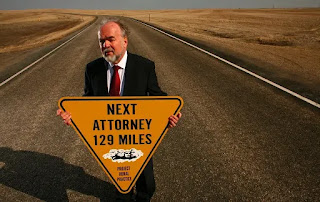
In 2013 David Gilbertson, then chief justice of South Dakota, posed
with a sign he ordered. (New York Times photo by Matthew Staver)
"You're going to need a lawyer for that," pretty much everyone says at some point in time. But in rural areas, that lawyer is a lot harder to find: "Despite efforts in recent years by a handful of states, universities and legal associations to ease the problem, there remains a glaring lack of lawyers in many far-flung places," reports Elaine S. Povich for Stateline. "This leaves those areas and their residents without easy access to legal advice for family issues, wills, estates and property transactions, in addition to any criminal or civil legal disputes. Residents often have to drive long distances to another city or rely on remote video meetings."

Sam Clinch, associate executive director of the Nebraska State Bar Association, which has few lawyers outside Omaha and Lincoln, told Povich, “That’s an access problem when you are asking someone to drive 100 miles or more to do a simple will or a simple divorce." Povich notes, "Nebraska has a small state loan repayment program to help a few attorneys who agree to practice rurally; in a decade, the program has placed 39 lawyers in rural parts of the state."

Povich reports, "Some 40% of all counties in the United States — 1,272 of 3,141 — have fewer than one lawyer per 1,000 residents, so few that they are considered 'legal deserts,' according to the most comprehensive survey of attorneys available, conducted by the American Bar Association in 2020. . . . Nationwide, there are roughly four lawyers for every 1,000 residents, but those numbers don’t mean much because so many lawyers are concentrated in cities. . . . South Dakota is one of the few states where the legislature and governor agreed a decade ago on a plan to attract lawyers to rural areas." The state has few attorneys outside urban centers such as Rapid City and Sioux Falls. 

Povich notes that South Dakota's program is an exception. Lisa Pruitt, a law professor at the University of California, Davis and lead author of an article titled "Legal Deserts: A Multi-State Perspective on Rural Access to Justice," published in the Harvard Law & Policy Review in 2018, told Povich: “In most states, the relevant institutions are not willing to do this because constituencies are not strong enough. It’s hard to get lawmakers or The State Bar of California to care about rural people and places because there is no power there.” Povich notes, "A search of the California legislature’s database turned up no bills specifically designed to address the issue over the past several sessions."

Other states are showing some progress. Maine managed to open a "legal clinic in Fort Kent, a city on the Canadian border, and funded it at $600,000, according to Senate President Troy Jackson. In an interview, Jackson said while there was little opposition, some residents of other rural parts of the state thought maybe they should get a clinic too. That discussion was put off, but he expects others to make the case if the first program is a success," Povich reports. "Nebraska’s program, the Legal Education for Public Service and Rural Practice Loan Repayment Assistance fund, last fiscal year paid 34 recipients between $1,000 and nearly $5,000 toward their law school loans if they work in designated rural areas, according to an email from Jeffery A. Pickens, chief counsel of the Nebraska Commission on Public Advocacy. . . .To entice them, he said, the program’s advocates talk about experience rather than money."


Close encounters of the critter kind: Wildlife cameras catch interspecies meetings, caused in part by human activities

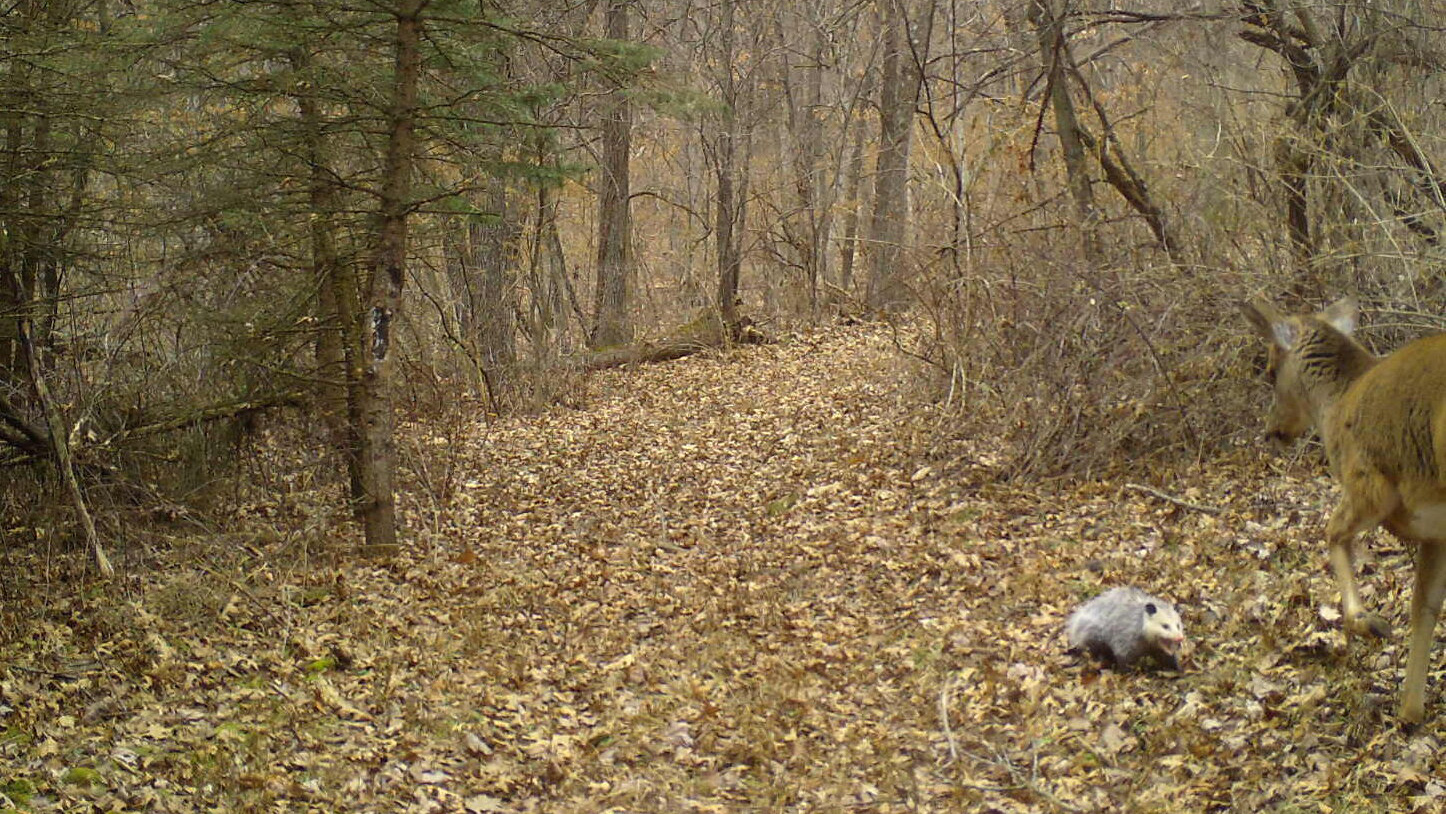
An opossum confronts a deer in a surprise encounter. (Photo via DNR Snapshot Wisconsin)
A turkey and a fawn in a close encounter (DNR Snapshot Wisconsin)
Even in the forest, timing is everything: "Hours, minutes or even seconds can make the difference for an animal between stumbling upon a predator and avoiding one, between finding a bush loaded with berries and discovering branches that have already been gnawed bare," writes Emily Anthes of The New York Times. "Now, a new study reveals how humans might unwittingly rewrite these ecological scripts, altering how the characters interact and fueling more interspecies encounters."

Anthes explains: "Neil Gilbert, a postdoctoral researcher at Michigan State University, and his colleagues analyzed images captured by Snapshot Wisconsin, a citizen-science project run by the Wisconsin Department of Natural Resources. Since 2016, volunteers have deployed more than 2,000 wildlife cameras across the state . . . Wild animals of different species were more likely to lead overlapping lives — appearing at local camera sites in quicker succession — in human-altered landscapes, like farms, than in more undisturbed locations, such as national forests," researchers reported in Proceedings of the National Academy of Sciences.

Anthes notes that human land use
Not all meetings are interspecies. ((DNR Snapshot Wisconsin)

"can squeeze animals closer together, increasing the odds that they bump into each other . . . Although more research is needed, that interspecies squeeze could have effects such as making it harder for prey to evade predators, intensifying competition for resources or increasing the risk of interspecies disease transmission, the researchers say." Benjamin Zuckerberg, an ecologist at the University of Wisconsin-Madison and an author of the study, told Anthes in an email, “The compression of species niches will likely lead to new interactions among species with unknown consequences.”

"The cameras, which are triggered by motion and body heat, have captured a menagerie of animals going about their everyday lives: bald eagles scavenging in the snow, bear cubs climbing trees, a newborn fawn, a bevy of otters gamboling down a grassy trail," Athens reports. "The time intervals between detections varied enormously. Sometimes the cameras captured the odd animal couples in the same frame; other times, days or weeks might pass between their appearances. But overall, across all animal pairs, the trend was clear: In relatively pristine habitats, such as national forests, roughly six days elapsed, on average, between detections. In the most human-altered habitats, that interval dropped to an average of four days.

Jennifer Stenglein, a state research scientist, said the study illustrates the potential for using wildlife cameras to probe aspects of animal behavior that might otherwise be difficult to observe.

Turkeys keep close watch on a sandhill crane. (Photo via DNR Snapshot Wisconsin)

Tuesday, January 24, 2023

Consolidation of groceries has greater impact in rural areas but some small-town markets find ways to survive

Cover of Economic Research Service report
The consolidation of groceries is greater in rural areas, according to a new study from the Economic Research Service of the U.S. Department of Agriculture.

“Food retailing markets in rural and small non-metro counties are considerably more concentrated than food retailing markets in metro and large non-metro counties,” the report says.

"That means for many small town residents, buying food requires driving to Walmart a few towns over or trying to make do with prepackaged and canned foods available at a Dollar General," reports Jonathan Ahl of Harvest Public Media.

The report "shows the percentage of grocery sales from the nation’s top 20 retailers more than doubled from 1990 to 2020," Ahl notes. "Even as small, full-service grocery stores become less common, some small-town grocers are finding ways to stay competitive, while in other communities, they’re banding together to start their own."

Ahl cites Sanborn Foods in Sanborn, Iowa, a a town of 1,400. Owner Scott Vogelaar "joined the Associated Wholesale Grocers, a co-op of small stories based in Kansas City. . . . He also works to differentiate his store through quality and service in particular departments," meat and produce.

"When the supermarket closed in Mount Pulaski, Illinois, a community-owned grocery store took its place," Ahl reports. "In 2020, Market On The Hill opened in the town of 1,500 people. The store focuses on locally grown and made foods to help differentiate themselves from national chains several miles away, as well as the dollar store that opened in town."