Monday, December 19, 2011

Iowa farmers say climate is changing, and a plurality point at least in part to human activities

A poll of Iowa farmers has found most of them believe the climate is changing, and a plurality think it is caused by a mix of natural changes and human activities. It was the first Iowa State University Farm Poll to ask such questions, and it surprised extension sociologist J. Gordon Arbuckle Jr.

“There’s been quite a bit of rhetoric over the years coming from farm groups and other agricultural interests about climate change,” Arbuckle told Brownfield News, “and a lot of discussion of how the jury is still out, it’s very uncertain whether or not climate change is occurring—and if it’s occurring, then what is it attributable to? So I was probably a little bit surprised at the magnitude of agreement that climate change is actually occurring, among farmers.” To hear the interview, click here.

The mailed poll found that 68 percent of the farmers who returned it said climate change is occurring, while 28 percent said there is not enough evidence to know for sure, and only 5 percent said it is not occurring. Among those who believe in climate change, 23 percent said it is caused mostly by natural changes in the environment; 10 percent said it is caused mostly by humans; and 35 percent said it is comes from a mix of natural changes and human activities. Thus, 45 percent of those who believe the climate is changing attributed it partly or fully to humans.

The poll found relatively little trust in mainstream news media, radio talk-show hosts, environmental organizations and government agencies as sources of information on climate change:

The poll questionnaires were mailed in January and February; usable surveys were received from 1,276 Iowa farmers, whose average age was 65. For the ISU press release, click here.

Rural places more dependent on Social Security; program has major economic impact

Social Security means more to rural areas, some of which are growing more dependent on the program, Roberto Gallardo and Al Myles of the Southern Rural Development Center at Mississippi State University report for the Daily Yonder. They conducted a study of Social Security's impact on the U.S. economy using figures from 2009. They report the program has greater impact in rural areas, where 21.6 percent of the population receives a monthly check. Payments to rural areas totaled $675 billion in 2009, with 9.3 percent of those counties' total personal income coming from Social Security. (Yonder map shows trend in counties' Social Security dependence)
In 2009, more than 51 million people, or 16.7 percent of the population, received "disability, survivor or retirement benefits" from Social Security. Gallardo and Myles say slight changes in the program could have a "tremendous effect" on the economy. "If Social Security payments were reduced by only 5 percent, the nation’s economic output would decrease by $63 billion, 419,000 jobs would be lost and tax revenues would decrease by $7.8 billion,"they write.

The researchers developed an index which shows how dependent individual states and counties are on the program. The index includes three factors: "the percentage of total county population receiving Social Security; the percent of a county’s total personal income derived from Social Security; and the average per capita payment in a county (that is, the total amount of Social Security received in a county divided by the total number of residents)." To measure the increase or decrease in dependency, they compared data from 2000 to data from 2009. The 10 most dependent counties are rural and in the following states: Florida, Michigan, Idaho, Missouri, Texas and Arkansas.

The researchers found that "for every dollar of Social Security payment, an additional 80 cents of economic output was created. At the national level, Social Security’s $675 billion in payments in 2009 supported a total output in the nation of $1.2 trillion. These payments supported approximately 8.4 million jobs, full and part-time. And this activity generated $157.2 billion in tax revenues, which amounted to $71.9 billion in state and local taxes and $85.2 billion in federal taxes." (Read more)

Utah Highway Patrol Assn. taking crosses from public lands after Supreme Court lets ruling stand

In October the U.S. Supreme Court decided not to hear two cases surrounding the Utah Highway Patrol Association's placement of memorial crosses at sites where troopers had died. Now three state agencies want the memorials removed, and the troopers are complying. Ten of the 14 crosses are on state land. (Deseret News photo by Stuart Johnson)

Warren Richey of the Christian Science Monitor reports the case originally went before a federal judge who dismissed it, agreeing with the UHPA's statement that "the cross is a recognized symbol of death, not an endorsement of a particular faith," Richey reports. Then the case went before Senior Circuit Judge Davide Ebel of the Denver-based 10th U.S. Circuit Court of Appeals, who concluded "the cross memorials would convey to a reasonable observer that the state of Utah is endorsing Christianity," violating the separation of church and state. (Read more)

Now three state agencies have asked the UHPA to remove all memorial crosses on public lands, Jared Page of the Deseret News reports. "Pursuant to prior agreements, you are hereby requested to remove the memorials from the land controlled by this agency at your earliest convenience," letters from the Department of Transportation and the Division of Facilities Construction and Management said to UHPA President Chad McWilliams. The third letter from Utah Highway Patrol Supt. Daniel Fuhr only calls for the removal of UHP logos. The UHPA has already removed the UHP logo from the 14 crosses, adding notes that the crosses are private memorials and are not an endorsement for any religion, Page reports. The UHPA says it will move all crosses to private property and give the court a timeline and locations. (Read more)

Ex-forest chief says timber payments should be based on counties' need, or ecology and recreation

In 2000, Congress passed the Secure Rural Schools and Community Self-Determination Act, to guarantee timber revenue to counties with much of their property in non-taxable national forests. The program expired in September after a parlous existence of several years, and the recent budget debate may replace it with a previous payment program that was, and would be, less reliable. Former U.S. Forest Service chief Dale Bosworth, left, gives an overview of the previous system, proposals before Congress and other options to continue paying counties in an op-ed piece in the Los Angeles Times. (High Country News photo)

The previous system gave local governments 25 percent of the revenues from their county's timber harvest. Bosworth writes such a system is unpredictable and would likely reduce payments to counties at times because the amount of timber harvested and the price of timber fluctuate.

President Obama has proposed phasing out the program over a two-to-five year period and funding payments from the already strapped Forest Service budget. This means the program would have to be reauthorized annually through the appropriations process, making it "difficult for many counties to provide basic services," Bosworth writes. A draft bill in the House "proposes a timber-only approach in which logging would pay for all future federal payments to counties" and would lead to more lax environmental laws and more federal spending, Bosworth writes. The Senate proposes using the current system at reduced levels for the next five years.

Bosworth says Congress should "deliver payments to counties based on economic need" or "link funding to efforts by counties to improve ecosystems and recreation opportunities on federal lands." After all, if the bill is not reauthorized, the Oregon State University Rural Studies program estimates that Oregon could lose about 4,000 jobs and be forced "to make deep cuts in school funding", not to mention how it would impact other states with national forests. (Read more)

College wins $30 million grant to help students in 3 poor Ky. counties; program's only rural grantee

Berea College in Kentucky is the only rural applicant to win one of five implementation grants from the Promise Neighborhoods Program, designed to improve the educational and developmental outcomes of children and youth in America's most distressed communities.

Berea will get a first-year grant of $6 million, totaling up to $30 million across the five-year life of the grant, which will support implementation of cradle-to-career services to improve the educational achievement and healthy development of children in Kentucky's Clay, Jackson and Owsley counties. The college was one of three rural applicants to get a planning grant last year; the others were in the Mississippi Delta and the Northern Cheyenne Indian Reservation.

“We feel privileged to be selected as the only Promise Neighborhood grantee working in rural America,” outgoing Berea President Larry D. Shinn said in U.S. Department of Education news release. “We take the responsibility of service to communities beyond Berea very seriously and feel an even greater responsibility to serve well the Promise Neighborhood communities.”

Education Secretary Arne Duncan said, “Promise Neighborhoods recognizes that children need to be surrounded by systems of support inside and outside of the classroom to help them be successful in school and beyond.” Plans for the project "include a range of services from improving a neighborhood’s health, safety, and stability to expanding access to learning technology and Internet connectivity, and boosting family engagement in student learning, the news release said. For teh national release, click here.

They shoot horses, don't they? Yes, that's the only vet-endorsed method, and it can easily fail

A month after the U.S. ban on horse slaughter was overturned, horse advocates, animal-rights activists and politicians are wondering if horses can be killed humanely. Jake Nichols of JH Weekly in Jackson Hole, Wyo., reports about the complexity of horse slaughter.

According to hidden-camera footage and documents obtained through the Freedom of Information Act, the inhumane treatment suffered by horses in Mexican-run slaughterhouses is "grisly." Nichols reports details of the slaughter, which leaves the horse fully aware of being paralyzed and later killed by having its throat slit. He reports this is the unintended result of the forced closure of U.S. slaughterhouses in 2007.

Nichols reports anti-slaughter activists say horses will never be killed humanely despite suggested USDA inspections. They rely on a 900-page FOIA-obtained report from a Texas slaughterhouse, Dallas Crown, which allegedly reveals abuse. Sue Wallis, a Wyoming state representative and United Horsemen member, told Nichols the allegations are false, saying USDA inspectors must be present during and after any animal is killed for human consumption. She said the USDA dealt appropriately with every case pointed out by activists.

The American Veterinary Medical Association endorses only one method for killing horses humanely: shooting in the forehead with a bullet or a 4-inch captive bolt, and even with the latter, "about the size of a roll of quarters . . . Workers sometimes need to shoot three or four times before the horse stops moving," Christopher Beam wrote for Slate in 2009.

"Horses, because of their size, are not good candidates for euthanasia by drugs – death can take hours," Nichols writes. "Dr. Temple Grandin, a noted autistic and designer of livestock handling facilities, says she struggles with her feelings about horse slaughter plants." She said at the recent Summit of the Horse "that she is skeptical whether a horse slaughter facility can ever be made humane. Horses are slaughtered using the same method as cattle. The problem is, Grandin said, that they are nothing like cattle. A horse’s flight instinct works contrary to cattle’s huddling behavior when scared, making the recommended 95 percent first-attempt kill shot difficult to achieve."

Since the ban was lifted, Congress hasn't set appropriations for Department of Agriculture inspections of horse slaughterhouses, estimated to cost $5 million annually. Chris Heyde, deputy director of government affairs for the Animal Welfare Institute, told Nichols he would be surprised if the government found money for inspections when there is such pressure to reduce its budget deficit. (Read more)

Proposed Pennsylvania law would restrict local governments' control over gas drilling

Pennsylvania lawmakers are working to approve legislation to impose "an impact fee on oil and gas companies," and tucked into that legislation is controversial language removing zoning authority over drilling from municipalities, Amanda Cregan of phillyburbs.com reports. This means towns could no longer restrict or ban drilling.

The state's Oil and Gas Act requires companies to obtain a permit from the state Department of Environmental Protection, and some areas like those covered by the Delaware River Basin Commission and several townships have additional restrictions. If lawmakers approve the legislation, the state will control where and how drilling happens. "Natural gas wells could be placed anywhere and everywhere across communities," Tracy Carluccio, deputy director of the Delaware Riverkeeper Network, told Cregan. "In residential neighborhoods, on preserved lands and historic sites, next to schools and day care facilities, in close proximity to municipal water reservoirs . . ."

Actually, the state can deny permits if it believes drilling will have a negative impact on "public resources, like historical sites, endangered habitats and drinking water supplies," Cregan writes. But Carluccio has little faith the DEP will do that. "I think it's a quid pro quo," Carluccio told Cregan. "It says 'OK, we'll pay something, but you've got to make it easy for us'." Steve Forde of the Marcellus Shale Coalition has a different view, telling Cregan that gas drilling supports 300,000 jobs in Pennsylvania with average pay of $74,000. "The new legislation would protect that job development" and give landowners interested in selling mineral rights some consistent regulations, he said. (Read more)

Saturday, December 17, 2011

Administration decides on first mercury rules for coal-fired plants; to be announced next week

"The Obama administration finished crafting tough new rules Friday curbing mercury and other poisons emitted by coal-fired utilities, according to several people briefed on the decision, culminating more than two decades of work to clean up the nation’s dirtiest power plants," Juliet Eilperin and Steven Mufson report for The Washington Post.

"As part of last-minute negotiations between the White House and the Environmental Protection Agency, the regulations give some flexibility to power plant operators who argued they could not meet the three-year deadline for compliance outlined by the EPA. Several individuals familiar with the details declined to be identified because the agency will not announce the rules until next week."

The new limits on mercury, acid gas and other pollutants "represent one of the most significant public health and environmental measures in years," the Post reports. "The rules will prevent 91 percent of the mercury in coal from entering the air and much of the soot as well: According to EPA estimates, they will prevent 11,000 heart attacks and 120,000 asthma attacks annually by 2016. Frank O’Donnell, who heads the advocacy group Clean Air Watch, told the Post, “I think this will prove to be the signature environmental accomplishment of the Obama administration.”

Friday, December 16, 2011

Illegal pot farms on public land still an issue

The Bureau of Land Management and the U.S. Forest Service have been responding to illegal marijuana growing on public land for a long time, but are concerned about recent developments. In Northern California, pot farms have increased violence in once sleepy rural towns, and Mexican nationals have migrated to Ohio national forests to grow pot. Energy and Environment News' April Reese provides a nice round-up of issues surrounding illegal marijuana growing on public lands, mostly national and state forests. (BLM photo: BLM workers clean up a marijuana farm after destroying plants.)

Reese reports federal officials have said illegal marijuana plots "harm native plants and wildlife, contaminate streams and cut off public access." This is particularly true in the West, where David Ferrell, director of Forest Service law enforcement, told Reese there are plenty of "remote sites with thick vegetation cover, good soils and easily accessible water sources." The sophisticated operations often involve upwards of 1,000 plants covering as much as 20 acres, with financial incentives totaling as much as $3,500 per processed plant.

In response, the Forest Service, BLM, the National Park Service and local and state law enforcement have "stepped up efforts to find growing operations in the past five years." Over the past two fiscal years combined, over 7 million plants were eradicated. Volunteers, and sometimes the National Guard, have helped the Forest Service clean up after crops are destroyed, which can cost between $15,000 and $20,000. Last year, $3.5 million was spent for clean-up. Despite efforts, though, officials tell Reese "the extent of the problem continues to place a strain on resources." (Read more)

Hunting grounds near schools make parents uneasy; most states and towns lack protective laws

Two students were shot during basketball tryouts at Harwell Middle School in Edinburg, Texas. Irresponsible hunting or target shooting on leased land may be to blame for the shootings. Many rural schools are near hunting grounds and many state and local governments have little regulations in place to protect students.

In Texas, Harwell and the neighboring elementary school are surrounded by hunting lands, as are Clinton Elementary and Pena Elementary in Penitas, KRGV Channel 5 reports. Mike Cox, spokesman for the Texas Parks and Wildlife Department, told The Associated Press he was unaware of a "specific law or regulation that prohibits hunting close to public buildings, such as schools and hospitals," but it is illegal to "discharge firearms within city limits or along public roads."

In North Carolina, parents in Gastonia raised concerns about gunshots fired near an elementary school but police said the rabbit hunters had valid permits and did not believe they were too close to the school, WSOC Channel 9 reports. A city ordinance says landowners with at least 15 acres "can apply to the chief of police to use shotguns or .22 caliber rifles with shot load ammunition on their property" but "no firearm can be discharged within 500 feet of any occupied home or building." (Read more) Statewide, there are no regulations "prohibiting hunting near schools in unincorporated areas of counties," Brent Ward, a North Carolina wildlife officer, told WRAL-TV. Target shooting is limited to a minimum of 100 yards from occupied buildings. (Read more)

Natural-gas boom may create basic chemical manufacturing renaissance in Appalachia

Officials in Appalachian states are hoping the natural-gas boom will attract more than just controversy to their economically struggling region. Pennsylvania, Ohio and West Virginia are offering tax breaks and incentives to "ethane crackers," or the multi-billion dollar plants that start the chain of making ethylene, a basic feedstock for chemical plants, reports Gabriel Nelson of Energy and Environment News.

No ethane cracker has been built in the U.S. since 2001 because natural-gas prices were too high, and most production was sent overseas. Since new deposits, such as those in the Marcellus Shale, have been tapped, crackers are now cheaper in the U.S. than anywhere except the Middle East. The U.S. ethane supply has grown by 25 percent over 10 years, and because it's harder to transport than methane, cracking plants must be located close to drilling sites. Nelson reports if ethane supplies stay at current levels, petrochemical companies will spend over $16 billion on pipelines and crackers.

However, the threat of new gas-industry regulations has companies worried. They've warned anything that makes gas production more expensive will threaten construction of crackers. Nelson reports the industry is lobbying against regulations, including those against hydraulic fracturing, as environmentalists and public health groups are calling for more rules to protect human health and water supplies. (Read more)

New law in W.Va. aims to regulate gas industry while attracting new chemical companies

In response to controversy surrounding hydraulic fracturing and the possibility of attracting chemical companies to the Marcellus Shale region of Appalachia, the West Virginia legislature passed the Natural Gas Horizontal Wells Control Act this week. Gov. Earl Ray Tomblin said in a press release the bill will "open the door to new job opportunities and reasonable regulations for Marcellus shale development" and protect communities, surface owners and waterways.

Brett Dunlap of the News and Sentinel in Parkersburg, W.Va., reports the bill increases permitting fees "from around $400 to $10,000 for an initial well and $5,000 for each additional well... that should provide the $2.4 million annually the Department of Environmental Protection needs to close a deficit in its oil and gas division while fielding 14 additional well inspectors and support staff." The bill also says wells must be kept 250 feet from a water well, 625 feet from occupied houses and 1,000 feet from a public water supply intake.

The Charleston Gazette's Ken Ward Jr. writes on the newspaper's watchdog blog, Sustained Outrage, that the governor hoped new legislation would help continue the boom and attract "ethane crackers," or chemical plants that create ethylene from drilling byproducts, to the state. He says, though, the bill is "almost exclusively aimed at pleasing industry and weakening the legislation."

State transportation budget cuts mean 'huge inequities' between urban and rural schools

Many California schools face transportation budget cuts as Gov. Jerry Brown announced a $248 million cut from home-to-school transportation. The state has reimbursed 35 percent of transportation costs, but will reduce it to nearly 17 percent if this proposal goes through, Marc Benjamin of The Fresno Bee reports. California is not the only state considering cuts to school transportation, but what many states fail to realize is the impact is much greater to rural schools than urban.

Sierra Unified, a school in Auberry, Calif., will lose $335 per student if these cuts go through while Burbank Unified in Los Angeles County will lose only $10 per student, Benjamin reports. This creates "huge inequities," Stephen Rhoads of the California Association of School Transportation Officials told Benjamin. Rhoads is working with others to produce a budget that distributes those cuts evenly between districts.

If Brown's proposal becomes law, transportation funding will be cut at the end of January, leaving many rural districts using general funds for transportation. "We are not going to stop transporting kids to schools, John Clements, transportation director for Kings Canyon Unified School District, which transports about 44 percent of its 10,000 students, told Benjamin. "The funding will come out of our reserve in our general fund," taking funds from classrooms. The result may mean larger class sizes, fewer employees, and reduced services for students, Supt. David East told Benjamin. (Read more)

Economic growth in farming region is higher than in urban areas, but gap may only be temporary

Economic "growth in the areas of the region and country tied to agriculture and energy are outpacing urban areas," Creighton University economist Ernie Goss told Steve Jordon of the Omaha World-Herald. The driving factors, at least in the 10 states Goss surveyed, are "global demand for grain and other food commodities, along with consumption of corn to produce ethanol."

The survey of bankers revealed a sharp increase in the farm land price index, marking the 23rd straight month of growth. The farm equipment sales index was also up from November. The economic growth may only be temporary, Goss warns, as Europe's financial problems slow growth in agriculture and energy, making the U.S. dollar stronger compared to other currencies. This may mean lower farm and energy prices for the first half of 2012, Jordan reports.

USDA secretary tries to clarify, defend child farm-labor rules; cites high accident and death rates

For the first time since the U.S. Labor Department proposed new child farm labor regulations, Agriculture Secretary Tom Vilsack is speaking out in an attempt to clarify and defend the proposals. It is a counter to the wealth of arguments from the agriculture community, reports Julie Harker of Brownfield Ag News. Vilsack said he wants to clear up "concern and confusion" in rural America about the proposal.

Vilsack writes on the USDA blog that "good old-fashioned farm work" has been "a longtime way of life that has helped make this country strong, and it teaches kids lessons that last a lifetime," but while "only 4 percent of working youth are in the agriculture sector, 40 percent of fatalities of working kids are associated with machines, equipment, or facilities related to agriculture. That’s way too high. We don’t want to blur the line between teaching kids about a good day’s hard work, and putting them in situations more safely handled by adults."

He says the Labor Department is "not proposing any changes to how a son or daughter can help on their family farm," and "there is nothing in the proposed rule that affects the ability of parents and families to assign chores and tasks to their children." He adds the proposed rule respects the structure of farms in rural America, including partnerships and LLC's. He says the department is only trying to protect the safety of children hired to work on farms.

Vilsack said comments about the proposal received by the agency during the extended comment period that ended Dec. 1 "ensured everyone had an opportunity to provide input." The agency wants to "ensure that children of farm families maintain their ability to help with the family farm, while working to prevent unnecessary child injuries or deaths," he says, and adds that in the months ahead, USDA will continue to work with the Department of Labor "to find a common-sense approach to strengthening our agricultural economy and keeping our farm kids safe." (Read more)

Meanwhile, the Labor Department issued a fact sheet on the proposal.

Thursday, December 15, 2011

To protect elk and livestock, U.S. agency considers again shooting wolves from airplanes

Federal agencies that protect recovering wolf populations in the West are now considering killing some of them from planes to protect wildlife and livestock, reports Kim Murphy of the Los Angeles Times.

Officials have secretly deployed sharpshooters in helicopters to kill wolves in the past, but Idaho officials said this week they would consider redeploying this program to kill up to 75 wolves threatening elk near the Montana border.

A 2006 photo (above) depicting a U.S. Wildlife Services plane decorated with 58 paw-print decals representing each wolf killed by shooters was recently published by Ken Cole on the Wildlife News blog, Murphy reports. He told her there's been a culture within the agency depicting wolves as the enemy, and "putting stickers representing your kills on the side of your plane is a pretty good representation of that." Lyndsay Cole, spokeswoman for the U.S. Department of Agriculture, told Murphy the stickers "represent wolves lethally removed for confirmed depredation on livestock or livestock protection dogs, with permission from the wolf management agency." They were approved by Idaho Wildlife Services, but were removed in 2009 after officials "recognized that they would be considered offensive by some individuals."

Wildlife management officials say a crucial part of helping wolves, livestock and humans coexist in the West has been removing those known to repeatedly attack sheep, cattle or prized game populations. However, wolf conservation advocates say there's no need to kill wolves from planes, and that the action provides "evidence of a cavalier attitude among federal agents whose aerial operations sometimes leave wolves painfully wounded for days before dying." (Read more)

Nurse practitioners are filling gaps in rural health care created by doctor shortages

Nurse practitioners are playing an increasingly crucial role in rural communities that have no primary care doctors or little access to them, reports Robert Joiner of the St. Louis Beacon. He writes about nurse practitioner Laurie Beach, who owns and operates the Pilot Grove Rural Health Clinic in Pilot Grove, Mo. She sees thousands of patients a day from within a 50-mile radius, and health-care providers in Missouri use her as an example of nurse practitioners' growing role in rural communities.

Even though nurse practitioners have advanced medical training and can perform many of the same tasks as primary care doctors, some patients still don't accept them as a replacement for doctors, probably because of the misguided idea that they are less capable than doctors, Joiner reports. He says they educate their patients and are often more empathetic. They also compliment the work of primary care physicians. (Read more)

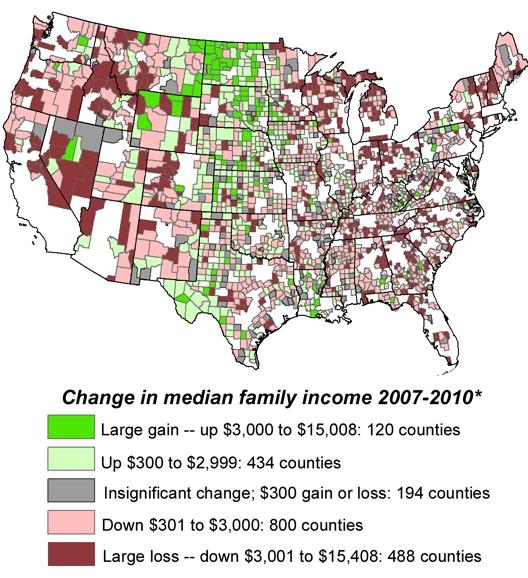
Family median income in most rural counties fell during the last three years

The median family income decreased in seven out of 10 rural counties from 2007 to 2010, according to census data, reports Bill Bishop of the Daily Yonder. The national median income last year was over $50,000; only 120 rural counties out of more than 2,000 had higher median incomes. (Yonder map; click for larger version)
Regions that saw large decreases in median income are parts of the West, New England, the Upper Midwest and the Southeast. Most high-income areas were metropolitan, which contained 68 percent of counties in the top quarter in terms of family income. The highest median incomes in rural America were in Virginia, where two rural counties last year saw incomes that exceeded $100,000. The five states with counties having the lowest median family income are South Dakota, Kentucky, Mississippi, Alabama and Texas. (Read more)

USDA urges farmers to limit use of fertilizer to protect waters

America's farmland is generally over-fertilized and pollutes waterways with an abundance of nitrogen and phosphorus, NPR's Dan Charles writes on his blog, The Salt. To reduce the amount of agricultural nutrients in waterways, the U.S. Department of Agriculture has drafted the National Nutrient Management Standard, which outlines ways farmers can reduce spreading nutrients outside their fields.

Charles says the rules involve "putting farmland on a sensible diet," in which the land is "fed" only what it needs. Farmers are also instructed to not apply fertilizer, even manure, when crops don't need it, and to try and capture excess nutrients though planting "cover crops" that will trap nitrogen before it reaches waterways.

The nutrient guidelines are not enforceable regulations, though states can make them mandatory, Charles reports. However, the head of  USDA's Natural Resources Conservation Service, Dave White, has said farmers will adopt the practices out of "economic self-interest" because fertilizer is expensive and wasting it costs money. Self-interest can work against a nutrient-reduction solution, though, Charles says, because an experiment at Michigan State University's Kellogg Biological Research Station showed nitrogen-reduction plans require farmers to "scale back their expectations modestly, rather than pursuing the highest yields of the most profitable crop, which is corn." (Read more)

Drilling companies working against local regulation

Increased and intensive natural-gas drilling, often in areas unaccustomed to it, has left local governments wondering how much control they have through zoning laws over companies' actions, reports Sabrina Tavernise of The New York Times. Local governments consider drilling an industrial activity, similar to a cement factory or gas station, and think it should be subject to zoning; companies say local regulations on top of state rules are overly burdensome and are hindering potential to provide jobs in tough economic times.

In Pennsylvania, the state legislature is considering a bill that would "sharply limit a community’s right to control where gas companies can operate on private property," giving an advantage to companies and weakening local zoning powers, the Times reports. In New York state, local governments have used zoning laws to enact rules limiting drilling noise, lighting and distance of drilling sites from homes. A spokesman for Range Resources, a Texas company, told Tavernise zoning laws were "like having to get a different driver’s license in every town." (Read more)

Wednesday, December 14, 2011

National report shows state education funding decreases as Medicaid costs increase

An analysis of state spending over recent years shows Medicaid budgets have been increasing steadily while education spending has decreased, reports Michael Cooper of The New York Times. This has implications in rural states that have historically housed a high number of Medicaid-eligible people. The National Association of State Budget Officers analysis says reasons for these budget shifts come from the "lingering economic downturn" and the overall struggling economy. As more people qualified for the program and medical costs rose, more stimulus money was pumped into it, increasing its overall budget. In 2009, Medicaid accounted for 21.9 percent of all state expenditures; this year, the estimate for state Medicaid expenditures is 23.6 percent.

Cooper reports education spending has decreased from 21.5 percent to 20.1 percent over the same period. In 1987, education got the largest amount of state spending, but in 2003 Medicaid became the largest state expenditure for the first time. The margin between the two used to be small, but for the past three years, Medicaid's lead has steadily increased. The report warned that states are likely to face "austere budgets" in coming years because of an uncertain economy, reduced federal aid, costs of the health-care overhaul and pressure to pay for pensions and health care for retired workers. (Read more)

Nationwide, especially in rural areas, food banks struggle to meet increasing demand

Calvary Food Pantry in Auburn, New York, has seen a "25 percent increase in foot traffic compared with previous years," director Nancy Sheffield told Nate Robson of The Citizen, and this food bank is not alone. Food banks all across the country are struggling this holiday season as poor economic conditions and changing demographics have increased demand in many communities.

The number of people needing assistance has increased. Kathleen Stress, chief operating officer for the Food Bank of Central New York, told Robson her 11-county region has seen an increase of 2 percent in the past year, but the need is even greater in rural communities. A Catholic Charities site in Boyes Hot Springs, Calif., had almost 27 percent more people seek assistance a few weeks ago, Kerry Benefield of The Press Democrat in Santa Rosa, Calif., reports, and many rural distribution sites' posted hours include the caveat "or until the food runs out."

Where is the additional need coming from? An increasing number of moderate to low-income families and military personnel are seeking assistance, Stress told Robson. Another growing population seeking assistance is senior citizens, Robson reports. Connie Briglin, coordinator of Cato Christian Food Pantry, has seen more elderly seek assistance after the loss of a spouse and the spouse's income. (Read more)

Donations at many food banks have also decreased. In Sonoma County, Calif., donations of food an money are down as much as 30 percent compared to 2010, Benefield reports. The Bay Area Salvation Army in California shows a 20 to 25 percent decrease in food donations, Amy Hollyfield of ABC7 News reports.

Over 1.6 million children are homeless in America; how does your state rank in their care?

One in 45 American children experience homelessness annually, according to a new report from The National Center on Family Homelessness. This is an increase of 38 percent during 2007 to 2010. Alabama is ranked the nation's worst state for well-being of homeless children. "The problem is even worse in rural counties throughout the state, where there are no shelters and fewer agencies to assist homeless families," Joan Wright of Childcare Resources in Birmingham told WIAT News.

Mississippi, Arkansas, Arizona and California finish out the five worst states for well-being of homeless children. Vermont, Minnesota, Nebraska, North Dakota and Maine were ranked as the five best. To see where your state ranks, click here for an interactive map.

Looking at trends in child homelessness from 2006 to 2010, researchers ranked states based on "the extent of child homelessness, child well-being, risk for homelessness and state policy and planning efforts," the center said in a news release. The recession is considered to be the contributing factor for the increase in homeless children, Ellen L. Bassuk, president and founder of the center and associate professor of psychiatry at Harvard Medical School. "There are more homeless children today than after the natural disasters of Hurricanes Katrina and Rita."

Medicaid cuts blamed for increase in suicides in rural West; rugged lifestyle also a factor

Suicide is increasing in rural America, mostly in Western states like Idaho, Wyoming and New Mexico, and mental-health professionals say it's a direct result of Medicaid cuts, the recession and the culture of the West, Alan Farnham of ABC News reports. According to a 2009 report by the Idaho Council on Suicide Prevention, someone commits suicide every 35 hours in the state. The report says suicide is a "major public health issue," and has a devastating effect on families, churches, businesses and schools.

Suicide rates have always been high in rural places, but the most recent national data shows suicide is the second leading cause of death among Idahoans aged 15 to 34. The state ranks sixth on a list of number of suicides per 100,000 people. The top five, in order, are Alaska, Wyoming, New Mexico, Montana and Nevada. Co-chairman of the Suicide Prevention Council, Kathie Garrett, told Farnham the recent struggle with poor economy and unemployment put a lot of stress on people, and to save money, they would skip doctor visits as well as cut back on taking medication. She added Medicaid cuts have reduced the number of mental-health services available, including the closure of mental-health offices, which has a big impact on a state like Idaho, where the closest therapist in some cases is 160 miles away.

Kim Kane, executive director of Idaho's Suicide Prevention Action Network, told Farnham the prevalence of guns in Western states is also a factor in high suicide rates. Last year, 63 percent of Idaho suicides involved a gun; the national average of gun-related suicides is 50 percent. Both she and Garrett told Farnham "the West's pride in rugged individualism can prevent people from seeking help," he reports. Kane said people feel like they should be able to "pull themselves up by their mental bootstraps." Idaho is the only state that does not have a suicide prevention hotline. (Read more)

Arizona officials are working hard to increase Mexican gray wolf numbers

Mexican gray wolves used to roam the rural southwest before humans nearly wiped them out almost 100 years ago. Now, officials hope to restore the Mexican wolf population to at least 100, reports Joanna Nellans of The Daily Courier in Prescott, Ariz. The first wolves reintroduced to the wild were released in 1998, and in 2002 the first wild pup was born to wild parents. Now, at least 50 wolves can be found in east-central Arizona and west-central New Mexico. (Photo by Les Stukenberg, The Daily Courier: Tasai, one of the two Mexican gray wolves at the Heritage Park Zoological Sanctuary in Prescott.)

The field team leader for Arizona Game and Fish program, Chris Bagnoli, outlined for Nellans the importance of this particular wolf. They are the smallest and most distinctive subspecies of gray wolves, and were the first to cross the Bering Strait to North America. Though many view the wolf as a "majestic creature that symbolizes freedom and nature," the Game and Fish website says "many people do not feel that wolves should be roaming free in Arizona." That's partly why the Heritage Park Zoological Sanctuary highlighted the Mexican wolves' story during their Centennial Zoofest last month. The zoo is also involved in the recovery program.

Nellans reports federal and state officials have struggled with the recovery program. The wolves aren't allowed to roam outside a 9,000-square-mile area, and if they do, officials kill or capture them. They meet the same fate if caught killing livestock. Recent wildfires in Arizona forced wolf packs to move their dens, but most wolf killings are committed by people who illegally shoot them. New Mexico has dropped out of the recovery program, but Arizona Game and Fish Commission wants the wolves de-listed as federally endangered so the state could have more control over recovery efforts, making them more affordable, effective and efficient. (Read more)

Tuesday, December 13, 2011

Natural gas companies generally don't tell landowners about potential drilling risks

Natural gas companies reveal the risks of hydraulic fracturing (explosions, leaks and spills) to their shareholders, but not to landowners, according to a report released yesterday by the Environmental Working Group, reports Neela Banerjee of the Los Angeles Times. The report reveals companies that have led the push to drill in the Mid-Atlantic and Northeast described in "explicit terms" to shareholders the risks of fracking. However, the companies and the land acquisition companies working for them "did not mention to landowners the same potential safety and environmental risks."

One company, Cabot Oil & Gas, said in a 2008 securities filing of the company's performance about the risks involved with fracking: "Our business involves a variety of operating risks, including: well-site blowouts, cratering and explosions; equipment failures … pollution and other environmental risks." But Craig Sautner and his wife Julie said in the report "they were never told of any risks when they leased about 3.5 acres of their land in Dimock, Pa., to Cabot in 2008." After drilling began, their well-water became contaminated, as well as the water of 18 other Dimock families. Cabot disputed the findings and would not respond to Banerjee for comment.

Jack Norman, chief executive of Elexco Land Services, a property acquisition company, said his company doesn't disclose as much to landowners as it does in securities filings because the actual risk of accidents is low. He told Banerjee companies don't benefit from disclosing risk to landowners: "No one is going to go out there and say something like, 'At one of every 10,000 of our wells, we may have an incident.' No one will do it." Authors of the report say companies "clearly have a double standard" when discussing risk with landowners and shareholders, saying because landowners are not warned of potential risk, they are signing legally binding contracts without understanding their property, health, finances and communities are at risk. (Read more)

Postal Service delays action on office closures until May 15, hoping for more help from Congress

The U.S. Postal Service announced today that it would delay the closing or consolidation of any post office or mail processing facility until May 15, 2012. The service said it was responding to a request from 18 Democratic senators who wrote, "While we may have very different views on how to financially improve the postal service, we all believe that democratically elected members of the Senate and the House have the responsibility to make significant changes to the postal service."

The service will continue public meetings and other steps required for closure of the facilities it has placed under review. "Given the Postal Service’s financial situation and the loss of mail volume, the Postal Service must continue to take all steps necessary to reduce costs and increase revenue," it said in a statement. It said it was delaying action to facilitate help from Congress

The service's solutions to its financial crisis involve things that would have a big impact in rural America, including the closure of many rural post offices and changes to first-class mail delivery. Missouri Rural Crisis Center Program Director Rhonda Perry says these changes will affect rural senior citizens and veterans the most.

She told Julie Harker of Brownfield News that seniors are less likely to pay their bills online and many aren't able to travel long distances to get their mail if their local post office closes. “It is a very serious issue for farmers, for rural families and really, particularly, for senior citizens who often don’t have the ability to travel and to connect in other ways," she said. She added that changes in mail delivery could also mean serious medication delays for veterans in rural areas who are completely dependent on the Department of Veterans Affairs and the Postal Service for receiving all their medications. (Read more)

New study links mountaintop-removal coal mining to long-term damage to water supplies

A new scientific study released today "confirms the pervasive and irreversible impacts of mountaintop-removal coal mining here in Appalachia," writes Ken Ward Jr. of The Charleston Gazette on his Coal Tattoo blog. "Cumulative Impacts of Mountaintop Removal Mining on an Appalachian Watershed" appears in the Proceedings of the National Academy of Sciences and reveals a direct link between long-term water quality damage and mountaintop removal. The team of Duke University researchers said they compiled results from a single watershed in West Virginia, the Upper Mud River, because "water-quality impacts from other potential sources are largely absent." (Map locates Upper Mud watershed in Central Appalachian coalfield)

Ward writes that previous studies have shown the impact on stream water, biological community structure and ecosystem function from individual mines and adjourning valley fills, but "empirical data on the cumulative impacts of multiple mining operations on larger downstream rivers has been lacking." This study fills that gap by considering both active and reclaimed mines and their impact on water quality both near the sites and many miles upstream. Researchers said in a Duke news release that their results provide evidence that mines reclaimed 20 years ago still affect water quality. They also say this study will help those making strip-mine permit decisions.

Researchers sampled for electrical conductivity, salinity and "concentrations of major ions and trace elements derived from coal or its matrix rock." The Upper Mud flows through the Hobet 21 surface mining complex, one of the largest in Appalachia. According to the news release, researchers found "All conductivity measurements taken downstream of mine discharge outlets exceeded levels known to be harmful to aquatic life ... though, at the two sampling sites upstream of any mines, conductivity levels were within an acceptable range. Concentrations of selenium, a known fish toxin, followed a similar trend ... They also found deformities typical of selenium exposure in fish collected from downstream waters."

Researchers also said: "As eight separate mining-impacted tributaries flowed into the Upper Mud, conductivity and concentrations of selenium, sulfate, magnesium and other inorganic solutes increased proportionately. Nearly 90 percent of the variation in trace elements and salinity could be explained by the amount of upstream surface mining." (Read more) Short-term, paid access to the full text of the study can be found here.

Appalachian commission grant will help create community foundations for local investment

Local non-profit community foundations, like the Community Foundation of Hazard and Perry County in southeastern Kentucky encourage local philanthropy and community development by tapping into local or expatriate wealth. Now, that group, with three other area non-profits, is using a $1 million grant from the Appalachian Regional Commission to help 11 other counties establish community foundations as part of the newly created Appalachian Rural Development Philanthropy Initiative.

The 11 counties are Bell, Clay, Elliott, Knott, Knox, Lawrence, Letcher, Lewis, Magoffin, Martin and Whitley. Tom Eblen of the Lexington Herald-Leader writes in his column the initiative's goal in those counties is to "tap into local resources and focus them in meaningful ways," like providing funds for education, the arts, health care, the environment and housing. There are about 700 community foundations across the U.S., mostly in large cities, though some in rural Iowa and Montana have been very successful. Eblen writes the initiative faces a challenge in creating foundations in the 11 selected counties, which are all very poor: Where will the money com from?

He already has the answer: "The non-profit Kentucky Philanthropy Initiative published a study last year that estimated Kentuckians' wealth at $311 billion. The study estimated the amount of that wealth that will transfer from one generation to the next at $72 billion over the next 10 years and $173 billion over the next 20 years. If just 5 percent of that transferring wealth were donated to community foundations, the impact could be huge: $8.7 billion over 20 years. (Read more)

Governor says Nebraska Farmers Union was vital in rerouting Keystone XL pipeline

Nebraska Gov. Dave Heineman thanked the Nebraska Farmers Union during the organization's state convention over the weekend for playing a major role in the effort to reroute the TransCanada oil sands pipeline away from the state's ecologically fragile Sandhills region. Robert Pore of The Independent in Central Nebraska reports the governor said NFU's input was vital. "You put the pressure on, you kept giving us advice, you kept sharing letters and emails, you showed up at two public hearings in Atkinson and Lincoln with the State Department and three days worth of legislative hearings on this issue," Heineman (Photo by Matt Dixon, The Independent) said during his lunch-time speech at the convention. "That is how we got to where we are today."

Controversy still surrounds the pipeline, as House Republicans introduced a bill last week to renew the Social Security payroll tax cut and extend unemployment benefits, with tacked-on language requiring the administration to issue a work permit within two months to begin building the pipeline. Last month, President Obama said he would reject the tax-cut bill if it contains pipeline language. (Read more)

Monday, December 12, 2011

Newspaper strikes blow against domestic violence with two-part series on victim, monthly feature

In Hickman County, Tenn., one in five calls to the sheriff's office involves domestic assault. This led Editor Bradley Martin of the Hickman County Times to begin searching for a domestic violence victim willing to share her story. On Nov. 21, starting a two-part series, Martin ended his 15-year search and provided readers a glimpse into the severity of domestic violence - quite literally.

The paper reported on the 2007 domestic assault of Shannon Beasley, complete with a striking front page photo of her injuries. In the first part of the series, the Times took a closer look at Beasley's relationship with the accused, the events that led up to the abuse and finally her rescue on March 24, 2007. The second part focused on the resulting trial and Beasley's path to recovery.

Martin said Beasley's attorney approached the paper, saying his client wanted to get the word out about what had happened to her. In January, the Times will start publishing a monthly "Survivor Story" with the assistance of a new coalition known as No Excuse. "The coalition believes it has victims who are ready to stand up, by name and photo, and tell their stories," Martin explained in an email.

Environmentalists object to Ky. settlement with coal company over fraudulent water-pollution data

Five environmental groups that alleged in March that Kentucky coal company Nally & Hamilton Enterprises committed 12,000 violations of the Clean Water Act by submitting fraudulent water-pollution reports are asking a judge to scuttle a proposed settlement in which the company would pay $507,000 in fines. Bill Estep and Beth Musgrave of the Lexington Herald-Leader report representatives from the groups said in a court motion that the settlement is "too small and will not deter further violations" by the company.

The groups, Kentuckians for the Commonwealth, Appalachian Voices, Kentucky Riverkeeper and Waterkeeper Alliance, claim the settlement has other problems, including: "state regulators apparently did not investigate whether Nally & Hamilton's violations resulted from fraud; the agreement does not address whether the company's actions covered up serious pollution discharges; and it does not specify what the company must do to fix problems."

After the groups uncovered the 12,000 reports, which in many cases repeated the same or virtually the same figures from month to month, the state Energy and Environment Cabinet filed an administrative complaint against the company in May. The motion by the environmental groups suggests state regulators negotiated a proposed settlement without including the groups and cabinet Secretary Len Peters signed the settlement ignoring their objections, report Estep and Musgrave. The environmental groups said the state's agreement doesn't explain the reasons for the low settlement, which is less than 1 percent of the total potential penalty.

If Franklin Circuit Judge Phillip Shepherd sets aside the deal, the groups want to be more involved in negotiating a better settlement, their attorney, Burke Christensen of Richmond, told Estep and Musgrave. Cabinet spokesman Dick Brown told them the groups' motion is "without merit." (Read more)

Rural populations of young adults continue to shrink, leaving towns struggling economically

More people over 65 and fewer people 20 to 44 live in small Great Plains towns than those living in suburban and urban areas, according to a recent Center for Rural Affairs study. People 20 to 44 make up 26 percent of small-town populations, 30 percent of urban areas and 35 percent of suburbs. Conversely, people over 65 make up 19 percent of rural populations, 11 percent of urban places and 16 percent in suburbs.

Jon Bailey of the Center for Rural Affairs attributes urban and suburban areas' abilities to retain young people through job creation to the "migration of young, working age adults" from rural areas. Bailey also reports the shift of younger workers to urban and suburban areas has an economic and social impact on rural America. As Jeff Caldwell of Agriculture.com writes: "As the younger residents leave small towns for metro areas, so goes the community and business investment that comes along with a larger young working population." Investment will follow young people to urban and suburban areas, Bailey reports, "to create jobs and opportunities and to meet the needs of the expanding population." (Read more)

CO2 emissions rose sharply in 2010; scientists continue to warn against climate change

A recently released scientific report reveals carbon dioxide emissions from burning of fossil fuels jumped 5.9 percent last year, the biggest percentage jump since 2003. The high rate is a "bounce-back" from the 1.4 percent drop in 2009 emissions which was a result of more investment in "green energy" and the recession. Justin Gillis of The New York Times reports the Global Carbon Project, a collaboration of international scientists tracking climate change, said the increase amounts to half a billion tons of extra carbon being pumped into the air, the most since the Industrial Revolution. Researchers fear the "ever-rising emissions" will make it difficult to curb severe climate change in coming decades.

The report says combustion of coal represents more than half the emission growth. The U.S. is the world's second-largest greenhouse gas emitter, following China, where emissions grew 10.4 percent last year. Gillis reports these figures are revealed as delegates from 191 countries met in South Africa for a negotiating session in emissions control effort that's been continuing for two decades with little success. Scientists' increasingly desperate efforts to convince society to curb their carbon habits "have met sharp political resistance in many countries, including the United States, because doing so would entail higher energy costs," Gillis reports.

In developing countries, like China and India, most emissions come from industrial production, while in wealthy countries, individual emissions outweigh those from industry. However, Glen P. Peters, researcher at the Center for International Climate and Environmental Research and leader in the recent report, told Gillis wealthy countries have simply out-sourced their emissions. Though scientists say emissions should return to a 3 percent yearly growth rate in coming years, they warn that figure is still "worrisome" and "signifies little progress in limiting greenhouse gases." (Read more)

Following confusion about new immigration law, Alabama police must complete training

Alabama is requiring more than 16,000 law officers to complete special training regarding the state's new immigration law as a result of confusion in trying to enforce the laws, The Associated Press reports. Police chiefs, prosecutors and judges all say the law is hard to understand due to its lengthy, complicated provisions, and the federal court rulings blocking some sections – like the provision requiring public schools check citizenship of students – making it even harder for officers to interpret and administer the law.

Training is supposed to aid officers in interpreting the law and will focus specifically on frequently used sections of the law including "detaining people who lack proper identification, Alan Benefield, head of Alabama's Police Officers' Standards and Training Commission,  told AP. Course materials explain the law "does not authorize state, county or municipal agencies to seek out 'illegals' for deportation" and instead shows officers how they "should operate under the law.

Sometimes officers properly interpret the law, like the officer who arrested a German manager with Mercedes-Benz for not having a driver's license while driving a rental car. The charges were dismissed after the man provided appropriate documentation. In another incident, a Japanese worker for Honda Manufacturing was wrongly cited. He was ticketed at a routine roadblock even though he had a valid passport and international driver's license. The law states passports with valid stamps should be accepted by police as proof someone is in the country legally. "Statehouse Republicans said descriptions of the incident didn't appear to match up with the law itself, which doesn't include a provision for ticketing someone," AP reports. (Read more)

Friday, December 09, 2011

House votes, mootly, to block rural dust limits

"The House voted Thursday to block federal pollution limits on the dust kicked up by farms, mines and other rural operations," but "It’s unlikely the bill . . . will go any further," reports Philip Brasher of the Gannett Co. Washington bureau. "The White House has threatened to veto the bill, and it faces strong opposition in the Democratic-controlled Senate." (Read more) For background, click here.

Rural areas continue to see lower unemployment

The Bureau of Labor Statistics released data this week that shows a continuing decline in unemployment in rural areas, report Bill Bishop and Roberto Gallardo of The Daily Yonder. The rate of unemployment in rural counties of 8.3 percent is lower than both the national rate of 8.5 percent and the rate in urban counties of 8.6 percent. (Yonder map)

Bishop and Gallardo report the rural unemployment rate has been falling steadily since June when the rate was 9.2 percent. It peaked in January 2010 at 11.2 percent. Bishop and Gallardo caution that the Bureau calculated its unemployment figures differently than the national rate announced each month, with one difference being unemployment rates aren't seasonally adjusted. Regional differences in rates are apparent, they report, with the Southeast and West continuing to have high unemployment, while New England, Great Plains and Mountain West states have better employment statistics than the national average.

The lowest unemployment rates come from a 60-county cluster in Great Plains states, with 25 in Nebraska and 27 in North Dakota. Bishop and Gallardo report rural counties with the lowest rates are places "that have been adding jobs." Rural America has added 130,000 jobs since October 2010, and seven out of 10 of those jobs were created in counties with rates already lower than the national average. There are rural counties that continued to lose jobs, however, and Bishop and Gallardo report they are scattered across the country. Athens, Ohio lost nearly 3,000 jobs over the past year, and Louisiana has 10 counties on the list of 50 rural counties that lost the most jobs at 10. (Read more)

Federal cuts, financial instability and competition leave many rural hospitals fearing the future

Many rural hospitals could be forced to close because of cuts to the Critical Access Program and the fact that, according to the National Rural Health Association, , 41 percent of critical-care hospitals are losing money, reports Jenny Gold of Kaiser Health News. This would be devastating to many rural communities, with a great impact felt by low-income and elderly residents. "A small hospital is often one of the biggest employers in a rural town, and closures 'can have an outsized economic impact,'" Eric Zimmerman, a health care lawyer and Washington lobbyist, told Gold.

More than 1,300 U.S. hospitals and nearly one in four acute-care facilities are designated as "critical access," giving them slightly higher Medicare and Medicaid reimbursements in return for limits on care they can provide. Many such hospitals like Hood Memorial, about an hour outside New Orleans, are dealing with uninsured patients, inability to collect payments from patients, and fewer funds from federal and state agencies, Gold reports. Many of these hospitals "tend to provide lower quality care" and are "less financially efficient than other facilities, according to a 2010 study published in the Journal of Health Politics, Policy and Law. Hood, for example, had $700,000 in losses last year despite the higher reimbursements. "It's a lot of variables, and all of them right now are working against us," CEO Hoppie Jones told Gold.

To prevent closures of rural hospitals and ensure "Americans in in isolated areas would still have access to health care," the federal government started the critical access program in 1997. To qualify, hospitals had to have 25 or fewer beds and be at least 35 miles away from another facility. However, states could waive the distance requirement, and many did, leaving hospitals like Hood with at least four other competing hospitals "within a 26 mile radius," Gold reports.

EPA draft tying fracking, underground pollution is likely turning point in debate, ProPublica says

For the first time, the Environmental Protection Agency has linked hydraulic fracturing and underground water pollution by concluding contaminants found in a Pavillion, Wyo. aquifer were caused by natural-gas well drilling. EPA officials said in a 121-page draft report yesterday that"the presence of synthetic compounds … and the assortment of other organic components is explained as the result of direct mixing of hydraulic fracturing fluids with ground water in the Pavillion gas field" in Wyoming.

ProPublica, the nonprofit investigative news agency, reports the findings will likely signal a turning point in the debate about whether or not fracking causes water pollution and will likely shape regulations in the Marcellus Shale region in Appalachian states, for example. Writers Abrahm Lustgarten and Nicholas Kusnetz also report EPA's findings "directly contradict longstanding arguments by the drilling industry for why the fracking process is safe," including the belief that hydrologic pressure forces fluids down, deep geologic layers are a barrier that prevents chemicals from moving toward the surface, and problems with barriers around gas wells aren't connected to fracking.

The report set off what will likely become a heated political debate in Congress as legislators consider how to better regulate the industry. After a phone call with EPA Administrator Lisa Jackson, Sen. James Inhofe of Oklahoma, whose office last year challenged the EPA investigation of Pavilion claiming the agency was biased, told colleagues the draft report is "offensive." (Read more)

In another first for monitoring of gas drilling, Don Hopey of the Pittsburgh Post-Gazette reports the Pennsylvania Department of Environmental Protection has asked 99 Marcellus Shale drilling and development companies to submit reports on air pollution. The reports will be used in a comprehensive three-year inventory of air pollutants required by EPA. Reports will come from companies involved in all phases of gas drilling, production, transmission and processing. (Read more)

Final rule will protect contract chicken and hog farmers, but not as much as administration wanted

The U.S. Department of Agriculture on Thursday published a final rule that will "protect contract poultry growers and pork producers," Agri-Pulse reports. The rule is a shadow of an earlier one that "ran into heavy lobbying from the meat industry and opposition in Congress," the Daily Yonder notes. "The House cut off funds for enforcement of the original rule," and prevailed in negotiations with the Senate.

The rule will take effect 60 days after publication, and mimics parts of the 2008 Farm Bill. It allows contract growers to decline arbitration of contract disputes, now mandatory under most contracts, and sets criteria for the Grain Inspection, Packers and Stockyards Administration to determine if the arbitration process is meaningful for growers and producers. The rule sets criteria to require "reasonable notice" by a poultry processor to a farmer of "any suspension of the delivery of birds," how to determine if a requirement for additional capital investment violates the Packing & Stockyards Act, and whether a packer, swine contractor or poultry integrator has given adequate notice for a grower to remedy a possible breach of contract before termination.

"While the Final Rule is a good first step, it is certainly not a last step," National Farmers Union President Roger Johnson told Agri-Pulse. USDA's plan to requireme the collection and posting of sample contracts and the "need for producers to show harm to competition" were blocked by the 2012 agricultural appropriations bill, but the department says it remains "committed to promoting a fair and transparent marketplace," Agri-Pulse reports. (Agri-Pulse is a subscription-only newsletter but offers a free trial.)

"The rule focuses primarily on contract arrangements between poultry and hog growers, companies and packers, leaving out, for now, some of the most contentious provisions relating to beef cattle marketing," John Maday, managing editor of Drovers CattleNetwork writes.

Thursday, December 08, 2011

Small upstate New York town owns state's first community-owned department store

When the Ames department store in rural Saranac Lake in upstate New York closed it's doors in 2002 and Wal-Mart threatened to overtake the small town of about 5,000 residents and it's locally-owned businesses, the community took matters into it's own hands. As The New York Times' Amy Cortese reports, residents decided to raise capital to open their own department store. One-hundred dollar shares in the store were marketed to local people as a way to "take control of our future and help our community," Melinda Little, Saranac Lake resident, told Cortese. (NYT photo: Customers peer into the windows of the Saranac Lake Community Store on opening day)

After five years, organizers reached their $500,000 goal and opened the Saranac lake Community Store on Oct. 29 of this year. It's located in a former restaurant space on Main Street across from the Hotel Saranac and has 4,000 square feet. Though the space was not fully renovated when the doors opened, Cortese reports shoppers seemed pleased with the mix of clothes, bedding and craft supplies for sale, and filled the store by 9:30a.m. on opening day.

Saranac Lake isn't the only rural town to create a community-owned department or grocery store. In western states where remote towns find it hard to attract business and retain population, community stores are not unfamiliar. However, these types of stores are less common on the East Coast. Organizers told Cortese the Saranac store is the first of its kind in New York state. Cortese reports communities from Maine to Vermont are taking notice, andthat "community ownership is resonating with people now because of frustration with Wall Street, corporate America and a system seemingly rigged against the little guy." (Read more)

North Dakota community newspapers discuss impact of oil boom on their business

North Dakota's recent oil boom has increased traffic accidents and created need for temporary towns; but, for the state's community newspapers it has created a rush of news stories, and as Teri Saylor reports for the National Newspaper Association's publication, Publishers' Auxiliary, they are scrambling to keep up with the boom's meteoric pace. Over a two-part series, Saylor interviewed four publishers from papers in the Brakken Oil Field of northeastern North Dakota to understand how their papers are handling the rush of stories related to the boom. North Dakota Newspaper Association Executive Director Roger Bailey told Saylor unemployment in the state is at 3 percent, far below the national average. This year, the state legislature had a surplus of $1 billion. There are downsides, like increased expendatures for infrastructure, not enough housing for workers and overflowing schools, and Saylor reports the publishers all think the oil boom will last a long time. (Publishers' Auxiliary map)

Steve Andrist, publisher of two third generation, family-owned newspapers: the Crosby Journal and the Tioga Tribune, told Saylor North Dakota has become the U.S.'s domestic Saudi Arabia, saying: "The oil reserves here are even more significant than earlier geographic surveys predicted." He said for the first time in 50 to 60 years, the population in his state is increasing, and all those people will have no trouble finding work. Now, his papers are "bursting at the seams" with legal notices, advertising and news. When the population was low, Andrist told Saylor his papers ran a lot of feature stories because his reporters struggled to find news. Now they "are wishing for the luxury of time so we can do more features. We are spending all of our time covering development stories: planning, zoning, water, roads. So many issues.”

At the Williston Herald, publisher Mitzi Moe told Saylor about housing for the droves of workers migrating to the state. Rent has "exploded," and tent cities, campers and basements have become residences of choice for workers who can't find other places to live. Hiring is "next to impossible" at her paper. "We are running short of staff in every department: news, advertising and circulation," she told Saylor. Moe said even she is pitching in to help meet demand and staff at the paper are currently doing multiple jobs to keep up. Williston is not prepared for the boom, she said, adding the town doesn't have the infrastructure for it.

Mary Kilen, Mountrail County Reporter publisher, is logging 80-hour work weeks and the four staff members at her husband's family paper are following suit. She told Saylor Mountrail County is considered ground zero in the oil boom. The population of Stanley, the county seat, grew by over 1,000 people in one year and Kilen said infrastructure needs have "turned into a nightmare," the hundreds of millions slated to fix it will only scratch the surface. Housing is a problem for her community as well, with current temporary housing "man camps"
on the edge of town reaching their 4,000-bed capacity. The county has currently placed a moratorium on those camps, though, and Kilen told Saylor the county government is "doing a fabulous job" of handling the boom.

McKenzie County Farmer's publisher, Neal Shipman, reminisced to Saylor about what life was like in Watford City 18 months ago when his paper was "a solid 10 to 12 pages a week." Now, the paper makes 16 to 22 pages easily. Stores can't keep the paper on news racks: issues are "disappearing from stores and racks in two days." While his community is also reaping the benefits the boom brings with it, it's also struggling with similar infrastructure, population and housing concerns. There are now 20 to 30 minute waits at the gas pump and school boards are looking for ways to increase classroom size to hold the addition 300 students enrolled this year. Shipman also told Saylor he's managing his paper the best he can with his three full-time and three part-time employees, but he adds they are dealing with stories they've never dealt with before and that keeps things fun.

This series can be found in Publishers' Auxiliary's November and December issues. An online version is available, but registration is required.

Former Massey CEO apparently heads new coal firm

Just days after a $200 million settlement was reached in the Upper Big Branch mine disaster case, a Massey Energy underground coal mine at time of incident, news has surfaced that former Massey CEO, Don Blankenship, is again at the helm of a coal company, and at least one congressperson is deplored by the move. Steve James of Reuters reports ranking Democrat on the House Committee on Education and the Workforce, George Miller, "lambasted Massey executives for allowing the company to flout federal safety regulations as well as intimidating workers and running two sets of books to hide safety failings" in Congress yesterday. He said Blankenship wants to get back into mining after killing 29 miners and that it's been suggested he may be able to get a permit to mine.

Blankenship, who stepped down as Massey's chief last year amid the chaos following the disaster, is now listed as president of newly incorporated McCoy Coal Group, according to Kentucky records. Attorney Gregory Blackburn of South Williamson, Ky., is listed as the company's registered agent and did not return calls seeking confirmation that Blankenship has started a new coal company. United Mine Workers of America spokesman Phil Smith told James he can't believe the "chutzpah" Blankenship has to get back into the industry. "If a miner does something that creates a hazard, he can lose his papers and can't work. But a coal company does it and 29 miners die, and nothing is done - there is something fundamentally wrong with that," Smith said.

As Ken Ward Jr. points out on his blog, Coal Tattoo, many are still wondering exactly whom U.S. Attorney Booth Goodwin intends to prosecute for wrongdoing at Upper Big Branch. "It’s still important to remember that Booth Goodwin, while talking pretty tough about his commitment to the investigation, has also been clear about the difficulties of going after upper-level corporate officials for criminal conduct," Ward writes. "There is plenty of evidence - some already made public by the McAteer report and some outlined in documents MSHA released yesterday - of widespread criminal conduct regarding falsification of mine-safety examination reports. Will any of those folks make deals, providing information about higher-up corporate officials to avoid tougher charges themselves?"

It is clear how families of the 29 killed miners feel about the situation; money can't replace justice in the deaths of their loved ones. The sentiments of the families are perhaps summed up by Gina Jones, who told Kate White of The Charleston Gazette no dollar amount could not be placed on the life of her husband: "We want those responsible all taken away from their families like what has happened to us."

West Virginia officials refuse to let MTV get 'Buck Wild' with state tax dollars

The West Virginia Film Office was not impressed by MTV programming director David Janollari's pitch that the channel's newest reality show, "Buck Wild" will give its "viewers a singular and fun glimpse at this generation's experience as we go into Appalachia to capture the lives of a lovable group of dynamic young people." The office has twice denied the show's applications for tax credit incentives because it's concerned the show will not portray West Virginia in a positive light, reports the Los Angeles Times. The show is set to begin filming next spring in Charleston and Sissonville and will chronicle the lives of recent high school graduates.

The state offers tax credits up to 31 percent for film or television productions, but to qualify the production has to meet content criteria established by the state legislature. Director of the state's Film Office, Pam Haynes, said a production in West Virginia can't portray the state in a "significantly derogatory manner," noting what is considered significantly derogatory is decided by a six-member panel. "Buck Wild's" executive producer, J.P. Williams, of Parallel Entertainment, is a native West Virginian, but representatives from his company and MTV would not comment on this matter.

The Times reports many states have similar content requirements governing filming incentives. A legal provision in Michigan requires any films receiving tax credits to promote the state as a tourist destination; Productions in Texas can't portray the state in a negative light, either; and, in Florida, cries of censorship ended legislative pursuit of barring tax credits for family entertainment that exhibited "nontraditional family values." (Read more)