Friday, November 16, 2012

'The Dust Bowl' by Ken Burns remembers scouring of a rural landscape and its lessons

Boise City, Okla., April 14, 1935 (Associated Press)
The Dust Bowl of the 1930s left an indelible mark on rural America. It is the drought against which all others are measured, writes Grant Gerlock of Harvest Public Media. And it was, of course, a man-made disaster, "an environmental catastrophe of Biblical proportions," he writes, replete with swarms of insects devouring the landscape. This weekend, renowned filmmaker Ken Burns will present "The Dust Bowl," his four-hour look back on the devastating years that changed lives, land and the history of the nation. Told largely through the stories told by surviving farmers, the documentary unfolds from the first words, "Let me tell how it was..." The film and the farmers' stories hold lessons for today, notes Gerlock.
 
The dust came from exposed wheat fields "plowed up in the 1910s and 1920s in a land rush spurred by high wheat prices and government homesteading programs," Gerlock explains. When the drought began and the winds picked up in the 1930s, enormous dust storms rolled through the southern Great Plains, causing severe economic and environmental damage. Farm communities in the Texas and Oklahoma panhandles and Kansas were hit. Crops and cattle died and innumerable other livestock perished. On April 14, 1935, Black Sunday, experts estimate a single dust storm displaced 300 million tons of dirt. Children choked. The end came in 1939, but not until many Midwesterners had packed up their family and gone West to find better lives. To prevent another such devastating event, the Roosevelt administration conservation programs were installed that continue today.

And yet, nature has its own mind. In light of this year's lingering drought and ongoing farm practices that stress land preservation, documentary producer Dayton Duncan told Gerlock that the Dust Bowl stands as a cautionary tale. “The Dust Bowl isn’t just about Mother Nature. It’s about human nature,” Duncan said. “I think one of the lessons of the Dust Bowl is that anytime you forget to be humble in the face of the environment and nature, and anytime you push the land too much, you’re taking a great risk that in certain instances like the Dust Bowl can be catastrophic.” (Read more)

"The Dust Bowl" premieres Sunday, Nov. 18, from 8 to 10 p.m. on PBS stations nationwide. It continues Monday, Nov. 19, from 8 to 10. For more information, go here.

Thursday, November 15, 2012

Recession, Obama and industry PR leave Appalachian coal counties less supportive of environmental rules

The combination of the Great Recession, President Obama's policies and the coal industry's allegations of a "war on coal" appear to have made residents of two major coal-producing counties in Central Appalachia less supportive of conservation and environmental rules, and more supportive of extracting local natural resources for current benefit rather than preserving them for future generations.

The residents of Harlan and Letcher counties, on Kentucky's border with Virginia, were polled in 2007 and 2011 by the Carsey Institute at the University of New Hampshire.

"The change in attitudes was most evident in Letcher County, where the percentage of residents who said local natural resources should be used to create jobs now jumped from 35 percent in 2007 to 54 percent in 2011," University of Kentucky student Mary Chellis Austin writes for The Mountain Eagle in Whitesburg, the Letcher County seat.

"In 2007, only 16 percent of Letcher County residents in the poll said conservation and environmental rules have generally been a bad thing for the community. In 2011, that share approximately doubled, to 36 percent. . . . Taken together as a region, the two counties showed a clear change in attitude. The share favoring use of natural resources to create jobs rose from 37 percent in 2007 to 52 percent in 2011. The share who thought environmental rules had been bad for the community rose from 17 percent in 2007 to 33 percent in 2011. Both results were outside the error margin for both polls, which was 3.1 percentage points." For local residents' comments on the reasons for the changes, click here.

Austin is a student in a Community Journalism course taught by Al Cross, who contributed to the story. He is director of the Institute for Rural Journalism and Community Issues, which publishes The Rural Blog.

Republican agriculture commissioner, U.S. senator in Ky. working to clear way for industrial hemp farming

Kentucky Agriculture Commissioner James Comer said yesterday that restarting hemp production in the state is his top priority for the legislative session that begins in January. The first-term Republican and former House member told the Interim Joint Agriculture Committee that he will push for a legislative resolution urging the federal government to revise its drug laws to allow production of industrial hemp, which advocates call the version of cannabis sativa that is grown for fiber.

Comer revived the Kentucky Industrial Hemp Commission, which had been dormant for nearly a decade. U.S. Sen. Rand Paul, R-Ky., is giving the commission $50,000 from his political action committee, and Dr. Bronner's Magic Soaps company in California is matching that amount, The Courier-Journal of Louisville reports.
(C-J photo by Aaron Borton: Paul speaks about hemp at a state-fair press conference)

Hemp is native to Kentucky and was a leading cash crop for the state in the 1800s, but with the growing use of it for marijuana, the crop fell from favor and was outlawed by Congress in 1937. Hemp only contains trace amounts of THC, the hallucinogenic chemical in marijuana, but because it is same  species as plants grown for marijuana, the Drug Enforcement Agency has authority over it and U.S. hemp production is virtually nonexistent.

Hemp can be used to make a wide range of products, from clothes to twine to fuel. The Hemp Industries Association estimates that retail sales of hemp-based products was more than $452 million in 2011.

Paul co-sponsored a bill to legalize industrial hemp, but the issue hasn't gotten much attention in Washington, Janet Patton of the Lexington Herald-Leader reports. Despite this, there is widespread support for hemp production in Kentucky, Comer said. He says it would provide much needed jobs to Kentucky farmers and help businesses who could use hemp to create products. "We just want the freedom to be able to grow a crop that we know will grow well in Kentucky," Comer said.

Law enforcement isn't on board. Kentucky State Police Major Anthony Terry and KSP Commissioner Rodney Brewer say they are concerned hemp production would make it harder to enforce drug laws because it's difficult to distinguish between hemp and marijuana, Patton reports. They and Comer say they want to meet. (Read more)

UPDATE, Nov. 28: The sheriff of Christian County, one of Kentucky's largest, endorses Comer's plan.
UPDATE, Dec. 8: Comer told the Kentucky Farm Bureau convention that support for industrial hemp is increasing, and the new Senate Agriculture Committee chairman said he would call Comer's bill for a vote, but the state police commissioner told The Associated Press that he continues to oppose it.

Bill with more protections for federal whistleblowers is headed to Obama's desk; could affect agriculture

The U.S. Senate approved the Whistleblower Protection Enhancement Act, which provides greater protection to federal employees who report "waste, fraud and abuse in government operations," reports Meatingplace, a trade journal for the meat industry. The bill passed the House in September and is expected to be signed by President Obama. The U.S. Office of Special Counsel , which will enforce the law, said its reforms "give additional tools to protect federal employees from unlawful retaliation."

The Government Accountability Project's Food Integrity Campaign outlines several ways this bill could impact agriculture: a public health veterinarian reporting to the Department of Agriculture that a slaughterhouse has repeatedly violated humane handling regulations; a Food and Drug Administration inspector exposing falsification of salmonella records at a cantaloupe farm; Food Safety and Inspection Service managers reporting complaints by FSIS inspectors about worker safety at poultry plants; and an FDA researcher whose attempts to publish findings about controversial food ingredients are stifled by upper management. (Read more)

'Texas Rising' miniseries in the works by producer and writer of 'Hatfields & McCoys'

The writer and producer of the hugely successful miniseries "Hatfields & McCoys" are working on another six-hour project for the History Channel, about the beginnings of the Texas Rangers, says The Hollywood Reporter's Live Feed, citing an unnamed source.

Producer Leslie Greif and writer Ted Mann are working on "Texas Rising," which will include  including the creation of the Republic of Texas in 1836 and its annexation by the United States in 1845. The Reporter mentioned no production or telecast schedule.

Wednesday, November 14, 2012

Immigration reform talks partly driven by farm lobby

Republicans are reconsidering their stance on immigration reform following the presidential election, in which 71 percent of Latinos voted for President Obama. The Census Bureau estimated there were more than 10.8 million undocumented immigrants living in the country in 2010, and more than half of those were Mexican. The push for reform is in part being driven by the farm lobby, many of whose members rely on immigrant workers.

American Farm Bureau Federation President Bob Stallman, right, said immigration-reform talks between congressional leaders and the Obama administration could provide a "'crack in the window of opportunity' for ag worker programs and other reforms the farm lobby wants," Agri-Pulse reports. The AFBF opposes amnesty for illegal immigrants, but supports giving some undocumented people who've worked in agriculture an avenue toward legal status. It also wants Congress to improve the federal H-2A visa program for foreign workers, heavily used by agriculture.

Republican leaders, including House Speaker John Boehner, are taking note of the farm lobby's call to action, and of the fact that Hispanics are the fastest-growing minority in the U.S. Democratic Sen. Chuck Schumer said on NBC's "Meet the Press" that he and Sen. Lindsay Graham, R-S.C., are trying to continue a compromise on immigration reform, noting the importance of a strong guest-worker program. Graham said the immigration debate within the Republican Party has alienated Hispanic voters "because of tone and rhetoric," and it's "an odd formula for a party to adopt," since the party is losing votes every election cycle because of it. "It has to stop. It’s one thing to shoot yourself in the foot; just don’t reload the gun," Graham said.

Agri-Pulse is available by subscription-only, but a four-week free trial can be accessed here.

Possible Senate Ag Committee shake-up could give Southern farmers more political leverage

More than a week after the election, Congress is facing a shake-up as newly elected members travel to Washington to learn the ropes and sort out leadership positions. "One of the biggest potential 'game changers' for agriculture" in the Senate could happen if Republican Thad Cochran took the ranking member slot on the Senate Agriculture Committee from Pat Roberts of Kansas, Agri-Pulse reports. Cochran's office would not confirm that he was seeking the position, but some Capitol Hill sources told Agri-Pulse that "It's more than just a rumor," and Cochran is visiting with colleagues on the committee about the possibility.

Cochran's possible putsch reflects Southern farm interests' unhappiness with Roberts' Midwest-friendly handling of the Farm Bill. "Roberts, who has frequently criticized target price proposals in the House Agriculture Committee’s version of the Farm Bill commodity title, has been a thorn in the side of several of Cochran’s Southern farm groups, including rice and peanut growers," Agri-Pulse reports. "If the Farm Bill were to be extended into 2013, which appears to be a high probability, and Cochran were to become ranking member in 2013, those same commodity groups could conceivably find themselves in a much better negotiating position. But if Congress extends the bill, Cochran would also likely have a much smaller baseline to work with for all commodity programs."

Agri-Pulse is available by subscription only, but a four-week free trial can be accessed here.

Voters OK land conservation programs in 21 states

Voters in 21 states approved ballot measures providing almost $800 million for land conservation measures in this month's election, according to The Trust for Public Land. There were 57 measures in state and local elections, and 46 won, an 81 percent success rate, reports Tom Kenworthy of ThinkProgress, a left-leaning online publication. (TPL map: Conservation measure election results; click on map for larger version)
Local and state support for public land conservation has been "extraordinarily resilient," Kenworthy reports. The Trust for Public Land says voters have approved conservation measures more than 75 percent of the time since 1988. It says voters have voted to pay more than $58 billion in taxes since 1988 to protect land.

Some example of this year's conservation measures approved by voters: Alabama's Forever Wild land conservation initiative will be extended for 20 years; Maine voters passed the Land for Maine's Future program by 62 percent; and voters in Rhode Island approved a $20 million bond to acquire farmland and protect water quality in Narragansett Bay. Other measures were also approved in 18 other states. To see if a measure passed in your state, click here.

Gangs are migrating into rural West Tennessee

Urban gangs are migrating into West Tennessee's rural areas, creating a problem for local law enforcement, Brian Haas of The Tennessean reports. "Sometimes on the weekends, thousands [go] into those towns, partying, violence, drugs, the things that follow that type of clientele," Tennessee Bureau of Investigation Director Mark Gwyn said after a budget hearing with Gov. Bill Haslam.

Gang crime has tripled in the state's rural area since 2005, "far outpacing urban centers more commonly associated with gang problems," Haas reports. Larger cities, like Nashville, have had success in reducing gang violence, but rural communities "suddenly find themselves facing gang murders, robberies and drug distribution," writes Haas.

Gywn told Haas gangs migrate to rural areas to escape crackdowns in cities, and because rural police forces don't always have the resources to fight gang violence. Gwyn has partnered with local law enforcement and District Attorney General James Woodall of southwest Tennessee to create a gang task force to address the issue in rural areas. (Read more)

Scientists say 350 coal-fired power plants should be targets for closure since gas and wind are cheaper

About 18 percent of U.S. coal-fired power plants should be targets for closure because the electricity they produce will be more expensive than energy from natural gas or wind, says the Union of Concerned Scientists. Its peer-reviewed study of U.S. coal data used an economic test to determine whether every coal generator could compete with cleaner, lower-cost energy sources after being upgraded with modern pollution controls, a press release says. (Photo from The Charleston Gazette's Coal Tattoo blog)

The report, "Ripe for Retirement: The Case for Closing America's Costliest Coal Plants," found that 353 coal-fired power plants in 31 states "may no longer be viable" even with upgraded pollution controls. The power they would produce would cost more than power generated by natural gas and wind plants. "Our analysis shows that switching to cleaner energy sources and investing in energy efficiency often makes more economic sense than spending billions to extend the life of obsolete coal plants," report co-author Steve Frenkel said. "Spending billions to upgrade old coal plants may simply be throwing good money after bad."

The report ranks states and utilities that generate the most coal-fired power that should be considered for closure. The top 10 states where plants should be closed are, in order: Georgia, Alabama, Tennessee, Florida, Michigan, South Carolina, Wisconsin, Indiana, Mississippi and Virginia. Atlanta-based Southern Co. owns the most coal-fired plants ready for retirement, followed by the Tennessee Valley Authority in Knoxville. Typical plants that the report classifies as "ready for retirement" are "older, less efficient, underutilized and more polluting than the rest of the nation's coal fleet." (Read more)

Tuesday, November 13, 2012

Veterans seem to prefer rural areas close to bases

The number of people in the U.S. military has decreased since 1980, but the number of veterans living in rural areas has increased over that same time, and civilians have less contact with veterans now than ever before, a new report says. The research, to be published in the journal Armed Forces & Society, concludes that veterans are segregated into smaller areas of rural America, often close to military bases in states like Florida, Texas and Alabama, Emily Badger of The Atlantic reports.

In 1980, there were more than 28 million veterans and more than 2 million active-duty service members. By 2010, the number fell to 22 million and 1.4 million on active duty, Western Washington University sociologist Jay Teachman found after U.S. Census data analysis. The U.S. population grew by 80 million from 1980 to 2010, making veterans' share of the population drop to 7 percent from 12 percent over that time. Teachman's maps illustrating the decline of veterans "suggest that service in the military has increasingly become something for rural Americans to do," Badger reports.
Click map for larger version
"Little research has been done until now looking at just how these vets are geographically distributed across the country," Badger writes. "Based on Teachman's analysis, it appears they've been increasingly concentrated in smaller rural counties -- the same areas from which we know most military recruits are drawn." Eighty percent of all counties contained more than 10 percent veterans in 1980. But in 2010, just 26 percent of all counties contained 10 percent veterans, and most of them were rural. (Read more)

Feds reduce law-enforcement spending on Indian reservations even as violent-crime rates skyrocket

The federal government is scaling back its law enforcement in Indian country by reducing police, cutting funding and investigating fewer violent felonies, even as rates of murder and rape on reservations have increased to more than 20 times the national average, according to Department of Justice data. The data "underscores a reputation for chronic lawlessness on Indian reservations, where unchecked crime has for years perplexed federal agencies, which are largely responsible for public safety on Indian lands," reports Timothy Williams of The New York Times. (NYT Photo by Matthew Staver: Indian reservation police officers at high school basketball game)

The Obama administration has cut funding for the Bureau of Indian Affairs and reservation law enforcement, and the Justice Department has opened fewer investigations of violent felonies on Indian lands while increasing investigations in the rest of the U.S, Williams reports. From 2000 to 2010, crime on some reservation surged by as much as 50 percent, but investigations by U.S. attorneys decreased 3 percent. But in the rest of the nation, while crime rates fell by 13 percent, federal prosecutions increased by 29 percent.

Reservation police forces are vastly understaffed. In 2000, there were nearly 3,500 full-time officers; there were almost 500 fewer in 2010. Often, very few officers are employed to patrol huge landscapes that would require many more police. There are 30 officers on the Fort Apache Indian Reservation in Arizona to patrol an area larger than Delaware, and on South Dakota's Pine Ridge Indian Reservation, there are just 49 officers to canvass 3,470 square miles. The federal government has given reservations more authority to prosecute crime, but has cut tribal court funding at the same time. Courts often lack money to pay per diems for jury duty, and tribal officials say "Federal funding barely covers the salaries of court clerks, much less judges," Williams reports. (Read more)

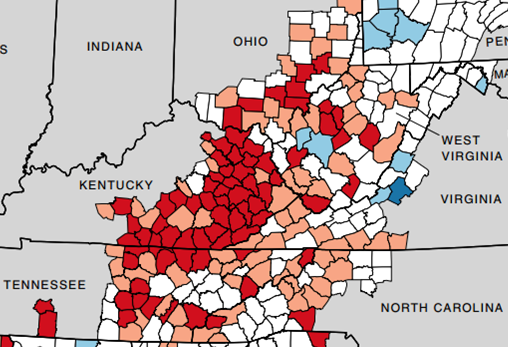
Appalachian economic development veteran says expectations for Eastern Ky. should be lowered

A debate may be starting on what to do about Eastern Kentucky, one of the nation's poorest areas.

Thomas Miller, who helped build the Kentucky Highlands Investment Corporation and founded the Mountain Association for Community and Economic Development, has written a strong response to Center for Rural Strategies president Dee Davis' October call to action in Central Appalachia. Davis said that in order for Eastern Kentucky to improve, the region needed to improve education and healthcare and fight corruption. However, Miller says it's not possible to "turn this things around," as Davis wrote. Both are featured on the Daily Yonder.

Appalachian Regional Commission map (partial)
shows economically distressed counties in red.
Miller says significant and durable economic development, and major changes in the size and composition of the region's economy, just won't happen -- because expectations for the region are too high. "As the years roll by I am ever less able to muster confidence that we have a sufficient chance of transforming our economy in these mountains," Miller writes. "I do not encourage us to give up, but if we are to make progress we must be realistic about our expectations and pick targets we have a good chance to hit." Many of the region's ills, including education, healthcare, transportation and communications, have been remedied, he says, but there are still major economic issues that need to be addressed.

"It would seem we have tried it all: 50 years of economic development involving lots and lots of taxpayer money, large scale and small spending on one program after another . . . job training to craft cooperatives, Foxfire to clean coal," Miller writes. But the Appalachian economy is still lacking and will "poised to fall into an even bigger sinkhole as our reachable coal reserves play out at the same time that coal is losing favor as a source of energy."

Miller says that he doesn't advocate giving up on development in the region, just being more realistic about it, and being more in tune with modern political life. He also says an understanding of proximity and economic development is important. "I submit that in an area of chronic economic distress, far removed from cultural and economic and social attractions, where the more ambitious kids have for decades brought their suitcases to high school graduation, we might be doing as well as can be expected. . . . Our own experience of these past 50 years is not encouraging, and if we can’t find others to show us where we have been going wrong and how to get our strategies right, then we must conclude that significant and durable economic development in the mountains is not a realistic prospect. Sure we should continue to work on stuff, but we should be honest about what we promise."

Much of Miller's lament is based on Eastern Kentucky's lack of population density, a key to for a region to "accumulate the necessary amenities to attract new residents and build the skills and connections between people that can lead to a diversified economy," he says. "It is time for us . . . to ask ourselves whether our focus ought to be less on the geography and infrastructure of Central Appalachia and more on the people themselves. . . .  Let our honesty begin with a discussion of what our efforts have or have not achieved and quickly move to lessons we can learn from others. . . . I do not know what else we can do but be radical now, in our analysis, in our debates and in who is sitting around the table." (Read more)

Virginia writer sees rural America as election loser

"Rural America seems to be the big loser in a presidential election decided by the cities," writes Michael Owens, right, of the Bristol Herald Courier. Virginia and several other swing states were decided by votes of the population centers, which voted heavily for President Obama. "In a democracy, he who has the numbers wins. It’s the tyranny of mathematics," University of Virginia College of Wise political analyst Eric Drummond Smith told Owens.

In Virginia, the election map "reveals a Mountain Empire bathed in Republican red," but it was the "seemingly small pools of Democratic blue . . . that stole the vote," Owens reports. The same was true for Ohio and Nevada. "But that's the devil of the popular vote . . . especially when massive tracts of sparsely populated rural lands try to compete with a few blocks of densely inhabited concrete jungle," Owens writes. (Read more)

Monday, November 12, 2012

Farm Foundation forum, online at 9 am Wed., looks at election's impact on farm, food and rural policy

“What the 2012 Elections Mean for Agriculture, Food and Rural Policies" will be the topic of the next Farm Foundation forum, to be held in Washington and webcast Wednesday from 9 to 11 a.m. EST.

The panelists will be lobbyist Craig Jagger of Legis Consulting; Ferd Hoefner, policy director of the National Sustainable Agriculture Coalition; Robert Paarlberg, professor of political science at Wellesley College; Christopher Waldrop, director of the Consumer Federation of America's Food Policy Institute; Erik Johnston, associate legislative director for agriculture and rural affairs at the National Association of Counties; and John Hardin, an Indiana farmer.

The forum will be held without charge at the National Press Club. Because of the increased interest, it will be webcast and archived for replay, says the foundation's Mary Thompson. To register to attend or view the webcast, click here.

Will U.S. be #1 oil producer by 2017, or will forecast founder on decline in oil fracked from shale?

The U.S. will overtake Saudi Arabia and Russia as the world's largest oil producer by 2017, according to a new global report. This is the first time the International Energy Agency, the developed world's most respected energy forecaster, has made such a prediction. It is "one of the clearest signs yet of how the shale revolution is redrawing the global energy landscape," Guy Chazan and Ed Crooks of The Financial Times report.

The IEA said in its world energy outlook today that the U.S. will be "all but self-sufficient in net terms" by 2030, a reversal of "the trend seen in most other energy-importing countries," the report says. It also says this trend will shift the direction of international oil trade toward Asia. The increase in U.S. production comes as federal fuel-efficiency measures are set to decrease demand for oil. IEA says this will decrease oil imports, and make North America a "net oil exporter" by 2035.

Some experts say that because the U.S. oil boom "is still in its infancy," continued growth to the levels predicted by IEA can't be guaranteed, Chazan and Crooks report. The boom began with increased natural gas production, which was made possible by hydraulic fracturing. Those drilling techniques have recently been used to tap vast oil reserves in North Dakota and southern Texas shales. The decline rate of shale wells is "very steep," Chazan and Crooks report. Analyst Barclays Capital has found that one year after being accessed, production has dropped by about 20 to 40 percent. (Read more)

Indian vote may have decided Mt., N.D. Senate seats

The New York Times' now-famous number cruncher Nate Silver predicted the outcomes of this year's elections with almost complete accuracy, but missed the Democratic victories in Senate races in North Dakota and Montana. Indian Country's Mark Trahant says Silver miscalculated because his models don't include the Indian vote. "Indian country is the smallest demographic slice of what is America," Trahant writes. "Yet when the history of the 2012 election is written, it must be said, that Indian country outperformed. By any metric."

North Dakota Sen.-elect Heidi Heitkamp and Montana Sen. Jon Tester "not only understood" the importance of the Indian vote, but they "campaigned on reservations hoping that it would be the one factor no one figured," Trahant reports. And they were right. The Montana counties where Indians vote -- Glacier, Roosevelt, Blaine and Big Horn -- were won by Democrats. In Glacier County, which includes the Blackfeet Reservation, total Democratic votes were twice Mitt Romney's. Heitkamp won North Dakota's Sioux County, where 84 percent of the population is Native American, by 83.9 percent. She also won in Rolette and Benson counties, which are both majority Native American.

American Indian and Alaska Native voters turned out in record numbers this election, the National Congress of American Indians reported last week. NCAI executive director Jacqueline Johnson Peta told Trahant it's important for Indians to take credit for their success at the polls and remind politicians when issues affecting Indian country are before them. Native American registered voters outnumber all other racial and ethnic groups in Montana and New Mexico, she said, giving them power on the state level to advocate for issues. (Read more)

Coal industry hopes Obama will go easier on it; might it be whistling past the graveyard?

President Obama probably doesn't feel like doing any favors for the coal industry, after its "war on coal" rhetoric was used to attack him in key battleground states like Ohio and Virginia (both of which he carried), but the industry is making guardedly optimistic noises, noting Obama's support for clean-coal technology, and hoping for some leniency in water- and air-pollution regulation.

Coal-company stocks fell 9 to 23 percent the day after the election, notes James Bruggers of The Courier-Journal in Louisville. The Dow Jones Industrial Average fell 2.4 percent. Coal officials told Bruggers they hope the administration will relax some Environmental Protection Agency regulations, which would make mining and burning coal more costly in Obama's second term. "We are hopeful the president's pro-coal comments from the campaign reflect a new direction for his administration," Kentucky Coal Association president Bill Bissett said. (Read more)

Coal interests may have some reason to be hopeful, The Charleston Gazette's Ken Ward Jr. writes. The day after the election, the U.S. Forest Service ruled against conservation groups who challenged the agency's expansion of a coal-mine lease 10 miles east of Paonia, Colo. The ruling will allow Arch Coal to build 48 natural-gas drilling pads on almost 1,700 acres of the Sunset Roadless Area, a section of wild forest. Ward notes that Arch's West Elk Mine is partly located in Gunnison County, one of only two of the top 25 coal-producing counties to vote for Obama.

But for coal operator Robert Murray, who hosted a rally for Mitt Romney that Ohio miners were asked to attend without pay, the war rages on. Murray made good on a promise he made to lay off miners if Obama was re-elected. More than 150 of owner of Murray Energy Corp.'s 3,500 miners were fired, the largest number at a Utah mine that was the scene of a 2007 disaster. The layoff notices "blamed Obama's 'war on coal' for the job cuts," Allison Linn of CNBC reports. Murray predicted the "total destruction of the coal industry" by 2030, and said increased regulations were one reason for the layoffs. (Read more)

UPDATE: Ken Ward Jr. asks in his Coal Tattoo blog, "Does the mining industry not understand who won the presidential election?"

Barbara Kingsolver's new novel is about rural perceptions of changes in climate and nature

Author Barbara Kingsolver, right, is taking on climate change in her most recent novel, Flight Behavior. She recently spoke with NPR's Flora Lichtman about the book and what Lichtman calls its central philosophical question: "Why do we believe what we believe and how is it that two people can look at the exact same set of circumstances and see two completely different things?"

The novel is set on a farm in Southern Appalachia, Kingsolver's home region, where a shift in climate has caused monarch butterflies to settle for the first time. The butterflies normally winter in Mexico, but because of climate change, their pattern has brought them to a hilltop farm in East Tennessee. Journalists, scientists and other outsiders call the event a drastic effect of climate change, but people in the rural, conservative town see it as a miracle from God.

"It's a novel in which I use this device [the monarchs] to talk about climate change, about the methods of science, because that's a really big part of this novel," Kingsolver told Lichtman. "It's really about . . . why we decide to believe what we believe and why it's so difficult for us to have this conversation about climate change."

The story is told through the eyes of a farmer's wife, who discovers the butterflies first and sees them as her personal "burning bush" sign from God. Kingsolver told Lichtman she wanted to write the novel through the wife's eyes so the reader would not initially know what they were seeing, either. "It is about perception and how we need to be to understand what we're seeing before we can really see it," said Kingsolver, who has a master's degree in evolutionary biology. "That's really key to understanding this whole issue of climate change and why we see or don't see what's right in front of us." (Read more)

UPDATE: Roberta Rubinstein writes in the Washington Independent Review of Books, "The novel keeps readers wondering until the narrative reaches its satisfying resolution. Flight Behavior may not be Kingsolver’s best — I reserve that position for The Poisonwood Bible — but it is an absorbing read, positioned at the cusp of contemporary concerns about environmental change and its impact on the human domain." (Read more)

Friday, November 09, 2012

Official Ky. report says office of constable is 'outdated and irrelevant,' should be dissolved

A new report released Thursday says that the office of the constable is "outdated and irrelevant as an arm of law enforcement and poses potential liabilities for counties." The report was commissioned by the Kentucky Justice and Public Safety Secretary, J. Michael Brown after several high-profile incidents occurred involving constables in the state over the past year.

Constables used to be vital members of law enforcement in many rural places, but over time other agencies took on their duties and the role of constables became blurred, Wendy Mitchell of The Ledger Independent in Maysville, Ky., reports. The report, "Constables in Kentucky: Contemporary Issues and Finding Surrounding an Outdated Office," was a six-month review that included historical perspectives of the constable, and other states' experience with the office.

Constable duties in the commonwealth have been handled in different ways in different counties. In the Buffalo Trace region, Bracken County Fiscal Court members put restrictions on constable use of police style lights and radio communications. They also required the five county constables to post their own bond. In nearby Lewis County, however, constables often accompany police when asked and patrol rural areas.

The report says that "an overwhelming majority of county and law enforcement officials see little to no practical purpose behind the constitutional office, and believe it should be abolished or its law enforcement authority eliminated or restricted," Mitchell writes. Constables have no formal training, education or experience before being elected to the position, the report says. This is inconsistent with Peace Officer Professional Standards, which require pre-employment standards.

According to Wikipedia, Kentucky is one of 18 states that still employ constables as peace officers. Those states include many rural states. They are Alabama, Arizona, Arkansas, Idaho, Louisiana, Maine, Massachusetts, Mississippi, Nevada, Ohio, New Jersey, New York, Pennsylvania, South Carolina, Tennessee, Texas and Utah. Several other states employ the office of constable in other capacities. (Read more)

National Rural Health Day to be celebrated with free week-long issue-based webinar series

Those almost 60 million Americans who live in rural America do not have as much ready access to health care or to the vast number of health care providers than those who live in more urbanized America. Rural Americans are more likely to arrive on the doorstep of health care facilities without insurance, and that number is growing. These challenges and more have prompted the National Organization of State Offices of Rural Health (NOSORH) to designate Thursday, Nov. 15 as National Rural Health Day. The day, explains NOSORH director Teryl Eisinger, is an effort to increase awareness of rural health-related issues. The event has stretched to a week of activities, celebrations and a daily webinar series on rural health-care issues accessible to anyone interested nationwide.

Here's a schedule of free webinars. All times are Eastern Standard.
Monday, Nov. 12, 3-4 p.m., Basics of Rural Health, with Kristine Sande, program director, Rural Assistance Center; Rebecca David, executive director, National Cooperation of Health Networks; Mike Shimmens, executive director, Rural Recruitment and Retention Network.
Tuesday, Nov. 13, 1-2 p.m., Cultural Awareness While Serving Rural Veterans with Jay H. Shore, MPH, Associate Professor, University of Colorado, Denver.
Wednesday, Nov. 14, 2:30-3:15 p.m., Health Resources and Services Administration Rural Health Update with Mary Wakefield, HRSA administrator.
Thursday, Nov. 15, 3-4 p.m., HRSA's Office of Rural Public Health Policy, Celebrating 25 Years
Friday, Nov. 16, 3 p.m. Looking Towards the Future of Rural Health Care with Randall Longenecker, MD, Rural Training Track Technical Assistance Program and Jim DeTienne, Montana EMS and Trauma Systems.

All webinars will be recorded and made available to the public at www.celebratepowerofrural.org.(Read more)

Drought persists in Plains, stunting winter wheat

Though drought in the Midwest seems to be easing, drought in the Great Plains continues to deepen, according to the most recent U.S. Department of Agriculture Drought Monitor. Texas, Oklahoma, Kansas and Nebraska all saw drought expansion, which is hindering growth of the new winter wheat crop in those states. Livestock grazing was also poor.

About 60 percent of the U.S. was listed in "moderate" drought as of Nov. 6, Carey Gillam of Reuters notes. That's down slightly from a week earlier. But the portion of the U.S. under "extreme" or "exceptional" drought rose slightly to 19.36 from 19.04 percent, mostly because of deepened drought in the Plains. In the High Plains, which includes Kansas, Nebraska and the Dakotas, the two highest drought levels covered 84 percent of the region. (Read more)

Group hopes webinar will encourage veterans to begin farming and ranching life

The Center for Rural Affairs is hosting a farming webinar for U.S. veterans. Veterans have become disproportionately rural, and many return home to places where jobs are scarce, the Center's Wyatt Fraas said. The webinar is meant to energize rural veterans to begin farming and hopefully take over for aging farmers and ranchers some day.

"The Center for Rural Affairs’ Veteran Farmers Project provides veterans with the knowledge to become successful farmers and ranchers. By creating sound farm and ranch businesses that tap into high value markets, returning veterans can reintegrate gracefully and fruitfully into America’s rural communities," a press release states. The webinar is free and features video farm tours and discussion with farmers and ranchers. It will also focus on financing, land access, disability assistance and other farming resources for veterans.

The webinar will be Nov. 16 from 8 to 9:30 p.m. EST. For more information, click here.

Thursday, November 08, 2012

First phase of USPS plan to close or reduce post office hours, most of them rural, begins Nov. 17

The first phase of the U.S. Postal Service's plan to close or reduce hours at about 13,000 post offices, most of them rural, will begin later this month, Steve Hutkins of Save the Post Office reports. The National Association of Postmasters has learned from USPS that 5,742 post offices will be affected in this first phase. USPS officials have scheduled a community meeting for almost all of those offices. As of yesterday, more than 3,000 of those meetings have taken place, and some decisions have been locally announced. (Photo: Paoli, Colo. post office)

Reduced hours at almost 500 post offices will start Nov. 17. Between Jan. 12, 2013 and February 9, about 1,100 more post offices will see reduced hours. The remainder of the first-phase offices will reduce hours from February and April, Hutkins reports. About 1,500 offices that didn't have a postmaster when the USPS announced its POstPlan in May are included in the first phase of implementation.

About 700 offices without a postmaster have yet to be scheduled for review by the USPS, and are thought to be prime targets. About 4,000 of the first-phase offices had a postmaster before the plan was announced, and about half of them likely accepted a retirement incentive, and the other half probably took a job elsewhere in the service, Hutkins writes. He says those numbers are only be estimates because the USPS hasn't released the number of postmasters who accepted the retirement incentive.

The USPS decided to reduce hours at nearly 2,500 post offices, leaving about 3,300 left to review. In almost all cases, hours will be reduced, Hutkins writes. But he says at least eight post offices in the first-phase review, all of which serve rural communities, are being considered for closure: Knoxboro, N.Y.; Hayesville, Iowa; Seville, Ga.; Paoli, Colo.; Lees Creek, Ohio; Perks, Ill.; Fowlerton, Ind.; and New Trenton, Ind. (Read more)

Industry may dial down 'war on coal' rhetoric, but what will a re-elected Obama do with regulations?

The coal industry will consider toning down the "war on coal" rhetoric used by Republicans in the presidential race and several close congressional contests but will continue to fight the environmental regulations to which the phrase refers, Ken Ward Jr. of The Charleston Gazette reports.

Political leaders in Central Appalachia told Ward they "hold out some hope" that the administration might be open to easing Environmental Protection Agency permit reviews and revising new air-quality standards. But experts said that is unlikely, and that the administration may even focus more attention on reducing coal mining's impact on the environment and communities, and reducing air pollution from coal-fired power plants over the next four years. "I think the election returns may embolden Obama on a number of fronts, including a more determined effort to shift black to green on energy," Vermont Law School environmental policy instructor Pat Parenteau told Ward. "He certainly doesn't owe the coal industry or coal-state politicians anything."

Republican challenger Mitt Romney easily won the nation's top three coal-producing states (Wyoming, West Virginia and Kentucky) and all but two of the 25 largest coal-producing counties. Industry-backed candidates won "some closely watched U.S. House races," Ward writes. But industry-endorsed U.S. Senate candidates lost six key races in which "Republicans harshly criticized generally pro-coal" Democrats for not fighting the EPA restrictions. (Read more)

TV-station company with large rural audience criticized for airing 'biased' election special

Sinclair Broadcast Group, a company that owns 74 TV stations, many of them with large rural audiences, aired what critics say was a biased election special in battleground states Monday night. The half-hour broadcast, shown on at least three stations in Ohio and Florida, is being called a partisan attack on President Obama. Sinclair was criticized in 2004 for planning to air a documentary it made attacking Democratic presidential nominee John Kerry.

WSYX graphic
ABC affiliate WSYX in Columbus aired the specials, "which included content prepared by their corporate parent company," twice during times when national news programs were scheduled, Eric Lach of Talking Points Memo reports. The programs did include some favorable comments about Obama, but the criticism of him was "elevated, while Mitt Romney seemed to escape the bulk of the attention," Lach writes. He says segments about health-care reform, the economy and foreign policy seemed to lean toward Republican views on the issues.

Similar scripts were used for specials on WRGT in Dayton and WPEC in West Palm Beach, Fla. Merrill Knox of TVSpy reports. WSYX and WRGT employees told Lach that the content was prepared by Sinclair and sent to them to be aired. To watch the entire WPEC broadcast, which is very similar to the other two broadcasts, click here.

USDA secretary, president take lickings in Shirley Sherrod's memoir about her hasty USDA firing

Shirley Sherrod, who was the first African American appointed to lead Rural Development in Georgia for the U.S. Department of Agriculture and who was very publicly fired just 13 months later, has written a memoir about her experience. In the book, The Courage to Hope: How I Stood up to the Politics of Fear, Sherrod does not cast President Obama, Agriculture Secretary Tom Vilsack and then-Deputy Undersecretary for Rural Development Cheryl Cook as heroes, Agri-Pulse reports.

Sherrod was appointed in 2009, and fired 13 months later after a conservative blogger released a small portion of a speech to an NAACP chapter in which it seemed to be bragging about turning away a white farmer who needed help. As it turns out, Sherrod was talking about an incident that occurred 23 years before her appointment, and the rest of the clip revealed that she turned the farmer away to refer him to a white lawyer thinking that would be more beneficial for him. When that lawyer didn't help him, she did.

"The most powerful portion of Sherrod's new memoir . . . fleshes out the story she sketched in her NAACP speech," Kevin Boyle of The Washington Post reports. He writes that Sherrod's activism was born out of her childhood on a farm in southern Georgia in the dying days of Jim Crow. After her father was murdered by a white neighbor when she was 17, her family began participating in civil rights marches. She has spent more than two decades working on behalf of rural poor, both black and white, Boyle writes.

In The Courage to Hope, Sherrod does fault Obama, Vilsack and Cook for "failing to try to learn the whole story . . . before Vilsack ordered her fired," Agri-Pulse reports. But she is not bitter about the situation. Instead, her sharpest criticism is for the blogger, Glenn Beck and Fox News for "piling on the story," and Iowa Republican Rep. Steve King for trying to block financial settlements with black farmers who were denied USDA loans over the years, Agri-Pulse reports.

Sherrod writes about her experience with racism in the South and the episode that ultimately drove her from public service. "Mostly, she is saddened by how Vilsack handled the affair, from the July 2010 firing that she describes as 'hasty and cowardly,' to his offer to her to become deputy director of a new Office of Advocacy and Outreach," Agri-Pulse writes. She refused Vilsack's offer. "His kind words and praise felt hollow to me," Sherrod writes.

Agir-Pulse is subscription-only, but a four-week free trial can be accessed here.

Wednesday, November 07, 2012

The more rural a voter, the more likely for Romney

Mitt Romney won 59 percent of the rural vote yesterday, according to exit poll results reported by CNN and other news outlets. That was five percentage points better than John McCain in 2008 and even beat George W. Bush's 2004 percentage by two points, but did not quite equal Bush's 2000 share of 61 percent.

Put another way, the more urban a voter, the more likely he or she was to vote for President Obama. USA Today illustrates the data this way, with each sector's percentage of the vote at the left:
Romney's rural performance reversed a decline in Republican presidential nominees' performance among rural voters. That hit a low of 49 percent in 1996, when Bill Clinton was re-elected, but zoomed upward when his vice president, Al Gore, tried to succeed him. For a graph and short story from the Daily Yonder, click here.

Is coal still king in Ky. politics? One result says so

Just a few decades ago, Appalachian coal miners fought battles with mine operators for worker's rights, mainly better pay and safety. They were bitter rivals in a real war that looks nothing like the so-called "war on coal" of today's politics, which has led voters in a congressional district well outside coal country to elect a candidate who mostly ran on a pro-coal ticket: Republican Andy Barr, right, of the state's 6th Congressional District, which comprises most of the famed Bluegrass Region.

In today's Eastern Kentucky, miners and their relatives and friends have joined with operators in response the "war on coal" that they have been told was started by the Obama administration to end coal mining as the state has known it for more than a century. Kentucky is the third largest producer of coal in the U.S., and the industry remains a major player in the state's politics. Many people outside the Eastern coalfields have sympathy for the industry's and miners' perceived plight, said Al Cross, director of the University of Kentucky's Institute for Rural Journalism and Community Issues, which publishes The Rural Blog.

Cross wrote in a column for The Courier-Journal of Louisville in October that Barr and his coal industry allies were trying to unseat Democratic incumbent Ben Chandler "by telling lies" about the "war on coal." Barr's campaign ran a television ad featuring a Western Kentucky coal executive posing as a miner, proclaiming that Chandler and President Obama were attacking the coal industry. The man still has his miner's certificates, but "Barr's ad was misleading to the point of untruth," Cross wrote. "In the longstanding language of coal mining in Kentucky, there are miners and there are operators, and executives belong in the latter category." When Chandler ran an ad calling Barr's spot "a big lie," Barr ran one in which the executive said Chandler was attacking him, and another in which miners denigrated Chandler, one calling him "a low-life."

Chandler, left, met with rural
electric cooperative officials
The basis for the ads was Chandler's vote for Obama's 2009 cap-and-trade bill, opposed by the coal industry and electric utilities. Thus did Barr and his allies use Kentucky's long-standing relationship and history with coal to play on the sympathies of 6th District voters and associate Chandler with President Obama, whom Chandler said afterward "was just a little too heavy for us in some of the rural counties." Cross wrote in his pre-election column, "The race is less about Obama than coal, which is not mined in the district but seems to have more friends there than Chandler may have thought." To help Chandler after his 648-vote win over Barr last time, the state legislature made his district more Democratic, but the new counties were close to or even in the Appalachian coalfield, and he lost every one of them. For coverage from the Lexington Herald-Leader, click here.

Poet: 'Conservative' has gotten a warped meaning

"Cutting firewood on a recent afternoon in the woods at the back of our farm, it occurred to me that the term conservative has lost all connection to its original meaning," Washington County, Kentucky, farmer and poet Maurice Manning writes in The New York Times. Manning, who teaches at Transylvania University in Lexington, discusses the various ways that he can be described as a conservative, and argues that many leaders in the Republican Party, which touts conservatism as its own, do not fit into the true definition of the word: to keep and preserve. (Wikipedia map)

"It's interesting that the origin is a verb and not a noun, a term that implies action and duty, rather than merely a stance," Manning writes. He notes that he qualifies as a conservative because his goal on the 20- acre farm he owns is to "preserve the character and health of this land." He doesn't use chemicals, he plants gardens on a "few patches of level ground" and rebuilds the soil with compost and leaves in the fall. He says he learned ethics of hard work and preservation of the land from his grandfather. He learned rainwater-catching techniques that helped him through this summer's drought from his great-grandparents and great-great aunt.

But this version of conservatism that he and his neighbors share "runs counter to the model presented by the Republican establishment," he writes. The Bush administration "got us enmeshed in two wars . . . both of which have cost us blood and treasure . . . that cannot be calculated," and he says a few people who call themselves conservative have profited from them. He says it's obvious that the U.S. economic troubles come from Wall Street bankers and not the government. But "'conservative' leaders think we should do away with oversight and regulation and give the financial world absolutely free rein," he writes. He also takes a look at the conservatives in Kentucky who advocate for mountaintop removal coal mining, and laments how this is not a conservative way of thinking. "That kind of extravagance has not been good for our country or anywhere else," he writes. "It places making money ahead of making sense." (Read more)

Legendary Kentucky journalist Al Smith tackles the state's public figures over 50 years in new book

Kentucky's most famous community journalist has completed his second memoir, this time focusing more on his journalism and the state's public figures than on his life and victory over alcoholism. Al Smith's Kentucky Cured: Fifty Years in Kentucky Journalism (History Press, $19.95) is on bookshelves now.

The book "says a lot more about Kentucky than it does about Al Smith," writes Tom Eblen of the Lexington Herald-Leader. The book is a collection of new and updated essays, many first published in the Herald-Leader or The Courier-Journal of Louisville. But most of them are about "some of Kentucky's most fascinating public figures of the second half of the 20th Century," Eblen writes. "Smith got to know them all, and many more, during his varied career."

Stories in the book are about many familiar Kentucky names: Gov.s Albert B. "Happy" Chandler, Bert Combs, Louie Nunn, Edward "Ned" Breathitt and Earle Clements; political figures Ed Prichard, Georgia Powers, Larry Forgy and Gatewood Galbraith; writers Robert Penn Warren and John Ed Pearce, and "the crafty politician/educators who transformed Kentucky's state 'teacher colleges' into dynamic regional universities," Eblen writes.

Author Don McNay writes in the Huffington Post that Smith's book is a "must-read for students of Kentucky history, journalism and politics," and calls it "the book that I thought Smith would write as his autobiography." It's "loaded with insight about Kentucky and Kentuckians," he says. Where Smith's first book, Wordsmith, was "raw" and dark, Kentucky Cured "reflects the upbeat, spellbinding and positive side of Smith's personality, laced with colorful characters, both well-known and unknown," McNay writes.

"Kentucky Cured by legendary Kentucky journalist Al Smith is the book his followers, fans and friends wanted," writes journalist Ferrell Wellman, who succeeded Smith as host of Kentucky Educational Television's "Comment on Kentucky," which Smith co-founded (as well as the Institute for Rural Journalism and Community Issues, which publishes The Rural Blog). In his first book, Wordsmith, Smith wasn't as honest about his encounters and impressions of the powerful and rich-and-famous whom he's met over the years, Wellman writes, but the new book "corrects that, and is proof, at 85, Smith can still bite when he turns a phrase." He lauds the state's political leaders' accomplishments, but is also critical about their lives and careers. Smith writes in Kentucky Cured: "In a state like Kentucky, leadership often falls to political hacks or fresh faces with painless promises, which fail."

Smith "is a gifted writer of tight prose, a storyteller with a good ear for a quote or a telling anecdote," Eblen writes. "But more than that, he is a keen observer and analyst who understands the historical and cultural forces that make Kentucky tick." (Read more)

Tuesday, November 06, 2012

N.C. couple who started a paper 2 years ago and immediately went after corruption win Gish Award

Jonathan and Susan Austin of the Yancey County News in Burnsville, N.C., are the winners of the 2012 Tom and Pat Gish Award for courage, integrity and tenacity in rural journalism, awarded by the Institute for Rural Journalism and Community Issues, which publishes The Rural Blog. (Photo by Bill Sanders, Asheville Citizen-Times)

The award is named for the couple who published The Mountain Eagle in Whitesburg, Ky., for more than 50 years. Tom Gish, who died in 2008, and his wife Pat were the first recipients of the award. “The Austins showed courage in starting a second newspaper in a one-newspaper town, in January 2011, then demonstrated courage, tenacity and integrity by reporting on local corruption,” Institute Director Al Cross said.

The weekly paper reported in its first edition about a state investigation of vote-fraud allegations, then analyzed records obtained from investigators to report that the county had an unusually high number of absentee ballots, many of which were witnessed by employees of the county sheriff’s department and cast by criminal defendants, some of whose charges were soon dropped.

The paper also revealed that the county's chief deputy, the arresting officer in several cases in which the suspects immediately voted and were given leniency, was also pawning county-owned guns for personal gain. He has resigned and pleaded guilty to failing to discharge his duties. The vote-fraud investigation continues. For a story about the Austins from the Asheville Citizen-Times, click here.

Ben Gish, son of Tom and Pat Gish and editor of The Mountain Eagle, serves on the award committee. He said, “Even though it occurred a few decades apart, I get the same feeling from looking at the examples of their work as I do when I look at copies of the Eagle when my parents were just getting started in the late 1950s.”

Upon getting the news, Jonathan Austin said, “We are humbled and honored to receive the Gish Award. Good journalists can spend their careers doing important work, yet they may never receive recognition other than an occasional tip of the hat from their neighbors. To be recognized by the Institute for Rural Journalism and Community Issues for our work reporting on the events in Yancey County is especially nice because the institute strives to strengthen the small, rural media in Appalachia." (Read more)

Romney's coal play for Pa. gets little issue analysis; and if he loses, GOP may have to become less rural

Mitt Romney's final-week play for Pennsylvania resembles "the coal-fueled campaign" he has run in Appalachian areas of Ohio and Virginia, but journalists in the state haven't given voters enough of the facts on the issue, writes Ken Knelly of Columbia Journalism Review. (Getty Images photo: Romney speaks in Yardley, Pa., on Sunday)

"Last Tuesday, the Romney campaign made its first ad buy this state, making a play for votes in western Pennsylvania in particular by casting the Obama administration’s energy policies as “crush[ing]” Pennsylvanians and touting Romney’s “different” energy plan (quoting Romney’s “I like coal” line from the first presidential debate)," Knelly reports. "The Republican National Committee and pro-Romney super PACs Restore our Future and Americans for Job Security have also poured several million dollars into ad buys here over the past week, totaling nearly $12 million from Romney and supporting super PACs and $1.6 million from the Obama camp."

Knelly says some Pennsylvania newspapers and TV stations have done a good job tracking the spending, but not analyzing the substance of the Republican ads: "reporting that places it in the larger context of coal-related rhetoric in this campaign and fills readers in on key things to know when evaluating what’s happened in the coal industry in recent years and why." Knelly lauds an analysis by Jon Delano of KDKA-TV in Pittsburgh of ads in the state's Senate race, but says "He didn’t, as little of this reporting seems to, discuss coal industry employment numbers over the course of Obama’s term (in a nutshell, up from 2009-2011 and down in 2012) or the role natural gas has played in putting market pressure on coal—two key points to understanding what’s happened in the industry and why." (Read more)

If Romney loses, Republicans will have to become less rural, to follow the nation's demographic trend, writes Jonathan Martin of Politico: "The GOP coalition is undergirded by a shrinking population of older white conservative men from the countryside, while the Democrats rely on an ascendant bloc of minorities, moderate women and culturally tolerant young voters in cities and suburbs. This is why, in every election, since 1992, Democrats have either won the White House or fallen a single state short of the presidency." (Read more)

Rural unemployment at lowest level in four years

Unemployment in America's rural counties in September was 7.4 percent, lower than at any time in the last four years, according to Bureau of Labor Statistics data. "The last time the BLS found unemployment that low in rural America was in November of 2008, when rates stood at 6.7 percent," Bill Bishop reports for the Daily Yonder.
Rural unemployment continues to be slightly less than the urban jobless rate, but more than in exurban counties, which are largely rural but in metropolitan areas. (Read more)

Valve maker in rural Minn. uses high-tech tools, attracts good workers who want a rural lifestyle

"While many American manufacturers outsourced their work to low wage, overseas locations, Marr Valve Company kept it rural" in Grantite Falls, Minn., reports Tom Cherveny of the West Central Tribune in nearby Willmar. "A skilled, rural workforce and high-tech manufacturing equipment provide the advantage," he writes, citing the company's operations manager, Cheryl Monson.

Marr Valve's Steve Banks explains an assembly to high-school
teacher Brian Albers. Banks said he works for Marr so he can
raise his children in a rural setting. (Photo by Tom Cherveny)
"Many of the component parts that are machined and assembled into valves and regulators at this site could be made in assembly line fashion by low wage workers," Cherveny reports. "But turn the drudgery over to computer-driven machines, costing anywhere from $150,000 to as much as $500,000 a pop, and you get a higher quality product. They machine the parts with a precision no human could manage."

"Wages are higher in the metropolitan area, but Monson said this company’s rural location has not hindered its ability to retain or attract quality workers," Cherveny writes, quoting workers who take the lower pay to enjoy the rural lifestyle. Marr Valve is a subsidiary of Specialty Manufacturing, based in St. Paul. (Read more)

Monday, November 05, 2012

State-by-state elections could decide fate of Medicaid expansion under Obamacare

Under the Patient Protection and Affordable Care Act, Medicaid expansion is mostly left up to state governments, making "the choices voters make to fill governor's mansions and state legislatures" decisions that will have "just as big an effect on what kind of health coverage they will have in coming years," Maggie Fox of NBC News reports.

Two states are at the extremes of the debate: Texas, which has "free-market, bare-bones" health care, and Vermont, "which is unabashedly going for a European-style, government-supported system," Fox reports. There are 6.3 million people in Texas without health insurance, which is about a quarter of the state's population, giving it the highest percentage of uninsured in the U.S.  Gov. Rick Perry has said he won't expand Medicaid, despite heavy federal incentives, and the Republican-dominated state legislature turned down $76 billion in matching federal funds that would have helped expand coverage.

In Vermont, Democratic Gov. Peter Shumlin and the legislature want a "single-payer system that they say will give them the leverage to lower prices and provide better care for everyone in the state," Fox reports. But they don't yet have the votes to make this happen. This year's state election will decide in which direction health care moves.

The Affordable Care Act was designed to force state expansion of Medicaid to give healthcare to about 16 million more of the county's poorest people. But the Supreme Court decided in June that the law went too far on this, and ruled that states could opt out of expansion, losing all federal matching dollars that would have come with it. "So now two of the biggest provisions of the law -- offering Medicaid to more people and setting up the health exchanges -- are in the hands of state officials," Fox reports, which makes this year's state elections vital in terms of healthcare. (Read more)

Rural children more likely to be obese; Extension Service in Oregon looking for community links

Children living in rural areas are 20 to 50 percent more likely than their urban counterparts to be obese. Researchers in at least one state are trying to find out why, and are looking for ways to change the statistic. The Oregon State University Extension Service is launching a three-year study with the help of children in two rural school districts, reports Shelby King of the Herald and News in Klamath Falls. The study could have implications for rural communities across the U.S.

Researchers will be trying to determine in what ways local communities influence the children who live there. Klamath County OSU Extension Service Professor Patty Case told King that researchers chose to focus on rural communities that are considered to be "food deserts," or places where fresh produce and other healthy foods aren't readily available, or cost too much for families to afford. She said this is the case for most rural communities. "At the end of this project we will hopefully have a better understanding of what works in these communities to help make kids healthier," Case said. (Read more)

Sandy puts climate change into election talk, but not candidates'; result won't alter Appalachia's realities

For the first time in decades, climate change wasn't mentioned in any of the three presidential debates, even though a recent Pew Research Center poll says that 42 percent of Americans now believe that global warming is "mostly caused by human activity," a sharp increase from five years ago. Now, Hurricane Sandy has thrust the issue into the election, though it has yet to be raised by the leading candidates.

In the wake of the storm, New York City Mayor Michael Bloomberg, right, endorsed President Obama Thursday, saying the president was best placed to lead the fight against global warming. Obama didn't react, and Mitt Romney kept talking about coal. (Getty Images photo by Andrew Burton: Bloomberg talks with reporters before Sandy's strike)

None of this discussion will help the Central Appalachian coal industry, no matter who wins, writes Ken Ward Jr. of The Charleston Gazette. Some coal enthusiasts say the defeat of Obama is the cure to the industry's ills, but industry experts and some of mining's biggest advocates agree: "Challenges facing the Appalachian coal industry are much broader and complicated than one election can solve," Ward reports.

Competition from cheap natural gas and other coal reserves in the West, the mining-out of the region's easiest-to-reach coal seams and added pressure to reduce carbon-dioxide emissions are adding up to reduce Appalachian coal's future viability, Ward notes. "Thinking that all of these things will simply go away if Gov. Romney wins is delusional and does a disservice to the industry and those who work in it," United Mine Workers spokesperson Phil Smith told him. The UMW, which endorsed Obama in 2008, did not this time, apparently following strong anti-Obama sentiment among miners.

The union sees a number of challenges for miners that aren't a part of the "war on coal" talking points: "threats to healthcare benefits for retired miner, hurdles for workers seeking to unionize, and continued health and safety problems," Ward reports. And politicians aren't talking about those, or other Appalachian coalfield problems. The region's coal production will continue, he writes, but for many communities, the projected decline in production "is significant and could have serious economic impacts," and no one wants to talk about how to address them. (Read more)

Season open for wolves in Minnesota, Wisconsin

The federal government removed wolves from the endangered species list last year, and since then mostly Western state governments have devised plans to reduce what they see as oversized wolf populations within their borders. Now Wisconsin's newly minted wolf-hunting season is in its third week, and Minnesota is scheduled to start its first wolf season this weekend. But opponents say these and similar measures could reverse at least 40 years of work to restore Western wolf populations.

Wolves have been causing problems again for ranchers, prompting the hunting seasons, Steven Yaccino of The New York Times reports. Wisconsin awarded 1,160 wolf-hunting permits and capped the harvest at 201 kills, or about a quarter of its wolf population. There are 3,600 licenses available in Minnesota, which would allow 400 wolves to be killed. That would reduce the state's wolf population by about 15 percent. Animal-rights groups argue the kill quotas don't account for other ways wolves can die, including poaching, and killings by ranchers protecting their herds. They say those additional causes of death could put wolves back at risk of extinction.

"Since the wolf hunt began last month, at least 42 have been killed in Wisconsin. All told, officials expect 600 wolves will die at the hands of hunters and trappers in the two states before spring," Yaccino reports. There was a time when ranchers and the governments paid people to kill wolves because there were so many. By the time they became protected, they were nearly extinct. But now wolf numbers have grown to 4,000, and have exceeded recovery goals in the western Great Lakes area. (Read more)