Wednesday, July 03, 2013

Big immigration raid in 2008 pushed the issue and made Iowa reporters do much more with it

Fermin Loyes was deported in the raid, but has reunited with
family in Postville. (Photo: Kaitlyn Bernauer, The Gazette)
A federal raid of a meatpacking plant in the small town of Postville, Iowa, in 2008 may have been the catalyst for putting the need for immigration reform back in the national spotlight, and for creating a new breed of journalists who became experts at covering the immigration debate, especially from the human-interest point of view, Deron Lee reports for Columbia Journalism Review.

The raid led to the arrest of 400 workers, who were the victims of deplorable working conditions, and ended up getting caught in the justice system, where they were separated from their families, imprisoned, and deported. The raid decimated the town’s immigrant-heavy population, and its economy, Lee reports.

The raid also changed the way journalists covered immigration, reports Lee. "In a state with a small (though exponentially growing) immigrant population, reporters may not have felt the need to engage with immigration on a local level had Postville not lifted the veil on the shadow world of migrant laborers in the heartland." Jens Manuel Krogstad, who reported on the raid for the Waterloo-Cedar Falls Courier, and still covers Postville for The Des Moines Register, said “I think that was a springboard to a lot of immigration coverage.”


Apdullahi Hassan, in his Postville convenience
store, is one of many Somalis who have moved
to the area since the raid.
(Bernauer photo)
Trish Mehaffey, who covered the fifth anniversary of the raid last month for The Gazette in Cedar Rapids, told Lee: “I think the Postville raid brought to light the fact that there needed to be changes, because it kind of ruined that town. It really opens your eyes to see how something like that can affect a whole community."

Journalists covering the scene also did something unusual, by interviewing the immigrants, Lee . What the reporters came away with was stories that turned stats and figures into real people with real stories. "The inherent difficulty in reporting on unauthorized immigrants is that most don’t want to be seen," Lee wrotes. "But when opportunities have arisen to talk to undocumented workers . . . Iowa reporters have taken the initiative." (Read more)

Libertarian-oriented foundation says North Dakota still has best state highways in the U.S.

North Dakota continues to have the best state-owned highway system in the country, according to the libertarian-oriented Reason Foundation's 20th "Annual Report of the Performance of State Highway Systems." Highways were rated based on expenditures, interstate and primary road pavement condition, bridge condition, urban interstate congestion, fatality rates and narrow rural lanes. The study was based on spending and performance data submitted by state highway agencies to the federal government, according to a Reason news release.

North Dakota, which has held the top spot every year since 2001, was followed by Kansas, Wyoming, New Mexico, Montana, Nebraska, South Carolina, Missouri, South Dakota, and Mississippi. Alaska was 50th and Rhode Island was 49th. Those two states (the largest and smallest in area) reported more than 10 percent of their rural primary mileage to be in poor condition. The percentage of road miles in a state that are the responsibility of the state varies widely. To view the full report click here.

Volunteers bringing veterinarian care to pets, owners in remote areas of Alaska

Pet owners in remote areas of Alaska have long struggled to get routine medical care for their pets, and the lack of spay-and-neuter procedures has led to an overabundance of animals, many of whom are sick, the Anchorage Daily News reports. Alaska Rural Veterinary Outreach, a non-profit organization, is trying to improve the quality of life for pets by bringing veterinary services to areas in need (Photo by College Village Animal Clinic: Veterinarians providing service in Nondalton)

Nondalton, located on the western shore of the Cook Inlet, has a population of 167, but no resources for pets. The outreach program, manned by volunteers, recently visited the village, providing care for 28 dogs in desperate need of basic services, such as vaccines, the News reports. Nondalton’s community health aide, Ron Lotsfeld said, “Our community has needed this service for a very long time. Their efforts will result in a healthier canine community here, and a more manageable dog population. We hope they can do the same thing for many other villages.”

Outreach founder and President Sally Clampitt said "Reaching out to Alaska’s rural pets and their people is long overdue. We are just getting started, but have received requests for help from all across Alaska.” The group said their biggest challenge is finding "enough veterinarians and trained volunteers willing to donate their time, and sponsors who are willing to pick up the cost of the needed medications and supplies." (Read more)

Tuesday, July 02, 2013

GOP sees Obama's climate initiative as an opportunity to beat coal-state Democrats

Republicans say President Obama's plan to fight climate change could benefit them in midterm elections in coal country, opening the door for their party to grab seats held by Democrats, and to ensure that an incumbent like Mitch McConnell of Kentucky stays in office, Trip Gabriel reports for The New York Times. (NYT photo by Shawn Poynter: Kentucky Power's Big Sandy Plant)

Alison Lundergan Grimes
Senate elections in 2014 include open seats in West Virginia and South Dakota now held by Democrats, and elections in energy-rich Louisiana, where Democratic incumbent Mary Landrieu is on shaky ground, and Kentucky, where Secretary of State Alison Lundergan Grimes said yesterday she is taking on McConnell, the Senate GOP leader and a top target of Democrats. He would like to become majority leader; to do that, his party would need a net gain of six seats.

Nick Rahall
Following Obama's climate-change speech last week, Republicans immediately went on the attack against Democratic House members in mining states, and Democratic candidates like Nick J. Rahall II of West Virginia are trying to distance themselves from the president, Fears reports. But Republicans are trying to link Democratic candidates to Obama and his speech, to get the upper hand. After Grimes announced she was immediately attacked by national Republicans as being joined at the hip to the president in a “desire to destroy the coal industry."

Obama's speech isn't helping Democrats in coal states. Al Cross, director of the Institute for Rural Journalism and Community Issues at the University of Kentucky (and publisher of The Rural Blog) told Gabriel that Obama “has no more elections to win, and he can play his real cards. He was already the most anti-coal president we’ve ever had, and now he’s doubled down. That is not good for Kentucky Democrats in any shape, form or fashion.”

Rahall sounded nearly as hostile as the billboards dotting coal country bought by mining interests that declare “Obama’s No Jobs Zone,” saying he was “profoundly disappointed” by the president’s new initiative, Fears reports. Rahall said “I’m not ever, ever, ever going to back away from fighting for our coal miners."

Shelley Moore Capito
"Republicans countered that on this issue Democrats can run but they cannot hide," Gabriel writes. Rep. Shelley Moore Capito (R-W.Va.) who is seeking the Senate seat that opened with the retirement of John D. Rockefeller IV, a Democrat, said the president’s climate initiative “is a problem for every Democrat. You are, for better or worse, a part of the party that you put your name on the ballot with.” (Read more)

Fracking waste from Pa., W.Va. going underground in Ohio at increasing rates

Hydraulic fracturing fluids and oil-and-gas waste from Pennsylvania and West Virginia are being injected into Ohio disposal wells at an increasing rate, with a reported 8.16 million barrels of waste from other states found in Ohio in 2012, a 19 percent increase from 2011, Spencer Hunt reports for The Columbus Dispatch. Overall, 14.2 million barrels were injected into Ohio disposal wells in 2012, up 12 percent from 2011. (Dispatch graphic; click on it to enlarge)

Fourteen new disposal wells have been drilled in Ohio since last year, giving the state 191, compared to 63 in West Virginia and seven in Pennsylvania, Hunt reports. "There also is little that state officials can do to keep out-of-state waste from Ohio wells. Federal commerce protections forbid one state from imposing tariffs or bans on legally shipped commodities from other states."

Teresa Mills, fracking coordinator for the Buckeye Forest Council, told Hunt, “I think we’ve been the sacrifice zone for the oil and gas industry long enough. How much can we take before there are more earthquakes and before (drinking water) wells are contaminated?” State officials said the wells are safe. They also say there was a 5 percent decrease in waste injections during the first three months of 2013, compared to the same period last year. (Read more)

Decline of butterflies could be a warning that the environment is struggling

Several subspecies of butterflies are declining in numbers, and some have disappeared completely, which has environmentalists worried, Darryl Fears reports for The Washington Post. Robert K. Robbins, a research entomologist at the Smithsonian Institution’s Museum of Natural History, said that if butterfly species are going extinct, "It’s a strong indicator that we’re messing up the environment around us," and when an entire line dies off, "It’s a report card on the health of the environment around us." (University of Florida photo by Dr. Thomas C. Emmel: The endangered male Schaus swallowtail)

The U.S. Fish and Wildlife Service recently announced that two species -- the rockland grass skipper and the Zestos skipper -- are probably extinct in South Florida, Fears reports. At least one species has vanished from the U.S., another 17 species and subspecies are listed as endangered nationwide, and two are listed as threatened.

"The same issues plaguing butterflies are also causing populations of frogs, salamanders and toads to plummet, along with bees and other insects," Fears reports. "A recent U.S. Geological Survey study estimated that seven species of amphibians will drop by 50 percent if the current rate of decline, fueled by pesticide use and loss of habitat, continues. Eighty percent of food crops are pollinated by insects such as bees, moths and butterflies." (Read more)

Atheist marker, stemming from settlement of Ten Commandments lawsuit, is called the first in U.S.

Atheists now have a monument, and place to rest, in Florida. And they say they intend to do likewise in every state.

American Atheists, a New Jersey-based organization that says it fights to separate government and religion, unveiled a monument Saturday of a bench next to a monument of the Ten Commandments at the courthouse in Starke, Fla. population 5,500, in the north-central part of the state between Gainesville and Jacksonville. It's believed to be the first public marker dedicated to atheism in the U.S., Morgan Watkins reports for The Gainesville Sun. (Sun photo by Matt Stamey: David Silverman, president of American Atheists, at the unveiling)

American Atheists "sued Bradford County in May 2012, soon after the Ten Commandments monument was erected in front of the courthouse, seeking the monument's removal," Watkins reports. "The Community Men's Fellowship, a Starke-based group that sponsored the religious monument when it was erected, refused the county's request that it remove the display and filed its own lawsuit. During court-ordered mediation, the groups settled on an agreement: The Ten Commandments monument could stay, but American Atheists would establish their own monument in kind."

The group announced that it "will erect up to 50 more monuments across the country in public places where religious structures like the Ten Commandments marker in Starke have been established," Watkins reports. "An anonymous donor has pledged up to $500,000 for this effort." (Read more)

Monday, July 01, 2013

Wildfire kills 19 of 20 firefighters in nation's only city-based 'hotshot' unit that fights such fires

"Prescott is mourning."

That's how Patrick Whitehurst of The Daily Courier in Prescott, Ariz., began his story about the horrific casualties from a wildfire that killed 19 of the 20 firefighters in a special unit of the city fire department yesterday. (Prescott Fire Dept. photo)

The Granite Mountain Hotshots are the only widlfire-fighting team in the U.S. "organized through a city fire department," Whitehurst reports. "It earned its national inter-agency hotshot designation in 2008. Prescott Fire Department Fire Chief Dan Fraijo said the 20th crew member was working in a different location on the fire and was not injured."

Prescott (Google Maps)
Frajo said, "We're devastated. We just lost 19 of the finest people you'll ever meet. ... Truly, we're going through a terrible crisis right now." Prescott's population is about 40,000.

"Sunday's fatalities amounted to the highest firefighter death toll on a single U.S. wildfire since 1933, when 25 firefighters were killed on the Griffith Park fire in Los Angeles," Whitehurst reports. At the bottom of his story are links to other coverage by the Daily Courier, and many reader comments.

Natural-gas producers charging fees that cut into Pennsylvania landowners' royalty payments

In a good example of local reporting on the relationship between gas companies and rural landowners, The Herald of Sharon, Pa. has a story about how gas company fees in the Marcellus Shale region are cutting into royalty payments for landowners who allow drilling on their property, and landowners are being seriously shortchanged while gas companies make huge profits, reports John Finnerty, state-capital correspondent for Community Newspaper Holdings Inc.

Republican Sen. Gene Yaw, chairman of the Senate Environmental Resources and Energy committee, said “In some cases, these costs have caused royalty payments to be as low as 1.47 percent, well below the 12.5 percent guaranteed minimum,” Finnerty reports. Yaw told him problems with confusing or ambiguous royalty stubs and excessive post-production cost deductions have significantly impacted many leaseholders.

The Pennsylvania Farm Bureau looked into allegations, finding that one well produced $41,861 worth of gas, but Chesapeake Appalachia deducted $28,249 before making a royalty payment of $13,611, Finnerty reports. "In another case, the gas company post-production deductions consumed 88 percent of the royalty payment. The well had produced $14,481 worth of gas. The company deducted $12,790, leaving the landowner with a royalty payment of $1,690."

The Pennsylvania chapter of the National Royalty Owners Association "is lobbying for changes in regulations to arm property owners with leverage to ensure they are being treated fairly," Finnerty reports. David Sikes, president of the national association, told a Senate committee, “The problem is that most royalty owners cannot afford to file a lawsuit on an oil company that has lawyers on their staff." (Read more)

Firefighters at West, Tex., fertilizer explosion were not trained to fight it; no states mandate it

Firefighters at the West, Tex., fertilizer explosion were not prepared for the hazards they were facing, according to testimony at a congressional hearing by Rafael Moure-Eraso, chairman of the U.S. Chemical Safety Board, Russ Quinn reports for DTN The Progressive Farmer. "Records have shown that West Fertilizer did apprise local emergency officials that dangerous chemicals and fertilizers were stored at the site, but no training or preparation of firefighters took place." (Photo by Longleaf Alliance, School of Forestry and Wildlife Services, Auburn University)

Kimberly Quiros, director of communications for the National Volunteer Fire Council, said there is no nationwide, mandatory training for volunteer firefighters to fight fertilizer-based fires, Quinn reports. She said some states may offer optional training, but she was not aware of any state mandated fertilizer fire training. Quiros said, "It is up to the states for specialized training like fighting fertilizer fires. And not only does training vary from state to state, but also community to community within a state depending on what is in their areas." 

Galen Barrett, a fire service training coordinator for Iowa Western Community College in Council Bluffs, said Iowa is one of many Midwest states that do not require volunteer firefighters to take any specialized training to fight fertilizer fires. Bob Spratt, manager of Le Roy Fertilizer in Le Roy, Ill., said Illinois rural firefighters are trained for awareness of fertilizer fires, but advanced training is optional. (Read more)

Coal played political ju-jitsu with Obama, becoming more victim than villain in Central Appalachia

As the Obama administration started working on climate change and targeted certain strip-mining practices, the Central Appalachian coal industry has battled back with a pro-coal campaign that has turned into a war with environmental interests. The battle continues to heat up as more coal jobs are lost, and environmentalists push for alternatives to coal, John Cheves and Bill Estep report for the Lexington Herald-Leader. (H-L photo by Charles Bertram: A sign in the Knott County Courthouse in Eastern Kentucky)

The group Coal Mining Our Future was created "to ensure that citizens are informed about coal industry activities," according to its mission statement "The group sponsors pro-coal rallies, encourages letters and phone calls to politicians, conducts surface mine tours to show the usefulness of flat land, makes charitable donations and distributes pro-coal T-shirts and bumper stickers, such as the now-ubiquitous decal declaring 'If you don't like coal, don't use electricity'," Cheves and Estep report in the latest installment of a year-long series on Appalachian Kentucky that began in December.

It's all part of an "us versus them" mentality, uniting miners behind their bosses, something new in the coalfield, Al Cross, director of the Institute for Rural Journalism and Community Issues at the University of Kentucky, told Cheves. Coal operators "are in a defensive mode, and they're gathering their friends around them. This has created, I think, kind of a siege mentality and a regional solidarity. There used to just be sympathy for miners. Now there is sympathy for an industry," Cross said in March speech entitled "From Villain to Victim: The Coal Industry's New Image in Appalachian Kentucky." In his column yesterday in The Courier-Journal, drawing from President Obama's plan to thwart climate change, Cross said "The industry has played political ju-jitsu with Obama’s policies, turning its public image from one of environmental and workplace villain into one of political victim. . . . Now there really is a war on coal."

Cross and the reporters cited polls in 2007 and 2011 by the Carsey Institute at the University of New Hampshire. Six years ago, 37 percent of people in Harlan and Letcher counties said natural resources should be used to create jobs today rather than be conserved for future generations, but by 2011, that number had jumped to 52 percent. Cross noted that the Great Recession surely had some effect on public opinion, too. (Map locates Harlan and Letcher counties in officially designated Appalachia)

The Lexington-based Kentucky Coal Association spent nearly $2 million over the past three years to promote the industry, and it backs Kentucky's Friends of Coal, which last year collected $174,790, by selling pro-coal merchandise and sponsoring popular events and a widely seen, official license plate. Kentucky politicians from both parties have appeared at its rallies to criticize President Obama and the Environmental Protection Agency. (Read more)

Online paper wins $111,000 in attorney fees, court costs over sheriff's stinginess with public records

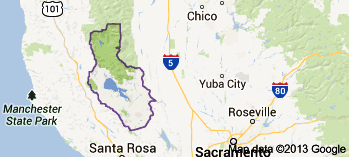
The Lake County News of Northern California won a lawsuit against the county, after a judge determined that Sheriff Frank Rivero (Sacramento Bee photo by Randall Benton) discriminated against the online-only newspaper by refusing to provide public information, reporter Patrick Boylan writes. The county will have to pay $110,990 in attorney fees and court costs.

The News's attorney said Rivero didn't like what it was printing about him and decided to cut it off, requiring it to use the California Public Records Act to obtain documents that had already been released to other news media, Boylan writes. The News also had to go to the sheriff's office and pay for copies that were free to other local news outlets. The daily newspaper in the county is the Lake County Record-Bee, owned by MediaNews Group.

Some of the stories at issue were allegations that Rivero lied about a 2008 shooting, and his creation of a "Brady List" for officers with credibility issues, reports Boylan. Elizabeth Larson, co-owner of the paper with her husband, John Jensen, said, “Our coverage has been truthful and accurate; he just doesn't like it. We tried everything to avoid going to court. The sheriff persisted in his retaliation against us for coverage that he didn't like, leaving us no alternative but to sue him.” (Read more)

In an email to the Press Democrat in Santa Rosa, Rivero said, “To the extent that the judge used his discretion to award attorney’s fees to a non-prevailing party, I believe that exceeded his authority." Rivero said he plans to appeal. Meanwhile, citizens in Lake County have begun a recall campaign against him, needing 7,026 signatures by Aug. 15. (Read more) The group circulating petitions reported June 20 "it had more than 90 percent of the signatures needed to get a recall election on the ballot," Jeremy Walsh of the Record-Bee reports.

Sunday, June 30, 2013

USDA OKs inspections for horsemeat plant in N.M., may do likewise in Iowa and Mo.; fight looms

The Department of Agriculture has agreed to inspect a New Mexico slaughterhouse that plans to process horse meat for human consumption, a move likely to set off another round of battles over whether horse abattoirs can operate legally in the U.S.

Valley Meat Co. of Roswell, N.M., waited more than a year to get the go-ahead from USDA, which gave it only grudgingly, saying the law required it to issue a "grant of inspection" because it had met all the requirements, Charles Abbott of Reuters reports, adding: "The USDA also said it may soon issue similar grants for plants in Missouri and Iowa." UPDATE: Agri-Pulse reports, "The other companies expected to receive USDA inspection permits are Rains Natural Meats in Missouri and Responsible Transportation in Iowa."

UPDATE, July 3: Responsible Transportation, in Sigourney, said it has received a grant of inspection, and the Rains plant, in Gallatin, Mo., "reportedly could receive a permit this week," Julie Harker reports for Brownfield.

USDA's move could prompt a blocking move in Congress, where members of both parties join with President Obama in opposing horse slaughter. Congress effectively banned it from 2007 to 2011 by denying money for inspections, but lifted the ban after a study showed that it had removed the bottom from the horse market and worsened the problem of horse abandonment and neglect.

An estimated 130,000 U.S. horses are shipped annually to slaughter in Canada and Mexico," Abbott reports. Horse meat is sold for human consumption in several other countries, "and is sometimes used as feed for zoo animals. But in the United States, horses enjoy a higher stature, more akin to house pets, than to hogs, cattle and chickens."

Abbott notes, "The Humane Society of the United States and Front Range Equine Rescue threatened on Friday to sue the USDA, saying horses are raised as pets and as working animals. Because they are not intended as food animals, horses are given medications banned from other livestock, the groups said, questioning if the meat would be safe. The USDA says it can test for residues of 130 pesticides and veterinary drugs." (Read more) On Friday, USDA's Food Safety and Inspection Service updated its instructions for inspection of slaughtered horses; a PDF is here.

Friday, June 28, 2013

House GOP may split Farm Bill, separating nutrition and food stamps from agriculture programs

Eric Cantor
House Majority Leader Eric Cantor (R-Va.), who played a significant role in the defeat of that chamber's farm bill, is leading a drive to split the bill into two parts, "so that the nutrition title and food stamps funding can each be considered on its own," David Rogers reports for Politico. The move follows the agenda of outside conservative groups, but "Speaker John Boehner’s office signaled Thursday that he also is open to the two-bill strategy and a final decision will be made after the July 4 recess."

"For Boehner and larger American agriculture interests, the two-bill approach represents a major challenge: Do they allow themselves to be whittled down more from the right or embrace a larger reform agenda that rebuilds the old urban-rural coalition more from the middle?" Rogers writes. Rep. Marlin Stutzman (R-Ind.) told him, “It’s simple: Farm policy and food stamp policy are different. The House should consider them separately. We have an opportunity to make common-sense reforms by splitting the bill into a real, farm-only farm bill and having an honest conversation about how Washington spends taxpayer money.”

The Senate, which passed its farm bill earlier this month, "treated food stamps and commodity programs together as a whole — much as they have been for decades," Rogers reports. "The food-stamps fight has dominated farm bill politics to date. But last week’s floor debate also reflected a bipartisan appetite for more reforms in crop insurance and international food aid — a path that could attract votes from both sides of the aisle. It is possible that the food-stamp issue has become so toxic that Democrats will be reluctant to come on board. But they, like agriculture, have a stake in keeping alive the partnership that has worked so long." (Read more)

Wife's humor column in rural daily costs associate pastor his job at local Baptist church

UPDATE, Aug. 1: After the issue was debated at a church business meeting covered by Oglesby, Thomas formally resigned, effective Aug. 8.

A humor column in a Kentucky newspaper that made fun of the Southern Baptist Convention's opposition to the Boy Scouts of America decision to admit gay members, even referring to the convention as “Shiite Baptists,” could cost the writer's husband his job as an associate pastor and minister of music at First Baptist Church of Madisonville, an SBC congregation, Savannah Oglesby reports for The Messenger of Madisonville (Wikipedia map).

Angela Thomas, a regular columnist for the daily paper, wrote: “Some might assume that because the Boy Scouts have addressed the issue, it must mean that Scout packs are filled with 10-year-old boys insisting on wearing their Scout caps at a rakish tilt and over-accessorizing their uniforms. … Sexuality doesn’t come up and isn’t relative to typical Scouting activities but now, thanks to Southern Baptists, the parents of little innocent Scouts everywhere are having to have The Talk. The Boy Scouts of America has been forced to confront this issue and cannot hide behind the freedom granted to religious organizations like the Southern Baptist Convention to condemn certain behaviors they deem unacceptable and excluded people based on their interpretation of the Bible.”

In addition to the Scouts, Thomas wrote, the convention also rejects "the Democratic Party, Disney, the TeleTubbies, and any Baptists that aren’t Southern," Thomas wrote. "Southern Baptists have little by little abandoned public schools and civic organizations. They are too sanctimonious to participate in Easter egg hunts and trick-or-treating. Santa and the Easter bunny are simply the devil in disguise and cable television and the Internet are his playground. The Boy Scouts are his evil minions."

Thomas told Oglesby that the church asked the writer's husband, Bill Thomas, to resign, and he declined, sending "a letter requesting more dialogue with the personnel committee. We haven’t heard an official response back from that, and that was on Monday." The newspaper couldn't reach the pastor for comment. Thomas said he husband was asked about the column and replied, "I did read it, I agreed with what she said and I don’t censor what my wife does." Oglesby's story concluded, "She said a celebration of her husband’s 10 years of service at the church was scheduled for July 7, but for now, the event has been canceled."

The Messenger, which has a pay-per-view site that can be accessed here, has received two letters to the editor, one criticizing the column and one supporting it.

Oregon temporarily bans 'neo-nic' pesticides after 50,000 bees and other insects die from a spraying

The Oregon Department of Agriculture temporarily banned 18 insecticides with the active ingredient dinotefuran, a member of a group of insecticides called neonicotonoids, after a landscaper sprayed trees with a pesticide that resulted in the deaths of 50,000 bees and other insects at a shopping center in Wilsonville, 18 miles south of Portland, Elizabeth Case reports for The Oregonian. (Oregonian photo by Motoya Nakamura: A dead bee in the Town Loop Shopping Center parking lot)

Bruce Pokarney, a spokesperson for the department, told Case, "We're not trying to get it off the shelves, or trying to tell people to dispose of it, we're just telling people not to use it." He said licensed pesticide applicators would be violating Oregon regulations if they use dinotefuran-based insecticides on plants in the next 180 days. Use of Dinotefuran in flea collars, and for ant and roach control, will still be allowed. (Read more)

Neonicotonoids, or "neo-nics," are used on 75 percent of American farmlands, and are getting part of the blame for U.S. beekeepers losing 40 to 50 percent of their bees this past winter. European nations have placed a two-year ban on the pesticides, and groups have called for a similar ban in the U.S. (Read more)

W. Va. residents have different takes on films depicting drug problems in their communities

A pair of southern West Virginia counties sit adjacent to each other, and share a common bond -- county-wide painkiller epidemics that have ravaged their communities, and documentaries about their plight. One community has rallied in support of one film, while the other has come together to rally against the other, David Gutman reports for The Charleston Gazette. (Still from "Oxyana" shows James, whose last name is not given, describing how his father killed his mother, his brother and himself in a dispute, likely over prescription drugs)

"Oxyana," which will be released online July 1, "is told primarily through interviews with about a dozen drug addicts and recovering addicts in Oceana," in Wyoming County, Gutman reports. "Hollow," which was released online June 20, "shows McDowell County through the eyes of its residents, many of whom were given cameras to tell their own stories."

West Virginia has the nation's highest rate of death from drug poisoning, according to data from 2010 from the Centers for Disease Control, Gutman reports. McDowell County has gone from one of the country's richest counties, when coal was booming in the middle of the 20th century, to one of the country's poorest. It has lost nearly 100,000 residents since 1965, and has the nation's worst death rate for prescription-pill overdoses.

Elaine McMillon at a screening Saturday in Welch
Still, McDowell County residents are mostly happy with "Hollow," which was directed by Elaine McMillon, who grew up in nearby Logan County, and spent more than a year filming her movie, Gutman reports. Linda McKinney, who runs a food bank in Welch and is featured in the film, told Gutman, "Elaine allowed us to tell our story. I was born and raised in McDowell County and McDowell County has been good to us. Elaine came in and became part of our family, she didn't come in with an agenda."

McMillon told Bill Archer of the Bluefield Daily Telegraph that people in McDowell County tell their stories with heart. "I think West Virginians are natural storytellers," she said. "When someone starts telling you a story, they’ll tell nine stories before their through.” Despite now living in Boston, she said  “I’ll never disconnect from this community. I love these people. They’ve adopted me as one of their own. I have many friends here.” (Read more)

Residents of Oceana don't feel the same about "Oxyana" filmmaker Sean Dunne, who spent three weeks filming his movie, which depicts one person claiming half their high school class is dead from overdoses, or another saying 70-80 percent of residents have Hepatitis C.  D.J. Morgan, a local lawyer who organized a town meeting to fight the film, said "Mr. Dunne spent three weeks filming and he used those three weeks to try to define our town. Today, we start to define ourselves on our own terms."

Renee Bolden, who lives in Wyoming County but was born in McDowell County and founded the McDowell County Historical Society, told Gutman "As far as 'Oxyana,' Sean Dunne just set out to exploit the people that he interviewed in that movie. And 'Hollow' was the exact opposite of that. The stories were told by the people . . . it just showed how the people here have lived." (Read more)

State police in Ind., Mich., Ohio, Pa., W.Va. and Ky. team up, issue 2,000 citations for distracted driving

If you're a journalist near an interstate highway in the eastern Great Lakes or Ohio Valley, it might be a good time to look up citations for distracted driving, call some of the alleged violators and do a story. State police in Indiana, Michigan, Ohio, Pennsylvania, West Virginia and Kentucky teamed up June 16-22 to combat distracted driving, issuing nearly 2,000 citations, reports the Pendleton Gazette, an online publication north of Indianapolis. During the week, 201 collisions due to distracted driving were reported in the six states.

Called the ‘6 State Trooper Project,' the program began in 2012, with states teaming up for campaigns targeting drunk driving and marijuana possession, reports the Gazette. During the campaigns troopers made 582 DUI arrests and seized 210 pounds of marijuana and 14,327 marijuana plants.

Indiana State Police Supt. Doug Carter said, “Any opportunity we have to work with our law-enforcement partners across state lines to reduce crashes and save lives is time well spent. The ISP will continue partnering in this effort and others like it in the future.” The next combined enforcement effort "is scheduled for September and will target marijuana interdiction and criminal patrol," reports the Gazette. (Read more)

Thursday, June 27, 2013

Senate passes immigration reform on 68-32 vote

The Senate passed a historic immigration-reform bill this afternoon, 68 to 32. The bill would create a new "blue card" program for agricultural workers, most of whom are generally believed to be in the U.S. illegally, and give them an easier path to citizenship than most others.

Harry Reid
“It’s landmark legislation that will secure our borders and help 11 million people get right with the law,” said Senate Majority Leader Harry Reid (D-Nev.). Minority Leader Mitch McConnell (R-Ky.) disagreed, saying “In its current form, it won’t become law.” Many House conservatives oppose the pathway-to-citizenship part of the bill, but Republican leaders generally believe immigration reform is needed for their party to expand its appeal to Hispanics. The bill got 14 GOP votes.

President Obama issued a statement saying in part, As this process moves forward, I urge everyone who cares about this issue to keep a watchful eye. Now is the time when opponents will try their hardest to pull this bipartisan effort apart so they can stop commonsense reform from becoming a reality."

The bill would open the door for 11 million undocumented immigrants living in the country to become legal citizens. It would also lead to 20,000 new border Patrol agents, and require the completion of 700 miles of fencing, and "an array of high-tech devices to be deployed to secure the border with Mexico," The Associated Press reports. "Those security changes would be accomplished over a decade and would have to be in place before anyone in provisional legal status could obtain a permanent resident green card."

"Businesses would be required to check on the legal status of prospective employees," AP reports. "Other provisions would expand the number of visas for highly skilled workers relied upon by the technology industry. A separate program would be established for lower-skilled workers, and farm workers would be admitted under a temporary program." (Read more)

Lobbies, political leaders, newspapers and citizens weigh in on Obama's climate-change plan

There has been no shortage of opinions about President Obama's plan to fight climate change. Here are a few of the more interesting ones.

National Rural Electric Cooperative Association: Co-ops alarmed by president's proposal that will increase electric bills
LINK: "America’s rural communities depend on coal-fired generation for affordable electric power and would be disproportionately penalized by this scheme. Folks in rural communities and those with low or fixed incomes already spend more of their household budget on energy; this proposal would increase their burden."

The Wall Street Journal: Big coal to fight Obama plan (News story)
LINK: "The beleaguered domestic coal industry, bracing for the possibility that no more coal-burning power plants will ever be built on U.S. soil, is teaming up with other business groups to blunt the impact of President Obama's climate-change agenda, while also shifting its business focus to exports."

Charleston Gazette: In attacking Obama on climate, W.Va. leaders ignore natural gas
LINK: "West Virginia's political leaders raced this week to attack President Obama's climate-change plan and its potential impacts on the already declining coal business, but they didn't mention another key part of the administration's plan: strong support for continued growth in natural gas drilling, especially in places like the Marcellus Shale region."

Lexington Herald-Leader:  Stop whining and help create jobs; Ky. can gain from new climate plan
LINK: "Some Kentuckians might be willing hostages to the coal industry, but most Americans are not. That's why our Republicans in Congress should get over their predictable conniption fits and get busy harnessing the tide of history to help those they are sworn to serve."

High Country Press: President Obama’s climate plan must do more for Appalachia
LINK: "Appalachian Voices applauds the much-needed efforts included in the plan, but notes that it fails to address one of the most dire consequences of America’s over-reliance on fossil fuels: the ongoing harm to human health in Appalachian states and the ruination of the mountain region’s economy, present and future, due to the impacts of coal mining, combustion and waste disposal."

U.S. News and World Report: Obama thinks too small on climate-change
LINK: "Beyond the expected nods to renewable and clean energy, cuts to fossil fuel subsidies, vague references to international leadership, delegated direction to the Environmental Protection Agency for power-plant emission limits and some statements about resilience and mitigation, there was little that was surprising. It is merely more of the same and most of it is safe."

Huffington Post: "Obama climate-change proposals won't be job killers, experts say"
LINK: "Even before . . . Tuesday, Republican leaders were denouncing the effort as a job-killer. Any move to restrict polluting carbon dioxide emissions from power plants, they maintained, would send energy costs up and lead to mass layoffs in a vital job sector. But experts who have studied the intersection of environmental policy and the job market say there's little truth to this claim, if any."

Huffington Post: Al Gore: Obama climate-change speech best 'by any president ever'
LINK: Former Vice President Al Gore called the speech historic.

The Atlantic: Why Obama's climate-change plan is hopeless without China
LINK: "President Obama has designed a plan to combat climate change without the help of Congress, because Congress is a place where even Democrats do things like cut TV ads in which they fire rifles at cap-and-trade legislation. Unfortunately, while the administration may be able to work around Capitol Hill on this issue, the same cannot be said of China."

Politico: Obama's scaled-down climate-change agenda
LINK: "Barack Obama finally gave his big climate speech Tuesday — the one environmentalists have been waiting for since he first took office. But even his biggest proposals fall short of what environmentalists had been hoping for, and what he came into the White House promising to achieve."

Richmond Times-Dispatch: Virginians weigh in on climate-change speech (News story)
LINK: "Virginia Republicans called it a 'war on coal' that will cost jobs and raise utility rates, while Democrats tempered cautious support with concerns for ratepayers and residents of its coal-dependent communities.

Bluefield Daily Telegraph: Area lawmakers: Proposed climate change regulations could cripple region (News story)
LINK:  "Far-reaching climate-change regulations proposed Tuesday by President Barack Obama could have a crippling impact upon southern West Virginia and Southwest Virginia, industry officials and area lawmakers warned."

Play uses painting as partial metaphor for print journalism, which still thrives in small towns

The importance of small-town newspapers has been brought to the stage by the University of Wyoming's Snowy Range Summer Theatre, which in July will present "Waiting for a Chinook," a play based on a painting of the same name by Charles Russell (1864-1926) who painted landscapes mostly set in the western U.S. The painting depicts a starving and beaten steer standing in the snow in the winter of 1886-87 while wolves wait and the steer hopes for a chinook, a warm wind off the mountains that will melt the snow and expose pasture. (Painting from charlesrussell.org)

"In the wake of the drastic declines suffered by metro daily newspapers in 2008," the play "follows Vince, a disillusioned city reporter, who returns to his boyhood Western town to search for place and meaning in the writings of his late father, Cliff, a Wyoming country editor," reports the twice-weekly Cody Enterprise.

The play was written as a fictional memoir by Gregory Hinton, who grew up in Cody, 350 miles from the university in Laramie, and was the son of G.C. “Kip” Hinton, a prize-winning photojournalist and editor of the Enterprise in 1956-62. Hinton said, “It was irresistible not to compare the Russell watercolor – essentially a political cartoon – to the decline in print journalism. The daily reporter just might be the 21st century version of Willy Loman in Arthur Miller’s 'Death of a Salesman.' So many newspapers have stopped their presses, with thousands of newspaper jobs lost and never to return.” (About 130 of the more than 8,000 paid-circulation newspapers in the U.S. have ceased opublication since 2008.)

Jim Hicks, retired editor/publisher of the Buffalo Bulletin, told the Enterprise that communities without hometown papers are communities without souls, and that community papers have repeatedly disproven forecasts of doom. “Expansion of radio into small towns was going to kill the community newspaper," Hicks said. "Then television was the death call for the little paper, and now it’s the Internet in all its forms of personal communication. But, somehow, objective reporting and journalism ethics keep the printed word afloat in most of these towns and villages. Citizens recognize they have no substitute for an effective watchdog of local government than their hometown paper." (Read more)

Rural Oklahoma town finds fun way to get residents involved, by painting downtown utility poles

One of many designs in Waynoka
A small town in Oklahoma got the community involved in a project to ingest some color into the downtown area. Waynoka, a town of just over 900 in Woods County and home to Little Sahara State Park, is a working-class town with a history as a railroad community. Its downtown utility poles were badly in need of paint, so city officials allowed local residents to paint the poles, giving them a chance to be creative, and spark some life into downtown.

"Something like this won’t draw any new visitors for you, but it could be a neat way to inject some life into what your visitors see when they do come downtown," reports the Pagosa Daily Post, of Pagosa Springs, Colo., which serves the Four Corners area where Utah, Arizona, New Mexico and Colorado meet; Woods County is one county away from the Oklahoma Panhandle, which borders southeastern Colorado. The Woods County Enterprise is not online. (Read more)

Wednesday, June 26, 2013

Readers' representative at NYT suggests journalism professors could perform function at smaller papers

The American Society of News Editors’ convention is always one of the year’s best journalism meetings. The one that concluded today in Washington had something for editors at newspapers large and small, and even a bit for broadcasters (note that the 90-year-old group is now for “News Editors,” not just “Newspaper Editors”).

The economic pressures on newspapers have prompted many to drop their readers’ representatives, or ombudsmen, a Scandinavian term adopted by The Courier-Journal of Louisville when it created the first one in 1967. An ASNE panel addressed the question: “Readers’ and Viewers’ Representatives: Who Needs Them?” Notably, two of the three panelists work for television networks; Michael Getler, former ombudsman at The Washington Post, now fills that role for PBS; and Robert Lipsyte, a retired New York Times sports writer, is ESPN’s first ombudsman. (The ASNE program incorrectly called the men "ombudspersons.")

Michael Adams, editor of the independently owned Fayetteville Observer in North Carolina, asked for suggestions about how a 50,000-daily like his could have a reader’s representative. Margaret Sullivan, the Times' public editor, suggested asking a journalism professor at a local college to handle the job, which probably wouldn't require as much time as hers. She noted that ESPN used the Poynter Institute faculty to perform the ombud function before hiring Lipsyte.

The suggestion was a good one, but wasn't much help to Adams, because there's no journalism school in his rural, 10-county coverage area, but he said afterward that he deals with reader inquiries ans complaints in his blog and occasionally in his Sunday column in the print edition. The most recent example involved the different play the paper gave the separate, accidental deaths of two recent graduates of the same high school, one black and one white. He said the black student's family, which also lost his brother, wouldn't talk to the newspaper, and the white student was a prominent athlete.

Sullivan said, "To the extent that editors can be very responsive to readers, particularly in real time, that's very important." Getler said having a readers' representative is "actually good business," because readers like it and it builds accountability and credibility for the paper.

UPDATE: Rem Reider writes in USA Today, "The number of U.S. news outlets employing ombudsmen has never been very large, and about 14 of the positions have been eliminated since the onset of the recession in 2008. As embattled newspapers have shrunk their staffs, the ombudsman has been a tempting target." (Read more)

More on the ASNE convention will appear later in The Rural Blog.

Reality star faked key part of show, failed to get proper credentials to film scene with snakes

Animal Planet star Ernie Brown Jr. of Lebanon, Ky., also known as "Turtleman" on the reality show "Call of the Wild," purposely put deadly snakes in and around a public pool, then pretended the snakes were there on their own volition so he could capture them while cameras rolled, according to city officials in Danville, Ky., Morgan Eads reports the Lexington Herald-Leader. The show also failed to obtain proper approval to film the scene. (Animal Planet photo by David Yellen)

The program often features Brown "cornering unwanted animals and using unconventional methods of capture," Eads notes. According to Danville City Manager Ron Scott, "The snakes were brought into the pool area, accompanied by a medic, and then were captured by Brown. The show left viewers with the impression that one snake was found in the pool and that others were on the property." Scott said the necessary authorization was not obtained before the filming, and the proper authorities did not sign off on the production.

When asked if a snake was found in the pool, or if animals were brought in for the show and if he was involved in location planning, producer Karl Hollandt repetitively said: "All I can say is that Turtleman was called with a problem and he came out to help," Eads reports. The Herald-Leader could not reach Brown for comment. (Read more)

Read more here: http://www.kentucky.com/2013/06/25/2692218/report-turtlemans-tv-show-faked.html#storylink=cpy

Read more here: http://www.kentucky.com/2013/06/25/2692218/report-turtlemans-tv-show-faked.html#storylink=

Read more here: http://www.kentucky.com/2013/06/25/2692218/report-turtlemans-tv-show-faked.html#storylink=cpy

Read more here: http://www.kentucky.com/2013/06/25/2692218/report-turtlemans-tv-show-faked.html#storylin
Read more here: http://www.kentucky.com/2013/06/25/2692218/report-turtlemans-tv-show-faked.html#storylink=cpy

SiriusXM to launch radio station dedicated to all things rural; programming scheduled to start July 15

SiriusXM satellite radio has teamed up with rural cable television network RFD-TV to launch Rural Radio, a station that will create 50 new jobs in Omaha and Nashville and "include commodity market news, weather, original and classic country entertainment and western sports programming," Barbara Soderlin reports for the Omaha World-Herald.

RFD-TV is part of the Rural Media Group, which says it reaches more than 63 million homes. CEO Randy Bernard told Soderlin the group is trying to break into more urban markets, where “rural is a way of life” even for city dwellers. “SiriusXM’s coast-to-coast coverage gives us the ability to reach listeners nationwide,” he said. “The lineup of programming we’ve developed and accumulated for this launch solidifies and expands our brand across North America.” Programming will begin July 15. (Read more)

Rural women with breast cancer are less likely to get additional recommended procedures

Rural women with breast cancer are less likely than their urban counterparts to get additional recommended medical procedures, reports The Mayo Clinic, which conducted the study along with the University of Minnesota and Georgetown University. "These study results are concerning, said the clinic's Elizabeth Habermann. "All women should receive guideline-recommended cancer care, regardless of where they live."

The study found that fewer rural women "receive recommended radiation therapy after having a lumpectomy, a breast-sparing surgery that removes only tumors and surrounding tissue," the clinic reports. Researchers also found that rural women "were less likely to have their estrogen receptor status tested and their tumor graded -- two important elements of the diagnostic work-up for breast cancer." Rural women are also more likely to choose a mastectomy over a lumpectomy. (Read more)

Maryland bans ginseng hunting on state land

Maryland has banned ginseng hunting on state land, after the reported wild harvest dropped from 423 pounds in 1996 to 143 pounds in 2010, Michael Rosenwald reports for The Washington Post. (Post photo by Ricky Carioti: The most prized ginseng roots look like human limbs, because Chinese people believe, for instance, that eating a root that looks like a human leg cures a leg ailment.)

The medicinal herb, which has been picked to near extinction in China, has long been revered in the country, and "has become a hot energy-drink ingredient and a trendy remedy for all sorts of maladies," Rosenwald writes. With a $2 permit hunters can search for ginseng, with the plant often selling for more than $1,000 per pound.

Jonathan A. Mc­Knight, the state’s associate director for habitat conservation, who made the recommendation to ban ginseng hunting on state land, told Rosenwald, “Some of the prices for ginseng look now like the prices for illegal drugs. But we have a declining population. I think the stuff is declining so rapidly that there weren’t many years of traditional picking left.” (Read more)

Some may ask, why not just grow more ginseng to meet Chinese demand? That's no answer; the plant grows slowly, and domestically raised ginseng is an inferior product.

Tuesday, June 25, 2013

Vilsack calls for 'outrage,' not 'disappointment,' at defeat of what he calls 'Food, Farm and Jobs Bill'

By Al Cross
Institute for Rural Journalism and Community Issues

In his first major speech since last Thursday's surprise defeat of the Farm Bill, Agriculture Secretary Tom Vilsack said rural advocates have failed to express proper outrage about it. And his 42 minutes of remarks at the National Rural Assembly's gathering near Bethesda, Md., also laid out some of the talking points he thinks they should make to people who don't know where their food and water come from.

"Are you kidding me?" (Daily Yonder video)
Vilsack said the bill's prospects for passage in the Republican-controlled House, "and then they overreach and try to send a political message and it goes down. And with it is the opportunity to promote trade ... reforming conservation, which will make it easier to expand conservation ... expansion of local and regional food systems, organic producer support, specialty crop production ... no energy title, no potential to expand bio-products. In short, no capacity to support the framework that will allow us to have a more inclusive nation and to have a more robust economy for those good, hard-working folks in rural America.  And what do we see from rural advocates? 'Utter disappointment.' Utter disappointment? Are you kidding me? There ought to be outrage. Utter disappointment? What's at stake with the Farm Bill? The lives and livelihood of 50 million people, 16 percent of America’s population and all we get is ‘extreme disappointment.’"

"Extreme disappointment" was the term used by the National Corn Growers Association and the American Soybean Association to describe their reactions to the bill. "Utter disappointment" was the quote from the United Egg Producers after the layer-protection language it had negotiated with the Humane Society of the United States did not appear in the Senate farm bill, which passed before the House vote. If Vilsack or his staff consciously chose that out-of-context phrase, which he used three times, it also pointed to two lobbying interests that are on the outs with interests that support the bill. In any event, none of these lobbies are "rural advocates."

"There has to be a way of holding people accountable for turning their back on rural America," Vilsack continued. "This is an extraordinarily important time. The consequences are very severe if the House of Representatives doesn’t reverse its failed actions and gets back to work, puts this back on the board in some form and fashion to get it through the process so there can be some consensus reached with their Senate colleagues and get a bill to the president so we can continue to support production agriculture and exports, local and regional food systems, conservation, outdoor recreation and the bio-economy. It's going to be important for groups like this to express more than just 'extreme disappointment'. You should not be satisfied with 'We just couldn't get it done. It was just too difficult. The divide is too wide.'"

Vilsack said the flap over what he calls the "Food, Farm and Jobs Bill" offers rural advocates an opportunity to do a better job of telling cities and suburbs what rural America does for them. "You would think that rural America would be highly valued appreciated in this country, but it’s not," he said. "It’s taken for granted." Later, he said, "To a certain extent, rural Americans are a minority."

He suggested an argument that at first seemed unrelated to farms, forests and recreation: "We have depended on rural families to disproportionately dedicate their sons and daughters to the military," to the point that they account for "nearly 40 percent of military" though the U.S. population is only 16 percent rural. "Why?" he asked. "Because they grow up in an area surrounded by a values system that’s very fundamental," where "Farmers know they have to give back to the land," and children understand "You’ve got an obligation to give something back. … That values system is fundamental to the entire country, that notion of sacrifice, of service, of something higher and more important than self."

Tim Marema reports for the Daily Yonder that some other participants at the conference "noted that farm bill appropriations weren’t primarily about supporting rural communities but supported urban-based agriculture companies and the federal nutrition program." (Read more)

Sebelius asks rural advocates to help her see that reform law achieves its promise for rural America

Photo by Shawn Poynter
The health-care reform law is designed to see that "Where you live shouldn’t determine your chance for a healthy life," Health and Human Service Secretary Kathleen Sebelius told the National Rural Assembly gathering Tuesday, pleading with the mostly liberal audience for help in enrolling in health-insurance plans, starting Oct. 1, the people the law is designed to help.

"We know that just making health insurance available isn’t enough," Sebelius said. "A lot of people have been uninsured or under-insured for so long that they don’t believe coverage will ever be within reach, or they don’t think this is for them, or they don't know how to make a good choice. ... Across rural, there are a lot of different health challenges compared to a lot of cities." She said rural people are more likely to be uninsured, and are harder to reach. "We know that might make enrollment and outreach more difficult, so I’m here to ask for some help."

Sebelius, a former governor of Kansas, cited injustices that she said rural Americans suffer from the current health-insurance system. In most rural states, she said, a single insurer has more than half the market, and in in many states no rules apply to the individual market, allowing insurers to charge what they please and cover whom they please. "Pre-existing health conditions can be defined pretty broadly," Sebelius said, even if "at some point you sought mental-health treatment." Under the new law, she said, "Insurance companies will actually have to compete."

For a story by Mary Annette Pember on Sebelius' speech, with a 4½-minute video excerpt, from the Daily Yonder, click here.

Biofuelers see hope in climate plan; McConnell calls it war on coal, jobs; Obama sets pipeline criterion

President Obama is giving a speech today at Georgetown University in Washington unveiling his strategy to combat climate change, with a concentration on building homegrown energy while cutting carbon pollution. The plan includes goals to reduce carbon pollution by at least 3 billion metric tons cumulatively by 2030, and by helping commercial, industrial and multi-family buildings cut waste and become at least 20 percent more efficient by 2020. Even before the speech, advocates and critics have already weighed in on the plan.

"The centerpiece of the strategy is a proposed rule to regulate carbon dioxide emissions from existing power plants by June 2014, an add-on to already proposed standards for new or future plants," Jason Samenow notes for The Washington Post. "The strategy also features initiatives to improve energy efficiency, increase renewable energy sources, reduce methane, build/enhance international partnerships to reduce greenhouse gas emissions, and prepare for/adapt to climate change." Advocates of the plan say the president is tackling a national threat head-on to improve the environment and economy, while critics say the plan kills jobs.

The White House released a video over the weekend promoting the speech. Chris Clayton of DTN The Progressive Farmer wrote, "For biofuel advocates, the president's brief video provided some positive indications that the administration would continue supporting efforts to grow renewable fuels and more investment into research on renewables. The president said, "We’ll need scientists to design new fuels, and farmers to grow them. We’ll need engineers to devise new sources of energy, and businesses to make and sell them. We’ll need workers to build the foundation for a clean energy economy." (Read more)

Some disagree that the plan will provide new jobs. Senate Republican Leader Mitch McConnell of Kentucky, running for re-election in the nation's third-largest coal producing state, noted in a speech that one of Obama's climate advisers, Daniel P. Schrag of the Harvard University Center for the Environment, "finally admitted something most of us have long suspected anyway. He said ‘A war on coal is exactly what’s needed’ in this country. . . . It’s an astonishing bit of honesty from someone that close to the White House. But it really encapsulates the attitude this administration holds in regard to states like mine, where coal is such an important part of the economic well-being of so many middle-class families." Citing the importance of energy costs to business, McConnell said "Declaring a war on coal is tantamount to declaring a war on jobs."

UPDATE, 5 p.m.: In his speech, Obama said "he will not approve the Keystone XL pipeline if building it would generate more greenhouse gas emissions than not constructing it," Juliet Eilperin reports for The Washington Post, which has a graphic illustrating the plan. Click here.

Supreme Court strikes down key section of Voting Rights Act

By a 5-4 vote Tuesday the U.S. Supreme Court freed states and localities "with a history of racial discrimination from having to clear changes in voting procedures with the federal government," Richard Wolf and Brad Heath report for USA Today. The restriction had applied to nine states and parts of six others, mostly in the South. (Getty Images photo by Chip Somodevilla)

Chief Justice John Roberts said Congress failed to update the formula it used to determine which states and counties would be covered by that requirement to take account of changing circumstances in the South, Wolf and Heath report. That failure, Roberts wrote, left the court "with no choice" but to declare Congress' formula unconstitutional. Roberts wrote "our decision in no way affects the permanent, nationwide ban on racial discrimination in voting. Congress may draft another formula based on current conditions."

The Voting Rights Act was passed in 1965, and included Section 5, which required certain states and municipalities to get federal permission before making changes in voting practices, Wolf and Heath report. Section 5 has since been amended to add more areas, or subtract areas that have been free of discrimination for 10 years. (Read more) For more background, click here.

Study finds volatile gases in water wells near shale-gas wells in Pennsylvania

People living close to shale-gas wells have a higher risk of drinking water contaminated by combustible gases, according to a study by researchers at Duke University, Dennis Thompson reports for The Philadelphia Inquirer.

"The study looked at 141 private water wells in the Marcellus Shale basin in northeastern Pennsylvania, where companies are using hydraulic fracturing to tap hard-to-access pockets of natural gas," Thompson reports. Methane was detected in 82 percent of the samples, with the average concentrations six times higher in homes about six-tenths of a mile from a natural gas well. Ethane and propane concentrations were also higher, with ethane 23 times higher in those wells, and propane found in 10 wells.

"These are volatile gases and in particular concentrations, they burn. If they leak into your home and build up, particularly in enclosed spaces, there's an explosive risk," Dr. Georges Benjamin, executive director of the American Public Health Association, told Thompson. He did say that he doesn't see any risk in drinking the contaminated water, because it's unlikely someone could drink enough to become sick. (Read more)

House put on Farm Bill amendment allowing industrial-hemp research, encouraging advocates

Before the House rejected the Farm Bill, it added to it an amendment by Rep. Jared Polis (D-Colo.), Thomas Massie (R-Ky.) and Earl Blumenauer (D-Ore.) allowing colleges and universities to grow and cultivate industrial hemp for academic and agricultural research purposes in states where it is already legal, without fear of federal interference. The amendment passed by a vote of 225-200, despite lobbying by the Drug Enforcement Administration.

"Industrial hemp, defined as a particular strain of cannabis with very low levels of THC, is produced in some 30 countries for use in a wide variety of fiber and textile products," Lydia DePhillis reports for The Washington Post. Even though some states have legalized its cultivation, U.S. law still treats it the same as marijuana." (Read more) While the Farm Bill is in limbo, hemp advocates say the vote spurs them to add the language to other bills.

Nineteen states have passed pro-hemp legislation legislation, Nick Wing reports for the Huffington Post. Eight (Colorado, Maine, Montana, North Dakota, Oregon, Vermont, Washington and West Virginia) have defined industrial hemp as distinct and removed barriers to its production; Hawaii, Kentucky and Maryland have passed bills creating commissions or authorizing hemp research. (Read more)

Rural voters in Midwest, South and Plains fear way of life is ending, say politicians ignore them

Rural and small-town Americans in the South, Midwest and Great Plains support a pro-active agenda of investment in job training, education, renewable energy and infrastructure, a new poll shows, but they feel even more strongly about cutting taxes and regulations, and want government to be more efficient and effective.

“They don’t feel that it’s contradictory, nor do I,” said Republican pollster Ed Goeas, who did the survey with Democratic pollster Celinda Lake. “It is too simplistic to believe that rural America is anti-government, . . . They do believe they are not receiving fair treatment that other areas of America are receiving. . . . They think they are being ignored in favor of the people on the cities.”

"Neither the conservative nor progressive ideological perspective has it right,” Lake told the 2013 gathering of the National Rural Assembly, where the results were presented for the first time.  She and Goeas said rural Americans also think they are ignored by politicians.

The pollsters found that rural America retains a strong streak of populism driven by distrust of anything big: government, cities, bank and other businesses, labor and news media, Goeas said. And that even applies to big agriculture; asked to rate their agreement with that statement "Too much of federal farm subsidies go to the largest farms, hurting small family farms," on a 1-10 scale, 36 percent replied "10" and 57 percent replied 8, 9 or 10.

Lake said rural Americans also show an entrepreneurial streak, and want government to help small businesses and first-time farmers. They do not want farm subsidies cut, and strongly reject diverting subsidies to other rural spending. "The strongest message highlights smaller government but the next strongest is 'investing more' to bring technology to rural America and betting business started," the pollsters said in a written summary.

"Rural America is an important value and lifestyle, and they want it to survive," Goeas said. "This ran all through the data. … They think it may be coming to an end, and they want to reverse it and revitalize rural America." One of the strongest endorsements in the poll was for the statement “The rural and small-town way of life is worth fighting for and protecting.”

Lake and Goeas conducted the poll for the Nebraska-based Center for Rural Affairs of 804 registered voters living in rural communities and small towns in the South, Great Plains and Midwest from May 28 through June 3. Chuck Hassebrook, director of the center, said the West and Northeast were not polled because they wanted to break out the results by region and doing the whole country would have been too expensive. Each region constituted one-third of the sample. Those surveyed categorized themselves as living in a rural area or small-town as opposed to a city or suburb.

Hassebrook said the results show strong support in rural America for economic-development programs, contrary to what most elected officials representing rural areas think. "When you think about the Farm Bill debate, rural America and rural communities are really an afterthought," he said.

Other findings in the poll: 66 percent of voters said they support the National Rifle Association, while 25 percent said they do not; 42 percent said they were born again 42, and 45 percent said they were not; 11 percent said they rely mainly on farming, ranching or agriculture for their income; 7 percent said they rely only on those pursuits. For a PowerPoint presentation giving details of the poll, click here.