Wednesday, June 25, 2014

Rural weddings are growing in popularity with everyone except the neighbors of event holders

Though rural weddings and receptions are a popular new fad that have wedding parties and families gushing at the rustic settings, the festivities are causing headaches for neighbors who don't like the noise and extra traffic, Paul Srubas reports for Gannett Wisconsin Media. (Post-Crescent Media photo by Dan Powers: Setting up a wedding in Greenville, Wisc.)

Peggy George, owner of Seize the Day Events, told Srubas, “It’s been a big deal for a long time, but it’s absolutely caught on fire in the last, I’d say, three years. Brides today don’t want the ordinary, the traditional. This is such a unique thing, and guests like it. And it’s not just weddings. Corporate people like them, family reunions, high school reunions. There’s a fire pit; it’s folksy; it’s family; it’s more fun.”

Steve Nagy, owner of Homestead Meadows Farm in Greenville, said he's had 1,097 wedding and 4,500 other events on his property since the 1980s, Srubas writes. Nagy told him, “In 1988, we had an almost three-year lawsuit where neighbors tried to put us out of business. Later, we were operating in limbo for many years. Neighbors are invariably opposed. Period.” He added, “I think these barns so often are derelict, look ugly for years, and this is a wonderful way to recycle them. Adaptive reuse.”

But one concern is safety. Paul Hutchison, chairman of the town of Maple Grove, said such operations "belong in the city, where there’s fire and police protection and a more controlled environment," Srubas writes. Hutchinson told him, “There isn’t one street sign telling the speed limit out here, and people from the city come around driving at 75 mph, and they’re so rude." Another concern, he said, is that Maple Grove is a dry township, and weddings often want to include alcohol. But Hutchinson conceded that most of the objections are because “we have a lot of older people in the community, and guess what? They don’t like change.” (Read more)

Interstate speed limits in rural Wyoming and Idaho to be raised to 80 mph on July 1

Drivers in rural Idaho and Wyoming will soon be able to get where they're going much faster. Just in time for Fourth of July weekend, the two states are raising speed limits on some rural highways and interstates to 80 mph beginning July 1.

The change will impact more than half of Wyoming's interstates, covering nearly 500 miles, Brian Scott reports for K2 Radio. New speed limits will cover 268 miles of Interstate 25, 116 miles of I-80 and 104 miles of I-90. (Read more) (Wyoming Department of Transportation map)

On most rural stretches in Idaho, including "the majority of interstates 15, 84 and 86, the speed limit will increase to 80 mph for vehicle traffic and 70 mph for trucks," Cynthia Sewell reports for the Idaho Statesman. In urban areas, speed limits will remain 65. This is the first time state interstate speed limits have been raised since 1996, when they went from 65 to 75. (Read more)

Read more here: http://www.idahostatesman.com/2014/06/23/3249337/coming-july-1-80-mph-on-most-idaho.html?sp=/99/101/#storylink=cpy

Nearly half of USDA rural broadband loans since 2003 were rescinded or defaulted upon

A report by the U.S. Government Accountability Office found that more than two-fifths of U.S. Department of Agriculture loans designed to improve broadband service in rural areas have been rescinded or defaulted upon, Anne Kim reports for Roll Call.

Of the 100 Rural Broadband Access Loan and Loan Guarantee Program loans approved since 2003 by the Rural Utility Service, 57 have been paid back or are being paid back, Kim writes. But 25 loans were cancelled before being issued and 18 defaulted. Officials said the main reason for loan defaults is because the “provider cannot produce the necessary revenue to support the broadband network and debt payments, often due to not attracting enough subscribers."

"And the report states that RUS officials said there are varying reasons for rescission of loans, 'including situations where the provider cannot meet equity requirements or the provider experiences significant financial problems before the principal has been loaned. Although providers sometimes voluntarily request a full rescission, that situation is less common.'” (Read more)

Tuesday, June 24, 2014

Farm fertilizer produces greenhouse gas; emissions can be reduced by adding less nitrogen

Greenhouse gas produced in the soil following nitrogen addition rises faster than previously expected when fertilizer rates exceed crop needs, according to a study by researchers at Michigan State University published in the journal Proceedings of the National Academy of the Sciences. Adding less nitrogen to overfertilized crops "would deliver major reductions to greenhouse gas emission," researchers said.

"Nitrogen-based fertilizers spur greenhouse gas emissions by stimulating microbes in the soil to produce more nitrous oxide," researchers said. "Nitrous oxide is the third most important greenhouse gas—behind only carbon dioxide and methane—and also destroys stratospheric ozone. Agriculture accounts for around 80 percent of human-caused nitrous oxide emissions worldwide, which have increased substantially in recent years, primarily due to increased nitrogen fertilizer use."

Phil Robertson, director of MSU’s Kellogg Biological Station Long-term Ecological Research Program and senior author of the paper, said, “Our specific motivation is to learn where to best target agricultural efforts to slow global warming. Agriculture accounts for 8 to 14 percent of all greenhouse gas production globally. We’re showing how farmers can help to reduce this number by applying nitrogen fertilizer more precisely.” (MSU photo: Phil Robertson)

The production of nitrous oxide can be reduced if "plant nitrogen needs are matched with the nitrogen that’s supplied," then "fertilizer has substantially less effect on greenhouse gas emission," Roberston said. Lead author Iurii Shcherbak added, “Because nitrous oxide emissions won’t be accelerated by fertilizers until crop nitrogen needs are met, more nitrogen fertilizer can be added to underfertilized crops with little impact on emissions." (Read more)

A step closer to Saturday mail elimination: fiscal 2015 funding bill doesn't include language stipulating that mail be delivered 6 days per week

The House took a significant step toward letting the U.S. Postal Service get rid of Saturday mail delivery. Rep. Ander Crenshaw's Financial Services and General Government Appropriations subcommittee did not include language in the fiscal 2015 funding bill stipulating that USPS must deliver mail six days per week. Every postal-related appropriations bill since 1983 has included such wording, Eric Katz reports for Government Executive.

Although House Republicans haven't been as enthusiastically pushing their idea to use the savings from transitioning the Postal Service to five-day delivery to pay for a one-year Highway Trust Fund extension, they are still backing the five-day delivery plan. That would get rid of the last thing keeping the agency from eliminating Saturday mail delivery.

In February last year, the Postal Service revealed its plan to stop Saturday deliveries with the exception of packages. "It was forced to backtrack when the Government Accountability Office ruled the appropriations rider prevented the agency from delivering fewer than six days per week," Katz writes.

Postmaster General Patrick Donahoe supports the five-day delivery idea because it would save the Postal Service $2 billion every year, but he has met significant opposition from Congress. "More than 220 lawmakers, including 40 Republicans, have signed on to a resolution sponsored by Rep. Gerry Connolly, D-Va., to ensure six-day mail delivery," Katz writes. Government Reform Committee Chairman Darrell Issa, R-Calif, said that the three-decade old language has changed into "a $2 billion per year unfunded mandated on the Postal Service—a mandate the agency can no longer afford."

Although President Barack Obama supports eliminating Saturday delivery, House Democrats haven't gotten behind the idea. During last week's subcommittee markup, Rep. Jose Serrano, R-N.Y., the ranking member of Crenshaw's subcommittee, said that "he will introduce an amendment to put the rider language back into the legislation when the full Appropriations Committee considers the bill," Katz reports.

The Senate Financial Services and the General Government Subcommittee will put together its own version of the appropriations bill. In February the Senate Homeland Security and Governmental Affairs Committee approved a bill to put off delivery cuts until 2017. (Read more)

Local cops are tracking phones then denying open records requests from journalists

Some local law enforcement agencies are using technology to get detailed information about the location and use of individual phones, and when journalists file open records requests on the matter, local agencies refuse to comply, or the federal government often steps in to seize records they claim belong to them, Susannah Nesmith and Jonathan Peters report for Columbia Journalism Review.

"Here in Florida, it’s not clear just what information about the technologies is covered under the state’s strong public records law," Nesmith and Peters write. "Records requests have produced a variety of responses, many of them not especially forthcoming. But it is clear that federal law enforcement is playing a key role in maintaining a shroud of secrecy."

In response to ACLU's public requests to 37 Florida law enforcement agencies for open records "state police have claimed the records are exempt under state law; in one case, a local department refused to confirm or deny the existence of such records," Nesmith and Peters write.

"But the most remarkable response came from the Sarasota Police Department, which in May was poised to release to Michael Barfield, vice president of the ACLU of Florida, records concerning applications and orders related to the department’s use of surveillance devices," writes the Review. "However, hours before the scheduled release, the records were instead seized by the Marshals Service, which had intervened to claim the records as its own, as the Sarasota Herald-Tribune reported. The federal agency said it had deputized the Sarasota officer who created the records, and therefore they were federal property not subject to state public records law."

Scott Ponce, a Miami-based media lawyer, told Nesmith and Peters, “We deal frequently with state agencies giving copies of documents to federal agencies and incorrectly claiming that something about the transfer makes them exempt from state public records law, but I have never seen the transfer of the creator of the records.”

But Sarasota County Judge Charles E. Williams "dismissed an action brought by Barfield and the ACLU to compel the production of the records," Nesmith and Peters write. "Williams said he lacked jurisdiction because the Sarasota officer had been deputized and 'assigned to a federally created regional task force,' and the state public records law doesn’t apply to 'records maintained by [the Sarasota officer] while operating in his capacity as a sworn federal law enforcement agent.” (Read more)

Writer examines the impact proposed rules to cut CO2 emissions by 30% will have on Nebraska

In a good example of localizing a national story, Fred Knapp, a reporter with Nebraska Educational Telecommunications, takes a look at how the Environmental Protection Agency's proposed rules to cut CO2 emissions by 30 percent by 2030 from existing power plants based on emission levels from 2005 will impact Nebraska. Only Montana, Wyoming, West Virginia and Kentucky had higher rates of carbon dioxide emissions than Nebraska in 2012. Nebraska will be required to cut emissions by 26.4 percent—from 2,009 pounds per megawatt hour in 2012 to the proposed figure of 1,479 lb/MWh in 2030. The rules vary by state. Here's a state-by-state list.

"EPA wants Nebraska to cut its rate of carbon emissions by more than a quarter over the next decade and a half. That’s raising questions about the future of plants like Gerald Gentleman," which EPA says releases more than 9 million tons of greenhouse gas every year, Knapp writes. (Knapp photo: Gerald Gentleman Station)

"EPA has suggested several things states could do to reach the targeted reductions," Knapp writes. "They could improve the plant’s efficiency—but (CEO Pat) Pope says Gerald Gentleman’s already operating efficiently. They could switch coal plants to natural gas—but (Nebraska Public Power District) says there aren’t enough pipelines in central Nebraska right now to do that. Or they could use more non-fossil sources, including renewables, like wind. But there are tradeoffs to that as well."

"NPPD spokesman Mark Becker says wind is less reliable than coal," Knapp writes. "Becker points to a computer showing that one of the district’s wind farms is generating about half of its maximum capacity, compared to 95 to 100 percent for the coal plant. It’s also still cheaper to generate electricity with coal—about 3 cents per kilowatt hour, compared to 5 cents for wind, even after wind’s 2 cent per kilowatt hour tax subsidy. But developments like the EPA’s proposed carbon reductions could make burning coal more expensive."

"One other strategy suggested by the EPA would be for consumers to use less energy," Knapp writes. "Nebraska’s Department of Environmental Quality, working with the utilities and other state agencies, is supposed to come up with a plan which could also include other strategies, subject to EPA approval. But as NPPD’s environmental manager Joe Citta told Pope, his boss, the process is just getting started." Citta told Knapp, “We’re starting into a big coordination and unification process to see how we can make this work in Nebraska." (Read more)

Last month was warmest May on record

Last month was the hottest May on record. The world's average combined land and ocean temperature in May was nearly 60 degrees, 1.33 degrees above the 20th Century average of 58.6 degrees, making last month the hottest during the 130 years when records have been kept, according to data released by the National Oceanic and Atmospheric Administration. Four of the five warmest Mays have occurred in the past five years.

"On land last month, the world saw its fourth-hottest May on record with a global surface temperature 2.03 degrees above the 20th century average," Terrell Johnson and Jon Erdman report for The Weather Channel. "The oceans saw their hottest May on record, with a temperature 1.06 degrees above the 20th century average."

"The March to May 2014 period was the second-warmest on record (behind only 2010) across global land and ocean surfaces—at 1.33 degrees above the 20th century average," Johnson and Erdman write. "And the first five months of this year have been Earth's fifth warmest on record, with a temperature 1.19 degrees above the 20th century average." Every month this year, with the exception of February, has ranked among the four hottest on record for that particular month. (Read more) (NOAA graphic. May temperatures have been above average every year since 1977)

Restoring American chestnut in coal-depressed Appalachia can spur 'cultural identity'

Abandoned coal mines in Appalachia resulted in job loss, economic depression and land ravaged by strip mining and mountaintop removal. While coal companies have been reluctant to try reforestation as a reclamation alternative, a movement is growing in many areas to restore the land's former beauty by returning the American chestnut to its full glory while giving locals a sense of pride in place. (American Chestnut Foundation photo: Chestnut trees, which once grew as high as 80 feet, are now virtually extinct.)

It's not a new project. In 2010 the American Chestnut Foundation led an effort to& plant 25,000 chestnut trees throughout the U.S. Hope was high, although experts knew it might take decades to see if the project was a success. In 2012, the foundation said it had plans to plant in all 19 states where the tree originated.

Cut to 2014, where "hardwood plantings are now increasing, thanks to the efforts of universities, environmental groups and landowners. Some are hoping to restore former mines using native species—including the American chestnuts," Jonna McKone reports for Public Radio International. "So far, tens of thousands of Chinese-American chestnuts have been planted. Early data suggests that well over 80 percent of the chestnut trees are surviving. In a few years scientists expect the chestnuts will start producing seeds to grow a second generation of trees."

And it's a much-needed project in depressed areas of Appalachia, especially in regions where coal once thrived but has since closed up shop. Nathan Hall, a reforestation coordinator for Green Forests Work, a non-profit that helps restore former coal mines by planting hardwood trees, told McKone, “As somebody who grew up here, I see every day the tremendous need for physical work for people to be engaged in. Not only for the money aspect, but also to give people something to do and a sense of cultural identity. Because as the coal mining is moving away from this area, moving out west to Montana and Wyoming, we’re left with a big question of what we do. To me there’s a big opportunity to get people back to work doing restoration and remediation of these lands.” (Read more)

Monday, June 23, 2014

School nutritionists' lobby, backed by food giants, switches to fight against new school-meal standards

The School Nutrition Association, which initially supported U.S. Department of Agriculture rules to curb obesity and encourage healthier eating in U.S. schools, is now one of the leading opponents of the rules. Backed by several major food companies—such as General Mills, Cargill, Land O’Lakes and Hormel—the organization "is pushing legislation that would allow school districts to bypass new lunch rules restricting sodium and requiring more fruits, vegetables and whole grains," Allison Sherry reports for the Star Tribune in Minneapolis.

The lobby asked for a one-year waiver from the new rules, saying schools were losing money when students refused to eat the healthier foods. A House committee approved a bill allowing some schools to opt out, but the House has since delayed a vote on it.

Even though 90 percent of U.S. schools have complied with the new standards, the SNA, which receives half its funding from food companies, isn't backing off, Sherry writes. That can be attributed to recent changes in the organization.

"The SNA for years worked from a different playbook. It employed an old-school Washington lobbying firm that specialized in agriculture. It worked closely with the USDA, made few waves and captured even fewer headlines," Sherry writes. "That changed last year. The SNA dumped its old lobbyist and hired Barnes & Thornburg, a group known for its top-notch, aggressive grass-roots outreach, whose client roster includes the National Rifle Association. The NRA last year snuffed out two major gun-control measures in the U.S. Senate employing a similar grass-roots approach. . . . Nutritional advocates and USDA officials say privately that with the new SNA lobbyist came a new, tougher approach. SNA stopped working through the executive branch and began pushing legislative fixes," Sherry writes.

The SNA sent a letter dated June 19 to Agriculture Secretary Tom Vilsack and First Lady Michelle Obama, a big supporter of the standards, who criticized the GOP bill and said parents should get involved in ensuring their children eat healthy, requesting a meeting with the two to discuss the standards.

SNA's suggestions are: Retain the current requirement that 50 percent of grains offered with school meals be whole-grain-rich, rather than further increasing the requirement to 100 percent; retain Target 1 sodium levels, and suspend implementation of further sodium levels unless and until scientific research supports such reductions for children; retain requirements to offer a wide variety of fruits and vegetables, but eliminate the mandate that students must take a fruit or vegetable with meals; and allow any food item permitted to be served as part of a reimbursable meal to be sold at any time as a competitive food.

Patti Montague, the CEO of SNA, was a recent radio guest on Agri-Pulse. To hear her interview click here. UPDATE, July 8: Darlene Superville of The Associated Press has a situation piece.

Study finds autism higher among babies born to women who exposed to pesticides in pregnancy

Pregnant women exposed to pesticides have a greater risk of giving birth to children with autism, according to a University of California Davis study published in Environmental Health Perspectives. The study found that "children with mothers who lived less than one mile from fields treated with organophosphate pesticides during pregnancy were about 60 percent more likely to have autism than children whose mothers did not live close to treated fields," Lindsey Konkel reports for Environmental Health News. The study of 970 children was exclusive to Northern California. (Flickr photo)

Pesticides are particularly harmful to women in their second trimester, with expectant mothers exposed to chlorpyrifos – the most commonly applied organophosphate pesticide – 3.3 times more likely to have children with autism, Konkel writes. "Chlorpyrifos, once widely used to kill insects in homes and gardens, was banned for residential use in 2001 after it was linked to neurological effects in children. It is still widely used on crops, including nut trees, alfalfa, vegetables and fruits."

"The study also is the first to report a link between pyrethroids and autism," Konkel writes. "Application of pyrethroids just prior to conception meant an increased risk of 82 percent, and during the third trimester, the risk was 87 percent higher." Pyrethroids are supposed to be a better, safer alternative to organophosphates. Previous studies in California and Sweden have determined that environmental factors, such as pesticides, can have an impact on babies whose mothers were exposed to them. (Read more)

Online cameras let viewers see nature undisturbed, but disturbing images can lead to disturbance

As more people live more of their lives online, a popular trend among animal lovers are webcams set up in the wild that allow viewers to watch animals during exciting moments, mundane acts, and absences that leave voyeurs leering only at flora, not fauna. 

"These wildlife cams aren’t delivering the kind of cheeky, viral animal video that the Internet is famous for — the tiny hamsters eating tiny burritos; Buttermilk the goat jumping over other goats — but a weird genre of non-narrated, unedited nature documentary that demands a lot more of its audience," Jon Mooallem writes for The New York Times. "All they offer is a sustained stream of animals doing whatever they happen to be doing, which, let’s be honest, often doesn’t look like that much. Bison stand around in Saskatchewan. A beaver sleeps in its dam. Every blip of action — every swipe a grizzly takes at a salmon in Alaska — tends to be offset by hours of moping and loafing. Often, you click on one of these cameras and there aren’t even any animals standing in the shot."

One effort to give a glimpse into the reality of birds' natural habitat turned into much more when a struggling baby bald eagle on Minnesota Bound's Eagle Cam prompted thousands of calls, emails and notes on social media urging the state's Nongame Wildlife Program to rescue the bird. Such programs have policies to not intervene and to let nature run its course, but after so many calls, even to the governor's office, the state sent workers to the nest, where they discovered the eagle was so badly injured that it had to be euthanized. (Minnesota Department of Natural Resources photo)

Lori Naumann, a public relations specialist for Eagle Cam, said she was conflicted about interfering with the eagle, Mooallem writes: "She explained to me that wildlife advocates generally look at these cameras as a way to deliver wildlife to people who don’t otherwise go out of their way to notice it. A live-stream of bears or birds brings nature to our tablets or phones with the long-term hope of eventually bringing us back to nature. But maybe it’s kind of backfiring on us."

Mooallem writes, "In Minnesota, the public had managed to turn the EagleCam into just another app. Rather than appreciate what they were seeing on its own terms, they saw something that didn’t feel right, swiped at it, and changed what was happening on the screen. In truth, that isn’t so different from how we’ve always interacted with nature off-line, too. We manipulate and manage the world’s wild things to reflect our ideas about what’s right and wrong, about what belongs in nature and what’s an abomination." (Read more)

Obama creates task force to figure out how save honeybees; more than 23 percent died last winter

President Obama on Friday announced the formation of a task force to seek a solution to stop the continued loss of bee colonies, which pollinate about 90 crops worldwide. Honeybee populations lost 23.5 percent of their numbers over the winter, and have been losing populations for years, with pesticides blamed by many for the deaths.

The Pollinator Health Task Force "will have 180 days to create a strategy to prevent future bee loss," Isabelle Khurshudyan reports for The Washington Post. "Specifically, the task force will investigate how to reduce pollinator exposure to pesticides found to harm bumblebees by interfering with their homing abilities." (Post graphic)

Honeybee pollination adds more than $15 billion in value to agricultural crops each year in the U.S., a White House release said. “Over the past few decades, there has been a significant loss of pollinators, including honey bees, native bees, birds, bats, and butterflies, from the environment. The problem is serious and requires immediate attention to ensure the sustainability of our food production systems, avoid additional economic impact on the agricultural sector, and protect the health of the environment.”

Ore. food-stamp recipients get paid to eat healthy; tokens buy fruits and veggies at farmers' markets

The five-year Farm Bill included a $100 million program that will give farmers' markets up to $20 million a year to help Supplemental Nutrition Assistance Plan (food stamp) recipients buy more fruits and vegetables. The idea is already paying off for low-income families in Oregon, where about 20 percent of residents receive food stamps, with more than 792,000 in the program, Yuxing Zheng reports for The Oregonian in Portland.

At a farmers' market, a food-stamp recipient gets five tokens, each worth $1 to use towards buying fruits and vegetables. "The program is part of a relatively new approach to answer a question: Does it work to pay poor people extra so they can afford to eat healthier? The data seem to indicate that it does," Zheng writes. "And it probably won't be long before matching programs spread nationwide." (Zheng photo: Exchanging tokens for vegetables in Forest Grove, Ore.)

SNAP recipient Delona Thies, who receives $348 a month in food stamps for her and her 16-year-old son, told  Zheng, "I believe it makes a difference, even if it is just $5. An extra $5 a week is $20 a month. I never have enough to last until the end, so everything helps."

Even before the bill passed, Oregon was already addressing the need to find better ways for food stamps recipients to eat healthy, through programs run by non-profits that rely heavily on local donations, Zheng writes. "In recent years, farmers markets across Oregon have teamed up with businesses and nonprofits to start matching programs for food stamps recipients. The benefits, supporters say, are twofold: Poor people eat healthier while supporting local farmers." (Read more)

Sunday, June 22, 2014

Ky. proposes more limits on water discharges from surface mines to resolve disputes with EPA

Kentucky officials have proposed new water-protection requirements for coal mines to resolve "concerns of federal environmental authorities who have objected to dozens of new or expanded surface mines in Eastern Kentucky," Bill Estep reports for the Lexington Herald-Leader. For the first time, the state would have different standards for that region and Western Kentucky, which is in a separate coalfield and is not mountainous.

"State officials say the new rules strengthen protection for streams in the region, but environmental groups argue the provisions still don’t go far enough," Estep writes. "The coal industry has concerns about some of the regulations, but supports moving forward with them as a way to potentially break the stalemate over permits between the state and the U.S. Environmental Protection Agency.''

If EPA approves, the changes would be made to the state's general permit for most strip mines, which expired July 31. "In 2010, the EPA began objecting to permits for surface mines in the region that state officials had already approved," Estep notes. "The federal agency said there was growing scientific evidence that runoff from surface mines and valley fills in Appalachia hurts water quality and aquatic life, and that the proposed permits were not adequate to protect water quality."

Federal officials blocked permits for 40 new or expanded strip mines, “contributing significantly to the social and economic decline of the entire Eastern Kentucky coal-producing region,” Kentucky Coal Association adviser Lloyd Cress told state officials at a hearing last week. Environmentalists note the "growing evidence of a correlation between mining-related pollution and human health problems, in addition to the environmental damage," Estep writes.

The new rules would include the first limits on selenium, "require companies to apply for individual permits for any discharge with concentrations of metals that might be in excess of water-quality standards;" require coal companies to test water for conductivity, an indicator of mineral pollution, and "do trend analyses on water samples, and, if water quality declined, to review their practices for controlling pollution," Eastep reports. It would also "require electronic reporting of water-quality tests coal companies must perform, with the results available to the public."

Saturday, June 21, 2014

Park service bans drones, at least temporarily

The National Park Service has banned, temporarily, the use of drones in all parks and areas it manages "until we can determine the most appropriate policy that will protect park resources and provide all visitors with a rich experience," NPS Director Jonathan Jarvis said in a news release.

The service had already banned drones in several parks because of visitor complaints, wildlife harassment and safety concerns. It cited examples, such as drones interrupting "a quiet sunset" at the Grand Canyon and the evening presentation at Mount Rushmore National Memorial.

Friday, June 20, 2014

More states are offering incentives to encourage rural students to attend college

Several states with large rural populations are making the push to encourage more rural students, especially those from low-income families, to attend college by allowing students to earn college credits while still in high school, Mary Beth Marklein reports for USA Today. "The push reflects a broadening effort by state legislatures and governors to boost college completion rates. Studies show that students who take college-level courses while in high school are more likely to complete a college degree."

Gov. Gary Herbert
In Utah, Republican Gov. Gary Herbert "signed into law a $1.3 million program that lets high school students who live in remote areas of the state take college-level courses as part of their high school studies through live videoconferencing," Marklein writes. "Wyoming offers a loan repayment plan for high school teachers in the state who take extra courses that make them eligible to teach college-level courses. Rural Colorado schools can receive $500 for each student who completes an Advanced Placement course and exam under a pilot project that will begin this fall."

Other states, such Texas, Oregon and Kentucky have borrowed "from a New York initiative that boosted high school graduation rates and college-going rates among poor students in Harlem," Marklein writes. "In addition to helping link students with college classes, the programs, some of them federally funded, aim to create a 'college-going culture,' in some cases by introducing college concepts to fifth-graders and their parents."

Jeff Charbonneau, a high school teacher in Zillah, Wash., who teaches college level classes, told Marklein, "Oftentimes, urban students (are) able to see colleges around them, and rural students don't have that opportunity. It's about not only about raising standards in terms of what is being taught, it's also about raising awareness." (Read more)

In a global 'war on coal,' coal is winning; worldwide consumption rose 3 percent in 2013

Despite President Obama's goal to encourage more use of renewable energy, and similar efforts by China and countries in Europe, enough coal was burned worldwide in 2013 "to meet 30.1 percent of the world’s energy demands -- its highest share since 1970," according to BP’s Statistical Review of World Energy, freelance writer Nick Cunningham reports for The Christian Science Monitor. Coal consumption increased by 3 percent, making it the fastest growing fossil fuel, but the growth is lower than the 10-year average of 3.9 percent.

"A large reason for its success is its low cost – coal markets have experienced several years of declines in prices," Cunningham writes. "Also, coal is relatively abundant and found around the world. And despite the inroads made by natural gas and renewables, coal demand continues to climb in China, India and other fast growing developing countries. Coal has also seen a bit of resurgence in the US and Europe, although its duration is likely to be brief."

"But the data shows how tough it will be to replace coal," Cunningham continues. "All the efforts at reducing pollution and finding cleaner alternatives could be overwhelmed by the inexorable growth of the developing world. For now, coal remains behind oil in terms of its share of global energy demand, capturing 30.1 percent compared to oil’s 32.9 percent. But that could change. The International Energy Agency predicted that by 2017, coal would become the world’s top source of energy. Between 2012 and 2017, annual global coal consumption is expected to jump by 1.2 billion tons, which is equivalent of adding the coal consumption of Russia and the US combined." (Read more) (BP graphic: World coal reserves to production ratios in 2013)

Texas city that has cashed in on oil and gas boom considers ordinance to ban fracking

Residents of a Texas town that has reaped millions through hydraulic fracturing, though only 2 percent of them receive royalties, are worried about the environmental impact fracking is having on their future. Some have pushed for a ban on fracking, and town leaders have "temporarily halted all fracking as they consider an ordinance that could make theirs the first city in the state to permanently ban the practice," Emily Schmall reports for The Associated Press. Gas fields in Denton, about 42 miles north of Dallas, "have produced a billion dollars in mineral wealth and pumped more than $30 million into city bank accounts." (Wikipedia map: Denton County)

"The willingness to reject fracking in the heart of oil and gas country reflects a broader shift in thinking," Schmall writes. "In place of gas drills, some of Denton’s 120,000 residents envision a future in which their city is known for environmentally friendly commerce and the nation’s largest community garden. They’ve even embarked on a campaign to persuade the maker of Sriracha hot sauce to expand its massive pepper-grinding business here — a prospect that appeals to the local farm-to-table culture."

When fracking began in Denton in 2000, the city was much smaller, but thanks to a number of graduates from the University of North Texas and Texas Women’s University choosing to stay local and open small businesses, the population grew, Schmall writes. "Then simmering concerns over the proximity of new wells to residential areas came to a head in 2009, when nurse Cathy McMullen organized a 300-person protest against five wells planned in a meadow across from a city park."

"The Denton Drilling Awareness Group proposed tighter fracking rules and even won a series of temporary bans on new drilling permits," Schmall writes. "At the same time, drillers defied city rules that required them to line wastewater pits and prohibited them from burning off, or 'flaring,' waste gas in residential areas." McMullen told Schmall, “All that did was make people so fired up. We had no choice (but to call for an outright ban)."

The ban now goes before the City Council. If they reject it, it goes to voters in November, Schmall writes. But standing in the way are fracking companies like Rayzor Co., which has one of the largest mineral holdings in Denton, and "stands to lose about $1.75 million a year if it’s barred from fracking on its former cattle ranch." (Read more)

More than 80 percent of new hires in North Carolina are for low-wage jobs

The "left-leaning" North Carolina Justice Center released a report Wednesday that found that more than 80 percent of the state's new hires from June 2009 through September 2013 were for low-wage jobs, defined by the center “as a job that pays less than what it takes for a family or an individual to make ends meet,” Richard Craver reports for the Winston-Salem Journal. Last month the center released a report saying that most job-growth incentives in the state go to wealthy urban areas, with little going to rural areas, including the state's most distressed.

"The center reported that during the four-year period, the state had a net gain of 75,157 ultra-low wage jobs (paying less than $24,000 annually), a net gain of 34,685 low-wage jobs (paying between $24,000 and $33,709) and a net gain of 21,887 jobs paying more than $33,709," Craver writes. 

The state's fastest growing ultra-low wage jobs are in fast-food, which accounted for 32,309 new hires, earning an average wage of $279 per week. Janitorial work was second, with 9,733 new hires, averaging $443 a week, Craver writes. The fastest growing low-wage jobs were in temporary work, with 44,721 new hires averaging $583 per week. That was followed by auto parts accessories and tire stores, with 2,038 new hires with an average weekly wage of $546. (Read more)

Duke Energy was warned in 1986 to have biennial inspections of pipe that leaked coal ash

Duke Energy was warned 28 years before February's spill that leaked as much as 39,000 tons of coal ash into the Dan River that "a stormwater pipe running under an ash dump was made of corrugated metal and needed to be monitored for leaks," Michael Biesecker reports for The Associated Press.

After the spill "Duke officials said the company didn't know that an underground section of the pipe was made out of metal, believing instead that it had been fully constructed of more-durable reinforced concrete," Biesecker writes. But records subpoenaed by federal prosecutors show that in 1986 Law Engineering Testing Co., which was hired by Duke to perform required inspections at the site, found that "part of this culvert is constructed of corrugated metal pipe which would be expected to have less longevity of satisfactory service than the reinforced concrete pipes."

The engineering company's report recommended that Duke "check on the pipe under the coal ash dump at least every six months," Biesecker writes. "The report said the inside of the pipes should be checked for leaks anytime there was a significant difference between how much was flowing in and how much was flowing out."

"In the days after the Feb. 2 spill, Duke issued public statements expressing surprise that the pipe wasn't made of corrosion-resistant concrete," Biesecker writes. Duke's lead lobbyist, George Everett, told state lawmakers at a Feb. 17 oversight hearing into the spill: "Originally, the media reported and we reported that this was a concrete pipe, the 48-inch one, because what we could see is right here at the river. The rest of this pipe, we discovered, as we worked from the other end, is a metal pipe — asphalt-coated metal corrugated pipe. That's the piece ... that broke." (Read more)

Thursday, June 19, 2014

House delays vote on school lunch bill; Democrats say Republicans realize they're on losing side

House Republicans may have bitten off more than they can chew with the controversial proposal to let schools losing money on their lunch programs have "a year-long reprieve from requirements to serve more fresh produce, more whole grains and less sugar, trans fat and salt," Carolyn Lochhead reports for the San Francisco Chronicle. "Democrats suspect that the delay indicates Republicans may have unexpectedly concluded they're on the losing side of the school-lunch fight, which has touched off a firestorm in Washington and across the country." (Chronicle photo: Students eating healthy in Novato, Calif.)

The chief opponent of the legislation is First Lady Michelle Obama, who called it unacceptable when it was approved by a subcommittee, then after the House Appropriations Committee passed the bill urged parents to get involved to ensure their children eat healthy. Food suppliers have argued that meeting increasingly lower limits on sodium will be hard to achieve. Wednesday, she hosted a group of health reporters at the White House to press her case.

Rep. Sam Farr of Carmel, Calif., the top Democrat on the agriculture appropriations subcommittee, told Lochhead, "I think they pulled the bill because they didn't know if they had enough of their own votes. Members go home, they pick up from the newspapers the feedback of what's happening in Washington, and I think the longer this issue is on front pages the more difficulty they have in passing their provision."

Under the current rules, "children are required to take at least one serving of a fruit or vegetable with their lunch," Lochhead writes. "The rules were passed by Congress in 2010 and championed by the first lady as a key part of her campaign to end childhood obesity in a generation." (Read more)

Most people happy with Obamacare plans, but some fear they won't be able to afford costs

The majority of people who bought their own insurance plans under the Patient Protection and Affordable Care Act say their coverage is excellent or good, but also say they worry about being able to afford the monthly costs, according to a survey of people with non-group insurance released Thursday by the Kaiser Family Foundation.

"Most feel well-protected by their plans and express confidence in their ability to pay for their usual medical costs, but some evidence of financial strain remains," the survey found. "Nearly half of those in ACA-compliant plans say they’re not confident they would be able to afford to pay for a major illness or injury, over four in ten say it is difficult to afford their monthly premiums and over six in ten say they are worried that their premiums will become unaffordable in the future."

The survey found that for usual medical costs, 34 percent of people with ACA-compliant individual plans and 18 percent with non-compliant individual plans are not confident that they have enough money or health insurance to pay bills. Among those respondents, 44 percent said they are in fair or poor health.

For people having to pay for major illnesses, such as heart attacks, cancer or a serious injury that requires hospitalization, 46 percent of people with ACA-compliant non-group plans and 31 percent with non-compliant non-group plans said they are not confident that they have enough money or health insurance to pay bills. Among those respondents, 46 percent said they are in fair or poor health.  

There is also concern about future costs. Of those surveyed, 36 percent said they are very worried, and 26 percent said they are somewhat worried, that premiums will be raised to a point that they can no longer afford them. Also, 30 percent said they are very worried, and 28 percent said they are somewhat worried that they won't be able to afford the services they need.

Another 28 percent said they are very worried, and 25 percent said they are worried that their income will go down to the point that they won't be able to afford insurance. Affording prescription drugs was another worry, with 19 percent saying they are very worried and 24 percent somewhat worried about paying those costs. Among respondents who receive subsidies, 30 percent said they are very worried, and 24 percent said they are worried that their income will change and they will no longer be eligible for financial help. (Read more)

W.Va. Medicaid deal could lead to closure of rural clinics; fraud issues could cost state funding

A West Virginia lawsuit settlement that "will alter how rural health clinics and larger health centers are reimbursed for treating low-income patients on Medicaid" could lead to big financial windfalls for larger health care centers, while smaller clinics could face back fees in the millions that could lead to the closure of dozens of rural facilities, Eric Eyre reports for The Charleston Gazette.
 
The settlement will lower Medicaid reimbursements for rural clinics, and "also requires some rural health clinics to reimburse the state and federal government for charges dating back to October 2012," Eyre writes. Dr. Mark Tomsho, who said Summersville Regional Medical Center (right) would lose $750,000 per year because of lower Medicaid reimbursements, estimated that under new rules he owes $1 million. He said the clinic runs on an operating budget of $3 million a year.
 
State health officials said they wouldn’t know how many of the state's 40 rural clinics "must pay back money and face lower Medicaid reimbursement rates—an estimated 30 percent to 50 percent cut—until after the clinics file cost reports," Eyre writes. "The clinics must submit reports by June 30."

Medicaid reimbursement changes were prompted by a 2011 lawsuit filed in federal court by eight larger health-care facilities that "alleged that the state Bureau of Medical Services miscalculated Medicaid reimbursement rates for years," Eyre writes. "Under the settlement, seven of the eight large health-care centers, as well as some of the other 19 federally qualified facilities, will be reimbursed at higher rates. Some health centers also will get a windfall for being shortchanged in previous years. (Read more)

Meanwhile, "Legislative auditors said West Virginia is at risk of losing millions of dollars in federal Medicaid funding because state hasn't complied with a 2011 directive [that] requires states to suspend Medicaid payments to health care providers if fraud allegations are determined to be credible," WCHS-TV in Charleston reports. "A legislative audit says Medicaid has paid at least $17.9 million to providers whose cases were referred to the state's Medicaid Fraud Unit. The payments could be as a high as $211 million.

Former EPA administrators under Republican presidents say action needed to curb climate change

While Republicans in Congress are objecting to proposed rules to curb climate change, the heads of the Environmental Protection Agency for the last four Republican presidents told Congress on Wednesday that such action is needed, reports The Associated Press.

Christine Todd Whitman, first EPA administrator under President George W. Bush, who resigned her post after disagreeing with the White House's direction on pollution rules, told Congress, "We have a scientific consensus around this issue. We also need a political consensus."

Also on hand was William Ruckelshaus, the nation's first EPA administrator under President Richard Nixon and who also served under President Ronald Reagan, William Reilly, who led the EPA under President George H.W. Bush, and Lee Thomas, who also served as administrator under Reagan.

The four former administrators "said the Obama administration had worked hard to make the proposal flexible and workable, using authority provided by Congress," AP reports. They "told lawmakers that global warming was similar to other serious environmental issues they confronted, such as industrial pollution, dangerous pesticides or water contamination. But tackling those issues enjoyed broad public support."

Ruckelshaus said, "Inherent in all of these problems was uncertain science and powerful economic interests resisting controls. The same is true of climate change. In all of the cases cited, the solutions to the problems did not result in the predicted economic and social calamity." (Read more)

Also of interest is a radio interview that Agri-Pulse, a Washington newsletter, had with Jo Ann Emerson, CEO of the National Rural Electric Cooperative Association. She "says the NRECA is concerned about the environment and points out that they've voluntarily cut carbon emissions in half over the past decade without additional government regulations." To listen to the interview click here.

Program to expire that allows veterans living in remote areas to receive local medical care

The Veterans Health Administration is ending a pilot program that allows veterans who live at least one hour from a VA health facility to get health care services from a community provider, Bryan Thompson reports for Kansas Public Radio. The program, called Access Received Closer to Home, is used in Northern Maine; Farmville, Va.; Pratt, Kan.; Flagstaff, Ariz.; and Billings, Mont.

In a letter to acting VA Secretary Sloan Gibson senators from the states wrote: “For reasons we do not understand, the Veterans Health Administration is choosing—at VHA’s own initiative—to end this successful program despite the more than 90 percent satisfaction rate communicated by veterans. All along, the VHA gave us the impression that they were waiting on analysis about the success of ARCH to inform their decision about extending the program—this is a misleading storyline at best. We are deeply disappointed by this breach of trust because those who suffer from this recklessness are veterans.” (Read more)

Wednesday, June 18, 2014

Property damage from oil-train derailments through May was nearly triple the total for all of 2013

Oil-train derailments in the U.S. through May caused more than $10 million in property damage, nearly triple the amount during all of last year, Kathryn Wolfe and Bob King report for Politico. The number of accidents is also on a record pace; 70 occurred through May. The total tally for 2013 was 118 incidents, spilling as much as 1.2 million gallons and causing up to $3.5 million in damage.

More oil was spilled on U.S. railways in 2013 than in the previous 37 years combined, and that doesn't count the spillage and 47 deaths from a derailment in Quebec of a train running from North Dakota to Maine. The surge in accidents has led to new safety rules in Canada and a demand for new rules and upgrades in the U.S. as well as more readily available information on what trains are hauling.

This year, "almost every region of the U.S. has been touched by an oil-train incident," Wolfe and King write. "These episodes are spreading as more refineries take crude from production hot spots like North Dakota’s Bakken region and western Canada, while companies from California and Washington state to Missouri, Pennsylvania, Virginia and Florida build or expand terminals for moving oil from trains to barges, trucks or pipelines." (Read more)

Poll: 67% support cutting CO2, 57% even if it means higher electric bills; climate-change belief rises

Two-thirds of Americans support proposed Environmental Protection Agency rules to reduce carbon-dioxide emissions by 30 percent by 2030 from existing power plants based on emission levels from 2005, according to a Wall Street Journal/NBC News poll. The poll, which surveyed 1,000 adults, found "that 67 percent of respondents either strongly or somewhat support EPA’s new rule, while only 29 percent oppose it," Amy Harder writes for the Journal.

"More than half of poll respondents—57 percent—said they would support a proposal requiring companies to cut greenhouse gas emissions that cause global warming even if it means higher utility bills," Harder writes. That number is up 9 percent from an October 2009 poll. More Americans also believe that climate change is occurring and that some action needs to take place, up from 54 percent to 61 percent. (Read more)

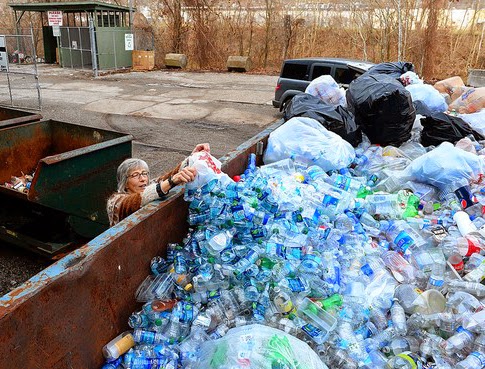
Recycling remains rural problem; W.Va. chemical spill sent millions of plastic bottles to landfills

Recycling bottles during West Virginia spill.
Photo: Chip Ellis, The Charleston Gazette
The January chemical spill that tainted drinking water in much of West Virginia, forcing residents to rely on bottled water, illustrated the lack of recycling in much of rural America. The vast majority of the millions of plastic bottles used after the spill ended up in landfills, Valerie Bauerlein reports for The Wall Street Journal.

Only 36 percent of West Virginia residents have curbside recycling, and in 2011 the Charleston area recycled less than 1 percent of its eligible plastic, compared to 30 percent nationally. "Many small towns and rural counties struggle to offer recycling services, especially with tight government budgets, limited access to recycling processors and wide fluctuation in the market for recyclable materials," Bauerlein writes. "Only half the population of Mississippi has access to drop-off or curbside programs. Some small cities, such as Lynn Haven, Fla., eliminated recycling programs because there were no nearby processing centers." (WSJ graphic)

The main reason rural areas lack access to recycling is that dumping trash is quicker and easier than recycling. "Shawn Lindsey, a recycling expert who advises the not-for-profit Center for Rural Strategies, said some towns cannot get vendors to bring in recycling containers because it takes weeks to fill a bin, tying up a company asset and providing an insufficient return," Bauerlein writes. Meanwhile, Lindsey said dumping trash in a place like Athens, Tenn., where he works, costs about $20 a ton, while it can cost more than $100 a ton in some urban areas.

Some people are optimistic that rural recycling has a bright future, with technological advances like automated bin-lifting trucks and optical sorters that will make it cheaper, Bauerlein writes. Mississippi was recently "awarded $1 million in grants to four communities seeking to build 'hub-and-spoke' networks, which could pool their collection to make recycling financially viable, according to the Mississippi Department of Environmental Quality." But the best solution, advocates say, is to make recycling free and easy for everyone. (Read more)

Report says states, not federal government, should crack down on abuses by for-profit colleges

The nonprofit National Consumer Law Center says states, not the federal government, should crack down on alleged abuses by for-profit colleges, which are prevalent in some rural areas, but many states are doing little to prevent the abuses in the first place. "Attorneys general in at least 32 states are investigating complaints that for-profit colleges and universities use misleading marketing and leave their students with high debt. Fourteen states have reached the stage of issuing subpoenas," Jon Marcus reports for The Hechinger Report. (National Consumer Law Center graphic)
The focus should be on shutting down the programs that don't meet minimum standards, Jonnelle Marte reports for The Washington Post. "The group argues that states' oversight should extend equally to accredited and unaccredited schools to ensure that they aren't using 'deceptive practices' to encourage students to enroll. Some states have been lenient with accredited programs, but they should also be scrutinized since they qualify for financial aid and have the potential to cause greater financial harm, the group says."

"The proposal also suggests that states set strict standards for schools by requiring them to meet minimum graduation rates and place a set number of students in jobs," Marte writes. Attorney and report author Robyn Smith, who works with the National Consumer Law Center, wrote: "Looking at job placement rates is the most direct measure you can have in terms of are schools doing what they promised they will do." The group argues that meeting those minimums should be a condition for state approval to operate.

The report also recommends that "states can ensure that complaints filed against schools are thoroughly investigated and that students are offered some form of relief, the report notes," Marte writes. "They can also make sure that any boards set up to oversee schools are not run by a majority of representatives from the schools themselves." (Read more)

Mayor of largely Hispanic rural town in Idaho campaigns in D.C. for immigration reform

John Bechtel, mayor of Wilder, Idaho, a rural town with 1,553 residents, many of them Hispanic, was in Washington Tuesday as part of a group urging the House to take action on passing immigration reform. In an editorial in The Hill, Bechtel relays his experience as a longtime resident and mayor of Wilder and his personal experiences in dealing with an immigration system that refuses to allow his Filipino-born daughter-in-law into the U.S.

John Bechtel
"Our little city is more than 70 percent Latino; our schools are 80 percent. Over the past 10 years we’ve had nine Gates Millennium Scholarship winners in our high school graduating class—all Latino. Any city would be proud of that," Bechtel writes. "Our city’s slogan is 'Welcome to Wilder, Come Grow with Us.' When I signed a resolution declaring Wilder a welcoming city a few years ago, I got quite a bit of flack. People thought I was supporting undocumented immigration. I simply believe all people should be treated with respect."

Describing his son's troubles, Bechtel writes, "Seeing this in my own family has given me a new perspective on the challenges immigrants face in coming here and the importance of reuniting families. There is no reason in the world that it should be this difficult to get to the United States, stay here and make a living. The bureaucracy around immigration has exploded, and nothing has been done about the broken laws that are hurting people’s lives."

"If you live in the United States legally, and you want to bring your mother from Mexico to live with you, the average wait is 12 years," he writes. "If you want to come here from the Philippines, the time on the waiting list is closer to 20 years. Immigration reform is personal to me: a white guy, the mayor of a small rural town in the heart of red-state Idaho. I’m probably the last guy you’d expect to see pushing for immigration reform. But the fact is, rural towns across America need immigration reform the most. Past generations of immigrants built rural America; new generations are revitalizing it." (Read more)

Missouri Farmers Union chief says proposed amendment would give more power to corporations

A proposed amendment to the Missouri constitution is being promoted as protecting the rights of farmers, but is likely to give corporations more power of voters approve it in August, Richard Oswald, a fifth-generation Missouri farmer and president of the Missouri Farmers Union, writes for the Daily Yonder.

"While many real, live people in the U.S. are beginning to see downsides to 14th Amendment protection for cold-blooded corporations, the U.S. Constitution says states still have the right to breathe life into them through their own constitutions," Oswald writes. "That’s why Missouri’s question on the August ballot is so important to big companies here. Approval of the amendment would help cement corporations into citizen-farmer roles before corporate powers can be revoked and voters in Missouri wake up to the real implications." (Yonder graphic: Ad supporting the amendment during the legislative session)

"In recent sessions the Missouri General Assembly has increased the amount of land foreign corporations can own," Oswald writes. "They have made it harder for people to protect themselves from corporate pollution and infringement on personal rights, like access to clean water and air.  Now most large producer groups and Missouri Farm Bureau have endorsed Amendment One because it protects the rights of farmers and ranchers." Oswald says the measure would do "nothing but guarantee that a few large companies will continue to dominate ever more of Missouri’s most productive rural landscape and exercise more control in the way we grow our food." (Read more)

Tuesday, June 17, 2014

Michelle Obama raises the stakes on school lunch: now it's about parenting; military supports standards


The House is expected vote this week on a Republican bill "that would waive tougher nutritional standards on school lunches if the school shows it has operated at a net loss over six months," Sink notes. Some school districts say they are losing money on meal programs because the standards, which limit sodium and require whole grains, fruits and vegetables, have made meals unpalatable to some students.

"The White House has backed a compromise agreement adopted by the Senate Appropriations Committee," Sink notes. "Under that deal, tougher requirements on sodium levels would not be implemented, although requirements for schools to offer fruits and vegetables would be kept." Obama said, “What we need to do is lend a hand to the schools that are struggling, not roll back the standards and say, ‘Oh, well. The kids don’t like it so let them eat cake.’ We can’t afford to do that.” (Read more)

At a Senate Agriculture Committee hearing last week, military leaders supported the standards as a way to strengthen military preparedness, Sarah Gonzalez reports for AgriPulse, a Washington newsletter. Retired Air Force General Richard E. Hawley said the military had to turn down 62,000 potential enlistees because of weight between 2006 and 2011, is discharging 1,200 troops per year because of weight issues, and spends $90 million a year finding and training replacements. (Read more)

Physicians at national meeting discuss future of rural primary care, how to solve doctor shortages

The shortage of primary-care physicians is a big problem in rural areas, and people need to do more to meet the need, according to a panel of physicians at "Rural Health Journalism 2014," Kris Hickman writes for the Association of Health Care Journalists, sponsor of the conference last weekend in Portland, Ore.

Almost half of rural counties, 44 percent, struggle with primary-care physician shortages, said Andrew Bazemore, M.D., M.P.H., director of the Robert Graham Center for Policy Studies in Family Medicine and Primary Care of the American Academy of Family Physicians. He said the U.S. ranks lowest in primary care and health outcomes among 10 other highly developed nations.
Primary care docs per 100,000 in 2012 (Centers for Disease Control and Prevention)
The number of primary-care doctors is expected to drop soon because almost 27 percent of those providers are older than 60, said Mark A. Richardson, M.D., dean of Oregon Health and Science's School of Medicine.

Bazemore said the medical community needs to draw more attention to the need for more primary care physicians in rural areas. He also said that for every dollar spent on health care, only six or seven cents are spent on primary care. "States facing a shortage should remember that primary care is the logical basis of any health care system," Bazemore said.

Richardson recommended that medical schools try to recruit students who have rural backgrounds because they're more likely to return to practice in rural areas. He and Bazemore agree that students who practice in rural areas should be given loan forgiveness or scholarships. "Debt prevents many people from choosing primary care," Bazemore said.

Richardson said the most important factor for where medical students end up practicing is where they completed their training. "Rural training is one of the highest predictors of a rural practice and should be required," he said. To do this, the government-imposed cap on graduate medical education (GME) spending would have to be abolished.

Bazemore said primary care in rural America "should be affordable and accessible to all. It should be more patient-centered and community-oriented . . . rather than the current fee-for-service dynamic that is 'provider and hospital centric,'" Hickman writes.

"Medical care is not a free market dynamic," Richardson said. "We pay for health care transactions, rather than health." (Read more)

Juneau paper to use drone; publisher says it will respect privacy when taking photos, videos

The daily newspaper in Alaska's capital last week introduced the newest member of its staff—an unmanned aerial vehicle, more commonly known as a drone. The Juneau Empire plans to use it for gathering news and for visual storytelling, Melissa Griffiths reports for the paper. Publisher Rustan Burton told her, “It gives us the power to look at things from different angles we’ve never seen before . . . It’s a completely new perspective on things they’ve seen before, seen on a regular basis." (Empire photo by Michael Penn)

Local residents won't have to fear about invasion of privacy, Burton said. He told Griffiths, “We won’t be floating through people’s backyards. We’ll use discretion and be very sensitive about the privacy of individuals. We’ll follow every law there is. And we’re just going to be ethical with it.” The Empire has already used the drone to make a series of short videos, which are available on the newspaper's website. (Read more)

The story didn't include the legal details involved in using a commercial drone. The Federal Aviation Administration has said drone use is illegal but appears to lack the ability to stop it because a federal judge dismissed an FAA fine, making it legal to fly a commercial drone at altitudes below 400 feet. But debate continues after a plane pilot said in March that he nearly collided with a drone flying well above 400 feet, showing that some drone users don't follow the rule.

'Walk on Washington' planned Wednesday to help put an end to soring of walking horses

Advocates leading the fight to end the walking-horse abuse known as soring are staging a "Walk On Washington" Wednesday in front of the U.S. Capitol "to support a bill sponsored by U.S. Rep. Ed Whitfield (R-Ky.) that would ban the use of pads and chains for achieving the exaggerated show gait known as the 'Big Lick,'" Janet Patton reports for the Lexington Herald-Leader.

Whitfield says his bill would crack down on all "illegal and abusive training methods—including painting chemicals on horses' front legs to make them sensitive and putting objects under the horse's front shoes to cause pain—all to encourage the horse to lift its feet higher," Patton writes. He said his bill would strengthen the federal Horse Protection Act, which is enforced by the U.S. Department of Agriculture.

Whitfield said in a statement: "This will be a good opportunity for Congress to see the amount of support this bill has from within the Tennessee walking horse industry and from those who present sound horses without stacks and chains. We are exploring all options to move this legislation forward in the House of Representatives." The bill has extraordinary bipartisan support in Congress, said Clant Seay, a Tennessee attorney working with the All American Walking Horse Alliance and other organizers of the rally.

"Opponents of Whitfield's bill, including U.S. Rep. Marsha Blackburn and U.S. Sen. Lamar Alexander, both Republicans from Tennessee, say banning pads and chains will cause economic damage by killing off the walking horse industry's flashy performance show classes, which Alexander called 'one of Tennessee's most treasured traditions'," Patton writes.

Study finds supposedly plugged oil and gas wells in Pennsylvania are leaking a lot of methane

Abandoned oil and gas wells in Pennsylvania are creating significant amounts of methane, a potent greenhouse gas, according to a study by Princeton University. The study found that between 200,000 and 970,000 abandoned wells in the northern part of the state likely accounted "for 4 to 7 percent of estimated man-made methane emissions in that jurisdiction, a source previously not accounted for," Andrew Nikiforuk reports for The Tyee, a British Columbia publication. The study found "that leaks from abandoned oil and gas wellbores pose not only a risk to groundwater but represent a growing threat to the climate."

An Associated Press investigation published in January found that Pennsylvania is one of four states where it was confirmed that oil and gas drilling has led to water pollution. Since 2005, the state has had 106 water-well contamination cases and in 2013 received 398 complaints that drilling polluted or otherwise affected private water wells.

And it seems that complianants have few friendly ears to bend. A report released in early 2013 by the Public Accountability Initiative found that many of Pennsylvania's policymakers, regulators and enforcement workers came from the oil and gas industry they oversee, or left state jobs for industry jobs. The report also found that Pennsylvania's last four governors and 45 current or state officials had ties to the gas industry. There is no direct federal regulation of oil and gas production except on federal land. (Read more)

For the Princeton study, researchers measured methane emissions from 19 abandoned wells, finding that "the highest-polluting well seeped 3.2 cubic metres of gas a day, or 1,168 cubic metres of gas a year. That's nearly $300 worth of natural gas annually," Nikiforuk writes.

The study also found that "methane leaks from plugged wells, which were properly sealed with cement at the time of their abandonment, were just as high as rates from unplugged wells," Nikiforuk writes. "Wells connected to sandstone formations leaked more often than wells constructed in other formations." Researchers also "found ethane, propane and n-butane mixed with the methane—all indicators that the gas came from zones targeted by industry as opposed to swamps or natural sources," and methane leaks were more prevalent during the summer. (Read more)

Alaska gets a law school, sort of; Ky. law school starts program to place graduates in rural areas

Many states with large rural populations are short of lawyers in their small towns. Alaska is a special case,as the only state without a law school. The Seattle University School of Law has announced the creation of a satellite campus in Anchorage that will let students finish their degree in Alaska, Michelle Theriault Boots reports for the Anchorage Daily News.

"The idea is to shrink the time necessary to relocate out-of-state for law school to two school years instead of three," Boots writes. "Students will be able to spend summers and their entire third year attending Seattle University law classes on the campus of Alaska Pacific University starting in 2015. There's no cap on the number of students who could participate, but organizers say anticipate starting with 10-15 per year."

For the past 12 years, Seattle University "has operated a summer program that brings law students from across the country to Anchorage for Alaska-specific law courses and internships," Boots writes. About 60 percent of the 170 students who have completed the program return to Alaska to work. (Read more)

One of Kentucky's three law schools, Northern Kentucky University's Chase College of Law, has begun a regional placement program that "will try to connect law-school graduates with opportunities in small towns and rural areas around Kentucky," Cliff Peale reports for the Cincinnati Enquirer.

Advocates say a lack of lawyers in smaller communities "restricts companies trying to expand or merge, denies civil rights to residents and keeps children from access to basic services," Peale writes. Many lawyer job openings in rural Kentucky often don't get any job applicants, Chase Dean Jeffrey Standen said. He told Peale, "Students today see the bright lights of the big city and think that's where lawyering has to happen." (Read more)

Pollinator Week runs through Sunday; good time to teach about birds, bees, bats, butterflies, beetles

Pollinators such as bees, birds, bats, butterflies and beetles help produce nearly $20 billion worth of products every year in the U.S. while providing up to 30 percent of pollination. But "farm and ranch lands that support pollinators are disappearing at the alarming rate of 3,000 acres a day," the non-profit Pollinator Partnership. says in promotion of Natinal Pollinator Week, which runs through Sunday.

Bee populations have been declining for several years, with 23.5 percent of honeybees dying this past winter, mostly due to pesticides and disease, and the species averaged a 30 percent loss of population during the past eight winters.

One way to help is through awareness. That's why Pollinator Week was started seven years ago. "Pollinating animals, including bees, birds, butterflies, bats, beetles and others, are vital to our delicate ecosystem, supporting terrestrial wildlife, providing healthy watershed and more," Pollinator Partnership says.

Pollinators impact 35 percent of the world's agriculture, says Crop Life America: "Bees are responsible for more than just honey; they pollinate grapes, strawberries, avocados and cucumbers, among many other food crops." In addition to pesticides and disease, other factors that negatively affect pollinators are availability of forage; beekeeping management practices; weather patterns and changing climate; lack of genetic diversity; and poor health or death of queen bees. (Read more)