Tuesday, May 10, 2016

Coal country becoming presidential battleground; polls show Ohio and Pennsylvania up for grabs

Hillary Clinton's continued decline in the Appalachian coalfield and Donald Trump's surging popularity there could spell trouble for the Democratic candidate this fall, Michael Finnegan reports for the Los Angeles Times. That has been evident during trips by both candidates into Appalachia, where Clinton is still reeling from her comment that she would "put a lot of coal miners and coal companies out of business" with policies to fight climate change, while Trump has been winning over voters by promising to bring lost coal jobs back without saying how. Clinton's apologized for her statement, but it was often taken out of context, and Republicans are hammering her on it. (AP photo by Steve Helber: Trump supporters in Charleston, W.Va.)

A Quinnipiac University survey released today has Trump leading Clinton in Ohio 43 percent to 39 percent, while Clinton holds narrow leads—43 percent to 42 percent—over Trump in Pennsylvania and Florida. The survey has Vermont Sen. Bernie Sanders beating Trump in all three states, by margins of 43 percent to 41 percent in Ohio, 47 percent to 41 percent in Pennsylvania and 44 percent to 42 percent in Florida. Peter A. Brown, assistant director of the poll, said, "At this juncture, Trump is doing better in Pennsylvania than the GOP nominees in 2008 and 2012. And the two candidates are about where their party predecessors were at this point in Ohio and Florida." No Republican has won the presidency without winning Ohio' electoral votes, and Pennsylvania has voted Democratic for president since 1988.

Finnegan writes, "Clinton's bungled remarks on coal's grim future—'I misspoke,' she conceded last week—opened the way for Trump to strengthen his bonds with the voters she offended. Trump has played to public anger over efforts by President Obama, Clinton and other Democrats to scale back the burning of coal and other fossil fuels that contribute to global warming. Trump has dismissed global warming as a 'canard,' 'hoax' and 'total con job,' citing cold snaps as evidence," though weather is not the same as climate. Trump could pay for rejecting science, Finnegan wriues: "Ohio, Virginia and Pennsylvania all include big metropolitan areas where Clinton's plans to fight global warming resonate with many moderates." At the same time, economists doubt any president can stop coal's decline. (Read more)

Army Corps sides with Native Americans in Wash., denies permit for nation's largest coal port

North America's largest proposed coal port has been blocked. "The U.S. Army Corps of Engineers, the agency reviewing permits for the deep water port project," agreed with the Lummi Nation on Monday that it could not grant a permit for a project that would infringe on the tribe’s treaty-protected fishing rights, Lynda Mapes reports for The Seattle Times. "The terminal would have brought some of the largest ships afloat into the usual and accustomed fishing waters of the Lummi up to 487 times a year to load and unload bulk commodities, principally coal, bound for Asian ports."

The proposed port had led to heated debates in Whatcom County, Washington, for years. Samantha Wohlfeil reports for The Bellingham Herald. Supporters said it would bring much-needed jobs, while critics said it would lead to increased train traffic and pollution. "Those backing the project have a few options to possibly revive it. SSA Marine, the developer of the project, can change the project so it doesn’t significantly impact treaty rights, reach an agreement with Lummi Nation so the tribe withdraws its objection or sue in federal court." (Proposed terminal)
Bob Watters, senior vice president of SSA Marine, said of the ruling: “This is an inconceivable decision. Looking at the set of facts in the administrative summary it’s quite obvious this is a political decision and not fact-based. We are very disappointed that the GPT project has become a political target rather than being addressed on the facts. The terminal promises to deliver substantial benefits through economic development, the creation of family-wage jobs, and the generation of significant taxes.”

Legal experts said the decision "followed federal obligation to protect tribal treaty rights and the habitat that makes those reserve rights meaningful," Mapes writes. Robert Anderson, director of the Native American Law Center at the University of Washington School of Law, told her, “This is based on a long line of precedent. You can’t have a right to fish without a decent environment.”

Nearly 6M low-skill, low-wage factory workers get government aid; most prevalent in South

About 6 million low-skilled manufacturing workers—half of the U.S. total—are earning such low wages that they have to rely on government assistance to make ends meet, says a study by researchers at the University of California-Berkeley. Nine of the 11 states with the highest participation rates in public programs are in the South, where manufacturing jobs typically pay lower and unions are less prevalent, Jim Tankersely reports for The Washington Post.

In 2013 the median manufacturing production wage was $15.66, with 25 percent of workers earning $11.91 or less, states the report. "In decades past, production workers employed in manufacturing earned wages significantly higher than the U.S. average, but by 2013 the typical manufacturing production worker made 7.7 percent below the median wage for all occupations. During the same time period productivity in the U.S. manufacturing sector increased at a rate one-third higher than in the private, non-farm economy overall." Manufacturing production wages now rank in the bottom half of all jobs in the U.S., says the National Employment Law Project.

Researchers found "that between 2009 and 2013 the federal government and the states spent $10.2 billion per year on public safety net programs for workers (and their families) who hold frontline manufacturing production jobs," says the study. Overall, 34 percent of families "of frontline manufacturing production workers are enrolled in one or more public safety net program" and 50 percent of families with workers hired through staffing agencies.
The majority of families are using public safety-net programs because of low wages, not because they aren't getting enough hours, the study found. "The families of 32 percent of all manufacturing production workers and 46 percent of those employed through staffing agencies who worked at least 35 hours a week and 45 weeks during the year were enrolled in one or more public safety net program."

The study's authors "say the simple explanation of what's happening is that many manufacturing jobs do not pay as much, per hour, as Americans expect them to," Tankersley writes. "Other statistics also suggest that manufacturing jobs are losing their advantage as a gateway to the middle class. In 1990, the average non-supervisory hourly wage in manufacturing was 6 percent higher than the average non-supervisory wage in the economy at large. Today, according to Labor Department statistics, the manufacturing wage is 5 percent lower on average than the economy at large."

Former Kansas newspaper owner bequeaths $2 million to his rural community

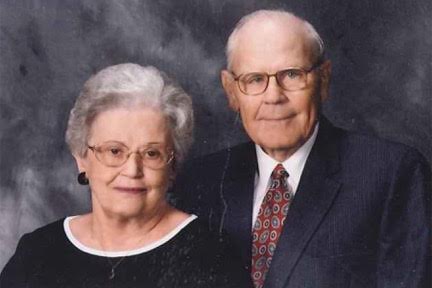
Schmitty and Web Hawkins
A rural Kansas community received a surprise $2 million gift from the former owner and publisher of the Osawatomie Graphic and Louisburg Herald, Tom Eblen reports for the Kansas Press Association. "As he neared the end of his newspaper career in the late 1990s, Web Hawkins learned something that he had never expected. He was rich, or at least comfortably well-off." Web and his wife Schmity had no children, and left money to the Kansas Newspaper Foundation; his alma mater, the University of Missouri School of Journalism; the Osawatomie YMCA and others. "But there was plenty left. So Web and Schmitty decided together that they would bequeath the rest to the Osawatomie community, the place where they had made their living. That would be about $2 million to be disbursed by a committee of the Hawkinses' friends for deserving projects in their hometown." Web died on April 8. His wife died in 2009.

"In 1959 Web signed a contract to run Nelson Reppert's Osawatomie Graphic-News for two years and to buy a half-interest in the paper," Eblen writes. "Within two years, Web and Gladys, known as Schmitty in the newspaper fraternity, had completed the purchase and later official changed the name to the Osawatomie Graphic. Then it was off to the races, Web doing the journalism that he loved and Schmitty keeping an eagle eye on the business side. They were a power couple before power couples were featured in the popular press."

"The Hawkinses eventually owned several weeklies in Kansas, including the Louisburg Herald, Emporia Times, Linn County News and had partial interest in the Hillsboro Star-Journal and Herington Times," Eblen writes. Web also was involved in the Kansas Press Association, which he served as president in 1970. "He was president of the National Newspaper Association in 1988; KPA awarded him the Clyde M. Reed Master Editor Award in 1996 and the KPA Hall of Fame in 2005. He also served on the Columbia Missourian's board of directors for several years. In 1998, Web and Schmitty retired." (Best Places map)

Osawatomie native Larry Byers, who worked for Web several years before taking over the Herington Times, with purchasing help from Web, told Eblen, "I know that Web and Schmitty put a lot of thought on the matter over a long period of time. The foundation will prove most beneficial to Osawatomie residents for decades to come. The people of Osawatomie will eventually come to recognize that Web and Schmitty were genuinely interested in the betterment of their town long after their passing." (Read more)

Longtime journalist in rural Nevada, known as 'Grandma with Attitude,' dies at 71

Anne Pershing
Most rural communities are blessed with a handful of treasured citizens, people "who labor in obscurity except in their hometowns, where they are key pieces of the civic infrastructure," said Al Cross, director of the Institute for Rural Journalism and Community Issues, which publishes The Rural Blog. One of those people was Anne Pershing, who did community journalism for 33 years in Fallon, Nev., and was known in more recent years as "Grandma with Attitude" for her columns championing the rights of senior citizens, Marcella Corona reports for the Reno Gazette-Journal, which published the columns. Pershing died on Thursday at 71.

Pershing "was nominated for a Pulitzer Prize in Public Service for her work on a series on child leukemia in Fallon from 1999 to 2002," Corona writes. "She was also awarded the Associated Press Public Service award in 2001. Pershing was also the president of the Nevada Press Association board from 1993 to 1994. She served on the board for 13 years and earned the NPA President’s Award in 1999. She was inducted into the Nevada Newspaper Hall of Fame in 2009."

NPA Executive Director Barry Smith told Corona, "She had that relationship with Fallon, as somebody who knew everybody in town. She was willing to stand by them if they were willing to stand up for themselves." Smith said Pershing was proud "of covering gay and lesbian issues 'in a small, conservative town long before they became an accepted cause.'" He told Corona, "She was a mom and a grandma to her own family, of course, but also to anybody she cared about—and that was a lot of people, from wayward kids to governors. Anne told them what they needed to hear, whether it was a mild scolding or a word of encouragement. And either way, she probably followed it up with a plateful of fudge."

In her final column, which appeared on Sunday, Pershing wrote about Mother's Day. She wrote: "Mother's Day is Sunday, May 8, which means the phone lines will be on fire all around the country with people calling to pay homage to Mom. And for those of us who have lost our mothers, we will quietly pay our respects and embrace the memories of our beloved mothers, each in his or her own way."

Monday, May 09, 2016

Heroin and prescription drugs are different opiates affecting different parts of U.S., Globe notes

Stories about an increase in opiate addiction and opiate deaths, growing concerns in rural areas, are missing the fact that opiates are made up of two distinct categories—heroin and prescription painkillers, Evan Horowitz reports for The Boston Globe. "Reacting to these very different epidemics with a set of policies focused on 'opioids' may ultimately prove inadequate, even counterproductive. Because heroin and prescription opioids are killing different people, in different ways, across different parts of the country."

"Heroin deaths are largely concentrated across New England and the Midwest, and heroin victims tend to be young men in their 20s and early 30s," Horowitz writes. "By contrast, prescription opioids are killing people all across the country, especially people aged 45-54 and including a substantial number of women. Perhaps most critical, a Globe anaylsis of death certificates compiled by the Centers for Disease Control shows a marked shift towards heroin, which once contibuted to less than 15 percent of opioid overdose deaths and now accounts for nearly 40 percent." (Globe map: Prescription opioid deaths per every 100,000 people in 2014)
Prescription opioid deaths, led by a rise in popularity of OxyContin, increased by 300 percent from 1999 to 2010, Horowitz writes. During that same time heroin deaths increased from .7 deaths per every 100,000 people to 1 death per every 100,000 people. But from 2010 to 2014, heroin deaths tripled, partly due to cheaper heroin and a concentrated effort by law enforcement to crack down on prescription drug abuse. Heroin deaths are far more rare in states such as Oklahoma, Kansas, Idaho and Wyoming, where "less than one in five opioid-related deaths stem from heroin." (Globe map: Heroin deaths per every 100,000 people in 2014)
"Prescription drug overdoses are most common among middle-aged Americans, 45-54, who account for about 25 percent of all prescription opioid deaths," Horowitz writes. "When you add in 55-64 year olds, you capture nearly half of all overdoses from prescription drugs. With heroin, the situation is reversed. It’s the 25-34 year olds who suffer most, with an overdose rate vastly higher than any other age cohort. This complicates the familiar story of opioid abuse, where people get hooked on prescription drugs before shifting to heroin. For young people, this may indeed be a real risk. One 2012 study suggested that 3-4 percent of opioid addicts do make the switch to heroin. But this doesn’t seem to be happening among older Americans. For that age group, the prescription drugs themselves are the big risk."

EPA chief: Coal communities in danger of being left behind, with or without Clean Power regulations

Environmental Protection Agency chief Gina McCarthy (Getty Images photo) said coal-dependent communities are "at risk of being 'left behind' as the country moves away from coal power," Timothy Cama reports for The Hill. McCarthy, who was participating in a discussion on Friday with science educator Bill Nye, also said that the move away from coal, which she said would happen even without President Obama's clean power regulations, "is causing a net increase in jobs." She told Nye, “On the whole, what’s happened is jobs continue to grow. What happens, though, is some communities may get left behind."

Nye asked McCarthy about the decline of coal in West Virginia and Kentucky, where presidential candidates have been stumping in advance of Tuesday's primary in the Mountain State and the May 17 primary in the Bluegrass State, Cama writes. McCarthy said "recognizing the harm to coal communities does not mean that the country should abandon efforts to cut greenhouse gas emissions or other harmful effects from coal." She told Nye, “You don’t change the entire dynamics of the economics for those communities or deny they exist. You invest in those communities so they continue to have opportunities moving forward.”

McCarthy said Obama's administration will "invest in coal country and help communities adjust to new economic development and educational opportunities, among other measures," Cama writes. "Lawmakers from both parties, along with the White House, have backed a similar proposal they call the Reclaim Act, which would use abandoned mine fees for coal country transitions. The Supreme Court put the administration’s main rule threatening the coal industry, the Clean Power Plan, on hold in February. Obama pledged last year that the U.S. would cut its greenhouse gas emissions 26 percent to 28 percent by 2025, when compared with 2005 levels."

McCarthy told Nye, "We have already taken considerable steps. We have planned ahead. And for crying out loud, what we have is a pause in the Clean Power Plan. If anybody knows anything about EPA in writing rules, we rock at it, we do them legally, we do them on the basis of sound science. And while there is a pause, there’s no pause in the action in the United States towards renewable energy and energy efficiency. We are going in exactly the direction our rule demanded, and we’re doing it because the markets demand it. We could not be in better shape than we are today.” (Read more)

Reporter with ties to militia groups, who covered Oregon occupation, is arrested with machine gun

A reporter who covered the occupation of the Malheur National Wildlife Refuge was arrested on Friday after a search of his home found a Browning M2, a .50 caliber machine gun, Les Zaitz reports for The Oregonian. Michael R. Emry (Oregonian photo by Mark Graves), a former weapons manufacturer who "described himself as an 'embedded' reporter with a militia group called 3% of Idaho ... was charged in a federal complaint of unlawful possession of a machine gun not registered to him and unlawful possession of a firearm with an obliterated serial number, the FBI said in a statement."

An affidavit, which said the machine gun could fire 550 to 650 rounds per minute, said "Emry admitted that he took the M2 from the shop where he works in Idaho about a month and a half ago," without the shop owner's knowledge, Zaitz writes. Emry was scheduled to appear in federal court today. A Facebook page controlled by Emry posted on Friday: "We don't know the charges—presumably it was because of the Malheur occupation. Michael was there as media and nothing more. For those of you who might think about cheering at the news, keep in mind that there are two issues involved here—freedom of the press and freedom of speech."

The 3% of Idaho group participated in a Jan. 2 rally in Burns hours before the refuge takeover, Zaitz writes. The group disavowed knowledge of the takeover, but its leaders were a regular presence throughout the 41-day occupation. The group at one point arrived at the refuge in a convoy of heavily armed members, who said they were there to shield the refuge occupiers from law enforcement. Occupation leaders sent them away." Emry's site also praised Grant County Sheriff Glenn Palmer, who is under criminal investigation by the state Justice Department about his dealings with the armed militants. 

Emry said "he was helping Grant County citizens establish a committee to investigate media reporting and, if necessary, conduct trial-like hearings on the accuracy of stories," Zaitz writes. "Emry earlier this week conducted a meeting of what he called the Committee of Correspondence, identifying three local residents who participated on the committee. County records show they all hold appointments from Palmer as special deputies—citizen volunteers." (Read more)

North Carolina governor suing feds to keep controversial transgender bathroom law on books

Republican Gov. Pat McCrory has filed a lawsuit against the U.S. Justice Department to save North Carolina's new and controversial bathroom law, Michael Gordon reports for The Charlotte Observer. McCrory is asking a federal court to clarify whether the law discriminates against transgender people as the Justice Department contends. McCrory wants the court "to overturn a federal prosecutor’s assertion last week that HB2 violates Title IX of the Civil Rights Act as well as the Violence Against Women Act."

"The law, which was passed by the General Assembly after the city of Charlotte extended LGBT protections, including a provision that allowed transgendered people the right to use the bathroom with which they identified," Gordon writes. "The resulting firestorm over HB2 has cost the state hundreds of new jobs, concerts and other events and made North Carolina a target of international criticism. The law is already the target of a federal lawsuit filed by the American Civil Liberties Union and other groups. HB2’s provision that limits transgender bathroom usage to the sex of an individual’s birth risks the loss of billions in federal dollars flowing into the state, the groups said last week in a joint statement. Title IX bans discrimination at schools, universities and any education program receiving federal money. North Carolina receives billions in federal education dollars every year."

McCrory, who’s in a tough re-election fight, "said HB2 is a common-sense law that makes bathrooms safer for women and children," Gordon writes. McCrory said in a statement: "The Obama administration is bypassing Congress by attempting to rewrite the law and set restroom policies for public and private employers across the country, not just North Carolina. This is now a national issue that applies to every state and it needs to be resolved at the federal level. They are now telling every government agency and every company that employs more than 15 people that men should be allowed to use a women’s locker room, restroom or shower facility.”

EPA inadvertently releases statement saying glyphosate (Roundup) is not likely a carcinogenic

The U.S. Environmental Protection Agency inadvertently posted on its website that "glyphosate is not likely to be carcinogenic to humans," Todd Neeley reports for DTN The Progressive Farmer. EPA has since deleted the post, calling it a mistake. "The document was described as the final report of a cancer assessment review committee (CARC) on the health effects of pesticides. The CARC report had yet to be reviewed by a scientific advisory board. EPA said Monday the advisory board is slated to complete its review by year's end, when an EPA assessment is finalized or released," Neeley writes.

"The CARC concluded that the epidemiological studies in humans showed no association between glyphosate exposure and cancer of the following: oral cavity, esophagus, stomach, colon, rectum, colorectum, lung, pancreas, kidney, bladder, prostate, brain (gliomas), soft-tissue sarcoma, leukemia, or multiple myelomas," Neeley writes. "The International Agency for Research on Cancer, or IARC, in Lyon, France, assessed the carcinogenic potential of glyphosate in March 2015. The IARC concluded glyphosate was 'probably carcinogenic to humans'."

Monsanto, which markets glyphosate under the brand name Roundup, has been critical of the IARC assessment, was quick to take advantage of the EPA error, Neeley writes. Hugh Grant, Monsanto's chairman and CEO, said in a statement: "No pesticide regulator in the world considers glyphosate to be a carcinogen, and this conclusion by the U.S. EPA once again reinforces this important fact. Glyphosate has a 40-year history of safe and effective use. Unfortunately, last year's inconsistent classification by IARC generated unwarranted concern and confusion about this important agricultural tool. This rigorous assessment of the data by EPA builds on the sound conclusions of both the European and Canadian regulatory authorities and once again makes it clear that glyphosate does not cause cancer." (Read more)

iVantage Health Analytics names top 100 rural hospitals, top 100 critical-access hospitals

iVantage Health Analytics has released its list of the Top 100 Rural and Community Hospitals and top 100 Critical Access Hospitals. iVantage said in a statement: "These top performers are excelling in managing risk, achieving higher quality, securing better outcomes, increasing patient satisfaction and operating at a lower cost than their peers. These two groups serve as a benchmark for other rural facilities as they strive to achieve similar results and provide a blueprint for successfully navigating the uncertainty of the new healthcare." For more information see ivantageINDEX.com.

Friday, May 06, 2016

Kaiser poll: Government, doctors not doing enough to combat prescription drug and heroin abuse

Most Americans don't think governments and doctors are doing enough to combat prescription drug and heroin abuse, growing concerns in rural areas, according to a Kaiser Family Foundation poll. The telephone survey of 1,201 adults found that 67 percent said their state government is not doing enough to fight prescription drugs, and 61 percent said the same of heroin. Doctors didn't score much better. Fewer people said the same of law enforcement, with only a third of respondents saying police are not doing enough for prescription drugs or heroin.

"Prescription drug addiction also impacts much of the public on a personal level, with 44 percent saying they personally know someone who has been addicted to prescription painkillers, including 20 percent who say the person was a family member and 2 percent who say they themselves were addicted," reports Kaiser. "When asked about the potential effectiveness of various policy actions, more than eight in 10 Americans rate five strategies as 'very' or 'somewhat' effective: increasing pain management training for medical students and doctors (88 percent); increasing access to addiction treatment programs (86 percent); public education and awareness programs (84 percent); increasing research about pain and pain management (83 percent); and monitoring doctors’ prescription painkiller prescribing habits (82 percent)." (Kaiser graphic)

Project looking to interview farmers and ranchers in 10 states about health care and insurance

A project called Health Insurance, Rural Economic Development and Agriculture (HIREDnAg), wants to interview 120 farmers and ranchers in California, Kentucky, Massachusetts, Michigan, Mississippi, Nebraska, Pennsylvania, Utah, Vermont and Washington about their experiences with health care. Participants will be paid $200 and be asked how health insurance influences the quality of their life and farm business. For more information contact Jon Bailey, Center for Rural Affairs representative, at jonmbailey1@gmail.com, or Katlyn Morris, project coordinator, at Katlyn.Morris@uvm.edu, or 802-656-0257. (Read more) (HIREDnAG graphic: States in study)

Va. high schools take playoff games from Liberty Univ., citing president's anti-Muslim remarks

Jerry Falwell Jr.
Virginia high-school sports championships will no longer be held at Liberty University in Lynchburg, in response to anti-Muslim remarks made by President Jerry Falwell Jr., Robert Anderson reports for The Roanoke Times. The Virginia High School League voted this month to move state championships in football, baseball, softball, soccer and tennis for the 2016-17 and 2017-18 school years. Some state championships, such as Class 3A and 4A football, have been played at Liberty for 18 years.

"The move comes in the wake of a boycott of the April 22-23 VHSL Debate Tournament at Liberty by students from at least five Northern Virginia high schools in protest of comments" Falwell made in December following the shootings in San Bernardino, Calif., which left 14 dead and 21 wounded, Anderson reports. The day after the shootings the Lynchburg News & Advance reported Falwell saying, "I always thought if more good people had concealed-carry permits, then we could end those Muslims before they walked in and killed them."

Falwell, who said his statement was misinterpreted, wrote in an opinion piece for The Washington Post that schools boycotted the debate tournament not because of his statements, but because of Liberty's concealed-carry policy. He wrote: "The policy, in place since 2011, states that individuals over 21 who have qualified for concealed-carry permits and granted such permits by the state of Virginia (as well as received permission through the Liberty University Police Department) are allowed to carry concealed weapons on campus. ... Some colleges and universities in Virginia have chosen to ban concealed carry, and we believe that those universities have created more dangerous environments for their students, faculty, and staff."

One week after the shootings in December, Falwell announced that Liberty was ending its ban on guns in residence halls, Nick Anderson reports for the Post. Falwell was carrying a gun with him at the time he made the announcement.

Children’s Defense Fund report paints a grim picture of lack of progress in Appalachian Ohio

Appalachian Ohio in blue
Little has been done over the past 15 years to improve dire conditions in Appalachian Ohio, especially when it concerns the well-being of children, says a report published this week by the Children’s Defense Fund-Ohio. The report states: “Looking back over the past 15 years, we find that in Appalachia a higher percent of children are poor, unemployment is higher, median incomes continue to lag behind the state average, and working families are struggling to make a living wage." (Children's Defense Fund graphics)

More than a quarter of all kids in Ohio's 32 Appalachian counties live in households without enough food, say Renuka Mayadev and Dawn Wallace-Pascoe of the Children's Defense Fund. Ohio's top 12 counties with the highest rates of child poverty are all in Appalachia.

The report found that in Appalachian Ohio, 15.4 babies per every 1,000 births are born with Neonatal Abstinence Syndrome—addiction to opiates—with numbers as high as 76 out of every 1,000 in Scioto County, on the Kentucky border. Also, "a higher percentage of babies are being born at low birthweight, putting them at increased risk of development problems and dying within the first year of life," the report says.

Health-care provider shortages are also a severe problem, as 28 of the 32 Appalachian counties suffer an acute shortage of dentists and 21 "face an acute shortage of primary care physicians and 28 counties have an acute shortage of mental health professionals," the report says. Education numbers didn't fare much better, with 14 counties lacking Early Head Start programs. Appalachian students are more likely to need to take remedial 'make-up' classes in college and fewer adults have college degrees, "in part because those with degrees move away for better opportunities." (Read more)

Gulf Coast, especially rural towns, is ill-prepared for impending arrival of Zika virus

Rural areas along the Gulf Coast are ill-prepared for the Zika virus, which could arrive in the region within the next few weeks, "carried here by travelers and spread by local mosquitoes," Liz Szabo reports for USA Today. "The Gulf Coast's steamy climate, abundant mosquitoes and international airports create an environment ripe for the mosquito-borne Zika virus, which has spread to 37 countries and territories in the Americas. The disease causes devastating birth defects and is linked to paralysis and other serious complications."

Scott Weaver, director of the Institute for Human Infections and Immunity at the University of Texas Medical Branch in Galveston, said "smaller, more rural and 'some poor communities in the region have virtually nothing available' in terms of mosquito control," Szabo writes. Arturo Rodriguez, public health director of the border town Brownsville, Texas, where thousands of people cross the border every day, told Szabo, "We literally have to fight this issue on our own. We have to bootstrap ourselves." The virus was detected in Mexico in November.

Southern states are most susceptible to the virus, said Cheryl Clay, public health senior environmentalist in Madison County, Alabama, Kym Klass reports for the Montgomery Advertiser. "There have been 67 investigations and three confirmed cases this year of travel-related cases of the Zika virus in Alabamians—positive specimens were confirmed from Jefferson, Shelby and Morgan counties—and state officials have increased its efforts to ensure the safety of its residents. As of April 27, there have not been any locally acquired vector-borne cases reported in the U.S. From Jan. 1, 2015, through April 27, there were 426 travel-associated Zika virus disease cases that have been reported." (USA Today map: Zika cases by state)
Local newspapers are asking local officials what they're doing about mosquitoes. Jacob Thomas of the Kentucky New Era in Hopkinsville surveyed local governments in the paper's three-county circulation and coverage area to see what they're doing or planning.

Thursday, May 05, 2016

Iowa farm-paper cartoonist says weekly fired him for upsetting advertiser linked to major corporation

A freelance Iowa cartoonist said he was fired this week after a company affiliated with a major corporation threatened to pull advertising in response to his cartoon "that bemoaned Iowa farmers' dwindling profits while CEOs at large agricultural corporations earn millions of dollars," Donnelle Eller reports for The Des Moines Regiser. Rick Friday's cartoons have appeared in Farm News, a weekly publication of The Fort Dodge Messenger, for 21 years. His last cartoon said the CEOs of Deere & Co., Monsanto Co. and DuPont Pioneer made more money than 2,129 Iowa farmers last year. Friday wrote on Facebook: "A large affiliated company 'was insulted and canceled their advertisement with the paper, thus, resulting in the reprimand of my editor and cancellation of 'It's Friday' cartoons.'"

CEOs at the three companies "earned about $52.9 million last year, based on Morningstar data," Eller writes. "Profits for the three companies, all with large operations across Iowa, also have declined as farm income has been squeezed. After peaking in 2013, U.S. farm income this year is projected to fall to $183 billion, its lowest level since 2002.

Publisher Larry Bushman, who refused to say why the newspaper would no longer publish Friday, said it was an editorial decision, Eller writes. "Farm News Editor Larry Kershner said he couldn't comment about the decision. DuPont and Monsanto officials said the companies were unaware of the cartoon until the media brought it to their attention." A Deere spokesman wasn't available for comment. (Read more)

This isn't the first time corporate discomfiture has squelched independent journalism about agriculture. The late Derry Brownfield lost his program on his own network (which he had sold) in 2008 after refusing to tone down criticism of Monsanto's patenting its seed corn.

FDA to ban sale of e-cigarettes to anyone under 18

In a long-anticipated announceemnt, the Food and Drug Administration said today it is assuming regulatory authority over electronic cigarettes, which have become a growing concern among youths, especially in rural areas, Tripp Mickle reports for The Wall Street Journal. FDA's new tobacco regulations will prohibit sales of e-cigarettes and all tobacco products to anyone under 18. Health warnings will also be placed on packages, saying, “WARNING: This product contains nicotine. Nicotine is an addictive chemical.” Rules also will "require manufacturers to submit products for approval." (CDC graphic)
FDA "rules have the potential to upend the $3.5 billion e-cig industry," Mickle writes. "Many of the small vape shops, device manufacturers and liquid nicotine producers won’t be able to afford the FDA’s approval process, which could cost anywhere from $2 million to $10 million per item, according to the regulatory consulting company SciLucent LLC."

Greg Conley, president of the American Vaping Association, an industry-funded advocacy group, told Mickle, “This is going to be a grim day in the history of tobacco-harm reduction. It will be a day where thousands of small businesses will be contemplating whether they will continue to stay in business and employ people.” Vapers argue that e-cigs help people quit; studies on that conflict.

Environmental groups sue EPA, calling for updated, stricter rules for wastewater from fracking

Environmental advocacy groups sued the Environmental Protection Agency Wednesday, "saying the government has failed to adequately regulate the disposal of waste generated by oil and gas drilling," Brady Dennis reports for The Washington Post. The groups, which want stricter rules on the disposal of wastewater, "argue that EPA has neglected to revise its existing rules for nearly three decades, despite acknowledging in the late 1980s that stricter requirements were needed for the handling of oil and gas drilling waste." The groups also cited an increasing number of studies linking the oil and gas industry to earthquakes from fracking-disposal wells as another reason for stricter rules.

"In addition, the groups want EPA to ban the practice of dumping fracking wastewater on fields and roads, where it potentially could pollute drinking water sources," Dennis writes. "They also want the agency to require that ponds and landfills where drilling and fracking waste are dumped built to certain specifications and adequately lined to prevent leaks. The lawsuit asks the court to set strict deadlines for EPA to adopt updated rules."

A.J. Ferate, vice president of regulatory affairs for the Oklahoma Independent Petroleum Association, told the Post last year, “It’s hard to deny that in certain geographic locations with certain geologic circumstances, we’ve had some problems with some wastewater wells. But to make a blanket assertion that wastewater wells are always the cause, I don’t know that I can agree with that.” (Read more)

Sheriffs gone wild! Rural N.C. department accused of getting away with repeated abuse

Hartnett County in blue (University of North Carolina)
Who polices out-of-control sheriff's departments? In Harnett County, North Carolina, it seems the answer is no one, according to an investigative series, "Deadly Force," by the News & Observer. The investigation shows that the sheriff's office has free rein to do whatever it wants, leading to complaints from residents that they were "injured, abused or were having their homes needlessly invaded by sheriff’s deputies, Mandy Locke reports for the News & Observer. "At least six people who said they were abused or harassed by deputies called or wrote to the sheriff’s office, district attorney’s office or other officials about incidents in their home. They said they were ignored or told they would never know what action was taken as a result. The sheriff’s office and the district attorney’s office also did not analyze arrest records or use-of-force documents that signaled potential problems."

"In North Carolina, residents have little power to force officials to heed their complaints," Locke writes. "Sheriffs are elected, and they hire and fire at will. It is largely up to them to watch over deputies to make sure they work within the law. District attorneys have the authority to enlist the State Bureau of Investigation to look into complaints of excessive force, but that has not happened in Harnett."

"Larry Rollins, first elected sheriff in 2002, retired in March, citing personal reasons," Locke writes. His replacement, Wayne Coats, "said he had some knowledge of internal affairs investigations in two of the incidents, but he declined to discuss them. Requests for copies of the sheriff’s internal affairs investigations were denied. The department was also unwilling to give specifics about the number of the investigations it has conducted. No one evaluates criminal charges to track trends or report findings to other county officials or the district attorney."

Jesse Jones, a lawyer who represents the family of John Livingston—who was shot and killed by sheriff's deputies in his home in November—and several of those who say they were battered by deputies, "said the sheriff’s office and district attorney ignored his complaints about deputy behavior for years," Locke writes. "He said that the communities where it was happening—largely poor—made it easy for officials to disregard the questions." Jones told Locke, “They could give a rat’s ass. They don’t care. They don’t care. I’ve complained so many times about things that have happened.”

Most of the complaints involved officers on D Squad, which had nearly twice as many resisting public officer charges as any other squad, Locke writes. One officer alone, Nicholas Kehagias, had 26 resisting public officer charges from 2014-15, nearly as many as the total of the other squads during that time, with A Squad having 31, B Squad 39 (five of those were by Kehagias after he was transferred to that squad) and C Squad had 32. D Squad had 63.

Delays in guest worker visas cost farmers big; blueberries aren't made for machine picking

Agricultural groups say federal agencies take too long processing visas for the H2-A guest worker program, detailing last month to Congress how the slow process has negatively impacted shorthanded farmers. One example is in Georgia, where a blueberry farmer who requested 100 workers has yet to see any and another who asked for 500 has only received 30, Aaron Gould Sheinin reports for the Atlanta Journal-Constitution. One said the delay has cost him $750,000.

"The American Farm Bureau Federation reported in April that the H-2A program is processing twice as many applications as a decade ago and that requests are up 13 percent this year from 2015," Sheinin writes. "The increased demand is also contributing to the delays. Department of Labor data show only 90 percent of H-2A applications received in the second quarter of the federal government’s fiscal year were processed in a 'timely' manner, meaning 30 days before the farmer says he or she needs the workers to arrive. That’s down from 99 percent in the first quarter. More than 74,500 applications have been processed since the fiscal year began Oct. 1, including more than 6,000 from Georgia—the third-most in the country. In 2015, the department processed 97 percent of nearly 140,000 applications on time."

Blueberry farmers say they can pick with machines, but that squashes many berries or knocks them to the ground. One farmer said machine picking cost him 25 percent of his crop, Sheinin writes. "Meanwhile, thousands of migrant workers are waiting for clearance in Monterrey, Mexico," including at least 150 that Bill Brim expected at his 600-acre farm in South Georgia. Brim told Sheinin, “I’ve been doing the H-2A program since 1997. We’ve been doing it and doing it right. It looks like they could fast-track some of these people who have been coming back and forth to us since 1997. It’s not like they don’t know these people are good people that come in and don’t cause any problems.” (Read more)

Donald Trump keeps saying he will revitalize Appalachian coal industry, but won't say how

Republican presidential candidate Donald Trump has been hitting the campaign trail in Appalachia, telling coal miners about his plans to bring back lost coal jobs, reports The Associated Press. "Trump, however, has yet to explain exactly how he will revitalize Appalachia's coal industry. To pull it off, he will have to overcome market forces and a push for cleaner fuels that have pummeled coal." Trump said: "We're going to get those miners back to work ... the miners of West Virginia and Pennsylvania, which was so great to me last week, Ohio and all over are going to start to work again, believe me. They are going to be proud again to be miners." (AP photo bu Julie Jacobson)

It's not that simple, reports AP, telling some truths The Rural Blog has published for years. While Republicans blame President Obama's Clean Power Plan for coal's downfall, cheaper natural gas has been a major player. Another problem in Appalachia is that "after decades of heavy production, there is less of it to be mined. Wyoming, with rich reserves of low-sulfur coal near the surface, is the largest coal-producing-state and has the most coal still in the ground at producing mines. According to the U.S. Energy Information Administration, Wyoming has three times as much recoverable reserves at producing mines as West Virginia and about twice as much as West Virginia, Pennsylvania and Ohio combined."

Trump said: "I want clean coal, and we're going to have clean coal and we're going to have plenty of it. We're going to have great, clean coal. We're going to have an amazing mining business." AP reports: "Clean coal covers a range of technologies, some already in use, to reduce pollution. Many types of emissions from coal-fired plants have been reduced, but the capturing and storing of carbon dioxide, the emission that scientists say is most responsible for climate change, has been harder to accomplish on a significant scale. A model carbon-capture plant being built in Mississippi has encountered repeated delays and huge cost overruns that will make it one of the most expensive power plants ever built. The coal industry complains that carbon capture has not received the government incentives showered on renewable energy." (Read more)

Wednesday, May 04, 2016

Fewer migrant workers in agriculture, more in tech as more immigrants flock to urban centers

Agricultural communities that rely on migrant workers—especially from Mexico—are seeing a decline in immigrants, while more immigrants—many from India—are flocking to urban areas for tech jobs, Tim Henderson reports for Stateline. "Among the 10 counties with the biggest immigration gains in this decade are tech or education strongholds like Seattle’s King County, San Diego County, and Boston’s neighboring Middlesex County, home of the Massachusetts Institute of Technology and Harvard University."

"State Department records show people from India got 69 percent of the nearly 173, 000 H-1B visas issued last year, with 11 percent going to people from China. The number of visas is up 40 percent since 2005," Henderson writes. "Tech companies say the newcomers fill a gap in U.S.-born science and technology graduates, allowing them to keep more operations in the U.S. and create jobs for other Americans. Farmers and their advocates say the shortage of migrant workers forces them to cut production, waste crops they can’t harvest or pay more for labor, which opens the door to less-expensive foreign produce."

More than 75,000 new immigrants arrived in the Seattle area from 2010-2015, an increase of 24 percent over the previous decade, Henderson writes. During the same period the number of  new immigrants in the 11 rural counties around Seattle "was between half and 90 percent less than what it was in 2000-2005." (Stateline map: Change in new immigrants from 2000-2005 and 2010-2015)
Border crackdowns and Mexicans returning home to be with family have led to "a sharp decline in the unauthorized population of Mexicans in the U.S, from 6.9 million in 2007 to 5.6 million in 2014," Henderson writes. "There are almost daily reports of people being turned back or detained at the border, either trying to get in for the first time or returning from family visits, said Maru Mora, an unauthorized immigrant who volunteers at her Latino Advocacy office north of Seattle to help others find legal help." Mora told Henderson, “People don’t migrate the way they used to. They don’t move back and forth to Mexico like before.”

From 2002 to 2012 "the number of new field and crop workers immigrating to the U.S. fell by roughly 75 percent between 2002 and 2012, according to a report last year by the Partnership for a New American Economy, a coalition of business leaders and mayors seeking immigration reform," Henderson writes. "California was particularly hard hit by the farm labor shortage. But Alabama, Georgia and South Carolina collectively lost one in four crop workers between 2002 and 2014, while Colorado, Nevada and Utah lost more than a third of their crop workers, most of whom are immigrants."

Colorado Supreme Court rules against Front Range towns that blocked hydraulic fracturing

State laws trump local ones when it comes to hydraulic fracturing, the Colorado Supreme Court ruled this week. The court rejected Fort Collins' five-year moratorium on fracking within the city limits, concluding that "the measure 'operationally conflicts' with state law and therefore, under well-established principles, is pre-empted by state rules that allow some drilling in neighborhoods, Bruce Finley reports for The Denver Post. They also rejected Longmont's 2012 ban on fracking and disposal of fracking waste in the city because it 'materially impedes' state power." (Best Places map)

"Colorado has emerged as a leading oil and gas producer with more than 50,000 active wells and more than 45,000 inactive wells," Finley writes. "While companies want to be able to increase production, residents are revving ballot campaigns to amend the constitution or give locals more power to regulate hydraulic fracturing, or fracking, the industry's method of rocketing sand, millions of gallons of water and chemicals deep underground to accelerate extraction of oil and gas." Gov. John Hickenlooper, who was re-elected in November, has been a big supporter of the practice, saying he will do whatever it takes to beat anti-fracking initiatives.

"State attorneys, joining the oil and gas industry, argued that state regulators should have the final say in conflicts over drilling and that the local measures negate this state power," Finley writes. "Hickenlooper and state officials have said local authorities, while they do have some power to guide land use, cannot get in the way of state regulators in dealing with oil and gas. On the other side, the attorneys for Fort Collins and Longmont argued that local measures didn't prevent companies from producing." (Read more)

Democrats tip-toeing around Appalachia's coal decline ignore industry's downside, Ken Ward says

Democratic candidates paying lip service about ways to help struggling coal communities in Central Appalachia have missed a more critical point—that the coal industry has its drawbacks, longtime coal reporter Ken Ward Jr. writes for the Charleston Gazette-Mail. "Shouldn’t they even just once in a while make a larger point that life with coal as your only industry isn’t as rosy as some of the revisionist histories make it sound? Mines blow up. Slurry dams collapse. Workers die a slow, agonizing death from black lung. Pollution of the air, land and water makes people sick."

"If ever the Democrats needed a symbol of what the downside of the coal industry can do to communities," he was there in the flesh at Hillary Clinton's event Monday in Williamson, W.Va., Ward writes. Among the protesters at the event was former Massey Energy CEO Don Blankenship (under umbrella in photo) who last month received the maximum sentence of a year in prison and a $250,000 fine for his December conviction of conspiring to violate mine safety and health standards at Massey’s Upper Big Branch Mine where 29 miners dined in a 2010 explosion.

Clinton has "come out for a federal law to toughen the penalties for mine safety crimes of the sort that Don Blankenship was convicted of," Ward writes. "But it is also true that the Democrats went to coal country not with a message about the downside of coal. The message is more about insisting that there’s no real intent to hurt coal, but that a transition to cleaner energy is coming, and the Democrats have a plan to help the coalfields adapt. That’s great. But somewhere in there, if they expect anyone to buy any of that, they’ve also got to make the case for why a clean energy transition is necessary. For one thing, that means they have to actually talk about—sit down now—climate change. If Secretary Clinton’s gaffe about coal jobs showed anything, it was a total inability to even try to sell this policy to the people whose jobs might be affected."

"Of course, this is all by design. Like much of the presidential campaign—so much of politics, period—Sunday’s event in Logan and Monday’s in Williamson were all theater," Ward writes. "Visits by both Clintons were carefully orchestrated. The press got to see just enough to do a story. Participants were carefully chosen—even the part where a laid-off miner gets to ask Secretary Clinton why she’s trying to put him out of a job."

One coal-state Democrat who has turned away from coal is Sellus Wilder, a farmer and former Frankfort city commissioner who is among seven candidates running in this month's Kentucky Senate primary—where the winner will face Republican Sen. Rand Paul. Climate Hawks Vote PAC, registered in Agoura Hills, Calif., has backed Wilder, saying it is “delighted to endorse a remarkably honest progressive who sees the irreversible decline of the coal industry — in Kentucky. Wilder has the political courage to tell Kentucky that Obama’s EPA isn’t to blame for the decline of coal, to call for a just transition for Kentuckians.” So reports Nick Storm for cn|2, a service of Time Warner Cable. Wilder also been endorsed by Kentuckians for the Commonwealth, the state's leading social-justice and environmental group. Lexington Mayor Jim Gray, the favorite to win the primary, has criticized Obama's coal policies.

BLM hosting meetings in May and June to hear from public about federal coal leasing

The Bureau of Land Management will host a series of public meetings in May and June to gather input on federal coal leasing. A BLM release states: "In January, Secretary of the Interior Sally Jewell announced a comprehensive review that will examine a broad array of concerns about the federal coal program following critical reports issued by the Government Accountability Office and Interior’s Office of the Inspector General; concerns raised by members of Congress and other interested stakeholders; and feedback received from a series of public listening sessions last year in Montana, Wyoming, Colorado, New Mexico and Washington, D.C."

BLM says it is particularly interested in gathering public input on the issues and policies that should be outlined in the Programmatic Environmental Impact Statement for coal mines on federal property, "including topics such as whether Americans are receiving a fair return for federal coal, how market conditions affect coal, how federal coal affects the environment, and how these and other factors impact coal-dependent communities," says the release. BLM Director Neil Kornze said in a statement: "As we begin this review, we are looking forward to hearing from the public about a wide range of issues about the federal coal program,. The information we gather will help shape future decisions about this public resource."

The first public meeting will be May 17 in Casper, Wyo. Other meetings are: May 19, Salt Lake City; May 26, Knoxville, Tenn.; June 16, Pittsburgh; June 23, Grand Junction, Colo.; and a meeting will be held in Seattle at a date yet to be determined. The meetings in Casper, Seattle and Pittsburgh will be live-streamed. All six meetings will be available by audiocast. For more information click here.

USDA launches fund that could invest up to $100 million in rural agriculture businesses

The U.S. Department of Agriculture on Tuesday launched the Open Prairie Rural Opportunities Fund, which has the potential to invest as much as $100 million into rural food and agricultural businesses with high growth potential, says a USDA press release. It's the fourth Rural Business Investment Company that USDA has launched since 2014. The fund "will invest in companies with high-growth potential across the food and agribusiness value chain and rural America, including those in the crop protection, agricultural production and processing, precision agriculture, and information and data management sectors."

Agriculture Secretary Tom Vilsack told reporters that USDA "has invested over $224 billion in loans and grants in rural communities since the beginning of the Obama administration," Whitney Forman-Cook reports for Agri-Pulse. He said, “What excites me about this particular fund is (that) one of its focuses is on precision agriculture and data management. As we become more sophisticated in agriculture, we need to become more precise, and we need information and data to be collected and analyzed properly.”

Tuesday, May 03, 2016

Map shows changes in home values since 2004

The Washington Post has created a map that shows how home values changed, by ZIP code, from 2004 to 2015. Based on data from Black Knight Financial Services, the map "shows how the nation’s housing recovery has exacerbated inequality, leaving behind many Americans of moderate means," reports the Post. "It also helps explain why the economic recovery feels incomplete, especially in neighborhoods where the value of housing—often the biggest family asset—has recovered little, if at all."

"While a typical single-family home has gained less than 14 percent in value since 2004, homes in the most expensive neighborhoods have gained 21 percent," reports the Post. "Regional factors such as the Western energy boom explain some differences, but in many cities the housing market’s arc has deepened disparities between the rich and everyone else, such as in Boston, where gentrifying urban neighborhoods have thrived and far-flung suburbs have fallen behind. Also striking is how minority neighborhoods lag in the recovery. Zip codes where blacks are the largest population group are more than twice as likely as white Zip codes to have homes now worth less than in 2004." (Post map; to search by zip code click here)

Clintons have lost Appalachia to Trump; Hillary apologizes to laid-off coal miner for jobs remark

Democratic presidential candidate Hillary Clinton is not enjoying the same success in Kentucky and West Virginia her husband Bill Clinton did when he ran for president in 1992 and 1996, Lisa Lerer reports for The Associated Press. The two states—West Virginia's primary is May 10, Kentucky's May 17—favor Donald Trump, especially in the coalfields. Hillary Clinton's own aides "say she’s unlikely to win either Kentucky or West Virginia in the primaries later this month or the general election next fall." (Charleston Gazette-Mail photo by F. Brian Ferguson: Hillary Clinton at a roundtable discussion in Williamson, W.Va.)

Hillary Clinton's unwelcome reception in Eastern Kentucky this week "marks a striking political shift for the Clintons, who’ve long staked their electoral fortunes on working class white voters," Lerer writes. "Her husband won the White House in 1992 by wooing Southern swing voters in places such as Kentucky, West Virginia and Tennessee, and Hillary Clinton swept all three states in her primary run in 2008 against then-Illinois Sen. Barack Obama. Eight years later, Trump’s connection with those voters could pose a threat to Clinton not only in the coal mining communities of Appalachia she visited on Monday, but also in parts of the Rust Belt and upper Midwest hit hard by the decline of domestic manufacturing."

Lerer adds, "Democrats have lost support in Appalachia as the region has shed jobs in industries such as coal mining and as union membership has declined, said Democratic strategist Dave Saunders. It’s a shift on which Trump has capitalized." Saunders told her, “We’re in a new age of economic populism. Trump: he’s got the right message and he delivers it properly.” Democrats also haven't been helped by supporting gun control and gay marriage, two issues largely unpopular in rural areas of Kentucky and West Virginia. Saunders told Lerer, "In those areas it has become culturally unacceptable for a white male to admit he’s a Democrat.”

Clinton didn't do much to help herself in Central Appalachia when during a March CNN interview, she said in response to how her policies would benefit poor white people in Southern states, "We're going to put a lot of coal miners and coal companies out of business." While that remark was taken out of context—she followed it by saying '"And we’re going to make it clear that we don’t want to forget those people"—Republicans jumped on the first part of the statement.

On Monday Clinton met laid-off West Virginia coal miner, Bo Copley, one of many who was offended by the statement, David Gutman reports for the Charleston Gazette-Mail. Copley, who handed Clinton a picture of his three children during a roundtable discussion in Williamson that was met by protesters, and told Clinton, “The reason you hear those people out there is because, when you make comments that you’re going to put a lot of coal miners out of jobs, these are the people you’re affecting. That’s my family.”

Clinton, who apologized for the comment, told Copley, "What I said was totally out of context from what I meant, because I have been talking about helping coal country for a long time. What I was saying is the way things are going now, we will continue to lose jobs. I can’t promise miracles. We are going to do whatever we can to help the people here in West Virginia who deserve the gratitude of our country for everything that you have done over so many decades.”

Citizen journalist fights for open government in Ga.

Citizen journalist Nydia Tisdale has been tirelessly traveling Georgia in an attempt to promote open government and educate residents about state open records laws, Timothy Pratt reports for Columbia Journalism Review. Tisdale travels to public meetings and political events to hand out books containing Georgia’s Sunshine Laws and the Georgia Law Enforcement and the Open Records Act. She also records meetings to post on the internet. (Forsyth Herald photo by Aldo Nahed: Cumming Police Chief Casey Tatum takes control of Tisdale’s tripod and camera during a city council meeting on April 17, 2012)

"Over the past five years Tisdale has made more than 800 'Nydeos,' as she calls them, chronicling the mundane machinations of local public affairs," Pratt writes. "They include council meetings and candidate forums, remarks on press freedom and Tea Party gatherings, accounts from people shot by police and ribbon-cutting ceremonies: a sort of 'hyperlocal C-Span,' as Laura Paull, former citizen journalism editor at The Huffington Post, puts it." Tisdale told Pratt, “I enjoy doing it, and I think it’s making a difference. I do feel a connection with other concerned citizens who are paying attention to what’s going on in local government. I feel I’m not alone.”

Most of videos only get a couple hundred views, or a couple dozen views, and produce no direct revenue, Pratt writes. "But Tisdale is most well-known, and has attracted a much larger online audience, for the occasions on which she has been blocked from filming. Her approach tests how faithfully elected officials adhere to open-meetings laws—and how ready the broader civic and political culture is to embrace a you’re-on-tape level of transparency. It’s an approach that has won praise from open-government advocates."

"In 2014, Common Cause Georgia gave Tisdale its Citizen Advocate of the Year award. A year later, she was named an Open Government Hero by the nonprofit Georgia First Amendment Foundation, which produces the books Tisdale hands out," Pratt writes. "The foundation’s award recognized her battle with the Cumming City Council, where officials in 2012 blocked her from recording a public meeting. After filing a lawsuit against the city, Tisdale secured a $200,000 settlement and a promise by the city to allow filming in the future. The state attorney general, Sam Olens, also took up her cause, and a judge levied a $12,000 fine against the city for a violation of the state’s open meeting law." Hollie Manheimer, the foundation’s executive director, told Pratt, “We need more of her. She shows a lot of bravery … particularly since she is filming in areas of Georgia … that are used to getting their business done without anyone paying attention.”

Abstinence pledges do little to reduce youth sexual activity, STDs, pregnancies, studies conclude

Abstinence pledges—sometimes called purity pledges—don't keep young people from having sex, contracting sexually transmitted diseases or avoiding pregnancy, according to a pair of studies, Denise-Marie Ordway reports for Journalist's Resource. The main problem may be that students are not receiving enough sex education. A Centers for Disease Control and Prevention report from December 2015 found that "fewer than half of high schools and only a fifth of middle schools teach all 16 topics recommended by CDC as essential components of sexual health education."

A 2005 study by Yale and Columbia universities found that 88 percent of youth who take the abstinence pledge engage in premarital sex, Ordway writes. "The study found that pledgers were just as likely to get exually transmitted diseases as those who never made a pledge of virginity." (CDC graphic)

A more recent study, published in April in the Journal of Marriage and Family, found that among students in grades 7 to 12, "as a whole, young women who did not take abstinence pledges and those who did but broke them were equally likely to acquire HPV," human papilloma virus, a common STD, Ordway reports. "Approximately 27 percent of each group tested positive for HPV. Of the young women who had two or more sex partners, pledge breakers were more likely to have HPV. The difference was largest among women who had between six and 10 sex partners. One-third of women who had not taken a pledge and had six to 10 sex partners tested positive for HPV. Meanwhile, 51 percent of pledgers who had six to 10 sex partners acquired HPV. About 30 percent of pledgers and 18 percent of non-pledgers became pregnant within six years after they began having sexual intercourse outside of marriage."

"In the U.S, the teen pregnancy rate is higher than in any other Western industrialized country, according to the CDC," Ordway writes. "At the same time, a growing number of American teens and young adults have been diagnosed with sexually transmitted diseases. While individuals aged 15 to 24 make up 27 percent of the U.S. population that is sexually active, the CDC estimates that they account for half of the 20 million new infections occurring annually."

In budget cuts, Oklahoma to close five rural health clinics that served 19,000 people last year

The Oklahoma State Health Department announced it is closing five rural health clinics—in Drumright, Lindsay, Buffalo, Beggs and Henryetta—that provided service to more than 19,000 people last year, Janelle Stecklein reports for Community Newspaper Holdings. The clinics, which will close in July, "offer a range of services—such as wellness exams for women, screenings for cervical cancer and treatment for sexually transmitted diseases—sometimes regardless of an individual's ability to pay," Stecklein writes. "Department spokesman Tony Sellars said the agency is bracing for a cut as deep as 19 percent from its annual budget of $56.4 million—the effect of a $1.3 billion hole in the state budget. Closing the clinics, which only open a few days each week, will save $77,600 a year."

Health care experts say "closing rural clinics especially hurts the poor, including families and the elderly, who rely on the offices for primary care including vaccinations to ward off potentially serious illnesses such as the flu," Stecklein writes. While the health department said the closures are taking place in areas with multiple health offices, Andy Fosmire, vice president for rural health at the Oklahoma Hospital Association, said the closures will force some residents to travel 20 or more miles to another clinic. He said that will make it difficult for low-income residents with limited transportation living in remote areas to receive care and will put a greater burden on local hospitals. (Read more)

S.D. case raises issue of medically unnecessary placement of thousands in nursing homes

A lack of community-based services is leading South Dakota to unnecessarily place thousands of residents with disabilities in nursing homes, says a Justice Department report released Monday. That's in direct violation of "the community integration mandate of the Americans with Disabilities Act" an a Supreme Court decision, the report says. "The ADA and the Olmstead ruling require states to make services available to people with disabilities in the most integrated setting appropriate to their needs, regardless of age or type of disability."

The report shines light on a national problem. The Justice Department said there are 250,000 working-age people in the U.S. who are estimated to be needlessly living in nursing homes, Matt Apuzzo reports for The New York Times. "There are more than 1.7 million nursing beds in the U.S, and many Americans require round-the-clock care and the protection of a nursing home. But for untold numbers of others—with mental illnesses, developmental disabilities or chronic diseases—the confines of a nursing home can be unnecessarily isolating. Yet when patients seek help paying for long-term care, states often steer them toward nursing homes, even though it may not be needed."

The Justice Department said some of the people "could live at home, hold jobs and lead productive lives," Apuzzo writes. "Instead, they are confined and segregated from society. Many cannot leave the grounds of their institutions without supervision or perform tasks such as shopping for groceries or cooking meals. One resident told investigators that when friends visited to take him for a car ride, 'they have to sign me out, like a kid.'”

South Dakota—which has one of the highest nursing facility utilization rates in the country—"funds the placement of about 3,400 people in nursing facilities through Medicaid at any given time, and approximately 5,500 people over the course of one year," says the report. "People with similar needs to those living in South Dakota’s nursing facilities successfully receive services at home in other states, and even in South Dakota. The state already offers many of the services people will need to live in their own homes and can increase community capacity and address service limitations to ensure all individuals can choose these services instead of nursing facility placement." The report also found that "people with disabilities living in rural and frontier areas of the state, including those living on reservations, have particular difficulty accessing services in their homes and communities."


Monday, May 02, 2016

Burning of coal to generate electricity dropped in all but two states from 2007 to 2015

From 2007 to 2015 the amount of coal burned to make steam to generate electricity fell in every state except Alaska and Nebraska, after peaking about a decade ago, the U.S. Energy Information Administration said in a report Thursday, Benjamin Hulac and Elizabeth Harball report for ClimateWire. "Combustion of steam coal reached its apex in 2007, but it has declined nationwide 29 percent since then, EIA said. The swoon was particularly sharp in the Midwest and the Southeast. Six states—Indiana, Ohio and Pennsylvania in the Rust Belt and Alabama, Georgia and North Carolina in the South—accounted for nearly half of the national decline." (EIA graphic)

Ohio has seen a drop of 49 percent and Pennsylvania 44 percent, most likely because the proximity of the states to inexpensive natural gas, said Mike Ferguson, director of energy infrastructure ratings at S&P Global Ratings, Hulac and Harball write. The amount of coal burned has also dropped by 53 percent in Georgia, 51 percent in North Carolina and 44 percent in Alabama. Two of the nation's biggest coal-mining and -burning states, West Virginia and Kentucky, have seen the amount of coal burned drop by 26 percent and 16 percent, respectively.

Brian Park, an economist at EIA's oil, gas and coal supplies office, said that in Northeastern states "falling gas prices most likely have played a bigger role in crimping coal demand than the regional carbon-trading market, the Regional Greenhouse Gas Initiative," Hulac and Harball write. "And pipelines in the Northeast and Southeast have already been erected, Park added." (Read more)