Thursday, May 12, 2022

Several rural news outlets join the Trust Project, a campaign to identify and elevate news sources that are trustworthy

Several rural news outlets, or small-metro outlets serving large rural audiences, are among the latest additions to The Trust Project, a campaign to identify and elevate trustworthy news sources.

"They clearly stand out from pay-to-play and hyper-partisan sites that distort facts to serve their agendas," the project said in a news release. The list includes Montana Free Press and Buffalo's Fire, published by the Indigenous Media Freedom Alliance from the Fort Berthold Indian Reservation in North Dakota.

Twenty of the 27 additions are part of Forum Communications, of Fargo, N.D., including AgWeek, the Alexandria Echo Press, the Bemidji Pioneer, the Brainerd Dispatch, the Park Rapids Enterprise,
the Perham Focus, the Pine and Lakes Echo Journal, the Pine Journal in Carlton County, the Superior Telegram, the Wadena Pioneer Journal and the West Central Tribune.

"With war, pandemic and economic hardship creating fertile ground for falsehood and uncertainty, we are proud that so many sites are strengthening their commitment to the public," said Sally Lehrman, founder and CEO of the Trust Project. "These organizations go beyond lip service to accountability. They have put hard work into building integrity, honesty and inclusion into their daily practices."

The project uses eight categorical indicators that members agree to follow: best practices (such as funding and standards), journalists' expertise, type of work (is it clearly defined?), source citations and access, use of local sources, investigative methods, diversity and "actionable feedback." A Trust Mark logo indicates implementation of the indicators.

The Trust Project is funded by Craig Newmark Philanthropies, Google and Democracy Fund. It says "Trust Project policies and the Trust Indicators are shaped and enforced independently from funding sources. To learn more, visit thetrustproject.org."

Feds' resource guide and May 23-24 virtual meeting on placemaking aim to boost rural economic development

The Agriculture Department's Rural Development and the Commerce Department's Economic Development Administration have released a joint resource guide meant to help rural communities create and execute economic-development strategies.

The guide lists RD and EDA programs under four broad categories to help rural stakeholders get started: Infrastructure and Broadband Expansion, Entrepreneurship and Business Assistance, Planning and Technical Assistance, and Workforce Development and Livability.

Entries for each program provide a summary of its purpose, links to learn more and apply, the type of assistance offered (grants, loans, cooperative agreements, or technical assistance, for example), and who is eligible.

Another good resource for rural stakeholders is the Placemaking in Small and Rural Communities Conference, held May 23-24. The free, virtual conference is presented by Rural Development and by the University of Kentucky's Community and Economic Development Initiative of Kentucky. Xochitl Torres Small, USDA undersecretary for Rural Development, will be the keynote speaker.

From the website: "Placemaking is a collaborative process among public, private, philanthropic and community partners to strategically improve the social, cultural, and economic structure of a community. The 2022 Rural Placemaking Conference aims to showcase effective placemaking strategies for rural areas, introduce attendees to placemaking resources and tools, and connect them to placemaking experts and potential funders."

The conference will offer online tracks on the following topics:
  • Initiating Place
  • Public Spaces & Gathering Places
  • Community Cultural Planning & Assessments
  • Cross-Sector Engagement

Click here for more information and click here to register.

Friday webinar will teach you how to use free Google Tools to punch up your business and data reporting and graphics

A hands-on digital workshop on Friday, May 13, aims to teach journalists how to use free Google Tools to strengthen your reporting. The workshop goes from 10 a.m. to 3 p.m. ET and costs $10. It's presented by a partnership of the Society of Professional Journalists and the Google News Initiative and is sponsored by the Mid-America Press Institute. Click here for more information or to register.

From the website: "In this hands-on workshop, SPJ Google News Lab trainer Mike Reilley will show you how to use free Google tools that can help your newsroom build interactive charts, maps, visualizations and more. Tools we’ll cover: Google Flourish, Google Dataset Search, Google Fact Check Explorer, Google Trends, MapChecking.com, Google Earth Studio, Earth Engine Timelapse, Public Data Explorer, advanced search, data scraping with Google Sheets and Google Flourish. Prior to the session, set up a free account at http://flourish.studio. Participants will receive handouts with exercises, links to tools and more."

Using those programs, Reilley will teach participants easier ways to scrape data from websites or PDFs and turn it into graphics (some interactive); how to scrape and track both real-time and historic stock-market data; and how to tell visual stories with satellite data, maps, and more.

IMPORTANT NOTE: Set up a free Google Earth Studio account as soon as possible, since Google must approve applications before granting access.

House panel says big meatpackers uses baseless claims of shortages to get federal green light early in pandemic

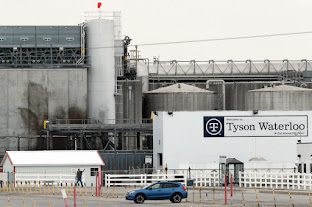
A Tyson Foods plant in Iowa (AP photo by Charlie Niebergall)
A House committee investigating the nation's response to the pandemic has found that leading meatpackers used “baseless” claims of shortages to persuade the Trump administration to let them "keep processing plants running, disregarding the coronavirus risks that eventually killed at least 269 workers," Taylor Telford of The Washington Post reports.

"In a report released Thursday, the committee alleges that Tyson Foods’s legal team prepared a draft with input from other companies that became the basis for an executive order to keep the plants open the Trump administration issued in April 2020, making it difficult for workers to stay home," Telford reports.

The report says, “Meatpacking companies knew the risk posed by the coronavirus to their workers and knew it wasn’t a risk that the country needed them to take. They nonetheless lobbied aggressively — successfully enlisting USDA as a close collaborator in their efforts — to keep workers on the job in unsafe conditions, to ensure state and local health authorities were powerless to mandate otherwise, and to be protected against legal liability for the harms that would result.”

The report from the House Select Subcommittee on the Coronavirus Crisis is based on government documents, calls with former federal officials, state and local health officials and meatpacking workers' union representatives. The documents showed that “despite awareness of the high risks of coronavirus spread in their plants, meatpacking companies engaged in a concerted effort with Trump Administration political officials to insulate themselves from coronavirus-related oversight, to force workers to continue working in dangerous conditions, and to shield themselves from legal liability for any resulting worker illness or death,” the report says.

Roundup: Overturning Roe would hurt rural poor more; states ready limits abortion access; recent poll results . . .

A Center for Reproductive Rights map categorizes states by protection of abortion rights if Roe v. Wade is overturned. (Click the image to enlarge it.)

Here's a roundup on abortion, which has been much in the news lately after the leak of a Supreme Court draft decision that would overturn Roe v. Wade:

"The end of Roe v. Wade – the 1973 Supreme Court ruling that prevents excessive government restriction of abortion services – could create multi-state regions where abortion is illegal, greatly complicating access for rural women who already must travel farther to terminate a pregnancy," Skylar Baker-Jordan reports for The Daily Yonder. One expert noted that abortion would still be accessible for those with the time, money, and transportation to travel to another state.

Americans' views on abortion diverge on more than just partisan lines. Younger Americans across party lines often express more liberal or stronger views on abortion, recent polling shows. Read more here.

Some editors and publishers at large news organizations are urging their employees to keep their views on abortion private, even on their personal social-media pages. Read more here.

Republican state lawmakers are quickly preparing bills to limit abortion access in the event that Roe v. Wade is overturned. Read more here.

Overturning abortion rights could amplify the crisis of missing and murdered Indigenous people, many of whom are victims of domestic violence or sex trafficking. Read more here.

Texas has some of the most restrictive abortion laws in the U.S., and illustrates how such laws can threaten medical treatment for miscarriages and dangerous ectopic pregnancies. Read more here.

Wednesday, May 11, 2022

A good example of how to hold your neighbors' feet to the fire when they don't respect open-government laws

By Al Cross
Director and Professor, Institute for Rural Journalism and Community Issues, University of Kentucky

Strong, well-argued editorials in rural community newspapers are the exception, not the rule. The typical editorial voice in a rural weekly is a column from the editor or publisher, not a metro-style editorial. The issues usually don't rose to the level of dressing down public officials, and in smaller communities there's often a reluctance to offend friends and neighbors.

But when an issue arises that goes to the heart of what community journalism is about, holding public officials and institutions accountable for their disrespect of open-government laws, a newspaper needs to speak up. Dennis George of The Lebanon Enterprise in Central Kentucky did that today with an editorial about the Marion County Board of Education's "cavalier approach" toward the state Open Meetings Act.

Dennis George
George laid the groundwork by first paying respect to the people he was about to criticize: "It is a challenging task to serve as a public official, and in many cases doing so in a community as close knit as ours." The county has about 19,000 people. George spoke form experience, noting how he voted for tax increases as a member of the Lebanon City Council. "If there is something I learned during that time, it is that people wanted you to be upfront and honest with them," he writes. "They might disagree with your thinking but respected you for taking the time to talk to them about an issue."

Under the first of three repeated "Trust and transparency" subheads, George writes, "Those are two traits that the public and the media should not only expect, but must demand of our public officials. We must be able to trust that they will not only make the proper decisions but be transparent in how they reached those decisions. As the Marion County school board goes through the process of selecting a new superintendent, a decision that will affect this community and its children for many years to come, some recent decisions make me wonder if we can rely on board members to be open in how they make that very important choice."

George laid out the secrecy that the board is following, speculation that it has already decided whom to hire, its failure to follow the open-meetings law's requirement for closed sessions, and the board chair's refusal to answer any more questions from him. "I had plenty of tough questions asked of me when I was on the Lebanon City Council," he writes. "Did I like them? Not always. Did I answer them? Yes, because it is what I signed up for."

He concludes, "The selection of a new school superintendent to too important to this community to hide behind closed doors during the process. If the board is so confident they are making the right choice, they should have no qualms about allowing the public to gauge the qualifications of the candidates."

Report documents abuse and deaths of Native American children at government boarding schools from 1819 to 1969

The Sherman Indian School Cemetary in Riverside, Calif. (Riverside Press-Enterprise photo by Cindy Yamanaka)
"An initial investigation commissioned by Interior Secretary Deb Haaland cataloged some of the brutal conditions that Native American children endured at more than 400 boarding schools that the federal government forced them to attend between 1819 and 1969," Mark Walker reports for The New York Times. "The inquiry was an initial step, Haaland said, toward addressing the 'intergenerational trauma' that the policy left behind. The report, released today, found that more than 500 indigenous children had died at about 19 federal boarding schools, and said that number is expected to grow to thousands."

Haaland called for the report last June after the unmarked graves of nearly a thousand children were discovered at similar boarding schools in Canada. She vowed that Bureau of Indian Affairs officials would search the grounds of former schools in the U.S. and identify any remains.

It's not an abstract issue for Haaland, a Laguna Pueblo member whose grandparents attended such schools. She said, "I came from ancestors who endured the horrors of the Indian boarding school assimilation policies carried out by the same department that I now lead," Axios reports.

The government forcibly took hundreds of thousands of children from their families to attend the schools. "In attempts to assimilate Native American children, the schools gave them English names, cut their hair and forbade them from speaking their languages and practicing their religions or cultural traditions," Walker reports. The government's other major goal with the schools was to claim Native American land by forcing the removal and relocation of their children.

While at the schools, children "suffered whippings, sexual abuse, manual labor and severe malnourishment," Chen reports. "Many children tried to escape but were found, brought back and punished, according to the report. The damage had long-term health effects."

"Haaland also announced plans for a yearlong, cross-country tour called The Road to Healing, during which survivors of the boarding school system could share their stories," Walker reports. The U.S. government has never before provided a forum for boarding-school survivors or their descendants to talk about their experiences at the schools.

Documents show how top opioid maker Mallinckrodt drove the epidemic by getting doctors to prescribe more pills

Average number of pain pills distributed per person, per year, by county, 2006-2014
(May by The Washington Post; click the image to enlarge it or click here for the interactive version.)

Even as the opioid epidemic raged across the U.S. in 2013, the nation's top opioid manufacturer, Mallinckrodt Pharmaceuticals, continued to aggressively court and lavishly reward doctors who prescribed more pain pills, even after sales reps cautioned the company that some doctors were running illegal pill mills, according to a treasure trove of newly released documents mined by Maryl Kornfield, Scott Higham and Steven Rich for The Washington Post.

The company also "played a key role in an industry-wide effort to convince the health-care industry that addiction was rare among opioid users and marketed its drugs to specific segments of society" such as seniors, the Post reports. "The Mallinckrodt documents are part of a cache of 1.4 million records, emails, audio recordings, videotaped depositions and other materials the company turned over as part of its $1.7 billion bankruptcy settlement in 2020. Several state officials with claims against the company, led by Massachusetts Attorney General Maura Healey (D), urged that the documents be made public."

The Post was granted exclusive access to the files, which are part of the Opioid Industry Documents Archive, a digital vault of records created or obtained by state and federal opioid lawsuits and managed by Johns Hopkins University and the University of California at San Francisco; it's the largest repository of such evidence from an opioid company to date.

"For the first time in a long time, industry secrets are going to be turned over to the public and millions of documents will live online in an archive forever,” Healey told the Post. "Making this evidence available to the public will hopefully pave the way for important reforms that will stop dangerous conduct and save lives."

Though OxyContin maker Purdue Pharma has been the prime bogeyman of the opioid epidemic, Mallinckrodt produced more narcotics because its pills were often more potent. "Between 2006 and 2014, Mallinckrodt accounted for 27 percent of the opioid market compared with 18% for Purdue Pharma, measured by the potency of the pills they produced," the Post reports.

Mallinckrodt's 30-milligram Exalgo pill quickly became the opioid of choice on the street, and in Massachusetts supplied to more than half of the people who died from opioid overdoses in the past 12 years—far more than Purdue and its affiliate Rhodes Pharmaceuticals supplied, the Post reports.

Retired Drug Enforcement Administration supervisor Jim Geldhof, who investigated Mallinckrodt before his 2016 retirement and now consults with cities in opioid lawsuits, told the Post: "Everybody thinks of Purdue when they think about the opioid epidemic, but Mallinckrodt was far worse."

In videotaped depositions from 2018 to 2020, top Mallinckrodt executives "took little or no responsibility for the opioid epidemic. Several skirted questions about whether an opioid epidemic even existed," the Post reports. "For years, drug companies have argued they were simply filling orders written by medical professionals for legitimate patients. But the Mallinckrodt files show that the company had detailed knowledge of the prescribing patterns of doctors and bemoaned their loss when they fell into trouble with regulators." Sales representatives whose clients prescribed more Exalgo were showered with perks like free trips to Hawaii and Europe.

In six months in 2013, company sales representatives contacted the top 239 Exalgo prescribers more than 7,000 times. "More than a quarter of those prescribers — 65 — were later convicted of crimes related to their medical practices, had their medical licenses suspended or revoked, or paid state or federal fines after being accused of wrongdoing," The Post reports.

One of those top prescribers was Cincinnati orthopedic surgeon George Griffin, whom the company knew was in legal trouble for overprescribing pain pills. "For one patient, he prescribed 640 mg a day of OxyContin — despite warnings from a pharmacist that the patient was a drug dealer with a history of drug-related felonies, according to the board," the Post reports. In 2019 Griffin was convicted of unlawful distribution of controlled substances and sentenced to 40 months in prison.

A former Massachusetts doctor, Fathalla Mashali, who was convicted of health-care fraud and more, complained that the companies have not faced the same consequences as the doctors they influenced. "We got prosecuted criminally and we lost all our money, lost everything," Mashali said. "The Sacklers get to keep their money, Mallinckrodt to keep their money. All the companies get to keep their money."

As part of its 2020 bankruptcy settlement, Mallinckrodt turned over $1.725 billion to a trust serving communities affected by the opioid epidemic, the Post notes.

New coronavirus infections in rural counties climb for fourth week straight, but urban infection rate is higher

New coronavirus infections, in ranges by county, May 2-8
Map by The Daily Yonder; click on the image to enlarge it or click here for the interactive version.
New coronavirus infections climbed in rural counties for the fourth week straight last week, but the infection rate remains at its lowest level since last summer. Meanwhile, the urban rate rose at a slightly higher pace, and is now twice as high as that of rural counties, The Daily Yonder reports.

Rural counties reported 33,300 new infections May 2-8, up 16 percent from the week before. "Over the past month, the weekly rate of new infections has doubled from about 36 new cases per 100,000 to 72 new infections per 100,000," Tim Marema reports. "Metropolitan counties reported 396,000 new infections last week, an increase of 18% from two weeks ago. In the past month, the metropolitan weekly infection rate has grown 80%."

Rural counties reported 476 deaths related to Covid-19 last week, nearly a third fewer than the previous week. Metro counties reported 1,989 Covid-related deaths, with the rate remaining steady, Marema reports. The rural death rate has been higher than the urban rate for more than a year.

Covid-19 roundup: Millions of Americans could lose Medicaid coverage when federal pandemic subsidies end

Here's a roundup of recent news stories about the pandemic and vaccination efforts:

Between 5 million and 14 million Americans could lose Medicaid coverage when federal subsidies end, a new analysis has found. Read more here.

Covid could lead to higher rates of erectile dysfunction among men, some studies have found. Read more here.

The share of Americans who refuse to get vaccinated against the coronavirus has barely wavered in the past year. That population is far more likely to be rural, Republican, white, and evangelical Christian. Read more here.

Covid misinformation is causing more people to die from the infection, and contributing to lower nationwide life expectancy, said Food and Drug Administration commissioner Robert Califf. Read more here.

A recent survey of adults and teens in rural Illinois in February found that most people said they feel overwhelmed by conflicting information and weren't sure what to believe. But local health-care providers were the most-trusted source of coronavirus vaccine information. The survey was commissioned by the National Rural Health Organization and the Centers for Disease Control and PreventionRead more here.

Covid-19 deaths are no longer overwhelmingly among the unvaccinated as the death toll among senior citizens grows. Read more here.

The Trump administration muzzled the CDC on its pandemic safety guidance for churches, emails show. Read more here.

Arizona is the only state where rural vaccination rates have outpaced the urban rate. Native Americans are mostly the reason for that. Read more here.

Misinformation about coronavirus vaccinations likely played a role in falling rates of routine childhood vaccinations, according to a newly published data analysis. Read more here.

Children can get long Covid, and it can show up in unexpected ways. Read more here.

Tuesday, May 10, 2022

Some Pulitzer finalists' work had rural resonance: FEMA's failings, foster kids' benefits, dirty sugar-cane harvest . . .

The Joseph Pulitzer Gold Medal for Public
Service went to The Washington Post for
its coverage of the assault on the Capitol.
None of the winners of Pulitzer Prizes in journalism yesterday had much rural resonance, but several finalists did, and the calls in such cases are usually close.

Both of the announced runner-ups in the National Reporting competition had rural elements. The Washington Post was named a finalist "for a sweeping series on environmental racism, illuminating how American communities of color have disproportionately suffered for decades from dirty air, polluted water and lax or nonexistent environmental protection," the judges said.

The other finalists in National Reporting were Eli Hager of The Marshall Project and National Public Radio "for powerful reporting that exposed how local government agencies throughout America quietly pocketed Social Security benefits intended for children in foster care." State agencies are involved, too, and the project has a listing that could lead to local stories. Check it out.

A finalist in Investigative Reporting was the work of Hannah Dreier and Andrew Ba Tran of The Washington Post for a series revealing how the Federal Emergency Management Agency "fails American disaster survivors by not confronting structural racism or climate change, prompting policy overhauls." The reporters wrote, "The vast majority of the money is caught up in delays that leave poor, rural and non-white towns and cities waiting years to get started on urgently needed work."

A finalist in Local Reporting was the entry of Lulu Ramadan of The Palm Beach Post and Ash Ngu, Maya Miller and Nadia Sussman of ProPublica "for a comprehensive investigation, including interactives and graphics, that revealed dangerous air quality during Florida’s sugar cane harvest season and prompted significant reforms."

This one isn't rural, but it's about journalism. A finalist in Editorial Writing was the Times-Picayune and the New Orleans Advocate "for editorials demanding transparency and accountability on behalf of the people of Louisiana when an investigative reporter was sued by the state’s attorney general for making a public records request."

This one is from an exurb of Fort Worth, but is an example of fights that are going on in rural and suburban school districts. A finalist in Audio Reporting was the work of Mike Hixenbaugh, Antonia Hylton, Frannie Kelley, Reid Cherlin and Julie Shapiro of NBC News "for 'Southlake,' a riveting and insightful account of an anti-Critical Race Theory movement in a Texas community, a phenomenon that has reverberated through school districts across the country."

A finalist in Feature Writing was the entry of Meirba Knight of Nashville's WLPN and Ken Armstrong of Pro Publica "for their enterprising and empathetic account of 11 Black children in Tennessee who were arrested for a crime that doesn’t exist." This was in Murfreesboro and Rutherford County, part of the Nashville metropolitan area, but perhaps reflected a traditional bias toward black youth seen in much of the rural South. The judge involved is not seeking re-election.

And what to make of so many finalists from broadcasting, as well as the online ProPublica and the advocacy-oriented Marshall Project, in a contest whose century-old gold medal for public service says it's for newspapers (though it's actually open to all "news sites")? Are papers producing less Pulitzer-worthy journalism? Or are these outlets attracting the sort of reporters and editors who once thought only of working at newspapers? One year does not a trend make; let's keep watching. --Al Cross, director and professor, Institute for Rural Journalism and Community Issues

UPDATE, May 12: Roy Peter Clark of The Poynter Institute, who likes short leads on stories, couldn't find one among the winners, but has some picks, and his favorite is the one on the winner of the Investigative Reporting prize: "Inside Florida’s only lead smelter, poisons abound." Clark writes, "It’s unusual to have the subject and verb of a lead sentence at the end, but it works here. Words at the end of a sentence or paragraph get special attention. “Smelter” is an unusual word that introduces a dangerous work environment. 'Abound' feels literary, but not in a showy sort of way. Since the whole project is about lead poisons, it makes sense to get both those words in the first seven."

Lincoln College, an HBCU in rural Illinois, will be the first U.S. college to close because of a ransomware attack

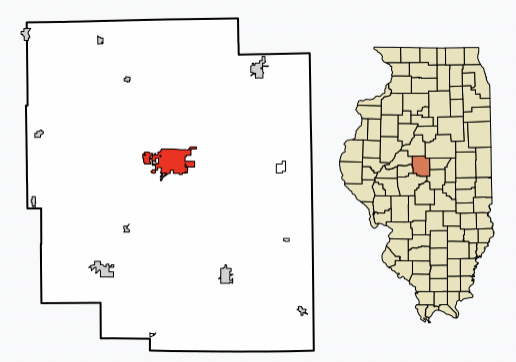
Lincoln, the seat of Logan County
(Wikipedia map)
Lincoln College
in rural Lincoln, Illinois, is set to close its doors Friday, making it the the first institution of higher learning in the U.S. to shutter because of a ransomware attack. "A goodbye note posted to the school’s website said that it survived both World Wars, the Spanish flu and the Great Depression, but was unable to handle the combination of the Covid pandemic and a severe ransomware attack in December that took months to remedy," Kevin Collier reports for NBC News.

The local economy will no doubt feel the loss of the college keenly, since staff and students make up nearly 900 of the community's more than 13,000 residents. Colleges can be a significant economic draw in general for rural towns in general.

The loss goes beyond the economic toll. Lincoln College, which broke ground on namesake Abraham Lincoln's birthday in 1865, "is one of only a handful of rural American colleges that qualify as predominantly Black institutions by the Department of Education," Collier notes. It is also the only college to be named after Lincoln while he was alive, and the town is the only one named for him before he became president; he was a lawyer for the railroad that founded it.

Ransomware attacks are an increasing threat to the security and finances of businesses, governments and schools nationwide, especially in rural areas that often lack the time, funding and expertise to fend off such attacks. Smaller schools are often especially attractive to hackers, owing to their smaller cybersecurity budget.

At least 14 colleges and universities have been hit with ransomware attacks this year. "Ransomware attacks against colleges come from a number of known, distinct cybercriminal gangs, and they don’t appear to have any particular pattern with what kind of college they target, and instead simply go after any victim where they can find a cybersecurity vulnerability," Collier reports. "Many ransomware hackers who attack American targets are based in Russia or other former Soviet countries. But even in cases where U.S. authorities know their identities, few of them have ever been arrested in conjunction with American law enforcement efforts."

Arts residencies can have an outsized impact on rural economies and culture; some national parks have them too

"Across the country, hotels, resorts, and even national parks, are offering residencies for artists to help draw in inspiration. Along the way, these rural communities are feeling the effects – both culturally and economically – of new life coming into the community and energizing and offering a new perspective from people who may not otherwise have had the chance to meet locals," Kristi Eaton reports for The Daily Yonder. "Call it rural arts tourism, and it’s catching on across the country."

Rural artist residencies can benefit both artists and communities for little cost. In Maupin, Oregon, for example, the owners of a local cabin resort offer artists free lodging and quiet time to work. In exchange, owners Michelle Taylor and Andy McFarlane ask them to contribute a work from their time at the cabins to add to its permanent collection, Eaton reports.

Taylor said they've gotten plenty of applicants since they launched the program this year, and that it had brought a lot of excitement and optimism to the community of about 450. Tourists, too. "You have folks coming in in droves from places like Portland and Tacoma, and places, far and wide, to see artists and be a part of something," McFarlane told Eaton. That boosts the local economy since they're eating at local restaurants and staying in local hotels.

Local governments aren't the only ones who recognize the benefits of bringing in artists; the National Park Service also has artist-in-residence programs at many of its national parks. "Depending on the location, residencies are open to writers, photographers, composers and other arts-based workers," Eaton reports.

Syringe program restrictions led to severe HIV outbreak in rural W.Va.; state often leaves local health depts. in the dark

Most residents of West Virginia now live more than 75 miles from a
sterile-syringe program. (Graphic by The Guardian; click on it to enlarge)
West Virginia is seeing a severe outbreak of the human immunodeficiency virus (HIV) that causes AIDS, spurred by state restrictions on clean-syringe programs for intravenous drug users, The Guardian reports. The problem may be particularly severe in rural areas, which now have even less access to the programs.

"Kanawha County, where Charleston is the seat, diagnosed 40 people who inject drugs with HIV in 2020, about as many as New York City, a place 47 times more populous," Jessica Glenza reports. "Last year, the head of HIV prevention at the Centers for Disease Control and Prevention warned Kanawha had the nation’s 'most concerning' outbreak of HIV among injection drug users." Cases began rising there in 2018 after the city restricted syringe programs. Soon afterward, nearby Huntington, then the state, followed suit. Since 2018, nearly half of such programs in the state shut down.

"The new law requires programs to offer a range of health services in addition to the exchange, only serve people with a West Virginia ID card, and aim to get one used syringe back for each new one they give out," Quenton King reports for Mountain State Spotlight.

Glenza reports, "The restrictions mean that almost 1 million people in West Virginia, the state with the highest drug overdose rate in the U.S. for nine years running, now live between 20 and 75 miles of the nearest needle exchange. Meanwhile, experts worry HIV is spreading undetected in rural West Virginia, where testing and treatment is limited."

However, it's difficult to assess the impact of HIV in rural areas: To preserve patients' privacy, the state's health department only releases ballpark numbers, King reports. That means even county health departments are in the dark about the local extent of the problem, and they are generally left out of the loop on HIV cases.

Robin Pollini, a substance-abuse and infectious-disease epidemiologist at West Virginia University, "says that it should be considered a significant concern when HIV appears in any county that previously had no cases, but especially in rural counties where access to care is limited," King reports. "There are actions that counties can take — from ramping up testing to creating harm reduction programs — by just knowing the number of HIV cases popping up in the county."

But local agencies might have a difficult time responding even if they knew about new cases. "With the current landscape — stressed by Covid, underfunded, and with new laws restricting the types of harm reduction programs they can offer — county health departments have few opportunities to address potential outbreaks, even if they see them coming," King.

Monday, May 09, 2022

Who's training your police? Some private trainers push extremist agenda in lessons, and states regulate them little

Some private police trainers have extremist political beliefs that color their lessons to local law enforcement across the country, but the lightly regulated industry hasn't done much to discourage it and states don't often have the bandwidth to do it, says an in-depth analysis by Reuters.

"Private trainers work in an unregulated industry that largely has evaded the heightened scrutiny of U.S. policing in recent years in the wake of high-profile police killings of civilians," Julia Harte and Alexandra Ulmer report. "Trainers like those identified by Reuters, a half dozen police-training specialists say, highlight a lack of standards and oversight that allows instruction that can often exaggerate the threats that officers face, making them more likely to respond with excessive force in stressful situations."

The story highlights Idaho-based instructor Ron Whitehead as an example of instructors with far right-wing beliefs. He began training officers in 1995, during his 25-year career in the Travis County Sheriff's Department in Texas. In the past few years on social media, "He has called for public executions of government officials he sees as disloyal to former President Donald Trump," Harte and Ulmer report. "In a post in 2020, he urged law enforcement officers to disobey Covid-19 public-health orders from 'tyrannical governors,' adding: 'We are on the brink of civil war'." Whitehead, who has taught at least 560 law enforcement officers in the past four years, also openly supports far-right anti-government groups the Oath Keepers and the Three Percenters, and follows the constitutional sheriff philosophy, which says sheriffs are the ultimate authority and should ignore any law they deem unconstitutional.

Whitehead "is part of a trend in pushing a radical-right political agenda to American police forces," Harte and Ulmer report. "He’s one of five police trainers identified by Reuters whose political commentary on social media has echoed extremist opinions or who have public ties to far-right figures. They work for one or more of 35 training firms that advertised at least 10 police or public-safety training sessions in 2021, according to a Reuters analysis of scheduling data from policetraining.net, the main site where local departments connect with trainers. The news organization also reviewed materials describing classes by specific training companies."

Whitehead and the other four trainers told Reuters their beliefs aren't extreme, and said social-media posts encouraging the overthrow of the government weren't meant to be taken seriously. They said they keep their personal politics separate from their lesson plans. However, Whitehead has frequently used racist and misogynistic material in his lessons, including one where he called a turbaned police officer a "towel head" and another in which he "teaches officers not to trust sexual-assault claimants if they use the word 'we' in referring to themselves and their assailant," Harte and Ulmer report.

Private law-enforcement trainers operate in a system with little oversight. Police academies in the U.S. often provide far less training for beginners than those in other countries, so police and sheriff's departments often pay private trainers to come in. Officers can also pay for the courses on their own to satisfy professional development requirements. State regulatory bodies set broad requirements for law-enforcement training but "have little power in most states to influence course content or set standards for private police trainers, in part due to budget constraints, Harte and Ulmer report.

Many community leaders don't realize that their own officers have been trained by Whitehead or those like him. The sheriff in Spokane County, Washington, criticized Whitehead during his campaign, but didn't realize until Reuters contacted him that his department had hired Whitehead to run 15 deputy trainings since 2015, Harte and Ulmer report.

Biden announces deal to make broadband more affordable, and often free, for millions of low-income households

UPDATE, May 11: The program should be a wake-up call to "newspapers, especially those with weak websites and limited online offerings," writes Tom Silvestri of The Relevance Project, a program of the Newspaper Association Managers. He says papers "should step up developing profitable digital delivery of news and marketing messages. Why run the risk of becoming irrelevant once internet access and speed are no longer obstacles for readers? Stop waiting."

President Biden has announced a program to make broadband internet service more affordable or even free for millions of low-income households, including those in rural and tribal areas.

As part of the Affordable Connectivity Program, 20 internet service providers will lower costs to no more than $30 a month or increase speeds to at least 100 megabits per second, the administration said in a statement Monday morning. The 20 ISPs, which include AT&T, Verizon and Comcast, cover roughly 80 percent of the U.S. population, according to the administration, CBS News reports.

Last year's infrastructure law allows some low-income families to get a $30 credit ($75 on tribal lands) to help pay for broadband, so households that apply that credit to one of the AFC plans will essentially get free broadband, Michael Collins reports for USA Today.

"About 48 million households, or nearly 40% of those in the country, are eligible for the broadband benefit. To make sure that eligible families take advantage of the offer, the administration [has launched] a website (GetInternet.gov) that will provide details about how they can sign up and find participating internet providers in their area," Collins reports. "Households with annual incomes at or below 200% of the federal poverty level, about $27,000 for an individual or $55,000 for a family of four, are eligible for the benefit program. Families also can qualify if they are enrolled in other federal programs, such as Pell Grants, Medicaid or Supplemental Security Income."

Rural Assembly Everywhere to be livecast Tue. and Wed.; breakout session Wed. will look at reporting on rural places

This year's Rural Assembly Everywhere will be livecast online tomorrow and Wednesday. 

One breakout session, at 5 p.m. ET Wednesday, will be "Reporting on Rural: The How and the Why." Caroline Carlson and Tim Marema of The Daily Yonder, Pamela Dempsey of the Midwest Center for Investigative Reporting and Terrence Williams of The Keene (N.H.) Sentinel "will explore why accurate representation of rural communities in media is important," the Assembly says. "The discussion will dive into how we’re looking at rural data, what we’ve been working on lately, and how we assess rural stories, among other things."

Another session at 5 p.m. ET Wednesday is "Creative Power in Rural Places with Springboard for the Arts," an artists' support group. The day before, also at 5, a session will look at the future of rural communities and the nation through young voters.  The Assembly will also feature conversations with local and national rural and Native American leaders, including:

  • Small farmers discussing food democratization.
  • Xochitl Torres Small, the Agriculture Department's undersecretary for Rural Development.
  • YouTube social and political commentator Justin King of "Beau of the Fifth Column."
  • Residents of McMinn County, Tennessee, who are advocating for intellectual freedom after the banning of the graphic novel Maus in their school district.
  • Neema Avashia, author of Another Appalachia: Growing up Queer and Indian in a Mountain Place.
  • Nonprofit Welcoming America hosting a conversation on building welcoming communities. The discussion will feature three female leaders from diverse backgrounds in Nebraska who will share their journeys to "build stronger connections between immigrant and non-immigrant communities, fight against divisive rhetoric, and ensure that inclusive policy is the norm in their communities."
The Rural Assembly and The Daily Yonder are programs of The Center for Rural Strategies, which calls the Assembly "a nationwide movement striving to build better policy and more opportunity for rural communities across the country." Click here for details.

Probe of Chinese solar-panel makers all but halts imports, slowing clean-energy projects and giving coal a reprieve

"Auxin Solar Inc., a tiny, struggling maker of solar panels, has thrown the entire American renewable-energy industry into chaos," Phred Dvorak and Katherine Blunt report for The Wall Street Journal. "A petition Auxin filed with the Commerce Department accusing Chinese companies of circumventing tariffs spurred a U.S. probe in March that has effectively halted most solar-panel imports, according to utilities and industry groups, delaying solar projects all over the country. Since the Commerce Department agreed to investigate, the complaint has halted panel shipments from Southeast Asia to the U.S., according to utilities and trade groups, because makers overseas worry that they could be hit retroactively with extra duties."

If it's bad for solar, it's good for coal. Dvorak and Blunt note, "Indiana-based utility NiSource Inc. said delays of up to 18 months in solar projects meant it would have to keep coal-fired power plants that are slated for retirement running longer than expected."

The investigation triggered an immediate backlash from utilities and politicians, who warn it "could set back U.S. efforts to transition to cleaner energy sources to combat climate change. A U.S. solar trade group estimates the turmoil could cost the industry billions of dollars," Dvorak and Blunt report. Auxin CEO Mamun Rashid said his employees have been harassed and his company servers hacked. He said hurting the renewable-energy industry is the last thing he wants to do, but that unfair trade practices have made it impossible to compete with Chinese solar-cell factories, the Journal reports.

"The furor over the petition by Auxin, a privately held company based in San Jose, Calif., highlights how dependent the American solar industry is on foreign supplies, most of which are controlled by Chinese companies that can produce large volumes at low prices," Dvorak and Blunt report. "Chinese manufacturers make around 63% of the polysilicon used in most solar panels globally, and more than two-thirds of the wafers that are the next step in the manufacturing process. For the past decade, the U.S. has tried to keep some solar manufacturing at home by levying tariffs on the solar cells and panels that are the final stages of production, including steep duties on Chinese makers. But production instead shifted to Southeast Asian countries such as Malaysia, Thailand, Vietnam and Cambodia, which last year manufactured nearly half of the cells and 80% of the panels that U.S. solar companies depended on for their projects, according to trade associations."

A group of American solar-panel manufacturers complained anonymously to Commerce last year that Chinese manufacturers were getting around tariffs by routing their business through those Southeast Asian countries, but it was rejected because the businesses didn't identify themselves. "Auxin, which had been a member of the group, decided to try again on its own and in the open, according to a person familiar with the matter," Dvorak and Blunt report.

The nation's largest solar manufacturer, First Solar, Inc., has publicly supported Auxin though it isn't part of the petition (and, owing to different materials and manufacturing processes, isn't affected by the tariffs). Samantha Sloan, the company's vice-president of policy, told the Journal that the blowback against Auxin suggests that some "are afraid that the Department will find that Chinese solar manufacturers are, in fact, engaged in circumvention and will hold them accountable for their unfair and unlawful trade practices," she said.

Friday, May 06, 2022

Silas House on J.D. Vance: 'He's dangerous. So is his book.'

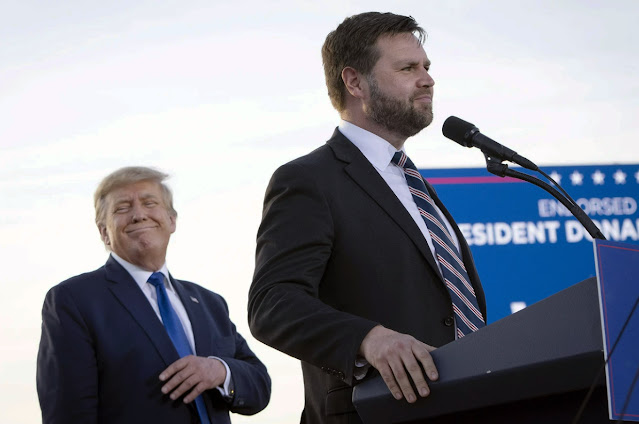
Former president Donald Trump hosted a rally for J.D. Vance in Ohio on April 23. (Getty Images photo by Drew Angerer)
Tuesday's plurality nomination of Hillbilly Elegy author J.D. Vance for senator from Ohio has prompted a fresh round of media scrutiny for the Rust Belt memoirist and never-Trumper turned Trumper, a move (along with millions from his prime sponsor, billionaire Peter Thiel) that won him victory in his first political race.

After Silas House, the Appalachian Studies chair at Berea College in Kentucky, tweeted on election night, “He’s dangerous. So is his book,” he got a call from Michael Kruse of Politico, who interviewed him and got one of the more salient yet nuanced analyses of Vance yet published.

Silas House
(Photo by C. Williams)
House is "one of the premier thinkers in and about the South and a bestselling writer in his own right," Kruse writes. "From the start [he saw the book] as not a memoir but a treatise that traffics in ugly stereotypes and tropes, less a way to explain the political rise of Trump than the actual start of the political rise of Vance."

House told Kruse, “It’s my job to read any piece of literature or view any media coming out of the region. It’s my job to analyze it and think about what are the intentions of this piece? What is the historical and cultural context of this piece of media? Are some of these stereotypes just coming out of ignorance, or are they intentional?"

He said Hillbilly Elegy is dangerous “because there’s such a lack of complexity in the book in a time when the national conversation lacks more and more nuance. There’s no nuance in the book. There’s a lot that’s false and intentionally misleading, and I always think that’s really dangerous when there’s intentional misinformation being shared. And I think he’s dangerous because he embodies all of that. And it seems to me that he’s willing to do whatever it takes to rise. And I can think of nothing more dangerous in a politician than that.”

That's how the interview ended, but here's more from House: “If it had just been a memoir, it would be a powerful piece of writing and it would be his own proof. But the problem is it is woven through with dog whistles about class and race, gender. And if your ears are attuned to those dog whistles, you know exactly what he’s saying. . . . The whole reason so many people responded to that book to help them understand the rise of Trump is because in a way it gave them exactly what they were looking for: easy answers instead of really complicated historical answers. And that’s why I think it’s so disingenuous and dangerous because it’s not true. . . . He, ever since Hillbilly Elegy, has always embodied Trumper ideas, even before there was such a thing. . . . 

“I think it’s so telling that this book was pushed as an Appalachian narrative when this man is two generations removed from Appalachia. This is a Rust Belt story, but Appalachian stories, Appalachian literature, is its own genre. In early cinema, one of the most popular movie genres was 'hillbilly movies.' We still have a genre of horror that’s very popular called 'hillbilly horror.' So there’s a market there, in a different way, for the idea of the hillbilly, more than there is for the idea of the Rust Belt. So that alone is manipulative in that it’s sold as an Appalachian story or a hillbilly story, and if you read the book, you realize that hardly any of it is set in Appalachia.”

More dams are in danger of collapse, but the Army Corps won't disclose the condition of some 'high-profile' dams

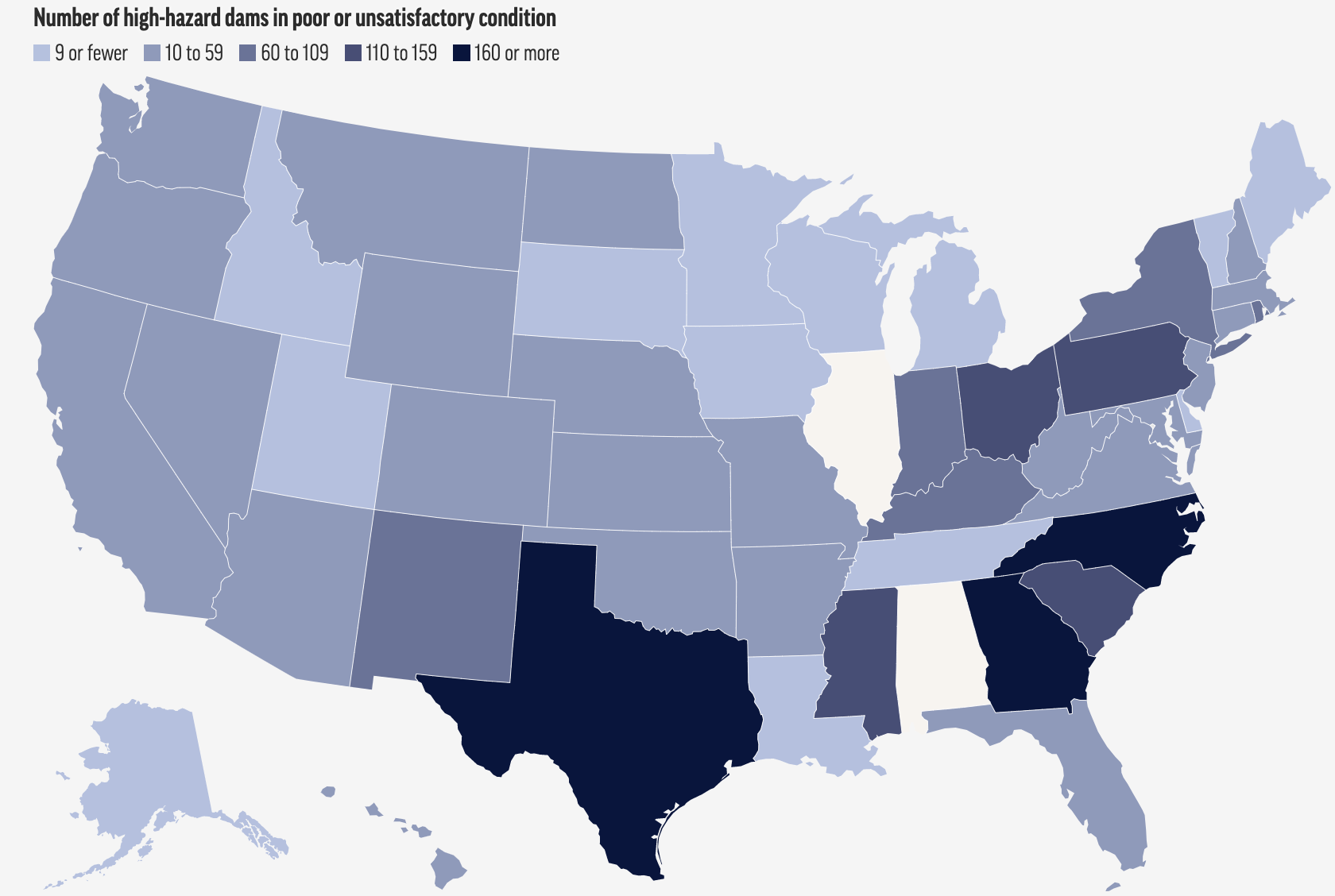
More than 2,200 of the nation's 92,000 dams are in poor condition and likely to cause deaths if they fail. Alabama doesn't have a dam safety program and Illinois doesn't assign condition ratings to its dams. (Associated Press map)

"An Associated Press analysis tallied more than 2,200 high-hazard dams in poor or unsatisfactory condition across the U.S. — up substantially from a similar AP review conducted three years ago. The actual number is likely even higher, although it’s unclear because some states don’t track such data and many federal agencies refuse to release details about their dams’ conditions," David Lieb, Michael Casey and Michelle Minkoff report for The Associated Press. The U.S. Army Corps of Engineers maintains the National Inventory of Dams, a federal database that discloses the condition and hazard rating of most dams nationwide, but it doesn't list data for many prominent dams such as Hoover Dam or California's Oroville Dam. More than 180,000 residents near Oroville had to evacuate in 2017 after its spillway failed. The dam was found to be poorly designed, built and maintained.

"The nation’s dams are on average over a half-century old and often present more of a hazard than envisioned when designed because homes, businesses or highways have cropped up below them. Meanwhile, a warming atmosphere can bring stronger storms with heavier rainfall that could overwhelm aging dams," AP reports. "Decades of deferred maintenance has worsened the problem. But a changing climate and extreme floods — such as the one that caused the failure of two Michigan dams and the evacuation of 10,000 people in 2020 — have brought a renewed focus to an often overlooked aspect of America’s critical infrastructure."

Last year's $1 trillion infrastructure bill allotted about $3 billion into dam-related projects, including repairs and state dam safety programs. "Yet it’s still just a fraction of the nearly $76 billion needed to fix the almost 89,000 dams owned by individuals, companies, community associations, state and local governments, and other entities besides the federal government, according to a report by the Association of State Dam Safety Officials."

Some states are trying to deal with dam problems, but it can be difficult. "Addressing the problems posed by old, unsafe dams can be challenging. Repairs can be costly and take years to complete," AP reports. "Attempts to remove dams — and empty the lakes they hold back — can spawn legal battles and a public outcry from those who rely on them for recreation or to sustain nearby property values."

Roundup: Post and Courier wins Headliner Award for 'Undercover' series; AP gets a director from small papers

Newsprint rolls at a Kentucky newspaper (KPA photo)
Here's a roundup of recent happenings in journalism and the news business:

The Charleston Post and Courier has received a National Headliner Award for "Undercover," its collaborative series with 18 non-metropolitan papers aimed at exposing government corruption and misconduct throughout South Carolina. Read more here.

The Associated Press has a new director on its board, Mark Adams, to represent the interests of small-market newspapers. He is president and CEO of Adams Publishing Group, which he launched in 2013. The company says it employs 2,000 print and digital professionals in 13 states.

There's still a newsprint shortage, Kentucky Press Association Executive Director David Thompson reports in his weekly newsletter: "Requiring longer contracts, requiring orders placed a year in advance and refusal to add any new customers for the rest of 2022 seem to be the threads in each report from around the state."

A nationwide survey of 1,000 adults found that 79% believe that big tech companies such as Google and Facebook have too much power over news publishers and want Congress to pass the Journalism Competition and Preservation Act, which would allow news publishers to bargain collectively to get better compensation when tech companies use their content. Results were similar across the political spectrum. Read more here.

Mich. town is an example of neglected rural water systems, and why more don't seek government loans for upgrades

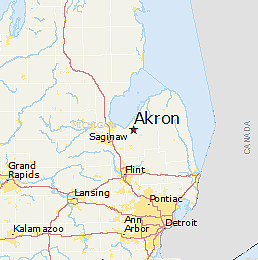
Many rural areas have substandard, long-neglected drinking-water systems. A small farming community in Michigan shows how that can happen and what it looks like at the local level. In Akron, which once had more than 500 people and fell to 366 by the 2020 census, "Shrinking populations, growing poverty, and diminished state and federal assistance have fueled a crisis of underfunded drinking water infrastructure," Lester Graham reports for NPR affiliate Michigan Radio. "Those problems often are compounded by a lack of qualified staff to keep up with water system operations and little to no expertise in applying for grants and loans that could help bolster utility budgets."

Best Places map
The specific problems in Akron are that families use much more water than they did seventy years ago, when the water system was built, and locals also can't afford to maintain a too-big distribution system or replace a water tower at the end of its lifespan, Graham reports. Another problem is that Akron must now spend more money to executive state-required testing for lead, PFAs, and other toxic substances. 

Though there are state and federal loan programs meant to help communities afford water system upgrades, many communities don't apply for them. "They might not be able to afford the debt. Also, it takes a lot of money to hire contractors to determine a system’s assets," Graham reports. "That’s needed in order to apply for the loans. A lot of these small towns don’t have the expertise needed to fill out an application on their own. It’s a big expense and there’s no guarantee the town will get a loan or grant."

Nonprofit helps schools in poor areas get grants to help older students mentor younger ones toward higher ed

"Schools are often the heart of a community, and in rural Appalachia, community schools are a center of gravity where local and regional partnerships merge to improve outcomes and strengthen local communities," Jennifer Kotting reports for the Brookings Institution. "Community schools in three counties in Kentucky have opened the doors for high-school students to mentor younger students on their way to postsecondary education, for retired teachers to support schools and their own financial well-being, and for family members to engage in enriched learning opportunities."

Kotting said Kentucky was a fertile field for the idea because the state funds Family Resource and Youth Services Centers to help disadvantaged students, "and they grew stronger when U.S. Department of Education funding was expanded. The organization Partners for Rural Impact has increased funding for community schools by bringing together partners and districts to apply for funding, as well as combine programs that improve academic outcomes and build on the strengths of local communities for long-term results." 

The group and its partners, including Berea College, have won $7.5 million in federal community-school grants to Knox County in 2014, Berea in 2018, and Leslie County in 2020. "There are 50 schools under the designation of community schools across southeastern Kentucky," Kotting reports. "Partners for Rural Impact also works with partners like Save the Children, Strive Together, Advance Kentucky, Operation UNITE and the Annie E. Casey Foundation to successfully weave together programs with these community schools efforts."

Partners for Rural Impact is run by the aptly named Dreama Gentry, whom Kotting quotes at length, starting with: “Rural districts don’t always have the staff capacity to adequately identify and apply for federal grants. Partners for Rural Impact serves as a trusted backbone so that multiple school districts will partner with us to design the program and develop the funding applications. Then, the money comes in through us and flows to the school districts. We have flexible models for employee contracts depending on the individual school districts. The result is the same—a local person becomes site coordinator, and that local person belongs to our team. We train them and provide oversight and supervision.” There's lots more here.

Quick hits: USFS needs firefighters; 'forever chemicals' may damage your liver; podcast talks rural Black health

Here's a roundup of stories with rural resonance; if you do or see similar work that should be shared on The Rural Blog, email us at heather.chapman@uky.edu.

A new podcast, "Black in Red," discusses Black health in rural America. Read more here.

Hazardous "forever chemicals" found in a wide range of everyday products could damage your liver, a new study has found. Read more here.

"The rise of fracking in Appalachia has fed visions of turning the Ohio River valley into a petrochemical and plastics hub. But overproduction of plastic, opposition to natural gas pipelines, and public concern about rampant plastic waste are upending those plans," Beth Gardiner reports for Yale Environment 360. Read more here.

The U.S. Forest Service is scrambling to hire enough firefighters before this summer's wildfire season. Read more here.

Thursday, May 05, 2022

Abortion is not an issue widely discussed in rural America, but it is widely felt, and has now come to the fore

New York Times maps, source credit adapted by The Rural Blog

Because of its highly controversial nature, abortion isn't well-covered by many local news media, but now it has once again become central to our nation's political discourse, and people everywhere—including in rural America—have thoughts and feelings about it. And for some, the draft opinion of the U.S. Supreme Court has real-life impacts.

"Trigger laws" that would make abortion in 13 states illegal if Roe v. Wade is overturned would disproportionately affect rural women, who are more likely than their urban peers to be impoverished, less likely to have the time or money to drive long distances across state lines to obtain an abortion, and more likely to face stigma over the decision to end a pregnancy.

Abortion isn't often publicly discussed in rural areas, but it is widely felt, as indicated by a recent note to Al Cross, director of the Institute for Rural Journalism and Community Issues and publisher of The Rural Blog, by Bertie Salyer, retired health director in Magoffin County, in Appalachian Kentucky:

Bertie Salyer
“As a former social worker, social work supervisor, college professor, and health department director, I feel very distraught. Old white Republican men telling all females of childbearing age that they better not have sex unless they can see themselves nine months away successfully having and supporting a family of at least two. Punish the woman, don’t allow her to have sex education in school, don’t give her birth control, don’t give her health care, don’t give her support or any services while pregnant and after birth; just tell her to only have sex for procreation because SHE alone is responsible. Her body must bear the consequences, the lifetime consequences of that weak moment, that rape, that incestuous attack, that failure to think ahead in what could have been a moment of passion. She suffers the societal impact, the disruption of her life through what could have been a lapse in judgement, a mistake, crime victimization. HE can sexually enjoy the moment and move on without a thought. What is fair, equal, and just about that? And don’t allow me the space to discuss the possible outcomes for the child, and the additional social problems for our society.”

Many who oppose abortion rights are just as passionate, saying that all life is sacred and that it begins at conception. Though the topic has been a political football for decades, public sentiment hasn't changed much in the nearly 50 years since the Roe v. Wade ruling. "According to Gallup, 21 percent of Americans thought abortion should be illegal in all circumstances in 1975, compared with 19 percent in 2021," Michael Scherer reports for The Washington Post. "Twenty-two percent thought abortion should be legal under any circumstance in 1975, compared with 32 percent in 2021. Fifty-four percent in 1975 and 48 percent in 2021 said abortion should be legal under certain circumstances."

But in the 13 states with trigger laws, sentiment is decidedly different: "43 percent of adults on average say abortion should be legal in most or all cases, while 52 percent say it should be illegal in most or all cases," Nate Cohn reports for The New York Times.

For those covering abortion, The Associated Press has recently updated its Stylebook:

pregnant people
Phrasing like "pregnant people" or "people who seek an abortion" seeks to include people who have those experiences but do not identify as women, such as some transgender men and some nonbinary people. Such phrasing should be confined to stories that specifically address the experiences of people who do not identify as women. See gender, sex and sexual orientation.

And our long-standing entry on abortion:
abortion
Use the modifiers anti-abortion or abortion-rights; don't use pro-life, pro-choice or pro-abortion unless they are in quotes or proper names. Avoid abortionist, which connotes a person who performs clandestine abortions. Instead of pregnant women, use "pregnant people" or "people who seek an abortion" in stories that specifically address the experiences of people who can get pregnant but are not women. Such phrasing seeks to include people who have those experiences but do not identify as women, such as some transgender men and some nonbinary people.

Rural Pa. school staffers increasingly bore the brunt of pandemic frustration: 'We went from being heroes to villains'

A school in rural Pennsylvania during the pandemic (Associated Press photo by Matt Rourke, via The Conversation)

Penn State
professors wanted to see how schools in Pennsylvania's 235 rural districts fared in the pandemic, so they surveyed and interviewed rural superintendents, principals, teachers and parents. Their findings, which are likely echoed in most other rural communities: Rural schools already faced disparities in technology, broadband access, and teacher staffing before the pandemic, but it made things much worse, Gerald K. LeTendre and Peggy Schooling report for The Conversation, a site for journalism by academics.

"Over the more than two years of dealing with the pandemic, schools increasingly bore the brunt of the frustration local residents had with state or federal guidelines," LeTendre and Schooling report. One school leader even told them, "We went from being heroes to villains." LeTendre is an educational administration professor and Schooling is a professor of practice in educational leadership and the executive director of the Pennsylvania School Study Council.

Through focus groups, the researchers identified four phases in parent sentiment during the pandemic. In Phase 1 there was widespread concern about teacher and student wellbeing, and was marked by "rapid adaptation and improvisation," LeTendre and Schooling report. Phase 2 was about getting back to school and navigating the new rules of sharing classroom space. Common public sentiment in Phase 3, one participant said, held that "Teachers are no good and just do not want to work." And Phase 4, another participant said, devolved into people saying "You can’t make my kid wear a mask! I am the parent! Teachers are the devil!"

Many in rural communities were eager to return to normal by this spring, but there remains a deep divide between those who believe schools should return completely to pre-pandemic practices and those who want to continue to incorporate more technology into normal learning routines so as to be ready for future surges, LeTendre and Schooling report.

Rural residents benefit most from enhanced ACA subsidies, and have highest risk of losing coverage without them

"Rural residents were the most likely to benefit from enhanced subsidies for Affordable Care Act coverage and face the greatest danger of losing coverage if those benefits expire after this year, a new study finds," Robert King reports for Fierce Healthcare. "The study, released by the Robert Wood Johnson Foundation Tuesday, comes as healthcare groups are making a major effort to get Congress to renew the boosted subsidies. ACA enrollment grew to a record-setting 14.5 million people this year, thanks in part to the higher subsidies."

This year's federal poverty threshold for a single person is $13,590, but people whose earnings put them over 400% of the poverty line ($54,360 for an individual) may still have a hard time affording decent health care. Through the ACA, such people have qualified, for the first time, for enhanced subsidies on their insurance premiums. If the tax credits that fund those subsidies are allowed to expire, "Rural residents will have few if any policies to choose from that are both affordable and comprehensive," said Kathy Hempstead, a RWJF senior policy adviser.

Rural residents generally pay higher premiums than their suburban and urban peers for a number of reasons, according to Urban Institute researchers working in collaboration with RWJF. They compared average premiums for benchmark plans on ACA exchanges and found that they were higher in rural areas than in urban areas in 34 states, averaging about 10% more, and "18 of them had average rural premiums more than 10% higher than the average urban premium. In addition, 12 of those states had rural premiums more than 20% of their urban counterparts," King reports. Illinois had the largest disparity, with rural residents paying an average of $217 more for their monthly premiums than their urban counterparts.

Health-care provider and insurance groups wrote an open letter to Congress this week urging them to make the enhanced subsidies permanent, King reports. "Our country continues to work through the economic and public health implications of Covid over the past two years, including rising inflation which is forcing families to pay more at the grocery store and gas pump," said the letter. "We cannot add to these burdens by putting the healthcare of 14.5 million current marketplace enrollees, and millions of future enrollees at risk."