![]() |
| Tim Giago in May 2022 |
A digest of events, trends, issues, ideas and journalism from and about rural America, by the Institute for Rural Journalism, based at the University of Kentucky. Links may expire, require subscription or go behind pay walls. Please send news and knowledge you think would be useful to benjy.hamm@uky.edu.
Friday, July 29, 2022
Trailblazing Native American journalist Tim Giago dead at 88
Democrats' reconcilation bill has money that can be used for a 'climate-focused Farm Bill' next year, Stabenow says
Are we in a recession? PolitiFact has primer with rural angle
The turbulent economy has spawned a great deal of debate about whether the U.S. is in a recession, but it turns out it's not so easy to define. Here's what to know, from Louis Jacobson at PolitiFact.
Treasury Secretary Janet Yellen noted recently on NBC's "Meet the Press" that a common definition is two consecutive quarters of falling gross domestic product. On Thursday, the Bureau of Economic Analysis reported that the GDP fell 0.9% in the second quarter of 2022, marking the second consecutive quarter of falling GDP. Yellen said, "What a recession really means is a broad-based contraction in the economy. And even if that number is negative, we are not in a recession now."
Jacobson writes, "Yellen is correct that the official definition economists use is significantly broader than the two-consecutive-quarters shorthand. At the same time, arguing over the technical definition of whether the U.S. is in a recession is a distraction, economists say. In today’s economy, so many indicators are off-kilter because of the pandemic that old rules like the two-quarters rule may no longer apply. Still, there are plenty of reasons to be concerned about the economy even without calling it a recession right now."
The two-quarter rule is widely known because it's simple and easy for the public to understand, according to Creighton University economist Ernie Goss, who compiles the Rural Mainstreet Index. "But officially, the only recession arbiter is the National Bureau of Economic Research’s Business Cycle Dating Committee. The committee has been marking the start and end points of recessions since the late 1970s," Jacobson reports. "The committee deliberates privately, but it is open about what factors it uses to determine the start of a recession, namely 'a significant decline in economic activity that is spread across the economy and that lasts more than a few months.' Every recession requires 'depth, diffusion, and duration" of economic hurt.'"
On its website, the committee notes that it has sometimes called a recession even without the two-quarters rule. That includes the 2020 pandemic recession, which lasted only two months. "The committee says it weighs a variety of factors, including inflation-adjusted personal income, nonfarm payrolls, household employment data, inflation-adjusted personal expenditures, inflation-adjusted manufacturing and trade sales, and industrial production," Jacobson reports. "The biggest shortcoming of NBER’s system is that it isn’t done in real time. The fastest determinations have occurred about four months after a recession’s start; the slowest have come 21 months later."
Most of the two dozen economists PolitiFact contacted for the story warned against relying too heavily on the two-quarter rule. The data is only preliminary and gets revised later as more data comes in, they noted, which can change economic figures dramatically. That may be what's happened with the most recent GDP figures, they said. Though the GDP fell by 1.6% in the first quarter of 2022, economists said the numbers may be off-base because of issues with inventories and trade data, Jacobson reports.
Considering GDP alone overlooks other important economic data points. The unemployment rate remains historically low at 3.6%, nonfarm payroll employment continues to rise robustly, and most of the recent payroll growth has been in full-time as opposed to part-time jobs, said Brookings Institution economist Gary Burtless," Jacobson reports. "Consumer spending also continues to chug along, despite high inflation."
Quick hits: Why libraries are a boon to rural areas; rural opportunity in CHIPS bill; rural LGBTQ+ Americans face greater health care barriers; latest on flooding in Kentucky
Here's a roundup of stories with rural resonance; if you do or see similar work that should be shared on The Rural Blog, email us at heather.chapman@uky.edu.
At least 16 people have died from catastrophic flooding in Eastern Kentucky, and more deaths are likely to be confirmed, Gov. Andy Beshear says. Read more here.
Many cities and small towns see a huge economic opportunity in just-passed House bill that would create incentives for domestic manufacture of computer chips. Read more here.
Libraries are a boon to rural society, and more important than ever during the pandemic, retired journalist Keith Roysdon writes for The Daily Yonder.
LGBTQ+ Americans in rural Appalachia face greater barriers to accessing health care, according to a recent survey of providers. That's partly because of many providers may not be familiar with unique LGBTQ+ health concerns, or willing or able to address them. Some patients may be reluctant to seek care because of stigma. Read more here.
In the rural West, 'self-reliance' can take a heavy toll on mental health. Read more here.
West Virginia has blocked five major financial institutions, including Goldman Sachs and JPMorgan, from doing business with the state because they have stopped supporting the coal industry, which has become less profitable in recent years. Read more here.
Thursday, July 28, 2022
Knight Foundation, University of Vermont donors fund center to support local news media and help colleges do likewise
- Building and maintain a comprehensive database of academic-news collaborations in the U.S. Academics, administrators and journalists who are involved in such programs are invited to fill out this form to be included and potentially get involved in future efforts.
- Give direct support to academic and news institutions, creating case studies and advisory materials for organizations that want to launch or expand news partnerships.
- Keep innovating the Community News model, exploring ways to grow it with new partners and a statewide content-sharing tool.
- Keep training citizen reporters in the ethics, mechanics, and skills of responsible local journalism. The Community News Service recently graduated its third class of citizen reporters, in partnership with the Nackey S. Loeb School of Communications in New Hampshire.
- In coordination with the Knight Foundation, identify regions where it will focus its efforts.
Minnesota weekly: Traditional newspaper business model can still work, with commitment to quality news coverage
![]() |
| Full-page ad by Minnesota newspapers |
Newspapers around Minnesota have been making a point in recent days, and we’re joining that chorus in a full-page advertisement that appears in this week’s edition. At a time when so much has been written about the imminent demise of newspapers, a recent statewide survey in Minnesota found that the vast majority of Minnesotans still regularly rely on newspapers, either in print or digital, to stay informed about their community.
We suspect that the percentage of regular newspaper readers is even higher in small towns and rural parts of the state, where residents are more community-focused than in larger cities. Despite all the changes in how we access information today, most newspapers still remain the most credible source of local news and information.
At the same time, we’ve reported regularly over the past few years about the closure of some longstanding newspapers in our region. Newspapers in Two Harbors, International Falls, Hibbing, Warroad, and Chisholm have disappeared, while the Duluth News-Tribune has gone from daily to twice-weekly.
There’s no question that the industry is in trouble, in large part because the basic business model of newspapers— which dates back to the mid-1800s— has all but collapsed for many papers in the Internet age. Yet, we know from the feedback we receive every day that residents in our region rely on, and look forward to, the arrival of the Timberjay each week. And because so many area residents continue to rely on this newspaper, business owners continue to recognize the value of advertising here, both in print and on our very active website.
In a very real sense, the traditional newspaper business model can still work, when newspapers make the commitment to quality news coverage. That was the message that Timberjay Publisher Marshall Helmberger brought last month to the National Summit on Journalism in Rural America, where he was a featured speaker. The event, sponsored by the University of Kentucky-based Institute for Rural Journalism and Community Issues, brought about 50 invited guests together just outside Lexington to discuss the challenges that print journalism faces today and to highlight some of the ideas that are helping newspapers remain successful in today’s challenging environment.
Helmberger, and other speakers at the summit, talked about the many ways they had worked to build and maintain their newspaper’s relevance to their communities. Newspapers that are engaged in their communities and that go beyond mundane reporting and reliance on press releases, are maintaining readership and advertising.
One key factor that helps newspapers maintain success is independence. Attendees at the recent summit were well aware of how profit-focused corporations were playing a major role in the demise of many papers. Too many newspapers have vanished as a result of a predictable downward spiral.
This same process has left communities across our region and around the country without sources of local news— and that has consequences. Studies have shown that local officials in areas without regular news coverage are more likely to make questionable decisions. Taxes tend to be higher as well because the local watchdog died an ignominious death.
Our nation’s founders understood that accurate information was key to any form of successful self-government and it’s why they enshrined freedom of speech and of the press as the first order of business in the Bill of Rights. Thomas Jefferson viewed the press as just as important as the government in that it made it possible for voters to make informed choices about who would lead them.
While the internet these days is full of “information,” much of it is nonsense, generated by bad actors and bots to manipulate the gullible. Smart users of the internet know that when they want credible information online, they turn to newspaper websites. Despite the changes in the industry, Minnesotans still trust newspapers, whether in print or online, to deliver them the news they need to be effective, contributing members of their communities. Newspapers that live up to that trust still have a viable future here.
Manchin, Schumer cut deal with big clean-energy funding
![]() |
| Manchin and Biden in early 2017 (Photo by Tom Williams, Roll Call) |
What's a weekly newspaper? What's a daily? Changes in the industry may be turning the terms into anachronisms
![]() |
| The State Journal in Frankfort, Ky., the state capital, once published six days a week; now it prints two days a week. |
"Rising costs and shrinking demand for printed publications have changed the very definition of 'daily' newspapers," reports Greg Burns of the Local News Initiative at Northwestern University. "Publishers from coast to coast – at weeklies as well as dailies – are reducing the days of the week they print, filling the gaps with e-editions and around-the-clock online access. The once-routine, seven-day-a-week print run is disappearing, with 42 of the largest 100 newspapers now delivering a print edition six or fewer times a week. Eleven of those largest dailies publish in printed form only one or two times a week.
Eastern Ky. 'experiencing one of the worst, most devastating flooding events in Kentucky's history,' governor says
![]() |
| Map by The Washington Post from NOAA data |
988 hotline can't help rural Americans as much without more state funding; only 13 states have allocated money to it
The new 988 hotline is meant to help all Americans better access mental-health support, but access is still far from universal, especially since only 13 states have appropriated money for it.
"In particular, rural Americans, who die by suicide at a far higher rate than residents of urban areas, often have trouble accessing mental-health services. While 988 can connect them to a call center close to home, they could end up being directed to faraway resources," Christina Saint Louis reports for Kaiser Health News and The Daily Yonder. "The new system is supposed to give people an alternative to 911, yet callers from rural areas who are experiencing a mental health crisis may still be met by law enforcement personnel, rather than mental-health specialists."
More than 150 million Americans, most of them rural, don't have enough mental-health professionals in their communities. And though the Biden administration allocated $105 million to help states beef up crisis call-center staffing, "states are responsible for filling any gaps in the continuum of care that callers rely on if they need more than a phone conversation," Saint Louis reports. "States also shoulder most of the responsibility for staffing and funding their 988 call centers once the federal funding runs dry."
That continuum of care is critical to effective mental-health treatment. States with successful 988 programs will "will ensure callers have a mental health professional to talk to, a mobile crisis team to respond to them, and a place to go — such as a short-term residential crisis stabilization facility — that offers diagnosis and treatment," Saint Louis reports. That's according to the federal Substance Abuse and Mental Health Services Administration, which runs the original National Suicide Prevention Lifeline that 988 expands upon. Without a nearby crisis team and/or treatment program, callers may not have their needs met.
Wednesday, July 27, 2022
Misinformation undermines democracy; what to do about it?
Misinformation "deliberately aimed at disrupting the democratic process . . . confuses and overwhelms voters," they write. "Throughout the 2020 election cycle, Russia’s cyber efforts and online actors were able to influence public perceptions and sought to amplify mistrust in the electoral process by denigrating mail-in voting, highlighting alleged irregularities, and accusing the Democratic Party of engaging in voter fraud. The 'big lie' reinforced by President Trump about the 2020 election results amplified the Russian efforts and has lasting implications on voters’ trust in election outcomes."
"Darrell West, vice president and director of governance studies at Brookings, argues that the news media has a major role to play in combatting fake news and sophisticated disinformation campaigns," they write. "West argues that the government should invest in media literacy so that voters can identify false information and stop its spread. Brookings offers ways to tackle the problem, including:
- Myth busting: Some states are moving forward in educating the public by providing specific fact-checks on election information: New Mexico, North Carolina, Connecticut and California. Colorado has cybersecurity experts to monitor sites for misinformation about election processes.
- Education: Digital Informers at Howard University "think the best way to combat misinformation is through community engagement and educational efforts, including using trusted sources in the community to talk to individuals about what they believe. Then, those perspectives, if false, can be countered with factual information from people with respect in their community.
- News literacy: "More long-term efforts focus on the next generation of voters: middle-school and high-school students who are highly susceptible to misinformation given how much time they spend on social media platforms and given that they have not yet developed the ability to sort out misinformation from factual content on-line. . . . Illinois was the first state to require news literacy courses to be offered at every high school. . . . Colorado now requires media literacy standards in schools, and the state provides technical assistance.
As warming waters drive lobster north, Mainers raise kelp
"Seaweed is Maine's new cash crop," as the lobster industry adjusts to climate change, Kathy Gunst reports for The Washington Post. In the fall, lobster fishers "plant tiny kelp seeds on the 1,000-foot-long ropes, and by late spring, attached to each one is close to 6,000 pounds of fresh sugar kelp. The seaweed is harvested, flash frozen and used to make kelp cubes for smoothies, as well as seaweed salad, seaweed kraut and more."
The switch from lobster to kelp is the result of rising temperatures. "The Gulf of Maine is warming faster than 96 percent of the world’s oceans — increasing at a rate of 0.09 degrees per year," Gunst reports. "These warming temperatures have forced the lobster population to migrate north seeking colder waters, and the impact on Maine fishermen has been profound." The industry is also growing in Alaska.
The big player in Maine's kelp industry is Atlantic Sea Farms, which works with 27 partner farmers who brought in just under 1 million pounds this year. "The company’s products are now sold in more than 2,000 stores across the country, as well as in restaurants and college cafeterias," Gunst reports. "In 2021 the company was responsible for 85 percent of the line-produced seaweed in the country."
Kelp farming has environmental benefits, ASF President Briana Warner told Gunst: “There’s so much carbon in the air, and when carbon hits the ocean surface the ocean absorbs it and changes the pH and degrades shellfish. Seaweed absorbs the carbon and nitrogen in the water. When you harvest seaweed you are removing carbon with it and leaving behind a healthier body of water.” She said mussels planted on ropes after a kelp harvest have stronger shells thanks to the removal of excess carbon.
As cyberattacks rise, so do local governments' insurance bill
![]() |
| The Willner, Texas, library in 2019. (AP/Tony Gutierrez) |
“Cyber insurance used to be very cheap, but things have changed” Alan Shark, executive director of the CompTIA Public Technology Institute, a Washington, D.C.-based nonprofit that provides consulting services to local governments, told Bergal. “Insurance companies are increasing rates dramatically and raising the bar and making it harder to get insurance. Some local governments may no longer be able to get it.”
Bergal reports, "Insurance industry officials say the higher premiums for both public and private organizations are a result of rising demand for coverage amid more frequent and costly cybercrime incidents — often ransomware attacks. That means insurers have had to pay out more, which has led them to raise premiums and tighten standards for getting a policy. Some companies also have lowered caps on coverage or limited how many policies they write."
Bergal notes, "In the past several years, there has been a rash of ransomware attacks on cities, county governments, school districts, police agencies and health care systems. Local governments, especially smaller ones, can be easy prey because they may have fewer resources and staff with cybersecurity expertise. In 2021, there were at least 77 successful attacks on local and state governments and another 88 on school districts, colleges and universities, according to Brett Callow, a threat analyst for cybersecurity company, Emsisoft. This year, as of late June, there were at least 28 attacks on governments and 33 on schools."
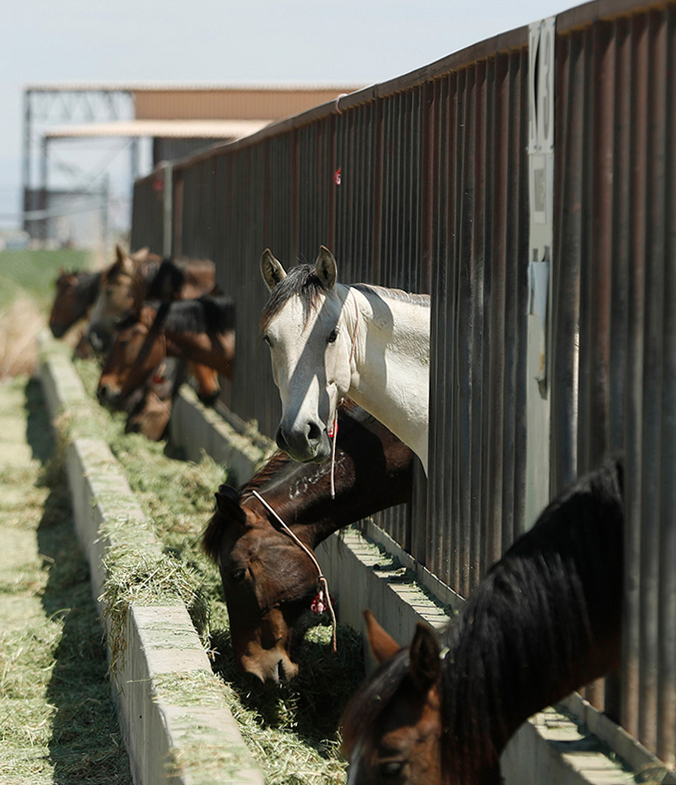
Wild-horse advocacy group puts numbers on slaughter buys
![]() |
| Wild horses in a holding/adoption yard in Delta, Utah (Photo by George Frey, Getty Images, via Greenwire) |
AWHC reports says of the 840 “BLM-branded wild horses and burros identified in kill pens,” at least 312 were adopted through the incentive program. “The whereabouts of these animals remain unknown.” The group said it “identified 24 groups of related individuals” that it says have adopted multiple wild horses and burros “to the same address, then flipped all the animals to kill pens as a group after receiving the full incentive payments. . . . At least 130 BLM wild horses or burros were sent to kill pens as part of such coordinated schemes.” AWHC said the numbers “represent the tip of the iceberg, as many kill pens directly ship horses and burros to slaughter without advertising them.”
The BLM said last year that it adopted 7,369 wild horses and burros into private care in the fiscal year that ended Sept. 30, "the most in at least two decades," Streater reports, noting roundups aimed at making the range population "closer to the level BLM considers sustainable without damaging the rangelands, or placing the animals at risk of starvation or dying due to a lack of water — a growing concern as much of the West is experiencing extreme drought conditions. As of March 1, there are now an estimated 82,384 wild horses and burros roaming 27 million acres of federal herd management areas in 10 Western states — down from a record 95,114 in 2020."
Tuesday, July 26, 2022
Uvalde paper calls police response 'a rudderless ship cast into a hurricane,' calls for more accountability and training
The special [state] House report on the mass shooting at Robb Elementary has delivered a devastating blow to public trust in two of our most revered institutions. Law enforcement and the Uvalde Consolidated Independent School District are singled out in the 77-page document for “multiple systemic failures.” The question that we must all consider and somehow answer is how the community goes about restoring trust.
It is a profound challenge without precedent. No mass school shooting in the United States has ended with such glaring failures in both the law enforcement response and school district security. That fact alone has been an egregious multiplier of the misery felt by the families of victims and, by extension, the entire community.
The House committee report, which has been widely accepted as the most credible accounting to date of the May 24 attack, described the law enforcement response as “chaotic” and “uncoordinated.” According to the report, since Columbine in 1999, active shooter training requires all officers to embrace the mantra “stop the killing, stop the dying,” even if it means sacrificing their own lives.
“At Robb Elementary law enforcement responders failed to adhere to their active shooter training, and they failed to prioritize saving the lives of innocent victims over their own safety,” the report reads.
Furthermore, the school district’s written active shooter plan (UCISD officers hosted and helped instruct an active shooter training course for area law enforcement last March) directed the school police chief to assume command of the scene.
As we are all painfully aware, neither UCISD police chief Pete Arredondo, acting city chief Mariano Pargas, Uvalde County Sheriff Ruben Nolasco nor any state or federal officer among the 376 responders to the scene was willing to take the helm of what was clearly a rudderless ship cast into a hurricane.
So how do we restore these ailing institutions to something approximating health? The school district took a halting first step on June 22 by placing Arredondo on administrative leave. A special meeting scheduled yesterday to consider terminating the chief was canceled Friday after Arredondo requested a formal hearing. His status is now unpaid administrative leave.
Assuming Arredondo will soon be gone, the district should not simply add more officers to a force born of a failed culture. Administration needs to start over or disband the department altogether, as is being done by an increasing number of districts across the nation.
UCISD building security, which received withering criticism, can be enhanced. Doors that lock reliably, lockdown alerts that actually work, and meaningful perimeter fencing could have bought the few minutes necessary to stop the Robb killer.
For any of that to be effective, school employees will have to shake off a sense of complacency and be willing to follow strict guidelines. No propping open doors, no substitute teachers without keys, and lockdown protocols that distinguish between an active shooter and the ongoing bailouts that plague our region.
The city of Uvalde has placed Pargas on administrative leave and is preparing for an independent review of the entire department. Following that analysis, some officers may find themselves unemployed. That will be part of the costly but necessary process of restoring trust.
None of these measures eliminate the need for further accountability. And while spreading it around – especially among the battalion of officers who responded to Robb – is appropriate, it does not change one important fact. If our city is ever again called upon to stop an active shooter, we must have officers in place who can execute the mission without backup or hesitation. That is what the training calls for. And that is what we should demand.
Rural areas need broadband to lure remote workers, but lousy federal connectivity maps may hinder buildout
Chicken processors to pay farmers $85 million in antitrust settlement, scrap pay system called abusive and opaque
Christian journalists tell Christianity Today: Believers should believe journalists, and care about the survival of local news
"Saving local media outlets is a way to love your neighbor" is Christianity Today's headline over an Angela Lu Fulton story reporting, "Christians are fighting to revive community-centered journalism."
"Organizations, politicians, and local citizens are starting to see the consequences of the demise of local media: a less-informed public, less accountability for local officials, less civic engagement, and a weakening sense of community," writes Fulton, organizer of the Reforming Journalism Project, a training for Christians interested in local journalism and CT’s incoming Southeast Asia editor.
![]() |
| This illustration by Rick Szuecs accompanies Fulton's story. |
"Garrett argues believers should care about the survival of local news because God is the author of truth and shining a light on wrongdoing, highlighting the good work of everyday people, and informing voters help a community thrive," Fulton writes. "Local news can also help Christians love their neighbors better as they learn about who those neighbors are and the struggles they face, said Mike Orren of the Dallas Morning News. He pointed to the times when readers have rallied to help individuals down on their luck after their stories were featured in the news."
Fulton offers testimonies from other journalists, including Rob Vaughn, an anchor at WFMZ, an independently owned television station covering the Lehigh Valley in Pennsylvania."When friends complain to Vaughn that journalists are often politically liberal, Vaughn agrees, but argues that it doesn’t mean they don’t tell the truth or they don’t have something worth listening to. He’s concerned that as Christians push away mainstream media, they become more susceptible to disinformation." Amen!
Governor to sign bill giving Alaska Native tribes recognition
| Supporters of the bill posed after its passage. (James Brooks/Alaska Beacon) |
“This is an historic moment for all Alaska tribes,” AFN President Julie Kitka said in a prepared statement. She called it “a step toward building a stronger relationship with our state government.”
"State recognition is not expected to affect tribes’ legal relations with the state, but supporters have said it is an important symbolic statement by the state, which has historically fought efforts by tribes to exert their sovereignty," James Brooks reports for Alaska Beacon, part of States Newsroom.
New rural coronavirus infections, deaths up for fourth week
![]() |
| New coronavirus infections, in ranges by county, July 12-18 Map by The Daily Yonder; click on the image to enlarge it or click here for the interactive version. |
New coronavirus infections and deaths in counties outside metropolitan areas rose modestly during the week of July 12-18, marking the fourth straight week of rising rates, Tim Marema reports for The Daily Yonder. Rural counties reported 101,575 new coronavirus infections July 12-18, up 3.3% from 98,293 the week before. Metro counties reported 749,593 new infections in the same time period, up 4% from the previous week's 720,721.
The true number of cases is likely much higher than the official count, due to at-home testing and data-reporting gaps, but "even with a substantial undercount in new cases, 80% of all rural counties are in the red zone, defined as having 100 or more cases per 100,000 residents in a seven-day period," Marema reports. "The percentage of red-zone counties is even higher in metropolitan counties – over 90%."
The death rate remains fairly low in both rural and metro counties, likely because of higher immunity and/or milder dominant strains of the virus. "Rural counties reported 476 deaths from Covid-19 last week, up 14% from two weeks ago. Metropolitan counties reported 2,383 deaths, up 17% from two weeks ago," Marema reports. The Covid-related death rate has been higher in rural counties for all but one week in the past year, and the cumulative death rate is more than one-third higher in rural counties than in metro counties.
Monday, July 25, 2022
Libraries and newspapers are natural allies for intellectual freedom and accurate information, librarians tell editors
![]() |
| Leaders from the Lexington Public Library spoke about intellectual freedom at the International Society of Weekly Newspaper Editors conference. (Photo by Heather Chapman) |
Nebraska campaign claiming that sex ed 'grooms' kids for pedophiles is a case study in the spread of misinformation
Sunday, July 24, 2022
Belief that 2020 election was stolen 'has fed a new wave of post-Trump activism on the right,' New York Times reports
After the election, the ranks of those claiming fraud "were swelled by new recruits radicalized by the Covid lockdowns, which many of the Stop the Steal organizers, including [Amy] Kremer, had also rallied against," Homans reports. "Those protests had also drawn in a cohort of far-right evangelical leaders, who had portrayed the lockdowns — which imposed prolonged restrictions on church attendance — as a secular elite campaign against Christians." Another recruit was Doug Mastriano, now the Republican nominee for governor or Pennsylvania and a central figure in Homans' story.
"Jan. 6 marked the explosive end of the self-described Stop the Steal movement — but it also marked a sort of rebirth," Homans writes. "It had showed direct action of even the most extraordinary scale to be, for now, a dead end. Many of the participants in the protests and the Capitol riot returned home and redoubled their efforts to work inside the system rather than just hurling themselves against it." After voting rules were eased during the pandemic, often by bipartisan agreement, there was a backlash of laws that made them more restrictive.
Iowa weekly has two of the 12 winners, including No. 1, in International Society of Weekly Newspaper Editors contest
![]() |
| Scott Campbell |