Thursday, August 25, 2022

Report for America wants rural newsrooms to apply for reporters by Oct. 3; information sessions Sept. 1, 15 and 22

Report for America is now accepting applications for newsrooms interested in hosting emerging and experienced journalists for up to three years, starting next summer—and rural newsrooms are especially encouraged to apply. The deadline is Oct. 3.

RFA is a nonprofit national service program, not unlike the Peace Corps, that places journalists in local newsrooms to report on under-covered issues and communities in return for mentorship and training. The organization pays half the journalists' salaries, and local newsrooms split the rest of the cost with local donors (RFA can assist in fundraising).

The organization has been expanding its rural reach over the past few years to help thwart rural news deserts. In December RFA sought more than 40 new rural journalists for the program, bringing the corps to 325 members in nearly 270 newsrooms in the U.S. and its territories.

Report for America plans to hold online information sessions with newsrooms and partner organizations throughout the application period, including one today at 2 p.m. ET  at 2 p.m. ET Sept. 1, 15 and 22. To begin the application process or to learn more information, news organizations can visit www.reportforamerica.org or send an email to: recruitment@reportforamerica.org.

Flood roundup: Supply-chain shortages hamper recovery; editorial blasts AT&T; lack of flood-proof building sites noted

It's been almost a month since the record flooding in Eastern Kentucky and surrounding areas, and recovery has been spotty and will take years. Here are some recent items of interest:

Supply-chain struggles with building materials that have plagued the nation since the beginning of the pandemic are making it harder—and more expensive—for Eastern Kentuckians to rebuild after the flood, Chad Hedrick of Hazard's WYMT-TV reports. Gov. Andy Beshear said Thursday that the rebuilding would be the most difficult ever in the U.S.

An editorial in The Mountain Eagle in Whitesburg rips into AT&T for not only failing to get most residents' phone service back up and running in Letcher County, but for the company's out-of-touch customer service. The paper's staff called AT&T in an attempt to get answers, and was told that flood victims who needed their service restored could contact the company online, call on their cell phones, or visit the nearest retail store. However, the editorial notes, many flood victims live where cell reception is impossible, meaning internet is also a no-go. And since many lost their vehicles in the flood, it's difficult to get to the nearest AT&T retail store 30 or more miles away. Read more here.

So many people were in harm's way during the floods because they live in flood-prone bottomlands. Landholding corporations and government agencies mostly own the higher ground, and they're not leasing it for commercial or residential development. In the case of reclaimed strip mines, their reclamation bonds may not have been released. Companies should be fairly compensated but obliged to allow some development to protect locals from future floods, writes Joe Childers in an op-ed for the Lexington Herald-Leader. Childers was Kentucky coordinator for the 1981 Appalachian Land Ownership Study.

Wednesday, August 24, 2022

Gannett's latest layoffs have hit small dailies hardest; Plains regional editor says smaller owners may serve them better

Burlington, Iowa, the seat of 
Des Moines County (Wikipedia map)
Gannett Co., the nation's largest newspaper chain, announced widespread layoffs last week after losing money in the second quarter. The company mostly cut jobs at smaller newspapers to protect its 40 largest metro papers, Zachary Smith reports for Iowa Public Radio. For some, like The Hawk Eye in Burlington, the layoffs are difficult to absorb after years of attrition that have left them stretched thin already.

When Carol Hunter, executive editor of the Des Moines Register and regional editor for Gannett papers in the Plains region, broke the news about the layoffs last week and explained the company's strategy of preserving resources at the top 40 papers, a staffer asked her: "Sure that’s good for the Register, but what is the long-term plan for these other papers?" Hunter responded that the issue was "a real difficulty" and said she didn't think large news companies like Lee Enterprises and McClatchy have figured it out, Smith reports. Gannett has sold several smaller papers in the region, mainly to Cherry Road Media.

Hunter said Gannett is trying different measures to keep smaller papers open, such as reducing delivery days, but said she doesn't think a large company with expensive infrastructure needs serves smaller papers as well as local ownership, Smith reports. She also said Gannett's cost-reduction program won't immediately affect its non-dailies in Iowa, "But I think they’re in some ways – most of them – are in rougher shape than the dailies and are being heavily looked at for what their future should be."

As for right now, The Hawk Eye "got the worst of the Plains region: Three full-time reporters and one part-timer were laid off," Smith reports. "This left three in the newsroom: two for the news section and one for sports." One of the layoffs was Laigha Anderson, who found in 2019 that the county government had double-taxed the city government for its emergency communications service for over a decade, costing the city between $1.23 million and $1.52 million.

Biden issues student debt relief; legal challenges likely; rural areas have higher debt rates; see state-level statistics

President Biden announced today that he's canceling $10,000 in student loan debt for individuals who earn $125,000 or less per year or who live in households that earn $250,000 or less. He is also "extending a pause on payments for all borrowers until Dec. 31, capping months of anticipation over a campaign promise to provide economic relief to millions of people," The New York Times reports. Also, there is "$10,000 of debt forgiveness for students who received Pell grants in college, focusing the additional aid on people from lower-income backgrounds." Legal challenges are likely.

Though rural areas tend to have lower college-graduation rates than metro areas, student debt is a critical issue for many rural Americans. "Recent estimates indicate that 6.5 million people in rural areas across the country each owe an average of $35,000 in student loan debt, and that as many as 1.1 million rural student loan borrowers (nearly one-in-six rural borrowers) have fallen into delinquency or default (compared to roughly one-in-seven student-loan borrowers nationwide)," according to the Student Borrower Protection Center, a nonprofit that advocates debt relief. 

"Moreover, the student debt crisis is hitting rural states the hardest. For example, borrowers in the five states with the highest proportion of residents that live in rural areas (Wyoming, Vermont, Montana, Mississippi, and South Dakota, as defined by the U.S. Department of Agriculture) have a 3-year federal student loan cohort default rate that is over 25 percent higher than that of borrowers in other states (using an average weighted by the number of borrowers in the state, 12.3 percent v. 9.2 percent)." Here's a list of rural student debt data for each state, as of December 2020, from SBPC.

The Biden administration says that 90% of the announced debt relief will go to households that earn $75,000 a year or less. However, the move will likely face legal challenges, so it's unclear when or if it will go into effect, the Times reports: "On its face, the move could cost taxpayers about $300 billion or more in money they effectively lent out that will never be repaid. But the true cost is harder to calculate, and smaller, because much of that debt was unlikely to ever be repaid. More than 8 million people — one in five borrowers with a payment due — had defaulted on their loans before the coronavirus pandemic. Many of those people carried fairly small balances and will now be eligible to have their loans canceled."

The plan "reduces the maximum monthly payment amount from 10% of income to 5% and guarantees that individuals with incomes under 225% of the federal poverty level do not make a monthly payment," reports Ashley Spalding of the Kentucky Center for Economic Policy. "In addition, as long as those required to make payments do so every month, interest will not accrue."

The issue has been hotly argued for months; some oppose relief, saying it's unfair to those who have paid off loans or are current on them. Senate Minority Leader Mitch McConnell called it "a slap in the face to every family who sacrificed to save for college, every graduate who paid their debt, and every American who chose a certain career path or volunteered to serve in our armed forces in order to avoid taking on debt." Some moderate Democrats on the ballot this fall also came out against it, "a sign of fears that it could alienate swing voters in November," reports Josh Kraushaar of Axios.

Others say $10,000 isn't enough, and still others say it's more important to reduce or eliminate interest, noting that many have paid off the principal many times over, but still owe as much or more than they started with because of interest, the Times reports. Still, the measures will help many. Some 33% of Americans with student loan debt owe $10,000 or less, The Washington Post reports: "Economists at the Federal Reserve say borrowers with the least amount of debt often have difficulty repaying their loans, at times because they did not complete a degree. Conversely, people with the highest loan balances are often current on their payments likely because of their higher education levels and associated earning power."

Rural counties with recreation economies tend to produce more votes for Democrats than other rural counties do

Voting margins in rural recreation counties in the 2020 presidential election
(Daily Yonder map; click the image to enlarge it or click here for the interactive version.)

"Americans are increasingly likely to live in a county where presidential elections are decided by a landslide of 20 points or more. But the trend is slightly different in so-called rural recreation counties – places where recreational activities drive a big part of the local economy," Sarah Melotte reports for The Daily Yonder. Such counties "have fewer landslide elections and more Democratic votes than rural counties of other economic types." Melotte defines a landslide as one where a party won by more than 20 percentage points.

The overall increase in landslide elections is a function of people self-sorting, partisan gerrymandering, and the migration of rural Democrats into the Republican Party, but recreation counties tend to have a larger share of Democrats, making elections more competitive. "The difference is slight, but measurable for the last 16 years," Melotte reports. "Republican counties have higher average percentages of landslide elections in both recreation and non-recreation counties from 2004-2020. But there were more Democratic landslides in recreation counties than other economic types."

Recreation counties not only have a larger share of Democrats than other rural counties; they had an average voter turnout of 70% in the 2020 election, 9 percentage points higher than the 61% average voter turnout for other rural counties that year, Melotte reports.

Moreover, recreation counties are seeing more population growth than other counties, chiefly driven by the pandemic trend of urbanites relocating to rural areas with amenities such as good broadband and natural beauty. So, the current trends could continue in the coming years, Melotte reports.

Democrat wins U.S. House seat in largely rural N.Y. district; Republican wins the other, but Dems seem more motivated

Democrat Pat Ryan won a special House election in a largely rural district in New York Tuesday, suggesting that the midterm elections will not be a disaster for his party after all.

Ryan, the executive of Ulster County and a combat veteran, defeated Republican Dutchess County Executive Marc Molinaro by 1.8 percentage points in the 19th District, which President Biden won by 2 points in 2020 and Donald Trump won by 7 in 2016.

"This is not the result that you would expect to see in a strongly Republican political climate," NBC News analyst Steve Kornacki said on MSNBC as the race was called. "For Democrats you could not get more encouraging signs in a political landscape that looked terrible for them a few months ago." He called the 19th "a truly bellwether district."

Wikipedia maps, adapted
In a somewhat less rural New York district that is more Republican, the southwestern 23rd, GOP nominee Joe Sempolinski got just over 53% of the vote Democrat Max Della Pia in another special election, Jeff Smith of the Elmira Star-Gazette reports.

Denis Slattery and Dave Goldiner of the New York Daily News write, "Special elections tend to be an accurate assessment of the overall political climate because they attract the most engaged voters from each party, political data crunchers say."

Ryan campaigned hard against the Supreme Court's reversal of the 1973 Roe v. Wade decision that established abortion rights. "Molinaro, meanwhile, tried to focus on other issues," reports Amy Wang of The Washington Post. "The special election was closely watched as a possible bellwether for other midterm races around the country, as Democrats attempt to channel voters’ anger over the Supreme Court decision, as well as other abortion restrictions that Republican-led state legislatures have imposed since."

Grace Ashford of The New York Times looks ahead: "Mr. Ryan will be seeking a full term in Congress in November, but — in a confusing redistricting-year twist — it will not be in the 19th District. His home lies within the new boundaries of the 18th District, where he is running in November. His Republican opponent in that race will be Assemblyman Colin Schmitt of New Windsor. Despite Mr. Molinaro’s loss in the 19th District, he, too, will be seeking a full term in Congress in November — in the district’s new contours."

Based on Ryan's "impressive" win, political scientist Larry Sabato of the University of Virginia changed his ratings on the two districts, based on Ryan's win. The new 18th went from tossup to leans Democratic and the 19th went from leans Republican to tossup. "Higher Democratic voter enthusiasm likely explains Ryan’s victory," wrote Kyle Kondik, editor of Sabato's Crystal Ball.

Where is the worst corn in the country this growing season?

Corn conditions in Texas, Kansas and North Carolina
(Successful Farming graph using Agriculture Department data)
"Texas, Kansas, and North Carolina corn farmers have been challenged by drought and more," Natalina Sents Bausch reports for Successful Farming. In the three states, "313 counties have USDA disaster designations. Corn condition in the respective states is rated as the worst in the U.S. at this point in the 2022 growing season." Her article has a drought map for each of the three states, as well as data on corn quality, soybean quality, harvest data, and topsoil moisture.

Corn conditions in other states (Successful Farming graph using Agriculture Department data)

Tuesday, August 23, 2022

Arkansas publisher and her weekly win Tom and Pat Gish Award for courage, tenacity and integrity in rural journalism

An Arkansas publisher and her weekly newspaper, which revealed school officials’ cover-up of sexual-abuse allegations by students in the face of court challenges and harsh criticism by the officials, are the winners of the 2022 Tom and Pat Gish Award for courage, integrity and tenacity in rural journalism from the Institute for Rural Journalism and Community Issues, publisher of The Rural Blog.

Publisher Ellen Kreth
Ellen Kreth and the Madison County Record have long been standouts in Arkansas journalism, and leaders in the battle for freedom of information in the state. Their FOI experiences served them well in their battle with the Huntsville School District, which tried to conceal sexual abuse by members of the Huntsville High School Junior High boys’ basketball team against some of their teammates over two basketball seasons.

The Record learned of the case from parents of the victims, who approached the newspaper to make sure the allegations weren’t swept under the rug and school officials were held accountable. The paper didn’t name any students involved, but did report that the school board reduced or rejected the recommended punishment for the violators. It focused on how officials handled the allegations. It reported the district’s failure to immediately report the allegations, as required by law, and multiple open-meetings violations of the Arkansas Freedom of Information Act.

The newspaper’s reporting prompted an investigation by the county sheriff; special open-meetings training for the school board, which didn’t do it in the time required; a lawsuit by a parent alleging violations of Title IX of the Education Amendments of 1972, which ban sex-based discrimination in any school that gets federal funding; the board’s admission of liability in that suit; and the electoral defeat in May of three of the four board members who sought re-election.

Madison County (Wikipedia map)
The Record also reported that on election night, five days after the board granted the school superintendent’s request to become director of compliance and personnel, the sheriff’s office found her hidden under a bridge with the unopposed board member in his truck, claiming to be “star-gazing” on the stormy night.

“The school district fought us each step, publicly criticizing our editorial decisions and the credibility of our reporting,” Kreth told the Institute for Rural Journalism. “The school board claimed ignorance for never having previously handled a Title IX investigation. It failed to provide notice of meetings, claiming a newspaper should not cover student discipline. Based upon our reporting, a parent sued the district for the open-meetings violations and won.” The district asked for a gag order, and the paper hired legal counsel to intervene in the case on that issue and won. That allowed parties to the case, “including victims, to continue to speak to us, helping ensure accuracy in every article,” Kreth wrote.

Gen. Mgr. Shannon Hahn
The work (at https://www.mcrecordonline.com/Content/Default/Title-IX/-3/111) was done by Kreth, General Manager Shannon Hahn and Celia Kreth, the publisher’s younger daughter, now a senior at the University of Pennsylvania. Ellen Kreth said the 4,000-circulation paper with a staff of five turned down help from larger news organizations because they had promised anonymity to several victims and families.

Kreth started out as a journalist and became a lawyer, but got back into journalism in 2002 when she inherited the newspaper from her grandmother. She said her knowledge of FOI law prevented officials and their lawyers from intimidating her, and the paper’s use of the laws has made readers more aware of them, to the point that they come in asking how to file an open-records request.

Reporter Celia Kreth
“At a time when newspapers need to remind the public of their value to local democracy, as independent watchdogs of local officials, Ellen Kreth and the Madison County Record are an example to the nation,” said Al Cross, director of the Institute for Rural Journalism and extension professor of journalism at the University of Kentucky.

The Tom and Pat Gish Award is named for the couple who published The Mountain Eagle in Whitesburg, Ky., weekly for more than 50 years and repeatedly demonstrated courage, tenacity and integrity through advertiser boycotts, business competition, declining population, personal attacks, and even the burning of their office by a local policeman who state police believe was paid by coal companies.

Author and journalist Bill Bishop of LaGrange, Texas, who worked for the Gishes and is a member of the award selection committee, said of the winners’ work, “I can't imagine a harder issue to pursue in a community. And the open-records fight is straight out of early Tom and Pat.”

The Gishes, who died in 2008 and 2014, respectively, were the first winners of the award, in 2005. The other winners, in chronological order, have been the Ezzell family of The Canadian (Texas) Record; Stanley Dearman (former publisher, now deceased) and Jim Prince (publisher), The Neshoba Democrat, Philadelphia, Miss.; Samantha Swindler of Portland, Oregon, for her work at the Jacksonville (Texas) Daily Progress and the daily Times-Tribune of Corbin, Ky.; Stanley Nelson and the Concordia Sentinel of Ferriday, La.; Jonathan and Susan Austin, publishers of the now-defunct Yancey County News in Burnsville, N.C.; the late Landon Wills of the McLean County News in Calhoun, Ky.; the Trapp family of the Rio Grande Sun in Española, N.M.; Ivan Foley of the Platte County Landmark in Platte City, Mo.; the Cullen family of the Storm Lake (Iowa) Times; Les Zaitz of the Malheur Enterprise in Vale, Oregon; Ken Ward Jr., then of the Charleston Gazette-Mail and now of Mountain State Spotlight, along with his mentor, the late Paul J. Nyden of the Charleston Gazette and Howard Berkes of NPR; the late Tim Crews, editor-publisher of the Sacramento Valley Mirror in Willows, Calif.; and the Thompson-High family of The News Reporter in Whiteville, N.C.

Renee Shaw
The Gish Award will be presented Nov. 3 at the annual Al Smith Awards Dinner at the Embassy Suites Lexington on Newtown Pike near Interstate 64/75. The keynote speaker will be Renee Shaw, public-affairs director for Kentucky Educational Television.

The annual dinner also honors recipients of the Al Smith Award for public service through community journalism by Kentuckians, which the institute presents with the Bluegrass Chapter of the Society of Professional Journalists. The 2022 winners of the Smith Award are Chris Evans and Allison Mick-Evans of The Crittenden Press, a small weekly in West Kentucky that has punched above its weight and persevered for almost 30 years in the face of increasing challenges, most recently a city water crisis in which it has been an information lifeline.

Dinner tickets for non-SPJ members are $125 each; table sponsorships are $1,250. For more information, contact Al Cross at al.cross@uky.edu.

'Byzantine' hospital billing practices often leave patients with huge bills; Maine paper's work provides example for U.S.

Kaiser Health News and NPR map based on Urban Institute data

Despite efforts in recent years to increase the transparency of medical bills, millions of Americans are still saddled with medical debt from "unexpectedly huge expenses," partly from "facility fees" charged by hospitals, Joe Lawlor reports for the Portland Press Herald/Maine Sunday Telegram. That's according to a three-month investigation the paper conducted into the "byzantine system of medical billing in Maine," The most rural state. Its findings are broadly applicable.

More than 100 million Americans, or 41% of adults, have medical debt, and they are more likely to live in rural areas, the South, and/or in states that didn't expand Medicaid. The government has attempted to help Americans avoid such debt: The "No Surprises Act," which took effect Jan. 1, 2021, is meant to prevent patients from being blindsided with surprise bills for out-of-network medical treatment. But there are loopholes: Ground ambulances, which can cost thousands of dollars, aren't covered. Another law that took effect that day required hospitals to begin posting the prices for their services online, but few hospitals have complied and fewer still have been fined.

Percentage of those surveyed with below-average income
who said they had serious problems paying or couldn't pay
a medical bill. (Portland Press Herald chart based on
2021 data from the Commonwealth Fund.)
"It has long been standard practice for hospitals to shift uncompensated costs, such as care for uninsured patients who can’t afford to pay their bills, to patients with insurance," Lawlor reports. "But with more patients on high-deductible plans – and insurers sometimes refusing to pay or paying only a fraction of their bills – individuals are picking up more of the tab and bearing more of the financial burden."

Facility fees are another way often cash-strapped hospitals try to stay in the black, Lawlor found. That jibes with a years-long investigation on sky-high emergency room bills by health journalist Sarah Kliff (now at the New York Times, then at Vox). In Maine, "patients are paying hundreds of dollars extra for routine medical tests or procedures simply because the tests are occurring at hospitals," Lawlor reports. "And they may have no idea, because the 'facility fees' are not clearly explained and sometimes hidden on their bills." But one hospital's chief financial officer said facility fees are an "industry standard" because hospitals must cover higher expenses than other medical providers.

Other findings from the Portland Press Herald's investigation:

  • "Medical bills are confusing and opaque, and sometimes carry arbitrary and hidden costs" such as facility fees, which can reach hundreds of dollars.
  • "The practice of assessing facility fees – sometimes hiding such fees in other charges – increasingly contributes to some patients’ surprisingly large bills."
  • Insurance companies sometimes deny claims for unclear reasons that may never be explained. That forces patents to choose between a long fight with insurance or paying huge bills.
  • Insurance and procedure costs vary so widely that even patients who carefully compare prices can end up with much higher bills than expected. (See this Kaiser Health News story.)
  • Even though Americans have more access to insurance through the Affordable Care Act marketplace, many are still underinsured and risk owing massive unexpected medical bills.
  • The high number of underinsured and uninsured people makes the health-care system less efficient and raises costs for providers. The higher costs make even insured people reluctant to seek medical care.
  • Everyone agrees reform is needed, but change is difficult because change in one sector often hurts another.
  • Reforms like the ACA tend to focus on expanding insurance access instead of addressing root problems with pricing and out-of-pocket costs.
  • A single-payer model (not the same thing as universal health-care, though the two are often conflated) could help, but only if the state and federal governments adequately fund it. And there is little momentum right now in enacting such a system, either at any state or national level.

Eastern Kentucky residents say strip miners worsened flood

For decades, people in Central Appalachia have said floods have been worsened by surface mining and inadequate reclamation. Now last month's record floods in Eastern Kentucky have prompted a lawsuit making that claim.

"Nearly 60 residents of the Lost Creek community in Breathitt County are suing coal mining companies which operate nearby, alleging the companies’ negligence contributed to the devastation of historic flooding last month that caused death and the destruction of homes and personal property," reports Taylor Six of the Lexington Herald-Leader.

"The residents are suing Blackhawk Mining and Pine Beach mining companies, alleging that the two companies knew they were sitting on “ticking time bombs” by failing to properly construct and maintain silt ponds, which are artificial bodies of water created through coal operations that collects pools of water, waste and sediment. An attorney representing the residents says debris, sediment and fish flowed out from the silt ponds and came onto their properties, according to the lawsuit."

Some of the people filing suit have mixed emotions because the coal industry provides jobs, Phil McCausland of NBC News reports: "Residents here said that they were raised, fed and clothed by the jobs created by coal mining but that they believed the companies operating the mines have acted irresponsibly and without regard for those who have called the area home for generations. Many of those displaced by the storm are living with family or neighbors, in travel trailers or in tents pitched on the cleared patches of dirt where their homes once stood."

In post-Roe America, some teenagers are stepping up to get and give sex education when their schools are hamstrung

Chart compares states by their required emphasis on abstinence in sex education and the availability of abortion, with squares sized for each state's population of women of reproductive age. (New York Times chart)

A growing number of teenagers nationwide "are stepping up to demand more comprehensive lessons on reproduction, contraception and abortion — and . . . if the adults refuse, are teaching each other instead," Hannah Natanson reports for The Washington Post.

Pregnancy prevention has become more important since the Supreme Court overturned Roe v. Wade, but only 29 states require schools to teach sex education; 30 states require schools to emphasize abstinence as a method of contraception; and 16 states only teach abstinence. But abstinence doesn't work on a broad scale, and many states that have restricted or outlawed abortion are the same ones that emphasize abstinence. That's a problem when about 79% of girls and and 77% of boys have had sex by age 20, and 75% of teen pregnancies are unplanned.

Sex education in the classroom is often "too little, too late," says Rutgers University public-health professor Laura Lindberg, an expert on it. Her research indicates that fewer than half of U.S. teens are told where to get birth control before they have sex for the first time, "and she noted that the teen birthrate in the United States — 16.7 births per 1,000 females in 2019 — is consistently among the highest in the developed world, though it has been declining in recent years," Natanson reports.

Social conservatives have been trying to restrict or remove sex ed for decades, Natanson reports. "And they’re especially fired up now, post-Roe and amid raging education culture wars that have delivered new laws restricting what teachers can say about race, racism, sexuality, gender identity and LGBTQ issues." Tiffany Justice, co-founder of parent group Moms for Liberty, told Natanson that teenagers advocating for better sex ed "are being pushed by activist organizations, whose purpose is making children politically literate rather than actually literate so they can become social justice warriors."

But most teens are "starved for information" and "intensely curious," according to a Utah teen who educates others. Some teens create their own programs, while others work through existing initiatives such as the Planned Parenthood Teen Council program. "The initiative, begun in 1989 in Washington state, trains teens to teach other schoolchildren sex education, then partners with willing private schools, school districts or community groups to host peer-led lessons on topics ranging from consent to contraception, depending on state law and school policy. Since its founding, it has expanded to 15 states, and last year 300 teens volunteered on 31 councils," Natanson reports. "The end of Roe appears to have driven more interest in the Teen Council program, which is poised to expand." One community health educator in Utah's Planned Parenthood chapter said they have had unprecedented interest from rural parts of the state.

Mega-merger of poultry processors is proceeding, despite anti-trust concerns; processors ask producers to back it

A mega-merger between two of the country’s largest poultry processing companies is proceeding even as the Biden administration attempts to clamp down on antitrust violations by big agriculture companies, including 'Big Chicken'," Claire Carlson reports for The Daily Yonder. "Wayne Farms and Sanderson Farms will soon become Wayne-Sanderson Farms after the Department of Justice greenlit the acquisition of Sanderson Farms by Cargill and Continental Grain Co. in late July. Cargill and Continental already owned Wayne and a year ago announced plans to buy Sanderson.

Days after the acquisition was finalized, the Justice Department filed suit against Cargill, Sanderson and Wayne, saying the companies illegally exchanged information about poultry workers' wages in violation of federal anti-trust laws. "The lawsuit also alleges that the poultry companies pitted chicken growers against each other through deceptive practices via the poultry tournament system, which ranks chicken producers based on the speed or efficiency with which they raise chickens," Carlson reports. "Growers who can deliver more product in a shorter amount of time are paid more by poultry processing companies." The tournament system has enabled huge processors to control the entire production process, and consolidation has concentrated power in the industry to a handful of players.

Though the companies agreed to pay an $84.8 million settlement, Diana Moss, president of the American Antitrust Institute, told Carlson she worries that the lawsuit isn't enough to keep the new company from having too much control over the poultry industry. 

The Department of Agriculture "is considering a rule that would require chicken processors to provide farmers with more information so growers can advocate for themselves in sales negotiations," Carlson reports. "A second rule under review could change the way chicken packers compensate farmers who raise chickens for them. Comments on those proposed rules are due Aug. 23 and Sept. 6, respectively."

Labor advocates, former growers, and the USDA are accusing some of the nation's largest poultry processors of pressuring farmers to oppose the proposed rule. "Growers contracted to raise chickens are increasingly weighing in against that rule through form letters," Marcia Brown reports for Politico. "Some poultry processors have acknowledged sharing the pre-written letters with farmers, urging them to submit them through the public comment process or asking them to weigh in individually. In an industry already under scrutiny for wage fixing and other practices, that’s raised concerns among advocates and USDA."

Agriculture Secretary Tom Vilsack warned against pressuring farmers when the USDA announced an extension of the public comment period earlier this month. "There is fear throughout the meat and poultry industry as we saw earlier this year at two separate Congressional hearings where witnesses did not testify due to concerns of retaliation," Vilsack said in a press release. "But it is still critical that we hear the full story, so we are highlighting the option for comments to be provided anonymously."

Monday, August 22, 2022

Public-notice battles get more political, threaten existence of many small newspapers that need the 'legal ads' to survive

The long battle over public-notice advertising, a source of revenue that has become critical for small newspapers as they have lost retail ads, gets some needed national attention from the Local News Initiative at Northwestern University's Medill School of Journalism.

Writer Susan Chandler notes the latest efforts in several state legislatures to reduce public-notice requirements, including passage of a very worrisome law in Florida, and the laws in some states that leave selection of public-notice platforms up to elected officials, who can ignore basic standards while exercising political retribution.

Custer County (Wikipedia map)
She cites the examples of two Colorado counties: Pitkin, where the county commission made the Aspen Daily News the paper of record after The Aspen Times mishandled a libel suit and its fallout, and Custer, population 4,700, where commissioners moved public notices from the long-established Wet Mountain Tribune "to a nine-year-old partisan newspaper called the Sangre de Cristo Sentinel even though the Tribune submitted the low bid. . . . One of them cited the Tribune’s 'combative' coverage as the reason for the change. Losing legal notices has cost the Tribune between $10,000 and $15,000 a year in direct revenue, said Publisher Jordan Hedberg. . . . The loss is likely higher because of the halo effect of being the paper of record, he added."

Hedburg told Chandler that he may file a federal lawsuit, citing the First Amendment: “The Supreme Court has ruled that governments can’t use contracts to retaliate against protected speech, but we have a county commissioner retaliating against us for doing our job. Basically, the only way we are going to qualify is if we don’t write anything that irks this particular commissioner.”

Richard Karpel, executive director of the Public Notice Resource Center, which tracks the issue and sponsors an annual award for the best stories that come from public-notice ads, told Chandler, “We’ve seen it become more of a partisan issue in the last five or 10 years. In some states, there are Republicans who are in battle with the media as part of their political strategy.”

This is an existential issue for many newspapers, Chandler warns: "Les High, a longtime publisher in a small town in North Carolina, estimates that small community papers could lose 20 to 25 percent of their revenue if legal notices went away, compared with only a 5 percent loss for larger dailies."

“It’s the little guys who are under threat,” said High, who runs the Border Belt Independent, a nonprofit public-interest news site that covers four North Carolina counties. “They’re struggling already and they’re in counties without large revenue streams from retailers. If we lost public notices here, I bet you would see 15 to 20 percent of small newspapers disappear.”

Newspapers need to do a better job with public notices to help save them, said Dean Ridings, CEO of America's Newspapers, a trade group: “Publishers need to look for creative ways to push those out. Maybe it’s a bigger button on their website. Maybe it’s having a standing report once a month. This would be a good time to devote effort to making them easier to find digitally. We know how to do those things.” (Read more)

Rural Covid-19 infection rate above metro for first time since March, as rural cases fall more slowly than metro cases

Newly reported coronavirus infections, in ranges by county, Aug. 9-15
Map by The Daily Yonder; click on the image to enlarge it or click here for the interactive version.

The rate of new coronavirus infections in rural counties fell by 5 percent from Aug. 9-15 while the metro rate fell by 12%. "The relative difference in the decline in infections means that the rural infection rate exceeded the metro rate for the first time since mid-March, according to a Daily Yonder analysis," Sarah Melotte reports. During that time period, 84% of rural counties were in the red zone, defined as those with 100 or more new infections per 100,000 residents in a seven-day period. That's down slightly from 87% the previous week. However, Melotte notes that the actual infection rate is almost certainly much higher because many people test and treat at home without reporting their infection.

Rural counties reported 562 Covid-related deaths from Aug. 9-15, down 10% from the previous week. "But deaths in metropolitan counties increased 3.3% last week and totaled 2,791," Melotte reports. "The rural death rate was 1.22 per 100,000 residents. That’s 23% higher than the metropolitan death rate of 0.99 per 100,000 residents. The rural death rate has exceeded the metropolitan rate every week except one in the last year." Click here for more charts, regional analysis, and county-level interactive maps from the Yonder.

Liberal groups' latest report on rural electric cooperative boards shows them to be overwhelmingly white and male

Percentage of women on rural electric cooperative boards, in ranges, by state. (Rural Power Project map)

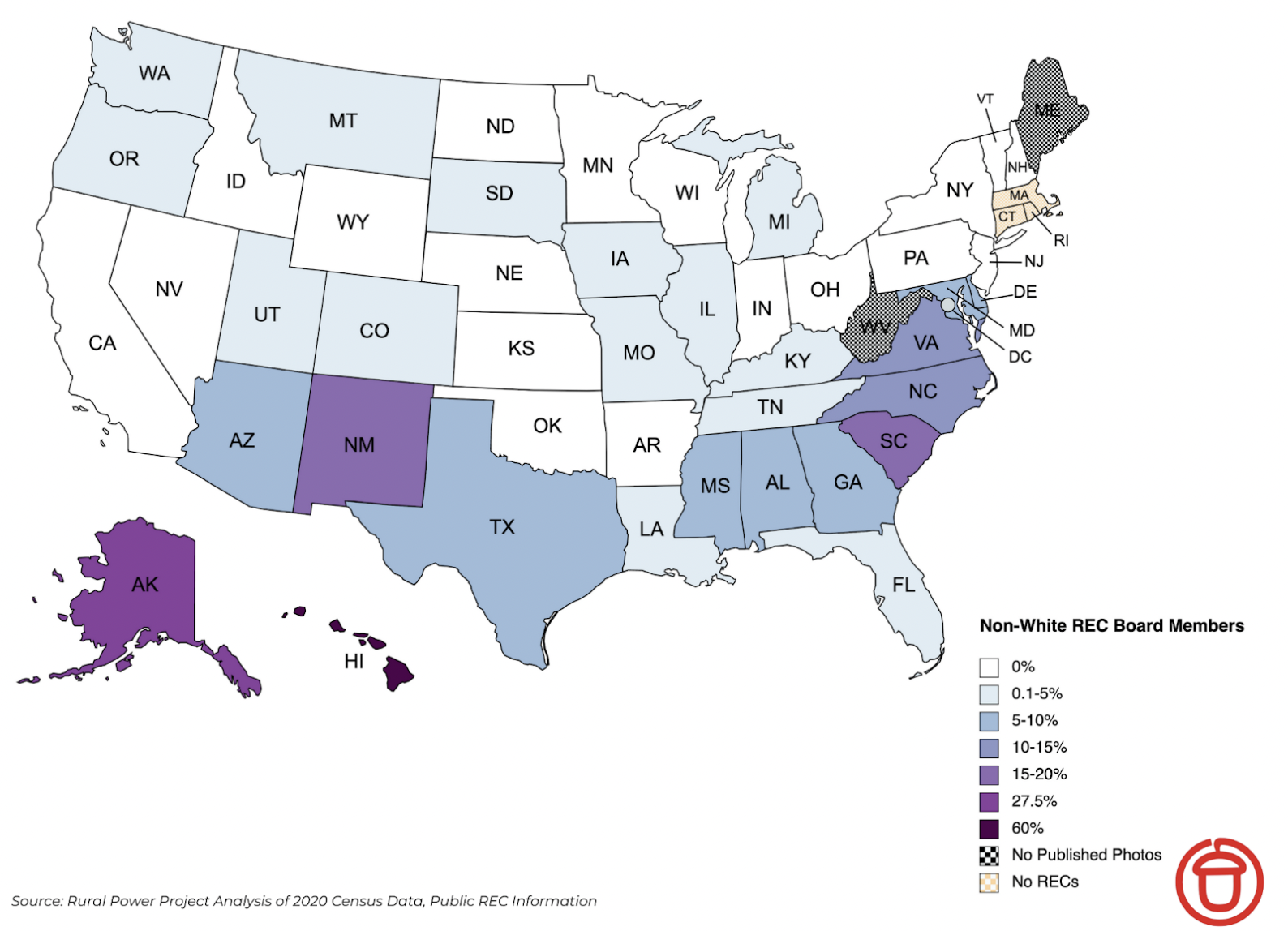
Rural electric cooperatives are major economic players in their communities, and reliably one of the most effective ways to bring high-speed broadband internet to rural areas. But their elected boards are overwhelmingly white and male, leaving rural women and racial minorities under-represented, according to a new report from two liberal groups, ACORN International and the Labor Neighbor Research and Training Center. Their joint Rural Power Project has been assessing co-op boards' gender and racial equity since 2016. As of this year, women made up 12.6% of the boards and people of color, who make up 24% of the rural population, only hold 4% of board seats. 

About 30% of co-ops had no female board members, and all but six out of the 888 surveyed had male-majority boards. New Hampshire's board had the largest share of female members, 45.5%, but the next-highest, Vermont, had only 28.6%. At the other end of the spectrum, West Virginia's board had no women at all, and Nebraska had only 4.8% female board members.

Percentage of non-white members on rural electric cooperative boards in ranges by state. (Rural Power Project map)

The boards didn't fare much better in racial diversity. "Of the 6,198 REC board members across the country for whom we could make a reasonable determination about racial identity, 96% were white. Just 2.4% were Black, 0.9% Hispanic, 0.5% Native American, and 0.2% Asian American," says the report. "Of 697 cooperative boards whose racial demographics we could assess, 557 of those boards – 80% –were all white. While people of color make up majorities of 10% of rural counties, there were only 11 majority nonwhite cooperative boards (1.6%)." ACORN sees the lack of diversity as "an act of exclusion," its research director, David Thompson, told Kristi Eaton of The Daily Yonder.

The National Rural Electric Cooperative Association says in a statement on its Mission page that the co-ops "are built by and belong to the diverse communities and consumer-members they serve. They are founded on seven principles that set them apart from other businesses. Concern for community and the open, democratic structure of co-ops are two of these core principles. With these foundational concepts in mind, NRECA supports electric cooperatives as they strive to serve their communities and work to enhance quality of life for their consumer-members. As an employer and an advocate, NRECA is committed to a positive, inclusive culture. We support policies that foster employee growth and success without fear of discrimination. The ongoing conversation about racism demands that we recognize how we can contribute to a more transparent, fair and accountable society. NRECA, its leadership and employees are expected to play a leadership role in rejecting racism, speaking against injustice, and demonstrating the value of diversity, equity and inclusion."

NRECA and the National Rural Utilities Cooperative Finance Corp., which makes federally backed loans to the co-ops, created a task force to examine co-op governance in 2017. "The task force completed the report in February 2018, but never published it," says the Energy and Policy Institute, which says it works to "expose attacks on renewable energy and counter misinformation by fossil fuel and utility interests." EPI republished the report after it was published on a co-op website and cited in an investigative report on South Carolina co-ops by The State, the daily newspaper in Columbia. Each page of the 69-page task-force report says it is “For NRECA and CFC Voting Members Only.”

Friday, August 19, 2022

Dems need to compete harder in rural areas with candidates like congressman from Maine, Economist columnist says

As Democrats lost millions of rural voters in the last decade, "They took to lamenting Republican advantages in the electoral college and the Senate," writes James Bennet in his Lexington column on American politics for The Economist. "What Democrats have not done is compete harder. They instead condemn rural voters as mourning their white privilege in a diversifying country. Bennet, the first American to write the column, notes Hillary Clinton's and Barack Obama's lines at big-city fund-raisers about "deplorables" "clingers" to guns and religion.

Bennet has an example for Democrats to follow: Rep. Jared Golden of Maine's 2nd District, the second most rural in the nation. "The district tells the story of how Democrats lost their appeal to rural and working-class Americans, and with it at times majorities in Congress to match the party’s consistent majorities in the national vote. It also suggests how the Democrats might recover," with candidates like Golden, who is favored to win a third term in November.

Golden hates What's the Matter with Kansas, the 2004 book by Thomas Frank that argues rural Americans' vote on social issues at the expense of their self-interest. “No, people are not voting against their own self-interest. They know what’s important to them,” he said, while the Democratic Party “has developed too much of an attitude that anyone that disagrees with us is just not smart.”

This Marine vet of Afghan and Iraq "says he is a Democrat because he believes government has a critical role to play in helping people," Bennet writes. "But he thinks his party has taken a grandiose view of that role, alienating rural voters by trying to dictate national standards that ignore local realities—such as unrealistic credentials for day-care teachers—and wasting money on people who do not need it. He supports anti-poverty initiatives like the child tax credit, but was outraged that Democrats continued permitting it to couples earning as much as $400,000 a year. . . . Golden worries that Democrats think they can write off rural voters and rely on demographic change to supply majorities by turning more of America into Portland. 'I don’t know if that’s even true,' he says. 'Secondly, even if it is, don’t you just want to do right by everybody?'"

Golden and Bennet met in Skohegan, over a successful local beer made by a company that a teacher and millworker started in a barn; now they "are turning the idled mill in town into a brewpub, hotel and apartments. The brewers want to help clean up the Kennebec River," and they and and other local business people met with Golden that day. "Their excitement about the future of their pretty, faded town was infectious."

“I think my job is to try and connect them with as much help along the way or clear as many roadblocks as possible,” Golden told Bennet. “I think they want to believe in a government that will help them do those things. But they’re very skeptical of it.”

'Redefining Your Newspaper Business Model with Research' webinar, reporting on a Kansas experiment, set Thursday

The 200-year-old business model used by the newspaper industry clearly needs changing, and experiments are underway. A progress report on one major experiment will be the focus of a webinar Thursday, Aug. 25 from 2:30 to 4:30 p.m. ET.

Teri Finneman
"Redefining Your Newspaper Business Model with Research" will be presented by Dr. Teri Finneman, associate professor of journalism at the University of Kansas. She is leading an 18-month research project to test a new business model based on data collected from rural publishers and readers to help weekly newspapers adapt, survive and thrive in the 21st century.

With the study now in its final stages, Finneman will review in the live webinar what weekly newspaper publishers and readers have had to say, and present feedback from the publishers piloting the proposed memberships, e-newsletters and events model, as well as answer questions about the research project. Joey Young, owner of Kansas Publishing Ventures, will also be sharing his perspective as a publisher and research participant.

The webinar is being held by the Arkansas Press Association; the fee for non-members of APA is $30. Register at arkansaspress.org/event/APAWebinar. For more information email info@arkansaspress.org.

Finneman has been a print journalist and multimedia correspondent covering state government, business and enterprise. She talked about her project at the National Summit on Journalism in Rural America.

Thursday, August 18, 2022

Bourbon boom has downsides for neighbors who don't want aging whiskey feeding unsightly fungus and posing risks

Buffalo Trace Distillery built these warehouses at Frankfort, prompting complaints from neighbors. Now it wants to build a similar group of warehouses in the nearby Elkhorn Creek valley. (Photos by Ryan C. Hermens, Lexington Herald-Leader)
Fungus on a nearby sign
The boom in bourbon has been a boon to Kentucky economically, but now rural residents in a swath of the western Bluegrass region are fighting the warehouses that turn whiskey into bourbon. They object to the fungus that is fed by the aging alcohol escaping into the air from barrels in the warehouses, worry about the storage of so much flammable material, and dislike what they call an industrial invasion of bucolic landscapes.

Residents of Henry, Franklin and Anderson counties point to the black fungus that is obvious on signs, homes and other surfaces. Distillers pooh-pooh those concerns, citing studies that show the fungus is harmless, but they acknowledge it's unsightly. And the concerns are more than cosmetic.

Wendell Berry
“What I fear is this will be a continuation of an old Kentucky story, in which outsiders come in, take as nearly as they can what they can, what they want, and give as little back as they possibly can,” farmer-author-poet-activist Wendell Berry, 88, told Janet Patton of the Lexington Herald-Leader. Near the farm where Berry grew up, Angel’s Envy has won Henry County Planning Commission approval to turn a 1,200-acre cattle farm into a "bourbon campus" with up to 25 warehouses, lodging, an amphitheater, a visitors center, a helicopter pad and more.

“We are being asked to sacrifice this land to tourism and whiskey,” Berry told the commission last month. The commission voted 6-3 for the zone change; the final decision is up to the county's legislative body, the Fiscal Court, on Sept. 20.

One the other side of the argument is "Connie Blackwell, a Lawrenceburg real estate agent who lives in Tyrone in the valley below the Wild Turkey distillery," Patton reports, quoting her about the fungus: “It is a mess; you do have to pressure-wash your house once a year. You get used to it. Everybody down here in Tyrone tolerates it. It’s just no big deal … for the taxes they bring into our county, it’s worth it, to me. . . . I don’t believe the whiskey fungus hurts us. Honest to god, for the amount of taxes . . . it really is a fair exchange.” But Patton notes that distillers are lobbying for the local tax on aging whiskey to be reduced, which would be the latest in a series of tax breaks that have helped fuel the boom.

USA Today series shows gaps in health care for rural moms

USA Today's Nada Hassanein has just published a four-part series on disparities in health care among rural mothers. Part one has an overview of the issue; part two focuses on inequalities among rural indigenous people; part three has data on maternal mortality among rural women of color, and part four explores the historical roots of the phenomenon.

"About 2 million rural women of childbearing age live in maternity care deserts at least 25 miles away from a labor and delivery unit," Hassanein reports. "Rural hospitals and obstetric wards, already scarce, have continued to shut down in record numbers. Women of color are even more vulnerable . . . and the federal government has only recently started to identify the problem. The maternal death rate for rural Black women is three times higher than for rural white women, a 2021 Government Accountability Office report found, and the rate of severe maternal illness for those Black mothers was twice that of white women.

"The Covid-19 pandemic made matters worse. The nation’s overall maternal death rate increased, and disparities widened. While the death rate for white mothers rose in 2020 from about 18 to 19 deaths per 100,000, Black mothers' death rates remained three times as high, soaring from 44 to 55 deaths. Hispanic mothers' death rates also surged, from 12 to 18 per 100,000, according to the CDC. At the same time, half of rural hospitals already had no obstetric care, and two dozen hospitals shut down entirely."

As threats of political violence increase, leaders need to take it seriously and tone down their rhetoric, expert writes

Darrell West
OPINION By Darrell West
Vice president and director, Governance Studies, Brookings Institution

Following the FBI raid on former President Donald Trump’s residence at Mar-a-Lago last week, one of his supporters tried to attack an FBI office in Cincinnati. After being repulsed, there was a high-speed car chase that resulted in shots being fired at the police and the suspect being killed.

Members of Congress have been getting death threats that have forced a number of them to obtain security details to safeguard their personal safety. Representatives such as Adam Kinzinger, Liz Cheney, and Nancy Pelosi have received detailed threats of violence that necessitated enhanced protections.

In response to these threats, Rep. Kinzinger noted that “threats of violence over politics has increased heavily in the last few years. But the darkness has reached new lows.” According to news reports, one caller “threatened to come to Kinzinger’s house and go after his wife and his newborn baby.”

A GOP gubernatorial candidate in New York was attacked onstage while giving an election speech. In front of startled attendees, a man with a knife jumped onstage and sought to stab Lee Zeldin, before on-lookers subdued the individual and prevented serious harm to the candidate. Academic experts are not immune to this onslaught either. One-quarter of my Governance Studies residential scholars have been the object of credible death threats.

Others warn that the possibility of armed conflict is real. “There is suddenly a very real risk of violent political instability in this country for the first time in more than 150 years,” noted Joel B. Pollak of the conservative Breitbart News. It does not help that some Republican leaders have fueled public outrage by pledging if they regain majority control of the U.S. House, they will hold legislative hearings on the Department of Justice, FBI, members of the January 6 Select Committee, and private organizations critical of the former chief executive as that escalates political rhetoric and encourages GOP supporters to think something amiss is happening that justifies a strong response.

The rise both of threats and actual violence shows the dangerous levels of polarization, extremism, and radicalization that we face in America today. In the current period, people see opponents as enemies and many do not trust the motives or actions of opposition leaders. The lack of civility has reached such a dangerous level that it threatens the safety of leaders, the functioning of law enforcement, and our society’s ability to address major problems.

Given the variety of contemporary threats, it is important to take political violence seriously and undertake actions that mitigate these risks. For example, the Department of Homeland Security needs to expand its domestic terrorism unit to monitor violent threats. A 2022 DHS report recommended the federal government improve its case management capabilities, train workforces on how to deal with violent activities, and work with local officials on reducing domestic terrorism.

The FBI should increase its enforcement actions against people in organizations who foment violence. Federal agents should enforce current laws and direct resources against those who encourage violence. Many violent incidents are presaged by online rhetoric so keeping track of dark web chatrooms would help law enforcement identify those with violent tendencies.

Our intelligence agencies must be alert regarding possible foreign support of extremist groups. News reports have suggested that foreign entities might have provided money to alt-right figures who were part of the January 6, 2021 insurrection. In addition, there has been evidence that “Russian state and proxy media outlets ‘have amplified themes related to the violent and chaotic nature of the Capitol Hill incident, impeachment of President Trump, and social media censorship.’”

Social-media companies need to be a better job of policing violent content on their websites. Firms are using artificial intelligence to slow the dissemination of violent threats, but some are making money from organizations that advertise on their sites. It is fool-hearty and short-sighted for businesses to profit from the rise of violence in America.

Ultimately, political leaders need to tone down their inflammatory rhetoric. Reacting to various events with divisive rhetoric or threats of retaliation encourages people to act on that language. Leaders should understand that words have consequences and how they lead has major ramifications for the health of our polity.

This article has been edited. For the full original, click here.

Wednesday, August 17, 2022

New business models for newspapers are emerging in non-metropolitan and small metro areas, Northwestern reports

New business models for newspapers are emerging in "improbable" places, Tim Franklin writes in the latest installment of The State of Local News 2022 report from Northwestern University.

Richland County (Wikipedia map, adapted)
Franklin's first object example is Richland County, Ohio, center of the Mansfield metropolitan area but "a mostly rural enclave." Some may question that use of "rural," but its characteristics are similar to most rural places in the U.S.: "The median household income and the percentage of adults with college degrees are well below the national average. Richland also lags the rest of the country in broadband internet penetration."

Nevertheless, the county has "one of the more successful local, for-profit digital news startups of the past decade," Franklin reports. "The Richland Source is defying the odds of its demographic deficits and has found a profitable journalistic niche in a community of 125,000 residents that is also home to two local dailies and a weekly newspaper. The Source’s financial elixir is a committed local ownership, a highly diversified revenue stream, a clearly defined editorial mission focused on solutions journalism, a cost structure unburdened by legacy print and award-winning journalism."

He adds later, "Other examples include The Pilot, a hundred-year-old twice-weekly newspaper in central North Carolina that serves a community of similar size to Richland County, and the Shawnee Mission Post, in the suburbs of Kansas City. The common characteristics of all three are local owners who are invested in both the news outlets and the markets where they are located. They have developed business models that stress diversified revenues sources, a laser-like focus on readers’ needs and behaviors, high-touch engagement with the community and trustworthy journalism."

The owner of the Richland Source says 27 percent of its revenue comes from marketing services for "brands throughout the U.S.," and philanthropy (three national funders are cited) provides 21%. Advertising accounts for 35% and 1,100 reader memberships 17%. "On its news side, the Source is differentiating itself by practicing solutions journalism, a rigorous form of reporting that explores both community problems and potential answers. The Source also has adopted tools in which readers can easily submit questions and story ideas," Franklin writes. "As a result, the Source’s website says, stories on the home page are typically about "progress, entertaining events, and the accomplishments of people, organizations and businesses in our area'."

This newspaper produces just
26% of its company's revenue.
Pilot Publisher David Woronoff "is demonstrating how legacy newspapers in mid-sized communities can also transform themselves," Franklin writes. Woronoff "created and acquired a statewide business magazine and four lifestyle magazines – of which three are in the largest cities in the state – that now make up the majority of his company’s revenue. Buying and operating the local independent bookstore provides both new revenue and a way to directly engage with residents in his community. He also established a full-service, in-house marketing agency, and even published phone directories. Now, The Pilot news organization represents just 26 percent of his company’s total revenue." Moore County's population is 100,000.

These and other examples "illustrate how the local news ecosystem in the U.S. has entered a phase of robust experimentation," writes Franklin, senior associate dean of the Medill School of Journalism and director of its Local News Initiative. "At the same time, however, the unabated loss of local newspapers in the U.S. is a shrill-sounding alarm about the urgency to reinvent the local news business model. Indeed, the continuing secular declines in print, combined with high inflation and weakening consumer demand, could further accelerate the loss of local news in the U.S. in coming months."