![]() |
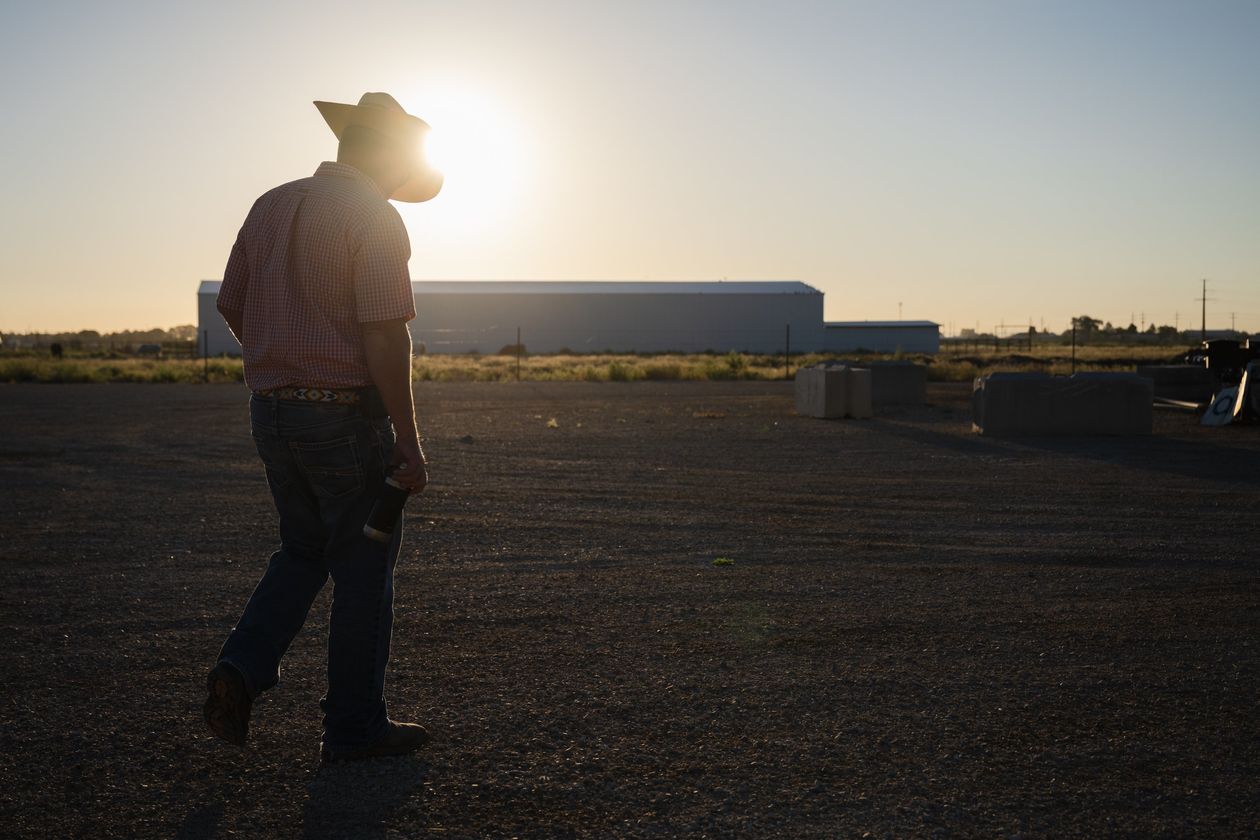
| Bart Barber (60 Minutes) |
A digest of events, trends, issues, ideas and journalism from and about rural America, by the Institute for Rural Journalism, based at the University of Kentucky. Links may expire, require subscription or go behind pay walls. Please send news and knowledge you think would be useful to benjy.hamm@uky.edu.
Monday, October 10, 2022
Southern Baptist Convention head says blind partisanship 'destroys everything,' criticizes Christian nationalism, Trump
Democratic and Republican voters in Washington state are split on more than just candidates, polls show
Voters on opposing sides of the political divide in Washington state's upcoming elections are split not just on candidates but on what they think are the most important public issues, writes Danny Westneat, a columnist for The Seattle Times. In a recent poll of 782 Washingtonians conducted by Emerson College, crime was a top issue for Republican voters while just four Democrats said they were focused on crime. A poll conducted by Seattle pollster Stuart Elway showed that environment and climate change are a top-five issue for Democrats while no Republicans in the survey cited it. “It’s as if there’s two different elections going on,” Elway told Westneat.
The divide may be more acute in Washington where the urban-rural divide is accentuated by geography — the Cascade Mountains runs north-south through the western end of the state, separating the more populated coast from the largely rural eastern portions.
Elway's poll showed that Republicans and Democrats even measured their personal lives differently from one another. Nearly 70% of Republicans told Elway that they were doing worse financially this year than last, while 75% of Democrats said they were doing just as well or better. "There’s very little chance that that finding can actually be true,” Elway said. “People are putting themselves into tribal camps with their answers, even on questions that aren’t about issues or the state of the world."
Westneat writes that this divide could have a real impact on public issues. "Crime is clearly a major issue — last week, the Seattle police chief said the city has hit a 25-year high in violent crime. Tacoma and some suburban cities are also suffering unusually high crime rates," Westneat writes.
"But the extreme partisanship has gotten to the point that if Republicans are going to be saying crime is a huge problem, then the Democrats are going to say it’s not. Even if it is," Elway said.
Some N.Y. sheriffs say they won't enforce the state's new law banning concealed weapons in many public places
![]() |
| Sheriff Robert Milby (Lauren Petracca for The New York Times) |
Supporters of the law accused the sheriffs of endangering the public for not supporting the law, McKinley and Louison report. David Pucino, the deputy chief counsel at Giffords Law Center, which works to lessen gun violence, said that several states have laws restricting concealed weapons in places like airports, courthouses and bars. “The statements that we’ve been seeing here are ideological statements,” Pucino said of the sheriffs. “And that’s not an appropriate basis for a sheriff to enforce or not enforce laws.”
Friday, October 07, 2022
Mental-health crisis teams are catching on in rural areas, saving time and money for patients and law enforcement
For years some cities have had social workers or mental-health professionals respond to 911 calls from or about a despondent or agitated person. In most smaller communities that hasn't been an option, forcing local law officers — who may not be properly trained or equipped for a mental health emergency —to respond, report Tony Leys and Arielle Zionts for Kaiser Health News.
"They don’t know how to handle people like me," said Jeff White, an Iowa man who struggles with depression and schizophrenia. "They just don’t. They’re just guessing." White told Kaiser Health News that officers often took him to a hospital or jail. But now, as part of a program that serves 18 mostly rural counties in central and northern Iowa, residents like White are able to instead contact a state-run hotline that will send a pair of mental health professionals instead.
Though mental illness is just as prevalent in rural areas as urban ones, mental-health crisis response teams have been slower to catch on in rural areas because they are geographically larger and have fewer mental-health professionals, said Hannah Wesolowski, chief advocacy officer for the National Alliance on Mental Illness. However, the programs are making inroads slowly across the country, as small police departments and sheriffs' offices find the crisis-response programs can save them time and money, Kaiser reports.
A South Dakota program called Virtual Crisis Care equips officers with iPads and officers "can use the tablets to set up video chats between people in crisis and counselors from a telehealth company." According to a state study, nearly 80% of the people who complete the video assessment wind up staying at home, as opposed to being taken by an officer to the hospital or jail for observation.
The town at the center of U.S. population, with 613 souls, increasingly faces same challenges as many small towns
When the results of the latest census were analyzed, Hartville, Mo., gained a plaque but still faced a declining population, reports Joe Barrett for The Wall Street Journal. The census showed that the town of about 600 was the one closest to the U.S. population center — the point at which "an imaginary, flat, weightless and rigid map of the United States would balance perfectly if all residents were of identical weight," the Census Bureau says.
![]() |
| Hartville, Mo. (Wikipedia) |
Since the nation's first census, the U.S. population center has trended west and south over time. The town clerk of Plato, Mo., the previous population center, told Barrett that the distinction brings in occasional visitors but not much money.
Still residents take pride in Hartville, opening new business ventures that aim to enliven the town square. A local nonprofit, the Community Betterment Foundation, is working to transition a shuttered Subway restaurant into a local cafe, while a local couple hopes to open an alcohol-free gathering place for young people just a few blocks away, Barrett reports.
Quick hits: Ky. teachers lose licenses mostly due to sexual misconduct; should California rebuild burned towns? . . .
A peer-reviewed report from the Brookings Institution aims to explain why the federal government needs to step up rural broadband efforts.
The top reason Kentucky teachers have lost their licenses over the past five years has been sexual misconduct, a year-long Lexington Herald-Leader investigation found.
Want a career saving the planet? Become an electrician, reports The Washington Post.
California spends billions rebuilding wildfire-ravaged towns, but should the always be rebuilt? asks the Los Angeles Times.
The racism, and resilience, behind today's salmon crisis, from ProPublica and Oregon Public Broadcasting.
Program leans on paramedics from across Maine to maintain round-the-clock treatment at a remote rural clinic
![]() |
| Jackman Community Health Center (Photo from Rural Health Information Hub) |
"The program, which was designed and developed through a series of community meetings and discussions, allows the paramedics to perform basic urgent care procedures and connect with emergency department physicians" at a hospital in Bangor, Kauffman writes.
Without the initiative, dubbed the Critical Access Integrated Paramedics program, residents of the Moose River Valley who needed urgent treatment would have to travel nearly an hour to Bangor. For nearly two decades the town of Jackman had been unable to retain a new doctor for more than a year and a half, Kauffman reports. Now specially trained paramedics can sign up to provide emergency medical services to residents who need it.
"I think of EMS as the spackle of healthcare: If there’s a crack, you can use EMS ability,” said Dr. Jonnathan Busko, one of the lead organizers of the CAIP initiative. “This is a big crack being filled by EMS, but now all of these other small cracks are being identified — we can also do this, and this, and this.” Kauffman reports that new CAIP initiative is being used as a pilot project that could be adapted to communities across Maine, should the program prove itself effective to the state's EMS board.
Local journalism well portrayed in ABC's new 'Alaska Daily'
![]() |
| Actors Grace Dove, Hilary Swank and Jeff Perry in "Alaska Daily." (ABC publicity photo by Darko Sikman via Alaska Public Media) |
So says Jeff Perry, playing Editor Stanley Cornik, in the first episode of ABC's "Alaska Daily," one of the most realistic representations ever of local journalism. He's talking to Hilary Swank, playing Eileen Fitzgerald, who lost her New York City reporting job in a dispute about a source who turned sour. To his job offer, she says she's already paid her dues in the minors.
But she goes to Alaska anyway. And the first episode touches many bases: a downsized newspaper, a city editor afraid to alienate the cops, Alaska Native staffers who want to do more but feel constrained, the moral crises that can thwart accountability reporting, the state's awe-inspiring beauty, outsiders' notions about Alaska, and widespread notions about journalism.
To a Native staffer (Yuna Park, played by Ami Park) who doesn't want to write a front-page story about a public official's misuse of public funds, because he told her it would ruin his life, Swank says: "This job isn't easy; we don't do it to be liked; we do it because it matters. . . . This is exactly why local journalism matters." Park writes the story, and tells Swank they're lucky to have her.
The series was created by Tom McCarthy, who wrote and directed the Oscar-winning “Spotlight” about The Boston Globe’s reporting on sexual abuse by Catholic clergy, notes Robert Lloyd of the Los Angeles Times: "It borrows its long arc from a series of articles, reported by the Anchorage Daily News in conjunction with ProPublica, about official indifference to missing or murdered Indigenous young women." Kyle Hopkins, the main ADN reporter on the Pulitzer Prize-winning series, is one of the other executive producers on the show, as is Swank."Hopkins says the show’s creators have taken a keen interest in creating an honest portrayal of journalists and journalism in Alaska," reports Casey Grove of Alaska Public Media, introducing an interview with Hopkins, who says "This is not telling how I or anyone else at the paper reported a specific story. It’s a fictional workplace drama that shares a lot in common with the Anchorage Daily News. And it’s meant to kind of be about how local news is made."
Thursday, October 06, 2022
Flush with new funding, forestry leaders try to figure out how to turn it into more trees across 130 million acres
![]() |
| Conifers at the Montana Conservation Seedling Nursery. (Alex Brown/Stateline) |
Over 130 million acres in the U.S. have the potential to be reforested, research by nonprofits American Forests and The Nature Conservancy found, but "even getting halfway to that target by 2040 would require 3 billion seedlings a year — far more than the 1.3 billion grown today," Brown writes.
Federal agencies are starting to release plans to allocate funding from last November's bipartisan infrastructure law. It has $200 million for a national revegetation effort, "much of it on federal lands but including $60 million for state and private forestry." Another $1 billion will pay for forest health projects while another $11 billion will go toward restoring abandoned mine lands. That money also doesn't include the $1.5 billion earmarked for green infrastructure in urban and underserved communities by way of the Inflation Reduction Act passed in August.
“The Forest Service is trying to push money out to states, and our partners are saying, ‘Hold on a sec, we have to get more people in place so we can accept this money’,” said Kasten Dumroese, a national nursery specialist and research plant physiologist with the service. Many programs for distributing the forest money are still being developed and the staffing problem affecting all parts of the economy will need to be addressed in order to put the money to work, Brown reports.
The snail darter, a small fish that became focus of big conservation fight, goes off the threatened-species list
![]() |
| A snail darter (Tennessee Valley Authority photo) |
A lawsuit followed and construction of the Tellico Dam stopped as the case made its way to the Supreme Court, which sided with advocates for the fish, reports Travis Loller of The Associated Press. The conflict "was portrayed as environmental extremists versus economic realists; in reality, the Tellico Dam was quite small and unneeded to generate electricity." It was eventually built after Congress exempted the dam from the law with a rider on an appropriations bill. But prior to construction, biologists collected the fish and transplanted them to other rivers, and later they were discovered in other streams. Three years ago, biologists petitioned for the fish's removal from federal protection since its population has adequately recovered. It left the list Tuesday.
Snail darters are members of the perch family, and grow to be about 3.5 inches long while eating mainly snails. The Department of the Interior said the snail darter is the fifth fish species, and first in the eastern U.S., to be delisted because of population recovery.
“There are a lot of people who don’t believe in the Endangered Species Act,” said Jim Williams, the U.S. Fish and Wildlife Service biologist who first listed the fish as endangered. “That say, ‘You know, this is like 'Hotel California'; you can check in, but you can never leave.’ And it’s like, ‘No, you can leave. You just got to get recovered before you leave. And the Endangered Species Act is a vehicle to do that.”
Reporting tips: Crime data, story ideas and understanding the difference in percentage and percentage-point changes
Crime data may confuse: The FBI now bases its crime data based on its new National Incident-Based Reporting System, so some crime numbers may appear to have jumped when they haven't. Other issues include gaps in the data, old information, a narrow definition that doesn’t include crimes committed by law enforcement and a lack of oversight of crime data collection, says Kelly McBride of The Poynter Institute: “As a nation, we keep horrible, incomplete data that makes it impossible to get an accurate sense of the scope or impact of crime,” she writes. This can often lead to sensational coverage that focuses on splashy numbers without an appropriate context.
"Levenson provides a formula: a feature idea = subject + angle + audience (and sometimes, but not always, a news hook). Picture a slot machine with three reels: subject, angle and audience. You can develop a brand new story just by spinning one of those. Change the subject: who else is doing this? Change the angle: what else does the subject do? How could they do it differently? Change the audience: what would another type of reader (younger, older, urban, expert, layperson etc.) want to know? You can hit a dead end, but this is also how you can produce multiple stories based on one lead. . . . But here is a catch: reporters often focus on what amuses or appeals to them. Do not write for yourself or your editor. Think about how stories impact your audience and keep your ego in check."
Fat Bear Week: Vote for Alaska's chunkiest bear by Oct. 10
![]() |
| Fat Bear contestant 128 Grazer (Lian Law/NPS Photo) |
Wednesday, October 05, 2022
Editors, news directors are asked to help start conversation about righting our ship of state for nation's 250th birthday
The Designing Government Forum invites you and your audience to take part in a national conversation leading up to the 250th anniversary of the Declaration of Independence in 2026.
The Forum is a group of former government and academic experts and retired journalists who have been studying and discussing the state of America – how did we come to this state of affairs and are there ways to right our ship of state? A main concern of the Forum is communications between our leaders and those they lead. Our Founding Fathers believed strongly in the Wisdom of the People. Yet the People's voice no longer seems to be heard in the halls of power.
The DGF is completely non-partisan and independent, and does not participate in overtly political or ideological arguments.
We intend to begin this conversation by asking civic groups and individuals to suggest answers to a series of questions about the many crises that face us today – how did they come about, and how might they be best addressed?
We will start with the question: What does the American Dream mean to you? The replies would be submitted in essays in any format – written, artistic, music, videos, etc. They will be judged at every level – local, regional, national. Prizes will be awarded. The replies will also be published by the DGF on line as well as in your newspapers or other media.
Our request is that you publish at a selected time the accompanying announcement, as an op-ed or other category you choose, and that you or someone you select review and judge the replies, then send them on to us. As there are still a few details to complete (our web site is under construction), we will notify you when the program will begin.
You may, of course, publish as many or as few of those replies as you choose. We also will be asking civic organizations such as the League of Women Voters and others to participate.
A representative of the DGF – former Associated Press foreign correspondent Terry Anderson – is attending the National Newspaper Association convention this week, and is available to anyone who would like to know more about this effort. Terry's cell phone number is 954-218-8083. You can also email him: tanderson@theforum.us.org.
Linda Ronstadt can't sing now, but she has a cookbook that she calls 'a song' and tells the story of the Sonoran Desert
![]() |
| In the desert, Ronstadt is most at home in places like the tiny town of Canelo, Ariz. (Photo by Cassidy Arazia for NYT) |
Linda Ronstadt can sing no more, due to Parkinson’s disease, but she can write, and may have completed her oeuvre with a different sort of composition. Her new cookbook, Feels Like Home: A Song of the Sonoran Borderlands, has only 20 recipes, but “is a way to explain why the arid land that starts in Arizona and stretches into Mexico’s west coast is her foothold in the world,” writes Kim Severson of the New York Times after spending two days with her in the Sonoran Desert. "It’s a story she has told through music, and now wants to tell — as much as she can — through food."
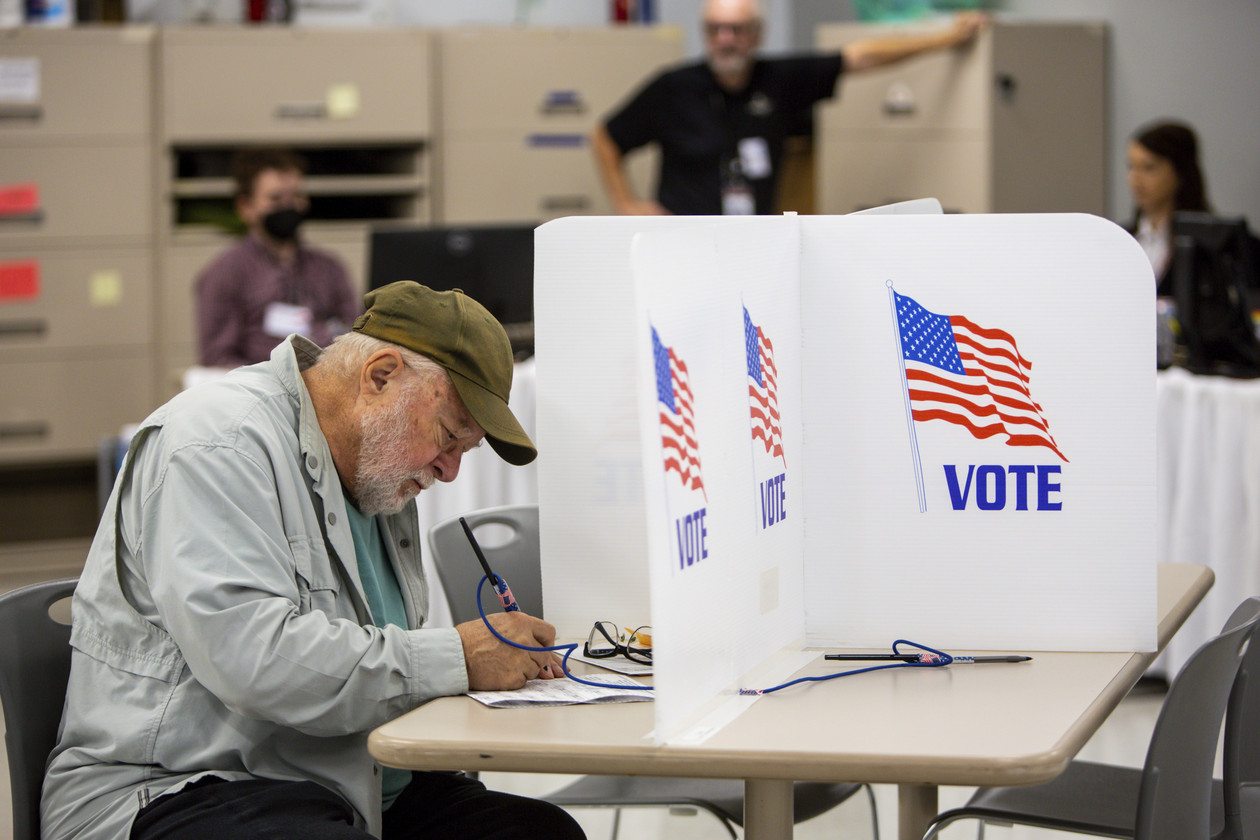
Rural turnout has lagged in recent special elections, but Republicans say that's not a good predictor for the midterms
![]() |
| A man votes in Minneapolis (Photo by Nicole Neri, AP) |
“Republicans are not as energized as they want or expected, and Democrats are very energized right now,” said Chris Walsh, campaign manager for U.S. Rep. Pat Ryan of New York, who defeated his Republican challenger in an August special election. Democratic operatives largely told Politico that the court decision energized Democrats, while Republican campaign workers dismissed the theory. Will Dawson, campaign manager for the Republican candidate who lost to Ryan, said Democrats have created a "false narrative" claiming the midterms are a referendum on abortion. “The midterm elections are and always have been a referendum on the White House.”
Otterbein and Piper write that the GOP is "still the odds-on favorite to win a majority in the House, and inflation and dissatisfaction with Biden continue to be a drag on every Democrat running for office." John Couvillon, a pollster who typically works for Republicans, said Washington state's all-party primary in early August was a better predictor for the November elections. In that primary, there were no major differences in turnout between rural areas and bigger counties.
Roundup maker is on courtroom winning streak, giving it leverage as it tries to resolve tens of thousands of claims
![]() |
| Roundup on store shelves (Scott Olson/Getty Images) |
Citing legal analysts and interviews with lawyers representing the plaintiffs, Thomas reports that the company's recent success "is a result of focusing on the scientific question of whether Roundup causes cancer, and providing more robust data to juries. . . . The company has also been more aggressive in attacking plaintiffs’ arguments on their individual use of the product." Majed Nachawati, a Dallas-based lawyer representing nearly 5,000 claimants, told Thomas that after multiple trials, Bayer's legal team has been better able to roll out a line of experts who have seemed "more appealing" to juries than prior experts.
The wins come on the heels of the Environmental Protection Agency's withdrawal of its interim approval of the herbicide. It can still be used at least through 2026. In 2020, EPA issued an interim decision that found the chemical likely didn't cause cancer, but a federal judge ruled in June that the EPA reached that conclusion without enough facts and ordered the agency to redo its assessment.
In Texas, where health insurance is most lacking, free clinic draws big crowds, but doctor says it's 'peeing in the ocean'
![]() |
| Dr. Doug Curran (Photo by Blaine Young/Public Health Watch) |
Texas is one of 12 states that haven't expanded Medicaid under the Patient Protection and Affordable Care Act, and Medicaid eligibility in Texas "is so restrictive that a family of three is denied coverage if it earns more than $4,000 a year," Krisberg and Leffler write. "Those who do qualify may not be able to find doctors who accept public insurance because the state’s reimbursement rates are so low. A 2017 survey found that a third of Texas doctors refuse to accept new Medicaid patients."
In May 2020, when the free clinic opened in Gun Barrel City, a town of 6,400 where nearly 30% residents lack health insurance, it soon became fully booked, often serving patients who had been forced to delay treatment they could no longer afford, Krisberg and Leffler report: "One woman had postponed surgery for an abdominal tumor because she had lost her job and health insurance," and the doctors rarely had a week "without seeing someone who lived in a car."
Securing constant, reliable funding for the clinic and others like it is a challenge, Krisberg and Leffler write. The clinics' doctors successfully lobbied for a state law that allowed free clinics to apply for a slice of federal Covid-19 relief money, but until state policy is able to expand coverage for uninsured Texans, the free clinic's work will be like "peeing in the ocean," said Dr. Doug Curran, one of the physicians who came out of retirement to start the clinic.
Lawyers: High court likely to reject its and EPA's definitions of 'waters of the U.S.,' but which wetlands will be regulated?
![]() |
| Chantell and Michael Sackett erected these signs early in their dispute with EPA. (Photo by Keith Kinniard, The Associated Press) |
So said lawyers on both sides Monday after the court heard oral arguments in Sackett v. EPA, in which an Idaho couple is fighting the Environmental Protection Agency's effort to make them protect or replace a wetland on property where they have wanted to build a home for 15 years.
"The court’s fractured 2006 ruling" written by then-Justice Anthony Kennedy allowed EPA to regulate wetlands with “significant nexus” to the nation's navigable waters, on the logic that "any pollution or development causing pollution in a tributary of a navigable river or lake would affect the biology and chemistry of the larger water body," reports Bobby Magill of Bloomberg.
“I just don’t see five votes for the significant nexus test,” Jeff Porter, chair of the environmental law practice at Mintz, Levin, Cohn, Ferris, Glovsky and Popeo, told Magill. “The real question is what will replace it.” Wetland protection has implications for developers and farmers.
The high court "searched for a way to clarify which wetlands near federally protected waters fall under federal jurisdiction," Magill reports, "Justice Sonya Sotomayor asked if another test could be used that is more precise than the significant-nexus test. Her questioning offered a clue that the 'significant nexus test is likely gone,” said David Smith, a partner at Manatt, Phelps and Phillips.' The court appears to be pivoting toward using adjacency as one of the ways to define WOTUS, he said."
Aspen Institute to host free webinar at 1 p.m. ET Friday to address the news and information gap in rural America
The Aspen Institute's Community Strategies Group will host a free webinar on addressing the news gaps in rural America this Friday at 1 p.m. ET.
The webinar is designed to explore one question with two divergent aspects: "How is your community thinking and acting on the issue of access to quality news coverage in rural communities and Native nations, as well as building trust and accurate rural narratives through national media?"
The institute says national narratives about rural areas, residents and Natives are largely inaccurate, and rural and Indigenous voices are missing from the wider discussion. It hopes to focus the webinar on solutions that will increase accurate rural narratives, "driven in part by high-quality journalism."
"We want you to join the discussion!" Aspen says. "Anyone and everyone interested in how accurate rural narratives, equitable information access, and national media coverage of rural areas can help their rural community or Native nation should plan to attend to share a success story or experience and to hear from others." Sign up here.
Tuesday, October 04, 2022
Poor oral health in children isn't just from too much sugary food; education, income and environment play a role
![]() |
| CDC photo |
Loretta Lynn, a coal miner's daughter who spoke strongly for women, dies after a music career that lasted 64 years
![]() |
| Loretta Lynn in 2000 (Photo by Christopher Berkey, Associated Press) |
Lynn began her career in 1958. Songs like "Coal Miner's Daughter" reflected her pride in her rural Kentucky upbringing and "she crafted a persona of a defiantly tough woman, a contrast to the stereotypical image of most female country singers," writes AP's Kristin Hall. "She was the first woman ever named entertainer of the year at the genre’s two major awards shows, first by the Country Music Association in 1972 and then by the Academy of Country Music three years later.
“It was what I wanted to hear and what I knew other women wanted to hear, too,” Lynn told the AP in 2016. “I didn’t write for the men; I wrote for us women. And the men loved it, too.” Walter Tunis of the Lexington Herald-Leader writes, "The pride of Butcher Hollow redefined forever the role, and especially the power, of women in all corners of the entertainment industry."
Another Iowa 'ag-gag' law, criminalizing the use of cameras in agriculture facilities, is struck down by a federal judge
![]() |
| Pigs in a confined farm (Scott Olson/Getty Images) |
District Judge Stephanie Rose ruled that the law targeted speech protected by the Constitution. "Recording, editing and producing videos are all protected conduct under the First Amendment, Rose wrote. And while a private landowner has some rights to block others' First Amendment activity on their property, the government does not have the same authority," reports William Morris for the Des Moines Register.
The ruling sided with animal-welfare groups who sued the state last August over the law. Since 2012, the Iowa Legislature has passed four laws targeting "animal rights activists who have published video and images from inside large livestock facilities, sometimes infiltrating them by signing on as employees without revealing their true intent," Morris writes. Three of those laws have been at least partially struck down by federal judges who ruled that the laws tried to regulate speech.
County where John Prine was once controversial now has a park named for him, at the place he wanted his soul to be
![]() |
| A crowd gathered at the park on the Green River for the dedication. (Hoptown Chronicle photos by Jennifer P. Brown) |
"Few places in rural America are so cherished for their connection to a song as Muhlenberg County is to people who revered the singer-songwriter John Prine for his blend of country and folk music. His song 'Paradise' — about the tiny coal town on the Green River that was wiped out by strip mining — immortalized the community for generations of listeners," writes Jennifer P. Brown of the Hoptown Chronicle, in Hopkinsville in adjoining Christian County, Kentucky.
![]() |
| Muhlenberg County, Kentucky (Wikipedia map, adapted) |
It's the John Prine Memorial Park at Rochester Dam. Prine fans "came from across Kentucky and from as far away as San Francisco and Seattle" for Saturday's dedication, Brown writes. "Parking their cars and trucks in a field where corn had recently been harvested, they carried lawn chairs, guitars, cameras and dogs up to the park. Numerous John Prine concert T-shirts, many faded and worn with age, were scattered throughout the audience. Some of his fans leaned on canes."
![]() |
| Prine's widow, Fiona Whelan-Prine, spoke at the dedication. (JPB photo) |
House Republicans say Chinese acquisitions of U.S. farmland could be security threat, ask GAO to investigate
“China’s ownership of U.S. farmland is a threat to our food security and national security,” said Rep. James Comer (R-Ky.) said in a statement Monday. Comer and Rep. Glenn Thompson (R-Pa.), the top Republicans on the Agriculture and Oversight committees, asked for the GAO investigation in a letter signed by over 100 House Republicans. The letter specifically raised concerns over a Chinese company's purchase of 370 acres near an Air Force base in Grand Forks, N.D.
Democrats have also expressed concern over foreign investment; they have backed a measure that would prevent acquisition of land by companies from China, Russia, North Korea and Iran, Peterson reports.
By the end of 2020, less than 3% of all privately held farmland in the U.S. was held by foreign investors, Agriculture Department data shows. Canadians owned 32% of foreign-held U.S. farmland, the largest share of any country. Chinese investors owned less than 1% of the foreign-owned land but "analysts and lawmakers have expressed concerns that China’s need for more arable land and its search for new ways to feed its population are pushing the country to expand its U.S. holdings, through both legal and illicit means," Peterson reports.
Even in his rural hometown, U.S. Senate nominee Herschel Walker is not popular among Georgia's Black voters
![]() |
| Herschel Walker with Trump (Audra Melton, The New York Times) |
"There are easy explanations: Mr. Warnock, who is also Black, is a Democrat who preaches at Martin Luther King Jr.’s former church, and Mr. Walker is running as a Republican tied to Donald J. Trump," Branch writes. But in Wrightsville, the seat of a county with fewer than 10,000 residents, there are "complex reasons."
"Herschel’s not getting the Black vote because Herschel forgot where he came from," said Curtis Dixon, who is Black and taught and coached Walker in the late 1970s. "He’s not part of the Black community." In Walker's final semester of high school in 1980, Wrightsville's Black community protested for more equitable treatment, and after a protest in the town square where Black protesters said they were attacked by sheriff's deputies and white supporters, violence sporadically gripped the town for weeks. Walker never got involved and Black residents in Wrightsville wonder why he has "not used his fame, fortune and now his political standing to raise the voice of those he left behind," Branch reports. "It is a question raised in 1980, echoing in 2022."
![]() |
| Wrightsville in Johnson County, Georgia (Wikipedia map) |
Rural students are about as likely to be homeless as urban students, but have fewer resources to keep them in school
![]() |
| A school bus in southern Ohio (Photo by Danna Slinger, NYT) |
The funding, rules and priorities of America's "homeless industrial complex" does not generally focus on rural areas, often leaving public school districts as the only local resource for students and families in need, Shapiro writes: "The limited data that exists suggests that rural students face homelessness in roughly the same proportion as their urban counterparts — and with far less in the way of a support system."
The 1987 McKinney-Vento Act requires public schools to have a homeless liaison. Shapiro reports that iImperfect reporting from these liaisons often represents the only count of homeless students in rural counties. That data is aggregated by the Department of Education, which has a wider definition of homelessness than the Department of Housing and Urban Development. In 2019, HUD counted 53,692 parents and children experiencing homelessness on a single night whereas the DOE counted 1.4 million children as homeless over the course of the school year.
A national survey of McKinney-Vento liaisons conducted by School House Connection and the University of Michigan found that roughly 420,000 homeless students did not enroll in school during the first year of the pandemic. In response, the American Recovery Plan Act allocated $800 million to public school districts to help fund projects countering student homelessness.
Monday, October 03, 2022
Facing drought-caused financial worries, some Western farmers find new ways to squeeze money out of their land
![]() |
| Nathan Jurva on his New Mexico land (Photo by Justin Hamel, The Wall Street Journal) |
With less irrigated water reaching his alfalfa and cotton farm, Jurva has turned part of his land into a recreational-vehicle park and is hoping to lease more of his land to a solar project. An Arizona farmer gave tours to 2,000 people last year, and Colorado rancher Zandon Bray said a big-game hunting business he started on his land has come to represent about 80% of his ranch's income, Frosch reports.
In an effort to save water, some farmers are also pivoting away from water-intensive crops. A survey from the American Farm Bureau Federation "found that 33% of respondents reported destroying or removing orchard trees and other multiyear crops to save water. That is up from 17% last year. Some 42% said they intended to switch crops, compared with 37% in 2021," Frosch reports.
“This is a pretty rough time,” said Dawn Thilmany, an agricultural economics professor at Colorado State University. “There may be at the very top some really large established producers who have the economies of scale and the market position to remain focused on their core business. But we see a large share of farms are compelled to look for more diversified streams of income.”
Forest Service mismanagement worsened wildfire that destroyed a California town, '60 Minutes' investigation finds
![]() |
| A "super scooper" drops water on the Caldor Fire. (Forest Service) |
Just hours after the fire began and when it was still relatively small, the team managing the response to the fire suspended nighttime operations to reassess the situation, which lessened the chances of firefighters being able to contain the flames, Whitaker reported, citing documents obtained from the service and interviews with current and retired firefighters in the area. Fire crews also lost precious time by relying on outdated maps; roads and a critical bridge suffered from lack of maintenance.
"The leadership failed to give the team on the ground what they needed to put that fire out in a timely manner," retired firefighter Grant Ingram said, adding that night is often the best time to fight fire.
![]() |
| Grizzly Flats in El Dorado County, Calif. (Wikipedia map) |
The fire spread quickly in part because the Eldorado forest was "so thick with dead trees and dry underbrush," Whitaker reported. Leoni Meadows, a camp on the edge of the fire and not on federal land, was largely spared from damage because staff had previously thinned the trees near the camp and cleared underbrush. Lloyd Ogan, a retired deputy fire chief who was at the camp, told Whitaker that there was "no management" on the Forest Service lands near the camp that had completely burned.
Nine years ago, the service pledged to clean up and thin 970 acres on the southeast flank of Grizzly Flats after the service's own research found that the town could be completely wiped out by a wildfire. Only a fraction of the work was done by the time the Caldor Fire destroyed the town, Whitaker said.
In an email, the service said it plans to scale up forest-health projects over the next decade. The would start with communities that are in immediate risk.
W.Va. chain buys Va. weekly that was in danger of closing
![]() |
| Buchanan County borders West Virginia and Kentucky. (Wikipedia map) |
Sam Bartley, owner of the Mountaineer for 47 years, praised HD's plan to add a website for the paper, which is 100 years old this year: "HD Media is an experienced and reputable company in the newspaper industry." The company started in Huntington and bought the Gazette-Mail in 2018.
HD President Doug Skaff Jr. said in his company's news release, "The Virginia Mountaineer has a proud heritage that we are honored to continue. This is in keeping with our focus on keeping journalism alive in communities like Grundy as well as the other places we serve."
Sunday, October 02, 2022
Don White, who published mug shots of convicted drunk drivers and did much more as a weekly editor, dies at 74
![]() |
| Don White (Photo via Somerset Commonwealth Journal) |
In 1998, White had been editor of The Anderson News in Lawrenceburg for 20 years when he decided to tackle drunk driving in Anderson County, which had about 19,000 people at the time. “Most violators of the law dislike having their name in the local paper,” he wrote in an editorial announcing his plan. “We hope the certainty that their picture will also be published will keep more drunks off our highways.” In that edition, he also ran drunk-driving statistics and stories about seven people killed by drunk drivers. A few months later, he limited the photos to residents of counties where the paper circulated, according to an ethics case study for the Society of Professional Journalists by Elizabeth Hansen, then a journalism professor at Eastern Kentucky University.
"The only cases in which photos were not published were those where the DUI suspect was injured, taken to the hospital for treatment and, although charged, never processed at the jail and never photographed," Hansen wrote. "Only once did White give any person special treatment. When the chairman of the county Democratic Party was convicted of drunk driving for the second time in five years, White published his mug shot and a story on Page 1 rather than on the District Court page."
From 1999 to 2000, drunk-driving cases in the county declined 37 percent, and the National Commission Against Drunk Driving gave White an award. When he retired in 2006, Ben Carlson, the new editor-manager placed by Landmark Community Newspapers, stopped the practice. He wrote that publishing mug shots of those convicted “adds a level of punishment, or at least embarrassment, beyond what is imposed by a judge.” He told the Lexington Herald-Leader, “I really don’t think that the role of a community newspaper is to punish or embarrass anybody. It’s to report the news and provide information.”
White was softspoken but resolute in his convictions, and had a quick wit. He was news editor of the Commonwealth Journal in his hometown of Somerset and wire editor of The Lexington Leader, but joined Landmark as editor of the Casey County News in 1976 because he missed contact with the public. He won many awards and helped spur school consolidation in Anderson County, but also restoration of a one-room school, one of several civic activities. After retiring, he traveled the state writing syndicated features and a book, Paper Boy: Giving His Heart to Journalism. “He called what he did with feature writing ‘living obituaries.’ It was so important to him to tell people’s stories,” his daughter, Amanda White Nelson, told the Somerset paper.
"Don was the ultimate community journalist, Hansen wrote on her Facebook page. "I often used his work as an example in my community journalism classes at EKU. I will miss him." Funeral services were held Sunday; the family says expressions of sympathy should be a subscription to your local paper or a donation to the Kentucky Journalism Hall of Fame Fund "to support and honor the work of journalists, like Don, who are passionate about telling Kentucky's stories."