The pandemic "pummeled" rural hospitals, especially those not part of ownership groups, and has made it more difficult for them to plan for the future, reports veteran health-care writer Dylan Scott of Vox.
His object example is Titus Regional Medical Center in Mount Pleasant, Texas, which "lived through four separate surges in 18 months. They had reopened their building’s third floor, closed eight years ago, and relied on traveling nurses to staff their beds. Then, at the end of 2021, the government funding that had paid for that extra help ran out. For the first two months of 2022, as patients lined the building’s hallways and his staff struggled to find anywhere else to send them, [CEO Terry] Scoggin said his hospital experienced its most traumatic trial yet."
“We didn’t have the staff,” Scoggin told Scott. “People were dying and you couldn’t get them out.” Now he "worries about how three years without a real break — five Covid surges, a monkeypox case that forced his facility to prepare for a wider outbreak, and now a nasty wave of RSV and flu — is compromising his ability to plan and prepare for the future," Scott reports. "Four hospitals within 35 miles of his facility have closed in the last eight years. . . . Nearly one-third of people in Titus County are uninsured. It is a majority-minority area, 45 percent Hispanic and almost 10 percent Black." And Texas is one of the 12 mainly Southern states that haven't expanded Medicaid, which has been a lifeline for rural hospitals in states that have.
Scott cites some familiar data: "More than 130 rural US hospitals have closed in the past 10 years, and hundreds more are projected to be in danger of closing. According to one report from the University of North Carolina’s rural health research program, about 30 percent of all U.S. hospitals were operating in the red as of 2018. A majority of them are located in rural communities."
Wednesday, January 04, 2023


Sexual assault victims in some rural areas are now able to get examinations through telemedicine services
 |
| Nurse Lindee Miller stands with the cart used for teleSANE exams at Avera St. Mary’s Hospital in Pierre, S.D. (Photo by Arielle Zionts, KHN) |
Zionts presents the example of a nurse in Eagle County, Colorado: "Amanda Shelley was sitting in her dentist’s waiting room when she received a call from the police. A local teenage girl had been sexually assaulted and needed an exam. . . . She went to her car and called a telehealth company to arrange an appointment with a sexual assault nurse examiner, or SANE. The nurse examiners have extensive training in how to care for assault survivors and collect evidence for possible criminal prosecution. . . . About an hour later, Shelley met the patient at the Colorado Mountain Medical urgent care clinic in the small town of Avon. She used a tablet to connect by video with a SANE about 2,000 miles away, in New Hampshire."
The exam process involves "the remote nurse using the video technology to speak with the patient and guide Shelley through each step of a two-hour exam. One of those steps was a colposcopy," Zionts reports. "The remote nurse saw, in real-time, what Shelley could see, with the help of a video camera attached to the machine."
Zionts writes, "The service, known as 'teleSANE,' is new at Shelley’s hospital. Before, sexual assault patients faced mountains of obstacles — literally — when they had to travel to a hospital in another county for care." Shelley told Zionts, "We’re asking them to drive maybe over snowy passes and then [be there] three to four hours for this exam and then drive back home — it’s disheartening for them. They want to start the healing process and go home and shower.”
TeleSANE services are "expanding across the country in rural, sparsely populated areas," Zionts reports. "Research shows SANE programs encourage psychological healing, provide comprehensive health care, allow for professional evidence collection, and improve the chance of a successful prosecution."
As in-home pot edibles increase, they sicken more children; more than half of those in a study were 2 or 3 years old
 |
| Marijuana edibles are displayed at a dispensary. (Photo by Steve Marcus, Las Vegas Sun) |
Lead researcher Dr. Marit Tweet, a medical toxicologist at the Southern Illinois University School of Medicine, told Aleccia, "When it’s in a candy form or cookies, people don’t think of it in the same way as household chemicals or other things a child could get into. But people should really be thinking of it as a medication.” Tweet noted that the study could only include reported cases, so many less serious cases may have gone unreported.
"Tweet called for greater vigilance by parents and for more laws like those adopted by several states to make pot products — often packaged to look like kids’ candies and snacks — less appealing and accessible to children," Aleccia reports.
The study "analyzed reports to the National Poison Data System, which includes the nation’s 55 regional poison control centers. More than half of the children were toddlers, ages 2 and 3, the study showed. More than 90% got the edibles at home," Aleccia reports. "Of more than 7,000 reports, researchers were able to track the outcomes of nearly 5,000 cases. They found that nearly 600 kids, or about 8%, were admitted to critical care units, most often with depressed breathing or even coma. Nearly 15% were admitted to non-critical care units and more than a third were seen in emergency rooms. Drowsiness, breathing problems, fast heart rate and vomiting were the most common symptoms."
Dr. Brian Schultz, a pediatric emergency physician at Johns Hopkins Medicine in Baltimore who previously worked at Children’s National Hospital in Washington, told Aleccia that he and his colleagues treated kids who had eaten pot edibles 'almost on a daily basis'."
The study "analyzed reports to the National Poison Data System, which includes the nation’s 55 regional poison control centers. More than half of the children were toddlers, ages 2 and 3, the study showed. More than 90% got the edibles at home," Aleccia reports. "Of more than 7,000 reports, researchers were able to track the outcomes of nearly 5,000 cases. They found that nearly 600 kids, or about 8%, were admitted to critical care units, most often with depressed breathing or even coma. Nearly 15% were admitted to non-critical care units and more than a third were seen in emergency rooms. Drowsiness, breathing problems, fast heart rate and vomiting were the most common symptoms."
Dr. Brian Schultz, a pediatric emergency physician at Johns Hopkins Medicine in Baltimore who previously worked at Children’s National Hospital in Washington, told Aleccia that he and his colleagues treated kids who had eaten pot edibles 'almost on a daily basis'."
Ex-president of Yale is a leading scholar of American West
 |
| Howard Lamar, Ph.D., Sterling Professor Emeritus of History and former president of Yale University. (Yale Art Gallery) |
Lamar grew up in Alabama, attended Emory University in Atlanta, and at Yale "intended to study the history of the American South or diplomatic history" under renowned historians," Peed writes. "But it was another great of the era, Ralph Henry Gabriel who pushed him toward his life’s work. As Lamar told it, Gabriel advised him, 'Raised in the South, educated in the East, go West, young man!'”
He did: "Lamar identified a subject for his dissertation: a nuanced examination of territorial political forces. That study, which became his first book, Dakota Territory, 1861-1889, marked an advance of historical inquiry into the American West," Peed writes. "Jay Gitlin, a professor of history at Yale, has written, Lamar 'brought a new sense of realism to a field of Western history'."
Lamar's view of the West was original, he "looked critically at the role of capitalism and labor systems in the West, and at the complex interplay of — and conflict among — the region’s people and cultures," Peed shares. "His work was a forerunner of what became known as 'new Western history,' a movement that casts a critical eye on the role of class, race, and the environment in the development of the West."
As a teacher, Lamar was "equally revolutionary, establishing Western history as a popular strand of scholarship on the Yale campus. His two-semester survey course, called 'The History of the American West,' was initially reserved for history majors who’d taken enough 'regular' courses. Over time, however, it became what one former student described as 'a tour de force … students flocked to it.'"
As a leader at Yale he was exceptional, but his focus remained on the West, Peed writes: "In 1998, he published The New Reader’s Encyclopedia of the American West, an updated and expanded version of the encyclopedia he’d produced two decades earlier, which offers more than 2,400 entries on significant aspects of the region and its history, along with hundreds of photographs and illustrations."
Lamar's uncommon spirit is an extension of his outlook on life. George Miles, a history curator at Yale, told Peed: “His entire outlook is that people are a gift to him. He’s fascinated by people, he is intrigued by them, and he sees in people the opportunity to learn more and expand his understanding of the world.”
Tuesday, January 03, 2023
'Urban' now requires 5,000 people or 2,000 housing units; losing 'rural' designation could help some towns, hurt others
 |
| Gravette, Ark., pop. 3,547, was urban and is now rural. (File photo by the Arkansas Democrat-Gazette) |
"The new criteria raised the population threshold from 2,500 to 5,000 people and housing units were added to the definition," Schneider reports. "The change matters because rural and urban areas often qualify for different types of federal funding for transportation, housing, health care, education and agriculture,"The federal government doesn’t have a standard definition of urban or rural, but the Census Bureau’s definition often provides a baseline."
Mary Craigle, chief of Montana’s Research and Information Services Bureau, told AP, “Places that qualify as urban are eligible for transportation dollars that rural areas aren’t, and then rural areas are eligible for dollars that urban areas are not.”
The change reflects the reduced economic vitality and diversity of small towns. North Carolina State Demographer Michael Cline told AP that in 1910, a town with 2,500 people had many more goods and services than a typical town that size today, “and these new definitions acknowledge that.”
The Census Bureau had proposed raising the urban threshold to 10,000 but retreated in the face of opposition. The 5,000 threshold means that slightly, to 79.6% of the U.S. population is urban and 20.4% is rural. Under the old criterion, almost 81% was urban, Schneider reports.
The change reflects the reduced economic vitality and diversity of small towns. North Carolina State Demographer Michael Cline told AP that in 1910, a town with 2,500 people had many more goods and services than a typical town that size today, “and these new definitions acknowledge that.”
The Census Bureau had proposed raising the urban threshold to 10,000 but retreated in the face of opposition. The 5,000 threshold means that slightly, to 79.6% of the U.S. population is urban and 20.4% is rural. Under the old criterion, almost 81% was urban, Schneider reports.
UPDATE, Jan. 6: The bureau told Josh Zumbrun of The Wall Street Journal that its old 2,500 threshold was “the lowest in use among all federal agencies. We see the change in our minimum threshold as signifying that the Census Bureau is listening to stakeholders and feedback from other agencies and is matching the way others have characterized and classified settlement in the United States.” Zumbrun concluded, "The official rural population count has long been held down by an arbitrary definition. The country is more rural and small-town than we think."
This is the first time the bureau has used housing units to define urban areas. "A place can be considered urban if it has at least 2,000 housing units, based on the calculation that the average household has 2.5 people," Schneider reports. "Among the beneficiaries of using housing instead of people are resort towns in ski or beach destinations, or other places with lots of vacation homes, since they can qualify as urban based on the number of homes instead of full-time residents."
Rural businesses struggle with population losses and lack of qualified staffing, nonprofit's study finds
Rural small businesses continue to report more negative consequences from population loss and a shrinking market of skilled labor. "With rural America losing population, rural entrepreneurs (45.3%) are significantly more likely than non-rural entrepreneurs (25.5%) to say that population trends impact their business," reveals a newly released research study of rural businesses by Score, a nonprofit organization that fosters small businesses and started life as the Service Corps of Retired Executives. The research also showed that "rural businesses are hurting for workers: population shifts create challenges for small rural employers, over a third of which (35.9%) say there are few qualified workers in their area."
In South Royalton, Vt., pop. 600, rural labor challenges have reduced the town's ability to provide school children's dental care. The town had been utilizing HealthHub, a non-profit mobile dental-hygiene clinic, but HealthHub had to reduce its care schedule due to staffing shortages, reports Nora Doyle-Burr of the Valley News in West Lebanon, N.H., and White River Junction, Vt. HealthHub's president told Doyle-Burr, "HealthHub now has funds and equipment sufficient to double the dental care it was providing to school children in the White River Valley last year, but instead it has reduced the amount of care it is providing to just 20% of what it was last year." Doyle-Burr reports, "The mobile clinic’s full-time hygienist retired this summer and the nonprofit has been unable to find someone to replace her. As part of a planned expansion, the clinic also had hoped to hire a dentist or dental therapist to staff another mobile unit, as well as another mental health provider, but has so far been unable to do so."
Across the Connecticut River, "The Ammonoosuc Community Health Services dental clinic in Littleton, N.H., has closed due to staffing shortages," Doyle-Burr reports. "And the Mascoma Community Health Center in Canaan suspended its dental service indefinitely in July after the dentist there left and it was unable to recruit a dentist or a hygienist."
John Mozena, president of the Center for Economic Accountability, a think tank that promotes free-market ideas, who was not involved in the report’s methodology, told Kristi Eaton of The Daily Yonder, “The single biggest challenge for rural communities in the modern era is the fact that the very nature of a rural community is that there just aren’t a lot of people.”
 |
| Rural Vermont and New Hampshire grapple with staffing shortages. (Image fromThe Directory.Org) |
Across the Connecticut River, "The Ammonoosuc Community Health Services dental clinic in Littleton, N.H., has closed due to staffing shortages," Doyle-Burr reports. "And the Mascoma Community Health Center in Canaan suspended its dental service indefinitely in July after the dentist there left and it was unable to recruit a dentist or a hygienist."
John Mozena, president of the Center for Economic Accountability, a think tank that promotes free-market ideas, who was not involved in the report’s methodology, told Kristi Eaton of The Daily Yonder, “The single biggest challenge for rural communities in the modern era is the fact that the very nature of a rural community is that there just aren’t a lot of people.”
Some anti-abortion states consider extending Medicaid to likely increasing number of pregnant women
 |
| Viola's House in Dallas provides housing and services to young, expectant mothers. (Photo by Allison V. Smith, The Washington Post) |
Usha Ranji, associate director for women’s health policy at the Kaiser Family Foundation, told Hennessy-Fiske, "There’s a discussion among Republicans and those who are anti-choice about, 'What should we be doing to support mothers?'"
Texas is one red state with coverage and care dilemmas: "The limits on Medicaid coverage after the emergency insurance lapses hinge on Texas’s long-standing rejection of the Affordable Care Act, which included provisions for expanded Medicaid," Hennessy-Fiske writes. "And it has set up an uncomfortable dynamic: While Texas and nearly a dozen other red states have resisted expanding Medicaid for those who are pregnant, many of them have also restricted access to abortion, leading to more new mothers needing coverage."
Steve Aden, general counsel and chief legal officer for Americans United for Life, told Hennessy-Fiske, “On our side, there is an awareness and a very strong move after Roe’s overturn toward caring for women. I think the whole movement is looking for ways to implement policy on the state level to support the increasing number of women who will have children.”
John Seago, president of Texas Right to Life, told Hennessy-Fiske, “We want Texas to be abortion-free, but we also want Texas to be pro-life. We want these mothers to be healthy and to have access to the care they need.” The group wants postpartum coverage: “Don’t call it Medicaid expansion, just ensuring insurance for moms up to a year after birth.”
Tenn. farmers challenge Tyson Foods' right to taxpayer financing, saying barns it controls are not 'family farms'
 |
| Chicken barns controlled by Tyson Foods in West Tennessee house more than 624,000 chickens each and produce massive quantities of waste. (Tennessee Outlook photo by John Partipilo) |
Tyson Foods' rapid expansion across the rural U.S. has been partially taxpayer-financed, with Department of Agriculture loans. Both the rapid expansion and the use of taxpayer dollars for corporate growth, seemingly without oversight, has some West Tennessee farmers taking stock: "A new lawsuit brought by the Southern Environmental Law Center, banded together to form 'Concerned Citizens of West Tennessee,' is now challenging the federal government’s role in providing tens of millions of dollars in taxpayer-backed loans to Tyson contract growers," reports Anita Wadhwani of Tennessee Lookout. The suit claims USDA, “through the Farm Service Agency, is illegally subsidizing industrial chicken operations through a federal lending program intended to provide 'family farms' with startup and operational capital.”
The lawsuit claims "federal loan guarantees are illegal because the lending program is reserved for helping ‘family farms’ And because Tyson controls virtually all aspects of the industrial chicken growing operations, those facilities are not ‘family farms’ under applicable lending rules,” Wadhwani writes. “The lawsuit notes that other government loan programs have determined that poultry contractors do not qualify for loans because of their integration into corporate operations."
Wadhwani’s object example is a $425 million meat processing plant in Humboldt, Tenn., its third large-scale plant in the state, opened last year and subsidized by “$20 million in taxpayer incentives from the administration of Gov. Bill Lee."
In addition to taxpayer financing, local farmers are concerned about the plants’ pollution and lack of oversight. "The lawsuit also accuses the Farm Service Agency of failing to follow its own rules in conducting thorough environmental impact studies of farm operations seeking the loans — or in keeping local communities informed," Wadhwani reports. "Instead, the federal agency only conducts perfunctory environmental reviews, before issuing 'rubber-stamped approval.'"
James Lavel, a retired Navy commander who has advocated for greater poultry operation regulation, told Wadhwani that he has been frustrated by local and state elected leaders’ actions, and inactions: “I’ve gotten a hodgepodge of excuses from them. And then the FSA comes in here and uses our taxpayer money for this. If you just keep putting the people at risk you’re trying to feed, what’s the point? We need regulations. They exist to protect the people.”
The lawsuit claims "federal loan guarantees are illegal because the lending program is reserved for helping ‘family farms’ And because Tyson controls virtually all aspects of the industrial chicken growing operations, those facilities are not ‘family farms’ under applicable lending rules,” Wadhwani writes. “The lawsuit notes that other government loan programs have determined that poultry contractors do not qualify for loans because of their integration into corporate operations."
Wadhwani’s object example is a $425 million meat processing plant in Humboldt, Tenn., its third large-scale plant in the state, opened last year and subsidized by “$20 million in taxpayer incentives from the administration of Gov. Bill Lee."
In addition to taxpayer financing, local farmers are concerned about the plants’ pollution and lack of oversight. "The lawsuit also accuses the Farm Service Agency of failing to follow its own rules in conducting thorough environmental impact studies of farm operations seeking the loans — or in keeping local communities informed," Wadhwani reports. "Instead, the federal agency only conducts perfunctory environmental reviews, before issuing 'rubber-stamped approval.'"
James Lavel, a retired Navy commander who has advocated for greater poultry operation regulation, told Wadhwani that he has been frustrated by local and state elected leaders’ actions, and inactions: “I’ve gotten a hodgepodge of excuses from them. And then the FSA comes in here and uses our taxpayer money for this. If you just keep putting the people at risk you’re trying to feed, what’s the point? We need regulations. They exist to protect the people.”
Moving to the country can mean having to deal with snakes; the key seems to be eliminating their main prey: mice
 |
| A rattlesnake (Photo by Meg Jerrard, Unsplash) |
Getting used to more 'critters' was one thing, getting rid of the snakes was the sticky wicket. Milbank asked Daniel Frank, director of Virginia Tech’s pesticide programs, "what to do about his snakes, mice and sundry insects. The first step after identifying and monitoring the critters, Frank told Milbank is that of 'determining thresholds.' In other words, decide 'what amount of damage or pest population you can live with'."
That was easy for Milbank, who writes, "When it comes to venomous copperheads in my house, I have calculated my threshold tolerance, and it is exactly zero. When it comes to harmless but 6-foot-long black snakes in my house, my tolerance is not much higher than zero."
Frank told Milbank not to waste his time "with electronic deterrents or herbal remedies. It isn’t practical to trap them, and it isn’t humane to kill them. The way to make the snakes vacate was to evict the mice," Milbank reports.
Tony Sfreddo, a director of the Virginia Pest Management Association, toured Milbank's house and had this to share: “I’ve seen worse." Sfreddo also suggested how to take care of randomly roaming snakes by "putting a wet towel on the floor, wait for the snake to wrap itself in the towel and then remove it," Milbank writes. "If I find a snake in my bedroom, I will immediately sign the deed of trust over to the squatting reptile and flee to the city — never to leave its concrete cocoon again."
Monday, January 02, 2023
News-media roundup: PBS aims to rebuild trust in news media, look at whole country; Nader starts a weekly . . .
"Don’t blame traditional media for being put under the pressure of cataclysmic change and struggling, blame those in leadership for not telling you clearly what was happening," writes Darrell Ehrlick, editor of the Daily Montanan (published by States Neswsroom) and former editor of the Billings Gazette. "Journalists are taught repeatedly that the story – whatever they’re covering – is not about them. . . . Decades of being told that the story is never about journalists or journalism has given publishers and corporate owners just enough leverage to remain silent on what is going on within the company."
The new anchors of "PBS NewsHour," Amna Nawaz and Geoff Bennett, feel “an obligation to do good journalism, and to build back hopefully the trust that the audience has been losing in the overall media industry,” Senior Executive Producer Sara Just told The Wrap. Bennett, who has been PBS's chief Washington correspondent and anchor of its weekend news show, said he hopes to to take “a deeper look at the messaging and the agenda of the Democratic and Republican parties and how that intersects with the greater country” and help viewers understand that “politics is more than just what happens in Washington. . . . It’s what’s happening across the country.”
Consumer advocate Ralph Nader is helping launch a weekly newspaper to eliminate what he calls a “news vacuum” in the small Connecticut town where he lives and five surrounding towns, the Hartford Business Journal reports. The pilot edition of the Winsted Citizen "is slated for publication in early 2023," the HBJ reports. The name is a shorter version of the daily evening paper that served the town of 7,700 until 1984, when it was merged with Hearst Corp.'s Torrington Register to create The Register Citizen. Nader told that paper that the editor and publisher will be Andy Thibault, who teaches journalism and communication at the University of New Haven.
EPA, Corps again redefine 'waters of the U.S.'; rule includes ephemeral streams and 'significant nexus' test ag dislikes
The Biden administration has redrafted the regulations defining what the Clean Water Act means by "waters of the United States," a topic of controversy for more than nine years, beginning in the Obama administration. It repeals a Trump administration rule that failed in court, but could result in more court action, and the Supreme Court is considering a separate case that could also change the regulatory framework again.
The regulation maintains "longstanding exemptions for farming activities but also trims back an exclusion for prior converted cropland" that was in the Trump-administration rule, Agri-Pulse reports. And it includes "ephemeral streams, which flow in response to precipitation. The Trump administration's 2020 rule categorically excluded ephemeral streams."
"Agriculture interest groups and others said the Biden administration's iteration of the rule will complicate life on the farm," Todd Neeley reports for DTN/The Progressive Farmer. He cites its use of a "significant nexus" test to "establish a scientific connection between smaller water bodies, such as tributaries, and larger, more traditional navigable waters such as rivers." American Farm Bureau Federation President Zippy Duvall said farmers and ranchers "deserve rules that don't require a team of attorneys and consultants to identify 'navigable waters' on their land."
The rule will become effective 60 days after publication in the Federal Register, unless blocked by a court. The Environmental Protection Agency issued the regulation with the Army, whose Corps of Engineers decides whether a parcel of land includes a water of the U.S. The agencies said they would improve consideration of regional differences in applying the rule, and issued a coordination memo with the Department of Agriculture.
The regulation maintains "longstanding exemptions for farming activities but also trims back an exclusion for prior converted cropland" that was in the Trump-administration rule, Agri-Pulse reports. And it includes "ephemeral streams, which flow in response to precipitation. The Trump administration's 2020 rule categorically excluded ephemeral streams."
"Agriculture interest groups and others said the Biden administration's iteration of the rule will complicate life on the farm," Todd Neeley reports for DTN/The Progressive Farmer. He cites its use of a "significant nexus" test to "establish a scientific connection between smaller water bodies, such as tributaries, and larger, more traditional navigable waters such as rivers." American Farm Bureau Federation President Zippy Duvall said farmers and ranchers "deserve rules that don't require a team of attorneys and consultants to identify 'navigable waters' on their land."
The rule will become effective 60 days after publication in the Federal Register, unless blocked by a court. The Environmental Protection Agency issued the regulation with the Army, whose Corps of Engineers decides whether a parcel of land includes a water of the U.S. The agencies said they would improve consideration of regional differences in applying the rule, and issued a coordination memo with the Department of Agriculture.
Radhika Fox, EPA's assistant administrator for water, told The Associated Press that the rule “balances that protecting of our water resources with the needs of all water users, whether it’s farmers, ranchers, industry, watershed organizations.” AP's Jim Salter and Michael Phillis write, "The new rule is built on a pre-2015 definition, but is more streamlined and includes updates to reflect court opinions, scientific understanding and decades of experience, Fox said. The final rule will modestly increase protections for some streams, wetlands, lakes and ponds, she said." Here is the EPA press release.
Thursday, December 29, 2022
Long Island weekly revealed George Santos as a fake when he was a candidate, but no other news media took heed
 |
| Rep.-elect George Santos (Photo via North Shore Leader) |
"Months before the New York Times published a December article suggesting Rep.-elect George Santos (R-N.Y.) had fabricated much of his résumé and biography, a tiny publication on Long Island was ringing alarm bells about its local candidate," reports Sara Ellison of The Washington Post.
Maureen Daly, managing editor of the Republican-oriented paper North Shore Leader, reported in September: "Controversial U.S. congressional candidate George Santos has finally filed his Personal Financial Disclosure Report on Sept. 6, 20 months late, and he is claiming an inexplicable rise in his alleged net worth to $11 million. Two years ago, in 2020, Santos' personal financial disclosures claimed that he had no assets over $5,000: no bank accounts, no stock accounts, no real property. A net worth barely above zero. And his income was only just over $50,000 for the prior year, derived from a venture fund called Harbor Hill Capital, that was closed and seized in 2020 by U.S. federal prosecutors as a 'Ponzi scheme.' Santos was the New York director of that 'fund'."
Daly pointed out conflicts between the document and some Santos statements: “Interestingly, Santos shows no U.S. real property in his financial disclosure, although he has repeatedly claimed to own ‘a mansion in Oyster Bay Cove’ on Tiffany Road and ‘a mansion in the Hamptons’ on Dune Road. . . . The house is owned by someone else having nothing to do with Santos, and has a market value of less than $2 million. For a man of such alleged wealth, campaign records show that Santos and his husband live in a rented apartment, in an attached rowhouse in Queens.”
After more details, Daly noted, "It is a federal felony to make false filings in federal disclosures."
 |
| 3rd District, with Leader office marked (Wikipedia map, adapted) |
In October, the Leader said in an editorial, “This newspaper would like to endorse a Republican for U.S. Congress, but the GOP nominee, George Santos, is so bizarre, unprincipled and sketchy that we cannot. … He boasts like an insecure child — but he’s most likely just a fabulist — a fake.” The endorsment went to Democrat Robert Zimmerman, who promised a bipartisan approach like that of retiring Democratic Rep. Tom Suozzi, who lost in this year's primary for governor.
The Post's Ellison writes, "It was the stuff national headlines are supposed to be built on: A hyperlocal outlet like the Leader does the leg work, regional papers verify and amplify the story, and before long an emerging political scandal is being broadcast coast-to-coast. But that system, which has atrophied for decades amid the destruction of news economies, appears to have failed completely this time. Despite a well-heeled and well-connected readership — the Leader’s publisher says it counts among its subscribers Fox News hosts Sean Hannity and Jesse Watters and several senior people at Newsday, a once-mighty Long Island-based tabloid that has won 19 Pulitzers — no one followed its story before Election Day."
“We expected it to pop a lot more than it did,” owner Grant Lally (who had run for the seat in 1994, 1996 and 2014) told Ellison, adding that Zimmerman didn't make enough of the endorsement and failed to push the Leader's revelations into Newsday or the Times. Zimmerman told Ellison that there were “many red flags that were brought to the attention of many folks in the media” but that “frankly a lot of folks in the media are saying they didn’t have the personnel, time or money to delve further” into the story. “This experience has shown me just how important it is for everyone to support local media.”
The Leader bills itself as "The leading news source for Long Island's Gold Coast," but Ellison reports most of its staff "works part time and holds down other jobs to pay the bills." Lally told her, “Nobody can survive on local papers alone.”
Our year-end appeal: not just for us, but for all those news outlets that need more money to pay for journalism
 |
| Another version of our bumper strip adds: "to independent journalism" |
The Rural Blog is published by the Institute for Rural Journalism and Commuity Issues, which was founded 20 years ago to help rural journalists define the public agenda in their communities through strong reporting and commentary, especially on issues that have local impact but few good local sources. In the last 10 years, we have increasingly worked to help rural news outlets survive and serve, and our new focus is on the sustainability of rural journalism, which is under threat. Newspaper closures, which have been almost entirely in suburban communities and rural towns that are not county seats, are spreading to county seats, and more than 200 counties in the U.S. have no local newspaper. Many other county-seat papers are struggling, and every month brings news of more closures or mergers.
One of the more encouraging developments in journalism recently has been the influx of philanthropic money to support local and statehouse reporting, but it remains to be seen if philanthropy can be effective in rural areas, where news outlets and their audiences are small. In such places, it is especially important for a news outlet to have the support of the community, and it must earn that support. We like to say that people aren't going to pay good money for bad journalism, so we also remain focused on helping rural news outlets do journalism that helps communities realize their value.
In June we held the second National Summit on Journalism in Rural America, which asked this question: "How do rural communities sustain journalism that supports local democracy?" We began to get answers, and will keep looking for them, with the help of our colleagues at the University of Kentucky. We hope you will help, too, by making a tax-deductible donation. You can do it here. Thanks, and happy new year!
Tuesday, December 27, 2022
Appalachian greenhouse-farming firm re-engineers its finances but needs more cash flow, and maybe political help
UPDATE, Feb. 16: The company netted $37.1 million by selling 40 million shares at $1 per share, Rick Childress of the Lexington Herald-Leader reports. It issued a prospectus saying, “We believe that net proceeds from this offering, together with our current cash and cash equivalents and other potential sources of financing, will be sufficient to enable us to fund our operating expenses and capital expenditure requirements through the end of calendar year 2023.”
AppHarvest, a publicly traded startup that is trying to bring commercial farming back to the Appalachian foothills on a huge scale, sold one of its hydroponic greenhouse farms this week and leased it back to its marketing and distribution partner, "freeing up more funds for the financially struggling fruit and vegetable grower," reports John Cheves of the Lexington Herald-Leader.The company also announced the opening of its fourth farm, all in Kentucky, and said it is "focused on operations to ramp up production and revenue." That is an existential challenge, according to its earnings report for the third quarter of 2022, which said, “Absent additional sources of financing, we expect that our existing cash and cash equivalents will only allow us to continue our planned operations into the first quarter of 2023.”
The sale-and-leaseback deal of the 15-acre farm near Berea, the company's smallest, provides cash, but it has production problems. "AppHarvest’s chief financial officer, said that the low numbers were due to crop health issues," Liz Carey reports for The Daily Yonder. The company will change the tomatoes it raises to varieties that bring higher prices, a spokesman told Carey.
But James Branscome, a Yonder supporter who started as an Appalachian journalist and ended up evaluating companies for S&P Global, has issues with the firm's business model: “The best high tech in agriculture will not overcome a bad business model based on selling a commodity product – tomatoes – in a highly competitive market,” he told Carey. “AppHarvest does use the highest tech in greenhouse production from the Netherlands, and its commitment to Appalachian Kentucky has rightfully given it a very high profile. The strategy of moving beyond the tomato market to vegetables and berries is a good business strategy; however, the company is in a race against the oldest challenge in business: Can it execute that strategy when the business cash flow is so dismally poor?”
Branscome seems to think not: “At this point their future depends more on financial engineering than agricultural engineering,” he said. “There is value in what they have constructed, but the cash flow from operations is so small that there is no way sales can bail them out over the next few years.”
There could also be some political engineering. Company founder and CEO Jonathan Webb said at the groundbreaking for the firm's 30-acre berry farm in Somerset in July, "Where AppHarvest goes from here is going to be dependent largely on the communities around us." Gesturing to Democratic Gov. Andy Beshear and Republican U.S. Rep. Hal Rogers, he said, "Where we take it from here, I turn to our political leaders, I turn to our community leaders, I turn to our university leaders; we want to partner with you."
 |
| The AppHarvest 15-acre farm just north of Berea, Ky., grows salad greens. (Photo from AppHarvest Facebook page) |
The sale-and-leaseback deal of the 15-acre farm near Berea, the company's smallest, provides cash, but it has production problems. "AppHarvest’s chief financial officer, said that the low numbers were due to crop health issues," Liz Carey reports for The Daily Yonder. The company will change the tomatoes it raises to varieties that bring higher prices, a spokesman told Carey.
But James Branscome, a Yonder supporter who started as an Appalachian journalist and ended up evaluating companies for S&P Global, has issues with the firm's business model: “The best high tech in agriculture will not overcome a bad business model based on selling a commodity product – tomatoes – in a highly competitive market,” he told Carey. “AppHarvest does use the highest tech in greenhouse production from the Netherlands, and its commitment to Appalachian Kentucky has rightfully given it a very high profile. The strategy of moving beyond the tomato market to vegetables and berries is a good business strategy; however, the company is in a race against the oldest challenge in business: Can it execute that strategy when the business cash flow is so dismally poor?”
Branscome seems to think not: “At this point their future depends more on financial engineering than agricultural engineering,” he said. “There is value in what they have constructed, but the cash flow from operations is so small that there is no way sales can bail them out over the next few years.”
There could also be some political engineering. Company founder and CEO Jonathan Webb said at the groundbreaking for the firm's 30-acre berry farm in Somerset in July, "Where AppHarvest goes from here is going to be dependent largely on the communities around us." Gesturing to Democratic Gov. Andy Beshear and Republican U.S. Rep. Hal Rogers, he said, "Where we take it from here, I turn to our political leaders, I turn to our community leaders, I turn to our university leaders; we want to partner with you."
Holiday roundup: Blizzard creates a temporary community of travelers; an enchanted garden also cultivates people
 |
| The Alabama Hotel in Basom, N.Y., hosted more than 100 people in the storm. (Photo by Joe Bradt) |
When the big blizzard closed the New York State Thruway (I-90) west of Batavia, some travelers headed north on NY 77 and found refuge in the hamlet of Alabama, specifically the Alabama Hotel. "The restaurant was founded in 1840 as a hotel/bar, but it hadn't welcomed overnight visits for decades," Tracey Drury reports for Buffalo Business First. Owner Joe Bradt told CNN some thought from online searches that the inn had rooms to rent, but they had to stay in its 70-seat dining room. Bradt said the guests "came together; they were cooking, they were washing disches, they were busing tables; it was a sight like no other."
The youngest daughter of Donna Reed, who plays Jimmy Stewart's wife in "It's a Wonderful Life," has made it her mission to ensure that small-town theaters can show the classic 1946 film, which was more difficult this year, Ann Hornaday of The Washington Post reports.
The Post's Sydney Page has another nice holiday feature, about a 100-year-old woman in an assisted-living facility in Lexington, Va., who makes custom jackets by hand and gives them away!
 |
| Woodlake, California (Google map) |
Opinion: Rural America is listening for leadership to support its economic and social renewal, but hears mostly silence
America needs a coherent rural policy, writes Tony Pipa, a senior fellow at the Center for Sustainable Development at the Brookings Institution, leader of the Reimagining Rural Policy Initiative and host of its Reimagining Rural podcast.
"Despite widespread acknowledgment since 2008 that rural places have generally been left behind, our nation still lacks a coherent federal rural policy," Pipa writes for The New York Times. "The Rural Electrification Act, Title V of the Housing Act and other national-scale development programs helped bring rural America into the modern era, and its contributions helped make the American economy the envy of the world. But today’s federal programs were built for a different era. We need a renaissance of rural policy to enable a renaissance of rural America.
"What we have are lots of programs — over 400 available for community and economic development spread across every nook and cranny of the federal government. But navigating that maze and the peculiarities of their applications, reporting and matching requirements is a high bar for anybody, let alone the part-time volunteer elected officials and the bare-bones staffs that make up many local rural governments. That leaves most rural communities starved for investment. Very few can get the type and level of resources necessary to reinvent their economy or unleash the full potential of their human, intellectual and natural capital as they face rapid change."
Agricultural policy is often mistaken for rural policy, Pipa writes: "Farming now accounts for just 7 percent of rural employment. Service jobs, retailing, manufacturing and government employment all outweigh agriculture." And contrary to prevailing belief, rural America is ethnically and racially diverse: "People of color make up 24 percent of the rural population. Close to half of rural Native Americans and more than half of rural Black Americans live in a distressed county. That’s compared with 18 percent of rural white residents." The image of rural America as an overwhelmingly white place may have cooled some Democrats' interest in it, but elements of the Biden administration remain interested.
What about Congress? "Rural policy is one issue where Republicans and Democrats should be able to find common ground to work together," on such things as the new Farm Bill, Pipa writes. "Yet early indications signal high-profile fights over food stamps, agricultural subsidies and conservation investments — and limited attention to rural development. . . . Rural America is listening for how public leadership and resources can better support the economic and social renewal of rural communities, but it hears mostly silence."
"Despite widespread acknowledgment since 2008 that rural places have generally been left behind, our nation still lacks a coherent federal rural policy," Pipa writes for The New York Times. "The Rural Electrification Act, Title V of the Housing Act and other national-scale development programs helped bring rural America into the modern era, and its contributions helped make the American economy the envy of the world. But today’s federal programs were built for a different era. We need a renaissance of rural policy to enable a renaissance of rural America.
"What we have are lots of programs — over 400 available for community and economic development spread across every nook and cranny of the federal government. But navigating that maze and the peculiarities of their applications, reporting and matching requirements is a high bar for anybody, let alone the part-time volunteer elected officials and the bare-bones staffs that make up many local rural governments. That leaves most rural communities starved for investment. Very few can get the type and level of resources necessary to reinvent their economy or unleash the full potential of their human, intellectual and natural capital as they face rapid change."
Agricultural policy is often mistaken for rural policy, Pipa writes: "Farming now accounts for just 7 percent of rural employment. Service jobs, retailing, manufacturing and government employment all outweigh agriculture." And contrary to prevailing belief, rural America is ethnically and racially diverse: "People of color make up 24 percent of the rural population. Close to half of rural Native Americans and more than half of rural Black Americans live in a distressed county. That’s compared with 18 percent of rural white residents." The image of rural America as an overwhelmingly white place may have cooled some Democrats' interest in it, but elements of the Biden administration remain interested.
"While the Biden administration has started the Rural Partners Network to embed federal staff members in rural communities to help them identify and secure federal resources, the program is limited to select communities in just 10 states and Puerto Rico," Pipa notes. "The country needs a national rural prosperity strategy that offers a coherent vision for rural America in the 21st century. Someone at the highest levels of the White House should be responsible for its execution and cutting through the bureaucratic entanglements. Canada and Ireland, among other countries, have completed such policies and created cabinet-level positions to carry them out. Governors in Wisconsin and Michigan have created rural prosperity offices."
What about Congress? "Rural policy is one issue where Republicans and Democrats should be able to find common ground to work together," on such things as the new Farm Bill, Pipa writes. "Yet early indications signal high-profile fights over food stamps, agricultural subsidies and conservation investments — and limited attention to rural development. . . . Rural America is listening for how public leadership and resources can better support the economic and social renewal of rural communities, but it hears mostly silence."
Michigan study that gave families tools to discuss firearm safety finds most did, and 40% changed their gun storage
 |
| Photo by Amr Taha, Unsplash |
In what researchers call an intervention, the project gave 45 families in Marquette County with "messages about safe firearm storage and teen firearm suicide," tailored to the rural audience, and "specific tips for improving safety," to implement in conjunction with its website, the university said in a press release.
Three weeks after the intervention, 86% of the parents said they had completed a firearm home-safety checklist suggested by the program, and 88% said they talked about firearm safety with another adult in the household. Nearly two-thirds discussed firearm safety with children in their home, and 40% reported that changed how they store firearms in the home.
Ewell Foster, a clinical psychologist in the UM Institute for Firearm Injury Prevention, said “We are excited by these findings, and by the variety of actions that these families took, including changing to unloaded and locked storage, and moving hunting rifles to another location less accessible to children . . . . Putting time and distance between individuals who are at risk for suicide and highly lethal means like firearms is a critical part of a comprehensive suicide-prevention strategy."
The press release said, "The program’s materials emphasize the range of options that rural families have for reducing risk within the context of their lifestyle, which includes firearm ownership for both hunting and protection." The researchers "plan to increase the availability of the Store Safely intervention while continuing to evaluate its impact in other rural communities both within and beyond Michigan’s Upper Peninsula." For a related story and video, click here.
 |
| Marquette County (Wikipedia) |
The press release said, "The program’s materials emphasize the range of options that rural families have for reducing risk within the context of their lifestyle, which includes firearm ownership for both hunting and protection." The researchers "plan to increase the availability of the Store Safely intervention while continuing to evaluate its impact in other rural communities both within and beyond Michigan’s Upper Peninsula." For a related story and video, click here.
Friday, December 23, 2022
Quick hits: Chestnuts, horses, igloos, poinsettias, karaoke, cancer vaccines, vertical farms, fantastic beasts, kids' books
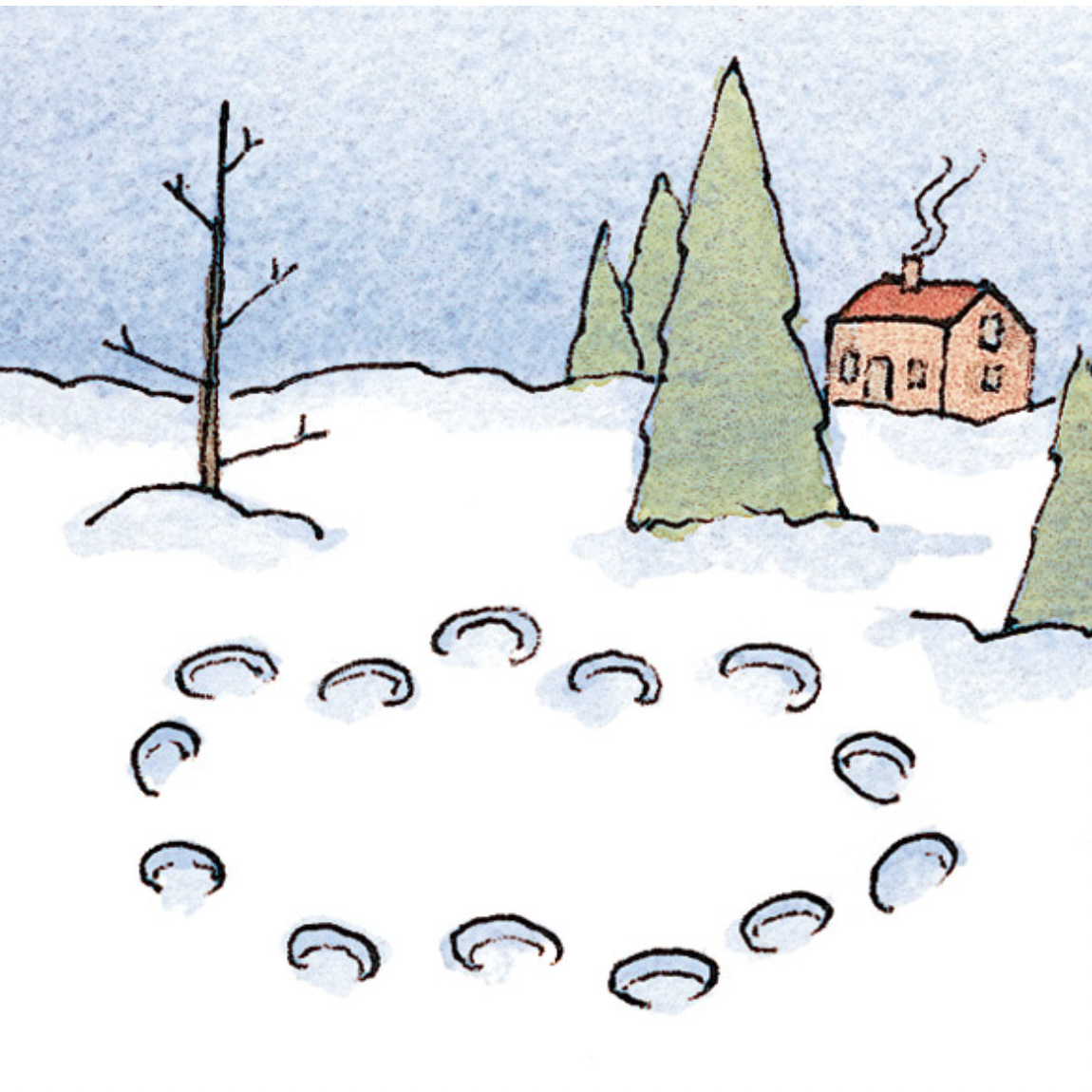 |
| How to build an igloo in 10 steps. (Art by Gil Martinez, New England Today) |
When it snows, build an igloo. Rural New Englanders know how.
The American chestnut tree is not quite extinct, and the struggle to bring it back to its former glory is ongoing. To celebrate the chestnuts part in rural history, roast some that Nat King Cole or Mel Torme would be proud of. This Masterclass can help.Everybody's favorite animal ought to be a horse! Here's how to convert the world.
A cure to cancer? How about a vaccine to prevent cancer? For some cancers, yes. Here's how they work.
In many produce sections, there's often not much to pick from. One company aims to remedy that by building indoor vertical farms, each capable of producing seven tons of greens daily.
J.K. Rowling isn't the only one with "fantastic beasts." The New Yorker has some lovable, imperiled fantastical beasts drawn by a great illustrator.
Indigenous to Mexico and Central America, poinsettias herald the festive spirit of Christmas. Read the history of how this shaggy-leaved plant became cherished holiday decor.
 |
| Glenn Highway tree (Photo by Bill Roth, Anchorage Daily News, via Washington Post) |
The holidays can be lonely, cold or filled with family that stress you out. Holiday movies and songs can help, or at least distract, The Daily Yonder has it covered.
Planning a karaoke night? Here's the ultimate guide to finding your go-to karaoke songs with the help of reader suggestions, a panel of karaoke enthusiasts and Pandora music analysts.
The Three Billy Goats Gruff are back! For gift ideas or delightful 2023 reading, The New York Times Best Children's Books of 2022 is here.
In rural Ga., a seemingly unlikely rebel against Trump is part of 'a precariously narrow but consequential' slice of voters
 |
| Cody Johnson leaves Beulahland Baptist Church in Beulah, Ga., where he voted in the state’s runoff election for U.S. Senate. (Photo by Michael S. Williamson, The Washington Post) |
On Election Day, "Nearly everything about Cody Johnson suggested he would vote a certain way," McCrummen writes. "He was white. He was 33. He was an electrician with no college degree. He had a beard and a used pickup with 151,000 miles, and he was angry at what the country was becoming. Most of all, he was from northwest Georgia, a swath of rural America where people who looked like him had voted in large majorities to send Donald Trump to the White House."
But Johnson voted against U.S. Rep. Marjorie Taylor Greene, whom he called ”an embarrassment,” and against Trump-backed Senate candidate Herschel Walker because he didn’t want “some stupid s--- to happen,” he told McCrummen, who sums up, “He voted against every single Republican on the ballot for the same reason he supported Joe Biden in 2020, which had been the first time he voted in his life."
“I don’t want extremists in office,” he said. “And I have some small glimmer of hope that maybe things aren’t as screwed up as I think they are.”
Johnson's resistance was not singular. McCrummen writes: "All across the country, a similar uprising was underway as an unexpected tide of people showed up for midterm elections, turning what was supposed to be a rout for the Republican Party into a repudiation of Trumpism. In Arizona, voters rejected candidates who embraced white nationalist ideas and conspiracy theories about election fraud. In Pennsylvania, they rejected a candidate who said America is a Christian nation. Similar results had rolled in from New Mexico, Nevada, Virginia and other states including Georgia, where Walker would lose in a runoff earlier this month. Even in the deep-red 14th Congressional District, Greene saw her winning margin from 2020 slip by 10 percentage points."
Neither pollsters nor politicians can see the stories that make up a life. In the case of Johnson, McCrummen writes, "it is the story of a thousand life experiences that add up to a certain kind of American character, one that can arise from the very landscape where the Trump movement took root." To explain how he got where he is politically, he and McCrummen took a trip “across the 14th District, an area that stretches from the Appalachian foothills to the outermost edges of Atlanta’s sprawl.” It’s an engrossing read.
UPDATE, Dec. 24: McCrummen's thesis is supported in a story by The New York Times, which reports, "A precariously narrow but consequential slice of the electorate broke with its own voting history to reject openly extremist Republican candidates — at least partly out of concern for the health of the political system," write Charles Homans, Jazmine Ulloa and Blake Hounshell. Their examples include a young Republican committee member in Lancaster Township, Pa., who was ousted as committee chair when he criticized the local party's alignment with a group that had spread misinformation about Covid-19 vaccines; and a former federal worker in Kingston, Nev., pop. 194,who said she believed the 2020 election was marred by fraud, but voted Democratic because of the Supreme Court's overturning of federal abortion rights.
UPDATE, Dec. 27: "Republicans faced similar unexpected setbacks with the small but crucial slice of voters who don’t identify with either major party, according to AP VoteCast, a sweeping national survey of the electorate," The Associated Press reports, with and graph (below) and examples. "Some Republican strategists say the finding is a sign that messages that resonate during party primaries, including searing critiques of Biden, were less effective in the general election campaign because independent voters were searching for more than just the opposition."

Opinion: Industrial policy goes rural as policies of Congress and administration look to help 'left-behind places'
 |
| U.S. Rep. Ro Khanna, D-Calif. (Photo from Ro for Congress) |
"Khanna has been touring the country to promote economic development in distressed areas, especially places Democrats don’t usually go. He noted that more and more members of his party now recognize that the decline in manufacturing was not only an economic problem but also 'it had a deep social cost, hurting the social cohesion of this nation."
Yes, Democrats will gain some political swagger if their projects are seen by voters, but Waldman writes, "When I asked [Khanna] whether Democratic losses in small towns and rural areas played a part in the design of these bills, in that they direct money to such left-behind places, Khanna brought up the White House chief of staff and two members of the Council of Economic Advisers." Khanna told Waldman “I know for a fact it was on the top of the minds of people like Ron Klain, people like Heather Boushey, people like Jared Bernstein — I personally have had that conversation with all three of them. And I’ve discussed it with the president himself.”
The Chips Act is now considered the highest-profile industrial project, "Though that law was signed only four months ago, the Semiconductor Industry Association claims it has already spurred $200 billion in private investment in 16 states," Waldman reports. "Some of those projects are happening in places where manufacturing has declined, such as a new Micron Technologies plant outside Syracuse, N.Y., and an Intel factory near Columbus, Ohio. But the bills also have specific place-based strategies meant to lift up entire areas that have fallen behind."
Waldman adds, "The rationale is that we suffer from inequality not only among individuals but also on the level of entire regions." Mark Muro of the Brookings Institution told Waldman the new industrial policies create “a geographical intervention: there’s a reason we’re seeing growing distrust of technology companies and economic elites. That economy seems to be taking place far from where people are. I don’t think you can run a successful economy where 10 metros on the coast dominate."
Thursday, December 22, 2022
Omnibus passes with earmarks and pandemic relief for infrastructure, and making spending website permanent
The $1.7 trillion omnibus budget-and-policy bill passed the Senate Thursday, with 18 of the 50 Republicans supporting it. The House is expected to pass it Friday to keep the government open.
The bill's prime architects were Democrat Patrick Leahy of Vermont and Republican Richard Shelby of Alabama, chair and ranking member, respectively, on the Senate Appropriations Committee, who are retiring after nearly 100 years of combined service in the Senate. Shelby, who became a Republican in 1994, said of the bill: “We know it’s not perfect, but it’s got a lot of good stuff in it.” The Senate rejected an attempt by Sen. Ron Johnson, R-Wisconsin, to remove specific projects, or earmarks, from the bill, but it approved one allowing pandemic relief funds to be used for infrastructure projects.
Leahy and Shelby "steered millions of dollars to their home states through earmarks, now known as community project funding," Emily Cochrane of The New York Times reports. "Mr. Shelby secured more than $762 million for Alabama, while Mr. Leahy sent home over $212 million."
"The spending package drew objections from some Republicans in the Senate and House who said it was bloated and full of unnecessary spending. Critics said that leadership should have released the bill sooner rather than forcing lawmakers to vote after just days to review it," The Wall Street Journal reports. "House GOP leaders had also argued that Republicans should refuse to begin talks on the bill until the next Congress, when the GOP will control the House. But those calls were ignored by Senate negotiators in both parties, in part because they worried that a GOP-led House wouldn’t be able to pass spending bills next year."
 |
| Leahy and Shelby (Photo by Bill Clark, CQ Roll Call) |
Leahy and Shelby "steered millions of dollars to their home states through earmarks, now known as community project funding," Emily Cochrane of The New York Times reports. "Mr. Shelby secured more than $762 million for Alabama, while Mr. Leahy sent home over $212 million."
"The spending package drew objections from some Republicans in the Senate and House who said it was bloated and full of unnecessary spending. Critics said that leadership should have released the bill sooner rather than forcing lawmakers to vote after just days to review it," The Wall Street Journal reports. "House GOP leaders had also argued that Republicans should refuse to begin talks on the bill until the next Congress, when the GOP will control the House. But those calls were ignored by Senate negotiators in both parties, in part because they worried that a GOP-led House wouldn’t be able to pass spending bills next year."
The 18 Republicans who voted yes on the 68-29 roll call were Roy Blunt, Missouri; John Boozman, Arkansas; Shelley Moore Capito, West Virginia; Susan Collins, Maine; John Cornyn, Texas; Tom Cotton, Arkansas; Lindsey Graham, South Carolina; Jim Inhofe, Oklahoma; Minority Leader Mitch McConnell, Kentucky; Jerry Moran, Kansas; Lisa Murkowski, Alaska; Rob Portman, Ohio; Mitt Romney, Utah; Mike Rounds, South Dakota; Richard Shelby, Alabama; John Thune, South Dakota; Roger Wicker, Mississippi; and Todd Young, Indiana.
Three Republicans did not vote: John Barrasso, Wyoming; Richard Burr, North Carolina; and Kevin Cramer, North Dakota. Four Republicans who had previously voted to advance the bill switched their votes to oppose it: Chuck Grassley, Iowa; Cindy Hyde-Smith, Mississippi; Marco Rubio, Florida; and Tommy Tuberville, Alabama.
Three Republicans did not vote: John Barrasso, Wyoming; Richard Burr, North Carolina; and Kevin Cramer, North Dakota. Four Republicans who had previously voted to advance the bill switched their votes to oppose it: Chuck Grassley, Iowa; Cindy Hyde-Smith, Mississippi; Marco Rubio, Florida; and Tommy Tuberville, Alabama.
UPDATE, Dec. 23: The House passed the bill 225-201. Retiring Budget Committee Chair John Yarmuth, D-Ky., noted that the bill makes permanent "a requirement that the Office of Management and Budget maintain a public apportionment website." Last year's omnibus required the apportionment website to be operational for the last fiscal year, but this one makes it permanent. Yarmuth said that would improve " congressional and public oversight of executive spending."
Subscribe to:
Posts (Atom)