Friday, January 13, 2023

Born to chop and saw, he dissed it; now he aims to be king of lumberjacks in 'original extreme sport' sort of like golf

Jason Lentz (Photo by Natalie Ivis, The New York Times)
How can a man can fall into a life he never wanted? Jason Lentz didn't want the life of a competitive lumberjack when his family tried to thrust upon him: "He certainly fought against it," reports Reid Forgrave of The New York Times. "His father and his grandfather and his great-grandfather, who had worked the Great Depression-era logging camps in Oregon, were all elite lumberjacks. And Jason didn’t want to do it. In fact, he hated it."

Growing up in Webster County, West Virginia, Lentz saw how lumberjacking hurt his family: "Jason hated that lumberjacking took his dad [Mel] away for as many as 11 months a year, barnstorming the country and world in search of competitions and their measly winner’s checks. He could make $500 or $1,000 at a show, but the winnings didn’t amount to much when set beside the cost of equipment and travel," Forgrave writes. "For a time, Mel worked a lumberjack show at Sea World Ohio, while Jason, his mother and his little sister scraped by in West Virginia. Jason blamed the sport for his growing up poor — poor even by the standards of one of the poorest counties in one of America’s poorest states." Jason told the Times, "I didn't want to be anything like him."

Right out of high school Jason dissed lumberjacking and focused on basketball, Forgrave reports, but when his post-college overseas basketball opportunity vanished, Jason was poor and lost. "Then his father put him in touch with a friend who had a job for Jason doing lumberjack exhibitions at Chimelong Paradise, an amusement park in Guangzhou, China," Forgrave notes. "Reluctant to follow in his dad’s steps but out of options, he flew to the other side of the world. There, out from under Mel’s shadow, Jason Lentz was free to find his own path. It led him right back to his father."

In China and then around the world, Lentz found his place as powerhouse lumberjack, "That brute strength is the advantage that Lentz, who is roughly the size of an NFL tight end, holds over virtually all his opponents in the Stihl Timbersports Series, which are the biggest-money events in the sport," Forgave reports. Stihl series calls lumberjacking "the original extreme sport." And for those who may think it's all about brute strength, Forgrave explains: "Lentz and other lumberjacks often compare their sport to golf: Power comes from hip torque instead of arm strength; precision comes from producing a repeatable swing. As in golf, the difference between really good and a champion often depends on mental strength: being able to forget one bad swing and move on to the next."

Mel and Jason Lentz (Natalie Ivis, NYT)
Forgrave recounts Jason's progress and regress: "Lentz did not do well at the 2022 Stihl Timbersports U.S. Championships in Little Rock, Ark. In 2021, he established himself as the best lumberjack in the world, winning pretty much every big event, including his first Stihl world title (which his dad won six times). He has a plan for 2023. He plans to head to Australia in January, where he will spend a few months training. . . . . The Australia portion of his 2023 season will end in April at the Sydney Royal Easter Show, known as the 'Wimbledon of Woodchop.' He thinks he has a chance to win the single-buck title in Australia. Only one American has ever won that title in Sydney: Mel Lentz."

Jason Lentz, 37, told Forgrave, “It’s the maturity thing. It’s like golf. My next 10 years, 13 years — those are going to be my prime.”

Electric school buses going rural; Missouri plans fall rollout

Row of electric buses (Photo by Bill O'Leary, The Washington Post)
Electric vehicles don't have a high profile in rural Missouri, but that's about to change. "Come this fall, dozens of electric school buses will hit Missouri roads thanks to a new federal rebate program that enables school districts to switch their diesel-powered bus fleets to electric," reports Claire Carlson of The Daily Yonder. "A Missouri school district superintendent says the electric buses will lower fuel costs, allowing them to invest the savings elsewhere."

Heath Oates, superintendent of western Missouri’s El Dorado Springs R-II School District, told Carlson, “Our district’s diesel-fuel costs are tremendous. My initial estimates show we’re going to save around $200,000 a year, which is the cost of four beginning teachers with benefits.” Carlson notes, "Rural school districts’ longer bus routes and lower population density mean they can have higher transportation costs than urban districts. Reducing fossil-fuel dependency will lower those costs, say electric-bus advocates."

Since rural areas lack electric-vehicle infrastructure, knowledge and planning will proceed the bus launch. "According to First Student, the largest school-bus company in North America, electric buses will need to be equipped with batteries that hold enough power to transport students morning and afternoon through remote areas," Carlson reports. "Bus providers will need to know the mileage, local topography, and average speeds of the school districts’ bus routes to determine battery size."

The Environmental Protection Agency is managing the switch to electric buses through its Clean School Bus program, and school districts were awarded funds in the program’s 2022 funding cycle. Carlson writes, "There are four more Clean School Bus award cycles planned over the next four years. While rural communities were a priority in this round of funding, more districts will be included in the next rounds, according to the EPA."

Quick hits: Remembering the Kings, rural research on a road trip, Appalachian recipes, marvelous maple syrup . . .

The Embrace is more than a memorial. (Photo by Murray Whyte, The Boston Globe)
Remembering Martin Luther King Jr. and Coretta Scott King with The Embrace. More that a memorial, the sculpture celebrates the unsung.

The creepiest day on the calendar has returned: Friday the 13th.

January marks the beginning of tax season. Helpful changes to get you started are here. Words of wisdom taken from the "unofficial" IRS website to get you started: A tax loophole is "something that benefits the other guy. If it benefits you, it is tax reform.''  –Russell Long, U.S. senator, Louisiana

A road trip through rural New England is always welcome. Especially when it involves an experiment and several homemade donuts.

Amaryllis, paper whites, or a Christmas cactus, winter slogs on but these gems are still spreading cheer. Notes on how to take care of your holiday plants.

Warm and romantic. In the 1930s, car trips took you to some unexpected places.

The vivid colors and flavors of Appalachian cooking are celebrated in Ronni Lundy’s book Victuals: An Appalachian Journey, with Recipes.

Maple syrup is more complex than sugar and punches above its weight as go-to ingredient.

Good news: The phrase "it is what it is" has been banished along with nine other skunk phrases that aren't invited to the garden party. Thank you, Michigan.

Whomp! Whomp! Whomp! When a helicopter shows up in rural town, spectators gather. Kind of like when there's a bear headed into the general store.

Thursday, January 12, 2023

Many U.S. museums fail to return Native American remains and cultural items, ignoring law; some are catching up

Pottery from Pueblo Bonito, Chaco Canyon’s largest structure, sits behind glass in lab at the American Museum of Natural History. (Photo, American Museum of Natural History Library)
Western expansion of the U.S. in the 1800s muscled Native Americans off their land. At the same time, "Museums and the federal government encouraged the looting of Indigenous remains, funerary objects and cultural items," Logan Jaffe, Mary Hudetz and Ash Ngu of ProPublica report with Graham Lee Brewer of NBC. "Many of the institutions continue to hold these today — and in some cases resist their return despite the 1990 passage of the Native American Graves Protection and Repatriation Act. . . A small group of institutions and government bodies has played an outsized role in the law’s failure."

The reporters write, "Ten institutions hold about half of the Native American remains that have not been returned to tribes. These include old and prestigious museums with collections taken from ancestral lands not long after the U.S. government forcibly removed Native Americans from them, as well as state-run institutions that amassed their collections from earthen burial mounds that had protected the dead for hundreds of years. Two are arms of the U.S. government: the Interior Department, which administers the law, and the Tennessee Valley Authority, the nation’s largest federally owned utility."

D. Rae Gould, executive director of the Native American and Indigenous Studies Initiative at Brown University and a member of the Hassanamisco Band of Nipmucs of Massachusetts, told ProPublica, "'one of the faults with the law' is that institutions, and not tribes, have the final say on whether their collections are considered culturally related to the tribes seeking repatriation." In sum, Native Americans do not get to decide what they want returned.

ProPublica notes, "As of last month, about 200 institutions — including the University of Kentucky’s William S. Webb Museum of Anthropology and the nonprofit Center for American Archeology in Kampsville, Illinois — had repatriated none of the remains of more than 14,000 Native Americans in their collections. . . . . A University of Kentucky spokesperson told ProPublica the William S. Webb Museum “is committed to repatriating all Native American ancestral remains and funerary belongings, sacred objects and objects of cultural patrimony to Native nations.”

Some entities due not feel a duty to act. Jason L. King, the executive director of the Center for American Archeology, said that the institution has complied with the law, said: “To date, no tribes have requested repatriation of remains or objects from the CAA.” Others entities are attempting to address their lack of action. In a statement, a [Webb] museum spokesperson said that “we recognize the pain caused by past practices . . . The University of Kentucky recently told ProPublica that it plans to spend more than $800,000 between 2023 and 2025 on repatriation, including the hiring of three more museum staff positions."

New abortion clinics change blue-state towns near borders

A sign installation for Choices, a new abortion clinic in Carbondale,
Ill. (Photo by Erin Schaff, The New York Times via Redux Pictures)
Since the overturning of Roe v. Wade, small blue-state border towns are experiencing an increase in abortion clinic openings and an influx of visitors as women seek abortion services. Carbondale, Illinois, is one blue-state town where a Tennessee-based provider opened a clinic named Choices, reports Shia Kapos of Politico. "Choices is seeing a steady stream of abortion patients from Arkansas, Tennessee, Mississippi and Texas since it set up space in a shuttered dermatology office last fall, its only location outside Memphis."

Choices CEO Jennifer Pepper told Kapos, “For towns like Carbondale in states that continue to have access to abortion and border states that don’t, how can you not be impacted by having two, three or four clinics pop up? There are thousands of people traveling through your town.”

Carbondale, Ill. (Google map)
Kapos writes: "For Carbondale, a college town of 22,000 people, geography had a lot to do with Choices’ new site: Illinois is bordered by five states that all have abortion laws more restrictive than its own, turning the Democratic-controlled state into a destination for those seeking the procedure since Roe v. Wade fell in June. . . . And with the influx of patients has come more customers at local restaurants, booked up hotels and other early measures of economic change, particularly in the Midwest and the West."

Alison Dreith of the Midwest Access Coalition, a fund that helps people access abortion care across the region, told Kapos, “The current hotel infrastructure can’t handle the needs of the university community, let alone the new and emerging abortion community. It’s something we know we have to face down the line.”

Conservatives have voiced worry over the phenomenon. Jeanne Ives, a former state representative who sits on the Illinois Right to Life board, told Kapos, "They come in for a quick in-and-out procedure, and a lot of abortions are not easy decisions. It basically makes it a drive-thru service decision and I think that’s shameful."

Meanwhile, border towns will continue to experience a higher demand for services. Mayor Rachel Medina of Cortez, Colo told Kapos, “What’s tough about border towns is that they’re rural and don’t have a lot of funding. Small towns take the brunt of it and can barely meet the needs of their own residents."

Bison benefit prairie more than cattle, help the ecosystem (plants, birds, etc.) and make it more resilient to drought

Three bison on the American Prairie reserve in Montana (Photo by Louise Johns, The New York Times)

Iconic horns, massive bodies, and shaggy fur: the American bison is a commanding presence that some think the West needs to regrow and protect its once magnificent ecosystem. "Since 2001, American Prairie — formerly known as American Prairie Reserve — has been working to create a fully functioning wild prairie, complete with herds of bison thundering across the landscape and playing their historical ecological role," reports Jim Robbins of The New York Times. "Experts originally thought it would take a decade or so to restore the bison-driven grassland ecosystem that would, in turn, replenish native species, including numerous grassland birds, river otters, prairie dogs, grizzly bears and wolves — all of which have been eliminated or diminished, largely by farming and livestock grazing." Robbins notes that experts have had to expand their timetable to decades.

The Great Plains was once home to "between 30 million and 60 million bison," Robbins writes. "They were a 'keystone' species in a complex ecological web, creating a cascade of environmental conditions that benefited countless other species. . . . A long-term comparative study of bison and cattle on tallgrass prairie in Kansas showed that over about 30 years on land grazed by bison, the richness of native plant species doubled compared with places where cattle grazed, and the presence of bison made the prairie ecosystem more resilient to drought."

Wes Olson, a bison expert who worked to return the animal to Grasslands National Park in Saskatchewan for Parks Canada, told Robbins, “In virtually every ecosystem currently grazed by bison, all of the grassland songbirds are lining their nest with bison hair. It insulates and increases chick survival and egg survival by up to 60 percent.”

Bison advocates have had to reset their completion schedule multiple time and "a full-blown prairie ecosystem is still decades away, and it won’t be cheap: Dr. Freese, who is writing a book about the return of wildlife to the plains, estimates it is likely to cost several hundred million dollars," Robbins reports. But the ultimate goal is attainable: "Someday, the bison on reservations, American Prairie and nearby wildlife refuges in the United States and Canada, may become one vast herd, roaming across about 3 million acres."

News-media roundup: Oregon paper closes; broadcasters worry about police radio encryption; others should too

UPDATE, Jan. 31: Newspapers from other Oregon towns are now in "an old-fashioned newspaper war" to serve Jackson County, reports Brier Dudley of The Seattle Times.
Jackson County is on the California border. (Google map)
The Medford Mail-Tribune, which went digital-only last fall, announced Wednesday that Friday would be its last day of publication. "The Mail Tribune’s closure will result in a dramatic loss of news coverage for the biggest population center in southern Oregon. Jackson County, where Medford is the county seat, is home to nearly 224,000," The Oregonian reports. "Travis Moore, publisher of the Daily Courier, a newspaper serving Grants Pass and the surrounding area, said Wednesday that his company would move to hire some Mail Tribune journalists and expand its coverage in nearby Jackson County."


"Police departments across the country are encrypting their radio scanner communications with an increased and frightening urgency," the Radio Television Digital News Association tells its members. "Though encryption is not a new issue, it is rapidly accelerating . . . These encryption policies look different from department to department — with some opting for a delayed release of information, others decrypting for media personnel, and many choosing to encrypt communications entirely. Was there a moment where your lack of access to radio communications led to a loss of real-time information sharing? Has your newsroom been impacted by scanner encryption? Why is it important to keep this resource available to the public, including journalists? Help us build our case by sharing your newsroom’s experience with encryption. Read more about police encryption and RTDNA's approach here."

PR for journalism: “Even if the media industry takes urgent steps like diversifying newsrooms and empowering local media, the populist media bashing won’t go away. Ignoring it is not a sustainable way forward,” Cambridge University Ph.D. student Ayala Panievsky writes for Nieman Lab. “Journalists must start campainging for journalism. . . . promote and explain journalism as a flawed-yet-necessary social institution. As media-savvy journalists should know, vague arguments about 'saving democracy' or 'checks and balances' won’t do; they’re too abstract and carry little sentimental resonance for many.”

Seek solutions: "It is not enough for stories to expose problems to societal problems; they should explore how people tackle those problems," Lauren Kessler writes for Nieman Storyboard, promoting the concept of solutions journalism, as defined by the Solutions Journalism Project: “rigorous, evidence-based reporting on the responses to social problems,” the mission of which is “to transform journalism so that all people have access to news that helps them envision and build a more equitable world.” Or, as the late Molly Ivins said, “Listen to the people who are talking about how to fix what’s wrong, not the ones who just work people into a snit over the problems. Listen to the people who have ideas about how to fix things, not the ones who just blame others.”
Constructive Institute table, adapted by The Rural Blog, shows forms of journalism and their differences.

Rural Covid-19 infections and death rates fell below those of urban areas during the last week of 2022

map
Since early in the pandemic, rural America has had more deaths and coronavirus cases than urban areas. Not in the last full CDC reporting week of 2022, when "Covid-19 infection and death rates . . . were lower in rural counties than in metropolitan areas," reports Sarah Melotte of The Daily Yonder. "The weekly rural death rate was about 12% lower than the metropolitan death rate. . . . That's only the eighth week since August 2020 that the rural death rate has been lower than the metro rate. In 2022, it was lower on just three occasions."

Urban and rural infection rates have been more varied. "The early days of the pandemic saw urban areas with very high rates compared to rural areas because the epicenter of infections was the New York metropolitan area," Melotte writes. "Since those early months, new outbreaks generally led initially to higher metropolitan rates which later rolled into higher rates for rural areas."

Melotte compares the numbers: There were 43,499 new rural cases, "27% fewer infections than the previous week. The rural infection rate was 94.4 infections per 100,000 residents, 16,184 fewer infections than the previous week. . . . There were 342,545 new cases last week in metropolitan counties, where the infection rate was 121.4 cases per 100,000 residents. Urban infections dropped by 22%, 97,283 fewer infections than the previous week." A comparison of rural and urban deaths shows a greater percentage drop in rural deaths. "During the week of August 8, 2020, the rural death rate exceeded the urban rate for the first time since the beginning of the pandemic and it remained that way for all but a handful of weeks."

Wednesday, January 11, 2023

Some states try to save railroad regulation authority, seeking to prevent blocked crossings that endanger citizens

Photo by Bruce Bisping, Star Tribune via Getty Images
A roadway blocked by a train can mean an unpredictable wait: five minutes, 30, or an hour; and however common, often the extended wait time is illegal under state law. "Thirty-seven states and the district have adopted statutes or regulations limiting how long trains may block grade crossings," reports Daniel C. Vock of Route Fifty. "But lower courts have determined that federal laws pre-empt the state rules, even though the federal laws don’t specifically address blocked crossings."

In response to a federal court ruling in Ohio, "Eighteen states are asking the U.S. Supreme Court to hear a case that could affect their ability to regulate railroad crossings and the amount of time freight trains can block local roads," Vock writes. "The attorneys general argued that the problem of trains blocking roadways has become worse, as railroads use longer and longer trains to increase efficiency. 'Blocked grade crossings have serious—sometimes life-threatening—consequences for everyday Americans,' they wrote."

The AGs' friend-of-the-court brief argues, "Too many emergency vehicles have arrived too late to save lives; too many EMTs have risked life and limb climbing over trains to reach those in need; too many fires have burned while emergency crews detoured miles out of the way; and too many communities have been bisected for days waiting for train crews to unblock intersections."

The attorneys general want the Supreme Court to reaffirm state authority: “For over a century, state and local authorities have regulated safety at railroad crossings through anti-blocking laws that limit how long stopped trains may block crossings. Those laws not only safeguard public thoroughfares but also ensure passage by emergency personnel to citizens in need."

Supporting Ohio’s appeal are Alabama, Connecticut, Delaware, Idaho, Indiana, Kansas, Kentucky, Michigan, Mississippi, Montana, Nebraska, Oklahoma, Oregon, South Carolina, Texas, Virginia, Washington, West Virginia, and the District of Columbia.

Wyo. wildlife conservation gets a boost from tourism-industry donations; hunters no longer solely responsible

Wyoming has an appealing mix of land, sky, wildlife, and geography. (Photo by Nomadsunveiled)

What do you know about Wyoming? Wide open spaces where striking wildlife can be spotted? All things photo-worthy? Wyoming has begun using tourism funding to support those spaces and creatures, and that is "changing the face of wildlife conservation funding," reports Kelsey Wellington of Writers on the Range. "It’s based on the state’s startling mountains, rivers filled with fish and forests where bears and wolves roam — everything that makes Wyoming unrivaled."

The Wyoming Game and Fish Department is largely funded by hunters and anglers, "but as we all know, hunters and anglers aren’t the only people fascinated by wildlife," Wellington notes. "The number one reason people travel to Wyoming is to view wild animals, and wildlife watching alone accounts for almost half a billion dollars in state revenue. It also employs over 10,000 people. . . . Yet the tourism industry contributes very little when it comes to funding wildlife conservation."

Now some in the industry are voluntarily donating to the cause, thanks to Taylor Phillips, owner of EcoTour Adventures, a Wyoming wildlife tour company who "felt this gap was unfair and wanted to do something about it. Since founding his business in 2008, Phillips donated over $115,000 to nonprofits that work to conserve the Greater Yellowstone ecosystem," Wellington reports. "Phillips expected other wildlife-tourism businesses to catch on, but very few did. Phillips partnered with Chris McBarnes, president of The WYldlife Fund, a partner foundation to the state game and fish department," which helps fund wildlife projects. They created Wildlife Tourism for Tomorrow, which "funds conservation by targeting businesses and people that depend on wildlife to make their living. These are the companies that run wildlife tours, and the hotels, restaurants and shops that cater to wildlife watchers."

Wellington writes, "Since October of 2021, Wildlife Tourism for Tomorrow has raised over $200,000 for Wyoming’s wildlife from over 70 businesses and dozens of individuals, and has given $84,900 in gifts for wildlife conservation projects. Trout Unlimited received a gift of $20,000 in 2020 for a project to keep spawning cutthroat trout from getting trapped in an irrigation system." Trout Unlimited’s Leslie Steen told Wellington, “I’ve seen wildlife tour trips in the area and it is really neat to think that those same businesses are now giving back to native fish.”

Deere, Farm Bureau sign deal to let farmers fix equipment on their own, discourage legislative action on the issue

A John Deere fully autonomous tractor at last year’s Consumer Electronics
Show (Photo by Patrick T. Fallon, Agence France-Presse via Getty Images)
Deere & Co. and the nation's leading farm lobby have struck a compromise in the battle between farm-equipment manufacturers and farmers. "Deere signed a memorandum of understanding with the American Farm Bureau Federation that the group said ensures farmers can repair their own farm equipment or take it to independent repair shops," reports Patience Haggin of The Wall Street Journal. "The agreement addresses a debate that has grown in recent years, as the farm industry has implemented high-tech equipment like software and sensors in machinery like tractors and harvesters aimed at boosting harvests and speeding planting."

While the understanding appears to address demands from both sides, it discourages further legislative action: "The agreement creates a mechanism to address farmers’ concerns and give them access to resources needed to repair their own equipment," Haggin writes. "It seeks to address the so-called “right-to-repair” issue through the private sector. . . . and discourages the federation’s state organizations from introducing, promoting or supporting such legislation. . . . The federation said the agreement could serve as a model and that it had begun talks with other manufacturers."

Kevin O’Reilly, Right to Repair campaign director at the Public Interest Research Group, a progressive advocacy organization, said the agreement could be difficult to enforce. He told Haggins that lawmakers "should continue pushing right-to-repair legislation until every farmer in every state with every brand of equipment can fix every problem with every tractor."

The conflict has been a circle of frustration for both sides: "Some farmer organizations and consumer advocacy groups have accused Deere and other manufacturers of using proprietary software on their equipment to restrict repair work to the manufacturers’ own dealers. . . . It has increased their costs by forcing them to call in technicians from dealerships for repairs they could handle themselves, if the equipment companies would give them greater access to the software," Haggin writes. "Deere has said it provides tools and repair manuals enabling private repairs, but has pushed back against what it says are attempts by farmers to modify software that controls machinery operations."

Maine has ambitious broadband plan for fiber-optic internet service for 'everyone who wants it' by the end of 2024

Josh Landry installs fiber-optic cable in Dedham, Maine.
(Photo by Carolyn Campbell, The Daily Yonder)
Just because Maine is the second most rural state (61.4% the 2020 census, second only to Vermont's 65%) doesn't mean it can't be the most connected. Gov. Janet Mills "has pledged that everyone in the state who wants high-speed internet will be able to get it by the end of 2024, whether they live in more populous areas around Portland or in the state’s extensive rural regions, where more than half the state’s population resides," reports Carolyn Campbell of The Daily Yonder.

Campbell uses the northeastern Maine town of Dedham, pop. 1,700, as an example of the lengths the state has gone to: "Laying fiber cable to remote regions is the first phase . . . . Moore Fiber Solutions completed installing 60 miles of fiber optic cable as part of Dedham’s broadband infrastructure build-out. . . . Many internet service providers have avoided this last stretch of connectivity, termed the 'last mile,' between the ISP network and the users in homes and businesses. The reasoning is that the cost of laying and maintaining fiber-optic cable in remote regions is too expensive."

The project is already over budget, and its expense has drawn criticism, but Downeast Broadband Utility President Danny Sullivan told Campbell: “Fiber is the only platform that provides equal download and upload speeds. Whether you’re a content creator, a business, a health entity, or even a retired person receiving telehealth care, fast upload speed is a fundamental necessity. It’s time to stop reinventing this wheel and get fiber installed to businesses and homes in all communities, no matter how rural.” John Moore, a fiber-optic installer who worked on Dedham's project, told Campbell, “Last year as we were laying cable, kids would be sitting on their porch without the ability to connect to school online. Getting fiber’s gonna change their life.”

The funding for Maine's expansion is ongoing and includes money from both state and federal coffers. "Maine’s 2020 Broadband Plan estimated the total cost to build out 17,502 miles currently unserved by fiber-optic or coax cable would be at least $600 million," Campbell reports. "To advance digital equity for all Mainers, regardless of ZIP code, in 2021 the state created the Maine Connectivity Authority, a quasi-public agency, to leverage state and federal investment in broadband infrastructure through partnerships with private providers and rural communities."

America's beautiful but pothole-filled dirt roads and those who love them and hate them (sometimes secretly)

Riders on a dirt road in Chatham, New York. Heather Uhlar, right, who grew up in the area, started the Chatham Dirt Road Coalition, which has 1,300 members. (Photo by Lauren Lancaster for The New York Times)

Dirt roads are _______? A heritage. Cheap. Expensive. Distinctive. Able to remove transmissions. "For one town on the Hudson River, the soul of the place is found in its dirt roads. That is, unless you have to drive on them in bad weather," writes Jim Zarroli of The New York Times.

Chatham, N.Y., is part of the ongoing American argument over to maintain or to pave dirt roads. Zarroli presents Heather Uhlar, a dirt-road enthusiast, who "spent many happy hours riding her pony along the dirt roads . . . stopping here and there to swim in a creek or amble through rolling pastures flecked with asters and goldenrods. Even then, she understood that Chatham’s dirt roads were something wonderful." Uhlar told Zarroli, “I just always thought dirt roads gave our area character. They made us special.”

Uhlar was so dismayed when "some of the prettiest roads get paved over . . she helped start a nonprofit, the Chatham Dirt Road Coalition, which lobbies to promote an appreciation for dirt roads and slow the advance of the asphalt trucks." But not everyone is down with dirt. Jeff Antalek, Chatham’s road superintendent, told Zarroli, “I’ve never gotten a call from anybody that lives on a paved road that told me they want me to tear it up and turn it into an unpaved road." He lives on a dirst road, and "I have antique cars, and it’s a royal pain driving them in and out. They get dirty, even just sitting in my barn because of the dust off the road.”

"Not everyone shares Ms. Uhlar’s enthusiasm for dirt roads," Zarroli reports. "Unpaved byways are difficult to maintain and costlier in the long run than gravel; they are also muddy in ‌spring and dusty in ‌summer. . . . Coalition members don’t dispute that dirt roads are expensive and occasionally a nuisance. They simply agree that the hassle and extra cost to maintain them are well worth it."

John Wapner, a psychologist who lives in an 1852 farmhouse in Chatham, told Zarroli, "It’s different walking on a dirt road than it is walking on a macadam road. You can drive fast on asphalt, he said, but dirt roads force you to slow down, take in the scenery and enjoy the rural quiet. You notice things you wouldn’t have otherwise. It feels to me like you’re walking on the land, not over the land."

So far in Chatham, the push to pave has not won out over the charming heritage of dirt. "Partly for budget reasons, Chatham hasn’t embarked on a major paving project," Zarroli adds. "But some town officials privately acknowledge that the coalition’s efforts have also made them reluctant to broach the subject. . . . Of course, some people in town would love to see an asphalt truck come their way."

Tuesday, January 10, 2023

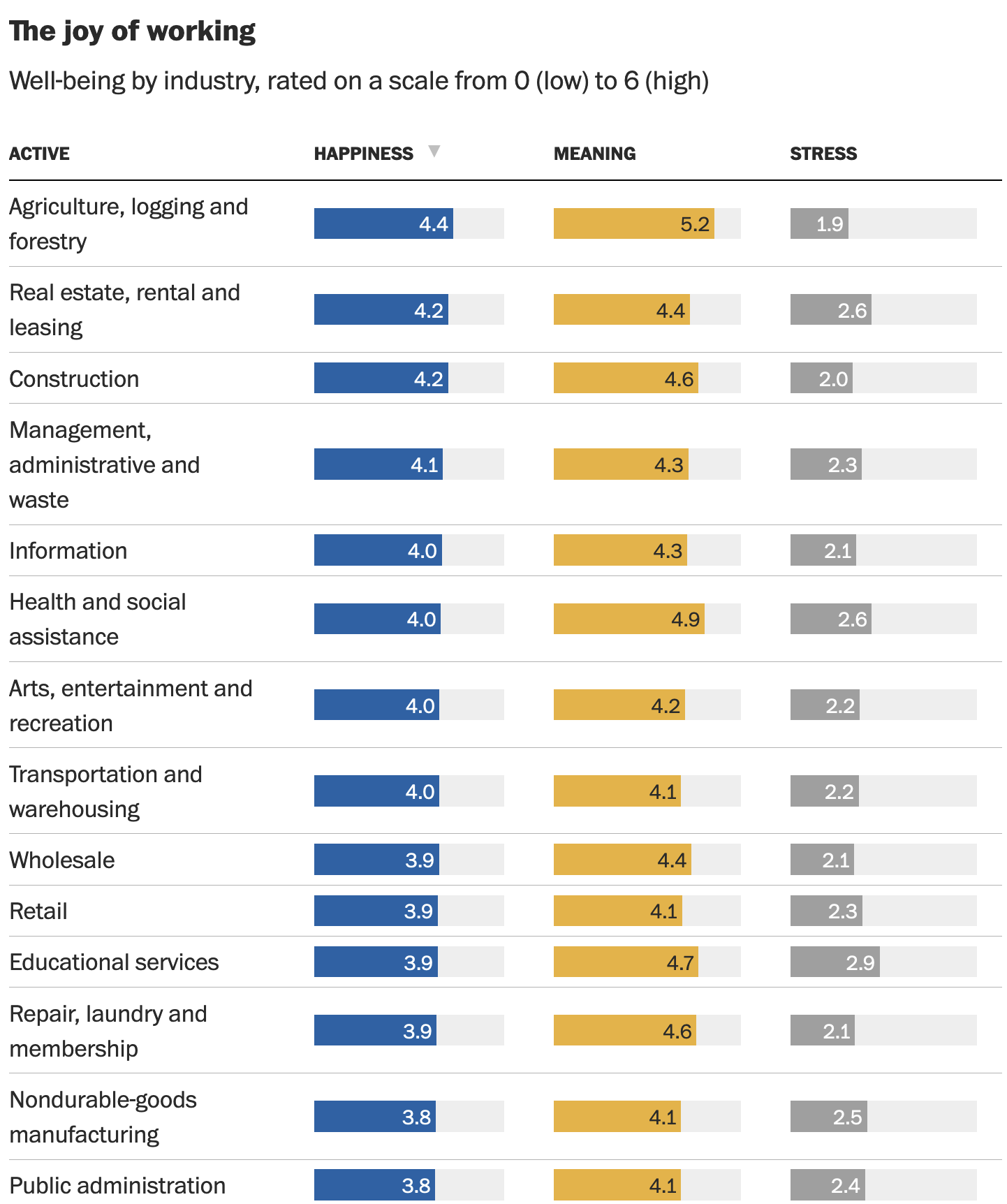
America's forests and its farms are where you find the nation's happiest, least stressful, most meaningful jobs

(Graph by The Washington Post, data from Bureau of Labor Statistics)
Naturalist and ecological thinker John Muir wrote, “The clearest way into the universe is through a forest wilderness.” A new analysis agrees: "Envy the lumberjacks, for they perform the happiest, most meaningful work on earth. Or at least they think they do. Farmers, too," writes Andrew Van Dam of The Washington Post. "Agriculture, logging and forestry have the highest levels of self-reported happiness — and lowest levels of self-reported stress — of any major industry category, according to our analysis of thousands of time journals from the Bureau of Labor Statistics’ American Time Use Survey."

Why would bonding with trees create joy? Van Dam explains: "Researchers across the social and medical sciences have found a strong link between mental health and green space or being outdoors. Even seeing a tree out your window can help you recover from illness faster. So imagine the boost you get from being right next to said tree — even if, like our friend the lumberjack, you’re in the process of chopping it down."

The Post's analysis compares being at work with being in nature: "We found that while your workplace looms as the single most stressful place in the universe," Van Dam writes. "The great outdoors ranks in the top three for both happiness and meaning — only your place of worship consistently rates higher."

Leslie Boby, whose work supports forest-focused outreach across 13 Southern states, told Van Dam that a forester's sense of fulfillment comes from more than being outside: "There’s a point where you are now planting trees that you are not going to see harvested. It speaks to something larger than yourself. … Your work is living on, and someone else will benefit from your efforts in a tangible way.”

This land is your land, this land is my land: who owns the most U.S. real estate, and big sales and transfers in 2022

The Emmerson family's timberland in Northern California
(Photo by Katie Luther, Sierra Pacific Industries)
When it comes to land purchases and transfers, 2022 was a big year. "From strategic acquisitions to out-and-out buyouts, America’s largest landowners bought and sold millions of acres all year long in 2022, acquiring inholdings, selling nonessential acreage, and delving into new markets," reports Eric O'Keefe of Successful Farming. "That information is included in the 2022 Land Report 100, which is compiled each year by The Land Report magazine."

O'Keefe provides a highlighted listing:

Emmerson Family - The nation’s largest private landowners, California’s Emmerson family, are a prime example of this trend. Through their Sierra Pacific Industries, the Emmersons increased their landholdings by more than 100 square miles to over 2.4 million acres. The bulk of that growth was nearly 78,000 acres of Northern California timberland acquired from the descendants of Thomas Barlow “T.B.” Walker.

Four Sixes Ranch - For sheer size, no transaction compares to the sale of Texas’s Four Sixes Ranch. Taylor Sheridan, the Oscar-nominated screenwriter behind "Yellowstone", "1883," and "1923," led an investment group that acquired the legendary landmark. The sale marked the first time in more than 150 years that the iconic outfit had changed hands.

John Malone - The Malone Family Land Preservation Foundation has partnered with The Nature Conservancy and Colorado State University to study the impact of virtual fencing on California’s Red Top Ranch.

East Foundation - In 2022, Texas’s East Foundation completed the 60-month transition process to convert from a private foundation to an agricultural research organization. This process had long been in the works. The ARO designation is similar in many ways to the long-established medical research organization (MRO) status, which dates back to the 1950s.

Top Ten Largest Private Landowners:
Emmerson family 2.411 million acres
John Malone, 2.2 million acres
Ted Turner, 2 million acres
Reed family, 1.661 million acres
Stan Kroenke, 1.627 million acres
Irving family, 1.267 million acres
Buck family, 1.236 million acres
Singleton family, 1.1 million acres
Brad Kelley, 1 million acres
King Ranch Heirs, 911,215 acres

Reconsidering the divisions between rural and urban, and Lincoln's maxim: 'A house divided ... cannot stand'

(Photo by Kelly Sikkema, Unsplash)
Considering the political division in America today, it seems hard to see how the country will get through it together, but recalling U.S. history can offer context. "Many consider the oft-quoted phrase by Abraham Lincoln, 'A house divided against itself cannot stand,” as almost cliché. But in reality, it may contain nearly as much relevance and be as applicable today as in Lincoln’s time," writes John Rukhus Jr. of Southside Pride, in southern Minneapolis. "Taking into account the social upheaval and political events in just the last several years alone, one detects shades of a societal climate that existed in the late 1850s and later during Reconstruction. The racially charged discourses of the abolitionists versus their Southern counterparts and later Jim Crow are reflected in today’s actions and reactions regarding the Black Lives Matter movement and the passage of laws in several states to restrict voter access to the polls."

In that discussion, "There is one demographic that is often overlooked, that is, until the most recent presidential election. We are talking about rural America, a segment of the political and societal map whose attitudes and shifts in political leanings can have far-reaching implications nationally," Rukhus writes. "There is a long history, of course, of rural dwellers being written off with the help of stereotypes as being rubes, rustic, ignorant, unsophisticated and isolated. But with the development of better schools in rural areas and the proliferation of public media, rural citizens have become much more connected and savvier than they were, say, 70 years ago."

The divides between rural and urban have led more alienation between Americans, and rural dwellers have had to bear a disproportionate amount of community loss: "There is an underlying current of frustration and fear that is as much economic as political. Insurance companies and other large corporations buy up the farmland and create 'megafarms,' pushing out the family farmer," Rukhus notes. "Retail giants like Dollar General and Kwik Trip and Walmart shut down existing small businesses, while fast food corporations like A&W and McDonald's spring up to replace mom and pop cafes. People who once had economic freedom are forced to work long hours at low wages to support their families. It is like living in economic jail."

Rukhus opines, "Once a bastion of Democratic political leanings, in the last presidential election they threw their support at then-President Donald Trump. Emboldened by the demagoguery of the former president, they found a voice to their frustrations where previously they felt marginalized, disenfranchised and left behind by the American dream. Lest the Democratic party make the fateful mistake of losing this large bloc of American voters forever, they had best find a way to speak to these independent-minded citizens and address their particular issues and concerns."

Iowa farmers want year-round raccoon hunting to lessen gnawed-down crops; population has tripled since 2006

(Photo by Peter Nuij, Unsplash)
Ethan Crow is an Iowa farmer with a gripe: raccoons. "Shine a light at any of the buildings on Ethan Crow’s central Iowa farm at night and you are likely to see several pairs of eyes staring back," Crow told Joe Barrett of The Wall Street Journal. "And piles of scat covering the floor—signs of what farmers are calling an out-of-control raccoon problem."

Crow told Barrett that he loses several thousand dollars in sweet corn to raccoon raids every year. “We do some trapping when we can. Otherwise, I mean legally, there’s not a lot that we are supposed to do.” The fine for hunting or trapping a raccoon outside the early-November-through-January season can be as much as $335, Barrett notes.

Farmers want year-round raccoon hunting, and the Iowa Department of Natural Resources, isplanning hearings on it. DNR biologist Vince Evelsizer noted that Iowa's raccoon population has tripled since 2006, and raccoons love sweet corn and grain corn, which both vital to Iowa agriculture.

Year-round hunting "won’t solve the problem overnight,” Evelsizer told Barrett. “But it will give people more flexibility to deal with nuisance situations.” He said the department would keep supporting nonlethal means of dealing with raccoons, such as putting electric wire around sweet-corn patches, installing a metal mesh to keep raccoons out of homes, and relocating problem raccoons.

Barrett writes, "Many farmers have clearly had enough of the crafty mammals, which typically weigh about 8 to 20 pounds, have distinctive bandit-mask facial markings, keen eyes, human-like forepaws that make them excellent climbers and a bushy, ringed tail."

Dean Fisher, a Republican Iowa state representative, told Barrett: “They may be cute and cuddly, but not here in farm country. They’re vermin and a nuisance.” Barrett reports, "Last year Fisher introduced a bill to extend raccoon hunting, which passed both chambers but was never reconciled," Fisher said he is waiting to decide whether to reintroduce his bill based on what happens with the state proposal.

Monday, January 09, 2023

Rural editor dreads writing her column, because 'The world has become an ugly place for us to exchange ideas and thoughts,' with 'baseless cynicism and unwillingness to think'

By Sharon Burton
"One Voice" column, Adair County Community Voice, Columbia, Ky.

I’ve been a journalist for several decades now, and I’m honored to have won my share of awards over the years. When it comes to annual newspaper contests, the ones I’ve been most proud of were awards for writing this column.

I’m proud to say I’ve won first place more than once, and there was a time when that encouraged me to bravely share my thoughts on this page, hoping that readers would take the journey with me as I called out elected officials when I believed it was needed, when I shared words of wisdom I had learned from life’s experiences, or even when I shared a warm story about family.

I often heard from readers who either loved what I have written or really, really didn’t like it, and either way, I knew I had encouraged others to spend at least a moment in thought about something important.

Sharon Burton
Today, the part of my week I dread the most is sitting down and writing this column. I leave it until I can no longer avoid it, and this page is often the last one to make it to the printers.

Our world has changed – no, we say, the world, but in all honesty, people have changed. Because people have changed, the world has become an ugly place for us to exchange ideas and thoughts. So many people no longer value the voice of others, and it breaks my heart every week when I realize that I no longer feel encouraged to share ideas with hope that we can all learn together.

When I would write something others might disagree with, I enjoyed the calls or visits from them as we talked about our disagreements. I learned from a better journalist than myself to use the opportunity to ask for letters to the editor – to even offer to type them up so that the person who disagrees with me can share his or her opinion on the very same page where I express mine.

Those have always been my favorite conversations, the ones with the people who disagree with me. I didn’t always change my mind, although sometimes I did, but mostly it helped me view the world from a different perspective, and I think we all become better people when we can do that. I don’t have to agree with someone to empathize with a countering viewpoint; I only have to respect that person as another human with ideas, emotions, thoughts and experiences of his or her own.

I wanted to write this week about the past year and my hopes for 2023, but to be honest, I don’t feel like sharing. While newsprint doesn’t give readers the chance to write nasty little comments below the article, the free-flowing river of hate and trolling we are bombarded with daily on social media has cost us more than we realize. It has cost us accountability.

We embrace the free flow of opinion without expecting any forethought or, heaven forbid, some research or thorough reading. In the past, I always knew I better do my homework before writing about a subject on this page. Readers expected me to be informed, and I did not want to disappoint.

We used to be a community where we stood side by side with the very people we considered different from ourselves. Now, we can’t even have a winter storm that people aren’t ridiculing others because they do or don’t believe in global warming, because they think electric vehicles do or don’t make sense, or whatever the latest thing is that most people have done very little research on but hold a very strong opinion about.

It’s not even the lack of being informed that bothers me the most. It’s the attacking attitude toward others with a different opinion that boggles my mind. Why be so mean?

Don’t misunderstand – I can handle mean. I’ve had someone come into my office and rip the newspaper up in front of me (or attempt it; newsprint does not tear easily). I’ve had the paper slung across my desk in anger. I’ve had phone calls where some very nasty words were used, and I’ve had my Christianity questioned more than once. It’s all part of the job.

But I understood that those people were invested in the topic I had written about. An article didn’t sit well with their values; an elected official didn’t get his way; a family member made the news for breaking a law and they wanted me to cover it up. Those tirades I can handle.

It’s the baseless cynicism and unwillingness to THINK that has me discouraged about mankind. It’s the blind support of viewpoints with no interest whatsoever of exchanging thoughts and ideas. It’s the inability to think there is more out there for you to learn.

It takes the fun out of being right, and it certainly takes the fun out of being wrong. In the past, I’ve used this spot to share my thoughts, knowing it could go either way. I knew my readers were looking out for me, letting me know when I said something that made an impression on them and having my back when I missed the mark.

While the awards have been fun, in truth, my favorite response to “One Voice” has always been, “I don’t always agree with you, but I enjoy reading your column.”

When did we stop enjoying the people with whom we disagree?

If I were to pick out my hopes for 2023, it would be that we become a kinder, gentler world, that we see and embrace the imperfections of one another, that we seek knowledge, and we view the world through the lens of grace.

We can only better ourselves when we allow ourselves to be imperfect in front of one another. It’s through that experience that we learn, and we still have a lot to learn.

Emergency briefing: Great Salt Lake has 5 more years without 'extreme intervention' for water conservation

Dust blows through Antelope Island and the Great Salt Lake.
(Photo by Trent Nelson, The Salt Lake Tribune)
The Great Salt Lake is the largest saltwater lake in the Western Hemisphere and the eighth-largest terminal lake in the world. Experts are warning that without extreme intervention, the lake will be gone in five years due to "excessive water use" in the lake's basin, reports Leia Larsen of The Salt Lake Tribune.

Released as an emergency briefing to the state legislature, the warning outlines the "'unprecedented danger to Utah’s public health, environment and economy if the lake does not receive a 'dramatic' influx of water by 2024," Larsen writes. "The lake has already hit record-low elevations for two years in a row, exposing 60% of its lakebed which continues to dry into a toxic source of dust pollution."

Ben Abbott, a professor of aquatic ecology at Brigham Young University and lead author of the briefing, said in a news release, “The decisions we make in the coming few months will affect our community and ecosystems across the hemisphere."

In response, "The Utah Legislature took some of its biggest conservation measures to date last session in an effort to save the Great Salt Lake. They took a helicopter tour of its massive exposed lakebed and approved a $40 million trust to secure water rights and improve habitat for the lake," Larsen reports. "They funneled millions toward mandatory secondary water metering. They revised the state’s pioneer-era water laws to allow farmers to lease their water rights and use them to benefit environmental interests like the Great Salt Lake. . . . But lake researchers and advocates say it’s not enough."

As the clock ticks, "The Great Salt Lake’s collapse has begun. High salinity levels have all but wiped out brine flies, which support millions of migrating birds. Microbialite colonies that serve as the foundation of the lake’s food web have surfaced and died," Larsen writes. "The lake’s multimillion-dollar mineral extraction industries can’t reach the brine they need, marinas are dry and the lucrative aquaculture industry could go bust next year if rising salinity wipes out the lake’s brine shrimp."

Lynn de Freitas, executive director of Friends of Great Salt Lake, told Larsen, "In the face of this [crisis], we need our state leadership to say, ‘Not on my watch,’ and "do whatever it takes to pull the lake back from the edge.”

Larsen reports: "Human consumption is mostly to blame for the Great Salt Lake’s desiccation. The lake has lost more than 1 million acre-feet each year since 2020, according to the report, which is 'much more' than models predicted. . . . According to the report, "Conservation is the only way to provide adequate water in time to save Great Salt Lake. Conservation is also the most cost-effective and resilient response."

Cost of living and child care are at the heart of rural family concerns, survey by Save the Children shows

They survey asked respondents to name one or two top issues.
(Graph by Save the Children Action Network)
A rural-voter survey sponsored by the political arm of Save the Children, "shows that rural residents are facing several challenges, including worries about the ability to feed their children and access to good and affordable child care," reports Kristi Eaton of The Daily Yonder. According to the survey: “Rural voters deem inflation to be the greatest challenge facing rural families. In an open-ended question about the biggest problems facing families in rural areas, respondents are most apt to volunteer gas prices and inflation. When asked about specific problems in their area, 68% say children not having enough to eat is a serious problem.”

When it came to opinions on childcare, "More than half (55%) said that high-quality and affordable child care has become less accessible since the pandemic," Eaton reports. "Additionally, a majority (54%) of rural voters said there are only some or very few high-quality, affordable early education programs in their area."

Christy Gleason, executive director of Save the Children Action Network, told Eaton: "Congress and state legislatures have taken incremental steps to provide relief on child care and hunger but more must be done to address the scale of the crisis we see in these numbers. From boosting rural development in the farm bill to reviving the expanded child tax credit and increasing state and federal investments, rural families want to see bold leadership from their elected representatives in the new year.”

A bipartisan team of pollsters and staff from Save the Children will brief Congress on the findings of the survey Jan. 18, Eaton reports.

Use of force in Pa. jails common with mentally compromised inmates; 2/3 of people in U.S. jails are just awaiting trial

(Mixed media by Tom Downing, WITF)
In its investigation into Pennsylvania's county jails, WITF, the state's public television station, found that "One in three uses of force from 25 jails during the last three months of 2021 involved a person who was having a mental health crisis or who had a diagnosed mental illness," Brett Sholtis reports. "The situation brings risks ranging from lasting psychological trauma to death."

In the U.S., "two-thirds of people in jails are there pre-trial — meaning they haven’t been convicted of a crime. Most are there on nonviolent charges such as parole violation, theft, drunkenness and drug possession," Sholtis reports. "Though their time in jail may be relatively short, those who fail to adapt can pay a heavy price."

One story Sholtis provided: "When police found Ishmail Thompson, he was standing naked outside a Dauphin County hotel, where he had just punched a man. A mental-health specialist working with the county prison said Thompson should be sent to a hospital for psychiatric care. But at the hospital, a doctor ran some tests and cleared him to return to jail. At the jail, when corrections officers tried to strip-search Thompson, he ran into a shower where he was 'wetting himself down,' prison records show. An officer pepper-sprayed him in the face and tried to take him to the ground. Thompson fought back. Staff flooded the area, handcuffing and shackling him. . . . About 20 minutes later, an officer saw that Thompson was taking 'short, abnormal breaths.' Five days later, Thompson died. The district attorney said no criminal charges would be filed."

Sholtis writes, "Most uses of force don’t lead to death — and the coroner did not determine whether Thompson’s death was due to being pepper-sprayed and restrained. But the practices corrections officers employ every day in Pennsylvania county jails can put prisoners and staff at risk of injury and can hurt vulnerable people who may be scheduled to return to society within months."

Craig Haney, a psychology professor at the University of California Santa Cruz, who specializes in prison conditions told Sholtis, "Some mentally ill prisoners are so traumatized by the abuse that they never recover, some are driven to suicide, and others are deterred from bringing attention to their mental health problems because reporting these issues often results in harsher treatment." While use of force is needed "for officers to prevent violence against others. However, records obtained by WITF show that a significant number of uses of force are against people who are not hurting anyone else," Sholtis reports. "WITF found that one in five uses of force — 88 incidents — involve a prisoner who was either attempting suicide, hurting themselves or threatening self-harm. Common responses by prison staff included what was used on Thompson — a restraint chair and pepper-spray. In some cases, officers used electroshock devices such as stun guns."

Native Americans' fight for salmon rights continues; and they're subject to more discipline in New Mexico schools

In New Mexico, a detailed analysis of state records reveals that "Native American students are expelled far more often than any other group and at least four times as often as white students," reports Bryant Furlow of New Mexico In Depth and ProPublica. "Gallup-McKinley County Schools are responsible for most of the disparity. The district has a quarter of New Mexico’s Native students, but it accounted for at least three-quarters of Native student expulsions in the state during the four school years ending in 2020."

Furlow reports, "The state education department requires school districts to report all disciplinary incidents. Gallup-McKinley reported at least 211 expulsions over the four school years, an annual rate of 4.6 per 1,000 students. That’s at least 10 times as high as the rest of the state. The disparities persisted from elementary through high school."

A spokesperson for New Mexico Attorney General-elect Raúl Torrez called the news outlets’ findings 'alarming' but told Furlow that the office doesn’t have the authority to investigate civil-rights abuses by school districts or other public bodies.

Gina Laura Gullo, assistant director of education services at the Pennsylvania State Education Association, who did her Ph.D. dissertation on unconscious bias in school discipline, told Furlow she found that school administrators who scored higher on measures of implicit racial bias assigned harsher discipline to students of color than white pupils: "Infractions that are more subjective in nature such as disorderly conduct, insubordination, classroom disturbance and the like, are those that are specifically subject to more implicit bias.”

Salmon rights: The classroom isn't the only rocky battleground for Native Americas. Tribal fishing rights are also a fight for justice. Randy Settler is a member of the Yakama Nation, a tribe that has spent generations fishing along the Columbia River. He is fighting for his tribe's right to harvest salmon, reports Tom Schick for Oregon Public Broadcasting: "They had fought for their right to fish, a right the U.S. government promised to honor more than 150 years ago and then violated generation after generation through laws, policies and flat-out discrimination. He inherited that fight. Now, with climate change threatening the remaining salmon runs, he thinks about the legacy they left for him, the one he’ll pass down to his nephew, George, and to George’s 10-year-old daughter."

Columbia River watershed (American Rivers map)
The past 50 years have been marked with "many disputes over the federal government’s actions toward salmon and tribes," Schick writes. "Settler summed up the tribal position in his testimony before Congress at the time. Fish runs are in terrible condition, he told them: 'The United States is not living up to its commitments in the Treaty of 1855.'"

There have been some positive discussions that may help the Columbia River tribes including the White House recommendation that dams along the Snake River be removed and funding for the reintroduction of salmon of be provided.


Want to keep those fresh eggs coming during cold weather? More light and attention to diet can help hens produce

(Photo via Successful Farming)
For chicken owners who love their fresh eggs, winter can pose a challenge: "Many hens stop or slow down egg production during the fall and winter. The lack of daylight and cooler temperatures tell their bodies to rest," notes Successful Farming. "If you keep the chickens comfy with light and warmth, they'll reward you with more eggs."

Extension Poultry Specialist Jesse Lyons of the University of Missouri told Successful Farming: "It takes about 12 hours of day length to get the birds stimulated to where they start laying. Up to about 16 to 17 hours or so, somewhere in there, is probably the maximum day length that will stimulate the birds."

To add heat and light to a hen house, Lyons said, "Many poultry houses use the relatively inexpensive incandescent light. One light bulb would keep 15 or 20 chickens happy to where they can see, and walk around and eat, and be stimulated by the light . . . You can also use an infrared heat lamp for a couple of hours to warm them up. . . . You can use some of the fluorescent lights, but in cold environments, some of these lights will not come on."

A balanced feed plan can also help, Successful Farming advises: "Provide a diet that is balanced for protein and calcium. More feed may be required to give them the extra energy they need for maintaining body heat and egg laying."

David Frame, an extension poultry specialist at Utah State University, told Jodi Henke of Successful Farming that free-range chickens find plenty to eat other times of the year, but you have to help them with their diet during the winter: "Offer them some table scraps from your salads, or as you trim them. Save those carrot peels and save the ends of the lettuce and the spinach, and things like that. Throw out there, let them peck around at them, and get some greenery. Another idea that works pretty well is to cut a pumpkin or a squash open and just let them peck around at that. Those squash-type plants are very rich in vitamin-A, plus it gives them something to do."