Thursday, January 26, 2023

President Biden is halfway through term, but not halfway through his promises, PolitiFact analysis concludes

Chart by PolitiFact, The Poynter Institute
Promises, promises. As President Biden hit the two-year mark, PolitiFact measures how well he is doing at his job "by examining what he’s accomplished so far: PolitiFact’s Biden Promise Tracker monitors 99 promises Biden made on the campaign trail," amy Sherman writes. "Our latest review shows Biden was able to implement some promises on his own, such as nominating a Black woman for the U.S. Supreme Court. But many promises stalled in Congress because of slim Democratic majorities or, in the case of forgiving some student debt, setbacks in the courts."

Sometimes Biden can't "make good" without Congress. John P. Frendreis, a Loyola University emeritus professor of political science, told PolitiFact, "The change in House control makes it impossible to move any promise forward if it requires congressional action."

PolitiFact's evaluation is "based on outcomes, not intentions. Only full enactment of a promise qualifies for a Promise Kept; partial enactment merits a Compromise rating," PolitiFact says.
 
"So far, Biden earned a Promise Kept rating for about one-quarter of his promises, and a handful of promises received a Compromise rating. About one-third of his promises are rated In the Works, and almost one-third are Stalled. Biden received a Promise Broken rating on his pledge to block hydraulic fracturing on federal land."

Highlights from the findings of PolitiFact, whichn is a service of The Poynter Institute:
  • Biden made progress on job creation and the economy, but not on raising the minimum wage
  • He got Covid-19 under control and scored wins on health care
  • He has struggled to deliver primises on immigration
  • He made progress on some foreign policy promises and got big win on climate

Wednesday, January 25, 2023

Teacher shortage leaves many rural and minority students without teachers, as administrators struggle to fill positions

Teacher shortages leave students learning via software or on their
own in Rosedale, Miss. (Photo by Rory Doyle, The Washington Post)
To raise educated citizens, the U.S. needs good teachers, but from state to state, the system is falling short with rural and minority students, and "rural and Southern states face a crisis," reports The Washington Post.

"The nature and the severity of the teacher crisis differ radically from state to state, district to district and even school to school," Moriah Balingit writes. "Some districts have only recently started experiencing teacher shortages, but in many Southern states, the problem has been long-standing and only gotten worse. . . . In rural Mississippi, the geometry teacher is a recording. The chemistry students often teach themselves."

Balingit uses West Bolivar High School in Mississippi as an example: "The school is 98 percent Black, and 100 percent of children qualify for free or reduced-price meals," and keeping the school staffed is a "high-wire balancing act that relies on long-term substitutes, virtual classes and hiring educators to teach subjects they have no training in. Before Supt. Will Smith arrived, the district had hired so many uncertified educators that it risked losing accreditation." Will Smith asked Balingit, “It’s not fair, but what else do we have?”

Balingit writes: "The importance of teachers cannot be underestimated. Research suggests that they matter more to a child’s learning than any other school-based factor, including the condition of the school building or the principal. Teachers not only affect academic achievement, they can also influence the likelihood a child will graduate from high school and how much they’ll learn over the course of their lives, researchers found. For children whose teachers are underqualified, inexperienced or nonexistent, the stakes are high. . . . Researchers have found that schools that serve high percentages of minority students and students in poverty have more difficulty finding and retaining qualified educators than whiter, more affluent schools."

The national teacher shortage began after the "2008 Great Recession, when the nation’s public education system lost more than 120,000 teachers," Belingit reports. "When the economy rebounded and schools started hiring again, they found that many of those who had left were reluctant to return. There have been other factors, too: The number of people entering teacher training programs dropped by about one-third between 2008 and 2019."

Rosedale, Mississippi (Wikipedia map)
A teacher shortage meant states needed to offer greater salaries; however, "Two years ago, Mississippi came in dead last in average teacher pay, according to a National Education Association report, at a little less than $47,000 a year," Balingit reports. And schools like West Bolivar became "like a lot of communities in the region, the county is rich in culture, history and community pride but economically poor, having lost population when manufacturing jobs left and agriculture became more automated. Those who remain send their children to deteriorating schools that their districts struggle to run because of a dwindling tax base and a state legislature reluctant to fund schools at the per-student rate the law is supposed to guarantee."

For school administrators, teacher recruitment and student achievement are ongoing stressors. Smith told Balingit: “When you get that email, you’re jumping. You have to quickly call the candidate and have a talk before they get hired by somebody else. . . . At the end of the day, you’re still expected to produce the results. None of the excuses are going to matter.”

Walmart raising minimum hourly wage to $14 from $12; its pay scale influences those of many other rural employers

A Walmart checkout line (Photo from Walmart)
Walmart, which is the nation's largest employer and has a huge rural footprint, is raising wages for hourly workers in stores and warehouses. Starting pay next month will be at least $14 an hour, up from $12, the company said in a memo to staff Tuesday. 

"The company’s move could lead to wage pressure in lower-income areas where it is one of the main employers," Sarah Nassauer and Gabriel T. Rubin write for The Wall Street Journal. "Some economists have found that Walmart’s market power is a primary determinant of wage levels in local economies where they have a large presence, especially at other retailers and grocery stores."

Noting the company's more rural and Southeastern base, the Journal says "That means more of its 4,600 stores and warehouses are in states such as Texas, Mississippi and Georgia that haven’t adopted higher minimum wages in recent years. Twenty states don’t have a minimum wage higher than the federal minimum of $7.25 an hour, "which was last raised in 2009," the Journal notes. "More than half the states in the U.S. are set to lift their minimum wages in the coming year, although due to the tight labor market, employers have in many cases needed to offer pay significantly higher than the legal minimum in order to attract and retain employees."

Walmart's starting-pay hike is "the latest in a series of increases by the company to close the gap with rivals," the Journal reports. It "will push the company’s average hourly wages to over $17.50. Currently hourly workers at Walmart earn an average of around $17, a spokeswoman said." But its minimum will still be below the $15 minimum at its major rivals, Target and Amazon, which have a $15-an-hour minimum wage, and Costco's minimum is even higher, the Journal reports.

Rural nursing homes closing because they can't find staff, uprooting residents who thought they had a forever home

Marjorie Kruger and son Dan White at the Evangelical Lutheran Good Samaritan
Society nursing home in Waukon, Iowa. (Photo by Tony Leys, Kaiser Health News)
Rural nursing homes are closing due to shortages of workers, and "The problem could deepen as pandemic-era government assistance dries up and care facilities struggle to compete with rising wages offered by other employers, industry leaders and analysts predict," reports Tony Leys of Kaiser Health News.

"Many care centers that have managed to remain open are keeping some beds vacant because they don’t have enough workers to responsibly care for more residents," Leys reports, noting shortages of "nurses, nursing assistants, and kitchen employees."

Last year, 13 of the 15 Iowa nursing homes that closed "were in rural areas, according to the Iowa Health Care Association," Leys reports. Brent Willett, the association’s president, told Leys, “In more sparsely populated areas, it’s harder and harder to staff those facilities,” partly because many rural areas have fewer working-age adults.

The closure of a nursing home or assisted-living facility can have traumatic effects on residents and their families. "The lack of open nursing home beds is marooning some patients in hospitals for weeks while social workers seek placements," Leys reports. "More people are winding up in care facilities far from their hometowns, especially if they have dementia, obesity, or other conditions that require extra attention."

Leys starts his story with Marjorie Kruger, 98, who "was stunned to learn last fall that she would have to leave the nursing home where she’d lived comfortably for six years" in Postville. She told him, “The rug was taken out from under me. I thought I was going to stay there the rest of my life.” Her son found her another home, "but she misses her friends and longtime staffers from the old one," Leys writes. "The Postville facility’s former residents are scattered across northeastern Iowa. Some were forced to move twice, after the first nursing home they transferred to also went out of business."

Rural America lacks lawyers, and only a few states are addressing the problem; go 100 miles for a will or a divorce?

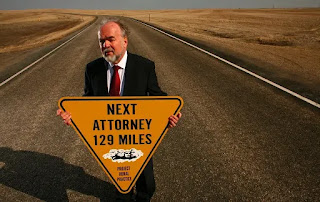
In 2013 David Gilbertson, then chief justice of South Dakota, posed
with a sign he ordered. (New York Times photo by Matthew Staver)
"You're going to need a lawyer for that," pretty much everyone says at some point in time. But in rural areas, that lawyer is a lot harder to find: "Despite efforts in recent years by a handful of states, universities and legal associations to ease the problem, there remains a glaring lack of lawyers in many far-flung places," reports Elaine S. Povich for Stateline. "This leaves those areas and their residents without easy access to legal advice for family issues, wills, estates and property transactions, in addition to any criminal or civil legal disputes. Residents often have to drive long distances to another city or rely on remote video meetings."

Sam Clinch, associate executive director of the Nebraska State Bar Association, which has few lawyers outside Omaha and Lincoln, told Povich, “That’s an access problem when you are asking someone to drive 100 miles or more to do a simple will or a simple divorce." Povich notes, "Nebraska has a small state loan repayment program to help a few attorneys who agree to practice rurally; in a decade, the program has placed 39 lawyers in rural parts of the state."

Povich reports, "Some 40% of all counties in the United States — 1,272 of 3,141 — have fewer than one lawyer per 1,000 residents, so few that they are considered 'legal deserts,' according to the most comprehensive survey of attorneys available, conducted by the American Bar Association in 2020. . . . Nationwide, there are roughly four lawyers for every 1,000 residents, but those numbers don’t mean much because so many lawyers are concentrated in cities. . . . South Dakota is one of the few states where the legislature and governor agreed a decade ago on a plan to attract lawyers to rural areas." The state has few attorneys outside urban centers such as Rapid City and Sioux Falls. 

Povich notes that South Dakota's program is an exception. Lisa Pruitt, a law professor at the University of California, Davis and lead author of an article titled "Legal Deserts: A Multi-State Perspective on Rural Access to Justice," published in the Harvard Law & Policy Review in 2018, told Povich: “In most states, the relevant institutions are not willing to do this because constituencies are not strong enough. It’s hard to get lawmakers or The State Bar of California to care about rural people and places because there is no power there.” Povich notes, "A search of the California legislature’s database turned up no bills specifically designed to address the issue over the past several sessions."

Other states are showing some progress. Maine managed to open a "legal clinic in Fort Kent, a city on the Canadian border, and funded it at $600,000, according to Senate President Troy Jackson. In an interview, Jackson said while there was little opposition, some residents of other rural parts of the state thought maybe they should get a clinic too. That discussion was put off, but he expects others to make the case if the first program is a success," Povich reports. "Nebraska’s program, the Legal Education for Public Service and Rural Practice Loan Repayment Assistance fund, last fiscal year paid 34 recipients between $1,000 and nearly $5,000 toward their law school loans if they work in designated rural areas, according to an email from Jeffery A. Pickens, chief counsel of the Nebraska Commission on Public Advocacy. . . .To entice them, he said, the program’s advocates talk about experience rather than money."


Close encounters of the critter kind: Wildlife cameras catch interspecies meetings, caused in part by human activities

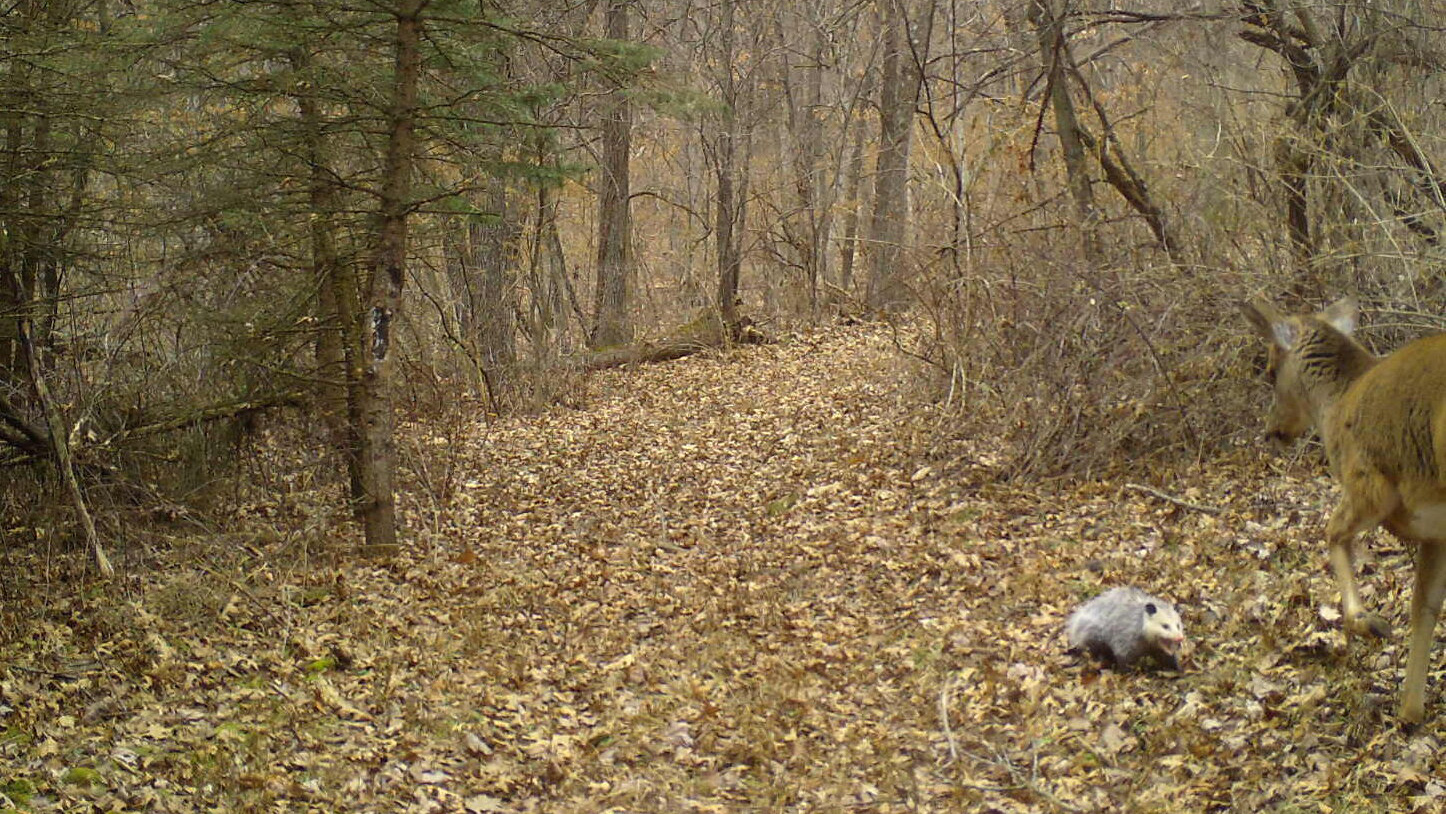
An opossum confronts a deer in a surprise encounter. (Photo via DNR Snapshot Wisconsin)
A turkey and a fawn in a close encounter (DNR Snapshot Wisconsin)
Even in the forest, timing is everything: "Hours, minutes or even seconds can make the difference for an animal between stumbling upon a predator and avoiding one, between finding a bush loaded with berries and discovering branches that have already been gnawed bare," writes Emily Anthes of The New York Times. "Now, a new study reveals how humans might unwittingly rewrite these ecological scripts, altering how the characters interact and fueling more interspecies encounters."

Anthes explains: "Neil Gilbert, a postdoctoral researcher at Michigan State University, and his colleagues analyzed images captured by Snapshot Wisconsin, a citizen-science project run by the Wisconsin Department of Natural Resources. Since 2016, volunteers have deployed more than 2,000 wildlife cameras across the state . . . Wild animals of different species were more likely to lead overlapping lives — appearing at local camera sites in quicker succession — in human-altered landscapes, like farms, than in more undisturbed locations, such as national forests," researchers reported in Proceedings of the National Academy of Sciences.

Anthes notes that human land use
Not all meetings are interspecies. ((DNR Snapshot Wisconsin)

"can squeeze animals closer together, increasing the odds that they bump into each other . . . Although more research is needed, that interspecies squeeze could have effects such as making it harder for prey to evade predators, intensifying competition for resources or increasing the risk of interspecies disease transmission, the researchers say." Benjamin Zuckerberg, an ecologist at the University of Wisconsin-Madison and an author of the study, told Anthes in an email, “The compression of species niches will likely lead to new interactions among species with unknown consequences.”

"The cameras, which are triggered by motion and body heat, have captured a menagerie of animals going about their everyday lives: bald eagles scavenging in the snow, bear cubs climbing trees, a newborn fawn, a bevy of otters gamboling down a grassy trail," Athens reports. "The time intervals between detections varied enormously. Sometimes the cameras captured the odd animal couples in the same frame; other times, days or weeks might pass between their appearances. But overall, across all animal pairs, the trend was clear: In relatively pristine habitats, such as national forests, roughly six days elapsed, on average, between detections. In the most human-altered habitats, that interval dropped to an average of four days.

Jennifer Stenglein, a state research scientist, said the study illustrates the potential for using wildlife cameras to probe aspects of animal behavior that might otherwise be difficult to observe.

Turkeys keep close watch on a sandhill crane. (Photo via DNR Snapshot Wisconsin)

Tuesday, January 24, 2023

Consolidation of groceries has greater impact in rural areas but some small-town markets find ways to survive

Cover of Economic Research Service report
The consolidation of groceries is greater in rural areas, according to a new study from the Economic Research Service of the U.S. Department of Agriculture.

“Food retailing markets in rural and small non-metro counties are considerably more concentrated than food retailing markets in metro and large non-metro counties,” the report says.

"That means for many small town residents, buying food requires driving to Walmart a few towns over or trying to make do with prepackaged and canned foods available at a Dollar General," reports Jonathan Ahl of Harvest Public Media.

The report "shows the percentage of grocery sales from the nation’s top 20 retailers more than doubled from 1990 to 2020," Ahl notes. "Even as small, full-service grocery stores become less common, some small-town grocers are finding ways to stay competitive, while in other communities, they’re banding together to start their own."

Ahl cites Sanborn Foods in Sanborn, Iowa, a a town of 1,400. Owner Scott Vogelaar "joined the Associated Wholesale Grocers, a co-op of small stories based in Kansas City. . . . He also works to differentiate his store through quality and service in particular departments," meat and produce.

"When the supermarket closed in Mount Pulaski, Illinois, a community-owned grocery store took its place," Ahl reports. "In 2020, Market On The Hill opened in the town of 1,500 people. The store focuses on locally grown and made foods to help differentiate themselves from national chains several miles away, as well as the dollar store that opened in town."

Rebuild Local News Coalition is now a nonprofit that will push for policies that will lead to hiring of more reporters

Coalition logo
With the collapse of local news accelerating, Steve Waldman, co-founder of Report for America, leads new independent nonprofit organization developing non-partisan public policies to strengthen community journalism. It's called the Rebuild Local News Coalition.

The group, an alliance of news organizations launched in 2020, is now an independent nonprofit "and plans a drive to advance a range of public policies to address the accelerating crisis in local news that threatens so many communities," it said in an announcement today.

The coalition says it will "research, develop and champion public policies at the state, local and national levels, including payroll tax credits to hire and retain local reporters, proposals to target government advertising spending toward local news instead of social media, and reducing the influence of hedge funds on local newspapers." It has a page with links to research about local news.

Funding the coalition are several journalism organizations and philanthropies, including the John S. and James L. Knight Foundation, the Ford Foundation, the Yellow Chair Foundation, the John D. and Catherine T. MacArthur Foundation, the Charles H. Revson Foundation, the Argosy Foundation, the Posner Foundation and Microsoft Corp.

Members of the coalition include the National Newspaper Association, the National Newspaper Publishers Association (representing Black papers), the Institute for Nonprofit News, The News Guild-CWA (Communications Workers of America), Local Independent Online News Publishers, the National Association of Hispanic Publications, the Association of Alternative Newsmedia, Report for America / The GroundTruth Project, the American Journalism Project, the Solutions Journalism Network, the Local Media Consortium, Chalkbeat, PEN America, The Lenfest Institute for Journalism and several state newspaper associations. "Together, they represent more than 3,000 local newsrooms," the announcement says.

The Institute for Rural Journalism and Community Issues at the University of Kentucky, publisher of The Rural Blog, is a member of the coalition and its Steering Committee. In addition to the steering committeem, the coalition will have an Advisory Council with a range of leaders from the civic sector, including both political parties.

Steven Waldman
Waldman will become the full-time president of the organization, which was incubated at the GroundTruth Project, home of Report for America. “The collapse of local news poses a massive crisis for American communities, and democracy,” Waldman said. “Part of the solution is smart, nonpartisan public policy that carefully preserves editorial independence. We have had this at other points in American history, and we must again.”

The announcement noted that the coalition stresses that policies need to be carefully crafted to be “content-neutral, nonpartisan and ensure editorial independence,” and will focus on federal, state and local policies that lead to the hiring of more local reporters."  The group will especially explore policies that strengthen weekly papers, hyperlocal newsrooms, diverse media, nonprofits and other newsrooms truly grounded in the communities they serve," the announcement says.

Now it's easier for doctors to prescribe drug that helps beat addiction; rural areas have had fewer willing doctors

Photo by Joe Raedle, Getty Images, via Politico Pulse
Today the federal government lifts extra requirements for doctors who want to prescribe buprenorphine, a partial opioid that is used to help drug users beat addiction. That will be a boon for rural areas that have a disporportionate share of overdoses and a shortage of doctors willing to prescribe it.

Gone is "a time-consuming process that both discouraged doctors from prescribing the drug and created an unhelpful stigma around the medication, advocates say," Krista Mahr and Daniel Payne report for Politico Pulse. "As deaths from opioid overdoses reached record numbers, access to buprenorphine remained elusive: Just 11 percent of people diagnosed with opioid use disorder received FDA-approved medication in 2020.
 
That changed with the Mainstreaming Addiction Treatment Act, "which was added to the year-end omnibus bill passed in December," Politico reports. "Practitioners who want to prescribe buprenorphine to their patients will still be required to get a DEA license, as they would any other controlled substance like morphine or Xanax. But they won’t have to face additional administrative requirements that have slowed down patient access to the drug for years."

Libby Jones, project director of the Overdose Prevention Initiative, told Mahr, “You could prescribe as much Oxycontin as you wanted without additional training, without an additional waiver. But in order to treat someone and provide a medication that prevents you from overdosing, you had to go through this extra step.”

Suicide hotline's new number, 988, will soon get big rollout; operators are being trained how to talk with rural callers

By Miryam Leon, Unsplash
The new 988 phone number for the national Suicide Prevention Hotline has been live since July, but it hasn't been heavily promoted, partlt in order to give rural areas and others lacking mental-health resources to prepare for more calls. This summer, it will get a “hard launch,” which means "a bigger advertising push with the weight of the federal government behind it," reports Liz Carey of The Daily Yonder. "And officials said they are working to make sure it will provide added help to rural residents in crisis."

Cheryl Witt, project director for Raising Hope, a Kentucky nonprofit helping farmers with mental health, told Carey that people answering the calls needed training in how to talk to farmers and others in rural communities.

The new number is already generating more calls. In Kentucky, crisis prevention call centers got about 11,500 calls in the first half of 2022, before the July 16 launch of 988. After that, "Calls climbed to about 14,100 for the second half of the year, excluding the last two weeks of December," Carey reports. "The state anticipates that by June 2023 calls to the hotline will quadruple."

Jeff Winton, founder and chairman of Rural Minds, an upstate New York non-profit dedicated to helping rural residents with their mental health issues, told Carey that the new number makes it easier for people in rural communities to get help with an issue that carries stigma. “It’s not seen as an illness. It’s seen as a character flaw. It’s seen as something you should be able to just pull yourself up by your bootstraps and get over,” Winton said. “Until such time that we get people to consider it an illness, we’re going to be hamstrung and this epidemic is going to continue to grow.”

Winton "has stressed to federal organizers the importance of training call operators on communicating with rural residents," Carey reports. "Winton knows first-hand the importance of the hotline. It could have saved his nephew, he said."

He told Carey, “I think for people that live in rural areas, (the 988 number) is a definite plus because it’s that one person that can listen to you and that can provide you with other resources without having that person end up sitting next to you at church, knowing that you’ve reached out for help.” The operators connect callers with resources in their local area.

"Calls are routed based on the area code of the phone number someone is calling from," Carey explains. "If someone is living in rural Minnesota, but their cellphone number has a South Carolina area code, the 988 call they make using their cell phone would be routed to a call center in South Carolina. It’s not an uncommon occurrence to handle out-of-state calls, Larson said."

Moving USDA research units from D.C. to K.C. made them less productive, cost them many veteran staff, GAO says

The General Accounting Office has found that the Trump administration damaged the research agencies of the Department of Agriculture by moving them out of Washington.

The number of journal articles by the Economic Research Service fell by more than half, and the National Institite of Food and Agriculture "took longer to process grants," GAO reports. By fall 2021, "productivity had largely recovered," but "the agencies’ workforce was composed mostly of new employees with less experience."

The moves of the agencies to Kansas City were also somewhat haphazard, GAO indicated, saying USDA did not follow some "leading practices for effective agency reforms and strategic human-capital management. For example, USDA minimally involved employees, Congress, and other key stakeholders in relocating the agencies. In addition, both agencies partially followed, or did not generally follow, many of the leading practices related to strategic workforce planning, training and development, and diversity management."

Then-Agriculture Sonny Perdue promised “a rigorous site selection process” that would lead to “attracting highly-qualified staff,” but GAO says the process “excluded estimated employee attrition rates” and “limited the ability of USDA leadership to ensure that it was making an appropriately informed decision on relocating.”

"Instead of attracting employees as Perdue promised, the move quickly decimated the workforce, trashed employee morale, shunned employee input and slashed the number of Black employees at the agencies," reports Joe Davidson of The Washington Post. The relocations “resulted in a significant loss of institutional knowledge, talent, and diversity on staff that will take time and intentionality to fully rebuild,” USDA press secretary Marissa Perry told Davidson.

"USDA officials told GAO auditors the relocation decision, which President Biden has not reversed, 'was the sole decision of the secretary'," Davidson reports. "Perdue, now chancellor of the University System of Georgia, and its media office did not respond to questions submitted by email."

Davidson notes, "During the Trump administration, the Interior Department also moved an agency headquarters west and received similarly negative reviews" from GAO. The Bureau of Land Management headquarters moved to Grand Junction, Colo., but is moving back to Washington, D.C.

College students and 2023 grads have until Feb. 20 to apply for Rural News Network internships at nonprofit newsrooms

College students and 2023 college graduates can apply until Feb. 20 for paid internships available at nine nonprofit newsrooms in the Rural News Network of thhe Institute for Nonprofit News.

The Scripps Howard Fund created the internship program in partnership with INN, to give students of diverse backgrounds high quality, hands-on experience, at no cost to the newsroom.

Six internships will last 10 weeks and three will last 20 weeks. The nine news organizations will host and hire the interns.

The 20-week internships will be at The Daily Yonder, Carolina Public Press and Indian Country Today. The 10-week internships will be at KOSU (Oklahoma State University), South Dakota News Watch, Lower Cape Community Access TV in Massachusetts, Oklahoma Watch, The Conversation US and the Wisconsin Center for Investigative Journalism.

The application is here. Details about compensation are here.

Monday, January 23, 2023

Roar of fans at cryptocurrency 'mine' makes Blue Ridge rumble; one of 12 a Calif. firm has in Southern Appalachia

The cryptocurrency "mine" is a few miles outside Murphy, N.C. (Screenshot from CNN)
The undending roar of fans cooling computer servers at a cryptocurrency "mine" in the Blue Ridge Mountains has "upended local politics" in Cherokee County, North Carolina, CNN reports, but officials there have said there is little they can do about it.

"The mine in Murphy is just one of a dozen in Kentucky, Tennessee and North Carolina owned by a San Francisco-based company called PrimeBlock, which recently announced $300 million in equity financing and plans to scale up and go public," CNN's Bill Weir reports.

Mine neighbor Mike Lugiewicz told Weir, “There’s a racetrack three miles out right here,” pointing toward it and away from the nearby crypto mine. “You can hear the cars running. It’s cool!” Neighbor Judy Stines interjected, “But at least they stop. And you can go to bed!

Lugiewicz takes sound readings at his home. More 30 percent have exceeded 60 decibels, Weir reports: "Estimates from the National Park Service show that expected environmental sound levels in the area should be around 41 decibels. Kurt Fristrup, a former Park Service scientist who studied noise impacts on rural environments, compared the noise near Lugiewicz’s home to living close to a very busy road without normal pulses in traffic."

Residents have complained about the noise at meetings of the Cherokee County Commission, and the commission's lack of action helped lead to the defeat of some members, CNN reports, but the county "still has not found a legal 'magic wand' to make noise from unenclosed crypto mines go away," the Cherokee Scout reports. However, Commissioners in Clay County, which borders Cherokee on the east, voted in August to ban crypto mines, the Scout reports. The Cherokee County Commission did pass a resolution asking state and federal officials to ban crypto mining in the U.S., as China has. The county "has had a noise ordinance on the books since 1999, but locals say it is unevenly enforced and does not specify a decibel threshold," The Washington Post reported in August.

Athletes invest in Iowa farmland, which rose 17% in value in 2022, partly due to investors, who made 27% of purchases

Joe Burrow (Photo illustration by Front Office Sports)
Cincinnati Bengals quarterback Joe Burrow, who advanced his team's defense of its Super Bowl title on Sunday, is investing some of his money in Iowa farmland, along with other professional athletes.

Burrow was part of "a group of about 25 athletes [who] pooled $5 million for an agricultural investment fund to purchase farmland," Abeer Allam reports for Successful Farming. "The first purchase was a 104-acre corn and soybean farm in northern Iowa, Front Office Sports reported this month."

The athletes "will lease the land to farmers and seek a single-digit-percentage annual return on the total investment, FOS reports. "The group — which will purchase four additional farms within the next few years, seeking a diverse set of agricultural assets — have looked into watermelon farms in Oregon, which tend to be smaller and offer higher per-acre rent." Allam reports the move was prompted by "investment in farmland by high-profile billionaire buyers like Bill Gates and Warren Buffett . . . to diversify their investment portfolio and hedge against inflation, experts say."

“Beyond the traditional reasons of buying recreational land, many investors see farmland as a stable asset that could generate robust returns,” Wendong Zhan, leading researcher of the Iowa Land Value Survey at Iowa State University and assistant professor at the Dyson School of Applied Economics and Management at Cornell University in Ithaca, N.Y., told Allam. “The declines during downtimes tend to be less drastic.”

The Land Value Survey found that the average value of Iowa farmland "increased 17% to $11,411 an acre in November 2022 from November 2021, the highest nominal value ever since the 1940s," Allam notes. "The value growth has been driven by several factors including high commodity prices, bumper crop yield, low-interest rates, limited land supply, and strong demand from investors. . . . Investors represented 27% of land sales in Iowa, split between local and non-local investors, while new farmers accounted for 4% of sales in 2022, according to the survey."

Higher land value is good news for owners, but "Farmers who still have farmland mortgages and/or rent many acres from others, face a much higher cost of financing and cash rents," Allam notes.

A universal human experience is fading: Sky gets 10% brighter each year, survey shows; previous estimate was 2%

Screenshot of interactive Light Pollution Map, which shows where skies are dark and bright all over the planet.

Seeing stars keeps getting more difficult because "artificial lighting is making the night sky about 10% brighter each year," according to a study that analyzed reports "from more than 50,000 amateur stargazers," reports Christina Larson of The Associated Press. "That’s a much faster rate of change than scientists had previously estimated looking at satellite data.

The research, which includes reports from the nonprofit Globe at Night project in 2011-22, was published Thursday in the journal Science. To illustrate the magnitude of the change, researchers "gave this example: A child is born where 250 stars are visible on a clear night. By the time that child turns 18, only 100 stars are still visible," Larson reports.

“We are losing, year by year, the possibility to see the stars,” which has been a universal human experience, said Fabio Falchi, a physicist at Chile's University of Santiago de Compostela, who was not involved in the study. “If you can still see the dimmest stars, you are in a very dark place. But if you see only the brightest ones, you are in a very light-polluted place.”

“This is real pollution, affecting people and wildlife,” Christopher Kyba, a study co-author and physicist at the German Research Centre for Geosciences in Potsdam, told Larson. "Kyba said he hoped that policymakers would do more to curb light pollution," Larson reports. "Some localities have set limits. . . . Prior studies of artificial lighting, which used satellite images of the Earth at night, had estimated the annual increase in sky brightness to be about 2% a year. But the satellites used aren’t able to detect light with wavelengths toward the blue end of the spectrum — including the light emitted by energy-efficient LED bulbs. More than half of the new outdoor lights installed in the United States in the past decade have been LED lights, according to the researchers. The satellites are also better at detecting light that scatters upward, like a spotlight, than light that scatters horizontally, like the glow of an illuminated billboard at night, said Kyba."

Georgetown University biologist Emily Williams, who was not part of the study, said skyglow disrupts circadian rhythms in humans and other forms of life: “Migratory songbirds normally use starlight to orient where they are in the sky at night. And when sea turtle babies hatch, they use light to orient toward the ocean – light pollution is a huge deal for them.”

Advocacy group claims that record egg prices are the result of illegal collusion among vertically integrated companies

Eggs for sale in Glenview, Ill., Jan. 10 (Associated Press photo by Nam Y. Huh)
Why are eggs more expensive than ever? It's not inflation or bird flu, "as claimed by egg companies, but by price collusion among the nation’s top egg producers," an advocacy organization claims in a letter to the Federal Trade Commission, Claire Carlson of The Daily Yonder reports.

Farm Action's letter said, “The real culprit behind this 138% hike in the price of a carton of eggs appears to be a collusive scheme among industry leaders to turn inflationary conditions and an avian flu outbreak into an opportunity to extract egregious profits reaching as high as 40%.”

Carlson notes, "Egg production has become a more vertically integrated industry over the past 45 years, according to the Agricultural Marketing Resource Center, a USDA-funded program based at Iowa State University. . . . The largest egg producer in the United States, Cal-Maine Foods, has come to dominate the egg industry through the acquisition of other egg farms across the country, according to their website. . . . Cal-Maine’s gross profit jumped 10-fold from one 26-week period in 2021 to the same period in 2022, according to the company’s most recent quarterly financial statement."

The outbreak of avian flu was the second in seven years. The one in 2015 "was deadlier but did not produce price spikes as high as those seen in 2022," Carlson reports.

Sarah Carden, senior policy advocate at Farm Action, told Carlson, “We see big agriculture controlling this narrative about avian flu and supply chain issues, but when you block out all that noise and just look at the numbers… there’s not a substantial decrease in supply.” The American Egg Board told Carlson, “Eggs are bought and sold on the commodity market, where farmers don’t set the price of eggs – the market does.”

Farm, energy and construction groups sue to block new federal definition of 'waters of the United States'

As expected, the Biden administration's new definition of "waters of the United States" under the Clean Water Act is being challenged in a federal court.

Farm, energy and construction groups filed suit in the Galveston division of the Southern District of Texas, likely a favorable forum for their argument that the new definition will apply to "staggering range of dry-land and water features—whether large or small; permanent, intermittent, or ephemeral; flowing or stagnant; natural or manmade; interstate or intrastate; and no matter how remote from or lacking in a physical connection to actual navigable waters." The suit claims "Plaintiffs’ members will constantly be at risk that any sometimes-wet feature on their property will be deemed WOTUS."

The suit was filed by the American Farm Bureau Federation its Texas and Matagorda County affiliates, the American Petroleum Institute, the American Road and Transportation Builders Association, Associated General Contractors of America, Leading Builders of America, the National Association of Home Builders, the National Association of Realtors, the National Cattlemen’s Beef Association, the National Corn Growers Association, the National Mining Association, the National Multifamily Housing Council, the National Pork Producers Council, the National Stone, Sand and Gravel Association, the Public Lands Council, and the U.S. Poultry and Egg Association.

The suit notes that the U.S. Supreme Court recently heard oral arguments in a case that could determine what wetlands are “waters of the United States,” and complains that the Environmental Protection Agency and the Army Corps of Engineers issued the new definition "rather than await the decision in that case, which will almost certainly provide additional guidance as to the meaning of WOTUS."

Friday, January 20, 2023

Newspaper public notices take hit as big Fla. county shifts to online; some papers' mishandling of ads undermine industry

Notices of public hearings in Sarasota County, Florida, will no longer appear as paid advertising in the Sarasota Herald-Tribune, which could be the canary in the coal mine for newspapers in the state, and perhaps beyond. The county commission acted under a new state law that is "the most significant piece of public-notice legislation in modern history," says the Public Notice Resource Center, an advocate for the "legal ads" that have become a much more important revenue source for local newspapers as their advertising bases have shrunk.

Sarasota County will shift the notices on its own website, just as local governments all over the nation are lobbying their state legislatues to authorize. Newspapers argue that citizens won't go to government sites to look for such notices; governments stress cost. Sarasota County officials say they have averaged spending $200,000 a year on the "legal ads" and have hired a full-time employee to run the legal-ad program at an annual cost of $80,000.

Florida Press Association President Jim Fogler told the commission that newspapwer publication provides third-party verification that state law is being followed, and "that allowing the county to post the notices would create a conflict of interest," the Herald-Tribune reports. “We believe that there’s definitely a transparency issue there,” Fogler said. Most state newspaper associations have websites where papers post public notice free of charge.

The public-notice news wasn't all bad for newspapers in 2022, but some papers are causing trouble for the industry by not running notices when they should be run. "It's an isssue that affects a small but significant cohort of papers, and it appears to be growing worse," the Public Notice Resource Center reports. "The scope of the problem is evident any time a group of press-association directors meet and talk about public notice. During a roundtable discussion at the Newspaper Association Managers convention this summer in Austin, the topic dominated conversation. One director after another complained about member papers that have little connection to the communities they serve and make it more difficult for their press association to protect newspaper notice in the state legislature. . . . The biggest offenders are corporate newspaper chains."

Noting papers' staff cuts, PNRC reports, "There are now multiple papers in every state that don't even employ a publisher, which attenuates local relationships and accountability at those publications. Those factors played a significant factor in the Florida Legislature's passage of HB 7049, and they threaten to torpedo newspaper notice in other states as well. If newspapers hope to continue to serve as the government's official provider of notice, they need to make it as easy as possible for customers to publish their statutorily required notices. It's as simple as that."

Dollar stores are fastest-growing food retailers, doubling their rural share; N.C. fines biggest chain for overcharging

UPDATE, Jan. 31: North Carolina has fined more Dollar General stores, along with Family Dollar, Circle K, Target, Walmart and 7-Eleven, The Charlotte Observer reports.

Dollar stores are a help for rural families, but consumers need
to be watchful at checkout. (Photo by Bob Bawdy, Tri-City Herald)
Rural town, two-lane road, open swaths of land on either side, some homes, a small post office and . . . a dollar store. Of course, there's a dollar store! Researchers have "found that dollar stores are now the fastest-growing food retailers in the contiguous United States—and have doubled their share in rural areas," reports Tufts University in Boston, where the researchers work. "Households with more purchases at dollar stores also tend to be lower-income and headed by people of color." The study was published Jan. 19 in the American Journal of Public Health.

The study, "which the researchers believe is the first to look at this trend over the past 10 years, could have meaningful implications for nutrition policy. Food and beverages stocked by dollar stores are typically lower in nutrients and higher in calories, while only a small percentage of such shops carry fresh produce and meats," Tufts says. "Their growing footprint, especially in the remote South, is also important: These regions already have higher baseline levels of obesity and food insecurity."

Wenhui Feng, the study's first author, said “Dollar stores play an increasingly important role in household food purchases, yet research on them is lacking. Many localities have established policies such as zoning laws aiming to slow dollar store expansion even though we don’t fully understand the role that they play. Our study is one of the first to use nationally representative data to see the role of dollar stores at the household level.”

The study confirms that rural towns and dollar stores go hand in glove. Researchers Wenhui Feng and Elina T. Page "analyzed how Americans use dollar stores to access food by analyzing food-purchase data from the IRI Consumer Network. The data captured purchases from 2008 until 2020. . . . In general, as people’s income goes up, they spend less of their budget at dollar stores. . . . In rural and low-income areas, people spend on average more than five percent of their food budget at dollar stores.  . . . rural non-Hispanic Black households spend 11.6 percent of their food budgets in dollar stores. Households in the rural South also spend in large numbers."

“The South is a hot spot,” said Sean Cash, food economist and senior author of the study. “The dollar-store business model originated in the South. They have more distribution centers there, and there’s also more consumer demand.”

The chain is not without its problems. North Carolina fined Dollar General Corp. for over-charging customers at the register. In Ohio, Attorney General Dave Yost is seeking a temporary restraining order against the company, reports Kevin P. Curran of Seeking Alpha: "Yost said that the discount retailer has habitually charged higher prices at registers than advertised on shelves. This trend has continued despite his filing of a suit against the chain in November."

Wind farms bring windfalls to rural areas, but not everyone agrees that the massive structures are a positive thing

Screenshot of interactive map from the Wind Turbine Database of the U.S. Geological Survey; its display can be filtered by tower height, generating capacity and year erected, and zoom to particular locations to view project specifications.  
Unseen. Ever moving. Wind. Across the central U.S., wind power has changed the fate of many rural areas. "Coke County, Texas, which has a population of about 3,300, had the biggest increase in economic output of any county in the country between 2019 and 2021, according to a Stateline analysis of Bureau of Economic Analysis statistics," reports Stateline's Tim Henderson. "Coke County’s gross domestic product, or GDP, increased from $128 million to $235 million, or 83%. . . . Rural counties in Colorado and South Dakota saw similar increases, reflecting a record year for wind turbine construction in 2020. Landowners also get annual royalties for hosting the turbines, typically around $10,000."

County Judge Hal Spain, the top elected official in Coke County, told Henderson, "We’re just a poor West Texas county. We don’t get much economic stimulation here. We’re tickled pink about this.” Henderson reports, "Texas has used tax abatement incentives to attract wind farms, including allowing local governments to grant 10-year abatement deals like the one Coke County used."

Henderson reports, "In rural areas such as Coke County, where ranchers’ herds are suffering from drought and oil production is dwindling, wind farms are generating cash to fix roads, recreation centers, senior centers, swimming pools and other aging infrastructure, Spain said." Eric Brunner, an economics professor at the University of Connecticut who studies the economic impacts of wind farms on local governments, told Henderson, “The incentive is to use it for one-time capital costs. It doesn’t work well for buying books, recurring things.”

Not everyone is tickled; some rural residents don't like the look and sound of wind farms, and wildlife defenders note that they kill birds. Sarah Mills, a senior project manager at the Graham Sustainability Institute at the University of Michigan, told Henderson, "For communities that want to go all in on agriculture, wind fits well. For those that want to see a bunch of residential development or have economies based on tourism and the landscape, they may need to look more closely.”

Henderson reports, "The conservative Texas Public Policy Foundation opposes such tax abatements as 'corporate welfare,' arguing that the abatements have allowed wind farms to take over too much of the power capacity in Texas, said Brent Bennett of the foundation, which is partly funded by oil and gas interests. About a quarter of the energy Texas uses is generated by wind . . . . Some local residents have organized in Texas and around the country to oppose the farms, and have even sued to fight nearby installations they contend are ugly and noisy."

As of late 2022, Texas led all states in the number of wind turbines, with 18,315, followed by Iowa (6,205), California (5,981), Oklahoma (5,370) and Kansas (3,962), Stateline reports.

Rural Covid-19 deaths hit a four-month peak last week


"Rural Covid-19 death rates climbed by 90% during the week of January 5th, reaching a rate rural America hasn’t seen since last September," reports Sarah Melotte of The Daily Yonder. "Rural counties reported 803 deaths last week, 382 more [than] the previous week. The rural rate of deaths was 1.74 per 100,000 residents. . . . In metropolitan areas, there were 3,087 Covid-19 deaths last week, a 38% increase from the previous week. The urban rate of deaths was 1.09 deaths per 100,000 residents."

Since the start of the pandemic, the rural death rate is 415 deaths per 100,000, "while the cumulative urban death rate was 303 deaths per 100,000," Melotte reports. "The cumulative rate of deaths is still 37% higher in rural counties than metropolitan counties, but the disparity between rural and urban deaths has not widened since April of 2022."

Flooded Eastern Kentuckians seek higher ground, which coal firms own; radio station and others tell story of recovery

Logo for WEKU series
The record flash flooding in Eastern Kentucky last July has prompted a search for higher ground on which people can live and remain in the region. That's one upshot of an ambitious, collaborative reporting series that began on WEKU, the public radio station of Eastern Kentucky University, this week.

The "Rise" series is about "present realities and future prospects" in the 13 affected counties, host Tom Martin says: "As extreme weather seems to become more frequent, how will efforts to prevent future losses of life and property affect a mountain culture characterized by deep, strong ties to place, family and neighbors? Will enough people remain in the region to keep local tax bases above water for the resources they need to respond when crisis strikes?"

There is a strong consensus that housing is the immediate need, with many people still in temporary housing, Martin reports. Mike Harrison of First Christian Church in Pikeville, said he expects that it will take "two or three years to get people back to normal."

With $37,000 the maximum grant avalable from the Federal Emergency Management Agency, not enough to build a home, many residents are being urged to relocate, but many don't want to leave the region: "This is my home, my everything," one woman said. "I just want people know we still need help, and we're deserving people."

From their devastated hollows, residents look up, to ridgetops and reclaimed surface coal mines, where new neighborhods could be built. But such places generally lack utilities, and most of them are owned by coal and landholding companies that have demonstrated little if any interest in making it available for housing. Kentucky River Properties, former Kentucky River Coal, is the largest landowner in the four hardest-hit counties, lawyer Joe Childers told WEKU. The company has donated $500,000 to housing-development nonoprofits that are building and rehabbing homes.

Rebuilding in Knott County, Kentucky (Photo by Jeanne Marie Hibberd)
Some landowners recently donated 75 acres for a new housing development, which encouraged Gerry Roll, president of the Foundation for Appalachian Kentucky: "If this gives even a handful of people in our region some hope there is a better time ahead, there is a better opportunity coming, that gives me joy."

Gov. Andy Beshear said donations are still needed for relief and recovery and the state is "in active negotiations in every county" to find land for housing. UPDATE, Jan. 24: Beshear announced another high-ground development, on 50 acres near Hazard.

"Rise" is produced with the help of several other newsrooms that pay attention to Appalachia: Sam Adams of The Mountain Eagle in Whitesburg, Bill Estep of the Lexington Herald-Leader, Anya Slepyan and Joel Cohen of The Daily Yonder, Jared Bennett and Justin Hicks of the Kentucky Center for Investigative Reporting, Alexa Beyer of West Virginia's Mountain State Spotlight and Katie Myers of WMMT, the Appalshop radio station in Whitesburg.

UPDATE: The second segment "focuses on a pre-existing housing shortage made far worse by the destruction and damage of the flood; flood-insurance issues; floodplain mapping; leadership exhaustion and stress; and the work of some of the key non-profit organizations in the region," WEKU says. "The episode is capped by a Chris Begley essay about the nature of mountain communities and how this event is forcing difficult change." Feb. 18: The final segment asks important questions: "While still adjusting to such heavy loss and amid much uncertainty, Eastern Kentuckians are giving careful consideration to the future. In addition to addressing the immediate need for housing on higher ground, that future includes preparing for the possibility of more frequent extreme weather. Is this a turning point? Or just another turn on the curvy road ahead? Residents demonstrate the most important key to a strong community is knowing how to show up for your neighbors."