Tuesday, February 07, 2023

U.S. count of rural homeless is 'a seemingly simple task that isn't that simple,' but it determines local aid allotments

The rural homeless live in autos, abandoned buildings and friends'
couches. (Photo by Michael S. Williamson, The Washington Post)
Rural America has homelss people, but they are further apart and harder to find, reports Justin Wm. Moyer of The Washinton Post. Moyer points to Beth Kempf, executive director of the homeless services nonprofit Community Cares, in Cumberland County, Pennsylvania: "Kemp was among about two dozen advocates and volunteers seeking out the unhoused in a recent 'point-in-time' count — a nationwide census of homeless people conducted each January that helps advocates track demographic data, which the federal government can use to decide where funds meant to combat homelessness should be spent."

The sheer area that rural advocates had to cover compared to urban counters made the task daunting. "In Washington, D.C., for example, advocates must search a jurisdiction of about 68 square miles to find thousands of homeless people. Homelessness is visible," Moyer writes. "Cumberland County is a 555-square-mile region about 120 miles west of Philadelphia. Here, a much smaller number of homeless people — fewer than 100 in 2022 — are dotted across a great swath of land in locations unlike urban underpasses and encampments. Small towns. Woodlands. State parks. Farms. Truck stops. Abandoned motels. . . . If unhoused people aren’t counted, they won’t count."

The rural homeless have often been ignored. "Biden’s December plan said homeless people living outside cities are 'historically undercounted," Moyer reports. "On Thursday, the Department of Housing and Urban Development announced $315 million in grants to address homelessness among people in unsheltered and rural settings in 46 communities." HUD Secretary Marcia L. Fudge said in a statement, "For the first time the federal government is deploying targeted resources to meet the needs of people experiencing homelessness in unsheltered settings or in rural areas."

For advocates like Kempf that meant "Counting people — a seemingly simple task that wasn’t that simple," Moyer reports. Regional homeless-systems manager Chris Kapp explained that the point-in-time count was not just a census, but also a search: “You’re not going to see people with a neon light that says, ‘I’m homeless.’”

Point-in-time counters had to identify possible homeless individuals and approach them. "Some people didn’t want to be found. Those who refused to talk or wouldn’t acknowledge that they were homeless became 'observational' counts — counters would record why they suspected a person was unhoused along with the person’s location and estimated age, then move on," Moyer reports. "Those who did consent to an interview would be peppered with, depending on their patience, dozens of questions," and and the counters faced risks: "They were reaching out to those who had been exiled or exiled themselves to society’s fringes. The vast majority were harmless. Some weren’t."

Moyer writes, "Advocates counted about 80 homeless people, including about 10 children, in Cumberland County that night — about 10 percent higher than the number last year — and everyone in the tally had the same problem:" poverty. Kempf said, “Poverty is poverty.”

Farming is latest flashpoint between U.S. and China; Grand Forks drops support of Chinese mill after Air Force objects

Grand Forks, N.D., officials had previously backed plans for a
Chinese-owned corn mill. (WSJ photo by Lewis Ableidinger)

Adding new jobs, increasing tax revenue and providing a possible "perch for spying;" that last one is not something Grand Forks, North Dakota, will be offering: "The mayor of this city near the Minnesota border backed a Chinese company’s plans to build a $700 million corn mill on the outskirts of town," reports Kristina Peterson and Anthony DeBarros of The Wall Street Journal. "Then last week Brandon Bochenski reversed course, hours after the release of a letter from an Air Force official declaring the corn-mill project a security risk because of its proximity to the Grand Forks Air Force Base 12 miles away."

Bochenski, a former professional hockey player who previously played in Russia and was elected mayor in 2020, told Peterson and DeBarros, “When it comes to national security, I don’t think the economics matter. You’ve got to draw a hard line there.”

They write: "Bochenski said he and other officials who had supported the project would now block the development by the U.S. branch of Fufeng Group Ltd., which still owns the 370 acres of land . . . . The episode reflects intensifying concerns over whether the U.S. should be restricting the ability of foreigners, particularly from China, to buy American farmland. Lawmakers and others say they want to make sure the U.S. food-supply chain is protected. . . . Worries about China’s espionage deepened after a suspected Chinese spy balloon was identified in U.S. airspace and later shot down over the Atlantic on Saturday."

“Grand Forks and Fufeng became a flashpoint for a much broader discussion. The country collectively realized we had not been keeping our eye on the ball,” North Dakota Sen. Kevin Cramer told the Journal. In response, a Chinese Embassy spokesperson, said, "We oppose the malicious generalization of the concept of national security and the obstruction and sabotage of normal exchanges and mutually beneficial cooperation between the two countries."

The Journal adds: "China remains the biggest market for U.S. agricultural exports, buying almost $36 billion worth of agricultural goods in 2021, according to the Department of Agriculture. . . . In Congress, lawmakers have introduced bipartisan bills to tighten federal oversight of foreigners’ proposed purchases or outright block the ability of buyers from China, Russia, North Korea and Iran to buy U.S. farmland or agricultural businesses."

Rural Montanans were the first civilians to report the Chinese spy balloon; why are such balloons still used?

One of Larry Mayer's photos for the Gazette
Rural Americans were the first civilians to spy China's "weather balloon" escapade. "The president of the United States knew about the presence of the Chinese spy balloon for several days before it was spotted drifting over Montana. But the White House wanted to keep it secret fearing news of the surveillance balloon would sabotage Secretary of State Antony Blinken’s planned diplomatic trip to China, Bloomberg News reported. . .That changed when on Feb. 1 when Billings Gazette photographer Larry Mayer, responding to vague reports that the airspace around Billings had been closed, photographed an odd glowing orb high in the sky," the Gazette reports.

"Using a large telephoto lens, Mayer discovered it was a high-altitude balloon powered by a large solar array. ... The Gazette’s publication of those photos, connecting them to the closed airspace and the fighter jets being scrambled to track the balloon, was quickly picked up by other media around the world — and the White House," the Gazette notes. "The White House was especially alarmed the balloon was hovering over a part of Montana that houses intercontinental nuclear missile silos."

Thank you, curious Montanans. So, what is a spy balloon? "A spy balloon is literally a gas-filled balloon that is flying quite high in the sky . . . It has some sophisticated cameras and imaging technology on it, and it’s pointing all of those instruments down at the ground. It’s collecting information through photography and other imaging of whatever is going on down on the ground below it," reports Iain Boyd of The Conversation, an independent source of news and views from the academic and research community.

How and why do spy balloons work? Spying satellites give us clues, but have built-in disadvantages. In low Earth orbit, Boyd writes, "It takes them about 90 minutes to do one orbit around the Earth. That's pretty fast to take clear photographs." In geosynchronous orbit, satellites stay in one place above the ground to capture images continuously but are much farther away. "A balloon in some ways gets the best of those. These balloons are much, much closer to the ground than satellites, so they can see even more clearly. The balloons are moving, but they’re moving relatively slowly, so they also have a degree of persistence."

What was it doing up there? "It’s likely to be different kinds of cameras collecting different types of information," Boyd writes. "The broad interest in this incident illustrates its unusual nature. Few people would expect any country to be actively using spy balloons these days." UPDATE: The Washington Post reports that the balloon is part of "a vast aerial surveilance program" that "has for years collected information on military assets in several countries, U.S. officials said."


Think tank sends 8,000 middle and high-school teachers books that it says shows we are not in a 'climate crisis'

Photo by RJ Sangosti, The Denver Post
It's taken decades of public debate, scientific research and misinformation discussions, but "Nearly three-quarters of Americans now accept that climate change is happening; not only that, more than half understand it is caused by human activity," reports Blanca Begert of Grist, a nonprofit that covers climate issues. "This shift has forced fossil-fuel companies — and the organizations they fund — to alter their tactics to avoid regulation. Where they once denied climate science outright, companies now engage in 'discourses of delay,' publicly accepting the science but working to stall climate policy."

The latest on that front: The Heartland Institute, a free-market think tank that has long debated climate science, says it sent its new book, Climate at a Glance, to 8,000 middle- and high-school teachers across the country, and that the book "provides the data to show the earth is not experiencing a climate crisis."

Glenn Branch, deputy director of the non-profit National Center for Science Education, told Begert that the book uses a good-cop, bad-cop style by admitting some scientific facts and "adding some commentary that’s wildly exaggerated or a completely false interpretation." For example, "A page on sea-level rise says 'levels have been rising at a fairly steady pace since at least the mid-1800s,' but the rate has actually more than doubled in the 2000s when compared to most of the 20th century."

About the institute: "Founded in Chicago in 1984, the Heartland Institute received hundreds of thousands of dollars from fossil fuel companies and industrial billionaires," Begert writes. "Climate misinformation has historically been funded and spread through a network of front groups, and Heartland no longer discloses its major supporters." Branch said, “What Heartland is hoping for is to catch those who haven’t been equipped to understand climate science well enough to realize the highly misleading nature of the materials."

Opinion: Ignoring celebrities and giving 'reality of personal relationships' a chance could help heal communities

Prior to tonight's State of the Union address, a top-down sort of thing, Andy Stanton-Henry of Mt. Gilead, Ohio, argues in The Daily Yonder: "We are going to have to flip the conventional wisdom of top-down change and give bottom-up another try."

Stanton-Henry, a community navigator for a United Way, begins by looking at how we pick our leaders: "Don’t meet your heroes, we are told. It’s not the worst advice, since they so often let us down. Interreacting with anyone is a humanizing act, and meeting our heroes reveals that they are human just like us. And that’s not always a pleasant experience. But most of the time, we don’t have to meet our heroes to be disappointed by them. We only have to watch what they do and listen to what they say. . . . They should be held accountable and we deserve leaders with integrity and courage. But, if we are honest, it’s partly our fault. We have placed too much hope in celebrities."

Rural Americans can also fall for celebrity glitz, Stanton-Henry warns: "Rural folks like to think we are not susceptible to celebrity, but recent national elections have reminded us that this is not always the case. We value self-reliance and local community but sometimes we turn to 'strong man' leaders who promise to save us. . . . The truth is, however, no politician can 'make America great again.'"

What can leaders do, and what can average Americans do? "They can lead by example, work to pass helpful legislation, and inspire the nation by word and deed," Stanton-Henry writes. "But none of those, by themselves, are enough to heal our communities or create pathways out of poverty. The work of repair and rebuilding that our historical moment requires includes all of us. We can’t do it by ourselves but neither can it be done without us."

Stanton-Henry theorizes: "Maybe part of the problem is our fixation on charismatic leaders coming to save us. If we are going to heal and if our communities have a chance at thriving, we are going to have to rethink some things. To do this, we are going to have to disinvest our hope in powerful, public heroes and reinvest it in hidden ones. . . . I’ve come to believe that most real heroes are hidden. Most saints are unseen. You probably know some. You may even be one of them. Whether our communities fail or thrive has a lot to do with sustaining and celebrating the work of hidden heroes and unseen saint."

Thomas Merton (Christian Book photo)
He offers a rural example: "Kentucky writer and monk Thomas Merton wrote a letter to peace activists telling them to 'not depend on the hope of results.' They were bound to be let down by conventional definitions of 'success' and 'effectiveness.' Instead, he suggested they find fulfillment in the rightness of the work itself. When they let go of their hope in results, they would 'gradually struggle less and less for an idea and more and more for specific people. In the end, it is the reality of personal relationship that saves everything.'"

He reminds us again that rural Americans know how to apply Merton's teachings. "At our best, rural and small-town folks model this principle. We don’t get caught up in the topics and trends that make national news. We don’t obsess over traditional metrics of success. Instead, we focus on doing our work well, loving our families and neighbors well, and leaving a legacy for our kids or community. Country life is all about 'the reality of personal relationship.' But I fear that many of us have forgotten or neglected this. Some of us have even outright rejected this. It’s time to remember and reclaim it." 

Monday, February 06, 2023

House Republicans consider making Supplemental Nutrition Assistance Program (food stamps) part of debt-limit fight

House Republicans are "considering new work requirements or general cuts to federal food assistance in the brewing debt limit fight," Politico reports. That could complicate work on the new five-year Farm Bill, in which the big ticket is the Supplemental Nutrition Assistance Program.

House Appropriations Committeee Chair Kay Granger confirmed to Politico's Weekly Agriculture that the ideas are being considered. “We're still looking at it. Haven't made a decision yet,” Granger said when asked if food assistance spending cuts or new SNAP work requirements are on the table.

"Some Republicans think they’ll have a better chance of pursuing their yearslong effort to cut back on SNAP spending and add work requirements in debt negotiations rather than in the Farm Bill, where Democrats are likely to strip it out," Meredith Lee Hill and Garrett Downs report.

But Agriculture Committee Chair G.T. Thompson told Politico that he would be “shocked” if SNAP is touched in the debt-ceiling battle. "He wants to leave any SNAP discussions for the Farm Bill talks," Hill and Downs report. "Emergency pandemic-era SNAP benefits are ending this month. And, work requirements that had been paused during the pandemic are returning as well as the public health emergency is set to end in May."

Thompson, who was on food stamps (now SNAP) as a young adult, said, “I don't think it's appropriate, especially given the fact that so many families are struggling under this Biden inflation . . . which makes it tough.”

But the talk of work requirements "is sure to bring back congressional debate over able-bodied adults without dependents," Hill and Downs write. "ABAWDs are usually the target of imposed work requirements, but vulnerable populations might not be able to verify their work."

FBI offers rewards on top of those N.C. officials offered for intel on substation saboteurs; security a national concern

Rural substations are particularly vulnerable.
(Photo by Kate Medley, The New York Times)
The FBI is offering $25,000 apiece "for information that leads to the arrest of whoever shot up two electric substations in North Carolina on Dec. 3." Soon after the incidents, "A $75,000 reward was posted jointly by the Moore County Sheriff’s Office, the state and county governments for . . . information 'leading to the arrest and conviction of the person or persons responsible'," Jonathan Bym reports for The Pilot in Southern Pines, N.C. "Along with the attacks in Moore County that left approximately 45,000 Duke Energy customers without power, a shooting that occurred in Randolph County that damaged an EnergyUnited substation in the western part of the county on Jan. 17 is also being investigated by the FBI."

"The authorities have not arrested anyone or identified any motive," reports Michael Levenson of The New York Times. "Over the last three months, at least nine substations have been attacked in North Carolina, Washington State and Oregon, cutting power to tens of thousands. . . . After those attacks, federal regulators ordered a review of security standards for the electrical system. . . . John Wellinghoff, a former chairman of the Federal Energy Regulatory Commission, said that smaller substations in rural areas remain protected by little more than chain-link fencing, security cameras and lighting. That leaves them vulnerable to rifle attacks. . . . Larger plots against a 'finite number' of substations nationwide, which, if disabled, would knock out power in half the country." Wellinghoff pointed out, "Lives are at stake," because of threats to heating and medical equipment.

Attack motivations could be a complex blend. Lewis reports: "From 2016 to 2022, white-supremacist plots targeting energy systems 'dramatically increased in frequency,' according to a study released in September by researchers at the Program on Extremism at George Washington University. The study attributed the targeting of the energy sector to the rise of 'accelerationism,' a term white supremacists have adopted to describe their desire to hasten the collapse of society. . . . While most of the warnings have focused on right-wing extremists, a man who was convicted of firing a rifle at a Utah substation in 2016 told a confidential witness that he wanted to 'destroy industrial capitalism.'"

Manny Cancel, chief executive of the Electricity Information Sharing and Analysis Center, a clearinghouse for information about threats against the electrical system, told Lewis that cyberattacks were more likely to cause widespread outages than guns and explosives. Cancel noted to Lewis: “I do think there is a level of protection, of resilience, that’s built into the grid." The question is “Is there more that we should do?”
 
UPDATE, Feb. 7: Two Neo-Nazis, including the founder of Atomwaffen, have been accused of plotting an attack on the Maryland power grid, report Rachel Weiner, Jasmine Hilton and Dan Morse of The Washington Post. "The charges come amid a spate of sabotage targeting power stations across the country. . . . Most of the cases remain unsolved, but authorities and experts say they follow increased interest among white supremacists in targeting electric infrastructure."

Covid-19 death rates in rural and urban America seem to be reaching 'tentative equilibrium', Daily Yonder reports

Percentage difference between rural and urban death rates, by week
(Graph by The Daily Yonder)

As the pandemic moves into its fourth year, its ultimate impact on rural America seems to be leveling off.  "Weekly death rates are still higher in rural America than in metropolitan America, but the difference is nothing like it was in earlier phases of the pandemic," reports Sarah Melotte of The Daily Yonder. "Rural America has borne a disproportionately large share of the Covid-19 deaths. . . . But after years of sharply divergent death rates, rural and urban America have reached a tentative equilibrium."

In rural areas, surges of infection were often to blame for "the large gap between the cumulative death rates in rural and urban areas," Melotte writes. "Earlier in the pandemic, the weekly rural death rate was more than two times higher than the urban rate for months. In the last year, however, the gap – while still significant – has stabilized. . . . . Health experts say, the smaller gap between urban and rural death rates is reassuring because it means the nationwide death rate is relatively stable."

The cumulative impact of Covid in rural America tells a story. "By the first week of December 2020, rural and metropolitan counties had about the same number of cumulative deaths proportionately. . . . Since the initial coronavirus surge, which concentrated in New York, the rural death rate has been higher than the metro death rate during every single surge, including the current small surge."

That's explained partly by lower vaccination rates, Melotte reports: "Only 56% of rural residents are fully vaccinated today, compared to 67% of their urban counterparts. . . . Rural areas are, on average, poorer, older, and sicker than their urban counterparts."

Dr. Randy Wykoff, dean of the College of Public Health at East Tennessee State University, told Melotte: “For two years we saw massive spikes. But for the last 10 months, we haven’t. The question everybody is asking is, are we going to keep seeing the spikes?" Wykoff noted the prospect of annual vaccinations "that are targeted at the currently dominant strains of the coronavirus, similar to the way flu vaccines are developed," Melotte reports.

'Right to repair' gets strong pushback from tech industries

Photo by Mark Lennihan, The Associated Press
When "Right to repair" legislation passed in Colorado and New York in late 2022, the movement gained traction, but an uphill climb remains: "The tech industry, despite making some concessions, has maintained its furious opposition to the measures, making it difficult for tinkerers and small businesses to get instructions and components," reports Elaine Povich of Stateline. "Given the resistance from industry on broader actions and a last-minute effort last year that weakened the New York law, repair advocates are skeptical that new state laws will make much of a difference."

Movement leaders are trying to build on their limited successes to push right-to-repair legislation in other states. Nathan Proctor, a senior director at the Public Interest Research Group, a left-leaning advocacy group that has been a leader in the movement, told Stateline, "'There’s an inherent momentum in proof of concept when you get across the finish line." Stateline reports, "According to Proctor and other legislative trackers, bills have been introduced, or held over from last year, in 17 states, including California, Colorado, Connecticut, Delaware, Florida, Hawaii, Massachusetts, Missouri, Montana, New Jersey, New Hampshire, Oklahoma, Oregon, Tennessee, Texas, Vermont and Washington."

Stateline notes: "A Consumer Reports survey conducted in 2021 found that 84% of the U.S. adults polled said they agreed with a policy that would require manufacturers to make repair information and parts available either to independent repairers or to product owners." In response, some manufactures have lessened their grip, "taking some limited steps toward allowing more self-repairs. Apple recently added more desktop Macs to the devices covered by its self-service repair program, for example, while Samsung did the same with certain phones and laptops . . . . but given the resistance from industry, repair advocates say manufacturers are trying to open loopholes."

Many tech-industry coalitions remain opposed to the movement's efforts. Chris Gilrein, Northeastern executive director for TechNet, told Stateline, "We still have concerns with the final legislation [in New York]. At its core, the law remains a state-mandated transfer of intellectual property that is unwarranted at a time when consumers have access to more repair options than ever before. We do not encourage other states to follow New York’s lead."

Elizabeth Chamberlain, director of sustainability at iFixit, an independent technology repair company, told Stateline that while momentum is building, the New York case shows that right to repair advocates need to be vigilant about all the legislation. “We recognize there will be narrowings [of legislation],” she said in a phone interview. “We are going to have to fight on.”

Joe Edwards, a Corn Belt native who went on to chronicle country music in Nashville for The Associated Press, dies

Loretta Lynn and Joe Edwards (AP photo, undated)
Joe Edwards, who "documented the ascent of country music through interviews with stars ranging from Dolly Parton to Taylor Swift," died Friday in Nashville after a lengthy illness, reports The Associated Press, for which he worked for 42 years, retiring in 2012. He was 75.

Edwards was a product of rural America who worked his way south. Born in Crawfordsville, Indiana, in the Eastern Corn Belt, he worked in Vincennes and Cincinnati before graduating from Eastern Kentucky University and joining AP in Nashville in 1970, working most of the jobs in the bureau. But his byline soon became familiar to country-music fans, and he had superb entré into the music industry.

Edwards had influence in Tennessee. "In 1982, a story Edwards wrote about the popularity of the song 'Rocky Top' led the General Assembly to declare it a state song," AP reports. "He got the ball rolling," said Boudleaux Bryant, who wrote the song in 1967 with his wife Felice at The Gatlinburg Inn (Rocky Top is a peak in the Great Smoky Mountains National Park, not the Tennessee town that adopted its name 50 years later). It was first recorded by the Osborne Brothers, a Kentucky-born duo; a more mainstream version by Lynn Anderson in 1970 led to its adoption by the University of Tennessee band and finally to Edwards' September 1981 story, which said the song "has become as beloved in Tennessee as the immortal, but more sedate, 'Tennessee Waltz'."

Edwards "specialized in writing obituaries, including those for music stars Johnny Cash, Porter Wagoner, Roy Orbison, Bill Monroe and Carl Perkins," AP reports. "In 2010, he wrote extensively about the Nashville flooding that left much of the city submerged for several days. But he preferred reporting about more light-hearted topics, such as the taster at the Jack Daniel’s distillery in Lynchburg, Tennessee."

UPDATE, Feb. 7: Former AP Tennessee staffer Beth Miller tells Connecting, the newsletter for AP retirees and friends: "I cannot even begin to stress how huge of a force Joe Edwards was for the AP both in Tennessee and afar, even in his always unassuming demeanor. He was a masterful interviewer, and he could tell a story like none other (and boy, did he have the stories!)"

Sturgeon outlived dinosaurs and the Chicxulub asteroid; now they must contend with mankind, will they survive?

Atlantic sturgeon were once plentiful, but now may face extinction.
(Photograph by Joel Sartore, National Geographic Photo Ark)
Atlantic sturgeon have been swimming in North American waters for the past 10 to 15 million years. Sixty-six million years ago, when the Chicxulub asteroid hit, eliminating about 70 percent of species on Earth, Acipenser oxyrinchus oxyrinchus survived, reports Andrew S. Lewis of The New York Times. "Last year, however, the International Union for the Conservation of Nature called sturgeon "the animal group most at risk of extinction in the world," adding, "Humanity has reduced this ancient and enduring fish to such a fragile state speaks to the force of the latest impact event to remake the Earth — our own presence."

The North Atlantic sturgeon's demise began on the lower Delaware River estuary in the mid-1800s: "During the spring spawn, an estimated 360,000 adults thronged the reach that marked the brackish threshold between bay and river," Lewis writes. "Theirs was the roe prized by the Russian czars, whose brokers at one point paid more than $1,400 in today’s dollars for a single female Atlantic sturgeon. During the fishery’s peak, in 1888, 16,500 Atlantic sturgeon — they can live 60 years and grow to 14 feet and 800 pounds — were 'harvested,' or killed. Most were female, and the millions of eggs that each could produce during a spawn never made it into the water within which they were meant to hatch."

Lewis reports: "Because individuals from different rivers do not commonly interbreed, their homing instinct has produced populations whose genetics are unique to the waterways of their birth. In 2012, the species became protected under the Endangered Species Act. At the time, researchers estimated that the Delaware population consisted of 300 or fewer spawning adults per year."

In the Delaware estuary, "strikes by vessel hulls and propellers are a threat to Atlantic sturgeon across their range but responsible for half of all adult deaths . . . dredging is known to be especially harmful for Atlantic sturgeon," Lewis reports. A study by Dewayne Fox, a fisheries biologist at Delaware State University used Delaware’s data on vessel strikes to "calculate how many additional fatalities were going unnoticed," and his estimates were unsettling.
  
"In a population with so few adults, it signaled an alarmingly high rate of deaths," Lewis writes, adding that the study results were held for review by the Northeast Fisheries Science Center: In June 2021, a National Marine Fisheries Service biologist who was writing the biological opinion on proposed port projects "said he was considering using Fox’s study as part of the best available information on vessel strikes. . . . . but when the BiOps were released, Fox learned that NMFS had instead relied on a decade-old study from the James River in Virginia."

Meanwhile, dredging began for a "wind port" to serve turbines planned off the coast, "and would continue to do so for several months," Lewis writes. "While there were no reports of sturgeon killed during the work, the new port would mean more ship traffic for years to come."

Friday, February 03, 2023

Texas publisher who made his office a coffee shop offers 30 minutes of free advice for making your paper sustainable

By Al Cross
Director, Institute for Rural Journalism and Community Issues, University of Kentucky

While some newspapers are closing their ofices to the public, one publisher in Texas is engaging with the community by operating out of its own coffee shop. And he's very much into the digital transition while still producing an oversized, black-and-white weekly print edition. And now he's willing to give you 30 minutes of his time to discuss making your paper sustainable.

Big Bend Sentinel Publisher Max Kabat and Texas Press Association
President Leonard Woosley at the newspaper's office/shop
 in Marfa
Max Kabat is publisher of The Big Bend Sentinel in Marfa, Texas, which has fewer than 2,000 people but is the county seat of Presidio County, which has little more than 6,000 – most of whom live in the county seat of Presidio on the Rio Grande, on the other side of the county. There, Max has another weekly, The International. But he is best known for his paper in Marfa, a town Vanity Fair magazine has called "a playground for art-world pioneers and pilgrims."

Kabat "is making a highly emotional connection with his community, daring to tear down any walls between The Big Bend Sentinel and his readers and advertisers," Texas Press Association President Leonard Woosley of the Galveston Daily News wrote in last month's Texas Press Messenger. "In Marfa, people hang out at their local newspaper." While the coffee shop is an example of revenue diversification, Kabat "is not done – and neither should we ever be. Tweaking and reinvention will always be a part of his successful formula."

When Kabat posted a comment on the recent Rural Blog item about closed newspaper offices, we had an email conversation in which he said, "I've been thinking about making my services available to help folks consider this transition" and wondered if people would be interested. I said I thought they would, and many certainly need help. He said we could hang out a shingle for him: "Max is making a free 30-minute chat available to interested parties." Email max@bigbendsentinel.com.

Pregnancy riskier for rural women without health insurance

Illustration by Alexis Jang, The New York Times
The physical demands of pregnancy are risky, and "Women and birthing people in rural America are at higher risk of adverse maternal-health outcomes, including maternal morbidity and mortality . . . One possible factor: lower enrollment in health insurance," the University Michigan reports on a study by researchers there. "Residents of rural communities had lower rates of continuous health insurance before, during and after pregnancy compared to those in urban cities."

Lead author Dr. Lindsay Admon said in the news release, "Being uninsured during the time of pregnancy has been associated with less adequate prenatal and postpartum care, which decreases opportunities to address risk factors affecting health outcomes for both the birthing person and baby. . . . Our study suggests that uninsurance disproportionately affects rural residents during pivotal stages of pregnancy."

To flesh out disparities, "Researchers analyzed survey data from 154,992 post-partum individuals in 43 states in 2016-19, including roughly 16 %, or 32,178, rural residents," the release says. "They compared rates of those without any insurance or had gaps in coverage between rural and urban residents during preconception, at the time of birth, and postpartum."

Admon noted, “Rural inequities persisted regardless of age, marital status or insurance type. But these differences were even more significant among specific racial and ethnic groups." The release says: "In each of the three periods, rural residents who were non-Hispanic white, married, and with intended pregnancies experienced greater odds of less adequate or consistent insurance compared to their urban counterparts. They were also less likely to have commercial health insurance during any of those times."

Insurance that extends past 60 days after birth also needs review, the release says: "This lack of coverage the year after pregnancy is especially worrisome, Admon says, since rural residents without postpartum insurance in the study were more likely to be older than 35 and have obesity or chronic hypertension compared with uninsured urban residents." Admon added, "We need to explore policies that help increase insurance enrollment during all phases of pregnancy and that account for rural differences . . . Health insurance is critical to accessing quality healthcare and improving maternal health in the U.S. We hope these findings help inform policies that address rural–urban inequities in maternity care access and maternal health across the country."

Farm Bill hearings begin; look for a fight over food programs

Hearings on a new Farm Bill, which goes well beyond farming to the well-being of rural America and the feeding America's poor, started in the House this week. With the Republican takeover of the chamber, the new chair of the Agriculture Committee is Rep. G.T. Thompson (R-Pa.), who "could soon become Washington’s hottest new dealmaker," Garrett Downs reports for Politico's Weekly Agriculture. He’ll have to get comfortable in that role as one of the top players in the only major legislative game in town" in a Congress split between the parties.

Rep. G.T. Thompson, R-Pa.
"He’ll have to manage an insurgent right wing of his caucus demanding spending cuts and Democrats hoping to score climate wins and protect nutrition," Downs notes. Former chair Collin Peterson, D-Minn., now retired, told Downs, “He understands that he's going to have to figure out how to navigate this because at the end of the day, they're not going to get these things that they keep pushing for. As long as they don't pick a fight over food stamps, I think they'll be fine.”

"Food stamps" is the old name for the Supplemental Nutrition Assistance Program. Thompson noted his family used the program when he was a young adult and that he has rounded up Republican support for it: “I got folks on my side of the aisle, they vote against everything, but they didn’t vote against that because I brought them to the table.”

Rep. Dusty Johnson (R-S.D.), who chairs the moderate Main Street Caucus, favors work or education requirements in SNAP and different levels of eligibility geared at avoiding benefit cliff, "two things that Republicans say would move recipients towards independence from benefits," Downs reports. "Democrats, meanwhile, are drawing hard lines in the sand." Rep. Jim McGovern (D-Mass.) told him that Republicans “make proposals that throw people off the program … Come March, [the benefit] will only be two bucks on average per person, per meal. Come on Dusty, you try and live on that.”

The Farm Bill doesn't always pass on time, and Congress could punt until 2024 to get a better bill, suggests Roman Keeney, an associate professor of agricultural economics at Purdue University, in The Hill: "The 2018 Farm Bill expires at the close of September this year. Failure to replace that law with a new package puts a number of agricultural programs in limbo. Expiration of the farm bill leaves some programs with no authorization while others would revert to archaic permanent laws established before 1950. The close of the 2023 fiscal year is not just a deadline for replacing the current farm bill. In any year, those final weeks represent a legislatively tense period of government negotiations. With a new U.S. House majority splitting the political leadership in Congress and competing agendas within each political caucus the timeline for delivering replacement farm legislation is incredibly short. An early, pre-emptive extension of the 2018 Farm Bill’s authority for one additional year could be pursued to offer a degree of policy certainty to decision-makers and agricultural markets while gaining the necessary time to deliver transformative farm legislation for a policy era that requires it. . . . the abbreviated timeline would also promote the status quo in areas where current policy has fallen short."

Decades of underfunding, neglect leave public defenders buried and the Sixth Amendment dangling in some states

Sandy Chung, Oregon ACLU's executive director, speaks about the importance of
 of the right to representation. (Photo by Kylie Graham, Mid-Valley Media)
I object. To not having representation. If a person is accused of a crime, the Sixth Amendment guarantees a right to an attorney, even if a person can't afford one. That's the law. But. "Staff shortages and decades of underfunding have created public defense systems crises across the West," report Emily Hamer, Seaborn Larson, Caitlin Schmidt of newspaper chain Lee Enterprises. "Public defenders say they’re unable to serve clients effectively as they grapple with crushing caseloads, few resources, burnout, student debt and low pay. . . . Experts say states must retain public defenders and recruit more of them to ensure everyone who needs an attorney gets one."

The Lee reporters sought data on public defenders' workload in 17 western states. Those in Arizona, Idaho, Kansas, New Mexico, North Dakota, Oklahoma, Oregon, Texas and Wyoming "had more cases than outdated national standards recommend," they report. "Public defenders in Colorado, Montana and Nevada worked too many hours. The other states don’t track that data statewide. . . . Montana’s state public defender office says it needed on average 63 more public defenders to handle cases assigned since 2019 and still meet its workload management limits. . . . Oregon and New Mexico have one third the attorneys they need to provide adequate representation, according to American Bar Association studies from last year."

Dean Brault, Public Defense Services director in Pima County, Arizona, told reporters: “At some point, we will have to go attorney to attorney and ask if they can take another case and provide effective representation. When the answer to that from everyone is ‘no,’ we’re going to be at a crisis where we have to go to the court and say we can’t ethically take any more cases.”

Savina Haas's PD office did not have 
money to purchase her an office chair.
In Wyoming's Campbell County, an unnamed public-defense supervisor told Lee, “I don’t tell my clients this, but most of the time, especially on misdemeanor cases, I’ve never read their police report. I’ve never watched their videos from the police. I’ve had no time to really investigate their case at all."

Savina Haas, who was public defender in Lassen County, California, told Lee the main solutions were simple: "In all honesty, all they needed to do was get us the resources that we need. Pay us at least somewhat competitive wages so we can bring people here. Have a full staff. Have the ability to be able to run with a decent budget."

Lassen County Chief Administrative Officer Richard Egan "said the county tried several times to recruit and 'just couldn’t do it.' He conceded the county did not increase the salary range." He told Lee, "It’s a rural county that we’re in. Our resources are just limited."

Quick hits Friday: Why we love Pigpen, drone images we might rather not see, a book for Black History Month . . .

Illustration by Ivan Brunetti, Astra

“I can tell just where you’ve been all week from the dirt on your clothes,” Charlie Brown tells a consternated Pigpen proceeding to rattle off a series of dusty locations. Why do some of us love Pigpen so much? Here's the dirt.

An Opinion from Claire Carlson: "What The New York Times Got Wrong About 'Rural Rage'" from The Daily Yonder.

Drones let us see some things maybe we would rather not see. Like how close that great white shark is to your kick board. “Sometimes they’ll swim right under a surfer, but they don’t circle back." How reassuring.

Getting deeper into Black History Month with an almost 100-year-old book.

It's still winter and SAD is a real thing. Add some cheer to your week by helping Tulsa Zoo name their super-sweet African penguin. "The Good Stuff" is a newsletter; you might want to subscribe.

Spring Break offers rest, rejuvenation, and perhaps travel to some rural locations.

A Marine Mammal Program dolphin

In her youth, Blue was a standout mine-hunter for the U.S. military. But at 57, Blue is one of the oldest dolphins in the U.S. Navy Marine Mammal Program. Navy scientists are now delving into geriatric marine mammal medicine. The pursuit may help not only the Navy’s animals but also wild ones — and, perhaps, even for people.

Words matter. When marketing your farm to consumers, keep all the good things in mind. 

Deception Pass in Washington State ranked fifth most beautiful U.S. state park. Go beyond the bridge: bays, lakes, and beaches.

The James Webb Space Telescope is discovering distant clusters of stars that formed surprisingly early—presenting new mysteries about how the universe evolved.

Thursday, February 02, 2023

USDA hides outlays to farmers with operating loans, saying it's lenders who get the checks; USDA is the biggest lender!

Environmental Working Group photo illustration
It's harder to track payments of farm subsidies because the U.S. Department of Agriculture is listing lenders rather farm owners in answering open-records requests from the Environmental Working Group, which has long maintained a database of the payments.

"For most of the 22 years EWG has tracked subsidies, USDA has released the names of all farm recipients," the group reports. "Now . . . when a recipient has an operating loan with any bank or other financial institution, USDA now releases the name of the bank or financial institution, not the person’s name. Farm subsidies are sent to the banks instead of the recipients, to help pay off farmers’ operating loans.

"This is not a new practice. But it is new for the USDA to give us the bank names instead of the farmers’ names. The change occurred when the Trump administration switched to a new reporting system in 2019. USDA claimed the move was to increase efficiency but gave no reason why the new system names banks instead of recipients. The agency has denied our appeals for the farmer names."

EWG says the policy "effectively conceals the beneficiaries of almost $3.1 billion in taxpayer dollars between 2019 and 2021," about 6 percent of the total. "But it also means we can garner unprecedented insight into the main lending institutions farmers use. Surprisingly, the financial institution that received the most farm subsidies was the USDA." Its Farm Service Agency "got almost $350 million in farm subsidies between 2019 and 2021, more than any other financial organization." How about asking for those payments' real parties in interest?

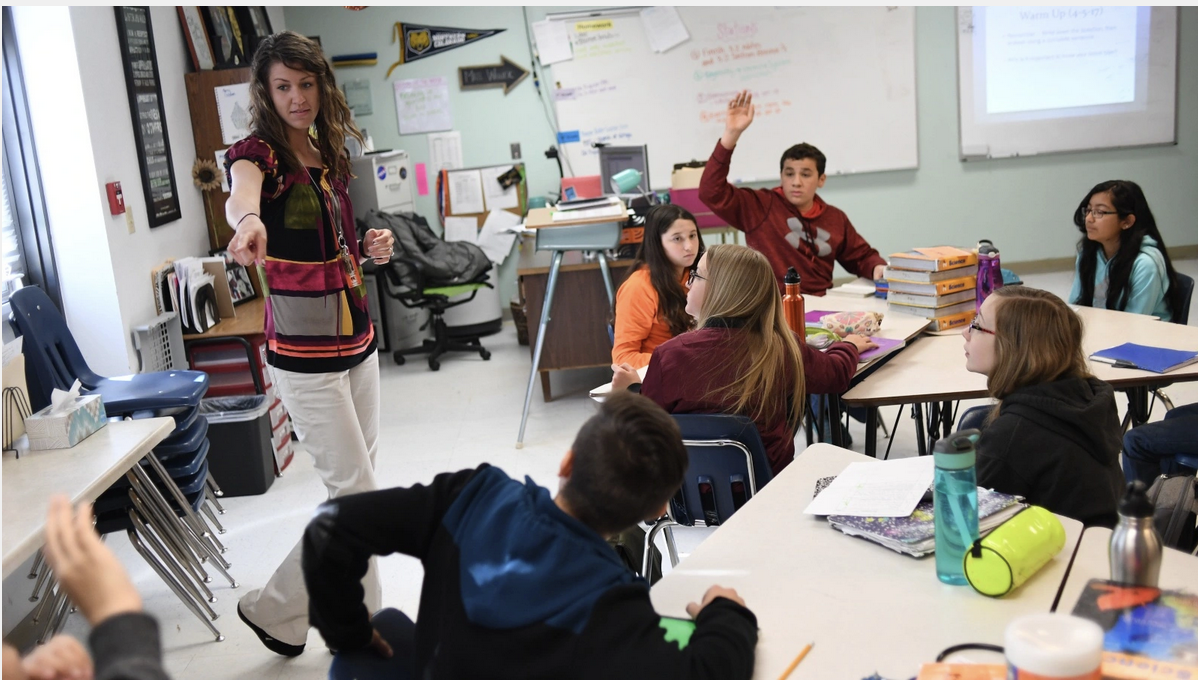
When teachers miss school, finding substitute teachers is an increasing challenge that needs a closer look by journalists

Image generated by artificial intelligence system DALL.E 2,
with directions from Carmen Nobel of Journalist's Resource
Sub vacation: Term used by students when a substitute teacher is present instead of the "real teacher."

By Heather Close
Institute for Rural Journalism

I was a substitute teacher in Monroe County, Indiana, from 1998 to 2000. I covered K-12. Here are some items to consider: Students stole the TV remote, so initially I struggled to start their physics video; once I manually turned the TV on, they kept changing the channel. More than one student went to the bathroom and never returned. A middle-school boy climbed wall shelving filled with Bunsen burners. I sent Spider Boy to the principal. She sent him back with a note to me that read, "I don't have time for this." I did not return to that school, ever. That's why this resonated with me:

"Last school year, almost 3 out of 4 public schools reported higher rates of chronic teacher absenteeism, or teachers missing 10 or more days of work, according to the U.S. Department of Education," reports Denise-Marie Ordway of The Jounalist's Resource, a free academic research group from Harvard Kennedy School. "At the same time, 77% of schools reported having more difficulty finding substitutes to fill in while regular teachers were out, with 61% saying it was 'much more difficult' than it had been before Covid-19 began to spread. . . . As kids make their way from kindergarten through their senior year of high school, they spend an estimated total of almost a whole academic year being taught by subs, on average."

Some areas are going to extremes. "In 2022, staffing shortages were so severe, some public schools closed temporarily and the governor of New Mexico called on National Guard troops to help cover classrooms," Orway reports. In 2022, "The federal government provided $122 billion in emergency relief to elementary, middle and high schools to 'to keep schools safely open, tackle learning loss and mental health.' Since then, many school districts have raised substitute pay or considered it. To expand their pool of applicants, districts in several states have lowered their educational requirements notes a January 2022 report for the National Council on Teacher Quality."

Filling instruction time with adequately trained substitutes needs attention. Orway writes: "Jing Liu, an assistant professor in education policy at the University of Maryland, warned that increasing pay will not, on its own, improve the overall supply of substitute teachers. He urged journalists to investigate the issue more closely." Liu told Ordway, "Similar to regular teaching jobs, substitute teachers care about their earnings as well as working conditions. Some consistent factors that affect substitute teachers’ willingness to teach I consistently find in my study are the challenge of managing student behavior and the lack of support from school administrators and staff members.”

Ordway writes: "To help journalists better understand and cover this topic, we’ve summarized several academic papers and reports that examine teacher absenteeism patterns, substitute recruitment and substitute teachers’ job preferences. You’ll find those summaries below."
  • School district leaders expect the demand for substitute teachers will grow over the next few years. One big reason: As Baby Boomer educators retire, they are replaced by younger educators, many of whom will start families, requiring them to sometimes take parental leave and time off to care for sick children.
  • There are significant differences in teacher absentee rates across school districts. For example, teachers in the District of Columbia missed an average of 6.9 days of school in 2016-17. In Newark, New Jersey, teachers were out an average of 16.7 days.
  • Even before Covid-19, children spent considerable time with substitutes. As kids make their way from kindergarten through their senior year of high school, they spend an estimated total of almost a whole academic year being taught by subs, on average.
  • Veteran educators miss class more often than less experienced ones. High school teachers tend to have higher absence rates than elementary school teachers.
  • In addition to student misbehavior and a lack of support from other school employees, a long commute is another reason subs don’t take jobs at certain schools. The perceived safety of the neighborhood around a school is another factor.
  • Teacher absences are most detrimental to students during the weeks leading up to end-of-year exams and on exam days.
  • When teachers leave their jobs mid-year, their students show smaller gains in math and language arts than kids whose teachers stayed the whole academic year. Teacher departures are more harmful to elementary school students than middle school students.

As Eastern Kentucky climbs the uphill battle to recovery, it has lessons and a warning to share with the nation

A house built with funds from the Housing Can’t
Wait initiative. (Photo form HOMES Inc.)
Six months out from Eastern Kentucky's disastrous summer floods, the area's recovery has lessons for the nation as it struggles to face climate-change challenges, Kim Kobersmith reports for The Daily Yonder. But first things first: "The urgent need for housing assistance shines a light on the complexity of recovery in an already challenged rural area. Their deepest hope is not just to get roofs over people’s heads but also to secure the resources to build stronger, more resilient communities going forward."

Scott McReynolds of the Housing Development Alliance in Hazard told Kobersmith: “We have the opportunity to get it right and economically move the needle for some of the most distressed Appalachian counties. Getting people out of substandard housing in flood prone areas, into safe, energy efficient homes, will give residents the opportunity to create wealth through housing.”

Flooding is not covered in most home insurance policies, and most say they can't afford flood insurance, ao that has creates painful outcomes. McReynolds shares a real-life example: "His house was literally washed away. It was worth about $120,000 and he has a $60,000 mortgage on it. He had no insurance and received the $40,000 FEMA allotment," Kobersmith writes. "He now owes $20,000 on a house that no longer exists and a piece of flood-prone property. Land on higher ground will cost him approximately $30,000. He is facing $50,000 in mortgage obligations before he even begins to build a new home."

HDA's plan includes climate change as part of the new reality, Kobersmith reports: "In anticipation of increasing 'unprecedented' rain events, it states, 'It is clear that simply repairing and rebuilding homes where they were is a short-sighted, inadequate, and dangerous solution. One option is to site homes on higher ground on family land where possible and rebuild with flood-resistant construction techniques. . . Area leaders anticipate these types of disasters will continue to occur more frequently and intensely due to climate change. Their experiences in Eastern Kentucky have shown the recovery system in the U.S. is not up to the task."

Democratic Gov. Andy Beshear has announced two new housing-development sites on higher ground, but the Republican-controlled legislature passed a flood relief package without any funds designated for housing. But local efforts are energized. Housing Can’t Wait committed "to build 12 new houses. . . It was about more than recovery; it was a challenge aimed at elected officials," Kobersmith reports. "The Foundation for Appalachian Kentucky contributed more than $1 million towards the effort. . . . social investment platform Invest Appalachia has given two innovative five-year conditional repayment grants."

Calif. offers Colorado River plan, saying lack of consensus means 'law of the river' rules; that law favors Golden State

The Colorado River flows near Hite Overlook, Utah, upstream from
Lake Powell. (Photo by Carolyn Cole, Los Angeles Times)
California has entered the Colorado River water battle royale with a counter-proposal that refutes plans from the other six states in the watershed and says their plan "would disproportionately burden farms and cities in Southern California," reports Ian James of the Los Angeles Times. Wade Crowfoot, the state’s natural resources secretary, told James, "It doesn’t seem like a constructive approach for some states to fashion a proposal that only impacts the existing water security and water rights of another state that’s not part of that proposal.”

The “consensus-based modeling alternative” plan offered by Arizona, Colorado, Nevada, New Mexico, Utah and Wyoming included "an accounting for evaporation and other water losses along the lower portion of the river — a calculation that would translate into especially large reductions for California, which uses more Colorado River water than any other state," James writes. "Crowfoot said the other states had devised an approach that would go beyond anything established in the agreements and laws that govern how the Colorado River is managed and used. . . . The proposal by California water agencies, in contrast, lays out practical and achievable changes that can be made starting this year to stabilize reservoir levels."

California officials noted that the state has water rights that are senior to those of the other states, but “I don’t think there is disagreement on the magnitude of the reductions that are needed,” John Entsminger, general manager of the Southern Nevada Water Authority, told James. “We need this magnitude of cuts in order to stabilize the system. . . . he’s hoping “we can come up with something everybody can live with.”

J.B. Hamby, chair of California’s Colorado River Board, told James, the state’s alternative “provides a realistic and implementable framework by building on voluntary agreements and past collaborative efforts in order to minimize the risk of legal challenge or implementation delay. . . . California is not wavering from our legal position. We continue to look forward to developing a seven-state consensus if possible, but in the absence of that, it defaults to the law of the river.”

Expert opinion: 'The new normal cannot fall back to a pre-Covid normal; we must be bigger, better and smarter'

By Katelyn Jetelina
Your Local Epidemiologist

On Monday the World Health Organization’s Emergency Committee gave official word that they voted to renew the Public Health Emergency of International Concern. They are likely teeing up for “the end” in 2023. The U.S. is far more confident in “the end” of the national emergency. On Monday, the White House announced that they are ending it in mid-May.

An inflection point is clearly on the horizon, albeit with uncertainty. This leads to legitimate questions: Are we still in an emergency? What will the future hold? What happens next?

Are we still in an emergency? There is no “level of disease” that defines a pandemic or emergency. Even if there was an objective metric, the reality is that this isn’t determined through epidemiology alone. Where we, as a society, place SARS-CoV-2 in our repertoire of threats is a collective decision—a psychological, cultural, and political decision. Every day we consciously (or subconsciously) decide how much risk and suffering we are willing to accept: How many people get the booster? How many people wear a mask? How many people order free antigen tests? How many deaths, and among whom, are we willing to accept?

This has sparked an intense tug-of-war among scientists, leaders, and the public throughout the pandemic: a push towards “normalcy” from some and push back towards “urgency” from others. All individuals and societies fit somewhere on this spectrum. And one’s position may (and perhaps should) change with time.

How did winter play out? How we fared this winter gives us a good idea as to whether we are still in “emergency” phase in the U.S. We essentially had two tests:

How well did our immunity hold up against a constantly changing Omicron? According to varying hospitalization models from early fall, the 2022-23 winter played out as a best-case scenario for Covid-19. Even the best-case scenario, though, led to a peak of 48,000 hospitalizations.
Projections of hospitalizations, from CDC's Advisory Committee on Immunization Practices meeting on Sept. 1, 2022

Could our hospital systems handle the stress of a novel virus on top of the “normal” respiratory viruses? We hadn’t previously seen the impact of all of them at the same time. In addition, health-care workers are increasingly burnt out, and hospitals are increasingly understaffed. Given all of this, hospitals did okay this winter. Pediatricians were drowning, particularly because of a massive RSV wave. Emergency rooms were overcrowded with sickness. But a Covid-19 emergency declaration wouldn’t necessarily help with either of these. Hospitals were not overwhelmed with adults because of our immunity wall, and I’m increasingly convinced there was viral to viral interaction—in other words, we didn’t see all three viruses peak at the same time.

Given this, I agree that we are not in an emergency phase in the U.S. An emergency declaration was appropriate when we had rational hope that transmission could be interrupted on a population level and when we needed extreme measures to prevent collapse of healthcare systems. We are past this. Continuing the emergency would not be constructive given public sentiment and lack of funding anyway. As one epidemiologist told me, “If it’s always an emergency, nothing’s an emergency.”
What will the future hold?

If we end the emergency, it begs the question: What phase are we in?

I don’t believe we are in an endemic phase— a state of predictability. I think we are on our way, and Covid-19 will eventually fall into seasonal patterns. But this will likely take years. Until then, we will be in an awkward space between pandemic and endemic. Epidemiologists don’t have an official word for this phase. WHO flu risk management people would probably call this the “transition” phase.
Graph from World Health Organization pandemic risk management guide

We will continue to see the virus ebb and flow—it will mutate, we will get waves, people will continue to miss work and daycare, and people will continue to be hospitalized and die, particularly those over 65 years and immunocompromised. The end of an emergency does not mean the end of disruption or suffering.
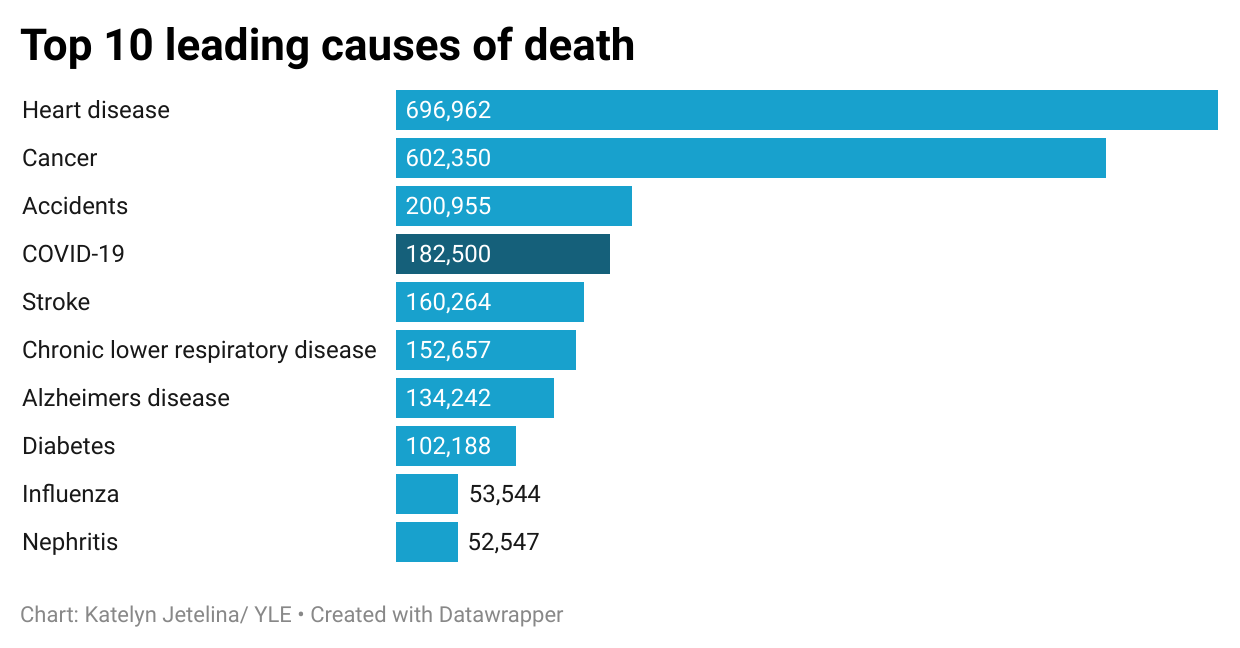
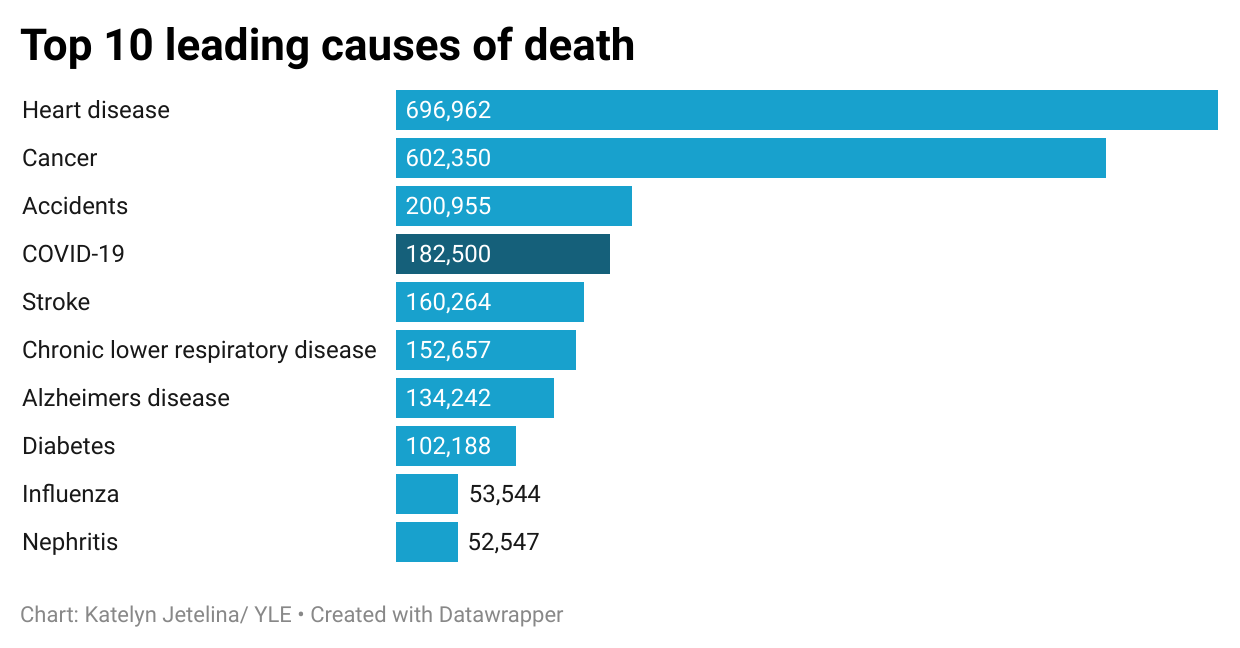
Deaths from Covid-19 are projected for 2023; data from CDC, here

Today, roughly 500 Americans are dying each day from Covid-19. At this rate, SARS-CoV-2 will be the fourth leading cause of death in the U.S. in 2023—about triple the threat of influenza.

What happens next?

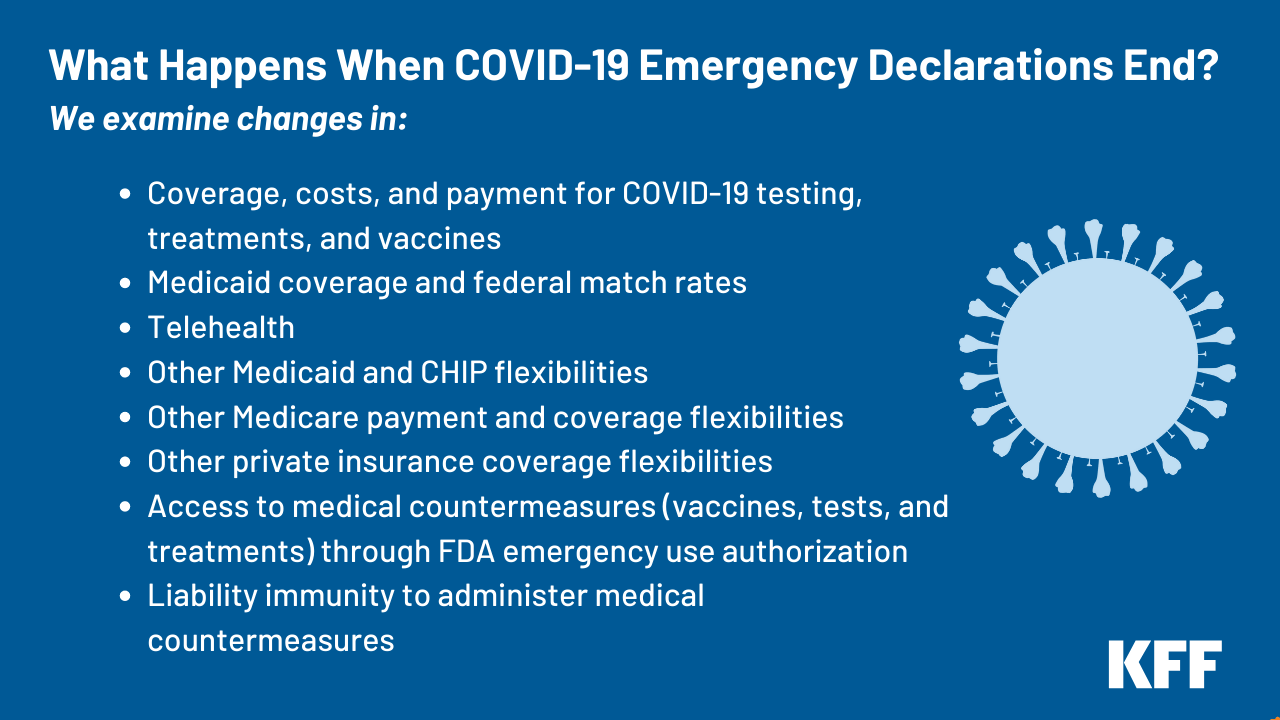
Unraveling the public-health emergency may get messy. It will certainly take time (hence the 3 month lag time). The Kaiser Family Foundation outlined the implications nicely:
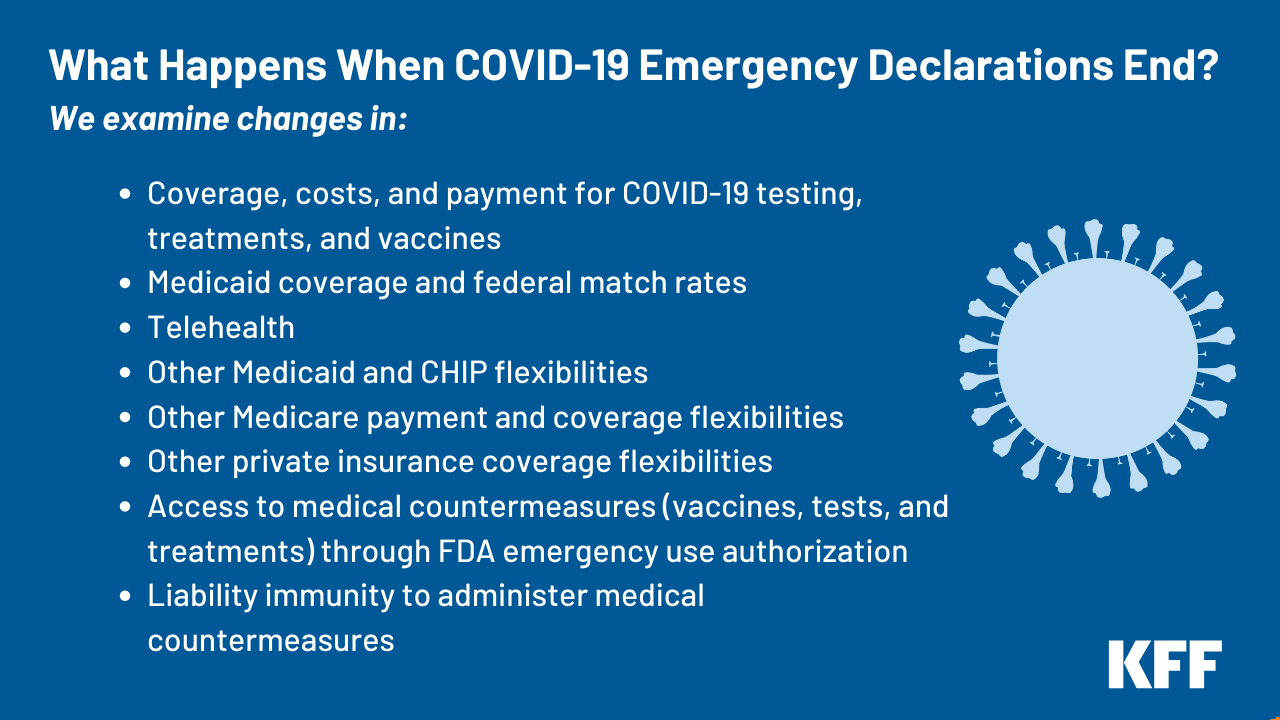

This does not impact the Emergency Use Authorization of vaccines and therapeutics from the FDA. In other words, these will still be available.

HOWEVER, the ending of funding for testing and vaccines is a real cause for concern. Once our free supply is out, everything will be privatized. Pfizer announced its vaccine will cost $130 per dose. Insurance will have to cover it, like the flu vaccine. This will, no doubt, fuel deep inequities in the U.S. And it is part of a much larger, deeply flawed system of pharmaceutical profiteering that this country hasn’t got the ethical fortitude to address yet.

Our work is not done: Most importantly, the end of the emergency doesn’t mean our work is done. There is no infectious disease more insidious or with greater impact on global mortality, morbidity, and health care systems than Covid-19.

As individuals, we still need to get vaccinated. We still need to leverage antigen tests. We need to invest in better filtration and ventilation. We still need to protect the most vulnerable.

As public-health officials, we must decide the minimum structure needed moving forward. Invest in wastewater monitoring. Continue to report hospitalizations (and get better at it). Commit to transparent and effective communication. Vaccine innovation is needed.

As a society, we MUST put real energy, innovation, and investment into repairing and strengthening our health and public health systems. The new normal cannot fall back to a pre-Covid normal. We must be bigger, better, and smarter. This means the very notion of for-profit healthcare needs to be fixed. In public health, we must figure out how to get out of the cycle of panic and neglect through preparation. We are LESS prepared for the next pandemic, given loss of trust, polarization, changing information echo-systems, and mis/disinformation.

Sadly, I’m starting to see denial and wishful thinking. I hope this changes as it will definitely not be another 100 years before the next pandemic emerges to grip the globe in a choke hold.

Bottom line: In the U.S., the end of the emergency is coming. I agree with this decision, but this certainly isn’t the end of Covid-19 or public health threats. In fact, this end is the beginning. We have our work cut out for us.

Katelyn Jetelina is a California epidemiologist and biostatistician who says she writes her newsletter on Substack as a way to translate public-health science for everyday use, helping people to make evidence-based decisions. She is a consultant to several organizations, including the CDC.