Thursday, February 16, 2023

'East Kentucky Flood' tells the story of a deadly disaster, a courageous and heartfelt recovery, and an uncertain future

Rockhouse Creek, a major tributary of the North Fork of the Kentucky River, flooded Isom and its supermarket.
The record flash floods in southeastern Kentucky last summer killed 45 people and worsened a regional housing shortage. More than six months later, hundreds of people are still staying in campers or substandard housing, Bill Estep of the Lexington Herald-Leader reports. Some people in the region worry that it will become depopulated, but others see the flood as an opportunity to build back better. They're the stars of a half-hour documentary, "East Kentucky Flood," produced by the Center for Rural Strategies in Whitesburg, one of the flooded towns.

Letcher County, Kentucky (Wikipedia)
Like all well-told stories, this one is in three parts: Stories of the flood and its close calls, the courageous and heartfelt response, and the ongoing recovery and prospects for the future. And it focuses on one Appalachian county, Letcher, which has the headwaters of three rivers. The villain in this story, funded by the Flora Family Foundation, is the North Fork of the Kentucky River.

A man recalls the waters rising around him: “It was everything I could do to keep my feet on the ground.” Another tells of a woman in her late 70s who uses a walker but hung on to the roof of her front porch for five hours awaiting rescue. Whitesburg firefighter Charles “Red” Colwell found a woman neck-deep in water and couldn’t get her into a kayak: “I just found some adrenalin and I just was able to put her in that kayak. I said, ‘We have to go. We have to go now. I cannot swim.’”

Much help came from “the hillbilly refugees, the people who have moved out of here,” recalled Gwen Johnson of the Hemphill Community Center. “They knew we weren’t gonna get any help from anybody else,” and started making contact. “When the roads opened up, they rolled in here.” She said three “drunk angels” arrived with a load of meat and “stayed with us three days, and I don’t think they drew a sober breath while they was here, and they just kept on a-cookin’.” 

But much help has also come from local residents, including fellow victims. Huffman said, “I noticed that the ones who lost so much have been trying to help everybody else.”

Appalshop filmmaker Willa Johnson recalled, “I didn’t know the people who were showing up to help me – or it was people I never expected show up to help me. People who have very openly disagreed with me on politics – it’s become a line in the sand for us, and we just can’t talk – were showing up.”

Photographer Malcolm Wilson of Blackey said he made 2,500 images of the flood, “some of the hardest photographs I’ve ever made in my life. . . . Some things I didn’t photograph, that I saw; I just couldn’t bring myself to do it . . .  The other thing that really blew me away was the Isom IGA.”

Simon and Gwen Christion in their Isom IGA, being rebuilt (Images from documentary)
The rural supermarket's owner, 67-year-old Gwen Christon, who had spent 50 years in it, told the filmmakers, “For a week, I actually walked around in shock, wondering what I was going to do.” But her tragic story brought outside help, and a determination to reopen, with the help of her son, Simon, who decided two years ago to follow in her footsteps. She said she worked 50 years to buy the store and pay the mortgage, and he said “I’m next in line to work another 50 years and get it paid up.” She said, “We plan on opening April 1, 2023. This is our home. This is our people, and we have to stick together. . . . I think we can come back stronger. I think we can come back more together.”

Angie Hatton hopes that's true. The former state representative, defeated for re-election due to gerrymandering fostered by long-term population loss, said tearfully, “I just don’t want people to move away. The people who’ve stayed have been so brave to try and stay, you know . . . We can do a lot with a little here; we always have been able to. And for those who are moving away, I get it, you know, I understand, but I just hope we can find a way to build housing up off of the creeks, flood-proof our bridges and use this disaster was, instead of the end of us, as a catalyst for a new beginning for everything that makes it hard to live in Eastern Kentucky.”

Coal companies own most of the high ground. Educator Jeff Hawkins mentions coal without saying the word: “Part of the struggle has been that we have been so closely connected to a single industry; it has really driven our economic base and our personality and who we are for a century.”

Wes Addington of Appalachian Citizens Law Center said as he was surrounded by relatives’ homes: “It’s really difficult to figure out, well, how do you move away, or how do you leave the place? And I haven’t mentioned, it’s like, a beautiful part of the country. It’s a really pretty place to live.”

But how does it build back better? “Frankly, it's gonna require a lot of federal money – and interest in, you know, supporting a region that’s really supported a lot of the rest of the country’s growth over the past 100 years," Addington said. "That’s what I hope happens. I think it’s really uncertain.”

WEKU-FM has concluded its six-part series "Rise" about the flood and recovery. The opening narrative for the closing episode: "While still adjusting to such heavy loss and amid much uncertainty, Eastern Kentuckians are giving careful consideration to the future. In addition to addressing the immediate need for housing on higher ground, that future includes preparing for the possibility of more frequent extreme weather. Is this a turning point? Or just another turn on the curvy road ahead? Residents demonstrate the most important key to a strong community is knowing how to show up for your neighbors."

Train that derailed Feb. 3, creating a dangerous disaster, wasn't labeled hazardous; critics see lax federal monitoring

Photo Gene J. Puskar,  The Associated Press
The official website for East Palestine, Ohio, calls itself "The place you want to be." But at 9 p.m. on Feb. 3, a Norfolk Southern train chugged through, and no one in the town of 5,000 knew the cars were carrying hazardous chemicals. The train derailed, followed by an explosion, a dangerous fire and a controlled burn that released more toxins.

"Among the chemicals the freight was carrying, five cars contained vinyl chloride, a colorless gas that is linked to various cancers and is used in a variety of plastic products and manufacturing," reports John McCracken for Grist. "In the initial days after the derailment, temperatures rose in the cars holding the vinyl chloride and officials at both the railroad company and the U.S. Environmental Protection Agency ordered that residents evacuate East Palestine" while they conducted a controlled burn of some cars. Gov. Mike De Wine "two bad options," McCracken reports. "Do nothing and risk that a train car full of vinyl chloride would explode, which would have been 'catastrophic,' resulting in shrapnel flying out in a one-mile radius. The second option won."

East Palestine in Columbiana County, Ohio (Wikipedia)
DeWine "said he learned that the train cars were marked as non-hazardous, and thus officials weren’t notified that the train would be crossing through the state," McCracken writes. "He called on Congress to look into the regulations that would allow a train carrying multiple cars with hazardous substances to be labeled non-hazardous." He said, “We should know when we have trains carrying hazardous materials that are going through the state of Ohio." 

"About 4.5 million tons of toxic chemicals are shipped by rail each year and an average of 12,000 rail cars carrying hazardous materials pass through cities and towns each day, according to the U.S. Department of Transportation, reports Tom Perkins of The Guardian. "Ineffective oversight and a largely self-monitoring industry that has cut the nation’s rail workforce to the bone in recent years as it puts record profits over safety is responsible for the wreck, said Ron Kaminkow, an Amtrak locomotive engineer and former Norfolk Southern freight engineer" and secretary of Railroad Workers United, "a non-profit labor group that coordinates with the nation’s rail unions."

“The Palestine wreck is the tip of the iceberg and a red flag,” Kaminkow told Perkins. “If something is not done, then it’s going to get worse, and the next derailment could be cataclysmic.” Perkins notes that the Transportation Department "in 2020 approved a rule to allow liquified natural gas, or LNG, to be shipped via rail with no additional safety regulations. Trains can now run 100 or more tank cars filled with 30,000 gallons of the substance, largely from shale fields to saltwater ports. The decision was opposed by local leaders, unions, fire departments and the National Transportation Safety Board."

Dismal report on public trust in news is not so bad for local news, but has many warning signs – and some guidance


By Al Cross
, Director and Professor
Institute for Rural Journalism and Community Issues, University of Kentucky

The national headline on stories about the latest poll on the news media and democracy were about its finding that half of Americans believe national news organizations deliberately "mislead, misinform or persuade the public to adopt a particular point of view through their reporting," as Associated Press media writer David Bauder put it. "In one small consolation," Bauder reports, "Americans had more trust in local news."

For people in local news, it's not a small consolation. The survey by Gallup and the Knight Foundation, of 5,593 Americans aged 18 and older between May 31 and July 21, 2022, shows a much higher level of trust in local news organizations, driven in large measure by a belief that they care about the impact of their reporting; 53% agreed with that statement and 19% disagreed with it. "The biggest differentiator is that the public feels local news organizations care about the impact of their reporting while national news does not," Knight says in its report.

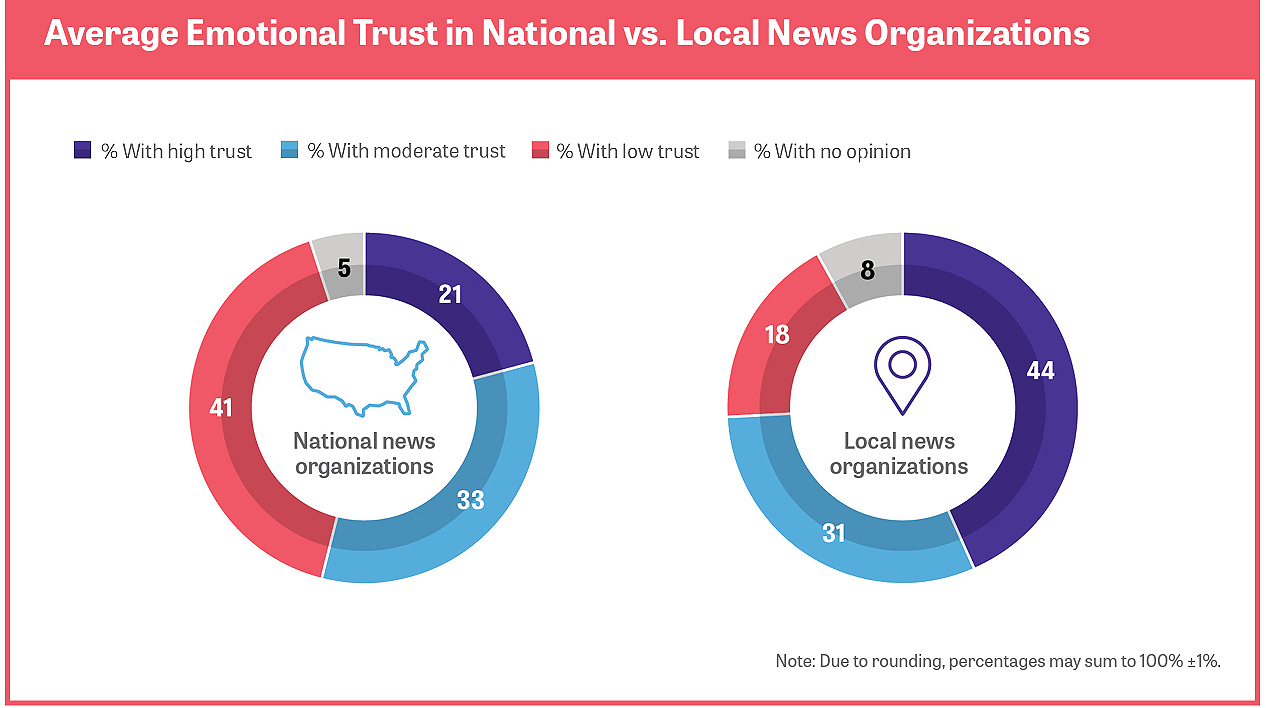
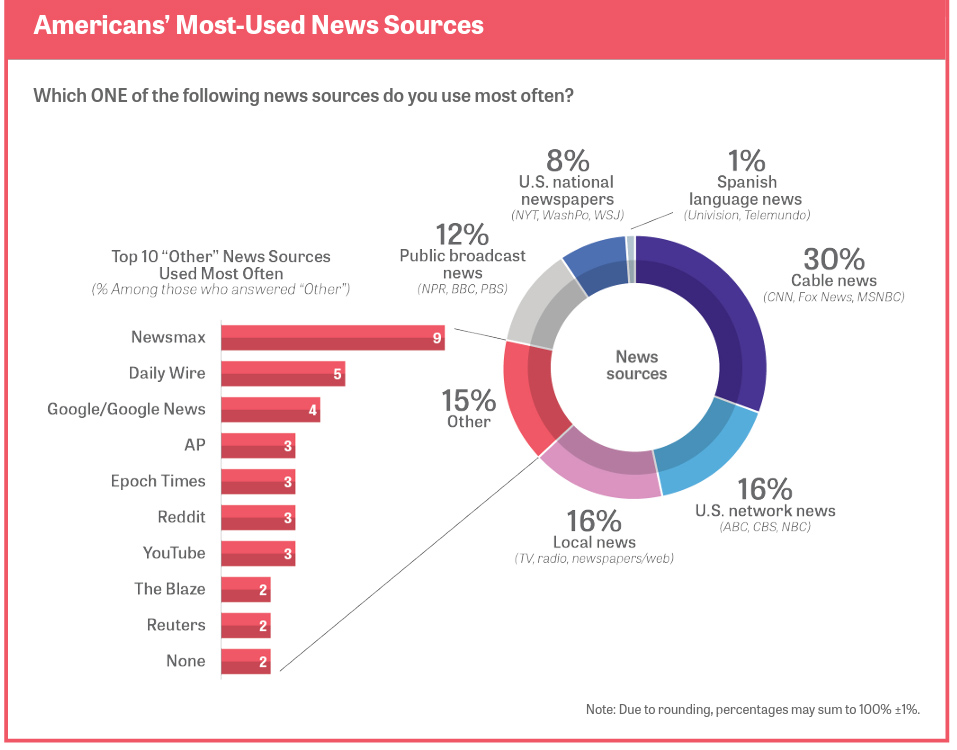
Graphs by Gallup Inc. from Knight Foundation report; click any image to enlarge
"While past investigation of trust in news has focused on issues of transparency and credibility, recent research has emphasized the affective or emotional aspects of trust — that is, how trust in news is related to how people feel about news outlets," Knight repots. "Emotional trust in news is driven by the belief that news organizations care, report with honest intentions and are reliable. More than twice as many Americans report high emotional trust in local news than in national news; 44% have high emotional trust in local news organizations, compared with 21% who have high emotional trust in national news organizations. . . . Greater emotional trust in local news is consistent across various demographic groups. Variation in levels of emotional trust in local news organizations is less pronounced across demographic groups. For example, 31% of Republicans and 58% of Democrats express high levels of emotional trust in local news — a narrower gap than with emotional trust in national news. This finding is consistent with findings from previous Gallup/Knight studies."

So, Americans trust their local news organizations, but do they really know them? The poll found that 65% agreed with the statement "In general. most local news organizations have the resources and opportunity to report the news accurately and fairly to the public," but the question left much to be desired. Most Americans are not familiar with "most local news organizations," and many if not most of those organizations are having difficulty reporting as much news as they once did or would like to do. Accuracy and fairness are essential, but audiences notice gaps in coverage, and that could have been measured, too.

Bauder describes one other hopeful finding: "If Americans believed local news organizations didn’t have the resources or opportunities to cover the news, they would be more likely to pay for it." Knight reports, "Americans who think local news organizations lack the resources and opportunity to report the news accurately and fairly are more likely to pay for news. . . . Among those who agree, 23% report having paid for news in the past. This percentage nearly doubles (45%) among those who disagree. Those who say local news organizations do not have the resources and opportunity to report the news accurately and fairly are more than twice as likely to be willing to pay for news in the future as those who agree (32% vs. 14%, respectively). These findings mirror previous Gallup/Knight research on local news, which found that Americans who are exposed to information about the financial challenges of local newspapers are more likely to donate to a nonprofit organization that supports local journalism."

Knight says journalists need to go beyond emphasizing transparency and accuracy to show the impact of their reporting on the public. That recommendation is directed to national news organizations, but it's good advice for local news organizations, too. And the study reaffirms that they need to do that online, because that's where most of the audience is. The poll found that 58% of Americans in mid-2022 reported getting most of their news online, up from 46% in 2019. Television was named by 31%, down 10 points from 2019. Only 3% named printed newspapers or magazines, down from 5%.

Another interesting finding, described by Bauder: "The ability of many people to instantly learn news from a device they hold in their hand, the rapid pace of the news cycle and an increased number of news sources would indicate that more Americans are on top of the news than ever before. Instead, an information overload appears to have had the opposite effect. The survey said 61% of Americans believe these factors make it harder to stay informed, while 37% said it’s easier." That finding doesn't differentiate between national and local news, but the poll seems to confirm a trend pointed out by many observers, that people are paying less attention to local news than they once did. Local news providers must give them reasons to seek it out, make it easy to do so, and make clear its value.

Wisconsin EMT shortage leaves rural responses uncertain

Glidden Ambulance provides emergency medical services
to four northern Wisconsin towns. (Photo by Danielle Kaeding,WPR)
Calling 911? You expect a quick-volley conversation and help to arrive. In many rural communities that depend on volunteers to staff ambulances, that help has been slow or non-existent, as The Rural Blog reported last week. In Wisconsin, the lack of emergency medical technicians is sobering. "A recent survey of ambulance services found staffing and financial challenges have left many on the brink of collapse, leaving them unable at times to respond to 911 calls," reports Danielle Kaeding of Wisconsin Public Radio. "Services in Wisconsin have long-relied on volunteers. . . . Over time, a lack of volunteers and inadequate funding have left some communities struggling to provide service." The survey was conducted in late 2022 by the Wisconsin Office of Rural Health.

James Small, who manages the state's rural emergency medical services outreach program, "said 41 percent of the 218 services that responded didn’t have enough volunteers to respond to 911 calls at times within the last year. The survey found 21% of services only had a crew of two or three people to provide around-the-clock coverage — the bare minimum required in Wisconsin," Kaeding notes. Small told Kaeding, "That's putting them in a very, very precarious position as far as being able to continue responding to calls."

"Cari Broge, service director for Glidden Ambulance, said she has 10 volunteers that receive a stipend to respond to about 100 calls each year for four northern Wisconsin towns," Kaeding reports. "Two of those towns lost service for roughly half a year in 2021 when their previous provider ended its contract. Often, she said, only two people can respond to calls during the work day when it's most challenging to find volunteers." 

Alan DeYoung, executive director of the Wisconsin EMS Association, told Kaeding that the recent survey found 41% of services have six or fewer staff. Rural areas like northern Wisconsin have confronted greater challenges and longer response times, but urban and suburban departments aren’t immune. DeYoung told Kaeding, "Everybody is struggling with staffing. So as your department is unable to staff a 911 call, and you call mutual aid to another department, and they have the same staffing crisis happening, they're not able to go either." At its worst, the survey found 911 calls went unanswered by ambulance services in at least 10 communities.

"The Wisconsin EMS Association wants the state to devote more funding to the issue to help with attracting and retaining people to staff services," Kaeding adds. "Just under one-third or 29 percent said they don’t have adequate funding to operate through this year as communities have faced declining state aid . . . DeYoung noted that communities like Washburn (pop. 2, 000) have passed referendums to exceed their tax levy to address EMS staffing."

Small told Kaeding, "It's taken for granted that if something bad happens, I can just pick up my phone and dial 911, and something good will happen. And we're finding that we took it for granted for a long time because that was the case for a long time, and we're not in that place anymore." 

‘Right to repair’ farm equipment pushed in 11 states; makers cite intellectual-property and environmental issues

A combine harvests grain in northeastern Colorado.
(Photo by Danny Wood via Associated Press)


A big thunderstorm blows through, and your electricity goes out. You wait. You can't fix the electricity on your own and some waiting is expected, but do you want to wait three days? Five days? Should the wait cost you thousands of dollars?

That's the bind many American farmers face when their equipment needs repairs, reports Jesse Bedayn of The Associated Press. Bedayn introduces Colorado farmer Danny Wood as an example: "Wood scrambles to plant and harvest proso millet, dryland corn and winter wheat in short, seasonal windows. . . until his high-tech Steiger 370 tractor conks out. . . . The tractor’s manufacturer doesn’t allow Wood to make certain fixes himself, and last spring his fertilizing operations were stalled for three days before the servicer arrived to add a few lines of missing computer code for $950. . . . [this common plight] has pushed lawmakers in Colorado and 10 other states to introduce bills that would force manufacturers to provide the tools, software, parts and manuals needed for farmers to do their own repairs — thereby avoiding steep labor costs and delays that imperil profits." Wood told Bedayn, “That’s where they have us over the barrel, it’s more like we are renting it than buying it." Wood spent $300,000 purchase his used tractor.

"Right to repair" laws have gained traction, "In 2021, the Federal Trade Commission pledged to beef up its right to repair enforcement at the direction of President Joe Biden," Bedayn writes. "And just last year, Rep. Brianna Titone sponsored and passed Colorado’s first right to repair law, empowering people who use wheelchairs with the tools and information to fix them."

But there is the other side: "Manufacturers argue that changing the current practice with this type of legislation would force companies to expose trade secrets. They also say it would make it easier for farmers to tinker with the software and illegally crank up the horsepower and bypass the emissions controller — risking operators’ safety and the environment," Bedayn reports. "Similar arguments around intellectual property have been leveled against the broader campaign called ‘right to repair,’ which has picked up steam across the country."

Bedayn notes, "Rep. Richard Holtorf, the Republican who represents Wood’s district and is a farmer himself, said he’s being pulled between his constituents and the dealerships in his district covering the largely rural northeast corner of the state. He voted against the measure because he believes it will financially impact local dealerships in rural areas and could jeopardize trade secrets. Holtorf told Bedayn, "I do sympathize with my farmers. I don’t think it’s the role of government to be forcing the sale of intellectual property.”

"The bill’s proponents acknowledged that the legislation could make it easier for operators to modify horsepower and emissions controls," Bedayn reports. "But argued that farmers are already able to tinker with their machines and doing so would remain illegal."

Flora and fauna quickies: Falco the Owl; Great Backyard Bird Count starts tomorrow, trees can add years to your life

Flaco's ability to hunt for himself prompted zoo officials to scale back
retrieval efforts. (Photo by Jacqueline Emery, The New York Times)
Get set! The 26th annual Great Backyard Bird Count will be held Friday, Feb. 17, through Monday, Feb. 20. How? For as little as 15 minutes, perch yourself and participate in this free, fun and easy event that engages bird watchers of all ages in counting birds to create a real-time snapshot of bird populationsParticipants are asked to count birds on one or more days of the four-day event and report their sightings online at birdcount.org.

Falco the Owl, who was inadvertently released from New York City Zoo, has proven that 13 years of captivity can't keep an owl from being an owl. Zookeepers originally feared that Falco would not be able to hunt successfully, but he's a quick study: his activities had included facing off with a Cooper’s hawk, at least one close encounter with a squirrel, foray onto Fifth Avenue near Bergdorf Goodman and catching his own rats for dinner.

The keys to a long life can seem elusive, but here's one idea that isn't tricky: plant a tree. A recent study conducted in Portland, Ore., found that in neighborhoods where a nonprofit planted more trees, fewer people died. The findings are in line with results from other researchers suggesting nature is good medicine for many ailments, including depression and high blood pressure.

Meet a U.S.-based search and rescue team of four humans and a K-9 dog named "Peter Pan." This crew was flown to Turkey in response to the earthquakes to search for people among the rubble. K-9 dogs can differentiate between people who are dead and people who are alive. They can also tell the difference between the scent of someone who's been out in the fresh air and someone who's been confined.

Humor is a powerful weapon against despair. Follow Bipolar Bear as tries to navigate the fictituous WeCare Co., complete with cigar-smoking felines who profit unfairly from a lopsided economy and a corrupt justice system. His fellow outcasts include such characters as an over-educated owl drowning in student debt and a bomb-sniffing puppy suffering from PTSD. Kathleen Founds says her experiences wit the U.S. health-care matrix led her to write this amusing, yet dark tale.
                                                                                                       
Lake Oroville (Photo by Brian van der Brug, L.A. Times)
Photo-journey of Lake Oroville before and after California's epic storms. The largest reservoir in the State Water Project was at 68% of its capacity on Friday, up from 28% just two months ago. The project is a system of reservoirs, canals and dams that serve about 27 million people.

River otters have returned to Florida, and their presence indicates a healthy ecosystem. The otters are native to Florida, but have not always been seen. Some advice: Yes, they are super-cute, but they have a dark side that involves hissing and sharp teeth. If you're walking your dog and and you run across one, go the other way.

Meet Melissa, who works at her family's dairy farm in the small northwest Massachusetts town of Buckland. Melissa is also a professional trumpet player. During Covid, Melissa learned that her cows really enjoyed her trumpet playing. Although Melissa prefers to play in an orchestral group vs. a cow pasture, she's open to hosting a summer concert at her farm someday.

Wednesday, February 15, 2023

Jim Boone, who built a chain of newspapers, dies at 87

Jim Boone
James B. “Jim” Boone Jr., who built the ninth largest newspaper company in America, by number of newspapers (about 70), died Feb. 13 in Birmingham after a brief illness. He was 87.

Boone succeeded his father, Buford Boone, as publisher of The Tuscaloosa News in 1968 and built "a community media company that now owns or manages 91 newspapers and related print and digital products in Alabama, Georgia, Kentucky, Louisiana, Michigan, Minnesota, Mississippi, North Carolina, Ohio, Tennessee, Texas and Virginia," the Boone Newsmedia Inc. obituary said, adding that he "remained active in BNI and with its affiliate newspapers until his death."

"He worked until 5 p.m. on Friday of this past week," his youngest daughter, Vicksburg Post Publisher Catherine Boone Hadaway, told the News. "He believed in the mission of newspapers, to make the community better; to be an advocate and voice for the community."

A 1958 graduate of the University of Alabama, Boone received many honors, including the Alabama Business Hall of Fame, the Lifetime Achievement Award from the Alabama Press Association; the Casey Award from the University of Minnesota for leadership in the newspaper industry; and the Frank Mayborn Award from the Southern Newspaper Publishers Association for leadership.

“Jim Boone, by his example, set the highest bar for so many for how to lead and serve a community, civic organization, church, a business organization or his family,” said Todd Carpenter, president and CEO of Boone Newsmedia and Carpenter Newsmedia. “Put simply, he made doing the right thing the main thing and that guided his every choice and decision. He was also dedicated to recognizing talent in every person that perhaps they did not know they had, then with sincere determination he dedicated himself to guiding, leading and driving them to reach their highest potential. All who knew Jim benefitted from his benevolent interest, first in their welfare as a human being, followed by wisdom and guidance he gave generously to all that is both uncommon and special.” 

Boone is survived by his wife, Carolyn, and five children. His funeral is set for 1:30 p.m. Saturday, Feb. 18, at the Lowndesboro Methodist Church, followed by a graveside service at Oakview Cemetery in Lowndesboro and a gathering at The Marengo House, 100 N. Broad St., Lowndesboro.

Federal and state officials erased a Black cemetery; their only public notice was a legal ad too many people missed

Mike and David Moseley at an ancestor's grave
(Photo by Christopher Smith for ProPublica)
Construction site excavators often unearth surprises, but what comes after the find can be more disturbing.

"Nobody working to bring a $346 million Microsoft project to rural Virginia expected to find graves in the woods . . . but surveyors happened upon a cemetery. The largest of the stones bore the name Stephen Moseley in a layer of cracking plaster. Another stone, in near perfect condition, belonged to Stephen’s toddler son," reports Christopher Smith for ProPublica.

"This is not as bad as it sounds," an engineering consultant wrote in March 2014 to Microsoft and an official in Mecklenburg County, Virginia, who was helping clear hurdles for the project — an expansion of a massive data center. "We should be able to relocate these graves." But archaeologists, which federal law required, said the cemetery was eligible for the National Register of Historic Places because it was for "a community of landowners who farmed tobacco in the wake of the Civil War and Reconstruction," Smith writes. Their report "stressed the cemetery’s significance to African American life and death, citing the fact that Stephen Moseley and his relatives were Black,' and advising: "It is recommended that the area be avoided."

The county and consultants challenged the recommendation. "They sent the report to another archaeologist, seeking a second opinion," Smith writes. "But the archaeologist didn’t go along. . . he rejected the notion that some of the people buried there might be white. 'Jim Crow would not have had whites and blacks buried that closely together,' he wrote. . . . He suggested that the original firm conduct additional historical research. 'More work needs to be done on Moseley family members to identify who’s in the graves,' he wrote in an email to Jones’ boss, who forwarded it to the county. . . . The county and its consultants ignored the advice."

The county and consultants continued to pursue the property for Microsoft. They "ran a legal notice tucked among the ads and classifieds in several weekly print editions of The Mecklenburg Sun," Smith reports. "The second week the notice ran, the paper published a front-page story [about another subject] under the byline Mike Moseley. Moseley is a staff writer. He is also Stephen Moseley’s great-grandson. . . . Mike Moseley would not have been hard to locate, had the county actually tried to find Stephen Moseley’s descendants." Mike Moseley told Smith, “Everyone who works for the county knows me. They know who we are. It’s hard to understand how they didn’t come talk to us.”

When Smith asked Moseley "if he’d seen the notice in the pages of his own newspaper, he responded: 'Do you read the classifieds and the ads? I do not.' . . . Like his nephew, David Moseley heard nothing from the county about the threat to the cemetery. The soft-spoken retired schoolteacher and administrator, who is now 85, grew up on the land adjacent to where Microsoft was building its data center." He told Smith, “Somebody would have called me if they moved the cemetery."

Smith reports, "In the months after the notice that ran in The Mecklenburg Sun, workers kept finding graves, ultimately 37 of them. . . . A crew dug up each of the graves, collecting bones, casket fragments, metal handles and hinges, etched epitaph plaques, a pair of eyeglasses, an ivory comb. The remains and other items were packed in plastic crates and stored in an office. Months later, all of it was reburied in four tightly packed, $500 cemetery plots one town to the north." The county did not reply to Smith's questions about the handling of the issue, Other than County Administrator Wayne Carter saying the newspaper notice was sufficient to comply with the law.

Smith writes: "In Mecklenburg County, before Microsoft took possession of the land — for free, with significant tax breaks, along with state development dollars earmarked for struggling tobacco farming regions — the Army Corps [of Engineers] raised no concerns about the development’s compliance with the [National Historic] Preservation Act. Nor did the Virginia Department of Historic Resources, the agency tasked with enforcing state and federal preservation laws, make any effort to step in and protect the site. . . . The Army Corps and the Department of Historic Resources facilitated the cemetery’s legal erasure."

David Moseley and other family members, "still own the eastern 83 acres of the property," Smith writes. "Every so often, David Moseley or another family member gets an offer to buy their remaining land. Sometimes the correspondence is signed by Wayne Carter, the county administrator who oversaw the permitting process for the Microsoft data center. David asked Smith, "If they can find us to buy the land, why couldn’t they find us for the cemetery?”

Fred McGhee, an African American archaeologist, told Smith: “We are among the only developed countries in the world that considers archaeological sites on private property to be private property themselves rather than cultural heritage. Black historic places are some of the first to get maligned.”

'Culture of silence' envelops sexual abuse of rural kids; training program in Oregon and California seeks change

Photo by Kristina Flour, Unsplash
Wikipedia describes the culture or conspiracy of silence as "the behavior of a group of people of some size, as large as an entire national group or profession or as small as a group of colleagues, that by unspoken consensus does not mention, discuss, or acknowledge a given subject."

Silence can proliferate problems; however, "A program that educates adults in rural Oregon and California about child sexual abuse is increasing the likelihood that victims will get the help and protection they need, according to a new report issued by one of the program’s funders," reports Claire Carlson of The Daily Yonder. "The report, made in collaboration with Oregon State University and the [Oregon-based] Ford Family Foundation, found that adult participants in the Protect Our Children training are three times more likely to know the signs of sexual abuse in children and five times more likely to know how to prevent abuse in their community after taking the training."

Carlson writes, "Protect Our Children participants also reported change in their communities’ norms surrounding conversations about abuse. In the United States, reluctance to discuss the topic creates what the report calls a 'culture of silence' that isolates survivors of child sexual abuse, despite the likelihood that they are surrounded by others with similar experiences. Of the 10,748 program participants who were surveyed for the report, a third said they were survivors of childhood sexual abuse."

“Historically, the topic of sex is taboo, and it’s hard to talk about,” Mary Ratliff, Protect Our Children project director, told Carlson. “The way we talk about child sexual abuse sometimes can inhibit kids from disclosure.” Carlson notes, "This culture is especially prevalent in rural areas, where a 'not in my town' attitude – the perception that small towns are safer – can prevent people from reporting or discussing abuse, according to the nonprofit ValorUS."

"The goal of the Protect Our Children training is to normalize conversations about sex and child sexual abuse. . . The training also encourages conversations among adults regarding child sexual abuse, like asking fellow parents what their closed-door policies are when their child’s friends are over," Carlson reports. "Normalizing those conversations is a key way adults can decrease child sexual abuse, which is usually caused by someone the child already knows, not a stranger, according to the Rape, Abuse & Incest National Network, the nation's largest anti-sexual violence organization."

Carlson notes, "While Oregon has a law that requires child sexual abuse prevention programs to be taught in public schools, nothing exists for adults, even though the program emphasizes that the duty to protect children from sexual abuse lies with adults, not the child." Ratliff told Carlson, "There are tools for kids, but we want to make sure that we instill that responsibility in adults, too. We have to have these conversations and social norms changes and policy changes because that’s what’s going to protect kids everywhere and all the time.”

How can Congress help solve high food prices? Politico asks four farmers: a senator and three House members

Egg prices continued to increase in January 2023.
(Photo by Teresa Crawford, The Associated Press)
Good thing it's an apple a day keeps the doctor away and not an egg a day: who could afford it?

"The January Consumer Price Index found that the price of food in January increased slightly from the month before and was 10.1 percent higher than it was in January 2022, with the cost of eggs, meat and poultry leading the surge," report Garrett Downs and Meredith Lee Hill of Politico. "The factors driving high food prices are complex. . . Politico turned to a group of experts — four members of Congress who are also working farmers. . . There was bipartisan agreement on many of the main drivers of food inflation. But agreement evaporated when asked what Congress can do to slow it."

Politico: What’s driving up costs for you on your farm?

Sen. Jon Tester (D-Mont.), who frequently tweets updates while driving a combine in his wheat fields: “Repairs. The cost of diesel fuel, in particular. The cost of tires. I mean, repairs, supplies and energy. Repairs would be mostly manpower, and then diesel’s diesel.”

Rep. Doug LaMalfa (R-Calif.), a rice farmer in Northern California: “If you want to make my cost of producing an acre of rice come back into line with just a few years ago … then my diesel doesn’t need to cost me five-and-a-half dollars a gallon versus two-and-a-half. . . my fertilizer doesn’t need to be tripled, some of the pesticides I use for controlling weeds and stuff. Those have gone up dramatically.”

Rep. John Rose (R-Tenn.), raises beef cows on his farm: “Farmers, just like everyday consumers, we buy lots of fuel to do what we do, and the prices for that have gone up dramatically. Like any auto buyer, it’s hard to get tractors because of the supply chain shortages there, and there are more expensive parts.”

Rep. Jim Costa (D-Calif.), an almond farmer who represents Fresno, a critical agriculture district in California’s Central Valley: “The cost of energy. Fertilizer. I grow almonds and the cost of bees has increased significantly over the last five years. And the cost of subcontracting, I’m not large enough to have my own harvesting equipment for my almonds so I hired that out … that has increased significantly over the past several years.”

Politico: As a farmer, what do you think it would take to fix food inflation?

Tester: “More competition in the marketplace. It’s as simple as that. So what the administration has done with meat processing is a step in the right direction. Now they needed to pass my [cattle market] bills to deal with the spot pricing and special investigator. Capitalism works when there’s competition. It doesn’t when there’s consolidation.”

LaMalfa: “[Energy] is one. Also enforcing trade. Trump got a deal cut with China back then. … Our ag products are suffering greatly because [China] is not meeting the goals that were set for the ag portion of it. I talked to him [President Biden] about water, California water. We need his Bureau of Reclamation and the other federal regulatory entities to cut us some slack.”

Rose: “The biggest thing contributing to inflation right now is the runaway government spending that the Biden administration has engaged in. . . . But then you also have just an onslaught of regulation that stands in the way of current production … the types of policies that have interfered with farmers being able to get their hands on badly needed pesticides.”

Costa: “We have a problem in this country that we’ve not been able to address successfully, and that’s the amount of food waste. … I want to look at in this farm bill reauthorization is how we can do a better job with those impacts. Then if it’s not extreme droughts or floods, I don’t know what category you put the avian flu. Clearly these are things we’re looking at better ability to provide in the farm bill reauthorization, [where] we plan for a lot of invasive pests.”

Lee Enterprises requiring most employees to take 2-week furloughs or salary reductions; some go public with gripes

Map from Lee website, adapted by The Rural Blog
Newspaper publisher Lee Enterprises, one of the last big independents in the industry, is requiring most of its employees "to take a two-week, unpaid furlough or accept a salary reduction, according to an internal memo," Axios reports.

"Since thwarting a hostile takeover from Alden Global Capital last year, Lee's struggles have deepened, prompting some Lee staffers to wonder if hedge fund ownership would have been better," Kerry Flynn and Sara Fischer write. Alden, "an investment firm known for slashing costs at local papers, dropped its bid for Lee Enterprises last year following a bitter legal battle. Lee laid off hundreds of employees across its local papers and at the corporate level amid the takeover drama."

"Nearly three years into the new regime, it's becoming apparent that it might as well have been Alden, as Lee Enterprises is following the same playbook," wrote Jim Heaney, a reporter with the Investigative Post in western New York and a former investigative reporter with The Buffalo News, a Lee property.

Lincoln Journal Star reporter Chris Dunker told Axios, "The size of our news staff at the Journal Star is now less than half of what it was when I started in 2014, even though the issues and people we are covering are increasingly complex and nuanced. The loss in wages adds insult to injury as many haven't received a pay raise in years and are now dealing with inflation the same as everyone else," Dunker says. "We want to serve readers and cover our communities with depth and sensitivity, but [this] corporate model ... is making that almost impossible."

The furloughs do not appear to have reached Lee's relatively few unionized newsrooms, where the move would have to go through the union, Axios reports. Lee's website says it has "nearly 350 weekly and specialty publications serving 77 markets in 26 states." The 2022 State of Local News report from Northwestern University says it has 152 newspapers, third most in the U.S. It's based in Davenport, Iowa.

American farmers will plant less cotton this year, partly due to drought in high-production areas like Texas

U.S. Department of Agriculture map
Ten years ago, U.S. farmers opted to grow more cotton, but this year marks a change. "Battered by drought and rising costs, U.S. cotton growers will devote more of their land to corn, wheat, and soybeans — crops that promise higher revenue this year — while sharply reducing their cotton plantings, said a survey released on Sunday," reports Chuck Abbott of Successful Farming. "The National Cotton Council said its survey of growers indicated 11.4 million acres will be planted to cotton this spring, 17% less than last year."

Multiple factors have prompted the shift. The Cotton Council's economic summary cited "an environment characterized by increased production costs, slumping consumer demand, and supply chain disruptions. . . . Growers across the Cotton Belt said they would shift some of their land out of cotton. Corn, wheat, and soybeans were the most frequently mentioned alternatives. Futures prices for most alternative crops were strong for the past year but cotton futures have fallen more than 16% since last winter."

Texas produces about 40 percent of the nation's cotton, and Texas growers told the Cotton Council they would plant 6.2 million acres of cotton, 21% less than last year. "Much of the Texas Panhandle and South Plains was in a state of 'exceptional' drought in 2022," reports Jillian Taylor of the Texas Tribune. "More than 70% of all acres in the region failed. It’s one of the worst cotton production seasons the area has seen since the 1950s, according to Plains Cotton Growers, a nonprofit organization of cotton producers from a 41-county region in the northernmost part of the state."

Darren Hudson, a professor of agriculture and economics at Texas Tech University, told Taylor that about a third of economic activity in the region is related to agriculture, “but one of these smaller towns, probably, 80% of their economic activity is related to agriculture in some way. So when you see a loss like this, it impacts those communities much more severely than it does a major metro area.”

Taylor writes, "This year’s drought doesn’t spell the end for most cotton farmers. The federal government offers an insurance subsidy that allows farmers like Walker to break even on their expenses. But breaking even doesn’t mean farmers are in the clear. Farmer Steven Walker said, “We can only do that so many years before it really catches up to us and we’re behind on keeping up our equipment.”

Tuesday, February 14, 2023

With Social Security and Medicare off the budget-cutting table, Medicaid remains, but has much political support

Protesters in 2017 (Photo by Drew Angerer, Getty Images)
Now that President Biden and Republicans agree they won't cut Medicare and Social Security, the federal-state Medicaid program will be on the table as Republicans try to get concessions for raising the national debt ceiling. But "Medicaid is politically better positioned to weather the storm than ever," Politico's Joanne Kenen reports.

While the House Republican platform for midterm elections was vague about cuts, "and even more vague on health policy, the conservative Republican Study Group’s budget blueprint for the current fiscal year would have restructured Medicaid entirely and cut $3.6 trillion over a decade compared to the current spending trajectory — but there’s no way that Democrats (or even some more establishment Republicans) would accept that," Kenen writes.

Medicaid has "a much stronger constituency" these days because it covers many more people, 90 million, and is "the largest payer of nursing-home care in the U.S, and it’s a lifeline for disabled kids and their families, both very politically sympathetic populations," Kenen reports, citing Larry Levitt, executive vice president for health policy at the Kaiser Family Foundation. "More than half of U.S. kids are covered by Medicaid and its sister program the Children’s Health Insurance Program, or CHIP. In some states, more than half of births are covered, and it provides postpartum care, including to minority populations that have disproportionately high rates of maternal death. And it covers long-term care for the poor elderly — or people who became poor after spending most of their savings on long-term care. . . . It’s also a huge payer for mental health and for addiction treatment for opioids, including for kids."

“Medicaid now is touching the majority of families in the country,” Joan Alker, executive director of the Center for Children and Families at Georgetown University in Washington, D.C., told Kenen.

"As if all that wasn’t enough, Medicaid keeps safety net hospitals afloat," Kenen notes." And those hospitals, which treat a large share of poor people in both rural and urban settings, are in an even more precarious financial position than usual after the pandemic. . . . Tom Miller, a health expert at the center-right American Enterprise Institute who has written extensively on what he sees as more realistic conservative approaches to improving Medicaid, including broader use of federally-approved waivers for states, expects conservative Republicans to try again this year — and again overreach and fail."

Some rural Americans push back on wind energy; land is meant for 'cattle and corn, not turbines and transformers'

A wind farm by corn fields near Latimer, Iowa (Reuters photo by Jonathan Ernst)
In 1941, the first modern wind turbine was built in Castleton, Vermont, current population 4,500. Fast-forward 44 years, and the popularity of wind energy has grown exponentially with rural areas as their primary focus, but the push is meeting with rural resistance, reports Joe St. George of Scripps News. "The White House and many environmentalists want to build more wind projects around the country. From offshore sites to new wind turbines on farmland, it's a push that has some big dollars behind it. . . .Over $370 billion in taxpayer money is set to be spent on clean energy projects, like wind, in the coming years."

Wind turbines are considered eyesores by some. Their blades average 200 feet long, and turbine towers average over 300 feet tall—about the height of the Statue of Liberty. "If you want one, you live beside it." Jon Winkelpeck of Tama County, Iowa, told St. George. "These huge industrial wind turbines you will see for miles . . . It's our job to protect our farmland."

Winkelpeck has many allies. "If you go on Facebook, you'll find over 1,200 members of the group Tama County Against Turbines," St. George writes. "Heather Knebel, a Tama County resident, stays informed through social-media posts and scheduled meetups that are posted in the group. It's also where she has learned about possible safety risks from ice developing on the blades of turbines during winter. To be clear, the wind industry says ice can form but de-icing solutions do exist."

"Similar fights are underway in Colorado, Illinois, Ohio, Michigan and other states," ST. George reports. "With President Joe Biden and other officials hoping newly created tax credits will spur wind development in the coming years, small-town opposition is quickly becoming a big problem. . . . . In Tama County, for instance, the landowner has to sign off before anything can be built."

Some rural residents favor wind energy. Kathy Law, a farmer and an attorney who represents the industry in Iowa, "believes misinformation is an issue, something that is easy to spread online," St. George reports. "Wind, she said, is safe, and with some parts of rural America worried about the future of their economies, wind represents cash. Farmers can be paid a couple thousand dollars a year for putting just one turbine up."

Winkelpleck told St. George that his land is meant for cattle and corn, not turbines and transformers: "We aren't interested."

States struggle to replace benefits stolen from poor's food accounts; must have plan to use federal funds this month

EBT cards lack security against electronic theft.
(Photo by Robert F. Bukaty, The Associated Press)
Theft of federal benefits from the Supplemental Nutrition Assistance Program, or SNAP, formerly known as food stamps, "skyrocketed in the spring and summer last year," reports Elaine S. Povich of Stateline. "News reports and law enforcement agencies said the benefits most likely were stolen with 'skimming' devices attached by crooked employees or thieves posing as customers to card processing machines at store checkouts. The skimmers take seconds to install, and law enforcement officials say they are often placed late at night when store employees are distracted. Those devices clone the data encoded on the cards and can also steal PINs."

In the past, the situation was a hardship for benefit recipients because only a few states "reimbursed stolen benefits, according to the American Public Human Services Association. . . . Unlike regular credit or debit cards where refunds are often available when thieves poach funds, EBT cards don’t have those protections. That leaves many victims with no recourse." Povich writes. The omnibus spending bill contains "a federal mandate that allows states to use federal money to reimburse SNAP recipients whose benefits were stolen through electronic card fraud. . . . The federal law also calls on states to increase the cards’ security. . .. States have until the end of February to draw up plans to use federal money they get for the SNAP program to reimburse recipients who were ripped off."

"State legislatures are grappling with how to comply, said the association's senior director, Matthew Lyons," Povich reports. "So far, according to an email to Stateline from a Department of Agriculture spokesperson, no state has yet forwarded a plan to the department. And critics say since the law did not spell out parameters on how to make the cards more tamper-proof, there may still be room for misuse."

SNAP recipients in Massachusetts were particularly hard hit with thefts. Povich writes: "In November, just weeks before the federal omnibus bill passed, the Massachusetts Law Reform Institute, a liberal public interest group, filed a class action lawsuit against the state agency that handles the benefits on behalf of SNAP beneficiaries who had their money stolen from their EBT cards. . . . Betsy Gwin, the attorney for the institute that filed suit, told Povich the federal omnibus bill was a 'really, really positive step' and that her group 'has a duty to the clients to fight for justice for them.'”

Advocacy group asks Interior Department to investigate connection of Kentucky flood deaths to surface coal mining

Screenshot of Kentuckians for the Commonwealth interactive map; streamflow is generally NW
Four inches of rain in a single hour. And the rain just kept on falling. Now, "A Kentucky advocacy group is calling on the federal government to launch an investigation into whether a legacy of surface coal mining in Eastern Kentucky exacerbated the catastrophic, deadly flooding the region faced last July," Liam Niemeyer reports for Kentucky Lantern. "Kentuckians For The Commonwealth, a progressive, grassroots organization known for lobbying on environmental issues, made public Monday a letter it was sending to federal surface-mine regulators. The letter not only requests an investigation into whether a relationship exists between surface coal mining and the severity of floods but also calls on federal officials to investigate a state agency charged with inspecting surface coal mines."

"At least 44 deaths have been attributed to the floods by the governor's office," reports Connor Griffin of the Louisville Courier Journal. The group's letter to the U.S. Department of the Interior, which includes the Office of Surface Mine Reclamation and Enforcement, "pointed out the proximity of 35 flood-related deaths, and one missing person, to land that has been used for mining. Even after reclamation, strip-mined land often cannot absorb flood runoff as it would naturally." 

KFTC accuses the Kentucky Department of Mine Reclamation and Enforcement "of failing to properly investigate complaints and requests for inspection, even after Eastern Kentuckians filed more than 100 of them with the regional office in Hazard after the floods hit." In response, the state Energy and Environment Cabinet "defended its record of mining-regulation enforcement, and cited its extensive work on the ground in the hours and days following the floods, and said the Division of Abandoned Mine Lands responded to 400 complaints of flooded areas in the months after," but said it "would welcome any DOI analysis of any surface mining contribution to the flooding."

Winner, winner, winner, accidental chicken for dinner: How a minor error started America's large-scale poultry industry

Ike Long, a farmer; Cecile Steele’s children, and Cecile Steele.
(Photo from National Archives and Records Administration)
The Popsicle, chocolate-chip cookies and raising chickens for meat all started with accidents. In the case of chicken, a shipping error launched a 30-billion dollar industry, writes Kenny Torrella for Vox. "The story begins in 1923, with homemaker and farmer Cecile Steele of Ocean View, Delaware. Steele kept a small flock of chickens that she raised for eggs and waited to slaughter them for meat once their productivity waned. . . . But one day by accident the local chick hatchery delivered 500 birds. . . . Returns weren’t really an option, so she kept them anyway in a barn the size of a studio apartment — 256 square feet — that was heated by a coal stove.  . . . She still made a sizable profit off the 2-pound survivors — almost $11 per pound in today’s dollars — and began to ramp up her operations."

Steele's success allowed "her husband to quit his job to help Cecile expand, and within three years, they were raising 10,000 chickens. Word of the Steele family’s success spread, and by 1928 there were hundreds of farmers in the area raising chickens primarily for their meat," Torrella writes. "And the hatchery accident occurred during the Roaring ’20s, a decade of immense economic growth in the United States. . . . The Delmarva Peninsula, where Steele’s farm was located, was also the perfect place for large-scale chicken farming to take off. There was cheap, abundant land a relatively short distance from the hungry consumers of Washington, Baltimore, Philadelphia, and New York City."

Torrella continues: "Steele’s accident set off the chicken revolution as we know it. In the first half of the 20th century, chicken accounted for well under 20 percent of meat consumption in the U.S. Today, it’s about 44 percent. . . . Today grocery stores charge $4 to $10 a pound for beef and pork, while chicken can cost as little as $1.80 a pound. Bacon and steak may take center stage for meat lovers, but when it comes to what’s for dinner, the answer is more often poultry."

The industry's beginnings were a serendipitous "mix of coincidence and ambition. Steele set off a race to put chicken at the center of the American plate, changing the face of agriculture forever," Torrella writes. But for all its popularity, not all the results have been positive. Torella adds, "In the process, we bent the chicken to our will, pushing the species to its biological limits, polluting waterways and our lungs along the way, all to supply a growing population with cheap protein."

Unplanned revival at Christian university in Ky. draws from 'far and near' seeking God's healing, forgiveness and hope

UPDATE, Feb. 19: The Lexington Herald-Leader reports, "The final public evening service will be held on Sunday at 7:30 p.m. Public worship will continue in the afternoons through Wednesday, Feb. 22, at 2 p.m. each day."

Worshippers at Asbury University in Wilmore, Ky., on Monday afternoon, the sixth day of continuous  worship. (Photo by Robin Cornetet, Kentucky Today)
They that dwell under his shadow shall return; they shall revive as the corn and grow as the vine
(Hosea 14:7). Hosea means “Yahweh has rescued.”

The chapel at Asbury University in Wilmore, Kentucky, has been filled with a fire of revival and the joy of rescue since last Wednesday's regular chapel service morphed into continuous worship and prayer, attracting people form a wide area, report Chip Hutcheson, Hannah Julian and Robin Cornetet of Kentucky Today, a publication of the Kentucky Baptist Convention. "They came from far and near, from mothers carrying their infant children to senior citizens — all flooding into chapel. . . . A whiteboard just inside the front doors of the chapel speaks to the impact of more than 120 hours of preaching, singing, testimonies and confession of sin. The board was jam-packed with praises and prayer requests, evidencing how God had moved on people during this extended revival time."

Asbury student Carly Cawthon told Kentucky Today, “The revival at Asbury happened unexpectedly, just as the scriptures say, ‘No eye has seen, no ear has heard, and no heart has imagined what the Lord has prepared for those who love him’ (1 Corinthians 2:9). . . . there was nothing special about this week, no one could have imagined Tuesday or even Wednesday morning what was about to transpire."

People have answered a seemingly collective call to attend: "Hannah Dennison, from Akron, Ohio, read about the revival on social media and came alone — 'Everyone thought I was crazy.' . . . Susan Carson with her three children drove Sunday night from Brunswick, Ga., because Susan wanted her children to experience the revival. . . . Emma Sparks from Ashland was with a group of Boyd County High School [near Ashland, Ky.] who received permission from the principal (and their parents) to be there Monday said, 'This is a once-in-a-lifetime kind of thing — we took two cars and drove two and a half hours.'"

A dry-erase board in Hughes Auditorium contains prayers and praises
by revival attendees. (Photo by Robin Cornetet, Kentucky Today)
On Monday at 10 a.m., "the 1,500-seat chapel was filled. Asbury students left to attend classes. Those seats they vacated did not remain empty for long as people continued to stream into Hughes Auditorium. . . . That worship time found young and old lifting hands and bowing heads in praise. . . . On the altar were numerous prayer requests written on sticky notes."

Greg Haseloff, the Asbury campus chaplain, told Kentucky Today that said the events provide “such a beautiful experience of seeking God — it is holy ground. It will continue to be a place of worship and prayer.” Asbury is nondenominational but grounded in the Wesleyan-Holiness movement.

Monday, February 13, 2023

NPR does deep dive at West Virginia Public Broadcasting, finds CEO (governor's ex-flack) making editorial decisions

West Virginia Public Broadcasting's recent dismissal of a part-time reporter who angered state officials was "part of a years-long pattern of mounting pressure on the station from Gov. Jim Justice's administration and some state legislators," reports NPR media reporter David Folkenflik. "Since 2017, politicians have sought to eliminate state funding. The governor appointed partisans hostile to public broadcasting to key oversight positions. And the station's chief executive has intervened repeatedly in journalistic decisions."

CEO Carl "Butch" Antolini
WVPB Chief Executive Carl "Butch" Antolini denied "any hint of political interference in coverage," Folkenflik reports, quoting him: "A lot of the information that has been reported or disseminated is either partially or completely inaccurate." Folkenflik notes, "The statement was the only response Antolini or any West Virginia Public Broadcasting official would give NPR News for this story, despite repeated questioning." Later, Folkenflik notes that when he began inquiring, WVPB removed from its website all references to NPR.

"Allegations of serious political pressure on state-funded stations are rare," Folkenflik reports. "More than a third of West Virginia Public Broadcasting revenue comes directly from the state. Outside West Virginia, there are currently eight NPR member stations licensed to state entities, according to NPR. Many others are licensed to state universities." But WVPB "plays an outsized role in the local media landscape" in a state where "vast natural resources and wealth sit alongside abject poverty," because "the news industry has hit hard times." WVPB's 2021 annual report says it served 684,000 television viewers each month and 91,000 radio listeners each week, and other materials said its website got 1.6 million page views in 2022.

When Gov. Jim Justice took office in 2017, he tried to end all state funding of WVPB, but the legislature only cut 10 percent. The news director at the time said two senior officials "pressed the newsroom to stop covering Justice's business travails," Folkenflik reports. The officials didn't reply to his queries. After two CEOs came and went, the job went to Antolini, a former executive editor of The Register-Herald in Beckley, who had been Justice's spokesman. He was hired by a new governing board named by Justice, including "a top lobbyist for the West Virginia Chamber of Commerce" who had been a director of "a conservative think tank that has characterized state funding on West Virginia Public Broadcasting as 'wasteful' spending," and another lobbyist and "top adviser" to controversial coal operator Don Blankenship, Folkenflik reports.

When state Senate President Craig Blair questioned the dismissal of the part-timer who reported abuse of residents in state nursing homes, Antolini told his news director to get Blair on the air immediately, "saying Blair misspoke or was uninformed," and said he would review the news director's questions before the interview. Blair wouldn't cooperate. Folkenflik's story ends, "According to two people with direct knowledge of its activities, the legislature's commission on special investigations — a joint committee of the House and Senate — has launched hearings behind closed doors about the political pressures besetting the station."