Wednesday, March 01, 2023

Higher religious participation linked to fewer deaths of despair; research suggests it's the social ties that matter

National Bureau of Economic Research working-paper graph
shows underlying cultural trends that preceded the opioid edpidemic
In 2000, the label "death of despair" did not exist. The phrase is now common and often attached to the opioid epidemic, but a deeper understanding of its root causes is still being explored. "A new paper by Tyler Giles of Wellesley, Daniel Hungerman of Notre Dame and Tamar Oostrom of Ohio State bolsters the case that deaths of despair stem in part from weakening social ties. It shows that mortality from these causes among middle-aged whites stopped falling around 1990—well before the rise in opioid use," The Economist reports. "What changed at that time? The authors studied attendance at religious services. They found that states with more participation had fewer deaths of despair and that the faster religious attendance fell in a state, the more such deaths rose. A paper in the Journal of American Medical Association in 2020 also showed that of 110,000 health workers, those who went to services were less likely to die from these causes."

To study the relationship between deaths of despair and religious participation, "The authors tried to isolate the impact of religion by studying blue laws, which banned commerce on Sundays to encourage churchgoing," The Economist reports. "Whenever a state repealed a blue law, religious attendance tended to plummet, creating a natural experiment. And sure enough, deaths of despair rose unusually quickly in the few years following these repeals. Although legalizing alcohol sales on Sundays may account for some of this trend, the biggest increase in mortality came from suicides."

A Google search of "Why go to church if I can pray at home?" yields pages of responses. And yet, this study "strikingly found that private prayer was not linked to lower deaths of despair," The Economist notes. "This suggests that the risk reduction stems not from belief, but rather from the interpersonal connections that organized religion provides. Although secular groups like charities or labor unions also produce such 'social capital,' the JAMA authors say that faith-based networks provide unusually potent protection."

The phrase "death of despair" comes from a 2015 milestone paper published by Anne Case and Angus Deaton that analyzed death rates in America and found deaths of despair to be disproportionately rural. "The economists found that mortality had been rising among middle-aged whites, thanks to a surge in drug overdoses, alcohol-related illness, and suicides—causes they deemed 'deaths of despair,'" reports The Economist. Since 2015, academics have sought tease out the root cause of these deaths -- are they caused by mental anguish or opioid abuse -- the answer is yet to come.

Beginning with mysterious disappearance of some bats, an ecological danger is unmasked: The world needs darkness

The Luxor Hotel’s 'sky beam' in Las Vegas. (Illustration by Carson Ellis, The New Yorker)
White-nose syndrome, windmill turbines and climate change have all contributed to bat deaths. In Darkness Manifesto, Swedish ecologist Johan Eklöf's reveals an entirely different threat to bats and humans, which he discovered studying Swedish belfries, reports Adam Gopnik of The New Yorker. "According to Eklöf, most churches in southwest Sweden had bat colonies back in the 1980s, and now most of them don’t. Light pollution, his research suggests, has been a major culprit." Eklöf's Manifesto explains, "District after district has installed modern floodlights to show the architecture it’s proud of, all the while the animals—who have for centuries found safety in the darkness of the church towers and who have for 70 million years made the night their abode—are slowly but surely vanishing from these places.”

Eklöf is an bat expert at Stockholm University. "He is able to tell us authoritatively that, though bats do indeed use natural sonar to echolocate their way around, their eyes see well enough in the dark to help in their navigation," Gopnik reports. "Though the book is written as a sort of Silent Spring manifesto against the ecological devastations of light pollution, its considerable charm depends on the encyclopedic intensity with which he evokes the hidden creatures of the night."

With the creation of artificial light, humans erased some of their own connections with the natural world. Gopnik writes, "Where once human life had its nocturnal rhythms, interrupted only by the dim light of candles and fireplaces, the Earth is now so lit up that, seen from space, it glows like a Japanese lantern. Eklöf writes, 'artificial light, the polluted light, is now dominant—light that causes birds to sing in the middle of the night, sends turtle babies in the wrong direction, and prevents the mating rituals of coral in reefs, which take place under the light of the moon.'”

Often extreme light pollution is "not some helpful harborside lighthouse but the 'sky beam' atop the Luxor Hotel in Las Vegas. Creating forty-two billion candlepower of light every night, meant merely as a come-on to tourists and gamblers, it unintentionally excites and undoes flocks of birds, genetically programmed by evolution to fly toward bright light—and, in 2019, attracted clouds of grasshoppers, who flew toward the pseudo-Egyptian pyramid with all the horror of a pseudo-Egyptian plague."

Gopnik adds: "Eklöf insists that doom is still avoidable. 'Light pollution is the easiest of all environmental problems to solve, at least technically,' he writes. 'We, as private individuals, can, with little cost, reduce the amount of our light pollution. With light shades, downward-facing light sources low to the ground, and dim lighting, we can reduce the cities’ total amount of light, as well as the artificial light scattered in the atmosphere.'”

Gopnik reminds us, "The light of reason makes searchlights and lighthouses; the love of darkness asks us to adjust our eyes and egos sufficiently to see as owls do. Seek light in the morning; accept the night when it comes. Then call it a day."

Quick hits: As farmers mobilize for protest, one in 1979 is recalled; West Virginia crooner invites folks to visit state . . .

U.S. Rep. Dan Glickman, D-Kansas and later secretary of agriculture, left, with prized Polled Hereford bull "King George" and his owner, farmer and American Agriculture Movement communications czar Leon Riffel. (Photo courtesy of Crystal Carson)

As Farmers for Climate Action get ready for their early-March rally in Washington D.C., let's revisit the 1979 Tractorcade. "In early February 1979, David Senter — a fourth-generation farmer from Burleston, Texas — and more than 3,000 other striking farmers from around the country drove their tractors to the nation’s capital to demand parity for farmers. The predominant issues at that time were fair commodity pricing and country-of-origin labeling," reports Dan Sullivan of Lancaster Farming.

Spring planting will soon be upon us. Heirloom seeds are something special to consider as you plan your 2023 garden.

"Don't hesitate, come and see the Mountain State," croons Landau Eugene Murphy, Jr. in his latest release, "Come Home to West Virginia." Murphy, who once washed cars, is working to keep jazz classics from what some call "the Great American Songbook" alive and is adding his own creations. He still lives in coal-rich Logan County and finds ways to celebrate Appalachian life through big-band music.

Read something unusual about America's last rural president: "A nuclear reactor was melting down. Jimmy Carter came to the rescue. As a 28-year-old Navy lieutenant, Carter was one of the few people on the planet authorized to go inside a damaged nuclear reactor," reports Gillian Brockell of The Washington Post.

Bison and Montana go together. In this outdoor classroom, a recent bison harvest highlights a growing number of state-level curriculum programs that teach students Native ceremony and food traditions.

Wikipedia map
Moffat, a small Scottish town of about 2,400, "first gained attention as a Victorian-era spa town known for its sulfur-rich springs. More recently, the town’s fame has taken a darker turn—literally. After upgrading its public lighting, in 2016, Moffat became the first European town to receive International Dark Sky Place certification," reports Blair Mastbaum of Atlas Obscura.

Catching Covid-19 may be the best way to avoid the worst of it, a new study from the University of Washington has found. Contracting the disease may offer more durable immunity, reports Julia Marnin of The Seattle Times.

Too hot? Too cold? "Cold is far more deadly. For every death linked to heat, nine are tied to cold," reports Harry Stevens of The Washington Post. It's a complex argument: "If cold was deadlier than heat, and the planet was getting hotter, global warming might actually save lives. But whose lives?"

How do human fingerprints get their special swirls? Their intricate patterns "are produced during fetal development by waves of tiny ridges that form on the fingertip, spread and then collide with each other — similar to the process that gives a zebra its stripes, or a cheetah its spots," reports Heidi Ledford of Nature.

"Phillip Andrew Marx takes care of chickens, ducks, and turkeys in exchange for money to help him graduate college with no student debt. . . . For Marx, he said he believes change starts with farmers, and he’s proud to work on projects related to farming and agriculture," reports Kristi Eaton of The Daily Yonder. This piece presents a new program in CaliforniaCorps, a job program for students, and it's a program other states can mimic.

Tuesday, February 28, 2023

Secret ballot or public votes from the floor? Pandemic-era changes stir debate on New England town-meeting structure

Town Meeting of Tunbridge, Vt., May 2022, delayed two months due to Covid-19 (Valley News photo by James Patterson)

May I have the floor? If you're at a New England town meeting, that's an important question. First, bear in mind that every bit of New England, except sparsely populated areas like northern Maine, lies within the boundary of a town or city. Towns are New England's fundamental unit of government, like the county is elsewhere in the U.S.

"The institution of Town Meeting dates to the 1630s, the days of the earliest European settlements," notes Alex Hanson of the Valley News in West Lebanon, N.H., and White River Junction, Vt., as he reports a move to secret-ballot voting: "The past two years with Covid-era trials have given Town Meeting voters a taste of Australian-ballot voting, where the polls are open from morning until 7 p.m., and in many cases universal mail-in voting, where ballots are sent to every verified voter. . . . In at least three towns on the Vermont side of the Upper Valley . . . will reconvene for floor meetings for the first time since before the pandemic and will consider whether to move to ballot voting."

Debating whether to have or not to have town meetings has "revived a long-standing debate about New England’s signature form of government," Hanson reports. "Supporters of moving to Australian-ballot voting for some or all town-meeting business note that, in some towns, turnout was double in 2021 and 2022 what it was in previous years of in-person meetings. But the value of the traditional meeting, where neighbors gather to talk over and amend town budgets and other matters, might be greater than ever following the pandemic’s isolation, backers of the in-person format say."

The push for Australian ballot vs. in-person town meeting is often economic, Hanson reports: "Vermont law requires employers to give workers the day off for the meeting, but it isn’t always feasible. . . . Eric Lopez, a member of the Strafford School Board, expects he’ll have to miss Town Meeting for work. The board hasn’t taken a position on Australian balloting, but speaking for himself alone, Lopez is for it. While he appreciates the deliberate nature of the in-person meeting, 'It’s difficult for me to take the position that denying access to the process is a viable way forward,' he said."

For broader perspective, Hanson called Susan Clark, longtime town moderator of Middlesex, Vt., and a researcher of town meetings. "While a move to Australian ballot would also entail holding an informational meeting prior to voting, such meetings tend to be poorly attended, Clark said. . . . If greater participation is a goal, it might be better to find ways to hold the meeting at a time when more people can get there." 

"Australian-ballot voting allows more people to participate, but it shrinks the legislature’s vocabulary" in holding town selectmen to account, Hanson writes, quoting Clark as saying that the results of a secret-ballot vote, without the background discussion, is like sending U.S. Sen. Peter Welch to Washington “and telling him he can only use two words: ‘yes’ and ‘no’.”

Clark quoted fellow town-meeting researcher Frank Bryan: "Yes, Town Meeting has its flaws, but show me a better system." Bryan argues that town meetings are "accessible to people of all classes, and that towns with lower socioeconomic status have just as much turnout as better-off communities," Hanson writes. Clark said the opposite is true with secret-ballot voting, which she said is skewed by socioeconomics and race.

“Basically, we do democracy differently at Town Meeting,” Clark told Hanson. “We tell stories. We show up as neighbors. … A story can humanize an issue and can actually carry the day.”  Hanson writes, "In the social-media era, that kind of democracy might be more important than ever, she said."

UPDATE, March 9: For the Valley News, former New Hampshire agriculture commissioner Steve Taylor laments the loss of community meals as a central feature of town meetings.  

Rural hospitals keep closing their maternity units, leaving many women far from care and their babies at more risk

Hills outside of Toppenish, Washington. Ambulances are often slow to arrive on the Yakama Indian Reservation, which spreads over a million acres. (Photo by Ruth Fremson, The New York Times)

Suspensions of obstetric services in rural hospitals "appear to have accelerated" in the last year, "as hospitals from Maine to California have jettisoned maternity units, mostly in rural areas where the population has dwindled and the number of births has declined," reports Roni Caryn Rabin of The New York Times. "A study of hospital administrators carried out before the pandemic found that 20 percent of them said they did not expect to be providing labor and delivery services in five years’ time."

The closings are predicted to continue. "From 2015 to 2019, there were at least 89 obstetric-unit closures in rural hospitals across the country. By 2020, about half of rural community hospitals did not provide obstetrics care, according to the American Hospital Association," Rabin writes. "In the past year, the closures appear to have accelerated, as hospitals from Maine to California have jettisoned maternity units, mostly in rural areas where the population has dwindled and the number of births has declined."

Hospital closures leave pregnant women feeling vulnerable and betrayed. Rabin reports from Toppenish, Washington, where "frustration and fear erupted at a recent City Council meeting, which drew such a large crowd that it spilled into the hallway outside the chambers." Astria Toppenish Hospital "had committed to keeping certain services, including labor and delivery, available for at least a decade after acquiring the hospital," Rabin writes. "Now the hospital said it could not afford to do so, and the state has taken no action." Leslie Swan, a Native American doula, told Rabin, “There will be lives lost — people need to know that."

Toppenish is on the Yakama Indian Reservation, but is "the canary in the coal mine" for other rural hospitals' obsttric units, Cassie Sauer, president and chief executive of the Washington State Hospital Association, told Rabin, who writes, "The closure in Toppenish mirrors national trends as financially strained hospitals come to a harsh conclusion: Childbirth doesn’t pay, at least not in low-income communities."

Obstetric units are expensive. They "must be staffed 24 hours a day, seven days a week, with a team of specialized nurses and backup services, including pediatrics and anesthesia," Rabin reports. "In Washington State, Medicaid would pay $6,344 for a childbirth, about one-third of the $18,193 paid by private plans, according to an analysis by the Health Care Cost Institute. . . In wealthier communities, private insurance helps offset low Medicaid payments to hospitals. But in rural areas where poverty is more entrenched, there are too few privately insured patients."

Rabin recounts the downward spiral of U.S. maternal care: "The United States is already the most dangerous developed country in the world for women to give birth, with more than one death for every 5,000 live deliveries. . . . Recent figures show that the problems are particularly acute in minority communities and especially among Native American women, whose risk of dying of pregnancy-related complications is three times as high as that of white women. . . . According to the March of Dimes, the maternal health nonprofit, seven million women of childbearing age reside in counties where there is no hospital-based obstetric care, no birthing center, no obstetrician-gynecologist and no certified nurse midwife, or where those services are at least a 30-minute drive away."

That has effects on mothers and babies, the Centers for Disease Control says: "Severe maternal morbidity includes unexpected outcomes of labor and delivery that result in significant short- or long-term consequences to a woman’s health. Using the most recent list of indicators, SMM has been steadily increasing in recent years and affected more than 50,000 women in the United States in 2014."

Rural hospitals' financial data show a significant advantage for them if their state has expanded its Medicaid program

Kaiser Family Foundation graph, adapted by The Rural Blog, based on KFF analysis of hospital data from 527 short-term general and/or critical access rural hospitals. Expansion status is as of July 2017 and excludes states that expanded Medicaid during the period, as well as Wisconsin (the only non-expansion state without a coverage gap), leaving 438 facilities. Margins reflect profit earned on patient care and other operations such as gift shops, parking, and cafeterias.

Just how big an advantage is Medicaid expansion for rural hospitals? It's significant, according to hospital finalcial data that the Kaiser Family Foundation compiled from Medicare cost reports.

"Median operating margins among the rural hospitals in our analysis increased earlier in the Covid-19 pandemic, likely as a result of government relief funds, but that these facilities face renewed financial challenges, especially in states that have not expanded Medicaid," Kaiser reports. "Among rural hospitals in non-expansion states, median operating margins were 2.1 percent during the July 2021-June 2022 period and were -0.7 percent when excluding documented relief funds. In Medicaid expansion states, median operating margins dropped, but remained positive even after excluding documented relief funds."

Now that the pandemic funds are going away, rural hospitals "face renewed financial challenges," Kaiser reports. "After increasing substantially earlier in pandemic, median operating margins among the rural hospitals in our analysis fell from 7.7% in July 2019-June 2022 to 3.3% in the July 2021-June 2022 period. When subtracting out relief funds documented in hospital cost reports, median operating margins were slightly lower than pre-pandemic levels during the July 2021-June 2022 period and would likely have been even lower if accounting for relief funds that were not specifically documented by hospitals. Industry reports suggest that the outlook for hospitals and health systems deteriorated in 2022, which is only partially reflected in our analysis of July 2021-June 2022 data. In this context, it is not clear whether hospital closures may reemerge as an issue facing rural communities. There were seven hospital closures in 2022, which was greater than the number in 2021 (two closures), but still less than the average number from 2005-2022 (10.3)."

Opinion: Senator and med-school professor say allowing physicians to own hospitals again would help rural areas

Getty Images
"What if lawyers weren’t allowed to own law firms or chefs weren’t allowed to own restaurants? Sounds absurd, but it’s a reality for one profession: doctors," opine U.S. Sen. James Lankford of Oklahoma and Brian J. Miller, an assistant professor at Johns Hopkins University, for The Wall Street Journal. "A tiny paragraph in the enormous Affordable Care Act prohibits physicians from building or owning hospitals. Any existing physician-owned hospital built before 2010 is prohibited from growing beyond the size it was when the bill passed. This law limits competition, defies common sense and is likely contributing to higher prices for Medicare and reduced access to treatment for millions of Americans."

Noting projections that the trust fund for Medicare’s hospital financing will be unable to pay full benefits in six years, and arguing that costs have risen 5.9% a year despite "government price controls," they say "Political leaders overlook the most obvious way to increase health-care options: letting doctor-owned and -managed facilities grow as they did before 2010."

Physician-owned hospitals could help rural areas, they argue that the Centers for Medicare & Medicaid Services "sees the value in physician ownership, particularly in high-need areas, as shown through its recent proposed rule on Conditions of Participation for Rural Emergency Hospitals. But the clause relaxing ownership restrictions wasn’t finalized, owing to vague, unsubstantiated staff unease regarding 'program or patient concerns.' If it had been, it would have permitted physician ownership of new rural emergency hospitals, which would benefit rural America. . . .These small hospitals struggle under today’s healthcare complexity and costs. . . . Allowing doctors to own and run hospitals would give rural communities another option to maintain local high-quality care and encourage local investment in existing hospitals." 

What do hospitals have to say about it? They write, "The hospital industry has long argued that physicians cherry-picked healthy patients and preferred those with private insurance as a rationale for supporting the ban on physician-owned hospitals. . . . Specialty physician-owned hospitals focused on cardiology and cardiac surgery were found to deliver higher-quality care than nonprofit hospitals, with lower rates of hospital readmission or mortality for high-risk surgery. Physician-owned specialty hospitals for orthopedic procedures, such as hip and knee replacements, offered lower costs and higher quality than nonprofit counterparts."

They offer a possible solution: "Existing laws prohibit new physician-owned hospitals from billing Medicare. One of us (Lankford) is introducing the Patient Access to Higher Quality Health Care Act to solve this problem. . . . The federal government doesn’t prohibit plumbers from owning plumbing companies, radio hosts from owning radio stations or farmers from owning farmers markets. It’s time to reopen the free market in health care and let the power of competition do its work."

Revenge of the tree rats: Some thoughts from rural Wisconsin on living too close to the Sciuridae family

Red squirrel (Photo by Geran de Klerk, Unsplash)
Be-bopping around your yard, planning raids on your bird feeders or gas grill and yelling at the dog, who lives closer to us than squirrels? But there is a point at which it becomes too close.

"A home should be a peaceful sanctuary for its inhabitants, a quiet place of comfort and solitude. But when you live in the country, sometimes your abode is sought after by critters other than humans," rural columnist Chris Hardie writes for the Wisconsin Newspaper Association. "A few weeks ago I wrote about how our power supply was cut off when a red squirrel came into contact with the electrical line on top of a transformer. The deceased – with an incriminating black scorch mark across its chest – was pulled down by the lineman’s fiberglass pole. . . . I discovered that squirrels are the top power grid attackers, with thousands of outages each year caused by the Sciuridae family."

The enemy is red, and has many aliases. "The most troublesome squirrels appear to be the red squirrel, also known as a pine squirrel or a chickaree. Recently they’ve been hanging out at our bird feeder and in the rafters of our garage. . . . When we first started spending weekends at our house in 2004 – two years before we moved permanently and fixed it up – the attic was a popular hangout for the critters. . . . At night the attic sounded like a bowling alley, with the squirrels scampering and rolling walnuts around. All you needed were a few cheers of someone getting hung in the beer frame and it would have been like league night."

Perhaps limiting their numbers would help. "I told my father about the prevalence of the pesky pine squirrels and suggested that if he had the time and inclination, he could perhaps become a scourge to the scurry, the latter being the preferred name for a group of squirrels. . . . Since Dad lived next door and needed something to do, he readily accepted the challenge. . . . he kept his .22-rifle close by. . . The porch overlooked their backyard bird feeder which hung in a maple tree. It was a popular hangout for squirrels. It became death row for the squirrels."

That escalated quickly. "His actions were totally legal in Wisconsin, where a landowner may hunt small game-like squirrels on their own land year-round without a license. Dad’s efforts paid off as the death toll topped a couple of dozen. The chatter amongst the squirrels was to stay away from death row. The bowling alley became quiet."

Not everyone will understand. "We moved to the farm in 2006 and opened an inn. But Dad was vigilant about keeping the squirrel population at bay. . . .One morning while we were serving breakfast, I saw a pine squirrel dashing around the corner of their house. It was soon followed by Dad – wearing his beaten-up straw hat, a t-shirt and cutoff shorts accented by his cowboy boots – carrying his gun while stalking the squirrel. . . . I hoped he would go unnoticed, but the look of shock on the face of the guests told me otherwise."

Squirrels believe in revenge. "Dad is gone, but I wonder if the squirrels remember and are now seeking their revenge. Last week we were in the middle of washing dishes and our power went out. Again. . . .The cause? Another red squirrel dancing death on top of our transformer. The Sciuridae family is everywhere."

Monday, February 27, 2023

Conservative Lutheran Church-Missouri Synod may respond to white nationalists by excommunicating them

Rev. Matthew Harrison (Photo by Erik M. Lunsford, LCMS)
"This is evil. We condemn it in the name of Christ." So said the Rev. Matthew Harrison, president of the Lutheran Church-Missouri Synod, in calling for the excommunication of unrepentant white supremacists in the church’s ranks.

Amid congregational disturbances and online threats to church leadership, Harrison is "rebuking an extremist effort to exert influence within the conservative Lutheran denomination," report Jack Jenkins and Emily McFarlan Miller of Religion News Service. "In a recent letter . . . Harrison said he was 'shocked to learn recently that a few members of LCMS congregations have been propagating radical and un-Christian views via Twitter and other social media . . . . He noted far-right members were causing 'local disruption' for congregations and alleged that LCMS leadership and deaconesses had fallen victim to online threats."

Merriam-Webster defines "alt-right" as "a right-wing, primarily online political movement or grouping based in the U.S. whose members reject mainstream conservative politics and espouse extremist beliefs and policies typically centered on ideas of white nationalism." In his letter, Harrison adds a more detailed view. "Harrison went on to rebuke the 'horrible and racist teachings of the so-called ‘alt-right,’" listing ideologies such as "white supremacy, Nazism, pro-slavery, anti-interracial marriage, women as property, fascism, death for homosexuals, even genocide," RNS reports. "He noted that while the LCMS is 'not a top-down institution,' he would work with local pastors and district presidents 'to address this matter wherever it arises among us and reject it.' Citing Scripture, he called on those spewing hateful ideologies to repent."

RNS explains, "The letter comes in the wake of an article published this month by anti-fascist group Machaira Action alleging the 'rise of a white supremacist faction within the Lutheran faith.' The post singled out Corey Mahler, who has reportedly been active in far-right circles and has posted about whiteness and 'white genocide' on Twitter. Mahler also identifies as a Christian nationalist. . . .
Asked whether Mahler would be excommunicated, a representative for the church he allegedly attends in Tennessee said the matter was being handled internally but declined to comment further."

Harrison's letter also addresses "a recent controversy over a new edition of Luther’s Large Catechism," RNS reports. "Earlier this year, the president asked Concordia Publishing House, the denomination’s publishing partner, to pause distribution . . .  citing an 'online disturbance.'" The disturbances came in the form of Amazon reviews of the new edition. "A one-star review complains, 'Women, forbidden from teaching according to Scripture, are afforded extensive opportunities to do just that in this sorry compilation.'. . . Others slam the accompanying essays as 'woke' and accuse them of promoting pedophilia."

In response to the harsh reviews, Harrison responded with a written update. “I have had time to re-evaluate the controverted sentences and found that while some things might have been expressed more clearly, nevertheless, there is nothing in the content of the volume promoting critical race theory, confusion of sexuality issues, or any theological position at odds with biblical and confessional Lutheranism."

Rural Texas hospital's new, scaled-back model could show how a new federal program could save others like it

Bowie, Texas (Wikipedia map, adapted)
As federal pandemic dollars end, many rural hospitals face possible closure. The small town of Bowie, Texas, pop. 5,000, has a revamped model that could change that fate, reports David Montgomery of Stateline. "The federal Rural Emergency Hospital program launched in January is to preserve at least some health-care services in rural communities that can’t support a full-fledged hospital. . . . It provides higher Medicare payments and other dollars to small rural hospitals that shed inpatient services and instead staff a round-the-clock emergency department and provide observation care. . . . Because Bowie Memorial Hospital closed before the Rural Emergency Hospital program launched, it isn’t eligible to participate. However, the town’s pursuit of the same strategy independently makes it a case study for how the program might play out elsewhere."

The new model provides a bittersweet solution. "The revamped facilities will transfer people who need inpatient care to full-service hospitals nearby. But for many rural communities, the conversions to fewer services will be a bitter pill to swallow," Montgomery notes. "In Lock Haven, Pennsylvania, hospital officials say scaling back to an emergency department is 'the best model of care to meet the needs of this community.' But Mayor Joel Long worries that the absence of a full-scale local hospital could endanger residents. Long told Montgomery, "That travel time [to a full-scale hospital] could make all the difference in the world to one of our citizens. You know — whether they survive or not.” 

In Bowie, the hospital will operate as a satellite of one in Jacksboro, 30 miles away, having local emergency care is considered a positive change. "Earlier this month, 31 residents showed up at the Bowie Community Center for a presentation by Frank C. Beaman, the man in charge of the hospital’s transformation. Although the timetable has been delayed by construction setbacks related to supply chain shortages and other issues, Beaman said he is hopeful the facility can open sometime around summer," Montgomery reports, "Bowie's economic director, Janis Crawley, said the residents of Bowie will be happy whenever the doors swing open. Crawley told Montgomery, "They're excited about it. No. 1, it's going to bring back jobs. No. 2, it's going to bring back the life to an entire block that has sat empty.” The old hospital accounted for 474 jobs.

Without some changes, many rural hospitals are likely to close. A study by the Chartis Center "reported that 143 rural hospitals have closed over the past 13 years, and another 453 are vulnerable to closure," Montgomery reports. "Moreover, costly services such as obstetrics and chemotherapy 'continue to vanish at an alarming rate,' the report said. . . . At least 43% of the nation’s rural hospitals are in the red, but in states such as Texas that haven't expanded Medicaid under the Affordable Care Act, more than half of rural hospitals are losing money, according to the report."

FDA allows soy and almond drinks to be labeled 'milk' but specify nutritional differences; dairy-farm count is down

FDA example of how plant-based
milk alternatives should be labeled
The Food and Drug Administration issued labeling guidance allowing drinks that are not cow's milk to keep "milk" in their names, "but [FDA said] they should display a special nutrition statement showing how their products differ from milk," reports Philip Gruber of Lancaster Farming, which is based in Pennsylvania and serves the Northeast, a dairy hub.

"The agency’s guidance on milk alternatives is a major loss and a minor win for the dairy industry, which for decades has sought to restrict use of the term 'milk' to stifle competition from the $2 billion plant-based beverage industry," Gruber writes. "The FDA defines milk as coming from a cow, so plant-based beverages cannot be marketed as milk," but the manufacturers say they're not calling it milk. "FDA does not have a regulatory definition of plant-based milk alternatives . . . So the alternative drinks must be labeled with their common names, and terms like soy milk appear to be established by common usage, the agency said."

Jim Mulhern, president and CEO of the National Milk Producers Federation, told Lancaster Farming that FDA’s guidance doesn’t go far enough, but at least acknowledges consumer confusion. He told Gruber, "We reject the agency’s circular logic that FDA’s past labeling enforcement inaction now justifies labeling such beverages ‘milk’ by designating a common and usual name."

While people realize that almond milk is not cow's milk, "Research suggests shoppers don’t understand the nutritional differences between milk and plant-based alternatives," Gruber writes. "Milk is an important source of calcium, protein, vitamin A, vitamin D, magnesium, phosphorus, potassium, riboflavin and vitamin B12 — nutrients that plant-based milks may not provide in comparable amounts." Yet the FDA's guidance notes, "Consumers often use the products as milk substitutes and prefer to call them milks. Dubbing them 'beverages' or 'drinks' may suggest inferior quality." The guidance does not define the differences between 'quality' and 'nutritional value.'

The guidance took the FDA's "2018 request for comment that received more than 13,000 responses," into account, Gruber reports. As well as results from "focus groups and consulted other research, finding that shoppers generally realize that plant-based alternatives don’t contain milk." The FDA will accept comments on the regulation through April 24. To learn more about commenting, go here.

Meanwhile, the number of U.S. dairy farms continues to shrink. "The U.S. lost 6% of its dairy farms last year, roughly the same share as last year," Gruber reports in another story. "The U.S. lost 1,900 dairies last year, slightly more than the 1,800 dairies the previous year but smaller than the 2,500 farms that exited in 2020."

UPDATE, March 3: Lancaster Farming's Tom Venesky reports that the FDA has "frustrated groups on both sides of the issue. . . . The plant-based camp lauds the decision but is critical of FDA’s nonbinding recommendation that packages specify which nutrients a beverage has in lower quantities than cow's milk."

A Walmart parking lot pole in Maine has become famous. Why? Because drivers keep hitting it.

The Walmart pole in Auburn, Maine (Photos by Makayla Irene Roberts and Lexi Doak)

There's just no explaining why cats purr, what causes lightning strikes, and why drivers keep hitting this pole in a Walmart parking lot in Maine, reports Steve Annear of The Boston Globe. "One theory is that the bright yellow pole is secretly a magnet, using its powers to pull cars directly into a collision course. Others have suggested that the ordinary stop sign bollard would make a perfect plot for a Stephen King novel, given its location in his home state of Maine, about an object possessed by the spirit of a disgruntled driver seeking revenge."

True, the actual reason "people have repeatedly hit the notorious road marker are probably more mundane: poor design, distracted and impatient drivers, motorists miscalculating a turn," Annear opines. "But that’s poor fodder for the memes, jokes, and buzz surrounding the Pine Tree State’s newest — if unofficial — tourist attraction. . . .The pole stands in a parking lot near the front of a Walmart store in Auburn."

There's also no explaining the creative things humans do. "People are now driving to the sign, hopefully without incident, to take selfies with it. A 9-year-old girl went viral after asking her mother to make a pit stop at Walmart for her birthday and sharing a picture online," Annear adds. "Someone made a five-minute YouTube documentary about the history of the many collisions. And a Facebook group dutifully documenting the crashes, appropriately named 'The Auburn Walmart Pole Strikes Again,' has ballooned to more than 7,000 fans and followers."

Even in death, the pole gets attention. "The pole’s treacherous reputation even earned it a mention in a Maine woman’s obituary," Annear writes. "When Janet Morse died in 2021, her family didn’t ask for floral arrangements. Instead, friends were directed to 'donate to the removal of the notorious Auburn Walmart pole that has led to the needless destruction of countless vehicles.'”

Auburn Police Chief Jason Moen told Annear that police have responded to an astounding 130 crashes at the scene since 2020. And like many villains, "the infamous Walmart pole" has an accomplice. Moen said there is actually a second pole that has also been involved in crashes. Both are at the end of parking rows near the front of the store. Moen told Annear, "We’ve had cars roll on their side after hitting the pole, somehow one car ended up on top of the pole (we could never figure out how that one actually happened.) . . . Their magnetic pull is apparently too strong."

Annear continues, "The poles have been painted bright yellow, and surrounded by concrete barriers. According to News Center Maine, bright red-and-white lights were added to the stop signs. . . . Some are skeptical it will help. Nothing seems to, after all. . . . Just a few days later, someone reportedly smashed into the Jersey barriers surrounding one of the poles. The pole itself, now capable of causing damage without sustaining it, appeared unharmed."

And finally, "A manager at the store contacted by the Globe said they couldn’t talk about the sign’s apparent powers of attraction," Annear added. "And referred a reporter to Walmart’s media relations team, which did not return a request for comment."

Sunday, February 26, 2023

L.A. Times: Counting evaporated water in Colorado R. dibs would be unfair to California; creative management needed

Arizona and Nevada have never used all their shares, the Times says.
The six Colorado River states that are not California came up with an idea to manage the river that was both clever and disingenuous, the Los Angeles Times says in an editorial: "When calculating the amount of water used by each state, include the amount that evaporates in the Lower Basin before it reaches its destination. The Colorado travels farthest to reach California, which uses the most water, so naturally — the argument goes — California should be on the hook for most of the evaporation."

The plan, offered in January, "was a public relations victory, because left unexamined, it sounds almost reasonable. California and the [L.A.] Metropolitan Water District had a different proposal, but the evaporation argument caught them flat-footed," the Times reports, then argues: "Federal regulators should not be swayed. Evaporation was not part of the formula when all seven states entered into the Colorado River Compact in 1922, nor in the subsequent treaties, agreements and court decisions that together form what is known as the Law of the River. It’s a questionable measure even for the long-term recalculation that the states face in 2026. It has no legitimate place in discussions of short-term emergency measures.

"All seven states need a more constructive approach that recognizes not merely the necessity of broad cuts all around, but of creative management of existing supplies. Nevada knew this when it wisely banned thirsty decorative lawns. The other states and their water agencies have likewise adopted smart strategies, none more so than the MWD, which is building a huge water-recycling plant, and which voluntarily banked much of its supply in Lake Mead to keep the reservoir operating."

The editorial concludes, "The Law of the River is complex and the peril of shrinking water supplies is serious. There are many painful decisions to make between now and 2026, debates about whether to restrict what farmers can grow and what developers can build, how to respect the water rights of Indigenous tribes and Mexico (where the river now dries up before it reaches the Gulf of California), whether and how to adjust the West’s first-come, first-served water laws. First, though, the states need a fair and workable survival strategy, and soon. Nature has its own timeline, and it’s short."

Friday, February 24, 2023

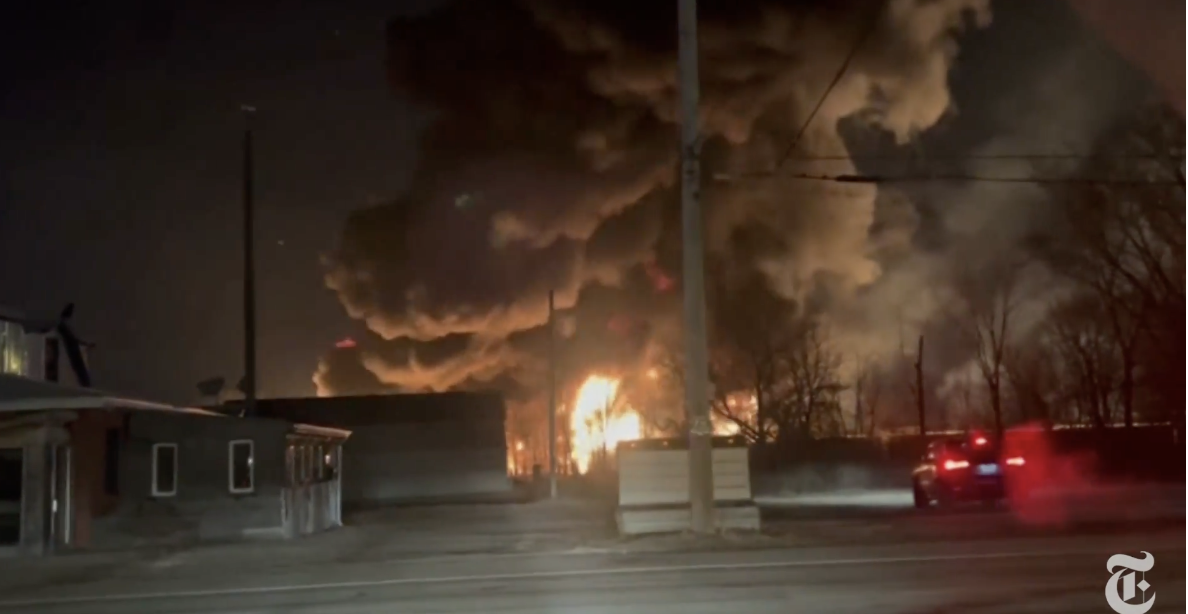
Rail-borne hazardous materials moving through American communities are 'often invisible' until they leak or explode

East Palestine, Ohio (Photo by Gene J. Puskar, The Associated Press)
What do crude oil, ethanol, vinyl chloride or methane have in common? They are hazardous chemicals moving coast to coast on U.S. railroads. On the heels of the early-February train derailment in East Palestine, Ohio, "Communities alongside rail lines had two more close calls this week as freight trains carrying hazardous materials derailed in Houston and Detroit," reports Saul Elbein of The Hill. "Where this week’s wrecks took place, the damage was less severe than symbolic: a reminder of the importance of rail-borne hazardous materials to every part of the economy just after the crash in Ohio."

The additional derailments amplify "the risk posed by hazardous materials moving through the nation’s towns and cities. . . . That is a risk that is often invisible until, suddenly, it explodes." Elbein writes. "Last year also saw a spill of 19,300 gallons of hydrochloric acid from a derailment in Oklahoma and 20,000 gallons of nervous system-distorting methyl methacrylate monomer. Since 2015, the U.S. rail system has been responsible for 106 derailments in which hazardous materials were released, according to Federal Railway Administration data analyzed by The Hill."

“Local communities don’t know what’s in these trains,” said Kristen Boyle, an attorney with public interest law firm Earthjustice, told Elbein. “Local communities can’t find out. They can’t stop the trains from going through, and they have been unable to get safety regulations. . . . And then they’re the ones left with, you know, the explosion."

The potential for problems is large. "Trains also carry far more cargo than trucks — making the risks of a spill far more severe. And the sheer volume of U.S. rail travel means that even a failure rate of 0.1 percent can lead to a lot of damage," Elbein reports. "For example, about 20,000 rail shipments of vinyl chloride — the highly explosive and carcinogenic chemical that Norfolk Southern contractors poured in a ditch and burned off in East Palestine — cross the country each year, according to the American Chemical Society. . . . That 99.5 percent success rate would still allow for 100 possible releases of a hazardous chemical — such as crude oil, ethanol, vinyl chloride or methane." 

Iowa editor sees a coalition to pass Farm Bill that has more for conservation and avoids cuts in nutrition programs

By Art Cullen
Storm Lake (Iowa) Times Pilot

A new five-year Farm Bill could be one of the rare accomplishments this year from an otherwise deadlocked Congress. Talks are just beginning as House Republicans and Senate Democrats organize their respective agriculture committees. They are starting amicably enough.

Art Cullen
It was not so last time around, when the bill was delayed a couple of years, mainly by House radicals trying to burn down the food-stamp program [officially the Supplemental Nutrition Assistance Program, or SNAP]. House Agriculture Committee Chair G.T. Thompson, R-Pa., and Ranking Member David Scott, D-Ga., both come from purple districts. Thompson is defending nutrition programs against Republican assaults, and last week brushed off suggestions of new restrictions on SNAP benefits. He did criticize a Biden administration expansion of benefits.

Thompson said his priority is to strengthen crop insurance, as half the corn growers in his state don’t buy in. He’s looking to sweeten that pot.

Senate Ag Committee Chair Debbie Stabenow, D-Mich., puts conservation at the center of the discussion and, of course, defending nutrition program from cuts. Their common interests may result in one of the best farm bills in history for conservation and food security.

The main rap on Agriculture Secretary Tom Vilsack is that he is too cozy with agribusiness. But he managed to assemble a “climate-smart ag” coalition that includes titans like Cargill, ADM and Tyson alongside the Farmers Union and Practical Farmers of Iowa. Vilsack doled out several billion last year in pilot projects designed to promote sustainable production and resiliency, with many of those corporate players leading projects.

Critics call it greenwashing. Call it what you will. You could call it smart politics. The ag supply chain understands that change is underfoot. Farmers get that the climate is changing — if you’re growing corn in Western Kansas, you should be highly interested in how you can convert to grassland grazing.

Vilsack bringing in the corporate players helps reminds House Republicans that conservation programs might play a role in sweetening crop insurance — for example, a generous spiff for planting cover crops that actually could get something seeded.

There will be money for carbon pipelines to protect the ethanol industry, for manure digesters that interest the livestock industry, and “smart fertilizer” programs to keep Koch Industries at bay.

In return, Thompson makes kind remarks about nutrition programs. Of course, there will be a lot of rhetoric about welfare queens feeding at the USDA trough. There also will be whispers to keep a rein on it if you want to keep the climate spigot open to the big boys.

This will be Stabenow’s legacy bill, as she intends to retire. She also wields tremendous influence in energy legislation that draws the interest of these same corporate players. Michigan’s interests are in many ways Pennsylvania’s.

Vilsack has claimed that the next Farm Bill could be “transformative” for rural America through conservation and renewable energy. Armed with $20 billion for climate and agriculture in the Inflation Reduction Act, Vilsack has been deferential to Congress in marching forward. So far, the administration has taken baby steps in addressing food security and sustainable agriculture in a rapidly changing environment. You would have to squint hard to see transformation.

There is unquestionably an openness to conservation agriculture that there was not before. Thompson and his colleagues insist on voluntary programs. Regulation is their red line, as it is with the corporate lobby. Vilsack has enough sugar cubes in his pocket to keep the horses from nipping. The Farm Bill is supposed to be finished by September. It may get held up a couple months, but not a couple years. It should be good for crop insurance and conservation, and food stamps [SNAP] will get protected.

The coalition has been assembled. It’s hard to fight the most powerful players in world food markets. It is better politics at the moment to dance with them. As Thompson said, “The Farm Bill is always bipartisan, always bipartisan. At the end of the day, final votes are fairly bipartisan, and my goal is to keep it that way from the very beginning.” Go along to get along.

Texans block Chinese billionaire's wind farm, citing security; 18 states mulling limits on foreign farmland ownership

Sun Guangxin (Photo by Zhang shi, Imaginechina)

Before curious rural Montanans reported a glowing orb high in the sky and the Chinese spy balloon was shot down, "Texas ranchers were worried about billionaire Sun Guangxin’s close connections with the Chinese state," reports Blake Schmidt of Bloomberg. "The former People’s Liberation Army captain . . . made a fortune by turning failing factories into lux real estate developments. . . . Critics have alleged that state connections are the backbone of Sun’s wealth, estimated at $2.8 billion, according to the Bloomberg Billionaires Index. And that’s precisely why ranchers in southern Texas are worried."

Their worries stem from the sheer size of Sun's landholdings and its location: "They are trying to stop Sun’s foray into the Lone Star State on national-security grounds after his firm amassed 140,000 acres of farmland worth about $100 million along the Mexican border," Schmidt writes. "When he tried to develop part of it as a wind farm, Texas lawmakers sounded alarms because of its proximity to the state’s electric grid and a U.S. Air Force base. ... Spurred by neighboring landowners who oppose the wind farm, state officials passed a law protecting state infrastructure from foreign entities, and are now considering an even more contentious proposal to ban Chinese companies and individuals from owning rural land entirely."

The Texas resistance was local, but it "snowballed into a national movement. The issue of restricting ownership of farmland by entities linked to China and other foreign powers has popped up in at least 18 states, according to the National Agricultural Law Center," Schmidt reports. "It’s another way in which geopolitical tensions are simmering between the world’s two largest economies."

Data from the U.S. Department of Agriculture shows that "foreign entities or individuals control less than 3% of the nation’s farmland, and, within that subset, those with ties to China control less than 1% or about 384,000 acres," Schmidt points out. Despite those details, "In Montana, the suspected spy balloon has breathed new life into a bill to restrict foreign ownership. A city council in North Dakota this month voted down plans for a Chinese company to build a corn mill near an Air Force base. . . . . Virginia’s Democrat-led state Senate approved a ban on land ownership by foreign governments after Republican Gov. Glenn Youngkin rejected an effort by Ford Motor Co. to build a plant partnered with a Chinese battery maker."

Texas landowners first opposed the wind farm due to its scenic impact, but over time, they became more focused on national security. “We don’t care if you’re Elon Musk, Tom Hanks or a Chinese oligarch,” Randy Nunns, a board member of the landowner group Devils River Conservancy told Schmidt. “We don’t want the wind farm here.” Schmidt reports, "Nunns said that he didn’t expect his group’s not-in-my-backyard battle to go global, and that while the state’s proposal to ban Chinese ownership is 'too broad,' Sun’s investment activity was particularly concerning."

News-media roundup: Gannett back in black, closing more papers; how to ask audiences to help shape coverage

Gannett Co. made money in the last quarter of 2022 "after a series of cost-cutting measures," reports its flagship, USA Today. "The company reported a net income of $32.77 million in the quarter compared with a loss of $22.45 million a year earlier. The results benefited from a nearly 30% rise in digital-only circulation revenues and lower operating expenses. It was the company’s first quarterly profit since the third quarter of 2021. Gannett had 2.03 million digital-only paid subscriptions at the end of the quarter, up 24% year over year."

Gannett is closing six free-distribution weekly newspapers published by the Akron Beacon Journal. The final editions of the Twinsburg Bulletin, Aurora Advocate, Stow Sentry, (Cuyahoga) Falls News-Press, Tallmadge Express and the News-Leader in Nordonia Hills are schduled for March 22 or 26. The Hudson Hub-Times will continue print publication on Sundays.

A Nebraska judge has ruled that the state Department of Environment and Energy violated state law by requiring Flatwater Free Press to pay $44,000 for emails about nitrates, nutrients, fertilizer and nitrogen, which are sources of water pollution. The agency tried to charge FFP for the labor involved, but the state law says fees for records "shall not exceed the actual added cost of making the copies available," Courthouse News reports. FFP is published by the Nebraska Journalism Trust, which was created in 2021 to address the decline in local news across the state and is supported by the American Journalism Project.

Stephanie McCrummen, who has written many deeply reported stories on rural phenomena, is moving from The Washington Post to The Atlantic. Her latest on The Rural Blog was on a Georgia man who was an example of a narrow slice of voters who have abandoned and rebelled against Donald Trump. Other examples: A Muslim doctor in Minnesota, a newly stronger liberal's return to her hometown, the moxie of a marginalized Black Belt town, and other stories from Georgia.

Jon Allsop of Columbia Journalism Review looks at various types of threats to news-media freedom in the U.S., finds them "relatively common" and sees "concentric circles," starting with the arrests of two journalists covering a homeless encampment in Asheville, N.C., to the murder of a Las Vegas investigative reporter and "political meddling" with West Virginia Public Radio.

Many newsrooms invite audiences to help shape coverage, but Joy Mayer of Trusting News says they often use their own language, not the community’s language, "and make it seem like a lot of work to participate. She suggests that instead of asking for story ideas, ask questions like, “If you could be in charge of our reporting team for a day, what would you assign them to do?” Or, instead of seeking “feedback,” ask for specific insights, such as “What else do you want to know about this topic?”

If a study says it proves something, it doesn't. Unless it's about mathematics, in which case it's highly unlikely to be news anyway. Denise-Marie Ordway of Journalist's Resource at Harvard University has a new tip sheet on how to cover academic research.

Flora/fauna quickies: Watching hybrid hogs from Canada, snaring pythons in Florida, protecting pets from coyotes

A long-exposure image shows Phacelia flowers waving in the wind. (Photo by Justin Benttinen, National Geographic)
Super. Fantastical. Fabulously. Epic. California is about to bloom! The state has received abundant rains and Mother Nature is planning a luscious “sea of flowers” this spring. Here’s how to soak in this increasingly rare phenomenon. California is also having an epic 'supershroom' season. These mushrooms are breaking records.

Invasive and "highly intelligent," a hungry, hybrid breed of pigs, created by matings of wild boars and domesticated sows, has gone feral. They are making their way from Canada, where they were bred for cold-hardiness and released when the hog market fell, and have been found in North Dakota.

As we ease into spring, it might be time to think about honey bees. You know, those highly social insects with a work ethic that makes even the most industrious human look lazy. Want to know how to become a beekeeper? Try a Cooperative Extension Service website. Want to read a wryly humorous book on beekeeping? Pick this one up.

Pythons are an invasive predator in the Florida Keys that have proved difficult to catch; however, researchers devised a way. They began "strapping GPS collars to opossums and raccoons. When one was eaten by a python, researchers programmed the device to notify them from within the snake’s stomach," reports Kyle Melnick of The Washington Post. "After roughly six weeks of searching for the python that activated the alarm, research technicians located the 66-pound snake hiding underground. . . . In her stomach, researchers discovered the collar — confirmation their plan worked."

A nuisance-animal bill aims to make farmers "honest folks," or at least that's what Iowa Rep. Dean Fisher thinks. House File 118 would allow farmers to trap and kill wild animals — such as groundhogs, opossums, raccoons, and skunks — without first contacting the Iowa Department of Natural Resources if they are a “nuisance.” Of course, there's controversy, “Because there’s a culture of breaking the rules or the law, we change the law?” said Rep. Elinor Levin, D-Iowa City." Story by Iowa Capital Dispatch here.

"Goran the bull escaped from his barn one Easter Sunday," chaos ensued, and everybody came to watch. Read selections from The Fearless Little Farm Boy by Astrid Lindgren, illustrated by Marit Törnqvist.

Coyotes are on the move. (Photo by Carolyn Cole, Los Angeles Times)
If you have pets, perk your ears up and prepare to protect them from coyotes. "Wildlife officials warn people to protect their pets during coyote mating season, which lasts from January to March. During that period, the males are particularly bold and aggressive," Sandy Banks of the Los Angeles Times reports, The Kentucky Department of Fish and Wildlife Resources warns, "Coyotes roam more to search for suitable partners and to establish territory, and as such, they find themselves in rural and urban areas."

Falco the Owl update: he will remain free and under observation. Falco is the Eurasian eagle owl that escaped from the Central Park Zoo in New York City after his enclosure was vandalized. Zookeepers tried to capture him "but Flaco eschewed the bait, and instead adeptly navigated the park and supped on the park’s many rats," reports Dina Fine Maron of National Geographic.

Thursday, February 23, 2023

'We've run the table this week,' rural editor-publisher writes after documentary premiere and tentative decision to close

The Canadian Record's front page this week; click to enlarge.
Has a newspaper ever been the subejct of a freshly premiered documentary and announced its plan to suspend publication, all in the same edition? Surely not, but that is the remarkable case of The Canadian Record in the Texas Panhandle, one of the best weeklies we know.

"We'll just call it what it is. This is the Navel-Gazing edition of The Canadian Record," Editor-Publisher Laurie Ezzell Brown says in her "Field Notes" column. "I’m not proud of that, but we have made the news, and we are determined to give The Record and its staff the same treatment we would any other newsmakers—good, bad and otherwise. Frankly, we’ve run the table this week."

The other news about the Record was a long-touted lawsuit filed against it and other local news media by the family of a high-school student who disappeared in 2016 and whose body was found three years later. Events in the case "have been accurately, fairly and thoroughly covered in these pages for over six years now," Ezzell Brown writes. "News of the lawsuit followed our difficult decision at midweek to walk away from the sale" of the paper, which has been in her family since 1947.

"That decision was preceded by a series of delayed contract signings and requests by the buyer for key changes to the contract, which we ultimately rejected. The outcome was both unexpected and quite frankly, a relief. The sale was not meant to be. However, it has left us in the difficult position of deciding what this newspaper’s ultimate fate will be. After three decades and counting under our ownership, we are 30 years older, 30 years wiser, and 30 years more tired. We cannot continue to work at the pace we have, or to shelve our personal lives to meet the demands of this community newspaper that we love. . . . At the risk of appearing to concede defeat, which we do not, my staff and I have agreed to suspend publication of The Record following our Thursday, March 9, edition. This will allow us time to notify our readers and subscribers and advertisers, to continue to seek a new owner for this newspaper, and to fight a toxic lawsuit meant to impugn the reputation of this newspaper and its publisher. We have arrived at this decision with great difficulty, having tried for at least the last two years to find someone who will take over this job. There is no way to adequately express our sadness in closing these doors. We can only assure you that we have chased every lead, walked down every dead end, and knocked on every door in an attempt to find an alternative to quitting."

In the documentary by Heather Courtney, "For the Record," filmed over the last five years, Ezzell Brown talks about those efforts – "Newspapers with small circulations in rural communities aren’t exactly the hot ticket;" Canadian has 2,649 people, Hemphill County 3,382 – the tribulations that preceded them, and possible outcomes: “No one else is gonna tell the stories that we’re tellin’, nobody . . . What happens if nobody’s doing this?”

The 37-minute film premiered at the Big Sky Documentary Film Festival in Missoula, Montana, Saturday. In the story about the premiere, Ezzell Brown says,  “For The Record feels like a very personal story about our lives and work here in Canadian, and that of my parents, Ben and Nancy Ezzell, who established such a strong legacy with this newspaper before us. It also conveys a more universal message, though, and one I hope many will hear and heed: that community newspapers like this one play an essential role in protecting and celebrating democracy from the ground up, in small rural towns that otherwise might have no voice, no visibility, and certainly no one holding public officials accountable for their decisions. Without strong community newspapers, we are risking the health and vitality of the rural communities they have nurtured and protected for so many decades.”