Thursday, March 30, 2023

$315 million for cleaner, more efficient energy in rural U.S.

(Photo by Ben Hasty, Reading Eagle via Getty Images)
Having consistent electricity can be tough and pricey for rural dwellers. "One-sixth of U.S households are in rural communities, where people often pay a larger share of their income for electricity. Reliability can be spotty, and investment in de-carbonization scant," reports Katie Myers of Grist. "Geographically scattered towns and aging infrastructure can make maintaining the grid expensive. Even simple steps to improve energy efficiency, like insulating an attic, can be out of reach for cash-poor residents, especially renters."

The Department of Energy aims to lessen some price tag troubles "by dedicating $315 million toward a sweeping effort to help rural and tribal communities modernize their electrical grids nationwide, invest in renewables, and help residents increase energy efficiency of their homes," Myers writes. A senior Energy Department official told Myers, "There isn't one ideal project. We're casting a wide net." Myers explains, "The funding is part of a broader effort to allocate more than $1 billion over the next five years to support energy projects in communities of less than 10,000 people. The goal is to promote climate resilience and address the rural energy cost burden — defined as the percentage of a household's income allocated toward energy bills each month — through 'replicable energy projects that lower energy costs, improve energy access/resilience, and/or reduce environmental harm.'"

The investments will be a first for some areas. "Brett Isaac, the founder and executive chairman of public benefit renewable energy corporation Navajo Power, said public assistance in funding the energy transition is essential for communities that have long been left behind." Isaac told Myers: "The investment from the various opportunities under the Biden administration, from infrastructure to the Inflation Reduction Act … these are all monumental because they're actually putting quantifiable investments into certain areas that have never really experienced them.' . . . Almost 30 percent of the Navajo reservation's homes still don't have electricity."

Some areas are ready to get started. "In Kentucky, Chris Woolery, a residential energy coordinator with the Mountain Association, can't wait to help rural power companies and electric cooperatives access federal funding. Advocates throughout the state have been laying the groundwork for a renewable transition for many years. . . . Woolery noted that the state is grappling with banning utilities from accepting federal funds to shut down coal plants. . . . Woolery said energy efficiency and distributed renewables could increase grid resiliency during extreme weather. Woolery told Myers, "We're working towards a vision in which access to energy is just a human right."

Myers adds, "Applications for the funds are due in June, and must include a 'community benefits plan' outlining how the project will ensure worker safety, fair wages, and diversity in hiring."

Interest-rate risks could sneak up on some community banks; regulators may need a stricter approach

Photo by Immimagery via stock.adobe.com
Big banks aren't the only ones that stocked up on bonds only later to regret it. "Dozens of other banks — most of them quite small — are deeply underwater on their bond investments and could hit trouble if they were unexpectedly forced to liquidate the investments. That's according to an American Banker analysis of regulatory filings by the country's more than 4,700 banks," reports Polo Rocha of American Banker. "The losses, a result of banks' bonds losing their value when interest rates rose, remain 'unrealized' and only theoretical. They would only cause trouble if a bank needed cash and was forced to sell the bonds early for less than it bought them, thus making the losses real."

"Bert Ely, a bank consultant, said it 'boggles the mind' that banks took on the same type of interest rate risk that brought down hundreds of savings and loan companies starting in the 1980s," Rocha adds. "Ely, who predicted what became the savings-and-loan crisis, said American Banker's analysis shows a need for regulators to take a stricter approach on the issue. Commenting on the large degree of risk many banks took on, Ely told Rocha, "It just absolutely astounds me that they can be in compliance with the regulations."

"Several bankers contacted for this story pushed back on any concern that they'd ever need to get rid of the bonds to raise cash. Those bankers said they have plenty of cash available. . . . The Federal Reserve Board launched a new program this month aimed specifically at helping banks with underwater bonds," Rocha reports. Still, "The review of call report data reveals how some banks appear to have misplanned for a scenario in which interest rates rose sharply. . . They effectively took the same position as Silicon Valley Bank, where executives thought interest rates would stay ultralow for years and were caught by surprise when the Fed raised rates aggressively." Cliff Rossi, a University of Maryland professor and former chief risk officer of Citigroup's consumer lending division, told Rocha, "It was Risk Management 101. They need to be all over that."

"The Federal Deposit Insurance Corp., whose chairman has warned about unrealized bond losses across the industry since at least May 2022, declined to comment," Rocha adds. "Bank lobbying groups, as well as several of the banks in question, said American Banker's analysis is incomplete and paints an inaccurate picture of those banks' health. . . .Hugh Carney, a top executive at the American Bankers Association, said a single metric such as unrealized bond losses 'does not accurately capture the risks or health of an individual bank.'"

Native American editor and reporter Mark Trahant among six entering National Native American Hall of Fame

Mark Trahant will be inducted into the National Native
American
Hall of Fame. (Indian Country Today photo)
Indian Country Today Editor Mark Trahant will be inducted into the 2023 National Native American Hall of Fame. Trahant, who is a member of the Shoshone Bannock Tribes, is a celebrated author, editor, reporter, and former president of the Native American Journalists Association. "Trahant has had a lasting effect on media to the benefit of Native American communities through his responsible storytelling and journalism. . . . He was co-author of a series on federal Indian policy and a finalist for the 1988 Pulitzer Prize for National Reporting," the 2023 class announcement says. "Books that he has written include The Last Great Battle of the Indian Wars, Pictures of Our Nobler Selves and The Constitution as Metaphor. . . . He was named Best Columnist by the Native American Journalists. He was a co-winner of the Heywood Broun Award. In 2019, Trahant received the NAJA-Medill Milestone Achievement Award. Trahant was chairman and chief executive officer at the Robert C. Maynard Institute for Journalism Education.

The 2023 class includes individuals who have "made contributions across a range of categories, including law, journalism, advocacy, writing, and entertainment." The induction ceremony will be held this fall. The additional inductees to be enshrined are:


Joe DeLaCruz, Quinault Indian Nation, brought intelligence and charisma to the struggle to get effective self-governance to his tribe. He served as president for 22 years and to Indians across the country. DeLaCruz built a formidable record of accomplishment, tackling such tough and long-standing issues as access to reservation lands by non-Natives, fisheries, and logging management, and perhaps most notably, the status and role of Indian tribes within the American body politics. DeLaCruz passed away in 2000. 


Will Sampson, Muscogee Creek, was an actor, artist, and rodeo competitor before passing away in 1987. Sampson's most notable roles were as Chief Bromden in One Flew Over the Cuckoo's Nest and as Taylor the Medicine Man in the horror film Poltergeist II. . . . Sampson received the Canadian Genie Award in 1980 for "Best Performance by a Foreign Actor" in the film, Fish Hawk. He advocated for Native actors to play Native roles in movies. Sampson founded the American Indian Registry for the Performing Arts for Native American actors. 


Leslie Marmon Silko, Laguna Pueblo, is an acclaimed novelist, poet, and essayist. She received the 1994 Native Writers' Circle of the Americas Lifetime Achievement Award and the 2020 Robert Kirsch Award. Silko was a key figure in the first wave of what literary critic Kenneth Lincoln has called the Native American Renaissance. Silko garnered early literary acclaim for her short story "The Man to Send Rain Clouds," which was awarded a National Endowment for the Humanities Discovery grant. 


Richard Trudell, a member of the Santee Dakota Sioux Tribe in Nebraska, was the founder and executive director of the American Indian Lawyer Training Program and its American Indian Resources Institute. Under Trudell's direction and vision, AILTP launched its premier publication, the Indian Law Reporter.Trudell is a veteran and received a degree in accounting and a law degree. 


LaNada Means War Jack, Shoshone Bannock, Native American writer and activist and the first Native American student admitted to the University of California in 1968. War Jack co-led the student occupation of Alcatraz Island in a peaceful protest of the federal government's ill treatment of Native people and broken treaties with tribes. . . . War Jack was on the founding board and executive board of the Native American Rights Fund for nearly a decade. She has been an elected councilwoman for her tribes and served on many boards both locally and nationally. 


The Native American Hall of Fame is located on the campus of the First Americans Museum in Oklahoma City. Its mission is to recognize and honor the inspirational achievements of Native Americans in contemporary history. The organization also serves as a unique resource for identifying and honoring these contemporary pathmakers, new heroes, and significant contributors to American society.

Wednesday, March 29, 2023

Society of Professional Journalists says Fox News apparently gave its viewers false and misleading information

The Society of Professional Journalists, which has sometimes wrestled with the question of if, when and how to call out bad behavior in journalism, issued a statement Wednesday on Fox News's treatment of the allegations against Dominion Voting Systems in the weeks after the 2020 election.

SPJ President Claire Regan and the organizaiton's Professional Standards and Ethics Committee said recenly released evidence in Dominion's defamation lawsuit against Fox "appear to show that popular prime-time Fox News hosts, with support from network executives, gave their viewers false and misleading information."

The statement said the first tenet of SPJ's Code of Ethics, "Seek the truth and report it," is “a fundamental ethical rule of journalism . . . If a news organization knowingly spreads lies, either in news reporting or opinion, it has clearly breached this most sacred of principles. No responsible journalist can accept or excuse this behavior. News organizations have a fundamental obligation to be honest in the reporting and opinion they disseminate. It is unprofessional, unethical and potentially harmful for a journalist or news organization to deliberately mislead their audience, no matter the motivation or format.”

Fox has said it was reporting on matters of public concern, and that opinions endorsing the allegations against Dominion were constitutionally protected opinion. SPJ said, “The lines between factual reporting and commentary have become increasingly blurred. However, responsible opinion hosts and commentators have a duty to use verified facts as the basis of their arguments and to not peddle what they know to be lies and disinformation. Many people use the information they get from their favorite hosts and commentators to form their own opinions. We support journalists at Fox who have refused to take part in narratives of falsehoods.”

The statement concluded, “Some media companies have found footing in pandering to target audiences on all sides of our cultural and political divides. Appealing to confirmation bias and manufacturing outrage with deceptive posturing for profit, popularity or power while turning away from facts is a cynical and hypocritical strategy. It is unconscionable and an insult to the tens of thousands of American journalists, including many at Fox, who understand their obligation to serve the public interest, not the bottom line.”

We're looking for examples of how lack of broadband affects rural news outlets' ability to serve their communities

Broadband access and adoption remain major challenges for rural America, despite recent expansion of high-speed internet service to many rural areas and the prospect of more with federal infrastructre funding. The Rebuild Local News Coalition is seeking examples of how a lack of broadband infrastructure affects the ability of local news outlets to fulfill the information needs of its community, and is especially interested in examples from rural areas.

If you know of such examples, please click here to email them to Al Cross, director of the Institute for Rural Journalism and Community Issues at the University of Kentucky, publisher of The Rural Blog. He is a member of the coalition's steering committee, which will hold its monthly meeting next week.

The Federal Communications Commission estimates that 16 million people in rural America lack high-speed internet, but that number may be far higher; some estimates go as high as more than 150 million Americans lacking adequate broadband, according to research published recently in the Journal of Computer-Mediated Communication.

Small towns are creating and saving their local grocery stores; here's how a few are finding success

Prairie Market's design is inspired by a popular chain, Trader
Joe's Grocery. (Photo courtesy of Prairie Market)

You have no fried onions for tomorrow's green-bean casserole. You'll go to the store and get some if you're an urban dweller. If you're a rural dweller, you will have no fried onions unless you want to DRIVE. "The Department of Agriculture lists 76 counties nationwide that are without a single grocery store, and 34 of those counties are in the Midwest and Great Plains," reports Aaron Bonderson of Harvest Public Media. Rural grocery stores that do exist face stiff challenges. "Big-box stores and grocery consolidation have added even more pressure on local grocers. A recent USDA report shows the percentage of grocery sales from the nation's top 20 retailers more than doubled from 1990 to 2020, while the consolidation was more pronounced in rural areas."

Yet most small towns residents want a local grocery. Bonderson explains, "For about five years, Emerson, Nebraska, pop. 824, had no grocery, leaving residents to drive at least 20 miles for a full-service grocer. Then last year, the community came together to support a new co-op. . . . . Post 60 Market moved into the old American Legion building. . . . . Manager Brian Horak said the village of people invested nearly $160,000 in the store. . . . . Investors receive discounts, dividends and elect a board of directors each year to oversee large financial decisions." Horak told Bonderson, "With being a co-op and so many people bought in – it's like you got multiple owners who have just as much commitment to see this thing succeed."

Bonderson provides Circle C market in Cody, Nebraska, pop. 167, as an example: "It's run by the Cody-Kilgore school district. The store got started in 2008 with the help of several national organizations and a grant from the USDA. . . . . The Village of Cody owns the building, while the school district and a local nonprofit, Cowboy Grit, helped finance the store. . . . Each semester about eight students help at the Circle C Market as part of a class, learning important skills." Teacher and store manager Liz Ravenscroft told Boderson, "We are vital to the community. The next closest grocery store is 40 miles to the east, and the other closest grocery store is an hour to the west."

Other rural grocery stores have tweaked their business models to increase sales. "Laura and Don Palmer first started Prairie Market in Paullina, Iowa, pop. 952, eight years ago. Like many businesses, they struggled at first. Then they adjusted their hours, staying open on nights and weekends to cater to their customers, who often commute long distances," Bonderson reports. The couple painted their store a cheery shade of teal, mimicking a popular retailer. Laura Palmer told Bonderson, "My favorite store was Trader Joe's. . . . People come in the store, especially young people, they want to come in, and they want it to be vibrant and clean and organized."

Kansas is another state working to address the lack. It established "The Rural Grocery Initiative" to support rural grocery stores, reports Bonderson. The initiative's leader Rial Carver told Bonderson, "We've seen success with communities kind of becoming engaged through cooperatives, through public-private partnerships. We've even seen nonprofits and school run grocery stores, as well as municipally run stores in communities."

Once a shunned gun, the AR-15 is now America's most popular firearm; it was never intended for public use

Image from The Washington Post
How did a gun that was never made for mass use become America's favorite? The AR-15's beginnings are quiet: "Originally designed as a soldiers’ rifle in the late 1950s. 'An outstanding weapon with phenomenal lethality,' an internal Pentagon report raved. It soon became standard issue for U.S. troops in the Vietnam War, where the weapon earned a new name: the M16," report Todd C. Frankel, Shawn Boburg, Josh Dawsey, Ashley Parker and Alex Horton of The Washington Post. "Few gunmakers saw a semiautomatic version of the rifle as a product for ordinary people. It didn’t seem suited for hunting. It seemed like overkill for home defense. Gun executives doubted many buyers would want to spend their money on one. . . . The industry’s biggest trade shows banished the AR-15 to the back."

The move to market the AR-15 "began after the 2004 expiration of a federal assault weapons ban that had blocked the sales of many semiautomatic rifles. A handful of manufacturers saw a chance to ride a post-9/11 surge in military glorification. . . . This transformation — from made-for-combat weapon to mass-market behemoth and cultural flash point — is the product of a sustained and intentional effort that has forged an American icon," the Post writes. Randy Luth, the founder of gunmaker DPMS, one of the earliest companies to market AR-15s, told the Post, “We made it look cool. The same reason you buy a Corvette.”

The numbers tell the story: "Ten of the 17 deadliest U.S. mass shootings since 2012 have involved AR-15s. . . . after repeated mass killings involving the AR-15 that accounted for some of the nation’s darkest moments, efforts in Congress to resurrect an assault weapons ban repeatedly fizzled," the Post reports. "Calls by Democratic politicians to renew the ban fell short, with some in their own party voting against it at key moments. Almost no Republican would even entertain the idea." Sen. Chris Murphy, a vocal supporter of stronger gun laws, told the Post, “The protection of the AR-15 has become the number one priority for the gun lobby. It makes it harder to push this issue on the table because the gun lobby does so much messaging around it.”

Associated Press table from Northeastern U. Mass Killing Database
"Today, the AR-15 is the best-selling rifle in the United States, industry figures indicate. About 1 in 20 U.S. adults — or roughly 16 million people — own at least one AR-15. . . . Today, the industry estimates that at least 20 million AR-15s are stored and stashed across the country," the Post reports. "Video games introduced a new generation to the AR-15 through popular first-person shooter games such as 'Call of Duty.' Players got to simulate using military weapons with down-to-the-bolt realism."

The Post provides an AR-15 convert as an example: "Bill Shanley saw his first AR-15 up close when one of his adult sons came home with one in 2010. Father and son took the AR-15 to a gun range. Shanley couldn’t believe how loud it was. . . . . But the black rifle had little recoil. It was fun to shoot. Three shots with his old hunting rifle bruised his shoulder. Fifty rounds with the AR-15 felt like a breeze. Shanley was sold. He soon bought his own, a Smith & Wesson M&P 15." Shanley told the Post, "The AR is the modern-day musket."

"The AR-15 was also especially alluring to the gunman who killed 10 Black people at a supermarket in Buffalo in May 2022," the Post writes. "'The AR-15 and its variants are very deadly when used properly,' he wrote in a manifesto filled with hateful vitriol. 'Which is the reason I picked one.'. . . Ten days later, 19 schoolchildren and two adults were shot to death in Uvalde, Tex., with another AR-15, the Daniel Defense DDM4."

A real-life electric-van story from an Iowa publisher: 'We had been spending $900 a month on gasoline'

By John Cullen
Storm Lake (Iowa) Times Pilot

It’s been almost a year since the Times Pilot bought our electric van, and we receive a lot of questions about it. Here’s a progress report.

It replaced two worn-out vehicles — a van and a cube truck — that had amassed nearly 400,000 miles each. In the same month both broke down, one victim to a transmission, the other to a deer. We needed a replacement fast.

We had been spending $900 per month on gasoline, and so the economy of an electric van appealed to us, not to mention that within a decade or so internal combustion engines are going the way of the horse and buggy.

Art has had three Chevy Volts, the plug-in hybrid that was produced from 2011-2019, and barely had to fill his tank with gas because he got about 40 miles on electricity before the gas engine kicked in. Other than a trip to Byron’s in Pomeroy on Sunday evenings, he hardly drives it out of town. He’s sold on electric vehicles.

The Ford E-Transit van we bought costs about $160 per month in electricity. We put about 2,000 miles per month on it running papers all neighboring counties. The purchase price was a little more than a gasoline van, but the savings in fuel more than made up for that in the first six months.

While most electric cars these days have a range of 250-300 miles, our van’s range is about half that. Ford research found that most cargo vans average 74 miles per day, so to keep the cost and weight down, it has a smaller battery capacity. The mileage limit has worked out all right for us. We figured out routes that minimize mileage.

In summer the van’s range is up to 150 miles. In winter, the range drops to about 100 miles on the coldest days. The same limits apply to cars. Cold weather drops battery range by nearly a third.

We installed a level 2 charger, which uses 240 volts, at our office at a cost of about $1,900. It charges about 26 miles per hour. A home charger, running off regular household current, might only charge at a rate of 3 or 4 miles per hour.

There are commercial DC fast chargers along interstates that charge at a much higher rate, but they can cost $100,000 or more to install.

At the time we bought our van, Ford was the only electric option. Ford introduced its van just after it brought out its F-150 Lightning and those pickups are selling like hotcakes. Ours is the only electric van that we know of in Buena Vista County, and maybe western Iowa. As for the Lightning pickup, there is one in Storm Lake, and the owner waited 11 months for it. I’ve seen a couple Teslas in Storm Lake. They don’t have dealers. You buy direct from Tesla online. Ford and GM have service centers in practically every county seat town in Iowa. Tesla’s only Iowa service is in Council Bluffs and Des Moines.

GM produced the Chevy Volt until three years ago in favor of the all-electric Bolt, which is an inexpensive small vehicle with limited range. GM is coming out with a variety of electric vehicles later this year. Ford has the Mustang Mach-E, Lightning pickup and E-Transit van, and can’t keep up with demand. Along with European and Asian automakers, they are chasing an exploding market that Tesla has had pretty much to itself for the past five years.

There are other cost savings in electric vehicles. They require much less maintenance, for example, no oil changes and no transmissions.

The biggest challenge to electric vehicles now is the lack of public charging facilities. If you stay on interstates, you have no trouble juicing up. But if you wander up two-lane roads, even major routes like Hwy. 71, you’ll develop range anxiety real quick. There are no public chargers between Early and Spencer, nearly 60 miles. We’ve accommodated several visiting Tesla drivers at our charger who found out to their dismay about Storm Lake’s lack of charging facilities. In a few years as more electric cars hit the roads there should be chargers in every town from Schaller to Sioux Rapids, but until then, drivers be wary.

Many public charging stations, except for Tesla, are often out of service or slow. Where you can fill a gas car up in five minutes, it can take an hour or more to rejuice an electric car at a DC fast charger. Tesla is the gold standard for charging around the world. It operates its own proprietary charging stations that are fast, reliable and plentiful. The problem is that non-Teslas could not charge there until this month. Tesla is gradually converting its chargers to allow competitors, but there are only about 14 so far across the nation. That will change as Tesla converts. But non-Teslas pay a premium.

The cheapest place to charge is at home. MidAmerican Energy’s residential and business electric rates here are very reasonable, about 10 cents per kilowatt hour. Public DC fast chargers along highways cost from 30 cents to 50 cents kWh. At the higher rates, electric isn’t a whole lot cheaper than gas.

Gas stations aren’t going out of business anytime soon. There are hundreds of millions of internal combustion vehicles that will need dinosaur juice for decades to come.

Once marketed to farmers as a 'no-till' solution, herbicide paraquat is on trial; companies may have known its risk

Image via Civil Eats
While still legal and widely used by U.S. farmers, the deadly herbicide paraquat will soon face court scrutiny. "As of mid-March, more than 3,000 farmers with Parkinson's disease have filed federal lawsuits against the herbicide's former chief distributor Chevron and its lead manufacturer Syngenta, which sells it under the brand name Gramoxone," reports Grey Moran of Civil Eats. "Paraquat is applied in the greatest quantities to fields of soybeans, cotton, and grapes, according to the U.S. Geological Survey. It's also the deadliest pesticide used in U.S. agriculture, capable of killing a human with just a sip, as the U.S. Environmental Protection Agency warns. . . . . As far back as 1983, the journalist Andrew Revkin warned that 'the potent weedkiller is killing people,' as he starkly detailed its link to suicides and accidental deaths. A considerable body of evidence links the toxicant to Parkinson's disease, a progressive neurological condition with no cure."

The use of paraquat began as "no-till" farming evolved. "It was sold to farmers as revolutionary. Its introduction into the marketplace in 1962 coincided with a growing awareness of overplowing soil, year after year until it degrades," Moran writes. "Looking to avoid another Dust Bowl, farmers were eager for ways to keep their soil intact. Chevron, a distributor of paraquat at the time, jumped on this opportunity. . . . 'Let paraquat be your plow,' a 1972 Chevron advertisement in No Till Farmer, the leading resource on no-till methods, urged soil-conscious farmers. . . . In 1984, an op-ed in The New York Times by a Chevron representative proclaimed that 'the plow has been replaced with the use of herbicides,' celebrating the 'quiet revolution.'"

"The first federal bellwether trial is set for October 2023, and it could result in payouts to affected farmers," Moran writes. "The lawsuits, which were consolidated to pool evidence, have led to a trove of hundreds of documents, published by The Guardian and The New Lede, including evidence that the companies knew—as early as the 1960s—about paraquat's potential risks to the brain and feared the potential. . . . Observing these dangers to life and health, more than 50 countries have now banned paraquat, including the E.U., U.K., China, and Brazil."

A plaintiff in the federal litigation, retired farmer Larry Wyles, told Moran, "The companies that produce this herbicide should be held responsible for whatever they are responsible for. If [my Parkinson's disease] had to do with paraquat, then they should pay dearly for that because it has helped to take the dignity out of my life. . . . . I am a shell of my former self." Moran adds, "The disease has also taken a toll on Wyles financially; last year, he had to sell the farm to pay his mounting medical bills."

Moran explains, "At the heart of all the lawsuits is the claim that exposure to paraquat is causally linked to Parkinson's disease—both in the plaintiffs' uniquely devastating cases and on a broader scientific level. . . . Lawsuit plaintiffs were never made aware of the research linking Parkinson's disease and paraquat, largely because it is not included on the label for Gramoxone. In fact, the company's website reads: 'Scientific evidence does not support a causal link between paraquat and Parkinson's disease. Syngenta rejects claims made in litigation to the contrary.' However, this could change as the EPA reconsiders its risk analysis of the herbicide, potentially revising its labeling requirements."

The plaintiffs maintain that the EPA did not protect them. "The lawsuit challenged a range of oversights, claiming the EPA considered the economic risk to growers more heavily than the health risk to farmers and farmworkers, in violation of federal pesticides law," Moran reports. "This includes ignoring the risk of inhaling the herbicide while it's sprayed. The agency, petitioners claimed, also overlooked the medical evidence relating to Parkinson's disease, citing research by the National Health Institute, the nation's main medical research agency, which 'found that people who applied paraquat were more than twice as likely to develop Parkinson's disease as those who applied other pesticides.'"

"Dr. Ray Dorsey, an advisor on the lawsuit and Professor of Neurology at the University of Rochester, noted that Parkinson's disease is the fastest-growing brain disease, but he believes its rate of growth could be slowed if environmental factors, like the spraying of paraquat, were addressed." Dorsey told Moran, "I think the EPA has a lot of explaining to do. Why is it not addressing a known environmental contributor to the rise of Parkinson's?"

Ginseng Diggers: A History of Root and Herb Gathering in Appalachia wins Appalachian Studies Association award

Ginseng Diggers: A History of Root and Herb Gathering in Appalachia
is the winner of this year's non-fiction Weatherford Award, given by Berea College and the Appalachian Studies Association. Author Luke Manget's debut book presents a new take on Appalachian history: "It is the first of its kind to unearth the unique relationship between Appalachia and the global trade of medicinal plants. This release provides an extensive addition to the understanding of land use and gathering commons, medicine, capitalism, and the beginnings of the pharmaceutical industry," the award announcement says.

It's an absorbing history of people and plant: "The harvesting of wild American ginseng (panax quinquefolium), the gnarled, aromatic herb known for its therapeutic and healing properties, is deeply established in North America and has played an especially vital role in the southern and central Appalachian Mountains. Traded through a trans-Pacific network that connected the region to East Asian markets, ginseng was but one of several medicinal Appalachian plants that entered international webs of exchange." Ginseng Diggers also received the 2023 James A. Duke Excellence in Botanical Literature Award in the Consumer/Popular Category. Luke Manget is an assistant professor of history at Dalton State College in Dalton, Ga.

Runners-up in the nonfiction category were Making Our Future: Visionary Folklore & Everyday Culture in Appalachia by Emily Hilliard, Another Appalachia: Coming Up Queer and Indian in a Mountain Place by Neema Avashia, and Something in These Hills: The Culture of Family Land in Southern Appalachia by John M. Coggeshall.

The fiction award goes to Barbara Kingsolver, author of Demon Copperhead. Beth Macy, author of "Dopesick," described this work: "Demon is a voice for the ages—akin to Huck Finn or Holden Caulfield—only even more resilient.” Fiction Finalists were Ashley Blooms for Where I Can’t Follow and Patricia Hudson for Traces: A Novel.

The Weatherford Awards honor books that “best illuminate the challenges, personalities, and unique qualities of the Appalachian South.” They commemorate W.D. Weatherford Sr., a pioneer and leading figure in Appalachian development, youth work, and race relations, and of his son, Willis D. Weatherford Jr., who was president of Berea.

Tuesday, March 28, 2023

Most U.S. police departments are small; 9 of 10 have fewer than 50 officers; changing their culture is no small task

Photo by Logan Weaver, Unsplash
Words heard when a policing goes bad: "Defund. Investigate. Overhaul. Change the culture." While some big-city police departments may need a reboot, "the agencies that have been in the spotlight recently for uses of force — fatal shootings of Black men in Brooklyn Center, Minn., pop. 34,000, and Elizabeth City, N.C., pop. 19, 000, and pepper-spraying a Black and Latino man in Windsor, Va., pop. 2,700 — are more like what American law enforcement looks like, small departments in places that rarely make the news," reports Mark Berman of The Washington Post. "Nearly half of all local police departments have fewer than 10 officers. . . . . Nine in 10 employ fewer than 50 sworn officers. Brooklyn Center, which has 43 officers, and Windsor, which reported a seven-member force, fit comfortably in that majority."

Part of the problem with local is that it's local. "Experts say that while smaller departments have their benefits, including being able to adapt to their communities and hire officers with local ties, these agencies also are typically able to avoid the accountability being sought as part of the national movement to restructure and improve policing," Berman writes. "These departments' often limited resources and the decentralized structure of American law enforcement complicate efforts to mandate widespread training and policy changes, experts say."

"You want to change American policing, figure out how to get to . . . . the departments of 50 officers or less," Chuck Wexler, executive director of the Police Executive Research Forum, a Washington-based group that works with police departments, told Berman. "It's unlike any other country. In places like the United Kingdom, you have a Home Office; you have standards. In Germany or Israel … they have a national police. Our policing is completely fragmented, decentralized, with no national standards."

In March, an example of "fragmented standards and fewer resources" was uncovered by The Chronicle newspaper in Cottage Grove, Oregon, pop. 11,000: "Five months after the sudden resignations of former Cottage Grove Police Chief Scott Shepherd and Captain Conrad Gagner, The Chronicle obtained documents that detail the circumstances around their departure, including racism, homophobia, sexual harassment, illegal detainment, failure to support outside law enforcement agencies," reported Ryleigh Norgrove. "After Shepherd and Gagner's resignations, city manager Richard Meyers told The Chronicle: "The investigation associated with their administrative leave has been stopped because of their resignations. It would be fiscally irresponsible to continue to pay the costs associated with an investigation regarding personal actions for people who are no longer city employees."

The issues in Cottage Grove seem less extreme than others. "Police in Windsor stopped and held Army 2nd Lt. Caron Nazario at gunpoint in December for not having a permanent rear license plate," Berman reports. "In video footage, officers are heard yelling and berating Nazario and are seen striking and pepper-spraying him before handcuffing him. . . . . On April 21, sheriff's deputies in Elizabeth City shot and killed Andrew Brown Jr. while attempting to serve a felony warrant."

There are no simple answers. "The rules of policing change depending on where you are," Dennis Kenney, a former Florida police officer and a professor at the John Jay College of Criminal Justice, at the City Universiy of New York, told Berman. Berman notes, "Kenney pointed to community policing, a concept that involves building ties between officers and the communities they patrol, as an example. Advocates of the approach had to sell it to thousands of different agencies, he said."

Christy E. Lopez, who now teaches law at Georgetown University in Washingotn, D.C., told Berman, "There are pros and cons [to the American system]. . . . It's a very big country with different challenges in parts of it. I like the idea of having different agencies that can experiment . . . . and respond to that particular community. I think there's value to that."

Another fish fry? Why local emergency medical services have so many fundraisers; here's what you can do to help

Rural ambulance in Sweetwater, Wyoming
(Photo by Kim Raff, The New York Times)
Another fish fry, ticket raffle or silent auction? Many of us would like to take a hard pass, possibly for life. But those fundraising efforts are the life of some emergency medical services across rural America. "If you don't do the fundraising, how do you pay for equipment needed to keep those people safe on a job for which they receive no pay?" Donna Kallner reports for The Daily Yonder. "It all adds up. It also takes a toll. When unpaid volunteers spend so much time fundraising, they have less time available for training, equipment checks, and other tasks – including paperwork, without which you don't get funding."

Kallner provides a personal example: "My rural volunteer fire department just purchased a new self-contained breathing apparatus. Those air packs include a frame that holds a pressurized cylinder containing breathable air, a mouthpiece and a regulator. . . . It wasn't cheap. Each new 45-minute pack with a cylinder was $7,500, and spare bottles were $900 each. . . . It took two years of fundraising to raise the $50,000 needed to put that new equipment into service."

What some residents may not know is that fire services impact family budgets. Kallner explains, "What those households pay for homeowners insurance is directly related to the readiness and reliability of the fire department that serves them. That's true in other rural areas, as well. . . . . Homeowners' insurance rates factor in ISO ratings. Those are determined by the Insurance Services Office, which assigns fire departments a score between 1 and 10. A score of 1 is the safest bet that an insurance company won't have to pay out on fire claims. Any area over five driving miles from the nearest fire station is automatically rated a 10."

"Like the rural households they serve, rural volunteer firefighters often pay a premium for homeowners insurance based on where they live. But they show up to flip flapjacks to pay for National Fire Protection Association-compliant PPE and other equipment," Kallner points out. "In my area, the portion of annual revenues municipalities allocate to fire departments might cover what it costs to outfit one new firefighter in PPE and provide an air pack and a radio. The rest of the budget? Fundraising."

"Volunteer fire departments need all kinds of help, and it doesn’t all involve training to put on an air pack and enter burning structures. Sometimes it’s helping sell food and beverages or raffle tickets at community events," Kallner adds. "Next time your volunteer fire department hosts an open house, get pictures of the kids or grandkids with the shiny fire trucks, for sure. But also ask, how old is that truck? If you had to replace it, what would that cost? And what would it take to raise that money? Sticker shock about PPE and other equipment pales in comparison to fire apparatus. . . . We also need people brave enough to look at price tags and grant applications squarely, swallow their sticker shock, and say, 'How can I help?'"

We are in Southwest Kansas, and there's not enough water; moving water to the area is a long-shot option

Ogallala Aquifer map by U.S. Geological Survey
Map by Emma Brown, The Wall Street Journal
"When the well is dry, we know the worth of water." --Benjamin Franklin

Increasingly arid states across the country agree with Franklin, and Kansas is no exception. "Southwest Kansas officials have long pushed a moonshot aqueduct project to send Missouri River water across the state to their region, where a $12.5 billion agricultural economy relies on a dwindling Ogallala Aquifer," reports Shannon Najmabadi of The Wall Street Journal. "In Kansas, where federal data shows that nearly every county was experiencing some level of drought at the end of 2022, water is among the most urgent issues facing the state legislature this year."

Despite the expense and hefty challenges, other states have completed "projects that move water to fuel development or to irrigate crops. . . . . states such as Arizona and California. The Kansas aqueduct would be farther east—reflecting spreading concern about water scarcity amid a changing climate and growing population centers," Najmabadi writes. "The Arizona state legislature in 2021 asked Congress to study a plan to transport Mississippi River floodwaters to the Colorado River, upon which seven states rely."

Najmabadi explains, "U.S. Army Corps of Engineers first assessed the feasibility for a Kansas aqueduct in 1982, as part of a federal study looking at ways to supplement the Ogallala Aquifer . . . . A 2015 update of the study estimated it would cost between $5 billion and $20 billion to build the concrete-lined canal system and up to $522 million in annual energy. . . . Proponents of the Kansas aqueduct say it is needed to sustain the economy of the state's southwest . . . . Opponents say the idea is too expensive . . . .The Ogallala Aquifer lies under parts of eight central U.S. states, running from South Dakota to Texas. It adds $3.8 billion to the value of the land in western Kansas, one 2022 study found."

"Blake Brownie Wilson, with the Kansas Geological Survey, says 80% to 90% of the aquifer's water in Kansas goes to irrigation," Najmabodi reports. "About 30% of it had been pumped as of 2013. Another 39% was expected to be gone by 2063 given current rates of use." Clay Scott, who is a member of the board for the Southwest Kansas Groundwater Management District and a proponent of the aqueduct plan, told Najambodi, "We will continue to dry up the infrastructure for feed yards and dairies and grain elevators and cotton gins. . . . We can't afford to wait any longer."

Najmabodi adds, "The project remains a long shot. Kansas lawmakers this year are focused on bills aimed at promoting conservation and dedicating tax revenue to water projects."

Flora/fauna quickies: Burmese pythons slither north; time to tap and sap maple syrup; mounted archery as a sport

(Photo by Cristobal Herrera-Ulashkevich, Shutterstock)
From mysterious beginnings, Burmese pythons have been noshing their way north, "reaching West Palm Beach and Fort Myers and threatening ever-larger stretches of the ecosystem," reports Patricia Mazzei of The New York Times. "That was one of the few definitive conclusions in a comprehensive review of python science published last month by the U.S. Geological Survey, which underscored the difficulty of containing the giant snakes."

It's maple syrup time, and in Vermont, New York, Maine, Pennsylvania, Wisconsin, Ohio and Michigan makers are tapping and sapping. "Allison Hope, executive director of the Vermont Maple Sugar Makers Association, is optimistic about this year's prospects," reports April Barton of the Burlington Free Press. "In mid-February, Hope said she visited an operation that had been boiling on Valentine's Day, which is the earliest in a long time. At that time, their sugar content was 2%, which they were really pleased with for an early season boil."

Artesmis, Fred Bear and Legolas Greenleaf are all on the "Most Famous Archers" list. We may want to add Caroline North from Collins, New York, pop. 6, 000, to the esteemed roster. "North is a riding instructor and horse trainer. Her equine interests took a turn toward a more daring endeavor about five years ago," reports Jason Guarente of Lancaster Farming. "Eternal Flame Mounted Archery is exactly as it sounds. People shoot arrows at targets while on horseback. The sport is deeply rooted in history through military training and warfare."

Paying for parking. Ugh. Here's one place you might not mind so much. "With few exceptions, all vehicles parking in Great Smoky Mountains National Park for more than 15 minutes now need a parking tag as part of the park's new Park It Forward program," reports Eve Chen of USA Today. "'100% of funds collected from these fees stay in the Smokies and go directly back into preserving the Smokies and ensuring the visitor experience remains first-rate,' the national park said on its website."

Climate change and extreme weather are a power couple no one likes. The results are swaths of loss from physical damage, but there are emotional scars, too. "Climate change is drying out rivers, supercharging wildfires, raising seas, and altering the seasons as we know them. These disastrous changes to the environments we depend on for food and shelter are also harming our mental health,"

With ropes, animal sleds and a whole lot of patience, rescue teams in California successfully pulled 17 large farm animals out of a thick, sticky mud trap on a farm in the unincorporated area," reports Deborah Netburn of the Los Angeles Times. "The sounds of agitated mooing could be heard over the voices of more than a dozen rescue workers as they struggled together to heave a black cow out of the mud. . . . After rescuing the first six animals, the crews had to set up a skid steer to clear a path to access the additional 11 animals before they were able to rescue them as well."

While not egg-ceptionally great news, the price of eggs has finally begun to fall. "Prices fell 6.7% in February. . . . With February's price drop, the cost of a dozen eggs declined to $4.21," reports Khristopher J. Brooks of CBS News. "Even though prices are easing, shoppers are still paying 55% more for a dozen eggs than they did a year earlier, partly due to an avian flu epidemic."

Monday, March 27, 2023

Electric-vehicle takeup slow in Northern Plains; states with many rural folk continue to favor gas over charging stations

Tesla charging stations (Photo: Abbie Parr, The Associated Press)
For rural residents, the choice to drive an electric vehicle is often not simple or easy. "Concerns over range and the effects of sub-zero weather on battery life are higher on the vast northern prairies, areas of which have the fewest charging stations in the country," reports Tom Peterson of Stateline. "Political debates over ethanol, emission standards and market forces also envelop the region. . . . The shift to EVs across the Upper Midwest and Great Plains lags."

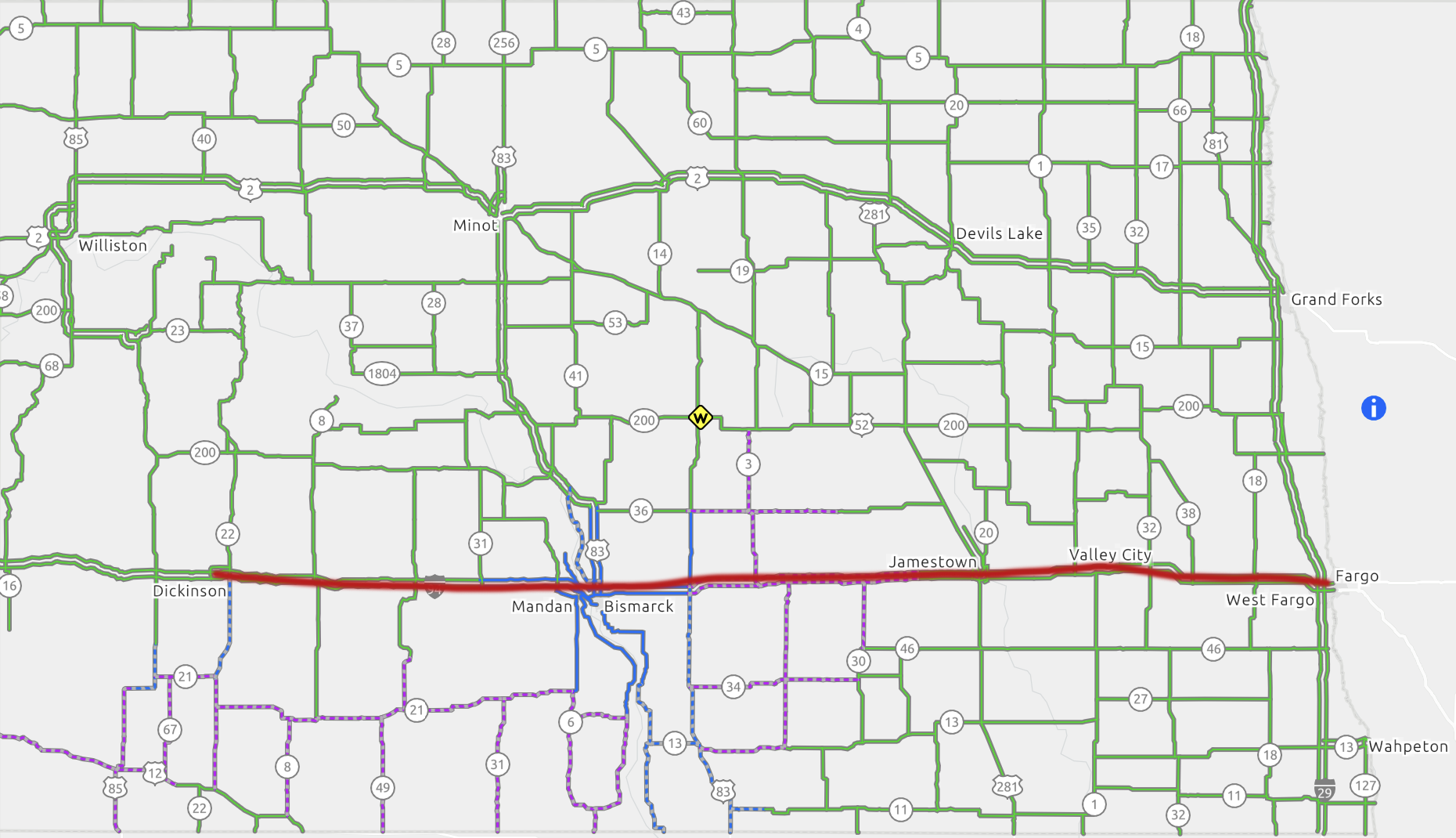
Practically speaking, the need for charging stations in Western states presents a horse before the cart challenge. Residents don't want to purchase a vehicle that can't be refueled. Charging stations aren't built because there's not many EVs to use them. "North Dakota (roughly 400 vehicles), Wyoming (500) and South Dakota (700) have the fewest EV registrations in the nation. . . . Across western North Dakota, bison outnumber EVs," Peterson writes. "The number of EVs with ranges of 300 miles or more nearly tripled in 2022, growing from five to 14, the U.S. Department of Energy reported. But in North Dakota, that’s barely a one-way trip from Dickinson to Fargo."


It's 292 miles from Dickinson to Fargo, N.D. (ND Roads map)
Regional economics and politics also create EV acceptance barriers. "North Dakota and other states in the region are top-10 producers of ethanol. . . . Because as much as 40% of U.S. corn is used for ethanol, the states fear more EVs will have the ripple effects of a drop in ethanol demand on their agriculture economies," Peterson adds. "The rural-urban and red-blue divides in the region also enter the debate over the push toward EVs." Marc Geller, a spokesperson for the Electric Vehicle Association, which promotes EVs, told Peterson, "It's been kind of unfortunate that electric cars have become caught up to some extent in kind of the partisan divide and the culture wars."

Peterson notes, "Across the region, difficult political decisions lie ahead . . . . as states build out their EV policies. . . . and how states will use their shares of the $7.5 billion in federal funds set aside for charging infrastructure. Idaho, Montana, North Dakota, South Dakota and Wyoming — all large, rural states with long stretches of remote highways — joined in a comment to federal regulators, noting the difficulties complying with the requirements, E&E News reported."

Wide EV acceptance may be slow, but it is progressing. "For Geller, education is vital as state policies evolve. Technology is rapidly addressing the range and weather-related issues that rural, northern auto buyers cite as their chief concerns about EVs," Peterson reports. "At-home chargers, he said, are often underplayed in the discussion and make rural ownership more practical."

A look at how Covid-19 devastated one rural county: It's an outlier, but still 'representative of the quiet catastrophe'

Lamb County, Texas, endured waves of death during
the pandemic. (Photo by Dawn Bottoms, Time magazine)
Covid-19 left an indelible mark on many rural communities, and they may never be the same. "I first came to report on the pandemic in Lamb County in the winter of 2020–2021," writes Alejandro de la Garza of Time magazine. "Now, with the pandemic slipping out of the public consciousness a year and a half later, I was back to write about what moving on looks like here. . . . Nearly one out of every 100 people living in Lamb County, Texas, died of Covid-19. . . . For the lucky ones, it's like nothing ever happened. For many others, nothing will ever be the same. Some of those who died were pillars of the local community."

Olton, in Lamb County (Wikipedia)
In Olton, pop. 2,200, the death of the town's local barber, Chris Jones, 53, "resonated across an entire community. Almost everyone in the town of Olton knew Chris. . . . He lived alone, but several households considered him part of what he called his 'family by heart,'" Garza writes. "All over town, others continue to mourn his death. . . . More than a year and a half after Jones’s death, Michael Ramage hadn’t let anyone move into the apartment he used to rent to Jones, nor had he removed a note that a friend taped the door when Jones was sick. It said 'Get well soon.'”

While some areas have recovered, "Many residents in the rural towns making up the Panhandle county say things are back to normal," Garza writes. "But there are many places like Lamb County around the country—poor, rural towns, susceptible to misinformation, suffering even before the pandemic and have now taken another body blow. What happened here is typical of a broader, little-noticed disaster across flyover America. . . . . The pain, the losses, and the lingering division left by the pandemic can be found almost anywhere in the country. In Lamb, the permanent effects are just more visible, a reminder of the magnitude of what we've lost and how little we've reckoned with it."

Garza points out, "Lamb County's pandemic death rate is an outlier: it's the eighth highest in the nation as of March 2023. . . . But it's representative of the quiet catastrophe in rural America. . . . these are regions where populations have been aging and shrinking . . . . Jobs and other opportunities have dwindled. . . . Rural Americans seemed more susceptible to vaccine misinformation. As vaccines first became available in early 2021, 35% of rural respondents in a Kaiser Family Foundation survey said they wouldn't get the shots, compared with 26% of urban dwellers."

Combined, rural demographics and isolation allowed Covid-19 to decimate much of small-town America, Garza reports: "The result has been a widening cumulative death rate in America's rural regions. In October 2021, rural America had a total death rate about 24% higher than that in the cities, according to the Centers for Disease Control. A year later, after the Omicron wave, the number had shot up to close to 40%, and one out of every 250 rural Americans was dead." Alan Morgan, head of the National Rural Health Association, told Garza, "We took the population most at risk for Covid-19 and ran them through a meat grinder. . . . The result has been just devastating."

Animal trapping was once more lucrative; trappers are an 'endangered species' who still have a vital ecological role

Baker carries a muskrat and trapping equipment while
workinga marsh. (Photo by Eric Lee, The Washington Post)
Once vital to colonial America and then to the fashion industry, fur trappers in states like Maryland are becoming an "endangered species," reports Fredrick Kunkle of The Washinton Post. "As recently as the 1970s, Maryland counted approximately 5,000 trappers; today there are maybe 300 to 400 active statewide . . . . Changes in fashion, and the long, steady migration of Americans from farms and rural areas into cities and suburbs have made trapping a controversial anachronism. Global fur prices have collapsed since 2013-14."

Beyond the fur industry, trappers play an essential role in wildlife knowledge. "Trappers are some of the most devout and most detail-oriented … outdoorsmen out there," Joshua Tabora, a furbearer biologist with Maryland's Department of Natural Resources, told Kunkle, "When you talk to some of these guys who've been doing it since the '70s and the '80s—they're walking repositories of ecological knowledge." Kunkle adds, "Trappers, who provide data to the DNR for research on animal populations and tracking zoonotic and other diseases, tend to be keenly observant and knowledgeable about animal behavior and the signs their quarry leave behind, Tabora said."

Kunkle joined Dan Baker, a life-longer trapper from Maryland, to discover how he makes a living. "The Maryland State Highway Administration pays him to trap beavers, whose dams can flood and wreak havoc with country roads, and ordinary folks pay him to remove pesky home invaders." He told Kunkle, "It got to the point where somebody had a groundhog in their garden so they'd call me . . . . And then somebody would say, 'I got a snake in the house. Can you come down?' And it just got bigger and bigger."

Baker also sells meat most groceries don't carry. "One of his regular customers is Howard Brooks, who took 300 muskrat meats off Baker last year," Kunkle reports. "Brooks said he kept a few dozen for himself and distributed the rest, at cost, to other folks who prize the muskrat's dark, savory flesh." Brooks told Kunkle, "You can bake 'em, grill 'em. I can fry them and make gravy with some onions. They don't taste like chicken. I can tell you that."

Baker spends time teaching new hunters, but the trade is declining, Kunkle reports. "During the fur trade peak between the 1970s and 1980s, prime red fox pelt would fetch an average of $46 — about $185 in today's dollars — and old-timers guarded their turf as closely as their trade secrets. . . . Nowadays, though, fox pelts go for around $3, Baker said. The [trade] has plummeted because of the animal rights movement and advances in fabric technology that led to a switch from natural furs."

Quick hits: Seed catalogues promise amazing produce; a round barn rises; the Audubon Society's complicated name

Illustration by Nolan Pelletier, The New Yorker
"Leafing through seed catalogues" is all kinds of fun, reports historian Jill Lepore, writing for The New Yorker. "They promise 40-pound beets, rhubarb that tastes like wine, tomatoes that look like stained-glass windows, and world salvation. It doesn't hurt to dream." Or to read Lepore's piece!    

One in six children lack access to clean underwear; a nonprofit is partnering with underwear maker to help.

Pollution exposure is tough on the human body, and skin is no exception. "Here's what we know about what pollution does to your skin, and what you can do about it," reports Courtney Rubin of The New York Times.

A little bit of StoryCorps from rural Tennessee is always good on a Monday: "Father And Son Look Back On A Life Filled With Music" with Jason Von Stein and Jim Von Stein.

The interior of Jay Branson’s round barn in Guthrie, Oklahoma 
(Photo by Hailey Branson-Potts, Los Angeles Times)
Some beautiful things can happen in the midst of loss or perhaps because of it. "Jay often was home alone with his grief. To stay sane, he went out to his backyard and started building the barn. . . . Although not exactly common, round barns have a long history in the U.S.," reports Haily Branson-Potts of the Los Angeles Times.

After a year of discussions, the National Audubon Society board voted to retain the organization's name despite John James Audubon's history as an enslaver and racist, reports Jesus Jiménez for The New York Times. "The decision faced sharp criticism from other birding groups across the country, including its own staff in the Bird Union." The society's website attempts to address the founder's failings: "His contributions to ornithology, art, and culture are enormous, but he was a complex and troubling character who did despicable things even by the standards of his day."

As winter hangs on, cattle raisers should remember that when "squatty, squishy bales make their way out of the ditch and into the cow, it can be costly," the University of Missouri advises. In other words, "Cheap hay isn't cheap."

High school basketball competitions can be fierce, but they can also bring out the best in people. "Martin County High School boys' basketball team was in the final quarter of a nail-biter of a game at a regional tournament in Pikeville, Ky., when live music suddenly started playing for them," reports Sydney Page of The Washington Post. "They knew it wasn't their school's small 23-member band — which could not attend the game because of a bus driver shortage. . . . The music was coming from the nearly 100-member band of a rival school. The score was tied in the tense game when the music started." The band was from Pike County Central High School.