Tuesday, August 14, 2012

Romney alleges 'war on coal' at a backer's mine while Obama defends tax credits for wind industry

UPDATE, AUG. 28: The miners who stood behind Romney were told by mine officials that attendance was mandatory and they would not be paid for the day because their mine was shut down, reports Sabrina Eaton of The Plain Dealer in Cleveland. "No one was forced to attend," Murray Energy Chief Financial Officer Rob Moore told David Blomquist of WWVA Radio in Wheeling. He said federal election law doesn't let companies pay workers to attend political events. (Read more)

Seeking votes in Ohio coal country today, Mitt Romney echoed the coal industry's contention that the Obama administration is "waging a war on coal." Meanwhile, President Obama, still in Iowa, planned to criticize Romney's support for repeal of wind-energy tax credits, and fresh attention was focused on the coal industry's role in the election. (Associated Press photo by Mary Altaffer)

Romney pledged that by the end of his second term, North America would be energy-independent. "If you don't believe in coal, if you don't believe in energy independence for America, just say it," Romney said at Murray Energy's Century Mine in Beallsville, about 25 miles southwest of Wheeling, W.Va. "If you believe the whole answer for our energy needs is wind and solar, then say that." The Obama campaign responded by noting that Romney supported anti-coal regulations as governor of Massachusetts, and said a coal-fired power plant "kills people." A story by Joe Vardon and Joe Hallett of The Columbus Dispatch is here.

The mine "is in a slice of Appalachia whose culture is more akin to neighboring West Virginia and rural Pennsylvania than to urban islands like Cleveland and Toledo," Stephen Koff of The Plain Dealer in Cleveland wrote in a scene-setter that also noted the "company’s colorful chief executive," Bob Murray, left, who "became famous after a collapse at the Crandall Mine in Utah, which his company co-owned, killed six miners in 2007. Murray was on the scene constantly and disputed claims about safety violations, although his company was ultimately fined." (Read more)

Murray, Joe Craft of Alliance Resource Partners and Richard Gilliam of Cumberland Resources Corp. are among a group of coal executives who "have been among the most prolific donors to Republican candidates for office in what they see as an existential fight for survival," Manuel Quinones of Environment & Energy News reports, noting that the industry's contributions "have doubled since the 2008 election cycle, according to the Center for Responsive Politics. . . . This week a group of coal boosters from several producing states unveiled the COALition for Romney." (Read more)

The United Mine Workers of America isn't planning to endorse for president, apparently because of Obama's stands on coal, but former UMWA President Richard Trumka, now president of the AFL-CIO, stars in a direct-mail piece the labor federation is sending to 100,000 Ohio households. The piece identifies him as a "UMWA member." For a copy, via Politico, click here. Meanwhile, the American Coalition for Clean Coal Electricity released a video of "two small business owners whose livelihoods depend on the survival of the coal-based electricity industry."

West's timber industry booming, mainly via exports

The timber industry is making a comeback in Western states, and boosting the economies of rural towns in the process. Demand for timber used in construction plummeted when the housing market crashed in 2009, and it's been slow to recover. But, as Justin Scheck of The Wall Street Journal reports, the "boom-trend" is "part of a West Coast logging rebound" driven mostly by exports.

Overseas wood shipments more than doubled from 2008 to 2011, according to RISI International Wood Markets Group, a timber research group, and U.S. Forest Service data shows log exports increasing by 5.3 percent in the first quarter of 2012, Scheck reports. The increase has reopened some sawmills, raising employment in rural areas and causing "an uptick in local spending and new stores," Scheck reports. (Read more)

Lawyer has become rural America's 'new antitrust cop,' filing suit against agribusiness concentration

Kansas City lawyer Dan Owen, left, could have a major impact on the agriculture business if the antitrust suits he's filed are successful. Bill Bishop of the Daily Yonder reports two suits are "aimed at both the economics and politics of the food industry." A potential third suit would "challenge the way meat packers are buying live cattle at auction."

The Obama administration appeared ready to challenge the increasing centralization and concentrated of agricultural production by large companies with industrial-style farms,  announcing it would conduct a "wide-ranging investigation" to see if it violated antitrust laws. Hearings were conducted and speeches made, but nothing of substance ever happened, Bishop reports. Activists turned to the private sector for help, and no one, Bishop writes, "has taken up the cause more fervently than Owen." He has become "the new antitrust cop on the beat in the food business."

His first suit seeks to keep money collected through the beef checkoff program from going to the National Cattlemen's Beef Association. For 26 years, the Department of Agriculture has collected $1 per head of cattle sold for a fund to promote beef industry, and almost all of the $1.6 billion collected has gone to the NCBA, which Owen claims has violated the terms of the  program.

The second suit concerns price fixing in the fertilizer business, particularly among potash producers. Five companies control 70 percent of the world's potash supply, and prices have increased to $1,000 a ton from $140. Owen's suit claims potash companies "conspired to close mining operations in order to manipulate supplies and prices," Bishop reports.

Bishop reported last week that the USDA issued a report concluding that "there are so few cattle sold at auction that there was no way to determine a fair price for beef." Most cattle raisers were selling according to a formula created by meat packers, which left prices up to large companies. "The report says, to us, that cattle raisers no longer have power in the markets. ... Instead of a competitive market, there is a 'dictatorship,'" Bishop wrote.

Owen said he's started investigating the way livestock is purchased. He received complaints from cattle raisers who said they were receiving only one bid at auction, Bishop reports, and Owen said he's investigating "whether packers are avoiding bidding against each other by divvying up feed lots." He's discovered a study in Utah that concluded half of all feedlots sold to one buyer, and is continuing to investigate. (Read more)

To help livestock producers and limit meat prices, U.N. wants feds to halt mandated ethanol production

The United Nations is calling on the United States to halt its mandate for ethanol production in order to lower corn prices, which would help struggling livestock producers and mitigate increases in meat prices. Recent oppressive drought caused the U.S. Department of Agriculture to estimate a large decrease in the size of the U.S. corn crop last week, which forced prices to almost $9 a bushel.

About 40 percent of U.S. corn will be used for ethanol production as part of the government mandate, Javier Blas and Gregory Meyer of the Financial Times report. But UN Food and Agriculture Organization Director-General Jose Graziano wrote in a Financial Times opinion piece that a temporary suspension of ethanol production "would give some respite to the market and allow more of the crop to be channelled towards food and feed uses." (Read more)

Heavily obese states have large rural populations

At least 30 percent of adults in 12 states are considered obese, according to Centers for Disease Control and Prevention data. Previously, only nine states had such high obesity rates. More than one third of adults, and almost 17 percent of youth, were obese in 2010.

Most of the states have relatively large rural populations. Mississippi had the highest rate at almost 36 percent. (Read more)

Monday, August 13, 2012

Week's start on drought news: Wells dry up, crop insurance helps, pot shrivels, some areas gain

A cornfield in Bloomsdale, Mo., where wells
wells are going dry. (St. Louis Post-Dispatch)
"Everyone, most everything, needs water," Rick Montgomery of The Kansas City Star wrote Sunday in the first installement of his three-part series, "Chasing the Drought." "We just can’t always expect it to be there, not as the world’s population grows and its moisture content stays the same."

So begins the week's reporting on what is fast becoming the topic none of us can escape.

“This year’s drought is a great opportunity to look at the plans in place and better prepare for the next drought,” Michael Hayes, executive director of the National Drought Mitigation Center at the University of Nebraska told Montgomery. The reporter has traveled through seven Midwest states and "met with farmers, beef producers, worried weather experts, park managers and policy wonks" to find out how each would try to avert some of this pain down the road, if it can be averted. (More here)

Abandoned Main Street in post-irrigation
Happy, Texas (Scott Tong photo)
How much impact? Today, 36 states are projecting water shortages next year. For regulators, it's hard to limit the use of the essential resources, especially in states like Texas, where groundwater is part of your private property. American Public Radio's Marketplace visited Happy, Tex., a small town in the Panhandle that knows what it's like to run out of water. (Read more)

You can add residential water wells to the list of casualties claimed by the Drought of 2012, reports the St. Louis Post-Dispatch. "For months, farmers have been forced to drill deeper wells to water parched crops and feed livestock. But in recent weeks, homeowners across the state have reported that they can't perform basic tasks such as doing laundry or washing dishes, let alone even think about watering their flower beds. It's a difficult problem to quantify, because most private wells go unmonitored."

While the government has slashed its estimate of the soybean yield, made only a month ago, to the lowest level since 2003 and its estimate of the corn yield to the lowest level since 1995, Agriculture Secretary Tom Vilsack says 85 percent of farmers are covered by crop insurance, The New York Times reports.

It's safe to bet that these farmers aren't covered: Lauren Pack of the Dayton Daily News and John Caniglia of The Cleveland Plain Dealer report that the state's marijuana crop has suffered horribly in the drought. "The potent plant that thrives in fields and wooded acres across Ohio has suffered through an unusually brutal summer," he writes. In many places, plants are a fraction of the 4- or 5-foot height that is normal for this point of the growing season. Give it time; it's a weed, remember? (Photo from KEVO-TV, Brownsville, Tex., with story by Tina McGarry)

Of course, the drought is good news for farmers in places where it is absent, because it has driven up prices, but those effects can be broader and indirect, in areas where grains are not major crops. In western North Carolina, award-winning editor Jonathan Austin of the Yancey County News found a way to make the national story local in a region that is getting plenty of rain: "Some area farmers may want to consider taking a chance by buying some of the cattle flooding the market in the Midwest. The impact of the drought on food prices could also lead more residents to begin shopping locally," according to North Carolina State University's Arnold Oltman, a professor of agriculture and resource economy. Austin also reports the region's "availability of water may prove to be an economic boon to microfarmers, beef growers and others who look to the land for at least some of their income." (Read more)

Farm Bill politics: Obama says U.S. will buy meat, blames Ryan for lack of bill; incumbents feel heat

Obama speaks in Council Bluffs today.
(Register photo by Bryon Houlgrave)
President Obama is announcing today that the Department of Agriculture intends to buy up to $170 million of pork, lamb, chicken and catfish to help support farmers suffering from the drought. The food purchases will go toward "food nutrition assistance" programs such as food banks. Reuters reports "The president will also direct the Department of Defense to encourage its vendors to speed up purchases of lamb, pork and beef and freeze it for later use." (Read more)

Today in Iowa, a key swing state, Obama gave U.S. Rep. Paul Ryan partial blame for Congress' failure to pass a Farm Bill with short-term relief for farmers, and called Mitt Romney's running mate the “ideological leader of the Republicans in Congress,” Jason Noble reports for the Des Moines Register. Obama also criticized Romney for favoring expiration of tax credits for wind energy. (Read more) A campaign spokesman replied, "Paul Ryan hails from an agriculture state and supported disaster relief, and the truth is no one will work harder to defend farmers and ranchers than the Romney-Ryan ticket." When a reporter asked Ryan about drought relief, which the House passed but which died in the Senate because of the Farm Bill impasse, he declined to discuss it, Steve Peoples of The Huffington Post reports.

Ryan's selection has made it less likely that a new Farm Bill will pass before the election, writes Chris Clayton of DTN/The Progressive Farmer: "Despite increasing pressure to adopt the legislation to help rural America cope with the drought, the Farm Bill now becomes an even more political document." (Read more)  While the drought is not the president's fault or a problem he can cure, "It is a far bigger issue for Barack Obama than Republican presidential contender Mitt Romney," says the Chicago Sun-Times. "Corn is the biggest crop in the U.S., and the price impacts a variety of domestic and international markets." (Read more) However, Obama's "promising help and compassion" in Iowa shows the advantages of an incumbent, McClatchy Newspapers reported.

The lack of a new Farm Bill has also turned up the heat on congressional incumbents in farm country. "Farmers are complaining loudly to their representatives, editorial boards across the heartland are hammering Congress over its inaction, and incumbents from both parties are sparring with their challengers over agricultural policy," Jennifer Steinhauer writes for The New York Times. "This year’s Farm Bill was unlike any before it. While the House Agriculture Committee signed off on a measure, its substantial cuts to food programs alienated too many Democrats. And its cuts to those programs, as well as to some forms of farm aid, were not enough to appease the chamber’s most conservative members." (Read more)

Carolinas auto club notes dangerous rural roads

U.S. 129, a favorite of motorcyclists
but one of North Carolina's most
dangerous roads. (Citizen-Times)
In the latest of a long line of reports documenting the carnage on dangerous rural roads, the Asheville Citizen-Times that an annual AAA Carolinas analysis has labeled rural counties the “killing grounds” for traffic in the state. Five of the state's counties combined for 5.4 percent of the state’s fatal crashes, despite having only 2 percent of the state’s vehicle miles traveled.

Nationally, two-thirds of fatal crashes occur along rural roads, as reported here last year. Many AAA chapters issue reports about the phenomenon, which can serve as useful reminders.

“We really do it for heightened awareness, so drivers are aware when they are in these counties that there is an increased chance of being in a crash,” said Angela Vogel Daley of AAA Carolinas. “I think that people are obviously concerned when particular counties are on the list year after year.” Clay County handled less than 0.1 percent of the state’s vehicle miles traveled but had five fatal crashes per 100 million miles traveled — nearly five times more than the state average of 1.11 fatal crashes per 100 million miles traveled, according to AAA. (Read more)

Crop scientists are breeding – and farmers are raising – plants and animals more tolerant of drought

Texas rancher Ron Gill puts out cottonseed
feed for cattle bred for heat. (AP photo)
Across American agriculture, farmers and crop scientists have concluded that it’s too late to fight climate change, writes David Pitt of The Associated Press. They are responding with a new generation of hardier animals and plants specially engineered to survive, and even thrive, in intense heat with less rain. Cattle, Pitt reports, "are being bred with genes from their African cousins who are accustomed to hot weather. New corn varieties are emerging with larger roots for gathering water in a drought. Someday, the plants may even be able to "resurrect" themselves after a long dry spell, recovering quickly when rain returns."

"The single largest limitation for agriculture worldwide is drought," said Andrew Wood, a professor of plant physiology and molecular biology at Southern Illinois University. Kansas farmer Clay Scott is testing a new kind of corn called Droughtguard as his region suffers through a second consecutive growing season with painfully scarce precipitation.

The urgency also is evident in Texas, where rainfall has been below normal since 1996. Crops and pastures were decimated in 2011 by a searing drought, and some got hit again this year. Ranchers have sold off many animals they couldn’t graze or afford to feed. Cattle inventory, at 97.8 million head as of July 1, is the smallest since the U.S. Department of Agriculture began a July count in 1973. At least one rancher is now breeding cattle with genes that trace to animals from Africa and India, where their ancestors developed natural tolerance to heat and drought. (Read more)

South Dakota starts program to get health workers, not just doctors, to work in rural areas

Mindy Jagerson, left and Julie Crick at
work at the Freeman Regional Health
Services Hospital (Argus-Leader photo)
Incentives to get doctors in rural areas, like this one in Missouri, are common. Now a program will put $10,000 bonuses into the hands of newly hired health-care employees if they promise to keep working in rural South Dakota for three years. The money comes from the state with a matching share from the worker's employer, reports Jon Walker of the Argus Leader in Sioux Falls. The South Dakota legislature approved the arrangement this year to protect towns where hospitals and nursing homes struggle to find employees.

The jobs include nurses, dietitians, nutritionists, lab technicians, pharmacists, paramedics, X-ray technologists and occupational, physical and respiratory therapists. "It's a no-brainer for the staff person," said Dan Gran, CEO at Freeman Regional Health Services. "They get their $10,000. All they've got to do is show up and maintain their employment. We benefit because we've retained them."  The program is limited to communities with less than 10,000 people.  If the town is smaller than 2,500, the state will pay 75 percent.

The new program bypasses federal involvement, notes Walker. It would use about $300,000 a year from the state general fund. A companion program sets up bonuses for rural health professionals with more training. They range from $35,000 for midlevel professionals to $100,000 for doctors starting new jobs and promising to stay three years in towns smaller than 10,000. The state again covers up to 75 percent of costs. Annual cost is $515,000 for the state. Deputy State Health Secretary Tom Martinec said it's reasonable to use public money to assist private business. "The fact of the matter is we need health care workers in rural areas. They're competing against larger towns. That's why we needed to step in."
 

Sunday, August 12, 2012

The state of the weekly newspaper industry: healthy, more rural, not as digital as it could be

Between 1997 and 2009, the community weekly newspaper industry became dramatically more rural and more dominated by group ownership, according to a research paper, "The State of the Weekly Newspaper Industry," presented today at journalism educators' annual convention in Chicago. (Because of an error in the conclusions section, an earlier version of this item said it had become less rural.)

Fifteen years ago, 45 percent of weeklies were defined as rural, being in a city or town with fewer than 10,000 people; in 2009, the rural share was 67 percent. The suburban share fell to 21 percent, from 46 percent. Average circulation declined for weeklies based in metropolitan central cities, but grew for those in rural and suburban or "micropolitan" areas, with cities of populations between 10,000 and 50,000.

The study found that the share of weeklies that were group owned increased by about half, to 62 percent, since 1997. Research presented in 2004, using different methodology by different researchers, showed group ownership at 58 percent.

Roughly two-thirds of weeklies had websites in 2009, but only about 6 percent allowed visitors to directly upload articles, and about 6 percent had paywalls, the latest study found. That number appears to have increased greatly in the past year or two, but the research only went through 2009.

The study was presented by Stephen Lacy of Michigan State University at the convention of the Association for Education in Journalism and Mass Communication. His co-authors were Daniel Riffe of the University of North Carolina, David Coulson of Jackson State University and Robin Blom of Michigan State. For a PDF of the paper, click here.

Friday, August 10, 2012

As USPS's cutbacks proceed, 4,100 postmasters, mostly rural, retire -- and get written up

This week the U.S. Postal Service said that, thanks to a $20,000 incentive, nearly 3,800 postmasters had taken early retirement as of July 31, and about 300 will be retiring by the end of September, bringing the total to 4,100. Save The Post Office has compiled dozens of news articles from small newspapers that chronicled the lives and importance of those people on the communities they served. The stories show just how much the postmaster is valued in a small town and how sorry people are to bid farewell. "They provide a glimpse, into a world that’s being stamped out by POStPlan," Save the Post Office says, providing a sweet slide show of some of the departing postmasters and links (including a few that don't work) to the stories.

Here's our favorite lede of the stories we were able to read, by John Christensen of the Chronicle-Express in Penn Yan, N.Y.: "Despite the widely held belief by his coworkers that he took his oath of office from Benjamin Franklin himself, and that he would never retire, Penn Yan Postmaster Leigh MacKerchar is about to do just that after a mere 30 years braving the rain hail and sleet, and the heat of the day and dark of night. Known as one of the friendliest faces in public service, he will be sincerely missed by all who have benefited from his commitment to that service and the satisfaction of his postal customers." (Read more) Most of the stories are from newspapers, but here is one from KOLN-TV in Lincoln, Neb., which covered a musical sendoff by the Riverdale Rounders, above, for Riverdale postmaster John Schafer.

In a tribute to them all, Save The Post Office writes, "Nearly 6,000 POStPlan post offices are losing their postmasters — 1,800 to retirement and 3,900 to transfers. These post offices will not be welcoming a new full-time postmaster ever again. Instead, a postmaster relief or a clerk will be filling in until the Postal Service conducts a survey and holds a community meeting and decides the fate of the post office. Those that aren't closed will have their hours reduced, and the postmaster position will be filled by a part-time worker. All the retirements and transfers have to be causing confusion and consternation for customers and postal workers. The average length of service for the 50 retiring postmasters in those news articles was 32 years. Those 4,100 retirements thus represent over 130,000 years of experience. That’s a lot of institutional knowledge to disappear overnight." (Read more)

In thirsty times, natural-gas industry's use of water for hydraulic fracturing is getting new scrutiny

The impact of the water-hungry technique of horizontal hydraulic fracturing is increasingly coming into question, particularly in drilling hotbeds stricken by the crop-shriveling drought now covering close to two-thirds of the 48 contiguous states. In much of the West, reports Jim Malewitz of the Stateline, the news agency of The Pew Center for the States, water supplies have long been dwindling due to population expansion and climate change. This year’s drought, coupled with an uptick in drilling, is what Jason Bane, of the nonprofit Western Resource Advocates, calls a perfect storm. The drought “is changing the way people are looking at things,” says Bane, whose group is advocating for more study of fracking’s effect on available water. (Associated Press photo)

How much fracking impacts the availability of water depends on geography — "and on how you define impact," Malewitz writes. "So far, there has been little comprehensive research" on the topic.  "Depending on the depth of the drilling, it can take anywhere from 2 to 12 million gallons of water to frack one well. Those numbers may appear staggering to laymen," but drilling companies prefer to compare them to those of the heaviest users. Chesapeake Energy, the nation’s second largest producer of natural gas, has circulated a fact sheet that states that the company’s water use amounts to just a fraction of agriculture's 82 percent of water use or 8 percent for public water supplies.

"Environmental groups frame the issue differently," Malewitz notes. Western Resource Advocates estimated this year that drilling companies "were consuming enough water to meet the needs of between 66,400 and 118,400 households. The industry is researching ways to reduce water use and improve treatment and recycling, but with current technology, returning water to its natural cycle remains a daunting, costly task." See a related story from CNN/Money here.

Despite lower crop forecasts, Vilsack insists U.S. will remain leader in food aid and food exports

UPDATE: In his weekly address, President Obama says his administration’s has an "all-hands-on-deck" approach to the drought, and lists steps it has taken, including opening more federal land for haying and grazing; giving farmers, ranchers, and small businesses access to low-interest emergency loans; and providing assistance to get more water to livestock and restore land affected by the drought. The audio and video of the address will be available at www.whitehouse.gov at 6 a.m. ET, Saturday, August 11.
The government slashed its expectations for U.S. corn and soybean production for the second consecutive month Friday, predicting what could be the lowest average corn yield in more than 15 years as the worst drought in decades grips major farm states. The Associated Press reports that Agriculture Secretary Tom Vilsack insisted that U.S. farmers and ranchers will remain resilient and the country will continue to meet demand as the global leader in farm exports and food aid. For a more thorough reading of the USDA Drought Monitor, go here.

Editor: Exciting times in agriculture will need 'new blood and passion' to build rural communities

With populations moving out of rural areas, with some farmers finding it hard to press on against drought, with a lot of other obstacles we name daily, here comes Susan Crowell, editor of the Eastern Corn Belt's Farm and Dairy, to do a bit of cheerleading under the hot August sun. It's just so refreshing, we include a bit of it here, to wrap up the week.

"There’s farm material in carpets, plywood, concrete sealer, the foam in automobiles, industrial coatings, adhesives, lubricants, and, of course, fuel," Crowell writes. "Last year, PepsiCo unveiled a new bottle that was made entirely of plant material (switchgrass, pine bark and corn husks, among other things). In Missouri, they’re even breaking down hog manure into a tarry product that can either be burned to generate electricity, or used as an asphalt binder. That’s right, the road to agriculture’s future is paved with hog manure. . . Not only do we need these new products and new opportunities, but we need that new blood and passion to continue to build our rural communities."

Crowell then quotes Agriculture Secretary Tom Vilsack saying recently, "The greatness of this country, the soul of this country, lives in rural America." Crowell was clearly moved by that. "This year may be a difficult year for many farmers, but these are exciting times in agriculture. I wish I was 21 again." (Read more)

Ho no: The summer water Scrooge that is hitting Christmas tree crop now will be felt in the future

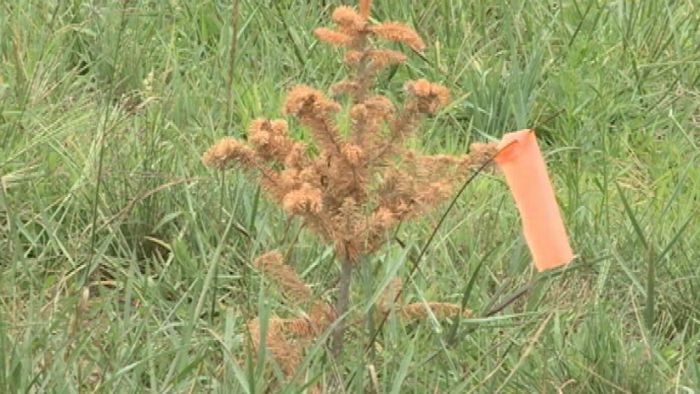
It makes no difference where you live, this story is a tough one to bear: An NBC affiliate in Iowa is reporting that this year's drought could already have some negative impact on Christmas trees in eight years or so, and a long while on those who grow them. "We started planting trees on our farm in 1980 and fought a couple of bad years but this is by far the worse we've seen," Bob Moulds, who owns Wapsie Pines Tree Farm in Fairbank, Iowa, told KWWL of Waterloo. (KWWL photo)

Moulds said the most popular Christmas tree, a fir, has been hit the hardest by the heat and drought. Crop losses have been significant. "Most of our losses are in this year's planting. And in this particular area over 50 percent. And before it's over I think almost all of them will be gone," Moulds saidThe grower has already taken steps for the shortage of trees his farm will see in the future, ordering extra seedlings to "make up the difference because in about eight years from now we'll probably have a little gap in the number of trees we have available." He said some fir growers in Wisconsin and Michigan have also lost everything they've planted. (Read more)

Study: Injection of fracking's waste near faultlines, not drilling, is responsible for quakes

A new study has found that deep injection of oil and gas wastewater appears to be causing more earthquakes than previously thought. Cliff Frohlich, a senior research scientist at the University of Texas' Institute for Geophysics, said that his findings should be taken seriously by drillers especially as the practice spreads to more densely populated areas. His work, reports Mike Soraghan of EnergyWire, was done around the Barnett Shale around Dallas to measure small earthquakes taking place near injection wells. His peer-reviewed study was published in the Proceedings of the National Academy of Sciences.

Soraghan explains that "Frohlich did not find any suggestion that the earthquakes were caused by hydraulic fracturing, or fracking. But fracturing creates millions of gallons of briny, toxic wastewater that drillers must eventually dispose of, usually by injecting it into the type of injection wells Frohlich was studying. That suggests, he said, that earthquakes occur only if there is a fault nearby that is susceptible to being triggered by high volumes of fluid." This suggested to Frolich that drillers could stop the earthquakes by choosing an alternate site to dispose of their wastewater. (Read more)

Thursday, August 09, 2012

UMWA plans no endorsement in presidential race

The United Mine Workers of America does not plan to endorse either presidential candidate in the upcoming election, something that has not happened in memory, Amy Harder of the National Journal reports.

The vice president of the UMWA's International Executive Board, Mike Caputo, right, told Harder that he wanted the organization to stay out of the fray. "I don't think quite frankly that coalfield folks are crazy about either candidate," he said. Obama and presumptive Republican candidate, Mitt Romney, are circulating ads and making stops in swing states with coal mines, such as Ohio and Virginia, to convince residents that they support the industry, Harder writes. Caputo said it's "unusual" for the UMWA to pass on presidential candidate endorsement. The organization hasn't officially completed its endorsement selection decisions, but expects to by mid-September; it had endorsed Obama by May in 2008.

"Politically, the Environmental Protection Agency is the culprit for the coal industry's woes," Harder writes, and this has influenced UMWA member's decisions on endorsement. Caputo said new mercury emission regulations were first introduced under George H.W. Bush, but "whoever is in charge is going to get blamed." Labor unions traditionally side with Democratic candidates, but the UMWA "has been ranting more about Obama for much of 2012," Harder writes, perhaps peaking with UMWA President Cecil Roberts' description of EPA Administrator Lisa Jackson's actions on regulation as terroristic. (Read more)

Large-scale agriculture is using more groundwater than nature can replenish

Humans in large agricultural regions are over-exploiting underground water, depleting it faster than nature can replenish it, a new study of international aquifer use concludes.

Scientists mapped the "groundwater footprint" of 15 major agricultural regions, Monte Morin of the Los Angeles Times reports. The study, published in the journal Nature, concluded that the global groundwater footprint of agricultural regions was 3.5 times higher than the size of all aquifers combined. (Click on map for larger version)
Lead author and McGill University professor Tom Gleeson said the heavy consumption was "driven by a handful of areas," Morin reports, including the High Plains of the U.S. California's Central Valley had a groundwater footprint larger than its aquifer, but it was almost a third smaller than in the High Plains. About 80 percent of the world's aquifers had a footprint smaller than their size, but the major agricultural regions contributed to a global deficit, Morin reports.

Founder of Christian Appalachian Project has died

Monsignor Ralph Beiting, the Roman Catholic priest who founded the Christian Appalachian Project and served the people of Eastern Kentucky since World War II, has died. He was 89.

Beiting was introduced to Appalachia when he traveled to the region on a mission trip in 1946. He had lived through the Great Depression and was familiar with living in poverty, but in Appalachia, he said during an interview with Story Corps, he had found "that there was another America ... the America of Appalachia." He said the poverty there at the time was the worst he had ever witnessed.

Charles Compton of WEKU, the public station at Eastern Kentucky University, reports that Beiting was called in 1950 to start a Catholic church in Berea, just outside the Appalachian coalfield, and though his reception was not warm, he continued to "spread the faith and raise money" to build more churches throughout Eastern Kentucky. In the 1950s, Beiting launched a summer camp, Cliffview Lodge, that offered recreation and fellowship to boys from poor families. In 1964, the camp became the Christian Appalachian Project, which Beiting declared would "be a group that would roll up our sleeves and get the job done." It expanded its work to a variety of projects to help the Appalachian poor.

Beiting served as pastor of parishes in the Berea region until 1981, when he transferred to Eastern Kentucky, where he founded and/or constructed 20 churches. He served as CAP's president until 1986 and was chairman until 1999. Here are links to three videos of Beiting and Father Terry Hoppenjans talking about their work.