Friday, August 13, 2021

Census data show which counties shrank over past decade; maps show racial and ethnic makeup change in your area

U.S. Census Bureau map; click the image to enlarge it.

Census Bureau statistics released Thursday "portray dense, diverse and growing metropolitan areas, while rural areas struggle to grow – or even hold on to their populations. That will have implications as states use the data to redraw their congressional boundaries in upcoming months, shifting political power and representation among their residents," Matthew Brown reports for USA Today. Rural population loss could make it more difficult for some areas to get federal funding, since areas without a large enough population can be shut out of certain programs and spending.

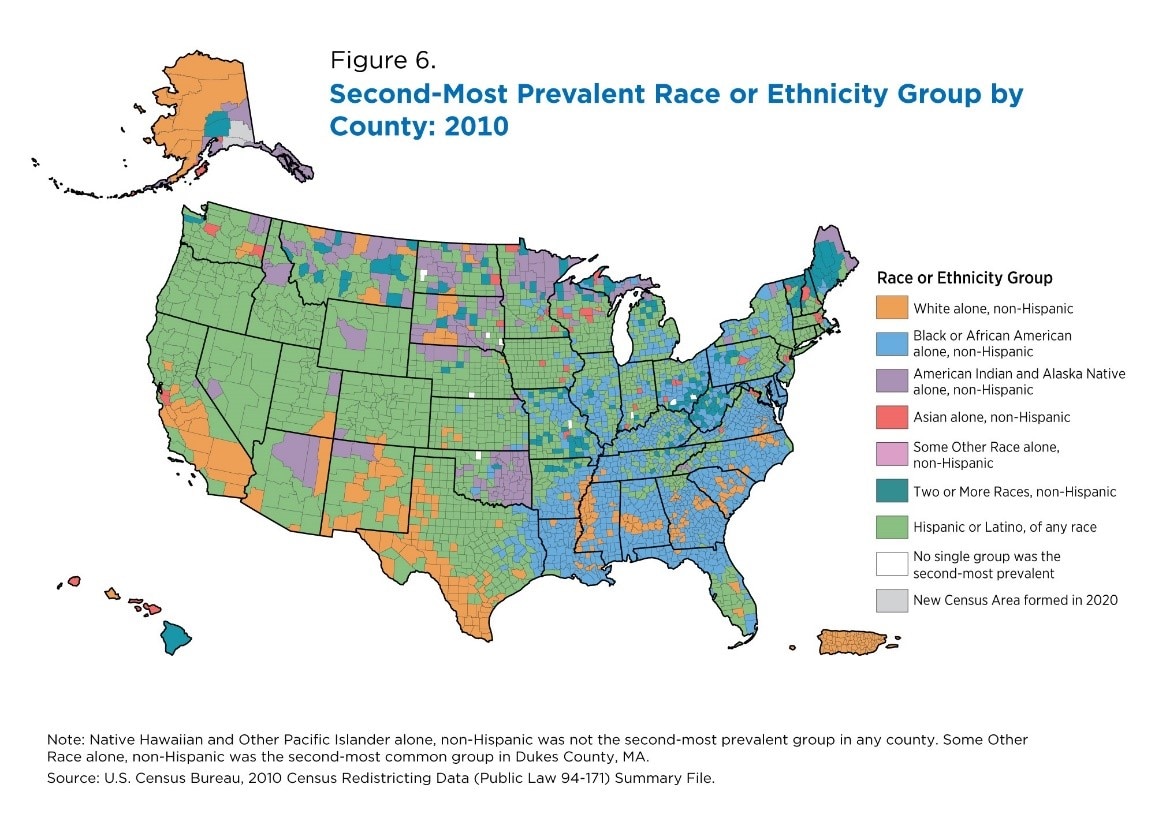
The new data showed, as expected, that the white population of the U.S. declined for the first time, though they remain the majority in most counties. But, a map showing the second-most prevalent race or ethnicity in each county illustrated the growth of Hispanic and multi-racial Americans:

Second-most prevalent race or ethnicity in U.S. counties, in 2010 and 2020. Census Bureau maps for 2010 and 2020, adapted by The Rural Blog; click to enlarge it.

A package from The Washington Post has interactive maps at the state- county-, and census-tract-level showing how the racial makeup of the U.S. has changed since 1990. Among other things, it illustrates how Black Americans have increasingly moved away from rural areas.

Here are some other highlights of the report:

  • Metropolitan areas grew by 9 percent while non-metropolitan areas grew 1%. 
  • Fewer than half of the nation's counties grew in population.
  • Even in rapidly growing states, rural counties on average lost population while rural and suburban counties outpaced expected growth.
  • Overall population growth is slowing: the U.S. population grew by 7.4%, down from 9.7 in the last decennial census.

Rural telecoms ask House to add funding for wireless, which was given short shrift in the Senate's infrastructure bill

The Senate infrastructure bill has $65 billion for broadband deployment in under-served areas but not much for wireless, which rural and tribal residents disproportionately rely on for internet service. So, rural telecommunications companies are asking the House to add mobile connectivity funding in its version of the bill, Jeanne Whalen reports for The Washington Post.

A lack of cell phone towers and competition means rural residents are more likely to have spotty, more expensive, and more outdated wireless service—if they have service at all. But, as with broadband, government funding may be necessary because the expense of building out wireless connectivity isn't profitable enough for most private companies, Whalen reports.

It's not just private citizens who need better wireless connection: First responders also desperately need better mobile service to deal with emergencies. Volunteer firefighter Jason Edwards in Stevens County, Washington, told Whalen that EMTs sometimes can't get enough of a signal to call a hospital and seek advice for critical patients. "On a day-to-day basis, the lack of cell services is one of the biggest things affecting us," he said. "We might need to find a house with a landline or do what we can over the radio, but we can only talk to our dispatchers, and they’re not medical experts."

Firefighters are also at a disadvantage, especially with the raging fires they're battling this summer, said rural fire chief Mike Bucy of Loon Lake, Washington. Without adequate cell service, they can't send up-to-date information to the public, call in reinforcements or keep neighboring firefighting forces updated, he told Whalen.

Pandemic roundup: New rural infections up 40% last week

New coronavirus infections, in ranges by county, Aug. 1-7
Daily Yonder map; click the map to enlarge it or click here for the interactive version

Here's a roundup of recent news about the pandemic and immunization efforts:

New rural coronavirus infections "jumped more than 40% last week, rising to 99,136 from about 70,000 the week before. In the past month, the weekly number of new infections in rural counties has grown sevenfold -- the highest single-month increase in rural America since the start of the pandemic," Tim Murphy and Tim Marema report for The Daily Yonder. Rural Covid-19 deaths also began to accelerate last week. Click here for more charts, regional analysis, and an interactive county-level map.

Neighbors' deaths from Covid-19 have a rural Arkansas town reassessing vaccination. Residents are still deeply skeptical, but community leaders are trying to persuade them. Read more here.

You may have noticed that Daily Yonder infection maps don't have data from Nebraska. That's because the state, citing privacy concerns, is no longer releasing to the public infection data from counties with fewer than 20,000 people—about 80% of the state's 93 counties. The Centers for Disease Control and Prevention and the state health department still publish county-level data, but those are only updated weekly and aren't as extensive as what many local health departments had been reporting. Rural counties have lower vaccination rates and are more likely to see "explosive outbreaks" of Covid-19, said one expert. Without state-released data, it's more difficult for news media and policymakers, as well as the general public, to assess how bad the pandemic is. Read more here.

Poll shows, state by state, reasons people give for not getting, or not planning to get, a vaccination for Covid-19

Why are people in your state hesitant about, or resistant to, getting vaccinated for the coronavirus? A national survey by the Bureau of the Census has the answers, with adaptable graphs.

Taken June 23 through July 5, the poll showed that 54% of Americans said concerns about side effects are keeping them from getting the vaccine or planning to get it. Health experts say the side effects pale in comparison to the potential effects of the Covid-19 disease, such as serious illness and death.

Among other main reasons, 40% said they are waiting to see if the vaccines are safe, and 37% cited distrust of the vaccines; 28% cited distrust of government. The latter factor was highest in Minnesota, Kentucky, Iowa, Kansas and Massachusetts had the highest shares of government distrust.

Medical experts say everyone over age 12, with very limited exceptions, needs to be vaccinated, but 26% of Americans said they don't. That was highest in Alaska, Montana, North Dakota, Minnesota and Utah. Quote Wizard, an insurance website, has a story.

Quick hits: Tips for using drones in journalism; book shows how urban-based news leaves rural residents behind

Here's a roundup of stories with rural resonance; if you do or see similar work that should be shared on The Rural Blog, email heather.chapman@uky.edu.

Most journalists for nationwide publications work in large cities and produce news with similar audiences in mind. Media scholar Nikki Usher writes about how that alienates rural audiences in her new book News for the Rich, White, and Blue: How Place and Power Distort American Journalism (Columbia University Press, $30). Read more here.

Why the South is the epicenter of anti-abortion sentiment. Read more here.

Housing was already scarce in the Lake Tahoe-area town of Truckee, California; the pandemic-driven remote worker boom made it worse. Read more here.

Here's some tips on using drones for multimedia journalism. Read more here.

Noted Appalachian author Gurney Norman sat down for a chat with Dee Davis of The Daily Yonder after learning that a Kentucky town is naming a new neighborhood after him. Read more here.

A "cookie cutter" nationwide plan to reach Democratic voters won't help rural Democrats, writes a rural political strategist. Read more here.

New Agriculture Department market reports could help cattle producers make more money. Read more here.

For the first time, the average pay for supermarket and restaurant workers nationwide tops $15 an hour, but not everywhere. As competition for workers heats up, large retailers and other major employers are boosting their starting wages. That could help rural employees, where wages tend to be lower, but could hurt smaller local competitors who will feel obliged to follow suit. Read more here.

A soon-to-be-released documentary tells the story of hunger in rural Wisconsin during the first year of the pandemic through the eyes and voices of five rural food pantry directors. Read more here.

The Boston Globe plans a special vaccination section for Wednesday, Aug. 18; invites other news media to participate

By Marjorie Pritchard
Deputy managing editor, The Boston Globe

We all know how to end the coronavirus pandemic: Get vaccinated. But we also know that reality has run into resistance from millions across the nation who are hesitant to get the vaccine.

In an effort to clear up misinformation about vaccines, The Boston Globe will run a special front-page section on Aug. 18 that will comprehensively debunk myths about vaccines and identify other barriers to vaccination in our community. The package will include stories, charts, and a diagram on how to respectfully talk to people about their vaccine concerns.

We will also publish an editorial that addresses vaccine hesitancy in our community and recommends next steps to encourage vaccination. We’d love it if you would join us by writing your own editorial for Aug. 18. As trusted members of our communities, we can each address our individual community’s concerns and hopefully persuade people to get vaccinated. Publishing on the same day would send a powerful message to the nation that civic journalism can help solve this public health crisis. Please join us. It’s our last best shot. To join the editorial campaign, click here.

Thursday, August 12, 2021

Today's census numbers show that rural America will have to fight to keep political influence in states and U.S. House


Today the Census Bureau is releasing population data for congressional and legislative redistricting which will show rural areas (which are disproportionately white and conservative) have lost people overall in the past decade, and are in line to lose power in statehouses and the U.S. House. 

"An analysis of recent U.S. Census Bureau estimates shows that "rural areas lost 226,000 people, a decline of about 0.5 percent, between 2010 and 2020, while cities and suburbs grew by about 21 million people, or 8%," Tim Henderson reports for Stateline. "Republican state legislatures will try to draw districts that preserve the political power of mostly conservative rural voters, but that task will become increasingly difficult as the population balance shifts toward cities."

Rural interests in some states have organized keep as much representation as they can, Henderson reports: "Pro 15, a group that advocates for largely rural northeastern Colorado, asked the state redistricting commission not to dilute the power of rural counties by dividing those voters into districts dominated by urban voters. Colorado’s rural counties grew 4%, a fraction of the state’s 17% urban growth, according to the census estimates."

The Census Bureau is holding a news conference at 1 p.m. ET today to discuss the first local-level results from the 2020 census, which states use to redraw federal and state legislative districts. After the presser on the Census Live page, credentialed news media can participate in a Q&A session with presenters. Click here to register for the press conference and access. The new data will be released today on the Census Bureau's FTP site, and will be released in easier-to-use formats by Sept. 30.

Pandemic-boosted SNAP benefits still can't cover food costs in most counties; see interactive county-level map

Urban Institute map; click the image to enlarge it or click here for the interactive version

The maximum Supplemental Nutrition Assistance Program benefit still can't cover food expenses in over 40 percent of U.S. counties, even after a pandemic-related 15% increase in benefits, Olivia Weeks reports for The Daily Yonder. The program is used disproportionately in rural America.

Before the pandemic, the maximum SNAP benefit fell short of monthly food costs by an average of nearly $40 per person. In 96% of counties, the top benefit couldn't pay for a modestly priced meal ($2.41) three times a day, according to a new report from the Urban Institute, Weeks reports.

Even after the pandemic benefits bump, food costs exceed maximum SNAP benefits in 40.5% of counties. "In rural Leelanau County, Michigan, where the gap is the highest in the nation, the average modestly priced meal costs $3.90 more than SNAP provides, even after the temporary increase," Weeks reports. "Rural recreation counties such as Nevada County, California; Pacific County, Washington; Blaine County, Idaho; and Teton County, Wyoming, are all among the top 10 highest-gap counties. Only two of the 10 highest-gap counties are metropolitan."

Some argue that SNAP benefits aren't meant to cover a family's whole food budget, but about 40% of SNAP-eligible families have zero net income, the report says.

Heat roundup: Dixie Fire survivors share stories of loss and uncertainty; farmworkers at higher risk of heat-wave deaths

The Dixie Fire is about five times the size of Disneyland
and is only 30% contained. (Google Maps screenshot)
More than half of the 48 contiguous states are under heat advisories as heat waves blanket much of the nation. The combination of high temperatures and low humidity is expected to increase wildfire risk in the Pacific Northwest for the next several days. The Washington Post notes: "Climate change is intensifying the frequency and intensity of extreme heat as increasing concentrations of greenhouse gases from fossil fuel burning warm the atmosphere." Read more here.

Drought is shrinking rivers and lakes, which could slow barge traffic and make it harder for farmers to ship crops. Read more here.

Farmworkers are some of the most vulnerable to heatwave deaths; employers and governments must do more to protect them, writes a columnist. Read more here.

The Dixie Fire is now the largest single fire in California history, though it is still only half the size of the August Complex, a 2020 conflagration that spanned seven counties. Dixie is only 30 percent contained and covers 790 square miles, according to Cal Fire. Meanwhile, the uncontrolled Richard Spring Fire in Montana has grown to more than 230 square miles. Read more here.

Rural Dixie Fire survivors share stories of loss and uncertainty. Read more here.

Analysis: Bigger child tax credit helps rural economies most

Child Tax Credit as a share of regional GDP
(Niskanen Center chart)
The newly expanded Child Tax Credit will drive $27.6 billion in new household spending, support more than half a million new jobs, and disproportionately help rural economies, according to a new analysis from the Niskanen Center, a moderate D.C. think tank.

The credit began paying out an advanced monthly tax refund of up to $300 per child on July 15, and has reached an estimated 60 million children in 39 million households. Though the policy is only authorized for one year, it's expected to reduce child poverty by 40 percent, the report says.

But less attention has been paid to how the refund can stimulate local economies through increased consumer spending. Niskanen estimated that economic impact by state and congressional district.

Naloxone shortage could lead to 11,000+ deaths, many rural

A shortage of the opioid-overdose antidote drug naloxone could result in thousands of overdose deaths in rural and other under-served areas that are already less likely to have access to the drug, Meryl Kornfield reports for The Washington Post. One organizer estimated that the back-order of 250,000 doses could lead to at least 11,000 more overdose deaths,

Pfizer stopped making naloxone in April after a manufacturing issue and might not be able to meet demand until February, a spokesperson said. Pfizer typically provides the drug at a discount to the Opioid Safety and Naloxone Network Buyer's Club, a consortium of over 100 harm-reduction programs that distribute it. "The community programs that rely on the Buyer’s Club have resorted to seeking donations to buy naloxone at market price or looking for supply from places where the antidote is sitting on shelves and expiring," Kornfield reports. "A dose of generic naloxone typically costs upward of $20 wholesale. Buying the same quantity of the drug from other manufacturers isn’t attainable, activists told The Washington Post."

Programs with limited funding or without adequate local laws and infrastructure to distribute naloxone are likely to suffer most, activists said. "In some areas, especially in the Midwest, South and Appalachian regions, programs operate under the radar, without authorities’ approval, said Eliza Wheeler, another buyer’s club organizer," Kornfield reports. "Harm reduction, or efforts to minimize the harms of substance use, has faced backlash from critics who argue providing clean needles, fentanyl testing strips and naloxone enables drug use. Recent studies show such approaches save lives.

Wednesday, August 11, 2021

Studies assess level of vaccine misinformation in rural America (it's higher than in urban), and Facebook's role in it

Respondents were asked to identify four misinformation items as true or false: The vaccines 1) will alter DNA; 2) contain microchips that can track; 3) contain tissue of aborted fetuses; 4) can cause infertility. (Covid States Project chart)

Misinformation about the coronavirus vaccines is present on nearly every type of media, but a pair of new studies highlight the link between social-media consumption and resistance or hesitancy to get vaccinated among rural residents and other demographics.

The studies are a product of The Covid States Project, a joint effort of Harvard, Northeastern, Northwestern, and Rutgers universities, which has been publishing meaty, survey-based reports since April 2020. It also has a dashboard with state- and national-level charts detailing the percentage of residents who have recently gone out in various public places, who have recently been in an enclosed space with people who don't live with them, and who have followed health recommendations such as hand-washing and wearing a mask.

One study addresses the role of Facebook in vaccine misinformation and refusal. President Biden and Senate Republican Leader Mitch McConnell have criticized social media as a source of vaccine misinformation, which Facebook has denied. But the study found that people who rely on Facebook for news and information about the pandemic are substantially less likely than the average American to be vaccinated, the researchers write for The Washington Post. In fact, they found that those who rely on Facebook for such news are less likely to be vaccinated than those who rely on the often vaccine-skeptical Fox News. Even after weighting the figures to account for differences in social-media habits by rurality, rural respondents were more likely than suburban residents, and about as likely as urban residents, to say they didn't intent to get vaccinated. Suburban and urban residents were more likely to report that they had already been vaccinated, which matches official vaccination data.

The other study focuses on how entrenched vaccine misinformation is among different demographics such as age, gender, race, income, educational attainment, political party, and rurality. Respondents were asked to rate four vaccine misinformation items as true or false (see chart above). Rural residents were less likely than suburban or urban residents to correctly identify all four statements as false.

The Covid States Project receives support from the National Science Foundation, the Knight Foundation, the Russell Sage Foundation, the Peter G. Peterson Foundation, and Amazon.

As chicken prices rise, and more increases are forecast, Cargill and Continental Grain are buying Sanderson Farms

“With the price of chicken soaring, the third-largest poultry producer in the U.S. is being bought for $4.53 billion,” report Dee-Ann Durbin and Michelle Chapman of The Associated Press. “Cargill and Continental Grain have formed a joint venture to acquire Sanderson Farms, paying $203 per share in cash for a company that last year processed more than 4.8 billion pounds of meat.”

The merger will have to pass anti-trust muster with the Department of Justice. Republican Sen. Chuck Grassley of  Iowa said on Twitter that he has expressed concerns to Justice about the deal, and "We've been too soft in allowing past mergers." He said he has heard complaints about lack of competition in the meat industry at his county meetings, and the poultry industry "has recently been investigated for price fixing, so we need thorough review."

“The deal comes as chicken prices are surging,” AP reports. “Wholesale chicken breast prices have been at or above $1.80 per pound since mid-April, a seven-year high, according to the Livestock Marketing Information Center. Last year at this time, they were $1.13 per pound.” The increases have been driven by demand from restaurants; several major chains have introduced new chicken sandwiches.

Tyson Foods, the biggest meatpacker, is projecting even higher meat costs ahead, as it "seeks to pass along elevated prices for animal feed, increased wages and ongoing pandemic expenses to restaurants and supermarkets," Jacob Bunge reports for The Wall Street Journal.

“Rising labor costs along with elevated prices for packaging, transport and grain—typically the biggest expense in raising livestock and poultry—are pushing Tyson to raise prices the company charges supermarkets and restaurants, executives said” in a conference call with reporters.

All state broadcaster groups back local journalism tax break

"Local broadcasters are urging the Senate to provide tax credits to stations that staff up their newsrooms, citing, in part, Big Tech's 'devouring' of their local ad market. In a letter to Senate leadership, all 50 state broadcaster associations called for passage of the Local Journalism Sustainability Act," John Eggerton reports for industry publication Broadcasting + Cable. "The bill, which was introduced last month by Sen. Maria Cantwell (D-Wash.), chair of the Senate Commerce Committee, along with Sens. Mark Kelly (D-Ariz.), and Ron Wyden (D-Ore.), would provide tax breaks for stations as well as small businesses that support local media with their ad dollars."

The bill would be a "lifeline" for local newsrooms and enable them to continue providing a "critical public service" to their communities, the broadcasters wrote. It's especially needed now because ad revenue is down during the pandemic, and tech companies (mainly Google and Facebook) take a large percentage of news media sites' online advertising dollars, Eggerton reports.

Census is likely to confirm white population is declining; demographer cites opioids, low millennial birth rate

"For the first time in the history of the country’s census-taking, the number of white people in the United States is widely expected to show a decline when the first racial breakdowns from the 2020 Census are reported this week," Tara Bahrampour and Ted Mellnik report for The Washington Post.

The Census Bureau has estimated for the past five years that the white population has been shrinking and that people of color have driven all population growth. Data from the 2020 decennial census, planned to be released tomorrow, is expected to confirm and quantify those estimates, Bahrampour and Mellnik report. If that happens, the benchmark will come about eight years earlier than previously estimated, according to Brookings Institution demographer William Frey. He noted that the opioid epidemic and low birth rates among millennials after the Great Recession have accelerated the decline.

Census Bureau estimates from 2016 to 2020 "show that all of the country’s population growth during that period came from increases in people of color. The largest and most steady gains were among Hispanics, who have doubled their population share over the past three decades to almost 20 percent and who are believed to account for half of the nation’s growth since 2010. They are expected to drive about half the growth in more than a dozen states, including Texas, Florida, Arizona, New Mexico and Nevada," Bahrampour and Mellnik report. "The shifts signal what Frey calls a 'cultural generation gap,' with older generations that are much Whiter than younger ones. Racial minorities will drive all the growth in the U.S. labor force as White baby boomers retire and will make the difference between growth and decline in rural and suburban areas."

Infrastructure bill has provisions for abandoned mine and well reclamation, dangerous dam removal, and more

The infrastructure package the Senate passed Tuesday has plenty in it for rural America. The Rural Blog has previously reported on this, but some parts of the huge bill are still coming to light. 

The package allocates $11.3 billion to help clean up abandoned mines, nearly double the $6 billion the Abandoned Mine Reclamation Fund has received in the past 15 years (see p. 1776 of the bill) but short of the estimated $20 billion (click here for state estimates) needed for total clean-up costs.

The package also has $4.7 billion for plugging and reclaiming abandoned oil and gas wells on federal, state and tribal lands (p. 1744). States can apply for competitive grants of up to $25 million for the purpose. Well and mine operators must post bonds meant to cover clean-up costs, but they're often inadequate, and rural governments are frequently stuck with the bill when companies go under.

The mine funding will be spread over 15 years and will go to 25 states and three tribes: Alabama, Alaska, Arkansas, Colorado, Illinois, Indiana, Iowa, Kansas, Kentucky, Louisiana, Maryland, Mississippi, Missouri, Montana, New Mexico, North Dakota, Ohio, Oklahoma, Pennsylvania, Tennessee, Texas, Utah, Virginia, West Virginia, Wyoming, and the Crow, Hopi and Navajo.

Dam safety also gets attention in the bill: It creates and funds a $553 million grant program for hydroelectric dam owners to make them safer and more efficient. And it would provide $1.6 billion for government agencies to remove dangerous dams. 

The package calls on the Transportation Department's Build America Bureau to establish a Rural and Tribal Assistance Pilot Program to provide technical, financial and legal assistance to rural and tribal governments' infrastructure projects. The pilot program is meant to last five years, and is funded as follows: $1.6 million for fiscal year 2022, $1.8 million for FY 2023, $2 million for FY 2024, $2.2 million for FY 2025, and $2.4 million for FY 2026.

Tuesday, August 10, 2021

Infrastructure bill would give state, local governments freer hand with broadband cash, so rural might have to fight for it

The coronavirus pandemic has highlighted the need to close the rural-urban digital divide, and many state and local governments plan to use billions of dollars in federal relief funds to do that. The $1 trillion infrastructure bill the Senate passed today would provide a big boost, and give governments more flexibility with it, Managing Editor Rich Ehisen reports for State Net Capitol Journal.

H.R. 3684 allocates $65 billion for broadband deployment and adoption in under-served areas, an amount that is "both much more than Congress has previously allocated specifically to broadband and substantially less than the $100 billion President Joe Biden was seeking," Ehisen reports. If passed as-is, $42 billion would likely be sent to states as block grants and $14 billion would permanently fund an emergency fund that helps low-income Americans pay internet bills.

Notably, the bill "grants state and local governments wide latitude to set their own priorities in funding broadband projects, a significant departure from the usual mandates for how federal funds are utilized," Ehisen reports. "It also allows funds to be allocated toward 'communities,' as defined by states themselves instead of the usual census blocks based on Federal Communications Commission data." That could mean rural areas shouldn't take for granted that they will get help from the bill, because it is not focused only on rural areas.

Study: Smoking rates have declined less among rural teens

Estimates of rural-urban difference in the prevalence of smoking
by high-school seniors, 1996-2021 (University of Minnesota chart)
Overall smoking rates continued to decline among teens from 1998 to 2018, but less so among rural teens, according to a newly published study in The Journal of Rural Health.

Smoking, the primary cause of preventable death, is more common in rural America. Since smokers typically begin the habit during adolescence, the researchers posited that higher smoking rates among rural teens contribute to significant long-term health disparities between rural and urban adults. They recommend that policymakers redouble their efforts to get rural teens to stop smoking or never start, since it could have big ramifications for rural morbidity and mortality rates down the line.

Researchers pulled data from 12th-grader surveys by the U.S. "Monitoring the Future" study from 1998 to 2018. Using the data, they estimated trends in the age of smoking initiation as well as how much the respondents smoke, both now and ever, and compared rural and urban estimates. 

Between 1998 and 2018, rural teens became far more likely than their urban peers to have ever smoked in their lifetimes. In 1998 rural teens were 6.9 percent more likely to have ever smoked, which rose to 13.5% in 2018—among the highest disparity in the past 20 years. 

However, over the past 20 years, the gap narrowed between rural and urban teens who had ever regularly smoked or currently smoke. The gap between rural and urban teens who had ever regularly smoked narrowed from 6.4% to 4.8% in the time period studied, while the gap between rural and urban teens who currently smoke narrowed from 5.5% to 3.0%.

Major climate report warns of increasingly extreme weather in coming decades, even if warming emissions are cut

The Intergovernmental Panel on Climate Change, scientists convened by the United Nations, has issued many reports on global warming and climate change. The latest sounds an alarm like no previous report. U.N. Secretary-General António Guterres called it “a code red for humanity.”

"Nations have delayed curbing their fossil-fuel emissions for so long that they can no longer stop global warming from intensifying over the next 30 years, though there is still a short window to prevent the most harrowing future," The New York Times reports. "Humans have already heated the planet by roughly 1.1 degrees Celsius, or 2 degrees Fahrenheit, since the 19th century, largely by burning coal, oil and gas for energy."

The consequences are already evident in record-breaking heat waves, wildfires, floods and more. "But that’s only the beginning, according to the report," Brad Plumer and Henry Fountain report for the Times. "Even if nations started sharply cutting emissions today, total global warming is likely to rise around 1.5 degrees Celsius within the next two decades, a hotter future that is now essentially locked."

What does that mean? "At 1.5 degrees of warming, scientists have found, the dangers grow considerably. Nearly 1 billion people worldwide could swelter in more frequent life-threatening heat waves. Hundreds of millions more would struggle for water because of severe droughts. Some animal and plant species alive today will be gone. Coral reefs, which sustain fisheries for large swaths of the globe, will suffer more frequent mass die-offs."

University of Leeds climatologist Piers Forster, who wrote the report along with hundreds of international scientists, summed it up for the Times: "We can expect a significant jump in extreme weather over the next 20 or 30 years ... Things are unfortunately likely to get worse than they are today."

Vaccinations pick up in most rural counties, indicating Delta variant is spurring more, but rural rate still 3/4 of metro rate

Rural/urban vaccination rates as of Aug. 5, compared to the national average and adjusted to account for vaccinations not assigned to specific counties. Map by The Daily Yonder; click the image to enlarge it or here for the interactive version.

"More than half of the nation’s rural counties increased their pace of new vaccinations last week, an indication that the rapidly spreading Delta variant of Covid-19 is encouraging unvaccinated Americans to take action," Tim Murphy and Tim Marema report for The Daily Yonder. "Each of the 47 states in the union with rural counties had larger numbers of rural vaccinations last week than two weeks ago."

Between July 30 and Aug. 5, an additional 260,695 rural Americans completed their vaccinations, 74 percent more than the 150,205 who completed their vaccinations the week before. The nationwide rural vaccination rate climbed to 36.7% as of Aug. 5, up 0.5 percentage points from the week before. "Despite the gains, the rural vaccination rate remains much lower than the metropolitan rate," Murphy and Marema note. The metro rate rose 0.7 points, to 48% of the metro population.

Click here for an interactive county-level map, regional analysis and charts from the Yonder.