Thursday, December 16, 2021

Western Kentucky radio station keeps locals informed, helps community heal after last week's deadly tornadoes

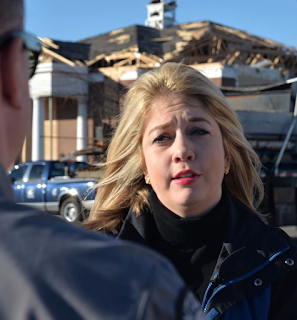
WPKY station owner Beth Mann helps keep Princeton locals informed in the aftermath of last week's deadly storms. (Poynter Institute photo by Al Tompkins)

When deadly tornadoes ripped through Western Kentucky last week, local newsrooms were lauded for their coverage. And as nationwide media begins trickling out, local news is still here to keep people informed and help the community heal. 

In Princeton, a community of 6,329 and the seat of Caldwell County, locals rely on WPKY-AM for updates and more, Princeton native Al Tompkins reports for the Poynter Institute for Media Studies. When morning host Tess Cowan emerged from the storm shelter after the tornado had passed, her first thought was to get to the station and begin broadcasting.

Princeton in Caldwell County (Wikipedia)
Station owner Beth Mann said the station plays a vital role in Princeton and nearby towns. "When everyone else is gone, we are still here," she told Tompkins. "We are community stewards. It is our job to connect the dots for people, to help them find the help they will need. And we will be key to building back the economic base of this town. It will be more important than ever for us to stress that we all have to support our local businesses."

And as Cowan noted, their drive to serve their community is about more than professional responsibility. "This is home and these are my neighbors that I am talking to," she told Tompkins. "Two people who work for the station lost their homes."

Biden visits tornado-devastated rural Western Ky., 'perhaps the most conservative place he has visited as president'

Biden in Dawson Springs, Kentucky (Photo from WPKY Radio)
President Biden inspected tornado damage and met with local and state officials yesterday in rural Western Kentucky, "perhaps the most conservative place he has visited as president, the one where open hostility would be most apparent," writes Matt Viser of The Washington Post. In Mayfield, population 10,000, "He set foot in a county that voted for Donald Trump by nearly a 4 to 1 margin. Many here protested his election, and some still do not accept that he is the rightful president. But the storms that have transformed parts of Western Kentucky suggest that a natural disaster remains one of the few spaces left in American life where, however briefly, many attempt to put their politics aside."

Biden then went to Dawson Springs, pop. 2,500, which lost three-fourths of its buildings. It's in Hopkins County, which he lost 3 to 1. “Reporters heard a smattering of 'Let’s go, Brandon' shouts as Biden toured the area, but that reaction was relatively muted,” Viser reports. Republican James Comer, the district's congressman, told Viser that such was  “not appropriate.” He added, “Overwhelmingly, 99.5 percent of the people who were on the parade route were very polite and, I think, appreciated that the president of the United States took time to come here after the disaster. The people here are very patriotic — very conservative, but they’re patriotic, and they respect the office of the presidency.”

On CNN Thursday morning, Comer reiterated his gratitude for Biden's surprise announcement that the federal government would cover all of state and local governments' cleanup costs for the first 30 days, instead of the usual 75 percent. “This is rural America,” he told anchor Kate Bouldan. "Rural America just doesn't have the tax base that urban and suburban areas have.” Biden said he had never seen such damage from a tornado.

Bouldan said "Some things are above and beyond politics" and asked Comer about the working relationship between Democrats and Republicans. “It's been great thus far,” he said. "Everyone, as they should, put politics aside . . I hope and pray that will continue over the coming months.” He said some people fear that the federal government will attention will come “as long as CNN and Fox and the news stations are covering it,” and “That was the underlying theme of the message that residents in West Kentucky gave to President Biden . . . just don't forget about us.” Biden seemed to get the message, saying in Mayfield, “We’re not leaving. We’re not going to leave. I promise you, the federal government is going to be involved until this gets rebuilt.”

Hospital closure left rural Ga. town reeling; trend dominant in South, where most states haven't expanded Medicaid

Cuthbert, the seat of Randolph County
(Wikipedia map)
A recent Kaiser Health News profile shows how a hospital's closure in rural Georgia is hurting its community, the factors that contributed to its closure, and how it fits in with a larger trend.

After Southwest Georgia Regional Medical Center closed in October 2020, the majority-Black community of Cuthbert, pop. 3,520, had no access to nearby emergency treatment. The closest hospital is 27 miles away in Eufaula, Ala., and that can mean the difference in life and death, Andy Miller reports for Kaiser Health News. A Cuthbert woman died from a heart attack this year; the ambulance took 20 minutes to respond and had to drive all the way to Eufuala. Her roommate said she could have been saved by a local hospital.

"University of Washington researchers have found that rural hospital closures led to increased mortality for inpatient stays in that region, while urban closures had no measurable effect," Miller reports. "Among the reasons they cited were the increase in the time people had to travel to get hospital care and that some medical providers leave communities when hospitals close." Rural ambulance services are often stretched thin and may take longer to answer calls.

Southwest Georgia RMC was one of 19 hospitals that closed in rural America last year, the highest single-year number since the University of North Carolina's Cecil G. Sheps Center for Health Services Research began tracking the data in 2005. Most were in the South, where most states have not expanded Medicaid, which has kept rural hospitals open in other states. "In the past 10 years, eight rural hospitals have shut down in Georgia; only Texas and Tennessee have had more closures," Miller reports. "The center’s data shows that 86 of the 129 hospitals that closed in that time were in Texas and the Southeast." They're more likely to be in communities with large Black and/or Hispanic populations.

"None of the eight states with the most rural hospital closures since 2014, when Medicaid expansion was first implemented through the Affordable Care Act, had chosen to expand the insurance program by the start of 2021,: Miller notes. "In several of those states, including Georgia, Republican-led governments have said such a step would be too costly." Former Cuthbert mayor Steve Whatley told Miller that Georgia's failure to expand Medicaid "hurt us probably more than anybody else."

Rural hospitals treat higher shares of uninsured patients and those with chronic illnesses, who are often unable to pay but often don't qualify for unexpanded Medicaid, Miller writes. The local populations also tend to be older, which means increased costs of care. On top of that, rural hospitals often have a hard time recruiting physicians, even as they struggle with infrastructure and maintenance costs.

Today, a quarter of rural hospitals—an estimated 453—are at risk of closure, according to the National Rural Health Association. Federal Covid relief funding has helped slow the trend of closures this year, but more solutions will be needed. Local, state and national lawmakers in many areas are applying for grants and exploring public-private partnerships.

bell hooks, a Kentucky native and rural advocate, dies at 69

bell hooks (Washington Post photo by Margaret Thomas)
bell hooks, a rural Kentucky native whose writings on race, feminism, and the environment brought her international acclaim, died Dec. 15 at her home in Berea, Linda Blackford reports for the Lexington Herald-Leader.

hooks, 69, was born Gloria Jean Watkins in Hopkinsville and attended segregated schools in Christian County as a child. She took her great-grandmother Bell Blair Hooks' name as a pen name, using lower-case letters to emphasize the importance of the writing over the author. After graduating from Stanford University, she went on to earn a master's degree in English at the University of Wisconsin and a Ph.D. in literature from the University of California at Santa Cruz. In 2004 she began teaching at Berea College in Kentucky, and in 2010 the school opened the bell hooks Institute, attracting visitors such as Gloria Steinem and Emma Watson.

Though hooks is best-known for her intersectional treatment of race and feminism, she was also a steadfast rural advocate and questioned why academics and activists discounted her voice when she spoke up for her home. In her essay "Connecting Appalachia to the World," she wrote: "As a Black woman writing about Appalachia, I receive little notice. I can talk race, gender, class, and be heard, but when I speak on environmental issues and all the ways agrarian Black folks hold the earth sacred few listen. As a voice for Appalachia, Wendell Berry is heard. Suddenly, I listened to his words and learned. Fervently, he teaches me. But like a mighty giant, a goliath, as a Kentucky Black female writer I stand always in his shadows. I am not considered a companion voice." (Berry is not from Appalachia but has been a voice for it.)

Her writing frequently addressed the intersection of rurality, race, and gender, especially in her 2009 book "Belonging: A Culture of Place," where she noted that mainstream urban Americans often dehumanized rural Kentuckians and saw their Appalachian subculture as a threat, "creating the notion that folks who inhabited these spaces were ignorant, stupid, inbred, ungovernable. By dehumanizing the hillbilly, the anarchist spirit which empowered poor folks to choose a lifestyle different from that of the state and so called civilized society could be crushed."

Though hooks' death is mourned the world over, Kentucky writer Silas House perhaps said it best: "bell hooks was one of the most interesting, remarkable, and complicated people I've ever known. . . .  I will miss her, and the world is less fierce without her."

Wednesday, December 15, 2021

Poll shows religiously unaffiliated Americans are now a plurality; professor says it's happening in rural America too

Though most Americans are Christians, their share of the adult population is waning, and more than ever say they don't follow any religion, according to polling from the Pew Research Center.

About 63 percent of respondents self-identified as Christians, down 12 points from 2011. "In addition, the share of U.S. adults who say they pray on a daily basis has been trending downward, as has the share who say religion is 'very important' in their lives," Gregory A. Smith reports. The decline in religion is concentrated among Protestants: 40% of respondents identify as Protestant, down 4 points in the past five years and 10 in the last 10.

About one-third of Americans identify with no religion, and say they're atheists, agnostics, or "nothing in particular" when asked about their religious identity. "If the unaffiliated were a religion, they’d be the largest religious group in the United States," Santa Clara University religious-studies professor Elizabeth Drescher told The Associated Press. Religiously unaffiliated Americans were once concentrated in urban, coastal areas, but are increasingly common in rural areas, said Drescher, who wrote a book about the spiritual values of the "nones."

The findings underscore a March report from Gallup showing that Americans' membership in houses of worship fell below half the population for the first time since Gallup's tracking began in 1937.

Paul Prather, a columnist and evangelical pastor in Kentucky, has theories on why religious affiliation is waning. The internet exposes us to many different belief systems and makes it easier to connect with others online instead of seeing a local church as a social hub, he wrote. And younger Americans tend to distrust all types of institutions, including churches.

Pandemic has put more public meetings online, but not all have broadband, and virtual meetings may discourage input

When the City Council in Midway, Kentucky, has met virtually during the pandemic, no citizen has signed up to speak during its public comment period. (Jan. 21 photo from the Midway Messenger, which has the same publisher as The Rural Blog)

"It’s difficult to imagine that there have been any silver linings surrounding the deadly Covid-19 pandemic. But there has been one that’s been seen as particularly valuable to people who are concerned with government transparency: Public meetings in which attendees can participate remotely," Katherine Barrett and Richard Greene report for Route Fifty.

Most public meetings were once conducted in person, but the pandemic necessitated an increase in remote gatherings for local and state officials. Many entities are considering keeping a hybrid format even after the pandemic ends so people can come in person or participate remotely, Barrett and Greene report.

However, areas with low broadband access (which are disproportionately rural) may have a harder time taking advantage of virtual or hybrid meetings and making their voices heard, they note. Even in places with good access, the move to virtual meetings may have discouraged citizens from taking advantage of the public comment period. When the city council in Midway, Ky., was in virtual mode (which it just resumed doing due to a rise in coronavirus cases), no one signed up for the public comment period.

More than 6,150 news employees laid off and more than 100 newsrooms shuttered in 17 months; see interactive map

Newsroom cutbacks (including reductions of hours) and closures, March 2020 to August 2021
Screenshot of Tow Center for Digital Journalism map; click the image to enlarge it or click here for the interactive version.

The pandemic has been rough on newsrooms, as the recession forced many businesses to cut back on their advertising budgets. New data from the Tow Center for Digital Journalism at Columbia University shows just how rough: At least 6,154 news workers were laid off from March 2020 to August 2021, and at least 100 news organizations have closed, Gabby Miller reports for Columbia Journalism Review. The list of newsrooms includes weeklies and other non-daily publications, and relies heavily on data compiled by Poynter's Kristen Hare. Here are more top findings:
  • Fourteen of the closed news organizations have since resumed operations to some extent.
  • Another 42 newsrooms were eliminated through mergers or acquisitions.
  • The layoffs were made by 35 chains and 343 individual outlets.
  • The first three months of the pandemic were the worst; there were 832 layoffs in March 2020, 905 in April, and 1,165 in May. In June 2020 there were 317.
  • The federally funded Paycheck Protection Program helped many local publications stay afloat through forgivable loans. Nearly 2,800 news companies employing 40,000 workers got one.

Climate change threatens New England lobster fishers' work

Single mom Kelsey Barker works on a lobster boat off the coast of Vindalhaven, Maine. The job has allowed her financial freedom she would be hard-pressed to find with other local jobs, she said. (Boston Globe photo by Jessica Rinaldi)

We know climate change is affecting the livelihoods of farmers, those in the tourism industry, and more. But here's another one to add to the list: lobster fishermen. A two-part series by Jenna Russell of The Boston Globe and Penelope Overton of the Portland Press Herald digs into what that looks like at the local level on Vindalhaven, a small island whose population relies on the lobster industry. In short, "the climate disaster that Maine fishermen dread is not some far-off, half-formed threat. It’s here," they report.

The Gulf of Maine is one of the fastest-warming ocean areas on the planet. For a while that worked in favor of local fishermen. "Lobsters, which make up the nation’s second-most valuable fishery, are sensitive to temperature, preferring the chilly North Atlantic to southerly waters," Russell and Overton report. "Since the 1970s, the epicenter of the lobster population has shifted more than 100 miles to the north as the Gulf of Maine warmed. That brought new prosperity to Maine coastal villages, while in southern New England, lobster populations and profits dwindled — and, in some places, all but vanished."

It's starting to happen in the Gulf of Maine too: "Maine lobstermen caught less in 2019 than in any of the last 12 years — down about 23 percent from the 2016 high," Russell and Overton report. Demand stayed low last year because of the pandemic, but even if this year's predicted rebound comes to pass, locals are worried about the future.

Climate change is hurting lobstermen in more than one way. Not only are they getting smaller lobster catches, but they're facing sweeping new restrictions meant to protect the North Atlantic right whale, whose food supply has been disrupted by climate change. "As they roam new routes in search of food, more whales are suffering injury or death resulting from entanglements in fishing lines, the ropes that stretch from traps on the sea floor to buoys floating on the surface," Russell and Overton report. "The growing risk to the whales, which now teeter on the brink of extinction, is driving a crackdown on lobstermen, the most catastrophic fallout they have faced to date as an indirect result of climate change."

Regulators will soon ask lobstermen to buy new gear that minimizes the danger to whales, but most balk at the notion. They're also having a hard time considering transitioning to another way of life, or even talking about it. Reaction to the issue on Vindalhaven is a microcosm of global reaction to climate change: "Every reading from the scientific buoy makes it harder to deny the world is warming," Russell and Overton report. "Yet many on this island of 1,200 still deny it, their complicated responses to climate change — disbelief, anger, grief, resistance — mirroring those of people everywhere. All the world, in different ways, is facing the same choice: to come to terms with life-altering disruption and adapt, or to turn away."

Tuesday, December 14, 2021

Biden recently nominated a mine-safety chief, but still no one to run Interior Department's Office of Surface Mining

"Congress approved $11.3 billion to clean up abandoned mine lands in the $1.2 trillion infrastructure bill, but environmental groups are worried that President Biden hasn’t chosen anyone to oversee how that money is spent on coal mines," Jael Holzman reports for Energy & Environment News.

President Biden hasn't nominated anyone to run the Office of Surface Mining Reclamation and Enforcement, which hasn't even had an acting director, Holzman concludes from the website of the agency, part of the Interior Department.

Tuesday, the Sierra Club and other activists, mainly from Appalachian states, urged Biden to nominate an OSM director to see that the money is “carefully administered.” They also asked, among other things, that the new money be spent on mines that closed before 1977. That's when Congress passed the federal strip-mine law, which included a severance tax on coal to fund reclamation of abandoned mines.

"This letter comes after Biden recently made picks for posts at other mining-related government agencies, including Christopher Williamson, a labor attorney and former staffer for West Virginia Democratic Sen. Joe Manchin, to run the Mine Safety and Health Administration," a Labor Department agency, Holzman reports, without making the departmental distinction.

Abandoned oil and gas wells, coal mines, hurt environment and locals' health; infrastructure funds earmarked to help

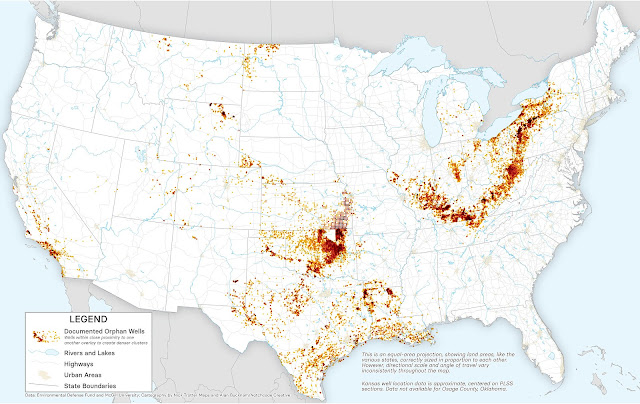
Map of documented abandoned wells from Environmental Defense Fund report; to enlarge, click on it or go here.

Coal, oil and natural gas have been major economic drivers in many rural areas, but these extractive industries have in many cases damaged the environment, and in some health of nearby residents, and too often failed to clean up after themselves. Federal funding can make a dent in the problem.

"In Pennsylvania, underground mine fires burn and iron-laden, acidic water pours into rivers from abandoned mine shafts. In New Hampshire, the iconic sugar maple is threatened by soil damage lingering from coal-induced acid rain," James Bruggers reports for Inside Climate News. "In Florida, a young mother obsesses over air and water pollution from a vast pile of coal ash stored by her local utility. And in Kentucky, the multi-billion dollar cost of reclaiming abandoned mines . . . far exceeds the amount of surety bonds left behind by an increasing number of bankrupt coal companies. "

Many states don't require coal companies to buy enough bonds for reclamation. That means bankrupt companies often leave rural places to pay for the cleanup themselves or suffer the environmental consequences. "Across Appalachia, mountaintop removal and other forms of surface mining have scarred an area of more than 2,300 square miles in Kentucky, West Virginia, Virginia and Tennessee. Nationwide, over a million acres of land used by still operating, idle or abandoned mines need to be cleaned up and reclaimed," Bruggers reports.

Meanwhile, there are more than 2 million inactive, unplugged oil and gas wells scattered across the U.S., according to a recently published map from the Environmental Defense Fund. Such wells often poison groundwater and leak the potent greenhouse gas methane. The Environmental Protection Agency estimates that the wells could leak as much methane per year as 5 million cars. The EDF's map shows 81,000 abandoned wells that are documented as having no owner.

Cleaning up abandoned fossil fuel sites is cost-prohibitive for states. It costs an average of $25,000 to $475,000 to close each oil or gas well. And a recent report found that it will cost as much as $9.8 billion to reclaim coal mines in Central Appalachia. On the upside: the recently signed infrastructure bill included $16 billion to clean up abandoned mines and old oil and gas wells.

Webinar at 2:30 p.m. ET TODAY to discuss how rural areas can identify and leverage assets to bring in more investment

The Urban Institute will host a free webinar from 2:30 to 4 p.m. ET today to discuss how rural communities can attract more government funding and private investment by identifying their strengths and leveraging their assets. Click here for more information or to register.

From the website: "We will begin with remarks by Xochitl Torres Small, under secretary for rural development in the U.S. Department of Agriculture, followed by a demonstration of Urban’s new typology and dashboard with national data on rural census tracts and peer groups that support asset-based rural investments and capacity building. After the demonstration, a panel of rural stakeholders will discuss the opportunities and challenges of identifying rural assets and using an asset-based investment framework."

Andrew Dumont, a senior community development analyst for the Federal Reserve Board of Governors, will moderator the panel, which will include:

  • Heidi Khokhar, executive director of Rural Development Initiatives
  • Joy Moten-Thomas. assistant administrator for community development and outreach at Fort Valley State University's College of Agricultural, Family Sciences, and Technology
  • Corianne Payton Scally, principal research associate at the Urban Institute
  • Janet Topolsky, executive director of the Aspen Institute Community Strategies Group
  • Sarah Rosen Wartell, president of the Urban Institute

USDA's Rural America at a Glance report shows disparities among urban, rural, and persistently poor rural counties

Broadband availability in nonmetropolitan counties by persistent poverty status as of 2019
(USDA map; click the image to enlarge it)

The U.S. Department of Agriculture's Economic Research Service has released the 2021 edition of its Rural America at a Glance report, a summary of broad rural trends in population, employment, poverty and income. This edition focuses on factors affecting the resiliency and recovery of rural communities in the wake of the coronavirus pandemic, including population and employment change, intensity of infection, vaccination rates, and broadband internet availability and adoption.

The report also highlights differences between persistently impoverished counties and counties that aren't persistently poor. A county is deemed persistently poor if at least 20 percent or more of the population has lived at or below the federal poverty line during four consecutive decennial censuses since 1980. Except in Appalachia, such counties tend to be more ethnically diverse and are often less resilient in the face of economic and social stress because they generally have fewer resources.

Here are some of the topline findings from the report:
  • 46 million Americans lived in rural areas in 2020, making up 14 percent of the population.
  • The typical rural county had less than one-tenth of the population of the typical metropolitan county: 23,000 compared to 245,000.
  • The rural population fell by 0.6% since 2010 while the urban population grew by 8.8%.
  • The U.S. population as a whole grew more slowly in the past decade than in previous decades, in part because of declining birth rates and decreased immigration to the U.S.
  • Rural counties that aren't persistently poor increased their population by 0.1%, while the population of persistently poor rural counties fell by 5.7%.
  • The local economy is also a factor in rural population trends. The five states with the fastest-growing rural populations over the past decade were in the West. Four of them (Utah, Idaho, Montana and Washington) have been attracting rural residents—especially retirees—with outdoor recreation and tourism amenities for decades.
  • North Dakota had the highest percentage of rural population gain over the past decade because its booming shale oil and gas sector attracted many workers.
  • The states with the highest levels of rural population decline relied on farming (Kansas and Illinois), manufacturing (Pennsylvania and New York) and resource extraction (Louisiana and West Virginia).
  • Poverty was a strong indicator in high rural coronavirus infection and mortality rates at the county level. Persistently poor rural counties have led the nation in percentage of cumulative coronavirus cases since September 2020.
  • Coronavirus vaccination rates in rural counties have consistently lagged metro rates throughout the pandemic; persistently poor rural counties have lagged even more.
  • Rural unemployment declined for nearly a decade before the pandemic, hitting a low of 3.5% in Sept. 2019. But by April 2020 the rural unemployment rate hit 13.6%, the highest rate since the 1930s. The pattern hints that persistently poor counties may have had higher coronavirus infection rates because more people in such counties were working, and such counties tended to rely on one industry, such as meatpacking.
  • Rural counties lost fewer jobs than metro counties during the first year of the pandemic. Employment in consistently poor rural counties fell 2.9% from Jan. 2020 to Jan. 2021, while employment in other rural counties fell 3.1% during the same time period. Consistently poor metro counties fell 9.0%, while other metro counties fell 5.7%.
  • 15.3% of rural residents living in poverty were unable to afford a home internet subscription in 2020.
  • More than 90% of Americans had broadband internet as of June 2019, but only 72% of rural residents had access to it in their census blocks, and only 63% of rural residents in poverty had access.
  • 83.3% of metro residents lived in census blocks with broadband access, compared to 62.7% of rural residents.
  • Only 58.3% of residents in consistently poor rural counties lived in census blocks with broadband access, compared to 71.8% of residents in other rural counties.
  • Broadband is less available in nonmetro persistent poverty counties in the Deep South and Southwest, and among nonmetro counties in the lower Great Plains and western Mountain States.
  • Internet subscription trends suggest that households in persistently poor rural counties may face additional barriers to internet adoption such as affordability and digital literacy.
  • 81.9% of rural households with internet subscriptions and 56.1% of urban households had internet subscriptions through wired sources such as cable, fiber-optic, or Digital Subscriber Line broadband.
  • Metro households were much more likely to have internet access solely through cellular data plans (35.5% vs. 7.2%). This could be due to the lack of cell towers in rural areas, inability to afford it, or both. Federal programs that aim to make rural broadband more affordable tend to focus on wired services, also exacerbating the issue.
  • Persistently poor counties, metro and rural, are more likely to have a higher share of racial minorities. The exception is Central Appalachia.

Investigation: S.C.'s poor ethical oversight has let small-town corruption flourish, especially in news deserts

This February, The Post and Courier partnered with dozens of smaller South Carolina newspapers for a yearlong project aimed at filling gaps in public accountability, especially those left by expanding local news deserts. The latest entry in the "Uncovered" series shows how the Charleston paper partnered with 17 community papers to expose how the state's inadequate ethical oversight system has allowed corruption to flourish in small towns, especially those with poor news coverage. Examples: 
  • A rural school superintendent had an expensive travel habit, spending thousands of dollars without the school board's permission on out-of-state trips with student groups.
  • Mysterious health problems made residents in Summerton afraid to drink the tap water. It turns out the local water tank was slowly filling with sludge because it hadn't been cleaned in years, and no one in charge noticed. A town council member's company was meant to be working on the system, but he didn't notify colleagues or publicly disclose his ties, and allegedly falsified logbooks and allowed equipment to fall into disrepair.
  • A convicted felon was improperly elected to city council, then kept collecting a salary and traveling using local government funding even after he had been suspended from office. His travels came at a time when the city could barely afford to cover payroll.

Rural coronavirus vaccination rate has barely budged for a month, still about 12 points below the urban rate

Vaccination rates as of Dec. 9, compared to national average and adjusted to account for vaccinations not assigned to specific counties. Map by The Daily Yonder; click the image to enlarge it or click here for the interactive version.

As of Dec. 9, the rural coronavirus vaccination was at 46.4 percent, up 1.6 percentage points from mid-November. With the metro rate at 58.8%, up 1.8 points from mid-November, "the gap between the rural and metropolitan vaccination rates has remained a little over 12 points throughout the last month," Tim Murphy and Tim Marema report for The Daily Yonder.

The Yonder's analysis encompasses several weeks because "data anomalies from the Thanksgiving holiday and adjustments in vaccination totals in Pennsylvania, Hawaii, and West Virginia make week-to-week comparisons difficult," Murphy and Marema report. "The rural vaccination rate jumped 1.4 percentage points last week, for example, but adjustments in West Virginia and Hawaii accounted for half of that gain."

Click here for more charts, regional analysis, and county-level interactive maps from the Yonder.

Monday, December 13, 2021

'We're not gonna be defined by rubble,' Paxton VP says; tornadoes highlight importance of local news media

Louisville anchor Lauren Adams covering the disaster in her
in-laws' hometown, Mayfield, Ky. (Poynter photo: Al Tompkins)
The tornadoes that killed dozens Friday and Saturday highlight the importance of local journalism and why we must fight to keep local papers and stations alive, CNN's Brian Stelter and Paxton Media Group's Bill Evans agreed on Stelter's show, "Reliable Sources," Sunday morning.

Hometown journalists are not only providing some of the first and most comprehensive reporting on the disasters, but have probably saved lives, said Bill Evans, Western Kentucky vice president of Paxton, a Paducah-based, family-owned firm that owns most daily and weekly newspapers in the region.

Evans oversees the Paducah TV station and six newspapers, including the Mayfield Messenger, whose office was wrecked along with much of the town. When Stelter asked how they were covering the disaster, Evans said that area Paxton newsrooms have pooled resources for years, so it was "nothing new" to come together to help the Messenger cover the aftermath of the storms.

Stelter noted that many towns in Paxton's coverage area had 20 minutes' warning before the tornadoes hit and asked if Evans believed WPSD-TV's weather coverage had saved lives by alerting locals. Evans, visibly choking up, said: "I can't tell you the number of people that I've heard from yesterday morning that said that . . . and that's exactly what we do. It's not trite to say that." When meteorologists are hired, he said, they are told that their job in severe weather is to save lives.

Besides covering the storms' immediate aftermath, local news media will chronicle the towns' recovery long after reporters from nationwide publications go home. "Beyond all this destruction you see is the people that remain, and we know that we're going to rebuild, we know we have stories to tell, stories of heroic efforts, and stories of people that will go on," Evans said. "So yeah, we're not gonna be defined by rubble. We're gonna be defined by the spirit that is us, and we're gonna move forward."

Covering a hometown disaster can be heart-wrenching, but journalists say they feel called to do it, Western Kentucky native Al Tompkins writes for Poynter. Lauren Adams, a weekend anchor at WLKY in Louisville, spent six years as a reporter in Paducah, and her husband's family is from Mayfield. She insisted on covering the disaster. "Before I got here, I had a pit in my stomach," she told Tompkins. "It hurts so much to see a place I love in such pain. I tried to tell my family why we have to be here. Maybe the power of our words will move people to donate to help, maybe go give some blood. Maybe it will just make people pay attention to weather warnings next time ... These are such good people. I want to do my best for them."

Tompkins advises journalists covering the disaster to be mindful of their own mental health, especially after the trauma of the past few years: "For the next few weeks, you will see people cry over all they lost, you will hear heartbreaking stories of people who died, and it will hurt every time," he writes. "You will get through it because it is what you do. But sometime — you decide when — you are going to have to stop and deal with what you feel. That is not weakness, it is strength. Notice when your colleagues are hurting and reach out to them. Check on your bosses, too."

10 sites picked for Mississippi River Basin Ag & Water Desk; apply for reporter jobs by Jan. 31, adviser posts by Jan. 14

Ten newsrooms have been picked to join the Missouri School of Journalism’s new Mississippi River Basin Ag & Water Desk that was announced in July. The newsrooms will get "salary support to hire a full-time environmental reporter," a Mizzou news release said.

They are the Wisconsin Center for Investigative Journalism; the Midwest Center for Investigative Reporting in Champaign, Ill.; the Louisville Courier-Journal; the Milwaukee Journal Sentinel; the Daily Memphian, Northern Illinois Public Radio, Kansas City-based Harvest Public Media; the Minneapolis Star Tribune; The Gazette of Cedar Rapids, Iowa; and The Lens of New Orleans.

Reporters will cover individual beats for their newsrooms, work together on regional and national projects and get training, mentorship and expenses-paid travel to the annual conference of the Society of Environmental Journalists. In some cases, such as the Louisville newspaper, the support will enable at least temporary restoration of an environmental reporting beat that was lost even before the pandemic. Journalists may apply for the 10 positions through RFA until Jan. 31.

The Ag & Water Desk is a collaborative that aims to provide "in-depth journalism and communication about water, agriculture and environmental issues across the Mississippi River Basin," the release says. "The editorially independent project is funded by a three-year, $1.4 million grant from the Walton Family Foundation." Sara Shipley Hiles, an associate professor, is executive director.

Editorial Director Tegan Wendland will lead collaborative reporting produced by the team. “I am thrilled that we received so many applications for the project,” she said. More than 20 newsrooms applied. The desk will hire five expert journalists to serve as mentors, team leaders and collaborators at $5,000 a year, with applications due by Jan. 14. More information is on the desk's website.

Report shows how much the pandemic has hurt outdoor recreation economy in 2020; federal aid could help rebound

"Earnings from outdoor recreation stumbled a bit in 2020 due to the pandemic, but the sector remained an important part of the U.S. economy, according to a new interactive report from Headwaters Economics," Kristi Eaton reports for The Daily Yonder. "The gross domestic product from outdoor recreation fell 19 percent from 2019 to 2020, and employment dropped by about 17%, the report said. But the sector still accounted for $374 billion of gross domestic product last year. That’s more than twice the size of motor-vehicle manufacturing, fossil-fuel extraction, or air transportation."

Outdoor recreation tends to play a bigger role in rural areas, Headwaters economist Megan Lawson told Eaton. Rural states are "more likely to have the natural amenities like open spaces and public lands that can support outdoor recreation," she said, noting that outdoor recreation is often a big moneymaker in New England, the Mountain West, Florida and Hawaii.

The biggest challenges of 2021 for hospitality-industry businesses such as restaurants and hotels will likely be supply-chain disruptions and difficulty finding employees, Lawson said. But she said that increased federal funding through the infrastructure bill and the Great American Outdoors Act could help communities better deal with those issues and others.

Fake meme about Omicron variant illustrates report warning about misinformation and recommending ways to fight it

The resurgence of a doctored image blaming the pandemic on a conspiracy illustrates a report warning that misinformation is a major threat to our society and highlights the critical role of the news media.

"In July, a fake slide deck with the logos of the World Health Organization and the World Economic Forum purporting to show a schedule for when coronavirus variants would be 'released' rocketed around social media, racking up thousands of likes on Twitter and Instagram," Gerrit De Vynck reports for The Washington Post. Anti-vaccine influencers cited the image as proof that powerful interests were orchestrating the pandemic.

The image has become popular again recently; it and other false or misleading claims about the Omicron variant have circulated widely on social media in the two weeks since the strain was identified. They serve as an illustration of a recent report from the Aspen Institute's Commission on Information Disorder. "Information disorder is a crisis that exacerbates all other crises. When bad information becomes as prevalent, persuasive, and persistent as good information, it creates a chain reaction of harm," write the commission's chairs: veteran journalist Katie Couric; Chris Krebs, the first director of the Cybersecurity and Infrastructure Security Agency; and Rashad Robinson, president of advocacy group Color of Change.

"If we want to reduce information disorder, there are structural changes that we can and must make to our information ecosystem, and there are rules that we can and must implement to better govern the decisions and behavior of information platforms and propagators," the commission writes. They recommend action in three broad areas:
  • Increase platforms' transparency to users and researchers concerning content, ads, moderation policies and more.
  • Build users' trust in the accuracy and reliability of information by supporting local journalism outlets, promoting new norms that include personal and professional consequences for those who spread misinformation, increasing workforce diversity at social media and news media companies, and improve election security.
  • Reduce harms caused by misinformation. The federal government should create a comprehensive strategic approach to countering misinformation through education, research and investment in local institutions. Platforms must have features aimed at increasing users' awareness of resilience to misinformation. Also, the Communications Decency Act should be amended to withdraw immunity to individuals and platforms responsible for spreading misinformation.

Report: Rural parents least likely to say they had or were willing to have their children vaccinated against coronavirus

Percentage of parents who said their children had been vaccinated for the coronavirus, or who said they were extremely or somewhat likely to do so, by political affiliation and rurality (Covid States Project chart; click the image to enlarge it)
Rural parents were the least likely of any demographic group measured to get their children vaccinated against the coronavirus, according to a new report from The Covid States Project. Only 17 percent of rural parents said their children between the ages of 5 and 11 were vaccinated, compared to 25% of suburban parents and 32% of urban parents. Meanwhile, only 45% of rural parents reporting that their children between the ages of 12 and 18 were vaccinated, compared to 54% of suburban parents and 60% of urban parents.

Republican, independent, non-college-educated, and younger parents were also less likely overall to report having their children vaccinated.

The Covid States Project is a joint effort of Harvard, Northeastern, Northwestern, and Rutgers universities. It receives support from the National Science Foundation, the Knight Foundation, the Russell Sage Foundation, the Peter G. Peterson Foundation and Amazon.

Friday, December 10, 2021

Many rural law-enforcement officers still use dangerous restraint techniques condemned by U.S. Justice Department

Officers in many rural police and and sheriff's departments still use dangerous restraint techniques that the U.S. Department of Justice condemned in 1995. "The agency, along with the International [Association of] Chiefs of Police, warned law-enforcement officials that keeping people restrained face down in what is known as the prone position increased the risk of death from asphyxia," reports Jerry Mitchell of the Mississippi Center for Investigative Reporting. "The Justice Department also told officers never to use a hogtie — a form of prone restraint in which officers also attach wrists to ankles behind the person’s back. Many police departments have banned the practice because of its link to positional asphyxia."

Mitchell cites the deaths of a rural Mississippi mother and son in separate incidents years apart as an example of the continuing use of the techniques—and their deadly consequences. "A joint investigation by NBC News and The Marshall Project identified at least 23 deaths involving hogtying or similar restraints across the country since 2010. At least 13 of those who died had mental illnesses or were in mental crisis," Mitchell reports.

It's also worth noting that officials involved in such cases generally blame the deaths on other factors such as intoxication or even heat stroke, but investigative journalists have been able to shine a light on such cases with footage obtained through state open-records or federal Freedom of Information Act requests.