Tuesday, August 01, 2023

Free webinar on 'Covering Contaminated Sites' from Society of Environmental Journalists 1-2 p.m. ET Wednesday

Jordan Gass-Pooré, creator/host, "Hazard NJ"
podcast from NJ Spotlight News/NJ PBS

Journalists can play a pivotal role in keeping their communities healthy by reporting on contaminated sites, but investigative reporting is often intimidating and resources for it often scant. A free webinar Wednesday, Aug. 2, is desigend to help.

"Covering Contaminated Sites in Your Community," from 1 to 2 p.m. ET, will feature investigative journalist and podcaster Jordan Gass-Pooré, who will provide tips on reporting on contaminated sites by incorporating local voices who have been affected by the pollution. The session presents expert views on how future extreme weather events fueled by climate change may threaten to further spread a pollution site if clean-up is not done.

This webinar, sponsored by the Society of Environmental Journalists, is free, and all journalists are welcome to attend. Registration includes name and email address only, here.

News-media roundup: Miss. Basin Ag & Water Desk to add 10 more reporters; Calif. paper was 'tortured plaything' . . .

The Walton Family Foundation is giving the Missouri School of Journalism $2.47 million over the next three years to expand the Mississippi River Basin Ag & Water Desk, a network of journalists that covers agriculture, water and environmental issues in the basin and makes articles free to publish. The foundation's additional support will fund a second cohort of 10 journalists starting next summer, through a partnership with Report for America. They will get training from the J-school and the Society of Environmental Journalists. Associate Professor Sara Shipley Hiles, the desk's executive director, said it wants a wider range of newsrooms. Applications from newsrooms are due Sept. 18.

James Rainey of the Los Angeles Times tells how billionaire Wendy McCaw made a "tortured plaything" of the Santa Barbara News-Press, which closed July 21. The closure "leaves Santa Barbara with a few online news sources and a solid alternative weekly, the Independent," the Times reports. "But those outlets collectively do not employ the number of journalists who once powered the News-Press."

Ken Tingley, retired editor of The Post-Star in Glens Falls, N.Y., has published The Last American Editor, Vol. 2, a collection of 90 stories and columns that "explore particular themes or periods of a person’s life that best represent Small-Town America," says his come-on.

Flora and fauna: Cat is a shepherd; your fruit is sweeter; the American Serengeti; wild boar for dinner; Vt. prefers cats

Bodacious loves his sheep.
(Photo by Jesse Hirsch, Modern Farmer)
You heard it here first. A cat in Ireland is a shepherd. "If you've ever owned (or met) a cat, the idea of using one like a sheepdog is absurd. Cats hate to be bossed, they're too puny to scare a sheep, and they'd much rather take a sunshine nap than run around doing farmwork. Even though they have evolved to recognize their owner's voices, studies say that they just don't care," yarns Jesse Hirsch for Modern Farmer. "Still, as cat shepherds go, Bodacious is at the top of his field. He's assisted in lamb births, barbed wire sheep rescues and hypothermia resuscitations, to name a few. His owner, Irish farmer Suzanna Crampton, says she could not function without him."

Do your "cotton candy" grapes taste as sweet as cotton candy? Is fruit sweeter now? "Yes, though the longer answer is more complicated. Some of the most powerful evidence that fruit is sweeter than before comes from zoos," reports Bee Wilson of The Wall Street Journal. "In 2018, it was reported that Melbourne Zoo in Australia had stopped giving fruit to most of its animals because cultivated fruit was now so sweet that it was causing tooth decay and weight gain. . . . Among fruit breeders, the word 'quality' is now routinely used as a synonym for 'high in sugar.'"

Where the buffalo roam: Charles M. Russell National Wildlife Refuge.
(Photo by Katie Butts, Fish and Wildlife Service, via the Revelator)
Efforts to bring back the American version of Africa's Serengeti Plain are underway. The project is "a call to protect and restore the northern Great Plains and the biodiversity it once held in great numbers. That includes swift foxes, beavers, river otters, bison, elk, pronghorn, black-footed ferrets, grizzly bears, wolves and numerous species of grassland birds," reports Tara Lohan of The Revelator. "In 2002, Curtis Freese helped launch the nonprofit American Prairie, which aims to establish a preserve of 3.2 million acres in northeast Montana. . . .The group's about halfway to its goal."

Wild hogs in a swamp near Slidell, Louisiana.
(Photo by Laura Prieto, Alamy via The Guardian)
Tired of wild boar committing rampant land destruction? Warm up the golden pipes, sing the ultimate Christmas carol, and then get ready for a feast. Here it goes: The boar's head in hand bring I, Bedeck'd with bays and rosemary. And I pray you, my masters, be merry, Quot estis in convivio ("As many as are at the feast"). "Some chefs, farmers and meat purveyors in southern wild-boar hotspots are bringing feral hogs into the food chain," reports Sara Ventiera of The Guardian. "They're transforming a nuisance species into a sustainable protein for human consumption. Chef Jesse Griffiths, co-owner of Dai Due and author of James Beard-winning The Hog Book and Afield, is one of the hospitality industry's biggest advocates for consuming wild hog." Menu ideas here.

It's raining cats and dogs. Well, maybe not raining, but there's a lot of 'em. "In most states, the percentage of households with pets is higher than the percentage of voters who voted in the last election. Dogs hold the lead in every state but Vermont," reports State Legislatures News. "And the percentages of cats and dogs don’t add up to 100% in any state due to the ownership of other pets that are neither feline nor canine. All those pets cost money, to the tune of $136.8 billion in 2022, according to the American Pet Products Association. Click meow to get the map.

Monday, July 31, 2023

Next pandemic could come from pigs at county or state fair

A researcher takes a 'snout out' sample at a fair.
(Photo by Maddie McGarvey, The New York Times)
A state or county fair can be all sorts of fun, but when there are pig shows, there's often swine flu, and the next pandemic could start there. "But there is real risk in our own backyards — and barnyards. Since 2011, there have been more confirmed human cases of swine flu in the United States than anywhere else in the world," reports Emily Anthes of The New York Times. "Outbreaks of zoonotic diseases, which can spread between animals and humans, have become more frequent in recent decades, and animal pathogens will continue spilling over into human populations in the years ahead. . . . Most have been linked to agricultural shows and fairs."

Americans often see pandemics as something that comes into the country and not something that happens here. But considering the number of swine cases in the U.S., the next pandemic could as easily come from within. "Although flu is often mild in pigs, the animals are renowned for giving rise to novel flu variants. In 2009, one of these new variants, which originated in pigs in Mexico, set off a pandemic that killed at least 150,000 people, according to estimates from the Centers for Disease Control and Prevention," Anthes writes. "Dr. Andrew Bowman, a molecular epidemiologist at Ohio State University and his colleagues have been documenting the dangers and seeking ways to make swine shows safer. Meaningfully reducing the risks will require looking past the pigs to creatures on the other side of the spillover equation. What needs to change, Dr. Bowman said, 'is an awful lot of human behavior.'”

Anthes notes, "Pigs play a key role in the evolution of influenza. They can be infected by swine, bird and human flu viruses simultaneously, serving as mixing vessels in which different strains can reshuffle their genetic material, yielding new versions of the virus. When the 2009 swine flu pandemic hit, influenza surveillance in pigs was limited. [Bowman] began swabbing pigs at swine shows, ultimately uncovering a national network of events that resulted in human infections in a predictable annual cycle. Starting every spring, regional and national 'jackpot' shows, which attract serious swine competitors, bring together pigs from far-flung farms, causing new flu variants to spread across the country."

"Over the years that followed, the researchers worked to identify what made these shows risky. They found that although most fairs had hand-sanitation stations, few had signs explaining how to use them — and almost no one did," Anthes writes. Researchers also found that fair "line-ups" where pigs are one behind speeds transmission. "The researchers, who have shared their findings with show organizers and health officials, say they have seen some changes, with many shows moving away from mandatory mass weigh-in. . . . Still, some health recommendations, such as the advice to avoid eating or drinking around the animals, have been a tough sell. For many families, some of whom bring crockpots into the barn with them, sharing a meal at a show is a way of building community. . . . It is hard to determine how effective the team’s efforts have been overall; the surveillance is still fairly new, and some flu seasons are naturally worse than others." Bowman told Anthes: “But I think we have moved the needle. . . .There is change happening.”

Oppenheimer film becomes toehold for residents downwind from test site to be added to federal compensation program

The 1945 explosion at the Trinity test site in New Mexico
(Associated Press photo via The Washington Post)
The summer movie blockbuster Oppenheimer doesn't mention the first atomic bomb's profound health effects on residents, animals and soil close to and downwind from the test site in southern New Mexico. Residents known as "downwinders" are using the film to boost their last-ditch efforts for coverage by the Radiation Exposure Compensation Act of 1990, a which "compensates people sickened by presumed exposure to radiation from aboveground nuclear tests," report Karin Brulliard and Samuel Gilbert of The Washington Post. "The Senate wants to compensate them, but the House is reluctant."

The Trinity site sits bout 60 miles northwest of Tularosa, N.M., pop. 2,600. "It was chosen in part for its supposed isolation. Nearly half a million people lived within a 150-mile radius," Brulliard and Gilbert write. "Manhattan Project leaders knew a nuclear test would put them at risk, but with the nation at war, secrecy was the priority. Evacuation plans were never acted upon. The military concocted a cover story: The boom was an explosion of an ammunition magazine. . . . Surviving downwinders and their relatives say, there is a legacy of serious health consequences that have gone unacknowledged for 78 years."

Downwinders have formed consortiums to advocate for compensation. "Locals hope that the Hollywood glow may elevate their long quest to be added," the Post reports. The Manhattan Project had numerous test sites, and RECA has paid more than $2.5 billion to some downwinders and "on-site participants," but New Mexico residents have never been included. New Mexico Sen. Ben Ray Luján (D) and Sen. Mike Crapo (R) of Idaho "have pressed for years to expand RECA to include people who lived in their and other states during test periods. The Senate took up the amendment for the first time and passed it. Approval by the House remains uncertain, with some members contending the cost is too high. The program will expire next May without further action."

Fallout from the testing's massive blast "fell for days, on areas where people grew their own food, drank rainwater collected in cisterns and cooled off in irrigation canals that made the arid region fertile," the Post adds. According to a new study, "The fallout floated to 46 states, Mexico and Canada within 10 days. In 28 of 33 New Mexico counties, it estimates the accumulation of radioactive material was higher than required under the federal compensation program."

"RECA does not require claimants to establish causation, only to show that they or a relative had a qualifying disease after working or living in certain locations during specific time frames," the Post reports. "Bernice Gutierrez, who was born eight days after the test, and lived in Carrizozo, directly east of the Trinity site said she, her eldest son and daughter and 20 other family members have battled cancer." Gutierrez asked: "What has made us different than the other people given compensation?"

'Forensic nursing' could help victims of domestic violence in rural areas, where it is often more difficult to deal with

Unseen and unspoken, rural victims of domestic violence are more likely to suffer alone because of geographical isolation, lack of medical support networks, and an "everybody knows everybody" small-town culture that can keep victims from asking for help.

Leslie Copp (Photo from The Daily Yonder)
With the help of a Tillman Foundation scholarship, Leslie Copp, a nurse who grew up in a home with domestic violence, aims to change some of that in rural Indiana, reports Liz Carey of The Daily Yonder. "Copp is an online graduate student at Frontier Nursing University located in Versailles, Kentucky. Her nursing work includes caring for trauma victims and gathering evidence for prosecutors. She wants her graduate education to help her specialize in trauma care and establish trauma care centers in rural communities like her hometown of Odon, Indiana, pop. 1,400."

Forensic nursing is an emerging field that many students may not know exists. Copp began her medical career as a Certified Nurse Assistant, then earned a bachelor's degree in nursing, but along the way, "realized she enjoyed taking care of trauma victims and helping as a forensic nurse to collect evidence to assist in prosecuting abuse cases. She said she feels born to work as a forensic nurse examiner." She told Carey: "I was raised at the very first of my life in a home where I dealt with watching my mother go through domestic violence. I didn't realize that the trauma that I had been through as a young adult would set the base for something that I would grow to love. I turned my trauma into something that I could do to help others." Carey reports, "She intends to pursue a doctorate in nursing practice and to become a mental health nurse practitioner."

Copp told Carey: "In Indiana alone, there are wide areas where there are no resources or care for victims of trauma or violence. My goal is to start with one (rural trauma care center) and plant it in a place that has the widest area of no coverage so that we can at least start providing medical exams (for trauma victims) and point people in the right direction." Part of the dilemma in gathering prosecutorial evidence from victims is timing and victim bandwidth for the process, Carey writes. By the time a victim is treated at their local hospital, they don't have the energy to go to a metro hospital for another work-up. "Even if a nurse sees them in a metropolitan area, the patients get lost in the system without access to resources like trauma therapy, advocacy services, and support systems."

Frontier Nursing University Assistant Professor Dr. Joshua Faucett told Carey, "Copp's experience as a nurse and violence survivor made her a good candidate for the scholarship. . . . Leslie is a sexual assault nurse examiner and has testified on behalf of sexual assault victims to bring their abusers to justice." Carey adds, "Copp's goal is to create a trauma center in a rural area that could both do medical exams and help victims gain access to social workers, prosecutors, and emergency housing."

Editor bids farewell after 46 years at weekly in Great Plains

The retiring managing editor of The Imperial Republican, Jan Schultz, is "not sure what Monday morning next week will feel like," as she recalls the good, the bad and the neighborly in her Nebraska journalism adventures. Here's her goodbye, gently edited:

"I had just started working at The Imperial Republican that June in 1977, and was in the front office when a local resident walked in and wanted to renew her subscription. I didn’t know her, so I asked her name for the renewal. She looked at me, a little surprised I think, saying, “Well, you should know me. I’ve lived here all my life!”

"After 46 years on the job here and retirement now in front of me, I’m happy to report that I now know most of you who walk in the front door these days. This is my last week here at The Imperial Republican, and there is so much to look back on—so many meaningful events both concerning my job as managing editor and life in a small town. I’ve lived here more than twice as long as my early years growing up in Omaha, so this is definitely home now.

Chase County, Nebraska (Wikipedia map)
"I will miss the daily interactions with all of you. . . . A job like the one I’ve been blessed to have gives you the opportunity to meet a lot of great people along the way. That’s why I got into journalism, I think—not just to be in the midst of what’s happening and reporting the news, but the constant interaction with people. And, I’m not sure I would have ever had a better community in which to work than here and that’s because of the people in Imperial and Chase County.

"It’s been a great job. I’ve been able to share the news about so many good things that have happened here, and in today’s world with so much negativity, I have been able to cover a lot of good stuff! A friend who I met not long after moving here stopped in just this week while she was in town from North Carolina. It was so great visiting with her and you know what she said as she left with a newspaper in her hand? She said she continues to renew her Imperial Republican subscription because it’s so nice to read 'happy' news today. News about you!

"As I reflected on her comment, I thought about all the high school graduations, the fun community events, holiday celebrations, the sports, the Chase County Fair and so much more that I’ve had the privilege to report on and photograph for this newspaper. I have told many of my out-of-town family and friends what a great community this is and how lucky Nick and I feel to have raised three children here—our kids even made the newspaper once in awhile!

"Not all the news I’ve covered for more than four decades has been the 'happy' stuff. There have been tragic fires and accidents, plane crashes, murder/manslaughter cases, controversy between city and county government and terrible storm damage over the years. Chase County always seems to come back, though, and move forward.

"The newspaper business has seen a lot of changes since I started here in 1977, when I wrote my first stories on a typewriter. Those changes will continue as technology grows. I only hope all of you continue to support community journalism—as I’ve said in previous columns: Who else is going to cover Imperial and Chase County?"

Friday, July 28, 2023

Removal of people from Medicaid rolls, mostly because they don't follow procedure, starts to hurt rural health care

Looking for help at an office in Arkansas, which has aggressively
cut Medicaid rolls. (Photo by Andrea Morales for The Washington Post)
About 4 million Americans have been taken off the Medicaid rolls this year, most of them for reasons unrelated to their eligiblity, according to the Kaiser Family Foundation, a health-policy organization.

"Three-fourths have been removed because of bureaucratic factors," reports Amy Goldstein of The Washington Post. "Such 'procedural' cutoffs — prompted by renewal notices not arriving at the right addresses, beneficiaries not understanding the notices, or an assortment of state agencies’ mistakes and logjams — were a peril against which federal health officials had cautioned for many months."

When the pandemic began, the governments suspended the annual renewal process, in which Medicaid beneficiaries certify their eligibility. Now that process has resumed, and federal officials are finding problems with how states are handlign it. Nine states have agreed to pause removals from the rolls, but the removals are beginning to undercut health care in rural areas, which are more dependent on federal health programs.

"The large proportion of beneficiaries in some states tumbling into the ranks of the uninsured is starting to hurt clinics and hospitals that focus on low-income patients — especially in the poorest states, such as West Virginia, where about 1 in 3 residents have relied on Medicaid," Goldstein reports. At the clinics of Cabin Creek Health Systems, patients arrive every day only to find that they are not covered, Executive Director Craig Robinson told Goldstein: “It’s a total failure, this unwinding.”

Goldstein reports, "At West Virginia Health Right, a Charleston clinic with 43,000 patients at three sites, the number covered by Medicaid fell by about 1,600 in May and June, the first two months of that state’s unwinding, according to Angie Settle, the clinics’ chief executive. The number of uninsured patients, usually fairly stable, rose by about the same number during those two months. Settle said the unwinding is putting a strain on the staff as new people show up for medical services they can no longer afford — and a strain on finances as more people show up for medications for which no one else is paying the costs."

The Centers for Medicare and Medicaid Services says 34 states "have been out of compliance with at least one federal requirement," Goldstein notes, "but even some states that meet all the federal rules have high rates of people being dropped from the program for paperwork reasons, mystifying state officials and patient advocates alike."

News-media roundup: AL.com keeps winning prizes for police probe and commentary; latest on Aspen paper war ...

The winners of this year's Frank A. Blethen Award for Local Accountability Reporting from the News Leaders Association are John Archibald, Ashley Remkus and Ramsey Archibald of AL.com, for “The Rise and Fall of a Predatory Police Force” in an Alabama town, and Michael Stavola of the Wichita Eagle for “Secret Messages,” an expose about racist messages openly shared among law-enforcement officers. The judges said AL.com "took what everyone in a community knew to be true about a local police department and brought reporting depth and a clarity of writing that is too often hard to come by." It said Stavola "local newsroom had widespread impact that tremendously benefited the community and shocked even its highest-ranking officials." Kyle Whitmire of AL.com won the Mike Royko Award for Commentary and Column Writing, for “State of Denial: How 150 years of whitewashed history poisons Alabama today.” Whitmire's work and the police series also won Pulitzer Prizes this year. AL.com is owned by the Newhouse family's Advance Publications, which stopped printing its newspapers in Birmigham, Mobile and Huntsville this year. Those are the NLA winners with rural resonance; the rest are here.

FEDERAL ADS: The Senate bill to fund health and human services would direct agencies to prioritize advertising in "local media in small or rural markets." The provison was added by Sens. Jeff Merkley, D-Oregon, and Cindy Hyde-Smith, R-Miss., after lobbying by the National Newspaper Association.

LOCAL LEGALS: The city council in Aspen, Colo., has moved its public-notice advertising from the Aspen Times to the Aspen Daily News, reports Corey Hutchins of Inside the News in Colorado. The Daily News became Pitkin County's paper of record a year ago "to punish the Aspen Times over how the newspaper handled a lawsuit from a billionaire developer," Hutchins writes, but "deliberation among city leaders was prosaic. Staff and council members kept their reasoning limited to a 'clear set of criteria' between the two rival papers including experience, efficiencies, and cost." The Daily News is locally owned and has the motto “If you don’t want it printed, don’t let it happen;” the Times is owned by Ogden Newspapers. Hutchins notes, "Aspen is one of the few cities left in the United States with two daily newspapers." It has 7,000 people; the county has about 17,500.

Google map, adapted; click to enlarge
PRINT SITES: Hutchins also reports that the shuttering of the press at The Pueblo Chieftain "has put at least one newspaper out of business," the Eastern Colorado Plainsman in Hugo. It's the paper of record for Lincoln County; that status is likely to go to its sister paper, the Limon Leader, which says it is increasing prices and moving its printing to CherryRoad Media in Hutchinson, Kansas. That's a five-hour drive from Limon, but such hauls are becoming more common as newspaper chains consolidate their printing locations.

One 'needle sewing the thread binding Rural America together': a weekly paper run by a College of Journalism

This week's Echo; for a larger version, click on it.
When a journalism school takes over a rural weekly newspaper, it's not just about preserving local news coverage and giving students real-world experience. It's also about sustaining the enterprise, adjusting to the digital environment and overcoming suspicion of outsiders at the local paper.

That's the unspoken message in what University of Georgia faculty member Amanda Bright calls "the first snapshot of what building a news-academic partnership to avert a news desert looks like," in her report for NiemanLab at Harvard University.

Bright is, in effect, the publisher of The Oglethorpe Echo, which was going to close 18 months ago until Oglethorpe County resident, newspaper-chain co-owner and Georgia alum Dink NeSmith put it into a nonprofit and got Charles Davis, dean of the Grady College of Journalism and Mass Communication, to staff it with journalism students.

With 20 students writing at least 10 bylined stories a week, coverage has improved and subscriptions have doubled, Bright reports: "A website, audio and video reporting, a weekly email newsletter, and regular posts on Facebook and Instagram have aided that growth, too. These products alone reach 4,500 each week, nearly a third of the county’s population. On the flip side, our Twitter and YouTube have languished, and our website’s high bounce rate shows that our paywall rarely leads to conversions. However, we plan to implement digital advertising and sponsorships in the next six months or so, which will change that paywall strategy significantly."

A survey of 75 Echo readers by the school's Kyser Lough provided encouragement and caution. "It’s possible to build trust when new to a community, but it’s nearly impossible to escape the perception of bias," Bright writes. "However humble and intentional our approach, there’s a gap revealed through perceived bias and occasional errors. Just 42% of our community felt strongly that the Echo was not biased at all in its reporting. . . . One error can undo months of good-faith effort. Our editor, Andy Johnston, has handled complaints transparently, inviting those who say we got it wrong into dialogue. But, it’s hard, especially in a community where missteps travel fast (usually in Facebook groups). In the end, though, the data is encouraging; 82% said they feel some level of trust in our coverage."

Bright says the survey also found some readers unhappy with "journalistic editing" of material from local residents, and removal of "long, unsubstantiated police-report narratives." But some said the reports "create suspicions" and wecomed their replacement by bullet-point arrest reports.

The county seat of Lexington is 15 miles from
Athens and the university. (Wikipedia, adapted)
Some also said they appreciated the Echo's effort to "intentionally pursue stories from a variety of demographics" in a county that is 79% white, 16% Black, and 7% Hispanic or Latino, Bright reports. "One long-time subscriber mentioned he didn’t remember seeing any photos of Black community members on the front page before we took over. It was a record we were happy to break."

And the survey of readers elicited at least one comment that resonates far beyond the borders of Oglethorpe County and Georgia. One of them wrote, “I believe printed news is the needle sewing the thread binding Rural America together. More publications such as the Echo are needed in today’s times.”

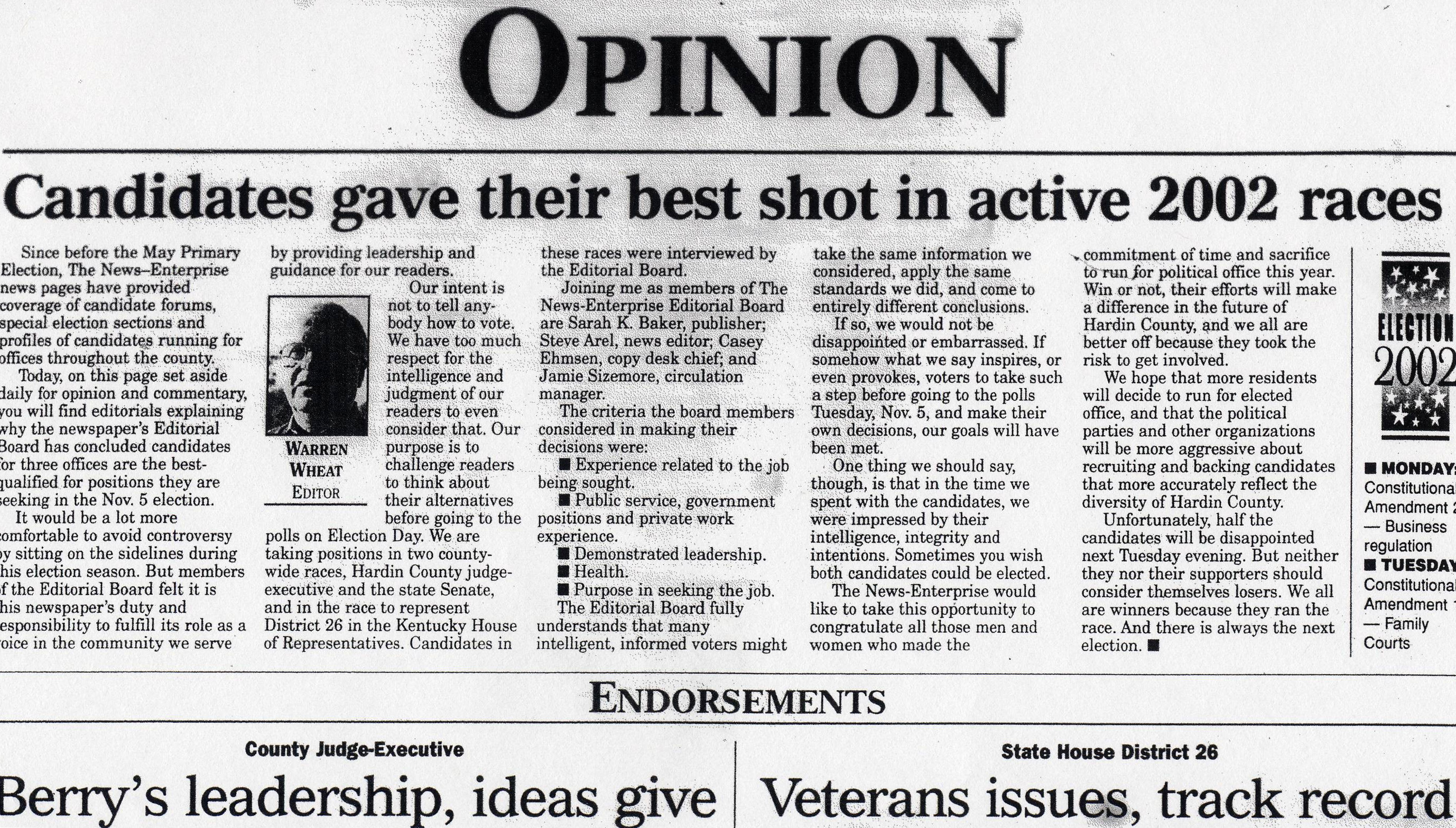
Warren Wheat, who showed how and why small daily newspapers can make political endorsements, dies at 83

Warren Wheat, who helped start USA Today and ended his career as editor of a small daily newspaper that took the unusual step of endorsing candidates in almost every local election, died Sunday in Lexington, Ky. He was 83.

He retired as editor of The News-Enterprise in Elizabethtown, Ky., in 2009 after 55 years as a reporter and editor at newspapers in Kentucky, Ohio, Washington, D.C., and South Carolina. He was Columbus bureau chief for The Cincinnati Enquirer, worked in the Enquirer's and Gannett News Service's Washington bureaus, and was part of the initial team that launched USA Today in 1982, serving as deputy Washington editor and later reader editor for the editorial page. He was governance and national editor at The State in Columbia, S.C., before becoming editor in Elizabethtown in 2002.

The page on which Wheat began election endorsements; click to enlarge
Soon after he arrived, Wheat concluded that the newspaper should make endorsements in local elections, because growth in Hardin County had limited citizens' personal contact with candidates and created more partisan competition. He told readers, “It would be a lot more comfortable to avoid controversy by sitting on the sidelines during this election season. But members of the editorial board felt it is this newspaper’s duty and responsibility to fulfill its role as a voice in the community we serve by providing leadership and guidance for our readers.” The News-Enterprise gradually expanded the number of races in which it made endorsements, including even those with small constituencies, such as school-board member. But as its staff shrank after he left, it was less able to do that, and finally stopped.

A brief service for Wheat will be held at 11 a.m. Saturday, July 29, at First United Methodist Church in downtown Lexington. Pictures will be on display at 10:30 a.m. The family requests that instead of flowers, donations be made to the scholarship established in Wheat's honor at the journalism school of his alma mater, the University of Kentucky, at this site, or by checks to College of Communication and Information, Attn: Director of Philanthropy, 308 Lucille Little Library, Lexington KY 40506.

Farm Bill may offer more mental-health help for farmers, who are showing more stress from extreme weather

Ali Aas graphic forAmbrook Research, from AP photo 
Extreme weather is hard on everyone, but farmers may be some of the most vulnerable to its often brutal impact, which can affect their mental health. This year's Farm Bill could bring additional funding and resources for mental-health care for farm families and workers. "Experts say they have witnessed a rise in farmers struggling with anxiety and depression as climate impacts have worsened in recent years," reports Mélissa Godin of Ambrook Research. "The farmer crisis hotline run by Farm Aid, for instance, has seen a significant increase of calls from farmers during natural disasters linked to climate change." Caitlin Arnold-Stephano, a farmer and a Farm Aid program manager, told Godin, "When climate disaster strikes, or an ongoing disaster such as drought is occurring, the toll on farmer mental health is high. Often a disaster can push a farmer over the already-thin margin or edge that existed."

The 2018 Farm Bill was the first with contained "direct funding toward farmers' mental health, by providing grants for the Farm and Ranch Stress Assistance Network, which connects farmers, ranchers and agricultural workers with mental-health-assistance programs and resources," Godin notes. "Advocates hope that the 2023 Farm Bill will offer even more support. Bipartisan legislation, led by Sens. Joni Ernst (R-Iowa) and Tammy Baldwin (D-Wis.), would reauthorize the FRSAN to establish helplines, provide suicide prevention training for farm advocates and create support groups for farmers and farm workers. The bill would increase funding for the program, authorizing $15 million per year for the program for the next five years, up from $10 million allocated in the last Farm Bill."

Farmers have long faced unrecognized and untreated mental-health problems. "The rate of suicide among farmers has historically been three and a half times higher compared to the general population, according to the National Rural Health Association," Godin reports. "Many farmers, however, struggle to access mental health services, often not readily accessible in rural areas. And when services are available, they are not always tailored to farmers' needs. Traditional mental health services can be alienating to farmers, who sometimes come from communities where mental health is highly stigmatized. . . . Unless the federal government takes action to address the root causes of farmers' distress — the economic precarity, the lack of support, the increasingly unpredictable weather — many experts are concerned farmers will continue to struggle."

Greg Mruk, executive director of New York FarmNet, an organization that offers financial and emotional counseling to farmers, told Godin: "More than anything, farmers want to be given a chance to be part of the solution, a chance to figure it out. Let's not be of the 'sky is falling' mindset. We need to take a proactive approach."

Purdue professor explains why the world is getting hotter and what that means for wildfires, rain and air quality

Dr. Daniel Cziczo
Is it hotter than it used to be? The short answer is yes. Why? A video explanation from Daniel Cziczo, a professor and head of the Department of Earth, Atmospheric and Planetary Sciences at Purdue University, has been loaded for viewing by members of The Associated Press, AP reports. "He goes over why higher temperatures have become more common and what that means for wildfires, rain and air quality." The video can be found here.

"Cziczo says that as man-made greenhouse gases are released into the environment, heat becomes trapped and raises temperatures. Greenhouse gases such as carbon dioxide and methane act like a blanket over Earth, keeping the sun’s heat from escaping the atmosphere," Purdue reports. "Thanks to this rise in temperature, forest-fire season starts earlier, ends later, and happens in areas where wildfires didn’t used to occur. Hot and dry weather can also lead to a decrease in precipitation and a drop in air quality."

If you'd like more in-depth look at Cziczo's research, he presents his area of expertise, particle and cloud research, as key to a human response to climate change in his July 2022 MEERTalk. He points out that humans are are heating up the atmosphere mostly through mixed greenhouse gases, but we are also cooling the planet with particle matter. Clouds form around tiny airborne particles called aerosols. Understanding how cloud formation influences our atmosphere is key to understanding and mitigating climate change from the stratosphere.

22 attorneys general urge federal court to reject 3M Co.'s $10.3 billion settlement offer for 'forever chemicals' pollution

Water sample testing for PFAS research at the EPA
(Photo by Joshua A. Bickel, Associated Press)

Twenty-two attorneys general argue that the proposed settlement 3M Co. has offered to resolve claims that it contaminated water systems with "forever chemicals" wouldn't be enough. The group "urged a federal court to reject a proposed $10.3 billion settlement . . . saying it lets manufacturer 3M off too easily," reports John Flesher of The Associated Press. They argue that the agreement needs to give water suppliers more time to compute what their portion of the settlement would be and compare it to "their costs of removing the compounds known collectively as PFAS, said the officials with 19 states, Washington, D.C., and two territories."

California Attorney General Rob Bonta, leader of the multi-state coalition, told Flesher, "While I appreciate the effort that went into it, the proposed settlement in its current form does not adequately account for the pernicious damage that 3M has done in so many of our communities." 3M spokesman Sean Lynch said, "It is not unusual for there to be objections regarding significant settlement agreements. We will continue to work cooperatively to address questions about the terms of the resolution."

3M's "forever chemicals" problems began with its use of "polyfluorinated substances — a broad class of chemicals used in nonstick, water- and grease-resistant products such as clothing and cookware, as well as some firefighting foams," Flesher reports. "PFAS have been linked to a variety of health problems, including liver and immune-system damage and some cancers." The American Chemical Society describes polyfluorinated chemicals as "toxic, extremely resistant to degradation, bioaccumulate in food chains, and can have long half-lives in humans."

Three hundred communities have sued 3M and other companies over water and soil pollution from their products. Flesher writes, "Although the company put its value at $10.3 billion, an attorney for the water providers said it could reach as high as $12.5 billion, depending on how many detect PFAS during testing the Environmental Protection Agency has ordered over the next three years."

The attorneys general disagreed with the deal's opt-out provision, which would "shift liability from 3M to water suppliers that don't opt out. That could enable the company to seek compensation from providers if sued over cancer or other illnesses in PFAS-affected communities," Flesher reports. "The attorneys-general filings said it would force nearly all public water providers nationwide to participate unless they withdraw individually — even those that haven't filed suits or tested for PFAS. 'Troublingly, they would have to make their opt-out decisions without knowing how much they would actually receive and, in many cases, before knowing the extent of contamination in their water supplies and the cost of remediating it, the officials said in a statement. . . . As such, the proposed settlement is worth far less than the advertised $10.5 billion to $12.5 billion."

Flora and fauna: Ladybugs; mushrooms and fires; wolves and ranchers; tomatoes; animal senses; Vermont loons

Painting by Ed Steed, The New Yorker

Aphid eaters and adorable, ladybugs, or Coccinellidae, are like little summertime friends. A "swarm of ladybugs is collectively called a loveliness," Françoise Mouly writes for The New Yorker. Mouly interviewed artist Ed Steed, who decked out the magazine's June ladybug cover, about "the joy of painting, an affection for the little things, and the luck of the ladybugs." Mouly asked him if each ladybug had its own personality. He told her: "That's the good thing about painting by hand. No matter how hard you try to make things look the same, each comes out unique. So each one ends up having its own character. Just like in real life, no two of anything can be the same."

Mushrooms could be an answer to megafire prevention. "Slash piles are an increasingly common sight in the American West, as land managers work to thin out unnaturally dense sections of forests. . . [The piles] have inadvertently increased the risk of devastating megafires," reports Stephen Robert Miller of The Washington Post. Hauling the slash piles out of the woods has been one solution. Letting mushrooms do the job is another. "Like a flame, saprophytic fungi break organic material into carbon compounds. Mycelium, the often unseen, root-like structure of the fungi, secretes digestive enzymes that release nutrients from the substrate it consumes. . . Whereas a flame destroys nearly all organic nitrogen, mycelium can fortify nitrogen where it's needed in the forest floor."

Gray wolves in California, where they are a recovering
endangered species. (Shutterstock photo)

In areas where ranchers and gray wolves must coexist, some states compensate ranchers for predator damages, reports Shea Swensen of Ambrook Research. "To aid the ranchers who deal with the impacts of wolf presence, states like New Mexico, Oregon, and California started programs that pay them back for the financial burdens of losing their animals. The programs offer reimbursement for direct livestock loss due to wolves or non-lethal on-ranch tools — like fences, guard dogs, or even extra staff."

Pink Pounder hybrid tomatoes
(Garden Plants online photo)
With names like Beefsteak, Big Beef, Bucking Bronco or Pink Pounder Hybrid, summer tomatoes are fun, but more importantly, they are delectable. Try out these meaty varieties. Rejoice in learning how to make all the best tomato recipes. Find out about the infamous Southern tomato sandwich. Enjoy!

Sometimes it can be hard for humans to grapple with the tremendous gifts other animals have. They don't go to school, YouTube it or read how-to manuals. "Pit vipers have infrared vision, bees can view ultraviolet light, and electric eels use their zaps to 'see' through the murky waters of the Amazon," reports Jason Bittel of Popular Science. He adds five animals that can sense things humans can't. They are just born that way.

A parenting loon gives the chicks a ride. Male and
female loons co-parent. (Shutterstock photo)


Vermont's oldest loon, known as "Neward Pond Male," died at age 31. For the past 45 years, The Loon Conservation Project "has helped bring the common loon back to lakes across the state and made huge strides in research, education and advocacy, reports Hannah Cho of the Valley News of West Lebanon, N.H., and White River Junction, Vt. "When Newark Pond Male was banded, the loon was still on Vermont's endangered species list (it wouldn't come off until 2005), but the population had already begun to rise."

Thursday, July 27, 2023

Advocacy group says over 30% of rural hospitals are at risk of closing, many immediately; publishes financial data

Maps from Center for Healthcare Quality and Payment Reform; to enlarge, click on it.
More than 30% of the nation's rural hospitals are at risk of closing, partly because special financial aid they got from the federal government during the pandemic has ended, according to the latest analysis of their 2020-22 Medicare cost reports by the Center for Healthcare Quality and Payment Reform, a private group.

New York, Alabama and Mississippi have "the highest percentage of rural hospitals at risk of immediate closure," reports Devna Bose of Mississippi Today. In New York, 43% of rural hospitals (22) are considered at risk; it's 37% (19) in Alabama and 34% (25) in Mississippi. The report has numbers and percentages for each state.

A map with figures for each hospital is here (example screenshot below). The group said its analysis was based on examinations of hospitals' financial reports, with the main risk factors being on negative operating margins, losses on patient services and low financial reserves.

Rural hospitals' troubles are often blamed on low rates of reimbursement for Medicare and Medicaid patients, which are a majority of their admissions, but the group says "losses on private insurance patients are the biggest cause of their overall losses."

Here's part of the map that has data for hospitals in 2020-22, highlighting one in Kentucky:
Screenshot of map by Center for Healthcare Quality and Payment Reform at ruralhospitals.chqpr.org 

Opinion: The crisis in America's evangelical churches calls for spiritual revival, not nostalgia, leading Baptist writes

Photo illustration by Katie Martin from photo by Roberto
Schmidt,
Agence France-Presse/Getty via The Atlantic
American evangelicalism is at a crossroads; it must choose between spiritual revival or continuing in its attempt to recreate the past, and it cannot have it both ways, writes Russell Moore, editor and chief of Christianity Today, in an opinion for The Atlantic.

"The No. 1 question that younger evangelicals ask me is how to relate to their parents and mentors who want to talk about culture-war politics and internet conspiracy theories instead of prayer or the Bible. These young people are committed to their Christian faith, but they feel despair and cynicism about the church's future. Almost none of them even call themselves 'evangelical' anymore, now that the label is confused with political categories. 'Sometimes I feel like I'm crazy,' one pastor said to me just days ago. 'Does no one see that the church is in crisis?'"

Moore recounts his years as head of the public-policy wing of the Southern Baptist Convention: "For years, I dealt with evangelical backlash, including from some of my closest allies and friends, over my opposition to Donald Trump and my views on issues such as racial justice and church sexual abuse. I hardly thought of myself as a 'dissident.' Instead, I believed I was just what I'd always been: a loyal Southern Baptist evangelical trying to apply what I'd learned from children's Sunday school onward about basic Christian morality and justice. Still, I felt like an outcast and a heretic. I felt homeless. And two years ago, I left the Southern Baptist world I loved."

Revival may need to be redefined, Moore suggests: It is "a concept with a long history in American evangelicalism, rooted in the Bible, that says a people who have grown cold and lifeless can be renewed in their faith. It is a kind of resurrection from the dead. . . . Yet the language of revival is now riddled with cynicism, and is associated with some of the worst aspects of American evangelicalism. Entrepreneurial American evangelicalism built a programmatic structure for 'revival'—whether in the spring- and fall-meeting schedules of little Bible Belt churches like the one in which I grew up, or in massive stadium events traveling across the country like rock concerts." Commercialized revival isn't what Moore has in mind, nor does he think returning to "a mythical golden age" is a good choice.

"A generation ago, one evangelical leader said that the goal of the religious right should be 1950s America, just without the sexism and racism. . . . The idea of revival as a return to some real or imagined moment of greatness is not just illusory but dangerous," Moore writes. "Crisis shakes up an old order—ripping apart, as the apostle Paul put it, what's made of 'wood, hay, stubble' (1 Corinthians 3:12). Now every moment is a possible apocalypse—in which what's been around us all the while is revealed—and thus every moment is an hour of decision."

The answer to the crisis is founded in God's recent actions, Moore says: "Those who wish to hold on to the 'Old Time Religion' must recognize that God is doing something new. The old alliances and coalitions are shaking apart. And the sense of disorientation, disillusionment, and political and religious' homelessness' that many Christians feel is not a problem to be overcome but a key part of the process. . . . The insight of evangelical Christianity, at its best, is that any pilgrimage cannot start with a road map of certainty but must begin with the cry of faith that says, like the noble disciple Thomas wrongly labeled as a doubter, 'Lord, we do not know where you are going. How can we know the way?' (John 14:5)." More says nostalgia "cannot protect religious faith, because it uses religion as a tool for worldly ends, leaving a spiritual void. The Christian Church still needs an organic movement of people reminding the rest of us that there's hope for personal transformation, for the kind of crisis that leads to grace."

Researchers say you live in an 'ambulance desert' if it takes more than 25 minutes to reach you; many places fit the bill

Callers to 911 in rural areas know they will have to wait longer than their city counterparts, but how much longer? And how long do you have to wait to have experts say you're in an "ambulance desert"? A first-of-its-kind study has some answers, including a definition of the desert wait: more than 25 minutee, and there may be far more ambulance deserts than you might think.
Some states are not represented on this map due to their uncertainty about ambulance locations.
(University of Southern Maine map, from Ambulance Deserts: Geographic Disparities study)

The study, by the Maine Rural Health Research Center, looked at every state's ambulance data, and "found a major disparity between rural and urban residents' proximity to ambulance stations, reports Liz Carey of The Daily Yonder. "While less than 1% of urban residents live in an ambulance desert, about 5% of rural Americans live in one. . . . Another way of understanding the rural disparity is that while about 14% of Americans live in a rural area, they make up more than half of the population that lives in an ambulance desert. Urban Americans constitute about 86% of the U.S. population but make up less than half of the population that lives in an ambulance desert."

Carey adds, "Researchers found the highest number of people living in ambulance deserts in the Southern Appalachian region, in Western states with mountainous terrain, and in the rural mountains of Maine, Vermont, Oregon, and Washington. Eight states west of the Mississippi had fewer than three ambulances covering every 1,000 square miles of land area. The states are Idaho, Montana, Nevada, New Mexico, North Dakota, South Dakota, Utah, and Wyoming."

The number of ambulance desertss can be explained in dollars and cents. Ambulance services are only reimbursed when a patient is transported to the hospital, which leaves many trips unpaid. Lead researcher Yvonne Jonk told Carey: "Hospitals and health-care systems are not going after ambulance services because they are not a lucrative service line. And that's a problem." She said the next step in her research will determine the impact ambulance deserts have on communities, including the prevelance of paramedics and funding options.

Researchers found that some states don't know where their ambulances are. Carey explains, "Part of the research effort was finding physical addresses for ambulance stations, rather than using post-office-box addresses. . . . In nine states, information either wasn't available or was so limited it wasn't included in the report."

U.S. Supreme Court greenlights Mountain Valley Pipeline

The Mountain Valley Pipeline has gone all the way to the U.S. Supreme Court and won, at least for now. Thursday the court overturned a lower appeals court and said work on it can resume, "potentially moving the project closer to completion as a legal fight continues," The Wall Street Journal's David Harrison reports.

U.S. Sen. Joe Manchin, D-W.Va., won "a provision in the bipartisan debt-ceiling bill signed into law last month [that] stripped the lower court of its jurisdiction over the natural-gas pipeline and mandated that it be completed," Harrison notes. "The environmental groups behind the suits argued that stopping legal challenges before the Fourth Circuit violated the separation of powers clause of the Constitution, in effect giving Congress the power to decide the outcome of judicial proceedings. The Fourth Circuit agreed to pause the project while it sorted out the effect of the debt-ceiling law, prompting [pipeline owner] Equitrans Midstream to appeal to the Supreme Court. As is typical in emergency orders, the Supreme Court didn’t explain its ruling. There were no noted dissents. The court’s ruling didn’t dismiss the legal challenges to the pipeline entirely, allowing project opponents to continue making their case before the Fourth Circuit," which had a hearing scheduled Thursday.

The pipeline "has aroused controversy ever since it first was proposed almost a decade ago. Opponents, including adjacent landowners and environmental groups, have challenged the project’s environmental permits, delaying the project for years," Harrison notes. "Last year, the Biden administration struck a deal with Manchin: He would agree to provide the pivotal vote for the administration’s climate bill, and in exchange the White House and Senate Democratic leaders would support Manchin’s efforts to get the pipeline finished."

'Residents said they didn't realize how much they depended on the paper until it was gone,' AP reports from news desert

The final story remains posted on the paper's website.
When a rural newspaper closes, it leaves more than an empty building; it leaves an indelible hole where a sense of community and shared information used to thrive. McDowell County, West Virginia, pop. 19,000, is one of those places.

The Welch News, the only newspaper and "The Spirit of McDowell County," closed in March, and the town's residents miss it, reports Leah Willingham of The Associated Press. "Residents suddenly have no way of knowing what's going on at public meetings, which are not televised, nor are minutes or recordings posted online. Even basic tasks, like finding out about church happenings, have become challenging. The paper printed pages of religious events and directories every week, and that hasn't been replaced."

More than 2,000 newspapers have closed or disappeared in mergers since 2005, and most have been weeklies, which in rural areas provide profound connections, with their sharing presence like a heartbeat and their closings like deaths. In mountainous McDowell County, "Residents live miles apart in hollers connected by winding roads and no interstate access, leaving people isolated. Cell and internet service is inconsistent, or nonexistent, and there are no locally based radio or television stations," Willingham reports. "Residents said they didn't realize how much they depended on the paper until it was gone." The county is the state's poorest, "with some of the lowest graduation and life expectancy rates in the nation."

McDowell County (Wikipedia)
Sarah Hall, the first Black prosecutor elected in McDowell County in the 1980s, said it's tragic when any community loses its newspaper. But for communities like hers, it's detrimental." Hall told Willingham: "We're in a unique situation because our community is unique. We have no other substantial way of communicating." Willingham wriotes, "It bothers Hall not to know about decisions county commissioners are making with taxpayer money. She misses the legal notices the paper published informing residents about developments like utility rate increases. With the school year set to start, she's worried families won't know about a ministry program in early August providing free school supplies," Willingham explains. "Local crises, like the desperately needed upgrade of water and sewer systems, are going unreported. And there is no one to keep disinformation in check, like when the newspaper published a series of stories that dispelled the rumors of election tampering at local precincts during last year's May primaries."

Once the self-proclaimed "Heart of the Nation's Coal Bin," the Cumberland Mountains county has "lost big-box stores, schools, thousands of jobs and people. But it still had its newspaper — one that tracked government spending, published elections, spelling-bee and basketball-game results and spreads with color photos and biographies of every member of the graduating class," Willingham reports. When the paper closed, no local service replaced it, leaving residents to rely on unverified social-media sources or coverage from "national outlets that focus on the poverty rate, opioid use, infrastructure woes and the declining coal industry," Willingham adds. "The paper was a vital platform for residents to tell their story from their perspective — a lifeline for a community that's often been misrepresented and misunderstood."