Friday, November 25, 2011

Rural station, 'glue' for Eastern Kentucky, is being undermined by satellite television and its rules

A rural television station that has created a stronger regional identity and connections among isolated counties in Eastern Kentucky is being undermined because "a combination of federal regulations and business decisions keep WYMT off satellite," reports Ivy Brashear, a graduate assistant for the Institute for Rural Journalism and Community Issues, publisher of The Rural Blog.

"As people in Eastern Kentucky increasingly choose satellite TV, the number watching WYMT decreases," writes Brashear, a former reporter for the Hazard Herald, a weekly newspaper in the same town as the station. “It’s the glue that sticks the Eastern Kentucky counties together,” U.S. Rep. Hal Rogers, a Republican whose 5th District includes all 24 counties the station reaches, told Brashear.

WYMT is not on satellite because "Satellite companies don’t have to carry more than one affiliate of a network in a market, and WYMT and its parent, WKYT of Lexington, are both CBS affiliates," and because their parent company, Gray Television, has been unable to get Direct TV or Dish Network to budge, Brashear writes. The situation is complicated by the station's location at the far end of the Lexington TV market and near three other markets. Here's a map; for the full story, click here.

Studies show organic farming makes economic and environmental sense over the long term

"Organic crop systems can provide similar yields and much higher economic returns than a conventional corn-soybean rotation," because they "fetch a premium price on the market and eliminate the need for expensive inputs like herbicides and synthetic fertilizers," researchers at Iowa State University announced this week after 13 years of comparison at the university farm. And they noted a longer study elsewhere that showed similar results.

ISU's Long-Term Agroecological Research Experiment "is one of the longest running replicated comparisons in the country," a university news release said. “The transitioning years are the hardest years,” said Professor Kathleen Delate, who leads the project. "To sell a product as organic, the crop must be raised on land that has received no synthetic chemicals for three years prior to harvest," the release notes. But the study showed organic crops "can remain competitive with conventional crops even during the three-year transition."

The study resulted in yields of organic corn, soybean and oats "equivalent to or slightly greater than their conventional counterparts," averaged over 13 years, the release said. "Likewise, a 12-year average for alfalfa and an 8-year average for winter wheat also show no significant difference between organic yields and the Adair County average."

“I think there’s a strong future for organic agriculture,” Delate said. “My phone is ringing off the hook.” The economic side of the study was led by Craig Chase, an extension farm management specialist. He found that "organic systems return roughly $200 per acre more than conventional crops," the release said. "In addition to its profitability, organic agriculture helps build healthy soils."

But how do organic farmers control weeds? With “a whole suite of practices,” including timely tillage and longer crop rotations, Delate said. "Chemicals from rye and alfalfa help keep weed populations under control, as does growing an alfalfa cover crop in winter, which provided cover for beneficial insects and animals," the release said.

The findings concur with those seen over 30 years in Pennsylvania by the Rodale Institute, which "calculated that organic crops required 45 percent less energy, and contributed significantly less to greenhouse gas emissions," the Iowa State release said. For that study, click here. A brochure about the Iowa project can be downloaded here.

Rick Rojas of the Los Angeles Times reports on World Wide Opportunities on Organic Farms, "a loose global network that hooks up those willing to work with farmers eager to take them for a few weeks, or even a few months."

'Climate' seems to be a dirty word to lawmakers, who nix a Climate Service even as threats mount

The National Oceanic and Atmospheric Administration wanted to create a National Climate Service similar to the agency's National Weather Service in order to meet "skyrocketing" demand for climate information. Even though the agency said it would shuffle existing staff and didn't ask for any additional funds, Republican members of Congress "barred NOAA from launching what the agency bills as a 'one-stop shop' for climate information," reports Brian Vastag of The Washington Post.

Vastag reports that over one year, the amount of climate data obtained from NOAA's website increased by 86 percent. Calls to the agency about climate information rose by 4,000 over the same period. But even the word "climate" can be polarizing one, drawing ire from Republican representatives like Andy Harris, who said in June: "Our hesitation is that the climate service could become little propaganda sources instead of a science source." Rep. Ralph Hall, chair of the House Committee on Science, Space and Technology, launched an investigation of NOAA, saying they were "operating 'a shadow climate service operation' without congressional approval," even though NOAA's climate data has been public for decades.

The idea of a climate service has received much support from scientific, weather and industry groups, Vastag reports, along with insurance companies, who use climate information to set rates. They've realized what the Intergovernmental Panel on Climate Change is expected to say in a report today: "Climate change is likely to cause more storms, floods, droughts, heatwaves and other extreme weather events." Flona Harvey of The Guardian reports that the IPCC has conducted "the most authoritative review yet of the effects of global warming."

The Democratic-led Senate approved most of the climate service in its budget, but the Republican-led House approved none of it. A news release from the House Appropriations Committee "implied Congress saved $322 million" by not allowing the climate service. But as Vastag reports, NOAA will still receive that amount for climate research, just not under "an umbrella climate service." (Read more)

Are 'paperless papers' the future of newspapers?

Yes, says John Paton, right, chief executive of the Journal Register Co., MediaNews and parent company Digital First. Paton reinvented two struggling newspaper chains, making them the second-largest newspaper chain in America, with more than 800 print and digital products in 18 states, David Carr of The New York Times reports. The companies' annual revenue is over $1.4 billion and they employ 10,000. Paton attributes their success to his push for "paperless papers." (Times photo by Matthew Staver)

In Paton's new model of newspapering, content sources should be local content by professional journalists; readers and community input, and aggregated services, roughly one-third each. At the Journal Register, Paton gave reporters Flip pocket video cameras, created a community newsroom cafe in Torrington, Conn., and moved to free, Web-based publishing tools, Carr writes.

"Choosing digital revenue over print revenue is like choosing dimes over dollars," Paton told Carr. Over the last five years print dollars have dropped by over half, so it's time to start "stacking the dimes." The move to digital is not entirely smooth. The Journal Register staff is down 16.5 percent with layoffs and outsourcing, and MediaNews revenue is down 2 percent, but that is still less than the newspaper industry average, over 6 percent, Carr reports.

Thursday, November 24, 2011

A prayer for Thanksgiving

"Thanksgiving requires a (turkey) wing and a prayer," writes Curtis Seltzer of Blue Grass, Va., writer of the "Country Real Estate" column, recalling the "Saints," whom we now call "Pilgrims," who started the tradition: "In the interest of recapturing a smidgeon of that old-time religion, I offer this Thanksgiving prayer."

We are thankful today for those who are with us,
and for those with whom we once shared this meal.
We are thankful today for what’s good in the world,
and for when we’ve done the right thing in the right way.
We are thankful today for what we have,
and for what we don’t need.
We are thankful today for any help we’ve received,
and for any we were able to give.
We are thankful today for the freedom we have,
and for the times we’ve used it.
We are thankful today for those who love us,
and for those we have loved.
We are thankful today for today,
and for the possibility of tomorrow.

Wednesday, November 23, 2011

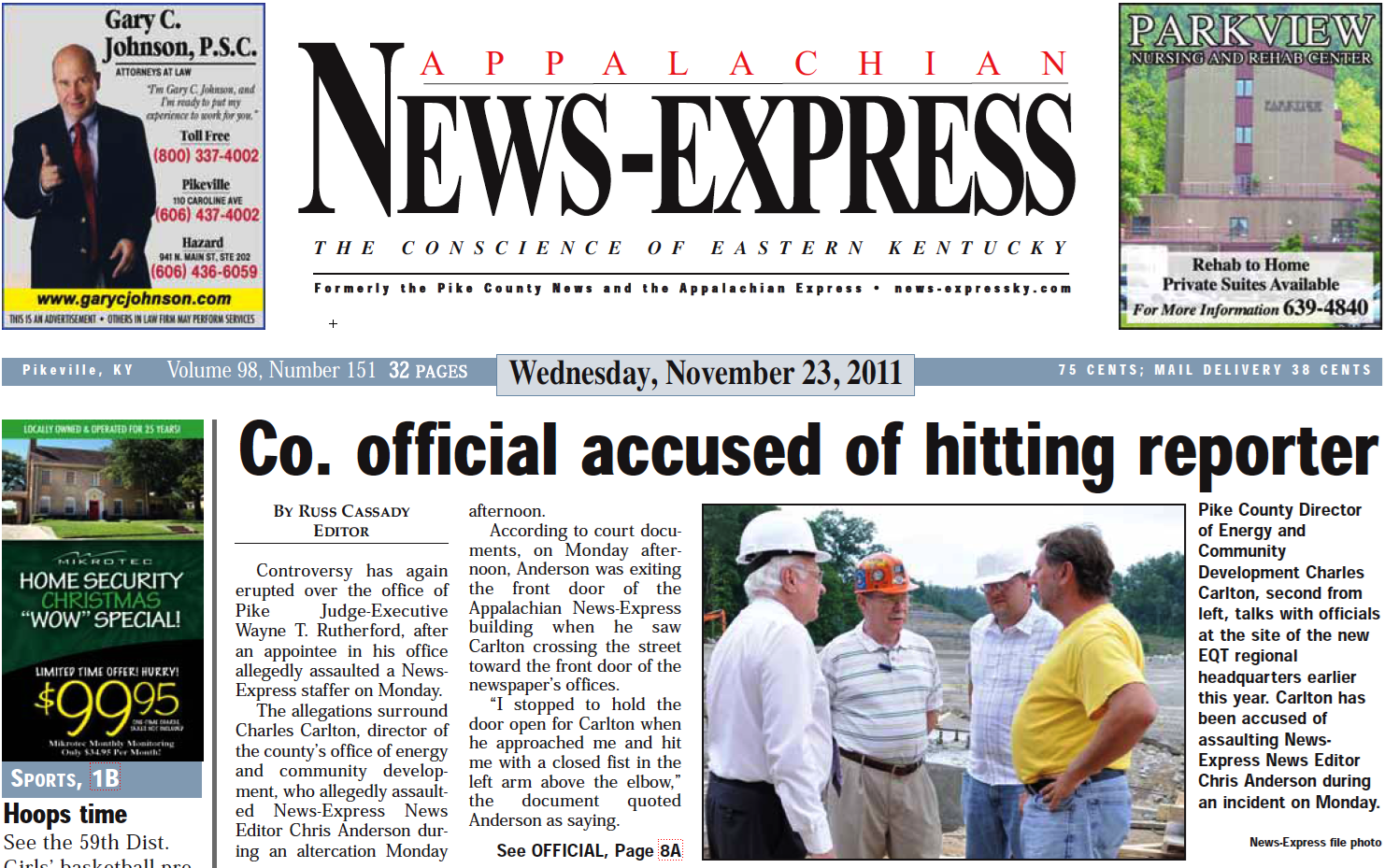
Editor at weekly putting heat on secretive energy projects says county official assaulted him

A thrice-weekly newspaper's watchdog reporting about local-government support of two secretive energy projects got physical this week, as the county's energy and development director punched an editor in the arm, according to a story in today's Appalachian News-Express of Pikeville, Ky. The criminal complaint by News Editor Chris Anderson said Charles Carlton "approached me and hit me with a closed fist in the left arm above the elbow" as he opened the newspaper's front door for Carlton, who said, "You son of a bitch; what are you people harassing me for?"

"According to court documents, Anderson said the incident occurred shortly after he had sent an open- records request to Pike [County] Judge-Executive Wayne T. Rutherford’s office, which would have been forwarded to Carlton for fulfillment," News-Express Editor Russ Cassady wrote. His story said Carlton issued a statement repeating a denial that he hit Anderson, but said "It was a reaction through frustration because it seems every time I spend considerable amounts of time and energy negotiating with large national and international companies the newspaper intervenes at critical moments and makes it very difficult for me to get anything accomplished."

Cassady wrote that Carlton "has been at the center of controversy since late last month, when the News-Express released the results of an investigation of a pair of coal-to-liquid fuel plants proposed for Pike County. Carlton, in his capacity as director of energy and community development, figured heavily in both the projects and in the News-Express investigation, which found that the county may have illegally provided equipment and labor to a private company working on private property." For that story and two sidebars, click here.

Today's story notes, "This incident is the second in less than two years in which a News-Express staffer was involved in an altercation regarding a news story." In the first, Pikeville Mayor Frank Justice hit former editor Jerry Boggs in the face and later issued a public apology. The online News-Express is subscription-only, but the pages containing today's story are posted here and here.

Small Business Saturday will follow Black Friday

Saturday, Nov. 26, will be the second annual Small Business Saturday. The day, sponsored by American Express, is dedicated to supporting small businesses during one of the busiest shopping weekends of the year, the Small Business Saturday website says. The impact on local economies is very significant.

Last year, sales were 28 percent higher than the same Saturday in 2009, Mary Ann Fitzmaurice, American Express's senior vice president, told Kate Rogers of FoxBusiness. This year, 89 million customers are expected to shop at small businesses. (Read more)

Small Business Saturday may be more important to local economies than Black Friday or Cyber Monday, Peralte Paul of East Atlanta Patch writes. The 177,445 small businesses in Georgia, reported by the Small Business Administration's Office of Advocacy in 2006, accounted for 98 percent of employers in the state and 46 percent of Georgia's private-sector employment, the Bureau of the Census reports. "That means the lion's share of Georgia's total economic output," projected by JP Morgan Chase to be $364 billion for 2011, "will come from small businesses." (Read more)

Penn State sexual abuse scandal hits home in rural areas where the victims live

In the wake of child sexual abuse allegations against Penn State University's football defensive coordinator Jerry Sandusky, the media has focused mainly on Centre County, where Penn State is located. But some reporters are reminding us that victims in this case live in some of Pennsylvania's most rural areas.

"In these remote places, nestled between the graceful ridges of the Allegheny Mountains, almost everyone knows someone who was affected by the scandal, and whether they felt comfortable talking about it publicly or not, Penn State's pain is their pain, too," reports Curtis Tate for McClatchy Newspapers. The university has more students than the entire population of Clinton County where Sandusky volunteered at Central Mountain High School as a football coach for three years. Tate details the grand jury report about "Victim 1," who attended the school and alleges sexual abuse by Sandusky. He also reports about the fall-out in the community after the scandal made news.

Elizabeth Regan of The Express in Lock Haven, Pa., reports that Sandusky's case, along with presidential candidate Herman Cain's sexual harassment case, created media storms about everyone but the victims. This is changing, though, and Deb Zinck, who works at the Clinton County Women's Center, told Regan this is a good thing, especially since the community can help the victims cope. Zinck told Regan: "If anything can come out of this, people can become aware that many kids are living this day in and day out. We need to educate our community members on how to stop abuse and look for the flags."

Delay of vote on Delaware Basin drilling shows Obama administration in another political bind

The Obama administration is again caught between environmental and energy interests, much as it was during debate over the proposed Keystone XL pipeline in the Midwest. The latest rock-and-a-hard-place situation is in New York and Pennsylvania, where a vote to allow natural gas drilling in the Delaware River Basin was postponed Monday. The administration controls the tie-breaking vote on the Delaware River Basin Commission, which consists of governors from Delaware, Pennsylvania, New Jersey and New York. It controls decisions about development in the river basin, and the four governors are split on the issue. (New York Times map)

Drilling has been on hold while regulations were being written, reports Mike Soraghan of Environment & Energy News. When they are decided, drilling can start. Proponents promise jobs and economic development, but environmentalists want the commission to conduct a "cumulative impact statement" before approving the rules, which could delay drilling for a year. Soraghan reports that no reason was given for the delay in the vote on regulations, but it suggests the commission wouldn't have gotten a majority vote to begin drilling. The administration's position on the matter is not clear.

The Delaware River Basin provides drinking water to 5 percent of the U.S. population, including Philadelphia and New York City. The proposed rules would allow 300 wells to be drilled in the 13,539-square-mile area. Soraghan reports the Army Corps of Engineers, which is representing the administration, is relying on consultations with staffers and other federal agencies to make its decision. The delay was praised by some lawmakers in Northeast states who had called for a delay so more research could be conducted on drilling and hydraulic fracturing of the Marcellus Shake and other deep deposits. It was criticized by those who said the delay was "driven more by politics than sound science." (Read more)

Journalists across the Northeast have covered this issue extensively. Bob Jordan of the Parsippany, N.J., Daily Record reports that commission support for drilling has eroded and "fallen apart." Sandy Bauers of the Philadelphia Inquirer reports about drilling protests in Trenton, N.J., where more than 800 people celebrated the decision to delay the vote. In a magazine story highlighting Pennsylvania's struggles with natural gas drilling, "The Fracturing of Pennsylvania," Eliza Griswold of The New York Times puts a human face on the controversy surrounding natural gas well drilling in the region.

Tuesday, November 22, 2011

Agroforestry advocates try to debunk conventional wisdom that farming and trees don't mix

A demonstration project to help spur the growth of agroforestry - growing trees on the same land as crops to improve land values - has started in Montana. Gloria Flora, environmental consultant and former U.S. Forest Service supervisor, planted more than 300 trees on her farm north of Helena among crops of berries, edible flowers, grapes and medicinal plants. She says "the extensive tree canopy and the use of native plants make the garden more resilient in the face of a changing climate, needing less water, no chemical fertilizers and few, if any, pesticides," making the farm more sustainable than conventional agriculture, reports Jim Robbins of The New York Times.

The U.S. Department of Agriculture made a push in August to encourage agroforestry because it's a great way to "harness the ecological services that trees provide," Robbins writes. Experts say trees provide "all sorts of contributions to agriculture," like erosion prevention, fertilizer production, water filtration and species diversification. Cattle farmers can also improve income by selling timber and cooling cows in shade. When placed properly, studies have shown that trees can filter out 95 percent of sediment run-off from farm fields.

"There are several approaches to agroforestry," Robbins reports. "Grazing livestock under a canopy of trees is called silvo-pasture. In alley cropping, an ancient technique becoming more common in the U.S., rows of commercially valuable hardwood trees like oak are alternated with rows of corn, wheat or grasses for biofuel." He also reports the method is helping raise specialty crops like shiitake and oyster mushrooms and truffles. This method is a sophisticated form of land management, though, and advocates face an uphill battle to break down the conventional wisdom that trees and farming don't mix. (Read more)

Native American 'Shadow Wolves' help track drug smugglers along Ariz.-Mexico border

A group of eight Native Americans is helping the U.S. Government hunt Mexican drug smugglers in the rural Tohono O’odham Nation on the Arizona-Mexico boarder. Brian Bennett of the Los Angeles Times reports The Shadow Wolves "spend their days traversing the most isolated parts of the reservation" tracking smugglers in an area where there are no street signs and few paved roads. (L.A. Times map)

The smugglers' operations moved to this desolate region five years ago when the U.S. Border Patrol increased drug searches east of the reservation. Bennett reports "two billion dollars worth of marijuana, cocaine and heroin have moved through the reservation since then, according to Immigration Control Enforcement estimates." The Shadow Wolves use GPS, ATVs, and high-powered radios, but "it is their tracking skills and their feel for the hidden box canyons, caves and seasonal watering holes that make them formidable counter-narcotics agents."

Tohono O'odham Native Americans were first hired by the U.S. government to track smugglers in 1972. To increase numbers, they began hiring from outside the tribe. Bennett reports they are driven not only by a duty to the government, but also by a duty to their tribe because they are protecting ancestral lands and cemeteries in their hunt for drug runners, whom they've become adept at tracking. (Read more)

What is rural impact of supercommittee's failure?

Yesterday the congressional "supercommittee" on deficit reduction failed to reach a deal before its Nov. 23 deadline, meaning sequestration or automatic $1.2 trillion cuts in defense and domestic programs is set to start in 2013. The question remains whether another congressional agreement can be reached before then and if not what programs are likely to get the automatic cuts.

The failure spared Medicaid and Medicare temporarily until the 2 percent automatic cuts designated for health care and defense take effect in 2013, David Nather of Politico reports. Social Security, a disproportionally rural program, is also safe temporarily as the supercommittee's new consumer-price-index model that would have reduced payments to seniors is now off the table, John Allen of Politico reports.

The military did not fare so well, since the debt-ceiling deal creating the supercommittee requires half the cuts to come from defense. The defense industry's chances of blocking the cuts are slim, Allen reports. To read his summary of the winners and losers in the supercommittee failure, click here. To read Bob Cusack of The Hill's breakdown of winners and losers, click here.

The agriculture industry, safe for the moment, must wait as Farm Bill negotiators focus on producing their own legislation before the current authorization expires next September, David Rogers of Politico reports. The agricultural committees proposed $16.7 billion in "outlay savings," or a 27 percent reduction, which would include an end to direct payments and the related Average Cost Revenue Election program giving farmers three options instead. (Read more)

Click here to read The Washington Post's guide to the deficit-and debt rhetoric, by Glenn Kessler.

Monday, November 21, 2011

Police are encrypting scanners; journalists say the move prevents coverage of developing news

The days of reporters relying on police-radio scanners for early tips on breaking stories may come to an end as police around the country move to encrypt radio communications. Departments say the measure will prevent criminals from listening in and evading capture, but journalists say "open communications ensure that the public receives information as quickly as possible that can be vital to their safety," The Associated Press reports. (Kentucky New Era photo)

Police are responding to new technology that allows scanning by smart phones. Officers in Washington, D.C., the most recent department to start encryption, provide two instances of criminals getting away because they were scanning. Journalists say departments have the ability to encrypt sensitive communications and shouldn't shut out the news media, which rely on scanners to learn of developing crimes and threats to public safety. Scanner hobbyists have followed police activity from their homes for years and oppose encryption saying it makes government less transparent.

Some departments have tried to compromise with media outlets by leasing them radios and increasing efforts to update developing stories through Facebook, Twitter and email. Journalists have thus far been able to bypass encryption in D.C., AP reports, and the news director of local station WTTG-Fox 5 defended the media's right to hear police communication: "It is our jobs to inform the public in times of emergency." (Read more)

Coal mining jobs in Appalachia increase despite industry concern about federal 'war on coal'

Mining jobs in Appalachia have increased by 10 percent since the Environmental Protection Agency intensified efforts to reign in mountaintop removal mining in 2009, according to Mine Safety and Health Administration data. The current 59,059 jobs in the region are the most since 1997, reports Ken Ward Jr. of The Charleston Gazette. This data runs counter to complaints about the Obama Administration's "war on coal" eliminating coal mine jobs.

United Mine Workers spokesman Phil Smith told Ward the union has seen more jobs for union members in Northern Appalachia and Alabama. Though mountaintop-removal mines are in Central Appalachian and most are non-union, the UMW says it hasn't seen job loss at unionized surface mines. Whether or not those mines will see losses depends on the extension or renewal of permits, which could be blocked by EPA. Ward reports that West Virginia operator Alpha Natural Resources isn't worried about permitting problems, citing comments from CEO Kevin Crutchfield in which he said "there's nothing in 2012 that is contingent upon any sort of regulatory relaxation or need."

Ward reports "the current increase in jobs comes amid government projections that coal production in Central Appalachia, meaning Southern West Virginia and Eastern Kentucky, will decline rapidly through the rest of the decade." He writes that West Virginia University law professor Pat McGinley told a U.S. House subcommittee there is evidence that one form of stricter regulations might actually increase jobs. He asked the subcommittee to see "why federal and state agencies have not enforced post-mining land development requirements for mountaintop-removal mining operations if they're concerned about coalfield jobs." (Read more)

Sunday, November 20, 2011

Retailers besides Walmart eye primary-care prize

Last week, a document leaked showing Walmart's intention to become the country's largest provider of primary health services, but the company's interest is not unique. Drug retailers like CVS Caremark and Walgreens are eyeing the same prize: "the millions of Americans with costly illnesses such as diabetes and heart disease," reports Julie Appleby of Kaiser Health News. CVS already has 550 retail clinics, the most in the country. Walgreens has also set up programs aimed at diabetic customers, which includes counseling with pharmacists.

The retail industry is looking at ways it can use its clout to save money and offer a primary care infrastructure that experts say will be short by 21,000 doctors by 2015, largely because of the 30 million more people becoming insured by 2014 under the federal health-care reform law. "It's sad that the existing health care establishment has not figured out a way to make primary care affordable and accessible," said Jerry Avorn, a professor of medicine at Harvard University. "We should not be surprised if someone outside of our world comes in and does it for us."

Costs at retail clinics are "roughly 30 percent to 40 percent less than similar care at a doctor's office and 80 percent cheaper than at an emergency room," Appleby reports, referring to a study in the American Journal of Managed Care. Those savings appeal to insurers. Retail clinic use by people with health insurance increased tenfold from 2007 to 2009, with clinics accounting for 7 percent of all medical visits for 11 common acute conditions, the study found. "If these trends continue, health plans will see a dramatic increase in retail clinic utilization ... particularly among young, healthy and higher income patients living close to retail clinics," the study concluded.

Patients like the clinics for the predictability, with costs made clear ahead of time. And employers — who under the new health law could get incentives to provide wellness programs for their employees — may partner with the clinics to provide blood testing, nutrition counseling and diabetes management. However, there are still many unknowns. While the clinics have proved useful for acute care, it remains to be seen how they will deal with complicated issues like diabetes management.

Some states prevent clinics from employing physicians, nurse practitioners or physician assistants. "Other states cap the number of nurses each doctor can oversee," Appleby reports. The vast majority of clinics are staffed not by doctors, but physician assistants and nurse practitioners. A report by the Convenient Care Association shows 95 percent of the clinicians are nurse practitioners. With these practitioners able to provide basic care, part of the fear among doctors is they will be left to treat only the sickest patients and won't be reimbursed accordingly.

Most of the clinics are in the South and Midwest. In January, Merchant Medicine listed 40 retail clinics in Kentucky, with more to open in 2011. The clinics "are more likely to be in areas with lower overall poverty and only 12.5 percent were in medically underserved areas," Appleby reports, though 21 percent of the U.S. population lives in those areas.

The clinics have typically offered vaccinations and simple physical exams and treatment for strep throat and ear infections, but plan to expand their services and enlarge retail's foothold in the medical world. "Think about Toyota; they didn't start off by competing with Cadillac and BMW. They started with cheap little cars but got better and better over time," said Mark Smith, president and CEO of the California Healthcare Foundation. (Read more)

Small, weekly newspaper gets best of stonewalling state agency in case of adopted child's murder

When a 9-year-old girl was found beaten to death and her adoptive brother was charged with murder, the local newspaper wanted to know what the state child-welfare agency had done, or not done, with the family in the four years Amy Dye, left, had been placed there. The Kentucky Cabinet for Families and Children stonewalled the Todd County Standard, but the small, weekly newspaper fought in court and a judge found that the agency had violated the state open-records law -- and prevented further stonewalling on appeal by putting the records in his ruling.

The records paint "deplorable picture of what happens when those who are assigned to protect a child fail," Editor-Publisher Ryan Craig wrote in his Nov. 9 paper. Franklin Circuit Judge Philip Shepherd of Frankfort "said that Amy was put in the Dye home despite there being a 'substantiated' incident of child abuse prior to her placement" and the case is an "example of the 'potentially deadly consequences of a child welfare system that has completely insulated itself from meaningful public scrutiny'."

In his Nov. 16 edition, Craig wrote that a closer look at the records showed "that the cabinet made a choice within a few days of Amy Dye’s death and a day after the Standard filed an open records request to declare the scope of the investigation in a way that would keep the files from becoming public," by classifying its probe as a "neglect investigation" instead of a "fatality investigation," which by law must be public. His story noted that "Officials with the Cabinet delayed nearly two weeks — violating open-records laws — before even responding to the Standard’s initial request for records. Then when the Standard received a response, it was told there were no files whatsoever on Amy Dye."

The Standard is not online, but we have posted PDFs of its Nov. 9 front and jump pages here and here and its Nov. 16 pages here and here. The photo of Amy is from The Courier-Journal of Louisville, which reported on the case in detail today. For the story by Deborah Yetter, go here. University of Kentucky journalism professor Mike Farrell wrote about this and related cases for KyForward, giving a good summary of details, concluding, "We know all of this only because the Todd County Standard sued the cabinet for the records, and in ruling for the newspaper, the judge laid out the story." (Read more)

Local paper broke Penn State story in March; reporter calls it 'a huge testament to local news'

Uncovering the story of a former Penn State football coach's alleged rapes of boys "was all local journalism," Harrisburg Patriot-News reporter Sara Ganim told Howard Kurtz this morning on CNN's "Reliable Sources." (CNN image)

"Its a huge testament to local news," the 24-year-old Penn State journalism graduate told Kurtz, who initially referred to the 71,000-circulation Advance Publications newspaper as "The News-Patriot." Ganim said, "It was all local journalism, going to my sources. ... I spent a lot of time knocking on doors and getting shooed off properties."

Ganim said the newspaper "did have some pushback" to her stories that first reported the investigation, starting March 31, but "I actually expected a lot more than we got. . . . For the most part people were happy that we were bringing this out." The stories didn't get much play beyond Pennsylvania until ex-coach Jerry Sandusky was indicted this month, perhaps because they were based on interviews with people who had testified before a grand jury, reporting that was difficult for non-local media to match, Ganim said.

The story of Sara Ganim "is also the story of a family-owned media company, Advance, of a second-generation newspaper editor, David Newhouse, of a publisher, John Kirkpatrick, who understands what a newspaper means to a community, and of a newsroom that has the deep local connections and also the courage to keep going no matter what the potential cost to its own reputation," Carl Lavin writes on his 07newsroom blog.

For Ganim's original story, click here. For her latest summary, focusing on authority figures and "What did they know and when did they know it?" go here. Her last-Sunday story about why the probe took so long is here.

Friday, November 18, 2011

Agriculture panels offer deficit-reduction plan, a new Farm Bill, as 'supercommittee' nears failure

Negotiators delivered a proposal to cut farm programs by $23 billion over five years as part of a deficit-reduction plan just as partisan divisions seemed likely to derail the process and lead to a more traditional Farm Bill debate next year.

"Regional politics trump party" in the proposal to the Joint Select Committee on Deficit Reduction, better known as the "supercommittee," David Rogers of Politico reports. The agriculture committees of the House and Senate have been challenged to balance competing Southern, Corn Belt and Great Plains interests in reducing subsidies.

As expected, the plan would phase out the current direct cash payments but offer three new options for farmers. One option, a supplemental crop insurance plan to guarantee up to 90 percent of average farm income, "would allow a more individualized, farm-based standard demanded by Great Plains states . . . than the Midwest Corn Belt," Rogers reports.

“Critics of farm programs say that farming interests are unfairly using the secretive drafting process to guarantee themselves continued subsidies at a time when commodity prices and farm income are at historically high levels," writes Philip Brasher of the Gannett Co. Washington bureau. "If the bill is included in the deficit-reduction plan, the farm programs would be shielded from any amendments in the House or Senate, because neither chamber can make any changes in the fiscal legislation. . . . The bill drafting could be all for naught if the supercommittee is unable to reach an agreement on an overall deal, although the farm legislation could be resurrected later.” (Read more)

Under the plan, lLandowners with adjusted gross income of more than $950,000 would be ineligible for commodity-program payments, and payments would be limited to $105,000 per producer. USDA Rural Development programs would continue, but with lower spending levels. For details, click here.

The Johns Hopkins Center for a Livable Future has created an online tool anyone can use to visually analyze details of the proposed Farm Bill, the Pork Network reports. To analyze the farm bill options, click here.

Growing Hispanic population revitalizes some rural communities in the Great Plains

The Hispanic population has "spiked by 54 percent" in the rural Great Plains, reviving many communities, The New York Times reports. Hispanic residents are opening Mexican groceries in vacated storefronts, enrolling in diminishing school districts, living in formerly vacant houses and working in these small communities, correspondent A.G. Sulzberger reports. (Times graphic: Hispanic and white population changes, Hispanic percentage change; click for larger version) Bazine, Kan., has seen population growth for the first time in over a half century, The latest census shows the town a population of 334 and an increase in Hispanic population from 4 to 86 from 2000 to 2010, Sulzberger reports. "The decline was happening," Mayor Patricia Showalter told him. "And then the Hispanics came." Now houses are occupied and the local school has seen an increase in enrollment, from 35 to 46.

Despite the growing Hispanic population's contribution to the Great Plains' rural communities and economy, not everyone welcomes the changes. Ulysses, Kan., population 6,161, has a Hispanic population that equals its non-Hispanic population, and many Anglo residents complain about cultural differences and don't like the changes. But former mayor Thadd Kistler told Sulzberger, "We're either going to change or we're going to die. . . this immigration is happening and the communities that are extending a hand are going to survive." (Read more)

Farmers & Ranchers Alliance partners with Discovery Networks to boost farmers' public image

From Nov. 14 through Dec. 25, the networks of Discovery Communications will air multiple documentary-style videos to educate consumers about agriculture's commitment to healthy food choices and build trust of farmers and ranchers among consumers, Marlys Miller, editor of Pork Magazine reports for the DairyHerd Network.

The year-old U.S. Farmers & Ranchers Alliance and Discovery have partnered to produce three 60-second videos and one longer video featuring farmers, ranchers and U.S. consumers who "have real questions and make real decisions about the healthy choices they make for themselves and their family," USFRA officials told Miller. (Read more) To view the videos online, click here.

Would proposed labor rules limit FFA and 4-H members' farm work to their parents' property?

The U.S. Department of Labor's proposed revisions to child-labor rules have some wondering what will happen to FFA and 4-H programs if children under 16 can no longer work except on farms owned by their parents. Ty Walter, an FFA member and freshman at Laramie County Community College in Cheyenne, Wyo., told The Fence Post he would hate to see the rules take affect because they may take away the hands-on learning experience for many students.

The proposal would "prohibit child agricultural work with animals, along with pesticides, timber, manure pits and storage bins," Eric Brown writes. "The restrictions would also include barring children younger than 16 from operating most power-driven equipment, and all youth in both agricultural and non-agricultural work from using electronic devices while operating such equipment. Grain elevators and bins, silos, feed lots, stockyards and livestock exchanges and auctions would be off limits to non-agricultural workers younger than 18."
 
Jarrod Bessire, FFA adviser for Briggsdale School, 35 miles northeast of Greeley, Colo., told Brown that if the new rules pass many of his students may not be able to complete their livestock and crop-based projects unless they live on a farm owned only by their parents. "We all agree that kids -- and everyone else, for that matter -- need to be as safe as possible, but we need to make sure we're still providing good experiences for kids, whether it comes through FFA or 4-H, and a good foundation in agriculture," Bessire added. (Read more)

Other opponents of the proposed rules say limiting work to parents' property would ignore the fact that many farms involve grandparents and grandchildren. The comment period for the proposal has been extended to Dec. 1. The next step is for the Labor Department to propose a final version.

Thursday, November 17, 2011

On 1st National Rural Health Day, Illinois paper notes clinic in national program to help farmers

Today is the first National Rural Health Day, started "to increase awareness of and showcase the efforts of rural health care providers," writes Steve Eighinger of the Quincy Herald-Whig in Illinois, who interviewed several health-care providers in his Illinois town.

A clinic operated by Blessing Health System of Quincy, the East Adams Clinic in Golden, was the first in the state to join the AgriSafe program, "where staff members are trained to recognize symptoms that are farm-related and are capable of recommending personal protective equipment and education to improve health symptoms," Eighinger reports. (Map shows Agri-Safe locations; click on map for larger version or here for interactive version)

Rick Ruggles of the Omaha World-Herald used the observance as a news peg for a story about farm safety: "Agriculture is one of the most dangerous occupations," he wrote. "Injuries can stem from time pressures and the fact that farmers work in all kinds of weather. They climb onto roofs and they work with electricity. Their injuries may become more serious because farmers often work alone and may not be rescued for hours" (Read more)

New tilllage technique helps create healthier soil

An eco-friendly irrigation technique is helping farmers in Tennessee develop healthy soil, Anne Paine of The Tennessean reports. "Keylining" is a method that cuts into soil and deposits liquid compost in the cuts, which are placed where slopes level out so the cuts can absorb rainwater and be open to beneficial fungi and bacteria. It allows soil to hold more moisture in places where it's needed and is becoming an alternative to chemically feeding crops. (Photo: Keylining machine)

Howard Switzer and Brian Bankston told Paine they use the method because traditional agriculture practices destroy soil. University of Tennessee agriculture expert Don Tyler disagrees. He said the new technique isn't "needed for most soils" in Tennessee because studies show the dirt isn't very compacted. Switzer and Bankston said keylining will make farms more sustainable because they don't have to import or use chemicals. Farmer Justin Sanders says he has already seen results from the practice and he plans to continue it. Arkansas farmer Thomas Post said the technique kept grass green in his fields during extreme drought while pastures around his "burned up."

The Tennessee Agriculture Department told Paine it is unfamiliar with the process, but Switzer said the agency should be made aware because the method has turned barren fields in other countries into places lush with plants. (Read more)

Drilling is regulated by states, and mostly weakly

Only a small number of environmental violations committed by oil and gas drilling companies result in fines, and the enforced fines "often amount to little more than a rounding error for billion-dollar companies," reports Mike Soraghan of Energy & Environment News. His investigation of enforcement data focused on companies operating in drilling hot spots, which are found mostly in rural areas.

"In Texas, 96 percent of 80,000 violations in 2009 resulted in no enforcement action. West Virginia, a state with 56,000 wells, issued 19 penalties last year. And Wyoming, the center of Rocky Mountain energy, collected $15,500 in fines in 2010. Pennsylvania, the most aggressive about fining violators, sought penalties for more than a quarter of the violations found last year. It levied fines for 4 percent of the violations, with the penalties totaling $3.7 million. The largest of those was a $900,000 fine against a drilling company that contaminated the water of 16 homes. That was less than the profit the company makes in three hours." And some states, he writes, don't keep track of enforcement data so no one knows the companies that are repeat violators.

The Energy Information Administration reports that natural-gas drilling grew 50 percent per year from 2006 to 2010. Regulation is left to "a patchwork of state agencies," whose approach, resources and assertiveness are very different from state to state, Soraghan reports. The industry and its regulators tell Congress the agencies are effectively doing their job, and Congress "largely takes them at their word," Soraghan writes. The industry also dismisses suggestions for more regulation. (Read more)

Congress may block new school-lunch rules

Some in Congress are trying to block the Obama administration's call for healthier school lunches proposed by the Department of Agriculture earlier this year. The changes would have limited potato and salt use and increased use of whole grains. New legislation introduced in a spending bill will block or delay those changes, and allow tomato paste on pizza to be considered a vegetable.

Mary Jalonick of The Associated Press reports that "school meals that are subsidized by the federal government must include a certain amount of vegetables, and USDA’s proposal could have pushed pizza-makers and potato growers out of the school lunch business." Conservatives are saying government shouldn't tell kids what to eat and school districts say the proposed changes would put added strain on already tight budgets. Jalonick reports schools follow guidelines on free or reduced lunches for low-income students, but now are upset about the government telling "them exactly what foods they can't serve."

USDA secretary Tom Vilsack said the changes are "necessary to reduce childhood obesity and future health care costs." Spokespeople say USDA will continue to work toward healthier lunches. Margo Wootan of the Center for Science in the Public Interest said the bill would slow efforts to make pizza more healthy. Since obesity has become the main medical disqualifier for military service, a group of retired generals called Mission:Readiness called the move a national security issue. (Read more)

Tenn. study finds trace amounts of chemicals, drugs and pesticides in water; impact uncertain

A recent study by the University of Tennessee Center for Environmental Biotechnology reveals trace amounts of chemicals that could affect hormonal and immune systems at drinking water intakes of six of 11 facilities tested in the state. Anne Paine of The Tennessean reports the chemicals include insect repellent, ibuprofen, caffeine, detergents, hand-sanitizer antiseptic, hormones and chemical compounds found in plastic.

"Many parts of the country have found the same compounds in waterways, which is no surprise since people excrete pharmacueticals they use and caffeinated beverages they drink and send hair care and laundry products down toilets and drains," Paine writes.

Amounts found in Tennessee did not rise above existing hazard indexes, but only one of the standards, for the herbicide atrazine, is health-based. The study is the first step in a process that could establish standards to protect human health.

Little is known about the potential for drugs and personal-care products to contaminate water, and it is unclear what affect the trace amounts found will have on human health. The amounts were very small, but tiny amounts of certain chemicals can effect hormone and endocrine systems. The researchers found these traces in raw water; none of the few treated-water samples they took contained the chemicals. (Read more)

Wednesday, November 16, 2011

Wages seem to be main reason Americans won't take jobs vacated by scared, illegal immigrants

Earlier reports suggested Americans are unwilling or unable do manual labor that appeals to immigrants and migrant workers; Bloomberg Businessweek reports the lack of interest from American workers in vacated processing and farming positions may be due to unrealistic employer expectations and an inefficient market.

Chad Smith, owner of an 85-acre tomato farm outside of Birmingham, told Bloomberg he has tried to hire locals but many quit because they cannot "work fast enough to make the money they thought they could make." Does this mean they are not as capable as immigrant and migrant workers? Cedric Rayford, of Gadsden, Ala., who responded to a radio ad for farmhands, does not think so. "They gotta come up with a better pay system," Rayford tells Bloomberg, suggesting farmers move to hourly pay instead of paying per basket picked. Typically farmhands make about $2 per 25-pound basket filled, Elizabeth Dwoskin reports for Bloomberg.

Randy Rhodes, president of Harvest Select, a catfish processing plant in Uniontown, Ala., that processes about 850,000 pounds of fish weekly, lost many of his Guatemalan workforce following the crackdown on illegal immigrants, Dwoskin reports. Rhodes, who's tried to recruit Alabamans, understands why they don't want to slice catfish in a cold, wet room for minimum wage, but he says offering higher wages is not an option. Even as the largest processor of catfish in Alabama, he says he cannot compete with overseas competitors who pay even lower wages. (Read more)

North Dakota oil boom leaves many rural residents at greater risk for traffic accidents

North Dakota is quickly becoming one of the largest oil-producing states, and not without some growing pains for many of the state's rural residents. Among those pains are increases in traffic accidents, rising rents and longer waits for medical care.

Of the state's 17 counties producing oil and gas, two-thirds exceed the state's average for crash risk, according to the Great Plains Transportation Institute at North Dakota State University. The estimated property cost related to traffic crashes has increased from $90.9 million in 2006 to $121.8 million in 2010. The number of large trucks involved in crashes doubled from 2006-2010 and trucks, pickups and vans now make up more than 70 percent of crashes in these counties, The Jamestown Sun reports. To read an NBC News interview with Williston, N.D., Mayor Ward Koeser, who talks more about the traffic impact, click here.

Lois Sinness, an 82 year old resident of one small Oil Patch community, is among those leaving her home because surging rent prices. Sinness' $700-a-month apartment became almost three times that due to the increased demand for housing, James MacPherson reports for The Huffington Post. "We're all on fixed incomes, living mostly on Social Security, so it's been a terrible shock," Sinness told MacPherson.

North Dakota law prohibits rental rate caps, so many low income housing units are now housing oil workers who can pay higher prices, MacPherson reports. With a missile base in the area, the elderly are not the only ones left without affordable housing. Lt. John Nordstrom, a single Air Force officer, experienced a $1,000 a month rent increase for a small house he was renting, MPR News reports.

At Mercy Medical Center in Williston, N.D., emergency room visits have increased 50 percent over the last 12 months creating an average wait time of at least two hours, Blake Ellis of CNN Money reports.

Deficit reduction could hurt many rural hospitals

Medicare payments may be slashed between $6 and $60 billion over the next 10 years as part of proposed spending cuts from Congress. This means, with higher percentages of retirees living in rural areas, rural hospitals may be disproportionately affected, the Center for Rural Affairs reports.

Forty percent of payments to rural critical access hospitals come from Medicare, while only 32 percent of urban facilities' payments come from the program. (Read more) To see the National Rural Health Association's summary of the proposed cuts, click here.

Oklahoma and Kansas towns' struggle tell story of nation's failure to control toxic air pollutants

Earlier this month, we told you about the reporting of NPR and Center for Public Integrity about lack of Clean Air Act enforcement by state and federal regulators. The four-part series chronicles stories from rural places and people struggling with toxic air pollution, and are good examples of how to cover environmental stories.

One part of the series focused on Ponca, Okla., and carbon black, a fine, black powdery substance and potential human carcinogen used to strengthen tires and other rubber products in the Continental Carbon facility, which adjoins a residential community on the outskirts of the town. Through their investigation of the company, reporter Howard Berkes and his colleagues found hundreds of residents in Ponca have faced "a persistent and frustrating struggle" with the company and carbon black. The effects of carbon black can be felt and seen miles away from the town, where the former mayor of Ponca said complaints about playgrounds and cars being tainted black flowed into his office.

Two parts of the series detail the fight by residents of Chanute, Kan., for closer regulations of the nearby Ash Grove cement plant. Though the Kansas regional Environmental Protection Agency administrator says the plant is in compliance, Berkes and crew report "cement kilns are legally allowed to pump more toxins into the air than are hazardous-waste incinerators, which burn many of the same dangerous materials." To read stories from the series, click here.

Washington apple growers latest group feeling burden of illegal immigration crackdown

Many Washington apple growers are posting "pickers wanted" signs (Seattle Times photo by Steve Ringman) to make up for the shortage of immigrant labor they claim is caused by stricter immigration policies in places like Arizona and Alabama. Normally about 70 percent of the the state's farmworkers are in the country illegally, but tougher immigration laws have made many Mexican and other migrant workers stay away, Fox News Latino reports.

Apple growers believe this could have been one of the best years ever until the shortage of workers forced them to leave fruit on trees, Fox reports. Many growers have tried unsuccessfully to fill worker shortages with domestic workers, only to have little success, similar to Alabama farmers.

Jeff Pheasant and Darla Grubb, fourth-generation apple growers near Soap Lake, about 120 miles east of Seattle, told Fox their orchard was two weeks behind: one week because the weather forced a late start this year and the other because they had no pickers. Pheasant Orchards usually has about 65 workers at harvest peak, but this year there were only 50, many of whom were inexperienced. (Read more)

Some Washington growers are relying on inmate labor to collect what remains of their harvests. Prison labor is significantly more expensive costing growers to pay $22 an hour per inmate, a cost of three times that of an experienced picker, Elisa Jaffe of KomoNews reports.

Tuesday, November 15, 2011

Feds to keep local police funding, but reduce it

Although the House Appropriations Committee voted to cut funding for Community Oriented Policing Services and several other criminal-justice programs that assist rural police, a joint Senate-House committee agreed last night to save COPS and some other programs, reports The Crime Report. Congress is set to approve the appropriations this week, but the programs will receive less funding than last year.

"For many programs, the reductions reflect a trend that could get worse as Congress considers debt-reduction plans," The Crime Report says. Under the agreement, COPS hiring would be cut by $81 million, down to $166 million. Read the full report from the House and Senate appropriations committees here.

Carbon-capture demonstration project hits another snag as a key partner backs out

The leading American effort to capture and store carbon dioxide from coal-fired power plants has "hit a stumbling block" that could set back what proponents call "a promising technology for addressing global warming," reports Matthew Wald of The New York Times.

Ameren, the Midwestern power company that agreed to be the host for the Illinois project, "told its partners that because of its financial situation, it cannot take part as promised," Wald reports. The company was going to convert one of its old oil-fired power plants to be used for carbon capture on a commercial scale. Ameren now says it will shut the plant down by the end of the year.

Wald reports that other partners in the venture, known as FutureGen 2.0, could buy the failing plant and convert it, but they would have to do so before the 2015 deadline to use the $1 billion (or 80 percent of the project's cost) promised them by the federal government. This is only the latest in a long string of setbacks for the project, which has been viewed as "the nation’s best hope for taking a worldwide lead in developing ways to capture and bury carbon dioxide," Wald writes.

The first incarnation of the project in 2003 called for building a plant that would turn coal into gas, filter out carbon dioxide and burn hydrogen for power. That plan was killed when the Bush administration shifted focus in 2008. The Obama administration then pumped $1 billion of economic stimulus funds into the program with a different technology: burn coal in oxygen creating almost pure carbon dioxide to pump underground. It's unclear whether or not Congress will give the project an extension because of the current budget environment, and experts on coal-fired emissions say that without government assistance, the private sector is unlikely to invest. (Read more)

A new study finds that volunteering decreases risk of drug abuse among rural teenagers

A recent study at the University of Missouri found that rural teens who participated in pro-social behavior, like volunteering or helping others, are less likely to abuse drugs as young adults, reports Samantha Craven of the MU News Bureau. Gustavo Carlo, Millsap Professor of Diversity in the Department of Human Development and Family Studies, examined data from surveys given to rural youth and concluded that things like volunteering "serve as protective factors against adolescents engaging in risky behaviors."

Rural youth were chosen as the focus of the study because "previous research indicates they may be more apt to use illicit substances earlier, putting them at risk for developing addiction problems as adults." It's also more difficult for rural youth to get transportation to volunteer activities because rural communities are more spread out and there also tends to be less "access to recreation centers, spaces for meetings, volunteers to run programs and funding for organized activities" in rural areas. Carlo told Craven: “Many rural communities have suffered from the economic downturn and are unable to offer opportunities for youth activities. Financial stress can also affect the psychological health of parents making them less cognizant of how children spend their time."

Carlo said the research in his study, however, has important implications for substance-abuse prevention and intervention programs for teens. "Pro-social behaviors are good for society and communities, but also they are a marker of moral development," he said. "Parents want their kids to be kind, selfless, considerate and respectful. We now have evidence that these pro-social behaviors make adolescents less likely to break moral codes and engage in illegal activities like getting drink and smoking marijuana."

Farmworkers handling pesticides have less protection than industrial chemical workers

A group of public health advocates, environmental lawyers and labor groups want the Obama administration to protect farm workers who handle pesticides regulated by the Environmental Protection Agency at the same level as those "whose work with industrial chemicals is overseen by the Occupational Safety and Health Administration and U.S. Department of Agriculture," Jeremy Jacobs of Energy & Environment News reports.

The rule in question is the Worker Protection Standard under the Federal Insecticide, Fungicide and Rodenticide Act, which Jacobs reports hasn't been updated since 1992. EPA said it was going to release a proposed update early next year. The coalition of groups wants the agency to make changes to protect farm workers' health, including requiring medical monitoring of workers using pesticides known to affect the nervous system, "closed systems" for mixing and loading pesticides to avoid splashing and spilling and enclosed tractor cabs when pesticides are being sprayed. Medical monitoring of workers and closed mixing systems are already required in California and Washington.

Eve Gartner of Earthjustice told Jacobs that farm workers, most of which are low-income minorities, are treated in a second-class way because their health is not protected by the EPA. "We must speak up for the very people who help to put food on our tables," she said. "Their work is integral to our daily lives and further delay in providing these basic protections is just unacceptable." (Read more)

Deal means Keystone heavy-oil pipeline would be routed away from Sand Hills of Nebraska

Days after the Obama administration said it would delay a decision on the Keystone XL oil pipeline, an agreement was announced to reroute the line to avoid the Sand Hills region of Nebraska, right. The announcement was made Monday, during a special state legislative session called to consider the issue. TransCanada, the oil company, said it would support state legislation to shift the route.

If approved, the pipeline would carry to the Gulf of Mexico heavy oil produced from Alberta tar sands. The Sand Hills region is environmentally sensitive and overlies the Ogallala Aquifer, the drinking-water source for much of the Great Plains. Daniel Frosch of The New York Times reports the rerouting offer does little to change the State Department's plans to conduct a new environmental review of the changed route. A new review is expected to take over a year and push the final decision into 2013, after the next presidential election.

Though the deal is being hailed as a "win-win," Paul Hammel and Martha Stoddard of the Omaha World-Herald report opponents of the pipeline project question why Nebraska taxpayers will pay for the review by the Nebraska Department of Environmental Quality. Spokeswoman for lobbying group BOLD Nebraska said taxpayers should not have to pay for TransCanada's mistake of trying to cross the Sand Hills. Sen. Mike Flood, a key proponent of the compromise, said "the cost was worth it to protect the state's natural resources and to ensure that a state review would be impartial."

Monday, November 14, 2011

Local police forces have become more militarized since Sept. 11, 2001

American police departments have become increasingly militarized over the past 10 years since the "war on terror" began, report Arthur Rizer and Joseph Hartman of The Atlantic. Local police have purchased military equipment, adopted military training and sought to "inculcate a 'soldier's mentality' among their ranks," and all in the name of fighting terrorism. Rizer and Hartman write that police are tasked with "keeping the peace," but those duties are blurred when they start behaving like soldiers. (Reuters photo by Danny Moloshok)

Before the attacks of Sept. 11, 2001, military-like Special Weapons and Tactics teams only existed in large cities and were used sparingly. Now, almost every local police force has a SWAT team and employs it for "everyday patrolling" and tasks as small as serving search warrants. "To assist them in deploying this new weaponry," Rizer and Hartman report "police departments have also sought and received extensive military training and tactical instruction," with most members of local SWAT teams being trained by the U.S. special operations commandos.

Former Seattle Police Department chief Norm Stamper writes on AlterNet that the militarization of local police forces is a result of not only increased counterterrorism tactics, but also of the decades-old war on drugs. Stamper writes: "There are more than 50,000 police paramilitary raids in the United States each year – more than 130 every day. Virtually all are for prosecution of drug warrants, the vast majority involving marijuana. Many jurisdictions use SWAT teams for execution of every search warrant for drugs."

Rizer and Hartman report "the most serious consequence of the rapid militarization of American police forces is the subtle evolution in the mentality of the 'men in blue' from 'peace officer' to soldier," which they classify as an "absolutely critical" development in a fundamental change in the nature of law enforcement. Stamper writes that a growing minority of cops are starting to "realize the harm these tactics have done to the people they’ve been hired to serve, the risks to their own safety and wellbeing, and the erosion of public confidence and respect for law enforcement."

FFA succeeds by expanding beyond farming

At a time when farm employment accounts for less than one percent of all U.S. jobs, the FFA, once the Future Farmers of America, is the largest vocational student group in the country, with more than half a million members, reports Motoko Rich of The New York Times after covering the group's annual convention in Indianapolis. About 70 percent of F.F.A.'s members live in rural areas, but the fastest growing segment of the membership is found in urban and suburban areas, which make up about 10 percent of the organization.

"You would think that something called Future Farmers of America would have come to a screeching halt by at least the 1960s in most parts of the country," Iowa State University historian Pamela Riney-Kehrberg told Rich. She said the group has succeeded largely because it has continued to remain relevant. FFA has expanded its agriculture science focus to include genetics, logistics, landscape gardening and alternative fuels. Chapters of the group also "aim to teach students leadership and job readiness as much as the finer points of cattle care or corn fertilization."

Rich adds, "At a time when many employers complain about the lack of basic communication and interpersonal skills among job candidates, the FFA emphasizes work on group projects and old-fashioned presentations in essays and speeches at many of its events. Even in the purely agricultural contests like the judging of livestock, students defended their positions before the judges as if they were trial lawyers in court."

About one in 12 jobs in the nation are agriculture-related, according to the U.S. Department of Agriculture, and Rich writes that part of FFA's appeal could be the expanded definition of agriculture that now includes forestry and fishing, and the fact that the organization does more to prepare youth for viable careers. As Agriculture Secretary Tom Vilsack told Rich: "There is unlimited future in agriculture" because of a growing global population and changing diets in developing countries. (Read more)

FDA finds more than 1,200 retailers selling tobacco to minors; database can be searched

More than 1,200 retailers, including CVS, Walgreens and Rite Aid, were issued warning letters by the Food and Drug Administration this year for illegally selling cigarettes to minors. FDA inspectors conducted 27,500 undercover checks by sending children under 18 into stores to buy cigarettes. These checks resulted in hundreds of letters being sent to retailers. Many of the warnings were sent to stores in rural areas, where a recent U.S. Department of Health and Human Services report found youth are more likely to use tobacco products.

In 2009, Congress gave the FDA broad authority over tobacco manufacture and sales, and store workers are required to check identification of anyone looking younger than 27. Another provision of the Tobacco Control Act "allows the agency to contract with states to inspect spots where youths could buy cigarettes or chewable tobacco," Alina Selyukh reports for Reuters. "FDA officials said they are on a mission to begin battling the stubbornly high U.S. smoking rates by keeping tobacco out of underage hands in the first place."

The agency posted the warning letters on its website last week with a searchable database of all checks it conducted. The letters allow retailers to correct their infractions without fines, but repeat offenders could face fines or loss of ability to sell tobacco products of any kind. To see if retailers in your state, community or city were issued a warning letter, search the FDA database of compliance checks.

Finalists for federal educational innovation grants include rural projects

The U.S. Department of Education announced 23 highest-rated "Investing in Innovation" potential grantees for the 2011 grant fund of $150 million last week through a press release. This year's "i3"competition required applicants to focus on one of the five absolute priorities, including a new one aimed at "increasing achievement and high school graduation rates in rural schools."

Finalists were selected from almost 600 applicants and must secure matching private donations equivalent up to 15 percent of specific awards by Dec. 9 to receive the grant. Berea College is one of the 23 potential recipients and would use the money for education initiatives in Appalachian Kentucky. North Carolina's New Schools Project would use its grant money on a program to increase college readiness.

Said Education Secretary Arne Duncan: "This round of i3 grantees is poised to have real impact in areas of critical need including STEM education and rural communities, on projects ranging from early childhood interventions to school turnaround models that will prepare more students for college and career." For a summary of the announcement, which includes a link to the list of 23 potential grantees and frequently asked questions about the program, click here.

Resource to monitor Great Plains and Upper Midwest energy transmission lines available

Journalists, lawmakers, landowners and others interested in electric transmission projects in the Great Plains and Upper Midwest can now track the progress of projects in their communities through the Center for Rural Affairs' new Clean Energy Transmission Database.

The database contains information about 20 proposed transmission lines that would transport wind energy to more than 11 states. Many of the highlighted projects are still in planning and development stages, so the map is only a rough approximation. The center says it will update the map as more information becomes available. To see a map of the proposed lines, click here.

Rural journalist proposes to girlfriend in his column

The marriage proposal has become something of an art. There have been proposals at baseball games, on YouTube and even proposals in the form of police raids. But one we hadn't seen yet seen came in the form of a newspaper column earlier this month in The Item of Sumter, S.C. (Photo: McCormac and now fiance, Whitney Bragg)

Nick McCormac took time from his usual coverage of local and state politics to tell the story of how he and his girlfriend met at a bar through a friend and talked all night and into the morning. Everything for them seemed to fall into place almost too perfectly over their year-and-a-half long relationship, he wrote. The actual proposal speaks for itself: "No matter what I do or what I say, no words could ever justifiably describe how I feel about you. But there are six words that come awfully close. Whitney Bragg, will you marry me?" McCormac told Nina Mandell of the New York Daily News that Whitney "read the column on the computer as the two were getting ready to leave for work as McCormac looked on nervously." She "turned around and had tears in her eyes" and took a few seconds to respond with a "yes."

The column has received heavy response. It was first linked on the journalism website Poynter.org, and then again on the Southern Newspaper Publishers Association site last week under "Reader's Corner." For McCormac, his proposal just made sense: "I'm a lot better at writing than I am at speaking. Ever since I've become a professional writer, I've looked at it as something really unique."