Wednesday, November 21, 2012

Wild horse population out of control; citizens using birth-control darts, idea to which feds are warming

Controlling wild horses in the West has become a vexing problem for the federal government, which has long been tasked with keeping their numbers in check so they don't overgraze and out-compete livestock and native species. "The animals exist in a sort of legal and cultural gray area, caught between different mandates for their management," Dave Philipps of High Country News reports. To many, they represent independence "that once defined the frontier;" but they are "technically feral -- non-native transplants, like wild hogs or knapweed," he writes. (HCN photo by Melissa Farlow: BLM horse roundup)

About 37,000 wild horses roam parts of 10 Western states. That is 10,000 more horses than the land can support, according to the Bureau of Land Management. They have no natural predators anymore, leaving them to "outstrip population goals designed to protect the range," Philipps writes. Slaughter and hunting aren't viable options because mention of slaughter creates public outrage, so the BLM regularly removes thousands of wild horses through helicopter roundups. Horses that aren't adopted are placed in "holding systems," which is a network of government feedlots and private pastures. The horses remain there until other plans can be made. More mustangs live in government custody today than in the wild, Philipps reports.

The BLM spends 7 percent of its budget, or $76 million, controlling wild horses -- three times what it spends to protect the 211 endangered species on its land -- and is also running out of room to hold horses. Ranchers, hunters and some environmentalists are frustrated with the agency's management because it isn't controlling numbers at a fast enough pace, Philipps reports. But wild-horse advocates feel the law isn't adequately protecting the animals. Meanwhile, horse lovers across the West are arming themselves with dart guns loaded with drugs that make mares infertile for up to a year, hoping to "end the need for both roundups and the holding system by reining in the population at the source," an idea that is slowly gaining BLM support, Philipps writes.

High Country News is available by subscription, but a 30-day free trial can be accessed here.

Small Business Saturday, coming this weekend, needs to have rural angles

We're not sure if Small Business Saturday, coming up this weekend, is all that rural a phenomenon, but it needs to be. Way too many small-town businesses have closed because customers flocked to the nearest Wal-Mart or other big-box store, looking for the cheapest price, and also spent time shopping at the businesses that pop up around such stores. Many of those are small businesses, but what we like to see is busy traffic (pedestrian and vehicular) in the business districts of small towns, so Small Business Saturday should be an aid for them.

The effort includes a long-
term shop-at-home campaign.
The observance "was started as a reaction to the excesses of Black Friday, which almost entirely benefit major chain retailers. It is promoted most visibly by large corporations that have many small businesses as customers, including American Express, FedEx and ClearChannel this year," reports Small Biz Survival, which bills itself as "The rural and small town business resource." We might add that such companies are also sponsoring the day in an effort to get more trade from small stores.

The Small Business Saturday website has "a section to help consumers find local businesses," Small Biz Survival notes. "This is less important for small towns, where most people know what stores are in town; they just need to be reminded to shop at home. For small towns, the big competitor isn't the big chain store next door as much as it is the Shopping Trip to the Big City. That's where we lose most of our sales." The site also offers promotions like Shift Your Shopping, a continuing shop-at-home campaign. "One day is not enough, especially since Saturday is a prime day for those trips to the Big City," Small Biz Survival says. (Read more)

Iowa scientists: warming earth to cause more extreme weather; state has new nutrient-runoff plan

A group of Iowa scientists is warning that extreme weather events, like this summer's oppressive drought, will become more frequent as global temperatures continue to rise, Ken Anderson of Brownfield Ag News reports. The group released an updated "Iowa Climate Statement," in which lead author David Courard-Hauri of Drake University wrote there will be an increase of "extreme wet and dry events" in Iowa as pollution continues to rise, which will directly impact crops.

"Weather varies too much and has too many drivers to attribute any particular event to a single cause like climate change," Courad-Hauri wrote. "But there is a clear pattern of crop loss and property damage from increasingly frequent events like flooding, drought and dangerous storms." Iowa State University climate scientist Christopher Anderson says higher frequency of wet springs in the state is another indicator of extreme weather caused by climate change.

The University of Iowa's Jerald Schnoor said agriculture has a role to play in addressing climate change, Anderson reports. "We need to recover energy from anaerobic digestion on farms and landfills, and use the methane from those processes to create—through micro-turbines—electricity," Schnoor told Anderson. "We need to become leaders in biomass, biorefineries and cellulosic biofuels from non-food crops." (Read more)

Iowa farms are already in the hot seat for high amounts of nutrient runoff into streans. State Agriculture Secretary Bill Northey revealed a new nutrient-reduction strategy this week that he said will produce better results than previous efforts, Anderson reports. Northey said he will increase efforts to persuade farmers to adopt different fertilizer application rates, timing and methods; and edge-of-field practices. The plan has support from the Iowa Soybean Association.

Tuesday, November 20, 2012

Telco merger deals often have loopholes that allow firms to break commitments to rural broadband

Millions of rural Americans are still without high-speed broadband Internet access, even after large telecommunication companies promised to extend the service into rural homes in their coverage area after buying regional telecommunication companies. Consumer advocates say companies "have pocketed the profits from those deals while regulators have failed to enforce their obligations," reports Gerry Smith of The Huffington Post, formerly of the Chicago Tribune. About 19 million people still lack high-speed Internet access, and most live in sparsely populated rural areas.

AT&T merged with BellSouth in 2006 in an $86 billion deal that gave the company customers in 22 states. It stuck a deal with the Federal Communications Commission to extend broadband to "all residents in its combined territory," with at least 30 percent of wired Internet deployment, or DSL, in rural or low-income communities, Smith reports. AT&T says it has met those obligations, but it refused to tell Smith where services were extended. Advocacy groups say the FCC doesn't hold companies accountable for defaulting on their extended-broadband promises, but an agency spokesman told Smith the FCC "has and will continue to take action to enforce these merger commitments," and that the FCC believed AT&T had followed through based on a letter the company sent to the agency.

The FCC depends on companies to self-report compliance with merger conditions, and doesn't conduct its own audits. Some former FCC commissioners and industry experts say merger conditions often have loopholes that allow companies to comply without fully extending broadband to rural areas.

"AT&T committed to provide Internet service at minimum speeds that were hardly faster than dial-up . . . while pledging to deliver 'alternative technologies,' including satellite Internet, through as much as 15 percent of its territory," Smith reports. "At the time, satellite Internet was already available through nearly all of BellSouth’s turf, making AT&T’s commitment 'utterly meaningless,' said Dave Burstein, editor of the telecom industry publication DSL Prime." (Read more)

Over-the-counter drug makers start campaign to tell potential meth 'smurfers' the possible consequences

The lobby for makers of over-the-counter drugs, which has fought laws to tighten controls on sale of cold medicine that is used to make methamphetamine, is starting a public-education campaign to discourage evasion of the system that tracks purchases of pseudoephedrine. The targeted states are Kentucky and Alabama, which could be key to preventing passage of laws like the one in Mississippi, which requires a prescription for pseudoephedrine.

The Consumer Products Healthcare Association rolled out the campaign in Alabama last month. It joined with the Kentucky Pharmacists Association and the Kentucky Retail Federation yesterday to announce the program in Kentucky, and won the blessing of its primary adversary in the state's legislative battle, Senate Republican Leader Robert Stivers of Manchester.

Stivers, who is in line to become Senate president, was asked if the drug makers' move signaled a truce in the battle. He indicated that he would wait to see the impact of this year's law, which reduced the amount of pseudoephedrine that can be bought during one a month, before trying to tighten it. "Let's look at the history and see what happens," he said. Earlier, he said: "I appreciate the fact that they're coming here in a very conciliatory way, a very open way, to say we all know there is a problem."

Democratic Gov. Steve Beshear said the success of the law depends on educating the public: "As laws are passed, criminals adapt and find new ways of getting around them." Preventing that is the goal of CHPA's "Anti-Smurfing Campaign," named for the practice of meth makers using others, "smurfs," to buy pseudoephedrine for them. Beshear noted that the new law makes smurfing a felony, and said the posters are "designed to make smurfers think twice" and "think of the moral and criminal consequences of their actions." He told cn|2 Politics, "I think will be a good deterrent in this situation."

CHPA's director of state government affairs, Carlos GutiƩrrez, said the posters were tested in 2011 with focus groups of Kentuckians and strike a balance of educating potential smurfers without alarming law-abiding buyers of pseudoephedrine. The campaign's website is here. (Read more from Kentucky Health News)

New Mexico set to loosen waste-disposal rules for drilling as other states tighten up

Oil and gas officials in New Mexico are going against the national grain of tightening regulations at the request of the industry, Mike Soraghan of Energy and Environment News reports. Under the state's "pit rule," which was instated in 2008, drillers must use steel tanks for waste disposal instead of open pits where groundwater is near the surface. But drillers say the rule adds as much as $250,000 to the cost of drilling a well, driving many out of state where regulations are looser. (E&E photo: Waste pit in Midland, Tex.)

The industry wants the rule changed, and put $1 million into the 2010 campaign of Gov. Susana Martinez, who vowed to roll it back. She appointed two of three members to the state's Oil Conservation Commission, which is meeting to make changes to the rule. Environmentalists and ranchers are fighting to keep the pit rule in place, saying that water and soil will be contaminated without it. But, it's a fight they expect to lose, Soraghan reports.

Many states are banning waste pits altogether, and most require liners in pits. But in Texas, where many New Mexico drillers go to avoid the pit rule, there are no liner requirements. Many officials in New Mexico want its rules loosened so drillers will come back and boost the economy. But statistics don't show that drillers mass-migrated out of the state because of the rule, Soraghan reports. The number of drilling rigs actually increased after the rule was enacted. He writes that the industry is more upset that the pit rule prevented it from expanding large-scale hydraulic fracturing in the state. (Read more)

Loophole allows oil companies to dump wastewater on Indian reservations; EPA keeping quiet on it

In most areas of the U.S. oil companies inject wastewater far underground where it can't harm humans or the environment. But a loophole exists in Western states, where arid conditions prevent livestock from getting enough water. If oil companies can prove to the Environmental Protection Agency that wastewater is used by ranchers or wildlife, they are free to dump it. This mostly doesn't create problems for Western states, which get to regulate oil companies' wastewater. But on Indian reservations, widespread dumping of oil waste occurs, Elizabeth Shogren of NPR reports. (NPR photo: Wastewater leaves solid deposits that can cause hazardous fumes)

The loophole was created in the 1970s, when the EPA was banning oil companies from dumping wastewater. Ranchers complained their livestock needed it to drink, and still dismiss concerns about its safety. And even though states can regulate wastewater, regulation on Indian reservations is done by the EPA on a case-by-case basis. Oil and gas companies dump freely on the Wind River Reservation in Wyoming, "so much that is creates streams that flow into natural creeks and rivers," Shogren reports. Wastewater often contains toxic chemicals, including carcinogens and radioactive material.

Through a review of EPA documents and emails obtained through a Freedom of Information Act request, Shogren found that some EPA staffers "clearly are appalled by wastewater releases," with one even saying that it could have "irrevocable human health and environmental impacts." The documents "suggest that as least some people inside the EPA are advocating for stricter rules," Shogren writes. "But much of this debate has been kept secret."

Tribal leader Wes Martel told Shogren, "You've got to wonder, what types of chemicals are those beef retaining? And when that goes to the slaughterhouse, what's in your steak?" Eastern Shoshone Tribe member Darwin Griebel, "one of a handful of ranchers whose livestock use the oil field water, pooh-poohs Martel's concerns," Shogren reports, quoting him: "Animals drink it. People aren't going to drink it. Hell with the quality of the water." (Read more)

Eastern coal companies sell heavy equipment as industry in region deals with production declines

Coal prices and production are down in the Eastern U.S. because of cheaper natural gas, increased pollution controls and geologic issues. The price of Eastern coal is down 30 percent, and production in Appalachia is down 9 percent. Several coal companies are auctioning off large earth-moving equipment to "generate cash and avoid maintenance" costs, Kris Maher of The Wall Street Journal reports.

The biggest auction of mining equipment that many industry officials said they had ever seen was in September, when 1,750 lots -- groups of certain types of equipment -- sold for $76 million. The sale has become known as "big iron." Much of the machinery was sold by Trinity Coal Corp., a West Virginia company in the middle of restructuring. It closed its Kentucky mines earlier this year after losing a large contract with a utility company. (Read more)

Former coal miners find work installing solar panels

As layoffs at Central Appalachian coal mines increasing, many  wonder what will become of former coal miners, and one story out of West Virginia may provide some answers. Former miners in the state's southern coalfield are working with a local company and a local nonprofit dedicated to creating alternative energy jobs to install rooftop solar panels, Vicki Smith of The Associated Press reports. (AP photo)

The Jobs Project, an organization trying to bring renewable-energy jobs to Kentucky and West Virginia, is working with solar energy company Mountain View Solar & Wind of Berkeley Springs, W.Va., to create a jobs-training program. Solar panels are assembled and installed by unemployed or underemployed coal miners. Jobs Project spokesman Nick Getzen told Smith some people were "skeptical" when the idea was first brought up about a year ago because nearly all the region's electricity comes from coal.

Demand for solar energy has been growing in West Virginia, Mountain View owner Mike McKechnie told Smith. His company is growing with the demand, and is working with Jobs Project trainees to assess seven new properties for solar installation at the time of Smith's article. "This is the first sign for a lot of folks that this is real, and that it's real technology, and they can have it in their communities," Getzen said. Smith writes that a 40 by 15-foot solar array being installed on a doctor's office in Williamson "is significant not for its size but for its location: It signals to an area long reliant on mining that there can be life beyond coal." (Read more)

Telehealth lets rural seniors be independent longer

"Revolutionary telehealth approaches across the United States are helping senior citizens continue to live independently in their own homes," Candi Helseth of the Rural Assistance Center. Those approaches include a research project that uses telehealth and motion sensors to track and report residents' daily vital signs; integration of telehealth and home nursing care; and management of chronic diseases from home.

The LivingWell@Home program is a five-year Good Samaritan Society telehealth research project being conducted in 40 communities in the Dakotas, Minnesota, Iowa and Nebraska. Participants in the program wear personal emergency response systems that "automatically summon help if they are unable to do so," Helseth writes. The system also directs participants through vital sings checks, and motions sensors installed in homes monitor movement and sleep quality 24 hours a day. Data is sent to Good Samaritan's headquaters in Sioux Falls, S.D., where it's analyzed by nurses who report it to designated care providers.

Windsor Place At-Home Care in Kansas has provided long- and short-term care to seniors since 1997. Ten years later, it started using telehealth, and Executive Director Monte Coffman says the integrated program "improves continuity of care and reduces hospitalizations," Helseth reports. Coffman also said the because keeping seniors at home longer requires less labor, his organization is able to do more with less workers. The Geriatric Assessment Program in New York state allows elderly patients with chronic health problems to connect with doctors via telehealth to develop a care plan. (Read more)

Monday, November 19, 2012

A look at the problems of Georgia's rural schools reflects problems seen in many states

Overall, rural public schools underperform when compared to their suburban counterparts. Two journalists investigated the disparities facing Georgia's rural schools, highlighting the national problem. Kelly Guckian and Jaime Sarrio of the Atlanta Journal-Constitution focused on college preparation and found that high-achieving students in Georgia's rural schools are more likely to need remedial help in college and score lower on the SAT than students in Georgia's suburban schools. (AJC photo by Johnny Crawford: school bus in rural Wilcox County)

Guckian and Sorrio discovered several reasons for the stark disparities. Mostly it's all about money and location. Only 5 percent of rural students take advanced placement exams, compared to more than 20 percent in suburbs; rural districts spend about $400 less than other per student; and rural teachers don't have as many opportunities for training and development. Rural superintendents told Guckian and Sorrio that more money doesn't necessarily mean students will be successful, but they can't afford educational extras that are standard at suburban schools, giving their students a systemic disadvantage. Also, Georgia has more counties (159) than any state but Texas, and each has at least one school district, for a total of 198.

Some rural districts have trouble recruiting and retaining qualified teachers. Teacher salaries in rural districts are much lower than in suburban, and many rural communities lack amenities and job opportunities. Guckian and Sorrio report that almost a quarter of new rural teachers come from non-traditional educator programs, like Teach for America, which means they likely don't have teaching experience. (But they can still outdo locally educated teachers, J.J. Snidow reported for the Institute for Rural Journalism and Community Issues this year.) "Educators also battle community apathy toward education that poisons efforts to motivate students," Guckian and Sorrio report. (Read more)

UPDATE, Nov. 23: In another installment of the series, the AJC illustrates the disparity in preparation of students in suburbs and rural areas, starting with the story of a rural valedictorian struggling to stay in a low-level college.

Lame-duck Congress could cut funding for critical access hospitals, almost entirely rural

Critical access hospitals, which in most states are rural facilities with fewer than 25 beds, may be under attack in the lame-duck session of Congress, former national rural-health director Wayne Myers writes for the Daily Yonder. President Obama's "budget proposes to revoke CAH status and special payments for any such hospital within 10 miles of another hospital, and to cut the extra 1 percent payment for all of the critical access hospitals," Myers writes. (Census Bureau map of CAH locations)
This would "have enormous consequences," Myers writes. "Of the hospitals that lose CAH designation probably most will close or merge with another hospital. I've seen no estimates of numbers. There are more than a few congressional budget hawks in both parties who would like to eliminate the special payments to Critical Access Hospitals entirely. If these small hospitals dodge the bullet during the lame duck session, they'll continue to be targets in the next Congress. If they are successful in reducing payments to CAHs, the net effect will be to move health care capacity and jobs from smaller to larger towns."

The issue is complex. Rural areas have less political clout than ever, because of declining population, and many rural people use urban hospitals over CAHs, even for ordinary care. "Those who do use CAHs say their experience there is just as good as that in urban hospitals, even if the quality of care isn't as good as in larger facilities," Myers writes. "Elderly patients stay at CAHs because they know the nurses and doctors and their families live close by." (Read more)

Study suggests children in day care are more likely to be obese than those cared for by parents

Children who attend day care regularly are 50 percent more likely to be overweight than those who stay home with parents, according to a new University of Montreal study in Quebec. Lead researcher Marie-Claude Geoffroy said the disparity "cannot be explained by known risk factors such as socioeconomic status of the parents, breastfeeding, body mass index of the mother, or employment status of the mother."

Researchers studied more than 1,600 families with children born in 1997 and 1998 in Quebec, a sample that was representative of the majority of kids in the province. Mothers were interviewed about their children's care at ages 1.5, 2.5, 3.5 and 4. Children were put into groups based on the type of care they received most. Researchers concluded that 65 percent of children spent most of their time in day care. Just 19 percent were cared for mostly by a parent.

Researchers found no clear explanation for the weight disparities, but they argued that day care has the potential to reduce weight problems in children through promotion of physical activity and healthy eating. (Read more)

Lamb prices plummet one year after record highs

Wholesale lamb prices are at an all-time low. A pound of lamb chops costs about $16 and ground lamb costs about $10; but ranchers are being paid less than 90 cents a pound, "far below what they need to break even," reports Emily Guerin of High Country News. Ranchers say slaughterhouses are fixing prices because lamb was selling at record high prices of more than $2 a pound last year. Senators from Montana, the Dakotas and Wyoming have asked the Grain, Inspection and Packers and Stockyards Administration to investigate. (HCN photo)

But Guerin writes there are a lot of other theories for the sudden price drop. Increasing amounts of African and Middle Eastern immigrants who favor lamb meat caused prices to soar for almost a decade. Last year's record-high prices have likely created this year's bust because prices eventually got too expensive for consumers, Guerin writes. Consolidation of meatpacking companies had a big impact, too. There are only a few major lamb packers in the U.S., and one company's decision to reduce buying can have a major impact on prices. Greater imports of cheaper lamb from New Zealand and Australia, which now account for almost half the lamb on the U.S. market, also hit ranchers hard.

The drought this year, though, "really crippled the sheep industry," Guerin writes. Nearly 60 percent of the country was in drought by mid-July, and since sheep ranchers rely heavily on pasture because lambs are rarely "finished" in feedlots, drought hit the industry hard. Feed prices rose at the same time, forcing many sheep ranchers to sell off flocks early because they couldn't afford to feed them. (Read more)

A mostly red South on state-by-state map obscures deeper divides: racial and rural-urban, author writes

The state-by-state presidential election map showing a mostly Republican South obscures clearer divides among the electorate: racial and rural-urban, Karen Cox, a history professor at the University of North Carolina-Charlotte, writes in The New York Times.

The author of Dreaming of Dixie: How the South Was Created in American Popular Culture writes that the "Republican Party has become the bastion of white voters, and not just within the South." But her focus is on rural vs. urban, and on reminding the rest of the country that the South has plenty of liberals like her. But her analysis can only be taken so far, say the political experts at NBC News.

Citing Obama's big margins in Southern cities, and Romney's in rural counties, Cox writes, "They are part of the same urban-rural divide that drives voting everywhere. . . . The same urban-rural divide can also be found in blue states like California and Washington." Romney won 59 percent of the vote in rural counties and 61 percent in exurban counties, which are in metropolitan areas but remain largely rural, according to the Daily Yonder.

Looking to the Republican West, she writes, "They are states with largely rural populations that tend to be less diverse racially and ethnically, and they tend to vote more for conservative Republicans — the same trend found in the rural counties of the bluest of states. . . . In other words, before our liberal allies in blue states point their fingers and scoff, they might want to take a look in their own rural backyards for evidence that their states actually have something in common with the supposedly backward ones in the South."

Cox concludes, "If the Democrats are going to be a true majority party, they will need to build a coalition in all 50 states. So rather than see the South as a lost cause (pun intended), the Democratic Party and liberals north and west of us should put a lid on their regional biases and encourage the change that is possible here."

Chuck Todd and his NBC colleagues write on the network's First Read that Cox's "analysis ignores this evidence from the 2012 exit polls: Obama’s support among white voters in the South was vastly different than white voters in the Midwest. In fact, in all former states of the Confederacy -- including Florida and Virginia, which Obama won -- the president’s share of the white vote was less than the national average. That includes Mississippi and Alabama, where Obama got, respectively, just 10 percent and 15 percent of the white vote. But in all contested battlegrounds in the Midwest, Obama’s support among white voters was higher than the national average." he notes that Georgia, South Carolina, Tennessee and Texas were among the states without exit polls. (Read more)

Saturday, November 17, 2012

Racist tweets from rural youth prompt writer to blame GOP strategists, but there's a deeper reason

Taken aback by racist and violence-advocating comments about President Obama by young people on Twitter, compiled here on Tumblr, and Republicans' comments about Mitt Romney being defeated by the urban vote, Marie Myung-Ok Lee sees a disproportionate share of the tweeters as rural, and writes on Salon:
In this ongoing culture war, “urban” now means black, and “rural” thus has begun to mean white. Yet, in rural white communities, like the one I grew up in, with a lack of actual people of color, from whence comes this racism that the GOP so desperately courts? An acquaintance who teaches at the community college there dashed off a quick email exclaiming, “How did you LIVE here? People are so anti-Asian, and there aren’t even any Asians here!”
The last phrase answers the question. Ignorance breeds fear, which breeds hate. Lee would prefer to blame what she calls the racist strategy of the Republican Party for the expression of such attitudes, but there is a more fundamental reason: Many white Americans live in places that are almost entirely white, and where a majority of adults have never been to college, which is the great cultural diversity experience for many Americans from such places.

That can be seen in the "McCain Belt," a great swath of counties from southwest Pennsylvania to the Oklahoma Panhandle, where John McCain did better against Obama in 2008 than George W. Bush did against John Kerry in 2004, a much closer election nationally:

Still, Lee has a point when she worries about the expressions of racism prompted by Obama and his re-election. She writes, "Perhaps progressives need to point out that this is the urgent culture war facing our country." (Read more)

It did not mention the election, but six days after it, The Robesonian newspaper in Lumberton, N.C. (Wikipedia map), announced that it would "no longer allow comments that are racial on stories that do not have a racial element that have been posted on the newspaper’s website," and that "The problem has escalated in recent weeks." North Carolina was a contested state in the presidential race.

“This is something we have thought about for a while, but recently it’s become clear that we need to crack down,” Editor Donnie Douglas said. “Unfortunately, we have a few people who comment regularly who turn everything into a racial issue. That just seems to create a feeding frenzy.” Douglas said other editors he had spoken with didn't seem to have the same problem. “I can only guess that it is a result of our tri-racial community and our problem with poverty, which seems to create a lot of finger-pointing,” he said. (Read more)

Friday, November 16, 2012

Lame-duck Congress could allow USPS to end Saturday mail delivery; first move likely in House

The lame-duck session of Congress may grant the U.S. Postal Service its wish to end Saturday mail delivery, the executive director and chief lobbyist for the National Newspaper Association said this afternoon.

Tonda Rush said in an email that retiring Sen. Joe Lieberman of Connecticut "is looking toward removing requirements in the law that would then enable USPS to wind down 6 day delivery. Earlier USPS had said it would take 6 months to do so, but with its current financial stress, it would be expected to move as quickly as possible." Rush said the postal service is now saying it would continue Saturday delivery of packages, a line of business on which it makes money.

The initial action would likely take place in the House, which has not acted on a postal reform bill that the Senate passed with NNA's support a few months ago. "Reps. Sam Graves and Jo Ann Emerson from Missouri and Rep. Gerald Connolly from Virginia will be offering an amendment to preserve 6-day mail when the bill comes to the floor," NNA and other lobbies say in a draft letter to House members, being circulated for signatures.

A provision allowing the service to deliver first-class mail only five days a week "will fall short of delivering the cost savings the USPS leadership has projected, and will, instead, further accelerate the decline in Postal Service volume and revenue, likely wiping out or exceeding the purported cost savings," the draft letter says. It notes the unanimous opinion of the Postal Regulatory Commission, which reduced the estimated savings to $1.7 billion from $3.3 billion "and noted a disproportionate impact on rural postal customers," Rush writes.

Patriot Coal agrees to stop large-scale strip mining

Saying it was acting in its own best interests and those of the communities in which it operates, Patriot Coal Corp. has agreed to stop mountaintop removal and other large-scale surface mining. (Photo by Vivian Stockman: Dragline at Patriot's Hobet Mine complex)

It "becomes the first U.S. coal operator to announce plans to abandon mountaintop removal, a controversial practice linked to serious environmental damage and coalfield public health problems," Ken Ward Jr. writes for The Charleston Gazette. "Patriot can continue some existing and smaller mining projects, but must also implement a cap on surface production and eventually stop all strip mining when existing coal leases expire."

Patriot made the deal with environmental and citizens' groups that had sued in West Virginia federal court to make the company stop polluting water with selenium, a metal released by large-scale strip mining, and clean up the pollution.

"Patriot had already agreed to a deal to clean up dozens of illegal selenium discharges at three major mining complexes in southern West Virginia," Ward writes. "But since filing for bankruptcy reorganization in July, Patriot has been at odds with citizen groups over the company's efforts to delay its compliance deadlines. The settlement gives Patriot the additional time, bumping back compliance deadlines from May 2013 until August 2014." Patriot CEO and President Ben Hatfield said in a news release that the company will now be able to defer up to $27 million of compliance costs to 2014 and beyond, "which improves our liquidity as we reorganize our company and increases the likelihood that we will emerge from the Chapter 11 process as a viable business."

Joe Lovett, an Appalachian Mountain Advocates lawyer representing the Ohio Valley Environmental Coalition, Sierra Club and the West Virginia Highlands Conservancy, told Ward, "Patriot's decision that mountaintop removal and other large surface mines are not in its best interests is the inevitable conclusion for any mining company that actually has to pay the costs of the environmental harm it creates."

In one of the more interesting parts of the deal, the giant boom excavators, or draglines, that Patriot uses at its Paint Creek and Hobet complexes will be retired within 60 days and by Dec. 31, 2015, respectively. "Patriot can sell the machines, but only if the buyer agrees never to use them again in Kentucky, Tennessee, Virginia or West Virginia," the only states where mountaintop removal is conducted. (Read more)

Wendell Berry: Our present agriculture is in a constant state of emergency. We can change that.

Internationally acclaimed farmer-author-poet-philosopher Wendell Berry graces the pages of The Atlantic online this week with an essay titled "The 50-Year Farm Bill." In it, he writes, "The entirely predictable ruination of land and people is the result of degenerate science and the collapse of local farming cultures. Industrial agriculture characteristically proceeds by single solutions to single problems: If you want the most money from your land this year, grow the crops for which the market price is highest." For many, that means grow only corn and soybeans.

There is human instinct at work here and Berry gets it. But the land isn't so understanding. "A good or a sustainable farm cannot be made in this way. Its parts, even its industrial parts, can be made coherent and lasting only in obedience to the natural laws that order and sustain the local forest or prairie ecosystem. This obedience is not just an option," he writes. "It is a necessity. By ignoring it, we have condemned our land to continuous waste and pollution, and our cultures of husbandry to extinction. If we hope to correct the consequent disorder, which is both human and natural, we have to begin by recognizing the fundamental incompatibility between industrial systems and natural systems, machines and creatures."

There is more, so much more. But here's the crux of it: "By this rule, our present agriculture, which gives 80 percent of our farmland to annuals, is in a state of emergency. You can't run a landscape, any more than you can run your life, indefinitely in a state of emergency. To live your life, to live in your place, you have got to bring about a settlement that does not involve you continuously in worry, loss, and grief. And so 'A 50-Year Farm Bill' proposes a 50-year schedule by which the present ratio of 80 percent annual to 20 percent perennial would be exactly reversed. The ratio then would be 20 percent annual to 80 percent perennial." Berry lays out a plan for that in his essay, which explains  monocultures, soil erosion and fertility cycles to anyone willing to save their farms, the environment and the land. (Read more)

Romney won counties biggest in farm subsidies

Republican presidential nominee Mitt Romney was the overwhelming choice of voters in counties that receive the biggest federal farm subsidy payments, even though his campaign resounded with demands to end America's dependence on big government, Bloomberg Businessweek reports.

The magazine's government analysis team ran the numbers this week and it found that nine of the 10 counties collecting the most in farm subsidies last year backed Romney. It determined that Stoddard County, Mo., a rice, corn and cotton producer in the southeast part of the state, voted for Romney over President Obama by the biggest margin, nearly 3 to 1. Farmers in that county got $13.5 million in farm subsidies in 2011, ranking seventh nationwide. Of the top 10 counties, Colusa County, Calif., received the most, at $19 million in 2011. The payments don’t include crop insurance indemnities that fluctuate widely among regions from year to year because of weather disasters, explained Bloomberg's Alan Bjerga.

“Farmers vote Republican but they like Democratic programs,” said former U.S. Rep. Charles Stenholm of Texas, who served as the top Democrat on the House Agriculture Committee and is now a lobbyist. “They consider themselves to be conservative, and if something is important to them, then they don’t consider that liberal.” (Read more)

'The Dust Bowl' by Ken Burns remembers scouring of a rural landscape and its lessons

Boise City, Okla., April 14, 1935 (Associated Press)
The Dust Bowl of the 1930s left an indelible mark on rural America. It is the drought against which all others are measured, writes Grant Gerlock of Harvest Public Media. And it was, of course, a man-made disaster, "an environmental catastrophe of Biblical proportions," he writes, replete with swarms of insects devouring the landscape. This weekend, renowned filmmaker Ken Burns will present "The Dust Bowl," his four-hour look back on the devastating years that changed lives, land and the history of the nation. Told largely through the stories told by surviving farmers, the documentary unfolds from the first words, "Let me tell how it was..." The film and the farmers' stories hold lessons for today, notes Gerlock.
 
The dust came from exposed wheat fields "plowed up in the 1910s and 1920s in a land rush spurred by high wheat prices and government homesteading programs," Gerlock explains. When the drought began and the winds picked up in the 1930s, enormous dust storms rolled through the southern Great Plains, causing severe economic and environmental damage. Farm communities in the Texas and Oklahoma panhandles and Kansas were hit. Crops and cattle died and innumerable other livestock perished. On April 14, 1935, Black Sunday, experts estimate a single dust storm displaced 300 million tons of dirt. Children choked. The end came in 1939, but not until many Midwesterners had packed up their family and gone West to find better lives. To prevent another such devastating event, the Roosevelt administration conservation programs were installed that continue today.

And yet, nature has its own mind. In light of this year's lingering drought and ongoing farm practices that stress land preservation, documentary producer Dayton Duncan told Gerlock that the Dust Bowl stands as a cautionary tale. “The Dust Bowl isn’t just about Mother Nature. It’s about human nature,” Duncan said. “I think one of the lessons of the Dust Bowl is that anytime you forget to be humble in the face of the environment and nature, and anytime you push the land too much, you’re taking a great risk that in certain instances like the Dust Bowl can be catastrophic.” (Read more)

"The Dust Bowl" premieres Sunday, Nov. 18, from 8 to 10 p.m. on PBS stations nationwide. It continues Monday, Nov. 19, from 8 to 10. For more information, go here.

Thursday, November 15, 2012

Recession, Obama and industry PR leave Appalachian coal counties less supportive of environmental rules

The combination of the Great Recession, President Obama's policies and the coal industry's allegations of a "war on coal" appear to have made residents of two major coal-producing counties in Central Appalachia less supportive of conservation and environmental rules, and more supportive of extracting local natural resources for current benefit rather than preserving them for future generations.

The residents of Harlan and Letcher counties, on Kentucky's border with Virginia, were polled in 2007 and 2011 by the Carsey Institute at the University of New Hampshire.

"The change in attitudes was most evident in Letcher County, where the percentage of residents who said local natural resources should be used to create jobs now jumped from 35 percent in 2007 to 54 percent in 2011," University of Kentucky student Mary Chellis Austin writes for The Mountain Eagle in Whitesburg, the Letcher County seat.

"In 2007, only 16 percent of Letcher County residents in the poll said conservation and environmental rules have generally been a bad thing for the community. In 2011, that share approximately doubled, to 36 percent. . . . Taken together as a region, the two counties showed a clear change in attitude. The share favoring use of natural resources to create jobs rose from 37 percent in 2007 to 52 percent in 2011. The share who thought environmental rules had been bad for the community rose from 17 percent in 2007 to 33 percent in 2011. Both results were outside the error margin for both polls, which was 3.1 percentage points." For local residents' comments on the reasons for the changes, click here.

Austin is a student in a Community Journalism course taught by Al Cross, who contributed to the story. He is director of the Institute for Rural Journalism and Community Issues, which publishes The Rural Blog.

Republican agriculture commissioner, U.S. senator in Ky. working to clear way for industrial hemp farming

Kentucky Agriculture Commissioner James Comer said yesterday that restarting hemp production in the state is his top priority for the legislative session that begins in January. The first-term Republican and former House member told the Interim Joint Agriculture Committee that he will push for a legislative resolution urging the federal government to revise its drug laws to allow production of industrial hemp, which advocates call the version of cannabis sativa that is grown for fiber.

Comer revived the Kentucky Industrial Hemp Commission, which had been dormant for nearly a decade. U.S. Sen. Rand Paul, R-Ky., is giving the commission $50,000 from his political action committee, and Dr. Bronner's Magic Soaps company in California is matching that amount, The Courier-Journal of Louisville reports.
(C-J photo by Aaron Borton: Paul speaks about hemp at a state-fair press conference)

Hemp is native to Kentucky and was a leading cash crop for the state in the 1800s, but with the growing use of it for marijuana, the crop fell from favor and was outlawed by Congress in 1937. Hemp only contains trace amounts of THC, the hallucinogenic chemical in marijuana, but because it is same  species as plants grown for marijuana, the Drug Enforcement Agency has authority over it and U.S. hemp production is virtually nonexistent.

Hemp can be used to make a wide range of products, from clothes to twine to fuel. The Hemp Industries Association estimates that retail sales of hemp-based products was more than $452 million in 2011.

Paul co-sponsored a bill to legalize industrial hemp, but the issue hasn't gotten much attention in Washington, Janet Patton of the Lexington Herald-Leader reports. Despite this, there is widespread support for hemp production in Kentucky, Comer said. He says it would provide much needed jobs to Kentucky farmers and help businesses who could use hemp to create products. "We just want the freedom to be able to grow a crop that we know will grow well in Kentucky," Comer said.

Law enforcement isn't on board. Kentucky State Police Major Anthony Terry and KSP Commissioner Rodney Brewer say they are concerned hemp production would make it harder to enforce drug laws because it's difficult to distinguish between hemp and marijuana, Patton reports. They and Comer say they want to meet. (Read more)

UPDATE, Nov. 28: The sheriff of Christian County, one of Kentucky's largest, endorses Comer's plan.
UPDATE, Dec. 8: Comer told the Kentucky Farm Bureau convention that support for industrial hemp is increasing, and the new Senate Agriculture Committee chairman said he would call Comer's bill for a vote, but the state police commissioner told The Associated Press that he continues to oppose it.

Bill with more protections for federal whistleblowers is headed to Obama's desk; could affect agriculture

The U.S. Senate approved the Whistleblower Protection Enhancement Act, which provides greater protection to federal employees who report "waste, fraud and abuse in government operations," reports Meatingplace, a trade journal for the meat industry. The bill passed the House in September and is expected to be signed by President Obama. The U.S. Office of Special Counsel , which will enforce the law, said its reforms "give additional tools to protect federal employees from unlawful retaliation."

The Government Accountability Project's Food Integrity Campaign outlines several ways this bill could impact agriculture: a public health veterinarian reporting to the Department of Agriculture that a slaughterhouse has repeatedly violated humane handling regulations; a Food and Drug Administration inspector exposing falsification of salmonella records at a cantaloupe farm; Food Safety and Inspection Service managers reporting complaints by FSIS inspectors about worker safety at poultry plants; and an FDA researcher whose attempts to publish findings about controversial food ingredients are stifled by upper management. (Read more)

'Texas Rising' miniseries in the works by producer and writer of 'Hatfields & McCoys'

The writer and producer of the hugely successful miniseries "Hatfields & McCoys" are working on another six-hour project for the History Channel, about the beginnings of the Texas Rangers, says The Hollywood Reporter's Live Feed, citing an unnamed source.

Producer Leslie Greif and writer Ted Mann are working on "Texas Rising," which will include  including the creation of the Republic of Texas in 1836 and its annexation by the United States in 1845. The Reporter mentioned no production or telecast schedule.

Wednesday, November 14, 2012

Immigration reform talks partly driven by farm lobby

Republicans are reconsidering their stance on immigration reform following the presidential election, in which 71 percent of Latinos voted for President Obama. The Census Bureau estimated there were more than 10.8 million undocumented immigrants living in the country in 2010, and more than half of those were Mexican. The push for reform is in part being driven by the farm lobby, many of whose members rely on immigrant workers.

American Farm Bureau Federation President Bob Stallman, right, said immigration-reform talks between congressional leaders and the Obama administration could provide a "'crack in the window of opportunity' for ag worker programs and other reforms the farm lobby wants," Agri-Pulse reports. The AFBF opposes amnesty for illegal immigrants, but supports giving some undocumented people who've worked in agriculture an avenue toward legal status. It also wants Congress to improve the federal H-2A visa program for foreign workers, heavily used by agriculture.

Republican leaders, including House Speaker John Boehner, are taking note of the farm lobby's call to action, and of the fact that Hispanics are the fastest-growing minority in the U.S. Democratic Sen. Chuck Schumer said on NBC's "Meet the Press" that he and Sen. Lindsay Graham, R-S.C., are trying to continue a compromise on immigration reform, noting the importance of a strong guest-worker program. Graham said the immigration debate within the Republican Party has alienated Hispanic voters "because of tone and rhetoric," and it's "an odd formula for a party to adopt," since the party is losing votes every election cycle because of it. "It has to stop. It’s one thing to shoot yourself in the foot; just don’t reload the gun," Graham said.

Agri-Pulse is available by subscription-only, but a four-week free trial can be accessed here.

Possible Senate Ag Committee shake-up could give Southern farmers more political leverage

More than a week after the election, Congress is facing a shake-up as newly elected members travel to Washington to learn the ropes and sort out leadership positions. "One of the biggest potential 'game changers' for agriculture" in the Senate could happen if Republican Thad Cochran took the ranking member slot on the Senate Agriculture Committee from Pat Roberts of Kansas, Agri-Pulse reports. Cochran's office would not confirm that he was seeking the position, but some Capitol Hill sources told Agri-Pulse that "It's more than just a rumor," and Cochran is visiting with colleagues on the committee about the possibility.

Cochran's possible putsch reflects Southern farm interests' unhappiness with Roberts' Midwest-friendly handling of the Farm Bill. "Roberts, who has frequently criticized target price proposals in the House Agriculture Committee’s version of the Farm Bill commodity title, has been a thorn in the side of several of Cochran’s Southern farm groups, including rice and peanut growers," Agri-Pulse reports. "If the Farm Bill were to be extended into 2013, which appears to be a high probability, and Cochran were to become ranking member in 2013, those same commodity groups could conceivably find themselves in a much better negotiating position. But if Congress extends the bill, Cochran would also likely have a much smaller baseline to work with for all commodity programs."

Agri-Pulse is available by subscription only, but a four-week free trial can be accessed here.

Voters OK land conservation programs in 21 states

Voters in 21 states approved ballot measures providing almost $800 million for land conservation measures in this month's election, according to The Trust for Public Land. There were 57 measures in state and local elections, and 46 won, an 81 percent success rate, reports Tom Kenworthy of ThinkProgress, a left-leaning online publication. (TPL map: Conservation measure election results; click on map for larger version)
Local and state support for public land conservation has been "extraordinarily resilient," Kenworthy reports. The Trust for Public Land says voters have approved conservation measures more than 75 percent of the time since 1988. It says voters have voted to pay more than $58 billion in taxes since 1988 to protect land.

Some example of this year's conservation measures approved by voters: Alabama's Forever Wild land conservation initiative will be extended for 20 years; Maine voters passed the Land for Maine's Future program by 62 percent; and voters in Rhode Island approved a $20 million bond to acquire farmland and protect water quality in Narragansett Bay. Other measures were also approved in 18 other states. To see if a measure passed in your state, click here.

Gangs are migrating into rural West Tennessee

Urban gangs are migrating into West Tennessee's rural areas, creating a problem for local law enforcement, Brian Haas of The Tennessean reports. "Sometimes on the weekends, thousands [go] into those towns, partying, violence, drugs, the things that follow that type of clientele," Tennessee Bureau of Investigation Director Mark Gwyn said after a budget hearing with Gov. Bill Haslam.

Gang crime has tripled in the state's rural area since 2005, "far outpacing urban centers more commonly associated with gang problems," Haas reports. Larger cities, like Nashville, have had success in reducing gang violence, but rural communities "suddenly find themselves facing gang murders, robberies and drug distribution," writes Haas.

Gywn told Haas gangs migrate to rural areas to escape crackdowns in cities, and because rural police forces don't always have the resources to fight gang violence. Gwyn has partnered with local law enforcement and District Attorney General James Woodall of southwest Tennessee to create a gang task force to address the issue in rural areas. (Read more)

Scientists say 350 coal-fired power plants should be targets for closure since gas and wind are cheaper

About 18 percent of U.S. coal-fired power plants should be targets for closure because the electricity they produce will be more expensive than energy from natural gas or wind, says the Union of Concerned Scientists. Its peer-reviewed study of U.S. coal data used an economic test to determine whether every coal generator could compete with cleaner, lower-cost energy sources after being upgraded with modern pollution controls, a press release says. (Photo from The Charleston Gazette's Coal Tattoo blog)

The report, "Ripe for Retirement: The Case for Closing America's Costliest Coal Plants," found that 353 coal-fired power plants in 31 states "may no longer be viable" even with upgraded pollution controls. The power they would produce would cost more than power generated by natural gas and wind plants. "Our analysis shows that switching to cleaner energy sources and investing in energy efficiency often makes more economic sense than spending billions to extend the life of obsolete coal plants," report co-author Steve Frenkel said. "Spending billions to upgrade old coal plants may simply be throwing good money after bad."

The report ranks states and utilities that generate the most coal-fired power that should be considered for closure. The top 10 states where plants should be closed are, in order: Georgia, Alabama, Tennessee, Florida, Michigan, South Carolina, Wisconsin, Indiana, Mississippi and Virginia. Atlanta-based Southern Co. owns the most coal-fired plants ready for retirement, followed by the Tennessee Valley Authority in Knoxville. Typical plants that the report classifies as "ready for retirement" are "older, less efficient, underutilized and more polluting than the rest of the nation's coal fleet." (Read more)

Tuesday, November 13, 2012

Veterans seem to prefer rural areas close to bases

The number of people in the U.S. military has decreased since 1980, but the number of veterans living in rural areas has increased over that same time, and civilians have less contact with veterans now than ever before, a new report says. The research, to be published in the journal Armed Forces & Society, concludes that veterans are segregated into smaller areas of rural America, often close to military bases in states like Florida, Texas and Alabama, Emily Badger of The Atlantic reports.

In 1980, there were more than 28 million veterans and more than 2 million active-duty service members. By 2010, the number fell to 22 million and 1.4 million on active duty, Western Washington University sociologist Jay Teachman found after U.S. Census data analysis. The U.S. population grew by 80 million from 1980 to 2010, making veterans' share of the population drop to 7 percent from 12 percent over that time. Teachman's maps illustrating the decline of veterans "suggest that service in the military has increasingly become something for rural Americans to do," Badger reports.
Click map for larger version
"Little research has been done until now looking at just how these vets are geographically distributed across the country," Badger writes. "Based on Teachman's analysis, it appears they've been increasingly concentrated in smaller rural counties -- the same areas from which we know most military recruits are drawn." Eighty percent of all counties contained more than 10 percent veterans in 1980. But in 2010, just 26 percent of all counties contained 10 percent veterans, and most of them were rural. (Read more)

Feds reduce law-enforcement spending on Indian reservations even as violent-crime rates skyrocket

The federal government is scaling back its law enforcement in Indian country by reducing police, cutting funding and investigating fewer violent felonies, even as rates of murder and rape on reservations have increased to more than 20 times the national average, according to Department of Justice data. The data "underscores a reputation for chronic lawlessness on Indian reservations, where unchecked crime has for years perplexed federal agencies, which are largely responsible for public safety on Indian lands," reports Timothy Williams of The New York Times. (NYT Photo by Matthew Staver: Indian reservation police officers at high school basketball game)

The Obama administration has cut funding for the Bureau of Indian Affairs and reservation law enforcement, and the Justice Department has opened fewer investigations of violent felonies on Indian lands while increasing investigations in the rest of the U.S, Williams reports. From 2000 to 2010, crime on some reservation surged by as much as 50 percent, but investigations by U.S. attorneys decreased 3 percent. But in the rest of the nation, while crime rates fell by 13 percent, federal prosecutions increased by 29 percent.

Reservation police forces are vastly understaffed. In 2000, there were nearly 3,500 full-time officers; there were almost 500 fewer in 2010. Often, very few officers are employed to patrol huge landscapes that would require many more police. There are 30 officers on the Fort Apache Indian Reservation in Arizona to patrol an area larger than Delaware, and on South Dakota's Pine Ridge Indian Reservation, there are just 49 officers to canvass 3,470 square miles. The federal government has given reservations more authority to prosecute crime, but has cut tribal court funding at the same time. Courts often lack money to pay per diems for jury duty, and tribal officials say "Federal funding barely covers the salaries of court clerks, much less judges," Williams reports. (Read more)

Appalachian economic development veteran says expectations for Eastern Ky. should be lowered

A debate may be starting on what to do about Eastern Kentucky, one of the nation's poorest areas.

Thomas Miller, who helped build the Kentucky Highlands Investment Corporation and founded the Mountain Association for Community and Economic Development, has written a strong response to Center for Rural Strategies president Dee Davis' October call to action in Central Appalachia. Davis said that in order for Eastern Kentucky to improve, the region needed to improve education and healthcare and fight corruption. However, Miller says it's not possible to "turn this things around," as Davis wrote. Both are featured on the Daily Yonder.

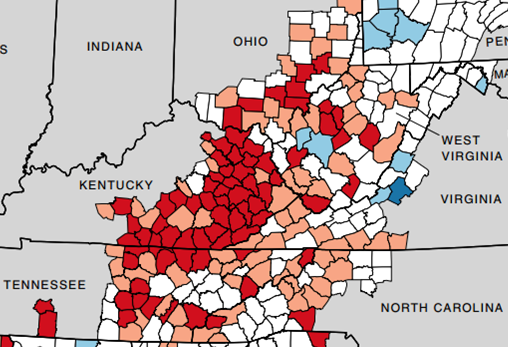
Appalachian Regional Commission map (partial)
shows economically distressed counties in red.
Miller says significant and durable economic development, and major changes in the size and composition of the region's economy, just won't happen -- because expectations for the region are too high. "As the years roll by I am ever less able to muster confidence that we have a sufficient chance of transforming our economy in these mountains," Miller writes. "I do not encourage us to give up, but if we are to make progress we must be realistic about our expectations and pick targets we have a good chance to hit." Many of the region's ills, including education, healthcare, transportation and communications, have been remedied, he says, but there are still major economic issues that need to be addressed.

"It would seem we have tried it all: 50 years of economic development involving lots and lots of taxpayer money, large scale and small spending on one program after another . . . job training to craft cooperatives, Foxfire to clean coal," Miller writes. But the Appalachian economy is still lacking and will "poised to fall into an even bigger sinkhole as our reachable coal reserves play out at the same time that coal is losing favor as a source of energy."

Miller says that he doesn't advocate giving up on development in the region, just being more realistic about it, and being more in tune with modern political life. He also says an understanding of proximity and economic development is important. "I submit that in an area of chronic economic distress, far removed from cultural and economic and social attractions, where the more ambitious kids have for decades brought their suitcases to high school graduation, we might be doing as well as can be expected. . . . Our own experience of these past 50 years is not encouraging, and if we can’t find others to show us where we have been going wrong and how to get our strategies right, then we must conclude that significant and durable economic development in the mountains is not a realistic prospect. Sure we should continue to work on stuff, but we should be honest about what we promise."

Much of Miller's lament is based on Eastern Kentucky's lack of population density, a key to for a region to "accumulate the necessary amenities to attract new residents and build the skills and connections between people that can lead to a diversified economy," he says. "It is time for us . . . to ask ourselves whether our focus ought to be less on the geography and infrastructure of Central Appalachia and more on the people themselves. . . .  Let our honesty begin with a discussion of what our efforts have or have not achieved and quickly move to lessons we can learn from others. . . . I do not know what else we can do but be radical now, in our analysis, in our debates and in who is sitting around the table." (Read more)

Virginia writer sees rural America as election loser

"Rural America seems to be the big loser in a presidential election decided by the cities," writes Michael Owens, right, of the Bristol Herald Courier. Virginia and several other swing states were decided by votes of the population centers, which voted heavily for President Obama. "In a democracy, he who has the numbers wins. It’s the tyranny of mathematics," University of Virginia College of Wise political analyst Eric Drummond Smith told Owens.

In Virginia, the election map "reveals a Mountain Empire bathed in Republican red," but it was the "seemingly small pools of Democratic blue . . . that stole the vote," Owens reports. The same was true for Ohio and Nevada. "But that's the devil of the popular vote . . . especially when massive tracts of sparsely populated rural lands try to compete with a few blocks of densely inhabited concrete jungle," Owens writes. (Read more)

Monday, November 12, 2012

Farm Foundation forum, online at 9 am Wed., looks at election's impact on farm, food and rural policy

“What the 2012 Elections Mean for Agriculture, Food and Rural Policies" will be the topic of the next Farm Foundation forum, to be held in Washington and webcast Wednesday from 9 to 11 a.m. EST.

The panelists will be lobbyist Craig Jagger of Legis Consulting; Ferd Hoefner, policy director of the National Sustainable Agriculture Coalition; Robert Paarlberg, professor of political science at Wellesley College; Christopher Waldrop, director of the Consumer Federation of America's Food Policy Institute; Erik Johnston, associate legislative director for agriculture and rural affairs at the National Association of Counties; and John Hardin, an Indiana farmer.

The forum will be held without charge at the National Press Club. Because of the increased interest, it will be webcast and archived for replay, says the foundation's Mary Thompson. To register to attend or view the webcast, click here.

Will U.S. be #1 oil producer by 2017, or will forecast founder on decline in oil fracked from shale?

The U.S. will overtake Saudi Arabia and Russia as the world's largest oil producer by 2017, according to a new global report. This is the first time the International Energy Agency, the developed world's most respected energy forecaster, has made such a prediction. It is "one of the clearest signs yet of how the shale revolution is redrawing the global energy landscape," Guy Chazan and Ed Crooks of The Financial Times report.

The IEA said in its world energy outlook today that the U.S. will be "all but self-sufficient in net terms" by 2030, a reversal of "the trend seen in most other energy-importing countries," the report says. It also says this trend will shift the direction of international oil trade toward Asia. The increase in U.S. production comes as federal fuel-efficiency measures are set to decrease demand for oil. IEA says this will decrease oil imports, and make North America a "net oil exporter" by 2035.

Some experts say that because the U.S. oil boom "is still in its infancy," continued growth to the levels predicted by IEA can't be guaranteed, Chazan and Crooks report. The boom began with increased natural gas production, which was made possible by hydraulic fracturing. Those drilling techniques have recently been used to tap vast oil reserves in North Dakota and southern Texas shales. The decline rate of shale wells is "very steep," Chazan and Crooks report. Analyst Barclays Capital has found that one year after being accessed, production has dropped by about 20 to 40 percent. (Read more)

Indian vote may have decided Mt., N.D. Senate seats

The New York Times' now-famous number cruncher Nate Silver predicted the outcomes of this year's elections with almost complete accuracy, but missed the Democratic victories in Senate races in North Dakota and Montana. Indian Country's Mark Trahant says Silver miscalculated because his models don't include the Indian vote. "Indian country is the smallest demographic slice of what is America," Trahant writes. "Yet when the history of the 2012 election is written, it must be said, that Indian country outperformed. By any metric."

North Dakota Sen.-elect Heidi Heitkamp and Montana Sen. Jon Tester "not only understood" the importance of the Indian vote, but they "campaigned on reservations hoping that it would be the one factor no one figured," Trahant reports. And they were right. The Montana counties where Indians vote -- Glacier, Roosevelt, Blaine and Big Horn -- were won by Democrats. In Glacier County, which includes the Blackfeet Reservation, total Democratic votes were twice Mitt Romney's. Heitkamp won North Dakota's Sioux County, where 84 percent of the population is Native American, by 83.9 percent. She also won in Rolette and Benson counties, which are both majority Native American.

American Indian and Alaska Native voters turned out in record numbers this election, the National Congress of American Indians reported last week. NCAI executive director Jacqueline Johnson Peta told Trahant it's important for Indians to take credit for their success at the polls and remind politicians when issues affecting Indian country are before them. Native American registered voters outnumber all other racial and ethnic groups in Montana and New Mexico, she said, giving them power on the state level to advocate for issues. (Read more)

Coal industry hopes Obama will go easier on it; might it be whistling past the graveyard?

President Obama probably doesn't feel like doing any favors for the coal industry, after its "war on coal" rhetoric was used to attack him in key battleground states like Ohio and Virginia (both of which he carried), but the industry is making guardedly optimistic noises, noting Obama's support for clean-coal technology, and hoping for some leniency in water- and air-pollution regulation.

Coal-company stocks fell 9 to 23 percent the day after the election, notes James Bruggers of The Courier-Journal in Louisville. The Dow Jones Industrial Average fell 2.4 percent. Coal officials told Bruggers they hope the administration will relax some Environmental Protection Agency regulations, which would make mining and burning coal more costly in Obama's second term. "We are hopeful the president's pro-coal comments from the campaign reflect a new direction for his administration," Kentucky Coal Association president Bill Bissett said. (Read more)

Coal interests may have some reason to be hopeful, The Charleston Gazette's Ken Ward Jr. writes. The day after the election, the U.S. Forest Service ruled against conservation groups who challenged the agency's expansion of a coal-mine lease 10 miles east of Paonia, Colo. The ruling will allow Arch Coal to build 48 natural-gas drilling pads on almost 1,700 acres of the Sunset Roadless Area, a section of wild forest. Ward notes that Arch's West Elk Mine is partly located in Gunnison County, one of only two of the top 25 coal-producing counties to vote for Obama.

But for coal operator Robert Murray, who hosted a rally for Mitt Romney that Ohio miners were asked to attend without pay, the war rages on. Murray made good on a promise he made to lay off miners if Obama was re-elected. More than 150 of owner of Murray Energy Corp.'s 3,500 miners were fired, the largest number at a Utah mine that was the scene of a 2007 disaster. The layoff notices "blamed Obama's 'war on coal' for the job cuts," Allison Linn of CNBC reports. Murray predicted the "total destruction of the coal industry" by 2030, and said increased regulations were one reason for the layoffs. (Read more)

UPDATE: Ken Ward Jr. asks in his Coal Tattoo blog, "Does the mining industry not understand who won the presidential election?"

Barbara Kingsolver's new novel is about rural perceptions of changes in climate and nature

Author Barbara Kingsolver, right, is taking on climate change in her most recent novel, Flight Behavior. She recently spoke with NPR's Flora Lichtman about the book and what Lichtman calls its central philosophical question: "Why do we believe what we believe and how is it that two people can look at the exact same set of circumstances and see two completely different things?"

The novel is set on a farm in Southern Appalachia, Kingsolver's home region, where a shift in climate has caused monarch butterflies to settle for the first time. The butterflies normally winter in Mexico, but because of climate change, their pattern has brought them to a hilltop farm in East Tennessee. Journalists, scientists and other outsiders call the event a drastic effect of climate change, but people in the rural, conservative town see it as a miracle from God.

"It's a novel in which I use this device [the monarchs] to talk about climate change, about the methods of science, because that's a really big part of this novel," Kingsolver told Lichtman. "It's really about . . . why we decide to believe what we believe and why it's so difficult for us to have this conversation about climate change."

The story is told through the eyes of a farmer's wife, who discovers the butterflies first and sees them as her personal "burning bush" sign from God. Kingsolver told Lichtman she wanted to write the novel through the wife's eyes so the reader would not initially know what they were seeing, either. "It is about perception and how we need to be to understand what we're seeing before we can really see it," said Kingsolver, who has a master's degree in evolutionary biology. "That's really key to understanding this whole issue of climate change and why we see or don't see what's right in front of us." (Read more)

UPDATE: Roberta Rubinstein writes in the Washington Independent Review of Books, "The novel keeps readers wondering until the narrative reaches its satisfying resolution. Flight Behavior may not be Kingsolver’s best — I reserve that position for The Poisonwood Bible — but it is an absorbing read, positioned at the cusp of contemporary concerns about environmental change and its impact on the human domain." (Read more)