Thursday, January 03, 2013

Painkiller epidemic driven by drug makers' subsidy of researchers who discounted risk of prescribing

For almost a decade, medical officials and experts claimed OxyContin rarely posed problems of addiction for patients. The drug's label, which was approved by the Food and Drug Administration, said addiction risks were small. Research published in the New England Journal of Medicine also said OxyContin wasn't addictive; so did a study in another journal, which OxyContin manufacturer Purdue Pharma reprinted 10,000 times. Since the drug first hit the market, it has fueled a large-scale swath of prescription pain killer addiction, beginning in Central Appalachia, that has grown into a national epidemic, especially in rural areas.

The epidemic was driven in no small part by doctors' lack of knowledge about OxyContin, which was perpetuated by the drug's manufacturer through false claims that became scientific consensus. But now, "Many in the medical profession have rediscovered the destructive power of opiates," and are calling that consensus into question, Peter Whoriskey of The Washington Post reports. "A closer look at the opioid painkiller binge, in which retail prescriptions have roughly tripled in the past 20 years, shows that the rising sales and addictions were catalyzed by a massive effort by pharmaceutical companies to shape medical opinion and practice."

Doctors were wary of prescribing painkillers to any patient except those with cancer for years. But manufacturers and some pain specialists "helped create a body of scientific research assuaging the long-standing worries about opioids and pushed to expand the use of the drugs in people with chronic pain: bad backs, arthritis, sore knees," Whoriskey reports.

Through an examination of key scientific papers, court documents and FDA records, the Post found that many of the studies claiming OxyContin wasn't addictive were supported by Purdue Pharma. The conclusions those studies reached were sometimes not supported by data, and when the FDA needed to develop an opioid policy, it turned to a panel of doctors who had financial relationships with Purdue Pharma and other drug makers. (Read more)

Spending time immersed in nature can increase creativity and critical thinking, study confirms

Those who appreciate rural places already know this, but a study has found that spending time fully immersed in nature can improve creativity and problem-solving. "Little is known about the human brain on technology, but many social psychologists fear that so much 'screen time' is rewriting our neural circuitry, and not for the better," Kevin Redmon of Pacific Standard magazine reports. Researchers wanted to find a tangible measure of how nature impacted the brain to counteract technology's sometimes negative impacts, something that had previously been unavailable. (Kentucky Tourism photo)

David Strayer, a professor of cognition and neural science at the University of Utah, and University of Kansas psychologists Ruth and Paul Atchley worked with Outward Bound to complete their experiment. Fifty-six students were asked to complete neural wordplay activities known as remote associates tests. Half the students took the tests before a camping trip, and the other half took them about midway through the trip. Students who took the tests after four days in the woods scored 50 percent higher then their peers. "Current research indicates that there is a real, measurable cognitive advantage to be realized if we spend time truly immersed in a natural setting," the authors write. The study, "Creativity in the Wild: Improving Creative Reasoning through Immersion in Natural Settings," was published in this month's issue of Plos One. (Read more)

The findings should be no surprise in New England, the New Hampshire Union Leader editorial board opines. "Most Granite Staters know that living among the hills, rivers, forests and mountains is good for the soul and body," the editorial states. "We also know what it can do for our peace of mind. Now scientists are confirming that it can improve creativity, attention span and mental function. Nice of them to catch up to us." 

Wind-energy tax credit will live for at least a year

A one-year extension of a tax credit for wind energy generators was included in the deal to avoid the fiscal cliff. The credit "has been a major driver for wind development across the U.S. over the past two decades," reports K Kaufmann of The Desert Sun in Palm Springs, Calif. Most large wind farms are built in rural areas in the West. (Desert Sun photo by Wade Byars, wind farm north of Palm Springs)

The extension would allow any wind project that begins construction this year to claim the credit, even if it doesn't become operational until 2014. The previous version required electricity to be generated by year's end. Many industry officials said that without the credit, construction of wind projects would be difficult, and the prospect it would expire had wreaked havoc on wind-parts plants across the U.S., which laid off thousands of workers in recent months, Kaufmann reports.

Project developers put operations on hold, threatening about 37,000 more jobs, according to the American Wind Association. Loss of momentum will likely slow new construction this year, California Wind Energy Association director Nancy Rader told Kaufmann. (Read more)

'Any compromises will mean less money for programs,' Indian Country blogger writes

Congress was able to reach an agreement to avoid automatic spending cuts and tax increases set to begin this week, but the outlook for Indian Country is not good, former Frontline reporter Mark Trahant writes on his blog, under the heading "Austerity."

The deal puts sequestration of funds off until March, which gives cash- and staff-strapped tribes across the U.S. time to prepare, Trahant writes. The deal also keeps the Special Diabetes Program for Indians funded at its current level. Continued battles about the budget and taxes are coming, especially since the continuing resolution funding the federal government expires in March.

"Here is the bad part for Indian Country," Trahant writes. "Any compromises will mean even less money for programs. There is zero chance for more money, even for critical programs such as Indian health." (Read more)

Wednesday, January 02, 2013

Health reform drives smaller hospitals into mergers and affiliations, makes clinical links more important

Is your community's hospital one of the many rural hospitals considering sale, merger or affiliation with a larger hospital or group of hospitals, all options that are becoming more common, partly due to federal health-care reform? A recent article in HealthLeaders magazine, which examines some of the considerations, may inform your coverage.

Basing decisions on past experiences "is difficult because the creativity surrounding partnerships among hospitals and health systems is expanding rapidly," writes Philip Betbeze, the magazine's senior leadership editor. For example, clinical collaborations have become more important in affiliations. "Whether they own or don't own each other doesn't matter as much as coming up with a structure for sharing those value-based purchasing points together," Joseph R. Lupica, chairman of Newpoint Healthcare Advisors, told Betbeze, who writes: "That's a sea change compared to prior affiliations or mergers. In the past, such deals were driven by traditional aims around increasing market share and increasing bargaining power."

Health reform will create incentives for better patient outcomes, which upsets the old "iron trangle" of hospitals: "volume, rates, and the ability to decrease unit costs," said Dr. Gregg Meyer, chief medical officer of Dartmouth-Hitchcock, a New Hampshire hospital group that recently affiliated with the Mayo Clinic, more than 1,000 miles away, "because we know that patients who come to us for care will often seek a second opinion. In the past, that meant going to Boston or New York, and we lost out on that because we lost the ability to keep that care local. Now we can have a virtual second opinion with arguably the most famous health system in the world."

The article has several more examples. to read it, click here.

Farm Bill extension favors status quo, big players; leaves many members and interests upset

The "fiscal cliff" package that passed Congress last night "includes a nine-month Farm Bill extension that forestalls any immediate spike in milk prices but also represents a bitter blow for farmers who had hoped for long-sought changes in the dairy support program," David Rogers reports for Politico. "The upshot is a victory for Southern agricultural interests with the greatest stake in a costly system of direct cash payments to often already profitable producers. In the dairy arena, giant processors like Dean Foods Co. come out ahead while the outcome is a major blow for the National Milk Producers Federation, which watched with disbelief from the sidelines," as did the Sustainable Agriculture Coalition.

The latter group's policy director, Ferd Hoefner, told Rogers: “Many smaller, targeted programs to fund farm and food system reform and rural jobs . . . were left out completely. . . . The message is unmistakable — direct commodity subsidies, despite high market prices, are sacrosanct, while the rest of agriculture and the rest of rural America can simply drop dead.”

Senate Agriculture Committee Chairwoman Debbie Stabenow of Michigan railed against the farm language inserted by Republican Leader Mitch McConnell, but the Obama administration took its lumps from other farm-state Democrats for going along. Rep. Collin Peterson of Minnestota, left, ranking Democrat and former chairman of the House Agriculture Committee, was more than upset. He told Rogers, “Upset is an understatement. I’m not going to talk with those guys. I’m done with them for the next four years. They are on their own. They don’t give a shit about me, anyway.”

Republican sources told Agri-Pulse that McConnell feared another senator would raise a point of order against the extension drafted by Stabenow and House committee Chairman Frank Lucas, R-Okla., because of its budget implications. "McConnell also listened carefully to objections from House Speaker John Boehner, R-Ohio, who is adamantly opposed to the dairy reform provisions that the committee chairs had included," Agri-Pulse reports.

Looking ahead, Rogers writes, "Beyond dairy, the outcome is a wake-up call to the entire farm lobby of its weakened political standing in Washington and need to avoid so much infighting. As agriculture has grown more concentrated, it commands fewer votes. Indeed, consumer fears about milk prices drove the deliberations more than dairy farmers. And in these tough economic times for the nation, the farm sector has been enjoying relative prosperity and in the eyes of many lawmakers has become more complacent politically." (Read more)

The overall bill includes "several tax provisions [that] affect farmers and ranchers, including an estate tax set at a new 40 percent rate on estates valued at more than $5 million, up from the 35 percent rate in effect for 2012," Agri-Pulse notes. "The estate tax, known as the 'death tax' in agricultural circles, threatened to revert back to the $1 million exemption and the 55 percent top tax rate had Congress taken no action." Agri-Pulse is subscription-only, but offers a free four-week trial, here.

Asian carp are threatening fisheries and tourism in the Ohio River system; Pennsylvania fearful

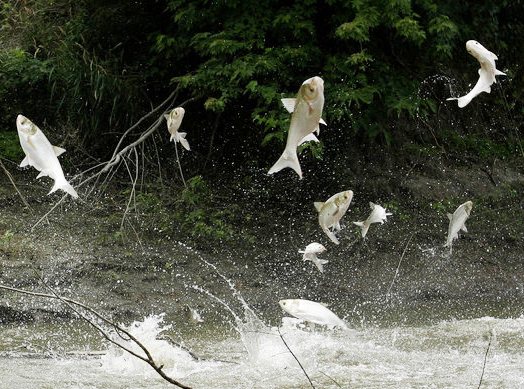
Almost all coverage of the Asian-carp invasion of the Mississippi River system has focused on the threat to the Great Lakes, but there is growing alarm that the silver and bighead carp are damaging sport fisheries and endangering boaters and skiers in the Ohio River and tributaries, Janet Patton of the Lexington Herald-Leader reports. Western Kentucky commercial fisherman Ronny Hopkins told Patton, "It's a nightmare, it really is. Not just for fishing but for tourism. . . . They're taking over and killing our native fish." (Associated Press photo by Chris Young; Herald-Leader map; click on images for larger versions)
Patton notes, "Federal agencies have spent over $200 million in efforts — so far thought to be successful — to prevent the carp from getting into the Great Lakes. With the carp moving up the Ohio River, Pennsylvania is desperate to stop them from getting there and Kentucky is leading several multi-state efforts to deal with the problem. . . . Federal legislation, from Pennsylvania lawmakers, has been filed to address fish removal that could provide some money outside the Great Lakes efforts."

Many think the solution is commercializing the fish, first for animal feed, then for human consumption, "but there are objections," Patton writes. "Fish and wildlife experts are divided because they fear establishing a business built on this fish means they can never be completely eradicated and that creating a market will give people an incentive to spread the fish." (Read more)

Monday, December 31, 2012

Farm Bill extension, resolution of milk crisis are waiting on tax deal; GOP divisions still a problem

House Speaker John Boehner is "betting that a tax deal in the Senate will let him slip through a [Farm Bill] fix without having to give in to demands for a new dairy program backed by the House and Senate agriculture committees," David Rogers reports for Politico. He says the internal conflict "illustrates the problems facing the GOP as it tries to untangle itself from the milk crisis brought on in large part because of Boehner’s refusal to allow floor debate in this Congress on a full-scale, five-year Farm Bill."

The milk crisis looms because without an extension or a new Farm Bill, federal farm law would revert to a 1949 statute that would "require the Agriculture Department to begin buying up dairy products at a rate of $38.54 per hundredweight, more than double the current prevailing price," Rogers notes.

"The four top Farm Bill leaders in the House and Senate are united behind an extension that would run through September and provide more certainty going into New Year’s," Rogers writes. "Boehner and the GOP leadership have responded with a pair of 30-day patches that the aggies dismiss as a 'poor joke on farmers' — who, they ask, plants a crop for just 30 days? The biggest single issue is the fate of a new dairy margin protection and market stabilization plan what promises to cost less than the current milk program but is strongly opposed by major processors aligned with the speaker."

The 30-day extension could be included in a deal on Bush-era tax cuts, which may come up for a vote in the House tomorrow. The draft of the extension does not include "the dairy language that Boehner opposes," Rogers reports.

U.S. definitions of 'frontier' and 'remote' could shift; you have until Friday, Jan. 4 to give feds your view

The federal government is accepting comments until Friday, Jan. 4, on possible new definitions for "frontier" and "remote" areas. If the definitions are properly changed, "It will allow future government programs to more effectively target those areas," Aleta Botts of the University of Kentucky writes for the Daily Yonder.

"While this new method is not linked to specific programs yet, it very well could be in the future," writes Botts, an agricultural and rural policy specialist. "Rural areas are notoriously hard to define, and the most rural areas in particular can be difficult to describe in objective, useful terms. The phrase 'trying to pin Jell-O to a wall' comes to mind. Nevertheless, the way you define a rural area determines which communities are eligible to apply for rural water improvements, what businesses can apply for low-interest loans, which areas are entitled to special Medicare reimbursements for their health services, and many other program questions."

Frontier and remote areas have been defined by population density (fewer than six people per square mile) and by county (as opposed to zip codes or census tracts), Botts notes, calling those "pretty blunt tools, since a more dense population might still be located a distance away from an urban center. And counties vary greatly in size." The proposed change would measure population density per square kilometer, about 61 percent smaller than a square mile, and define remoteness by travel time from various population centers.

There would be four levels of remoteness, developed by the Economic Research Service of the Department of Agriculture. Level 1 and Level 4 appear below; you can click on a map for a larger image, or click here for the four-page PDF with all four levels. For detailed data by ZIP code, go here.
ERS is working with the Office of Rural Health Policy in the Department of Health and Human Services on the proposal. Comments can be sent to shirsch@hrsa.gov, mailed to Office of Rural Health Policy, Health Resources and Services Administration, 5600 Fishers Lane, Parklawn Building 5A-05, Rockville MD 20857; or faxed to 301-443-2803. (Read more)

Friday, December 21, 2012

Journalism fellowships available for young reporters

The Phillips Foundation, a nonprofit organization seeking to "advance constitutional principles, a democratic society and a vibrant free enterprise system," is now accepting applications for its annual Robert Novak Journalism Fellowships, named for the conservative, investigative columnist. Journalists with less then 10 years professional experience, and who share the Foundation's core principles, are eligible.

Full-time awards of $50,000 and part-time awards of $25,000 are given to journalists to complete a one-year project of their choosing that focuses on "journalism supportive of American culture and a free society," a press release says. The foundation also awards year-long fellowships focusing on the environment, the benefits of free-market competition and law enforcement. Applications must be postmarked by Feb. 12, 2013, and winners will be announced in May 2013. For more information, click here.

Feral hogs are here to stay, but can be controlled

Feral hogs, once found primarily in the Southeast, have spread to more than 40 states in the north and west. It took about 20 years for them to spread, but once they took hold, they kept spreading. "If you're one of the lucky few who live in a state that hasn't been infested with feral hogs, it's likely your time is coming," Burt Rutherford of Beef magazine reports. Though the animal is considered exotic, it becomes a pest, and many people can't seem to figure out how to get rid of them. (Texas A&M photo)

Texas A&M University extension wildlife biologist Ken Cearley told Rutherford that once the hogs take hold, they're almost impossible to extirpate. "We've come to think of it as much like brush control," he said. "The real measure of success in living with the rascals is reducing the amount of damage they do." They can create a lot of damage on range and farmland, rooting down as much as a yard, searching for food and tearing up the land. They can also eat young calves and other small animals, displace wildlife and can carry as many as six different diseases. Cearley said they've done at least $52 million worth of damage just in Texas.

Experts say landowners can prevent as much as two-thirds of that damage by using a variety of control methods, including trapping and hunting. Several processing plants in Texas accept feral hogs and ship the meat overseas. Texas also allows shooting of feral hogs from the air. (Read more)

Rural before- and after-school programs face special challenges, primarily lack of funding

Before- and after-school programs in rural areas must deal with several challenges unique to their geography, such as low funding, access, transportation and staffing. Even though there's been national attention recently about the importance of these types of programs, rural leaders say their challenges, which were made worse by the recession, aren't getting easier, Diette Courrege of Education Week reports.

Most rural before- and after-school programs are actually worse off than they were three years ago at the height of the recession, according to an Afterschool Alliance survey. Nationally, rural and urban programs struggle because of the tight economy, which prevents them from providing high-quality programming, Afterschool Alliance's Jen Rinehart told Courrege. These struggles are more difficult in rural areas because of their unique challenges, according to a 2011 Harvard Family Research Project report, "Out-of-School Time Programs in Rural Areas."

Rural areas receive less funding than urban or suburban because of smaller population sizes. Many rural programs rely on federal "21st Century Community Learning Center grants," which are available to programs that provide before and after school programs for students who are considered poor and attend low-performing schools. The $1.2 billion grant program is formula-based and lets states distribute the money. Officials don't have to send most of the money to rural places, but some states give priority to rural, Courrege writes. (Read more)

NRA: Every school needs federally funded guards

The chief executive of the National Rifle Association said today that Congress should immediately fund trained, armed security guards "in every single school" to prevent mass shootings like the one in Newtown, Conn., "before any lengthy debate on legislation" and another "unspeakable crime."

"The only thing that stops a bad guy with a gun is a bad guy with a gun," NRA Executive Vice President Wayne LaPierre said at a press conference interrupted twice by protesters with banners. He did not provide a cost estimate or take questions, instead introducing former U.S. Rep. Asa Hutchinson of Arkansas, who will lead an NRA-funded effort to create a model school-safety program. Hutchinson also did not take questions, but said local schools should be free to turn down the proposed federal funding for armed guards.

LaPierre criticized news organizations on several fronts, in effect casting them as the NRA's chief opponents on gun-control issues, rather than advocacy groups and members of Congress. He said "media conglomerates" that produce violent movies and video games are "silent enablers . . . if not complicit co-conspirators" with those whom the games and films inspire to violence.

UPDATE, Dec. 22: Andrew Beaujon and Julie Moos of The Poynter Institute ran a fact-check on LaPierre's speech and found some points well supported, others not so much. For example, there was an armed guard at Columbine High School. (Read more)

Thursday, December 20, 2012

Is rural America politically relevant? It's a fair question, U.S. columnist for The Economist writes

If Tom Vilsack doesn't remain secretary of agriculture in President Obama's second term, the former governor of Iowa may be remembered most for two things: his hasty firing of Shirley Sherrod and his declaration in "a surprisingly tough speech to farm groups" last month that rural America is getting less relevant because its share of the population is the lowest ever, 16 percent, and its advocates are not "picking the right fights," as the latest United States column in The Economist magazine puts it. (The Economist, which calls itself a newspaper, does not typically identify its writers; the U.S. columnist is dubbed "Lexington," for the Massachusetts town where our country's rebellion against the United Kingdom began.)

Vilsack's message, which he has continued to deliver in other speeches, prompted Lexington "to head to the countryside, to see how a (hopefully representative) rural community felt about its place in the American political system." He picked Vandalia, Ill., population 15,000, because it was the subject of a story last month in the Daily Yonder, commemorating the 50th anniversary of Joseph Lyford's book, The Talk in Vandalia, "a sensitive portrait of a farm community in transition," as writer Marcel LaFlamme, a Rice University graduate student, put it. (Photo by LaFlamme: Gallatin Street)
Noting that Chicago's Barack Obama got 28 percent fewer votes in Vandalia and Fayette County than last time, Lexington writes that rural places are "increasingly mysterious, drifting further and further away from larger cities in their values, politics and economics. . . . Is rural America still politically relevant? The question is sincere, and not mere journalistic impertinence. Since the 2012 presidential elections, a cottage industry of comment has sprung up, examining the growing ideological gulf between America's countryside and its urban centres."

In Vandalia, "Locals talk of how their values and priorities place them out of line with Illinois, and differ dramatically from Mr. Obama's vision for America." But there's "a touch of muddle," Lexington writes, because several local farmers "would have been ruined by the harsh drought of 2012, were it not for federally-backed crop insurance. The city has received federal cash to renovate its handsome main street, and public money to renovate its main tourist attraction, a 19th-century statehouse in which the young Abraham Lincoln served, during Vandalia's brief stint as capital of Illinois. The problem is a sense of powerlessness and accountability. Locals do not like being dependent on government money and public works."

Vandalia "wishes to remain a living, risk-taking community, with a voice in big political fights of the day," Lexington concludes. "Yet in its fierce conservatism and piety (the city boasts 18 churches, or one for every 300 permanent residents), Vandalia feels the rest of America drifting away. Fifty years on the fight is not for survival, but for relevance." (Read more)

In a broader, online version of the column, titled "Rural America's fight for relevance," Lexington quotes from a recent column (not available online) by David Wasserman of the Cook Political Report about Republican legislators' drawing of congressional districts: "By purging Democrats and minorities from their own districts and into Democratic quarantine zones, Republicans may have drawn themselves into a durable House majority. But they have also drawn themselves into an alternate universe of voters that little resembles the growing diversity of the country."

Farmers still get their hands dirty, but increasingly rely on technology; Gannett papers give glimpses

Cori Natoli of The News Journal in Wilmington, Del., saw a story in farmers' reliance on technology in an industry that may be more often known for manual labor. Her editors agreed, and its big Gannett Co. sister, USA Today, also ran it, giving a large national audience glimpses of today's agriculture. As her object example she cited fifth-generation farmer Brandon Bonk, 28, who uses satellites and microchips to guide his equipment over 3,000 acres. (N-J photo by Jennifer Corbett: Bonk adjusts self-driving tractor)

"In so many respects, the farming life may never change," Natoli wrote. "Farmers get their hands dirty, work their fingers until they swell and then work some more. They get around their fields in pickups, working an industry with notoriously narrow profit margins." But today's farms are "driven by technology that raises yields, limits runoff and adjusts to changing weather, pests and commodity prices," and such agriculture is known as "precision farming."

Bonk's seeds are genetically modified to resist drought and pests, and his fertilizer is rationed by sensors and software. His biotechnology and agriculture-systems degree from Iowa State University helps him make the most of such technology, and "The reward is handsome," Natoli wrote. The technology "results in higher yields, less waste, higher profits, less environmental impact, higher growth and a priceless perk: less time away from the family." (Read more)

Odor study indicates air pollution from industrial hog farms can increase neighbors' blood pressure

Air pollution from large-scale pig farms may increase blood pressure in people living nearby, according to a University of North Carolina study. For two weeks, residents sat outside their homes, then measured their blood pressure. When odors from the pig farms were strongest, blood pressure rose slightly. High blood pressure is a risk factor for stroke and heart diseases, and many pig operations in North Carolina are located near low-income communities where residents are already at higher risk for such ailments, Virginia Guidry and Wendy Hessler of Environmental Health News report. (Photo by Jeff Vanuga)

The study, "Air pollution from industrial swine operations and blood pressure of neighboring residents," was conducted from 2003 to 2005 with 101 adults living within 2 miles of industrial pig farms. They sat outside for 10 minutes twice a day to record measurements of blood pressure. Air pollution monitors near their homes measured levels of hydrogen sulfide, a chemical in decomposing manure, and particulate matter, dust that comes from the farms.

Results showed that diastolic blood pressure increased by 2 millimeters of mercury during periods when odors were strong. High hydrogen sulfide levels increased systolic blood pressure, with a 10 part per billion rise of the chemical increasing systolic pressure by 3 millimeters of mercury. These effects were highest in men and those over 54 years old. The study found that these small increases in blood pressure could have "important public health implications," Guidry and Hessler report. It increases the risk of hypertension, stroke and heart disease. (Read more)

Rural culture of men providing for families might shift as coal's role continues decline in Appalachia

"As the Appalachian coal industry struggles through its current decline, the traditional role of a coal miner's wife, as well as the social structures and culture in certain communities, could be pushed to change," reports Taylor Kuykendall of The State Journal, a business-oriented weekly in Charleston, W.Va.

Many households in Central Appalachia are single-income because of high miner salaries. But now, as coal companies cut jobs because of competition from cheaper natural gas, market forces and increased regulation, wives might have to find jobs to support the household, Kuykendall writes. The male labor-force participation rate in West Virginia was 61.2 percent in 2010, and the female rate was 48.2 percent, according to a West Virginia University College of Business and Economics report.

"It's still possible to earn a substantial salary with a high school diploma because of the coal mines, something unique to Appalachia," WVU family studies professor Jessica Troilo told Kuykendall. "Because the financial culture didn't have to change as it did for many families in the 1970s and 1980s, cultural assumptions about work and providing for one's family, and who should do the providing, didn't have to change." She said she expects those assumptions to begin to change now. This shift has already happened outside the coalfields, Troilo said, as many families now have two income earners. (Read more)

Teens' cigarette use is down 9% since 2010, but more drink, and more 12th graders use pot

Teenagers' cigarette smoking dropped to a record low this year but alcohol use rose slightly after seven years of decline, according to a survey of 45,000 eighth-, 10th- and 12th- graders for the National Institute of Drug Abuse.

The survey also found that the use of illicit drugs dropped slightly among eighth-graders but rose slightly among 12th-graders. Among them, 36.4 percent reported using marijuana in the past year, up from 34.8 percent in 2010, and the share who saw great risk in smoking marijuana occasionally dropped significantly, to 20.6 percent, from 24.5 percent in 2010.

Among all the age groups, only 10.6 percent said they had smoked cigarettes in the past 30 days, down from 11.7 percent in 2010. The University of Michigan researchers who did the survey said the decline was significant, and may have been driven by a big increase in the federal tobacco tax in 2009.

"A 1-percentage-point decline may not sound like a lot, but it represents about a 9 percent reduction in a single year in the number of teens currently smoking," principal researcher Lloyd Johnston said in a news release. Among eighth-graders, the decline was about 20 percent. For other results of the survey, click here; for a PDF version, here. For the full survey report, go here.

"Teen attitudes toward smoking also continued to become more negative. For example, 80 percent of teens said they preferred to date nonsmokers in 2012," Steve Gorman reports for Reuters. "But anti-tobacco advocates said their battle to stamp out teen smoking was far from over, noting that 17 percent of high school seniors still graduate as smokers." And the figure is higher in many rural areas.

Wednesday, December 19, 2012

Medicaid expansion is a 'rural issue' and could save many lives, health expert says

"The big choices in health-care reform now rest with the state governors," Dr. Wayne Myers, former national rural-health director, writes for the Daily Yonder. "The biggest is whether to accept the federal offer of support for Medicaid expansion. This turns out to have a smaller price tag than a lot of people suppose, and a lot of lives depend on it."

Richer states would pay for half of Medicaid recipients' health care, and the federal government would pay the other half. Poorer states would pay less and the federal government would pay more. Myers says a lot of people will remain or become uninsured if states don't adopt the expansion deal. Between one-sixth and one-fifth of all Americans are on Medicaid, and it pays for more than 40 percent of all births and 70 percent of nursing home care in the country.

However, Republican governors are opposed to expansion for political reasons, stemming from their disapproval of "Obamacare," Myers writes. Some have promised to not implement any portion of it, which could create problems for millions of poor Americans, mostly living in rural areas, who can't afford health insurance and must rely on Medicaid. (Washington Post map)
"Medicaid is a rural issue because a higher percentage of low-income people live in rural communities, and rural families are less likely to have private health insurance," writes Myers, the first director of the federal Office of Rural Health Policy and former president of the National Rural Health Association. It's also "a major economic driver." According to the National Center for Rural Health Works at Oklahoma State University, Medicaid was responsible for 113,000 jobs and a total of $10.5 billion in economic activity in Oklahoma in 2010.

Medicaid also saves lives and expansion will be cheap for states, Myers writes. Studies have shown that patients with insurance that are hospitalized after accidents are 40 percent less likely to die than those without insurance because uninsured patients got less attention from medical staff. If all 50 states were to adopt expansion, they would spend a total of $8 billion over the next 10 years; but, if all 50 states opted out of expansion, they would spend $68 million over the next decade, according to a Harvard School of Public Health study.

With all of this in mind, opting out of the expansion "may get a governor a self-inflicted gunshot wound to the foot, some dead hospitals and a bunch of dead citizens who needn't have died," Myers writes. (Read more)

Study: Climate change has taken hold in the West

Helicopter dumps water on forest fire
(Jeffrey Allred, Deseret News)
Bug-infested forests, reduced flow in the Colorado River and less snowfall in the Rocky Mountains are signs that climate change has taken hold in the intermountain West, according to a multi-agency report, "Impacts of Climate Change on Biodiversity, Ecosystems and Ecosystem Services," which was peer-reviewed through the U.S. Geological Survey.

The report says climate change is manifesting itself in the summer, through droughts and heat waves. But it says climate change's biggest effects are in the winter, a "surprise revelation," Amy O'Donoghue of the Deseret News in Salt Lake City reports. Warmer winters are "enhancing pest outbreaks and accelerating the melting of snowpack each year, reducing the amount of water that's available later when needed," she reports. Forests are already adapting to climate change with longer growing seasons, but outbreaks of invasive beetles, caused by warmer winters, are causing massive tree die-offs, increasing forest-fire risk.

"I think the bottom line is that these impacts are not going to happen 50 or 100 years from now," National Wildlife Federation climate change director Bruce Stein told O'Donoghue. "Many of them are already here, and we are going to have to be rethinking what we do to protect our wildlife and how we build and protect our communities." (Read more)

Coal poised to beat oil as top world energy source, but U.S. demand and production will drop, IEA says

Demand for coal will increase in every world region except the U.S. through 2017, according to the Paris-based International Energy Agency. The trend is attributed to cheap natural gas providing stiff competition to coal in the U.S. The "Medium-Term Coal Market Report" says coal will come close to surpassing oil as the world's top energy source within the next five years, with developing countries burning about 1.2 billion more metric tons of coal per year by 2017.

The report says coal demand will drop in the U.S. by 97 million metric tons of coal equivalent by 2017, and that production will be down 20 percent, to 771 MTCE from the current 967. Predictions about coal's decline in the U.S. "conform with numerous other forecasts of coal use and production," Manuel Quinones of Energy & Environment News reports. The report says cheap gas, retirement of coal-fired power plants and environmental regulation are the leading factors in coal's U.S. decline. (Read more)

AEP subsidiary to stop burning coal at power plant in heart of Appalachian coal country

Kentucky Power Co. announced today that it will effectively close its Big Sandy Power Plant in Louisa, Ky., after scratching plans to install a $1 billion scrubber to comply with environmental standards, reports Ralph Davis of the Floyd County Times in Prestonsburg. The power produced by the plant will be replaced by a sister plant in Moundsville, W.Va. If this plan is approved, it will increase electric rates by 8 percent. The closure of a similar plant almost anywhere else in the U.S. would be expected. But in the heart of Central Appalachian coal country, the move speaks volumes. (Photo by Shawn Poynter)

Under a federal-court consent decree, the company must bring the Big Sandy plant into compliance with the Clean Air Act, or close it, by 2015 . If the company had installed the scrubber, electric bills would have increased by 31 percent, Davis notes. As the Kentucky Public Service Commission was deciding whether to approve that plan, Kentucky Power withdrew it, saying it wanted to "reevaluate alternatives due to changes in the energy market," Davis writes. Under the new plan, Kentucky Power would obtain 50 percent of the Mitchell Generation Station in Moundsville, which like it is owned by American Electric Power.

Kentucky Power's announcement doesn't address what will happen to the Big Sandy plant, but a separate statement released by the company says it is still trying to decide the plant's fate. The company said plans could come next year when it submits a filing to cover future generating capacity at Big Sandy, Davis writes. Some options for the plant include converting it to natural gas, which could be used for generation at times of peak demand. Regardless, the generator will "cease burning coal, as plans to retire it as a coal-fired generator in 2015 are already in place," Davis writes.

Employees at the plant will have an opportunity to get other jobs in the AEP system, and those who aren't hired elsewhere will be offered severance packages. "The closure will also have a negative ripple effect in the coal industry," Davis writes. The Big Sandy plant consumes about 2 million tons of coal a year, but after 2015, it will consume no coal, perhaps putting some coal jobs in the region in jeopardy. (Read more)

States compost roadkill, as farmers do dead stock

"Roadkill disposal is a serious problem nationally, as stricter environmental regulations close burial pits, landfills run out of space, and many rendering plants shut down," Eliza Murphy of High Country News reports. The problem can be a burden in rural areas, where roadkill is more likely to occur. But a pilot program in Oregon, in which roadkill is composted, could provide a national solution. (HCN photo: Working compost site in Oregon)

Composting is becoming a popular alternative for disposal of roadkill, as Montana, Washington and New York already have working composting sites. It cost the Oregon Department of Transportation $11,600 to develop its site in the eastern part of the state and get permits in 2010. It cost just $6,500 a year to operate the site. About 500 deer, and hundreds of other miscellaneous animals, have been "transformed into nutrient-rich soil conditioner" so far in Oregon. The project might eventually create enough compost to use for roadside planting. But right now, it only produces enough to keep the compost starter pile sustained, Murphy writes. Still, the site is successful enough to remain the official method for roadkill disposal in eastern Oregon, a very dry and rural place.

"This works just like a regular compost at home," ODOT's Michael Bennett told Murphy. "You put the carcass on a pile, keep it moist and aerated for several months, and it cooks and decomposes." When roadkill arrives, workers place it on a layer of wood chips close to another carcass to create more heat. They sprinkle it with a layer of starter compost, then another layer of wood chips, then they turn it for months until it's all decomposed. Some farmers and ranchers all over the country use the method for disposing of dead livestock. (Read more)

Tuesday, December 18, 2012

Farm Bill unlikely in debt deal, but what about milk?

House Speaker John Boehner remains opposed to including a five-year Farm Bill in a forthcoming budget-deficit-and-debt deal, though the Senate-passed version would reduce federal spending by $23 billion over the next 10 years and the House favors more cuts. David Rogers of Politico reports sources told him that Boehner "can’t include the Farm Bill in any package for fear of losing more Republican votes. . . . Boehner believes adding a farm bill is too cumbersome at this stage and it is better kicked over to a new Congress."

But it's not all on Boehner. "This is also a bill dying of a thousand cuts and a certain measure of indifference by the White House and even farmers grown content with high prices," Rogers writes. Also, Senate Agriculture Committee Chair Debbie Stabenow, D-Mich., "may have hurt herself last week by so aggressively – and publicly — criticizing a House offer on the commodity title," and Agriculture Secretary Tom Vilsack "stayed out of the farm-bill debate for much of this year," so he finds it harder "to assert himself now."

The fallback position is a temporary extension of current programs, but that is complicated by a need to stabilize the dairy program and the prospect of mich higher milk prices. "Boehner has strongly opposed the stabilization language because of his own home state’s dairy interests in Ohio. But in this case, House Ag Chairman Frank Lucas, R-Okla., has thrown in with Minnesota Rep. Collin Peterson, the committee’s ranking Democrat and the chief architect of the dairy security reforms." Unless the program is extended, "Dairy policy reverts to a 1949 law that prescribes a post-World War II vision of a more muscular government buying up dairy products directly to boost prices. The Agriculture Department would pay producers $38.54 per hundredweight compared to a market now running near $16.22," Rogers explains.

NRA says it will make 'meaningful contributions to help make sure this never happens again'

The National Rifle Association, which has remained mum since the Dec. 14 mass shooting in Newtown, Conn., and increased calls for renewal of the ban on so-called assault weapons, said this afternoon that it would make an announcement at a news conference Friday.

"Out of respect for the families, and as a matter of common decency, we have given time for mourning, prayer and a full investigation of the facts before commenting," the group said in a news release. "The NRA is prepared to offer meaningful contributions to help make sure this never happens again."

UPDATE, Dec. 19: President Obama announced that he has assigned Vice President Biden to convene stakeholders to help come up with recommendations for gun legislation that he will propose to Congress next month. News reports say Obama wants a renewed assault-weapons ban, limits on multi-round ammunition clips and a requirement for background checks for firearms purchases at gun shows.

Newtown Bee editor warns of scams and skimmers, guides us to a bank-operated fund

An associate editor of The Newtown Bee, the locally owned daily newspaper in Newtown, Conn., is offering a warning and some guidance, through his newspaper colleagues, about donations to victims of the massacre at Sandy Hook Elementary School. (Photo via The Poynter Institute)

"The outpouring of support has been and continues to be overwhelming," John Voket writes. "But it has created opportunities for scams and legitimate organizations that are taking pass-through and/or processing expenses before delivering donations being made. Newtown Savings Bank has assured me through its president and CEO that its survivors fund will be distributing 100 percent of every donation to assure the immediate victims are being cared for - including any expenses related to specialized counselors and responders who need to be brought in and put up in close proximity to Newtown. I will be discussing with them in the near future ideas about how any future surplus from donations can continue to serve victims and especially children affected by this and other similar tragedies."

Voket says more information on the fund is available at www.nsbonline.com. "Having friends of my own who lost children, and many more who were immediate to the incident, I can't begin to articulate the horror this unwanted event has showered on us, but your thoughts and prayers will make a significant and positive difference."

Paper gives police copy of letter alleging laxity about weapons at school, but honors request for anonymity

A newspaper in a Kentucky county that had one of the first mass school shootings gave police a letter it received from a student alleging lax enforcement of rules about weapons on campus, but refused to identify the student, who asked to remain anyonmous. The Paducah Sun gave the McCracken County Sheriff's Department a copy of the letter about Reidland High School on Monday "after a reporter called the department . . . although the name of the author was not included," the paper reported today in a non-bylined story.

Reidland High School
The story quoted from the letter: “Someone who sits in class with us, who has brought weapons twice ... has yet to be punished for anything.” It "does not mention the person’s name," the story says. "It adds that the person has plotted attack sites around the school area and asks why school administrators are afraid to enforce school rules. The letter does not contain any specific threats of violence, just the student’s observations."

After being told about the letter, police and school officials decided to close the school and the attached Reidland Middle School today. “School will not be in session until the threat has been adequately investigated,” Sheriff Jon Hayden wrote on his department's Facebook page. The paper's story is here; the letter is here. A story by WPSD-TV, also owned by Paducah-based Paxton Media Group, is here.

Reidland (A) and Heath (B) schools (Google map)
On Dec. 1, 1997, a student at a high school on the other side of Paducah fired on a group of students at a prayer meeting, killing three and injuring five. He pleaded guilty but mentally ill and was given life in prison with the possibility of parole in 25 years. "A federal appeals court panel is considering whether Heath High School gunman Michael Carneal should be allowed to take back his guilty plea and get a trial," Angela Hatton of WKMS in Murray reports.

UPDATE, Dec. 19: Today's Sun has a copy of the letter, a story about an unnamed teacher who says she prompted it, and a column from Editor Jim Paxton explaining the paper's handling of the matter: "Newspapers by statute in Kentucky have a right to protect the identity of their sources, just as law enforcement agencies do. Absent that ability, we would never be able to develop the type of information that is reported in today’s lead story about the school threat issue, information we believe most readers will agree sorely needs to see the light of day." Paxton said the paper asked the student's parents if he could speak to the sheriff's department if his confidentiality was protected. "The parents expressed reservations, noting their son is a juvenile. We advised investigators of the parents’ position, but said we would continue to try to broker a resolution that would allow investigators to speak to the student directly."

Paxton says a Monday night press release from the sheriff's department "was at best disingenuous and at worst defamatory. The release was crafted in such a way as to make it appear that the newspaper had received a letter from an individual who had directly threatened the high school and we were refusing to tell authorities his name citing 'journalistic ethics.' The release didn’t say that specifically, but it was clearly intended to be interpreted that way, and it was." That release appeared to be the basis of the TV station's report. The county school superintendent sent a similar message to school-district employees.

"The effect was as officials planned," Paxton writes. "People called to cancel subscriptions. Advertisers called threatening to pull out of our newspaper. Profane comments poured onto our Facebook page." And though the paper's First Amendment lawyer said it had an absolute right to withhold the student's name, "we continued working to broker a resolution, and later that morning, our source, his parents, and an adult employee of the school system who we learned was our source’s source agreed to meet here at the newspaper with Sheriff Hayden. While we were in the process of setting that meeting up, a sheriff’s detective showed up in our offices with grand jury subpoenas demanding that Executive Editor Duke Conover and yours truly appear in less than two hours before a grand jury along with the letter disclosing the identity of our source. (In what can only be described as a show of belligerence, the sheriff’s detective undertook to 'read' the subpoena to Conover in Conover’s office while Conover was engaged in a phone call. First, that’s hard to do, since subpoenas mostly have boxes and checkmarks on them. Second, legally, it has no effect. Subpoenas are simply supposed to be delivered, and sheriff’s deputies are well aware of that.)" Paxton, a lawyer, writes that the subpoenas were illegal and "purely an effort to intimidate a news organization. We doubt Kentucky’s attorney discipline board will smile on this exercise."

In the end, Paxton reports, "Our source and others familiar with this matter did meet in our offices with the sheriff, and as today’s lead story indicates, much was learned. Interestingly, some of what was learned was very unflattering to school administrators and others in the school system. Meanwhile, we as a newspaper remain puzzled by the scorched earth approach taken by local officials involved here." (Read more; subscription may be required)

Sheriff Hayden issued a press release Tuesday night saying that the alleged threat was a misinterpretation of two students' conversation about explosions in a video game, which had been investigated and cleared. "Had investigators been provided contact information sooner, this incident could have been cleared up much quicker," Hayden said.

Sandy Hook's familiar safety steps likely saved many lives, but deaths show 'grim reality' of school safety

"By nearly all accounts, the administrators, teachers, and students at Sandy Hook Elementary did everything right Friday, and long before that day, when a young man armed with powerful weapons blasted his way into the school with gunfire," Nirvi Shah of Education Week reports. They followed safety protocols commonplace in schools since the Columbine High School shooting in Colorado in 1999. (Associated Press photo by Jason DeCrow: police officer at checkpoint in Newtown, Conn.)

The 26 deaths at the school illustrated "a grim reality" of what can happen even if schools do "pretty much everything right," Amanda Paulson writes for The Christian Science Monitor. But experts agree that the protocol at Sandy Hook likely saved many lives. The school's security system delayed the shooter; the school secretary flipped on the intercom, alerting teachers to the danger; teachers herded their students into closets and bathrooms, locking doors behind them; and the principal and school psychologist acted as human shields. "At Sandy Hook, a number of things went very well," National School Safety Center director Ronald Stephens said. "The standard of care that schools have at the end of the day ... is whether or not the schools took reasonable steps."

From 1999 to 2010, many more public schools installed safety features such as controlled access to buildings, faculty photo-ID badges, security cameras and telephones in every classroom, according to the Indicators of School Crime and Safety. Former Secret Service agent Dennis McCarthy, who consults on school safety procedures, said that in the wake of Sandy Hook, school administrators, faculty and staff should make sure they and their students are well-trained in lockdown drills, an effort he says likely saved lives in Newtown.

However, overdoing those drills can be counterproductive, especially for young children, said Richard Fry, superintendent of Big Spring School District in Pennsylvania. "If you do more than necessary they're going to internalize it," he told Shah, adding that it's difficult to make children love school and do well academically if they are scared. One school-safety expert cautions schools about increasing security measures after Sandy Hook, even though it's the natural reaction. Those decisions have to be "carefully considered," he told Shah.

"If you're going to rush this week to fix things, you are probably going to make some mistakes," Safe Havens International Inc. Director Michael Dorn said. He's a former school police chief in Georgia. "Districts need to take their time and build something that will work for the next decade." He added that security measures need to consider many different emergency scenarios, not just shooters, which are still rare. (Read more)

Mississippi River bedrock is being blasted to clear way for barge traffic, which will slow temporarily

Barge operators along a key stretch of the Mississippi River are bracing for months of shipping delays as the Army Corps of Engineers prepares to blast rock formations that are impeding river traffic because of low water levels, The Associated Press reports. Contractors from Iowa and Ohio will begin drilling holes into the river's bedrock near Thebes, Ill., and detonating explosives this week. They expect to remove enough rock to fill 50 dump trucks.

The decision to blast the rock comes at the same time as a Corps decision to release water from Carlyle Lake in southern Illinois to increase the river's depth by six inches so barges can pass the rock formations as the rubble is hauled away. A six-mile stretch of the river will be closed to shipping today until 10 p.m. so the explosives can be detonated safely. Then, barges will have to line up, waiting to be flagged through the stretch one at a time, a process that could take up to eight hours.

The project was to be done in February, but at the behest of legislators from Mississippi River states, the Corps moved up its plan. Corps spokesman Mike Petersen told AP that the project would be completed by the end of March. The rock to be removed would typically be underneath sand and silt in the river bottom, but it has been exposed by Corps dredging to keep the channel open. (Read more)

New food-safety rules slowed by complexity, budget problems and maybe politics

Two years after President Obama signed the law, "The rules at the heart of the largest food-safety overhaul in more than 70 years have yet to be put in place, blocked by their sheer length, growing complexity and a White House that critics contend has delayed their implementation for political gain," Christopher Doering of the Des Moines Register reports. At the same time, the Food and Drug Administration, which would enforce the new rules, has been crunched by budget cuts.

FDA Commissioner Margaret Hamburg has said that unless the agency's food-safety budget is increased, the agency would continue to struggle to implement the new rules. "The longer it takes the food laws to be enacted, proponents of the law argue, the more time the country's food supply remains exposed to an unnecessarily high level of risk," Doering writes.

Some rules took effect immediately after the bill became law, including giving the FDA access to documents at a food company tied to illness or death; increased plant inspections; and giving the FDA power to order a mandatory recall or suspend plant operations. But other rules, such as requiring plans to identify and prevent contamination, tougher oversight on imported foods and stricter requirements for overseeing production and harvesting of produce, are months behind in implementation. (Read more)

Feds find fraud at several livestock auctions, especially in Missouri

The Grain Inspection, Packers and Stockyards Administration has found 12 separate cases of fraud at livestock auctions and from livestock dealers during a continuing, 18-month investigation into "schemes to falsify the selling price of livestock at livestock auction markets," Rita Gabbett of Meatingplace reports. The cases involve seven auctions and five dealers, and have been assessed for more than $200,000 in civil penalties.

"Federal regulations require that livestock auction markets, and individuals who buy on commission for someone else, keep and provide true written accounts of the transaction to the sellers and buyers," GIPSA Administrator Larry Mitchell said. "We continue to investigate evidence of fraud and any allegations of anti-competitive behavior in the livestock, meat and poultry industries, and aggressively enforce the P&S Act when we find them."

Livestock auctions and dealers in violation of GIPSA regulations include New Holland Sales Stables Inc. in New Holland, Pa., Milan Livestock Auction Inc. in Brookfield, Mo., Lolli Brothers Livestock Market in Macon, Mo., Appanoose County Livestock Inc., in Centerville, Iowa, and at least four others in Missouri. (Read more)

Monday, December 17, 2012

West Virginia senator ready to consider gun control

The school shooting in Connecticut is reopening the debate on gun control, which had been suppressed largely by Democrats who feared political repercussions. President Obama indicated at a memorial service for the victims last night that he would tackle the issue, and today a Democratic senator and former governor from a rural state that turned Republican partly because of gun issues said it is "time for an adult conversation" about the subject.
Joe Manchin (Photo by Mike Theiler, UPI)

"Never before have we seen our babies slaughtered," Joe Manchin of West Virginia, a lifetime National Rifle Association member, said on MSNBC's "Morning Joe." He told reporters in a conference call, "I believe everything should be on the table. We should be talking about everything." He specifically mentioned "assault rifles" with "multiple-round clips," like those used at Sandy Hook Elementary School. Noting that he went hunting last weekend, he said, "I never had more than three rounds in my gun. I don't know any people who go hunting with assault rifles with 30 rounds in their guns."

"Manchin said several other issues should be talked about, including mental illnesses and promoting violence," reports Paul J. Nyden of The Charleston Gazette. "Manchin praised Sen. Joe Lieberman, I-Conn., for saying we 'should look at everything, look at violence and how we have glorified it.' Lieberman, who is leaving the Senate, said the country should not only look at our gun laws, but our 'entertainment culture' that glorifies violence."

Manchin wouldn't say if he would suppoart an assault-weapons ban being introduced by Sen. Dianne Feinstein, D-Calif, but said, "We will be anxious to see it. We want to see if it is a responsible way to move forward." Nyden reports, "West Virginia Republican Party Chairman Conrad Lucas issued a statement late Monday afternoon calling Manchin's statements 'classless' and accusing him of trying to politicize the Sandy Hook deaths." (Read more) Senate Republican Leader Mitch McConnell didn't comment on guns in a floor speech, but said the shooting "stands out for its awfulness." Feinstein said on the PBS NewsHour that the incident is "the straw that broke the camel's back" on the issue. "People have had it." Here's a screen shot of an interactive map of mass shootings from The Daily Beast; click here for the active version.

Researcher who linked mountaintop removal, health problems surprised by findings and reaction

The West Virginia University health researcher whose studies suggest that mountaintop-removal mining is damaging residents' health says he was surprised by his findings and by the push back he has received from "industry groups and supportive politicians," Manuel Quiñones of Energy & Environment News reports.

Michael Hendryx, left, directs the West Virginia Rural Health Research Center and is chair of the university's Department of Health Policy, Management and Leadership. He had never done an environmental health study before coming to WVU in 2008, but now has published more than a dozen peer-reviewed articles about health and societal impacts of coal mining in the region, and his name is synonymous with research critical of mountaintop removal.

He told Quiñones he found few studies about coal mining affecting public health, so he decided to do the research himself. When he ran the data for his first study and it showed a correlation between mountaintop removal and poor health, "I said 'Oh, my God!' I was surprised, frankly." Further studies have linked the mines to "increased cancer rates, higher mortality rates and birth defects," Quiñones writes. "He has questioned the economic value of coal mining in West Virginia and has joined other scientists in calling for a moratorium on mountaintop-removal mining." The studies show correlations, not causations, but Hendryx said he feels like he's made significant contributions to the linkage between coal mining and health effects: "I think coal mining in West Virginia is the single most important public health problem that we face because of the indirect and direct results."

The National Mining Association hired consultants to conduct research rebutting Hendryx's studies, and he said coal-industry lawyers have filed "two very large" Freedom of Information Act requests with him. Alpha Natural Resources Inc. "sought subpoenas against Hendryx and WVU and fought to keep his studies out of a West Virginia federal case over a mining permit," Quiñones writes. And a Yale University public-health professor says Hendryx's has over-emphasized coal and de-emphasized other factors. But Hendryx is unfazed, telling Quiñones he will continue his research about the health effects of mountaintop removal and may start research about natural-gas drilling. (Read more)

Nev. gets iPhone app to bring tourists to rural areas

The really rural roads of rural America gets less traffic and have few guides for travelers who might like to know which restaurants in the upcoming town are the best, or if there are any local attractions nearby. With little or no cell phone service, and miles from 4G networks, Nevada state officials hope a soon-to-be-released web application will draw more visitors into the state's rural areas. It could be an example to other states wishing to cash in on tourism dollars.

The state's Commission on Tourism is set to unveil the travel app in Spring 2013. It will provide maps and information about rural attractions, Richard N. Velotta of Vegas Inc. reports. The "Travel Nevada" iPhone app will also contain travel guides, trip planners, suggested itineraries and geo-location services. It will also let users take pictures and make comments that will be shared with future users. It will be free, and will eventually be available to Android users.

The commission decided to create the app because of research showing that 85 percent of leisure travelers use their smartphones when they travel, 30 percent use them to find hotel deals, 29 percent use them for flight deals, and 15 percent will download apps to guide them in future vacations. (Read more)

Western fires stretch state, federal budgets; they're both an effect and a cause of climate change

"Wildfires have scorched almost 9.2 million acres of U.S. land this year, the third largest one-year burn in the country’s recorded history. They’ve claimed lives, destroyed homes, killed animals and ravaged their habitats, spewing toxins that settle in water and on land. The fires have pushed government resources to their limits, and in some cases beyond them," Jim Malewitz of Stateline reports. Officials in the hot, arid West are trying to figure out how to fight these increasingly devastating fires with less and less dollars. (Getty Images photo: Homes destroyed by forest fire in Colorado Springs)

The federal government has spent $1.45 billion fighting fires in the West this year, outpacing the $950 million budget for the work. Most of the money is spent on fire suppression, leaving little for fire prevention efforts, Malewitz writes. As many as 82 million acres of the 193 million acres managed by the U.S. Forest Service need to be treated to lower fire risk. That can cost as much as $2,000 an acre. States are far outspending their firefighting budgets, prompting Western governors to ask the federal government for help. They want the "Flame Fund," set up in 2009 to make sure the USFS had enough money to fight fires without reducing prevention funds.

Researchers expect Western forest fires to become worse as the climate continues to get warmer and drier. A University of California study found that hotter temperatures will likely cause more forest fires in most of North America over the next 30 years. "What's more, wildfires, at least in some part, are contributing to climate change," Malewitz writes. Wildfires release as much as 1.3 percent of the greenhouse gas emitted from burning fossil fuels, according to the U.S. Geological Survey. Those emissions are expected to increase by 80 percent over the next 40 years. "But more worrisome are the carbon-storing forests, grasslands and shrub lands that are being burned away," Malewitz writes. (Read more)

EPA announces new limit for fine particles in the air; some rural counties could be affected

A new regulation on fine-particle pollution was announced by the Environmental Protection Agency last week that will "force industry, utilities and local governments to find ways to reduce emissions of particles that are linked to thousands of cases of disease and death each year," John Broder of The New York Times reports. The EPA list of counties that would be affected includes some in rural areas.

The new standard is 12 micrograms per cubic meter of air, tightened from the previous limit of 15. The new figure is in the middle of a range the agency's science advisory panel recommended. Communities will face penalties, including lost federal transportation money, if they don't meet 12 micrograms by 2020.

EPA based its decision on health studies that found exposure to fine particles increases heart and lung disease, acute asthma attacks and early death. It estimates implementing measures to reduce particulates will cost $53 to $350 million a year, with benefits reaching $4 to $9 billion a year. There are 66 counties in eight states that don't meet the new standard.

Utilities "pleaded with" the EPA last week to delay the new rule, "arguing that the standard is based on incomplete science and would impose costly new burdens on states and cities," Broder reports. Utilities, trade groups, chemical companies and the oil and gas industry said new rules would push many communities into noncompliance, making it harder for them to get permits for new businesses. Advocates say those complaints are exaggerated because the EPA's new rule is a "common-sense pollution standard," Environmental Defense Fund lawyer Vickie Patton said. (Read more)

Poll finds public favors more regulation of fracking

Public support for more regulation of hydraulic fracturing has increased in the past three months, according to a national poll by Bloomberg News. Sixty-six percent of Americans want more government control of fracking, a process by which deep, dense shale formations are cracked under high pressure with a mixture of chemicals, water and sand. The number is a 12-point increase from Bloomberg's September poll. As might be expected, fewer people want less regulation than in September. Just 18 percent favor less regulations, down from 29 percent.

"More people are aware of fracking, and they are a little bit more opposed to it," University of Texas's Sheril Kirshenbaum told Bloomberg's Mark Drajem. Drajem writes that public awareness is likely to increase even more after the release of "Promised Land," a Matt Damon film about how fracking affects a small Pennsylvania community.

Advocates of greater regulation generally want some federal role; regulation of the process is now left up to the states. The Bloomberg poll was conducted among 1,000 adults Dec. 7-10. (Read more)

Sunday, December 16, 2012

Paper starts year-long look at E. Ky. with biography of author who focused U.S. attention on the region

By Chris Ware, Herald-Leader
The Lexington Herald-Leader today began what it promises will be a year-long examination of one of the nation's most economically distressed areas, with the start of a five-part biography of the late Harry M. Caudill, who "brought the world to Eastern Kentucky" 50 years ago with the publication of  Night Comes to the Cumberlands: A Biography of a Depressed Area.

The book was the seminal document in reporting and commentary that focused national attention on the mountainous Cumberland Plateau, led to the creation of the Appalachian Regional Commission and, the newspaper says, "forever changed Appalachia." Reporters John Cheves and Bill Estep write, "Coal mining was subjected to new taxes and new worker-safety and environmental laws. In the 1980s, Kentucky finally outlawed the 'broad-form deed,' a controversial legal device that allowed coal companies to strip-mine people's land against their will."

But the Whitesburg lawyer and former state legislator "never recognized this success," they write. "Ultimately, Caudill concluded that Appalachia could not be fixed because its people were broken, its gene pool hopelessly watered down by inbreeding among the 'dullards' who wallowed in ignorance and 'welfarism' in isolated hollows." The story reveals that Caudill and eugenicist William Shockley conceived a program to pay some families to undergo sterilization.

"Caudill's admirers . . . prefer that his legacy be advocacy of wise environmental stewardship and the courage to challenge long-entrenched powers, as a writer, a citizen-activist and a teacher," Cheves and Estep write, and quote University of Kentucky historian Ron Eller, the leading historian of modern Appalachia: "No one else at the time was saying the things that Harry was saying about the corruption in the relationships between business and government."

Part of an e-book the newspaper will publish, the biography is the first of Caudill. Former Los Angeles Times reporter Rudy Abramson nearly completed one, but "died in 2008 before he could publish it," the paper reports. "The manuscript rests with Abramson's grown children, who don't wish to discuss it." Abramson was a co-founder of the Institute for Rural Journalism and Community Issues, which publishes The Rural Blog. (Read more)

UPDATE, Jan. 11: Cheves did an hour-long interview with WMMT-FM of Whitesburg, Caudill's home town. Lister to it here.