Wednesday, June 12, 2013

Weekly newspaper in Oklahoma holds annual event to teach water safety to community's children

John M. Wylie II, publisher of the Oologah Lake Leader in the small town of Oologah, Okla., informed the International Society of Weekly Newspaper Editors about an interesting event the paper put together to combine fun and education. In response to a series of drownings, mostly involving young people -- in each case the victim was not wearing a life jacket -- the paper teamed up with two local, world-class fishermen to start the Kids Fishing Derby, an event to teach kids how to fish, and to promote water safety. (Lake Leader photo: A child is fitted with a life jacket)

The paper lined up sponsors to provide all children with free custom-fitted life jackets, and every child was required to go through a four-station safety course, Wylie said. That first year, more than 200 kids attended. The fifth annual derby was held earlier this month, with more than 250 participating. All total, 300 fish were caught and 175 life jackets were given away. To visit the paper's website click here.

Distillery in small W.Va. town has a wide market

Smooth Ambler Spirits produces bourbon, gin, vodka, and whiskey sold in stores and restaurants in nearly half the states in the U.S. But what most people might not know is that the distillery is actually a large-scale operation in Maxwelton, W.Va., just outside Lewisburg, in the southeastern part of the state, report Dale Mackey and Shawn Poynter for the Daily Yonder. (Photo: Smooth Ambler Old Scout Rye)

“People think we’re a couple of guys with a little moonshine still sitting over in the corner, when in reality, we’re in some of the finest restaurants and bars in the world.” said John Little, head distiller and vice president of Smooth Ambler. “We have people come in here all the time and try our stuff and say ‘You’re the best kept secret in Greenbrier County,’ but we’re doing everything we can to be the worst kept secret.” To see where Smooth Ambler is available click here.

Tuesday, June 11, 2013

N.M. attorney general says horses' medications preclude equine abattoir; water permit also an issue

New Mexico might not be the first state to open a horse slaughter facility after all. The proposed slaughter plant passed an April inspection by the U.S. Department of Agriculture, but now USDA officials are withholding final approval and questioning whether the needs a water-pollution permit. The lawyer for Valley Meat Co. said the plant won't discharge anything into water, and "such a permit was never needed during the 20 years the plant slaughtered cattle," The Associated Press reports(AP photo: Rick De Los Santos, who wants to open the horse slaughterhouse)

Another potential roadblock arose Monday, when state Attorney General Gary King, a vocal critic of horse slaughter, ruled that horse meat is an adulterated product that is illegal to produce in the state, Stephan Dinan reports for The Washington Times. (Read more) AP notes that King, is running for the Democratic nomination to face Republican Gov. Susana Martinez, who has opposed the abattoir.

Adulterated food is meat that has come from animals treated with drugs, including an anti-inflammatory commonly found in racehorses, and medications used to treat bacterial, parasitic and viral infections, AP reports. If the plant were to open, it would be the first such plant in operation in the U.S. since 2007. (Read more)

Montana trying to open dialogue among teens about mental-health issues; state leads country in suicides

Montana leads the country in suicides among young people, and some blame the "cowboy-up" attitude that has led to a statewide avoidance of open dialog about mental-health issues, reports Cindy Uken of the Billings Gazette. A unique program in the 8,500-population town of Miles City has  succeeded in getting young people to talk about depression, suicide, and mental health issues, and that program is now being brought to Billings, which has a population of more than 100,000. (Gazette photo by James Woodcock: Casey Elder of the Billings chapter of the National Alliance on Mental Illness speaks about the "Let's Talk Billings" campaign.)

From 2010 to 2011 Montana had 57 suicides among people aged 15 to 24, and 552 total suicides, Uken reported in a December 2012 story. Montanans kill themselves at a higher rate than any other state, with an estimated 15 attempts each day.

The Billings project will mirror the program in Miles City, including hiring a theater director and getting teens involved in theater workshops that will be performed at area schools and will include a question-and-answer session with a school counselor, reports Uken. It also includes creating a website for teens with information about depression and suicide, access to help at the local, regional and national level, and a Facebook page for teens to communicate with one other.

Among other goals are to work with administrators, staff and counselors at select high schools, researching local mental health resources, and reaching out to Native American youth, a group with an extremely high rate of suicide, Uken reports.

Senate Farm Bill includes pilot program to test ultra-high-speed Internet in five rural communities

Sen. Patrick Leahy
The Farm Bill that passed the Senate Monday night included an amendment by Sen. Patrick Leahy (D-Vt.) for a pilot program to test ultra-high-speed Internet in rural communities. The program allows the Rural Utilities Service to invest in up to five gigabit-broadband networks, which are about 100 times faster than the average high-speed Internet, in rural areas over the next five years, reports Jennifer Reading for WCAX in Burlington.

"What I want to make sure is that a rural area can compete the same way an urban area can," Leahy said. "It's actually the argument, the debate that went on before I was even born about whether you had rural electricity, rural telephone or not, and if we hadn't done that much of this country would be a wasteland."

Leahy said he hopes Vermont is chosen for one of the pilot programs, reports Bob Kinzel of Vermont Public Radio. “We have demonstrated that businesses are eager to come to Vermont, they like to come into some of our rural areas but need the ability to have phone connections, Internet connection, power and so forth," Leahy said. “This would give us a great step forward if we had this.”

A summer vacation story: a bucket list of fun

Community newspapers often have a summer lull, when stories, especially those related to education, are hard to find. But the Daily News Journal in Murfreesboro has an interesting story that has a different take on the popular bucket list. It found a family whose eldest daughter has created a bucket list of fun, allowing her to set, and accomplish, goals this summer. (DNJ photo by Helen Comer)

Allie Lawrence, who just finished kindergarten and is learning to write, created a list called Allie’s Awesome Summer, including items like swimming, bowling, hiking, catching fireflies, making S'mores and camping, reports Samantha Donaldson. Allie's mom, Sarah said, “I thought if the girls made a list, we would be more likely to get it done. It is goal setting. It is so easy to get busy and say they are having fun during the summer. We’ll probably do everything on the list.” (Read more)

Monday, June 10, 2013

Senate passes Farm Bill that would broaden definition of 'rural' for development programs

The Farm Bill that passed the Senate this evening would reduce the number of definitions that the federal government has for "rural," to nine from 15, two of which apply only to Puerto Rico, reports David Fahrenthold of The Washington Post. The definitions vary from program to program, which can be confusing for local officials.

The Department of Agriculture wants to use a single definition, a jurisdiction of less than 50,000 people, for its Rural Development portfolio of programs, and the bill would do that. Now, areas with 20,000 or fewer residents can get loans and grants for community facilities, but are too heavily populated to get aid for water and waste disposal systems, which only go to areas with 10,000 or fewer people. And those areas don't qualify for aid for telecommunications systems, because only areas with 5,000 or fewer residents qualify for that.

Some rural interests say broadening the definition will make it harder for small places to compete for funding. "In the House, both Republicans and Democrats have said the population cap is too high and the bill’s vision of 'rural' is too expansive," Fahrenthold reports. "The Senate bill would still give smaller places priority treatment." The bill passed 66-27 at 6:55 p.m. EDT. Brad Plumer of The Washington Post has a guide to the bill. For a look at its prospects in the House, from David Rogers of Politico, click here.

Among other federal definitions of "rural," the Census Bureau says it's any place outside a town or city with more than 2,500 residents. The Department of Veterans Affairs says it's areas with a population density between seven and 1,000 people per square mile. And the Department of Education just goes along with whatever state governments, who take the lead in school matters, define as rural. (Read more)

Rural editor joins advocates' crisis call for community and individual action against diabetes

Floyd County in Appalachian Region
The editor of a weekly newspaper in Eastern Kentucky has joined an advocacy group's call for residents in his county to make simple, healthy lifestyle changes, serving as an example of how local newspapers and community members can engage the public to confront poor health status of the area, which is often put on the back burner despite alarming warning signs.

Recently, the Tri-County Diabetes Partnership declared the rate of diabetes in Floyd, Johnson and Magoffin counties "a crisis of epidemic proportions." If the federal Centers for Disease Control and Prevention "saw a similar increase in any other illness, they would probably declare a national emergency,” said J.D. Miller, vice president of medical affairs for Appalachian Regional Healthcare.

The group's statement was an appropriate response to direct public's attention to the imperative of addressing the area's skyrocketing rate of the disease, Ralph Davis of The Floyd County Times wrote in an editorial.

Diabetes will remain a crisis unless we do something about it, and "if you have been waiting for a crisis before making healthy lifestyle changes, we’ve got one for you. In fact, we have several," Davis wrote. "It’s going to require the conscious decision by everyone in the region to do what they can to improve their diet and exercise habits, and to encourage their friends and family to do the same."

Backyard chicken coops are a popular trend

It has become increasingly more common to find live chickens running around people's backyards. The Richmond Times-Dispatch takes a look at a pair of chicken farmers in Goochland County, just outside Richmond, Va., who promote backyard chicken coops and the importance of chicken as a sustainable food source. (Associated Press photo: Pat Foreman, left, and Lisa Dearden on Dearden's farm)

Pat Foreman and Lisa Dearden teach classes and hold workshops, and are starting something called Coop Corps America that will provide chicken coops for residents who need help starting their backyard flocks, reports Bill Lohmann for the Times-Dispatch. Foreman told Lohmann, "The chicken movement hasn’t even begun to crest. Every single community and town is talking about chickens. It’s really gone nationwide.” She said chickens eat insects and create rich compost. Also, she said concerns about odors, loud noise, and disease are not as big as most people think. (Read more)

EPA and Chesapeake Bay Foundation reach agreement on controlling farm animal runoff in watershed

The Environmental Protection Agency and the Chesapeake Bay Foundation have ended their long-running battle over runoff from farms, agreeing how to monitor pollution in the bay, which has a watershed of 64,000 square miles in six states -- New York, Pennsylvania, Delaware, Maryland, Virginia, and West Virginia. (New York Times photo by Todd Heisler: Farm runoff in Lancaster County, Pennsylvania)

As part of the agreement, EPA will audit and inspect each state's animal feeding operations and programs to make sure they comply with the Clean Water Act and state regulations, taking action if they are not compliant, reports E.B. Furgurson of the Capital Gazette in Annapolis, Md. EPA will also collect data to determine if revisions are necessary.

The agreement mostly affects small farmers, with about 66 percent of nutrients -- mostly manure -- that enter the bay coming from such farms, reports Ad Crable for Lancaster Online. In Lancaster County, in south-central Pennsylvania, 63 livestock and poultry farms will be affected by the agreement.

Some people are concerned that the EPA is only concentrating on the bay area, reports Furgurson. Valerie Connelly, of the Maryland Farm Bureau, told Furgurson, “Rather than impose new standards across the country, the EPA appears to be imposing a tougher set of inspection and review requirements only on animal operations in the Chesapeake Bay watershed.”

Some environmental groups have expressed the same concerns, reports Furgurson. Seth Horstmeyer, of The Pew Charitable Trusts, said the organization “is extremely disappointed that, instead of strengthening national rules to protect all of our waterways from livestock waste, the EPA is conducting more assessments." (Read more)

Fish and Wildlife Service recommends taking gray wolves off endangered species list

The U.S. Fish and Wildlife Service has proposed taking gray wolves in most of the country off the endangered species list, saying the animals have re-populated to a safe level. The organization notes that the estimated 6,100 gray wolves in the Northern Rocky Mountains -- Montana, Idaho, Wyoming, Washington, Oregon, Utah -- and the Western Great Lakes -- Minnesota, Wisconsin, Michigan, North Dakota, South Dakota, Iowa, Illinois, Indiana and Ohio -- have rebounded from near extinction to exceeding population targets by more than 300 percent in some areas. (AP Photo by Dawn Villella)

State and federal agencies have spent more than $117 million restoring gray wolves since they were added to the endangered species list in 1974, reports The Associated Press. Over the past several years about 1,600 have been killed in Montana, Wyoming, Idaho, Minnesota and Wisconsin, and thousands more have been killed over the past two decades by government wildlife agents responding to livestock attacks. (Read more)

Montana, which only has about 625 gray wolves, is considering allowing hunters and trappers to take up to five wolves, and to expand hunting season to six and a half months as part of an effort to lower their numbers, reports Eve Byron for the Independent Record in Helena. (Read more)

Sunday, June 09, 2013

Veteran journalist says mental-health coverage should be careful, creative and balanced

The term 'mental health' has different meanings to different people, and perhaps more so in rural areas, where treatments is harder to get. It's important to use precise language when writing about the topic, because a fourth of Americans are affected by mental-health issues each year, and many  don't seek treatment due to its stigma.

"Fair, accurate and balanced portrayals of mental health in the news media are so important," says Melissa McCoy of the California Newspaper Publishers Association. She notes that studies show coverage of mental health is mostly reactive, responding to a school shooting or n act of violence, which could skew public perceptions about mental illness. She says journalists should "provide accurate coverage of mental health without adding to its stigma" or to the discrimination faced by those with mental illness.

Journalists can seek balance by asking themselves about the relevance of mental health to the story and making sure to use the right type of language, says McCoy; be creative about mental health coverage by integrating it into stories about general health, veterans returning from war, substance abuse recovery, unemployment or even stress among students. 

Friday, June 07, 2013

Lots of good rural journalism in Sigma Delta Chi Awards to be presented June 21 in D.C.

When the Society of Professional Journalists presents the Sigma Delta Chi Awards in Journalism on June 21 in Washington, many of the honors will be for rural journalism, and not just because many awards have a category for newspapers with circulation up to 50,000.

The award for Public Service Journalism in small newspapers goes to the Springfield News-Leader and Executive Editor David Stoeffler for “Making a Difference in the Life of Every Child,” a series of more than 40 front-page stories about poverty, hunger, abuse and neglect among children in southwest Missouri. The judges called the presentation "stunning," and it can be read online: Link 1 | 2 | 3 | 4 | 5 | 6 | 7 | 8 | 9

The public-service award for non-daily publications goes to Pam Zubeck of the Colorado Springs Independent for “Fire and failure: the Waldo Canyon tragedy,” in which poor preparation and organization by local officials exacerbatd a fire that killed two people and destroyed 350 homes. A PDF is here. The award for public service by magazines with regional or local circulation goes to Emily DePrang of The Texas Observer for “Life On the List,” a story about men who committed sex crimes as juveniles and are spending the rest of their lives on the state's sex-offender list.

The Deadline Reporting award for small daily newspapers goes to “Former soldier held in deaths,” by Mark Collette of the Corpus Christi Caller-Times, who started his story about a triple murder: "Michelle Hughes thought she was free. In the end, she couldn't escape her troubled relationship with a disturbed former soldier, and her last dash for help ended short -- in a bloody handprint on the front of her sister's house." (Read more)

The Investigative Reporting awards go to Mary Beth Pfeiffer of the Poughkeepsie Journal for "No Small Thing", a story about mistreatment of, and failure to disgnose, Lyme disease; and to Marc Perrusquia and Grant Smith of The Commercial Appeal in Memphis for "Cash Crop", about lax enforcement of questionable tax breaks for farms and forests.

The Editorial Writing award for newspapers of up to 100,000 circulation goes to Jamie Lucke of the Lexington Herald-Leader for “War on coal,” a series of editorials debunking that claim by the coal industry, pointing out the dangers it poses for coalfield residents and holding accountable state and federal regulators. The series is here: Link 1 | 2 | 3 | 4 | 5

The award for General Column Writing in small newspapers goes to Steve Matrazzo of The Dundalk (Md.) Eagle, who "exemplifies the best in persuasive writing," the judges said. His entry is here.

The Feature Reporting award for small dailies went to the staff of The News-Times of Danbury, Conn., for "12-14-12", a long, retrospective story about the school massacre in nearby Newtown, written by Linda Tuccio-Koonz, Ken Dixon, Robert Miller, Dirk Perrefort and Nanci G. Hutson.

The award for Sports Column Writing in newspapers with circulation up to 100,000 goes to Matt Calkins of The Columbian in Vancouver, Wash. The judges said his entry was "wonderful, refreshing, inviting [and] scary." Read it here: Link 1 | 2 | 3 | 4 | 5

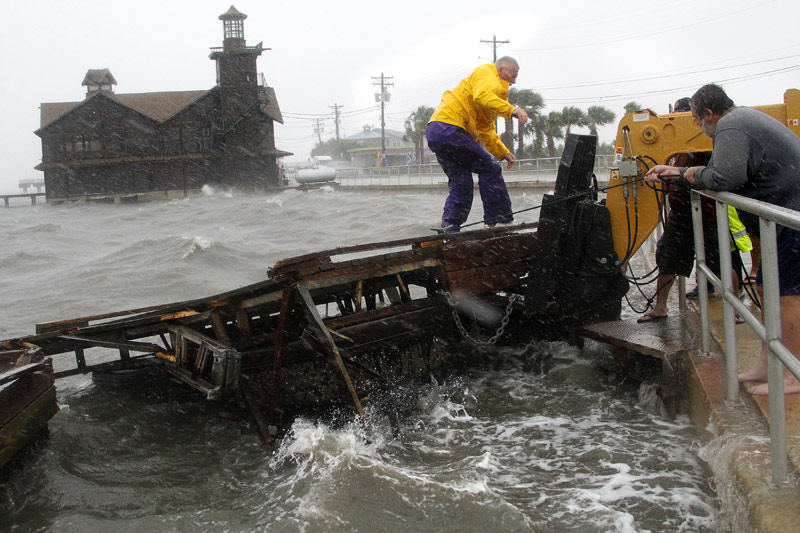
Photographers from The Gainesville (Fla.) Sun won two awards in the competition among newspapers with circulation up to 100,000, regional magazines and online publications. Doug Finger won the Sports Photography award for a shot of a Georgia Coach Mark Richt defending his injured football player to a referee by pointing to the player's bloody nose. Here's a photo gallery. The Breaking News Photography award goes to this photo by Brad McClenny, showing a fire chief trying to keep Tropical Storm Debby from sweeping part of the topwn's dock into the Gulf of Mexico.
The Sun also won the class's award for Informational Graphics for “Tragedy on I-75,” about a pileup on the interstate. Download a PDF here.

The domestic oil and gas boom was the topic of two awards. “The Ugly Side of the U.S. Oil and Gas Boom,” by Brian Hansen of Platts, wins the award for Public Service in Newsletter Journalism. A new award, for Specialized Journalism Site, goes to "Black Gold Boom: How Oil Changed North Dakota." The site is here.

In broadcasting among medium and small markets (smaller that 50th largest), the award for Investigative Reporting goes to Jordan Williams, Israel Alfaro and Jenny Martinez of KRGV-TV in Texas' Rio Grande Valley for “Got Guardrails?” a scam that may have cost taxpayers hundreds of thousands of dollars; the Public Service award goes to “Newtok: Village on the Edge,” by Rhonda McBride and Eric Sowl of KTUU-TV in Anchorage (watch at Link 1 | 2 | 3 | 4 | 5); and the Feature Reporting award goes to Eric Hanson and Glen Biermann of KCCI-TV in Des Moines for “Who Are Those Guys?”, a story about a group of fraternity brothers who show up randomly at sports contests to cheer on the team that they think needs their support. To watch it, click here.

The Documentary award for small radio markets (No. 101 and above) goes to Pat Duggins, Ryan Vasquez, Maggie Martin and Stan Ingold of Alabama Public Radio for “Winds of Change,” about the Tuscaloosa tornadoes and their aftermath.

The SDX Awards will be presented Friday, June 21, at the National Press Club in Washington. A reception begins at 6 p.m., with the dinner and awards presentation beginning at 7 p.m. Dress is black-tie optional. The deadline for buying tickets is Friday, June 14. To order, click here.

Check of two states shows frackers often fail to file chemical reports on time

Is your state reporting chemicals used in hydraulic fracturing? Ten states -- Colorado, Oklahoma, Louisiana, Texas, North Dakota, Montana, Mississippi, Utah, Ohio and Pennsylvania -- are required to report the information to FracFocus, which makes it available to the public. But a look at Colorado and Pennsylvania by Mike Soraghan of Environment and Energy News revealed that more than 20 percent failed to report the information on time in 2012.

No fines were levied in Colorado or Pennsylvania, and the only state to have penalized a company was North Dakota, which fined a company $300,000 for a December incident, after the state found the firm hadn't filed with FraFocus, reports Soraghan. But finding out whether a company is late takes some groundwork, since FracFocus doesn't list the information on its website. That information is available from state agencies.

The reports are supposed to be filed within 60 days of a well's completion. Of the 684 reports filed in Pennsylvania between May 1 and Dec. 31 of last year, 24 percent were late, and of the 1,440 filings from April 1 to Dec. 31 in Colorado, 21 percent were late, reports Soraghan. Earthworks environmentalist and lawyer Bruce Baizel told Soraghan, "That's lousy. You're not enforcing. If you stood up and said, 'We think this regulation will get 80 percent compliance,' the commissioners would laugh at you."

Soraghan notes that Harvard Law School's Environmental Law and Policy Program said states shouldn't use FracFocus because it "fails as a regulatory compliance tool." (Read more) Still, it can be a good tool for journalists; Soraghan advises that the data are available on Excel spreadsheets from state agencies.

Farmers are using subsidies meant to conserve water to use even more water

The U.S. government has given billions of dollars in subsidies to help farmers buy better irrigation systems to conserve water. But new studies show many farmers are misusing the money, and are using even more water, reports Ron Nixon of The New York Times. (NYT photo by Matthew Staver: A center-pivot sprinkler in Kansas)

Since 1997, the government has given about $4.2 billion in conservation subsidy payments to landowners, with $1 billion used to help agricultural producers increase the efficiency of irrigation, reports Nixon. Studies by the University of California, Davis and New Mexico State University found that farmers in Kansas, New Mexico, and Colorado "who received payments under the conservation subsidy were using some of their water savings to expand irrigation or grow thirstier crops, not to reduce consumption," Nixon notes.

Craig Cox, a senior vice president of the Environmental Working Group, told Nixon, “Given that we just had the worst drought in the last 50 years, lawmakers need to really look at this program and how it’s having the opposite effect of what was intended." (Read more)

Diminishing groundwater has been a problem in many states, with 40 aquifers seriously depleted of water. The problem has been especially bad in west-central Kansas, where up to a fifth of the irrigated farmland along a 100-mile swath of the aquifer has already gone dry, and in Northwest Kansas, where a 100-mile zone has been labeled as high priority.

Purdue Pharma to pay Kentucky county $4 million in Oxycontin case

Officials of Pike County, Kentucky, announced this week that Purdue Pharma, the maker of OxyContin, will pay $4 million to settle the county's part of a lawsuit the county and state filed in 2007 seeking damages for the addiction OxyContin caused "after the company aggressively marketed it to doctors as a safe option for pain relief," Russ Cassady reports for the Appalachian News-Express in Pikeville.

The state remains a plaintiff in the suit, which  is largely based on admissions of guilt made by the company and several top-ranking company officials in a May 2007 Virginia federal court settlement. Purdue Pharma, its president, chief legal counsel and former medical director pleaded guilty to misleading doctors, regulators and patients about OxyContin during that case.

The nation's prescription-drug epidemic apparently began in Central Appalachia, largely because of the introduction and high rate of prescription of OxyContin. The lawsuit sought reimbursement for drug-abuse programs, law-enforcement actions and prescription payments through Medicaid and the Kentucky Pharmaceutical Alliance Program. The local officials indicated the settlement could increase the size of a planned rehabilitation facility for people convicted of drug charges.

New York Mississippi Picnic goes country

The annual New York Mississippi Picnic was started 34 years ago in part to help transplanted Magnolia Staters find common ground with folks in the Big Apple, and that has often meant highlighting their mutual appreciation for blues music and jazz. This year, though, the picnic is giving center stage to country musicians. The free event begins at noon Saturday in Central Park. (Rock and Roll Hall of Fame photo: Jimmie Rodgers was the first country musician elected to the hall of fame)

The event was started in 1979 by a group of Mississippi natives living in New York who wanted to improve the perceptions of the regions to people from both. This year's theme is Mississippi Legends and Trails. Featured on stage this year will be a tribute to country legend Jimmie Rodgers, as well as a performance by Mississippi native Liz Davis, left, who competed on NBC's "The Voice."

There will be other Mississippi-themed offerings, including food, authors, college recruiters, and exhibits on the Jimmie Rodgers Foundation, the Mississippi Freedom Trail, Mississippi's literary heritage, and the U. S. Grant Association. For a full list of events click here.

Technologically enhanced glasses let users browse web, record images -- and commit journalism?

The Columbia Missourian has a story in its From Readers section from a journalist who is getting the opportunity to experiment with the new wave of technology that could change the future of reporting. Blogger Sarah Hill wrote about using Google Glass -- glasses that can record images and videos, and can surf the Internet with simple voice commands. (Photo: Hill wearing Google Glass)

Hill used Google's Hangout to converse with a group of blind veterans who are learning to make relay calls. "I hopped into their training session to say hello," writes Hill. "The former radio operators who are World War II veterans were fascinated with Glass and the ability to control a computer with your voice. Because of its voice integration, I could see Glass being helpful for individuals with sight impairments as it would allow them to control a computer hands free with their voices." (Read more)

Thursday, June 06, 2013

Losers on energy legislation and more, rural Colorado counties talk about creating a new state

Update July 10: "Fervor for a plan to carve northeastern Colorado into a 51st state has been cooled by legal barriers and a lack of public support, but commissioners from rural counties say they're not done fighting for better representation of their citizens," Adrian Garcia reports for The Denver Post. Cheyenne, Kit Carson, Lincoln, Logan, Morgan, Phillips, Sedgwick, Washington, Weld and Yuma counties are now considering a proposal that would have representatives elected by county, rather than population. However, a 1962 Supreme Court ruling requires that the legislative districts across states be equal in population. (Read more)

"Rural Colorado county commissioners are pursuing a plan to splinter from the state and create a new one in the aftermath of a legislative session they say runs counter to their way of life," Patrick Malone writes for The Coloradoan in Fort Collins: "Laws passed this year in the Democrat-controlled Legislature enacting stricter gun control and impacting agriculture paired with attempts to expand regulation of oil and gas production to provide the tipping point," according to Commissioner Sean Conway of Weld County (the westernmost county on the map; for a larger version of the map, click on it).

The new state would be called North Colorado but would comprise counties in the northeastern part of the state, the county's commissioners announced today, reports Analisa Romano of the Greeley Tribune. "Commissioners said Morgan, Logan, Sedgwick, Phillips, Washington, Yuma and Kit Carson counties all expressed interest in the idea." Those counties and Weld are colored on the map.

There could be more. "At the annual meeting of Colorado Counties Inc. this week, commissioners from up to 10 rural counties met formally for the first time to discuss moving ahead with the plan," Malone reports. "Any move to split from the state would involve votes in each county that seeks to be a part of the split, most likely referred by the boards of commissioners. If passed, the plan would require the approval of the Legislature and the governor to petition Congress to create a new state." (Read more)

Energy issues were "the straws that broke the camel's back," Romano quotes the commissioners as saying. In addition to more oil and gas regulation, the Legislature also voted to require rural electric cooperatives to get 20 percent of their power from renewable sources. The requirement is now 10 percent, and the co-ops are generally more dependent on coal than other utilities. "The bill, SB 252, was one of the most hotly contested of the legislative session, pitting environmental groups and renewable-energy companies against rural cooperatives and Republican lawmakers," Mark Jaffe of The Denver Post reports.

Study finds that rural cancer survivors lead less healthy lives than their urban counterparts

A quarter of rural cancer survivors smoke.
Cancer survivors from rural areas live less healthier lives than survivors from urban areas. That's the diagnosis of a study by the Wake Forest Baptist Medical Center in Winston-Salem, N.C., which asked a random sample of rural and urban survivors their body weight, and if they smoked, drank alcohol, and exercised.

The study found that 25 percent of rural cancer survivors smoked, compared to 16 percent from urban areas. It didn't have state-by-state figures, but Kentucky has high rates of both cancer and smoking.

Fifty-one percent of rural survivors didn't participate in any physical activities at all, compared to 39 percent for urban survivors, and 66 percent of rural survivors were obese, while 63 percent of urban ones were. Fewer rural survivors drank alcohol, a difference of 46 percent to 59 percent, and 18 percent of them were more likely to be unemployed because of health reasons, compared to 11 percent for urban survivors.

"Rural cancer survivors may not be receiving messages from their health-care providers about how important quitting smoking and being physical active are after cancer," said Kathryn E. Weaver, assistant professor of social sciences and health policy at Wake Forest Baptist. "It is concerning that we found higher rates of health-compromising behaviors among rural survivors, when we know cancer survivors who smoke, are overweight, or are inactive are at higher risk for poor outcomes, including cancer recurrence and second cancers." (Read more)

National Academy of Sciences says government should make wild horses infertile

The solution to America's rampant wild horse problem is sterilization, according to a recommendation by the National Academy of Sciences. Nearly 50,000 wild horses have been corralled, or put in pastures, costing taxpayers $75 million annually, notes Sean Cockerman of McClatchy Newspapers. More than half of that pays for holding facilities. (Fort Worth Star-Telegram photo by Rodger Mallison: Wild horses at an adoption auction)

The report said that by rounding up the horses the Interior Department’s Bureau of Land Management is worsening the problem, because there are now fewer horses on the range, which means less competition for food and water, and a greater possibility of increased growth, reports Cockerman. The wild horse population is growing as much as 20 percent a year. (Read more)

Read more here: http://www.mcclatchydc.com/2013/06/05/193109/science-panel-feds-making-wild.html#storylink=c(Read more)

An overabundance of wild horses led the Yakima Nation Native American tribe in Washington to ask President Obama to lift the ban on slaughterhouses. In December, Interior Secretary Ken Salazar said he would tighten rules on wild-horse sales because many of the horses were being sold for slaughter.

Read more here: http://www.mcclatchydc.com/2013/06/05/193109/science-panel-feds-making-wild.html#storylink=cpy

Weekly newspaper editors' group seeks to recognize local political cartoonists

Does your weekly newspaper have a local political cartoonist that you would like to see receive national recognition? If so, then you might want to recommend that person to be mentioned in the July newsletter of the International Society of of Weekly Newspaper Editors.

Marcia Martinek, editor of the Herald Democrat in Leadville, Colo., is seeking examples of local political cartoons. She wants to know how papers found local cartoonists, where their ideas come from, how they have been received by readers, an example of a cartoon that was especially effective, and if possible, what they are paid. Martinek can be reached at editor@leadvilleherald.com.

One example is a cartoon by Jim Turley of the weekly North Scott Press in Eldridge, Iowa, near the Quad Cities. Turley, who has worked for the paper for 15 years, drew this cartoon poking fun at a recent run-in local reporter Jeff Montgomery had with the school board, after the board publicly criticized the paper and Montgomery's coverage during a meeting. The North Scott Press is available by subscription only, but the web page can be viewed here.

Wednesday, June 05, 2013

Rural county's 'Arts and Ag Tour' is a hit, and the local paper covers it like the dew covers Dixie

Last year, a woman who moved from Atlanta to rural Hickman County, Tennessee, about 50 miles west of Nashville, had an idea: Set up an annual Arts and Ag tour to promote the county's many artists, artisans, crafters, musicians and specialty-crop farmers. The first one went well, and the second "was a rousing success, both for attracting visitors from in and out of the area and for vendors who offered local products for sale," reports Editor Brad Martin in the weekly Hickman County Times.

The weekly paper went all-out to cover the event, scattering its photo and text coverage over 10 pages. The paper is not online, but you can see its Arts and Ag pages in an 8mb PDF on the Institute for Rural Journalism and Community Issues site, here. (For a larger version of this front-page centerpiece, click on it.)

"This is a classically rural event, because its underlying theme is people," Martin told the Institute in an email. "You can't punch your ticket at all 25 stops no matter how hard you try, because you will find something fascinating along the way and someone just as fascinating to tell you about it, be it beekeeping or bread-making, and you'll spend an hour without trying."

Politics of the next election push immigration debate to the right; it may be headed for the ditch

"I heard a lot of optimism from both sides on immigration reform. I’m hearing less lately, from either side," Ezra Klein writes on his Wonkblog for The Washington Post. "House Republicans tell me to expect a lengthy, ugly process that ends with something that is an immigration-reform bill, but that Democrats might not be willing to credit as being an immigration-reform bill."

Several Republican leaders have said immigration reform is a must for the party to appeal to Hispanics, but the politics of passing a bill are usually individual, not collective. "Republicans who will lose if immigration reform fails are future Republicans," or future GOP candidates, Klein writes. "The ones who will lose in primaries if a moderate immigration bill passes are current Republicans. And it’s current Republicans who have to vote on this bill."

Klein says the public agrees with conservative Republicans' strategy of insisting on strict, provable border enforcement before the reforms can take effect: "The poison pills that Republicans could add to the bill — like 100 percent operational control of the border — sound good to most Americans. Republicans believe they can sell these arguments in the next election."
 
Klein concludes, "The Democratic theory has long been to pass a bill they like in the Senate, expect a bill they don’t like from the House, and then use the conference committee to jam House Republicans on the premise that House Republicans know they can’t kill immigration reform," Klein and Soltas write. "But now Senate Republicans are organizing to give Democrats a bill they don’t like in the Senate, a bill they absolutely hate in the House, and if this kills immigration reform, well, plenty of their members would be just fine with that." (Read more)

Senate could vote on Farm Bill by end of week; Democrats say bill is key to keeping their majority

UPDATE, June 6: The cloture vote was 75-22, showing a strong consensus to get a bill passed and put pressure on the House to pass its own bill and work out a final version in a conference committee. "A bloody fight lies ahead in the House, scheduled to take up its bill the week of June 17. But having blocked floor action last year, Speaker John Boehner will find it harder to justify more stalling after the bipartisan showing in the Senate," David Rogers of Politico reports.
The Senate could pass its version of the Farm Bill by Monday, since a cloture motion was filed Tuesday by Majority Leader Harry Reid. If Thursday's roll call receives the required 60 votes to limit debate, the number of pending amendments would drop from more than 100 to only a handful, leading to a vote by the end of this week or early next week, reports Derrick Cain for Agri-Pulse, a Washington newsletter.

On the cloture vote, Agriculture Committee leaders need "a strong showing to clear the way for passage Monday and begin to heal the breach sparked by revisions in the commodity title" and "bad blood" in a tussle over amendments, David Rogers reports for Politico. The big test for committee Chairman Debbie Stabelow, D-Mich., "may be the regional and ideological divide, which cost her precious Southern votes last June and now, could mean the loss of well-placed allies from the Midwest. . . . Behind this split is a decade of change in which net farm income in the Midwest had increased much faster than the national average while income for the Southeast and Southern Plains has trailed behind — or even declined."

Stabenow and ranking member Thad Cochran R-Miss., are trying to make both regions happy by keeping the big shift to crop insurance (Agricultural Risk Coverage) that was in last year's Senate bill, which died in the House, while adding "a modest $3.4 billion “adverse market” countercyclical program including target prices for rice and peanuts," Rogers writes. "Agriculture Department Chief Economist Joseph Glauber told Politico that the chances are low that ARC or the adverse-market program will violate limits set by the World Trade Organization. But this hasn’t cooled the rhetoric from Midwest Republicans, who have been predicting trade wars overseas and planting distortions at home," sounding alarms about the WTO.

Midwest Republicans may also have taken note that some Senate Democrats believe the Farm Bill holds the key to the 2014 election, especially among rural voters in mostly conservative states, reports Alexander Bolton for The Hill. Democrats hold a majority in the Senate, but could lose that position if voters in Montana, South Dakota, Arkansas, North Carolina, Alaska, Louisiana, New Hampshire and West Virginia elect Republicans next year.

“There’s probably no piece of legislation that’s more important to rural America than the Farm Bill," Stabenow said. "More than 16 million Americans have jobs because of agriculture and many of those jobs are found in rural communities. The Farm Bill is a game changer for rural communities and it’s one of the many reasons why passing a five-year bill is so critical.” (Read more)

Geotourism is drawing millions to rural areas

An exciting new form of tourism, that mostly takes place in rural areas, is quickly spreading across the nation, drawing millions of people to tourist destinations across the U.S. The move is aimed at geotravelers -- which the Billings Gazette defines as people who focus on the cultural, social and educational aspects of travel, placing a premium on authentic experiences in unique places. (Montana Tourism photo: Geotourists use stand-up paddleboards in Yankee Jim Canyon)

There are 55 million American geotourists, which is half the traveling public, according to National Geographic magazine: "These travelers have ceaseless expectations for unique and culturally authentic travel experiences that protect and preserve the ecological and cultural environment. These groups are different, but all are affluent, travel frequently, and have strong geotourism inclinations."

The move to market geotourism in in Montana, Idaho and Wyoming began when the states teamed up with the Center for Sustainable Destinations at National Geographic "to marketing their spectacular natural settings, unique experiences and authentic rural communities," Ruffin Prevost reports for the Gazette. National Geographic has also been working with states to create map guides, that local journalists can use to highlight geotourism in their areas.

Jeri Duran, head of the Montana Office of Tourism, said geotravelers are an attractive demographic, because they are typically well educated, have high incomes and spend a disproportionate amount of their incomes on travel, reports Prevost. Duran said, “Travel defines them. They are frequent leisure travelers, taking trips an average of three times per year.” (Read more)

Students at Berea College tour Appalachia, home to most of them, to better understand it

Berea College, a small school just outside the East Kentucky Coalfield, is unique in that all students are from low-income families, get free admission and must work on campus. They also are expected to be involved in community activities, such as helping the needy, educating people on social issues, or being a part of the thriving art community in the town of 14,000. (AP photo)

Most Berea students come from Appalachia, but the school wants them and the faculty to better understand the region, so every summer faculty and staff take a bus tour through Eastern Kentucky, Southwest Virginia, West Virginia and East Tennessee -- a five day trip preceded by a two-day seminar, reports Peter Slavin for The Atlantic. He went on last summer's tour.

"We stopped at small towns (two struggling, one thriving), a historic settlement school in the mountains, a family homeplace, two churches (one white fundamentalist, one African-American), a famous media and education center called Appalshop[in Whitesburg, Ky.], and a museum to a historic civil-rights struggle in Clinton, Tenn. We visited a historic log cabin belonging to Frontier Nursing University, heir of the renowned Frontier Nursing Service, which once sent nurses on horseback into the hollows. We spent an evening at the legendary Highlander Research and Education Center, which played a key role in advancing the Southern labor and civil-rights movements." The bus was supposed to see a mountaintop-removal coal mine, but company trucks blocked the way, Slavin reports.

"It's not a poverty tour through the glass of an air-conditioned coach," says Chad Berry, Berea's academic vice president and dean of faculty. "I'm trying to challenge people's preconceptions about arguably the most misunderstood region in United States." (Read more)

Tuesday, June 04, 2013

Will D. Campbell, white preacher from the rural South who campaigned for civil rights, dies at 88

The Rev. Will D. Campbell, one of the few rural Southern white leaders in the civil rights movement, died Monday night in Nashville. He was 88 and suffered from complications of a May 2011 stroke. "Campbell was a significant voice for integration ... while at the same time ministering to those who were against it," notes The Tennessean. One of his more famous quotes was, "Jesus died for the bigots as well." (Tennessean image)

The native of rural Mississippi "was a civil rights advocate who drank whiskey with Klansmen, a writer who layered fact and fiction, and a preacher without a church who presided at weddings, baptisms and funerals in homes, hospitals and graveyards for a flock of like-minded rebels that included Johnny Cash, Willie Nelson, Dick Gregory, Jules Feiffer and Studs Terkel," Robert McFadden writes for The New York Times. "Most of his scattered 'congregation,' however, were poor whites and blacks, plain people alienated from mainstream Christianity and wary of institutions, churches and governments that stood for progress but that in their view achieved little."

Campbell was the only white person the Rev. Dr. Martin Luther King Jr. invited to the meeting that organized the Southern Christian Leadership Conference in 1957, McFadden notes. The same year, he helped black students defy angry crowds to integrate Little Rock Central High School. "In 1961, he counseled and accompanied 'freedom riders' of the Congress of Racial Equality and the Student Nonviolent Coordinating Committee who integrated interstate bus travel at the cost of beatings by white mobs in Anniston, Birmingham and Montgomery, Ala."

"He was just a do-gooder," former Tennessean editor and publisher John Seigenthaler recalled in a video for the Nashville newspaper. "Wherever he saw a problem, he'd go and he'd try to do good, and there were a lot of places for him to go." He was such a high-profile figure in the South that he was "the model for the Rev. Will B. Dunn (above), the bombastic preacher with the broad-brimmed clerical hat in 'Kudzu,' Doug Marlette’s syndicated comic strip about rural Southerners," McFadden reports.

"His belief that Christ died for bigots as well as devout people prompted his contacts with the Ku Klux Klan, and he visited James Earl Ray in prison after the 1968 assassination of Mr. Campbell’s friend Dr. King," McFadden writes. "He was widely criticized for both actions. In later years, Mr. Campbell campaigned for equal rights for women, gays and lesbians." (Read more)

John Lewis, an organizer of SNCC and now a congressman from Georgia, says in the video, "Will understood early that we were all in the same boat, that we were all victims, we were all sinners."

Big chains continue to buy small, rural hospitals; some fear patients' costs will increase

Over the past year, there have been more than 100 hospital mergers and acquisitions, with bigger corporations buying smaller, mostly rural hospitals, reports Sarah Kliff for The Washington Post. The trend is driven in part by health-care reform. Some fear the trend will increase costs for patients, with the hospitals banding together to demand higher prices from health insurers, while others say consolidation has the potential to decrease costs, or can at least improve services.

A 2012 study by Martin Gaynor and Robert Town, funded by the Robert Wood Johnson Foundation, concluded that “Hospital consolidation generally results in higher prices,” reports Kliff. “This is true across geographic markets and different data sources. When hospitals merge in already concentrated markets, the price increase can be dramatic, often exceeding 20 percent.”

Advocates for consolidation say that even if prices increase, services will be much better, reports Kliff. For example, a hospital system could purchase an "electronic health records system to serve all its member facilities that a small, rural hospital couldn’t afford on its own." Plus, with patient volume increasing, hospitals would have an easier time hiring specialists.

Community newspaper provides excellent coverage of nationally significant disaster

Employees at a daily newspaper in northwest Washington are showing the true spirit of a community paper, working long hours to keep residents in the Mt. Vernon area up to speed on a local disaster -- a section of the Interstate 5 bridge over the Skagit River collapsed -- that has affected everyone who lives and works nearby. (Herald photo by Frank Varga)

The Skagit Valley Herald has done a tremendous job reporting about the incident, seemingly providing readers with everything they might want or need to know, including in-depth news stories, first-person accounts, human interest stories, information on detours around the bridge, what the local government is doing to restore order, costs to restore the bridge, and plenty of photos. To cover the event, hourly employees put in 55 hours of overtime in four days, editor Colette Weeks told Jim Romensko for his news-media blog. As a result of the increased coverage, circulation went up 170 percent the day after the tragedy, and website traffic was up 844 percent. (Read more)

(Varga photo: Man awaits rescue)
No one died in the collapse of the 1,111-foot-long bridge between Burlington and Mount Vernon, though two vehicles were thrown into the water and three people had to be rescued. It it expected to cost about $15 million to fix the bridge, and the federal government has promised $1 million to help, the Herald reports. To read stories and view photos of the Herald's coverage, click here.

Study: Corn syrup, other honey substitutes may have played role in decline of honeybees

While some have blamed pesticides known as neonicotinoids for the decline in population in bees, a new study says that beekeepers' use of corn syrup and other honey substitutes to feed bees may have weakened their immune systems, and played a role in the loss of more than 30 percent of honeybee colonies over the winter, reports Richard Valdmanis for Reuters. (Huffington Post photo)

Bees normally eat their own honey, which contains compounds like p-coumaric acid that appear to help detoxify and strengthen a bee's immunity to disease. The study by scientists at the University of Illinois says, "The widespread apicultural use of honey substitutes, including high-fructose corn syrup, may thus compromise the ability of honey bees to cope with pesticides and pathogens and contribute to colony losses." (Read more)

Public to vote on $53 billion plan to increase Texas' water reserves

Lawmakers in Texas have come up with a proposal they hope can fix the state's dwindling groundwater supply. The plan, which still needs to be approved by voters, calls for $53 billion in infrastructure upgrades that include construction of 20 reservoirs, reports Jim Malewitz for Stateline. At its current pace, Texas is expected to lose 10 percent of its water reserves in the next 50 years, while the population is expected to increase by 80 percent. (AP photo: Dead fish near the banks of Lake Wichita near Wichita Falls)

The problem is that many Texans don't view the dwindling water supply as a top priority in the state, reports Malewitz. "In 2011, Texas’ driest year on record, voters narrowly approved a ballot allowing state water planners to issue $6 billion in extra bonds to fund water projects including fixing pipes and constructing treatment plants. But they voted down a proposition that would have lowered taxes for landowners who practice water conservation techniques." (Read more)

Oregon lawmaker wants state to move road-kill carcasses to wolf country

Lawmakers in Oregon are considering a bill that would require state transportation workers to move roadkill from the side of the road to wolf country, a move intended to protect ranchers from having wolves on their property endangering their livestock, and to protect wolves from being killed by the ranchers, reports Mitch Lies for Capital Press.

The bill was introduced by Rep. Bob Jenson, R-Pendleton, who said that because the Department of Transportation was leaving animal carcasses to rot near where cattle and sheep graze, ranchers' efforts at wolf control were being undermined, reports Lies. Jenson said, "The net effect is ODOT is doing what ranchers are prohibited from doing, which is, in a sense, baiting wolves." (Read more)

Monday, June 03, 2013

Search for higher quality of life draws professionals in their 30s and 40s to rural communities

Much has been reported about the declining population in rural counties and certain states, especially among educated young people, part of a rural "brain drain." But Ben Winchester, a rural sociologist at the University of Minnesota, told Jo Dee Black of the Great Falls Tribune that one in five Americans in their 30s and 40s live in rural areas, higher than the overall rural population of 16 percent. (Tribune photo by Tim Goesmann: The Bucklin family moved from Las Vegas to Montana)

Winchester dubs this movement the "Brain Gain," because it consists mostly of young professionals who are moving to rural areas to raise families. He says that 36 percent of people moving to rural communities have never lived in one before. Half of Montana's counties had an increase in residents between 30 to 34 years old between 2000 to 2010, reports Black. Some rural counties had growth increases as large as 25 percent. (Read more)

Ky. cable-news outfit looks at America's poorest county, and changes residents hope to make

Owsley County, Kentucky, is consistently ranked as one of the poorest counties in the U.S. Trying to look beyond the numbers, and get to the heart of the county and its people, cn|2, a news service of the Insight cable television company, aired a multi-part series examining the challenges the county is facing, and the ways in which residents are trying to improve the quality of life in the area.

Of the 4,722 people living in the county, more than 39 percent live below the federal poverty line, and the average median household income is $19,344, less than half the average of the rest of the state, Don Weber reports. Seventeen percent of U.S. citizens receive government support, but the number is about three times as high in Owsley County, where 53 percent receive government benefits.

Poverty, substandard housing, lack of education, drug addiction and hunger are serious hurdles for people in a county labeled by the U.S. census as the poorest in the country, cn|2 reports. But many Owsley County residents are trying to make a difference.

Weber reports on a woman who was born and raised in the county, but returned after retirement to fight hunger first hand. In another story, cn|2 looked at one organization trying to create a better environment for residents in the county. In the final story, Weber took a look at a critical area in the future of the county, young people. In an area where only 56 percent of adults have a high school diploma, Weber reports on what the schools are doing to change the culture and improve student interest and performance.

Website offers useful, local data on foreclosures, sales and other real-estate information

RealtyTrac can be a good source for looking up local, state and national information on real estate and foreclosures. Its data gathering has been reported to be slow or spotty in some places, and some communities are not tracked, so journalists should check with their local, on-the-ground sources for corroboration and perspective. Still, the site offers a great deal of useful information, just by entering a ZIP code. To visit the site click here. Here's one of their latest charts.

Lawmakers who cite Bible to back food-stamp cuts have received millions in farm subsidies, critics note

Doug LaMalfa
U.S. Reps. Stephen Fincher (R-Tenn.) and Doug LaMalfa (R-Calif.) are under fire for citing the Bible to support cuts to food assistance programs after accepting millions of dollars in farm subsidies, another part of the Farm Bill.

The pair say that while Christians have a responsibility to feed the poor, the federal government does not, reports Arthur Delaney for the Huffington Post. Last year LaMalfa received $188,570 in farm subsidies and Fincher $70,574. Since 1995, LaMalfa has received more than $5 million, and Fincher more than $3 million, according to the Environmental Working Group.

Stephen Fincher
In quoting the Bible in defense of cuts, Fincher said, "If anyone is not willing to work, then he is not to eat, either," and LaMalfa said, "By grace you have been saved through faith; and that not of yourselves, it is the gift of God; not as a result of works, so that no one may boast,"  Delaney and Jaweed Kaleen report.

House Agriculture Committee Chairman Frank Lucas (R-Okla.) defended LaMalfa and Fincher, saying that are not hypocrites, reports Erik Wasson for The Hill: "Lucas argues that the Farm Bill stops abuse of the food stamp program by closing loopholes like one that allows states to give recipients phony heating aid so they can get food stamps when they would not otherwise qualify."

The House bill cuts $40 billion from farm and nutrition programs over the next 10 years, with $20.5 billion coming from the Supplemental Nutrition Assistance Program, commonly known as food stamps, The Senate voted to cut $23 billion overall, and $4.1 billion from SNAP, Ron Nixon of The New York Times reports

Real estate blogger names top 10 redneck cities

Oklahoma City is No. 3 on the list of redneck cities.
While some rural residents get labeled "rednecks" for their interests, looks, language and behavior, one writer says they can live anywhere and has come up with a way to determine which cities are the most redneck.

Natalie Grigson, writing for the real estate blog Movato, looked at eight key factors: Percent of population that didn’t complete high school; number of NASCAR race tracks close by; and the number per capita of Walmarts, gun and ammunition stores, taxidermists, cowboy-boot stores, country-music radio stations and repair shops for riding lawn mowers and tractors.

The formula labeled Atlanta as the most redneck U.S. city. Second was Kansas City, Mo., followed by Oklahoma City, Nashville, Tulsa, Fort Worth, Arlington, Tex. (between Fort Worth and Dallas), Sacramento, Cleveland, and Mesa, Ariz. (Read more) Cleveland? "That wouldn't have happened if Grigson had included race and voting patterns such as the McCain Belt, that swath of counties from Oklahoma to Pennsylvania that voted more strongly for John McCain in 2008 than George W. Bush in 2004," said Al Cross, director of the Institute for Rural Journalism and Community Issues, which publishes The Rural Blog.

EPA extends comment period on huge Alaska mine

The Environmental Protection Agency has extended until June 30 the comment period on the environmental impact of a proposed Alaska gold and copper mine that would be the largest mine in North America and, according to EPA's preliminary assessment, "probably cause the loss of between 54 and 89 miles of streams and between four and seven square miles of wetlands," Juliet Eilperin reports for The Washington Post.

The decision on the fate of the proposed Pebble Mine "may be one of the most important environmental decisions of President Obama's second term -- yet few in the Lower 48 are even aware that the fight is happening," Eilperin writes. The Anchorage Daily News added the italicized phrase to its version. (New York Times map; click it for larger version)

The mine would be "in a remote area that is home to several Alaskan native tribes and nearly half of the world’s sockeye salmon," and six Alaska Native tribes have asked EPA to block the mine on grounds it would "harm the region’s waterways, fish and wildlife," Eiperin writes. "Environmentalists argue that the Bristol Bay project poses a serious threat to the area’s delicate ecosystem and to the local fishing industry. Fishing businesses and tribal leaders, who have often quarreled, have banded together to oppose it. . . . The two mining firms behind the project, Northern Dynasty and Anglo American, have struck back with a major lobbying and public-relations campaign aimed at derailing any EPA intervention." (Read more)
"

Read more here: http://www.adn.com/2013/06/02/2924724/pebble-project-making-noise-nationally.html#storylink=cpy