Wednesday, December 08, 2021

Non-profit helps Black entrepreneurs in Mississippi Delta

Tim Lampkin (NPR photo by Kirk Siegler)
"The mostly rural Mississippi Delta has long been synonymous with racial and economic inequality. Yet today there are a growing number of small, economic bright spots, due in part to a grassroots effort that's trying to right some of the wrongs of the past," Kirk Siegler reports for NPR.

Though the Delta's population is mostly Black, relatively few Blacks own businesses, especially Black women. There are a number of reasons: distrust of banks, banks' reluctance to lend to Black entrepreneurs, lack of local role models and more, Siegler reports. But non-profits like Higher Purpose Co. are mentoring Black business owners, assisting with everything from securing grants and loans to navigating everyday operating issues.

Tim Lampkin, 35, founded Higher Purpose when he moved back to his hometown of Clarksdale after working in corporate America. He noticed that most local businesses were white-owned, even though more than 80% of the town's 15,000 residents are Black.

Ensuring that people of color can succeed as entrepreneurs is critical, according to Bill Bynum. He has worked to help Black entrepreneurs in the Delta since the 1990s, and has served as a White House economic advisor to Republicans and Democrats, including Joe Biden. "People of color are an emerging majority and if we leave the emerging majority of Americans on the outside of the economy, then we are really in for trouble," Bynum told Siegler.

Media executive gives up NYC high life to open sanctuary for donkeys, increasingly being killed for Chinese medicine

Ron King in 2016 (photo by Wesley Verhoeve) and hugging a friend at the donkey sanctuary (photo by Hugo Vazquez).

Ron King, 52, was once the senior vice president at Time and ran major magazines such as InStyle and Southern Living. But after 20 years as a media executive in New York City, he quit last year to open a sanctuary for donkeys, which are becomign scarce, Sydney Page reports for The Washington Post.

"I never thought about donkeys in my entire life," King told Page. But a TikTok video showing the animals being led to slaughter sent King down an internet rabbit hole, where he discovered that donkeys are much-maligned but intelligent animals often slaughtered for use in Chinese traditional medicines. The practice has so reduced the Chinese donkey population that American donkeys are often shipped to Mexico for slaughter and sale to China, reducing their numbers in the U.S.

Enter King's friend Phil Selway, an art dealer and philanthropist who had been meaning to turn his 75-acre property in Northern California, into a safe space for rescued animals, Page reports. When King pitched him on the idea of a donkey sanctuary, Selway jumped at the chance to fund its launch.

"They opened Oscar’s Place Adoption Center and Sanctuary — named after one of Selway’s beloved cats — in January 2020, and alongside Selway’s contributions, the organization relies on corporate sponsorships, grants, donations and volunteers to operate, Page reports. "The nonprofit cares for abandoned donkeys that would otherwise be slaughtered. It finds the animals at a livestock auction in Bowie, Texas — which is where one of the largest auctions is held, and it’s usually the final stop for most donkeys, given its proximity to the Mexico border. Oscar’s Place then rehabilitates the animals with the goal of ultimately finding them loving, forever homes." Oscar's Place collaborates with All Seated in a Barn, a non-profit that saves horses about to be shipped abroad for slaughter.

"Donkeys are being slaughtered for the sale of their skin, which is used in traditional Chinese medicine to treat anemia, insomnia and reproductive issues," Page reports. "The popular gelatin-based product is called ejiao, and according to the [Donkey Sanctuary] report, nearly 5 million donkey hides per year are needed to meet the surging demand. China’s donkey population — which is currently 2.68 million — has dwindled by a shocking 76 percent in the past three decades." Page's story says the U.S. population has dropped below 15,000, but that includes only wild donkeys and burros on federal land.

King now lives and works full-time at the sanctuary, which has rescued 77 donkeys and expects to receive another 50 in January. King told Page he has "never worked harder," but is committed to the cause and that being around them brings him joy: "I’ve never been happier in my whole life."

Most local hospitals are not complying with new laws requiring price transparency; how are yours doing?

More than 94% of hospitals surveyed in the Lehigh Valley of eastern Pennsylvania have not complied with a federal rule requiring transparency in pricing, even though the rule has been in effect for nearly a year. That's according to a nationwide survey of 500 hospitals by PatientRightsAdvocate.org and an investigation by The Morning Call in Allentown, Pennsylvania, Leif Greiss reports. The project provides an excellent template for replicating such an investigation in your area.

The rule, enacted under the authority of the Affordable Care Act, requires hospitals to post on their websites a list of standard charges for all services, as well as negotiated rates with insurers, among other things, Greiss reports. But two Lehigh Valley hospitals, for example, instead provide a price estimate tool on their patient portal apps, and users must provide personal information including their full name and insurance number to access those estimates. Users must fill out a request form and wait for a quote from the billing department if their insurer is not listed on the website. That could force them to wait for hours or days while suffering a medical issue, and the quote is still only an estimate.

"Cynthia Fisher, founder and chairperson of PatientRightsAdvocate.org, said unlike consumers in most other industries, patients have historically been left in the dark when it comes to the cost of care until after services are rendered, something that wouldn’t happen when booking a hotel or shopping at the grocery store," Greiss reports. "However, she said the point of the Hospital Price Transparency rule is to allow patients to know what they would pay ahead of time based on the hospital and insurance provider, opening a new door for competition among hospitals and insurance providers."

Monday, December 06, 2021

A county's vote for Trump is predictive of its Covid-19 vaccination rate, and more generally of its death rate

Screenshot of interactive plotter graphs shows how a higher vote for Donald Trump in 2020 correlates with a lower Covid-19 vaccination rate (left) and a higher Covid-19 death rate. In this example, Jackson County, Kentucky, which went 89% for Trump, follows trendlines created by the averages. For a larger image, click on it; for the interactive database, click here.

"Since May 2021, people living in counties that voted heavily for Donald Trump during the last presidential election have been nearly three times as likely to die from Covid-19 as those who live in areas that went for now-President Biden," Daniel Wood and Geoff Brumfiel report for NPR. 

Overall Covid-19 death rates were 2.7 times higher in counties where at least 60% of the votes went for Trump, and the higher the vote share for Trump, the higher the Covid death count. Recently, Covid-related deaths in the reddest counties were 5.5 times higher than the bluest counties, Wood and Brumfiel report. The data start in May since that's when vaccinations became widely available. 

"The trend was robust, even when controlling for age, which is the primary demographic risk," NPR reports. "The data also reveal a major contributing factor to the death-rate difference: The higher the vote share for Trump, the lower the vaccination rate. The analysis only looked at the geographic location of Covid-19 deaths. The exact political views of each person taken by the disease remains unknowable. But the strength of the association, combined with polling information about vaccination, strongly suggests that Republicans are being disproportionately affected."

Republicans are the largest demographic group of unvaccinated Americans, and Kaiser Family Foundation polling shows that they're highly likely to mistrust official information sources and be exposed to misinformation. Foundation Vice President Liz Hamel said political affiliation is now the strongest indicator of vaccination: "If I wanted to guess if somebody was vaccinated or not and I could only know one thing about them, I would probably ask what their party affiliation is."

"It was not always this way," NPR reports. "Earlier in the pandemic, many different groups expressed hesitancy toward getting vaccinated. African Americans, younger Americans and rural Americans all had significant portions of their demographic that resisted vaccination. But over time, the vaccination rates in those demographics have risen, while the rate of Republican vaccination . . . has flatlined at just 59%, according to the latest numbers from Kaiser . . . 91% of Democrats are vaccinated."

Less government aid and higher production costs to partially offset higher farm income in 2021, USDA predicts

USDA map shows regions used in forecasting farm income, To enlarge, click on it.

American farms will mostly make more income this year, but less government aid and higher production costs will eat into that, according to the Agriculture Department's Economic Research Service in its most recent Farm Income Forecast.

You can read the whole thing here, but below are some of the highlights:
  • Net farm income, a broad measure of profits, is estimated at $116.8 billion in 2021, its highest level since 2013.
  • In inflation-adjusted dollars, that's an $18.4 billion increase from 2020, or18.7%.
  • Net cash farm income, a more precise measure of profits, is forecast to increase by $12.6 billion, or 10.5%, in inflation adjusted dollars to $133 billion. That would mark its highest point since 2014.
  • The average net cash farm income is predicted to increase by $3,000, or 3.5%, to $89,100 per farm.
  • Projections for net cash farm income vary by region. Farms in the Heartland, Northern Great Plains, Prairie Gateway, Eastern Uplands, and Mississippi Portal are predicted to see net cash farm income increase, while farms in the Northern Crescent, Southern Seaboard, Basin and Range, and Fruitful Rim (some coastal and border states) are predicted to see a decrease.
  • Cash receipts from agricultural commodities sales are predicted to increase by $64.7 billion to $427.3 billion. That would drive most of the increase in both net income measures.
  • However, lower direct government aid and higher production expenses are expected to partially offset higher cash receipts (Spending on nearly all categories of expenses is expected to rise).
  • Direct government payments are predicted to fall by $18.5 billion, or 40.4%, to $27.2 billion.
  • Total production expenses, including farmers' housing expenses, are forecast to increase by $29.8 billion, or 8.3%, to $387.6 billion.
  • Farm assets are predicted to increase by 2.8% to $3.26 trillion in 2021, mostly because of increased real estate value. When adjusted for inflation farm assets and equity are projected to fall 1.0%. 
  • Farm debt is projected to decline by 0.8% in inflation-adjusted dollars.
  • Farms' debt-to-asset ratio is forecast to remain fairly steady at 13.91.
  • Farms' working capital, or money available for operating expenses after paying off debt, is predicted to increase 9.6% from 2020.
  • Total median farm household income is projected at $82,315, a 0.9% decline when adjusted for inflation.

Few Farm Service Agency and Rural Development state director positions filled; could hurt Biden's rural outreach

"The Biden administration has only appointed 22 state directors for the Agriculture Department’s Farm Service Agency and Rural Development branch, out of more than 100 open spots, a major delay compared to the Trump administration," Ximena Bustillo reports for Politico's Weekly Agriculture. "At this point in the Trump administration, nearly every state position was announced."

The jobs, which are political appointments that don't require Senate confirmation but do call for political consultation, are mostly being filled by acting directors, including in some of the nation's most rural states. Only nine states have both roles filled, Bustillo reports. The appointment process also went slowly during Agriculture Secretary Tom Vilsack's first term in the job, under Barack Obama in 2009.

"Some rural advocates consider the lack of appointees as a missed opportunity for the Biden administration to get people on the ground in each state, communicating changes and taking credit for Biden’s agenda," Bustillo reports. The appointees "play key leadership roles in making sure funds for programs such as rural broadband and other infrastructure projects get into local hands. That means the absence of state directors could hamper Democrats’ ability to claim credit in rural areas for their biggest policy achievements, like the $1.2 trillion infrastructure package Biden signed last month."

USDA is dealing with lower staffing levels overall, which Vilsack has blamed on Trump administration hiring freezes and funding cuts, Bustillo reports.

Webinar Thursday, Dec. 9, to discuss USDA's 'America's Diverse Family Farms' report to be released that day

The U.S. Agriculture Department's Economic Research Service will host a free, hour-long webinar at 4 p.m. ET Thursday, Dec. 9, to discuss the findings in its "America's Diverse Family Farms: 2021 Edition" report. The report is to be published earlier that day.

Agricultural economist Christine Witt will host the webinar. From the website: "This year's edition explores farm operating expenses, pandemic-related changes in direct sales, pandemic-related household unemployment, and the distribution of USDA and non-USDA pandemic assistance farms received in 2020." Click here to read the 2020 edition of the report, and click here to register for the webinar or for more information.

Sunday, December 05, 2021

Robert J. Dole, whose small-town roots and virtues were central to his politics, dies at 98

Bob Dole (Photo: David Ake, AFP/Getty)
Bob Dole, a son of small-town Kansas who dominated the Senate for a decade and was the 1996 Republican nominee for vice president and president 20 years apart, died Sunday morning. He was 98.

Robert J. Dole was born in Russell, a county-seat town in the heart of the state. It had about 2,000 people at the time, grew to 6,500 by the time he was elected to the state House in 1950 and now has 4,400. The story of his upbringing there, and the town's efforts to help him recover from the nearly fatal injuries he suffered in World War II, were central to the narrative of his political career.

"Russell was a speck on the flat Kansas prairie, but in the Dole biography it took on mythic significance. In his political campaigns, Russell was cast as the shaper of noble, small-town virtues and Mr. Dole as their personification," writes Katharine Q. Seelye of The New York Times.

"Remembering that period, and the generosity of his neighbors, often brought him to tears. In his first appearance with President Ford in Russell in 1976, with 10,000 well-wishers crammed into the downtown business district, he thanked the townspeople for their support after the war. Then he started to cry and couldn’t go on. The audience fell silent. Finally, Mr. Ford stood and began clapping, and the audience joined in. Regaining his composure, Mr. Dole said: 'That was a long time ago.' And yet even in 1996, long after Russell and his recovery had become a staple of his origin story, he could hardly mention that period without choking up."

"Bob’s lifetime of service was rooted in a simple mission: looking out for his neighbors," Senate Republican Leader Mitch McConnell said in a press release. "His Dust Bowl roots fueled a special commitment to vulnerable Americans, and sure enough, Bob’s work on food security, veterans’ issues, and the rights of disabled Americans have continued to have an especially lasting impact."

Dole also ran for president in 1988, winning the Iowa caucuses but losing to George H.W. Bush in New Hampshire after refusing to pledge not to raise taxes. "If he had won the nomination, he almost certainly would have won the White House because Americans then wanted something more like a third Ronald Reagan term than a first Michael Dukakis term," writes columnist George Will in The Washington Post. "Dole probably would have won that nomination if he had won New Hampshire’s primary. And he could have, if he had campaigned as what he really wasn’t — a fervent conservative."

Will adds, "Dole was never one of those puffed-up politicians who constantly act as though they are unveiling statues of themselves. He had a Midwestern cheerfulness — see Ronald Reagan, of Dixon, Ill. — about the United States’ possibilities, but his mordant, sometimes acidic wit fit a man with some grievances against life’s close calls."

"Though Mr. Dole had promised that he would return to his Russell roots if he lost the race, that didn’t happen," writes Gerald Seib of The Wall Street Journal. "He was far too much a fixture in the nation’s capital by then, both in his own right and as the spouse of former senator and Transportation Secretary Elizabeth Dole. So he became a high-powered member of Washington law firms, working for clients such as the government of Taiwan."

Friday, December 03, 2021

Rural LGBTQ youth least likely to feel accepted locally

Proportion of youth who described their community as
somewhat or very unaccepting of LGBTQ people
LGBTQ youth in rural areas and small towns were far more likely than their suburban or urban counterparts to say their community is somewhat or very unaccepting of LGBTQ people. That's according to a recent survey of nearly 35,000 such youth by The Trevor Project, a nonprofit suicide prevention and crisis intervention organization for lesbian, gay, bisexual, transgender, queer and questioning youth.

About 69 percent of rural youth surveyed said their community was not accepting of LGBTQ people, compared to 44% of those living in a small city or small town, 26% who live just outside a large city, and 19% who live in a large city, Kristi Eaton reports for The Daily Yonder.

The survey "also found that LGBTQ youth in rural areas and small towns had slightly greater odds of experiencing symptoms of depression, considering suicide, and attempting suicide compared to those in urban and suburban areas," Eaton reports.

LB Prevette told Eaton that she left Wilkes County, N.C., after being attacked at age 17. She said that the trouble isn't that most people don't accept LGBTQ people, but that the unaccepting people are the loudest.

Another young woman from the Hopi Nation noted to Eaton that Black, Indigenous and people of color who are LGBTQ often face even greater barriers to acceptance.

Study details how myths surrounding alcohol and addiction can hurt indigenous Americans

Photo from istockphoto.com
The many indigenous Americans who believe the myth that they are genetically predisposed to heavy drinking may crave alcohol more, drink more frequently, and suffer worse alcohol-related consequences than those who don’t believe the myth, according to a recent study that followed 141 Native American and Alaskan Native adults who who identified as having a substance use problem and had consumed alcohol in the previous 90 days.

The participants were interviewed and filled out questionnaires assessing their alcohol and substance use and its consequences, their craving, their confidence in their ability to moderate their drinking or drug use, and their belief that indigenous Americans are genetically predisposed to heavy drinking. The researchers then looked for associations between these factors, comparing indigenous participants who only used alcohol with those who used alcohol and hard drugs such as methamphetamine or opioids. The study was published in the peer-reviewed journal Alcoholism: Clinical & Experimental Research.

About 60 percent of participants expressed some belief in the myth that heavy drinking is in their genes. Among those who used alcohol only, believing the myth was associated with greater craving and more frequent drinking, which was in turn linked to worse alcohol-related consequences. Among those who used alcohol and hard drugs, belief in the myth was associated with fewer drinking days. But these participants were also less confident in their ability to self-moderate their substance use. They also reported craving substances more and experienced worse substance use consequences, suggesting that any potentially positive effect of their belief was slight. 

For all participants, more frequent drinking was associated with lower self-efficacy, which is the belief that one can control one's behaviors. Belief in the myth was not associated with self-efficacy, however, perhaps because the adults’ perception of their ability to moderate their drinking was more influenced by other factors, such as personal struggles with alcohol.

The myth of a biogenetic “cause” could falsely imply that problematic drinking is predestined and incurable, contributing to worse outcomes. The association between this belief and drinking frequency was found in participants who used alcohol only, not in those who also used hard drugs. In both groups, however, belief in the myth was linked to craving, which can impair recovery. The researchers cautioned that the study does not reliably indicate the causes of substance use, and recommended that more research examine how shifting belief in this myth may affect alcohol-related outcomes.

Fertilizer washed from Midwestern fields slowly poisoning Gulf of Mexico; latest story uses Illinois county as example

Excess nitrogen fertilizer washing into the Mississippi River is slowly poisoning the Gulf of Mexico, Ignacio Calderon reports for USA Today and the Midwest Center for Investigative Reporting in the latest take on an old story.

The fertilizer fuels the growth of toxic algae blooms that suck the oxygen from the water and create massive dead zones. "The environmental devastation – increasing blooms and a consistently growing dead zone – has been well documented for decades," Calderon reports. "But changes in the way rain falls, as explained in a yearlong USA Today investigation, have set the stage for things to get much worse, many scientists now believe. The warming planet is bringing more precipitation overall, and more downpours in particular, to the same U.S. regions that grow a majority of America’s fertilizer-dependent crops."

Champaign County, Illinois
(Wikipedia map)
The investigation focused on Champaign County, Illinois, which sheds some of the most surplus nitrogen fertilizer in the nation. After analyzing spring precipitation and nitrogen levels in the nearby Spoon River between 2014 and 2020, "the analysis found that the kinds of extreme rainfall events made more common by a warming planet cause three times as much fertilizer runoff than other rain events and contribute to an outsized share of it in the waterways," Calderon reports.

Most of the nitrogen spikes in the river happened after a rainfall, and the three heaviest storms alone accounted for one-third of all the nitrogen measured in the seven-year period. "The findings mirror a larger study conducted by several researchers that found heavy rain across the Mississippi River Basin also contributed to one-third of the nitrogen flushed to the Gulf of Mexico. This heavy rain happens in just nine days per year.," Calderon reports.

Though the Gulf of Mexico dead zone is the best-known example, runoff-fueled algae blooms are happening in rivers and lakes all over the U.S. The algae not only hurt people and aquatic life, but also emit the greenhouse gas methane. The Environmental Protection Agency "recently found the emissions from blooms could increase 30% to 90% in the next century," Calderon reports. "It’s a devastating feedback loop. Algae blooms contribute to global warming, which increases rainfall [east of the Mississippi River], which then exacerbates fertilizer runoff."

Quick hits: S.C. journalist Woods dies; overdose survivors don't get anti-drug meds; rural ERs on par with urban

Kim Young Woods
Here's a roundup of stories with rural resonance; if you do or see similar work that should be shared on The Rural Blog, email heather.chapman@uky.edu.

Kim Young Woods, a longtime leader in South Carolina journalism, has died. As publisher of the Yorkville Enquirer and The Clover Herald, she made history as the first female African-American publisher in the South Carolina Press Association's nearly 170-year history. Read more here.

Female journalists are frequently harassed online, and the trend is getting worse. Read more here.

It's increasingly rare to find newspapers that operate old-school printing presses, and rarer still to see female press operators. But one Arkansas newspaper has a pressroom staffed entirely by three women. Read more here.

A leading horse veterinarian suggests that there may be a shortage of equine vets soon, and has some ideas on how to keep that from happening. Read more here.

A recent story in The Washington Post takes readers inside a rural Pennsylvania McDonald's crew and how they came to be part of the "Great Resignation." Read more here.

Privet hedges and Bradford pears are scourges upon the land, but ginkgo trees—a species as old as the dinosaurs—are still a pretty great choice for your yard.

Rural hospitals' emergency rooms are just as effective in treating patients as urban ERs, a study has found. Read more here.

A study has found that fewer than 8 percent of overdose survivors are given or prescribed drugs that can block overdose and help them fight addiction. Read more here.

Bloomberg Philanthropies has given seven states multimillion-dollar grants to fight the opioid epidemic. Read more here.

Thursday, December 02, 2021

N.D. project trains future health professionals to write plain-language health stories for rural newspapers

A University of North Dakota project is teaching future health professionals how to put health information in plain language for rural newspaper readers. Targeted Rural Health Education aims to improve rural health through better health literacy, which the pandemic has shown is vital to public well-being. The article includes a blueprint for the program so other medical schools can replicate it.

School of Medicine and Health Sciences students are taught health-literacy concepts and tools, the Rural Health Information Hub reports: "Participants write a newspaper-friendly, data-informed, public health-focused education article that embraces health literacy's emphasis on the use of plain language. Because rural newspapers are an important disseminators of information — including health information — rural newspaper editors are the strategic project partners." Since the project's launch in 2017, nearly 30 students have published  articles in Montana, North Dakota and Wisconsin.

The project is a collaboration of the North Dakota Rural Health Association, the University of North Dakota Center for Rural Health, and the UND Department of Family and Community Medicine.

New rural coronavirus infections and deaths fell last week, likely because of holiday data reporting disruptions

New coronavirus infections, in ranges by county, Nov. 21-27
Map by The Daily Yonder; click the image to enlarge it or click here for the interactive version.

New rural coronavirus infections and Covid-related deaths fell during the week of Nov. 21-27, likely due to lags in testing and reporting over the long Thanksgiving holiday weekend.

"New infections in rural counties fell to about 100,000 last week, a drop of nearly 20% compared to two weeks ago. Covid-related deaths in rural counties dropped by nearly 30% to 1,380. New infections and deaths declined by similar percentages in metropolitan counties last week," Tim Marema reports for The Daily Yonder. "Before this week’s decline, rural infections had increased slightly for three weeks in a row." New York, Missouri and Pennsylvania had, in descending order, the highest rural infection rates last week.

"The death rate from Covid-19 in rural counties remained more than two times higher than the death rate in urban counties," Marema reports. "The rural infection rate was about 40% higher than the urban infection rate. Rural counties have had significantly higher rates of death and infections than urban areas since mid-August."

Click here for more charts, regional analysis, and county-level interactive maps from the Yonder.

Broadband roundup: Funds flow, but poor access maps may put it in wrong places; supply-chain issues delay updates

New federal broadband funding will be much needed and much welcomed in rural America, Jim Muchlinski writes for the Marshall Independent in Minnesota. Though many Americans believe private enterprise should lead rural expansion, he says it's not often cost-effective, so federal funding and incentives make a decisive difference in modernizing rural areas.

However, a lot of state and federal money may not go where it needs to go because the Federal Communications Commission's broadband-access maps are often inaccurate. That's partly because they rely on self-reported data from telecoms with a financial incentive to overstate their rural reach, John Hendel reports for Politico.

Rural internet carriers, scrambling to replace Huawei and ZTE gear, now face supply chain delays, Jodi Xu Klein reports for Hong Kong's South China Morning Post. Rural carriers have disproportionately relied on the companies' tech because it's much cheaper. In May 2019 the FCC banned use of equipment from "foreign adversaries." That included Huawei, ZTE and similar Chinese companies, which left rural telecoms scrambling to figure out their next move.

The FCC is distributing $1.9 billion to help mostly rural carriers replace Huawei and ZTE equipment, but it might not be enough, Jon Gold reports for NetworkWorld.

Farmer-owned cooperative Land O'Lakes is trying to facilitate rural broadband expansion by working with private organizations and government agencies. Land O'Lakes' chief technology officer recently discussed what the company is doing and why it matters in a recent webcast with eWeek, a site for internet technology professionals. Watch it here. The Appalachian Regional Commission published a report detailing trends in Appalachian computer and broadband access. Read it here.

Landowners' and environmentalists' objections to CO2 pipelines test future viability of carbon-capture programs

Navigator CO2 Ventures' proposed Heartland Greenway System
would store liquified carbon dioxide underground in Illinois
Heavy opposition to two proposed carbon-dioxide pipelines in the Midwest throws the future of carbon-capture programs into question. The pipelines would collect and liquefy carbon dioxide from Midwestern ethanol, fertilizer and other industrial-agriculture plants, then carry it thousands of miles and store it deep underground. But dozens of farmers are refusing to sell and other organizations are also rallying opposition, Leah Douglas reports for Reuters.

If the companies—Iowa-based Summit Carbon Solutions and Texas-based Navigator CO2 Ventures—are forced to resort to eminent domain to get the land, the pipelines could remain in limbo for years while messy courtroom battles play out, Donnelle Eller reports for the Des Moines Register. In Iowa alone, more than 400 people "have filed objections with the state's regulatory agency, questioning whether the pipelines are needed, safe and should be allowed to cross valuable farmland that's been passed down through multiple generations."

The technology is relatively untested, and landowners worry that it could damage crops or harm people. Douglas notes, "A 2020 liquid CO2 pipeline rupture in Yazoo County, Mississippi, for example, sickened dozens of people."

Summit Carbon Solutions' pipeline would store CO2 in North Dakota.
Iowa's Sierra Club chapter and other environmental groups think carbon capture and sequestration are "a lifeline to carbon-based industries, at a time when the world needs to be ending its dependence on fossil fuels in order to stave off the worst impacts of climate change," Kate Payne reports for Iowa Public Radio.

"The companies say the projects would help ethanol and other energy-intensive ag industries remain viable as the nation seeks to cut net greenhouse emissions in half by 2030 to address climate change. Summit says carbon sequestration would lower ethanol's carbon footprint to net zero by 2030 and allow it to be sold into California and other states with low carbon fuel standards," Eller reports. "Summit says it has the capacity to capture up to 12 million metric tons of carbon annually, an amount equal to removing 2.6 million vehicles from the road each year. Navigator says its pipeline has the capacity to capture about 15 million metric tons of carbon dioxide annually, the equivalent of removing 3.2 million vehicles from the road."

Wednesday, December 01, 2021

Trade groups for weekly and daily newspapers team up for lobbying and helping members with postal and digital issues

The leading trade groups for daily and weekly newspapers are teaming up for lobbying in Washington, D.C., and to help small daily papers deal with the ins and outs of circulation by mail. 

The News Media Alliance (formerly the Newspaper Association of America) and the National Newspaper Association, which includes some dailies, "have created a joint policy group to assist their members in the newspaper industry with postal issues and public policy," they said in a release.

NNA, whose members make much more use of the mail, will take the lead on postal issues. Many small daily newspapers have shifted to mail delivery, and NNA will help NMA members with case-specific postal problems, and the NNA Foundation will make its postal training available to them.

NMA will advise NNA on digital publishing policies, "on which it has sharpened its expertise since the breakup of the Bell telephone companies in the 1990s," the release said. "NMA will continue to factor in the concerns of community newspapers in its advocacy on important industry issues like the Journalism Competition and Preservation Act, and the two groups will form a consultative task force to help the industry to speak with one voice on other critical issues, such as journalism and First Amendment advocacy." NMA manages the news-media industry’s News Media for Open Government coalition.

“These are the two organizations that have been the voices for newspapers in Washington for more than a century, NNA representing the smaller newspapers and NMA the larger ones,” said NNA Chair Brett Wesner, a publisher in Cordell, Okla. “The demands and expenses of doing this work have accelerated in recent years and we see that this trajectory is going to continue. It seemed to both of us that we could do a better job if we eliminate duplication and amplify our voices wherever possible.”

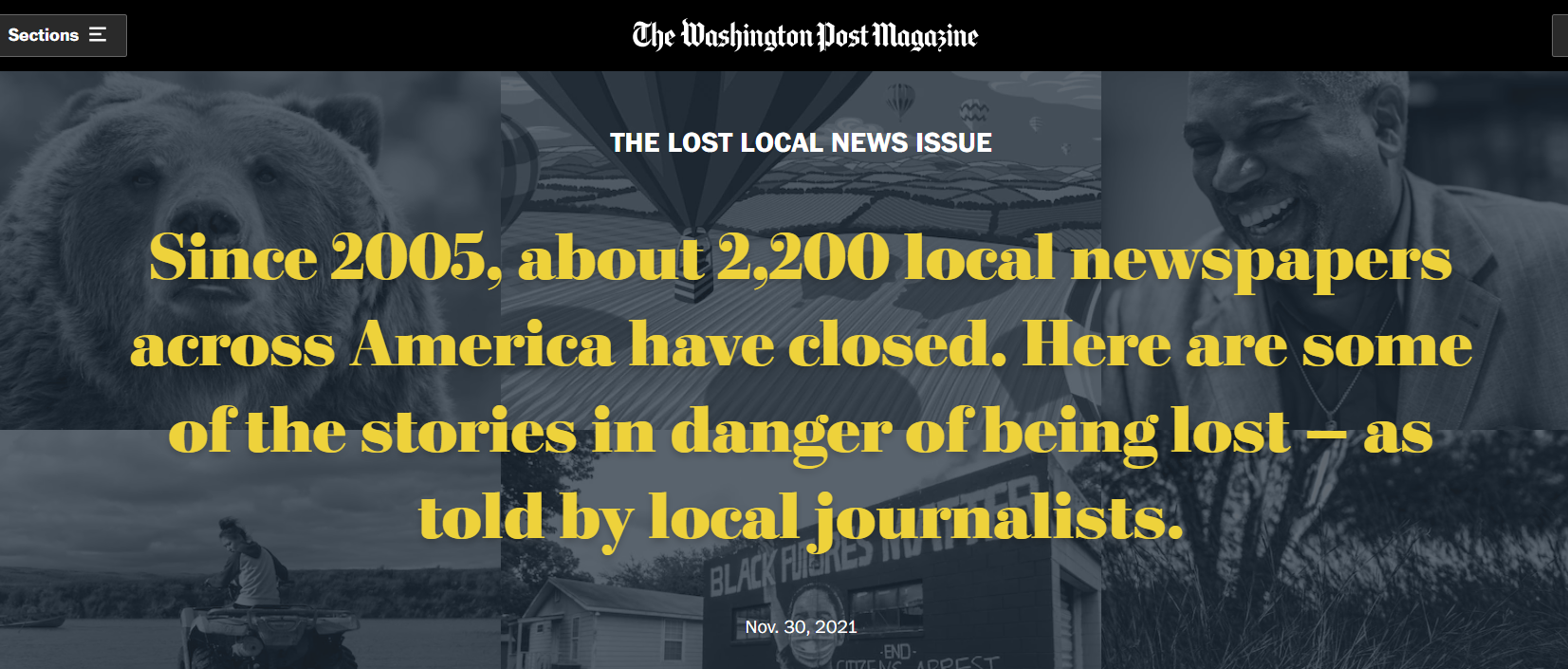
Post package shows its national readership of the dangers of local news deserts, but it has problems defining them

Screenshot of introduction to The Lost Local News Issue of The Washington Post Magazine

In honor of Giving NewsDay yesterday, The Washington Post Magazine published a package of stories celebrating local journalism and warning of the dangers of expanding news deserts. It includes a suite of stories solicited from journalists across the country, reminding the paper's national readership of the breadth and depth of news that is being lost to readers as "news deserts" expand through closure and hollowing out of newspapers.

The stories range from one about how a West Virginia pastor cultivated a racially diverse congregation in an overwhelmingly white area, to an investigation into suspicious grizzly-bear deaths in Idaho.

"Some of these stories have been previously covered by outlets that are trying against long odds to preserve a market for local journalism, and we are indebted to their work; other stories are being told here for the first time," the Post says. "What all these stories have in common is that they deserved more space, scrutiny and attention than they have previously received.

The Post notes that "about 2,200 local print newspapers have closed since 2005, and the number of newspaper journalists fell by more than half between 2008 and 2020. In many places where papers still exist, a lack of resources prevents them from reporting thoroughly on issues vital to the community — issues like public safety, education and local politics." 

The phenomenon, which the pandemic has accelerated, "poses the kind of danger to our democracy that should have alarm sirens screeching across the land," writes Post media columnist Margaret Sullivan.

A note from Al Cross, professor of journalism at the University of Kentucky and director of its Institute for Rural Journalism and Community Issues, which publishes The Rural Blog: 

The Post says "Every piece in this issue originates in a news desert," but that does not conform to reality (the West Virginia county is served by two dailies) or to the definition it cites from Northwestern University Visiting Professor Penny Muse Abernathy, who started tracking news deserts as the Knight Chair in Journalism and Digital Media Economics at the University of North Carolina at Chapel Hill. She defines a news desert as "a community, either rural or urban, with limited access to the sort of credible and comprehensive news and information that feeds democracy at the grass-roots level." The Post misinterprets what that means: "In practice, this means counties with few — sometimes zero — print newspapers of any kind." What the Post seems to not realize is that one-newspaper counties have been the norm in the U.S. for a long time, and it seems to dismiss the ability of weekly papers to provide comprehensive reporting that feeds democracy. Maybe the Post folks need to get out more.

With each story, the Post gives what it calls "the newspaper landscape in the story's setting," but that information is limited to the number of newspapers and how many print editions they have each week. It doesn't say anything about the quality of journalism they provide, though it does provide links so readers with plenty of time can judge for themselves. In some cases, the Institute for Rural Journalism knows from previous experience that some of the communities are well served.

The first story comes from three people in Bethel, Alaska, which doesn't have a paper but has a good public radio station, KYUK, which employs one of the reporters. The grizzly-bear story comes from a community served by a locally owned weekly, the Island Park News, which says "This newspaper is CERTIFIED politically incorrect and 100% American." A story about a drug-court judge comes from Rio Arriba County, New Mexico, where the weekly Rio Grande Sun has won many awards, including some for coverage of the local drug problem. No news desert there. In seven of the 12 cases, the communities are served by dailies, and in several cases, they have covered the topics of the stories.

Telehealth popular in rural U.S. during pandemic; states pass laws to continue access and maybe make it permanent

Telehealth has been a boon to rural areas during the pandemic, "but its future depends largely on whether state lawmakers extend emergency measures that made telehealth a viable alternative for patients and providers wary of in-person contact," Michael Ollove reports for Stateline. "The most important changes most states made were to expand Medicaid coverage to different types of virtual appointments and to enact telehealth coverage requirements for private insurers."

Before the pandemic, 43% of providers used telehealth; that jumped to 98% early in the pandemic. Telehealth visits increased by up to 40%, and remain 30% higher than before, Ollove reports.

Telehealth has proved so popular that at least half the states "already have extended temporary telehealth measures that were set to expire with the lifting of public-health emergencies, and other states are considering doing the same," Ollove reports. More than 1,000 telehealth bills are pending in state legislatures, many of which would mandate that insurers cover telehealth and/or expand the number of telehealth services covered. Those bills generally apply only to individual or non-employer-funded plans, since the federal government regulates employer-funded plans.

It's unclear whether patients will continue to prefer telehealth after the pandemic, and broadband connectivity and computer literacy are still significant barriers to use. But providers say the service has helped them stretch staff resources and better care for patients, Ollove reports.

Climate change keeps pushing fall leaf change back; the shift may endanger forests and tourism dollars

A forest in Newark, Vermont, in October (Getty Images photo by Tayfun Coskun)

You may have noticed that the trees were especially late in changing colors this fall. Scientists say it's probably the new normal. "From Vermont to North Carolina, fall foliage appeared behind schedule this year—continuing a long-term trend that, according to one recent study of maples by researchers at George Mason University, has pushed the appearance of fall colors back more than a month since the 19th century," Sarah Gibbens reports for National Geographic.

Climate change is a cause: "This past October was the world’s fourth warmest October in a 142-year record, according to the National Oceanic and Atmospheric Administration. That’s no surprise: The eight warmest Octobers have come in the last eight years. And the Northeast, which is most famous for fall foliages, is warming faster than the rest of North America," Gibbens reports. But temperature isn't the only reason for the leaves' delay: "Precipitation or the lack of it, extreme weather, and insect infestations all play a role. As climate change affects all those factors, it’s making the timing of peak foliage harder to predict."

That could disrupt leaf-peeping and other fall-centered tourism that generates as much as $30 billion each year nationwide. Scientists say the delays in leaf coloration disrupt trees' annual growth cycles and could destroy some forests. "While nobody wants to be the 'sky is falling' kind of person, we do understand these changes are the plants telling us something is not right," GMU ecologist Rebecca Forkner told Gibbens.

Founder of Christian television network that discourages coronavirus vaccination dies from Covid-19

Marcus Lamb of Daystar
Marcus Lamb, the founder of Christian TV network Daystar, died of Covid-19 Tuesday. A spokesperson would not say whether the 64-year-old was vaccinated, but Michelle Boorstein reports for The Washington Post that during the pandemic "Lamb and his network went in big with anti-vaccine conspiracies, hosting daily interviews with skeptics who talked about dangerous, hidden forces pushing vaccines and stealing Christians’ freedoms." 

Lamb's wife Joni said he had diabetes and got pneumonia after being diagnosed with Covid-19, which he tried to treat with alternative medicines. Earlier this month, his son Jonathan said on the network that he believed the illness was a "spiritual attack from the enemy" in retaliation for the network's promotion of unfounded alternative treatments, Boorstein reports.

"Lamb was an outspoken skeptic of Covid-19 vaccines and eagerly promoted unproven, alternative treatments, including hydroxychloroquine, which the US Food and Drug Administration says has no effect on Covid-19, but has been linked to heart rhythm problems, kidney trouble, and liver failure," Daniel Silliman reports for Christianity Today. "In Lamb’s last fundraising newsletter, he touted Daystar as 'the only Christian TV Network that has made continuous efforts to warn you about the dangers of the Covid-19 ‘Vaccine’ and to help you with the truth' about alternative treatments."

"Daystar is the second-largest Christian network in the world, according to CBN News, a competitor, reaching 2 billion people worldwide. Its brand is a fluid, modern, charismatic faith, more about general good-vs-evil, miraculous healings and religious freedom than any specific denominational theology," Boorstein reports. The network was founded in 1998, and now owns more than 100 television stations all over the globe. In recent years Daystar has been rocked with scandal: first for an affair Lamb admitted to, and more recently for claims of fraud, Silliman reports. In 2011 an NPR investigation found that Daystar only gave away about 5% of the money it had raised for charity, and in 2020 the network "returned $3.9 million in Paycheck Protection Program money after an Inside Edition investigation found his ministry purchased a jet two weeks after getting a PPP loan meant to help employees struggling during the pandemic," Boorstein reports.

Tuesday, November 30, 2021

Ogden Newspapers goes west, buys Swift Communications

Swift Communications, which owns about a dozen daily and weekly newspapers and other publications  in the West, many in resort communities, announced Tuesday that it is selling them to The Ogden Newspapers, based in Wheeling, West Virginia. Swift is based in Carson City, Nevada.

After the Dec. 31 sale, terms of which were not released, Ogden will publish 54 dailies and scores of weekly newspapers and magazines in 18 states, according to a story in The Aspen Times, which Swift owns. Its other publications include the Vail Daily, the Tahoe Daily Tribune, the Park Record in Park City, Utah; The Union in Grass Valley, Calif.; Steamboat Pilot & Today in Steamboat Springs, Colo.; Goat Journal, Backyard Poultry Magazine and The Fence Post, an agricultural magazine for Colorado, Nebraska and Wyoming. Ogden will retain the Swift name for the group.

UPDATE, June 6: Gold Hill California Media bought the Grass Valley Union from Ogden.

Robert Nutting (Twitter photo)
Ogden has three papers in Utah (Provo, Mount Pleasant and, fittingly, Ogden) but most of its papers are in Appalachia and the Midwest. The company was founded in 1890 by H.G. Ogden and is owned by the family of his grandson, G. Ogden Nutting. CEO Robert Nutting said, “Our company’s goal is to be a positive force in the communities we serve — celebrating each market’s unique strengths while also working to provide realistic solutions to areas of concern. We believe that strong, responsible and connected local newspapers are critically important to building and supporting strong communities now more than ever.” Nutting is principal owner and chairman of the Pittsburgh Pirates.

UPDATE: For Ogden's news release, click here. For a story in the Aspen Daily News about Nutting, his companies, his wealth and his liking for ski-resort areas, click here.

Coal prices highest in more than a decade as stockpiles dwindle after hot, dry summer boosted use of electricity

"Coal piles at power plants have dwindled to their lowest point since the 1970s, and the race to build up inventories ahead of heating season has sent domestic thermal-coal prices to their highest levels in more than a decade," Ryan Dezember reports for The Wall Street Journal. "Inventories in the U.S. power sector are about two-thirds of the five-year average for this time of year, according to the Energy Information Administration. Richard Nixon was in the White House the last time there was so little on hand, EIA data show."

Extreme weather driven by climate change bears some of the blame: "A lot of coal was burned this summer to power air conditioning during some of the hottest weather on record," Dezember reports. "The western drought reduced hydropower output, and coal plugged some of the generation gap, along with natural gas. The price of gas, which started out the heating season at its highest in more than a decade, has made switching to coal attractive to power producers that can burn both."

Most coal is sold in advance, and there isn't much available to buy for immediate use. "Coal has lost market share to natural gas, wind farms and solar installations over the past decade, drying up financing for speculative production," and it's challenging to produce more than previously set quotas, Dezember reports. "Backed up ports and railways would make delivery difficult, even if there were more coal coming out of mines."

Gas and renewable energy have increasingly crowded out coal's market share and depressed its production, Dezember reports, "yet coal remains an important source of power generation, serving as a swing fuel to augment other sources when output from renewable sources, like wind farms, is insufficient or natural-gas prices are high, as they are today."

Rural households are hurt more by inflation than urban ones

Inflation is at a 30-year high in the U.S., and rural households are some of the hardest hit. 

"Inflation has hurt lower-income families, families of color, and rural households more than other demographics, a Bank of America research report found last week," Jason Lalljee reports for Business Insider. "Breaking down demographics by race, geography, and income, the bank found that the 'inflation shock' of 2021 has disproportionately affected the marginalized: Households without college graduates, African American, Hispanic and Latino communities, and those not living in cities have been spending more of their post-tax income on goods and services."

Rural households are paying an average of 5.2 percent more of their post-tax income because of inflation, compared to 3.5% of households in metropolitan areas. "All of the high-inflation categories, particularly energy and new and used cars, make up a larger share of the consumption basket for rural households," researchers wrote. "They also earn and save less than urban households, and so inflation is a bigger drag on their income, and they have less buffer against the shock."

Inflation has been blamed on everything from corporate greed to President Biden, but it's mostly a function of reduced supply and increased demand.

Lee Enterprises adopts 'poison pill' stock strategy to ward off hostile takeover by hedge fund Alden Global Capital

Newspaper group Lee Enterprises has adopted what's known as a "poison pill" strategy to try to fend off a hostile takeover from New York hedge fund Alden Global Capital.

The plan "would kick in if Alden gets control of 10% or more of Lee’s stock in the next year," Austin Huguelet reports for the St. Louis Post-Dispatch, a flagship paper for Lee, which is based in Davenport, Iowa. "At that point, other shareholders could buy shares at a 50% discount or get free shares for every share they already own. Flooding the market with additional shares would dilute the stock, making it more expensive for Alden to acquire a controlling stake. Alden said in a filing Tuesday it owns 6.1% of Lee."

The plan would give shareholders and the board more time to consider Alden's unsolicited offer of $141 million "without undue pressure while also safeguarding shareholders’ opportunity to realize the long-term value of their investment," Lee Chairman Mary Junck told Huguelet.

The poison-pill strategy might not work. Tribune Publishing tried the same thing but Alden acquired the company in May 2021 after a years-long campaign.

The stakes are high for Lee, the hundreds of communities it serves, and maybe more: Alden is known for slashing newsrooms to increase profits. If Alden bought out Lee, a "clear majority" of U.S. dailies would be owned by hedge funds. Moreover, it would "essentially create a local news duopoly between Alden and Gannett/Gatehouse, which merged in 2019," Sara Fischer reports for Axios.

UPDATE, Dec. 2: Unions at Lee papers urged the board of directors to fight the takeover, Gateway Journalism Review reports.

Two weeks ago, new rural coronavirus vaccinations fell for fifth week in row; new rural infections went up; deaths fell

Vaccination rates as of Nov. 18, compared to national average and adjusted to account for vaccinations not assigned to specific counties. Map by The Daily Yonder; click the image to enlarge it or click here for the interactive version.

Two weeks ago, the pace of new rural coronavirus vaccinations declined for the fifth consecutive week as rural coronavirus infections rose slightly and Covid-related deaths declined.

Rural counties reported 144,000 newly completed vaccinations Nov. 12-18, a 9 percent drop from the week before. "Newly completed vaccinations in metropolitan counties declined even more sharply, dropping by more than 25% to about 890,000 new vaccinations," Tim Murphy and Tim Marema report for The Daily Yonder. "It was the first time newly completed vaccinations in metro counties fell under 1 million residents since the widespread rollout of Covid-19 vaccinations began this spring. The rural vaccination rate grew by 0.3 percentage points last week. That brings the rural rate to 45.2%, or about 20.7 million of rural America’s 46 million residents. The metropolitan vaccination rate of 57.3% is 12.2 percentage points higher than the rural rate."

Meanwhile, new infections increased by about 6% and Covid-related deaths fell by about 9% Nov. 14-20, Murphy and Marema report. While the infection and death rate gaps narrowed slightly between rural and urban counties that week, the rural infection rate remained 50% higher than the metro rate, and the rural Covid-related death rate remained twice as high as the metro rate for the fifth week in a row.

New coronavirus infections, in ranges by county, Nov. 14-20
Map by The Daily Yonder; click the image to enlarge it or click here for the interactive version.

Rural hospitals face widespread nursing shortages and lagging employee coronavirus-vaccination rates

"Vaccine hesitancy among rural health facilities remains rampant even as providers faced a major surge of Covid-19 due to the more transmissible Delta variant, a new study finds," Robert King reports for Fierce Healthcare. The study, released last week by the Chartis Group, "also found that nurse staffing shortages are contributing to suspensions in care in vulnerable communities." About 30 percent of respondents said the nursing shortage had caused their facility to suspend medical services, mainly surgeries, and another 22% said they were considering that.

Over 98% of the facilities surveyed reported staff shortages, mostly nurses. Burnout, retirement, and going for a better-paying job at another hospital are the main causes of the shortages, not mandates; in fact, about 75% of respondents said their facility doesn't have a mandate, King reports. The lack of mandates may have contributed to lower vaccination rates, the study noted.

However, vaccination rates are rising: "Chartis spoke with rural hospitals across the country from Sept. 21 to Oct. 15 and found that 44% of respondents said 50% to 69% of professionals in their facility were fully vaccinated," King reports. "That is an improvement on an earlier survey conducted in March and April of this year, where 37% of respondents said 50% to 69% of professionals were vaccinated."

The vaccination numbers will have to ramp up if the federal government's mandate takes effect. The rule would require all staffers to be vaccinated by Jan. 4 or risk losing federal reimbursement for Medicare and Medicaid patients. But 10 states have challenged the mandate in court, so its future is uncertain.

Monday, November 29, 2021

Rural banker survey finds record-high farmland price index, 12 straight months of sunny local economic outlook

Creighton University chart compares current month to last month and year ago; click here to download it and chart below.

A November survey of rural bankers in 10 Midwestern states that rely on agriculture and energy marked 12 straight months of positive outlooks on economies in about 200 rural communities with an average population of 1,300 in Colorado, Illinois, Iowa, Kansas, Minnesota, Missouri, Nebraska, North Dakota, South Dakota and Wyoming.

The Rural Mainstreet Index rose to 67.7 from October's 66.1, and the farmland price index hit a record-high 85.5, up from 81.5. "Readings for farmland prices and equipment sales over the last several months represent the strongest consistent growth since 2012" writes Creighton University economist Ernie Goss, who compiles the index. "Solid grain prices, the Federal Reserve’s record-low interest rates, and growing exports have underpinned the Rural Mainstreet Economy."

However, labor shortages continue to plague rural businesses; Bureau of Labor Statistics data show nonfarm employment in Rural Mainstreet states remains 2.5% lower than before the pandemic. Some bankers also worry about the infrastructure bill; asked what parts of it would most help agriculture, 30% said it has too many negatives to help at all, while more than a fourth each said it would help most with broadband and waterways. 

Interior declares 'squaw' derogatory word, creates speedier process for renaming federal sites with racist names

Interior Secretary Deb Haaland declared "squaw" a derogatory term for Indigenous women and created a task force to find new names for sites on federal lands that use the word. "The order, which takes effect immediately, stands to affect more than 650 place names that use the term, according to figures from the U.S. Board on Geographic Names," Bill Chappell reports for NPR.

Haaland, a registered member of the Laguna Pueblo, said in a press release that "racist terms have no place in our vernacular or on our federal lands. Our nation's lands and waters should be places to celebrate the outdoors and our shared cultural heritage — not to perpetuate the legacies of oppression."

Haaland created two groups to facilitate name changes, Chappell reports. In a nutshell, the Advisory Committee on Reconciliation in Place Names will help identify other derogatory place names, and the Derogatory Geographic Names Task Force will help vet proposed replacement names. Both are required to have Native American representation. The new committees "will accelerate the process by which derogatory names are identified and replaced," Native News Online reports. "Currently, the Board on Geographic Names is structured, by design, to act on a case-by-case basis through a process that puts the onus on the proponents to identify the offensive name and to suggest a replacement. The process to secure review and approvals can be lengthy, often taking years to complete a name change. Currently, there are hundreds of name changes pending before the Board."

The move follows previous Interior moves to remove racist names from federal sites. "In the 1960s and '70s, the agency said, place names containing slurs for Black and Japanese people were replaced on a wholesale level," Chappell reports.

How a local radio station and newspaper, and The New York Times, enabled prosecution of the killers of Ahmaud Arbery

The convictions of three white men for last year's murder of Ahmad Arbery, a Black man in coastal Georgia, probably wouldn't have happened unless a lawyer for defendant Greg McMichael, trying to quash rumors about the killing, hadn't taken a cellphone video of it to local radio station WGIG.

"Instead, the video published online by the radio station surfaced questions nationwide about racial profiling and the lack of criminal charges," Meryl Kornfield reports for The Washington Post, recounting early reporting by the Brunswick News, Georgia Public Broadcasting and WSB-TV. 

University of Maryland sociology professor Rashawn Ray told Kornfield, "I think part of what the McMichaels were trying to leverage was what their defense attorneys were trying to allege: That the mere presence, the mere physical body of Ahmaud Arbery as a Black person just running through the street, should pose a big enough threat to justify their use of force."

Brunswick News reporter Larry Hobbs told Kornfield that he had doubts about the incident from the start, and "said police wouldn’t answer his questions or even tell him Arbery’s name, which he discovered by calling the coroner. He published four stories before he obtained the police report, based almost entirely on an interview with Greg McMichael, who said he told his son to grab his gun when he saw a Black man running. . . . Prosecutors were also not forthcoming."

"Jackie Johnson, the Brunswick district attorney who was later indicted over her handling of the investigation and was voted out of office," gave the case to Waycross DA George Barnhill, who justified the shooting as a lawful "citizen’s arrest" but told Hobbs he was still investigating, Kornfield reports.

“The main thing I did was just not let go of it,” Hobbs said. “I didn’t do any great writing. I didn’t do any investigative reporting. I’m a small-town newspaper. We don’t really have time to invest. I come in every day and there’s an empty newspaper I have to do my part to fill up.”

Kornfield writes, "The New York Times reported reported on the shooting, bringing national exposure and emerging details of the video that would later be released. Still, Hobbs has been credited for his dogged reporting, as he stayed on the case, covering the trial every day until he wrote Wednesday’s story of the conviction."

Hobbs told Kornfield, “In times of reckoning, we’ve come up wanting so many times, especially people from my demographic. The South got it right today.”

Interior may make make oil, gas companies pay more to drill on federal lands; wouldn't affect home energy costs much

The Interior Department announced plans Friday to make oil and gas companies pay more to drill public lands and waters. The federal leasing program is outdated, fails to serve taxpayers, and worsens climate change, said an18-page report from the department.

"The document calls for increasing the government’s royalty rate — the 12.5 percent of profits fossil-fuel developers must pay to the federal government in exchange for drilling on public lands — to be more in line with the higher rates charged by most private landowners and major oil- and gas-producing states," Sarah Kaplan reports for The Washington Post. "It also makes the case for raising the bond companies must set aside for cleanup before they begin new development." Raising the royalty rate could generate between $1 billion and $2 billion a year annually, and wouldn't significantly impact energy prices for American households.

The report focuses on fiscal rather than environmental benefits of updating the law, but "Interior officials say they will also consider how to incorporate the real-world toll of climate change into the price of permits for new fossil fuel extraction," Kaplan reports. "Economic analyses suggest the changes to royalty and bonding rates will increase revenue, but they will not significantly curb carbon emissions." That's because "Less than 10 percent of oil and gas produced in the United States comes from Interior-controlled land, and cuts to U.S. production will be partly offset by increases in other countries."

Interested parties on both sides of the issue expressed dissatisfaction with the proposal. A representative of the American Petroleum Institute said it would increase the cost of production, Kaplan reports. Meanwhile, a spokesperson for the Center for Biological Diversity noted that one-third of Americans experienced a disaster driven by climate change this summer, and called for the Biden administration to end drilling on public lands rather than reform it.

The administration is under pressure to deliver on President Biden's campaign promises to protect the environment, especially after the recent United Nations climate agreement. "Even as he has come under criticism for not moving quickly or boldly enough to reduce the country’s greenhouse gas emissions, create jobs in a greener economy and alleviate pollution impacting poor and minority communities, Biden has continued to pursue swaths of his climate agenda," Juliet Eilperin, Brady Dennis and John Muyskens note for the Post. "Less than a year after taking the oath of office, Biden has now targeted half of Donald Trump’s energy and environmental policies." Click here for the Post's frequently updated list of the Biden administration's environmental actions.

Biden administration is giving out billions to rural health-care providers, passed as part of last pandemic relief bill

"The Department of Health and Human Services has begun distributing billions of dollars to rural health care providers to ease the financial pressures brought by the coronavirus pandemic and to help hospitals stay open," Mark Walker reports for The New York Times. "The agency said on Tuesday that it had started doling out $7.5 billion to more than 40,000 health care providers in every state and six U.S. territories through the American Rescue Plan," a relief bill that Democrats passed in March. "The infusion of funds will help offset increased expenses and revenue losses among rural physicians during the pandemic, the agency said."

Many rural hospitals and other medical providers were already struggling before 2019, since they often had to deal with more costs than suburban and urban providers. That's a function of supply chains and an overall older, sicker and poorer populace, Walker reports. The pandemic has worsened those struggles; 21 rural hospitals have closed since the start of 2020. 

"Rural physicians serve a disproportionate number of patients covered by Medicaid, Medicare or the Children’s Health Insurance Program, which often have more complex medical needs," Walker reports. "Under the program, every eligible provider that serves at least one Medicare, Medicaid, or CHIP beneficiary in a rural part of the country will receive at least $500. Payments will range up to $43 million, with an average of $170,700; the size is based on how many claims a provider submitted for rural patients covered by these programs from January 2019 through September 2020."

Providers can use the money for a wide range of needs, including salaries, recruitment and retention; capital investments; information technology; supplies such as personal protective equipment or ventilators, and more, Walker reports.

"The administration has also allocated billions of dollars through the American Rescue Plan for coronavirus testing for the uninsured, increased reimbursement for Covid vaccine administration, improving access to telehealth services in rural areas, and a grant program for health care providers that serve Medicare patients," Walker reports. "On Monday, Vice President Kamala Harris said that the administration would be investing $1.5 billion to address the shortage of health care workers in underserved tribal, rural and urban communities. The funds — which will provide scholarships and pay off loans for clinicians who commit to jobs in underserved areas — come on the heels of a report from the White House’s Covid Health Equity Task Force that made recommendations on how inequalities in the health care system could be fixed."