Thursday, April 14, 2022

Weekly editor in Iowa laments that 'nothing has changed' with his Pulitzer-winning topic, water pollution from farming

Weekly newspaper editor Art Cullen won the 2017 Pulitzer Prize for editorial writing for his campaign supporting the Des Moines Water Works' lawsuit to clean up the Raccoon River, overloaded with nitrates from over-fertilization and other poor conservation practices by farmers in his area. When he and his brother John bought the Cherokee Chronicle-Times in an adjoining county, he asked Editor Paul Struck if their Storm Lake Times Pilot could republish his sports column. "He countered that the Cherokee paper should publish samples of our 2016 editorials," Cullen writes. "I wasn’t certain at first that they should be dredged up. We already spoke our piece. Then I went back and reread them. It struck me that nothing has changed in seven years but talk."

Editor Art Cullen
Nitrate levels are not declining in the Raccoon or other rivers, and the reservoir that supplies Des Moines' drinking water "is routinely threatened by toxic algae blooms fed by phosphorous runoff," Cullen writes. "More than a decade after voters approved a fractional increase in the state sales tax for water quality improvement, among other conservation enhancements, the legislature has refused to abide by the amended state constitution by enacting the sales tax increase." He cites other failures at the state level, and moves up the totem pole:

"We hoped, and still hope, that something could be done at the federal level to clean up Iowa’s surface water. There are promising small steps: Agriculture Secretary Tom Vilsack authorized a pilot project to expand cover crops in Buena Vista County. Even with that, about 1% of our county’s acreage will be covered over winter. Vilsack says he wants to double the amount of Iowa cover crops in the next decade. So that might get BV County to 2%? Cover crops, along with buffers and grass strips, can almost wipe out surface water pollution. It can pay off if the government would take swift and bold action. But it doesn’t. Doubling nothing doesn’t get you something."

Des Moines' water boss, the late Bill Stowe, "started a conversation in Iowa about how we approach our gentle land," Cullen writes. "It helped steer people’s attention toward more sustainable ag practices that help farmers. The Practical Farmers of Iowa are showing us a different way forward to growing legions of land stewards. Yet it’s not nearly enough. . . . Industrial ag interests have a grip on our politics and minds. . . . The Iowa Department of Natural Resources is fine with 11,000 steers laid in next to one of Iowa’s rare trout streams. Meanwhile, the dead zone in the Gulf of Mexico persists, killing the fishing industry at the mouth of the Mississippi. It’s hard to say that farmers or rural communities have benefitted much from this chemical paradigm over the past half-century. Nitrogen and methane from agriculture are feeding extreme weather that lead to epic drought and winter tornadoes. Those editorials reminded me how much work we have to do in Iowa, if we actually intend to 'feed the world'."

Some pain patients and doctors worry the CDC's revised opioid-prescription guidelines won't help patients enough

Opioid prescriptions have fallen more than 40 percent over the past decade in response to the opioid overdose and addiction crisis. The Centers for Disease Control and Prevention has played a role in that by encouraging doctors to prescribe fewer painkillers, but that has made it more difficult for patients with chronic pain to get the medication they need. The CDC has drafted a new version, on which the public-comment period just ended, "but some worry it doesn't protect patients enough," Will Stone reports for NPR.

New CDC guidelines in 2016 encouraged doctors to be wary of opioid addiction and advised them to start at a low dose and avoid prescribing high doses. Amanda Votta, a Rhode Island graduate student who has rheumatoid arthritis, told Stone that it became much harder for her to get any kind of opioid prescription at all, and that she was often in great pain.

"There's broad agreement now that the 2016 guidelines were misapplied to pain patients like Votta," Stone reports. Dr. Roger Chou, who helped write the 2016 guidelines, told Stone the guidelines were only meant to guide doctors, not stop them from prescribing appropriate medication to patients with chronic pain. But many states used the guidelines as the basis for new laws, some of which limited doctors' ability to prescribe opioids, Stone reports.

The CDC's new prescribing guidelines show promise, some experts say. "The top-line recommendations no longer include specifics about the dose or duration a patient shouldn't exceed when taking opioids. The draft also warns up front that the guidelines should not be used as inflexible standards of care," Stone reports. But the lack of specific guidance could make some doctors uncomfortable and cause them to stop prescribing opioids at all, another expert said.

April 27 webinar from Agri-Pulse will discuss how farming technology and innovation can help thwart climate change

Agri-Pulse will host a free webinar at 2 p.m. ET April 27 to discuss how agricultural technology and innovation can help address climate change. Register here.

Agri-Pulse's Spencer Chase will moderate a panel including the following:

  • Rep. Cheri Bustos, D-Ill.
  • Karsten Temme, Ph.D., CEO and co-founder, Pivot Bio.
  • Pipa Elias, deputy director of the Environment Program, Walton Family Foundation.
  • Patty Mann, Mann Farms.

Wednesday, April 13, 2022

Maine House passes bill banning sewage sludge that can have 'forever chemicals' and is commonly used as fertilizer

Known PFAS contamination sites in 2021. Blue dots denote samples from drinking water, purple from military sites, and orange from other sites. (Environmental Working Group map; click image to enlarge or click here for interactive version.)
Maine's House of Representatives has sent its Senate a bill banning the spread, use or sale of sludge from sewage treatment plants and septic tanks, since the sludge (called septage) is often contaminated with "forever chemicals" linked to numerous health problems. The bill would also ban the sale of crops grown where septage was spread, and the material would go to landfills instead. "It would be one of the most aggressive actions to date in Maine, which has been ramping up its efforts to respond to the presence of per- and polyfluoroalkyl substances, or PFAS, in farmland, water and food after several farms have discovered unsafe levels of the chemicals," Caitlin Andrews reports for the Bangor Daily News.

Map shows sites where septage was spread in southern Maine. (Click to enlarge)
That includes Songbird Farm, 90 miles northeast of Portland. Adam Nordell and Johanna Davis bought the 44-acre farm in 2014 and established a thriving organic farm. But in 2021 state wildlife officials found dangerously high levels of PFAS in deer that hunters had harvested in nearby Fairfield. The state warned people not to eat the deer in that area, Keith O'Brien reports for The Washington Post: "Several farms there had been fertilized in the 1990s with municipal or industrial sludge — essentially, treated sewage — that contained an unknown amount of PFAS. The deer had ingested it over time and should now be avoided, the state announced."

Nordell and Davis suspended sales from their farm after voluntary testing revealed that their soil, water and spinach crops were all contaminated with PFAS. The farm's last owner had died of pancreatic cancer, so they got themselves tested for PFAS too, and discovered their levels were 250 times higher than the average American, O'Brien reports.

"It would be comforting to dismiss the story of Songbird Farm as a one-off calamity — a confined case of PFAS contamination. The reality is far more disturbing. According to the nonprofit Environmental Working Group, more than 2,800 sites nationwide are contaminated by PFAS — and that’s only what’s documented," O'Brien reports. "The real total is unknown, and possibly much higher. In Maine alone, the state Department of Environmental Protection is investigating 700 sites once fertilized with the same sort of sludge that likely contaminated Songbird Farm. Many cases are lurking beneath the surface, undetected and often unregulated by an official watchdog."

PFAS, invented in 1938, are nearly impossible to avoid: They're in everything from food packaging and non-stick cookware to baby bibs, and they have a habit of rubbing off on whatever they touch. Once they're in your body, they're around for the long haul. "It can take four to 15 years for levels of PFAS to reduce by half in the human body, and it can take centuries for the substances to disappear from the environment," Isabella Grullón Paz reports for The New York Times, citing a Consumer Reports investigation revealing how prevalent PFAS are (in fast-food packaging, for example).

Maine is taking some of the most aggressive regulatory actions of any state towards PFAS to date. The state government "advanced a first-in-the-nation phaseout of most consumer products containing PFAS last year. They are on track to approve a $100 million fund to aid farmers and address health effects and have also advanced a phaseout of pesticides containing the chemicals," Andrews reports.

Hackers causing crises at rural hospitals, specialty clinics

"The reality of being locked up by ransomware is no longer a concern reserved solely for major health systems, once a primary target," Marion Renault reports for Stat. "Regional hospitals and specialty clinics are now also constantly warding off, and falling prey to, malicious cyberattacks as ransomware groups grow more opportunistic than ever. Federal databases detail a number of small providers — from pediatrics clinics to hearing centers, chiropractors and child abuse prevention non-profits — caught up in the sweep of attacks targeting the health care system. Such attacks "can be devastating for a health system of any size and scary for anyone relying on its care. But for smaller hospitals and practices, the costs — both to patients and to the bottom line — can be especially steep. Experts say that small, rural providers are also less likely to be prepared to defend, resolve and recover from a ransomware attack than their larger, urban counterparts."

An October 2020 ransomware attack on Sky Lakes Medical Center in Klamath Falls, Oregon, for example, hobbled the hospital for nearly a month, left patients with little or no care, and cost the hospital an estimated $10 million in lost services, replaced equipment and more, even though it didn't pay the ransom, Renault reports. Cyberattacks have driven some providers out of business, such as Brookside ENT in Michigan or Wood Ranch Medical in California. Hospitals survive, but the breakdown in care can cause patients to lose trust, and sometimes they sue for damages, Renault reports.

New rural coronavirus infections at lowest level since June; deaths fell 40% last week but still higher than metro rate

New coronavirus infections, in ranges by county, April 4-10
Map by The Daily Yonder; click on the image to enlarge it or click here for the interactive version.

The pace of new coronavirus infections "fell for the 11th consecutive week last week, reaching its lowest level since June 2021, according to a Daily Yonder analysis. New cases dropped to 16,700, a decline of 8 percent compared to two weeks ago. Rural infections are down 97% from their peak in mid-January," Yonder Editor Tim Marema reports. "Meanwhile, metropolitan counties saw an increase of 25% in new cases last week, rising to about 219,000 for the week compared to 175,000 two weeks ago. But even with the uptick, metropolitan infections are 95% lower than they were during the height of the Omicron surge."

Deaths related to Covid-19 fell by about 40% last week in both rural and metro counties and hit their lowest numbers since August. "The rural death rate was higher than the metropolitan death rate last week – a trend that goes back nearly a year," Marema reports. "The weekly death rate was 53% higher in rural counties than urban ones."

Click here for more charts, regional analysis, and county-level interactive maps from the Yonder.

Study confirms silica has driven uptick in black-lung disease

A new study has confirmed a widespread belief that the cause of black-lung disease in coal miners has shifted recently from coal dust to silica dust. Silica has likely driven a spike in more severe black-lung cases among younger miners in Central Appalachia, the study found, since no other major variables changed over the decades; regulations have remained mostly in place, in come cases getting more strict, and people haven't suddenly become more vulnerable to coal dust.

The University of Chicago-Illinois study, in the Annals of the American Thoracic Society, is the first to examine changes over time in the disease's pathology (how it looks under a microscope, in this case) and its mineralogy (which kind of dust caused it) by comparing miners' lung tissue samples going back more than 100 years. Dr. Robert Cohen, the lead researcher, told NPR that there has been indirect evidence of silica's role, "but his study was the first to examine lung-tissue samples for it.

Coal and silica cause different kinds of lung damage, and though most black-lung disease results from a combination of coal and silica inhalation, modern lung samples showed a greater percentage of silica damage and also a greater amount of silica damage overall.

Silica dust is released when miners drill through rock. It takes more rock drilling and excavation to get a ton of coal today, especially in Central Appalachia, because easy-to-reach coal, in thick seams, is gone.

Tuesday, April 12, 2022

News Leaders Assn. winners and finalists include statewide nonprofits and a university project; climate change featured

Nonprofit news organizations with statewide missions, and thus a rural impact, were among the winners and finalists in this year's awards from the News Leaders Association, a recent merger of the American Society of News Editors and Associated Press Managing Editors. A university project also won a major award, reflecting the growing role of journalism schools in providing news coverage. 

The First Amendment Award went to Ed Williams of Searchlight New Mexico for its investigation of turmoil and cover-ups at the state's Children, Youth and Families Department. The judges said, "Ed Williams had a hard job – how do you find messages that are disappearing? – but his cultivation of sources led to a shocking abuse of public records law and the public's right to know." Another statewide nonprofit, Iowa Capital Dispatch, was a finalist for its pursuit of public records.

Two other statewide nonprofits, the Texas Tribune and Mountain State Spotlight in West Virginia, were a joint finalist with ProPublica for a "remarkable journalistic effort [that] turned a complicated data set of pollution records from the EPA into an easy-to-access interactive map that allows anyone to input an address and find out the toxic air pollution level and the estimated cancer risk in the area." The news outlets "sent postcards to affected communities and posted fliers in churches, libraries and other gathering spots. It is no wonder that the EPA took notice and responded." The project is the subject of a webinar at noon ET Tuesday, April 13.

The Howard Center for Investigative Journalism at the University of Maryland was named Punch Sulzberger Innovator of the Year for “Printing Hate,” which the judges called "an exceptional exercise in journalistic accountability and a memory project for the ages. Working with students at five historically Black colleges and universities and Black newspaper publishers, put "the racist coverage of horrific lynchings" in a database that "allows users to filter varying types of harmful coverage — including reporting that attempted to justify, and even organize, acts of state-abetted racial terror." It resulted in removal of a rural Maryland publisher from the Hall of Fame of the Maryland-D.C.-Delaware Press Association.

Climate change was in the NLA spotlight. Each year the NLA's Batten Medal recognizes "coverage of an issue that presents an urgent challenge to the United States." This year's issue was climate change. The Los Angeles Times won for an October story showing how California undercounts deaths from extreme heat "even as heat waves become more frequent and more deadly."

Other finalists were The Post and Courier, which explained how the fate of South Carolina's Low Country is connected to rising temperatures and melting glaciers in Greenland, and Bloomberg News, for "Methane Menace," which revealed many sources (including leaky oil and gas wells) of the gas that dissipates much more quickly than carbon dioxide but has a greenhouse effect 80 times as potent. "Judges were stunned that such an obvious problem had been left unfixed for so long," NLA said. "The fact that the reporters had to gather their own data and then analyze it was also unique."

The Frank A. Blethen Award for Local Accountability Reporting, named for the publisher of The Seattle Times, the Yakima Herald and the Walla Walla Union-Bulletin, went to the Tampa Bay Times for "a classic watchdog investigative report" on how toxic dust inside a local lead smelter "poisoned employees and their families for years." For all the winners, go here.

2/3 of U.S. drinking water systems have uranium; search new database to see how your county's water stacks up

Public water systems by uranium, concentration 2000-2011 (Columbia University map; click the image to enlarge it)

Uranium is present in two-thirds of the nation's community water systems, which may put many Americans at a higher risk of health problems such as cancer, heart disease, and kidney problems. That's according to an analysis of Environmental Protection Agency data from 2000-2011 published this month in The Lancet Planetary Health. Though only 2.1 percent of water systems had annual uranium levels that exceed EPA maximums, there has been little research about the health effects of chronic uranium exposure.

Semi-urban Hispanic communities had the highest average levels of uranium and other toxic metals such as arsenic, barium, chromium, and selenium, according to the researchers from Columbia University's Mailman School of Public Health. Because Hispanic communities tended to have those elevated levels regardless of location or region, the study's authors said a failure of regulatory policy and/or water-treatment infrastructure may be to blame rather than natural occurrence of the heavy metals in the groundwater.

Moreover, an interactive map and searchable database show that counties across the nation — many rural — have contaminated water too. How pure is the water in your county?

N.C. becomes first state to bar state, local governments from paying ransoms to hackers; others may follow suit

North Carolina just passed a law prohibiting state and local governments from paying ransom to hackers who encrypt their computer systems; other states could follow suit. That could put rural governments at a disadvantage, since they are often more vulnerable to cyberattacks.

State and local agencies and governments in North Carolina may not pay or even communicate with hackers, according to the new law. "Rather than communicate with attackers, agencies must consult with the Department of Information Technology as described in this statute, which requires reporting cybersecurity incidents to the DoIT within 24 hours. Private sector entities are encouraged, but not required, to report cybersecurity incidents to the state’s IT department," Susan Miller reports for Route Fifty. Other states, including New York and Pennsylvania, are considering similar laws.

"According to a National Law Review article, lawmakers in North Carolina and Pennsylvania have suggested that hackers will have no financial incentive to attack agencies that are prohibited from paying ransoms and will look for victims in other states," Miller reports. "This strategy would put under-resourced agencies at a disadvantage, the article suggested, as they may be unable to restore or rebuild their systems after an attack."

Biden greenlights E15 summer sales, releases funding guide for local governments in rural infrastructure tour

Senior officials with the Biden administration will visit 30 rural communities this month to tout billions of dollars in funding for rural broadband, water, jobs, roads, and more as part of a "rural infrastructure tour" launched Monday. That includes $14.6 billion in rural-specific programs in the $1.2 trillion infrastructure bill, which was bipartisan, along with billions more in regional and state funding that will be spent on roads, bridges and waterways in rural areas, Chuck Abbott reports for the Food & Environment Reporting Network.

President Biden is kicking off the tour today with a visit to an ethanol plant in Menlo, Iowa, where he will announce that E15 gasoline will be sold this summer to help drivers save at the pump, Chris Clayton reports for DTN/The Progressive Farmer.

Normally E15, which has 15 percent ethanol, can't be sold from June 1 to Sept. 15 because it generates more air pollution in hot weather. And the Supreme Court ruled in January that the Environmental Protection Agency doesn't have the authority to permanently greenlight E15 sales. But EPA is only issuing an emergency waiver here. A White House spokesperson said EPA "is considering other actions to further spur the use of E15 year-round, including continued talks with states that have already sent requests to EPA about year-round E15," Clayton reports.

The administration published a Bipartisan Infrastructure Law Rural Playbook to help rural governments identify funding opportunities. "It provides information on the 'what, when, where, and how to apply' for funding under the law, according to the White House, and identifies more than 100 programs funded," Alex Gangitano reports for The Hill. "The playbook builds on the guidebook the administration released in January to help state and local governments access funding from the law."

The administration will announce $2 billion in new rural funding this month as part of the tour, White House infrastructure coordinator Mitch Landrieu said. That includes $1 billion for an America the Beautiful Challenge "to combine federal and private funding for locally-led land and water conservation work," Abbott reports. "The government committed $440 million over five years for grants administered by the National Fish and Wildlife Foundation." Interior Secretary Deb Haaland announced the funding in Colorado while touring a wildfire-control site.

Overall tourism in U.S. was down in 2020, but many people wanted to get out and explore rural areas close to home

Though overall U.S. tourism fell in the pandemic-plagued year of 2020, several travel companies and rural communities with tourism economies told a writer for The Daily Yonder that they saw a rise in domestic tourism, especially from locals wanting to get out of and explore nearby areas by car.

"Leigh Barnes, chief customer officer for operator Intrepid Travel, said that during the height of the pandemic they saw people wanting to stay close to home and get to know their own country and the cultures within it better," Kristi Eaton reports for the Yonder. "Although overall numbers were down, Barnes said Intrepid Travel has seen increased interest in outdoor activities" such as cycling trips, canoeing, and hiking. State and national parks were often overwhelmed with tourists.

"That’s fundamentally been a shift, I think, over Covid," Barnes told Eaton. "Everyone was wanting to travel and experience other peoples’ cultures – there has been that shift. What that means for rural travel is that people are going back to different parts of their own country. I think we’re seeing an increase of people traveling to connect to understand themselves, understand their own culture."

Many tourists in rural areas showed an interest in food, including the history of food systems and learning about where their own food comes from, Barnes told Eaton.

Monday, April 11, 2022

Here's a map of poverty in America, 2020; much of it is rural

Screenshot of interactive map by Jared Whalen of Axios, with label added by The Rural Blog

It's a familiar map, but it has fresh data, and is interactive. It's a map of poverty in America, measured by the percentage of people in each county in the 2020 American Community Survey (the continuous poll by the Bureau of the Census) who gave an income figure that was below the federal poverty threshold for that year. Appalachia, the Black Belt, Indian Country and the Rio Grande stand out.

Higher fire risk also raises risk of lawsuits against electric utilities, which seem to be more aggressively cutting trees

UPDATE: "Pacific Gas & Electric Co. will avoid criminal charges for two wildfires started by its equipment under settlements announced Monday by district attorneys in six Northern California counties," reports Alex Wigglesworth of the Los Angeles Times. "Prosecutors said the agreements were a better outcome for fire victims and communities, because limitations in criminal law make it difficult to hold corporations accountable. . . . PG&E has also agreed to hire 160 to 200 employees in the six counties to bolster safety work, and enter into a five-year monitorship of its system inspection and vegetation management work in those counties." The settlements involved the Dixie and Kincade fires. "The utility still faces charges in the 2020 Zogg fire, which killed four people and destroyed more than 200 buildings," the Times reports.

Tim Goforth, left, and Kathy Kreiter lost their Oregon home
to a wildfire in 2020, and he lost vision in one eye. They are
among plaintiffs in a lawsuit. (WSJ photo by Mason Trinca)
The increasing risk of wildfire in the West has put electric utilities at more risk of lawsuits and settlements to avoid criminal prosecution, as malfunctions of utility equipment have caused some of the most devastating blazes, The Wall Street Journal reports.

"Pacific Power, an Oregon utility . . . faces more than $1 billion in potential liability costs from lawsuits related to a spate of fires that swept the state in 2020," Katherine Blunt writes. "Those incidents killed at least nine people, destroyed thousands of homes and burned more than a million acres of land and timber."

In Washington state, where state law doesn't make utilities do much to prevent wildfires, one utility was targeted Friday by a lawsuit "alleging inverse condemnation . . . in connection with a 2020 blaze," Blunt reports. "Attorneys say those cases could lead to similar claims against other utilities throughout the West, where wildfire risk has grown substantially within the past decade."

It's possible that the increased risk in the West is making electric utilities in other regions. Pittsburgh Power & Light and its Kentucky Utilities subsidiary have been taken to task for more aggressive cutting of trees under power lines in the last two years, report the Lexington Herald-Leader and a letter writer to The Morning Call of Allentown, Pa. 

The Economist asks: Do farm subsidies sustain the decline of rural America, by encouraging larger and larger farms?

Nearly a decade of high crop prices and record farm subsidies from taxpayers isn't necessarily good news for rural America, says The Economist, a London-based global magazine that still calls itself a newspaper.

"Despite all this cash, rural America is in deep decline," says The Economist, which generally doesn't name its reporter/writers. "Two-thirds of rural counties lost population from 2010 to 2020, and the total population of rural America fell for the first time in history. The counties that grew were mostly not farming ones but pretty places where people go to retire, near mountains or the ocean, or those with lots of oil. The Midwestern areas which grow most of America’s food are shrinking fastest."

The population is shrinking, but the farms are not. As they are sold or merged into larger operations driven by mechanization, fewer people are needed to tend them. "Just 6 percent of jobs in rural areas are directly linked to farming, and "Most farms, even small ones, 'are highly capitalized agribusinesses growing one or two commodity crops and employing very few people'," says Anne Schechinger, an agricultural economist for the Environmental Working Group," a research-and-lobbying group that dislikes farm subsidies.

"Subsidies, largely in the form of crop insurance, help to ensure the food supply continues, and protect farmers from going bust during downturns," The Economist notes. " But they also determine what America farms—incentivizing farmers to grow vast amounts of soybeans and corn, as well as wheat, which is mostly exported. . . . Fresh fruit and vegetables, which Americans ought to eat more of, are more expensive to grow, and require more labor, but farmers receive almost no subsidies for them."

As farmers get wealthier, "The communities they live in are not," the Economist says, using as its object example North Dakota wheat farmer Phillip Volk, who "says that when he went to school, there were 40 children on his school bus. Today his youngest son goes on the bus with fewer than 10 classmates. His eldest son is likely to take over the farm, but future children may have to go to a boarding school. It is harder to find people to serve as voluntary officials on the school board and county government. Many young people end up moving to places where the job opportunities are more exciting, if not necessarily more profitable. Over half of the churches that used to serve the community have closed. . . . Helping out farmers is politically popular, not least because rural communities are over-represented in Congress. Yet the subsidies may in fact be sustaining the decline of rural America."

Ukraine war could halve its crop output; that sends prices for food and most-used phosphate fertilizer to record highs

The Ukraine War has sent global food prices to record highs, and reality is beginning to reflect the prices already jacked up in markets driven by fear and speculation.

"Harvests of some of Ukraine’s most important crops could be cut in half this year, threatening its position as a major exporter and exacerbating already tight global supplies," reports Megan Durisin of Bloomberg. "Farmers have just started planting corn and sunflowers, progress of which is being hobbled by field mines and a lack of fuel and fertilizers. For wheat that was sown months before the war, a chunk of the area is occupied by troops." 

Ukraine's agriculture ministry said Tuesday "that six large granaries had been destroyed by Russian shelling," The New York Times reports. Black Sea ports are closed, and there are food shortages in places, so some farmers may "switch to crops more suited to local consumption than for export." But they also fear their supplies of seed, fertilizer, fuel and workers may run short. "The Ukrainian government has temporarily exempted agriculture workers from military duties, but some have chosen to fight," Emma Bubola, Valeriya Safronova and Maria Varenikova report for the Times.

Prices for diammonium phosphate, the world's most widely used phosphorus fertilizer, are higher than ever recorded by DTN/Progressive Farmer, its Russ Quinn reports. That's one reason U.S. spring-wheat farmers might not plant as much additional wheat as expected. One, Philip Volk of Rugby, N.D., told The Economist that he will plant only 5 to 10 percent more, because higher input costs raise risk: “Two weeks of the wrong weather can change the story in a heartbeat.”

Friday, April 08, 2022

Five-star restaurant and boutique hotel dominates a rural Virginia town, even the county, and it plans to get bigger

The new Patty O's replaced a local cafe. "A contractor floated the idea of saving money by installing painted Styrofoam beams," Tim Carrington reports. The idea was "waved away derisively" by the owner. (Luke Christopher, Foothills Forum)

About 225 people work at The Inn at Little Washington, a boutique hotel with a five-star restaurant in the county seat of Rappahannock County, Virginia, which was created before Washington, D.C., which lies 90 miles to the west and provides much of the enterprise's business. IT's the county's largest private employer, and it wants to get even bigger and "translate its dazzling culinary success to a broadened hospitality and retail enterprise," Tim Carrington reports for the Rappahannock News and the Foothills Forum, a local philanthropy that bolsters the weekly newspaper's coverage.

Rappahannock County (Wikipedia map)
The story is not just a news feature. Carrington writes, "In a county marked by divisive fights over new structures and new ideas, the Inn’s inventions might be expected to ignite the next culture war. In the 1990s, some local residents railed against the Inn’s postcard-perfect renovations and its parade of glitzy visitors. And the more recent displacement of the humble Country Cafe to make room for the upscale Patty O’s stirred resentful notes on the county’s RappNet listserv. But Washington residents have become accustomed to living in a company town, aware that the Inn generates as much as $600,000 in meals and lodging taxes for Washington’s coffers. A back-of-the-envelope calculation suggests that another 10 rooms would harvest an additional $100,000 in taxes for the town."

That's a lot of money for a town of only 130 people. The inn owns 25 structures in Washington, and has only 23 rooms, most of which cost over $1,000 a night. It wants to add as many as 10, plus an event space, pool, fitness center and spa, and maybe cottages "for guests seeking regular access with few maintenance burdens," Carrington reports. "A meal for two at the Inn – after a bottle of wine and payment of state and county taxes – tops $600."

The proprietor and chef is Patrick O'Connell, 76. Carrington writes, "A recent documentary features O’Connell about to sample an offering from a nervous sous-chef seeking approval; the fork poised mid-air, a smiling O’Connell says, 'It’s either art or it’s garbage.'" The restaurant is the world's longest-tenured Forbes Travel Guide five-star eatery, one of 14 Michelin Star restaurants in the U.S. and the only one on the East Coast outside New York City. The hotel is the longest-tenured American Automobile Association 5 Diamond Award winner for combined accommodation and restaurant.

Labor Dept. watchdog says USDA and OSHA should have better protected meatpacking workers during pandemic

The Agriculture Department’s Food Safety Inspection Service and the Labor Department’s Occupational Safety and Health Administration should have worked together more, and done more in general, to make sure meatpacking workers were better protected during the pandemic, says a new report released Tuesday by the DOL's Office of Inspector General.

Then-USDA Secretary Sonny Perdue "made clear he saw no role for the agency in protecting workers and mostly put it off on OSHA," Sky Chadde reports for the Midwest Center for Investigative Reporting. But "OSHA has been roundly criticized for failing to protect meatpacking workers from the coronavirus. In the pandemic's first year, the agency doled out small fines to only a handful of plants, and it failed to inspect every plant where cases were publicly reported."

OSHA “entered the pandemic with its fewest number of inspectors in its history. At the same time, the number of workplaces it has to oversee has increased,” Chadde reports. “Still, according to the inspector general's report, OSHA should have identified what federal agencies oversaw high-risk industries — including meatpacking — and provided training to on-the-ground employees in how to assist with worker safety.”

It was critical for OSHA and FSIS to work together because of the risky conditions in meatpacking plants, the report said, but “OSHA and FSIS had some history that made collaborating challenging … Before the pandemic, when FSIS inspectors would make a referral about potential worker safety violations to OSHA, OSHA would investigate FSIS, not the plant, according to the report. Because of this, FSIS inspectors were hesitant to refer possible violations.” Read more here.

Report finds 'alarming spike' in book bans at U.S. schools

A new report released Thursday by literary and free-expression group PEN America tracked book bans in public schools from July 2021 to March of this year. Its index counted 1,586 book bans targeting 1,145 books in dozens of school districts across 26 states. Sarah Ruiz-Grossman reports for Huffpost, "The report noted that while book bans in public schools have existed throughout U.S. history, the breadth of such efforts has 'expanded rapidly' in the last year, both in the number of books banned and 'the intense focus on books that relate to communities of color and LGBTQ+ subjects'."

The report found that 86 districts (comprising nearly 2,900 schools and more than 2 million students) had banned books. Over 40% of the banned books had prominent characters who were people of color. Texas had the most school book bans at 713, followed by Pennsylvania at 456 and Florida at 204, Ruiz-Grossman reports.

"Much of the recent push to ban certain books stems from Republican-led bills seeking to prevent students from learning about white supremacy and racism, under the pretense of purging so-called “critical race theory” from classrooms," Ruiz-Grossman reports. "While such laws don’t all explicitly mention critical race theory — a college-level academic discipline focused on how racism is embedded in the country’s legal, political and social institutions — they are all written with similar language meant to stifle instruction about racism, privilege and white supremacy."

Quick hits: Bird flu could curtail Easter Egg availability; a newer, simpler word for news organizations proposed

Here's a roundup of stories with rural resonance; if you do or see similar work that should be shared on The Rural Blog, email us at heather.chapman@uky.edu.

The bird flu that has wiped out millions of egg-laying hens has raised the price, and could affect the availability, of eggs leading into Easter, according to a new CoBank report. Read more here.

Remember murder hornets? They're invasive pests that kill honeybees. Scientists are trying to keep them from spreading east by using "insect sex spray" to lure swarms of male hornets to their deaths. Read more here.

More on entomology: U.S. scientists are about to release 2.4 billion genetically modified male mosquitoes to try to snuff out their own species. They do this by mating with female mosquitos and producing sterile duds. Read more here.

It's often difficult for people to know what to call a news organization, since it's not strictly a paper, nor a website, etc. One news-media expert argues for using the neologism "newspub." Read more here.

An American Farm Bureau Federation video argues that rural broadband is a necessity, not a luxury. Read more here.

Pandemic roundup: It's deadlier in red states; does their growing health gap with blue states stem from state policy?

Here's a roundup of recent news stories about the pandemic and vaccination efforts:

A new coronavirus variant called XE has been identified and is spreading in the United Kingdom. Early estimates suggest it's the most easily transmissible variant yet. Read more here.

As the United States nears 1 million Covid deaths, Kaiser Health News takes a deep dive into a rural Pennsylvania county that has suffered staggering losses. Read more here.

The pandemic has been deadlier in red states, according to a recently published analysis. That tracks with growing overall health disparities between red and blue states over the past 50 years. Though the divergence might reflect changing demographics and socioeconomic characteristics, public policy of state governments is more likely to blame, writes Dr. Steven Woolf, a professor of family medicine and population health at Virginia Commonwealth UniversityRead more here.

The White House has launched a new website, Covid.gov, that's meant to be a one-stop shop for everything from high-quality masks, vaccines, and testing to antiviral medication. Read more here.

The costs of going unvaccinated in the U.S. are mounting for workers and companies. Read more here.

"The world's first 'human challenge' trial in which volunteers were deliberately exposed to the coronavirus has found that symptoms had no effect on how likely an infected person is to pass the disease on to others," Reuters reports. Read more here.

Native Americans and Alaska Natives admitted to the hospital with Covid-19 have had higher death rates than Black and white patients, according to a newly published analysis. Read more here.

Dr. Robert Malone, a coronavirus vaccine critic often cited by others, says he helped invent mRNA vaccines and hasn't been given proper credit for it. He's spreading unfounded claims about the vaccines and the virus. Read more here.

Rural America can learn something from Puerto Rico about boosting vaccination rates. Read more here.

The pandemic is exacerbating the "paramedic paradox" in rural America. Read more here.

Thursday, April 07, 2022

N.J.'s largest independent group of community papers goes nonprofit, allowing it to get grants and tax-deductible gifts

Left to right: Executive Director Amanda Richardson and Chair Nicolas Platt of the Corporation for New Jersey Local Media, New Jersey Hills Media Group Executive Editor Liz Parker, and her brother, Business Manager Steve Parker.
The largest independent group of community newspapers in New Jersey has gone nonprofit. The New Jersey Hills Media Group, which has 14 newspapers in the north end of the state, is now owned by the Corporation for New Jersey Local Media, created with the help of local fund-raising.

CNJLM "will follow a model first used by the Lenfest Institute and the Philadelphia Inquirer. The newspaper group will function as a societal benefits corporation with its own board," the newspapers reported. Owners Liz and Steve Parker, sister and brother, will remain executive editor and business manager, and all "editors, reporters, advertising, and business staffers will similarly remain."

The nonprofit will have a separate board and an executive director, Amanda Richardson. “This structure preserves the traditional editorial independence of the newspapers,” she said. The board's chair is Nicholas Platt, who bear Richardson for township committee in a race "that was notable for its civil discourse and public-spirited debate," the papers report. “We were always in agreement that local news is of paramount importance to a healthy democracy and a strong society,” Platt said.

Liz Parker said much the same in a column, in which she said “We are one of the first community newspaper groups to convert to nonprofit ownership in what is increasingly a national trend for both dailies and weeklies.”

In the news story, she said, “The hedge funds and giant news corporations that have been buying up newspapers across the country come in and gut the news operation, fire editors and reporters, extract as much profit as they can and leave an empty shell. We didn’t want that to happen. Our family has served as stewards of these newspapers for 65 years. Converting to nonprofit community ownership under the Corporation for New Jersey Local Media was the clear solution.”

Steve Parker said going nonprofit “enables us to supplement traditional newspaper advertising and subscription revenue with grants, events, and charitable contributions to fund robust local journalism that enhances civic engagement and builds stronger communities.”

Richardson said, “We are grateful that these newspapers will remain community-owned as they continue to provide responsible local journalism, expand their coverage, serve as watchdogs on local government, and keep their readers informed on the day-to-day lives of the 50 municipalities they serve” in four counties. "Four of the newspapers – one each in Morris, Somerset, Essex and Hunterdon counties – are more than 100 years old, and all 14 have been published continuously for more than 40 years," the newspapers report.

Biden signs postal-reform bill with a 5x increase in the cap on newspaper sample copying, but postage rates going up

Congressional leaders and bill sponsors watch President Biden sign the postal-reform bill.
House sponsors James Comer and Carolyn Maloney are second and third from right, respectively.

Wednesday, President Biden signed a postal-reform bill that "shaves more than $50 billion off the USPS balance sheet. It also extends a new opportunity for newspapers to use mail sampling to reach non-subscribers with promotional copies," says a National Newspaper Association media release. "The Rural Newspaper Sustainability Act, broadening the sampling allowances for Within County newspaper mailers, was included in the PSRA with the sponsorship of Reps. Carolyn Maloney, D-New York; and James Comer, R-Kentucky. It lifts the existing cap on the number of nonsubscriber copies newspapers can mail at the lowest commercial rate from 10 percent of a newspaper’s paid within-county distribution to 50%." The 50% sampling rule is effective immediately.

However, the law doesn't save mailers from steep postage increases. The Postal Service announced yesterday that it would increase periodicals postage rates by an average of 8.5%, effective July 10. "Postmaster General Louis DeJoy this week said the price increases from the USPS Board of Governors would use the full measure of price increase available from the Postal Regulatory Commission," according to another NNA media release. "He said the reason for the big increases was USPS’ continued need for cash to update its vehicle fleet, prepare networks for more packages and make up for losses in earlier years. A small moderation of 0.3% that USPS recognized from the reform bill was offset by rising inflation, postal officials said."

NNA Chair Brett Wesner said that a small bright spot in the periodicals rate hike is that "USPS is finally recognizing the value of our use of flats trays for newspaper containers by passing along a 3.7% increase instead of the nearly 11% for mailing sacks. Increases are never welcomed, but recognition that we are doing a lot to be more efficient is some small relief."

Supreme Court reinstates, for now, Trump-era rule limiting states' authority over projects that could pollute water

"Conservatives on the Supreme Court on Wednesday reinstated for now a Trump-era environmental rule that limited the ability of states to block projects that could pollute rivers and streams, a decision more notable because Chief Justice John G. Roberts Jr. joined liberals in calling it an abuse of the court’s emergency powers," Robert Barnes reports for The Washington Post. "The fight is over a rule put forward by the Environmental Protection Agency during the Trump administration. It limited objecting states’ ability to stop pipeline and other projects that could pollute navigable waters regulated by the Clean Water Act, reacting to complaints that some states and Native American tribes were abusing their discretion."

In the decision, Justice Elena Kagan criticized the use of the court's emergency docket for what she argued was not an emergency case, a maneuver many call the court's "shadow docket." "The applicants have given us no good reason to think that in the remaining time needed to decide the appeal, they will suffer irreparable harm," Kagan wrote. "By nonetheless granting relief, the court goes astray." Instead, she argued, the case should have had the chance for full briefings and arguments so the court could make a more informed decision.

"Democratic members of Congress have been increasingly critical of the court’s use of the emergency docket, which has expanded since Justice Amy Coney Barrett joined the court to provide a more consistent conservative majority," Barnes reports. "Stephen Vladeck, a University of Texas law professor who has documented the court’s use of the shadow docket, said Wednesday’s order was significant for what it says about the chief justice’s role on the court."

"This is the ninth time that Chief Justice Roberts has publicly been on the short side of a 5-4 ruling since Justice Barrett’s confirmation," Vladeck told Barnes. "Seven of the nine have been from shadow docket rulings. This is the first time, though, that he’s endorsed criticism of the shadow docket itself."

"The high court’s action does not interfere with the Biden administration’s plan to rewrite the rule," Jessica Gresko reports for The Associated Press. "Work on a revision has begun, but the administration has said a final rule is not expected until the spring of 2023. The Trump-era rule will remain in effect in the meantime."

Revamped bill would give small news outlets more power in negotiating compensation from Google, Facebook

"Newly revamped federal legislation aimed at helping news publishers negotiate deals with tech giants would create a baseball-style arbitration process to settle disputes and wouldn’t apply to the biggest media companies, people familiar with the proposal said," Alexandra Bruell and Keach Hagey report for The Wall Street Journal. "The legislation amends an earlier proposal called the Journalism Competition and Preservation Act, which would allow publishers to band together to negotiate compensation from online platforms that use their content, including Meta Platforms Inc.’s Facebook and Alphabet Inc.’s Google, without violating antitrust laws."

The tech giants have claimed increasingly large shares of news sites' digital advertising dollars as many news outlets' ad revenue has collapsed. "The new proposal includes language that would require the tech companies to negotiate with publishers," Bruell and Hagey report. "After 180 days, publishers could initiate 'final offer' arbitration—sometimes called 'baseball arbitration' because of its use in baseball negotiations—to come to a deal, according to the new proposal. In that process, the arbitrator chooses one side’s final offer."

Smaller news outlets have wondered if the proposal would leave a meaningful place for them at the table, and the process seems to be moving in their direction; the new version applies only to news organizations with fewer than 1,500 employees. "The staffing threshold applies to individual publications, even when they are owned by a larger parent company. Any broadcaster with a license under the Federal Communications Commission—which would include all local TV and radio stations—would also be eligible under the new proposal," Bruell and Hagey report. "The new draft also proposes a 10-year antitrust exemption for publishers, rather than the four-year exemption in the initial legislation."

Coincidentally, a new bill was introduced to Canada's legislature this week that aims to ensure fairness in digital advertising rates for digital news, especially rural news organizations. In Australia last month, independent news publishers staged a "news freeze" in an effort to get a bigger voice in such deals in that country, its Press Gazette reports.

Documentarian urges journalists to report more on climate-change solutions aimed at overhaul of world economy

A recent United Nations report warned that the world must take decisive action to cut carbon emissions in the next few years to avoid catastrophic environmental changes. Emissions aren't the only thing that needs to change, independent journalist and documentarian John D. Sutter writes for NiemanReports at Harvard University's Nieman Lab. Sutter says journalists must change how they report the issue.

In the past decade, news organizations have gotten much better at presenting climate change as fact and reporting on how bad things have gotten. "All of that is helpful and should be applauded," Sutter writes. "There’s no point in talking about climate crisis solutions if the public doesn’t understand the massive scale of the disaster we face. We journalists remain terrible, however, at digging into the myriad ways in which 'It’s us.' And we seem even less ready to remind people 'There’s hope.'"

In 2019, major broadcast networks' nightly news and Sunday shows' climate-change reporting mentioned solutions 37 percent of the time. In 2020, that fell to 29%, according to a MediaMatters report. "There are plenty of organizations trying to change this and inject a 'solutions mindset' into climate reporting," Sutter writes. "The Society of Environmental Journalists has published a helpful list of climate-change solution resources. Harvard’s Belfer Center and the Solutions Journalism Network have hosted discussions. And The Guardian and The Washington Post, among others, announced solutions-focused coverage. I’ve hosted two seasons of a climate-solutions podcast for Foreign Policy."

any journalists focus on how individuals can change their behavior to curb emissions, like eating less meat. Though that's valid, "It’s hardly fair to dump this crisis on the shoulders of individual people when large corporations and governments are profiting from it," Sutter writes. "Solutions to the climate crisis must be measured by how far and how fast they take the world toward net-zero emissions. That will require an overhaul of the world’s economy."

Some journalists still hesitate to tackle climate-change stories because the issue is seen as unsettled, but, Sutter writes, there is no serious question among experts that climate change is real, and that it will likely bring catastrophic changes.

"Covering the climate crisis is an all-hands-on-deck affair. We need all approaches — all angles, from all beats. My hope is that our coverage of the world’s biggest long-term threat will include more investigative reporting, more solutions, and more context," Sutter writes. "Some carbon emissions stay in the atmosphere and ocean systems for approximately 1,000 years. The actions we take today matter for at least that long. That fact must motivate us to do better."

Bird flu has killed 23 million but losses could be significantly less than in 2014-15; deaths could reach peak this month

"U.S. poultry producers have strengthened their safeguards against disease, and the nation may see 'significantly less' damage from this year’s outbreaks of highly pathogenic avian influenza, Agriculture Secretary Tom Vilsack said Monday. The 2014-15 bird-flu epidemic killed more than 50 million birds, mostly chickens and turkeys, in domestic flocks and created spot shortages of eggs in grocery stores," Chuck Abbott reports for the Food & Environment Reporting Network. "During a teleconference, Vilsack said his assessment was based on conditions at present. The arrival of warmer weather will help end the outbreaks that began in early February, he said."

So far, about 23 million domestic birds have died from the bird flu or been culled along with infected flocks. Iowa  is the hardest-hit state, accounting for nearly 13.3 million culled birds, Jared Strong reports for Iowa Capital Dispatch. But the epidemic might slow down after this month, because the virus is primarily spread by migratory birds, mostly geese and ducks. Most of the geese have already come and gone, and duck migration is at its high point this month.

Wednesday, April 06, 2022

Number of statehouse reporters up since 2014, but fewer are full-time, and more work for non-profits, Pew finds

Change in number of statehouse reporters from 2014 to 2022 (Pew Research Center map; click the image to enlarge it.)

A Pew Research Center study found that the number of statehouse reporters has increased 11 percent since 2014, the last time Pew studied it but fewer of them are working full-time.

Of the 1,761 statehouse reporters the study found, 850, or 48%, are full-time. That matters because "being fully devoted to this coverage often provides the greatest opportunity to engage with the statehouse and produce stories that go beyond the basic contours of daily news," Pew says. "The remaining 911 statehouse reporters either cover the beat part time, are students/interns (whether at a university-run news service or at another news outlet) or are other supporting staff." In contrast, 904 of the 1,592 statehouse reporters found in 2014, or 57%, were full-time.

The gain in raw numbers "comes largely from two main developments: new nonprofit news outlets that are employing statehouse reporters, and a shift to more part-time statehouse reporting," Pew reports. "Nonprofit reporters alone (whether full time or less than full time) now constitute 20% of the statehouse corps, up from 6% in 2014. In total numbers, that translates to 353 statehouse reporters working for nonprofit news organizations in 2022, compared with 92 in 2014. Nonprofit statehouse reporters now make up the largest portion of the statehouse corps in 10 states, and the second largest in 17 states."

Webinar at 3 p.m. ET Thursday will offer information about new federal grants for plugging orphan oil and gas wells

Environmental Defense Fund map locates abandoned oil wells. To enlarge any image, click on it.

The National Conference of State Legislatures is hosting a webinar series that can help you study up on policy issues that can affect your readers (along with its target audience of state legislators). The webinars are free, and will be recorded for those unable to attend. The series kicks off at 3 p.m. E.T. on Thursday, April 7 with "Orphaned No More: Federal Oil and Gas Well Reclamation."

From the website: "States across the country face a backlog of orphaned oil and gas wells, which can continue to emit methane and other pollutants if left unaddressed or improperly sealed." They also pose safety risks. "However, the costs of plugging and reclaiming oil and gas well sites often exceeds the amount available for reclamation. Further, many older wells have long been abandoned, and their owners no longer exist. It is often unclear who can or should be responsible for paying the plugging and reclamation costs. Recognizing these challenges, Congress included $4.7 billion for orphaned well plugging, remediation and restoration in the federal infrastructure bill. This webinar will educate state legislators on this new program, how their states can obtain funding and their options for directing these funds to meet their states’ needs and reclamation priorities."

NCSL Associate Director Aaron Ray will moderate a panel of speakers who include:
  • Dave Andrews, orphan well program manager of Colorado Department of Natural Resources' Oil and Gas Conservation Commission.
  • Sarah Solomon, senior program associate at the American Association for the Advancement of Science's Center for Scientific Evidence in Public Issues.
  • Steve Tryon, director at the Department of the Interior's Office of Environmental Policy and Compliance.
  • Steve Feldgus, the Interior's deputy assistant secretary of land and minerals management.

Papers in Athens, Ohio, get a new, combined news staff after mass exodus; new editor eliminates anonymous forum

Over a month ago, Adams Publishing Group fired the editor of a weekly in Athens, Ohio, after she warned readers about ads she considered sketchy. Corinne Colbert's firing prompted the resignation of most other journalists at The Athens News as well as its daily sister paper, The Athens Messenger. Today, APG Media of Ohio president Mark Cohen announced a new staff for both.

New editor Allan Brown introduced himself in a column, promising to earn readers' trust. A native of Toledo, Brown wrote that he has most recently worked in retail in Florida, but was the editor of the campus paper at the University of Toledo and has worked for several small papers.

Brown's first big change was to eliminate a popular anonymous forum called the Athens Voice. "While it is vital to receive communication from you, our readers, I prefer they take on the content of a letter to the editor, rather than anonymous posts," Brown wrote. "I encourage you to send those letters to us, following the guidelines established prior to my arrival. And, they definitely must be signed, with contact information provided. Open dialogue is key to progressing in these trying times and I encourage the open, honest and transparent way a letter to the editor provides for that."

New England subsidies help make community-supported agriculture programs accessible to low-income families

A CSA share from Red Fire Farm
(Photo submitted to The Daily Yonder)
Community-supported agriculture is a win-win for rural communities: Farmers get an extra avenue of income, and families who often live in food deserts can access fresh, local produce. But CSA programs typically require an up-front payment of several hundred dollars for the season, and low-income families often don't have the money. Some New England communities have innovative variations on CSAs that preserve the benefits to farmers while making the programs more accessible, Caroline Tremblay reports for The Daily Yonder.

For example, the Northeast Organic Farming Association operates twin Farm Share Programs in New Hampshire and Vermont, which aim to lower CSA costs for low-income residents. Initially funded by a grant, the New Hampshire program is now supported mainly through an annual fundraiser to which community partners contribute a portion of that day's sales, Tremblay reports. Such fundraising covers half the cost of the CSA for each low-income family, while the families themselves and participating organic farmers contribute the 25 percent each. Farmers are able to keep the same profit level because they solicit donations from other CSA members. NOFA has an Agriculture Department grant to establish similar programs in Connecticut, New York, New Jersey, and Rhode Island.

Red Fire Farm, which has two locations in Western Massachusetts, has a novel way of getting fresh organic produce to low-income families: since 2017 the farm has been a certified retailer for the USDA's Supplemental Nutrition Assistance Program, formerly known as food stamps. "It’s a streamlined structure to simplify the use of SNAP benefits that was launched by the Department of Transitional Assistance," Tremblay reports. Farms certified as SNAP CSA retailers don't need dedicated equipment to process payment, as they would if they were selling at a farmer's market. Instead, low-income CSA members send a form to DTA, then the monthly benefit funds are automatically sent directly to the farm each month.

Tuesday, April 05, 2022

Migration of rural Democrats into the Republican Party has made congressional districts less competitive, experts say

"While gerrymandering is a factor that receives an abundance of attention, experts say that the grand political realignment of working-class rural voters abandoning the Democratic Party is a much more salient cause, particularly throughout Appalachia and into the South," reports David Catanese of McClatchy Newspapers.

Catanese's object example is Central Kentucky's 6th District, a once-competitive district that was already trending Republican before the state legislature made it even more so in this year's redistricting. It was held from 2004 to 2012 by Democrat Ben Chandler. He told Catanese that he had to practice the “politics of confusion” in order to survive in a district where most voters identified as conservative: “I had to confuse my constituents so they couldn’t tell whether I was a liberal or a conservative or a moderate.”

That became harder "as data showed him that an increasing amount of his constituents were primarily depending on conservative media outlets like Fox News, which blared narratives that tarred his entire party with the same broad brush," Catanese reports. "More frequently, media of all stripes increasingly seek representatives’ reactions to the latest national controversy, rather than probe their proposed legislation or committee work."

Chandler said, “All politics is national now, and it’s very simple. Everybody gets the same sort of news nationally and they don’t get nearly as much local news as they get national and international news. That’s been a big change. Because of the stances the national Democratic Party takes, it’s easy for the state Republican Party to brand all of the Democrats in the state with that national brand, which is very definitely an unpopular brand statewide and in most of the districts.”

Catanese offers another view: "Scott Jennings, a well-known and well-wired Republican operative, said the reason the seat isn’t competitive anymore is because Kentucky Democrats won’t nominate a Chandler-like moderate." Jennings said, “It would take a Democrat who isn’t completely totally beholden to the progressive left. You’d have to be non-orthodox on abortion, guns, education, some economic issues…If you popped yourself out of the ditch and said, ‘I’m a pro-gun Democrat’, you’d immediately get a primary and parts of the party would swarm you.”

Many communities — disproportionately rural — say 2020 census undercounted them, and are seeking recounts

"Two years after census 2020, many cities and states say the count wildly underestimated their residents, costing them significant federal and state money for the social services and infrastructure their areas need. The numbers also have created confusion in drawing new voting districts, potentially leaving some areas with less political power than they should have in state legislatures and Congress," Tim Henderson reports for Stateline.

The issue disproportionately affects rural counties and communities that are already often at a disadvantage in drawing state and federal funding. The pandemic may have skewed response rates overall, and the digital divide left many rural areas at a disadvantage since 2020 was the first census to rely primarily on citizens filling out forms online. Plus, the bureau used a new statistical technique to keep data anonymous that may have hurt small-town counts. And finally, the Trump administration halted the count early, making it more difficult for hard-to-count rural areas to catch up.

"While the U.S. Census Bureau has created programs to fix the errors, many state and local officials say they are not sufficient," Henderson reports. "The bureau’s Count Question Resolution program allows tribal, state and local governments to ask the Census Bureau to review their counts for errors. It already has drawn complaints from 20 places in Arkansas, Georgia, Iowa, Kansas, Mississippi, Nebraska, New York, Ohio, Tennessee, Washington and Wisconsin as well as Puerto Rico. It is accepting challenges through June 2023."

"And a new Census Bureau plan called the Post-Census Group Quarters Review allows state and local officials to flag errors in counts of people living in institutional settings such as college dorms and prisons. Cities and states have only until April 21 to submit comments on the plan and can submit possible errors for review between June of this year and June 2023." The program has already received complaints from 20 places; 11 are from communities with under 7,000 residents.

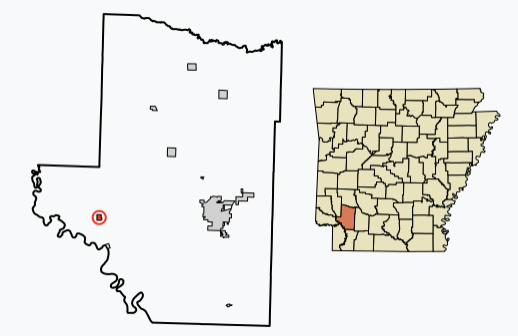
McNab, Ark., and Hempstead County
(Wikipedia map)
McNab, Arkansas, is one of the smallest places that lodged a complaint. The census showed the community went from 68 residents in 2010 to 30 people in 2020. "As a result, the city’s monthly revenue-sharing payment from Arkansas dropped to less than $209 from about $457 last year," Henderson reports. But Mayor James Conway told Henderson that count was wrong; he went door to door and counted 45 people.

Some of the incorrect counts can't be verified door-to-door, but a new tool from the bureau "allows state and local officials to flag errors in counts of people living in institutional settings such as college dorms and prisons. Cities and states have only until April 21 to submit comments on the plan and can submit possible errors for review between June of this year and June 2023," Henderson reports. "The new plan has drawn 34 detailed complaints from cities, states and their advocates, many asking for a way to correct errors that should have been picked up during review processes that were canceled because of the coronavirus pandemic. The new program will help fix institutional counts for future estimates, which the bureau issues annually between its full census each decade. Any corrections won’t, however, affect official counts used for redistricting."

The National Urban League (which sued to stop an early end to the count) is calling for a thorough review that includes more than institutions. Senior 2020 census adviser Jeri Green told Henderson that the bureau "should not place all the burden of getting the count right on elected officials, many of whom don’t have the resources or technical capabilities to challenge their count."