A digest of events, trends, issues, ideas and journalism from and about rural America, by the Institute for Rural Journalism, based at the University of Kentucky. Links may expire, require subscription or go behind pay walls. Please send news and knowledge you think would be useful to benjy.hamm@uky.edu.
Sunday, May 29, 2022
Publisher of Uvalde weekly explores two big unanswered questions about the massacre, and one with no answer
In Uvalde, some who own guns favor a higher legal age to buy them, and other measures; so does the local weekly
| Front page of today's twice-weekly Uvalde Leader-News |
| Back page of the front section and front page of the second section, with editorial and letters |
Saturday, May 28, 2022
Twice-weekly paper in Uvalde found its niche in what rural journalism can provide: context, comfort and community
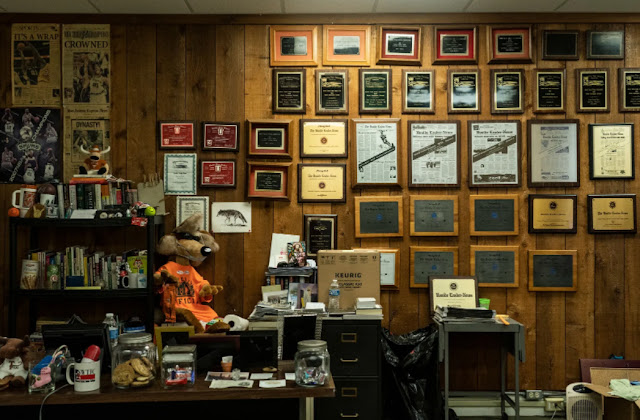
| The newsroom of the Uvalde Leader-News; the city has 15,000 people and Uvalde County has 25,000. (The New Yorker) |
How does a twice-weekly newspaper handle a tragic evil of national proportions that left one of its reporters with a dead child? By providing “context, a source of understanding, and hand-holding, and healing,” Craig Garnett, owner and publisher of the Uvalde Leader-News, told New Yorker contributing writer Rachel Monroe, who covers Texas and the Southwest for the magazine.
![]() |
| Front page of the May 25 edition |
| Craig Garnett |
Friday, May 27, 2022
Suggestions for localizing this week's big national story, and a look at how effective gun laws have been or might be
There is plenty of reporting to be done localizing the massacre in Uvalde, Texas. And Buffalo, N.Y. Consider initially documenting trends in three areas:
Gun ownership and gun purchases: Lots to consider. Start with what percentage of local households and commercial establishments own guns. If you want one focus, analyze statistics on the type of guns -- "assault rifle," long guns, or those that fire large amounts of bullets in short periods -- that were used in the New York and Texas mass shootings. Another focus: Guns being bought by individuals age 21 and under.
Mental health and treatment: If you want one focus, report how many people have been identified as threats and what happened after the initial inquiry. Explain how local authorities treat reports of dangerous individuals, antisocial behavior, or people in danger. Also: Describe in numbers your community's safety net to treat mental illness.
Deaths and injuries involving guns: Compare and contrast with other causes of death and injury.
If possible, analyze over the last 10 years. A narrower range could be the pandemic years as we are learning the dangers of prolonger isolation.
Added starter: Crime reports involving incidents on school properties.
In all efforts, stick to the facts. Run counter to today's "opinion first, facts later." Godspeed on such important, relevant coverage.
Southern Baptist Convention publishes full sex-abuse report, including a database of alleged abusers
In a bid for greater transparency, the Southern Baptist Conference's Sexual Abuse Task Force has published online an independent report detailing how its leaders protected pastors and local church staff accused of sexual abuse while ignoring, pressuring and trying to discredit sexual-abuse survivors.
The report includes the database of alleged abusers, along with links to news articles and other details. However, a note at the top cautions that the list is incomplete, has not been proofed or adequately researched, and is not always specific to Southern Baptists. Some names and other details have been censored, possibly to preserve the privacy of minors.
In a press release accompanying the report, the task force called on other Southern Baptists to heed the report's findings and care for abuse victims as well as "provide a culture of accountability, transparency, and safety as we move forward."
The task force called for specific reforms:
- The next SBC president should create a task force to ensure reforms are implemented.
- The Executive Committee should hire experts to work with victims and train state conventions on how to respond to abuse allegations.
- All SBC boards and committees should undergo background checks as part of the selection process, and should and receive training on sexual abuse prevention and survivor care.
- All SBC-affiliated seminaries should teach staff and students about sexual abuse prevention and survivor care.
- The Executive Committee should budget for and hire a salaried staffer for the SBC's Credentials Committee, which assesses whether churches are operating within SBC standards of faith and practice.
Groundwater group urges owners of water wells to prepare for drought by getting their systems inspected
![]() |
| Map by University of Nebraska-Lincoln, adapted by The Rural Blog; for details, click here. |
Private water well owners should prepare for extreme drought, the National Ground Water Association urged recently.
- Have your water well inspected by a certified water well contractor. Wells that are not operating correctly will waste water and are more likely to completely fail during prolonged periods of drought. An inspection can help locate current and potential problems with a system before they become serious issues.
- Test your well water. There has been growing evidence that lower water tables, deeper wells, and extreme drought have led to higher levels of contaminants in groundwater. These contaminants can typically be easily identified and treated with a simple water quality test.
- Test your water levels. Declining water levels can impact not only the mechanics of your well but also water quality. A simple water level test can help determine what service may or may not be needed.
- Conserve water, fix leaks, and utilize water-efficient technology. By properly conserving water, fixing leaks, and utilizing more efficient water technology, you can help ensure your water levels remain healthy for you and your neighbors.
- Don’t delay. Due to ongoing drought, supply chain issues, and national labor shortages, well owners are seeing longer than usual wait times for service. If it has been more than a year since your last water well inspection, we urge well owners to reach out today to a certified contractor.
Fact Check explains why and how infant formula is being sent to children of undocumented immigrants at the border
USDA to invest $770 million to help rural businesses in 36 states with job training, technical assistance and more
Quick hits: Black farmers' debt-relief controversy illustrated; Sinclair boss says political division is good for his business; FCC chair: school buses should get pandemic funds for wi-fi
![]() |
| Daily Yonder illustration by Nhatt Nichols |
Thursday, May 26, 2022
75% of rural counties have no or few mental-health care providers, and Texas is worst off; see interactive map
![]() |
| Mental-health care access by county. ABC News map; click the image to enlarge it or click here for the interactive version. |
Why does U.S. have a unique problem with guns, and why can't we fix it? Look to our rural history and federal structure
![]() |
| Today's front page of the local twice-weekly newspaper |
![]() |
| The paper's stories begin on the back page. |
As usual, a mass shooting spawns false rumors; if they get traction in your area, consider debunking them online
The AP reporters note, "In some cases, misinformation about mass shootings or other events are spread by well-intentioned social media users trying to be helpful. In other cases, it can be the work of grifters looking to start fake fundraisers or draw attention to their website or organization. Then there are trolls who seemingly do it for fun. Fringe online communities, including on 4chan, often use mass shootings and other tragedies as opportunities to sow chaos, troll the public and push harmful narratives, according to Ben Decker, founder and CEO of the digital investigations consultancy Memetica."
Rural Assembly Everywhere recorded sessions posted; see sessions on book bans, food security and more
- A discussion on book bans and intellectual freedom, featuring residents of McMinn County, Tenn. The community was thrust into the national spotlight after its school district banned the graphic novel "Maus."
- Remarks from Interior Secretary Deb Haaland.
- Remarks from Agriculture Department Undersecretary for Rural Development Xochitl Torres Small.
- Small farmers discussing food democratization.
- A discussion about apprenticeship opportunities for rural and Native American youth.
- Nonprofit Welcoming America hosting a conversation on building welcoming communities. The discussion will feature three female leaders from diverse backgrounds in Nebraska who will share their journeys to "build stronger connections between immigrant and non-immigrant communities, fight against divisive rhetoric, and ensure that inclusive policy is the norm in their communities."
- YouTube social and political commentator Justin King of "Beau of the Fifth Column."
- Neema Avashia, author of "Another Appalachia: Growing up Queer and Indian in a Mountain Place."
Federal Trade Commission probes whether formula makers and distributors illegally limited supplies in rural stores
At President Biden's request, the Federal Trade Commission began investigating formula manufacturers on Tuesday to discover their role in the nationwide shortage. The investigation will focus on whether corporate mergers contributed to the shortage by reducing competition, and whether manufacturers and distributors illegally kept formula from going to smaller retailers in inner-city and rural areas, Spencer Kimball reports for CNBC. "The FTC also asked the public to submit comments to a federal website about whether any state or federal agencies may have accidentally taken actions that contributed to the shortage."
"Discriminatory terms and conditions can exacerbate the inability of some grocers, pharmacies, and other stores to source products in short supply, impacting both rural and inner-city communities in particular," FTC Chair Lina Khan said in a statement Tuesday.Wednesday, May 25, 2022
Rural schools are more at risk for mass shootings, and need more mental-health care; Uvalde has been seeking a clinic
![]() |
| Uvalde County, Texas (Wikipedia map) |
The Uvalde shooting also highlights disparities in rural mental-health care. Friends and acquaintances of Ramos said he was relentlessly bullied and dealt with mental-health issues and "had a fraught home life as a child," The Washington Post reports. Before going to the school, he shot his grandmother in the face; she called police.
As a recent series by The New York Times highlighted, mental-health care can be difficult for rural teens to access. And though experts don't know whether bullying is more pervasive in rural communities, they say the small size of the community can make it harder for bullied students to cope. Republican U.S. Rep. Tony Gonzales, who represents the area, told CBS News that he has been working with the Republican mayor of the City of Uvalde and the Democratic county judge of Uvalde County to find money to build the city's first mental health clinic.
USDA data: Foreign ownership of rural land has nearly tripled in past decade, to 10.9 million acres from 4.1 million
![]() |
| Acreage of foreign-owned cropland (including forests and pastures) by county. (USDA data mapped by The Daily Yonder for the Midwest Center for Investigative Reporting; click the image to enlarge it or click here for the interactive version.) |
"Foreign investment in U.S. cropland has nearly tripled in the past decade, according to U.S. Department of Agriculture data. The total cropland controlled by foreign interests in 2020 was 10.9 million acres, up from 4.1 million acres in 2010," Jonathan Hettinger reports for the Midwest Center for Investigative Journalism. "This increase has been largely driven by foreign-owned wind companies signing long-term leases on a large number of acres, according to the USDA. However, 'the acres actually utilized by said companies are very few due to the small footprint of the wind towers erected on the land,' a USDA report said."
Biden police-reform order will create national registry of fired officers, discourage no-knock warrants and more
New laws could save Americans from more than 12 million surprise medical bills this year
Tuesday, May 24, 2022
Southern Baptists reeling in wake of sex abuse report; it's an opportunity for local action and local coverage
The report shows how SBC leaders used the denomination's decentralization to avoid accountability; an alleged abuser could simply pull up stakes and move elsewhere to preach, secure in the knowledge that Baptist leaders couldn't or wouldn't sound the alarm to local churches, which are autonomous and choose their own pastors.
Todd Gray, executive director of the Kentucky Baptist Convention, told his constituents in a letter today that when he read the report, "The Lord led me to pray for sexual-abuse survivors in a way I never had before." Gray noted that in November, the convention established a Sexual Abuse Task Force that was designed to be preventive "rather than investigatory," but Guidepost Solutions, which wrote the SBC report, "has requested many of our internal policies and will help us discover if there are gaps where we can better guard against sexual abuse."
Fentanyl drove record number of drug-related deaths in 2020; teens often score the pills on social media
![]() |
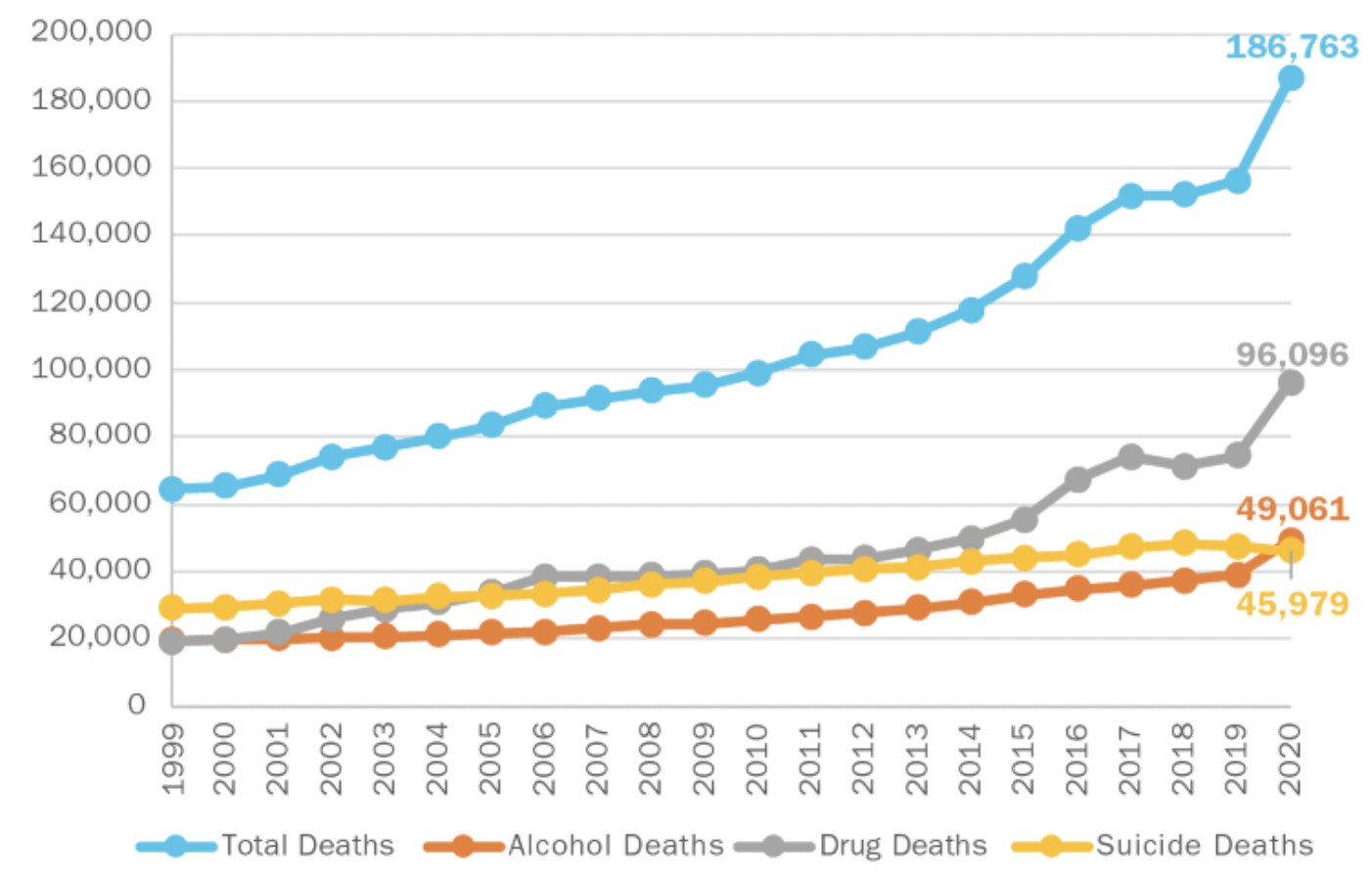
| Annual deaths from alcohol, drugs and suicide in the United States, 1999-2020 (Chart by Trust for America's Health and Well Being Trust; click on the image to enlarge it.) |
So-called deaths of despair—those related to alcohol, drugs, and suicide—hit an all-time high in 2020, claiming the lives of nearly 182,000 Americans, according to the Trust for America's Health and Well Being Trust. The 2020 total is 20 percent more than 2019, and mark the highest number of substance-misuse-related deaths recorded in any year; 2020 was dominated by the pandemic.
Telehealth is the future of rural health care, CEO of the National Rural Health Association says at telehealth meeting
Telehealth could be the key to rural healthcare's future, but stakeholders must figure out how to remove barriers to access, said Alan Morgan, CEO of the National Rural Health Association, at the Department for Health and Human Services' National Telehealth Conference.
During a panel discussion, Morgan said many rural health-care providers lack consistent, affordable broadband access, and that many don't know that telehealth services are available or how to use them, Katie Adams reports for MedCity News. He called the rural-urban access gap "beyond frustrating" and called on the health-care industry to stop studying whether telehealth helps rural patients. That question is settled, he said; instead, the industry should focus on identifying and removing barriers to access.
Morgan "and fellow panelist Ann Mond Johnson, CEO of the American Telemedicine Association, said communication about telehealth can be improved through partnerships with local organizations and community leaders, as patients are more likely to trust these messengers and heed their messages," Adams reports. "This need for programs designed to scale rural patients’ telehealth use is especially dire as healthcare’s workforce crisis intensifies . . . NRHA says the patient-to-primary care physician ratio in rural communities is 39.8 physicians per 100,000 people, compared to 53.3 physicians per 100,000 in urban communities, a disparity that is exacerbated by the country’s ongoing shortage of health-care workers."
Coal prices surge as Europe boycotts Russian gas, but it won't likely help U.S. mining much; Appalachia an example
Women, trust your gut if you suspect a stroke; how to judge
- sudden loss of limb control
- loss of vision
- difficulty speaking
- drooping of one side of the face
- difficulty reading
- double vision
- trouble balancing
- tingling in the limbs
- F: Face drooping. Does one side of the face droop, or is it numb? Ask the person to smile. Is the person's smile uneven?
- A: Arm weakness. Is one arm weak or numb? Ask the person to raise both arms. Does one arm drift downward?
- S: Speech difficulty. Is speech slurred?
- T: Time to call 911.
Monday, May 23, 2022
How do rural communities sustain journalism that supports democracy? Summit on rural journalism will seek answers
Director and Professor, Institute for Rural Journalism and Community Issues, University of Kentucky
Putting local philanthropy in your business model: Nathan Payne of Kaiser Health News, recently editor of the Traverse City Record-Eagle, on how community foundations can help; Jody Lawrence-Turner of the Fund for Oregon Rural Journalism; and Dennis Brack of the Rappahannock News, Washington, Va., which uses local philanthropy for polling and reporting projects.
Converting your newspaper(s) to nonprofit status: Liz and Steve Parker, former owners and still operators of the New Jersey Hills Media Group, on their recent conversion to the nonprofit Corporation for New Jersey Local Media.
Good journalism is good business, but how do we make people want local news? Editor-Publishers Marshall Helmberger of the Timberjay, Tower, Minn.; and Sharon Burton of the Adair County Community Voice, Columbia, Ky.
How two community newspapers are adapting to change: Publishers Bill Horner of the Chatham (N.C.) News+Record and Terry Williams of the Keene (N.H.) Sentinel.
Innovation at other community newspapers: Tony Baranowski, Iowa Falls Times-Citizen, with Jim Iovino, director, NewStart, West Virginia University.
National funders and supporters on help for rural journalism: Jason Alcorn, vice president for learning and impact, American Journalism Project; Jonathan Kealing, chief network officer at the Institute for Nonprofit News; and Elizabeth Hansen Shapiro, Columbia University, co-founder, National Trust for Local News.
New business models for community newspapers, and a plan to test one: Dr. Teri Finneman, University of Kansas, who says many rural newspaper subscribers are willing to buy memberships and e-newsletters to keep their local papers healthy. (Read more)
What other research is needed to help community journalism? Bill Reader, Ohio University, and Clay Carey, Samford University, author of The News Untold: Community Journalism and the Failure to Confront Poverty in Appalachia.
Concluding roundtable, open-ended and led by Institute Director Al Cross and Jennifer Greer, dean of the University of Kentucky College of Communication and Information, sponsor of the Summit.
Researcher testing new business model for community newspapers among speakers at rural journalism summit
![]() |
| Dr. Teri Finneman |
Publishers might be surprised to hear that 40 percent of small-town newspaper readers in a Great Plains survey by Finneman and her research partners (Pat Ferrucci of the University of Colorado and Nick Mathews of the University of Missouri) said they would be very likely or likely to donate, in addition to subscription costs, to support their local paper.
The model developed by Finneman, Ferrucci and Mathews includes memberships in which readers can get different levels of benefits. "The model will also work to engage community members, especially young residents, and focus on preferred reader content," the news release says.
The model will be tested at Joey Young's Kansas Publishing Ventures, which has Harvey County Now in Newton and the Hillsboro Free Press and will get $10,000 to participate in the experiment. “Just knowing Joey and the team there, there’s a lot of enthusiasm, there’s a passion for journalism and there’s a willingness to try, that isn’t there with many other places,” Finneman told Harvey County Now.
The newspaper's story said, "Harvey County Now hopes its participation in the project will present findings that can help other news organizations build strong and sustainable local newsrooms and enjoy some of the success the publication has had."
New report has shocking details about cover-ups of sex-abuse cases by leaders of the Southern Baptist Convention
Webinar tomorrow will discuss Federal Reserve Bank's new framework for advancing rural economic prosperity
![]() |
| The Federal Reserve's new book discusses its new framework for encouraging rural prosperity |
Speakers will discuss a host of specific issues:
- Ways to leverage natural assets to promote rural prosperity
- Strategies for investing in equitable resilience
- The need for more broadband investment
- Local collaborations between the health sector and community development
- Innovative case studies from France that use culture, nature, and innovation to revitalize smaller communities
Republicans still effectively control mine-safety commission, which seems not to be a priority for Senate Democrats
Friday, May 20, 2022
Trump administration's efforts to tilt the census may have cost states that voted for him seats in the U.S. House
According to a new Census Bureau report, the census significantly miscounted 14 states; in six, the counts are estimated to be off by 4 percentage points or more. "A trend you might notice if you peruse the data is that most of the states with significant overcounts were blue states like Hawaii (e.g., Delaware, Rhode Island, New York and Massachusetts), while most with undercounts were red, Southern states like Arkansas (e.g., Tennessee, Florida, Mississippi and Texas)," Blake notes.
That means that red states might not have received as many U.S. House seats as they should have during reapportionment, while blue states might have received more. So many factors are in play that it's difficult to estimate the exact impact of the miscounting, but it seems clear that blue-leaning states Minnesota and Rhode Island got to keep seats they should have lost, and red-leaning states Florida and Texas didn't get seats they should have gotten, Blake writes.
Blake notes that pandemic chaos could have contributed to the miscounts, as well as the fact that some undercounted states didn't do as much to encourage people to complete the census. He also notes that "adding a seat to a blue state doesn’t necessarily translate to a blue seat. That depends on how the maps are drawn in a particular state, given the distribution of population. The red-state undercounts mean those states could be deprived of billions of dollars in federal funding over the next decade, since much funding is calculated based on population counts, Reid Wilson reports for The Hill.