The ruling "also helps close out a Supreme Court term when the current justices’ increasing interest in claims of religious discrimination was on full display, with another 'church-state' case decided in religious plaintiffs’ favor just last week," Russo writes. "And on June 24, 2022, the court overturned Roe v. Wade. The debate over abortion is often framed in terms of religion, even though the court’s holding focused on other constitutional grounds."
A digest of events, trends, issues, ideas and journalism from and about rural America, by the Institute for Rural Journalism, based at the University of Kentucky. Links may expire, require subscription or go behind pay walls. Please send news and knowledge you think would be useful to benjy.hamm@uky.edu.
Wednesday, June 29, 2022
Supreme Court decision on football coach's post-game prayer is a game-changer, education-law expert says
The ruling "also helps close out a Supreme Court term when the current justices’ increasing interest in claims of religious discrimination was on full display, with another 'church-state' case decided in religious plaintiffs’ favor just last week," Russo writes. "And on June 24, 2022, the court overturned Roe v. Wade. The debate over abortion is often framed in terms of religion, even though the court’s holding focused on other constitutional grounds."
Health-care roundup: Providers in N.D. discuss challenges; regulations boosting telehealth expansion will expire soon
Here's a trio of stories about rural health care:
At a roundtable discussion Monday, rural health-care providers in North Dakota spoke to state and federal officials about the difficulties they face. Participants "cited workforce issues, regulations and rising costs as three challenges to provide services in rural areas," Masaki Ova reports for The Jamestown Sun. Officials in attendance included Sen. John Hoeven, R-N.D.; Xochitl Torres Small, the Agriculture Department’s undersecretary for Rural Development; and Erin Oban, her North Dakota director.
Rural hospitals had to adapt to survive during the pandemic, aided by federal funding. Some hospitals hope to keep some of those new capabilities, but may not be able to when the federal public-health emergency order expires—drying up funding with it.
Donald Lloyd, CEO of St. Claire Regional HealthCare system in Morehead, Ky., said the shift to telehealth is likely here to stay. "Before the pandemic, telehealth visits weren’t common at his hospital. Now telehealth visits account for nearly 20% of hospital visits," Liz Carey reports for The Daily Yonder. That goes especially for behavioral health, he said, since more than 80% of such visits to the hospital are via telehealth these days.
Speaking of telehealth: Relaxed regulations during the pandemic allowed health-care providers to more easily prescribe buprenorphine for opioid-abuse disorder. Studies have shown that telehealth prescription visits are at least as effective as in-person visits in keeping patients on their medication, but those regulations will expire along with the federal public-health emergency order. "That could come as soon as October, and the Drug Enforcement Agency, which has sought to clamp down on buprenorphine’s misuse, has already missed deadlines to facilitate virtual access," Krista Mahr and Ben Leonard report for Politico. "The expansion across sectors has been critical in rural areas, where access to licensed clinicians is scarce and social stigma runs high."
Election deniers mostly lose in GOP primaries Tuesday
![]() |
| Tina Peters (Associated Press photo) |
The epicenter was Colorado. "In races where the outcome was a tossup, election deniers fared poorly," reports Jesse Paul of The Colorado Sun. "Indicted Mesa County Clerk Tina Peters fared so poorly that she was slated to come in third in the Republican secretary of state’s primary to an Australian immigrant who lives in Yuma County and was making his first foray into politics. Peters, who claimed Tuesday night without evidence that she was the victim of election fraud, was even set to lose in her home county." The winner was Pam Anderson, "a former county clerk who previously led the state clerks’ association and defends the state's mail-in elections system," Steve Peoples of The Associated Press reports.
Also defeated in Colorado was state Rep. Ron Hanks, who "had also promoted lies about the last presidential election" and attended Trump's Jan. 6, 2021 rally, AP reports. He lost to Joe O'Dea, who now faces Democratic U.S. Sen. Michael Bennet. The Sun notes, "Tens of thousands of unaffiliated voters cast ballots this year in Colorado’s Republican primaries, far more than" in 2018,when more races were contested.
On the other hand, in a rural-Illinois contest of incumbents matched up by redistricting, "First-term Rep. Mary Miller, who campaigned alongside Trump over the weekend, defeated five-term Rep. Rodney Davis, who was considered more moderate," AP reports. "The primary victory all but ensures Miller will return to Congress for another term, given the heavy Republican advantage in her 15th Congressional District, which is the most Republican district in the state. Miller won just days after describing the Supreme Court’s reversal of Roe v. Wade as 'a victory for white life.' A spokesperson later said she had intended to say the decision was a victory for a 'right to life'."
Thursday webinar will review new federal resource package that is meant to address rural homelessness
The Rural Health Information Hub will host a free webinar at 2 p.m. ET Thursday, June 30, to discuss a new federal resource package meant to help rural communities address unsheltered homelessness. The webinar is free and is expected to last about an hour. Click here for more information or to register.
From the website: "The U.S. Department of Housing and Urban Development (HUD) recently released a first-of-its-kind package of resources to address unsheltered homelessness, with a unique opportunity for rural communities. This Initiative for Unsheltered and Rural Homelessness being made available by HUD strongly promotes partnerships with health care organizations, public housing authorities and mainstream housing providers, and people with lived experience and expertise of homelessness.
"This $365 million package will help communities pursue a public health approach and they can use this opportunity to coordinate and scale up efforts to sustainably solve unsheltered homelessness, create a unified approach with shared responsibility among local governments, homeless services organizations, health care providers and housing agencies."Existing Continuum of Care programs can apply, and see Appendix B of the Notice of Funding Opportunity for the rural areas that are eligible for the $54.5 million rural set aside. We encourage health partners to check to see if their area qualifies and connect with the CoC partners. These grants will fund projects for three-years, after which they will be eligible for renewal through the annual Continuum of Care (CoC) program competition."
Tuesday, June 28, 2022
Population and jobs outside metro areas were boosted by the remote-work surge during the pandemic, but will it last?
![]() |
| Graphs by The Wall Street Journal |
"Even in the face of inflation and the risk of recession, the broad economic prospects for rural America may be looking up for the first time in years," with a net gain in population of non-metropolitan counties from mid-2020 through mid-2021, "a sharp shift from the decade preceding the pandemic," report Sarah Chaney Cambon and Andrew Mollica of The Wall Street Journal.
| Another sign of the uptick: A website for the region north of New York City is starting a print magazine. |
The New York region may not be the best example "Big, dense cities are particularly susceptible to losing residents because they are expensive and employ the largest share of workers in jobs that can be done remotely in sectors such as finance, management and publishing, according to Princeton University economist Lukas Althoff and co-researchers," the Journal reports.
July 4 cookout may cost $10 more than last year's, biggest jump since Farm Bureau began tracking 10 years ago
![]() |
| American Farm Bureau Federation graphic |
New tool helps rural governments figure out what funding they can get from the $1 trillion infrastructure package
![]() |
| Screenshot of the Bipartisan Infrastructure Law Navigator tool |
Two convicted for rural-hospital lab-billing scam in 3 states
"Two Miami men were convicted Monday for conning vulnerable addiction treatment patients, rural hospitals and health insurance companies out of $1.4 billion in a health-care fraud scam that spanned Florida, Georgia and Missouri, according to authorities," Omar Rodriguez Ortiz reports for the Miami Herald. "Jorge Perez, 62, and Ricardo Perez, 59, were found guilty of conspiracy to commit health-care fraud and wire fraud, five counts of health-care fraud, and conspiracy to commit money laundering of proceeds greater than $10,000."
To help rural hospitals stay open, Medicare and some insurers reimburse them for laboratory services at higher rates. The defendants exploited that through Jorge Perez's company EmpowerHMS: "They promised to save the rural hospitals from closure by converting them into laboratory testing sites, but instead billed health-insurance companies for fraudulent laboratory testing worth hundreds of millions of dollars in a sophisticated and years-long billing scheme," Ortiz reports. "The plot made it appear that the rural hospitals themselves did the laboratory testing when, in most cases, it was done by testing laboratories controlled by others, the department added." When insurers began questioning the billings, the company would move on to another hospital and leave the one they had used for scams in the same or worse financial shape.
It's only the latest such scheme Jorge Perez has been involved in. A Kaiser Health News investigation in 2019 detailed how Perez and his company, EmpowerHMS, used hospitals in Arkansas, Kansas, Missouri, Oklahoma, Tennessee, and more to perpetrate billing scams. Most of the hospitals EmpowerHMS managed or owned have shut down.
Podcaster's rise and Colorado primary today illustrate increasing comfort with violent rhetoric on the right wing
![]() |
| Joe Oltmann (Photo: Olivia Sun, Colorado Sun/Report for America) |
Some Democrats are promoting Republican election deniers, thinking them easier to beat. "Democrats are behind some of the ads promoting more conservative Republican candidates for U.S. Senate, Colorado governor and the 8th Congressional District," Sandra Fish reports for The Colorado Sun. "The strategy has been criticized by some Democrats, who warn that it could backfire by raising the profile of election deniers and potentially adding fuel to their movement." The triangulating is spurring "a wave of campaign finance complaints and raising ethical questions about some of the political maneuvering," Fish reports.
Monday, June 27, 2022
New data on 'news deserts' coming Wed.; Abernathy says papers' recent closure/merger rate twice what she expected
![]() |
| Penny Abernathy of Northwestern previewed her research at the National Summit on Journalism in Rural America. |
“This is a crisis for our democracy and our society,” said Abernathy, visiting professor at Medill and the principal author of the report. “Invariably, the economically struggling, traditionally underserved communities that need local journalism the most are the very places where it is most difficult to sustain print or digital news organizations.”
The report will not be made available until the press conference. It will be published on the Local News Initiative site on June 29. This is the fifth update of the report since Abernathy first published it in 2016 at the University of North Carolina.
Despite billions in federal subsidies over more than a decade, many rural areas still await broadband internet
![]() |
| Maps by The Wall Street Journal; click on the image to enlarge it. |
"The U.S. government has spent billions of dollars on several rounds of programs to upgrade internet speeds in rural areas over the past decade. Despite those efforts, many residents are still stuck with service that isn’t fast enough to do video calls or stream movies—speeds that most take for granted," Ryan Tracy and Anthony DeBarros report for The Wall Street Journal. "Many communities have been targeted for broadband upgrades at least twice already, but flaws in the programs’ design have left residents wanting."
Early federal aid in the pandemic helped wealthy, urban hospitals far more than rural ones, Washington Post reports
In 2020, Congress authorized $178 billion in federal aid to help hospitals stay open. And while the money helped hospitals—many rural—stay afloat, data show that the funds "exacerbated the gap between the industry’s haves and have-nots, disproportionately rewarding wealthy hospitals that did not need the money as urgently," Christopher Rowland reports for The Washington Post. "Many institutions reported strong profits and pursued growth strategies without pause."
Rowland illustrates the phenomenon by contrasting the fortunes of a rural hospital in North Carolina and a larger regional hospital nearby. Randolph Health, a 145-bed rural hospital in central North Carolina, "declared bankruptcy in March 2020 and might have closed for good if it had not received $14.5 million in federal emergency pandemic grants. The cash didn’t cover all its Covid-related losses, but at least Randolph could make payroll," Rowland reports.
"The money flowing from Washington was barely enough to keep Randolph afloat — but those funds proved to be a windfall for Atrium Health, a regional nonprofit hospital chain headquartered in Charlotte. Atrium got $617 million in government relief from April 2020 to December 2021," Rowland reports. "The money, along with a soaring stock market and surging payments for patient care, helped it reap more than a billion dollars in surplus revenue last year. Atrium bulked up with two mergers and announced plans for a third during the pandemic. It boosted its CEO’s compensation by 24 percent, to $9.8 million."
A recent report from North Carolina's treasurer catalogued the hundreds of millions of dollars in federal aid given to the state's largest hospitals and contrasted it with their strong financial performance early in the pandemic. Treasurer Dale Folwell told the Post that the hospitals should have used the money for charity care, lower prices or even used reserves to cover pandemic costs and returned the money. But Cody Hand, a senior vice president of the North Carolina Hospital Association, told Rowland it would have put the "entire state bond rating in jeopardy" if larger hospitals had dug into their reserves to deal with increased demand.
"Now that the dust settles, we realize many hospitals got more than what they needed," said Ge Bai, a Johns Hopkins University professor of accounting and health policy management who advised the treasury department on the report.
Why did that happen? "The initial federal bailout formula, hastily put in place by the Trump administration to help hospitals cope with these burdens, bestowed a disproportionate share on wealthier hospitals. Distribution of the first $50 billion was calculated based on each hospital’s 2019 Medicare billings and 2018 overall patient revenue, including payments from private-insurance companies, which pay the highest rates," Rowland reports. "That put weaker safety-net hospitals, which serve higher numbers of uninsured people and low-income Medicaid patients, at a disadvantage. Medicaid typically pays hospitals less than Medicare and private insurance. Later distributions were tailored to favor hospitals hit with the most Covid patients, as well as those in rural communities and with large Medicaid populations. But those rounds of assistance were each smaller than the initial $50 billion, which automatically arrived in the bank accounts of hospitals and physician practices without even requiring an application."
Biden signs extension of pandemic waivers for school meals
Congress has passed and President Biden has signed a one-year, $3 billion extension of pandemic waivers for school meals. "Proponents said the extension would prevent 'a summer hunger crisis' and called for Congress to expand the school food program, rather than limit access," Chuck Abbott reports for the Food & Energy Reporting Network. "The extension allows free meals to all students this summer, increases the federal reimbursement rate to schools for each meal served and gives schools leeway throughout the 2022-23 school year in meeting nutritional standards for meals while they cope with supply shortages."
Thanks to federal aid, school meals have been free to all students since the beginning of the pandemic. But when classes resume in the fall, schools will return to the pre-pandemic system of serving free meals only to children from low-income households unless the school district has a different arrangement, Abbott reports.
Senate Agriculture Committee Chair Debbie Stabenow, D-Mich., "said she was disappointed by the removal, during Senate negotiations, of a provision that offered meals for free in the new school year for children who ordinarily would qualify for reduced-price meals. Revival of the reduced-price category allowed enactment of the extension before the current set of nutrition waivers expires on June 30," Abbott reports. "Elimination of the reduced-price category has been proposed periodically for years. About 6% of students fall into that category and pay up to 40 cents for lunch. Two-thirds of lunches are free to pupils from households with incomes below 130% of the federal poverty line. Children pay a reduced price for lunch if they are from households with incomes between 130% and 185% of the poverty line."Town with 1 resident illustrates depopulation of Great Plains
![]() |
| Elsie Eiler, standing, takes orders at the Monowi Tavern (New York Times photo by Alyssa Schukar) |
It's only a coincidence that Monowi, Nebraska, looks like it starts with Greek for "one." The name is reportedly a Native American word for "flower," but it's apropos; the town has only one resident.
In pictures and words, Alyssa Schukar of The New York Times paints a haunting, nostalgic portrait of Monowi and its last resident. Elsie Eiler, 88, still runs the Monowi Tavern 12 hours a day except Mondays. It's been in the family since 1971, but since Eiler has no successor, the last business in Monowi will likely shut down when she retires.
"The town continues to exist only because Mrs. Eiler files the required county and state paperwork every year. On top of bartending and cooking, she is the town’s mayor and tax collector," Schukar reports. Eiler told her, "The bar is the town, and I’m the town We’re all so intermeshed, you can’t quite imagine one without the other."| Wikipedia map of Boyd County, adapted |
Schukar explains the decline to urbanites: "Farm sizes have steadily grown in recent years, as larger, more efficient operations became better suited to survive the industry’s shift to a global market. Small family farms — once the backbone of the local economy — had to expand their operations or get out. Many got out. And without a way to make a living, generations of young people left for jobs in cities. Towns and businesses disappeared in their absence."
Friday, June 24, 2022
The rural impact, and more, of the end of Roe v. Wade
![]() |
| How the overturn of Roe v. Wade will affect abortion in the states Map by The Washington Post; click the image to enlarge it or click here for the interactive version. |
The Supreme Court overturned Roe v. Wade today, "touching off a cascade of anti-abortion laws that probably will take effect across roughly half the country," The Washington Post reports. "Without the landmark precedent in place, the national abortion landscape will change quickly. First, 13 states with 'trigger bans,' designed to take effect as soon as Roe is overturned, will ban abortion within 30 days. Several other states where recent anti-abortion legislation has been blocked by the courts are expected to act next, with lawmakers moving to activate their dormant legislation. A handful of states also have pre-Roe abortion bans that could be brought back to life." Lou Jacobson of Politifact has a state-by-state rundown.
Though most state legislatures have adjourned for the year, some governors have expressed interest in convening a special session to pass anti-abortion laws or remove anti-abortion laws already on the books, the Post reports. Here's a roundup with more on the watershed court decision:
The decision "will send shockwaves through the U.S. health-care system," including "thousands of unplanned births and thus the increased likelihood of maternal morbidity and mortality," said The Commonwealth Fund, a New York-based foundation that promotes a high-performing system.
Overturning Roe will likely increase births in rural areas and strain already stressed maternity services in rural hospitals, say experts. Read more here.
The poor will be most affected, says The Economist, and the rural poor even more so, since people with more time and money will likely travel to another state to get an abortion, says The Daily Yonder. Some firms said they would cover employees' travel for abortion, The Hill reports.
The rural impact is best seen in maps. NBC News has an interactive map showing the distance and time to the closest abortion clinic from all U.S. cities of more than 50,000. UPDATE: The New York Times has maps that show the distance for every county and how that changed in the hours after the decision and how it is likely to change soon.
Some states are cracking down on doctors' ability to prescribe abortion pills via telehealth and pharmacies' ability to distribute them through the mail. Read more here and here.
Some domestic violence survivors say abortion ban will trap many women with abusive partners. Read more here.
"Democratic county prosecutors, mayors and city council members in at least seven conservative states have vowed not to enforce strict abortion bans, arguing that their job is to protect, not harm, the public," reports Christine Vestal of Stateline.
Some editors and publishers at large news organizations are urging their employees to keep their views on abortion private, even on their personal social-media pages. Read more here.In Texas, which until recently had some of the most restrictive abortion laws in the nation, doctors worried about getting sued have delayed treating pregnancy complications until patients' lives were in danger. That could be a harbinger of the future elsewhere. Read more here.
Justice Samuel Alito wrote in the leaked draft of the majority opinion that pregnancy is no longer an economic burden since Americans now have guaranteed protection from pregnancy discrimination, guaranteed medical leave "in many cases," and medical costs that are covered by insurance or government assistance. That's not accurate, according to some experts, who say pregnancy and raising a child remain significant economic obstacles. Read more here.
Some Democrats have speculated that Native American tribes might erect abortion clinics on tribal lands to bypass state laws, but that's mostly coming from non-Natives. No tribes have advocated for such a thing thus far. Read more here.
Supreme Court curbs limits on the right to carry guns in public, as the Senate passes a bipartisan gun-violence bill
Though the overturn of Roe v. Wade is getting top billing in most news media, the nation's highest court issued another landmark decision this week.
"The Supreme Court ruled Thursday that law-abiding Americans have a right to carry a handgun outside the home for self-defense, issuing a watershed constitutional ruling against firearm restrictions as the nation reels from a spate of mass shootings and its political leaders are divided over how to curb such violence," Robert Barnes and Ann Marimow report for The Washington Post. "The court’s conservatives prevailed in a 6-to-3 decision that struck a New York law requiring a special need for carrying a weapon and puts at risk similar laws in Maryland, California, New Jersey, Hawaii and Massachusetts."Aspen paper's self-censorship, firing of editor, amid settlement with billionaire developer trigger local outcry
![]() |
| The Aspen Times office (Aspen Daily News photo) |
The trouble started when Swedish billionaire Vladislav Doronin, who was developing a controversial luxury hotel in Aspen, sued the Times for defamation a few months ago because he believed the paper's coverage of him falsely painted him as a "corrupt Russian oligarch," Shelly Bradbury reports for the Post.
The Times' upper management opted to withhold two opinion pieces that they worried might upset Doronin as the paper tried to negotiate a settlement. Top editor David Krause resigned shortly afterward, citing poor health and new management. New editor-in-chief and Times veteran Andrew Travers "published the columns along with a series of internal emails about why the articles had been killed," Tabachnik reports. "The Times’ publisher, Allison Pattillo, had supported his decision, Travers said. He said he only agreed to take the top job believing there would no further restrictions on what he could and couldn’t publish. But a day after publishing the columns and emails, they were removed from the Aspen Times’ website." Then Travers was fired, after less than a week on the job.
Roger Marolt, the writer whose columns had been spiked, promptly resigned, and the paper didn't run his farewell column. His columns will soon start running in the town's other daily, the locally owned Aspen Daily News. Travers and Marolt were only the latest exits under the Times' new owners, Tabachnik reports. "Ever since Ogden Newspapers out of West Virginia bought a chain of Colorado ski-town newspapers from Swift Communications in December, an accumulation of names has been sliding off of mastheads like a slow-moving avalanche," Corey Hutchins writes for Inside the News in Colorado.
Locals expressed alarm at news of the paper's self-censorship and praised the Aspen Daily News for reporting on the matter. One man wrote in a June 17 letter to the editor in the Daily News: "If Ogden is willing to censor our press and fire Andrew for allowing an important local columnist to question the motives of a new developer, who knows what they will do when the next billionaire in Aspen is not happy about his treatment by the local media? Hire Andrew back and keep The Aspen Times from becoming irrelevant. Hats off, Aspen Daily News ... for keeping it local."
During a May 24 city council meeting, Aspen's mayor blamed the tumult on outside ownership (The Times was last owned locally about 20 years ago): "I know that the leadership and the ownership of The Aspen Times may be out of town and not understand what is actually going on here, but I would hope that they spend a little bit more time looking into what the local affairs are and what this newspaper means to our community for information."Quick hits: House panel votes to keep firms from 4 hostile nations from buying farms; broadband boondoggle a caution
Here's a roundup of stories with rural resonance; if you do or see similar work that should be shared on The Rural Blog, email us at heather.chapman@uky.edu.
In a first-of-its-kind agreement, the Biden administration has signed a deal with five Native American tribes to give them more control over day-to-day management of federal land (Bears Ears National Monument in Utah). The deal marks "a new chapter in the federal government’s often-fraught relationship with tribes," Maxine Joselow reports for The Washington Post.
Despite threats of violence, an alpaca ranch in Colorado aims to be a refuge for LGBTQ+ Americans who long for the rural life they were sometimes obliged to leave. Read more here.
On Thursday the House Appropriations Committee voted to bar companies from Russia, China, North Korea and Iran from buying U.S. farmland. The provision will be included in the annual funding bill for the Agriculture Department and the Food and Drug Administration. Read more here.
The federal government paid out a record $41.6 billion in subsidies to farmers in 2020, twice as much as in 2018. Read more here.
Like it or not, climate change must be "front and center" in the crafting of the 2023 Farm Bill, write agricultural economists Harwood Schaffer and Daryll Ray in their latest column. Read more here.
Though the Trump administration launched a major initiative to bring broadband to rural America in 2020, many are still waiting; a Las Vegas-based company repeatedly fumbled after winning the right to deliver broadband in parts of 15 states. The situation serves as a cautionary tale as the federal government rolls out another expensive rural broadband program, The Wall Street Journal reports.
Pandemic roundup: Publix won't vaccinate kids under 5; even asymptomatic coronavirus infection can hurt a fetus
Thursday, June 23, 2022
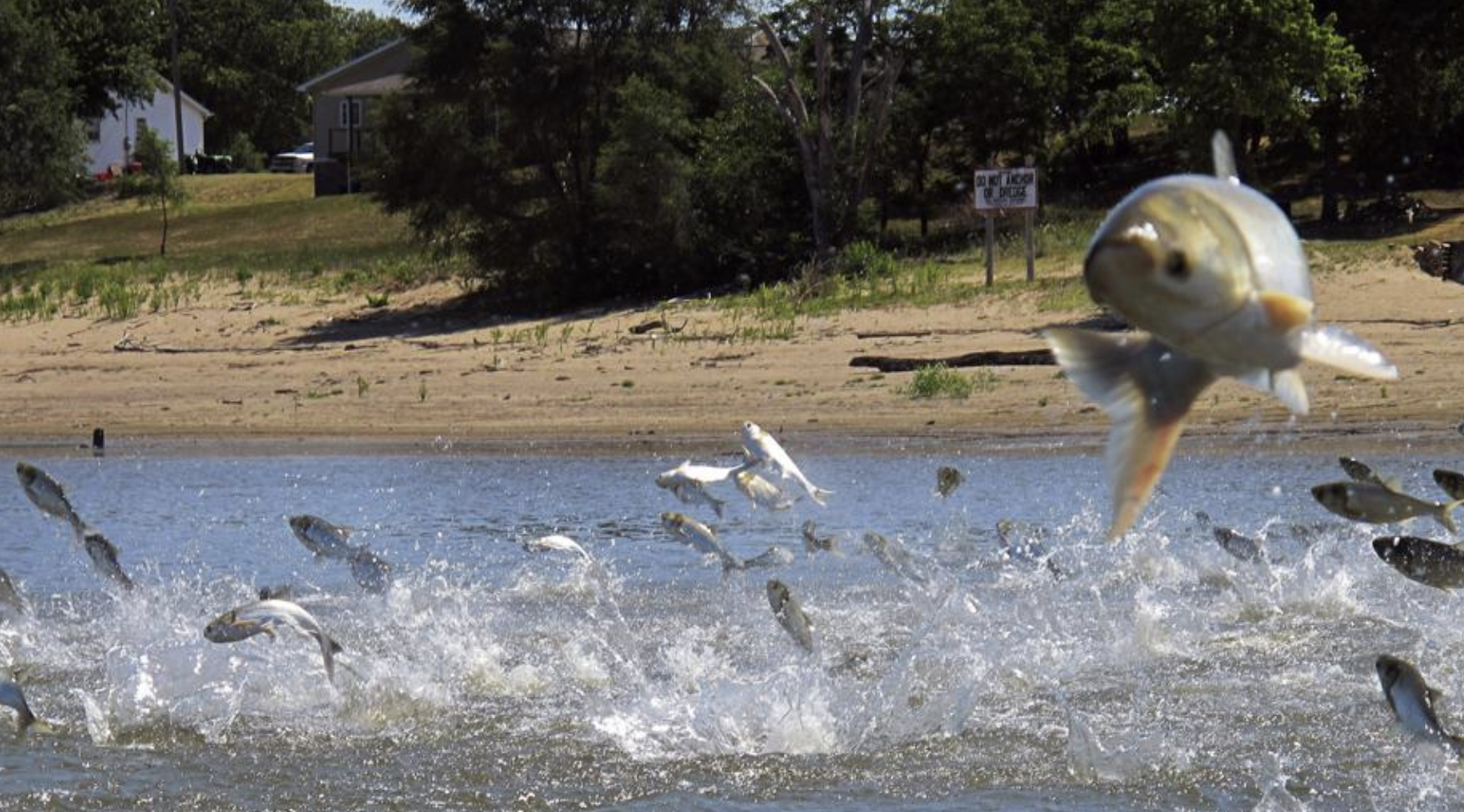
Invasive Asian carp get a new name, 'copi', to entice diners, but will they bite? And will the FDA approve the name?
![]() |
| Asian carp jump from the Illinois River after being jolted by an electric current. (Associated Press photo by John Flesher) |
You may have seen Chilean sea bass on the menu at a fancy restaurant. But the now-prized fish only landed on high-dollar menus after an enterprising fish wholesaler changed its name from the Patagonian toothfish and pitched it as a delicacy.
The State of Illinois is trying to do the same thing with Asian carp, an invasive fish that threatens ecosystems in the Mississippi River watershed. The state and partner organizations "kicked off a market-tested campaign Wednesday to rechristen as 'copi' four species previously known collectively as Asian carp, hoping the new label will make them more attractive to U.S. consumers," John Flesher reports for The Associated Press. "The federal Great Lakes Restoration Initiative is funding the five-year, $600,000 project to rebrand the carp and make them widely available. More than two dozen distributors, processors, restaurants and retailers have signed on. Most are in Illinois, but some deliver to multiple states or nationwide."
The name comes from "copious." State and federal officials have tried everything from fishing tournaments to bubbles and noisemakers to get invasive Asian carp out of U.S. waterways, but what to do with the captured fish has been an enduring problem. The fish show promise as pet food or fertilizer, and a processing plant in Western Kentucky exports carp to Asian audiences, where it's a popular food. It could be an easy and abundant food source in the U.S., too, if more people were willing to try them. Flesher reports. "Officials estimate up to 50 million pounds (22.7 million kilograms) could be netted annually in the Illinois River between the Mississippi and Lake Michigan. Even more are available from the Midwest to the Gulf Coast."
The state will seek approval from the Food and Drug Administration, "which says 'coined or fanciful' fish labels can be used if not misleading or confusing," Flesher notes. "Other regulatory agencies and scientific groups have their own policies and might not make the switch. The American Society of Ichthyologists and Herpetologists and the American Fisheries Society have a committee that lists fish titles, including scientific names in Latin and long-accepted common names. The panel never adopted 'Asian carp' as an umbrella term for the invasive species. The U.S. Fish and Wildlife Service plans to stick with 'invasive carp' and the four individual names, as its focus is on managing and controlling their spread."
New rural Covid cases steady last week; metro death rate may be higher than rural for first time in over a year
![]() |
| New coronavirus infections, in ranges by county, June 14-20 Map by The Daily Yonder; click on the image to enlarge it or click here for the interactive version. |
New coronavirus infections in counties outside metropolitan areas stayed relatively steady during the week of June 14-20 while Covid-related deaths in rural counties fell by about one-third. One noteworthy trend: For the first time in over a year, the weekly death rate in metro counties was higher than that in rural counties, Tim Marema reports for The Daily Yonder. However, data was missing for Mississippi, which could skew the results.
"Rural counties reported about 61,100 new infections last week, down about 7% from two weeks ago. Metropolitan counties reported a 15% reduction in new cases, from 647,000 two weeks ago to 554,000 last week," Marema reports. "An additional 277 rural Americans died from Covid-19 last week, down from 433 two weeks ago. In metropolitan counties, the number of Covid-related deaths fell by about 20%, from 2,184 two weeks ago to 1,728 last week." Click here for more charts, regional analysis, and county-level interactive maps from the Yonder.
Natural-gas storage fields' faulty equipment leaks methane
"Infra" is Latin for "under," but "infrastructure" often seems to mean mainly things on the surface: roads, rails, runways, etc. People are aware of pipelines, sewers, etc., but they don't think about them because they don't see them. Most people are probably not aware of one of the largest elements of energy infrastructure: giant, deep underground caverns where natural gas is stored for later use. And most surely don't know that some of those storage fields leak the main component of natural gas: methane, a potent greenhouse gas.
Phil McKenna of Inside Climate News tells us about that with the help of Alex Rozier of Mississippi Today, and their object example is the Petal Gas Storage Field in southeast Mississippi, which "emits the greenhouse gas equivalent of 87,000 automobiles—more than any other gas storage facility in the United States." Created by watering a salt dome and pumping out the brine in 1951, it is in the first underground salt dome carved out for gas storage, and it is the leakiest. It's only the 41st largest storage field, but emits three and a half times as much methane as the next biggest leaker, also owned by Gulf South Pipeline and parent firm Boardwalk Pipeline Partners.
"Gulf South and Boardwalk have begun to curb emissions at the Petal facility, cutting them in 2020 by nearly 50 percent of what they were in 2019, a year when Petal’s emissions were more than five times larger than any other underground gas storage facility in the country. Boardwalk executives said they slashed emissions again, this time by 54 percent, in 2021," McKenna and Rozier report. "EPA has not yet verified Petal’s 2021 emissions. . . . The Petal facility’s emissions do not violate any state or federal laws, but they call into question the ability of the oil and gas industry to voluntarily curb its own climate pollution. Emissions from the transmission and storage sector account for approximately 25 percent of the total methane emissions from the natural-gas industry. A draft rule proposed by the EPA last November includes what would be the first mandatory methane emission reductions for existing gas transmission and storage facilities."
The Federal Energy Regulatory Commission says methane is not toxic, but health experts say it is often accompanied by volatile organic compounds and toxic gases. Petal Alderman Gerald Steele, whose ward includes the gas field, "expressed surprise that the Petal plant’s emissions were the highest from such facilities in the nation," Rozier and McKenna report. "He said that the company is an important financial contributor to the city through its employment and tax contributions." The reporters say the leaks come from faulty equipment, not the geology of the infrastructure, and their story has useful diagrams that explain.Editor-publisher 'sees more than a headline;' Rotary Club reporter sees a hard worker who's looking for 'the best successor who will keep our community lifeline going'
| Laurie Ezzell Brown |
Wednesday, June 22, 2022
The politics of gun control: Senators for bill say calls run in favor of it, but most are insulated from voters' retribution
America's 'cowboy poet' Baxter Black dies at 77
![]() |
| Baxter Black performs in 2010 (Getty Images) |
Black was born in Brooklyn, but grew up in Las Cruces, N.M. He competed in rodeo through high school and college, and graduated from veterinary school in 1969. He was a practicing vet through the mid-1980s as he honed his skills as a poet and public speaker at Future Farmers of America functions, Neff reports.
"Black's first column was published in Colorado's Record Stockman in 1980. Several years later, he made his way to public radio," Rachel Treisman reports for NPR. In the mid-1980s, NPR played a recording he sent in of his poem about wildfires in Yellowstone National Park. Listeners loved the poem, and Black went on to offer commentary for "Morning Edition" for the next two decades.
"When he wasn't on the air, Black spoke at conventions and events across the country, appeared on television programs including "The Tonight Show with Johnny Carson," wrote a weekly column and published and recorded audiobooks — of which Ag Daily says he sold more than a million," Treisman reports. "His column, "On the Edge of Common Sense," was published by more than 100 newspapers across the U.S. and Canada over the years."Supreme Court lets stand verdict against Bayer for failing to warn users about the cancer risks of Roundup
The plaintiff, Edwin Hardeman, sued Bayer after he was diagnosed with non-Hodgkins lymphoma, saying that habitual use of Roundup caused his cancer, and that the company had failed to warn users of the cancer risks associated with key ingredient glyphosate, Marimow reports.
Chuck Abbott reports for the Food & Agriculture Reporting Network that the ruling won’t be "the final word in the company’s attempts to shield itself from lawsuits alleging its weedkiller causes cancer. Another Bayer appeal was pending before the Supreme Court and the company suggested a case being heard by an appeals court in Atlanta could be the third."
The ruling is another blow to Bayer; last week a U.S. appeals court ruled that the Environmental Protection Agency didn't have enough evidence in 2020 to rule that glyphosate doesn't cause cancer. EPA "has repeatedly concluded that glyphosate is unlikely to cause cancer in humans," Marimow reports. "California’s labeling laws are more stringent. After an international research group classified glyphosate as 'probably carcinogenic to humans' in 2015, the state required a warning label for glyphosate-based herbicides. The classification prompted a spate of lawsuits against the manufacturer of the nation’s most widely used weedkiller."