Friday, January 10, 2025

Rural schools funding bill fails in the U.S. House. The loss will 'create needless pain for rural communities.'

Superior High School in Mineral County, Montana. The county received nearly $900,000 in 2024
from the Secure Rural Schools bill. (Photo by Darrell Ehrlick, the Daily Montanan)

A lack of support in the U.S. House to fund a 20-year-old program will leave rural schools in 41 states without vital money. Western states will likely feel the pinch first. "For years, the Secure Rural Schools and Community Self-Determination Act has sent hundreds of millions of dollars to counties with federal land within their borders," reports Alex Baumhardt of The Daily Montanan. "In the West, the money has largely helped keep county and school budgets whole following reduced logging and a reduction in timber revenue."

Although the Senate reauthorized the bill in November, the House failed to find a compromise to keep the bill funded, and it died without a vote. "Democrat Ron Wyden, who co-authored the original bill in 2000 said the failure to approve the money will create needless pain for rural communities," Baumhardt writes. "Idaho Sen. Mike Crapo, a Republican who worked with Wyden to get the bill passed in the Senate, said he shared Wyden’s frustration."

In Oregon, the bill's funding goes to 30 of the state's 36 counties and "typically pays up to $80 million a year for schools and roads in Oregon along with wildfire prevention and conservation work. . . . Oregon has received $4 billion in funding from the bill in the last 24 years," Baumhardt reports. Other states also have received healthy chunks of support. In 2023, "12 counties in Alaska received $12.6 million; 34 counties in Idaho got $25 million; 32 counties in Montana received $16 million; and 25 counties in Washington state received about $18 million."

As the ranking member of the Senate Finance Committee, Crapo plans to revive the bill in early 2025. "He said he’ll push for the bill when he’ll take the reins of the committee under Republican control of the Senate," Baumhardt reports. "Wyden, now Finance Committee chair who will become the ranking member in 2025, said he’ll be pushing for passage, too."

Farmer income declines and U.S. government disaster payments begin; roughly $9.8 billion will be paid out

Approximately $9.8 billion will be paid out to farmers.
(FAPRI and RaFF map via Farm Journal)
As some U.S. farmers tally thousands of dollars in losses, the federal government has responded with disaster aid checks. "America has long provided subsidies to its farmers, dating back to the 1930s as a way to tackle rural poverty when a quarter of the population lived on farms," reports Patrick Thomas of The Wall Street Journal. "Today, subsidies largely come in the form of insurance. . . . Direct cash payments, while at times controversial, have been used to bolster farmers during agricultural downturns."

U.S. farmers have coped with declining profits and high input costs for the past two seasons. "Net farm income declined 4% this year to $141 billion after falling about 20% last year," Thomas explains. "Weaker prices for commodities such as soybeans and wheat have weighed on farmers’ earnings after growers in the U.S. and elsewhere reared big crops, swelling supplies. Their costs for essentials such as fertilizer and equipment are also higher."

Farm income woes will likely continue in 2025. Thomas reports, "Some of the world’s largest grain shippers and pesticide suppliers are girding for a shrinking farm economy by cutting costs or laying off workers. . . . [The] financial pain on the farm comes after one of the ag industry’s strongest runs on record. . . . In Iowa, the top corn-producing state, farmland values decreased by 3% this year, breaking a five-year streak of rising prices."

President-elect Donald Trump's pledged tariffs on Mexico and China may also hit farmers in the pocketbook. Both countries are "major importers of U.S. crops," Thomas writes. Still, many farmers "believe that Trump's policies may benefit the agricultural economy. . . . In 2018 and 2019, during Trump’s first term, about $23 billion in taxpayer money was paid to farmers to offset the impact of trade disruptions."

The current farm bill extension through Sept. 30 includes "$9.8 billion in market relief payments for 20 covered crops," reports Jim Wiesemeyer of Farm Journal. "According to an analysis by the Food and Agricultural Policy Research Institute, the top 10 states based on estimated total payments for corn, soybeans, wheat, cotton, sorghum, rice, barley, oats, and peanuts are:
  • Texas: $963 million, primarily because of its status as the largest cotton producer
  • Iowa: $846 million, with strong support for corn and soybean farmers
  • Illinois: $790 million
  • Kansas: $787 million
  • Nebraska: $625 million
  • Minnesota: $616 million
  • North Dakota: $597 million
  • South Dakota: $497 million
  • Indiana: $400 million
  • Missouri: $391 million
To get more details on the American Relief Act of 2025, click here. To see the state and crop breakdown and what it means for U.S. farmers, click here.

Not enough child care spots pushes states to help care centers expand; some emphasis is on rural needs.

Helping child care centers expand means more
parents can stay on the job. (Adobe Stock photo)
The lack of available and affordable child care keeps many parents -- mostly women -- out of the U.S. workforce. The need for more spots has pushed state lawmakers to use novel strategies to help child care centers expand.

"Nationally, more than half of all Americans live in 'child care deserts,' and the need for child care is especially great among . . . low and middle-income families, families of color and families living in rural areas," reports Maggie Clark of Stateline. "A child care desert is a place where there are more than three children for every regulated child care spot."

The child care conundrum isn't just an issue for parents. The problem "costs the U.S. economy roughly $122 billion each year in lost earnings, productivity and revenue," Clark explains. "To create more child care slots and reduce prices, lawmakers are increasingly using economic development strategies to help child care businesses expand, similar to the support they’ve offered to attract and expand manufacturing facilities, technology startups or other types of businesses."

Advocates and lawmakers are particularly focused on addressing child care shortages in rural areas. Clark explains, "This year, Oregon is awarding its first batch of $50 million in grants and loans for new construction, expansion and renovation for child care businesses, with priority for child care providers in rural areas."

Lawmakers in Colorado, Nebraska, Oregon and Vermont had "local and state zoning regulations reviewed," Clark reports. They also "set up help centers where child care business owners can get help with navigating permitting and other business rules so that they can expand their businesses and care for more children, which will help more parents stay in the workforce."

States that are working to support child care businesses with infrastructure offerings that other sectors receive "send a powerful message that child care businesses and the people who operate them are valuable to their communities and economies," Clark writes.

Erin Roche, Vermont director of First Children’s Finance, which is helping the state administer its child care infrastructure grant program, told Clark, "It’s a lot about changing our cultural values of thinking of [child care centers] as businesses, and not just something little that mostly women do on the side."

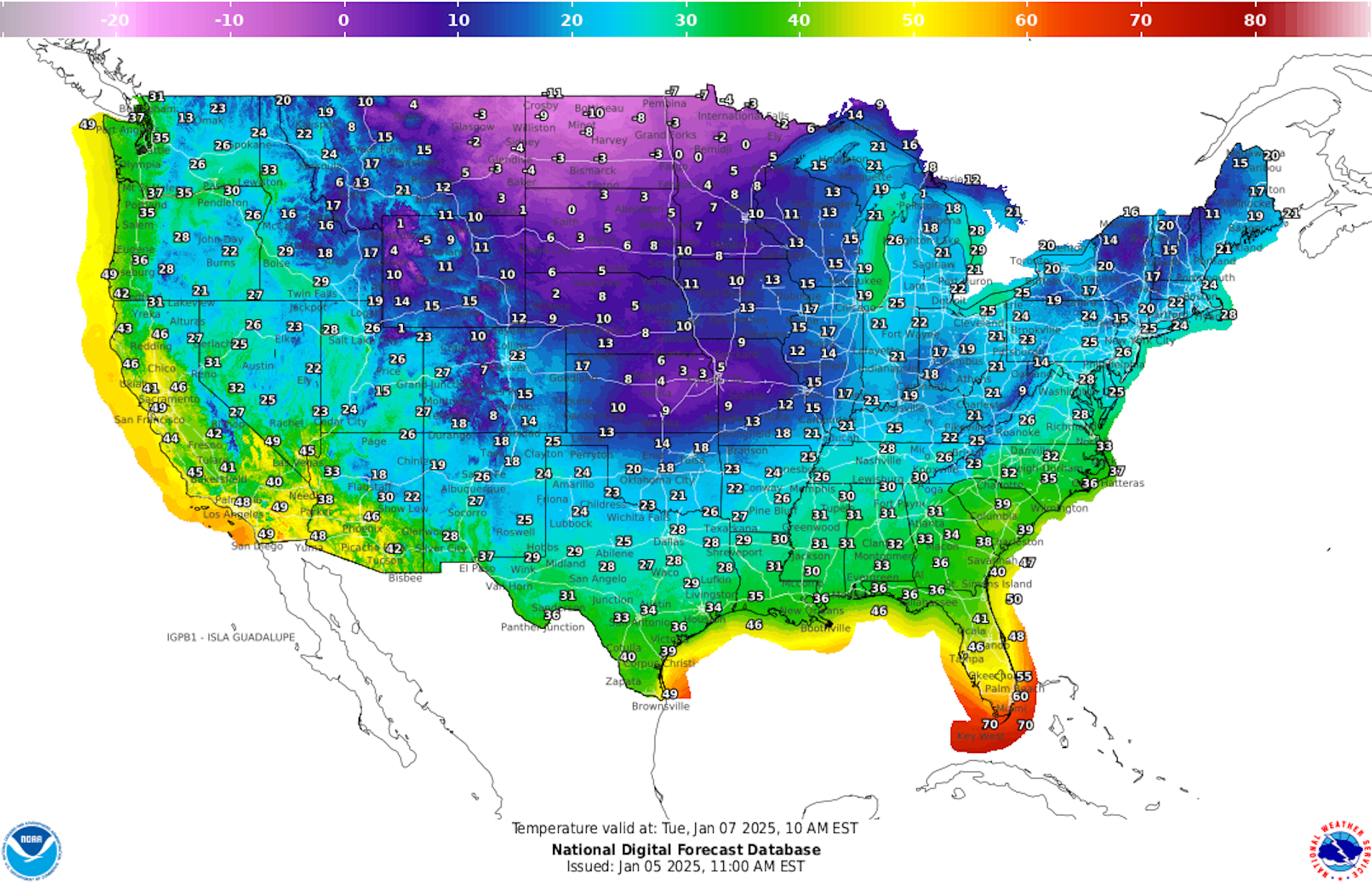
Is the weather really abnormally cold? That depends on which years are used as a baseline for 'normal.'

When winter fills the air with cold and bone-chilling gusts, and ice and snow bow down even the sturdiest looking of evergreen branches, it's easy to think that the weather is so much colder than normal. But is it? Using what's "normal" compared to what isn't normal can be confusing. "While temperature forecasts are important to help people stay safe, the comparison to normal can be quit misleading," writes Richard B. Rood for The Conversation. "That’s because what qualifies as normal in forecasts has been changing rapidly over the years as the planet warms."

Who determines what normal temperatures are? "One of the most used standards for defining a science-based normal is a 30-year average of temperature and precipitation," Rood explains. "Every 10 years, the National Center for Environmental Information updates these normals, most recently in 2021."

Over the past century, the planet's temperatures have increased. Rood writes, "Because global temperatures are warming, what’s considered normal is warming, too. So, when a 2025 cold snap is reported as the difference between the actual temperature and normal, it will appear to be colder and more extreme than if it were compared to an earlier 30-year average."

How U.S. temperatures considered normal have changed over the decades. Each 30-year period is compared to the 20th-century average. (NOAA Climate.gov graphic via The Conversation)
To get a better picture of our warming planet, "NASA scientists use 1951-1980 as a baseline," Rood explains, "The reason becomes evident when you compare maps. For example, January 1994 was brutally cold east of the Rocky Mountains. If we compare those 1994 temperatures to today’s normal – the 1991-2020 period – the U.S. looks a lot like maps of early January 2025’s temperatures: Large parts of the Midwest and eastern U.S. were more than 7 degrees Fahrenheit below normal, and some areas were much colder. . . . But if we compare January 1994 to the 1951-1980 baseline instead, that cold spot in the eastern U.S. isn’t quite as large or extreme."

Despite global warming, cold air outbreaks will continue, "but as the Arctic and the rest of the planet warm, the most frigid temperatures of the past will become less common," Rood adds.

Free virtual discussion covering infrastructure investment opportunities for distressed rural places on Jan. 15

Pipa will be joined by Prof. Stephens, right, for
 discussion on infrastructure in rural places.
Chronic underinvestment in infrastructure plagues distressed rural communities throughout the United States. And while several programs offer solutions specifically for distressed places, these communities have to know what's available and how to apply.

To help, Brookings is hosting a a free virtual session: "Unlocking infrastructure investment in distressed rural places," on Wednesday, Jan. 15, from 3:30 to 4:30 p.m. E.T. Get the details here.

The session will be led by Tony Pipa, the host of Brookings' "Reimagine Rural" podcast, who will be joined by West Virginia University professor Heather Stephens. The two will talk with leaders of the Appalachian Regional Commission (Gayle Connelly Manchin), Delta Regional Authority (Dr. Corey Wiggins), and Northern Border Regional Commission (Chris Saunders) on the insights offered by an upcoming report from Brookings that tackles the ins and out of investment in distressed rural places.

The experts will share their experiences and thoughts on the best practices for directing investment to distressed rural places.

Viewers can submit questions for speakers by emailing events@brookings.edu or via X (Twitter) @BrookingsGlobal using #RuralInvestment.

Tuesday, January 07, 2025

Syringe exchange programs meant to slow HIV's alarming spread in West Virginia limited by political resistance

Photo by R. Konkathi, Unsplash
Despite federal recommendations and community efforts to stem HIV infections among opioid or methamphetamine users in central Appalachia, the disease continues to spread. Harm-reduction advocates and medical providers cite resistance to syringe exchange programs as the primary obstacle, reports Taylor Sisk of KFF Health News. "The situation likely hasn’t improved, in part because of politicians who contend that such programs encourage illegal drug use."

In 2021, West Virginia's HIV outbreak was particularly concerning to officials from the Centers for Disease Control and Prevention. Sisk writes, "The CDC’s HIV intervention chief called it 'the most concerning HIV outbreak in the United States and warned that the number of reported diagnoses could be just 'the tip of the iceberg.'" 

Rural areas without substance disorder treatment or disease education present a ripe breeding ground where HIV can spread undetected. Ryan White HIV/AIDS Program Director Christine Teague "is concerned for West Virginia’s rural counties, most of which don’t have a syringe service program," Sisk adds. "Tasha Withrow, a harm reduction advocate in rural Putnam County, said her sense is that HIV numbers aren’t alarmingly high there but said that with little testing and heightened stigma in a rural community, it’s difficult to know."

Robin Pollini, a West Virginia University epidemiologist who conducts community-based research on injection drug use, told Sisk, “You would think that in a state that had the worst HIV outbreak in the country, we would have a statewide testing strategy." Sisk reports, "Teague would like every rural county to have a mobile unit. . . offering harm reduction supplies, medication, behavioral health care, counseling, referrals, and more."

While disease prevention through syringe exchange programs is well documented, the CDC's health warnings and recommendations for improved access to syringe exchanges have been largely ignored. Sisk reports, "In April 2021, the state legislature passed a bill limiting the number of syringes people could exchange and made it mandatory to present a West Virginia ID."

A made in the USA bicycle is in the works; maker hopes tariffs on Chinese imports will spur American production.

Guardian's USA-made children's bike is
still evolving. (Guardian graphic via WSJ)
Children’s bike maker Guardian Bikes moved its production from China to the U.S. intending to build its bikes with as many American-made parts as possible, reports Natasha Khan of The Wall Street Journal. The company's founder, Brian Riley, hopes "steep tariffs" on Chinese imports pledged by President-elect Donald Trump will make American-made bikes and parts more competitive.

Moving bicycle component production to the United States will still be tough partially because China has dominated the sector for decades. Riley knows the challenges and is still moving in that direction. Khan explains, "For now, components from China represent about 90% of the total cost of Guardian’s parts. By the end of next year, Riley hopes that figure will be about 20%. Guardian is starting production of its own bike frames. . . . As a result of Guardian’s new manufacturing, American-made parts could represent about 60% of the cost."

One of the reasons Riley moved his company to the United States was to build a "safer bike that could prevent the kind of head-over-heels braking accident that had injured his grandfather years earlier," Khan reports. "Many bikes sold at retailers such as Walmart or Target aren’t fully assembled when they are shipped to the retailers from overseas, so manufacturers don’t have oversight on the final assembly. Riley told Khan, "By controlling every aspect of production, we can guarantee the quality of every bike that rolls off our assembly line."

Riley admits that opening a U.S. factory was expensive and time-consuming. "At first, workers were slow to build the bikes, putting together 100 a day. It took time and constant tweaking of the assembly line to improve their speed and efficiency," Khan writes. Riley told her, "We had to bite the bullet. We had to be willing to lose money for a while to get to the other side of the strategy.”

The creation of Guardian's USA-made bike is evolving. "Guardian plans to begin making bike frames at the factory this year, using American steel. . . . Guardian is also considering making rims itself," Khan reports. "The bike maker has approached U.S. suppliers that could provide grips and reflectors."

Riley told Khan, "Everyone says making bikes here is impossible." Kahn adds, "His factory shows it isn’t."

Opinion: U.S. Postal Service should deliver mail, not profits. Privatization 'would be a nightmare for rural Americans.'

U.S. Postal Service history dates back to 1775. Its goal
was to deliver mail. (Photo by Joel Moysuh, Unsplash)
Postmaster General Louis DeJoy deployed plans to make the U.S. Postal Service profitable. But turning a profit isn't the point of mail delivery, write Tribune Phonograph editorial members Kris O’Leary and Brian Wilson. Service is the heart of the USPS, and its lack significantly impacts rural areas.

"The U.S Postal Service should focus on delivering the mail, not delivering a profit," they write. "Privatization of the postal service has been a dream for some who see the opportunity for profit, but it would be a nightmare for rural Americans who would see service cuts, additional delays and increasing costs. These would disproportionally impact rural residents simply due to the economics of having fewer potential customers over a wider area."

In many business ventures, privatization "can be a wonderful thing. . . . . It can bring about innovation. . . and the adoption of new efficiencies," O'Leary and Wilson add. "In a recent interview, President-elect Donald Trump broached the idea of revisiting privatization of the postal service as a potential goal. . . . Trump’s comments come at the same time that Postal Service leadership is under increased bipartisan scrutiny for spiraling increases in rates and ever-diminishing service standards."

In a December congressional hearing, members berated DeJoy for failing to meet service benchmarks and repeated upgrade delays. "Georgia Rep. Rich McCormick, a Republican, lambasted DeJoy," the editorial board writes, "leading to DeJoy covering his ears during the hearing." DeJoy defended his optimization strategies and said lawmaker interference could "end" the Postal Service.

However, profit-margin goals have little to do with the Postal Service's actual purpose. O'Leary and Wilson write, "DeJoy and other postal leadership have lost sight, if they ever had it, of the service that is at the core of the Postal Service. If DeJoy’s version of operational leadership and strategy were applied to highways, we would see interstates being turned into gravel roads."

If the U.S. postal service is privatized, its goal will become profits above all. "It will funnel off large city metro areas that can make money and drop rural areas that cover more land miles than people," O'Leary and Wilson add. "This is most of the U.S. population not living on either population-dense coast. The Midwest could lose any mail or package service if this becomes a reality. . ."

A historic first in Alaska may mean drilling in an untouched national refuge; Native Alaskans want a 'seat at the table.'

Map by Sarah Melotte, The Daily Yonder, from Bureau of Land
Management data. Click on map to enlarge.


Alaska’s Arctic National Wildlife Refuge is big, beautiful, and rich in natural resources and biodiversity. It has also been the "focal point of more than six decades of drilling controversy," which will come to a tentative resolution when tracts within the region's 19-million-acre expanse open for oil and gas leases this month, reports Sarah Melotte of The Daily Yonder. Native Alaskan communities want to be among the decision-makers for the coastal land that "is estimated to contain 11.8 billion barrels of recoverable oil."

Drilling in ANWR has never been done before. The region is home to "charismatic species like polar bears, wolves, and the caribou that are sacred to the Gwich’in, a Northwestern Alaska tribe," Melotte writes. "Oil and gas operations elicit mixed responses from Alaskan Natives. . . Some worry that drilling activity will hurt vulnerable wildlife and subsistence living, others say the oil and gas industry funds important infrastructure for their communities."

The coastal region, also known as the North Slope Borough, receives 95% of its total budget from oil and gas development taxation. Reservation members also depend on shareholder income regional corporations generate and pay out to Alaskan Natives. The Artic Slope Regional Corporation serves as an example. The company "has over 13,000 shareholders who receive dividends," Melotte notes. "Since its establishment in 1972, the ASRC has distributed more than $1 billion in dividends."

"Many leaders of the Iñupiat, an indigenous people native to Alaska’s North Slope Borough, say that oil and gas operations can be good for native communities if conducted responsibly," Melotte reports. Nagruk Harcharek, president of the Voice of the Arctic Iñupiat, a nonprofit organization that advocates for Alaska’s Iñupiat people, told Melotte, "Before oil and gas, you couldn't graduate high school and stay in the North Slope. Now there are K-12 schools in every North Slope village."

Harcharek used a past North Slope drilling project to help explain how Native Alaskans want to be included in drilling activity and practices. Melotte writes, "He said they were consulted 'early and often' in the decision-making process. . . . He said they want to be included before decisions are announced publicly."

Despite Alaska's rich natural resources, many Alaskan Natives live in poverty and still hunt for food, and drilling activities could interfere with their reliance on wild game. "Hunting is more than just a hobby in many native villages with high poverty rates," Melotte writes. "Hunting is a method of survival, said Dr. A.L. Lovecraft, professor of Political Science and director of the Center for Arctic Policy Studies at the University of Alaska. '[Drilling] also comes with all of this other baggage... Problems related to health, indoor health, indoor air quality, outdoor air quality.'"

Quick hits: Wallet-draining breakfast prices; the 'Walmart effect;' rural short story winner; bird flu stats; shouses

Photo by E. Aceron, Unsplash
Budget-busting beef with eggs and coffee breakfasts won't be cheaper anytime soon. "While commodities such as beef and eggs have long been volatile, others such as coffee have jumped in price more recently," report Patrick Thomas, David Uberti and Elizaveta Galkina of The Wall Street Journal. "Average prices for food at home rose in November by the largest annual pace in a year. . . . Store-bought ground [coffee] roasts have jumped 11% in price over the past year to an all-time high." In slightly less of a buzzkill, pork prices have remained steady, and "the average price of white bread is down around 3% over the past year."

Walmart's motto is "save money, live better," but oftentimes, that's not what happens to places after Walmart moves in. "New research suggests that the company makes the communities it operates in poorer — even taking into account its famous low prices," reports Rogé Karma for The Atlantic. "Walmart’s many defenders argue that the company is a boon to poor and middle-class families, who save thousands of dollars every year shopping there. . . .Two new research papers challenge that view." Read the research here.
Haworth's character, Michael, decides to venture home.
(Photo by Julian Scholl, Unsplash)

When one season of life ends, another begins -- or does it? Jeremy Haworth's short story "Blood Brother" explores Michael Riordan's path from retirement boredom to the uncertainty of going home. Haworth writes, "The sudden thought of home occurred to him. . . . Years had elapsed since he had crossed the threshold of the old farmstead. But the twinge in his chest told him time was shortening. The thought of death. . . an instinct to finally lay the ghosts of the past to rest. . ." Hadworth's story is the winner of the second annual “Best in Rural Writing Contest” presented by the rural literary journal The Milk House with support from The Daily Yonder.

The spread of bird flu or H5N1 in dairy cows has put many dairy farmers and consumers on edge. To help measure and mitigate the virus in cow herds, the Department of Agriculture rolled out mandated milk testing in December. The USDA is sharing its testing results with up-to-date graphics of confirmed bird flu cases, also called HPAI, found in U.S. herds. Over the past 30 days, testing found 182 new cases in two states. See the details here.

Shouses don't have to be small. This shouse is located in Okeana, a small unincorporated
community in rural Ohio. (Morton Buildings photo)

Rural landscapes have made room for country-living architecture that goes beyond barn-shaped homes and wood cabins. "Barndominiums" and "shouses" are dotting the countryside in surprising numbers. "Look carefully the next time you’re driving on the back roads of America, and you’re bound to spot a shouse — a hulking rectangular structure. . . . It could easily be mistaken for a machine shed," reports Dionne Searcey of The New York Times. "From the outside, shouses look a lot like the better-known barndominiums, or barndos for short. . . . It’s difficult to trace the genesis of shouses. . ."

'Fancy mechanic' Brienna Hall works for a company few have heard of doing work vital to maintaining all the tech in our lives. "The piece of equipment that the entire world has come to rely on — and Hall is specially trained to handle — is called an extreme ultraviolet lithography machine," reports Ben Cohen of The Wall Street Journal. "It’s the machine that produces the most advanced microchips on the planet . . . maybe the most remarkable thing about these invaluable machines is that they’re all made by the same company: ASML. . . . This one Dutch company is responsible for all of the EUV lithography systems that help make the chips in so many of your devices. Like your phone. And your computer. And your tablet. And your TV. Maybe even your car, too."

Friday, January 03, 2025

Goal-setting can be an important part of improving your news organization

Benjy Hamm
By Benjy Hamm
Director, Institute for Rural Journalism

January is a time when many people set new goals for themselves. There’s something about a new year or a milestone birthday that makes people think more about planning, goals and self-improvement.

Even if you’re not one to make personal New Year’s resolutions, you still should think about what goals you would like for your department or newspaper to accomplish in the coming year.

People who operate day to day -- or week to week as the case may be with weekly newspapers – often don’t take enough time to think about the larger, more important goals for themselves and their news organization.

In many years of working with newspapers and online news sites, I watched as the advertising, circulation and business departments set specific goals for each year and measured their performance against those goals. Newsrooms at larger news organizations sometimes did the same thing, but I found that journalists at smaller newspapers often were reluctant to set goals for various reasons.

The No. 1 reason they cited: News is unpredictable and priorities are determined by the news. Other times, journalists said they were uncomfortable with trying to measure goals for news coverage and other content, with fears of clunky story quotas or forced adherence to pre-determined plans.

Those concerns are understandable, but they should not lead to the alternative – no goal-setting or planning.

One of the primary differences between a good news organization and a great news organization is planning. Another key difference is the ability to set important goals and reach them.

When I worked at Landmark’s community newspaper division, we realized that many of the annual strategic plans from our newspapers left out the newsroom. So, we asked each newsroom to establish department goals that would lead to improvements for readers, the newspaper and online site, and the community.

The newsroom’s goals need to be tied to the overall goals of the organization. That seems obvious, but sometimes the newsroom’s goals conflicted with the goals of other departments. For example, one newsroom developed a plan to increase coverage of an adjoining community at the same time the advertising and circulation departments were reducing their efforts in that community because of poor sales.

That exposed a problem with internal communication, among other issues, but at least the fact that the newsroom wrote down its goals led to a fuller discussion about newspaper-wide strategies. And if you think that lack of communication only happens at larger news organizations, then you might be surprised to learn that it occurred at a smaller weekly newspaper.

Goals also need to be specific and, as much as possible, measurable. Everyone needs to understand how you will achieve your goals. A lot of businesses set goals based on the SMART concept – specific, measurable, achievable, realistic and time-specific. Using the SMART approach forces you to focus on the most effective ways to achieve your goals, such as clearly identifying the goal (specific), determining how you will know if you reach the goal (measurable) and establishing deadlines (time-specific).

We found that people who are new to goal-setting tend to use vague words such as “more” instead of specific measures. For example, if your goal is to increase coverage of high school sports in your region because that’s important for your audience and helps to differentiate you from a competitor, then you might be tempted to write a goal to do more coverage beyond football and basketball. But what does “more” mean? How many stories are you doing now on those other sports? What types of additional stories would benefit your audience? How specifically do you plan to increase coverage?

One way to judge a goal is to ask how you will know if you reach or exceed it.

Goal-setting should begin with discussions about what your audience and potential audience need and want from you as a news organization. What are you already doing well? How can you improve?

Maybe you think the newspaper is not doing enough editorials on local issues. Set a goal that will focus your efforts to improve for 2025.

Let’s say you want to set a goal to have “more” names of community members in the newspaper next year, which is an annual goal for some community newspapers. To determine what more means, you’ll need to know how many were published in the past year. But maybe you don’t have enough time now to go back through the past 12 months of newspapers to determine your baseline. Instead, you can review recent newspapers and establish a goal above those numbers. Another possibility is to establish a minimum goal for each issue and increase that number over time.

The point, of course, is not simply to establish numerical goals – but to tie those goals into improving readership, engagement and circulation while establishing the news organization as the leading source for news and information in your community.

Our time is limited, so it’s essential to focus on the most important goals. In my experience, managers and journalists who don’t take time up front to establish goals often waste more time through the year unnecessarily as they get sidetracked by the all-too-many everyday distractions.

Benjy Hamm is director of the Institute for Rural Journalism, which is based at the University of Kentucky. He previously served as editorial director for Landmark Community Newspapers, as an editor for The New York Times Regional Newspaper Group and as a reporter and editor for The Associated Press.

Opinion: Jimmy Carter brought human rights to the forefront and 'made a lasting impact on the U.S. and the world'

Statue of Jimmy Carter outside the
Georgia State Capitol. (Adobe Stock photo)
Jimmy Carter was one of the few U.S. presidents in the past 50 years who grew up in a rural area. He was cherished by many Americans as a man of deep intelligence and wisdom who spent his life actively working to improve the lives of others. In her opinion for The New York Times, Samantha Power reminds readers of Carter's political and personal dedication to humankind. A selection of her thoughts is excerpted below.

"Jimmy Carter’s elevation of human rights in U.S. foreign policy offers many urgent lessons for today. . . . As president, he made a radical break with decades of foreign policy tradition, changed the world’s understanding of America’s aspirations, showed deep empathy for individuals who had suffered human rights abuse and, in so doing, made a lasting impact on both the United States and the world.

"As president, his foreign policy legacy. . . includes the negotiation of the Camp David Accords, which brought about an enduring peace between Israel and Egypt, and the establishment of diplomatic relations with China.

"Carter didn’t just change the way U.S. officials talked; he also changed the way they worked, taking steps no American president had taken. When he assumed office, the United States Agency for International Development had nearly twice as many staff members in Washington as in the field — an imbalance his administration corrected, in addition to significantly expanding the agency’s presence in sub-Saharan Africa.

"He issued Presidential Directive 30, which stipulated that 'countries with a good or substantially improving record of human rights observance will be given special consideration in the allocation of U.S. foreign assistance, just as countries with a poor or deteriorating record will receive less favorable consideration.'

"Carter was the first U.S. president to publicly denounce apartheid in South Africa and the first to make a state visit to sub-Saharan Africa. . . . He was the first president to assert clear American support for a 'Palestinian homeland.' . . . He was the first American president to elevate environmental conservation to a global concern.

"He became president after public trust in government had plunged. More than 70% of Americans believed the Vietnam War was not just a mistake but was 'fundamentally wrong and immoral.' He viewed his embrace of human rights as a means of restoring faith in America.

"As we mourn the loss of Jimmy Carter, we should remember that in doing something so radical for his time — elevating attention to the plight and dignity of individuals in U.S. foreign policy and then living those values until his final days — he changed our world for good."

Samantha Power is the administrator of the United States Agency for International Development.

How one N.C. town is straddling 'ground-shaking development' while maintaining its small-town charm

Siler City, N.C. has been a farming community since the late 1880s. (Siler City photo)

A small North Carolina town known for its "Andy Griffith Show" connections works to embrace big business investments without sacrificing its rural charm. It's a balancing act that many Siler City residents want to see succeed, reports Bill Horner III for Business NC.

The town is a "relatively poor, formerly industrial-rich town fighting for traction, stability and identity. . . .With one caveat: Wolfspeed and Toyota are creating ground-shaking development to the tune of about $19 billion," Horner explains. "Wolfspeed has pledged 1,800 jobs at its $5 billion silicon carbide plant. . . . Toyota’s $13.9 billion battery manufacturing plant is expected to create an additional 1,500 jobs."

Location of Siler City, N. C.
(Wikipedia map)
That's a lot of investment and people for the town of roughly 8,000 residents to manage; however, Siler City officials have already begun to assimilate the town's new prospects. Horner adds, "The changes in Siler City aren’t just in new faces and construction. The town's mayor, Donald Matthews, is enthused about momentum and new initiatives, including a visitors center. . . .The town has signed a service agreement for water and sewer. . . . Downtown-wide Wi-Fi is on the horizon."

To help build retail infrastructure, Siler City officials "hired Josh Harris, the former athletic director at the local high school, to become the town chamber’s first executive director. Nearly 120 businesses have since joined," Horner reports.

Harris told Horner, "It’s a great place to live and enjoy your time, and raise your family. What happens in the next 10 years. . . is hard to predict. But the potential is there.” Horner writes, "Harris recognizes [Siler City's] farming roots and the need to preserve agriculture and grow agribusiness. His family’s Harris Homeplace Farm, in nearby Snow Camp, sells grass-fed meats directly to consumers."

Harris sees incoming businesses and residents as a way to make Siler City a "generational community." He told Horner, "I’m the sixth generation on our family farm, and our family’s been here a long time. . . . I needed to get my hands involved in this because I want this to be a great place to live in 30 years — not for me, but for my kids."

With its $12.98 T-shirt, this company shows how retail apparel production can thrive in the U.S.

American Giant photo via The Wall Street Journal
It isn't fancy -- it's practical. It's sold at Walmart, but it's no import. It's a "Made in America" T-shirt woven with U.S. cotton sold by an American company making a tidy profit off its $12.98 tee, reports Suzanne Kapner of The Wall Street Journal. The T-shirt maker, American Giant, used the "heft" of Walmart's guaranteed sales contracts to garner enough investor support to make affordable "Made in the USA" apparel items possible.

American Giant's success wasn't spurred by tariffs on Chinese imports. Instead, it was Walmart's 2013 pledge to spend more on items that were made, grown or assembled in the U.S. that helped the company grow. Kapner explains, "In 2021, Walmart increased its goal and promised to spend billions more each year through 2030."

Bayard Winthrop, the chief executive of American Giant, said that "without Walmart acting as a backstop by committing to buy a predetermined number of shirts over time, American Giant’s suppliers wouldn’t have had the confidence to make the investments in automation and other upgrades that drove down production costs," Kapner writes. "The T-shirt project brought together what Winthrop has called 'strange bedfellows.'"

The T-shirt is made out of "yarn that is grown, spun, dyed and sewn in the U.S., contracting with suppliers mainly in the Southeast," Kapner reports. "It also owns a cutting and sewing facility in Middlesex, N.C., and is part owner in another sewing facility in Los Angeles, which opened specifically to make the Walmart T-shirts."

Even with its $12.98 price tag, American Giant's Walmart T-shirt competes against similar 100% cotton tees at half the price. American Giant differentiates itself with American emblems, which other apparel makers cannot use. Kapner explains, "Walmart bars suppliers from using the term 'American Made' or the American flag on products that aren’t made in the U.S."

So far, the $12.98 T-shirt boasts solid sales and "American Giant is making 100% cotton sweatshirts for Walmart that will sell for $38.98," Kapner reports. Despite the company's success, "it is unclear how much Americans care about buying products made in the U.S. . . . With the uptick of inflation in recent years, budget-minded shoppers have become even more price conscious."

Friday, December 20, 2024

A little-known pharmaceutical company that made billions selling opioids 'escapes' billions in fines and IRS payments

Endo began in 1920 as "Intravenous Products of America." Its website does not mention opioids;
instead it highlights the company's "past successes and history of expertise." (Endo photo)

A lesser-known pharmaceutical company named Endo made billions of dollars during the U.S. prescription opioid crisis by marketing its flagship opioid, Opana ER, as safe and non-addictive.

Despite whistleblower suits from Endo employees, the U.S. Department of Justice failed to pursue Endo, even as it vigorously prosecuted Purdue Pharma for its part in the opioid crisis, report Bob Fernandez of ProPublica and Craig R. McCoy of The Philadelphia Inquirer. The DOJ's investigative delay and the company's clever bankruptcy exit strategy allowed Endo to "escape $1.5 billion in fines and forfeitures" it owed and billions more "officials said it owed the U.S. government."

When the DOJ finally moved to prosecute Endo for its part in the opioid crisis, the company was bankrupt. "In what amounted to a liability fire sale by the Justice Department, the company’s woes with the federal government would all be resolved by a $200 million payment," Fernandez and McCoy explain. "In sentencing Endo in federal court Judge Linda Parker wondered how the amount paid to the U.S. could be so low. Parker said, 'I just don’t understand how it went from $1 billion to $200 million.' Federal prosecutor Benjamin Cornfeld explained: Endo was broke."

While Endo's 2024 financial troubles were real, a deeper look at the DOJ's delay after winning a criminal case against Endo in 2014, revealed how in those intervening years allowed Endo "vastly expanded its narcotic-pill empire before executing a corporate escape plan," Fernandez and McCoy write. "The plan allowed Endo to restructure its debt to retain control of the company and hand out $95 million in executive bonuses before seeking protection in bankruptcy."

DOJ's settlement with Endo concluded some of the company's financial troubles and "also mostly erased claims of another $1.5 billion for false health care billing and Medicare costs generated by the opioid crisis." In addition, "Endo paid a tiny fraction — three pennies on the dollar — of the $7 billion that officials said it owed the U.S. government, including $4 billion in taxes," Fernandez and McCoy explain. "Hundreds of lawyers, paralegals and financial advisers litigated Endo’s bankruptcy, billing more than $350 million. . . . Individual opioid victims didn’t fare as well. They got just $40 million from Endo — a sum that works out to about $1,000 per victim."

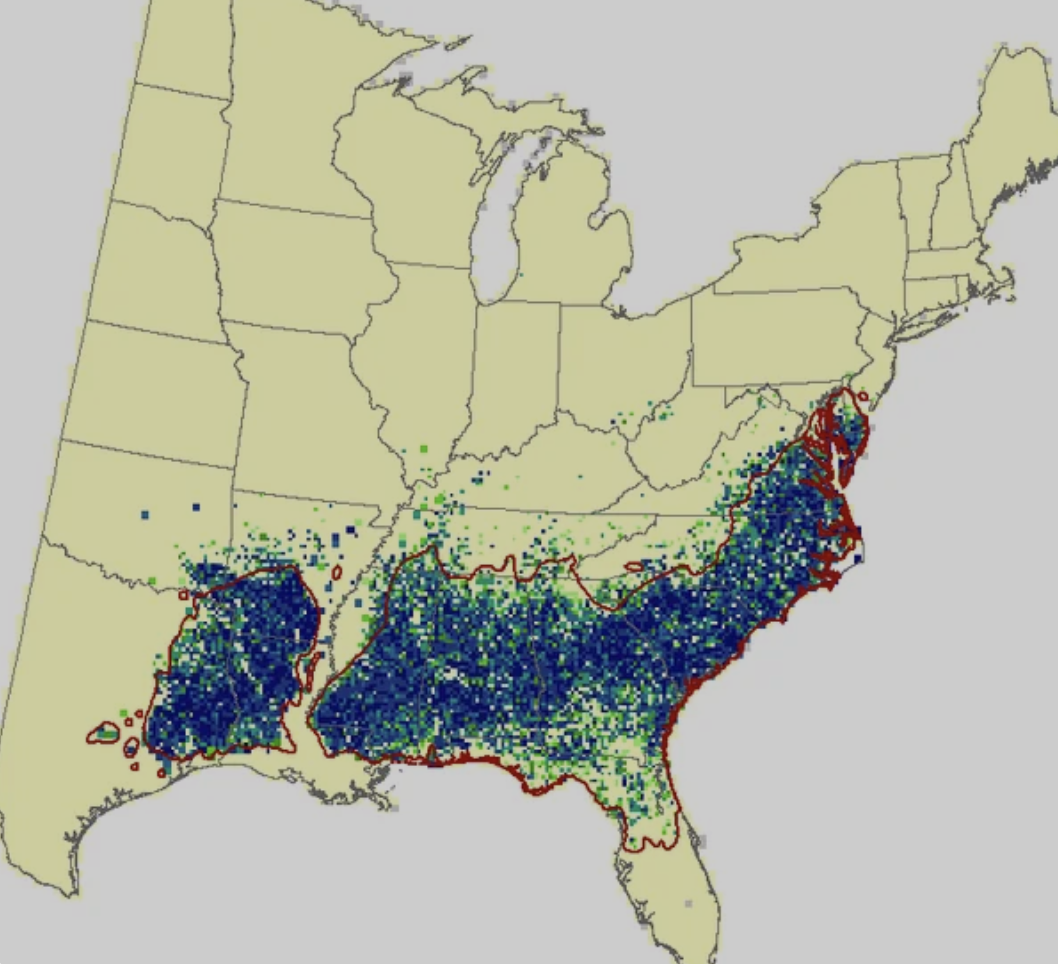
Southern timber owners could benefit from plan to create electricity and carbon credits by burning wood chips

The U.S. Pine Belt is filled with fast-growing Loblolly
pines. (Reddit map)
 
United Kingdom power producer Drax is scouting locations in America's Pine Belt to "build electricity generators fueled by burning wood chips," reports Ryan Dezember of The Wall Street Journal. "The plants’ exhaust will be piped underground instead of out of smokestacks, which generates lucrative carbon credits for which Drax is already lining up buyers." The company plans to sell its electricity to data center companies looking to fuel their artificial intelligence operations.

The plan could be an economic game changer for the U.S. South "where pulp and paper mills have closed and left timber growers without buyers for those trees unfit for making lumber or poles," Dezember explains. "Biomass power has long been dangled before Southern timberland owners as a potential solution to the glut of pine that has depressed prices and complicated harvests."

Drax's UK facility "burns pellets of compressed sawdust in a converted coal-fueled power plant," which fuels roughly 5% of the country's electricity. It already runs several U.S. pellet mills that fuel its UK operation, Dezember writes. The planned U.S. plant will be a BECCS, short for bioenergy with carbon capture and storage. The company plans to provide 24/7 renewable energy for AI data centers.

Drax is pinpointing locations that have all the elements it needs, which include a "confluence of carbon dioxide pipelines, pine plantations and a short wait to connect to the grid," Dezember reports. "It has options on properties and expects to announce a location for the first plant in 2025."

The company has sought timber managers who will manage forests without stressing their ecosystems, and it "plans to buy wood only from properties managed for timber production, not old-growth stands," Dezember explains. "Nor will the plants need the wood to be ground down to dust and pressed into pellets, which are made to facilitate ocean shipping. The U.S. power plants will only need the wood chipped into small pieces."

Understanding what pharmacy benefit managers are reveals flaws and solutions in U.S. drug pricing and selling system

Not all PBM savings are passed along to members.
(Adobe Stock photo)
Despite a deluge of news information discussing the unfair pricing practices of pharmacy benefit managers, what they are and what they do may still be a mystery. James B. Rebitzer, an economics professor at Boston University, provides some answers in his Q&A for The Conversation.

What are pharmacy benefit managers?
During the 1960s, PBMs "became essential middlemen [companies] between drugmakers and the many insurers, employers and government entities who purchase drugs on behalf of their members. . . . These companies negotiate price, affordability and access to prescription drugs. They do this by operating and designing formularies, which are lists of drugs that insurers cover.

Formularies assign drugs to different tiers that determine what patients must pay out of pocket to access the drug. . . . Tier placement determines how affordable a medication is to consumers and the effective drug price that insurers pay. . . .The price at which the PBM obtains the drug for its clients is the net price – the list price minus the drugmaker’s discount. . . . If a drugmaker increases its rebate, the net price falls, even if the publicly posted list prices remain high. This is why focusing on list prices to determine the cost of a drug can be misleading."

Are PBMs working to decrease their clients' costs or increase their profits?
Both. "If the contest for formulary placement works as it should, competition compels drugmakers to offer substantial discounts off the published list price. As a result, insurers and consumers benefit from a reduced net price for drugs. However, formulary competition can be undermined in various ways. . . . Competition within the formulary can also be distorted when drugmakers post very high list prices. This artificially inflates rebates for PBMs without lowering net prices for insurers and other parties."

How does market competition figure into PBM activity?

"The current regulatory environment in the U.S. tolerates overly large PBMs that engage in anticompetitive practices to accumulate excessive profits. Without strong competitors, dominant PBMs are free to charge their customers high fees and keep a larger portion of drugmaker rebates for themselves. . . . In theory, this problem should be self-correcting. . . . High profits should attract new competitors into the industry." But the chances for scrappy upstarts to survive are also limited by the industry's current PBMs' dominance.

Who are the villians?
The concentration of power is the problem. "If we didn’t have PBMs, we would need to invent them – or something like them – to obtain reasonable prices on patented drugs. But the concentration of market power among a few companies threatens to dissipate the value they create. A more competitive and transparent market for PBM services will help keep that contest fair and transparent – to the benefit of customers and society. . . . In that sense, PBMs aren’t the villain. Too much market power in too few hands is the problem, and that’s something more competition, sensible regulation and vocal consumers might fix."

Leaders and economists worry over what Trump's planned tariffs might do to business profits and consumer wallets

Businesses and U.S. economists are worried about how tariffs
could impact profits and American budgets. (Adobe Stock photo)

World leaders and CEOs are working to convince President-elect Donald Trump to reconsider his hard-line plans for tariffs against the country's biggest trade partners, which could "disrupt global trade and pummel profits," report Andrew Ross Sorkin, Ravi Mattu, Bernhard Warner, Sarah Kessler, Michael J. de la Merced, Lauren Hirsch and Tariq Panja of The New York Times. They "feel they’re making little headway in warning him of the consequences." Meanwhile, if Trump makes good on his threatened levies, U.S. consumers will likely pay higher prices.

Trump's first tariff announcements targeted Canada, Mexico and China. He said "he would impose 25% levies on Canada and Mexico, if they didn’t tighten their borders and stem the flow of illegal migration to the U.S.," The Times reports. "In subsequent social media posts, he went after BRICS countries," which include Brazil, Russia, India, China and South Africa, and other emerging markets.

Even though many Americans list high inflation, particularly on groceries and household staples, as a primary concern, "Trump conceded that he 'can’t guarantee tariffs won’t hit consumers hard," the Times reports. "That’s a concern among economists and big companies such as Walmart and Costco, who fear that levies could lead to price rises."

An estimate from The Budget Lab at Yale "found that the cost to consumers from Trump’s proposed tariffs could reach as much as $1,200 in lost purchasing power on average based on 2023 incomes, assuming retaliatory duties on U.S. exports are put into place," reports Rob Wile of NBC News. "While Trump has insisted other countries end up paying the cost of tariffs, most economists agree those costs wind up getting passed on to shoppers."

The National Retail Federation warned about "the impact of tariffs to everyday households," Wile writes. "Some Trump allies suggested the president-elect doesn’t actually plan to follow through with the proposed tariffs. . . . Rep. Dan Crenshaw, R-Texas, conceded, 'Tariffs will hurt the American consumer, that’s true. But they also make for good negotiation tools.'"

An Rx for American anger: Imagination, courageous peace-seeking and a collective will for something better for all

Graphic via MedPage
One look at social media posts or comments on newspaper stories, and it's easy to see why some Americans believe the mood of the country can be described as angry.

"This goes beyond malaise," writes psychiatrist Arthur Lazarus in his opinion for MedPage. This mood "signals something deeper. . . It isn't just dissatisfaction or unrest; it's a simmering anger, a wellspring of cynicism so powerful it spills over. . . . Our collective capacity for hope, patience, and even basic kindness seems to be eroding."

Why are Americans so angry? Lazarus writes, "At the heart of this phenomenon is a growing sense of betrayal -- by leaders, by institutions, by systems that promised stability, fairness, and opportunity. For decades, Americans have been sold visions of progress. . . But for many, these promises have proven illusory. . . . When a society feels full of "pervasive negativity," it's natural for humans to "armor up with cynicism" versus exposing feelings of hopelessness.

To make a way forward, we need to "go beyond anger," Lazarus explains. "Beneath the surface lies a yearning for something better -- a system that doesn't exploit, leaders who don't betray, and communities that support rather than divide. . . . Hope isn't naïve, nor is kindness. These qualities are necessary for the repair work ahead."

Reinvigorating courage and peace as American values can help change how we respond to adversity. Lazarus adds, "During the Civil Rights Movement, Martin Luther King Jr. championed peaceful protest and non-violent resistance as a form of courage. Sit-ins, marches, and boycotts challenged segregation and systemic racism without resorting to violence, even in the face of brutality."

Using current frustration as an energy to power change and innovation in U.S. health care models could also help. "Imagination in health care is often about seeing beyond immediate limitations to create systems that better serve humanity," Lazarus writes. "A compelling example is the transformation of Rwanda's health system."

A collective will to persevere together to make things better is an American ideal from the colonial period that can course-correct some of today's pessimism. Lazarus add, "In moments of crisis, it is tempting to retreat into cynicism or inaction. But previous challenges remind us that courage, imagination, and the will to rebuild are antidotes to despair."

Arthur Lazarus, MD is an adjunct professor of psychiatry at the Lewis Katz School of Medicine at Temple University in Philadelphia. He is the author of several books on narrative medicine, including Medicine on Fire: A Narrative Travelogueopens and Story Treasures: Medical Essays and Insights in the Narrative Tradition.

Tuesday, December 17, 2024

AI news: Humans write the news only to have bots steal and repost it 'under stolen or assumed identities'

AI "reporters" plagiarize stories from real publications
written by humans. (Graphic by AI robot, Adobe Stock)
Artificial intelligence bots revived a closed small-town newspaper site using culled stories and stolen reporters' names. "The defunct Daily Tidings was alive and kicking, sending out fresh stories again," reports Danny Westneat of The Seattle Times. "The site’s masthead showed eight reporters — a ton for tiny Ashland, Oregon. . . . As Oregon Public Broadcasting revealed this past week in an investigation, the entire site now is reported and written by artificial intelligence bots, under stolen or assumed identities."

"One 'reporter' they tracked down actually lives in the United Kingdom and had no clue he was practicing journalism in southern Oregon," Westneat explains. "The site pumps out about five stories a day — most of them cribbed from real publications, such as Ashland News or The Oregonian, and rewritten by AI programs." The site boasts ads and videos from "big ad-streaming companies such as Google."

The Daily Tidings past owner "told OPB he looked into suing the AI operation — whoever or whatever it is," Westneat reports. "His lawyers though said it’s coming from outside the United States, likely China. It would be 'pursuing a phantom.'"

Ashland's robot news spot isn't unique. "Sites are popping up everywhere using AI bots to create the vague appearance of journalism, usually by rewriting or repurposing articles culled from the real local media," Westneat reports. "AI tools have been developed, such as one depressingly called Spin Rewriter, that can digest an article and convert it into 1,000 'human-quality' facsimile articles."

In Seattle, the "Hoodline" news site produces stories by bots. A former human Hoodline employee, who lost her job to AI, told Westneat, "Old-fashioned shoe-leather reporting has been replaced by fake people who’ve never set foot in any of the neighborhoods they write about — because they don’t have feet."

The editor of the Ashland News, Bert Etling, "says that in Ashland, the scam journalism has been mostly just annoying," Westneat reports. "It’s a plagiarism operation, so the real town news source, his Ashland News, isn’t at much risk of getting scooped. . . . But it isn’t helping that gnawing sense that nobody believes anything anymore."