Showing posts sorted by relevance for query rural advisor. Sort by date Show all posts

Tuesday, January 16, 2024

Elite colleges begin recruiting more in rural towns; some students are interested, but many will opt to stay near home

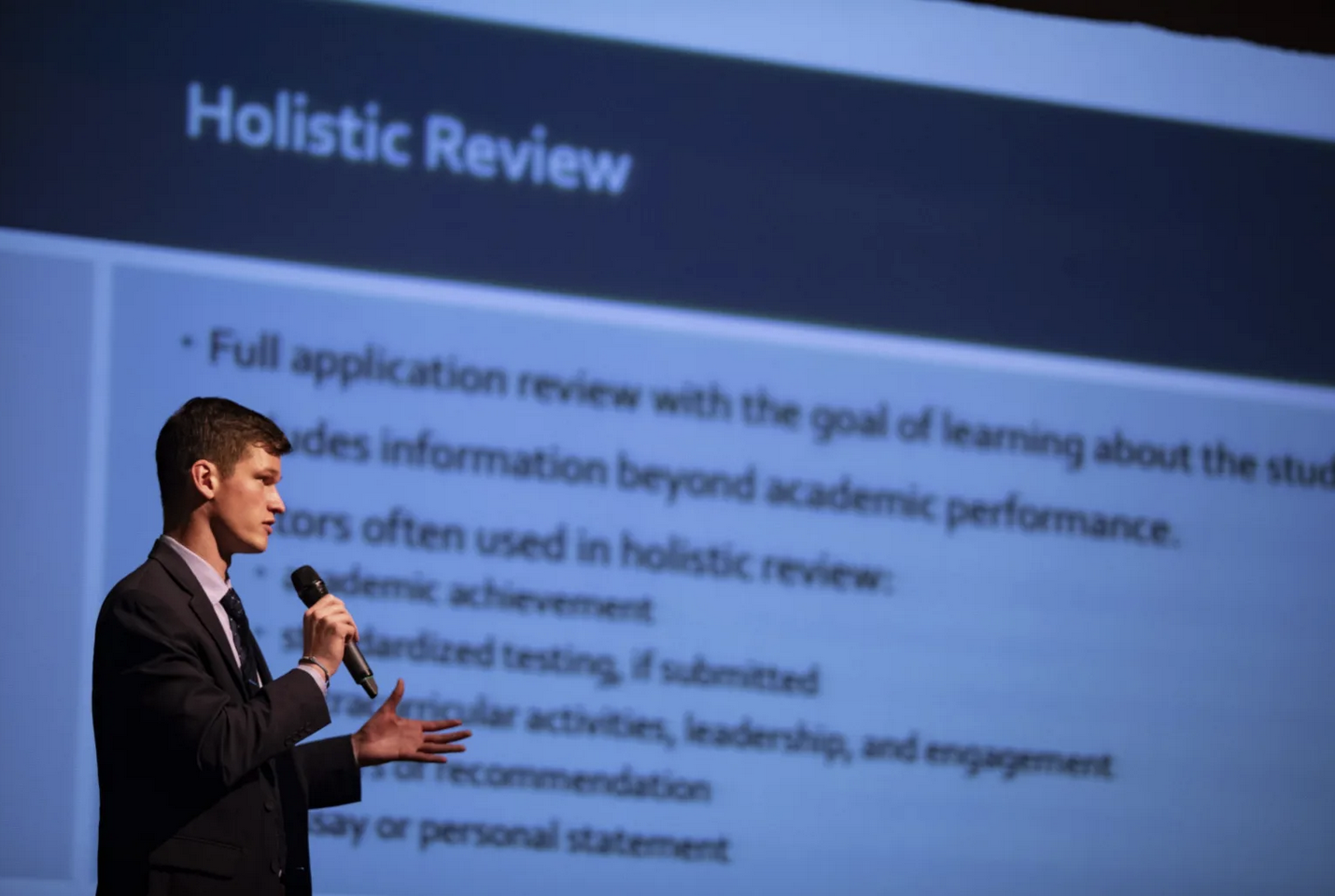
A University of Chicago recruiter from Maine speaks at a
college fair in rural Tenn. (Photo by Austin Anthony, THR)

For years, rural high school students were rarely visited by recruiters from highly selective universities, but that trend is changing, with schools such as MIT and Yale seeking students from rural places. While some students are excited about the opportunities, others are saying "no thanks," reports Jon Marcus for The Hechinger Report. The recruitment is "part of an effort to pay more attention to rural America, where students are less likely than their urban and suburban counterparts to go to college and, if they do, more likely to drop out."

There's a disconnect between high school and college for rural students. "Rural students graduate from high school at a higher rate (90 percent) than their counterparts in cities (82 percent) and suburbs (89 percent). But only 55 percent go directly to college," Marcus writes. A new consortium called STARS, or Small Town and Rural Students College Network, is working to bridge the rural-to-college gap.

STARS has 16 top colleges and universities participating in its program, which provides schools with financial assistance for travel and staffing needs. Some STARS schools went to Crossville, Tennessee, pop. 12,000, to recruit from an area they had never visited. Karen Hicks, a lead counselor at Crossville's Stone Memorial High School, told Marcus: "They've never come and taken an interest in us. But the big thing right now is rural, and they're finally seeing it, I guess. I love it in the sense that it gives our kids opportunities. I hate that they didn't see it before."

Despite the recruitment efforts, some rural students will choose to remain close to home. Laura Kidwell, another Stone Memorial school counselor, told Marcus, "Even the ones that have the higher scores, that can survive at some of the more prestigious colleges, they like it here, and they don't necessarily want to leave. They want to be within driving distance from home and their family and friends."

"Rural students often face cultural differences at universities that mostly enroll people from other backgrounds, said Corinne Smith, an associate director of admissions at Yale," Marcus reports. "Smith is also the advisor to the Rural Student Alliance at Yale, formed five years ago to help rural students feel more of a sense of belonging. When the group was started, she suggested social activities such as apple-picking." But the students, who may come from a town with one traffic light, asked for "help getting used to the unaccustomed urban traffic noise outside their dorms or off-campus apartments and for town tours to get to know their surroundings better."

Thursday, June 17, 2021

Podcasts explore how federal rural policy could improve

A new podcast series explores rural policy and how it can be changed for the better. The series is produced by Rural Matters with underwriting and editorial leadership from the Brookings Institution.

Anthony Pipa and Natalie Geismar of the Center for Sustainable Development write: "Through conversations with influential thinkers, practitioners, and policymakers, the series provides a road map for the Biden-Harris administration to reimagine federal policy so that it meets the diverse realities of today’s rural people and places: investing in their leadership and institutions, building on their assets and innovation, and providing their communities an on-ramp for sustained prosperity.

In the first episode, "Reimagining Rural Policy," Brookings Senior Fellow Tony Pipa and Janet Topolsky, executive director of the Aspen Institute's Community Strategies Group, draw from Brookings' "Reimagining Rural Policy" report to provide an overview of federal rural policy, which they describe as fragmented and incoherent, and suggest reforms policymakers should consider.

Episode 2, "Federal Policy to Meet the Diversity of Today's Rural America and Tribal Nations," features rural-development experts discussing how policy can be sensitive to diverse rural and tribal communities. Participants are Gbenga Ajilore, a senior advisor in the Agriculture Department's Rural Development section; Kennedy O'Dell, a senior research and policy associate at the Economic Innovation Group; and Erik Stegman, executive director of Native Americans in Philanthropy.

Episode 3, "Capacity Building as Key to Successful Rural Development," explores how the federal government can jump-start equitable rural prosperity by investing in workforce development and encouraging regional collaboration, as well as how it can better leverage development programs through pandemic relief funding. Speakers are Cheryal Hills, executive director of Region 5 Development Commission in Minnesota, and Rob Riley, president of the Northern Forest Center in New England.

Friday, January 08, 2021

Pandemic and vaccine roundup: Possible vaccine that needs only refrigeration would be a boon to rural America

Here's a roundup of some of the latest stories on the coronavirus pandemic and vaccine:

This article provides a good overview of the difficulties in vaccinating rural America and how they can be addressed. Read more here.

A new coronavirus vaccine in the late stages of testing could help rural residents get vaccinated, since it only requires refrigeration. Read more here.

Vaccine distribution is difficult in many rural areas. That's why one rural Michigan doctor has been making 140-mile round trips in his own car to deliver the vaccine to rural hospitals. Read more here.

Bold action is needed to support rural and tribal communities hardest hit by the pandemic, writes a former Obama administration advisor. Read more here.

The Moderna vaccine, which doesn't require ultra-cold freezers, has meant that rural residents in Alabama (and probably other states) can get vaccinated. Read more here.

Rural areas of Oklahoma have fewer resources to deal with a post-holiday coronavirus spike. Read more here.

The politicization of the pandemic has caused many rural health care workers to leave their jobs or leave their towns. Read more here.

NPR has created a tool that allows readers to see how full their local hospital and county overall are, though the dataset doesn't include all counties. Read more here.

Monday, February 08, 2016

Migrant workers in China flocking back to rural areas for better quality of life, lower costs of living

A faltering Chinese economy, high costs of living and high rates of air pollution are leading migrant city workers to head back home to rural areas, where the quality of life is better, Frank Sieren reports for Deutsche Welle, Germany's state-owned international broadcaster. In China, where the economy grew by 6.9 percent last year and is expected to grow 6.5 percent this year, slower rates than in recent years, manufacturing jobs "are becoming scarcer" and highly-skilled workers "are less inclined to work in factories or on construction sites." Also, younger rural workers are more reluctant to tackle the physically demanding jobs their parents worked.

"While 40 years ago, not even 20 percent of Chinese citizens lived in the city, today the number has risen to 50 percent. By 2020, it is expected to rise to 60 percent," Sieren writes. "For the first time in 30 years, the number of internal migrants in China sank last year—by about six million. To a certain extent, this is due to the country's demographic development—there are simply fewer migrant workers because of lower birthrates. In addition to this, the Chinese government has also acknowledged that a two-class society has emerged in the huge metropolises of China because of the hukou system which requires each citizen to be registered in a family register and makes moving within China illegal. A sort of caste system has come about in cities, turning internal migrants into second-class citizens who often have no access to social services, healthcare or schools for their children." (Advisor Perspectives graphic)
Another reason for rural migration is that the government has made a conscious effort to support "development of rural infrastructure and rural investment loans," Sieren writes. "This year, per capita income in rural areas is expected to exceed 10,000 yuan ($1,500) for the first time—a faster increase than urban per capita income. Many people are returning to rural regions because of cheaper rents, proximity to relatives, as well as access to unadulterated, unspoiled food."

In Western China, the central government "is supporting the idea of 'rural start-ups' more than ever," Sieren writes. "Some 40,000 people returning to the southwestern province of Sichuan have registered new businesses. This is not a bad means of opening up new growth opportunities for the Chinese economy and strengthen domestic growth."

Sunday, June 18, 2023

'Radically Rural' event in Keene, N.H., Sept. 27-28 wil be all in-person, with 7 tracks including journalism, with 3 sessions

"Radically Rural," the six-year-old community-development conference co-sponsored by The Keene Sentinel, will be full in person this year, without an online component.

This year's theme is “Reimaging Rural,” which “doesn’t always mean something that’s never been done, because sometimes progress includes reaching back to what’s been done before,” Julianna Dodson, director of Radically Rural, said in the Sentinel. “It’s sort of a prompt to help us rethink in new ways.”

The summit, set for Sept. 27-28, is a series of programs co-sponsored by Keene’s Hannah Grimes Center for Entrepreneurship. The opening speaker will be Tony Pipa, a senior fellow with the Brookings Institution’s Center for Sustainable Development and leader of the nonprofit’s Reimagining Rural Policy initiative, which launched in 2020. He will discuss rural issues with people who have appeatred on his none-episode podcast. The second day will open with Chris Estes, co-executive director of the Aspen Institute’s Community Strategies Group, who will talk about “a more cohesive strategy” in community development, Dodson said.

Radically Rural has seven tracks: arts and culture, clean energy, community journalism, entrepreneurship, All in for Health, land and community, and Main Street. The journalism track will be have three sessions: “Building Sustainability,” “Generating Audience Revenue” and “How Do They Do That?: Groundbreaking Journalism,” The first session will include Taos News Publisher Chris Baker, Joey Young of Kansas Publishing Ventures and Tristan Scott, managing editor of the Flathead Beacon in Kalispell, Mont., which dropped its print edition in April.

Shay Totten, newsroom-success manager for the American Press Institute, will moderate the audience-development session, with Arik Ligeti, director of audience for Canadian environmental magazine The Narwhal, and Christiaan Mader, founder of The Current in Lafayette, La., “These are organizations that have grown their subscriber base and their donor base over time,” said Terry Williams, the Sentinel’s senior advisor for audience and community engagement and its former president and chef operating officer

The third journalism session will be “a deep dive into how … journalists have reported on powerful stories” affecting their rural communities, Williams said. They are North Carolina freelance journalist Victoria Bouloubasis; Adam Ganucheau, editor-in-chief of Mississippi Today; and Samantha Hogan, investigative reporter for The Maine Monitor.

Tickets for the event are on sale, with prices based on a sliding scale using the honor system. A limited number of free tickets are also available for low-income people interested in attending. MOre information is available at www.radicallyrural.org.

Friday, September 29, 2017

Forum on improving rural infrastructure coming up

The Farm Foundation will host a free forum on the task of improving, expanding or replacing parts of the nation's rural infrastructure. The Task of Rebuilding Rural Infrastructure Forum will go from 9 -11 a.m. Oct. 3 in the Holeman Lounge at the National Press Club, 529 14th Street NW, Washington D.C. A free live audiocast will be available if you cannot attend, as well as a recording for later.

"We all recognize that the need for infrastructure improvements exists--everything from roads and bridges to electric and water supply systems and broadband service," says Contance Cullman, President of The Farm Foundation. "To make effective and efficient infrastructure investments, we need to understand the economic, public safety, national security and financing factors that must be considered."

Forum panelists will provide perspectives on the critical role of the broadband superhighway, rural transportation needs, financing options and how infrastructure impacts rural businesses and communities. Cullman will moderate the discussion. After comments by the panelists, the floor will be opened for questions and discussion. The panelists will be:
  • Mark Burton, Director of Transportation Economics at the University of Tennessee's Center for Transportation Research.
  • Robbie Boone, Vice President of Government Affairs for the Farm Credit Council, one of the member organizations of Rebuild Rural. 
  • Nick Tindall, Director of Government Affairs with the Association of Equipment Manufacturers, which recently completed a member task force report on infrastructure needs. 
  • Jannine Miller, Senior Advisor for Rural Infrastructure, Office of the Secretary, US Department of Agriculture.

Click here to register if you plan to attend the Forum in person (the event is free, but advance registration is mandatory).

Click here to listen to the live audiocast.

Tuesday, February 19, 2019

Federal agencies announce initiatives in telemedicine, housing to deal with opioid epidemic in rural areas

The federal government has taken several steps recently toward fighting the opioid epidemic in rural areas, including a program to help create transitional housing for recovering opioid addicts.

The Substance Abuse and Mental Health Services Administration will partner with the Department of Agriculture on the program, according to a press release. Through it, USDA-owned single-family housing units will be available for sale at a discount to nonprofits that provide housing, treatment, job training and other services for people in addiction recovery.

The USDA recently announced that it would give first consideration to opioid treatment projects that apply for its Distance Learning and Telemedicine program.

"The opioid epidemic is dramatically impacting prosperity in many small towns and rural places across the country," Assistant to the Secretary for Rural Development Anne Hazlett said. "With this focused investment, we are targeting our resources to be a strong partner to rural communities to build innovative local responses to this significant challenge."

Hazlett will soon leave her role in Rural Development to serve as the senior advisor for rural affairs for the White House Office of National Drug Control Policy.

Thursday, March 01, 2018

As rural hospitals face choice of closure or change, key is catering to the needs of the local population, execs say

Rural hospitals are reacting to the recent report by the Bipartisan Policy Center, which said the rural health-care system needs restructuring and suggested that some critical-access hospitals be turned into emergency treatment centers or other useful facilities. Adrienne St. Clair of NPR and Kaiser Health News talked to some hospital executives in the seven upper-Midwest states that were the basis for the report.

"Darrold Bertsch, chief executive officer of Sakakawea Medical Center in Hazen, N.D., says he agrees with the idea of catering health care facilities to the population — whether it's with an outpatient clinic, urgent care center, a hospital or something else," St. Clair reports, quoting him: "If communities had a little bit more flexibility, then they could adapt a health care delivery system in their area that is more relevant to the needs that they have, rather than trying to make a hospital fit in a community where it might not be able to be supported anymore."

"Hospitals tend to be cornerstone institutions in rural communities," St. Clair notes. "For many citizens in small-town America, losing the local hospital would threaten the livelihood of the town and its people, says Patrick Roche, chief operating officer at Faith Regional Health Services based in Norfolk, Neb." He told her, "There are two things they don't want to lose. The first one is their school, the second one is their hospital."

Challenges to keeping rural hospitals open include reduced federal reimbursements, difficulty finding a qualified workforce, problems with transportation, "broadband internet accessibility and the unique characteristics of the population, according to Dr. Anand Parekh, chief medical advisor with the Bipartisan Policy Center and one of the report's authors," St. Clair reports.
"You know, you don't have to close your hospital," Parekh told her. "You can transform the hospital to meet your community needs, improve health and still continue to improve your local economy. Rural America can thrive as health care transforms." (Read more)

Friday, November 13, 2009

Two community health organizations in East Ky. offer hope for better care, reformed or not

None of the health-care reform bills before Congress are likely to affect mounting health problems in Central Appalachia, says one rural health expert, but two examples of rural health care done correctly in Eastern Kentucky are providing hope for others, reports Frank Browning of Kaiser Health News. "It’s not all about the money," Dr. Forest Callico, former director of the Appalachian Regional Hospitals and a rural health advisor to both the Clinton and second Bush administrations, told Browning, a Kentucky native. “We have to transform the way we take care of people.”

Browning highlights the efforts of Hazard-Perry County Community Ministries and Harlan Countians for a Healthy Community as two examples of good rural health care. Community Ministries, which has no religious affiliation despite its name, was organized in part by Gerry Roll, who says she wants to "create a community that values good health." In an effort to encourage locals to seek the medical care they need, "Community Ministries’ 'lay health workers' go into patients’ homes once or twice a week, call them on the phone, drive them to the grocery or even organize regular walks with their neighbors — in short, taking an interest in their life," Browning reports.

Harlan organizer Annie Fox thinks the group's efforts to tackle everything from walking trails to clinical care to adolescent drug-abuse prevention has saved the local Appalachian Regional Hospital at least a half a million dollars a year in non-compensated emergency-room visits and other care. "Kentucky’s Fifth Congressional District, which includes Harlan and Perry counties, has the lowest life expectancy of any district in America: 72.6 years for men and 76.4 for women," Browning writes. Despite those numbers, Callico says the programs in Hazard and Harlan, which provide solid, bottom-up models for a profound shift in the overall health policy debate, are essential to any national reform effort that takes actual care seriously. (Read more)

The full story linked above also contains four videos about some of the women behind the two programs. Here's the one on Gerry Roll.

Wednesday, March 25, 2009

USDA urges farmers to generate 'green power'

A recent workshop by the U.S. Department of Agriculture's Rural Energy for America Program in Salt Lake City encouraged small business owners and farmers to generate their own “green power,” Jasen Lee reports for the Deseret News.

Perry Mathews, the business and cooperative program director for USDA Rural Development, told Lee that REAP can combine grants and loans to help farmers and rural businesses buyand install renewable energy systems. Environmentally conscious designs such as wind turbines, solar panels, geothermal, micro-hydro or biomass systems all add up to a better bottom line for owners.

"The administration feels that it's very important, from President Barack Obama to [Agriculture] Secretary [Tom] Vilsack,” Jeff Jobe, national cooperative field advisor for Rural Development, told the Deseret News. Lee reports that money is available on a competitive basis for communities with populations of less than 50,000.

An important angle is the ability to make the most of current resources. William Chatwin, energy efficiency coordinator for the Utah State Energy Program, said people can "multiply the benefits" of producing clean, renewable energy as they improve efficiency, with measures such as taking advantage of water running downhill as an additional source of electricity. Read more here.

Tuesday, May 12, 2026

Small towns use simple fix that starts with private funds to keep high schoolers out of dead-end jobs

rootED advisors help rural students navigate educational
and employment complexities. (rootED photo)
A new program launched by billionaire investment banker Byron Trott is helping students at small-town high schools develop and execute after-high-school plans that tap into their interests and keep them out of "dead-end jobs," reports Lauren Weber of The Wall Street Journal. 

Called rootEd Alliance, Trott's program "has placed advisers in schools across seven states to fill a gaping void: 17- and 18-year-olds are expected to navigate an astoundingly complex labor market, often with little or no explicit guidance," Weber explains. 

The majority of the 280 schools that rootEd partners with "already have guidance counselors," Weber writes. But many are "overstretched with basics like sorting students’ schedules and managing the life emergencies that hit students all too often."

The program partners with more than 1,500 national
and local businesses. (rootED photo) 
By planting an advisor dedicated to providing career guidance and opportunities, students and their post-high school plans get more attention. According to Weber, that kind of focused planning is particularly important for rural students who are traditionally exposed to fewer career options and role models. Root advisers also help employers connect with potential employees to fill skilled-labor shortages. 

Through its advisors, rootED also aims to help students avoid poverty by training for careers with solid pay and promotion possibilities. Weber reports, "Once a school is staffed with a rootEd adviser, students are 54% less likely to wind up in low-skill, low-paying jobs than before." 

At schools where a rootEd advisor is working, students are more likely to pursue higher education. Weber adds, But advisors are "agnostic on whether students choose college, military service, employment or trade school," Weber reports. "The goal is for each senior to have a Plan A and ideally a Plan B." To help students develop those plans, advisors take students to different trade schools and colleges and promote scholarships.

Friday, June 10, 2022

4 states get first broadband allocations from pandemic fund; money from infrastructure bill awaiting new FCC maps

Louisiana, New Hampshire, Virginia and West Virginia are the first states to get money from a $10 billion capital projects fund in last year's pandemic-relief bill, "which is expected to bring internet service to 200,000 homes and businesses" in those states, The Associated Press reports.

“There has never been anything like the pandemic to create a national teaching moment that we cannot have equal economic and educational opportunity unless all Americans and all regions, from urban to rural America, have access to high-speed affordable internet service,” Gene Sperling, a senior advisor to Biden, told reporters.

Virginia will get $219.8 million, with $176.7 million going to Louisiana, $136.3 million to West Virginia and $50 million to New Hampshire. Other states must send the Treasury Department by Sept. 24 their plans by "demonstrating how funding could fill critical needs," AP reports.

U.S. Sen. Joe Manchin, D-W.Va., said the money will make a “tremendous dent” in the broadband deployment needed in his rural state, AP reports. The Federal Communications Commission estimates there are more than 250,000 of the fewer than 2 million people in West Virginia lack broadband access, and Manchin said even more people are likely unconnected.

“We can’t help folks recover from the pandemic or encourage new economic development in areas like West Virginia if we don’t have connectivity — it’s that simple,” said Manchin, a former governor.

"The first wave of federal broadband funding to states, territories and tribal governments requires that the service providers building out their networks offer discounts to customers and provide service at download and upload speeds of at least 100 megabytes per second," AP reports. "Providers must participate in the FCC’s new Affordable Connectivity Program," which makes households with incomes at or below 200% of the federal poverty threshold eligible for discounts of up to $30 per month, or up to $75 a month on tribal lands.

"The money isn’t the only recent federal allocation for broadband — billions more were approved as part of the American Rescue Plan and the bipartisan infrastructure law," AP notes. "And more than 100 federal programs — administered by 15 agencies — already have some capacity to expand internet access." The number of programs “has led to a fragmented, overlapping patchwork of funding,” a Government Accountability Office report said last month.

“I’m not sure we fully used all our federal dollars well,” said Sen. Mark Warner, D-Va., noting that reliable internet access is a promise the government began making in the 1990s. “Candidly, in our country, we’ve done not a very good job of making that a reality.” He said federal efforts in the last 30 years have been “kind of hamstrung,” with some networks being partially built. "Faulty FCC maps that relied on self-reporting by the companies overstated coverage and hindered efforts to subsidize internet service in underserved rural areas," AP reports.

The FCC is required to issue new broadband maps before the National Telecommunications and Information Administration can allocate money from the new infrastructure bill, but legislators and broadband stakeholders "disagree on whether third-party maps should be used to supplement FCC’s maps," reports Cara Smith of Inside Health Policy. The first drafts of the maps are not expected until fall, Smith reports from a June 9 hearing at which "Lawmakers expressed renewed distrust in the FCC’s and NTIA’s ability to create accurate broadband maps and distribute funding properly to unserved and underserved communities."

Tuesday, October 24, 2023

Billions more for the power grid as the U.S. tries to get up to pace and scale for energy transition and climate change

Photo by Matthew Henry, Unsplash
How much money will it take to prepare the U.S. power grid for energy transition and climate change extremes? More -- billions more.

The Department of Energy "announced $3.5 billion in grants to expand capacity for wind and solar power, harden power lines against extreme weather, integrate batteries and electric vehicles, and build out microgrids that can keep the lights on during power outages," reports Jeff St. John of Canary Media. "The announcement named 58 projects across 44 states eligible to receive federal funding. When matched by funds from state and local governments and utility and industry partners, they will represent more than $8 billion in investment."

Energy Secretary Jennifer Granholm said in a press briefing, "The $3.5 billion is the first major round of funding from the DOE's Grid Resilience and Innovation Partnerships Program, created by 2021's Bipartisan Infrastructure Law, which has $10.5 billion available to expand transmission lines, improve grid resiliency and deploy ​'smart-grid' technologies," St. John writes. "That total is far more than the last major federal investment in grid infrastructure, the $3.4 billion in stimulus grants issued by the Obama administration in 2009."

Enough funding is only one part of infrastructure-building -- project developers are "facing years-long backlogs to connect to transmission grids, which themselves aren’t expanding nearly fast enough to meet the increasing demand," St. John reports. "The selected projects also prioritize communities that are ​'ignored or overlooked for far too often, including rural, Native and low-income communities,' according to Mitch Landrieu, the Biden administration’s senior advisor and infrastructure coordinator. . . . The Grid Resilience and Innovation Partnerships funding is subject to the Biden administration’s Justice40 Initiative, which pledges to direct 40 percent of federal climate-related funds to historically disadvantaged communities."

Funded grid projects include electric cooperatives in Georgia, which will install "new transmission lines to serve a territory that covers three-quarters of the state’s land mass, as well as deploy battery systems and microgrids to bolster grid reliability," St. John adds. "And rural cooperatives will receive $99.7 million to deploy wildfire assessment and resiliency technology to a consortium of 39 co-ops scattered across the Western U.S."

"Several of these projects also include microgrids to enable communities to keep power up when the grid falters. Some are led by utilities that see a valuable role for microgrids in boosting reliability and integrating more clean energy, but others are led by state and community groups," St. John explains. "Other grants are focused on integrating distributed energy resources — rooftop solar panels, electric vehicles, microgrids and other technologies that utility customers are installing in ever-rising numbers."

Friday, August 09, 2019

Rural California teen feathering his nest with egg business

Ayden Gartenlaub, 16, feeds his hens. (The Californian photo by Alex Horvath)
Many 16 year-olds have an after-school job, but Ayden Gartenlaub's is a little different. The teen, who lives on the outskirts of Bakersfield, California, has been running his own small business selling eggs for the past two years and is starting to see some big returns with Ayden's Eggs.

"The soon-to-be high school junior started his business two years ago as a freshman with 12 chickens and a few small coops on his school farm. Now he has 350 hens and is selling an average of 75 to 90 dozen eggs every Saturday at the East Hills Farmers Market in northeast Bakersfield," Steven Mayer reports for Bakersfield.com.

Ayden says the secret to his success is hard work, love for his chickens, and a better product. Grocery store eggs can be a month old before you buy them, but Ayden's are generally less than a week old. "I can definitely tell the difference. They're really good," customer Lori Clemmons told Mayer. Clemmons also said she likes supporting a young entrepreneur like Ayden who works so hard.

How hard does Ayden work? Every day, Ayden spends two hours a day feeding and watering his hens, gathering eggs and doing other related chores, and on Friday he spends five or six hours washing and packaging eggs (with help from his family). "Saturday is farmers market day, when the young farmer transforms into the salesman, engaging with customers, telling the story of why these eggs are not only white and brown, but robin's egg blue, light green, copper-colored and occasionally, even a blush-rose shade," Mayer reports.

When he's not chicken-wrangling, the young entrepreneur is an A-student who plays sousaphone in the marching band. He was once a defensive lineman for the football team at Highland High School, but gave it up to focus on his business. Amber Carter, a Future Farmers of America advisor and ag teacher at Highland, said Ayden's project was inspirational to other students. "A lot of students don't think they have anything to offer in ag. Ayden's project shows them what can be done," Carter told Mayer.

Friday, December 01, 2023

Expectant moms face OB-GYN deserts; one state is an example of the national problem

A mother holds a newborn baby.
(Photo by Katie Klingsporn, WyoFile)
Wyoming is one of many states where women and families are finding obstetric care harder to find. "More than 15% of Wyoming women had no birthing hospital within 30 minutes of home in 2022, compared to 9.7% of women nationally, a report by the March of Dimes shows," Katie Klingsporn of WyoFile reports. "Such distance from care comes with real risks. Women who live farther from delivery hospitals are more likely to experience adverse medical outcomes. . . . In rural areas of Wyoming, 22.4% of women live over 30 minutes from a birthing hospital compared to 5.2% of women living in urban areas, according to the March of Dimes."

Nestled in west central Wyoming, Fremont County is "not unique, but with one obstetric practice, one midwife and one birthing hospital serving the general population of Fremont County — a New Hampshire-sized area that's home to nearly 40,000 people — the situation here offers a window into the challenges, and consequences, of limited maternal health services," Klingsporn writes. And while Fremont County has a 24/7 delivery center in SageWest Hospital in Lander, women who labor and deliver there will most likely be treated by a traveling doctor, who is also a stranger. 

Traveling in Wyoming can be both risky and expensive. It "requires money, childcare, work flexibility and other resources that not everyone has. And then there's the issue of winter travel in Wyoming, where icy storms regularly close roads and ground air ambulances," Klingsporn reports. "The OB shortage is not isolated to Fremont County. Hospitals in Rawlins and Kemmerer stopped offering delivery services in recent years. Other counties like Sublette and Weston don't have birthing facilities at all."

Jen Davis, Gov. Mark Gordon's senior policy advisor on health and human services, "said of the dearth of maternal health care, 'It's a huge problem,'" Klingsporn writes. 

While traveling longer distances to see obstetric providers can lead to poor outcomes, more pregnant women in Wyoming are having to take that risk. "The farther a woman travels for maternity care, the greater the risk of maternal morbidity and adverse infant outcomes," Klingsporn reports. 

The loss of labor and delivery care is a national problem. "In 2022, the March of Dimes reported on the problem of 'maternity care deserts' across the United States," reports Stacey Kelleher for Health eCareers. "These communities do not have birthing centers or hospitals offering obstetric care. Outside these maternity care deserts, which affect more than two million women of childbearing age, nearly seven million other women and 500,000 births are also impacted by low or no access to Ob-Gyn care in this country."

Wednesday, November 30, 2016

Potential candidates for agriculture secretary include Kansas governor, former Georgia governor

Kansas Gov. Sam Brownback (MSNBC image)
Agriculture Secretary Tom Vilsack has made a point of pushing rural areas to the forefront during his eight years in office. With a change of administration coming in January, there will be a new agriculture secretary. While President-elect Donald Trump hasn't focused much on agriculture or Vilsack's replacement, there are some names floating around that could take the helm, Dan Nosowitz, reports for Modern Farmer. Nosowitz looks at four potential candidates. He doesn't mention Kansas Rep. Tim Huelskamp, who earlier this month expressed interest in being agriculture secretary.

Here are four potential candidates:

Kansas Republican Gov. Sam Brownback "was the secretary of the Kansas Department of Agriculture from 1986 to 1993 and while a senator served on the Agriculture Appropriations Subcommittee," Nosowitz writes. Brownback, who has voted to increase minimum wage and to limit farm subsidies, "supports increasing the number of legal immigrants and was a co-sponsor of the 2005 Kennedy/McCain bill aimed at creating a path to citizenship for illegal immigrants. He especially supports more foreign workers in the U.S. for farm work and has worked to establish a guest worker program." He also opposed universal healthcare.

Chuck Conner, former former deputy ag secretary under George W. Bush, "has gone on record supporting improved access to global markets, a substantial safety net for farmers and a reduction in regulations from the EPA," Nosowitz writes. "He has supported a guest worker program and has vigorously supported an overhaul of the immigration system to ensure that immigrant workers can safely and legally take on farm work."

Texas Agriculture Commissioner Sid Miller reversed "the ban on soft drinks and fried foods in Texas public schools," Nosowitz writes. "Miller has been extremely controversial in Texas, at the center of several firestorms about unethical financial transactions like using public funds to receive a cure-all medical shot and compete in a rodeo, or hiring his closest advisor’s wife, or the repayment of loans with campaign funds. An early Trump supporter, Miller is best known outside Texas for calling Hillary Clinton an extremely bad word on Twitter."

Sonny Perdue, the former governor of Georgia, "did not focus on agriculture in his governorship (2003-2011)," Nosowitz writes. "He won his initial governorship campaign by opposing the removal of the Confederate symbol from the Georgia state flag. He has opposed universal health care and access to welfare and other services for illegal immigrants."

Wednesday, November 03, 2021

Election officials stressed or quitting because of threats

Election officials say they're receiving threats to their lives and their children's lives, and many are quitting, Stephanie Sy and Geoffrey Lou Guray report for PBS's "NewsHour."

Many are in rural areas, including Joseph Kirk, the election supervisor of Bartow County, an Atlanta exurb. He told PBS: "I had a phone call after the 2020 presidential election before the January runoff from someone from a different state, who called to inform me how horrible of a person I was, how I was letting the country down, because she wasn't happy with the results of the election in a county that her candidate won by a large margin."

Michelle Carew, the outgoing elections administrator of Hood County, Texas, pop. 62,000, said she's quitting after doing elections work for 14 years because she can't take it anymore. "While attending the Election Commission meeting back in July, it was a two-hour-long meeting. The public was allowed to come in and speak and talk about things that they felt like I was not doing correctly as an elections administrator. They questioned my integrity," she told PBS. "I just don't want to do this anymore. I don't want to be a part of these unfounded truths, these constant lies, the constant scrutiny."

Natalie Adona, the assistant county clerk recorder for Nevada County, California, said a voter called her, upset that state laws don't always require photo ID for voting. When she listed for him the safeguards in the law to thwart fraud and told him her job was to follow the law, he told her that Nazis also followed laws blindly and asked her how she could live with herself. "That was really hard to hear."

Tammy Patrick, a senior advisor to The Democracy Fund's elections program and a former elections official in Maricopa County, Arizona, told PBS that the threats are "exemplary of what I’m hearing from all across the country," from both Trump and Biden counties. "we’re seeing a systemic rise in the number of vacancies . . . because of the pressure and the mental toll it’s taking on them." Republican candidates, including incoming Virginia governor Glenn Youngkin, now routinely question the legitimacy of an election if they were to lose, even in local races, Patrick said.

"Across the country, officials are noting 'an unusually large number of retirements,' as Kentucky Secretary of State Michael G. Adams (R) said of the departure rate of county clerks in his commonwealth," Talking Points Memo reports. In testimony to the Senate Rules Committee last week, Adams said two of the state's 120 clerks resigned last year, not because they were threatened or harrassed, but because "they had had enough; they were exhausted." This year, 15 clerks are retiring an "unusually large number. . . . It’s a harder job now to run an election," partly because of changes made during the pandemic to make voting easier.

The high turnover rate is "a double-edged problem," legal scholar and law professor Rick Hasen told TPM: "On the one hand, you’re losing the competent people, on the other hand, you’re potentially bringing in more people who are not committed to the fairness of the process, but have an allegiance to a particular candidate."

Tuesday, April 19, 2022

Thursday webinar will discuss how microgrids can promote rural energy resilience, with help of state policies

A free webinar at 3 p.m. ET Thursday, April 21, will discuss how states and utilities are using promoting energy resilience by using microgrids, which are groups of interconnected loads and distributed energy resources that act as a single entity connected to the national electric grid.

From the website: "As states work to enhance energy resilience in the face of human and natural threats, microgrids are a growing topic of interest due to their ability to serve customers with power even when grid outages occur. However, the unique nature of microgrids—which are designed to operate in tandem with the electric grid during normal conditions—often leaves them in regulatory and financial limbo in many states. This webinar will look at how certain states have developed policies to provide certainty to utilities and developers to promote and encourage microgrid development and enhance resilience."

This is the second in a series from the National Conference of State Legislatures that can help you bone up on policy issues that could affect your readers. If you can't attend, a recording of the webinar will be available later. Click here for more information or to register. Daniel Shea, NCSL's program principal on energy, will moderate a panel with:
  • Sam Cramer, senior program director, National Association of State Energy Officials
  • Leuwam Tesfai, chef of staff and legal advisor to Commissioner Genevieve Shiroma, California Public Utilities Commission
  • Donald Wingate, vice president of utility and microgrid solutions at Schneider Electric

Wednesday, December 08, 2021

Non-profit helps Black entrepreneurs in Mississippi Delta

Tim Lampkin (NPR photo by Kirk Siegler)
"The mostly rural Mississippi Delta has long been synonymous with racial and economic inequality. Yet today there are a growing number of small, economic bright spots, due in part to a grassroots effort that's trying to right some of the wrongs of the past," Kirk Siegler reports for NPR.

Though the Delta's population is mostly Black, relatively few Blacks own businesses, especially Black women. There are a number of reasons: distrust of banks, banks' reluctance to lend to Black entrepreneurs, lack of local role models and more, Siegler reports. But non-profits like Higher Purpose Co. are mentoring Black business owners, assisting with everything from securing grants and loans to navigating everyday operating issues.

Tim Lampkin, 35, founded Higher Purpose when he moved back to his hometown of Clarksdale after working in corporate America. He noticed that most local businesses were white-owned, even though more than 80% of the town's 15,000 residents are Black.

Ensuring that people of color can succeed as entrepreneurs is critical, according to Bill Bynum. He has worked to help Black entrepreneurs in the Delta since the 1990s, and has served as a White House economic advisor to Republicans and Democrats, including Joe Biden. "People of color are an emerging majority and if we leave the emerging majority of Americans on the outside of the economy, then we are really in for trouble," Bynum told Siegler.