Thursday, January 24, 2013

Neb. governor sets new Keystone XL pipeline route; Obama now faces tough climate-change choice

Nebraska Gov. Dave Heineman approved the new route for the controversial Keystone XL tar-sands oil pipeline this week, saying the new route poses very little environmental risk and represents substantial economic-development opportunities. Construction of the TransCanada Inc. pipeline has been halted so the company could find a route that posed less risk to the Ogallala Aquifer, a vast underground water supply for much of the Midwest, and the ecologically sensitive Sand Hills region of Nebraska; and so a year-long review of its possible impacts by the federal government could be conducted. (DTN Progressive Farmer photo: pipeline construction)

Gov. Heineman sent a two-and-a-half page letter to President Obama and Secretary of State Hillary Clinton explaining that Nebraska's review of the new route found that it meets state standards, Joe Duggan of The Omaha World-Herald reports. The letter comes 19 days after the Nebraska Department of Environmental Quality completed a 2,000-page report saying the pipeline would provide economic benefits and create minimal harm to the environment. The governor's decision means that TransCanada can start negotiating with Nebraska landowners for property easements, and if those negotiations fail, the company can take land through eminent domain. The new route avoids the Sand Hills but still crosses the aquifer.

The fate of the $7 billion pipeline still rests with Obama. Heineman's decision was announced just one day after the president "cited the obligation to posterity and the threat of climate change as an issue that can't be ignored" during his second inaugural address, Chris Clayton of DTN Progressive Farmer reports. Environmentalists say Obama can't declare a commitment to fighting climate change while approving the pipeline, regardless of the route, because of the climate-change impact of tar-sands mining. "Politically, I don't see how he does it because the green groups would see that as a clear sign of betrayal," Bold Nebraska director Jane Kleeb told Clayton. Bold Nebraska has led efforts in the state to stop the pipeline.

Several studies have concluded that the pipeline would provide much economic benefit with little environmental impact, including one by Creighton University economist Ernie Goss, who said the project would provide $1.8 billion to Nebraska over 17 years. However, several climate scientists claim tar sands are a direct and immediate threat and will increase climate change, David Biello notes in Scientific American magazine. James Hansen of NASA and  17 other climate scientists sent Obama a letter last week opposing the pipeline.

There are roughly 170 billion barrels of oil to be recovered from Canada's tar sands, which Canada calls oil sands, Biello reports. All those tons represent a lot of possible carbon dioxide if burned, Minnesota's University of Saint Thomas mechanical engineer John Abraham said: The sands industry emits more greenhouse gases than New Zealand and Kenya combined, and if all those sands could be burned, another 240 billion metric tons of carbon would be released into the atmosphere, and if just the oil sands that are recoverable with today's technology get burned, 22 billion metric tons would be released, Biello writes.

Wednesday, January 23, 2013

Postal Service still makes most retail revenue from post offices; lists of closures, cutbacks released

The U.S. Postal Service still makes most of its revenue from traditional post offices, despite claims that few people actually use physical brick-and-mortar post offices anymore, according to data the agency gave the Postal Regulatory Commission yesterday. The USPS has used the claim that traditional post offices are under-utilized as its main reason for closing, or reducing hours at, hundreds of post offices, most of them rural.

The information released for USPS's annual compliance report includes a list of post offices that were closed and suspended in 2012, and information about retail revenue sources, Contract Postal Units, and Village Post Offices, Save the Post Office's Steve Hutkins reports. USPS considers retail revenue as only the transactions that take place within a traditional post office. These revenues are only a portion of the agency's total revenue, $17 billion of $65 billion. Post offices account for more than 60 percent of USPS's retail revenues, at $10.6 billion. (Read more)

Small grant helps small schools serve local meat

A small, rural school district in Colorado may have one answer for rural districts across the country that want to make their lunches more local. The South Routt School District has fewer than 450 students in its three schools, but it serves local, grass-fed beef during lunch, Ann Schimke of Ed News Colorado reports. It's all the result of parent Jane Colby's effort. She won a $1,500 grant to pay for more expensive beef, and the district serves beef from cattle raised about 25 miles away.

Colorado is a big cattle state, and the number of school districts that use local beef in their cafeterias seems to be growing, Colorado Farm-to-School Task Force chair Jeremy West told Schimke. He estimated that about a dozen districts use local, grass-fed beef. Switching to local beef isn't easy for school districts. Tight budgets make it harder to buy, and limited kitchen facilities and small staffs can make it harder to properly handle raw beef instead of frozen. South Routt's food-service director, Susan Hart, told Schimke she still uses U.S. Department of Agriculture commodity beef in addition to the local beef because the grant only went so far. (Read more)

Sen. Reid says new Farm Bill is 'high priority'

Senate Majority Leader Harry Reid has included a new Farm Bill in a list of "high priority bills" that he introduced in the Senate yesterday, Brownfield Ag News reports. The bill passed the Senate in June with overwhelming support, but stalled in the House over food-stamp issues, and died during fiscal-cliff negotiations.

Sen. Charles Grassley, R-Iowa, said he was confident work on the bill won't start from scratch, Brownfield's Tom Steever reports. Grassley said the change in the Senate Agriculture Committee's Republican leadership from Northern to Southern influence might bring changes or debate about the bill that hadn't happened before, but he thought the bill could pass out of committee without much push-back. Farm policy experts are concerned, however, that the longer it takes to pass a bill, the more likely federal crop insurance will become a target for cuts, Ken Anderson of Brownfield reports.

Hemp legalization in Ky. gains political traction

An effort to legalize industrial hemp in Kentucky may have its best chance yet of passing the General Assembly this session, Gregory Hall of The Courier-Journal in Louisville reports in a big Page One story. Opposition from the Kentucky State Police has previously killed efforts at legalization. The KSP still claims that growth of the crop would make it harder to catch producers of hemp's illegal variety, marijuana. But this session, the bill has support from top politicians who find the claims that hemp production will create thousands of jobs hard to ignore.

Legalizing hemp would require cooperation of federal authorities, but the idea has gained traction in large part because of the crop's old history in the state and an alliance between state Agriculture Commissioner James Comer, U.S. Sen. Rand Paul, the Kentucky Chamber of Commerce and Senate Agriculture Committee Chair Paul Hornback, R-Shelbyville, right.

Comer supporters have worried that his fellow Republicans who run the Senate and have other candidates in mind for the 2015 governor's race would bottle up the bill, but Hornback told Al Cross, director of the Institute for Rural Journalism and Community Issues, that the leaders told him the committee he chairs would get the bill when the legislature reconvenes Feb. 5. Gov. Steve Beshear has also expressed a willingness to work with law enforcement on the issue.

"This is something that you don't have to borrow any money for that will have an immediate impact of thousands of jobs," Comer told Hall. Comer assumes that hemp processors and manufacturers would locate to Kentucky without encouragement if the state was one of the first to allow hemp growth. "We're ahead at something that relates to economic development for once, so let's pursue it." Senate Bill 50 would require growers to be licensed annually and have their backgrounds checked by the state Agriculture Department. Each grower would have to plant a minimum of 10 acres. (Read more)

Tuesday, January 22, 2013

Too many newspapers don't want to upset anybody

One sad fact about community journalism in the United States is that many, if not most, of the weekly and small daily newspapers don't publish editorials, or even have editorial pages. And another sad fact is that the first fact isn't often written about. Tom Larimer, right, the executive director of the Arkansas Press Association, broke the silence recently with a column that got our attention and admiration.

Larimer began by noting Minnesotans' negative reaction to the Swift County Monitor-News's endorsement of same-sex marriage, and Publisher Reed Anfinson's column about it, which noted, "Many community newspapers in America no longer carry editorial pages because of the fear of losing subscribers or advertisers." (For that column, see Page 4 of the December issue of Pub Aux, published by the National Newspaper Association, which Anfinson headed in 2011-12.)

The lack of edit pages is also about losing friends, in a segment of the business where personal comfort often conflicts with professional responsibility. Larimer knows that, and states the reasons for lack of leadership more broadly: "In an effort to avoid such occasional conflict with readers, a lot of newspapers have simply discontinued their editorial pages. . . . Many no longer endorse political candidates, feeling perhaps like this is just going out of the way to alienate some readers. There’s no arguing that this is the safe way not to offend anyone, and certainly not to create the sort of stir as they experienced at the Monitor-News. But is this truly what readers expect of us?"

Noting a controversial column that ran in one of the papers he edited, Larimer recalled, "Everyone in the community who read the newspaper was aware of this column, discussed it often, ranted, sometimes called the local editor to complain, and then read it again the next week. The important thing here was that they were reading, and they were thinking about the subject matter. This was an important lesson for a young editor of a country weekly newspaper. Not everyone is always going to agree with everything you may opine in the columns of your newspaper. But they will read it and they will discuss it, and they lose no respect for you for having expressed your thoughts on the matter."

Larimer concluded, "When we hear comments about nobody reading the newspaper anymore, consider that perhaps that’s because there’s nothing, or certainly nothing of substance, to read." For the full, 1,000-word column, in a PDF of the Dec. 27 Arkansas Publisher Weeklyclick here.

Business and computer-assisted reporting workshops to be held in Louisville Feb. 27 through March 3

Louisville's Hyatt Regency Hotel, right, will be one of the best places in America to improve your journalism skills this year, all in the space of a few days: Wednesday, Feb. 27 through Sunday, March 3.

The first day, from 2 to 5 p.m., the Donald W. Reynolds National Center for Business Journalism will offer a free workshop, "Breaking Local Stories with Economic Data." Center Director Linda Linda Austin writes, "Government data offer unparalleled opportunities to distinguish your reporting with trend stories about what’s happening in your local economy. Especially this year, with the release of the every-five-year Economic Census, journalists will have a unique opportunity to track changes in their local community from 2007 — before the recession — to 2012." Instructors Paul Overberg of USA Today and Jeannine Aversa of the U.S. Bureau of Economic Analysis, a former writer for The Associated Press, will show how to do least 15 local enterprise stories from government economic data. Examples will be specific to the Louisville region, but applicable anywhere. For a PDF of the program flyer, click here. To just sign up for the workshop, go here.

The next four days is the annual conference presented by Investigative Reporters and Editors and the National Institute for Computer-Assisted Reporting. It has something for everyone, from beginners (basics on spreadsheets, databases and online mapping) to experts (data science and the latest technological advances). The list of sessions is still growing, as is the attendance; the room block at the Hyatt is full of near-full, but other hotels are available; see here. For more information, go here.

NBC seeks 'small town' newspaper for reality show

A unit of NBC is seeking a small-town newspaper about which to do a reality show. A casting call was made last week through the National Newspaper Association, the principal organization for community newspapers in the U.S.

NBC Peacock Productions asks, "What’s your small-town paper like? Do you work hard? Make each other laugh? Is your team a real version of 'The Office' meets 'Parks and Recreation?' We’re . . . looking to produce a documentary style reality show featuring a small-town local paper working hard to stay on top of breaking small-town news and keep financially afloat in an ever-increasing competitive world. Interested in participating or hearing more? Please contact us at smalltownnewspapershow@gmail.com or call 212-664-2307."

JimRomenesko.com reports that more than 70 editors and publishers have replied, and NNA's Stan Schwartz says producer Cara Biega "was impressed with how amazing their stories are." Biega hasn't returned our call. Some clarification is in order; for example, when folks in New York say "small town," that usually has quite a different meaning than in most of America's truly small towns.

Few rural counties have incomes above U.S. median

Just 15 percent of rural and exurban counties had median family incomes that were at or above the national median of $50,502 in 2011, according to Census Bureau data analyzed by the Daily Yonder. Exurban counties are inside a metropolitan area but mostly rural in nature. "Remember, 'median' means the middle," Bill Bishop reports. "Half the households in the U.S. had income greater than $50,502 in 2011, and half made less."
The Yonder map above shows the median household income in each rural and exurban county. (Click on the map for a larger version.) Dark blue counties were the richest in terms of household income. Counties in any shade of blue have incomes higher than the median household income of $41,974. Half of all rural and exurban counties had median family incomes above $41,974, and half had incomes below that amount. Red counties on the map were below the $41,974 mark.

Familiar patterns are revealed by the map, Bishop writes. The richest rural and exurban counties are the western ski areas, the oil and gas region of North Dakota and the Hill Country counties of Texas. The poorest are in Appalachia, the Black Belt in the South, Native American reservations and the Texas/Mexico border. The poorest of the rural and exurban counties were, in descending order: Wilcox County, Alabama; Buffalo County, South Dakota; Owsley County, Kentucky, and Noxubee County, Mississippi. Those counties had median incomes lower than $22,000 in 2011. (Read more)

Many coal miners retire, pressuring pension plans

The exodus of underground coal miners who started working 40 years ago is putting more stress on an already strained coal industry, Erich Schwartzel of the Pittsburgh Post-Gazette reports. "Hiring trends that date back to the Nixon administration have resulted in a disproportionate number of older workers in mines across Pennsylvania and the rest of the nation," the paper reports. Older miners are leaving in droves, and experts say this is hitting the industry when it's in a state of flux because of decreased demand.

The large number of older miners has also "strained weak pension plans at major companies, appearing on balance sheets and in bankruptcy filings as a hazardous expense," the Post-Gazette reports. As much as 75 percent of the coal-mining workforce has retired in Pennsylvania, leaving companies to fill big gaps. "The retirement of older workers is especially acute in Appalachia," the paper reports, with three of the region's states in the top five coal-producers. The average coal miner has already been working more than 20 years and is 45 or older.

Pensions and other post-retirement benefits have started to affect company bottom lines. According to its most recent earning report, such benefits cost Alpha Natural Resources more than $1.18 billion in the third quarter. The two largest coal companies in the U.S., Peabody Energy and Arch Coal, are embroiled in a lawsuit over their lack of payment of benefits to United Mine Workers of America retirees, who claim the company offloaded benefits onto off-shoot companies, then had those off-shoots file for bankruptcy to avoid paying out benefits. (Read more)

Iowa task force looks at program that puts rural high-school students into community colleges

Rural school superintendents in Iowa worry that their students won't be able to compete for jobs in the global marketplace without early exposure to technology, and that their rural districts won't be able to attract and keeping tech-savvy teachers, Mike Wiser of the Waterloo-Cedar Falls Courier reports. Rural districts usually get smaller shares of state dollars because of small enrollments, and smaller revenues from local property taxes because there is less property to tax, so they have less money to pay teachers than urban districts, and they have even less money to pay for special classes, Wiser notes. (Courier photo by Tiffany Rushing: Rural Education Task Force members)

For decades, the answer to this revenue riddle in Iowa, and other rural areas across the country, was school consolidation. There have been 117 school district reorganizations in Iowa since 1965, and they aren't always popular. "Parents worry about students being forced into larger classes or exponentially increasing their travel times," Wiser writes. "Students may have a hard time adjusting to a new school in a different town, and people in the towns that lose their schools also lose some of their identity."

Two Republican state House members joined with a Democratic colleague to organize a Rural Education Task Force that includes superintendents, school administrators and teachers from rural districts. The task force is looking at the Cedar Valley West program, which brings students from four rural districts to a local community college to take upper-level classes and earn dual high school and college credit for their efforts. (Read more)

Monday, January 21, 2013

Obama says nation 'will respond to the threat of climate change' to preserve economy, resources

In an inaugural speech that resembled a State of the Union address, President Obama devoted a full paragraph to climate change, an issue from which he largely steered clear in his re-election bid.

"We will respond to the threat of climate change, knowing that the failure to do so would betray our children and future generations," Obama said. "Some may still deny the overwhelming judgment of science, but none can avoid the devastating impact of raging fires, and crippling drought, and more powerful storms. The path towards sustainable energy sources will be long and sometimes difficult. But America cannot resist this transition; we must lead it. We cannot cede to other nations the technology that will power new jobs and new industries – we must claim its promise. That is how we will maintain our economic vitality and our national treasure – our forests and waterways; our croplands and snowcapped peaks. That is how we will preserve our planet, commanded to our care by God. That’s what will lend meaning to the creed our fathers once declared."

John Harris and Jonathan Martin of Politico call the address "the most ideologically ambitious speech since Ronald Reagan’s first inaugural address" in 1981. "If Obama wanted to create a mandate for new government action on climate change, he could have talked about it prominently in the campaign, including in manufacturing states like Ohio. But he neglected to do that," they write, adding that on climate change and gun control, "A key brake on Obama’s goals will be lawmakers in his own party concerned about their own prospects in moderate districts. A related question is whether — even if changing demographics and changing times have dislodged the center-right consensus that has framed politics for the past 40 years — a federal government with record deficits and a still weak economy can support Obama’s ambitions." UPDATE, Jan. 23: Harris writes about what Obama omitted, and the risks of such a speech.

NPR reported yesterday, "One of the chief expectations of those who voted for President Obama is that he moves assertively to pass climate change legislation, whatever the political climate in Washington." Harvard University political scientist Theda Skocpol, who recently analyzed the failure of cap-and-trade legislation, told NPR's Jackie Lyden that she "is pessimistic about any sort of climate change legislation before the midterm elections in 2014. She does, however, think preparation is necessary." (Read more)

There wasn't much else in Obama's 2,100-word speech that had rural resonance, our general standard for inclusion on The Rural Blog, except his call for immigration reform, which agricultural interests generally favor. The president concluded his paragraph about immigration, gay rights, voting access and children by saying, "Our journey is not complete until all our children, from the streets of Detroit to the hills of Appalachia to the quiet lanes of Newtown, know that they are cared for, and cherished, and always safe from harm." (He pronounced the region "Appa-LAY-cha." In Appalachia, Va., they say "Appa-LATCH-a," and so does this YouTube video.) For the full text of the speech, via Politico, go here. The White House web page for speeches is here.

Ky. network will examine 'Price of Poverty' tonight

Noting that Dr. Martin Luther King Jr.'s life ended when he was trying to mount a "Poor People's Campaign," Renee Shaw of Kentucky Educational Television decries the lack of attention paid to poverty, especially in the nation's fifth poorest state: "Many people tell me how perplexed they are by the muted conversation about poverty by today’s national leaders and policymakers. Mention of poverty during the last election cycle was non-existent, other than ill-conceived characterizations of those below the line. No anti-poverty agendas were brought forth or even intimations made that they’re forthcoming. Poverty is treated as an intractable problem that we feel sorry exists, and we quickly concede to political impotence."

Shaw and KET's Bill Goodman are co-producers of an hour-long special that debuts on the network tonight: "The Price of Poverty in Kentucky," with special attention to the eastern counties that are persistently poor. "Poverty is a multi-dimensional problem. But, it is not without solutions," Shaw writes on her Prompter blog. "Community leaders, anti-poverty advocates, educators, and economists share their insights and lend recommendations on how — in the words of Dr. Martin L. King — “to make the invisible visible." And those insights should apply to states other than Kentucky. To watch the program online, click here.

Sunday, January 20, 2013

Rural town in Ohio shows how the nation is divided

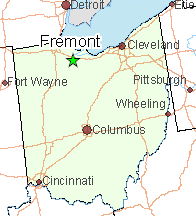
 Map from Sperling's Best Places
Fremont, Ohio, pop. 16,734, is the object example chosen by Eli Saslow and The Washington Post to illustrate "the America that [President] Obama will govern in his second term: A place divided not only by ideology, race and class but also by the very perception of reality. Four years since Obama first took office, is the country better or worse off? Safer or more at risk? Principled or desperately lost? Here in Fremont, as in much of America, it all depends on whom you ask. In this rural, Rust Belt county where Obama won exactly 50 percent of the vote, located in a state where he won 50 percent, residents expect Obama to either ruin the country or rescue it. The president who spoke ambitiously at his first inauguration about uniting America instead arrives at his second with the country further divided."

Saslow managed to find two employees at the same factory with diametrically different political views that give painfully clear examples of the divided country, and in this case a divided workplace: "Employees now self-segregate into what [Democrat Cathy] Morris calls 'ideological islands.' Co-workers who were once moderate Democrats or Republicans shifted fully to their sides over the past four years, intensifying the disconnect. There are free copies of a National Rifle Association monthly magazine in one break room and, as of late last year, a life-size cardboard cutout of Obama in the other." (Read more)

The Post's chief political writer, Dan Balz, has a good overview of the national political situation here.

UPDATE, Jan. 25: ProPublica provides a broad guide to good journalism and books about the partisan divisions and dysfunctionality of Congress.

Trains and port facilities for exports of coal stir opposition in the coastal Northwest

Saturday, January 19, 2013

Bubba's on target: Clinton says Obama backers need to understand, respect rural gun culture

President Obama's supporters should not dismiss pro-gun arguments or sneer at gun-rights advocates, former President Bill Clinton warned a group of Obama's financial backers today at a private meeting attended by a reporter from Politico. (Associated Press photo)

“A lot of these people live in a world very different from the world lived in by the people proposing these things,” said Clinton, who was governor of Arkansas for more than a decade before serving as president from 1993 to 2001. “A lot of these people … all they’ve got is their hunting and their fishing. Or they’re living in a place where they don’t have much police presence. Or they’ve been listening to this stuff for so long that they believe it all.”

"Clinton dedicated a substantial portion of his 40-minute address before a joint meeting of the Obama National Finance Committee and a group of business leaders to the issue of guns and gun control," reporter Byron Tau writes. "Clinton warned the issue of guns has a special emotional resonance in many rural states — and simply dismissing pro-gun arguments is counterproductive." So is "looking down your nose at them," he warned.

National polls show support for several gun measures Obama wants Congress to pass, but Clinton cautioned that what matters is the strength of feeling about the issues: “They are meaningless if they’re not voting issues.” (Read more)

Friday, January 18, 2013

New mine-safety rules tougher on repeat violators

In an effort to prevent fatal coal mining accidents and further protect miners' health and safety, the U.S. Department of Labor has finalized new rules that would make it easier to enforce strict penalties against coal operators whose mines repeatedly violate safety and health standards. The rules are aimed at reforming the "pattern of violations" program at the Mine Safety and Health Administration that targeted repeat offenders but allowed them to delay sanctions by appealing safety citations and be warned of special inspections, Ken Ward Jr. of The Charleston Gazette reports. (Photo by Stephen Wilkes, GalleryStock)

The rules would stop the appeals and eliminate MSHA warning letters that have given companies more time to fix problems before inspectors visit mine sites. The final rules were announced on the same day as former mine superintendent Gary May was sentenced to two years in prison for conspiracy for his involvement in the explosion at the West Virginia mine that killed 29 miners. May's sentence was shortened as part of a plea deal with prosecutors, who are using his information to pursue prosecution of other high-level officials. The mine had avoided being classified as a "pattern violator" by appealing hundreds of safety citations, and because of MSHA inaction, Ward reports.

MSHA director Joe Main said the updated rules will "help prevent another tragedy" like that one, and West Virginia Sen. Jay Rockefeller said they are "an important step forward for improving safety in mines across West Virginia and the country." Ward reports that the National Mining Association criticized the final rule, saying it "would deprive mine operators of 'due process' by allowing MSHA citations that are under appeal to be counted as part of a violation pattern." (Read more)

Corps will raise water level in largest reservoir in Eastern U.S. to test second massive dam repair

The U.S. Army Corps of Engineers hopes to increase water levels this summer in Lake Cumberland, the largest reservoir by volume in the Eastern U.S. at normal pool, Bill Estep of the Lexington Herald-Leader reports. Leaks at Wolf Creek Dam caused the Corps to significantly decrease water levels in 2007. Repair of the dam is the Corps' top construction project, costing $594 million. (Herald-Leader photo by Charles Bertram: Lake, dam and Cumberland River)

The Corps expects to finish repairs this spring ahead of schedule, which was originally set to finish in summer 2014. Local officials are hopeful that increased water levels this year will bring tourists back after six seasons of lower visitation. If the repairs pass review by third-party engineers, the lake will first be raised to about 20 feet below normal pool, allowing the agency to test the repairs. If the dam performs well at that level, the Corps will raise the lake to normal pool, 723 feet above mean sea level. For the Corps' news release, go here.

The Corps made an emergency decision to lower levels after engineers said Wolf Creek Dam was at high risk of failure. Estep notes the dam was built in the 1940s in terrain riddled with caves and underground fissures, through which water seeped under the mile-long earthen part of the dam. Another expensive repair job in the 1970s proved to be incomplete. (Read more)

Worst snow drought in six years will hit cattle and hog producers the hardest, experts say

National snow cover is at only 22 percent, the least since 2007. This snow drought in much of the U.S. is likely to have impacts on the cattle and hog industries this year, according to industry analysts. The lack of snow is affecting already beleaguered agriculture operations that were hit hard by last summer's intense drought, Chris Scott of Meatingplace reports. The Department of Agriculture designated 597 counties in states with grazing seasons as snow-drought disaster areas.

The concern for cattle and hog producers focuses on winter wheat and conditions for the upcoming corn-planting season, Scott reports. The cattle industry isn't suffering impacts from snow drought yet, but Oklahoma State University livestock marketing specialist Derrell Peel told Scott it will likely be forced into "immediate liquidation mode" if the drought continues into mid-March. University of Missouri agricultural economist Ron Plain told Scott hog producers should be worried about how the snow drought will affect feed supplies. (Read more)

European authority says widely used pesticide is definite cause of colony collapse disorder in bees

A European Food Safety Authority report has named the world's most widely used insecticide as an "unacceptable" danger to bees feeding on flowering crops, Damian Carrington of The Guardian reports. The report found that imidacloprid, a neonicotinoid made by the German firm Bayer, is a cause of bee decline. This is the first time neonicotinoids have been definitively linked to bee collapse.

Bees are important pollinators for one-third of the world's food, and recent studies have concluded that neonicotinoid pesticides were likely a cause of colony collapse disorder, a condition that prevents bees from finding their way back to hives. Scientists concluded that honeybees are exposed to imidacloprid through nectar and pollen, and that it could only be used on crops that honeybees don't pollinate, such as canola, corn and sunflowers. (Read more)

Kansas agriculture secretary seeks repeal of laws that strictly limit corporate farming

Kansas Agriculture Secretary Dale Rodman has asked the state legislature to repeal laws restricting corporate involvement in farming, a move that would reverse a nearly 80-year-old policy, John Hanna of The Associated Press reports. Rodman, a former executive with agribusiness company Cargill Inc., said the anti-corporate laws "hinder the growth of agriculture and recruitment of new agribusinesses" in the state, Hanna reports. 

Kansas law limits corporate ownership of farmland to family farm corporations, family partnerships and corporations with fewer than 15 stockholders, all of whom must be Kansas residents. There are exceptions to the law for feedlots and poultry operations, and counties can allow corporate dairies and hog farms. Kansas Farmers Union President Donn Teske told Hanna repealing the law would be the end of family farming. "Every time a 2,000-cow dairy [operation] goes in, it takes 20 dairy farmers out of a community," Teske said. "That is not economic development. That is rural depopulation." 

According to the National Agricultural Law Centerat the University of Arkansas, eight other states have laws restricting corporate farming: Iowa, Minnesota, Missouri, Nebraska, Oklahoma, Wisconsin and the Dakotas. The Eighth Circuit Court of Appeals, which has jurisdiction over most of those states, has struck down voter-approved corporate restrictions in Nebraska and South Dakota. (Read more)

Thursday, January 17, 2013

Some officials vow to ignore Obama gun measures

"From Oregon to Mississippi, President Barack Obama's proposed ban on new assault weapons and large-capacity magazines struck a nerve among rural lawmen and lawmakers, many of whom vowed to ignore any restrictions, and even try to stop federal officials from enforcing gun policy in their jurisdictions," Jeff Barnard of The Associated Press reports. (AP photo by Susan Walsh: Obama signs order)

Republican Mississippi Gov. Phil Bryant urged Congress to make it illegal to enforce any executive order that violates the Constitution. "If someone kicks open my door and they're entering my home, I'd like as many bullets as I could to protect my children, and if I only have three, then the ability for me to protect my family is greatly diminished," Bryant said, adding that he is standing against the federal government taking away civil liberties. Tennessee state Rep. Joe Carr wants to make it a state crime for federal agents to enforce any ban on firearms or ammunition. Similar proposals have popped up in Wyoming, Utah and Alaska.

"While such proposals are eye-catching, they likely could never be implemented," Barnard writes. The Supremacy Clause of the Constitution states that federal law always supersedes state law when there is a conflict between the two. University of Denver constitutional law professor Sam Kamin told Barnard that "such disdain of Obama's proposals is reminiscent of former Confederate states' refusal to comply with federal law extending equal rights for blacks after the Civil War."

Some rural sheriffs see the federal government as an adversary, and gun ownership is at the core of that belief, Barnard reports. Pine County Sheriff Robin Cole in Minnesota said he would refuse to enforce federal mandates about guns, and the Texas-based Constitutional Sheriffs and Peace Officers Association supports that view. The National Sheriff's Association has supported administration efforts to fight gun violence after Sandy Hook; the group's president, Larry Amerson, sheriff in Calhoun, Ala., said he understands rural people's frustration, but feels his oath of office binds him to uphold all laws. (Read more)

Uncertainty about subsidies makes Farm Bureau drop language favored by rice and peanut farmers

During a vote on federal subsidies at the annual American Farm Bureau Federation meeting in Nashville, Southern delegates found themselves in the minority. Agri-Pulse reports that the voting body of the organization voted 179-153 for a motion supporting some types of crop insurance, but removing specific language calling for shallow loss revenue and reference prices, which Southern delegates supported. Such programs most often help Southern peanut and rice farmers. "We're not going to be drawing a line in the sand and promoting a single position," Farm Bureau President Bob Stallman said. The group did support development of a revenue insurance program for peanuts, which the Arkansas delegation amended to include rice.

"It's critically important we have room as we move forward," Indiana Farm Bureau President Don Villwock said. He said the agricultural policy is entering a "new world," and "The crystal ball is as cloudy as it can be," echoing the majority's concern and uncertainty about farm programs. Members kept language supporting "catostrophic loss coverage as a first choice in policy, while noting that, 'If a catastrophic risk program is not achievable, we support producers being allowed a choice of program options,'" Agri-Pulse reports.

Agri-Pulse is subscription-only, but a free trial is available here.

Feds find many poor levees; repairs are up to locals

Hundreds of flood-control systems overseen by the federal government are at risk of failing and endangering people and property in 37 states, U.S. Army Corps of Engineers inspectors have found. Deficient levees are in every region, in large cities and small towns, Cain Burdeau and John Flesher of The Associated Press report. The corps hasn't yet issued ratings for more than 40 percent of the 2,487 federally-inspected levees; of those it has rated, 326 covering more than 2,000 miles were deemed in urgent need of repair.


"The problems are myriad: earthen walls weakened by trees, shrubs and burrowing animal holes; houses built dangerously close to or even on top of levees; and decayed pipes and pumping stations," Burdeau and Flesher report. The Corps denied to give AP details about specific levees, saying such information could heighten terrorism risks. But the reporters did find some specifics from federal and state records, and through interviews with officials in more than a dozen cities and towns. The most widespread deficiencies were design and construction flaws, inadequate or crumbling infrastructure, failure to control vegetation and invasive species, and building encroachment.

Localities are responsible for upgrading deficient levees, and some local officials told AP that the corps is exaggerating the danger. They said some deficiencies were approved or not objected to by the federal government, and repairs would likely be too costly for them to make. "It's just not right to tell a little town like this to spend millions of dollars that we can't raise," said Judy Askew, mayor of Brookport, Ill., population 1,000. (Read more)

Renewable energy could help rural economies more if state policies were more consistent, expert says

Renewable energy facilities other than hydroelectric plants, the oldest form of renewable, are producing 53 gigawatts of electricity, and most renewable energy production takes place in rural areas, Agri-Pulse reports. Renewables could lead to increased rural development, but only if legislators are sensitive to regional needs, University of Kentucky agricultural economist David Freshwater said in a recent National Association of Counties webinar reported by Agri-Pulse.

"If you just sort of focus on rural energy for the sake of, 'Look at all this money we can get to do this,' you're likely to make huge mistakes," Freshwater said, adding that proper implementation requires seeing it as an element in local economic-development strategies. He said it is unclear whether renewable energy would bring green jobs into rural communities because most of the research associated with renewable energy development focuses on urban areas.

Also, he said, inconsistent state policies on renewables prevent renewable-energy growth. "It's incredibly complex to coordinate state and federal renewable energy policy," he said, with several webinar participants adding that working from county to county was often difficult. Freshwater called for a "new rural paradigm" to address rural development that would be a broad approach and lead to "bottom-up operations" that aren't sector focused.

Thirty states and the District of Columbia have policies that require varying shares of electricity to come from renewables. Another seven have goals, but no penalties for failure to meet them. Some standards require only 5 percent of power to come from renewable sources, while others, like in California, require 33 percent. (North Carolina State University map)
Agri-Pulse is available by subscription only, but a free trial can be found here.

Interior Secretary Ken Salazar will leave the post

Department of the Interior officials say Secretary Ken Salazar will leave his post in March. "I want to thank Ken for his hard work and leadership on behalf of the American people," President Obama said in a statement. "Ken has helped usher in a new era of conservation for our nation's land, water and wildlife."

Salazar spent his time as secretary focused on energy issues, including promotion of renewable energy, and dealing with the British Petroleum oil spill in the Gulf of Mexico, Aaron Blake and Juliet Eilperin of The Washington Post report. He promoted solar energy projects on public lands, pushed for offshore wind energy development on the East Coast and has dealt more recently with wild-horse management on public lands. In the wake of the BP spill, he separated the leasing and enforcement functions of the agency in offshore oil and gas drilling.

Salazar faced opposition from the oil and gas industry, and to his efforts to create new federally protected areas of public land. In 2010, he proposed giving federal protection to areas with wilderness protections known as "wild lands." House Republicans created legislative language to overturn that policy, forcing Salazar to abandon it.

It's unclear who will replace Salazar, Blake and Eilperin report. But they write that interior secretaries generally come from the West, which has most of America's public land, and former Gov. Chris Gregoire and former Rep. Norm Dicks of Washington, former North Dakota Sen. Byron Dorgan, former Wyoming Gov. Dave Freudenthal and Deputy Interior Secretary David Hayes have all been mentioned as possible appointees. (Read more)

USDA announces new micro-loan program for beginning, minority, young and family farmers

The Department of Agriculture announced this week it will start a new micro-loan program for small, family, beginning and socially disadvantaged farmers seeking loans of less than $35,000. A press release says the program aims to help "producers through their start-up years by providing needed resources and helping to increase equity for that farmers may eventually graduate to commercial credit and expand their operations." The program will have a simpler application process than other farm loans.

Secretary Tom Vilsack said the program is another example of USDA expanding opportunities for minority, disadvantaged, young and beginning farmers and ranchers. The program will be administered by the USDA's Farm Service Agency, and will have an interest rate that changes monthly. The current rate is 1.25 percent. FSA offices are listed here.

Wednesday, January 16, 2013

Community newspaper in Kentucky tackles poverty in a series that it says will last all year

The Todd County Standard in Elkton, Ky., started a year-long series last week about the county's growing poverty rate. It's an issue that most community newspapers might shy away from, but the Standard is again proving why it has been judged the best small weekly newspaper in the state for six straight years. The county is not in Appalachia, as you might expect, but in southwestern Kentucky and the edge of the territory covered by the Delta Regional Authority.

"While our prospects for being able to attract manufacturers and the regional concept that has brought water, economic development and perhaps a regional job training center offer Todd County several ways to overcome poverty, the sad reality now is that we are in a state of crisis and we need to admit it," the paper opined. "With one of the highest rates of uninsured people in the state; with children in poverty on the rise; with one in three families on some sort of government assistance; with 40 percent of children born between 2007 and 2009 to mothers who do not have high school diplomas; with 61 percent of school-age children on free or reduced lunches there is more than enough information to make us concerned."

The paper will study Todd County's poverty to inform the public about it and discuss ways in which it can be addressed. The first two stories in the series appeared in the Jan. 9-15 edition, and cover babies born to mothers without high school diplomas and high rates of children receiving free or reduced-price school lunch. "Poverty is not a plague," the paper writes. "It is curable. It has been cured in other places, but the only way it can be cured is for people to become aware of its severity and then to care about poverty's demise." For the editorial and the stories in the first installment of the series, click here.

Obama would boost local police and mental health; guide shows where solons have been on gun issues

President Obama's plan for reducing gun violence, announced today, calls for new funding to employ local police officers and for improving mental health care services, which could help rural areas that lack police protection and where mental health care is often out of reach because of lack of facilities and providers.

The plan calls for expanding the COPS Hiring Grants, which help police departments hire officers to be school resource officers. The Department of Justice will be ordered to give preference to grant applications that support such school officers. The COPS program has helped rural police departments hire officers they likely wouldn't be able to hire without it because of small budgets.

The mental-health section of the plan calls for creating programs to train educators to identify mental illness in children and teens and how to refer them for treatment, and for $25 million for state-based initiatives to support people aged 16 to 25 who have mental health or substance abuse issues. An additional 5,000 mental health care professionals would be trained to serve youth under the plan, and insurance coverage for mental health issues would be required, including those covered by Medicaid.

Key parts of the plan would require background checks for all gun sales, increase penalties for gun trafficking, end the freeze on gun-violence research and pay for more school counselors. Its most controversial parts would ban military-style assault weapons and ammunition magazines with more than 10 bullets. "There are strong indicators that any comprehensive legislation restricting weapons and ammunition won't even see a vote on the House floor," Jonathan Martin and Jake Sherman of Politico report. Republican representatives from the Midwest and Northeast told Martin and Sherman they have "almost zero appetite to vote on any sort of sweeping gun bill." (Read more)

To give easy glimpses of where your senators and representative(s) have stood on these issues, and with the main lobbying interests, the independent, investigative journalism outlet ProPublica has created an interactive graphic showing how each lawmaker is rated by the National Rifle Association and the Brady Campaign for gun-control laws, with a chart of current members' votes on the 1994 assault-weapons ban and an accounting of the NRA campaign contributions to each legislator, available here.

Soot found to trap more heat than had been thought

Tiny black particles released into the atmosphere when fossil fuels are burned are far more powerful agents of global warming than previously thought, according to a study by atmospheric scientists. The particles, or black carbon, are the main ingredient of soot and are the second largest contributor to global warming, behind only carbon dioxide, the authors write. The study, "Bounding the role of black carbon in the climate system: a scientific study," will be published online in The Journal of Geophysical Research-Atmospheres.

The new estimate of black carbon's heat-trapping power is about double the estimate made in the 2007 report by the United Nations Intergovernmental Panel on Climate Change, notes Elisabeth Rosenthal of The New York Times. Researchers said that if indirect warming effects of black carbon are factored in, the total effect could be about three times the previously estimated rate.

"The new calculation adds urgency to efforts to curb the production of black carbon," which is released most by diesel engines in richer nations and cook stoves and kerosene lamps in poorer countries, Rosenthal reports. Forest fires can also release it. Black carbon is already being targeted by Climate and Clean Air Coalition to Reduce Short-Lived Climate Pollutants, a program seeking to reduce black carbon production to hinder climate change, air pollution and respiratory disease. (Read more)

Drought will continue; corn and beef will suffer most, experts say

The 2012 drought that nearly crippled the Midwest Corn Belt will continue through this year in the region, according to a crop outlook presented by Iowa State University economist Chad Hart at the American Farm Bureau Federation annual convention this week.

There was significant demand for corn last year because it was in such short supply, but the big question for 2013 is whether that level of demand will be experienced again, Agri-Pulse reports. "When we saw the drought coming, the market went into action: prices rose and we dropped demand down to match that supply," Hart said. The U.S. is likely to see a bump in yield compared to last year, but "we're likely going to remain below trend line again here in 2013. Mother Nature's not done with us yet."

The livestock sector will also face problems with demand this year, especially with beef, Texas A&M University economist David Anderson said during the Farm Bureau meeting. U.S. beef consumption is projected to fall from 65 pounds per person in 2007 to 55 pounds this year, and Anderson said that decline will continue because of high prices. People are eating less meat, but declining production and a booming export market are having the biggest impact on U.S. beef production. "In 2013 and 2014, you're going to start to really see the effects of a declining cow herd on beef production," Anderson said. "Fewer cows, fewer calves, less beef."

Agri-Pulse is available by subscription-only, but a free trial is available here.

Military suicides exceed number killed in combat

The number of U.S. military service members who committed suicide last year reached an all-time high of 349, outpacing the number killed in combat, according to military officials. The suicides "underscored the toll a decade of wars has taken on the all-volunteer force and the extenet to which the Pentagon continues to grapple with an issue senior leaders have called an epidemic," Ernesto Londono of The Washington Post reports. Veterans and active-duty service members come disproportionately from rural places.

The Pentagon has tracked suicides since 2001, and the military became concerned in 2006 when the rates began to rise. The military saw about one suicide a day last summer, prompting Defense Secretary Leon Panetta to express frustration. The rate remains slightly lower than in the general population, but officials say it is "nonetheless unacceptably high," Londono reports. The military has implemented several programs to encourage veterans and active-duty members to seek help for depression and post-traumatic stress disorder, including hiring more behavioral health-care professionals, expanding a mental-health crisis line and starting a long-term study of mental health for service members.

The Marine Corps, which has had success in lowering its suicide rate, saw a 50 percent increase last year over 2011. The branch's number of attempted suicides last year reached a record high at 179. The Army had 182 suicides in 2012, compared to 159 in 2011. The Navy and Air Force, which have traditionally had lower rates of suicide than the Army and Marines, saw suicide rates increase by 15 and 16 percent, respectively. (Read more)

Tuesday, January 15, 2013

Child obesity is linked to a wide range of immediate health problems, many more than previously thought

While a plethora of research on childhood obesity has linked it to long-term health problems, a new UCLA study focuses on the condition's more proximate consequences, showing that obese children are at more risk for immediate health problems than previously thought. (Photo by Tara Kaprowy, Kentucky Health News)

"This study paints a comprehensive picture of childhood obesity, and we were surprised to see just how many conditions were associated with childhood obesity," said lead author Dr. Neal Halfon, a professor of pediatrics, public health and public policy at UCLA. Rural children are more likely to be obese than their urban and suburban counterparts.

Compared to kids who are not overweight, the study found that obese children have nearly twice the risk of having three or more reported medical, mental or developmental conditions. Specific medical conditions included bone, joint and muscle problems; asthma; allergies; headaches; and ear infections. Obese children also reported a greater tendency toward emotional and behavioral problems, higher rates of grade repetition, missed school days and other school problems, ADHD, conduct disorder, depression, learning disabilities, and developmental delays.

The study provides the first comprehensive national profile of associations between weight status and a broad set of associated health conditions, a UCLA release said. Halfon said these findings should serve as a wake-up call to physicians, parents and teachers, who should be better informed of the risk for health conditions associated with childhood obesity. (Read more)

Tiny town in Eastern Kentucky bans discrimination based on sexual orientation

A tiny Eastern Kentucky town has become only the fourth city in the state to adopt a fairness ordinance banning discrimination against lesbian, gay, bisexual and transgender people. Vicco, with a population 334 and situated in the heart of the Central Appalachian coalfield, is now the smallest municipality in the U.S. with a fairness ordinance, Peter Smith of The Courier-Journal in Louisville reports. Louisville, Lexington and Covington (next to Cincinnati) are the other three cities with similar ordinances. (Sperling's Best Places map)

The Vicco ordinance bans discrimination in housing, employment and accommodations based on sexual orientation or gender identity, and adds discrimination based on other factors, including age, race and religion, which are already protected under state and federal law. "It's a great victory and we're definitely excited," the Kentucky Fairness Coalition's Chris Hartman told Smith. The group seeks to expand fairness ordinances throughout Kentucky's more conservative rural areas. Other cities, including Berea and Richmond in the east-central part of the state, have tried to pass similar measures, but were met with significant opposition that prevented adoption of such ordinances. (Read more)

Vicco city attorney Eric Ashley told Bill Estep of the Lexington Herald-Leader that there was little public opposition to the ordinance and no citizens spoke against it during the city council meeting Monday. "Most people realized it's not putting a stamp of approval on a lifestyle, it's about protecting human beings," Ashley said. Amelia Holliday of the Hazard Herald, the local newspaper, reports Police Chief Tony Vaughn said during the council meeting that he wanted the law on the books so he could protect people: "From my stand point, it just makes it easier to enforce the law."  

Report says better maintenance of locks and dams would reduce huge rehabilitation costs

There is little consensus about how to improve the beleaguered system of locks and dams on U.S. waterways even though significant changes need to be made to make long-term improvements to waterway infrastructure, Sara Wyant of Agri-Pulse reports. A recent Texas Transportation Institute and Center for Ports and Waterways study includes input from several groups and discusses several solutions for improving locks and dams.

Waterways are important transportation routes for agriculture and several other industries, with millions of tons of crops floated down inland waterways annually for export. It's estimated that major rehabilitation will be necessary at all 171 U.S. lock sites within the next 50 years. One approach suggested in the report, "New Approaches for U.S. Lock and Dam Maintenance and Funding," to update waterway infrastructure would be to encourage greater maintenance instead of new construction of locks and dams. This approach would include routine checks and preventative measures at locks and dams. (Read more)

Poverty can stem from extractive industries, politics; solutions to problems lie within the people

Poverty is a very complex issue, and too often people wonder why those living in poverty remain so even though there are programs to alleviate their struggles and raise their economic potential. Often forgotten are the political, social and economic systems that steer the lives of people living in regions where poverty is prevalent, as Jason Bailey, research and policy director for the Kentucky-based Mountain Association for Community and Economic Development, writes for the Daily Yonder.

Analyses about poverty should look deeply at why there are so many hardships and so few jobs for people living in poverty, especially those in Central Appalachia, Bailey writes. He says part of the answer can be found in the 2012 book, Why Nations Fail, by economist Daron Acemoglu and political scientist James Robinson. The authors look at nations throughout history to determine why some are poor and others are rich, and conclude that culture and geography aren't forecasters or determiners of economic success. Rather, it comes from economic and political institutions, which the book classifies as either inclusive or extractive -- the latter being "designed to benefit the few at the expense of the many," Bailey writes. "They discourage democratic participation, fail to enforce the rule of law or promote new economic activity, and are characterized by corruption and cronyism."

The writers' theory of an extractive economic and political system can easily be applied to Eastern Kentucky, Bailey says. "The region has long been made up of haves and have-nots," he says. The trend was established in the early 19th Century when wealthy investors and powerful local elites bought up much of the land and mineral rights, then allowed coal and timber companies to extract the region's natural wealth. Company towns superseded local democracy and local elites aligned themselves with the coal industry or became part of it, Bailey writes.

More than a hundred years after large-scale coal mining came to Eastern Kentucky, which remains one of the nation's most depressed areas, hope to transform extractive economies isn't lost, Bailey writes: "Developing new leaders and organizations can foster inclusive political and economic institutions. That's not easy. The process is slow, but it can be accelerated by unanticipated critical junctures that create opportunity. . . . Building an economy by building a democracy may be just the approach our region needs." (Read more)

Tom Vilsack will remain as agriculture secretary; calls for help in sharing rural America's importance

Tom Vilsack, right, will remain agriculture secretary during President Obama's second term, the Department of Agriculture announced Monday. Vilsack said in a statement that he and Obama "share a deep appreciation for rural America and its unlimited potential in the year ahead to feed a growing world population, revolutionize America’s energy, further protect our natural resources and create more jobs here at home." (USDA photo)

The farm economy boomed in Obama's first term, Mary Jalonick of The Associated Press reports. Vilsack's job hasn't been easy, though. Last year saw the worst drought in more than 50 years, and he said Congress's failure to pass a new Farm Bill showed rural America was losing its political relevance, which received some backlash. Vilsack will likely spend the next several months lobbying the body to pass a Farm Bill, Jalonick reports.

During a speech to the American Farm Bureau Federation in Nashville yesterday, Vilsack said the bill should also encourage more soil and water conservation and support more agricultural research, Charles Abbott of Reuters reports. Vilsack wrote in an op-ed piece in The Tennessean that there is "a future of unlimited opportunity for rural America." He asked agricultural leaders for "help to build new partnerships, and encourage new understanding among all Americans of the importance of our rural areas." For the text of the speech, click here.

Organic corn selling for $14 a bushel; farmers could cash in with some education about it

Last year's drought drove corn prices up to $8 a bushel, giving farmers incentive to plant even more corn this year, especially if it's organically grown. Tim Thornberry of KyForward reports that organic corn is selling at much higher prices, more than $14 a bushel in December. "That could be a deciding factor for many farmers, at least as a possible addition to already existing operations," Thornberry writes.

The University of Kentucky Cooperative Extension Service, gthe Kentucky Corn Growers Association and Organic Valley Cooperative are conducting a day-long workshop on Jan. 16 in Bowling Green, Ky., to inform farmers about organic corn. "Farmers who do not know about the [premium price paid for organically produced corn] often are not knowledgeable about organic corn markets, production systems and certification rules," UK agricultural economist Lee Meyer told Thornberry.

Meyer said farmers think they have to raise crops like their grandfathers did when they think about organic foods, but organic is simply another method of production. If there's a similarity between farming like their grandfathers and organic farming it is being a good land steward, he said. (Read more) There is a $10 registration fee for the workshop, and farmers can register by emailing Will Martin at William.martin24@uky.edu, or by contacting their local Kentucky extension office.

Monday, January 14, 2013

Rural America's record-low share of U.S. population means fewer opportunities in many rural places

"When the top cheerleader for rural America has some harsh words for the people he represents, it might be time to take notice," Christopher Doering of the Gannett Washington Bureau reports for the Des Moines Register, in a look at rural America and rural Iowa in the wake of the recent rural-relevancy comments by Agriculture Secretary Tom Vilsack, a former Iowa governor and small-town mayor.

Vilsack cited Congress's failure to pass a Farm Bill as evidence of the decline of rural political influence, but Doering got comments from farmers such as Justin Dammann, who raises corn, soybeans and cattle in Iowa's southwest corner. "We have less power as a vote, but as far as relevancy, we are more relevant today than we’ve ever been,” he said. “I kind of question if he's not just trying to get us fired up.”

But official South Dakota demographer Michael McCurry told Doering he has a hard time arguing with Vilsack when he looks at rural America's record-low share of the population, 16 percent. Larry Sabato, a University of Virginia political pundit, told the reporter that legislators with large rural constituencies need to remind urbanitres that “their fates are tied to rural America,” as the source of most of the nation's food and energy. (Read more)

In another story, Doering says the reasons for the declining share of rural population are varied and complex, but experts say they boil down to one thing: fewer opportunities.

Technological advances have reduced the number of farm workers needed, and the growth of other industries, including steel and automobile, and college educations have pulled rural youth into urban centers, where they married and had children and stayed, not returning to their rural roots, Doering writes. As rural towns shrink, there's less demand for services that create jobs. Schools with smaller classes might have to lay off teachers or other staff. Businesses are more likely to not expand if a town's population is too small for them to make large enough profits. And all of those things reduce the amount of jobs and tax money available to improve local infrastructure.

A rural place's decline can be a spiral. Doering reports on a Department of Agriculture study, based on school-reunion interviews with people who stayed in a community and those who moved away, revealed that "The decline of a town had a direct impact on the psyche of people and affected whether they would want to return to raise their family or open a business." (Read more)

Rural banks could gain advantage from federal mortgage rule exemption

New federal mortgage rules include a key standard: Consumers can't get a qualified mortgage if they have debts exceeding 43 percent of their income. But the Consumer Financial Protection Bureau pushed for, and got, an exemption for small banks with less than $2 billion in assets, giving them more freedom to lend in their communities to low- and middle-income people, who make up large portions of their clientele, Danielle Douglas of The Washington Post reports.

"Consumer advocates say the new standards could shut out first-time home buyers or others with low income," but the exemption for small banks "could provide a pathway for these types of borrowers and offer credit unions and other small lenders a bigger slice of the mortgage market, currently dominated by a few big banks," Douglas writes. Consumer Bureau director Richard Cordray told her that community banks and credit unions didn't cause the recent financial crisis and shouldn't be punished for it: "Their traditional model of relationship lending has been beneficial for many people in rural areas and small towns across the country."

There's a catch: To get the exemption, small banks would have to keep loans on their own books, rather than sell them to investors, Douglas reports. But the majority of community banks already do that. Independent Community Bankers of America president Camden Fine said he was pleased so many of his members got exemptions. The rule "could shift at least a certain class of borrowers toward community banks and away from the big national players because community banks will have more flexibility," he told Douglas. (Read more)

Rampant gun and ammo buyers fear bans coming; rise in concealed-gun permit requests also seen

Gun sales soared after President Obama won re-election, and have hit new highs as a task force led by Vice President Biden conducted meetings about how to curb gun violence in the wake of the Newtown, Conn., massacre. "Sales are spiking . . . as people rush to expand their arsenals in advance of any restriction that might be imposed," Michael Cooper of The New York Times reports. (Casper Star-Tribune photo by Alan Rogers: Wall in Wyoming gun shop where military-style rifles were displayed)

"People were crowded five deep at the tiny counter of a gun shop near Atlanta, where a pastor from Knoxville, Tenn., was among the customers who showed up in person after the store’s Web site halted sales because of low inventory," Cooper writes. "Emptying gun cases and bare shelves gave a picked-over feel to gun stores in many states. High-capacity magazines, which some state and federal officials want to ban or restrict, were selling briskly across the country: one Iowa dealer said that 30-round magazines were fetching five times what they sold for just weeks ago." Gun dealers told Cooper this rush to stock up isn't likely to ease.

According to the National Shooting Sports Foundation, criminal background checks increased by 58.6 percent in December, up to a record 2.2 million. Some gun dealers told Cooper they have never seen such high demand. (Read more)

Local news media all over the country have been doing stories about the gun-and-ammo rush. Kate Martin of the Skagit Valley Herald in Mount Vernon, Wash., is among those adding this angle: "Local law enforcement also has experienced a run on applications for concealed pistol licenses since the Newtown, Conn., shooting of 20 elementary students and six educators." (Read more)

Eastern Ky. event to discuss local food initiatives

The Community Farm Alliance of Kentucky is hosting a day-long workshop to discuss food systems in the Eastern third of the state. Farmers, consumers, educators, extension agents and others are welcome to join in regional networking and discussions about the topic at the Eastern Kentucky Food Systems Collaborative event.

"The focus of the day will be around continuing discussions of how to take action and move the vision of a robust, regional food system in Eastern Kentucky into a reality," a press release says. Agriculture Commissioner James Comer will speak, and an afternoon panel discussion will focus on local food success in Eastern Kentucky communities.

The event will be held Thursday, Jan. 17, from 10 a.m. to 4 p.m. at the Woodland Center at Natural Bridge State Resort Park at Slade. Registration is $8 in advance, $11.50 at the door. For more information or to RSVP, contact alexa@cfaky.org.

New federal report links climate change and human activity, mostly the burning of fossil fuels

Observable changes to the climate in the past half century are due "primarily to human activities, predominantly the burning of fossil fuel," and no part of the U.S. is immune to change, according to a draft of the most recent National Climate Assessment released Friday. "Corn producers in Iowa, oyster growers in Washington State, and maple syrup producers in Vermont have observed changes in their local climate that are outside of their experience," the report says. It also concludes that extreme weather, like Hurricane Sandy and last summer's drought, is the new normal.

Some environmentalists hope the report will make the Obama administration and Congress more active in curbing climate change, even though many Republicans are hesitant to link it to human activity, Deborah Zabarenko of Reuters reports. Congress has been largely silent on the issue since the failed attempt to pass "cap-and-trade" legislation in 2009 and 2010. Some Democrats hope President Obama will use executive powers to "clamp down further on some carbon-polluting industries," Zabarenko reports.

More than 80 percent of the 1.5-degree Fahrenheit increase in the country's average temperature since 1895 has occurred in the past 30 years, according to the report, which says temperatures could rise by 2 to 4 degrees in most parts of the country over the next few decades because of heat-trapping gases already in the atmosphere. The report noted that positive impacts of climate change, such as longer growing seasons, would be offset by more destructive impacts, including increased extreme weather events, wildfires and air pollution; decreased water supplies; vulnerable infrastructure in case of sea-level rises; and, warmer and more acidic oceans. (Read more)