Monday, January 12, 2015

Rural town using crowdfunding to raise money to replace old, unreliable ambulance

In another example of a rural town turning to the ever-growing world of crowdfunding when local and state funds won't cover costs, the Alexander Volunteer Fire Department in northwestern New York is using a GoFundMe campaign to raise money to replace an unreliable 15-year-old ambulance that serves 200 households, Emma Sapong reports for The Buffalo News.

The ambulance recently spent one and a half days in the shop, leaving the town without an ambulance, Sapong writes. Kelly O’Neil, a basic EMT with the department’s ambulance service, told her, “Our fear is if we don’t replace the ambulance soon, we won’t be able to meet all the needs of the community." (Best Places map)

The Fire Department receives funding from fire protection taxes, but the ambulance service relies solely on donations and fundraisers, Sapong writes. Ambulances are supposed to be replaced every 10 years, but a lack of funding delayed the purchase of a new vehicle. The department also failed to qualify for a FEMA grant. Officials can respond to calls in fire trucks if the ambulance is unavailable or ask for assistance from Mercy EMS in Batavia, but Mercy is a paid service, O’Neil said. (Read more)

Rural towns in Kansas and Kentucky are using crowdfunding to raise money for a grocery store and to re-open a theatre.

About 59 percent of nation's dairy farms have signed up for Farm Bill subsidy program

More than 23,000 farms—59 percent of the nation's dairy farms—have enrolled in the Dairy Margin Protection Program created through the 2014 Farm Bill "to protect producer incomes from spikes in feed costs and collapses in milk prices, the Agriculture Department says," Philip Brasher reports for Agri-Pulse, a Washington newsletter.

The program "triggers payments to producers when the difference between the price of milk and feed costs falls below the coverage level selected by the farmer," Brasher writes. "Basic coverage is available for a fee of $100. Higher levels require the payment of premiums. More than half of the enrollees opted for the higher levels of coverage, USDA said."

Agriculture Secretary Tom Vilsack said enrollment exceeded expectations, Brasher writes. Vilsack said, “When you compare the initial enrollment rate for the Margin Protection Program to the longstanding federal crop insurance program, where participation ranges from 30 percent to 80 percent depending on the crop, it's clear that these outreach efforts made a difference." Signup for 2016 coverage is from July 1 to Sept. 30. (Read more)

House approves Keystone XL Pipeline; Nebraska Supreme Court rules to let pipeline through state

The House passed the controversial Keystone XL Pipeline bill on Friday by a vote of 266 to 153, with only 28 Democrats voting in favor of the bill that President Obama has said he will veto if it passes the Senate, which it is expected to do, Sean Cockerham reports for McClatchy Newspapers. Senate Republicans said last week that they are four votes shy of overcoming a veto.

The House's passage of the bill was aided by a Nebraska Supreme Court decision on Friday to decline "to support challenges to a state law that allows the governor to bypass the state Public Service Commission and approve the pipeline’s route through Nebraska," Cockerham writes. In 2013, Nebraska Republican Gov. Dave Heineman endorsed legislation to allow the pipeline to cross part of the state, but a district judge ruled in February 2014 that that was violation of the state constitution.

"The White House said the president is waiting for a final State Department ruling on whether Keystone is in the national interest before deciding whether it should go forward," Cockerham writes.

State ordered report exposes West Virginia's environmental regulations shortcomings

A report ordered by West Virginia Democratic Gov. Earl Ray Tomblin says that the Mountain State has inadequate environmental regulations to prevent incidents such as the Freedom Industries January 2014 chemical leak that contaminated the drinking water of 300,000 people in Charleston and surrounding communities, David Gutman and Ken Ward report for the Charleston Gazette. Last month Freedom and six of its owners, managers and employees were charged with criminal violations of the Clean Water Act related to the spill.

"State officials bungled their efforts to explain the crisis to the public, government agency websites were 'embarrassingly out of date at the time of the incident' and even top staffers for Gov. Earl Ray Tomblin were not properly prepared to manage the response to the loss of clean drinking water for hundreds of thousands of residents, the administration said in an 'After Action Review,'" Gutman and Ward write. The report said, “The Freedom Industries chemical leak incident . . . was unique and unprecedented. There was no roadmap for handling the intricacies of this particular crisis.”

"The report asserts that, while the state had established a 'comprehensive statutory framework' in 1984 to regulate underground chemical storage tanks, aboveground tanks were not regulated 'under an applicable federal or state permit' and tanks like the MCHM tanks at Freedom Industries 'escaped government oversight,'” Gutman and Ward write. "The report said that the new storage tank law 'will help address these shortcomings, will increase public safety significantly and will help protect the environment.'” (Read more)

Friday, January 09, 2015

Series examines the impact of fracking on rural areas in the Marcellus region

About one mile from the center of the small town of Vienna, Ohio, five injection wells accepted and deposited 350,000 barrels of waste—more than 14 million gallons—from Pennsylvania during the first half of 2014, reports John Finnerty, Community Newspaper Holdings, Inc. state reporter in Pennsylvania as part of a three-part series about the impact of fracking in the Marcellus region. (Finnerty photo: Safety on rural roads is a concern in areas where fracking takes place)

"The Vienna wells—and more than 200 others like them across Ohio—figure prominently into the natural gas industry’s growth in neighboring Pennsylvania over the past six years," Finnerty writes. "While drillers treat and reuse 90 percent of their liquid leftovers, according to industry estimates, the remaining 10 percent that gets sent to injection wells adds up. And it’s far easier to dispose of it in the Buckeye State than over the border—so much that last year Pennsylvania exported enough drilling wastewater to this state to fill 200 Olympic-sized pools."

While drilling companies recycle their own wastewater in 90 percent of cases, environmentalists are concerned "that as companies increasingly skip off-site treatment and instead reuse their own liquids by diluting them or treating them on-site" the water used for fracking might not be as clean as originally thought, Finnerty writes in another story.

Mark Szybist, a lawyer for the watchdog group PennFuture, told Finnerty, “There’s no good way to confirm that drillers have in fact recycled what they say they’ve recycled because Pennsylvania has no cradle-to-grave wastewater tracking system. You could argue that this exemption doesn’t make sense. But it’s not the only exemption given to the oil and gas industry that doesn’t make sense.”

Finnerty writes, "The problem takes on greater significance in light of the discovery by the Pittsburgh Post-Gazette that landfills reported receiving more solid waste from drilling companies than the drillers reported sending to the dump."

Craig Konkle, energy development emergency services coordinator for Lycoming County, said that while many fear the environmental impact of fracking, its single greatest threat in rural Pennsylvania is to public safety on roads, Finnerty writes in another story.

"One of the first things a firefighter or police officer must know when rushing to a heavy truck crash in the heart of Marcellus Shale country: Don’t believe what it says on side of the truck," Finnerty writes. Konkle told him, “We’ve had accidents where it said 'fresh water' on the side of the truck. But when it started leaking black liquid, we knew we weren’t dealing with fresh water.”

Freedom Industries knew of dangers years before chemical leak in Elk River, documents reveal

Newly unsealed documents reveal that Freedom Industries knew about serious problems with the spill-containment dikes at the company’s Elk River facility years before the January 2014 chemical leak that contaminated the drinking water of 300,000 people in Charleston and surrounding communities, Ken Ward reports for the Charleston Gazette. Last month Freedom and six of its owners, managers and employees were charged with criminal violations of the Clean Water Act related to the spill. (Gazette photo by F. Brian Ferguson: The Freedom site today)

"Freedom was 'long aware' of 'inadequacies' with the containment dike around Tank 396—the one that leaked MCHM and other chemicals into the Elk on Jan. 9, 2014—and also knew the tank was old, had not been properly inspected and needed to be replaced, according to an FBI affidavit made public late Wednesday in U.S. District Court," Ward writes.

FBI Special Agent Jim Lafferty wrote: “The containment area at the Etowah Facility within which Freedom stored MCHM was incapable of holding a significant chemical spill. There were numerous cracks in the dike wall. Moreover, at various spots along the dike wall, mortar had ended between and underneath the blocks, thus creating space through which liquid could leak.”

On Thursday state Attorney General Patrick Morrisey "released a report that outlined similar findings regarding a long history of Freedom officials knowing about problems at the Elk River site but not taking action to fix them," Ward writes. "The 49-page report said that 'among the most disturbing findings' of the state investigation was that Freedom employees and outside consultants 'warned of a potential catstrophic incident due to poor tank conditions and design problems for years and in some cases offered solutions' that were never acted upon." (Read more)

Rural town turns to crowdfunding site to raise money to re-open local theatre

Crowdfunding websites are becoming an increasingly popular form of raising money for projects and can be a valuable tool for rural towns to get the message out to a national audience. In the small southcentral Kentucky town of Horse Cave, organizers are trying to raise money to re-open Horse Cave Theatre, which closed in 2013 because of financial difficulties. (Copius Notes photo: Horse Cave Theatre)

Organizers are using a site called Indiegogo, where they hope to raise $75,000 to be used as the theatre's production budget, Alyssa Harvey reports for the Bowling Green Daily News.

"Mayor Randall Curry said bringing the theater back would have a positive impact on the community," Harvey writes. Curry told her, “Our young people would get to see plays, and sometimes it would be the only way they would be exposed [to the arts]. If we could bring the theater back, the theater’s identity to the local community would come back. When it was renamed [Kentucky Repertory Theatre], there were a lot of people who weren’t happy about losing our local identity." (Read more)

Battle brewing among Nebraska's rural and urban schools about where state aid will go

Rural and urban schools in Nebraska are battling for state aid in a fight that is pitting state lawmakers against one another and could have drastic effects on rural towns hurt by a downturn in grain crops, Joe Dejka reports for the Omaha World-Herald. Last year 124 districts—nearly half of the state’s 249 total and more than double the number five years ago—did not get aid.

But officials from rural and urban districts are pushing hard for aid this year, Dejka writes. "Metro Omaha school districts want lawmakers to boost aid under a plan that would end the common property tax levy in the two-county Learning Community. Rural lawmakers, meanwhile, are eyeing state aid as a way to relieve the property tax burden in communities hit hard by rising agricultural land values."

"Rural lawmakers have their eye on state aid, too, as a means to ease rising property tax bills. Ag land valuations increased 29 percent from 2013 to 2014, following nearly 23 percent growth in the previous year," Dejka writes. "Many rural school districts no longer qualify for state equalization aid because their property valuations are so high. The state aid formula gives more money to districts that can’t raise as much money locally through property taxes—and less state money to districts that can."

"Rural lawmakers haven’t introduced any specific proposals for lowering property taxes, but those districts want 'some of the pie,' Sen. Jim Scheer of Norfolk said," Dejka writes. Scheer told him that a compromise must be reached because rural people can't be expected to keep writing larger and larger property tax checks, and that "by doing that they’re freeing more and more money up for the larger districts.”

The final decision could come down to newly-elected Gov. Pete Ricketts, a Republican who "has said he would like to end the Learning Community and move in a different direction, though he has not proposed specific legislation," Dejka writes. "Ricketts’ support of charter schools and vouchers, both of which often aim to help low-income kids, has people wondering if those ideas will enter the debate." (Read more)

Agricultural groups form U.S. Coalition for Cuba to support trade and travel to Cuba

Nearly 30 agricultural groups on Thursday launched the U.S. Coalition for Cuba to support trade and travel to Cuba, Daniel Looker reports for Agriculture.com. Last month President Obama said he wanted to renew diplomatic relations with Cuba, a move that could greatly benefit U.S. agricultural businesses, especially in Southeastern states located within easy shipping distance to Cuba.

Agriculture Secretary Tom Vilsack said Cuba imports about 80 percent of its food and is a $1.7 billion market, Looker writes. However, the U.S. supplies very little grain to Cuba, said Grant Kodavy, who heads Cargill’s sales in the Americas. (Read more)

Thursday, January 08, 2015

Farms severely lacking in access to broadband; 7% percent of farmers in 2012 still used dial-up

While disparity exists of broadband access between urban and rural America, the gap widens considerably when it comes to access to technology on the farm, Brian Whitacre, Tyler Mark and Terry Griffin report for Choices Magazine, a free quarterly online journal published by the Agricultural and Applied Economic Association.

Data suggests that 100 percent of urban residents have access to at least one broadband provider, compared to 78 percent of rural residents, Whitacre, Mark and Griffin write.

The U.S. Department of Agriculture says that 70 percent of farms in 2012 had access to the Internet, compared to 57 percent in 2007, Whitacre, Mark and Griffin write. But the level of service varies. "A significant number of those connections were via technologies that may not be adequate when it comes to accessing and delivering the large quantities of data that are associated with some precision agriculture processes." About 7 percent of farmers use dial-up, 13 percent satellite and 13 percent mobile broadband, typically via cellular networks. (National Broadband Map: Wired broadband availability for corn and wheat production in 2012)

USDA says meat production is bad for the environment, recommends people eat less meat

The U.S. Department of Agriculture wants Americans to eat less meat. USDA, which releases its dietary guidelines every five years, is expected to take into consideration for the first time the environmental impact of eating healthy when it releases its latest guidelines this year, Roberto Ferdman reports for The Washington Post. That means lowering the recommended intake of meat, which spells bad news for the meat industry.

"Carnivores contribute far more to environmental decay than do vegetarians," Ferdman writes. "The livestock industry is responsible for an estimated 15 percent of total global carbon emissions, roughly two-thirds of which is the result of beef production. On a per kilogram basis, the carbon footprint of lamb and beef production is unparalleled."
"Meat industry advocates have been battling the prospect of lowered meat intake recommendations for decades," Ferdman writes. "But those battles have largely been waged on the nutritional health front, and the evidence is mixed on whether meat is actually harmful to your health. As a result, the government now recommends that people opt for leaner meat, instead of less meat."

As expected, the meat industry isn't too happy about the government telling people to eat less meat, Ferdman writes. Industry officials have attacked the idea that meat production is bad for the environment and have questioned "the idea that environmental concerns should influence the dietary guidelines issued by the government." (Read more)

FAA issues commercial drone permits to an agriculture business and a real estate company

The Federal Aviation Administration on Tuesday issued commercial drone permits to a pair of agriculture and real estate companies, Jack Linshi reports for Time. "Exemptions to the ban on commercial drones were made for Advanced Aviation Solutions in Spokane, Wash., for 'crop scouting' and to Douglas Trudeau of Tierra Antigua Realty in Tucson, Ariz., for enhanced aerial footage of buildings, according to an FAA statement." (Associated Press photo by Jeff Chiu)

"Advanced Aviation Solutions will use a 1.5-pound eBee drone to take photographs of farm fields for measurement and inspection purposes, while Trudeau will use a Phantom 2 Vision+ quadcopter to 'enhance academic community awareness and augment real estate listing videos,' the FAA said," Linshi writes. "Among other rules, the permits require commercial drones to have an on-the-ground 'pilot' and an observer and that the drone must not leave the operator’s line of sight."

The FAA has granted commercial drone permits to 11 companies in filmmaking, oil and gas and landfill industries, Linshi writes. The National Transportation Safety Board ruled in November that drones are aircraft and are subject to existing aviation laws. Until FAA rules are put in place, most commercial use of drones remains illegal. Rules are not expected until September. (Read more)

2014 was hottest year on record, but skeptics still not ready to admit global warming exists

The Japan Meteorological Agency, the first organization to release worldwide temperature data from 2014, says last year was the hottest year on record, Chris Mooney reports for The Washington Post. That information could go a long way toward casting doubt on skeptics of global warming, especially if the National Oceanic and Atmospheric Administration and NASA have similar results when they release their findings on Jan. 16.

Based on information released through November, it is expected that the NOAA/NASA report will name last year the hottest on record, Mooney writes. The UK Met Office's Hadley Center has already stated that 2014 was the hottest year on record in the United Kingdom. 

Penn State University climate researcher Michael Mann told Mooney, "The record-breaking temperatures should put to rest once and for all the silly claim by contrarians that climate change has somehow stopped or stalled. In fact, the warming of the globe continues unabated as we continue to burn fossil fuels and increase concentrations of planet-warming greenhouse gases."

Yet, realists and skeptics continue to interpret weather information differently, Mooney writes. Skeptics believe in the "pause" effect, which "largely relies on the then-record temperatures of 1998 in order to create the impression that there's been little or no global warming ever since. Yet the fact remains that the 2000s were considerably hotter than the 1990s, and indeed, in most datasets 1998 isn't even the hottest year any longer." (Read more) (Skeptical Science graphics)

EPA delays until summer releasing proposed rules for cutting CO2 emissions 30% by 2030

The Environmental Protection Agency has delayed until the summer releasing proposed rules to cut carbon dioxide emissions from power plants, Amy Harder reports for The Wall Street Journal. The proposed rules, which were planned for release today, include a 30 percent reduction in carbon-dioxide emissions by 2030 from existing power plants based on emission levels from 2005.

The proposal, released in June, "set different carbon-emission limits for each state and depends heavily on individual plans to meet those targets, which the agency is requiring states submit by June 2016," Harder writes. "But for those states that choose not to issue a plan at all or for those that would rather defer to the EPA’s authority, the agency is planning to announce Wednesday it will develop a federal plan to cut carbon emissions. This move, also anticipated by some experts, could be controversial in states run by conservative governors critical of the federal government’s regulatory power."

Senate Majority Leader Mitch McConnell (R-Ky.) "has vowed to overturn the emissions rules," reports Dina Cappiello for the The Associated Press. "He tried in January 2014 when Democrats controlled the chamber. But Congress’ investigative arm said he would have to wait for a final rule."

FCC chair favors President Obama's net-neutrality stance, reclassifying broadband as a public utility

Federal Communications Commission chairman Tom Wheeler, whose stance on net-neutrality has not always appeared to be in step with President Obama's, said they were on the same page during a speech this week at the 2015 International CES tech trade show, Tony Romm reports for Politico. "Wheeler repeatedly hinted he favors reclassification of broadband as a public utility, which would subject Internet providers to some of the same rules that govern old phone companies."

"Obama late last year publicly endorsed the tougher approach of treating broadband like a utility—a move that put pressure on the FCC to change course," Romm writes. "But Wheeler insisted Wednesday that he and his team had last summer realized his initial proposal wouldn’t work—and were already proceeding down the path of looking at Title II."

Wheeler said a vote on the net-neutrality proposal was set for Feb. 26, Romm writes. Congressional Republicans do not favor the proposal, though a large portion of the public has expressed support for net-neutrality.

Wednesday, January 07, 2015

Without certification, when companies label food as organic it doesn't make it so, writer says

Some corporations that have long-battled organic products are now embracing them but "without really adhering to the laws and regulations that are supposed to govern organic production," Richard Oswald writes for the Daily Yonder. "They get away with it because government doesn’t enforce the rules, according to a legal complaint." (Cornucopia Institute photo: Herbruck’s Poultry Green Meadows egg production facility, which accounts for 60 percent of all eggs produced in Michigan, claims their eggs are organic because the chickens have access to "porches.")

"The basic principle of organic farming is clear and based on integrity," Oswald writes. "That’s the way most farmers view what they do. But integrity has to be backed up with a trust-but-verify philosophy." That's why earning organic certification is so important. It's a difficult and lengthy process but one that ensures consumers that the product "called" organic really is organic.

"That soil cannot be contaminated with unapproved pesticides or fertilizers, the rules say," Oswald writes. "Records must be kept to show that no unapproved inputs are used in production of organic crops and livestock. All organic products must be segregated in their own storage areas well away from non-organic crops, along with plenty of other rules dedicated to keeping the whole thing pure."

"One of the ways big business has tried to enter their own organic products into the market has been through liberalizing rules as they apply to organic food and weakening inspections," Oswald writes. "Another way is by sourcing organic foods from opaque foreign countries, like China, where it’s difficult to know anything at all about products called organic."

"In the past, unfortunately, many food manufacturers and retailers have been more interested in applying the organic label to their products than actually delivering the reputable goods organic labels promote," Oswald writes. "And simply avoiding products from unreliable sources like China is made even more difficult for consumers thanks to labeling laws that big business has tried to keep to a minimum." (Read more)

More cattle ranchers turning to DNA testing to identify prize animals

Cattle ranchers are using technology to test the genetic value of livestock, allowing breeders to "identify prize animals whose offspring will yield a larger volume of tastier steaks," leading to higher sale prices to beef processors, Jacob Bunge and Kesley Gee report for The Wall Street Journal.

Cattle breeders say having animals' DNA scanned by a gene-testing firm—which costs up to $100 per animal and includes sending a blood sample to the lab—allows them "to assess a bull’s genetic value with the same accuracy as if it already had sired up to 20 calves," Bunge and Gee write. "Testing also can save money on animal upkeep by culling cattle with less-desirable genes."

About 20 percent of purebred animals registered by the American Angus Association in 2014 were genetically tested, up from 1 percent in 2010, Bunge and Gee write. "Two-thirds of commercial cattle ranchers in the U.S. say their cow herds include animals with Angus genes, according to the association."
"Soaring cattle prices are helping fuel investment in beef genetics," Bunge and Gee write. "The nation’s cattle herd has dwindled to its smallest size in 60 years after years of drought in the southern Great Plains parched pastures and drove up feed costs. Tight supplies of steers and heifers have meant record prices for young beef cattle in the U.S., and retail beef prices were projected to climb 11 percent to 12 percent in 2014, according to U.S. Department of Agriculture estimates."

"Some ranchers, anticipating bigger payoffs, now aim to rebuild their herds with animals boasting better genes, said Luke Bowman, spokesman for Select Sires Inc., an Ohio company that provides dairy and beef-cattle semen to breeders," Bunge and gee write. "That is helping drive a surge in prices for high-quality breeding animals, Mr. Bowman said, with bulls fetching as much as $250,000 now, compared with about $50,000 four years ago." (Read more)

Small Pennsylvania daily demonstrates good example of localizing a larger issue

The Bradford Era, a small daily newspaper on the Pennsylvania/New York border whose coverage area includes the Bradford Oil Field—which at one point consisted of 90,000 wells and produced 83 percent of U.S. oil, says Allegheny National Forest Visitors Bureau—has demonstrated a good example of local reporting on a larger issue.

Staff writer Colin Deppen writes a local story on a report by the Department of Energy Protection and the University of Pittsburgh on mining in Elk, Armstrong, Beaver, Cambria, Clearfield, Greene, Indiana, Jefferson, Somerset and Washington counties. 

Of the 46 underground active mines active from 2008 to 2013, the study "found approximately 1,250 different 'effects,' or incidents related to mining and reported to DEP by its staff, coal companies or land owners," Deppen writes. "The vast majority involved contamination or loss of wells, springs and ponds as well as property damage due to subsidence, a gradual caving in or sinking of an area of land."

DEP Deputy Secretary for Active and Abandoned Mine Operations John Stefanko told reporters, “This report provides vital information about the significance of bituminous mining on Pennsylvania’s landscape. We will use this information to evaluate the effectiveness of our mining program and consider ways to enhance the program in the future.”

Commissioner Dan Freeburg "said he hopes lessons learned from successful state regulation of a coal industry at one time largely unchecked can serve as the framework for Shale development policies going forward," Deppen writes. Freeburg told him, “No one wants to see a repeat of non-responsible resource extraction as it happened in the late 1800s and early 1900s (with coal). There are precautions and safeguards in place to avoid the practices from a hundred years ago that we are still cleaning up after.” (Read more)

Obama's Federal Reserve's Board of Governors nomination has ties to community banks

The Federal Reserve's Board of Governors will have its first representative with community banking experience since 2013, if President Obama's nomination of Allan R. Landon is approved by the Senate, Binyamin Appelbaum reports for The New York Times.

Allan R. Landon
"Landon’s selection comes after months of pressure by the community banking industry, which is regulated by the Fed and which has argued that the Fed’s seven-member board should include at least one person with relevant experience of that sector," Appelbaum writes.

Landon, a graduate of Iowa State University, spent 18 years working in the Midwest for Ernst & Young auditing and advising community banks, before becoming chief financial officer of First American National Bank in Tennessee, Appelbaum writes. Landon was at the Bank of Hawaii from 2004-2010, and in 2012 he joined with a partner, Frank Reppenhagen, to create Community BanCapital, an investment fund focused on community banks.

While the Senate is now Republican-led and might not be quick to support an Obama nomination, "Landon may be helped by the broad bipartisan support for putting a community banker on the Fed board," Appelbaum writes. "Draft legislation reserving a board seat for such a candidate passed the House last year and has attracted wide backing in the Senate." (Read more)

County Council member threatens to sue local paper for using his name without his permission

What started as a strange local story has gone national, after a County Council member in Frederick County, Maryland, threatened to sue the local paper, the Frederick News-Post, for using his name in a story without first getting his permission.

Councilmen Kirby Delauter posted on Facebook (via The Washington Post): Shame on Bethany Rodgers for an unauthorized use of my name and my reference in her article today. She contacted me by phone yesterday. I did not return her call and did not authorize any use of my name or reference in her article. I had let her know after her hit piece during the election where she embellished, twisted and downright lied about what we discussed for that article that she was to never contact me again since she had absolutely no morals or journalistic ability. . . . So let me be clear, do not contact me and do not use my name or reference me in an unauthorized form in the future.

The Frederick News-Post responded with a tongue-in-cheek editorial (the first letter of each paragraph spells out the councilman's name) defending its First Amendment rights to write about local political figures.

The editorial board wrote:

Knowing Councilman Kirby Delauter as we do, we weren't surprised that he threatened The Frederick News-Post with a lawsuit because we had, he says—and we're not making this up—been putting Kirby Delauter's name in the paper without Kirby Delauter’s authorization. Attorneys would be called, Kirby Delauter said.

In fact, we spent quite some time laughing about it. Kirby Delauter, an elected official; Kirby Delauter, a public figure? Surely, Kirby Delauter can't be serious? Kirby Delauter’s making a joke, right?

Round about then, we wondered, if it’s not a joke, how should we now refer to Kirby Delauter if we can't use his name (Kirby Delauter)? Could we get away with an entire editorial of nothing but “Kirby Delauter” repeated over and over again—Kirby Delauter, Kirby Delauter, Kirby Delauter? OK, imagine we agreed because of temporary madness or something funny in the water that week, how would we reference "Kirby Delauter" and do our job as journalists without running afoul of our lack of authorization?

That's why we're taking his threat with a pinch of salt. We've seen this behavior before (not just from Kirby Delauter), and it’s worth highlighting again. Bullying seems to be the only way Kirby "Don't say my name" Delauter feels he can lead. Only now, the target is not the public at hearings or occasional "punk" staff member, an arrogant, self-serving, whining middle school teacher or fellow "moron" commissioner, it's The News-Post. Instead of taking his job seriously like the voters demanded and the rest of the council seem to grasp, he's grabbing at distractionary shoot-the-messenger tactics that make a lot of noise but, to quote Shakespeare, a man who knew drama when he saw it, noise that "signifies nothing." Frederick County has big issues to tackle in 2015, and we have yet to hear Kirby Delauter sound out one single, sensible idea. He used the word "govern" in his slogan. Maybe he should apply that to his temper first.

Rural residents concerned that 'wet gas' poses health, safety concerns

Some rural residents that use natural gas to heat their homes are now being supplied with gas that is not a fully processed, clean-burning fuel, reports Jim Malewitz for The Texas Tribune and Max Baker for the Fort Worth Star-Telegram. And with the natural gas business booming, more rural residents could be provided with this form of fuel. (Star-Telegram photo by Joyce Marshall: Jon Salis, of Palo Pinto, Texas, receives untreated natural gas at his home)

"Known as 'wet gas' because it contains higher concentrations of liquids such as ethane and butane, the unprocessed gas is prone to freezing in cold weather and, in rare cases, can corrode appliances, causing them to misfire and potentially emit carbon monoxide, according to documents filed with the Texas Railroad Commission," Malewitz and Baker write.

For residents in Palo Pinto, Texas, about 80 miles west of Arlington, natural gas is "tapped from a pipeline that runs beneath the lake on its way to a processing plant," Malewitz and Baker write. It's called a "farm tap," in which "many utilities and landowners considered it easiest and cheapest to hook up rural homes to nearby pipelines that carry mostly raw fuel from gas fields to processing plants."

"Most residential gas is stripped of troublesome liquids in processing," Malewitz and Baker write. "But thousands of landowners over the decades negotiated to tap into raw gas when they allowed pipeline companies to build across their property." (Read more)

Tuesday, January 06, 2015

Keystone XL Pipeline bill is four votes shy of overcoming veto Obama promises, sponsor says

Supporters of a bill to approve the controversial Keystone XL Pipeline say they lack the necessary votes to avoid a veto that the White House said today will come if the bill reaches President Obama's desk. In November the Democratic-led Senate defeated a Keystone XL Pipeline bill, but it is expected to pass with Republicans in control of the Senate.

Sen. John Hoeven (R-N.Dak.) said the legislation he plans to submit today has 63 votes—enough to pass the Senate—but is four votes shy of what's needed to override a presidential veto, Laura Litvan reports for Bloomberg News. Hoeven said Republicans hope to add Democratic support for the bill during debates.

"Keystone will be the first legislative showdown as Republicans (today) take control of both the House and Senate for the first time since 2006," Litvan writes. "A Senate committee is scheduled to consider Hoeven’s bill Wednesday and vote Thursday with action by the full Senate as soon as next week. The House is expected to vote on a similar Keystone bill this week." (Read more)

Community journalist with a flair for writing, and a style to match, retires after 41 years

For some journalists community newspapers are a temporary stop on a journey to larger papers, or a necessary springboard to a career in other arenas. But there are many rare, unique individuals who find a home at a small-town paper and become lifelong residents of the community. One is Donald Mahler, who after 41 years of bringing his distinctive style and personality to writing sports for the Valley News in West Lebanon, N.H., and White River Junction, Vt.,  has decided to hang up his notebook and sail off into retirement. Staff writer Tris Wykes wrote a nice sendoff for his colleague. (Valley News photo by James Patterson: Mahler reacts to a reader's email; gallery includes photos of him with political figures)

"With his frizzy hair, untamed beard and vintage clothing, Mahler does sometimes appear as if he’s crawled from under a bridge," Wykes writes. "But in truth, his home has been at the Upper Valley’s newspaper for more than 40 years. Since being hired as the second man in a two-man sports department during the summer of 1973, and then taking over as sports editor by 1978, Mahler has chronicled the highlights and heartbreaks, the everyday happenings and the quirky occurrences of the region’s sporting scene."

Steve Taylor, the paper's managing editor in 1965-72, told Wykes, “People may have looked at him and said ‘Who’s that crazy-ass hippie?’ But when they read his stuff, they know the guy was good. It’s not often you get that combination of commitment and irreverence.”

Wykes asks, "Why was Mahler kept around? For one, he was on his way to becoming a community institution. It was also evident that his gentle demeanor and growing work ethic made him an ideal co-worker and an effective, if unusual, leader. Those who worked for him knew he would not only go to bat for them with management, but also that he offered wise and compassionate counsel during difficult times."

And Mahler always set out to try to give everyone a fair shake, Wykes writes. Mahler told him, “My only true disappointment was that I couldn’t give them all what they wanted. It’s a pie, and some people get bigger pieces than others. People don’t understand that if their school’s big game gets (delayed) by snow and moved to another day, now it conflicts with another school’s big game. Other people don’t care about either game. They want us to cover NASCAR and (pro) golf and Premier League soccer. There are just not enough people, time and pages, no matter how much you plan.”

Hank Tenney, Hanover High School's longtime recreation director and a coach, told Wykes, “Don wanted kids to enjoy picking up the paper the next day. He wanted to recognize them even if they weren’t superstars and even if they didn’t score a lot of points in a game. He’s a true professional and legend in the Upper Valley. When he wrote, people paid attention.” (Read more)

New subcommittee could impact agriculture and rural policy, including clean-power, water rules

Rep. Jason Chaffetz (R-Utah), incoming chairman of the Oversight and Government Reform Committee, announced in a release that he plans to create an Interior Subcommittee of the panel to follow issues related to the Department of the Interior, the Department of Energy, the Department of Agriculture and the Environmental Protection Agency. Rep. Cynthia Lummis (R-Wyo.) will chair the subcommittee.

"The newly created subcommittee could have impacts on agriculture and rural policy through looming debates on the Endangered Species Act, the Clean Power Plan proposed rule, and the Waters of the U.S. proposed rule," Spencer Chase reports for Agri-Pulse, a Washington newsletter. "Final rules are upcoming on the CPP and WOTUS proposed rules, and many lawmakers have been critical of the use of the ESA, saying its scope is broadening much further than original congressional intent." (Read more)

Oklahoma led lower 48 states in earthquakes in 2014; officials acknowledge role of oil and gas

Oklahoma has become the earthquake capital of the lower 48 states, with 564 earthquakes of magnitude 3 or higher in 2014, compared to only 100 in 2013, Mike Soraghan reports for EnergyWire. And some state and local officials are publicly acknowledging that the surge in earthquakes is linked to the oil and gas industry's use of injection wells for wastewater.

From 1975 to 2008 the state averaged three earthquakes of magnitude 3 or higher, but as the oil and gas industry began to surge—one out of every six jobs in Oklahoma is now linked to the industry—so did earthquakes, with 20 recorded in 2009, Soraghan writes.

"The link between earthquakes and drilling in Oklahoma has been actively discussed since at least November 2011, when the state was hit by its largest recorded quake," Soraghan writes. "Centered near Prague, the magnitude-5.7 rupture injured two people and damaged more than 200 homes and businesses."

In May, the Oklahoma Geological Survey and U.S. Geological Survey "said the spike in the number of earthquakes meant it was much more likely that the state could suffer a damaging earthquake of magnitude 5.5 or greater," Soraghan writes. "The joint announcement said deep injection of wastewater was a 'likely contributing factor.'"

Local and state officials can no longer ignore the issue, but still temper their remarks. "Max Hess, a county commissioner in Grant County, which had 135 quakes last year. He also thinks the quakes are related to oil and gas, which has been an economic boon for the rural county northwest of Oklahoma City," Soraghan reports. "It's been good," Hess said of the drilling, "but it's got its drawbacks."

"The Oklahoma Corporation Commission, which oversees oil and gas in the state, last year adopted what it calls the 'traffic light' approach," Soraghan writes. "Disposal wells in a swarm area within six miles of the center of a quake of magnitude 4 or greater are put in 'yellow light' status. They get special scrutiny. The commission has temporarily shut down at least six disposal wells so they can be brought back into compliance."

A review by EnergyWire found that Oklahoma's seismic activity is spreading north into Kansas, Soraghan writes. Kansas, which had only two earthquakes in 2013, had 42 in 2014, with most occurring near the Oklahoma border, Soraghan reports.

Great Lakes Echo adapts '12 Days of Christmas' to invasive species around the lakes

Silver carp jump from electric shock. (Photo: Chris Young, AP) 
Great Lakes Echo, a service of the Center for Environmental Journalism at Michigan State University, on Monday completed its "Twelve Days of Invasive Species Christmas," pointing out an issue around the lakes that has many facets. At least 12.

The first stanza wasn't "a partridge in a pear tree," but "a carp barrier in the city." The Echo explained: "There are actually three electric barrier arrays in the Chicago Sanitary and Ship Canal. Two of the barriers are always on, while the other is on standby to provide emergency backup or to be functional during periods of maintenance. This configuration has prevented radio-tagged fish in an Army Corps of Engineers study from moving upstream of the barriers. As long as the electricity remains on, these barriers should prove to be effective at preventing additional silver and bighead carp from entering the Great Lakes until a more permanent solution can be found."

The carp got their own stanza, with this explanation: "There are seven species of non-native carp in the United States. There are the four collectively known as Asian carp (black, grass, silver, and bighead), the common carp, the crucian carp, and last but not least, the Prussian carp (a wild version of the goldfish.) While the current focus is on the silver and bighead carp, all of these carp cause problems one way or another." Here is each stanza, other than the first and last:
Eleventh day: ‘Leven gobies gobbling
Tenth day: Ten alewives dying
Ninth day: Nine eggs in resting
Eighth day: Eight shrimp ‘a swarming
Seventh day: Seven carp and counting
Sixth day: Six lamprey leaping
Fifth day: Five boat wash stations
Fourth day: Perch on ice
Third day: Three clean boat steps
Second day: Two red swamp crayfish

Writer offers tips to ensure that rural attendees are properly regarded at statewide conferences

Organizers hosting statewide events need to remember that a significant population of attendees are usually from rural areas, and conferences should include topics that relate to them, writes Becky McCray, owner of a small-town retail store and a cattle ranch in Oklahoma, in an article in the Pagosa Daily Post in Pagosa Springs, Colo.

McCray suggests conferences should include rural roundtables and cohort groups, rural speakers on existing panels and topics, breakouts or workshops on specifically rural topics, an increase in the number of rural sessions offered and a rural-themed keynote.

"Promote the rural topics straight to rural people," McCray writes. "Call back those same people you asked for input. Show them how you’ve taken their advice. Encourage them to attend themselves and to spread the word. Send emails promoting just the rural focus and rural topics. Target these to your rural and small town members. Now stick it out. You’re doing a long-term project of addressing rural needs. It will take time to rebuild your rural members’ confidence and gain their attendance. Keep at it, and don’t give up."

Monday, January 05, 2015

Rural white vote could be key swing demographic for Hillary Clinton in 2016 presidential election

Hillary Clinton is the near-prohibitive front-runner for the Democratic presidential nomination in 2016, but her general-election chances could hinge on whether or not she can secure the support of rural white voters, who have been trending toward Republicans in recent elections, Beth Reinhard writes for The Wall Street Journal.

"Working-class voters have long been a bedrock of Democratic support, and the party continues to do well with voters from lower-income households overall, according to exit polls," Reinhard writes. "But white, more rural voters in the South and elsewhere have been fleeing the party." Even in Clinton's home state of Arkansas, a state once largely controlled by Democrats, Republicans now hold every state and federal office. (Journal graphic; click on it for larger version)
Last month a Wall Street Journal/NBC News poll found that only 32 percent of whites without college degrees support Clinton, down from 43 percent in 2008, Reinhard writes. The number with a negative view of Clinton has increased from 44 percent in 2008 to 48 percent last month.

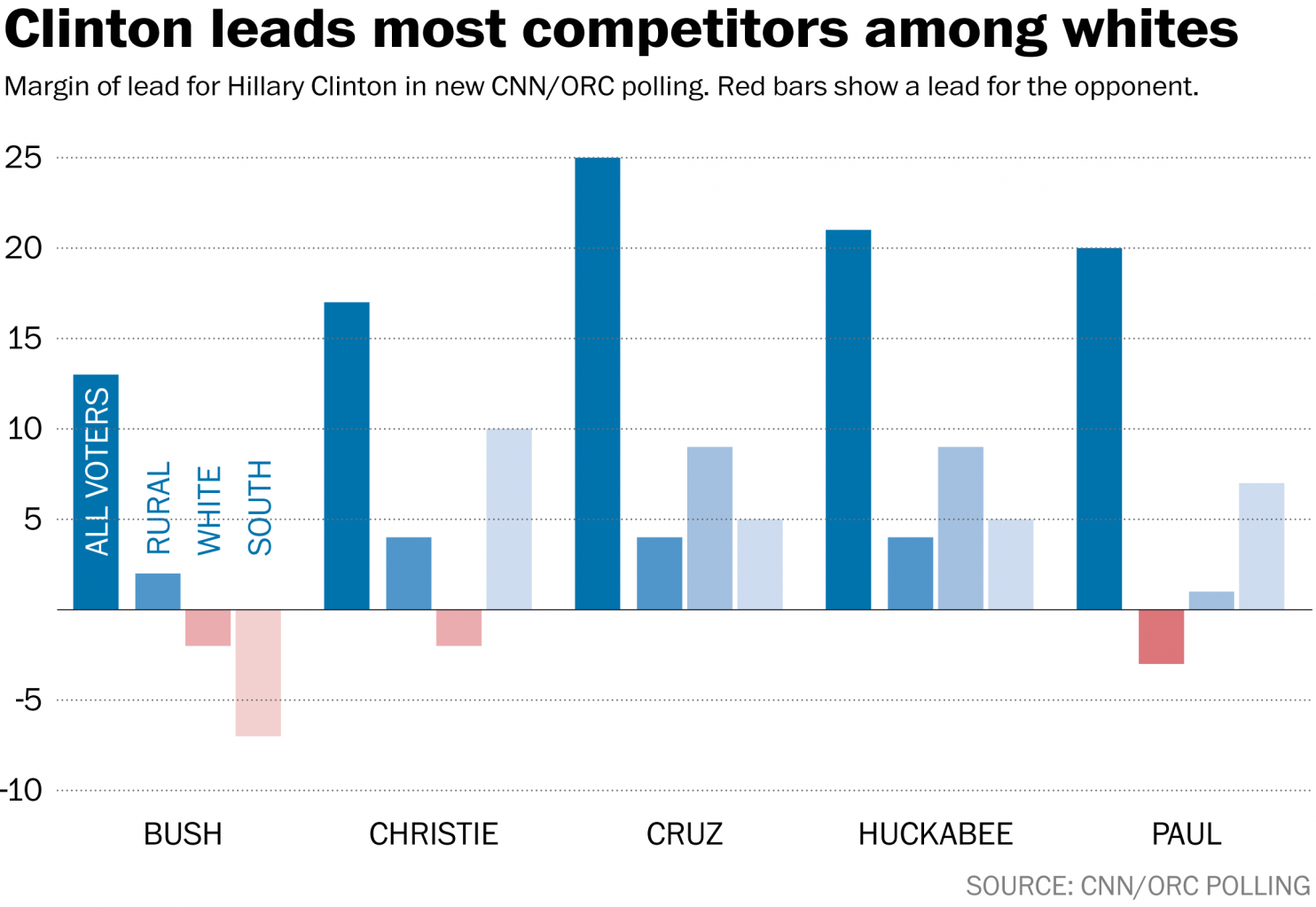
Still, a recent CNN poll of head-to-head contests of Clinton and possible Republican nominees says she leads among Southerners against New Jersey Gov. Chris Christie, former Arkansas governor Mike Huckabee and even Sens. Rand Paul of Kentucky and Ted Cruz of Texas, Philip Bump reports for The Washington Post. "She leads among rural voters against all of them except Paul and also against former Florida governor Jeb Bush. She even leads among whites against Cruz, Huckabee and Paul."

"Right now, though, Clinton is doing well enough among whites, rural voters, and Southerners to actually possibly beat some of her possible opponents," Bump writes. "The Democrats still have seen a long-term drop, but Clinton might at least help pump the brakes." And, it must be remembered that presidential elections are state-by-state, for electoral votes. (Post graphic; click on it for larger version)

Maps detail the rapid growth of poverty and income inequality, county by county

Poverty and income inequality, long-running staples of the South, have spread to other parts of the country at a rapid rate since 1989, Josh Zumbrun reports for The Wall Street Journal.

Poverty and income inequality have been especially bad in Appalachia, the Deep South and parts of the Southwest and California, Zumbrun writes. But "during the past decade, poverty and inequality spread to new areas in Alabama, the Carolinas, Georgia, Michigan and Tennessee," says Population Reference Bureau, a nonprofit demographic research group. (Population Reference Bureau maps; click on image to view a larger version)

Colorado city that banned fracking may be fighting a losing battle against powerful forces

Longmont, Colo., made headlines in 2012 when residents voted to ban fracking. But with Longmont sitting atop as much as $500 million worth of oil and gas, it "has become a cautionary tale of what can happen when cities decide to confront the oil and gas industry," Jack Healy reports for The New York Times. "In an aggressive response to a wave of citizen-led drilling bans, state officials, energy companies and industry groups are taking Longmont and other municipalities to court, forcing local governments into what critics say are expensive, long-shot efforts to defend the measures."

Longmont has already spent $136,000 to defend its measure banning hydraulic fracturing, Healy reports: "In July, a district court judge tossed out the ban, and the city is appealing." In August the City Council voted unanimously to defend the fracking ban. Many believe the town is facing a losing battle against powerful opponents with deep pockets and plenty of influence over state politicians, Healy writes: "Bryan Baum, a former mayor who opposed the ban, predicted that it would fall at every level of appeal, including at the Colorado Supreme Court, because only the state can regulate drilling."

Dale Bruns, a consultant for TOP Operating Company, the main oil-and-gas operator in Longmont, which is suing the city, told Healy, “There’s absolutely no question that what the city did is illegal. Longmont just repeatedly shoots itself in the foot. You’ve got a bunch of people who are just adamant that fossil fuel is bad, and it’s terrible for Longmont. This minority group has fired up the public with false claims.” (NYT photo by Luke Sharrett: Gas well in Longmont)

In Colorado the energy industry, "which argues that cities lack the authority to outlaw fracking, has already won rulings overturning three fracking prohibitions," Healy writes. And Democratic Gov. John Hickenlooper, who was re-elected in November, has been a big supporter of the practice, saying he will do whatever it takes to beat anti-fracking initiatives.

Kansas community turns to crowdfunding to raise money for a local grocery store

The mostly agricultural town of Plains, Kan. (Wikipedia map), has been holding on steady while other small towns in the area have struggled to survive. But many in this town of one-square-mile muncipality believe its future relies heavily on whether or not the town can acquire something it hasn't had since 2001—a local grocery store, Mitch Smith reports for The New York Times

In an effort to get that grocery store supporters have turned to crowdfunding through Kanstarter.com, Smith writes. Local residents have formed a nonprofit foundation that has "lined up about $400,000 through tax credits, grants, donations and fund-raisers. With about $5,100 more, they will have enough money to finish buying the empty land on Grand Avenue where, one day soon, they hope to build."

Supporters believe a grocery store will lead to further development and help increase the population in a county where numbers have been steadily dropping, Smith writes. Jeanne Roberts, who is leading the effort to bring a grocery store to Plains, told Smith, “A grocery store is the heart of the town. In small towns, it’s the social gathering place. And when you don’t have that social gathering place and you’re going outside, then you don’t feel connected.”

Overall, Plains is about one-third of the way to its fund-raising goal, Smith writes. "But even if donors raise enough money to buy the property in Plains, organizers will still need roughly $1 million more to build, equip, stock and staff a store. It is a lofty goal, a fact acknowledged even by the project’s most optimistic supporters." But that hasn't stopped residents from continuing to fight to bring a grocery store to their small town. (Read more)

USDA proposes rule to ease ID requirements on cattle and bison being shipped across state lines

The U.S. Department of Agriculture has proposed a rule to allow cattle and bison to travel across state lines without official identification "if they are shipped to no more than one approved livestock marketing facility and then directly to a slaughter plant,"  Philip Brasher reports for Agri-Pulse, a Washington newsletter. All other livestock are normally required to have official ID when being moved interstate.

Livestock owners have complained that delays while waiting for Interstate Certificates of Veterinary Inspection have caused animals to lose weight and hurt their market value, Brasher writes: "A separate provision of the rule would specify that federal and state inspectors can look at records and receipts held by marketing facilities that relate to pest detection, control or eradication efforts. The facilities would have to maintain records of receipt, distribution and application of ID devices and USDA-approved backtags." (Read more)

Early deadline today for Thur. webinar on linking newspapers, communities with social media

The National Newspaper Association is hosting a webinar on Thursday to discuss the results of a project by the North Carolina Press Association to promote newspapers through social media. As part of the NewspaperBaton project, NNA asked members to sign up for one day on Facebook or Instagram and post several photos with a caption about a specific topic, then pass the “baton” on to the next person who signed up for the next day.

The North Carolina group says baton holders were asked: "What role do newspapers play in your life? Do you start your morning with a cup of coffee and the local paper? Or do you get your news from Twitter? Maybe you glance at the headlines on the paper in your office. Or maybe you’re the one who turns news into a newspaper. Whoever you are, we want to see a day in that life! From the moment it gets tossed onto your driveway to the whoosh as you toss it into the recycling can; from the click of your mouse on the newspaper’s website to the swish of the comics page turning on a lazy Sunday morning... where do you encounter newspapers? Make a kite out of it, wrap up your fish (we prefer good sushi, frankly), fashion an old-school printer’s cap, make it into an old-time book cover. Make a video as you finish the crossword in record time, fold it into origami news birds… you get the idea. Have fun. Celebrate newspapers! Come, grab a paper and spend a day with us."

The webinar is scheduled from 11 a.m. to noon EDT. The cost is $30 for NNA members and $65 for non-members through today. After today, a $10 late fee will be charged. To register click here.

Thursday, January 01, 2015

Postal plant closures to resume, further slowing mail; rural newspapers worry about impact

Mail delivery is likely to get even slower soon as the U.S. Postal Service goes through with its plans to close dozens of regional mail-sorting centers, and that worried publishers of rural weekly newspapers that rely on the USPS not just for delivering papers, but also bills to subscribers and advertisers.

"The Postal Service plans to close 82 mail processing centers nationwide next year, starting on Jan. 10," Josh Hicks reports for The Washington Post. "USPS officials have said the consolidation plan will help the financially struggling agency save money and adjust to dwindling demand for first-class mail, one of its core services. But critics say the program will slow down delivery times and harm the agency’s brand. In October, the USPS inspector general released a report saying the Postal Service was leaving communities in the dark about the impacts of the changes. Auditors found incomplete impact studies for all of the 95 mail-processing facilities that are due to absorb operations from other centers. The Postal Service said it could not complete the statutorily required analyses because it had not yet finalized its new processing guidelines."

USPS has consolidated 350 processing plants since 2006 and has closed 143 in the last three years, Hicks reports, citing the service's annual report to Congress. "The next phase of consolidation will increase delivery times and eliminate overnight delivery for 'a large portion of First-Class Mail and periodicals,' according to the inspector general’s report."

Newspaper interests reached strongly to the news. The postmaster general "is mailing everyone in rural America a lump of coal this holiday season," wrote Dave Bordewyk, executive director of the South Dakota Newspaper Association., said in an email to members of the National Newspaper Association's Postal Committee.

"It appears we will be on our own in rural America in figuring out how to provide timely delivery of our newspapers – but then we have been dealing with that problem for some time. It will now get even worse," wrote Reed Anfinson, publisher of Minnesota's Swift County Monitor News and recent past president of the NNA.

In NNA's monthly newspaper, PubAux, a story headlined "Rural service declines as USPS builds urban strategy," Postal Committee Chairman Max Heath writes, "A second major problem is the “brain drain” within the U.S. Postal Service, as veterans with knowledge of mail acceptance and rules, especially Periodicals, a complex class, retire and people move up with much less knowledge and experience. Thirdly, there is a decline in customer service as postmasters and clerks with whom mailers, especially newspapers, have had a long-standing relationship, retire or move on. All too often, people are afraid to make a customer-friendly decision that they lack the experience to make, and their supervisors higher up are often equally untrained." Heath's column offers examples.

Tuesday, December 30, 2014

Reliable trend data on police shootings doesn't exist, but rural areas are part of the phenomenon

A recent rash of reports about shootings of unarmed black men by white police officers, including some in rural areas, "feels like a national tidal wave," Allen Breed reports for The Associated Press. "And yet, no firm statistics can say whether this spate of officer-involved deaths is a growing trend or simply a series of coincidences generating a deafening buzz in news reports and social media."

The FBI keeps data on police homicides, but relies on reporting by local law-enforcement agencies, and doesn't require information about race, age and circumstances, Breed notes in a story that focuses on the 2011 shooting by the only police officer in Eutawville, S.C., population 300 (Wikipedia map). Richard Combs had been charged with official misconduct for shooting Bernard Bailey, "who had come to the town hall to argue about a ticket his daughter had received," Breed reports.

Combs’ attorney, John O'Leary said prosecutor David Pascoe was taking advantage of national concerns to escalate the case, but the indictment was handed up the same day that a New York City grand jury declined to indict white officers in the videotaped choking death of African American Eric Garner, and "A letter dated Nov. 26, 2013, indicates O’Leary was informed of the prosecution’s intent to seek an indictment for murder," reported Richard Walker of the Orangeburg Times and Democrat.

Two other white police officers in South Carolina have been indicted in the last four months for killing unarmed black men, AP's Jeffrey Collins and Bruce Smith report.

Jenny Jarvie of the Los Angeles Times took a close look at the Eutawville case in a story published this week. "Nearly everyone knew Bailey, a 54-year-old father of five. He was the deacon of a Baptist church, his wife the elementary school librarian," she wrote in her second paragraph. "Throughout Eutawville, which is 36 percent black, there was shared relief at the former police chief's indictment. Yet . . . locals differed on whether race or bad policing was to blame."

The day after the indictment, Martha Rose Brown of the Orangeburg newspaper went to Eutawville and found likewise, but also wrote about a feeling that officials had said too little about the case. In an editorial, the paper said, "Based on the long history of the case and the questions surrounding just what happened that day, the state may have quite the task in convicting Combs of murder. Nonetheless, we do not believe that the solicitor is going forward with prosecution for political reasons any more than we believe Combs will have difficulty getting justice in a county with a majority-African-American population. . . . We believe the system will produce justice."

Agriculture, forestry and fishing is the industrial sector with the highest rate of workplace fatalities

The highest rate of fatal injuries in any U.S. industry sector is in agriculture, forestry, fishing and hunting. More than 100 children die on farms each year, but only about one in five of them are working. Those are some of the statistics on a fact sheet issued by the Agricultural Safety and Health Council of America. ASHCA says the annual cost of occupational injuries in agriculture is $8.3 billion in medical costs and lost productivity. Tractors are the leading cause of death and the typical cost of one overturned tractor is $1 million.

This is one part of the fact sheet. For a larger version, click on it. For the entire document, click here.
Effective safety programs can save $4 to $6 for every $1 invested, according to ASHCA, which says it is "a not-for-profit coalition of agribusinesses, producer organizations and safety professionals." Other facts on the sheet include: Although 87 percent of farms are operated by individuals or families, hired workers perform 60 percent of the work on U.S. farms, and 80 percent of those employees are foreign-born; and the world will need 70 percent more food by 2050 for the predicted 9.5 billion people. "Productive, efficient agriculture includes the preservation and well-being of agricultural workers at every level," ASHCA says.

Wages declined in 1/3 of counties in last decade; what happened in your county? This map shows

Even before the Great Recession, there was concern about wage stagnation, which has left millions of households with effectively less income than they had a decade ago. "One-third of all U.S. counties have seen their pay decline, when the figures are adjusted for inflation," Brian McGill and Dante Chinni report for The Wall Street Journal, with a handy map, emendated example below. (Click here for the interactive version.)
Overall, "Wages haven't budged in a decade," the reporters write. "The biggest winners for wage increases are the counties running down the center of the country, many of which have economies based on energy and agriculture." Other patterns are harder to discern; the phenomenon cuts across rural and urban, blue and red. State policies may have made a difference, judging from the clear differences between Illinois and Indiana, and between Alabama and Georgia.

"And even with all that in mind, the numbers on wage stagnation don’t tell the whole story," the reporters note. "Average annual pay still tends to be higher on the coasts and in the big cities than they are in rural Middle America." The data are from the Bureau of Labor Statistics' Quarterly Census of Employment and Wages.

Monday, December 29, 2014

Do you like The Rural Blog? Now is a good time to support its publisher with a donation

By Al Cross
Director, Institute for Rural Journalism and Community Issues

As you choose the tax-deductible contributions to make before the year ends, we urge you to consider The Rural Blog and its publisher, the Institute for Rural Journalism and Community Issues.

For more than 10 years, The Rural Blog has been a daily digest of events, trends, issues, ideas and journalism from and about rural America, designed for rural journalists but also serving everyone in rural America. This is a unique service, made possible by the endowment of the institute at the University of Kentucky.

At last report our endowment was still under water, meaning that its market value was less than its contributed value. That's because most of the endowment's money was raised at a time the stock market was high. We are trying to get it above water to avoid possible reductions in earnings that support the work of the institute, which you can read about at www.RuralJournalism.org.

We don't expect to get big donations from a blog post, but we are certainly interested in discussing our work with people who might be interested in supporting it. Our offices are closed for the holidays, but you can reach me at 502-682-2848. Our office number is 859-257-3744.

If your gift is small but you want it to make an immediate impact, you can give to our operating fund, from which we pay some current expenses. Donate to that fund or to the endowment by clicking here. Go to the gift-designation box and select "Institute for Rural Journalism and Community Issues Endowed Fund for Excellence" to give to the endowment; for the operating account, choose "Other" and type in "IRJCI operating."

Thanks for your support, and happy new year!

Montana, West Virginia among states considering laws to fight methamphetamine production

State lawmakers in Montana will consider a bill to create a database for purchases of pseudoephedrine or ephedrine—ingredients used to make methamphetamine—while a task force in West Virginia is recommending for the second time that state lawmakers require a doctor's prescription to purchase cold medicines used to make meth.

Montana has already enacted rules limiting purchases of pseudoephedrine or ephedrine to nine grams over a 30-day period, but without a database, officials say it's impossible to stop smurfing—when people frequent multiple pharmacies to purchase large quantities, Scott Zoltan reports for KECI in Missoula. Senate Bill 48, which has the support of the Montana Department of Justice, would connect the state to NPLEx, a system already used in 25 states to track purchases of cold medicine.

Meth has been a rampant problem in West Virginia, with officials seizing 290 labs this year, the third highest total in state history, Eric Eyre reports for The Charleston Gazette. Despite the number of busts being down from a record 531 last year, the Kanawha County Commission Substance Abuse Task Force said meth remains a problem in the state and the agency recommended that lawmakers require a doctor's prescription to purchase cold medicine with meth-making ingredients.

The task force criticized using NPLEx as a solution, saying drug manufacturers can get around the system by hiring large numbers of people to purchase their monthly limits, Eyre writes. Instead, the task force said the only way to rid the problem is by requiring a doctor's prescription. (Read more)

With help from Walmart, new devices and stagnant wages, U.S. sock makers ramp up production

The American sock industry, once all but dead, has been revived by "changes in technology, attitudes and costs," James R. Hagerty reports for The Wall Street Journal from rural Hildebran, N.C., just west of Hickory, where a Canadian designer-marketer who had given up manufacturing has reactivated an old plant to make socks for Walmart.

The new technology is in Italian machines that knit and seam socks in the same process, requiring about half the number of workers. The attitude change is at Walmart, "which is trying to reduce its heavy reliance on imports" and is giving more shelf space to U.S.-made products, Hagerty writes. Costs? American manufacturing has become more competitive with China because "average manufacturing wages in the U.S. have risen less than 2 percent annually over the past five years, while those in China have about doubled since 2008."

"For similar reasons, other sock makers are investing in the U.S.," Hagerty reports, but adds, "Some producers are still heading overseas. . . . Employment in U.S. hosiery and sock mills totals about 8,600, one quarter of the tally for 2001. The U.S. sock-making industry has shrunk so drastically that its trade group, the Hosiery Association, disbanded in 2013." (Read more)

English researcher says putting digital collars on livestock could increase rural broadband access

Sheep could help bring broadband to rural areas. English researchers are studying how digital sheep collars, sensors on riverbanks and rainfall monitors could advance technology in rural areas, while providing high-speed Internet service to residents, Victoria Woolaston reports for the Daily Mail. (Sony photo: Cameras on sheep covering the Tour de France)

Gordon Blair, a computer scientist at Lancaster University, is using a grant to conduct research in Wales on outfitting sheep with digital collars that can be used to allow farmers to better monitor livestock, while also doubling up as wireless Internet hotspots, Woolaston writes. "Earlier this year, sheep in Yorkshire were fitted with cameras to give a unique view of the Tour De France" bicycle race.

Officials at Lancaster University have proposed fitting sensors to riverbanks to monitor river levels and warn of floods, Woolaston writes. "This system uses sensors on the bank, and throughout neighboring towns to track rising water levels and weather conditions. Some sensor locations are designated as ‘government office nodes' and have an office with a laptop computer where data is collected and stored. An algorithm is then used to predict flood risks before alert notifications are displayed." (Read more)