Wednesday, July 12, 2017

Salmon fishers' big run clouded by EPA opening door to mine that they say threatens their fishery

New York Times map
"As commercial fishermen in Bristol Bay were busy landing salmon," Alex DeMarban reports for Alaska Dispatch News, "the Trump administration on Tuesday moved to cancel the Environmental Protection Agency's 2014 action that would have blocked development at the Pebble gold and copper prospect in Southwest Alaska," which foes say threatens the salmon fishery.

The mine, which would also produce molybdenum, has been proposed for more than a decade. Last month the Trump administration settled a lawsuit by the developers, allowing them to apply for federal permits. On Tuesday, EPA "proposed withdrawing its 2014 determination barring any large-scale mine in the area because it would imperil the region’s valuable sockeye salmon fishery," Brady Dennis reports for The Washington Post. "Even if the EPA eventually does withdraw its opposition, Pebble Mine would have to undergo a federal environmental review and clear other state hurdles before construction could begin. The EPA said Tuesday that after it hears from the public and consults with local tribes, its regional administrator will make a final determination 'in consultation' with" EPA Administrator Scott Pruitt.

"The opposition to the mine, including lodge owners led by Trout Unlimited, appears to be just as active as before," DeMarban reports from Alaska. "The proposal came as fishermen enjoy one of their biggest salmon-fishing seasons in years," according to Alannah Hurley, executive director of United Tribes of Bristol Bay, who DeMarban "reached by cellphone as she was commercial fishing with a net off the beach near Dillingham," he reports. She told him the announcement was "a stab in the back" to subsistence and commercial fishermen in the bay.

Shale-gas boom leads to plastic-pellet plants, but Appalachian infrastructure for them is lacking

A planned cracker plant in Beaver County,
Pennsylvania. (Royal Dutch Shell rendering)
Appalachian states are poised to capitalize on the world's growing appetite for plastics, not only with shale gas and oil drilling, but with plants called "crackers" that turn natural gas byproducts into usable plastic pellets for manufacturers, Tom DiChristopher of CNBC reports.

Northern Appalachian states such as Pennsylvania and New York have large shale-gas deposits and are already profiting from drilling, but the petrochemicals boom has triggered increased investment in crackers. "Since 2010, 301 chemical industry projects worth $181 billion have been announced in the United States," writes DiChristopher. Appalachia saw $16 billion of that, but states such as Pennsylvania, Ohio, Kentucky and West Virginia could bring the region an even bigger slice of the pie.

Royal Dutch Shell will begin building a cracker plant next year along the Ohio River in Beaver County, Pennsylvania, next year. The project will create about 6,000 construction jobs and 600 permanent positions. A Thai petrochemical company, PTT, is considering building another such facility in economically distressed Belmont County, Ohio. 

Cracker plants are used because because plastic pellets are much easier to transport than raw petrochemicals, a critical factor since much of the output from cracker plants will be exported. But because of a lack of infrastructure, investors may be hesitant to locate crackers in much of Appalachia. The American Chemistry Council said that they're unsure how a transportation-and-storage hub in Appalachia could be created. "It's something of a chicken-and-egg situation: The region needs infrastructure to attract petrochemical facilities, but it's hard to get financing for infrastructure without the facilities," DiChristopher writes.

Tuesday, July 11, 2017

Microsoft promises to harness unused TV channels to bring 'super wi-fi' to rural areas in 12 states

Microsoft map using June 2017 data from Federal Communications Commission
Microsoft says it will use the bandwidth from unused television channels, called white spaces, to deliver high-speed broadband to many of the 24 million rural Americans who lack fast internet access. The initial service will serve 12 states: Washington, Arizona, Texas, Kansas, the Dakotas, Wisconsin, Michigan, Georgia, Virginia, New York and Maine, "to connect 2 million rural Americans in the next five years who have limited or no access to high-speed internet," Cecelia Kang reports for The New York Times.

Fast, reliable, affordable internet service has been a longtime problem in rural America. Internet service providers often can't justify the cost of building infrastructure in sparsely populated areas. Microsoft and other companies have been testing white spaces as an alternative since 2008. Microsoft President Brad Smith told Kang that white spaces were "the best solution for reaching over 80 percent of people in rural America who lack broadband today." For Microsoft's blog post, click here; for its white paper, here.

White spaces technology is sometimes called "super wi-fi" because it "behaves like regular wi-fi but uses low-powered TV channels to cover far greater distances than wireless hot spots, "up to 10 miles in rural areas," Jay Greene reports for The Wall Street Journal. "It is also more powerful than cellular service because the frequencies can penetrate concrete walls and other obstacles," Kang reports. Microsoft stands to profit from the service because Americans who have internet access are better positioned to buy Microsoft apps and products.

But the initiative has its challenges. TV broadcasters argue that white-space tech can interfere with broadcasts on neighboring channels. Also, not many manufacturers have devices compatible with white-space technology, and such devices cost upwards of $1,000. Only 800 such devices are registered in the U.S., according to the National Association of Broadcasters. Microsoft promises to roll out compatible devices that will cost under $200 by next year, Kang reports.

Some, including broadcasters who jealously guard their parts of the electromagnetic spectrum, remain skeptical. “Microsoft has been making promises about white-spaces technology for well over a decade,” Patrick McFadden, an associate general counsel for the NAB, wrote in a comment filed with the Federal Communications Commission. “At what point do we finally conclude that the white spaces project is a bust?”

Microsoft declined to say how much it will spend on the 12 projects, but "estimates it would cost $10 billion to $15 billion to connect rural America with broadband access using TV white spaces, compared with $15 billion to $25 billion using fixed wireless technology, and $45 billion to $65 billion running fiber-optic cable to homes," Greene reports.

Democrats target several districts to win House in 2018; several are rural and labeled 'Left Behind'

For Democrats to win the House majority in the 2018 midterm elections, they "will need to make big gains with suburban voters, defend incumbents in rural districts where President Trump remains popular, topple a handful of Republicans in the Sun Belt and probably win a handful of seats that still aren’t on anyone’s radar," writes analyst James Hohmann of The Washington Post.

Democrats need a net gain of 24 seats to control the House. But while 23 Republican-held districts went for Hillary Clinton, those members are not necessarily vulnerable, since many are popular and have distinguished themselves from Trump's message, Hohmann says. Another complicating factor for Democrats: They must defend seats in 12 districts that went for Trump in 2016.

The analysis features an in-depth look at 65 districts where a majority might be won. The "Majority Maker" district analysis, created by the Third Way think tank using 48 census data points, divides swing districts into four categories: "Diverse/Fast-Growing Regions, Thriving Suburban Communities, Left Behind Areas, and Non-Conformist Districts." The districts are demographically diverse; some are suburban and mostly white, some are rural and heavily Latino. There are also wide differences in income, education level and employment. Many of the districts are mainly rural or have significant rural populations, and are mostly categorized as "Left Behind Areas."
"The most important takeaway is that there is no one kind of voter or district that can deliver the House for Democrats in 2018,” said Lanae Erickson Hatalsky, the vice president for social policy and politics at Third Way, who co-authored the report with Ryan Pougiales. "There are a lot of different kinds of candidates and policies we’re going to have to welcome into the coalition to win. There’s no single kind of candidate that would resonate in all these places. The idea of purification – that we just need one kind of person who is going to bring us the majority – is not borne out by how different these places look."

Research shows hydraulic fracturing for gas and oil can contaminate drinking water 1 kilometer away

A new research paper indicates that horizontal hydraulic fracturing can contaminate drinking water up to one kilometer from the well pad. Elaine Hill of the University of Rochester School of Medicine and economist Lala Ma of the University of Kentucky looked for a consistent connection between shale-gas drilling and water quality in Pennsylvania, a state with large shale-gas reserves.

Many Pennsylvania residents have said for years that the drinking water near fracking sites made them sick, David Trilling notes in Journalist's Resource, a service of the Shorenstein Center at Harvard University. The Environmental Protection Agency agreed in December 2016 that there is a connection between fracking and contaminated groundwater. The research from Hill and Ma answers the question of how far shale gas drillers need to stay away from drinking water.

Hill and Ma took 54,809 water samples over five years within 10 kilometers of a well pad, a group of wells. Trilling lists their takeaways:
  • Adding a well pad within 0.5 kilometers of a water-intake location is associated with a 2.7 percent increase in fracking-related contaminants.
  • Contaminants fall as the distance increases. A well pad within 1 kilometer is associated with a 1.5 percent increase in contaminants.
  • Beyond 1 kilometer, the results are no longer statistically significant.
  • A well placed uphill from a water source poses a slightly greater threat, providing “evidence that, unsurprisingly, it is the uphill threats that are disproportionately affecting drinking water quality.”

Missouri and Arkansas ban sale and use of dicamba herbicide that drifts on wind and damages crops

UPDATE, July 15: Tennessee placed restrictions on use of dicamba, Pam Smith of DTN reports: New rules "require anyone spraying dicamba to be certified as a private or licensed applicator and keep records of the applications. Available hours to spray dicamba are now restricted to a period of 9 a.m. to 4 p.m. to avoid temperature inversions. No older formulations of dicamba products can be sprayed in agricultural settings for the remainder of the agricultural growing season. Applications over the top of cotton after first bloom are also prohibited."

Soybeans damaged by dicamba herbicide
(University of Missouri photo)
Missouri and Arkansas announced on July 7 the immediate ban on the sale and use of dicamba, following two years of complaints that the herbicide drifts on the wind and damages crops. The Missouri ban is considered temporary, "until a solution is reached," and the Arkansas ban will last at least 120 days, Chris Clayton reports for DTN/The Progressive Farmer.

The Arkansas State Plant Board has received almost 600 complaints about the issue, causing it to recommend a ban on June 23. A state Legislative Council committee chose to take no action on the ban, enabling it to go into effect July 11. Arkansas farmers caught using dicamba will face a $1,000 fine, which will increase to $25,000 after August 1, Clayton reports.

Missouri Soybean Association President Matt McCrate estimates that more than 200,000 acres of soybeans in the state have been damaged by dicamba in the 2017 growing season alone. The Missouri Department of Agriculture received 212 dicamba-related complaints in the past fiscal year (July-June), up from 27 the year before, Benjamin Herrold reports for Iowa Farmer Today.

Farmers use dicamba on Xtend brand soybeans and cotton, which are genetically modified to tolerate dicamba, notes Herrold. Many Missouri farmers switched to Xtend beans because most of the cotton grown in the state's southeastern "Bootheel" was already the Xtend variety, and herbicide drift was damaging non-resistant soybeans. "A lot of people felt like they had to protect themselves," said Kevin Bradley, a University of Missouri weed scientist who has been speaking out on the issue. "In the Bootheel of Missouri, it's a tremendous problem."

At a recent event, Bradley said that nighttime spraying, tank contamination and improper straying setup could be contributing factors to the problem. According to Herrold, Bradley "called on chemical companies, farmers, applicators and experts at MU and the Department of Agriculture to work together." Bradley said, "Everybody has a role. It's a call to action."

Monday, July 10, 2017

Rural counties with more than half of kids on Medicaid voted overwhelmingly for Trump

More than half the children in 780 mainly rural counties rely on Medicaid and the related Children's Health Insurance Program, and 617 of those counties voted for President Trump, Noam Levey reports for the Los Angeles Times, drawing on data from the Georgetown University Health Policy Institute's Rural Health Policy Project.

For an interactive map, with data for all 780 counties, click here.
Parents and medical providers are becoming increasingly alarmed as the Republicans who many of them voted for are moving to scale back those programs, Noam N. Levey reports for the Los Angeles Times.

"There is just no way to cut Medicaid on the scale that they are talking about and avoid hitting kids," said Dr. Traci Acklin of Montgomery, W.Va., where more than two-thirds of the voters backed Trump. "Without the health insurance, kids aren't going to get the immunizations and the checkups. There are going to be more lost days of school. More trips to the emergency room. . . . It would be food or health care for a lot of these families."

Some Republicans in Congress have been listening to these concerns. Levey and Lisa Mascaro of the Times note that several GOP lawmakers, including West Virginia Sen. Shelley Moore Capito, have stalled the Republicans' Senate health-care bill. Polls show the Senate plan is supported by less than 20 percent of the public. The plan would limit payments to states instead of reimbursing them a percentage of what they spend. "The funding cap in the Senate bill would increase only at the rate of inflation, reports Levey, "leaving states with an increasingly larger share of medical costs, which have typically increased faster than inflation."

Medicaid and CHIP coverage for children has expanded over the last 20 years. Today, only 5 percent of children lack health coverage, compared to 14 percent two decades ago, notes Levey. Republicans insist that they won't take away those gains. Health and Human Services Secretary Tom Price recently said on NBC's "Meet the Press" that the new legislation will make sure that "nobody falls through the cracks."

Gun owners' opinions about firearms and gun laws depend partly on whether they're urban or rural

Gun owners have different experiences and opinions about gun laws, depending on whether they live in urban, suburban or rural areas, the Pew Research Center has found in its polling.


Gun ownership is much more common in rural areas (58 percent of rural households report having a firearm), and "gun owners in rural areas are far more likely than urban owners to cite hunting as a major reason they own a gun (48 percent vs. 27 percent, respectively)," Ruth Igielnik reports for Pew. "Rural gun owners also tend to become gun owners at an earlier age," and "Americans who grew up in rural areas are more likely to have grown up with guns in their homes."

Those numbers help explain how firearms are a part of rural culture, which associates the right to own guns with a personal sense of freedom. In rural areas, 82 percent of gun owners "say the right to own guns is essential to their personal sense of freedom, compared with 59 percent of gun owners in urban areas,' Igielnik reports.

"One notable similarity between rural and urban gun owners is how they store their guns. Similar shares of gun owners in rural areas (56 percent) and urban communities (51 percent) say there is a gun that is both loaded and easily accessible to them all or most of the time when they are home."

Appalachians who are unhappy with national news media are telling their own story

Appalachian journalists, fed up with what they perceive to be biased and opportunistic coverage from national news media sources, are trying to reclaim their voice, writes West Virginia-based Catherine Moore for the Columbia Journalism Review.

"Even before Donald Trump’s election, Appalachia was treated as a kind of Rosetta stone for deciphering rural white poverty in America," Moore writes. "In its aftermath, media inquiries . . . confirmed many residents’ deep-seated fear that the national press only shows up when the news is bad, or to make them look like fools or freaks. Instead of inviting input on how to frame their stories, reporters seemed to be looking for people to fit a frame they already had in mind."

When Communications Director Jake Lynch of the West Virginia Community Hub became increasingly frustrated by national media coverage, he invited members of the national media to New Story 2017, the organization's yearly conference for "people trying to drive the story and the future economy of the state." None would come, Lynch reported. "There wasn’t enough conflict or controversy, he was told," Moore writes.

At New Story 2017, a two-day conference held from June 16-17 at West Virginia University's Reed College of Media, "showcased a number of new platforms, projects, and enterprises that have sprung up to shape the narrative of Appalachia from the inside out," writes Moore. More than 300 people and organizations from Central Appalachia showed up.

"There was Kentucky-based Southerly, a robust new email newsletter aiming to fill a gap in environmental reporting in and about the South. And Mountain Tech Media's 'Upload Appalachia' internship program, designed as a vehicle for smart, talented young people to stay in the region and take on digital work. Many more inside-out, bottom-up media projects in the region—Vandaleer, Inside Appalachia, Scalawag, the Ohio Valley ReSource, WestVirginiaville, Hollow, Looking at Appalachia, Appalshop—were represented as well," Moore writes.

Large firms that are squeezing organic-milk farmers may not follow the same grazing standards

Amish organic farmer Eldon T. Miller of Kalona, Iowa,
packs eggs. (Washington Post photo by Rachel Mummey)
Amish dairy farmers who produce organic milk may soon be priced out of a living by large organic-milk operations – some of which may not be meeting organic grazing standards, Peter Whoriskey reports for The Washington Post.

Organic milk's increasing popularity has led large-scale dairy farms to get into the act, causing prices to fall, and with it, the paychecks of small organic farmers already operating with thin profit margins. In Kalona, Iowa, more than 90 farms in a 10-mile radius produce milk as well as eggs, corn and soybeans. But because of a glut of organic milk from large operations, "over the past year, the price of wholesale organic milk sold by Kalona farms has dropped by more than 33 percent. Some of their milk – as much as 15 percent of it – is being sold at the same price as regular milk or just dumped onto the ground," Whoriskey reports.

In June 2017, an investigative report by Whoriskey found that Aurora Organic Dairy in Colorado, one of the country's largest organic dairy producers and a supplier for Walmart, Costco and Albertsons, may not be allowing its cows to graze on grass enough to meet organic standards. Consumers pay more for milk from grass-fed cows because they believe it is healthier for the cows and makes for better milk. But grass-fed cows also produce less milk, so organic farms have an incentive to feed them grain on the sly, Whoriskey reports in his latest story.

The amount of organic milk on the market has risen disproportionately to the number of organic cows, suggesting that many organic farmers are secretly giving their cows grain. Some say that the increase in milk may be due in part to farmers reducing the amount of grazing the cow gets to the minimum required by organic regulations, Whoriskey reports.

The Agriculture Department uses inspectors hired by the farmers to investigate whether its organic standards are being met, but many argue that the department doesn't punish violators enough or at all. "The USDA has shown a remarkable lack of interest in whether these big organic dairies are really organic," Mark Kastel of the small-farm watchdog group The Cornucopia Institute told Whoriskey. USDA said it is reviewing the information from Post's investigation.

Rural Ohio editor writes in Washington Post: Opioid deaths are worse than a terrorist attack

The destruction caused by the opiod epidemic in Ohio is like a terrorist attack, writes Gary Abernathy, editor and publisher of The Times-Gazette in Hillsboro, Ohio, in a thought-provoking opinion piece for The Washington Post. The weapons are heroin and other opioid drugs, he says, and the terrorists are those who push them – not just by selling them on the street, but by inappropriately advertising or prescribing them. Opioid prescription rates increased in many rural areas and small towns from 2010-2015, though they fell elsewhere.

"Our vaunted 'war on drugs' has long represented little more than benign phraseology," Abernathy writes. "But it has become a real war, and the drug cartels and pushers here and abroad are enemy combatants. Until we respond as we would to any terrorist attack, the casualties will continue to mount."

In Abernathy's small town of Hillsboro alone, he notes that increasing overdoses are putting stress on local emergency responders and the foster care system. When parents are arrested for using drugs, their children must be placed in a foster home. But with only 15 foster families available in Highland County, the more than 100 local children in foster care sometimes must be placed in other counties at a higher cost.

Ohio leads the nation in deaths from opioid overdoses, with more than 4,149 Ohioans dying from it in 2016 -- more than died on Sept. 11, 2001. And that's a 36 percent increase from 2015, report Alan Johnson and Catherine Candinsky of the Columbus Dispatch. Ohio coroners say 2017 is on pace to outstrip 2016. Ohio Attorney General Mike DeWine recently sued pharmaceutical makers, alleging that they encouraged the problem with misleading marketing. And Highland County's prosecutor has been charging purveyors of fentanyl-laced heroin with involuntary manslaughter when it results in a death, instead of treating such incidents as accidental deaths, Abernathy reports.

Minn. governor cancels meeting on walleye fishing ban after protesters in boats surround his

Dayton gave a thumbs up after landing a bass at the
start of the season in Mille Lacs. (Official photo)
UPDATE, Aug. 14: Dayton has a closed meeting today with Mille Lacs resort owners.

Minnesota Gov. Mark Dayton canceled a meeting with business owners around a popular fishing lake Saturday "after about 75 protesters in boats encircled him on the lake to protest a temporary ban on walleye fishing" that started Thursday and runs through July 27, Sarah Jarvis reports for the Minneapolis Star Tribune.

Dayton, a Democrat, was trying to promote bass fishing and "spent about 90 minutes on the water before heading back to land," Jarvis reports. "Passengers on roughly 25 boats displayed balloons and signs reading “REGULATION WITHOUT REPRESENTATION = TYRANNY” and “GOV. DAYTON STOP LAKE MILLE LACS POLITICS!

"Dayton said he respects the protesters’ frustration, but he defended the ban as a way of preserving the struggling walleye population," Jarvis writes. "He said he canceled Saturday’s meeting — which was going to include several Lake Mille Lacs-area business owners — because he didn’t want to 'reinforce that kind of destructive behavior.' He said he would meet with them later." Some business owners told Jarvis the walleye ban would cost them tens of thousands of dollars.

Jarvis notes, "For more than 20 years the state has managed the lake with Minnesota and Wisconsin Ojibwe bands that net walleye but have been consistently under their quota." Walleye are more prized than bass.

Friday, July 07, 2017

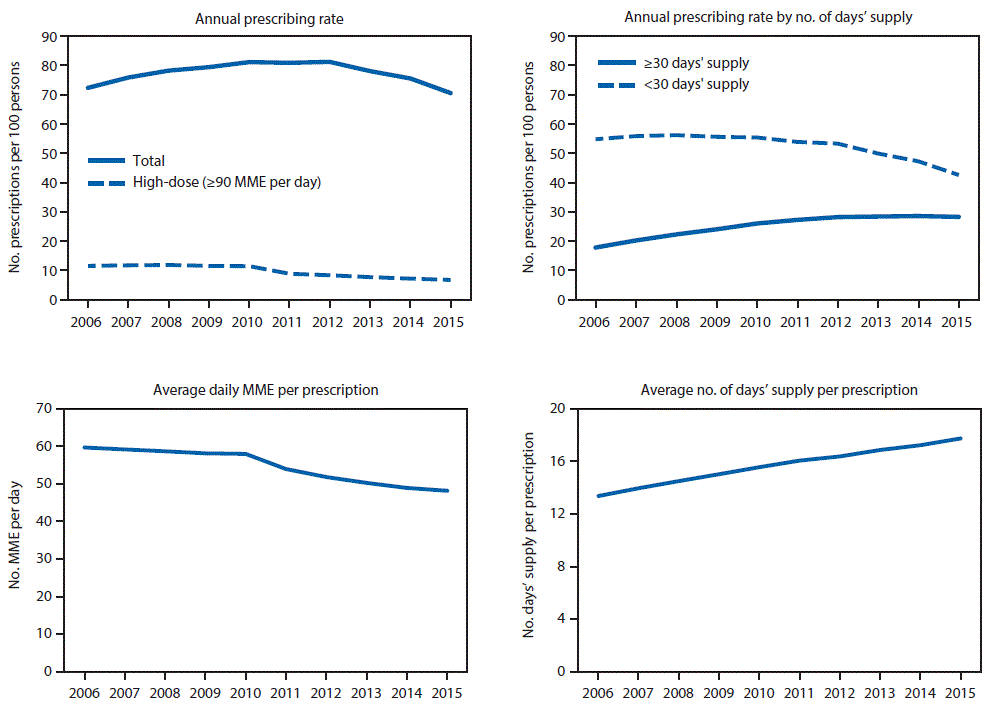
Opioid-prescription rate fell, but rose in rural areas; CDC study has county-by-county maps

Opioid-prescription rates fell recently, but continued to increase in more than half of U.S. counties, the federal Centers for Disease Control and Prevention says in a report that includes county-by-county maps showing ranges of prescription rates and whether the rates have increased or decreased since 2010. The national rate was still three times as high as it was in 1999.
Click on maps for a slightly larger version; MME is morphine milligram equivalents.
"While prescriptions rates fell nationwide between 2010 and 2015, their availability either remained steady — or actually increased — in just over half of the U.S. counties for which data were available," reports Melissa Healy of the Los Angeles Times. "The counties in the top quartile (top 25 percent) were largely rural places where residents are overwhelmingly white, low-income and in poor health."

The findings are based on where a prescription was dispensed, not the residence of the patient. CDC said rates were higher in "micropolitan" counties, those with cities of 10,000 to 50,000 people: "Reasons for higher opioid use in micropolitan counties might include less access to quality health care and other treatments for pain, such as physical therapy. In addition, persons in rural areas might travel to micropolitan areas, which often serve as an anchor community for a much larger rural region, to receive medical care and pick up medications."

Healy notes, "Florida, Ohio and Kentucky — all states that cracked down on high-prescribing doctors and clinics between 2010 and 2012 — saw opioid prescribing fall in 80%, 85% and 62% of their counties, respectively. Given that rates of opioid prescribing are closely linked to addiction and overdoses, the CDC said that counties and states can use its detailed breakout of prescribing trends to increase the availability of addiction treatment."
Charts from CDC report; click on image for a larger version

Jailer says repeal of Obamacare and Medicaid expansion could wreak havoc on jail budget

Anderson County, Kentucky, Jail
A rural Kentucky jailer says repealing the Patient Protection and Affordable Care Act could cause big problems for the budget of her jail, reports Ben Carlson of The Anderson News in Lawrenceburg, in a story with potential national implications.

The operating budget for the Anderson County Jail is just under $1 million, but Jailer Joani Clark has been forced to request large funding increases in the past few years, mostly because of the opioid epidemic that has brought more inmates with attendant medical expenses.

"Since Obamacare kicked in, the jail's inmates are charged the Medicaid rate for payment of hospital, doctor bills, etc., when they're in custody," Clark said at a recent meeting of the Anderson County Fiscal Court. "If this all goes away, the county will be paying all hospital and doctor bills and any other type of medical at full regular prices."

According to Clark, inmate medical services cost local taxpayers almost $32,000 during the 2016-2017 fiscal year. But Medicaid coverage for some of those services saved the county almost $170,000. "If an inmate has to be admitted to the hospital for more than 24 hours, Medicaid will pay all the bills in full," Clark said, also noting that many inmates have taken advantage of free injections offered to help them keep their heroin addictions under control. The normal cost of the Vivitrol injection, given once every 30 days to control a heroin addition, is $700-$1,000.

N.C. passes bill to move public notice from newspapers to government websites in one county

The North Carolina legislature has passed a bill that moves public notices from local newspapers to government websites in a single county, a move some say makes the government less transparent and targets the local newspaper.

State Sen. Trudy Wade
Republican Sen. Trudy Wade of Greensboro, the seat of Guilford County, has tried to pass similar laws twice before, but succeeded this time by narrowing the scope of the bill, creating it as a "pilot program" in the county only, and attaching it to a separate measure she had introduced that declares that newspapers carriers cannot be presumed to be independent contractors, reports the Public Notice Resource Center.

Under the bill, which will become law by July 30 if not vetoed, court-ordered legal notices will be published on the county website instead of in the local newspaper, the Greensboro News & Record. Other local officials may decide whether to publish their notices in the newspaper or on their own websites instead, according to the article. The bill also allows the county government to charge $10 to $450 for notices published on its site.

Some think Wade wanted to hurt the Greensboro paper for what she feels is unfair news coverage. Rep. Pricey Harrison of Greensboro says that Wade held up other pending Senate bills in order to get her bill passed. "I do think it's her vendetta against the News and Record," he told the paper's Taft Wireback.

Not so, Wade told Wireback: "It really doesn't have anything to do with the News and Record. It has to do with making sure the citizens have free access to legal notices. To be honest with you, technology changes. This is just another example of changing technology and people using that technology."

News & Record Publisher and Editor Daniel Finnegan worries that Guilford County residents will be less likely to see important notices that may affect their lives, saying "We reach far more people with the combination of our newspaper and website -- more than 100,000 per day -- than government websites."

States fight EPA's decision to allow pesticide

Several states are attempting to join a legal challenge to the Environmental Protection Agency's decision to keep a widely used pesticide on the market despite evidence it may be harmful.

Massachusetts, Maryland, Vermont, Washington, and the District of Columbia are seeking to join New York in the lawsuit pending in the appeals court in San Francisco, Michael Biesecker reports for The Associated Press. The lawsuit claims EPA Administrator Scott Pruitt violated the law by ending his predecessor's efforts to ban the popular pesticide chlorpyrifos, which has been sold by Dow Chemical since the 1960s and is one of the most widely used pesticides in the U.S.
Federal law requires the EPA to make sure that pesticides used on food are not harmful to consumers, but federal scientists reported that chlorpyrifos can damage the brains of fetuses and infants. A 2012 study from the University of California, Berkeley, found detectable levels of chlorpyrifos in 87 percent of newborns' umbilical-cord blood samples tested, reports Biesecker.

In addition to its effects on children, the pesticide is being blamed for causing 47 farmers around Bakersfield, Calif., to get sick on May 5. When the chlorpyrifos-containing pesticide Vulcan was sprayed on an orchard there, the wind caused it to drift over to nearby cabbage harvesters, who then complained of nausea and vomiting.

Some efforts have been made to mitigate the effects of chlorpyrifos. Dow stopped selling it for home insecticide in 2000, and the EPA mandated no-spray zones around schools and other vulnerable areas in 2012, but some advocacy groups such as the Natural Resources Defense Council and the Pesticide Action Network said those efforts are not enough and filed a federal lawsuit seeking a national ban.


Summit in Appalachia to brainstorm ideas for expanding rural broadband internet access

FCC Commissioner Mignon Clyburn
A July 18 summit will bring together experts from across the country to brainstorm ways to expand broadband internet access in rural communities. The Appalachian Ohio-West Virginia Connectivity Summit will be held in Marietta, Ohio, and will feature panel discussions, breakout sessions, and speakers such as Federal Communications Commissioner Mignon Clyburn.

The summit is the product of a partnership between the Center for Rural Strategies and Public Knowledge. The Center for Rural Strategies is a nonprofit that seeks to improve rural communities through spotlighting rural culture and reporting relevant news through its Daily Yonder blog. Public Knowledge, also a nonprofit, says it promotes "freedom of expression, an open internet, and access to affordable communications tools and creative works."

"In 2017, broadband is essential," speaker Kate Forscey, government-affairs associate counsel for Public Knowledge, said in a press release. "Connectivity makes the difference in access to a solid education, healthcare, and a stable job. Connectivity is the difference between your 911 call connecting to a first responder, or going unanswered. Yet more than 20 million Americans in rural communities still lack basic access to high-speed broadband, which is necessary to participate in daily life."

Click here to register for the event or learn more.

Thursday, July 06, 2017

President Trump's criticism of the news media affects local journalists, some of them say

President Trump has had a notoriously hostile relationship with many of the national news outlets that cover him--a feeling his supporters have been quick to echo. But local papers who rarely cover national news say that the animosity toward the press as a whole has been affecting them too, as we reported here and here. And first, here.

A great deal of this is likely because rural areas voted overwhelmingly for President Trump, James Warren reports for The Poynter Institute. He notes Pew Research Center polling showing that there has been a corresponding drop over the past year in Republicans who believe the press is doing a good job with watchdog journalism.

Sioux City Journal reporter Nick Hytrek says he believes local media are being lumped in with their national counterparts. "It seems that any story someone doesn't agree with is labeled as 'fake news'," he told Warren. "This is especially true in any story on politics or local government."

Tom Kearney, who edits three small papers in Vermont, told Warren, "I think it's easy to rip people when you've never met them, but our folks have met with us, dealt with us, and understand what we're doing. And for the most part, they appreciate our work. One challenge is to overcome the image of a news organization as a monolithic, impenetrable, uncontrollable force and demonstrate that we're neighbors, trying our hardest to deliver information local people need to have."

Jeffry Couch, editor of the McClatchy Co.-owned Belleville News-Democrat in western Illinois,
told Warren that he hasn't had too many problems with Republican readers, but acknowledges that some complain about perceived negative coverage of Trump. But most of the complaints he receives are normal for any editor: "We have always had our share of local politicians who criticize the Belleville News-Democrat because of our aggressive coverage, particularly when the reporting is about their area of responsibility. That goes with the territory."

EPA's Pruitt to take on climate-change consensus with hand-picked experts

Environmental Protection Agency Administrator Scott Pruitt has announced a program to critique mainstream climate science with pro-and-con debate teams of experts recruited by the Trump administration, a move many see as an effort to undermine the scientific consensus that humans are causing climate change. Pruitt said at a board meeting of the American Coalition for Clean Coal Electricity that he's establishing a "specific process" to review climate science, a senior administration official told Emily Holden of Environment & Energy News.

Coal industry executives believe the move means Pruitt will review a 2009 finding that greenhouse gases emitted by industry, power plants and cars endanger human health and welfare. According to Holden, Pruitt assured Robert Murray, the CEO of Murray Energy Corp., that he will review the endangerment finding within months.

The administration proposes to recruit "the best in the fields which study climate" and will create a process through which the experts can debate back and forth on new reports on climate science. Scientists usually go through a peer review process with new scientific reports, but the administration says that its government-recruited experts can also effectively evaluate new reports, writes Holden.

"Climate science, like other fields of science, is constantly changing. A new, fresh and transparent evaluation is something everyone should support doing," said the administration official.

States reduce coal mine inspections

Rickey Thorpe was killed in a 2015
mining accident in Western Kentucky.
A new law in Kentucky reduces state inspection requirements for underground coal mines, a move that follows similar changes in other states but concerns many miners and safety experts.

Three of the six required state inspections can now be replaced with a "safety analysis" visit that focuses on teaching miners better safety practices, Dylan Lovan reports for The Associated Press. Safety analysis visits have been done for years, but have never taken the place of mandatory inspections. Kentucky Department of Natural Resources Commissioner Allen Luttrell will also be allowed to reduce the number of required electrical inspections from two down to one.

West Virginia lawmakers proposed a similar law, AP notes, but it was shelved after backlash from locals. United Mine Workers of America spokesman Phil Smith said Illinois and Alabama have reduced their state inspection requirements, Virginia only requires two annual inspections, and western mining states have mostly eliminated state inspections.

Federal inspectors are still required to conduct four inspections a year on underground coal mines, though President Trump is proposing deep cuts to the Department of Labor, which oversees the federal mine safety program.

Kentucky's Luttrell insists that mines will still be inspected more frequently if there seems to be a safety problem. "We can still do as many inspections as we want, and if there's a reason to be there more often than three inspections or four inspections, we're going to be there," he told Lovan. "If you've got a normal mining activity and things are going in compliance, then in my opinion, the time is better spent performing observations and coaching and talking to the individual coal miner."

Kentucky mine safety lawyer Tony Oppegard is skeptical of the new law, however, saying that most mine accidents are because of company negligence, not miner safety habits. Emphasizing coaching over compliance violations is "code for saying miners are too stupid to work safely," he says.

Kathy Bartlett criticizes the new law, saying her son, Rickey Thorpe, was killed in a coal mining accident in 2015 because of unsafe working conditions, not poor personal safety habits. A coal digging machine's 17-ton cutting head was propped up with wooden boards but gave out as he worked underneath, she says. Federal inspectors after the fact agreed that Thorpe's supervisors created an unsafe work environment by propping up the machine with boards, AP reports. Bartlett says that companies can deliberately put miners in unsafe situations, so coaching wouldn't have helped. "The night that my son got killed, if somebody would have looked and seen how the miner head was cribbed up, the fatality would have never happened," she said. "He was doing as he was told."