Thursday, January 10, 2013

Ohio utility regulators nix big solar-energy project, say AEP customers shouldn't have to pay for it

The site is near The Wilds, reclaimed
strip mines housing endangered species.
The Public Utilities Commission of Ohio voted yesterday to remove what would be the largest solar array east of the Rocky Mountains, from an American Electric Power Co. plan to meet projected power needs, thus scotching construction plans, Dan Gearino of The Columbus Dispatch reports. (Dispatch map)

The commission said AEP didn't prove the necessity for the Turning Point Solar facility southeast of Zanesville, and left it up to the company to provide further justification for its construction. The agency said it remains open to finding ways to make the 49.9-megawatt project happen, but AEP spokeswoman Terri Flora told Gearino the vote undoes years of work by the company and is a severe blow. The Ohio Democratic Party and environmental groups called the decision a job-killer and an abandonment of clean energy. The only Democratic commissioner was the only dissenter.

AEP was to be the key buyer of power from the facility, but several other companies were involved. AEP had hoped to pay for the electricity from Turning Point by making all its customers cover some of the cost through a new utility-bill charge. The commission had previously agreed to allow such charges "if there was a clear need and if the free market was not going to provide a similar resource," Gearino reports. Because the commission rejected the new utility charge, AEP is left with no clear way to pay for the solar project.

Irony: PUCO's logo, a version of the
state seal, is dominated by the sun.
"The larger issue is Ohio’s continuing movement toward energy deregulation, which means that projects like this no longer would be paid for by mandatory charges," Gearino writes. Several business groups urged the commission to reject AEP's plan because they believed it would go against the idea of free markets. Gearino writes: "If the PUCO had approved the plan, it probably would have been challenged in court, and the opponents felt good about their chances of winning." (Read more)

New wave of rural Southern reality shows most watched by Southerners; but how real are they?

"The rural South is the hottest thing in TV right now, and it's not Northerners gawking that account for the staggering ratings -- it's Southerners," writes Kate Storey of the New York Post.

Eight of the top 10 markets for the A&E series "Duck Dynasty," about a Louisiana bayou family that made millions from a duck-call business, are in Southern cities -- No. 1 in Knoxville, No. 2 in Birmingham. According to digital research company Trenderr, 63 percent of the social-media conversations about "Duck Dynasty" originated in the South, which the company defines as the former slave states plus Oklahoma. The second most popular show on Facebook last TV season was TLC's "Here Comes Honey Boo Boo," about a 7-year-old Georgia beauty contestant and her family.

More than a quarter of A&E's programming features Southern families, but Executive Vice President of programming David McKillop told Storey that's just coincidence: "Those are shows that were based on a very strong character. . . . Maybe they're just more prevalent in the South." Horizon Media research director Brad Adgate told Storey. "I think these shows just strike a chord with Southern viewers. They've gotten really good at creating characters that viewers identify with." Creating characters? Hmmm. (Read more)

Wednesday, January 09, 2013

Smart, poor rural teens less likely than urbanites to apply for nearly free Ivy League educations; Why?

Every year, Ivy League universities offer scholarships to high-achieving, low-income students that often include free tuition and room and board. But, each year "Colleges are confronted with a paradox: No matter how many incentives they provide, enrollment of highly talented, low-income students barely seems to budge," Shankar Vedantam of NPR reports. And the disparity between the number of high-achieving urban students who attend top colleges and their rural counterparts is great. (Harvard University photo)

This quandary left school officials wondering why these types of students were not coming to their universities. Recently, Harvard University offered an essentially free education to students whose families earned less than $40,000 a year, but the number of new freshmen from these backgrounds rose by less than 1 percent. Administrators thought "the pool of low-income students with top credentials was just limited," Vendantam reports, but Stanford University economist Caroline Hoxby found that isn't true. There is a vast number of high-achieving students from low-income backgrounds; they just aren't going to Ivy League schools.

Why?  Hoxby discovered that 70 percent of academically gifted low-income students who apply for Ivy League schools come from 15 large metropolitan areas that often have highly regarded public schools. Students from those areas have almost 100 percent odds that they will attend an Ivy League school. Similar high achievers from rural areas, however, were significantly less likely to go to top colleges.

"The reasons are straightforward," Vedantam reports: Urban schools have top teachers, terrific guidance counselors, vast resources and highly selective colleges send scouts to them to recruit top students. There's also a higher density of high-achieving students at urban schools, giving those students a peer group of support, many of whom will also attend top schools. Rural high-achieving students are less likely to have any of those resources, especially a similar peer group because the density of academically gifted youth is much lower and a less frequent occurrence where they live."

"Without mentors and academically talented peers, Hoxby says many of these students fail to apply to schools that can offer them a premium education free of charge," Vedantam reports. "And because the students are widely dispersed across the 42,000 high schools in the country, college recruiters have a hard time finding them." (Read more)

Poverty rates remain higher in rural areas, but rose more slowly in 2007-2011 than in urban counties

The percentage of rural people living in poverty increased to 18.3 percent in 2011, up from 15.8 percent in 2007, according to Census Bureau data. Poverty increased faster in urban counties, but poverty rates in rural counties remained higher than in cities and "exurbs," areas in metropolitan regions where about half or more of residents live in rural settings, reports Bill Bishop of the Daily Yonder.
The Yonder map above (click on it for a larger version) shows the change in rural poverty rates from 2007 to 2011. Rates in red counties rose by more than 5 percentage points (252 counties), orange rose by 3 to 5 points (527), green rose by less than 2.9 percent (1,320), and purple counties' rates remained the same or declined (449).

The poverty rate rose by 2.9 percentage points nationally from 2007 to 2011, from 12.9 to 15.9 percent. "In absolute numbers, there were 10.4 million more people living in poverty in 2011, rising from about 38 million to about 48.3 million," Bishop notes. The number of rural poor increased to about 9 million people in 2011. (Read more)

Few judges still ride circuits; fewer have hat holders

Not too long ago, almost all rural judges traveled a circuit of courthouses to deliver once-a-month justice in communities far from city centers. Now, in the wake of urban sprawl and added judgeships, most judges are fixed to a single courtroom, but a handful still keep the tradition of their title's definition alive. John Glionna of the Los Angeles Times writes a good profile of the new judge in Nevada's 5th District (Wikipedia map) that could be an example to the rural reporters in areas where judges still roam, especially in the West.

Judge Kim Wanker ("Wahn-ker," the Times notes) travels her mostly rural district once a month on a highway that "is a straight line into the desert's nothingness, where cows begrudgingly relinquish their spots on the hot asphalt," Glionna writes. She is "one of a dwindling number of judges who still wander the West's wide-open spaces." Most of Montana's 56 counties are served by traveling judges; budget cuts threaten the practice in Wyoming, which may force litigants to come to the judges, not the other way around.

Wanker's 5th District covers just Nye, Mineral and Esmeralda counties, but that's 25,000 square miles, an area larger than West Virginia. Most of the district's 50,000 people live in one town, leaving an average of just 3 people per square mile for the rest of the district.

It takes Wanker, left, three days or more to make her circuit of more than 600 miles. She stops at courthouses in small towns like Goldfield, Tonopah and Hawthorne, where she hears between 60 and 80 cases a trip. She oversees procedings in Goldfield's 1907 courtroom, complete with an original steel judge's bench and observer chairs with metal Stetson hat holders. Defendants have changed over the years from vagrants and cattle rustlers to drug dealers, alcohol abusers and domestic-violence offenders, but Glionna reports that Wanker still holds them to an old-school standard: "Stand up and be accountable for your own failures." (Read more)

Climate change coverage driven by weather, politics

News coverage of climate change could make a comeback in 2013 after three years of decline, but "The media continue to pay it scant attention, and a lot would need to happen in 2013 to change that," Curtis Brainard of Columbia Journalism Review writes. The Daily Climate, a website that tracks media coverage about climate change, found a 2.4 percent drop in coverage last year from 2011. But some media trackers say the number of climate-change stories is slowly increasing.

The University of Colorado's Max Boykoff has tracked climate change coverage in The Wall Street Journal, The New York Times, USA Today, the Los Angeles Times and The Washington Post since 2000. He found a 42 percent year-to-year increase in climate-change stories at those papers in 2012. Drexel University's Robert Brulle found that NBC, CBS and ABC almost doubled their coverage from 2011 to 2012. "Those numbers are reassuring, especially since they attempt to measure total production at each outlet," Brainard writes.

Though coverage is up, it has not yet reached historically high levels seen in earlier years, according to Brulle. Brulle told Brainard, "What we see is a response to extreme weather, and nothing else. That is because the political elites were silent on climate change. There was nothing to report there. Obama’s silence on climate change shows in the lack of any coverage of the political dynamics of climate change." Boykoff said a "confluence of events, including more action in government, would be necessary to revive the climate story." (Read more)

Drought likely to continue through planting season, threatening restocking of global food stores

If last summer's oppressive drought, which ravaged corn and soybean crops and spurred record crop prices, continues, it could threaten a rebuilding of global food stores, Luzi Javier of Bloomberg News reports. (Bloomberg photo by Daniel Acker)

DTN/Progressive Farmer agricultural meteorologist Bryce Anderson told Javier that the drought will continue through the spring planting season "unless there's a sudden change to very wet conditions." The U.S. is the world's largest grower of corn and second largest grower of soybeans. The drought increased crop prices, which drove up food prices in foreign countries. Global supply concerns were just starting to ease, as corn most recently traded at 19 percent lower than August and soybeans at 20 percent lower. Still, "There's nothing in terms of changes in climate positions to suggest that the drought is going to be short-lived," Jim Dale, British Weather Services senior risk meteorologist, told Javier.

The Palmer drought index, which measures rain and temperatures in relation to drought, fell to minus 4 in July. Anderson said when the index has previously reached this level, it took one to four years for soil moisture to recover. Last year was also the warmest ever recorded, with drought covering almost 62 percent of the U.S. This extreme drought caused many large corn- and soybean-growing states to lose the majority of their topsoil moisture. (Read more)

Tuesday, January 08, 2013

MTV's 'Buckwild' ignores realities of Appalachia's poverty, Kentucky philosophy professor writes

MTV's most recent addition to its reality show pantheon is "Buckwild," which centers around a group of West Virginia teens whom the cable network has deemed a free-willing and authentic representation of what life is like for Central Appalachian youth. But the show's stars "represent something important," writes University of Kentucky philosophy professor Alexandra Bradner (right): the faces of exploitation.

"Cultural persecution and its social psychological effects are nothing new to the hardworking and hard-suffering people of West Virginia," Bradner writes in Salon. She notes NBC's "Saturday Night Live" had a running skit called "Appalachian Emergency Room," and CBS hoped to produce "The Real Beverly Hillbillies," in which a poor Appalachian family would have moved to Beverly Hills. Even news programs "seem to exploit the region," Bradner writes. PBS Frontline's "Country Boys" in 2006 and ABC's "Children of the Mountains" in 2009 tried to draw attention to the reality of poverty's effect on the region's children, but "both ended up exaggerating underlying stereotypes through their salacious choice of subject matter."

The latest show displays "ways in which Appalachian folk are superficially different than sophisticated urbanites: Appalachian people talk differently, have different hairstyles, live in different kinds of homes, and drink and eat different stuff," but not the harder realities of the region, Bradner writes, for two reasons. One is to avoid reminding the rest of the nation that the region has real needs, by making the audience believe that "the kids of 'Buckwild' are free and creative in ways that alienated, urban kids with cellphones will never be." If we we asked why the kids don't have cellphones and Internet, "We would have to care about [them] and help [them]. And that's no fun," Bradner writes. The second reason is more "deeply psychological:" The "non-Appalachian viewing audience needs this manufactured 'other,' in order to see itself as sophisticated and cosmopolitan -- as better. . . . Without the foil, we would have to face our own poverties, our own barbarism, our own shelteredness, our own actual lack of sophistication." In other words, most people, at least subconsciously, want to look down on someone.

The most damning effect of "Buckwild," Bradner writes, is that "The caricature MTV has manufactured for West Virginia will leave a long-lasting hurt, for it will dissuade external talent from settling permanently there. Instead of establishing homes in Appalachia, where their heirs will grow up and raise families, external business, scientific and educational leaders will either stay away completely or continue to run their West Virginia interests from other states, where they can live among wealthy, sophisticated people and where they can send their kids to schools without that buckwild element." (Read more)

Study: Rural babies hospitalized less than urban

In a phenomenon that could be happening in rural areas across the U.S., rural infants in California are less likely to be admitted to hospitals and will spend fewer days in the hospital when they are admitted than their urban counterparts, according to a University of Pennsylvania study. Despite that trend, there's no significant difference in mortality rates between rural and urban babies.

The study focused on California because of the state's availability of data. Researchers studied babies in their first year from 1993 to 2005, which was more than 6.4 million infants. The study, published in the November issue of Pediatrics, found that 9.8 percent of urban babies were admitted to the hospital in their first year, compared to just 8.9 percent of rural babies.

If urban babies had been hospitalized at the same rate as rural babies, there would have been 46,000 fewer hospitalizations over the time period of the study. Urban infants also spent more time in the hospital when admitted. Researchers concluded that proximity to hospitals may be an explanation for why urban infants are admitted more. (Read more)

Vilsack presses case that Farm Bill's fate was 'wake-up call' for rural America

UPDATE, Jan. 11: Vilsack tells Brownfield that he would like to stay on, as President Obama shuffles top advisers.

The agriculture community is asking many questions after the 2008 Farm Bill was extended instead of being replaced by a new one as part of Congress' fiscal-cliff package, Ken Anderson of Brownfield Ag News reports. Some are calling the extension "a fiasco." Others are discussing a big question, he writes: "Is the fact that Congress failed to pass a new five-year Farm Bill in 2012 a sign of the agriculture sector's declining influence on Capitol Hill, and with the public in general?"

Agriculture Secretary Tom Vilsack raises the idea in December in widely circulated remarks about the bill's fate showing rural America having lost political relevance. He told Anderson that he's still concerned rural America is losing sway in federal politics. "I think we need a broader message here, and I think 2012 was a wake-up call for all of us about the need for a more proactive message," Vilsack said. "A need to reach out and develop new and stronger alliances — and to be getting the agricultural message not just in agricultural publications and in agricultural meetings and discussions, but in discussions throughout the economy and throughout the government."

"Rural America needs to be more willing to embrace new ideas and opportunities," and to "replace that preservation mindset with a growth mindset," Vilsack said. "To the extent that we're just trying to hang on to what we have, that basically puts us in a mentality where we're not looking for those growth opportunities." (Read more)

Many farmers are dealing with a new wave of uncertainty as a result of the Farm Bill extension. Vilsack spoke with NPR's Ari Shapiro on "Talk of the Nation" yesterday about that uncertainty and why the Farm Bill is so important.

"Farmers are expressing some frustration about the fact that they were close to getting a five-year program that would have been comprehensive, that would have had a series of reforms, that would have assited in dealing with the fiscal challenges the country is faced with," Vilsack said. Now, they face uncertainties about what policies are going to be and how much support they will receive from subsidies and crop insurance, he said.

UPDATE, Jan. 9, 2013: Vilsack told Mike Adams of AgriTalk yesterday that he needed to clarify his statements about the relevance of rural America: "There’s a difference between the relevance of rural America and the political relevance of rural America, and people are failing to make that distinction. I want to make sure I explain it more succinctly. Rural America has never been more relevant to the rest of the country as a source of food, water, fuel, energy, et cetera. But its political reality is tied, in part, to the fact that there are fewer people, as a percentage of America, living in rural America than ever before. With fewer people, with population losses, more than half of our rural counties actually lost population, and when that happens and you have reapportionment and realignment of legislative districts and congressional districts, you have fewer and fewer people in Congress who understand the importance and significance of rural America."

He continued: "The fact that leadership in the House felt that they could, without much pushback, pull the plug on the work of the Senate Agriculture Committee and the House Agriculture Committee, and not get that five-year farm bill done at a time when we could have provided additional savings towards the fiscal challenges that we face, is a wake-up call for all of rural America."

Farm subsidies not necessary, should be eliminated to cut federal deficit, economic columnist says

"Symbolic of the debate we're not having about government's size and role, the essence of the deficit problem, is the future of farm subsidies," writes economic columnist Robert Samuelson of The Washington Post. Subsidies cost the federal government about $10 to $15 billion a year, but "don't do much good," Samuelson contends. He says they don't help small farmers, and farm income is at record highs without subsidies.

Farm subsidies were created in the 1930s as a response to instability caused by floods, droughts, pests and market swings, but Samuelson says this is no longer the case for farmers, whose jobs have been vastly improved and made more efficient and reliable by technological advances. "Government support for agricultural research and food safety can be justified. But direct subsidies to farmers can't," Samuelson writes. He says subsidies qualify as "low hanging fruit" in cutting spending, but "what's instructive is that no one is doing it."

Instead, he writes, Congress plays a "shell game" of retiring subsidies when they aren't effective and replacing them with similar programs under different names. "In Congress, ending subsidies is unthinkable," Samuelson writes. The Senate's version of a new Farm Bill would end direct payments to farmers, but the combined cost of direct subsidies and crop insurance would still average about $14 billion annually from 2013 to 2022, according to the Congressional Budget Office. Meanwhile, no one is asking whether or not these programs would be created today or why there's a need to subsidize farmers who are making record profits, Samuelson says.

Farm subsidies are a leading indicator of Washington's larger problem, Samuelson says: "We no longer have the luxury of carrying marginal, ineffectual or wasteful programs. We can no longer afford subsidies for those who don't need them or, at least, don't need so many of them. . . . If we can't eliminate the least valuable spending, then we will be condemned to perpetually large deficits, huge tax increases or indiscriminate cuts in many federal programs, the good as well as the bad." (Read more)

Updated book about climate change 'dead accurate'

Climate scientist Kerry Emanuel has updated his 2007 book, What We Know About Climate Change, explaining the most up-to-date science about global warming. Justin Gillis of The New York Times reports the new version is "an improvement, perhaps even the single best thing written about climate change for a general audience."

The new version updates climate science with the latest numbers, and adds chapters about potential solutions to climate change and "the bizarre politics that have cropped up around it in recent years," Gillis writes. He says the book is "dead accurate" about what we know and don't know about climate change, but Emanuel, of the Massachusetts Institute of Technology, keeps all his language taut and simple so "nobody is likely to be intimidated by the book or to feel put out at being asked to read it. Emanuel told Gillis the point of the book "is to give people some ammunition when they encounter the kind of contrarianism about climate change that has become pervasive in the U.S.."

"Conservatives will find a few points in the book that especially resonate," Gillis writes. "For instance, while Dr. Emanuel assails the irrationality of dismissing an entire branch of science as some kind of elaborate hoax — many Republicans have done lately — as he also takes green groups to task on certain points, including their skepticism about nuclear power. He sees nuclear energy as one of the few ways to reduce carbon dioxide emissions, which contribute to global warming, on a large scale. And he is doubtful that renewable energy sources like wind and solar power can be ramped up fast enough to meet the challenge." (Read more)

Monday, January 07, 2013

Farmers would be first line of defense in food safety under proposed FDA rules

The federal government proposed two new food safety rules Friday that would aim to prevent food contamination that has made tens of thousands sick recently. The rules are part of sweeping changes to laws that have undergone few changes in the last 70 years. It's also "a long-awaited step toward codifying the food safety law that Congress passed two years ago," Stephanie Strom of The New York Times reports. (NYT photo by Nicole Bengiveno: Checking lettuce temperature on Arizona farm)

The rules are an attempt to prevent food-borne illnesses before they begin by requiring farmers to play a role in detecting contamination before food is sent to stores or restaurants. Specific changes would require better recordkeeping, contingency plans for dealing with disease outbreaks, and prevention measures to stop the spread of contaminants. Farmers would have some leeway in implementing rules, but they would have to make sure irrigation water met certain standards. Food processors would have to find ways to keep contaminated fresh food from coming into contact with cooked food.  Farm workers might also be required to wash their hands, portable toilets might be installed in fields, and processors might also have to make sure food is cooked enough to kill bacteria.

It's unclear whether consumers will have to pay some of the expense to implement the measures, but the Food and Drug Administration estimates the rules could cost farmers and food producers tens of thousands of dollars a year. But officials said the new rules were necessary to better protect human health. The FDA is responsible for the safety of about 80 percent of the food that Americans eat. The U.S. Department of Agriculture is responsible for the rest, which includes meat, poultry and eggs. (Read more)

Decline in coal's popularity likely permanent in U.S., but rising world demand spurs American exports

The use of coal as an energy source is losing favor in America, a trend that is likely to continue, but just the opposite is happening elsewhere, The Economist reports.

In the U.S., cheaper, more abundant and cleaner-burning natural gas is currently leading the energy-source popularity contest, and more strict Environmental Protection Agency rules are decreasing the economic feasibility of mining and burning coal. Faced with these economic realities, mining companies are shifting U.S. operations. However, coal-fired power plants still provide two-thirds of the world's electricity, and though many coal-fired plants will be going offline in the U.S., such plants are increasingly being built in other nations.

China is driving the worldwide market for coal. In 2011, it overtook America as the world's largest electricity producer. In 10 years, the International Energy Agency estimated, Chinese coal demand had tripled. But in the U.S., coal provided only a third of America's energy in 2012, just over half of the 60 percent figure recorded in 1988.

The British publication lists two reasons why American coal's decline is likely permanent: Natural gas is becoming more abundant, and thus cheaper, and gas power plants meet environmental regulations more easily. But the world market for coal is shoring up the U.S. industry. The industry's infrastructure isn't designed for exporting, but if the problems of transporting coal from Wyoming's Powder River Basin to ports and onto ships bound for China were remedied, analysts say exports could reach 200 million tonnes a year, The Economist reports. "If America no longer dominates the business as it once did, what is happening to the industry there is still able to trigger changes far away." (Read more)

Obama-Biden gun-control proposals could include gun tracking, stronger mental health checks

A working group led by Vice President Joe Biden is considering more changes to gun laws than simply reinstating an expired ban on assault weapons and high-capacity ammunition, Philip Rucker of The Washington Post reports. The group is thinking about measures backed by "key law-enforcement leaders" that would require universal background checks, track movement and sale of weapons through a national database, strengthen mental health checks and increase penalties for carrying guns near schools or giving them to minors.

The working group is developing a plan to work around the National Rifle Association that could include support from Wal-Mart and other gun retailers for measures that would benefit their businesses, Rucker reports. The working group has also discussed measures that wouldn't need congressional approval and could be quickly implemented through executive order. Those measures include changes to federal mental-health programs and modernization of gun-tracking efforts by the Bureau of Alcohol, Tobacco, Firearms and Explosives, Rucker reports. (Read more)

Food writers forget 'rural people and the economic power they must deal with,' rural editor says

There's been an increase in "foodie" culture recently. Consumers are becoming more savvy about types of food they buy and grow, often opting for organic meat and produce. Food blogs and columns have also been on the rise, but Daily Yonder co-Editor Bill Bishop, left, says they seem to "write about food as if farmers and rural communities didn't exist." One in particular, Mark Bittman of The New York Times, suggested Jan. 2 that America needs to "fix its food problem," writing that what we grow and how it's grown "have been a major contributor to climate change, spawned the obesity crisis, poisoned countless volumes of land and water, wasted energy and tortured billions of animals," and that America must figure out a way to "uninvent this food system."

Bishop says Bittman and almost all "foodie" writers' fail to acknowledge that "the food industry has been rapidly consolidating, leaving farmers and communities powerless in an industrial system that is controlled by a handful of firms, from seed to grocery aisle." The Obama administration began a massive investigation of anti-trust in agriculture four years ago, looking into seed and meat monopolies, and evidence from farmers and agricultural workers who said less-than-free markets were constricting their lives and businesses. But nothing came of those investigations, and none of the Times food writers took notice, Bishop writes.

He says a good story about Montana rancher Ressa Charter, right (Gazette photo by Larry Mayer), ran in the Billings Gazette the same day as Bittman's columns, and that in a 100-second video accompanying the story, Charter "makes more sense about how to develop a local and fair food system than Bittman can conjure in a year's worth of columns." He says that food movement writers ignore "rural people and the economic power they must deal with." (Read more)

Friday, January 04, 2013

Cochran of Miss. replaces Roberts of Kansas as top R on Senate Ag; House panel's top D blisters R leaders

The Southern advantage that showed in this week's extension of the Farm Bill may be more likely to continue because Sen. Thad Cochran, left, has exercised his seniority to become ranking member of the Senate Agriculture Committee. "Pat Roberts of Kansas wanted to maintain the position but yielded," Bob Meyer of Brownfield Ag News reports.

The bill passed by the Democratic-controlled Senate last year "was centered on revenue-based crop insurance, which rice and peanut farmers found inadequate," Meyer notes. "The House version had some commodity programs and was more conducive to their interests."

Meanwhile, Meyer reports that the ranking Democrat and former chairman of the House Agriculture Committee has told Republican leaders that he won't work on a new Farm Bill unless they promise in writing to bring a bill to the floor -- which they didn't do last year because of divisions in the GOP between farm-district representatives and those who put a priority on reducing food-stamp spending, which was 80 percent of the Senate bill's budget.

Rep. Collin Peterson of Minnesota told Speaker John Boehner in a letter that he and other Republican leaders had disrespected the committee's work in writing a bill. He told Majority Leader Eric Cantor in a letter that the leaders' assertion that the bill didn't have the votes to pass was "patently false. The leadership team never conducted a whip count, never asking members whether they would vote for or against the committee package. I brought together members from both parties to conduct a count, and we found enough votes to pass it."

Also from Brownfield, here's a list of the members of the House committee for the 113th Congress. Two Democratic seats remain to be filled. 

Wireless firms putting cell antennas atop churches

Cellular phone companies have been trying to increase service in undeserved areas for years as smartphone use has skyrocketed. They've built cell phone towers in rural areas, but often local residents are opposed claiming the towers are an eyesore. Companies now hope churches can provide a compromise by allowing them to hide cell sites in steeples, belfries and crosses, Bob Pool of the Los Angeles Times reports. (Times photo by Gina Ferazzi: antenna doubling as church steeple)

Companies often refuse to build new cell towers in rural areas because the cost to build would be more than what could be recovered in profit from sparse local customers. But putting cellular transmission in churches could offer a solution. However, some local residents and churchgoers are opposed, claiming radiation risks from cellular transmitters. The wireless industry says this assertion is false, citing Federal Communications Commission studies that have found no evidence to link cancer and wireless transmission.

Despite the opposition, basing cellular transmitters atop churches is gaining support. California Watch, an investigative reporting group, found that no one keeps track of how many churches have cell transmitters, but some congregations in California actively market themselves. The Canyon Creek Presbyterian Church in San Ramon struck a deal with T-Mobile six years ago when it was building a new church because the deal would give the church about $25,000 to $30,000 a year in profit. The Times reports that lease deals with cell companies can bring a church about $4,000 a month. (Read more)

Cliff deal revives rural hospitals' Medicare program

Even though most of the hospital industry wasn't happy with the fiscal-cliff deal that will only pay half the $30 billion needed to avoid a 27 percent Medicare fee cut for doctors, the deal gave about 200 rural hospitals reason to celebrate. It extends a program that pays hospitals up to several millions of dollars a year because they have fewer than 100 beds, are located in rural areas and have a high percentage of Medicare patients, Phil Galewitz of Kaiser Health News reports.

The Medicare Dependent Hospital Program was created in 1990 and is one of several payment programs designed to help small, rural hospitals deal with financial challenges that larger hospitals don't face. The program is based on the idea that "some rural hospitals have such a high percentage of Medicare patients they are unable to get enough money from higher paying privately insured patients to make up for the lower government reimbursements," health lawyer Eric Zimmerman told Galewitz.

The program has come under scrutiny. Congress allowed it to expire in September 2012, but two senators from New York and Iowa made sure $100 million for the program made it into the budget deal. The Medicare Payment Advisory Commission said hospitals in the program will receive about 25 percent higher reimbursements as a result of the funding. (Read more) For a list of the hospitals in the program, click here.

Rural Americans are a bit less likely to read books, even more so when they involve work or school

About 80 percent of people living in urban and suburban areas say they have read a book within the past year, while 71 percent of rural residents say they have read a book within the last year, according to a Pew Research Center study. Rural residents who read books read as much as their urban and suburban counterparts. More than three-fourths of all groups say they read for pleasure. The poll was part of the center's Internet and American Life project.

Nearly 60 percent of urban and suburban residents read for work or school, compared to just 47 percent of rural residents, notes Henry Grabar of The Atlantic. Urban and suburban also have higher percentages of people with library cards. The biggest factors at play in terms of different reading habits remain age, education level and household income, the study's authors conclude: "The type of community in which people live is not an independent predictor of their reading behavior or their activities at libraries." (Read more)

Pa. poultryman shuns antibiotics; some are skeptical

Consumers wary of the use of antibiotics in animal feed, which some studies have recently shown can decrease the effectiveness of antibiotics to fight illness in humans, might be interested to hear that some farmers and livestock producers have turned to more environmentally friendly and organic ways of doing business. At least one Pennsylvania poultry farmer is profiting from a more organic way of producing chickens: mixing his feed with oregano oil and cinnamon. And he says more farmers should try his method, Stephanie Strom of The New York Times reports. (NYT photo by Jessica Kourkounis)

It's a combination Scott Sechler, owner of poultry producer Bell & Evans, swears by as a way to fight bacterial diseases without resorting to antibiotics,  reports Strom. Products from Bell & Evans "have long been free of antibiotics," which has contributed to its financial success. Skeptics of herbal medicine for livestock are quick to call the technique effective, Strom writes. "There isn't any evidence [to support the use of oregano oil], there are too many unanswered questions and the only proponents for it are the ones producing it," Science-Based Medicine writer and pharmacist Scott Gavura told Strom. Sechler said nothing Bell & Evans used so far to fight disease has worked as well as his mix of oregano oil and cinnamon.

Sales of organically raised, antibiotic-free meat totaled $538 million in 2011, according to the Organic Trade Association. That's just a small fraction of the U.S. meat market, but some retailers say they can't keep antibiotic-free meat on the shelves. And a nationwide Consumer Reports National Research Center telephone survey of 1,000 adults in March revealed that 60 percent of people surveyed said they would pay at least 5 cents more per pound for antibiotic-free meat. (Read more)

UMWA claims two largest coal companies created short-lived spinoffs to avoid paying miners' benefits

"Over the past decade, Peabody Energy and Arch Coal, the nation's largest coal companies, offloaded large amounts of retiree healthcare obligations to new companies that now face bankruptcy. The United Mine Workers of America says that the spin-offs were designed to fail in order to clean the companies' books of their retiree debts," reports Mike Elk of In These Times, a liberal, union-oriented newspaper based in Madison, Wis. (Charleston Gazette photo by Chip Ellis: West Virginia miner Robert Berry at UMWA rally)

Peabody created Patriot Coal in 2007, which inherited more than $500 million in healthcare pensions to UMWA miners in Kentucky and West Virginia. In 2008, Patriot bought Magnum, an Arch spin-off that had another $500 million in pensions and benefits due UMWA miners. Patriot, claiming it was unable to pay these pensions, filed for bankruptcy in 2012. The company has asked to be released from having to pay pensions to about 10,000 miners. In response, the UMWA is suing Peabody and Arch, claiming Patriot was designed to fail in order to release Peabody from retiree obligations. The union cites the Coal Act of 1992, which states that companies are required to pay lifetime benefits to UMWA coal miners. (Read more)

The Charleston Gazette's Ken Ward Jr. reported in August 2012 that miners feared they would lose UMWA benefits because of Patriot's attempts to use bankruptcy reorganization to "rewrite its contract with the UMWA and discard such liabilities." UMWA President Cecil Roberts told Ward that the union was "prepared to go to the mat over this," and that it was "an enormous challenge for the union."

Film festival 'highlights works that deal with rural people and places;' 2013 tour starting now in Iowa

The 2012-2013 tour schedule for the Rural Route Film Festival is underway, making stops from Iowa to Eastern Kentucky to Arizona. The festival was created to "highlight works that deal with rural people and places," according to its website. The festival has been centered in New York City since 2002, where its founders, both originally from Iowa, met while working in the film industry.


"While having a rural festival in one of the world's largest cities is an oxymoron, the irony proved to work, bringing in submissions from all around the world and attracting city slickers who were curious about the country, and country folk who had moved to the city but wanted to reconnect with home," the website states. The festival has allowed the founders "to place similar artists together whose work might otherwise be ignored or lost within the programming of broader based festivals."

The festival travels on tour every year, making stops across the country in large cities and small, rural towns. This year's tour is starting this weekend in Decorah, Iowa. Tour stops can be booked on the website, and this year's schedule of events can be found here.

Private citizens aren't waiting on anyone to restore their land to prairie; they're doing it themselves

Some rural residents have joined the cause of restoring U.S. prairie through conservation methods on their own property, from city yards up to hundreds of acres around their homes, Rebecca Kessler of Yale Environment 360 reports. Government agencies and conservation groups have been trying to restore prairie across large swaths of the U.S. and Canada for years, but the private landowners are helping on a much smaller scale, sometimes creating prairie where there wasn't any before. (Yale Environment 360 photo: Restored prairie in Michigan)

Nearly 600,000 square miles of the country's midsection, from Canada south to Texas and from Indiana west to Colorado, was once prairie. But European settlement, farming and development have significantly reduced this "iconic American landscape," with less than 1 percent of its former range still intact, Kessler reports. According to the National Park Service, U.S. prairie lands are one of the world's most endangered ecosystems.

The hub of private citizen intervention is in Iowa, southwestern Wisconsin, northern Illinois and Minnesota, Kessler learned from University of Northern Iowa's Daryl Smith, the director of the Tallgrass Prairie Center, and said the prairie in those areas is the most precious because it is so scarce. There are so many government agencies, conservation groups and businesses involved, that "no one seems to have a bird's-eye view of just how much prairie is being restored on private land," Kessler reports. No record is kept of private restoration, but Smith told Kessler "there's definitely been increasing numbers each year of prairie plantings" on private land.

Prairie restoration "can be labor-intensive and technically challenging," Kessler writes. "People are educating themselves on the intricacies of grassland ecology, planting genetically modified 'Roundup Ready' crops so they can blitz the soil clear of invasive species’ seed before sowing prairie plants, and bringing in heavy equipment to drill, till, spray and seed. They are setting fire to their land to mimic nature’s way of keeping trees out and replenishing soil nutrients. In some places, they are banding together to swap work on one another’s properties, which one Wisconsin prairie buff likened to the barn raisings of years past." And they are doing it all on their own, without the help of government or conservation groups. (Read more)

Scientists trying to tame kudzu bug, which eats its namesake, but threatens to be as big a pest

When scientists announced they had discovered a bug that loved to eat the invasive kudzu vine that has swallowed large patches of Southern forest, residents were relieved. The aptly nicknamed kudzu bug can kill off half an infestation of its namesake in just a couple of years. But now, the bean plastapid is causing problems, S. Heather Duncan of the Macon Telegraph reports. (University of Georgia photo)

The kudzu bug also likes to eat soybeans and wisteria, along with some other ornamental plants. It smells bad, tries to invade houses, flies in clouds, leaves behind orange stains and can cause skin rashes. "In a debate about which is the bigger pest, kudzu might actually lose," Duncan writes. The bugs first invaded Georgia in 2009 from Japan, and have spread "with breathtaking speed" since then. Now they are also found in South Carolina and six other states, which Duncan did not name.

Officials are trying to determine how to slow the spread of the bugs or reduce their destructiveness. University of Georgia scientist Tracie Jenkins discovered that all kudzu bugs in the U.S. descended from a single female. She's collected more than 300 bugs from eight states and is looking for genes that offer resistance to insecticides so they could be weakened. She has also identified bacteria inside the bug that helps it digest food, which could be altered to kill the bug. (Read more)

Thursday, January 03, 2013

Postal Service, decrying Congress' lack of action, says it will consider 'accelerated cost cutting' steps

The U.S. Postal Service warned today that it will consider "a range of accelerated cost cutting and revenue generating measures" because Congress has not passed a bill to help the service get back in the black. That could create more pressure to end Saturday home delivery, take other measures that could cause trouble for rural newspapers, and revive plans to close post offices.

Postmaster General Patrick Donahoe issued a statement, saying in part, "We are on an unsustainable financial path. We are currently losing $25 million per day, we have defaulted on $11.1 billion in Treasury payments and exhausted our borrowing authority. The Postal Service should not have to do business this way, which has undermined the confidence of our customer base and the $800 billion mailing industry we serve."

The Senate passed a postal reform bill that would guarantee six-day delivery for two years, but the House has not acted. Republican Rep. Darrell Issa of California, chairman of the House Oversight and Government Reform Committee, has a bill that would allow the Postal Service to go to five-day delivery. "Retiring Sen. Joe Lieberman (I-Conn.), one of the sponsors of the Senate bill, offered to get talks moving by giving up Saturday delivery for letters, a change the Postal Service has sought for years but which has generated opposition in both parties," The Washington Post reported Dec. 18, but the House-Senate talks did not produce an agreement.

In wake of Farm Bill extension, growing uncertainty

The nine-month extension of the Farm Bill "provides farmers and ranchers with a lifeline for this year, but it does little to suppress growing uncertainty in the agricultural community bracing for significant cuts to support programs," reports Christopher Doering of the Gannett Co. Washington Bureau.

"Farmers and ranchers complained the package was riddled with flaws, such as cutting funding for conservation and energy and failing to provide money for much-needed disaster relief programs that have already expired," Doering writes. "A growing concern among rural America is that, as Congress looks to cut spending, agricultural programs could be susceptible to even steeper cuts than those included in the farm bill proposals that failed to pass last year." (Read more)

However, Republican Sen. Mike Johanns of Nebraska, a former agriculture secretary, told Brownfield Ag News that he is optimistic that the projected savings of about $25 billion in the bill passed by the Senate last year will remain "a fair target" for a new bill. (Read more)

UPDATE, Jan. 4: Mary Clare Jalonick of The Associated Press writes that the new bill will probably have less money amid "the recognition that farm interests have lost some of the political clout they once held. She cites Senate Agriculture Committee Chair Debbie Stabenow D-Mich., who said of the extension language, "There is absolutely no way to explain this other than agriculture is just not a priority." (Read more)

Journalists' access to prisons varies widely, is usually difficult, and is often up to whims of the warden

"Many states make it extremely difficult for journalists to visit their prisons, interview inmates and report with any regularity or authority on what goes on inside America's prison system," Jessica Pupovac of The Crime Report writes. Quiet battles are waged across the country every year by reporters trying to report on how their states address criminal behavior, treat inmates, work toward public safety and spend the estimated $74 billion given annually to state and federal prison systems.

Pupovac completed a comprehensive study of state media-access laws and discovered a wide range of approaches, with one underlying theme: "Individual public officials, not laws or official policies, have the final word on how much the media, and thus the public, know about what happens inside America's prisons. And too often those individuals deny journalists access not because of security concerns, but because they fear the anticipated content of the story."

Some state corrections chiefs prefer to simply keep reporters out of prisons, Pupovac reports. About a dozen states have specific policies about what "constitute grounds for a denial" of access to the facility or documentation about it, but "The majority simply leave it to the ill-defined 'discretion' of an individual prison's warden," Pupovac writes. Wall Street Journal prisons reporter Gary Fields told her that "each prison has a fiefdom and the warden in at the top of the feudal system and the warden can actually reject your request to try to get in."

Most often when access to a prison is denied, reporters cite the 1972 Supreme Court ruling that government agencies can not discriminate in practice or policy against groups or individuals whose points of view it disagrees with, Pupovac reports. However, public information officers at prisons argue that safety is a real concern because prisons are working with such little resources. (Read more)

Arizona, Alabama, Georgia, Louisiana and Michigan make prison access "the exception to the rule," Pupovac reports. California, Kansas and Michigan don't allow interviews with specific inmates. Florida, Kansas, Michigan, New York and New Hampshire require inmates to put reporters on their visitation lists in order to speak with them, which reduces visits with family or friends. Wyoming screens potential questions before interviews, which are monitored, and can end an interview if it strays from approved questions. A complete list of media access policies can be accessed on the Society of Professional Journalists website.

Painkiller epidemic driven by drug makers' subsidy of researchers who discounted risk of prescribing

For almost a decade, medical officials and experts claimed OxyContin rarely posed problems of addiction for patients. The drug's label, which was approved by the Food and Drug Administration, said addiction risks were small. Research published in the New England Journal of Medicine also said OxyContin wasn't addictive; so did a study in another journal, which OxyContin manufacturer Purdue Pharma reprinted 10,000 times. Since the drug first hit the market, it has fueled a large-scale swath of prescription pain killer addiction, beginning in Central Appalachia, that has grown into a national epidemic, especially in rural areas.

The epidemic was driven in no small part by doctors' lack of knowledge about OxyContin, which was perpetuated by the drug's manufacturer through false claims that became scientific consensus. But now, "Many in the medical profession have rediscovered the destructive power of opiates," and are calling that consensus into question, Peter Whoriskey of The Washington Post reports. "A closer look at the opioid painkiller binge, in which retail prescriptions have roughly tripled in the past 20 years, shows that the rising sales and addictions were catalyzed by a massive effort by pharmaceutical companies to shape medical opinion and practice."

Doctors were wary of prescribing painkillers to any patient except those with cancer for years. But manufacturers and some pain specialists "helped create a body of scientific research assuaging the long-standing worries about opioids and pushed to expand the use of the drugs in people with chronic pain: bad backs, arthritis, sore knees," Whoriskey reports.

Through an examination of key scientific papers, court documents and FDA records, the Post found that many of the studies claiming OxyContin wasn't addictive were supported by Purdue Pharma. The conclusions those studies reached were sometimes not supported by data, and when the FDA needed to develop an opioid policy, it turned to a panel of doctors who had financial relationships with Purdue Pharma and other drug makers. (Read more)

Spending time immersed in nature can increase creativity and critical thinking, study confirms

Those who appreciate rural places already know this, but a study has found that spending time fully immersed in nature can improve creativity and problem-solving. "Little is known about the human brain on technology, but many social psychologists fear that so much 'screen time' is rewriting our neural circuitry, and not for the better," Kevin Redmon of Pacific Standard magazine reports. Researchers wanted to find a tangible measure of how nature impacted the brain to counteract technology's sometimes negative impacts, something that had previously been unavailable. (Kentucky Tourism photo)

David Strayer, a professor of cognition and neural science at the University of Utah, and University of Kansas psychologists Ruth and Paul Atchley worked with Outward Bound to complete their experiment. Fifty-six students were asked to complete neural wordplay activities known as remote associates tests. Half the students took the tests before a camping trip, and the other half took them about midway through the trip. Students who took the tests after four days in the woods scored 50 percent higher then their peers. "Current research indicates that there is a real, measurable cognitive advantage to be realized if we spend time truly immersed in a natural setting," the authors write. The study, "Creativity in the Wild: Improving Creative Reasoning through Immersion in Natural Settings," was published in this month's issue of Plos One. (Read more)

The findings should be no surprise in New England, the New Hampshire Union Leader editorial board opines. "Most Granite Staters know that living among the hills, rivers, forests and mountains is good for the soul and body," the editorial states. "We also know what it can do for our peace of mind. Now scientists are confirming that it can improve creativity, attention span and mental function. Nice of them to catch up to us." 

Wind-energy tax credit will live for at least a year

A one-year extension of a tax credit for wind energy generators was included in the deal to avoid the fiscal cliff. The credit "has been a major driver for wind development across the U.S. over the past two decades," reports K Kaufmann of The Desert Sun in Palm Springs, Calif. Most large wind farms are built in rural areas in the West. (Desert Sun photo by Wade Byars, wind farm north of Palm Springs)

The extension would allow any wind project that begins construction this year to claim the credit, even if it doesn't become operational until 2014. The previous version required electricity to be generated by year's end. Many industry officials said that without the credit, construction of wind projects would be difficult, and the prospect it would expire had wreaked havoc on wind-parts plants across the U.S., which laid off thousands of workers in recent months, Kaufmann reports.

Project developers put operations on hold, threatening about 37,000 more jobs, according to the American Wind Association. Loss of momentum will likely slow new construction this year, California Wind Energy Association director Nancy Rader told Kaufmann. (Read more)

'Any compromises will mean less money for programs,' Indian Country blogger writes

Congress was able to reach an agreement to avoid automatic spending cuts and tax increases set to begin this week, but the outlook for Indian Country is not good, former Frontline reporter Mark Trahant writes on his blog, under the heading "Austerity."

The deal puts sequestration of funds off until March, which gives cash- and staff-strapped tribes across the U.S. time to prepare, Trahant writes. The deal also keeps the Special Diabetes Program for Indians funded at its current level. Continued battles about the budget and taxes are coming, especially since the continuing resolution funding the federal government expires in March.

"Here is the bad part for Indian Country," Trahant writes. "Any compromises will mean even less money for programs. There is zero chance for more money, even for critical programs such as Indian health." (Read more)

Wednesday, January 02, 2013

Health reform drives smaller hospitals into mergers and affiliations, makes clinical links more important

Is your community's hospital one of the many rural hospitals considering sale, merger or affiliation with a larger hospital or group of hospitals, all options that are becoming more common, partly due to federal health-care reform? A recent article in HealthLeaders magazine, which examines some of the considerations, may inform your coverage.

Basing decisions on past experiences "is difficult because the creativity surrounding partnerships among hospitals and health systems is expanding rapidly," writes Philip Betbeze, the magazine's senior leadership editor. For example, clinical collaborations have become more important in affiliations. "Whether they own or don't own each other doesn't matter as much as coming up with a structure for sharing those value-based purchasing points together," Joseph R. Lupica, chairman of Newpoint Healthcare Advisors, told Betbeze, who writes: "That's a sea change compared to prior affiliations or mergers. In the past, such deals were driven by traditional aims around increasing market share and increasing bargaining power."

Health reform will create incentives for better patient outcomes, which upsets the old "iron trangle" of hospitals: "volume, rates, and the ability to decrease unit costs," said Dr. Gregg Meyer, chief medical officer of Dartmouth-Hitchcock, a New Hampshire hospital group that recently affiliated with the Mayo Clinic, more than 1,000 miles away, "because we know that patients who come to us for care will often seek a second opinion. In the past, that meant going to Boston or New York, and we lost out on that because we lost the ability to keep that care local. Now we can have a virtual second opinion with arguably the most famous health system in the world."

The article has several more examples. to read it, click here.

Farm Bill extension favors status quo, big players; leaves many members and interests upset

The "fiscal cliff" package that passed Congress last night "includes a nine-month Farm Bill extension that forestalls any immediate spike in milk prices but also represents a bitter blow for farmers who had hoped for long-sought changes in the dairy support program," David Rogers reports for Politico. "The upshot is a victory for Southern agricultural interests with the greatest stake in a costly system of direct cash payments to often already profitable producers. In the dairy arena, giant processors like Dean Foods Co. come out ahead while the outcome is a major blow for the National Milk Producers Federation, which watched with disbelief from the sidelines," as did the Sustainable Agriculture Coalition.

The latter group's policy director, Ferd Hoefner, told Rogers: “Many smaller, targeted programs to fund farm and food system reform and rural jobs . . . were left out completely. . . . The message is unmistakable — direct commodity subsidies, despite high market prices, are sacrosanct, while the rest of agriculture and the rest of rural America can simply drop dead.”

Senate Agriculture Committee Chairwoman Debbie Stabenow of Michigan railed against the farm language inserted by Republican Leader Mitch McConnell, but the Obama administration took its lumps from other farm-state Democrats for going along. Rep. Collin Peterson of Minnestota, left, ranking Democrat and former chairman of the House Agriculture Committee, was more than upset. He told Rogers, “Upset is an understatement. I’m not going to talk with those guys. I’m done with them for the next four years. They are on their own. They don’t give a shit about me, anyway.”

Republican sources told Agri-Pulse that McConnell feared another senator would raise a point of order against the extension drafted by Stabenow and House committee Chairman Frank Lucas, R-Okla., because of its budget implications. "McConnell also listened carefully to objections from House Speaker John Boehner, R-Ohio, who is adamantly opposed to the dairy reform provisions that the committee chairs had included," Agri-Pulse reports.

Looking ahead, Rogers writes, "Beyond dairy, the outcome is a wake-up call to the entire farm lobby of its weakened political standing in Washington and need to avoid so much infighting. As agriculture has grown more concentrated, it commands fewer votes. Indeed, consumer fears about milk prices drove the deliberations more than dairy farmers. And in these tough economic times for the nation, the farm sector has been enjoying relative prosperity and in the eyes of many lawmakers has become more complacent politically." (Read more)

The overall bill includes "several tax provisions [that] affect farmers and ranchers, including an estate tax set at a new 40 percent rate on estates valued at more than $5 million, up from the 35 percent rate in effect for 2012," Agri-Pulse notes. "The estate tax, known as the 'death tax' in agricultural circles, threatened to revert back to the $1 million exemption and the 55 percent top tax rate had Congress taken no action." Agri-Pulse is subscription-only, but offers a free four-week trial, here.

Asian carp are threatening fisheries and tourism in the Ohio River system; Pennsylvania fearful

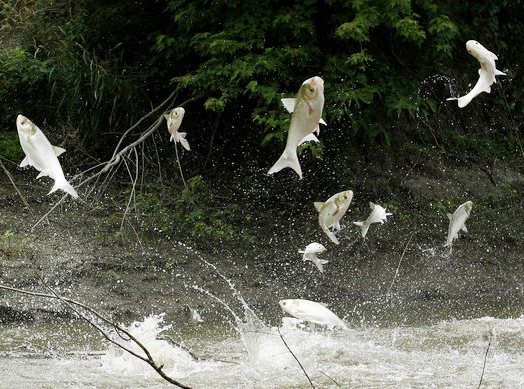
Almost all coverage of the Asian-carp invasion of the Mississippi River system has focused on the threat to the Great Lakes, but there is growing alarm that the silver and bighead carp are damaging sport fisheries and endangering boaters and skiers in the Ohio River and tributaries, Janet Patton of the Lexington Herald-Leader reports. Western Kentucky commercial fisherman Ronny Hopkins told Patton, "It's a nightmare, it really is. Not just for fishing but for tourism. . . . They're taking over and killing our native fish." (Associated Press photo by Chris Young; Herald-Leader map; click on images for larger versions)
Patton notes, "Federal agencies have spent over $200 million in efforts — so far thought to be successful — to prevent the carp from getting into the Great Lakes. With the carp moving up the Ohio River, Pennsylvania is desperate to stop them from getting there and Kentucky is leading several multi-state efforts to deal with the problem. . . . Federal legislation, from Pennsylvania lawmakers, has been filed to address fish removal that could provide some money outside the Great Lakes efforts."

Many think the solution is commercializing the fish, first for animal feed, then for human consumption, "but there are objections," Patton writes. "Fish and wildlife experts are divided because they fear establishing a business built on this fish means they can never be completely eradicated and that creating a market will give people an incentive to spread the fish." (Read more)

Monday, December 31, 2012

Farm Bill extension, resolution of milk crisis are waiting on tax deal; GOP divisions still a problem

House Speaker John Boehner is "betting that a tax deal in the Senate will let him slip through a [Farm Bill] fix without having to give in to demands for a new dairy program backed by the House and Senate agriculture committees," David Rogers reports for Politico. He says the internal conflict "illustrates the problems facing the GOP as it tries to untangle itself from the milk crisis brought on in large part because of Boehner’s refusal to allow floor debate in this Congress on a full-scale, five-year Farm Bill."

The milk crisis looms because without an extension or a new Farm Bill, federal farm law would revert to a 1949 statute that would "require the Agriculture Department to begin buying up dairy products at a rate of $38.54 per hundredweight, more than double the current prevailing price," Rogers notes.

"The four top Farm Bill leaders in the House and Senate are united behind an extension that would run through September and provide more certainty going into New Year’s," Rogers writes. "Boehner and the GOP leadership have responded with a pair of 30-day patches that the aggies dismiss as a 'poor joke on farmers' — who, they ask, plants a crop for just 30 days? The biggest single issue is the fate of a new dairy margin protection and market stabilization plan what promises to cost less than the current milk program but is strongly opposed by major processors aligned with the speaker."

The 30-day extension could be included in a deal on Bush-era tax cuts, which may come up for a vote in the House tomorrow. The draft of the extension does not include "the dairy language that Boehner opposes," Rogers reports.

U.S. definitions of 'frontier' and 'remote' could shift; you have until Friday, Jan. 4 to give feds your view

The federal government is accepting comments until Friday, Jan. 4, on possible new definitions for "frontier" and "remote" areas. If the definitions are properly changed, "It will allow future government programs to more effectively target those areas," Aleta Botts of the University of Kentucky writes for the Daily Yonder.

"While this new method is not linked to specific programs yet, it very well could be in the future," writes Botts, an agricultural and rural policy specialist. "Rural areas are notoriously hard to define, and the most rural areas in particular can be difficult to describe in objective, useful terms. The phrase 'trying to pin Jell-O to a wall' comes to mind. Nevertheless, the way you define a rural area determines which communities are eligible to apply for rural water improvements, what businesses can apply for low-interest loans, which areas are entitled to special Medicare reimbursements for their health services, and many other program questions."

Frontier and remote areas have been defined by population density (fewer than six people per square mile) and by county (as opposed to zip codes or census tracts), Botts notes, calling those "pretty blunt tools, since a more dense population might still be located a distance away from an urban center. And counties vary greatly in size." The proposed change would measure population density per square kilometer, about 61 percent smaller than a square mile, and define remoteness by travel time from various population centers.

There would be four levels of remoteness, developed by the Economic Research Service of the Department of Agriculture. Level 1 and Level 4 appear below; you can click on a map for a larger image, or click here for the four-page PDF with all four levels. For detailed data by ZIP code, go here.
ERS is working with the Office of Rural Health Policy in the Department of Health and Human Services on the proposal. Comments can be sent to shirsch@hrsa.gov, mailed to Office of Rural Health Policy, Health Resources and Services Administration, 5600 Fishers Lane, Parklawn Building 5A-05, Rockville MD 20857; or faxed to 301-443-2803. (Read more)