Friday, September 30, 2011

Vilsack warns federal payments to timber counties won't survive budget-cutting 'super committee'

UPDATE, Oct. 13: Thirteen West Virginia counties and more than 111 public schools in the state stand to lose almost $10 million a year if the program ends, Amy Harris of The Charleston Gazette reports.

Agriculture Secretary Tom Vilsack had a "bleak view of the future of federal payments to counties" dependent on timber production from national forests, the editorial board of The Oregonian in Portland says. On a visit to Portland this week, Vilsack said he does not expect the payments to survive the "super committee" process designed to cut the federal deficit. The law authorizing the payments expires today, and "The final payments are expected to go out to schools and counties in 41 states this December and January," The Associated Press reports.

"If those payments are not renewed, and nothing is done to promptly provide the counties with more revenues from public forests, Oregon will have a rural catastrophe on its hands," the Oregonian warns. "Federal payments pay for essential services across timber country; without them, some county governments are likely headed for default. Listening to Vilsack, it's not clear that he or anyone else leading the Obama administration fully understands the challenges of keeping county governments and schools operating in places where the U.S. Forest Service owns more than half the land and about the only economic activity it generates is whatever is spent putting out the wildfires that flare every summer."

The editorial had this line that could be quoted by many rural newspapers: "One way or the other, through timber receipts, direct payments or another source -- the government is obliged to share the costs of schools, roads and other public services in places where federal ownership of land cuts deeply into local tax bases" (Read more)

Farm Bureau writer bemoans Americans' lack of knowledge about how their food is produced

"The majority of today's population in this country is as much as three generations removed from the farm and the knowledge about what goes on in the agricultural realm of farm life is becoming even more distant for most every day," Pettus Read, communications director for the Tennessee Farm Bureau Federation, writes in the Daily News Journal of Murfreesboro. "The abundance we all enjoy when we walk into our local grocery store has made us complacent to the appreciation of what it takes to get the food from the farm to market shelf."

Read says "good intentions" of people who know little about farming can complicate life for farmers. He steers clear of controversial specifics, but cites the case of a woman who took a calf from the Middle Tennessee State University dairy farm, thinking it was abandoned; when it was returned the cow would not let it nurse. (Read more)

Longwall underground coal mining causing more property damage in southwestern Pennsylvania

"A surge in mining damage to waterways, houses and roads has sparked a fierce debate in southwestern Pennsylvania's coal region about whether regulations are strong enough to protect property and natural resources," Manuel Quinones of Greenwire reports for The New York Times.

The concern is about longwall mining, which "shears coal away from underground seams in massive panels that are generally hundreds of feet thick and a mile or so long," Quinones writes, noting that it "produces some 40 percent of all coal from U.S. underground mines, up from 5 percent in 1980," and more than three-fourths of the deep-mine coal in Pennsylvania.

Residents of Greene and Washington counties say longwall mining "has damaged buildings, sucked water from ponds and streams and cracked roads," Quinones reports. Some say it ruptured a dam, leaving a state-park lake dry; that issue is in court, but "A University of Pittsburgh study this year found that from 2003 to 2008 reported land damage from longwall operations increased 86 percent and building damage increased 31 percent over damage reported the previous five-year period."

Some residents say a state law "aimed at addressing problems caused by longwall mining and making sure companies help prevent problems, repair damage or compensate residents . . . is not strong enoug," Quinones writes. "State officials and mining industry representatives disagree. They do not deny that longwall mining is causing damage, but they maintain the system is working to ensure repairs or proper compensation." Environmentalists, such as Ben Stout, a biology professor at Wheeling Jesuit University, say longwall mines can cause permanent damage to streams, and members of the area's Citizens Coal Council say "threats to property and the environment are driving away coal-region natives," Quinones reports.

Energy Department in for more than 1/4 of cost of building clean-coal power plant in Texas

The Energy Department "will provide a Texas clean-coal plant with $450 million in funding months after a power company shelved plans for a similar plant in West Virginia," Timothy Gardner of Reuters reports. Texas Clean Energy LLC will get $450 million "through a cooperative agreement, up from its original plan to provide $350 million." The plant is expected to cost more than $1.7 billion.

The plant is supposed to capture about 90 percent of its greenhouse-gas emissions and send carbon dioxide "through a regional pipeline network to existing oil fields in the Permian Basin of West Texas for use in enhanced oil recovery," the department said in the Federal Register. Gardner notes that the money comes from a program "that was created during the administration of George W. Bush" and received more funding from President Barack Obama's economic stimulus package.

"Carbon capture and sequestration, or CCS, has been touted as one possible way to reduce the country's greenhouse gas emissions. But it has suffered a series of setbacks, including high costs, and the failure by the U.S. Senate to pass an energy bill that would have put a cost on emitting carbon dioxide and other greenhouse gases," Gardner writes, noting that American Electric Power recently "shelved plans to capture heat-trapping emissions from a coal plant in West Virginia, citing that failure to put a cost on emissions." (Read more)

Alabama immigration law takes effect; supporters rejoice, but farmers worry about harvest labor

Alabama's toughest-in-the-nation immigration law, allowing police to "stop and ask" for papers, and arrest those without valid documentation, was upheld in federal court Wednesday, with immediate impact on farmers who rely on immigrants to harvest crops, CBS News reports.

District Judge Sharon Blackburn upheld the law, which is stricter than similar statutes passed in Arizona, Utah, Indiana and Georgia. It is the first to address proof of citizenship among students, and it has many farmers worried. Farmer Keith Smith, above left, told correspondent Mark Strassman that only five pickers showed up for harvest work at his sweet-potato farm yesterday, and he needs 20. He acknowledged that he hires illegal immigrants: "If they got documentation, they got a better job than working for me." (CBS video)

Others welcome the law. "Judge Blackburn's ruling is the beginning of removing the enormous financial burden of illegal immigration from the backs of Alabama citizens," said Zan Gree, a Tea Party activist in metropolitan Birmingham. Smith's reply, via CBS: "If you want to get rid of illegal immigrants, quit eating."

Blackburn's ruling may not be permanent; the law is being challenged in three separate lawsuits including one from President Barack Obama's administration, which has also challenged a similar law in Arizona. An appeal is very likely and until a final ruling is made, Blackburn's orders temporarily block parts of the law, CBS reports. Justice Department attorneys "are talking to Utah officials about a third possible lawsuit and are considering legal challenges in Georgia, Indiana and South Carolina," Jerry Markon of The Washington Post reports.

Thursday, September 29, 2011

GOP turns up heat on Blue Dogs, a rural breed

House Republicans are increasing pressure on Blue Dog Democrats, the fiscal moderates whose districts are more rural and "politically challenging" than most, reports Josh Kurtz of Environment & Energy News.

"The National Republican Congressional Committee today created a new feature on its website dedicated to the Blue Dogs, with a map of the United States designed to show that the lawmakers are among 'Washington's endangered species' and are nowhere to be found," Kurtz writes. Videos attack Reps. John Barrow of Georgia, Jim Matheson of Utah, Dennis Cardoza of California, Ben Chandler of Kentucky, Kurt Schrader of Oregon and Heath Shuler of North Carolina.

Targeted in news releases are Reps. Jason Altmire and Tim Holden of Pennsylvania, Sanford Bishop of Georgia, Leonard Boswell of Iowa, Jim Cooper of Tennessee, Jim Costa and Loretta Sanchez of California, Henry Cuellar of Texas, Mike McIntyre of North Carolina, Michael Michaud of Maine and Collin Peterson of Minnesota.

"Republican strategists are making it no secret that even before campaign season begins in earnest, they are hoping to bully as many Blue Dogs into retirement as they can -- the theory being that it is easier for the GOP to win open-seat races in conservative districts than races against established Democratic incumbents, even if they are tethered to an unpopular Obama at the top of the ticket," Kurtz reports. (Subscription required)

Maine becoming the first state east of the Mississippi River with a 75 mph speed limit

It's no German autobahn, but motorists traveling Interstate 95 in Northern Maine probably won't be taking in the mountain vistas, bogs and acres of trees that line the highway quite as deeply, due to an increase in the speed limit on 110 miles of the road to 75 miles per hour from 65 mph. As the signs go up, Maine is becoming the only state east of the Mississippi River to have a 75 mph limit. (Associated Press photo: I-95 in Old Town, southern terminus of the faster zone)

Residents asked for the change, reports Glenn Adams of the Portland Press Herald. They told Adams no one followed the lower limit anyway and when state Rep. Alexander Willette went campaigning door-to-door last year in his northern district, people kept asking him to get the limit raised. When he drafted a bill, he found that the Maine Department of Highways had already completed studies about raising the limit and determined the change was justified. Because of residents' lax attitude toward the lower limit, the law passed quickly and quietly through the legislature.

Though residents and some in government approve of the change, others like insurance representative Anne Flemming told Adams the higher limit will encourage faster speeding and could cause more severe accidents. The American Trucking Association, which has previously lobbied for a national speed limit of 65 mph, say the issue is also an economic one for them because slower speeds help truckers save money on fuel. (Read more)

29 percent of homicides in Wisconsin are related to domestic violence; what are your local figures?

The rate of deaths related to domestic violence in Wisconsin accounts for 29 percent of all homicides in the state, according to a report released by the Wisconsin Coalition Against Domestic Violence. The deaths occur at a high rate in Milwaukee County, but also in 17 other counties across the state where rural areas' high poverty rates seem to spur domestic violence. Most states keep records of domestic violence homicides and incidents, as well as the number of emergency protective orders issued, often on a county-by-county basis.

Georgia Pabst of the Milwaukee Journal Sentinel reports that police are working with Sojourner Family Peace Center and prosecutors to reach out to families dealing with domestic violence. Last year, the groups received 1,700 referrals, but that number is expected to quadruple this year. Terry Perry, director of the office of violence prevention at the Milwaukee Health Department, told Pabst that 3 million children a year witness domestic violence, and they are most likely to suffer emotional stress and depression as a result. Perry called domestic violence a "public health issue" and said that one in four women will fall victim to it at least once in their lifetime.

Pabst also reports that African-Americans in Wisconsin are most likely to be domestic violence homicide victims due to high levels of poverty and unemployment in their communities. Those from the LGBT community who experience domestic violence are less likely to report the incidences and find it harder to receive assistance and support. (Read more)

Licensed gun carriers in Ohio no longer have to eat or drink without their piece

Ohio is following other states in allowing guns to be carried into more establishments, after state lawmakers struggled with the notion for years. Ohioans will be able to carry their guns into liquor stores, carry-outs, restaurants, nightclubs, hotels, shopping malls and museums after recent revisions to the state's gun laws go into effect.

Janice Morse of The Cincinnati Enquirer reports that parts of the law remove requirements forcing permit holders to keep guns in a holster, a locked case or unlocked in plain sight while driving, and includes a process allowing past violators of those laws to have their records wiped clean. However, under the new law, licensed concealed-weapon holders are banned from drinking alcohol while carrying their weapon, and they have to keep their guns out of businesses explicitly banning weapons. Lawmakers are counting on licensed carriers to follow the law, Morse reports, though most business owners, residents and weapon carriers don't expect there to be any problems with the new law, so long as gun carriers don't get drunk.

State Sen. Bill Seitz, who supported changing the law, told Morse the law was not going to usher in an era of "wild, Wild West violence." He said gun-carriers didn't like the idea of leaving their guns in the car when entering a business, fearing "real criminals" could possibly steal them. And if someone breaks these laws, they could face stiff penalties: Drinking while carrying is a third-degree felony which could land the violator in prison for up to five years and a $10,000 fine. It's also a felony to carry a gun in a business that prohibits it, Morse reports.

EPA's inspector general says agency needed better review to back greenhouse-gas regulations

The Environmental Protection Agency's inspector general issued a report this week concluding that EPA should have conducted a more detailed review of scientific findings about climate change before issuing regulations based on a belief that greenhouse gases pose a great threat to human health. The inspector general said EPA should have used more peer-reviewed scientific assessments because the findings were not publicly reported and one of the 12 people who reviewed the findings was an agency employee.

Juliet Eilperin of The Washington Post reports these findings won't directly affect new air-pollution regulations, but may hurt EPA's credibility and give those who think the agency is overstepping its bounds a reason to question its recommendations. It's not clear whether or not these findings will affect litigation that industries affected by the regulations have filed in federal court. Republican Sen. James Inhofe, a climate-change skeptic who requested the probe, said its findings bring into question EPA's conclusion that carbon-dioxide emissions qualify as pollutants under the Clean Air Act.

The inspector general's report also concluded that EPA met legal requirements to issue its "endangerment finding" that is the basis for federal limits on carbon-dioxide emissions from power plants. An EPA spokeswoman defended the agency's decision, saying it disagrees with its independent inspector general because it followed all necessary guidelines. She said the agency went through a "thorough and deliberate process" to arrive at its findings, including a review of peer-reviewed science. (Read more)

Wednesday, September 28, 2011

Mexicans growing powerful pot in Ohio

Marijuana farms cultivated by Mexican nationals continue to crop up across the country. Recently, farmers have made their way into Southern Ohio, where they grow massive amounts of pot in the region's hilly and brushy forests. John Caniglia of The Plain Dealer in Cleveland reports that state authorities think these growers are funded by Mexican drug cartels, but federal officials have not been able to link growers in Ohio with any larger drug operations. (Map: counties with recent large busts)

Officials do say Mexican growers come to the state to take advantage of temperate weather, good soil, the vast rural landscape and the willingness of Ohio buyers to pay higher prices. Officials are constantly on the hunt for new crops, Caniglia reports. Within the last year, state and local police have seized 39,000 plants in two separate busts. No one was arrested in either case, but officials noted that at each pot field, campsites with food from Mexico were found. In another incident, 11 Mexican nationals, 10 of whom were here illegally, were arrested on charges of cultivating marijuana. They all pleaded guilty and were sentenced to less than two years in prison.

Scott Duff, supervising agent with the Ohio Bureau of Criminal Identification and Investigation, told Caniglia that genetic and cultivation improvements make pot much more potent now than it was in the 1960s and 1970s. Levels of its psychoactive ingredient, tetrahydrocannabinol (THC), can now reach 18 percent compared to the 4 percent of 40 to 50 years ago. (Read more)

Residents of rural towns come together to keep local, independent groceries open

As rural America's population continues to shrink, so does the number of local businesses. Many, including local grocery stores, are forced to close when large chain stores like Wal-Mart move nearby. (Kansas City Star photo by Rich Sug)

The loss of local groceries leaves many senior citizens and poor residents living in food deserts, meaning they often have no transportation and live far from chain groceries, Richard Mertens of the Christian Science Monitor reports. 87 rural groceries have closed in Kansas since 2007 and over half of Iowa's groceries were closed from 1976 to 2000. The U.S. Department of Agriculture reports that over 1 million rural households live in food deserts.

Some people in small towns are determined to keep their groceries open. When the grocery in Onaga, Kan. burned, the town rebuilt the store itself and persuaded a grocer from Kansas City to locate there, Mertens reports. The grocer agreed to stay 20 years in exchange for the new building. In Leeton, Mo., local high-school students decided to keep their store open by running it themselves. Entrepreneurship and agriculture students earn class credit for operating The Bulldog Express. In other places, like Walsh, Colo., local residents bought their grocery after it closed five years ago and turned it into a thriving business. A similar story comes from Washburn, Ill., where townspeople bought shares in their store for $50 apiece. (Read more)

Alabama publisher 1st rural community newspaper person to win award given by Ohio University

H. Brandt "Brandy" Ayers, longtime publisher of The Anniston Star in Alabama, was awarded the Carr Van Anda Award by the E.W. Scripps School of Journalism at Ohio University in a ceremony and public lecture Monday at the campus in rural Ohio.

The school's faculty gives the award to high-profile journalists to recognize decades of professional excellence. Recipients have included Bob Woodward of The Washington Post and Nina Totenberg of National Public Radio. Ayers was the 72nd recipient of the award, which was launched in 1968 and named for the legendary New York Times managing editor who studied at Ohio U. in the late 1800s. It is the first time the award has gone to a journalist for a lifetime of work at a rural community newspaper, although many of the previous winners worked in community-level media earlier in their careers.

In a report journalism student Michelle Doe wrote for The Star, the liberal Ayers commented: "I thought I could hear the choir humming ‘Nearer my God to thee.' ... It’s awfully nice to have somebody say well done, and with my views and my area, you don’t get somebody saying well done very often.”

Ohio U. journalism professor Michael Sweeney said he nominated Ayers to recognize not only Ayers' many achievements but also to promote excellence at the thousands of community newspapers throughout the United States. "I like the way [he] is determined to produce high-quality journalism in a small market," Sweeney told Doe. "I have seen some awful, family-owned, small-town papers. Everyone could take a lesson from The Star." (Read more)

Former Eastern Livestock employees indicted on charges of theft and organized crime

Four men who used to work for the defunct Eastern Livestock, LLC have been indicted in Kentucky  for their alleged involvement in what state Attorney General Jack Conway calls a "check-kiting" scheme that cost 172 Kentucky cattle producers over $840,000 in 2010.

Thomas "Tommy" Gibson, 71; Steve McDonald, 59; and Grant Gibson, 48, all of Lanesville, Ind., and Darren Brangers, 43, of Louisville, allegedly took part in organized crime between 2009 and 2010 by collaborating in a criminal syndicate in order to commit theft. They were also indicted on 17 counts of theft by deception over $10,000, 144 counts of theft by deception over $500 and under $10,000 and 11 counts of theft by deception under $500.

According to a press release from Conway's office, this investigation has been ongoing since December 2010. At the time, Eastern Livestock was one of the largest cattle brokerages in America. Conway's office set up a hotline for victims of the scheme and received many complaints from producers saying they received bad checks for livestock sales from the company. Eastern Livestock owes about $130 million. The investigation revealed that over 280 of the almost 800 victims live in Kentucky. The indictment was returned in Metcalfe County, site of an Eastern facility.

Rural-journalism institute boss wins top internal award from Society of Professional Journalists

Institute for Rural Journalism and Community Issues Director Al Cross received the 2011 Wells Memorial Key, the Society of Professional Journalists’ highest honor, in recognition for his outstanding service to the society. Cross covered elections and state government as a reporter for The Courier-Journal for over 26 years and has served as permanent director of the Institute since 2005. He served as SPJ national president in 2001, served on several SPJ national committees and is a director of SPJ's Sigma Delta Chi Foundation. (The Working Press photo by Kevin Zansler)

“Al Cross rises to the challenges of our profession, and has done so consistently throughout his career,” Sue Porter, a Sigma Delta Chi Foundation board member and vice president of programs for the Scripps Howard Foundation, told Olivia Ingle of The Working Press, the SPJ convention newspaper. “Most recently, as director of the rural journalism institute, his leadership is fulfilling a need that would otherwise go unanswered.”

The award was presented by SPJ’s Immediate Past President Hagit Limor at the SPJ President’s Installation Banquet in New Orleans. To see a full list of the 2011 SPJ award recipients, click here.

Caregivers of wounded soldiers find their lives are also changed; getting compensation

The wars in Iraq and Afghanistan disproportionately affect rural areas, which provide more than the average number of recruits. The soldiers who make it home alive come back changed, with traumatic brain damage, post-traumatic stress syndrome or other injuries that require full-time care. Mostly wives and older parents are left bearing the burden.

Catrin Einhorn of The New York Times reports that many caregivers have to quit their jobs and are forced to spend their savings and retirement funds to pay for treatment. A growing number of caregivers suffer from anxiety, depression and exhaustion as a result of their new routines. Rosie Babin, 51-year-old mother of a severely wounded 22-year-old son, was managing an accounting office before her son's injury. Though she's happy to have her son home alive, she now has to take blood-pressure medicine and sleeping pills. "I felt like I went from this high-energy, force-to-be-reckoned-with businesswoman to a casualty of war," Babin told Einhorn. "And I was working furiously at not feeling like a victim of war."

According to research by Joan Griffin, a research investigator with the Minneapolis Veterans Affairs Health Care System, most of the injured are in their 20s and 30s, making this the first time since Vietnam the V.A. has seen such an influx of youth, which extending the length of care to years and sometimes decades. On average, Griffin found that family members spend more than 40 hours a week providing care, making it nearly impossible for them to keep a job.

Organizations like the Wounded Warrior Project have tried to ease the financial burden on these families by lobbying Congress to provide direct compensation and other benefits to caregivers and their families. In 2010, the veteran's agency approved 1,222 applications and awarded monthly stipends of $1,600 to $1,800 to caregivers. Along with the money, they can receive health insurance and counseling, Einhorn reports. This law only applies to caregivers of service members injured after Sept. 11, 2001, and it's uncertain who will qualify and how compensation will be determined. (Read more)

Energy Department says Central Appalachian coal production is rapidly declining

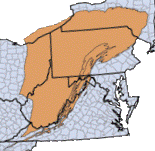
The U.S. Department of Energycontinues to project that Central Appalachia is running out of coal. The department estimates that in just over three years, production will drop from 234 million tons to 112 million. From 2000 to 2009, production in both surface and underground mines in the region dropped by 25 percent. Coal companies blame the Obama Administration and stricter Environmental Protection Agency regulations, saying they are slowing production and reducing jobs. But they admit that coal seams in Appalachia are getting thinner, making them harder and more costly to mine.

Dylan Lovan of The Associated Press reports that losing half its coal production would have a "devastating effect" on Central Appalachia economies dependent by coal mining. A report by Downstream Strategies, a consulting firm in Morgantown, W.Va., estimates that 37,000 coal-industry employees in the region in 2008 accounted for up to to 40 percent of the workforce in some counties. Rory McIlmoil, who helped draft the report, told AP that job losses would happen rapidly during this decline and that West Virginia could expect to lose over $100 million in taxes paid by coal operators.

Industry supporters and politicians from the area are attacking the federal government and the EPA for enacting regulations they say "kill jobs," Lovan reports. Senate Republican Leader Mitch McConnell of Kentucky, Gov. Steve Beshear and West Virginia Sen. Joe Manchin have openly said the EPA has started a "war on coal." On a recent visit with President Obama, Beshear asked him to reduce regulation of the industry. A national study found that regulations have little effect on jobs, and Robert Ukeiley, an environmental lawyer in Berea, Ky., told Lovan that political and industry leaders are ignoring facts: "They'll blame it on Obama and climate change, rather than just acknowledge that geology trumps economics."

The Energy Information Administration, the statistical arm of the Energy Department, said in an outlook statement released in 2011 that Central Appalachia coal is "extensively mined" and said that because the region's coal costs more, it will eventually be replaced by cheaper coal from regions like the Powder River Basin in Wyoming, which produced about 417 million tons in 2009. (Read more)

Tuesday, September 27, 2011

Marcellus Shale states are dealing with hydraulic fracturing in a variety of ways

As the debate over hydraulic fracturing, or fracking, rages on, several states atop the Marcellus Shale are trying to draft legislation or regulations on the natural-gas drilling and production technique, reports Jim Malewitz of Stateline.

In New York, where the industry has just began to locate, drilling could create 6,000 to 24,000 permanent jobs, but Malewitz reports that residents have mixed feelings. In spite of their concern, the state's Department of Environmental Conservation is planning to lift a ban on fracking, with exceptions for two watersheds. Many, including a group of scientists who wrote Gov. Andrew Cuomo about the impacts of fracking, think the method endangers human health. The Department of Energy has suggested companies disclose what chemicals are used in fracking, but only five states have chemical disclosure laws.

Elsewhere, laws concerning gas drilling have been drafted or passed. In New Jersey, legislators passed a bill to permanently ban fracking. Malewitz reports the bill was later vetoed by Gov. Chris Christie, who instead started a one-year moratorium on drilling and asked lawmakers to come up with new regulations. There's a three-year moratorium in Maryland right now so officials can study drilling's impact on human health and the environment.

Malewitz reports that in West Virginia and Pennsylvania, the industry moved fast and has developed quickly as a result. An industry-funded report released this summer found that drilling in these states could generate an economic impact of over $633 million in 2011. Though the U.S. Geological Survey recently found that Marcellus shale contains 326 trillion tons less natural gas than the Energy Information Agency previously estimated, Ohio Gov. John Kasich has labeled the gas deposits "a gift from heaven" for his state. Malewitz reports that he is constructing an energy policy that will likely involve natural gas. (Read more)

Census data show 12% of gay couples are rural

Even though gay couples tend to concentrate in urban areas, large numbers of gay couples live in rural areas, too, the Daily Yonder reports. Census data reveals that rural counties have 12 percent of the nation's gay couples and 16 percent of the overall population. Seven percent live in exurban counties, or those that are part of large metropolitan areas, but have at least half of their residents living in rural settings. (Yonder map)

The number of gay couples nationwide has doubled over the past decade to 901,997, reports the Yonder's Bill Bishop. This data comes from demographer Gary Gates of the University of California at Los Angeles, who has been tracking same-sex couples for years. Bishop found that rural counties with high numbers of gay couples are all over the country, from East Texas to Alabama and Kentucky. New England states and North Carolina have very large numbers of rural same-sex couples, with Sussex County, Delaware, having the highest concentration. The increase in gay couples in rural America can be attributed to higher reporting rates that increase as social stigma surrounding sexual orientation decreases.

UPDATE, Sept. 28: The Census Bureau revised the total number of gay couples to 646,464, citing inconsistencies on response forms for the previous inflated number.

Bishop also found that female same-sex couples are more likely to live in rural areas than male couples. Nearly 69 percent of female couples live in rural counties, and 70 percent live in exurban, compared to just over 57 percent that live in urban areas. Gates told Bishop that this data reflects wage gaps and child-rearing. Women are less likely to be able to afford living in urban areas, and female couples are more likely to have children and want to raise them in rural areas than male couples.

FCC rules keep near-local stations off satellite

Some Dish Network or Direct TV subscribers living in rural counties do not have access to nearby television stations, often making them the last to know when breaking weather alerts or school closings happen.

When satellite companies broadcast local channels, they chose which stations to broadcast in which places based upon designated marketing areas that are determined by Nielsenand its ratings. The Federal Communications Commission prohibits satellite companies from broadcasting local TV signals outside those Designated Market Areas. This leaves residents in some counties receiving news from larger stations that often don't feature news about their local area.

Jenna Mink of the Bowling Green Daily News in Kentucky reports that people living in Logan County do not receive signal from WBKO-TV, the station located in Bowling Green, about 12 miles from their county, because they are part of the Nashville DMA. The station manager for WBKO told Mink that residents would only be able to watch their local news with the use of an antenna, which most residents got rid of when the FCC mandated digital TV in 2009. (Read more)