Showing posts with label electric vehicles. Show all posts

Friday, January 30, 2026

Quick hits: Defining rural; WD-40 secret society; electric vehicle stations keep growing; a mental health hotline for teens, staffed by teens


What is rural? A recently recorded webinar addresses that question and adds context. "In 2025, many agencies across the federal government released new data allowing users to understand how rural populations and areas are changing. This webinar will provide a brief history of rural population over time and review how the term 'rural' is defined," reports the Rural Health Information Hub. "Changes to rural areas, as identified by Federal Office of Rural Health Policy (FORHP), with their most recent September 2025 data release, will be highlighted." Find session handouts here, and the audio version here. The recorded YouTube discussion is shared above. 

Carmel-by-the-Sea coastline (Wikipedia photo)
Whimsical or fantastic, home addresses in Carmel-by-the-Sea, California, had a breezy flair, free of physical address numbers, but that's about to change. "For 109 years, residents have used directional descriptors. . . . such as Sea Castle, Nut House and A Turn of Fraise," reports Hailey Branson-Potts of the Los Angeles Times. "This spring, every government building, business and house in the town of 3,200 people will be assigned a number." Many residents have long resisted the move, but "complaints about missed packages and mail-order medications, as well as trouble setting up banking accounts and utilities, kept piling up."

WD-40 can remove chewing gum
from all kinds of surfaces.
Freemasons and the Knights Templar aren't the only ones with secret societies: WD-40, the world's most famous lubricant, has one, too. The company's current CEO, Steve Brass, was at the helm for nearly 30 years before he was allowed to join the ultra-secret club, which gave him access to the "undisclosed Bank of America location" where the WD-40's handwritten formula is kept, reports Jennifer Williams of The Wall Street Journal. The formula has "only left a bank vault three times in the past 30 years." WD-40 is 70 years old and has been used "for everything from loosening bolts to coaxing a boa constrictor out of a car engine compartment and removing gum from turtle shells."

Zoom. Zoom. Zoom. It could be the sound of a Mazda, or the sound of EV charging stations popping up across the U.S., despite recent efforts to depress EV sales. "The U.S. added a record number of public electric-vehicle fast chargers last year, keeping up with demand from growing number of EV owners," reports Jeff St. John of Canary Media. "The Trump administration pushed Republicans in Congress to cancel Biden-era EV tax credits and revoke states’ rights to set clean-car mandates" but that hasn't put the brakes on charging station builds and consumer use. Data analytics firm Paren found that "new chargers are working more reliably and being used more heavily than ever — a sign the country is matching charging supply to demand." 

Approximately 100 teen volunteers log more than 10,000 contacts a year from youth around the world. (Teen Line photo via Reasons to be Cheerful)
When teens need someone to talk to about life problems, sometimes the best listener is another teen. Since 1980, the Center for the Study of Young People in Groups in California has supported a free teen hotline that connects trained teens with peers for nonjudgmental listening. Michaela Haas for Reasons to be Cheerful reports, "Approximately 40% of U.S. high-school students report persistent sadness or hopelessness, and suicide remains the second leading cause of death for youth ages 10 to 24. . . .For the teens who undergo rigorous training to become hotline volunteers, the experience can be "transformative." Read about the full project and its impact here

Pew Research graph, from survey of U.S. adults 
conducted Nov. 17-30, 202
The good, the bad and the ugly: That's what the majority of Americans say we need to be sharing about U.S. history, according to a recent Pew Research Center survey. Andy Cerda of the Pew Research Center reports, "Majorities in both parties say it’s important to talk about both America’s successes and its failures. . . .66% of U.S. adults say it is extremely or very important to publicly discuss the country’s historical successes and strengths and 66% say the same about discussing the country’s historical failures and flaws."


Friday, September 19, 2025

Rivian Automotive forges onward and breaks ground on its $5 billion electric vehicle plant in a small town in Georgia

Rivian builds electric in Georgia.
Despite the downturn in electric vehicle sales and enthusiasm, Rivian Automotive overcame delays and broke ground last week on its $5 billion plant in Social Circle, Georgia, a town with a population of 5,415.

"It seems like a terrible time to build an electric vehicle plant in the U.S., but Rivian Automotive leaders say they’re confident," report Jeff Amy and Alexa St. John of The Associated Press. Since its public offering, the company's stock has dropped "by more than 80%. . . . Rivian lost $1.66 billion in 2025’s first half."

The Georgia plant will make truck models that are smaller and less expensive than Rivian's current offerings, which feature high-end electric trucks that start at $70,000. The smaller models will start at $45,000, which the company predicts will enable it to sell to a much broader market and turn a profit.

While some state and local governments have resisted the push to go electric, Georgia is welcoming the change. "Georgia Republican Gov. Brian Kemp says he wants to make Georgia 'the electric mobility capital of America,'" AP reports. "Georgia has pledged $1.5 billion of incentives to Rivian in exchange for 7,500 company jobs paying at least $56,000 a year on average."

Not everyone in Social Circle supports Rivian building in the small, bucolic town about 45 minutes from Atlanta. According to the AP article, "Some residents say the plant is an inappropriate neighbor to farms and will pollute the groundwater."

Tuesday, June 17, 2025

Cooling off from summer sizzle will cost nearly 4% more this year

A hose may be the cheapest way to cool off
this summer. (Photo by J. Tyson, Unsplash)
Summer sun and heat might be good for beachgoers, but climbing summer temperatures will mean spiking power bills for U.S. consumers. Reasons for ballooning energy costs include higher natural gas prices, grid upgrade costs passed on to utility customers and increased domestic demand.

"Electricity prices across the country have increased 4.5% in the past year, topping the 2.2% jump in the price of groceries," reports Jennifer Hiller of The Wall Street Journal. "Consumer prices rose 2.4% in May from a year earlier."

Whether U.S. consumers flip on fans or crank the air, most will pay roughly 4% more "because of a jump in natural gas prices, the largest source of power generation," Hiller explains. "Natural gas deliveries to power plants will cost about 50% more from June through September than last year."

That's painful. "The higher bills are putting a strain on the wallets of consumers who are already stretched thin by rising costs for food, shelter and insurance," Hiller writes. "The average household power bill will reach $784 for the combined period from June to September."

Many Americans started the summer months already behind on their electrical bills. "Mark Wolfe, the executive director at the National Energy Assistance Directors Association, said one of every six U.S. households is behind on their electricity or natural gas bills," Hiller reports. "Customers owed gas and electric utilities more than $24 billion in late payments as of March."

Despite the pinch consumers are bound to feel, several utility companies are asking regulators to approve rate increases. "In Florida, NextEra Energy’s Florida Power & Light is asking regulators to let it increase rates between 1% and 5% a year through 2029," Hiller adds. "About $9.3 billion in additional electricity costs will begin trickling down to customers in the PJM Interconnection, the country’s largest grid operator and wholesale electricity market."

In some markets, AI data centers are "stressing the grid." In other places, increased demand is partially driven by electric vehicles. "Across the U.S., the growing pains are sparking fights over how to pay for upgrades and costs," Hiller reports. "The power industry also warns that a rollback of the clean-energy tax credits offered under the Inflation Reduction Act would push electricity prices higher, too."

Tuesday, September 24, 2024

A huge U.S. lithium mine needed for EV battery production vs. a flower found nowhere else in the world

Rhyolite Ridge lithium mine site (ioneer photo)
Step by step, the Biden administration inches closer to green-lighting ioneer's Rhyolite Ridge lithium mine in Nevada, reports Ernest Scheyder of Reuters. Last week, it "published a key environmental report [which is] the last step needed before approving what would become one of the largest U.S. sources of the electric vehicle battery metal." But some conservationists are adamantly against the mine opening despite its cleaner energy purpose.

Ioneer's path to opening has been ongoing for at least six years while the project was reviewed. "The Bureau of Land Management published a final environmental impact statement, that sets in motion a review period of at least 30 days before a record of decision -- essentially a mine's permit -- can be issued," Scheyder explains. "BLM also published an opinion on how a rare flower at the mine site can best be protected."

The rare Tiehm's buckwheat flower (CBD photo)
The site is home to Tiehm's buckwheat flower, "which is found nowhere else on the planet and was declared an endangered species in 2022," Scheyder reports. "The Center for Biological Diversity and some other conservation groups thus oppose ioneer's project." Patrick Donnelly of CBD called Tiehm's buckwheat flower a "linchpin of the local ecosystem, harboring a highly diverse pollinator community."

It's hoped the mine's lithium production can help the U.S. combat Chinese metal production. Scheyder writes, "The U.S. Geological Survey has labeled lithium a critical mineral vital for the U.S. economy and national security. The proposed mine, roughly 225 miles north of Las Vegas, contains enough lithium to power roughly 370,000 EVs each year."

Friday, August 02, 2024

Battle over mining in Arizona is about U.S. green energy needs, religious rights and land use

A view of Palabora, a South African copper mine, which was partially developed by Rio Tinto. Palabora's mine crater is roughly 1.24 miles across. Resolution's crater is expected to be 2 miles across. (Adobe Stock photo)

Resolution Copper wants to dig 5,000 to 7,000 feet into Arizona's Oak Flat desert to mine the region's vast copper-molybdenum deposit. The resistance to the project by Native American tribes and religious groups goes just as deep.

The Resolution Project has been under development by mining behemoths Rio Tinto and BHP Group since 2002. The companies and project supporters insist extracting the region's copper deposit is vital to shore up the mineral competition with China and for the U.S. transition to renewable energy. The opposition sees the mine and its expected 2-mile-across crater as exploitation of tribal holy ground.

Overall, the project has powerful backers: "It has generally been supported by the Obama, Trump and Biden administrations, though the latter has asked for more study as it seeks to balance its desire for clean-energy supplies with protections for the environment and the interests of Native Americans. The project can’t advance until that study is completed," report Phred Dvorak and Rhiannon Hoyle of The Wall Street Journal. "Many state and local officials [also] back the project."

Resistance to the project centers on Oak Flat, a stretch of land many Apaches consider sacred ground. The entrance to the mine is on Oak Flat, with the copper thousands of feet below. The main Apache opposition group, known as Apache Stronghold, was formed by the Apache San Carlos tribe and is represented by the Becket Fund, "a high-powered Washington, D.C., law firm known for championing conservative causes," Dvorak and Hoyle write. "Becket said it is planning to take its fight to the Supreme Court, where it has an 8-0 record."

Once Apache Stronghold and Becket joined forces the cause gained "a host of new religious allies. . . . Scores of religious groups have also submitted amicus briefs supporting Apache Stronghold’s suit," the Journal reports, "including organizations representing Mennonites, Seventh Day Adventists, Sikhs and Muslims."

Meanwhile, Resolution developers say "they have invested in an extensive monitoring network for groundwater, springs and other bodies of water that will be checked by regulators and a community working group," Dvorak and Hoyle add. "Resolution’s owners are trying to honor that commitment by consulting and joining with local tribes in good faith for the duration of the project, said Gare Smith, a lawyer who focuses on human rights and advises the project’s owners."

Not all regional tribes oppose the mine. "Other local tribes are attracted by potential economic benefits in a state where the tribal poverty rate is 29%," the Journal reports. "Among the ones with ties to Oak Flat, most have at some time officially opposed the mine."

To read more about U.S. copper needs, click here.
To find out more about the animals and plants that are native to Oak Flat, click here.

Tuesday, April 09, 2024

Many charging stations for electric vehicles are being built at gas stations and truck stops; rural areas might not benefit

EV charging gas stations may not be a win for rural
areas. (Photo by Oxana Melis, Unsplash)
A developing trend shows that one of the best ways to encourage cleaner energy use is to piggyback it with fossil fuel convenience. Despite this shift becoming a lifeline for fossil fuel-based gas stations, it may not help rural economies. "When Americans steer their electric vehicles off the highway and into shiny new charging stations — many paid for with federal tax dollars — they're likely to find them in a curiously familiar place: the gas station," reports David Ferris of E & E News. "More than half of the charging stations being built so far from the 2021 bipartisan infrastructure law are rising at truck stops and gasoline stations."

While the infrastructure development may be a positive for EV vehicle owners and gas stations, program restrictions and complex application processes can limit rural participation. "Because the National Electric Vehicle Infrastructure program rules require proximity to the highway and sites that operate 24/7, they could lead to EV drivers not stopping and spending money in rural downtowns, which are sleepy at night and distant from turnoffs," Ferris explains. "The extensive application processes that states have put in place to win the money may also create barriers to small-business owners, including mom-and-pop gas stations and convenience stores."

When EV charging stations first entered the energy market, fueling station owners pushed against the change, but the hybrid of both is gaining traction. "After initially resisting EVs and their charging needs, fueling centers are now using their lobbying strength and financial might to win federal dollars," Ferris writes. "Service stations have the upper hand in this first wave of subsidies because they occupy the very real estate where the federal government wants to build a charging backbone: at 50-mile intervals along the interstates and no more than a mile from highway exits."

Considering the cost and complexity of gaining NEVI funds, it's not surprising that "two of the nation's biggest truck stop chains, Love's and Pilot Flying J, are slated to host 39 charging plazas," Ferris reports. "As bidders, truck stops and gas station chains won $92.1 million, out of a total of $265 million awarded by the infrastructure law to date, according to the EVAdoption data. Gas stations and trucks stops together are hosts for almost 54 percent of NEVI-funded charging stalls."

Friday, January 19, 2024

Rural Tennessee communities want agreements to ensure that they will benefit from Ford's big electric vehicle complex

Ford and SK's mega EV complex in Tennessee is nearly six square miles.
(BlueOval City photo)

Named after Ford's iconic logo, Blue Oval City is a burgeoning electric vehicle development in Stanton, Tennessee, a rural town of 615 residents, many of whom are working to ensure the massive operation provides regional community advantages.

"The joint venture, between Ford and Korean company SK Innovation, promises 6,000 good-paying jobs for residents of the small, rural communities. . . . Development on such a large scale will, [residents] fear, change the community, suck up water and electricity, and prompt an influx of newcomers and development," reports Katie Myers of Grist. "The towns orbiting Stanton are sitting down with Ford and SK to negotiate a binding agreement that will ensure they benefit from Blue Oval City as much as the companies do."

Community advocates wanted residents to have a say in what benefits the companies provided, including youth facilities and support for road maintenance, alongside binding assurances for responsible plant waste disposal. To empower regional voices, they formed a coalition, which "drafted a list of stipulations, called a community benefits agreement, that it wants Ford/Blue Oval SK to abide by," Myers explains. "CBAs are a contract between a corporation and a coalition of local organizations that gives the community, through binding arbitration, leverage to ensure the commitments are kept."

In Los Angeles, the entertainment industry used CBAs to negotiate for a large sports arena, but a CBA's purpose and power can be broadly applied. Vonda McDaniel, the president of the Central Labor Council of Nashville and Middle Tennessee, "is helping to formulate Blue Oval agreement and plan town halls," Myers reports. "The process has been lively." McDaniel told her: "We haven't had a whole lot of wilting flowers that have shown up at our meetings. . . . The community is feeling a bit squeezed; there's heavy equipment up and down the road every day."

The "squeeze" is understandable. Blue Oval City is a 3,600-acre campus covering nearly six square miles. The complex is slated to open in 2025 and will employ at least 5,700 people. The surrounding towns of Covington, Brownsville and Stanton have an estimated population of 19,015.

Kathleen Mulltigan, who leads the National Labor Leadership Initiative at Cornell University, told Myers: "What we're really trying to do is bring real democracy into the economic realm, because a lot of the work of shaping the economy happens without workers having any voice in it."

The coalition will need Ford and SK to come to the negotiation table. The group plans to "take a complete draft of the agreement in hand early in the new year," Myers reports. "Even if the effort is not immediately successful, community members say, the relationships they've built with one another will only get stronger, leaving possibilities for further organizing open down the road."

Thursday, January 11, 2024

Finally Friday quick hits: America's last lighthouse keeper; no electricity bills; some good things just keep going

Sally Snowman was America's last lighthouse keeper.
(Photo by Seth Szilagyi, CBS Boston)
America's last lighthouse keeper has left her post, closing the door on an era," reports Emilee Coblentz of USA Today. "Sally Snowman, 72, became the guardian of the historic Boston Light, constructed in 1716, in 2002. She is its 70th keeper. 'The first 69 were all men,' she proudly told CBS News. . . . In a quick-changing society where technology is projected to replace many jobs across industries, the disappearance of one so rooted in our country's founding deserves pause."

If you hate paying your electric bill and like warm weather, you may want to consider relocating to Hunters Point, Florida where "no one pays an electricity bill," reports Nicolás Rivero of The Washington Post. "Hunters Point is the first residential development in the world to get a LEED Zero Energy certification, according to the U.S. Green Building Council, which means the entire community produces more electricity than it consumes.

The original cash register at Rock Dell Cooperative
Creamery (Photo by Noah Fish, AgWeek)
Nothing good lasts forever -- or does it? In Bryon, Minnesota, the Rock Dell Cooperative Creamery just turned 135 years old and is still buying milk. "Times are different today, and the creamery that was buying milk from producers across five counties in 1889 is now only buying milk from a single farm," reports Noah Fish of AgWeek. "The creamery is still owned by the patrons who sell milk or have equity in the business." The Creamery sells animal feed, cheese, ice cream and butter to loyal customers.

Chuttersnap photo, Unsplash
When it comes to its transition to green energy, the United States is on the proverbial struggle bus. "The U.S. is racing to overhaul how it powers its cars, trucks, buildings and industries. It has a long way to go," reports Shane Shifflett of The Wall Street Journal. "Wind and solar energy production are ramping up, but fossil fuels still provide a majority of the country's power." Shifflett provides five charts that show where the transition is now compared to the target goals.

Congress put billions of dollars into a program to help state and local governments build electric vehicle charging stations. However, getting the stations built will take much more than funding. "There's not nearly enough understanding from federal, state or local policymakers on how dysfunctional municipal permitting systems and utility connection processes are today," reports Catherine Geanuracos of Route Fifty. "For a program that's already been slow to launch, it's about to slam into systems that are already struggling, even before we need to dramatically ramp up capacity."
Image by Mariano Pascual, The Economist

How would you describe America's health care system? Bizarre? Infuriating? Dysfunctional? "The country spends about $4.3 (trillion) a year on keeping citizens in good nick [health]. . . twice as much as the average in other rich economies. And yet American adults live shorter lives, and American infants die more often than in similarly affluent places," reports The Economist. "Pharmaceutical firms and hospitals attract much of the public ire for the inflated costs. Much less attention is paid to a small number of middlemen who extract far bigger rents from the system's complexity." Want to know "Who profits most from America's baffling health care system?" Read here.

Friday, December 15, 2023

At last, the first electric vehicle charging station built with federal infrastructure funds opens in Ohio

The charging equipment at the Pilot Travel Center in Ohio.
(Photo by Dan Gearino, Inside Climate News)
The promise of federal funding for electric vehicle charging stations has finally come to fruition. "On the western outskirts of Columbus, Ohio, two doors down from a Waffle House, is a truck stop that, as of last Friday, has the first electric vehicle charging station in the country to be financed in part by the 2021 federal infrastructure law," reports Dan Gearino of Inside Climate News. "The Pilot Travel Center at I-70 and U.S. 42 has four charging ports. They are part of a partnership between General Motors and Pilot that the companies say will lead to chargers being installed at 500 Pilot and Flying J locations."

It's a first step with many more installations to go. "Ohio was one of the leaders in securing a share of this money and stands to receive $140 million over five years to construct charging stations along major travel routes," Gearino writes. The federal government is "showing progress in turning $5 billion worth of charger funding into completed projects." Charger expansion is critical to moving U.S. transportation away from gasoline dependence.

Building EV charging stations at a national truck stop chain offers travelers off-road conveniences for travelers and helps dispel "concerns from some EV drivers that the nation's charging network isn't nearly robust enough," Gearino reports. 

Pilot has other chargers at 18 locations in nine states, with ongoing expansions throughout the country. "The Ohio location is the first of those to benefit from the federal program," Gearino adds. "The country had 141,714 public charging ports as of the end of June, according to the National Renewable Energy Laboratory. . . . Many more federally funded chargers will follow the one in Ohio." The National Electric Vehicle Infrastructure program lists projects in Alaska, Colorado, Hawaii, Kentucky, Maine and Pennsylvania.

Friday, December 08, 2023

Can U.S. make EV batteries without China? Not yet.

China may have a 'lock on key parts' needed for
EV production. (Kumpan Electric photo, Unsplash)

When it comes to building electric cars, the industry may have to choose between tax incentives for buyers or minerals and parts from China, reports Jeff St. John of Canary Media. "Last week, the Biden administration released long-awaited proposed guidance for how it plans to enforce one of the most complex and controversial aspects of the electric vehicle incentives created by the Inflation Reduction Act: the requirement that the country's fast-growing EV and battery industries avoid using materials supplied by China, a geopolitical rival that has so far dominated clean energy manufacturing."

The requirement leaves companies that have "spent more than $100 billion establishing U.S.-based EV and battery factories. . . confronting the reality that, under the proposed rules, virtually none of the EVs they are currently manufacturing will still be eligible for the law's $7,500 federal tax credit as of 2025," St. John writes. "Under the proposed guidance from the Treasury Department, electric vehicles containing any battery component ​'manufactured or assembled by a foreign entity of concern' will no longer be eligible for the tax credit starting next year. In 2025, electric vehicles that ​'contain any critical minerals that were extracted, processed, or recycled' by a foreign entity of concern will no longer be eligible for the credit."

The ability of the U.S. to source all the critical minerals for lithium-ion EV batteries without doing business with China seems unlikely. "China has built a commanding lead in every step of the global EV supply chain, from the refining of minerals to the production of cathode and anode materials and the manufacture of battery cells and EVs," St. John reports. "Today, it's very difficult to find a lithium-ion EV battery that doesn't contain some portion of minerals or components processed or made in China or by a Chinese-based company."

Meanwhile, U.S. companies and partners from Europe and Asia are trying to catch up to China by "building domestic EV and battery manufacturing capacity," St. John explains. "They remain largely reliant on mineral and materials supply chains controlled by Chinese firms." 

Thursday, December 07, 2023

Billions of federal dollars were marked for EV charging stations in 2021 legislation, but none have been built

(Photo by Andreas Rasmussen, Unsplash)
Billions of dollars were made available to states for building electric vehicle chargers, but none have been built, reports James Bikales of Politico. In 2021, Congress agreed to "spend $7.5 billion to build tens of thousands of electric vehicle chargers across the country, aiming to appease anxious drivers while tackling climate change. Two years later, the program has yet to install a single charger."

"States and the charger industry blame the delays mostly on the labyrinth of new contracting and performance requirements they have to navigate to receive federal funds," Bikales writes. "While federal officials have authorized more than $2 billion of the funds to be sent to states, fewer than half of states have even started to take bids from contractors to build the chargers — let alone begin construction."

Despite the lack of chargers, electric vehicle sales have increased. "Consumer demand for electric vehicles is rising in the United States, necessitating six times as many chargers on its roads by the end of the decade, according to federal estimates," Bikales reports. But many Americans refuse to purchase electric cars because of the lack of charging stations.

President Joe Biden's EV-focused climate goals will not be met without charging stations and more EV acceptance. Bikales reports, "Biden signed the bipartisan infrastructure package into law. . . with an eye toward achieving his goal of building 500,000 chargers in the United States by 2030. . . . But Aatish Patel, president of charger manufacturer XCharge North America, is worried the delays in installing chargers are imperiling efforts to drive up EV adoption." He told Bikales, "As an EV driver, a charger being installed in two years isn't really going to help me out now. We're in dire need of chargers here."

There are chargers available, just not enough. Bikales reports: "The United States has around 180,000 chargers today, according to the Energy Department. That includes 41,000 of the type of fast chargers that can alleviate the dreaded “range anxiety” of a long-distance road trip in an electric vehicle."

Ohio Republican Gov. Mike DeWine, "whose state broke ground on the nation's first charger funded by the NEVI (National Electric Vehicle Infrastructure) program in October, said in a statement that he is committed to 'truly positioning Ohioans for the electric future," Bikales reports. "Following Ohio, Pennsylvania also broke ground on its first NEVI-funded charger in November. Another six states have awarded contracts for their first round of charging sites, while 15 states plus Puerto Rico are in the process of soliciting bids from the private sector."

Thursday, November 09, 2023

Electric vehicles on the farm? Electric tractors would be much more expensive and heavier than current models

Graphic by Joelle Orem, Successful Farming
Taking a ride out West, in my EVS, might be a nice little rhyme, but it's a hard sell. "There is one place in America where electric vehicles are glaringly absent — the back 40. Today, electric tractors and other farming equipment are hard to find on showroom floors, let alone in the field," reports Steve Cubbage of Farm Journal. Even though seven states have "banned the sale of gasoline-powered vehicles by 2035. . . . The hurdles EVs must clear to be viable on the farm are incredibly high from an engineering and an economic standpoint." 

Building an electric tractor means adding weight, and that's a problem. "John Deere's website shows its 8R tractor has a starting base weight of 25,200 lbs. Current engineering assessments say an all-electric version would weigh more than twice as much," Cubbage writes. "Soil compaction already weighs heavily on how modern farm equipment is designed. Increasing the weight and mass of such machines may end up creating more, not fewer, emissions. . . .Compacted soil releases greenhouse gasses such as methane and nitrous oxide, which are much more potent than a tractor's exhaust."

Electric tractors are limited by battery life, and many areas with significant farmland lack charging stations. "The all-electric tractors slated to come to market can only work four to eight hours per charge," Cubbage reports. "Heavy-duty agricultural vehicles will require multiple heavy-duty superchargers — an expensive and potentially unrealistic endeavor."

If an electric Quadtrac tractor existed, it would cost
around $650,000. (Quadtrac photo)
Should all those hurdles be overcome, the overall price for an EV tractor may prove untenable to farmers. "Low-horsepower tractors are approximately 30% more expensive than their diesel-powered equivalents. That may work on an all-electric garden tractor but not a half-million dollar Quadtrac," Cubbage explains. "But unlike with cars, there's no federal program to ease the burden of an electric tractor. If bureaucrats and consumers really want to turn Old MacDonald's farm all-electric, then they better put their money where their mouth is."

Friday, September 01, 2023

Auto industry moves South with electric vehicle factories; one rural town of 400 gets ready for 6,000 Ford workers

Business has picked up at Suga’s Diner in Stanton, Tenn.
(Photo by Andrea Morales, The Wall Street Journal)
How does a town of 400 people prepare for an influx of 6,000 additional residents? Stanton, Tennessee, is showing the way as the town readies for “all the people the Ford plant auto-complex build will bring,” reports Nora Eckert of The Wall Street Journal. Ford’s complex is a sign of the times: “The U.S. auto industry is accelerating its move south as car companies pour billions of dollars into new factories in Georgia, Kentucky and Tennessee. The shift is creating pockets of frenzied activity—and anxiety—for rural, southern towns bracing for new workers and residents.”

“Once fully operational, Ford’s 3,600-acre site is expected to employ about 6,000 workers, about 15 times Stanton’s current population,” Eckert writes. “Allan Sterbinsky, the mayor of Stanton, spends his days planning how the town—home to a barbecue restaurant, a Dollar General and a couple of cemeteries—will build thousands of new homes, expand the local school system and potentially establish a police force.” Sterbinsky told Eckert, “It’s tremendously overwhelming, just everything that has to be done.”

As America's shift to EVs gained momentum, the auto industry’s move South increased speed. “Auto companies have announced more than $110 billion in EV-related investments in the U.S. since 2018, with about half that sum destined for Southern states, according to the Center for Automotive Research, a nonprofit based in Ann Arbor, Michigan," Eckert adds. "Automakers are now rushing to construct assembly plants and battery-making facilities—some sitting on sites the size of 60 football fields.”

Location of Stanton in Haywood County,
Tennessee. (Wikipedia map)
For decades, Southern states have been setting the groundwork to attract automakers, “laying veins of waterways and electrical lines and shoveling heaps of dirt to prepare the land for potential new factory megasites," Eckert reports. "Local governments and technical institutes have partnered to train a new generation of manufacturing workers, including in automotive, even before some of the first construction beams were erected. "Ford Chief Jim Farley said one of the reasons the automaker based its manufacturing campus in Tennessee is because the Tennessee Valley Authority, an electricity company, is one of the largest clean-energy providers in the U.S. The state’s lower energy costs also attracted Ford there, he has said."

Meanwhile, folks in Stanton and surrounding towns of Haywood County, pop. 17,900, have their hands full. "The median household income in Haywood County, where the Ford complex is located, is about $40,000. One in five residents live in poverty," Eckert reports. Already some local restaurants and services are enjoying growth, but for some, Ford's presence has hurt their business. "Teknor Apex, a chemical producer and major employer in the county, was already struggling to find workers. . . . Many young people in the area end up leaving for better pay and a greater variety of opportunities elsewhere, draining the local talent pool."

Tuesday, August 15, 2023

America's shift to wind, solar and other clean energy has gained surprising momentum, even in fossil-energy areas

NYT graph based on The Energy Institute’s 2023 Statistical Review of World Energy
U.S. energy trends show the winds of change are blowing as the country switches from fossil fuels to clean energy. "Delivery vans in Pittsburgh. Buses in Milwaukee. Cranes loading freight at the Port of Los Angeles. Every municipal building in Houston. All are powered by electricity derived from the sun, wind or other sources of clean energy," report David Gelles, Brad Plumer, Jim Tankersley and Jack Ewing of The New York Times in the main runner of a three-story package. "A profound shift is taking place that is nearly invisible to most Americans. The nation that burned coal, oil and gas for more than a century to become the richest economy on the planet and historically the most polluting is rapidly shifting away from fossil fuels."

Historically, Europe's transition to renewable energy has outpaced the U.S. "But the United States is catching up, and globally, change is happening at a pace that is surprising even the experts who track it closely," the Times reports. "Wind and solar power are breaking records, and renewables are now expected to overtake coal by 2025 as the world's largest source of electricity. Automakers have made electric vehicles central to their business strategies and are openly talking about an expiration date on the internal combustion engine. Heating, cooling, cooking and some manufacturing are going electric."

The transition is worldwide. "The cost of generating electricity from the sun and wind is falling fast and in many areas is now cheaper than gas, oil or coal. Private investment is flooding into companies that are jockeying for advantage in emerging green industries. . . . As the planet registers the highest temperatures on record, rising in some places to levels incompatible with human life," the Times reports. "More than $1.7 trillion worldwide is expected to be invested in technologies such as wind, solar power, electric vehicles and batteries globally this year, according to the International Energy Agency, compared with just over $1 trillion in fossil fuels. That is by far the most ever spent on clean energy in a year. Those investments are driving explosive growth."

In many areas, economic investment in renewables is prompting regional change. The city "once known as the 'Oil Capital of the World' where the minor league baseball team is the "Drillers" is immersed in a new energy revolution," the Times reports. "As the workday begins in Tulsa, Okla., the assembly line at the electric school bus factory rattles to life. Crews fan out across the city to install solar panels on century-old Tudor homes. Teslas and Ford F-150 Lightnings pull up to charging stations powered in part by the country's second-largest wind farm. And at the University of Tulsa's School of Petroleum Engineering, faculty are working on ways to use hydrogen as a clean energy source."

U.S. government investments have helped move the needle for American clean energy. "A $1 trillion bipartisan infrastructure law provided money to enhance the power grid, buy electric buses for schools and build a national network of electric vehicle chargers," the Times reports. "Regulations are also hastening the energy transition. Mr. Biden has proposed tough new federal pollution limits on tailpipes and smokestacks, but several states are acting on their own."

"The shift is happening so quickly that some of America’s most iconic automakers are preparing for a world beyond gasoline-powered cars and trucks," the Times reports. "General Motors, which has the largest market share of any carmaker in the United States, has committed to selling only zero-emissions vehicles by 2035. It’s a 'once-in-a-generation inflection point' for the 114-year-old automaker, according to Mary Barra, GM’s chief executive."

Tuesday, May 30, 2023

Problems with charging stations threaten adoption of EVs

EV charging stations (Photo by Andrew Hawkins, The Verge)
The effort to shift Americans to electric vehicles has a big obstacle: unreliable charging stations. In rural areas, that's a bigger problem, because rural stations are in short supply. More than one in five EV users report that they have been unable to find a station at one time or another, and the number is rising as EVs become more common, according to surveys by J.D. Power.

"Parts break, information screens freeze, payment systems malfunction. Copper thieves steal the cords. Vandals damage charging plugs or, in one infamous instance, stuff them with ground meat," reports David Baker of Bloomberg News. "Nascent networks mean that if the machines at one station aren’t working, there may not be another nearby."

"A decade ago, early EV adopters were willing to put up with unreliable public chargers," Baker writes. "Now, however, the problem threatens President Joe Biden’s EV ambitions. Biden has made electric cars a cornerstone of his climate and economic policies, devoting $5 billion to the buildout of a charging network along major roads and $2.5 billion to charging within communities. The goal is convincing every American driver to go electric. But it’s a leap of faith for many — one they may not be willing to make if they don’t trust that public chargers will work."

“We have to address these issues before we get further along in EV adoption,” Brent Gruber, who oversees automotive research for J.D. Power, told Baker. “The mindset is changing, from the early adopters who expected some bumps in the road, to the mainstream consumer who is not willing to overlook those problems.”

To complicate things, Baker reports, "The precise scope of the problem isn’t known. EV drivers face a complex landscape of competing charging companies, each with its own stations and app, and there is no central repository of data on station performance." Charging companies "acknowledge that the first few waves of public chargers installed over the past 10 years weren’t as dependable as they needed to be" but now "insist they are getting more reliable, not less. Property owners who buy chargers from companies like Blink Charging and ChargePoint often sign service contracts for those companies to maintain or replace the chargers as needed. Gruber said some site owners let those agreements lapse over time, allowing the machines to fall into disrepair."

Wednesday, May 24, 2023

Ford does a U-turn; all its vehicles will still have AM radio

Photo by Caleb White, Unsplash
If you were looking at buying a new Ford vehicle, especially if you travel out yonder, you will probably be glad to learn that Ford Motor Co. has changed its tune on AM radio and will include it in all its cars, trucks and SUVs, reports Tom Krisher and Wyatte Grantham-Philips of The Associated Press. "CEO Jim Farley wrote in social media postings Tuesday that the company is reversing a decision to scrub the band after speaking with government policy leaders who are concerned about keeping emergency alerts that often are sounded on AM stations." Farley wrote on Twitter, "We've decided to include it on all 2024 Ford and Lincoln vehicles. For any owners of Ford's EVs without AM broadcast capability, we'll offer a software update."

"The move comes after a bipartisan group of federal lawmakers introduced a bill Wednesday calling on the National Highway Traffic Safety Administration to require AM in new vehicles at no additional cost. . . . . Sen. Edward Markey, D-Mass., one of the bill's sponsors, said eight of 20 major automakers including Ford, BMW and Tesla have pulled the band from new vehicles," Krisher and Grantham-Philips write. The Kentucky Broadcasters Association reports, "Sponsors of the 'AM for Every Vehicle Act' cited public safety concerns, noting AM's historic role in transmitting vital information during emergencies, such as natural disasters, especially to rural areas."

Amplitude-modulation radio continues to have a dynamic public presence. "With tens of millions of listeners, it serves as a vital lifeline to the public and a critical source of community news and exchange of diverse ideas," KBA reports. "The National Association of Broadcasters commends Ford for this commitment, which will keep Americans safe and informed, particularly in times of emergency. . . . In light of Ford's announcement, NAB urges other automakers who have removed AM radio from their vehicles to follow Ford's lead and restore this technology in the interest of listeners and public safety. . . . Supporters of the AM Radio for Every Vehicle Act. . . are helping to shine a light on the need to keep this critical service in all cars."

Thursday, April 20, 2023

Southern states on track to be nation's 'battery belt' though their leaders don't fully acknowledge climate change

Gov. Brian Kemp (R) stands next to a Rivian truck.
(Photo by John Bazemore, The Associated Press)
Once a tranquil town, Commerce, Georgia, is now on track to become one of the nation's electronic battery-making hubs, reports Shannon Osaka of The Washington Post. "The battery plant just north of Commerce is hard to miss. It looms over Interstate 85 like a monolith: sheer gray walls many stories high, a vast parking lot that extends almost half a mile. . . . The factory, which opened in early 2022, employs over 2,600 people — about a third of the town’s population. . . . It's operated and owned by the U.S. wing of the South Korean company SK Group," which has partnered with Ford Motor Co. to build two electric-vehicle battery plants just south of Elizabethtown, Kentucky. 

Clean-energy incentives "are landing in congressional districts represented by Republicans," and the Commerce plant "is one of a bonanza of electric vehicle investments that are transforming rural Georgia into a bustling 'battery belt'," Osaka writes. "But even as Gov. Brian Kemp aims to make Georgia the 'electric mobility capital of America,' he and other Republicans are doing little to put more EVs on state roads — or to acknowledge the climate reasons behind the switch. . . . Last month, the state Senate passed a tax on public EV charging. Along with the governor, most state lawmakers rarely mention emissions reductions and environmental benefits of switching to electric vehicles. . . . The result is a strange moment in Georgia's shift toward making and selling EVs: A state with one foot in — and one foot out — of a massive transition."

Even with the political teeter-totter, EV manufacturers are capitalizing on political aspects of the South. "Almost all Southern states, including Georgia, Kentucky, Alabama and Tennessee, are what conservatives call 'right to work' states — meaning employees can't be required to join a union as a condition of employment," Osaka explains. "Such states have gotten the lion's share of clean energy and EV money. . . . One study by researchers at Georgia Tech that examined almost 20,000 collective bargaining agreements found that right-to-work laws are associated with lower wages among unionized employees."

Could the growth in EV jobs in the South reduce the polarization of views about climate change? "Thomas Oatley, a professor of political science at Tulane University, argues that part of the schism on climate change stems from an economic divide. Republican voters are more likely to live in areas where jobs are closely tied to carbon-emitting industries like auto manufacturing or coal-fired power generation; Democratic voters are more likely to live on the coasts and work at a desk in 'knowledge-based' jobs." Oakley told her, "If you get a growing number of people employed in the clean energy sector, that could increase support for climate policy in red and purple states."

"Georgia is far from that point today. But the tens of thousands of jobs coming to the state make it difficult for politicians to oppose the transition," Osaka adds. "Former GOP senator David Perdue, who ran for governor against Kemp in 2022, was a vocal critic of the Rivian plant. . . . But that anti-EV message failed to gain much support — Perdue was soundly defeated in the primary." Mike Carr, a partner at the consultancy Boundary Stone, told Osaka, "If Georgians start to think of themselves as the heart of clean energy manufacturing — I don't know how you run against that and win."

Wednesday, March 29, 2023

A real-life electric-van story from an Iowa publisher: 'We had been spending $900 a month on gasoline'

By John Cullen
Storm Lake (Iowa) Times Pilot

It’s been almost a year since the Times Pilot bought our electric van, and we receive a lot of questions about it. Here’s a progress report.

It replaced two worn-out vehicles — a van and a cube truck — that had amassed nearly 400,000 miles each. In the same month both broke down, one victim to a transmission, the other to a deer. We needed a replacement fast.

We had been spending $900 per month on gasoline, and so the economy of an electric van appealed to us, not to mention that within a decade or so internal combustion engines are going the way of the horse and buggy.

Art has had three Chevy Volts, the plug-in hybrid that was produced from 2011-2019, and barely had to fill his tank with gas because he got about 40 miles on electricity before the gas engine kicked in. Other than a trip to Byron’s in Pomeroy on Sunday evenings, he hardly drives it out of town. He’s sold on electric vehicles.

The Ford E-Transit van we bought costs about $160 per month in electricity. We put about 2,000 miles per month on it running papers all neighboring counties. The purchase price was a little more than a gasoline van, but the savings in fuel more than made up for that in the first six months.

While most electric cars these days have a range of 250-300 miles, our van’s range is about half that. Ford research found that most cargo vans average 74 miles per day, so to keep the cost and weight down, it has a smaller battery capacity. The mileage limit has worked out all right for us. We figured out routes that minimize mileage.

In summer the van’s range is up to 150 miles. In winter, the range drops to about 100 miles on the coldest days. The same limits apply to cars. Cold weather drops battery range by nearly a third.

We installed a level 2 charger, which uses 240 volts, at our office at a cost of about $1,900. It charges about 26 miles per hour. A home charger, running off regular household current, might only charge at a rate of 3 or 4 miles per hour.

There are commercial DC fast chargers along interstates that charge at a much higher rate, but they can cost $100,000 or more to install.

At the time we bought our van, Ford was the only electric option. Ford introduced its van just after it brought out its F-150 Lightning and those pickups are selling like hotcakes. Ours is the only electric van that we know of in Buena Vista County, and maybe western Iowa. As for the Lightning pickup, there is one in Storm Lake, and the owner waited 11 months for it. I’ve seen a couple Teslas in Storm Lake. They don’t have dealers. You buy direct from Tesla online. Ford and GM have service centers in practically every county seat town in Iowa. Tesla’s only Iowa service is in Council Bluffs and Des Moines.

GM produced the Chevy Volt until three years ago in favor of the all-electric Bolt, which is an inexpensive small vehicle with limited range. GM is coming out with a variety of electric vehicles later this year. Ford has the Mustang Mach-E, Lightning pickup and E-Transit van, and can’t keep up with demand. Along with European and Asian automakers, they are chasing an exploding market that Tesla has had pretty much to itself for the past five years.

There are other cost savings in electric vehicles. They require much less maintenance, for example, no oil changes and no transmissions.

The biggest challenge to electric vehicles now is the lack of public charging facilities. If you stay on interstates, you have no trouble juicing up. But if you wander up two-lane roads, even major routes like Hwy. 71, you’ll develop range anxiety real quick. There are no public chargers between Early and Spencer, nearly 60 miles. We’ve accommodated several visiting Tesla drivers at our charger who found out to their dismay about Storm Lake’s lack of charging facilities. In a few years as more electric cars hit the roads there should be chargers in every town from Schaller to Sioux Rapids, but until then, drivers be wary.

Many public charging stations, except for Tesla, are often out of service or slow. Where you can fill a gas car up in five minutes, it can take an hour or more to rejuice an electric car at a DC fast charger. Tesla is the gold standard for charging around the world. It operates its own proprietary charging stations that are fast, reliable and plentiful. The problem is that non-Teslas could not charge there until this month. Tesla is gradually converting its chargers to allow competitors, but there are only about 14 so far across the nation. That will change as Tesla converts. But non-Teslas pay a premium.

The cheapest place to charge is at home. MidAmerican Energy’s residential and business electric rates here are very reasonable, about 10 cents per kilowatt hour. Public DC fast chargers along highways cost from 30 cents to 50 cents kWh. At the higher rates, electric isn’t a whole lot cheaper than gas.

Gas stations aren’t going out of business anytime soon. There are hundreds of millions of internal combustion vehicles that will need dinosaur juice for decades to come.

Monday, March 27, 2023

Electric-vehicle takeup slow in Northern Plains; states with many rural folk continue to favor gas over charging stations

Tesla charging stations (Photo: Abbie Parr, The Associated Press)
For rural residents, the choice to drive an electric vehicle is often not simple or easy. "Concerns over range and the effects of sub-zero weather on battery life are higher on the vast northern prairies, areas of which have the fewest charging stations in the country," reports Tom Peterson of Stateline. "Political debates over ethanol, emission standards and market forces also envelop the region. . . . The shift to EVs across the Upper Midwest and Great Plains lags."

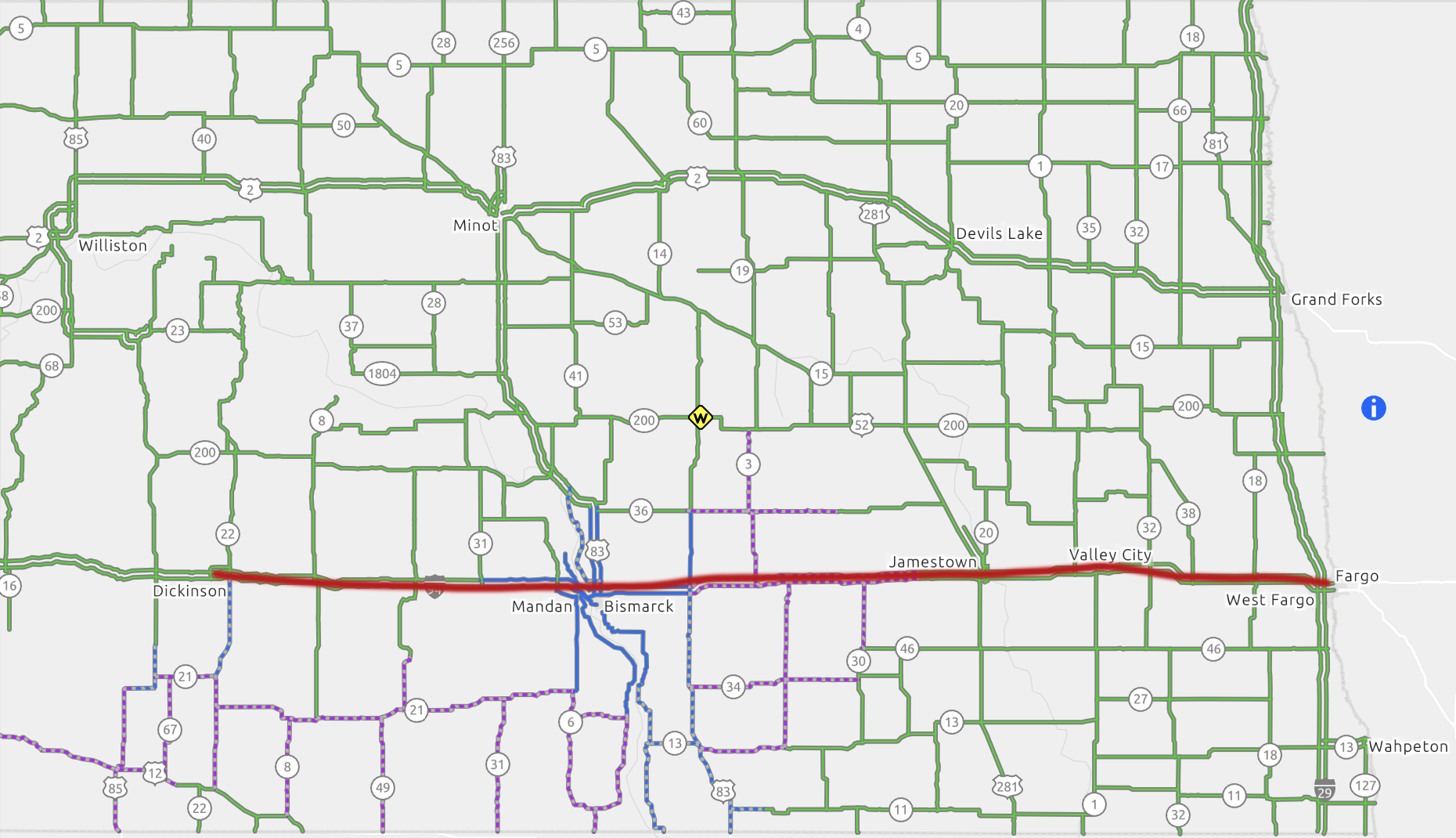
Practically speaking, the need for charging stations in Western states presents a horse before the cart challenge. Residents don't want to purchase a vehicle that can't be refueled. Charging stations aren't built because there's not many EVs to use them. "North Dakota (roughly 400 vehicles), Wyoming (500) and South Dakota (700) have the fewest EV registrations in the nation. . . . Across western North Dakota, bison outnumber EVs," Peterson writes. "The number of EVs with ranges of 300 miles or more nearly tripled in 2022, growing from five to 14, the U.S. Department of Energy reported. But in North Dakota, that’s barely a one-way trip from Dickinson to Fargo."


It's 292 miles from Dickinson to Fargo, N.D. (ND Roads map)
Regional economics and politics also create EV acceptance barriers. "North Dakota and other states in the region are top-10 producers of ethanol. . . . Because as much as 40% of U.S. corn is used for ethanol, the states fear more EVs will have the ripple effects of a drop in ethanol demand on their agriculture economies," Peterson adds. "The rural-urban and red-blue divides in the region also enter the debate over the push toward EVs." Marc Geller, a spokesperson for the Electric Vehicle Association, which promotes EVs, told Peterson, "It's been kind of unfortunate that electric cars have become caught up to some extent in kind of the partisan divide and the culture wars."

Peterson notes, "Across the region, difficult political decisions lie ahead . . . . as states build out their EV policies. . . . and how states will use their shares of the $7.5 billion in federal funds set aside for charging infrastructure. Idaho, Montana, North Dakota, South Dakota and Wyoming — all large, rural states with long stretches of remote highways — joined in a comment to federal regulators, noting the difficulties complying with the requirements, E&E News reported."

Wide EV acceptance may be slow, but it is progressing. "For Geller, education is vital as state policies evolve. Technology is rapidly addressing the range and weather-related issues that rural, northern auto buyers cite as their chief concerns about EVs," Peterson reports. "At-home chargers, he said, are often underplayed in the discussion and make rural ownership more practical."

Friday, January 13, 2023

Electric school buses going rural; Missouri plans fall rollout

Row of electric buses (Photo by Bill O'Leary, The Washington Post)
Electric vehicles don't have a high profile in rural Missouri, but that's about to change. "Come this fall, dozens of electric school buses will hit Missouri roads thanks to a new federal rebate program that enables school districts to switch their diesel-powered bus fleets to electric," reports Claire Carlson of The Daily Yonder. "A Missouri school district superintendent says the electric buses will lower fuel costs, allowing them to invest the savings elsewhere."

Heath Oates, superintendent of western Missouri’s El Dorado Springs R-II School District, told Carlson, “Our district’s diesel-fuel costs are tremendous. My initial estimates show we’re going to save around $200,000 a year, which is the cost of four beginning teachers with benefits.” Carlson notes, "Rural school districts’ longer bus routes and lower population density mean they can have higher transportation costs than urban districts. Reducing fossil-fuel dependency will lower those costs, say electric-bus advocates."

Since rural areas lack electric-vehicle infrastructure, knowledge and planning will proceed the bus launch. "According to First Student, the largest school-bus company in North America, electric buses will need to be equipped with batteries that hold enough power to transport students morning and afternoon through remote areas," Carlson reports. "Bus providers will need to know the mileage, local topography, and average speeds of the school districts’ bus routes to determine battery size."

The Environmental Protection Agency is managing the switch to electric buses through its Clean School Bus program, and school districts were awarded funds in the program’s 2022 funding cycle. Carlson writes, "There are four more Clean School Bus award cycles planned over the next four years. While rural communities were a priority in this round of funding, more districts will be included in the next rounds, according to the EPA."