Showing posts with label women. Show all posts

Friday, April 24, 2026

Survey: Rural voters, especially women, are 'deeply worried about the rising cost of living'

, from Lake Research and the Center for Rural Strategies data

The fight for rural votes during this year's midterm Senate elections could be decided by American voters seeking economy-stabilizing policies from Washington, and by women voters, who are acutely aware of rising living expenses, a new survey shows.

"Rural voters across Senate battleground states are deeply worried about the rising cost of living, and while that concern cuts across party lines, a new poll suggests it is especially pronounced among women," reports Sarah Melotte of The Daily Yonder.

The survey was conducted by Lake Research Partners and the Center for Rural Strategies, which publishes The Daily Yonder, included interviews with 600 rural voters in 13 states where the Senate seat tug-of-war is playing out. "It paints a picture of a partisan rural electorate, but one that is aligned on economic anxiety," Melotte writes. "The poll revealed a consistent gender gap in how rural voters experience economic strain."

Fifty-five percent of rural voters said "the rising cost of living is one of their top concerns," Melotte explains. "That includes about 60% of Democrats and 53% of Republicans. Women were more likely than men to cite the issue as one of their main concerns – 58% compared to 52%."

, from Lake Research 
and the Center for Rural Strategies data
When it comes to stretching family budgets nearly "a quarter of rural women said they were ‘very worried’ about having to choose between necessities like medical bills and food or utilities, compared to only 17% of rural men," Melotte reports.

Pollster Celinda Lake told Yonder Radio, "People were adamant about protecting social security benefits, increasing local manufacturing jobs, cracking down on price gouging, and making healthcare more affordable . . . There is a very, very strong proactive issue agenda in rural America.”

Tuesday, August 26, 2025

Analysis: Rural women are more likely to face domestic violence or be killed by an intimate partner

Physical and social isolation can keep abused women from 
asking for help. (Getty Images photo via Conversaiton CC)
Not only are rural women more likely to face violence or be killed by a partner, they also face fewer intervention options and stigmas that discourage them from asking for help. Regional acceptance of violence against women, social and physical isolation, and gun ownership can all be contributing factors.

"I analyzed aggregate 1992 to 2005 National Crime Victimization Survey data, and this data conclusively shows that rural women across the U.S. report physical and sexual violence at higher rates than those in more densely populated areas," explains rural violence expert Walter S. DeKeseredy for The Conversation.

While many people may think rural living is safer, for many women, it's often the opposite. "Rural women in the U.S. are more likely to be killed by their current or former male partners compared to their urban and suburban counterparts," DeKeseredy writes. "A study looking at data from 2005 to 2017 across 16 states, for example, found that female homicide rates are higher in rural places."

Why rural women are more at risk for violence is a complex mix of shared misogyny, fewer witnesses, higher gun ownership rates and social stigmas. DeKeseredy writes, "In rural sections of Ohio and other states, as my research uncovered, there is common acceptance of abuse of women. In many rural areas, community norms often prohibit survivors from publicly talking about their experiences and from seeking help."

Gun ownership is more common in rural places, but it has been correlated to "intimate partner violence in rural parts of the U.S.," DeKeseredy explains. "Moreover, firearms are used in 54% of all rural domestic homicides. . . .Gun ownership can create safety concerns for social workers, many of whom work alone."

So far, efforts to prevent violence against rural women has been focused on gun control or firearm background checks. And rural libraries "have proven to be a vital resource in the struggle to end interpersonal forms of abuse of women," DeKeseredy writes. "They are more accessible in many U.S. rural communities than are shelters, public transportation and other services."

Friday, April 04, 2025

Opinion: Bringing women's leadership back onto the farm could benefit the country

Malia Reisinger runs her family's farm and her house-
hold like generations of rural women before her.
For hundreds of years, American women ran or helped run family farms. The fact that they were female meant little to families who had to rely on every working hand to manage farm animals and crops. As the United States began urbanizing, women were removed from farming leadership, so much so that their decades of farming experience have been largely forgotten.

Book author and public relations consultant Brian Reisinger shares his sister's experience and why he believes revitalizing female leadership on U.S. farms could help bridge rural-urban divides while providing a more secure future for American family farms.

"My sister, Malia, was a skilled welder. . .one of the many trades a farmer picks up, to get [machinery] going again when break­downs halted work on the farm. So, when she needed a part that required going to town, she went in herself," Reisinger explains. "But when she asked a guy for help, she got a response my dad or I never would have: 'Shouldn’t a man be getting it?'"

Quips like that were "one of the countless moments Malia faced being a woman in the 'man’s world' of farming," Reisinger writes. "It was far from the only time she confronted this challenge, despite the independent women she’d grown up working alongside. Rarely, did she encounter openly hostile sexism; more often it was small indignities that piled up over time."

Rural women led social changes for
decades. (Boston Public Library photo)
For some readers, rural life and women's rights may seem at odds, but "American farming once boasted nearly 6.8 million farms, nearly all of them small operations often ran by women as much as their husbands in many ways," Reisinger writes. "For much of our history, rural women led the charge on social progress through many of our country’s biggest crises." 

The place of women as farm workers and as social leaders is marked throughout U.S. history:

Watching and learning from female farm leadership "can challenge us to change. But if we can force ourselves to stop getting rural voters — and each other — so wrong, we can craft new policies to help solve these problems," Reisinger adds. "There’s reason to believe we can do this. We still have nearly 2 million farms in this country, 96% of which are family operations. That’s nearly 2 million families, searching for a way to survive, led by people like my sister who our policymakers could do so much more to understand. . . "


Read Reisinger's full opinion here.

Tuesday, February 25, 2025

Opinion: People are getting married less often and having more children outside of marriage -- especially in rural areas

Rates for unmarried women and children out of
marriage are increasing. (photo by Thiago Cerqueira)
In an effort to prioritize "spending and infrastructure for communities with marriage and birth rates higher than the national average,” new guidelines from the Transportation Department have been issued by the Trump administration, according to a Washington Post opinion piece by Shelley Clark, a professor of sociology at McGill University, and Matthew Brooks, an assistant professor of sociology at Florida State University. 

Clark and Brooks said that the new guidelines would seem to be aimed toward Trump supporters in rural areas including “large traditional families.” However, their research shows that the appeal of having a large traditional family is not as popular as it once was. 

“Between 1988 and 2018, the proportion of rural women who were married fell from 55% to 33%… By 2018, rural women were more likely than urban women to be in an unmarried, cohabiting partnership (19% vs. 14%),” according to Clark and Brooks. They also said that the rates for women who have never been married has increased for both rural and urban women.

With the number of unmarried and divorced women rising, Clark and Brooks have tracked that the number of children born outside of marriage has also been on the rise. That is occurring at a time when the overall average number of children being born per woman has declined; and the number of rural children living with married parents has declined at twice the rate of urban children.

While Clark and Brooks said that rural transportation would be very beneficial due to the need to “travel greater distances to access necessities,” their research indicated “that using marriage and family size as the criteria for transportation funding is likely to disadvantage rural regions.”

“These rapid transformations in both marriage and non-marital childbearing help explain why many rural residents and politicians are inclined to think the traditional family is under threat,” according to Clark and Brooks. They also suggested that policies should be based on data about needs rather than “stereotypes about small-town family life.”

Tuesday, May 21, 2024

New doctors are avoiding abortion ban states, new analysis shows. Restrictions may add to mutiple-care shortages.

Fewer new doctors are applying for residency in
abortion ban states. (Hush Naidoo Jade photo, Unsplash)
States with significant restrictions or bans on  abortions may be inadvertently discouraging graduating medical students from applying for residency in their state, which could exacerbate regional physician shortages. Julie Rovner and Rachana Pradhan of KFF Health News report, "According to new statistics from the Association of American Medical Colleges, for the second year in a row, students graduating from U.S. medical schools were less likely to apply this year for residency positions in states with abortion bans and other significant abortion restrictions."

State battles over abortion aren't limited to uncertainties for doctors and pregnant patients; the tensions have "also bled into the world of medical education, forcing some new doctors to factor state abortion laws into their decisions about where to begin their careers," Rovner and Pradhan write. "Fourteen states, primarily in the Midwest and South, have banned nearly all abortions. . . . A preliminary review of a new analysis by the AAMC found that the number of applicants to residency programs in states with near-total abortion bans declined by 4.2%, compared with a 0.6% drop in states where abortion remains legal."

The AAMC's analysis shows that when new doctors start avoiding certain states, those states gain fewer doctors, which adds to regional physician shortages in many specialties. KFF Health News reports, "The organization tracked a larger decrease in interest in residencies in states with abortion restrictions not only among those in specialties most likely to treat pregnant patients, like OB-GYNs and emergency room doctors, but also among aspiring doctors in other specialties."

The number of new doctors applying for OB-GYN and internal medicine residency slots in those states "dropped 6.7%, compared with a 0.4% increase in states where abortion remains legal," Rovner and Pradhan explain. "For internal medicine, the drop observed in abortion ban states was over five times as much as in states where abortion is legal."

Wednesday, December 20, 2023

Female election officials are often targets of physical and verbal threats, but there are tools to protect them

A polling station worker in Falls Church, Va.
(Reuters photo via Brookings)
As the U.S. heads into the final months of election preparation, officials are dealing with challenges that go beyond counting votes --  physical and verbal threats, especially against women. "The threat of violence against election officials is pervasive. Women make up 80% of election workers in the United States, and they face unique, gendered harassment," report Zoe Wynn, Hannah Fried, and Norman Eisen of Brookings.

With more partisan politics, election site hostility has become more common. "Legal tools are available to make things better. The Violence Against Women Act of 1994 lays out confidentiality provisions aiming to protect the personal information of survivors of domestic violence," Brookings reports. "If codified into state law, similar provisions based on those in VAWA could help protect female election officials in advance of the expected surge of election denialism in the 2024 election."

The harassment of female election officials has been well-documented, alongside the loss of seasoned election officials who have quit or retired. "An investigation by Reuters in 2021 found that threats to election officials were typically generated by men and directed at a predominantly female workforce. Reuters found that dozens of these threatening messages used sexual or misogynistic language," Wynn, Fried and Eisen write. "The Brennan Center for Justice found that one in five election officials are 'very' or 'somewhat unlikely' to continue serving through 2024. The election officials surveyed specifically cite attacks on the system and stress as their primary reasons for leaving."

The VAWA gives states a framework to begin protections, but a "one-size-fits-all" structure is not the answer. "The VAWA provides a useful legislative starting point for a tailored, female-specific anti-harassment law. The bill's aims include reducing violence against women, securing offender accountability, and ensuring victim safety," Brookings reports. "Eleven states have passed comprehensive laws to protect election officials. . . . Threats to female election require a tailored approach that accounts for the gendered nature of the issue."

"A critical portion of the law is its confidentiality provisions. Confidentiality provisions are measures to protect the personal information of survivors of domestic violence and can provide opportunities for disciplinary action if personal information is disseminated," Wynn, Fried, and Eisen explain. "Lawmakers identified these measures as an effective means of preventing abusers from tracking their victims and causing them further harm."

Brookings reports, "Women who serve in election posts should be awarded similar protections commensurate with the nature of the threat to their safety. The functioning of our elections, and therefore our democracy, depends upon it."

Tuesday, October 03, 2023

Health investigation finds startling gap in funding to prevent maternal deaths, new grant award aims for change

USA Facts map, from CDC data
National maternal mortality rates have been on a steady incline, with far more minority women dying while pregnant or within 42 days of the end of pregnancy than white women, reports Sarah Jane Tribble of KFF Health News. Despite the rate difference, a federal program designed to "combat the alarming rates of rural women dying from pregnancy complications. . . . hadn't sent a grant to serve mothers in majority-Black rural communities."

A KFF Health News investigation discovered the possible funding-bias and criticized the program for neglecting some of the most marginalized women. The program has addressed that problem by "supporting an organization that serves predominantly Black counties in the Deep South," Tribble writes.


The Institute for the Advancement of Minority Health in Madison, Mississippi, was "one of two winners in the latest round of an initiative administered by Health Resource and Services Administration," Tribble writes. Mississippi has the highest rate of maternal mortality in the U.S. and the highest proportion of Black births in the U.S. "In June, KFF Health News found that HRSA's Rural Maternity and Obstetrics Management Strategies Program had failed to fund any sites in the Southeast . . . . despite a White House declaration to make Black maternal health a priority, and despite statistics showing America's maternal mortality rate rising sharply in recent years."


Peiyin Hung, deputy director of the University of South Carolina's Rural and Minority Health Research Center, is a member of the health equity advisory group for the maternal grant program. Hung said "the Mississippi nonprofit is an unusual awardee because it is not part of a larger health system." Tribble reports: "The grant application process skewed toward large health systems because they 'have much higher capacity to form a statewide network', Hung said. That's, in part, because grant winners were required to create a network of specific health care clinics, hospitals, and the state Medicaid office. In recent years, the agency has 'become much more flexible,' Hung said."


Tribble adds: "The success of the Mississippi application is a 'promising signal' for states that don't have large rural health systems focusing on maternal care, said Hung, who hopes a South Carolina applicant receives a grant in the future."

Monday, September 25, 2023

Farm safety quick hits: Create a rescue plan; manure pit accidents; women in ag; ATV safety; mental health first aid

Farming comes with a distinct set of dangers and demands. Sound planning, accident prevention and know-how can improve measures to keep farm workers safe, reports Lisa Foust Prater of Successful Farming. Prater also looks at the medical needs of women in agriculture and mental health for everyone who works the land.

Have a rescue plan before entering a silo, grain bin, manure pit or other confined space. The Department of Agriculture recommends identifying confined spaces on your farm and taking steps to prevent accidental entry. "Workers who do enter must receive specific training and have a permit to enter."

Dirty and deadly, take extra care around manure pits.
(Photo via Successful Farming)

Manure pits are dangerous. "Working in a manure pit is one of the dirtiest jobs on the farm, and it's also one of the deadliest. The majority of people who are overcome by the gases in a storage pit or lagoon do not live to tell the tale. . . . The most common task leading up to these injuries or fatalities in 2022 was performing maintenance tasks in or around manure storage structures, including pump repairs. This is true with all cases documented since 1975."

Whether you're delivering cookies to the back forty or hauling feed, ATVs are speedy, farm-friendly vehicles. Curt Porterfield, health and safety training coordinator at Virginia Tech, offers these tips to keep ATV riding safe: Recognize that ATVs can be deadly, the common hazards associated with their use, and your skill levels. Evaluate your equipment, terrain, environment, and load. Control and maintain your ATV properly. . . .and control your ride by driving safely.

Almost a third of all American farmers are women.
(Photo via Successful Farming)
The number of women in agriculture has increased, but information studies have yet to keep pace with the change. "Despite the fact that 31% of all American farmers are women, health and safety education for the agricultural population is most often aimed at men. . . . Women on the farm fill more roles than ever before – or are at least being publicly recognized for filling these roles – including primary operator, mother, wife, ag implement salesperson, and large animal veterinarian, to name a few. Specific areas of risk include heart disease, diabetes, breast cancer, broken bones and chronic pain."

Farming offers many benefits, but mental health often takes a back seat to getting the work done, which can ultimately cause a breakdown. "Becoming trained in mental health first aid allows you to stand in the gap of a crisis until professional help arrives. . . . If the emergency is someone having an anxiety attack, dealing with an opioid addiction, or contemplating suicide, having someone available who knows what to do can mean the difference between life and death."

Tuesday, August 22, 2023

Wisdom from the world's best homemaking hackers

Amanda Ahlenius, left, with her wise-tipster Grandma,
Marcia Clupper. (Amanda Ahlenius photo via WaPo)
Scratchy towels, stubborn stains, and tomato paste dilemmas all have handy hacks. But who are the best homemaking hackers? Grandmas! And other wise women who have been sharing their ingenious solutions long before hacking was a thing, writes Cathy Free of The Washington Post.

Mother and professional dietitian Amanda Ahlenius, "was feeling overwhelmed with her responsibilities when she began thinking about her grandmother, and how easily and seamlessly she seemed to tackle household chores. . . . Ahlenius has gotten dozens of life tips from her grandmother to make household tasks easier."

“I remember watching her do these things as a little girl, and she’s still doing them now," Ahlenius told Free. "I thought, ‘Wouldn’t it be great if we could all start sharing the advice we’d learned from the older women in our lives, like our moms, grandmas and aunts?’” Free reports,"In February, Ahlenius decided to post a quick video on TikTok, asking, 'How much could we learn from each other if we all shared the random things that the women in our lives have taught us?'"

Her video's theme had broad resonance. "That first video has been viewed more than 865,000 times, and another video with a tip about how to scrape tomato paste from a can has more than 9.3 million views. In another video, she said her grandmother has a solid set of tools and expertly knows how to use them all," Free adds. "She now regularly posts life hacks contributed by her 330,000 followers from their own grandmas."

"She said that as a child she would sit at her grandmother Marcia Clupper’s kitchen table in the farm town of South Whitley, Ind., population 1,800, and watch her flawlessly move from one household task to another," Free writes. Ahlenius told her: “She was born in the 1930s, so she knows how to save money. One thing she taught me is that when the price of milk is high, you can buy a gallon of milk, mix it half and half with powdered milk, and it will be cheaper and taste the same. . . What I’m really hoping for now is a solid tip on how to fold a fitted sheet. I’ve watched all the videos, and I still can’t do it.”

Thursday, June 15, 2023

Southern Baptist Convention upholds expulsions of two churches with female pastors; many more seem likely follow

Delegates voted at the convention in New Orleans.
(Photo by Christiana Botic, The New York Times)
Southern Baptist Convention delegates voted to uphold the denomination's previous expulsion of churches with women pastors who had appealed their "disfellowshiped" status, report Liam Adams and Katherine Burgess of The Tennessean. "The nation's largest Protestant denomination took a major stand this week on the role of women in the church, emphatically making clear that the office of pastor is reserved for men only. . . . Voting delegates upheld the ouster of Saddleback Church in Southern California and Fern Creek Baptist Church in Louisville, Ky., for having women in lead or senior pastor roles and took steps to enshrine in its constitution a prohibition on female pastors. . . . The decisions made clear that the conservative denomination will kick churches out with women pastors."

"Until now, the fight was limited to pastoral leadership and was included in theological statements, not the group's official legal documents. The amendment must be passed again next year for it to go into effect," report Ruth Graham and Elizabeth Dias of The New York Times. "The constitutional amendment threatens to unleash a crisis for the denomination ahead of next year's final vote. Bart Barber, who was re-elected president of the SBC on Tuesday, acknowledged that the faction pushing for the change was poised to file complaints against every church that they believed violated the tightening standards — potentially an estimated 1,900 churches who have women pastors."


Mike Law, a young pastor who proposed the amendment, said, "speaking from a microphone in the convention hall, 'Now is not the time for half measures or delay.' He framed voting against the amendment as being afraid of the Bible," the Times reports. "The dramatic clash over the place of women in leadership is the result of moves by an ultraconservative wing of the SBC to reverse what it sees as a liberal drift. More than 90 percent of the delegates voted in favor of Fern Creek's expulsion, and almost as many voted to confirm the removal of Saddleback, which was founded by the prominent preacher and author Rick Warren."


Two years ago, the ultrconservatives were considered a fringe minority. Some compared themselves to pirates who wanted to 'take the ship' and steer the church in a new course on issues of race, gender and politics," The Times reports. "Evidence of the denomination's rightward turn could be seen in their rejection of Warren, Saddleback's founder. . . . Warren noted that the denomination's theological statement was 4,032 words long. 'Saddleback disagrees with one word,' he said on Tuesday. 'That's 99.99999999 percent in agreement! Isn't that close enough?'. . . The crowd shouted back at him, 'No!'"


The Tennessean explains, "At the national level, the decisions about Saddleback and Fern Creek sets a precedent for the SBC Credentials Committee, an oversight group that evaluates churches’ affiliation with the Nashville-based SBC, to recommend disfellowshipping more churches with women pastors in the future. The SBC Executive Committee decides whether to approve those recommendations. . . . Meredith Stone, executive director of Baptist Women in Ministry, said in a statement, 'These votes devalue the worth and callings of women to participate in God’s work through the local church. . . . The emotional, spiritual, and physical safety of women is further threatened when they are not only devalued, but used in a political denominational battle.'"


Monday, June 12, 2023

Southern Baptist Convention faces issues of declining numbers, women pastors, use of 'abuse reform' database

Saddleback Church has a broad reach. (Photo via saddleback.com)
The Southern Baptist Convention faces pivotal decisions on female pastors and sexual abuse oversight at this week's yearly gathering in New Orleans. "Messengers, as representatives from thousands of Southern Baptist churches are called, will vote on whether to sustain the convention's executive-committee decision to expel some churches from the denomination because they had women serving as pastors," reports Adolfo Flores of The Wall Street Journal. "This year's election for president is being seen as a referendum on the denomination's efforts over the past year to hold abusers accountable and protect members of the church."

In February, the convention's Executive Committee voted to exclude Fern Creek Baptist Church in Louisville "for having a woman pastor — the same issue it cited for expelling four other churches," including the huge Saddleback Church in Southern California, reports Peter Smith of The Associated Press. "All Baptist churches are independent, so the convention can't tell them what to do; however, it can decide which churches are 'not in friendly cooperation,' the official verbiage for an expulsion."

The issue of women as lead pastors is emotionally and theologically debated. "The SBC's official statement of faith says the office of pastor is reserved for men, but this is believed to be the first time the convention has expelled any churches over it. Both of the congregations say Baptists should be able to agree to disagree — while making a common cause for evangelism," Smith reports. Rev. Linda Barnes Popham, pastor of Fern Creek for the past 30 years, told him: "I want to worship under that same umbrella and do missions together like Southern Baptists have done all of these years. . . .We want women to rise up and be able to answer God's call, just like men do."

Convention members will also decide whether to approve continuation of the convention’s Abuse Reform Implementation Task Force, Flores writes: "The task force is expected to present a database it has been developing over the past year of pastors, denominational workers, ministry employees and volunteers who have been credibly accused of sexual abuse." Jason DeRose of NPR notes, "Parts of this church are under investigation by the U.S. Justice Department because of the way it handled earlier sexual misconduct. And all of this is happening at the same time as an election to decide the [convention's] next president. . . . The incumbent is facing a challenger."

The deployment and use of the Abuse Reform Implementation Task Force's database is a sticking point in the election, alongside declining membership. "Bart Barber, the sitting president, is being challenged for a second term by an opponent who has questioned aspects of the database," Flores reports. Mike Stone, pastor of Emmanuel Baptist Church in Blackshear, Ga. . . . said he sought the nomination, in part, because an audit of the SBC Executive Committee found that it was on an unsustainable financial trajectory. The troubling finances, Stone said, are part of an overall decline in the number of members and churches that he said he would rectify through an evangelistic outreach initiative."

Wednesday, April 05, 2023

Wis. puts on top court a judge who broke norms by taking positions on big issues; some rural counties shifted her way

Janet Protasiewicz, center, celebrates her victory.
(Photo by Mike De Sisti, Milwaukee Journal Sentinel)

In the latest twist on Wisconsin politics, "Voters on Tuesday chose to upend the political direction of their state by electing a liberal candidate to the State Supreme Court, flipping majority control from conservatives, reports The Associated Press. Thus, the court is likely to reverse the state's 1849 abortion ban and "end the use of gerrymandered legislative maps drawn by Republicans," reports Reid J. Epstein of The New York Times. "Janet Protasiewicz, a liberal Milwaukee County judge, overwhelmingly defeated Daniel Kelly, a conservative former Wisconsin Supreme Court justice who sought a return to the bench."

The race was officially nonpartisan but Democrats lined up for Protasiewicz and Republicans for Kelly. Some rural communities that voted for Barack Obama in 2012 and then twice for Donald Trump returned to the "Democratic" column. Abortion-rights supporters credited the U.S. Supreme Court's overturning of Roe v. Wade, which reactivated the state's old abortion law, for the shift. "Rural voters moved 5 points toward the Democratic candidate compared to the 2020 presidential and 2022 U.S. Senate elections," The Daily Yonder reports. But that was not as much a shift as was seen in metropolitan areas.

"Judge Protasiewicz, 60, shattered long-held notions of how judicial candidates should conduct themselves by making her political priorities central to her campaign," Epstein writes. "She made explicit her support for abortion rights and called the maps, which gave Republicans near-supermajority control of the Legislature, 'rigged' and 'unfair.'. . . The contest, which featured over $40 million in spending, was the most expensive judicial election in American history. Early on, Democrats recognized the importance of the race for a swing seat on the top court in one of the country's perennial political battlegrounds."

"Justice Kelly, 59, evinced the bitterness of the campaign with a testy concession speech that acknowledged his defeat and portended doom for the state," and said Protasiewicz was "not a worthy opponent," Epstein reports. "In an interview at her home before the results were known, Judge Protasiewicz (pronounced pro-tuh-SAY-witz) attributed her success on the campaign trail to the decision to inform voters of what she called 'my values,' as opposed to Justice Kelly, who used fewer specifics about his positions."

Thursday, January 12, 2023

New abortion clinics change blue-state towns near borders

A sign installation for Choices, a new abortion clinic in Carbondale,
Ill. (Photo by Erin Schaff, The New York Times via Redux Pictures)
Since the overturning of Roe v. Wade, small blue-state border towns are experiencing an increase in abortion clinic openings and an influx of visitors as women seek abortion services. Carbondale, Illinois, is one blue-state town where a Tennessee-based provider opened a clinic named Choicesreports Shia Kapos of Politico. "Choices is seeing a steady stream of abortion patients from Arkansas, Tennessee, Mississippi and Texas since it set up space in a shuttered dermatology office last fall, its only location outside Memphis."

Choices CEO Jennifer Pepper told Kapos, “For towns like Carbondale in states that continue to have access to abortion and border states that don’t, how can you not be impacted by having two, three or four clinics pop up? There are thousands of people traveling through your town.”

Carbondale, Ill. (Google map)
Kapos writes: "For Carbondale, a college town of 22,000 people, geography had a lot to do with Choices’ new site: Illinois is bordered by five states that all have abortion laws more restrictive than its own, turning the Democratic-controlled state into a destination for those seeking the procedure since Roe v. Wade fell in June. . . . And with the influx of patients has come more customers at local restaurants, booked up hotels and other early measures of economic change, particularly in the Midwest and the West."

Alison Dreith of the Midwest Access Coalition, a fund that helps people access abortion care across the region, told Kapos, “The current hotel infrastructure can’t handle the needs of the university community, let alone the new and emerging abortion community. It’s something we know we have to face down the line.”

Conservatives have voiced worry over the phenomenon. Jeanne Ives, a former state representative who sits on the Illinois Right to Life board, told Kapos, "They come in for a quick in-and-out procedure, and a lot of abortions are not easy decisions. It basically makes it a drive-thru service decision and I think that’s shameful."

Meanwhile, border towns will continue to experience a higher demand for services. Mayor Rachel Medina of Cortez, Colo told Kapos, “What’s tough about border towns is that they’re rural and don’t have a lot of funding. Small towns take the brunt of it and can barely meet the needs of their own residents."

Tuesday, January 03, 2023

Some anti-abortion states consider extending Medicaid to likely increasing number of pregnant women

Viola's House in Dallas provides housing and services to young,
expectant mothers. (Photo by Allison V. Smith, The Washington Post)
After Roe v. Wade was reversed, many states further restricted abortion. Now some of them are thinking cause and effect, and considering extending Medicaid coverage to pregnant women, reports Molly Hennessy-Fiske of The Washington Post.

Usha Ranji, associate director for women’s health policy at the Kaiser Family Foundation, told Hennessy-Fiske, "There’s a discussion among Republicans and those who are anti-choice about, 'What should we be doing to support mothers?'"

Texas is one red state with coverage and care dilemmas: "The limits on Medicaid coverage after the emergency insurance lapses hinge on Texas’s long-standing rejection of the Affordable Care Act, which included provisions for expanded Medicaid," Hennessy-Fiske writes. "And it has set up an uncomfortable dynamic: While Texas and nearly a dozen other red states have resisted expanding Medicaid for those who are pregnant, many of them have also restricted access to abortion, leading to more new mothers needing coverage."

Steve Aden, general counsel and chief legal officer for Americans United for Life, told Hennessy-Fiske, “On our side, there is an awareness and a very strong move after Roe’s overturn toward caring for women. I think the whole movement is looking for ways to implement policy on the state level to support the increasing number of women who will have children.”

John Seago, president of Texas Right to Life, told Hennessy-Fiske, “We want Texas to be abortion-free, but we also want Texas to be pro-life. We want these mothers to be healthy and to have access to the care they need.” The group wants postpartum coverage: “Don’t call it Medicaid expansion, just ensuring insurance for moms up to a year after birth.”

Friday, December 09, 2022

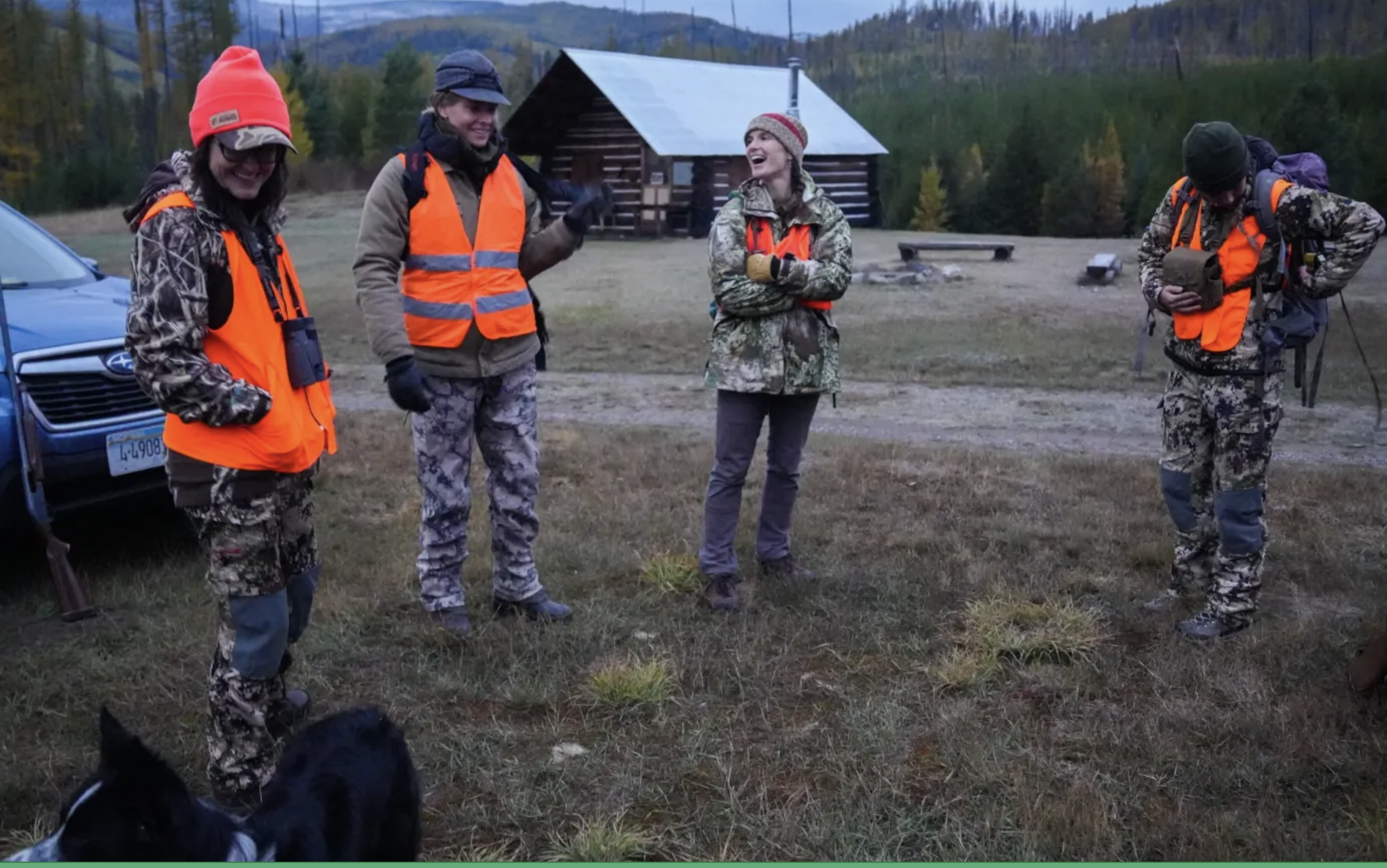
More women and minorities are hunting, but community support is 'critical' to grow their ranks, study finds

A women hunting group gathers for 'Ladies Hunting
Weekend' in Ninemile, Mont. (Photo by Aj Williams)
As state wildlife officials worry that the decline in hunting is reducing the license fees on which they depend, a new study "examines the role of confidence in introducing and retaining hunters from historically underrepresented backgrounds to the sport," Aj Williams reports for The Daily Yonder.

Conducted at the University of Montana and published in the Journal of Outdoor Recreation and Tourism, "The study concluded that attending community-building programs fosters confidence, also known as self-efficacy, while lowering barriers through forming connections with fellow hunters."

Researcher Ada Smith told Williams that most "hunter recruitment and retention programs have been focused on skill building, but our study shows that it is just as critical for efforts aimed at female hunters to also be geared toward fostering meaningful connections and community.” Women make up only 10% to 11% of all licensed hunters in the U.S.

Smith began hunting in 2019 and is in her third year hosting other female hunters on her family’s land. Williams writes, "Smith hopes to fast-track what many hunters gain through the years: a group of ‘buddies’ that can share hunting tips, resources such as gear and help each other through the process of learning to hunt and harvest."

“I feel equally excited about it [the research] because it resonates with things I’ve been dealing with as a beginner hunter, myself," Smith told Williams. "So, to look at the data then is pretty interesting."

Introducing new groups to hunting helps the sport in two ways: "The majority of federal funding for conservation efforts comes from taxes on guns and ammo. With a long-term trend of decreased hunting across the country, that money is dwindling as well." Williams reports. "For Smith and Metcalf [study researchers], this is why advocacy and outreach efforts have the potential to be impactful even beyond the sport, but to more people who have a stake in sustaining the environments in which they hunt."

Tuesday, October 04, 2022

Loretta Lynn, a coal miner's daughter who spoke strongly for women, dies after a music career that lasted 64 years

UPDATE, Oct. 5: "She was a theme on which other artists did variations," David Von Drehle of The Washington Post writes in perhaps the best tribute to Lynn that we at The Rural Blog have read. "Life threw everything it could scrape up at Loretta Lynn, and for 90 years she used it all to be bigger and stronger and more magnificent."

Loretta Lynn in 2000 (Photo by Christopher Berkey, Associated Press)
When a headline in The New York Times calls you a "symbol of rural resilience," you were more than a singer, songwriter and a coal miner's daughter. That was Loretta Lynn, died in her sleep Tuesday at her home in Hurricane Mills, Tenn., her family told The Associated Press. She was 90 years old.

"Her powerful voice, playful lyrics and topical songs were a model for generations of country singers and songwriters. So was her life story," says the Times' subhead, under which Bill Friskics-Warren writes: "Lynn built her stardom not only on her music, but also on her image as a symbol of rural pride and determination. . . . She became a wife at 15, a mother at 16 and a grandmother in her early 30s, married to a womanizing sometime bootlegger who managed her to stardom."

Lynn began her career in 1958. Songs like "Coal Miner's Daughter" reflected her pride in her rural Kentucky upbringing and "she crafted a persona of a defiantly tough woman, a contrast to the stereotypical image of most female country singers," writes AP's Kristin Hall. "She was the first woman ever named entertainer of the year at the genre’s two major awards shows, first by the Country Music Association in 1972 and then by the Academy of Country Music three years later.

“It was what I wanted to hear and what I knew other women wanted to hear, too,” Lynn told the AP in 2016. “I didn’t write for the men; I wrote for us women. And the men loved it, too.” Walter Tunis of the Lexington Herald-Leader writes, "The pride of Butcher Hollow redefined forever the role, and especially the power, of women in all corners of the entertainment industry."

Friskics-Warren writes, "Her songwriting made her a model for generations of country songwriters. Her music was rooted in the verities of honky-tonk country and the Appalachian songs she had grown up singing, and her lyrics were lean and direct, with nuggets of wordplay: 'She’s got everything it takes/to take everything you’ve got,” she sang in 'Everything It Takes,' one of her many songs about cheating, released in 2016."

The Academy of Country Music named Lynn the artist of the decade for the 1970s and she was elected to the Country Music Hall of Fame in 1988. Oliver "Doolittle" Lynn, her husband of nearly 50 years, died in 1996. They had six children, 17 grandchildren and four step-grandchildren.

Tuesday, September 06, 2022

Group that helps with abortion access in Midwest, including flights from small, rural airports, sees a spike in interest

A group called Elevate Access arranges transportation to abortion clinics from small airports. (Photo via The Daily Yonder)

"An organization that facilitates safe abortion access in the Midwestern United States says that it will most likely double the number of clients they support this year compared to last year," Kristi Eaton reports for The Daily Yonder. "Midwest Access Coalition assists with the costs of obtaining an abortion, including transportation, gas, food, medication and child care. . . . In 2021, the organization supported 800 people seeking abortions. This year, that number was reached in mid-July, meaning that they will more than likely double the number for 2022." So says Alison Dreith, the organization's director of strategic partnerships.

Dreith told Eaton that while Midwest Access serves rural and urban residents alike, rural clients often have the hardest time getting care because they live far from clinics. Many don't have the time or money to travel such long distances; in the wake of the overturn of Roe v. Wade, more are getting abortion pills online and self-managing their abortions at home because of travel difficulties.

"Midwest Access Coalition recently started a partnership with Elevated Access, which works with volunteer pilots to provide flights to patients seeking abortions and gender-affirming care," Eaton reports. Most Americans live within 30 minutes of a municipal airport, though many don't realize it because the airfields are so small, Dreith said. 

An Elevated Access employee told Eaton that these small airports offer clients privacy not found at larger airports. "There’s no TSA, there’s nobody asking you all these questions," she said. "When you drive up to the plane, the pilot welcomes you on board, flies you to where you need to go, you do your medical procedure."

"Currently, Elevated Access works with 800 volunteer pilots, but is hoping to recruit additional volunteers. Some may be more concentrated in certain areas, like California," Eaton reports. "They are specifically looking for pilots who can fly out of rural communities with patients."

Monday, August 22, 2022

Liberal groups' latest report on rural electric cooperative boards shows them to be overwhelmingly white and male

Percentage of women on rural electric cooperative boards, in ranges, by state. (Rural Power Project map)

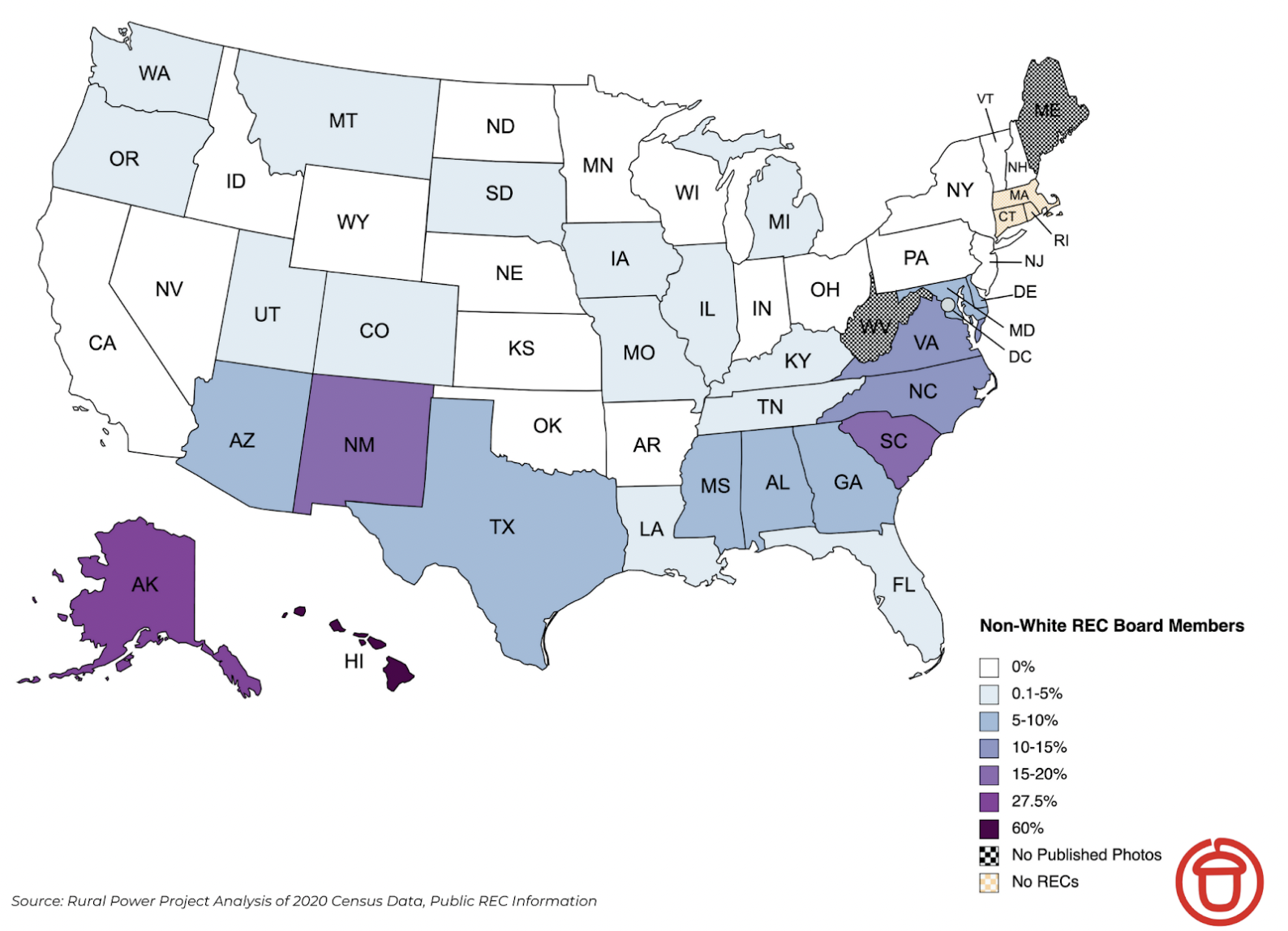
Rural electric cooperatives are major economic players in their communities, and reliably one of the most effective ways to bring high-speed broadband internet to rural areas. But their elected boards are overwhelmingly white and male, leaving rural women and racial minorities under-represented, according to a new report from two liberal groups, ACORN International and the Labor Neighbor Research and Training Center. Their joint Rural Power Project has been assessing co-op boards' gender and racial equity since 2016. As of this year, women made up 12.6% of the boards and people of color, who make up 24% of the rural population, only hold 4% of board seats. 

About 30% of co-ops had no female board members, and all but six out of the 888 surveyed had male-majority boards. New Hampshire's board had the largest share of female members, 45.5%, but the next-highest, Vermont, had only 28.6%. At the other end of the spectrum, West Virginia's board had no women at all, and Nebraska had only 4.8% female board members.

Percentage of non-white members on rural electric cooperative boards in ranges by state. (Rural Power Project map)

The boards didn't fare much better in racial diversity. "Of the 6,198 REC board members across the country for whom we could make a reasonable determination about racial identity, 96% were white. Just 2.4% were Black, 0.9% Hispanic, 0.5% Native American, and 0.2% Asian American," says the report. "Of 697 cooperative boards whose racial demographics we could assess, 557 of those boards – 80% –were all white. While people of color make up majorities of 10% of rural counties, there were only 11 majority nonwhite cooperative boards (1.6%)." ACORN sees the lack of diversity as "an act of exclusion," its research director, David Thompson, told Kristi Eaton of The Daily Yonder.

The National Rural Electric Cooperative Association says in a statement on its Mission page that the co-ops "are built by and belong to the diverse communities and consumer-members they serve. They are founded on seven principles that set them apart from other businesses. Concern for community and the open, democratic structure of co-ops are two of these core principles. With these foundational concepts in mind, NRECA supports electric cooperatives as they strive to serve their communities and work to enhance quality of life for their consumer-members. As an employer and an advocate, NRECA is committed to a positive, inclusive culture. We support policies that foster employee growth and success without fear of discrimination. The ongoing conversation about racism demands that we recognize how we can contribute to a more transparent, fair and accountable society. NRECA, its leadership and employees are expected to play a leadership role in rejecting racism, speaking against injustice, and demonstrating the value of diversity, equity and inclusion."

NRECA and the National Rural Utilities Cooperative Finance Corp., which makes federally backed loans to the co-ops, created a task force to examine co-op governance in 2017. "The task force completed the report in February 2018, but never published it," says the Energy and Policy Institute, which says it works to "expose attacks on renewable energy and counter misinformation by fossil fuel and utility interests." EPI republished the report after it was published on a co-op website and cited in an investigative report on South Carolina co-ops by The State, the daily newspaper in Columbia. Each page of the 69-page task-force report says it is “For NRECA and CFC Voting Members Only.”

Thursday, August 18, 2022

USA Today series shows gaps in health care for rural moms

USA Today's Nada Hassanein has just published a four-part series on disparities in health care among rural mothers. Part one has an overview of the issue; part two focuses on inequalities among rural indigenous people; part three has data on maternal mortality among rural women of color, and part four explores the historical roots of the phenomenon.

"About 2 million rural women of childbearing age live in maternity care deserts at least 25 miles away from a labor and delivery unit," Hassanein reports. "Rural hospitals and obstetric wards, already scarce, have continued to shut down in record numbers. Women of color are even more vulnerable . . . and the federal government has only recently started to identify the problem. The maternal death rate for rural Black women is three times higher than for rural white women, a 2021 Government Accountability Office report found, and the rate of severe maternal illness for those Black mothers was twice that of white women.

"The Covid-19 pandemic made matters worse. The nation’s overall maternal death rate increased, and disparities widened. While the death rate for white mothers rose in 2020 from about 18 to 19 deaths per 100,000, Black mothers' death rates remained three times as high, soaring from 44 to 55 deaths. Hispanic mothers' death rates also surged, from 12 to 18 per 100,000, according to the CDC. At the same time, half of rural hospitals already had no obstetric care, and two dozen hospitals shut down entirely."