Showing posts with label hydraulic fracturing. Show all posts

Sunday, July 12, 2026

A look back at fracking, from a leading reporter on the beat; environmental questions remain as industry shifts

Mike Soraghan started out with Energy and Environment News, which was bought by Politico, so now he writes for both. His latest opus is a look back at the history of horizontal hydraulic fracturing of deep shale, better known as "fracking," which has had a big impact on parts of rural America. Soragahn has covered it for more than a decade.

Mike Soraghan (Politico photo)
"Shale promised riches, and in some instances, it delivered, saving farms," he writes for Politico Magazine. "Fracking birthed tales of instant 'shale-ionnaires' and oilfield strippers tucking four-figure handfuls of cash in their garter belts for a night’s work. And it also fundamentally changed the United States’ position in the global energy economy, in ways that have been on prominent display over the first half of 2026.

"But a lot of the people you’d expect to profit from fracking . . . were instead crushed by it. And drilling wells could wreak environmental havoc, triggering earthquakes, ruining farmland, polluting airways and contaminating household water to the point it could catch fire. In short: Fracking rewrote the book on American energy, globally and domestically. . . . Today, even if you walk everywhere or drive an electric vehicle, fracking is responsible for keeping your grocery and electric bills down."

But now, "That tumultuous chapter is coming to an end, just as a war-driven energy crisis offers — or threatens — to rewrite the script once again. The irony is that the U.S. is outdoing the petro-kingdoms of the Middle East — just as the world is accelerating its turn toward renewable energy. The easy oil is getting harder to find. Even as production continues to climb, the rate of growth is slowing. Automation is replacing oil workers the way it did coal miners. Environmental protests have moved on to data centers. America’s wildcatters are again starting to scan the horizon for new discoveries abroad. Even Michael Steele, the former Republican Party chair who coined the term, 'Drill, Baby, Drill,' thinks the phrase has outlived its usefulness."

Environmental questions remain, especially "the long-term impact of pumping chemicals from the nearly 2 million fracked wells — questions that may not be answered for years or decades," Soraghan writes. Environmentalists are mostly against fracking shale, but Christopher Knittel, the associate dean for Climate and Stability at the Massachusetts Institute of Technology, told Soraghan that greenhouse-gas emissions have been cut mainly by power plants’ switch from coal to natural gas. More broadly, Knittel worries that the U.S. backoff from electric vehicles means the American industry could be “islanded off” from the rest of the world. "Perhaps the model for the United States’ energy future isn’t Saudi Arabia, but an actual island," Soragahn concludes.

Tuesday, August 13, 2024

Fracking wastewater is blowing out of old oilwells; the water can mean contaminated groundwater and unusable land

A Permian wellhead surrounded by fracking
equipment. (Adobe Stock photo)
Taking fracking wastewater and injecting it miles underground is the cheapest and most common way to get rid of Texas oilfield used or "produced water," but a new study from Southern Methodist University found that the toxic water may not be staying underground. The study showed "a significant link between wastewater injection and oil well blowouts in the Permian Basin," report Dylan Baddour of Inside Climate News and Carlos Nogueras Ramos of the Texas Tribune. "It’s the first scientific proof of a phenomenon local landowners have long warned was occurring."

To study wastewater injections and blowouts, researchers "examined a January 2022 blowout in Crane County that gushed almost 15 million gallons of brine before it was capped, according to the paper. That would fill about 23 Olympic-sized swimming pools," Baddour and Ramos report. "The study traced the cause of the blowout to a cluster of nine injection wells about 12 miles to the northeast."

The connection between the Permian Basin's briny sprays and fracking wastewater "raises concerns about the possibility of widespread groundwater contamination in West Texas," Baddour and Ramos write. While the Texas Railroad Commission regulates the oil and gas extraction, it has "refrained from putting forth an explanation. . . . The link between injections and surface blowouts has remained unconfirmed, despite widespread suspicions." This recent study, which was published in the journal Geophysical Research Letters, "marks a big step forward in scientific documentation."

Attorney Sarah Stogner told Baddour and Ramos, "It just validates what we’ve been saying." Baddour and Ramos add, "For the last three years, Stogner has represented the Antina Cattle Ranch, where dozens of abandoned oil wells have been spraying back to life. Stogner persistently alleged that nearby wastewater injection was responsible. But she couldn’t prove it. . . . Now a scientific consensus is beginning to fall in behind her."

When old wells gush oil wastewater, the land that absorbs the salty mess is at risk. Baddour and Ramos explain, "West Texas ranchers who own land where contaminated water is seeping from underground are beginning to worry it will soon become uninhabitable. . . . Despite those problems, the Railroad Commission approved 400 new disposal wells in the Permian Basin alone in 2021, according to agency documents, and 480 in 2022."

To learn how fracking wastewater can contaminate groundwater, click here.

Wednesday, February 01, 2023

As quakes in West Texas increase, some oil-wastewater disposal has changed, but preparedness questions remain

The Permian Basin is a major oil production area. (Wikipedia map)
In 2017, the National Aeronautics and Space Administration said "Texas is ranked first in the U.S. in the variety and frequency of natural disasters. Flooding, wildfires, tornadoes, hurricanes . . . . Sometimes, even utilization of the state’s natural reserves of oil, gas, and water can lead to subsidence and earthquakes." It's that last part, earthquakes, that has been increasing in number, and raising concerns: "In 2022, the state recorded more than 220 earthquakes of 3.0 magnitude or higher, up from 26 recorded in 2017, when the Bureau of Economic Geology at the University of Texas began close monitoring," reports David Goodman of The New York Times.

In oil-rich West Texas, two earthquakes were felt in late 2022, one in Pecos and the second in December near Odessa and Midland, all in the Permian Basin. Goodman writes: "The [November] tremor registered as a 5.4-magnitude earthquake, among the largest ever recorded in the state. Then, a month later, another of similar magnitude struck not far away. . . . . The earthquakes, arriving in close succession, were the latest in what has been several years of surging seismic activity in Texas. . . . In 2022, the state recorded more than 220 earthquakes of 3.0 magnitude or higher, up from 26 recorded in 2017, when the Bureau of Economic Geology at the University of Texas began close monitoring."

The cause of the earthquakes is known. Goodman reports: "Dr. Peter Hennings, the principal investigator for the Center for Integrated Seismicity Research at the University of Texas, said that earthquakes can be induced through human activity: the injection of a large amount of water in a short period of time adds fluid pressure under the earth, which essentially decreases the 'clamping' between rocks along natural faults and allows them to slip, creating an earthquake. . . . seismologists have established a relationship between smaller earthquakes and larger ones, Dr. Hennings said: The more small earthquakes you have, the greater the likelihood of a bigger one." 

Many Texas earthquakes "have been concentrated in the highly productive oil fields of the Permian Basin, particularly those in Reeves County, north and west of the city of Pecos," Goodman writes. "Where oil and gas production has increasingly meant hydraulic fracturing, a process of extraction that produces, as a byproduct, a huge amount of wastewater. Some of that wastewater is reused in fracking operations, but most of it is injected back under the ground."

An oil field near Pecos; Texas only recently began its statewide program of
monitoring for earthquakes. (Photo by Paul Ratje, The New York Times)
And what about the quakes? Rod Ponton, a former Pecos city attorney, told Goodman, “In West Texas, you love the smell of the oil and gas patch because it’s the smell of money. If you have to have the ground shaking every two or three months to make sure you have a good paycheck coming in every month, you’re not going to think twice about it.” But the area has made some changes. Goodman writes: "To address earthquakes outside of Odessa and Midland, state regulators suspended permits for deep disposal wells. . . . For local officials the earthquakes have presented new and unforeseen concerns about the structural integrity of buildings and buried pipes, as well as basic questions, such as, what are you supposed to do in an earthquake?"

Odessa Mayor Javier Joven told Goodman, "The big popular discussion out here is: Did you feel it? Did you feel it? And everyone goes on Facebook: I felt it. I felt it.” Joven also noted that the city has yet to alter building safety codes to prepare for earthquakes.

Wednesday, November 23, 2022

Collected research on health effects of fracking prompts physicians and advocates to call for stricter regulations

A natural gas fracking well pad in Valencia, Pa.
(Photo by Ted Shaffrey, The Associated Press)
A consistent pattern has emerged linking health symptoms to horizontal hydraulic fracturing to produce oil and gas. The evidence has researchers calling for new restrictions on where fracking wells can be drilled. “A paper by the Yale School of Public Health this summer showed that children living near Pennsylvania wells that use fracking to harvest natural gas are two to three times more likely to contract a form of childhood leukemia than their peers who live farther away,” reports Jon Hurdle of Yale Environment360. “That followed a Harvard study in January that found elderly people living near or downwind from gas pads have a higher risk of premature death than seniors who don’t live in that proximity.”

The oil and gas industry has insisted that its processes protects against water contamination and notes that there is no causation study proving that fracking causes any harm to groundwater. "The industry coalition cited earlier studies, including one by Duke University in 2017, which found no evidence of groundwater contamination over three years,” Hurdle reports “and another by Pennsylvania State University in 2018, which reported no deterioration in groundwater chemistry in Bradford County, a heavily fracked area of northeastern Pennsylvania.”

Hurdle continues, “In April, the nonprofit Physicians for Social Responsibility and Concerned Health Professionals of New York, which consists of health professionals, scientists, and medical organizations, published its most recent compendium of investigations into risks and harms linked with fracking. Since 2014, the compendium has tallied 2,239 peer-reviewed papers that found evidence of harm, with nearly 1,000 of those papers published since 2018.” Concerns about fracking harm "have prompted bans in France, Ireland, and Bulgaria," Hurdle notes.

For U.S. medical providers and advocates, the multiple studies have formed a pattern of connection. "There are enough studies now that show that fracking threatens the health of workers and communities and threatens the mental and physical health of people who work nearby and children who go to school nearby,” Dr. Ned Ketyer, president of Physicians for Social Responsibility Pennsylvania told Hurdle. But he cautioned that the studies show correlation, not causation. "There’s enough of those associations now between fracking and bad health outcomes that should be informing regulators, politicians and industry that there needs to be a better way."

Wednesday, September 14, 2022

NTSB blames deadly pipeline blast on bad pipe, failed corrosion protection, flow reversal for fracked gas, lots more

NTSB diagram overlays aerial photo of most of burned area onto satellite image. Flame from pipe went east-northeast.

Pipelines carrying natural gas and other flammable products sometimes blow up, bringing destruction and death to rural Americans. A gas pipeline blew up in Central Kentucky in 2019 mainly because of a manufacturing defect and failure of a system that is supposed to prevent corrosion of the pipe, the National Transportation Safety Board said in a report Wednesday.

Bill Estep of the Lexington Herald-Leader reports, "Ineffective electrochemical protection, called cathodic protection, on the outside of the pipe designed to prevent corrosion, the report said. The NTSB also said the operator of the pipeline, Enbridge, didn’t accurately assess the condition of the pipeline or properly assess the risks to it. That contributed to the accident, the agency said."

The report also blamed the Pipeline and Hazardous Safety Materials Administration's "non-conservative assumptions used to calculate the potential impact radius, incomplete evaluation of the risks caused by a change of gas flow direction [fracked northern gas going south], limitations in data analysis related to in-line inspection tool usage, incomplete assessment of threats and threat interactions, and missed opportunities in training and requalification practices."

The 30-inch Texas Eastern Transmission pipeline blew up at 1:23 a.m. Aug. 1, 2019, between Moreland and Junction City, rural communities south of Danville, releasing over 100 million cubic feet of gas that ignited, causing one death, six injuries, destruction of five homes, damage to 14 other residences, other property damage including the burning of 30 acres, and evacuation of more than 75 people. The same line "also failed in November 2003 near Morehead and in February 1986 in Garrard County. The Garrard County incident injured three people," Estep reports. A parallel line "blew up in April 1985 in Metcalfe County, killing five people and injuring three others."

Friday, May 06, 2022

Quick hits: USFS needs firefighters; 'forever chemicals' may damage your liver; podcast talks rural Black health

Here's a roundup of stories with rural resonance; if you do or see similar work that should be shared on The Rural Blog, email us at heather.chapman@uky.edu.

A new podcast, "Black in Red," discusses Black health in rural America. Read more here.

Hazardous "forever chemicals" found in a wide range of everyday products could damage your liver, a new study has found. Read more here.

"The rise of fracking in Appalachia has fed visions of turning the Ohio River valley into a petrochemical and plastics hub. But overproduction of plastic, opposition to natural gas pipelines, and public concern about rampant plastic waste are upending those plans," Beth Gardiner reports for Yale Environment 360. Read more here.

The U.S. Forest Service is scrambling to hire enough firefighters before this summer's wildfire season. Read more here.

Wednesday, April 06, 2022

Webinar at 3 p.m. ET Thursday will offer information about new federal grants for plugging orphan oil and gas wells

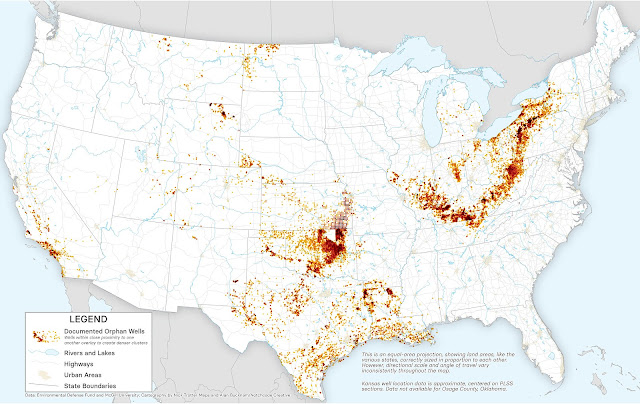
Environmental Defense Fund map locates abandoned oil wells. To enlarge any image, click on it.

The National Conference of State Legislatures is hosting a webinar series that can help you study up on policy issues that can affect your readers (along with its target audience of state legislators). The webinars are free, and will be recorded for those unable to attend. The series kicks off at 3 p.m. E.T. on Thursday, April 7 with "Orphaned No More: Federal Oil and Gas Well Reclamation."

From the website: "States across the country face a backlog of orphaned oil and gas wells, which can continue to emit methane and other pollutants if left unaddressed or improperly sealed." They also pose safety risks. "However, the costs of plugging and reclaiming oil and gas well sites often exceeds the amount available for reclamation. Further, many older wells have long been abandoned, and their owners no longer exist. It is often unclear who can or should be responsible for paying the plugging and reclamation costs. Recognizing these challenges, Congress included $4.7 billion for orphaned well plugging, remediation and restoration in the federal infrastructure bill. This webinar will educate state legislators on this new program, how their states can obtain funding and their options for directing these funds to meet their states’ needs and reclamation priorities."

NCSL Associate Director Aaron Ray will moderate a panel of speakers who include:
  • Dave Andrews, orphan well program manager of Colorado Department of Natural Resources' Oil and Gas Conservation Commission.
  • Sarah Solomon, senior program associate at the American Association for the Advancement of Science's Center for Scientific Evidence in Public Issues.
  • Steve Tryon, director at the Department of the Interior's Office of Environmental Policy and Compliance.
  • Steve Feldgus, the Interior's deputy assistant secretary of land and minerals management.

Tuesday, April 05, 2022

Canadian study links living near hydraulic-fracturing wells before and during pregnancy to poor birth outcomes

Hydraulic-fracturing wells in relation to
communities in Alberta, 2013-2018
(University of Calgary map)
A newly published study adds to growing evidence that living near hydraulic fracturing wells can harm infants and children. University of Calgary researchers studied nearly 35,000 pregnancies in rural Alberta from 2013 to 2018, and found that people who lived within 10 kilometers of 100 or more fracking sites in the year before getting pregnant were significantly more likely to give birth to infants who were premature and/or small for their gestational age.

"Past studies conducted in California and Pennsylvania have linked exposure to fracking sites and risk of spontaneous preterm birth," Lei Lei Wu reports for MedPage Today. "In addition, previous U.S. studies have suggested that living near fracking sites is associated with greater risk of mortality among the elderly, as well as heightened risk of heart failure.

Several factors could explain the link between fracking wells and adverse birth outcomes, the researchers said. "The quality of water and air may be lower near fracking sites due to contamination and the constant activity of heavy trucks, they noted, adding that around 90% of rural Albertans rely on groundwater for drinking," Wu reports. "They also noted that of the 240 chemicals in fracking fluids with toxicity information available, 103 are linked to reproductive toxicity."

Monday, February 28, 2022

Oil and gas industries release far more greenhouse gases than government data accounts for, investigation finds

University of Arizona photo
U.S. oil and gas operators release much more greenhouse gas than previous data suggests, a new investigation shows.

"Over much of the last decade, oil and gas operators in Texas and a dozen other U.S. states have flared, or burned off, at least 3.5 trillion cubic feet of natural gas, according to an analysis of satellite data by the Howard Center for Investigative Journalism" at Arizona State University, Laura Kraegel, Mollie Jamison and Aydali Campa report for Inside Climate News. "That’s the greenhouse gas emissions equivalent of nearly 42 million cars driving for a year. The industry has also directly released unknown amounts of gas into the atmosphere through a process called venting. Between them, flaring and venting release a noxious cocktail of carbon dioxide, methane and other pollutants."

Government auditors have warned for nearly two decades that inadequate data collection has obscured the amount of greenhouse gases released by flaring and venting, "but regulators are largely unaware of the amount of gas being flared and vented, the Howard Center found. It’s a blind spot that’s developed under limited federal oversight and a patchwork of state regulations, lax enforcement and inconsistent data collection," Kraegel, Jamison and Campa report. "The satellite flaring volumes calculated by the Howard Center, with the guidance of scientists who pioneered and used the methodology, far exceed the total reported to regulatory agencies in the 13 states designated by the U.S. Energy Department as having the most active flaring. They also far surpassed the total published by the Energy Information Administration, the U.S. Energy Department analytics agency that says it gets its data from the states."

The story is the first in a four-part series by the Howard Center about the flaring and venting of natural gas by oil and gas companies in more than a dozen states across the country.

Tuesday, December 14, 2021

Abandoned oil and gas wells, coal mines, hurt environment and locals' health; infrastructure funds earmarked to help

Map of documented abandoned wells from Environmental Defense Fund report; to enlarge, click on it or go here.

Coal, oil and natural gas have been major economic drivers in many rural areas, but these extractive industries have in many cases damaged the environment, and in some health of nearby residents, and too often failed to clean up after themselves. Federal funding can make a dent in the problem.

"In Pennsylvania, underground mine fires burn and iron-laden, acidic water pours into rivers from abandoned mine shafts. In New Hampshire, the iconic sugar maple is threatened by soil damage lingering from coal-induced acid rain," James Bruggers reports for Inside Climate News. "In Florida, a young mother obsesses over air and water pollution from a vast pile of coal ash stored by her local utility. And in Kentucky, the multi-billion dollar cost of reclaiming abandoned mines . . . far exceeds the amount of surety bonds left behind by an increasing number of bankrupt coal companies. "

Many states don't require coal companies to buy enough bonds for reclamation. That means bankrupt companies often leave rural places to pay for the cleanup themselves or suffer the environmental consequences. "Across Appalachia, mountaintop removal and other forms of surface mining have scarred an area of more than 2,300 square miles in Kentucky, West Virginia, Virginia and Tennessee. Nationwide, over a million acres of land used by still operating, idle or abandoned mines need to be cleaned up and reclaimed," Bruggers reports.

Meanwhile, there are more than 2 million inactive, unplugged oil and gas wells scattered across the U.S., according to a recently published map from the Environmental Defense Fund. Such wells often poison groundwater and leak the potent greenhouse gas methane. The Environmental Protection Agency estimates that the wells could leak as much methane per year as 5 million cars. The EDF's map shows 81,000 abandoned wells that are documented as having no owner.

Cleaning up abandoned fossil fuel sites is cost-prohibitive for states. It costs an average of $25,000 to $475,000 to close each oil or gas well. And a recent report found that it will cost as much as $9.8 billion to reclaim coal mines in Central Appalachia. On the upside: the recently signed infrastructure bill included $16 billion to clean up abandoned mines and old oil and gas wells.

Wednesday, August 11, 2021

Infrastructure bill has provisions for abandoned mine and well reclamation, dangerous dam removal, and more

The infrastructure package the Senate passed Tuesday has plenty in it for rural America. The Rural Blog has previously reported on this, but some parts of the huge bill are still coming to light. 

The package allocates $11.3 billion to help clean up abandoned mines, nearly double the $6 billion the Abandoned Mine Reclamation Fund has received in the past 15 years (see p. 1776 of the bill) but short of the estimated $20 billion (click here for state estimates) needed for total clean-up costs.

The package also has $4.7 billion for plugging and reclaiming abandoned oil and gas wells on federal, state and tribal lands (p. 1744). States can apply for competitive grants of up to $25 million for the purpose. Well and mine operators must post bonds meant to cover clean-up costs, but they're often inadequate, and rural governments are frequently stuck with the bill when companies go under.

The mine funding will be spread over 15 years and will go to 25 states and three tribes: Alabama, Alaska, Arkansas, Colorado, Illinois, Indiana, Iowa, Kansas, Kentucky, Louisiana, Maryland, Mississippi, Missouri, Montana, New Mexico, North Dakota, Ohio, Oklahoma, Pennsylvania, Tennessee, Texas, Utah, Virginia, West Virginia, Wyoming, and the Crow, Hopi and Navajo.

Dam safety also gets attention in the bill: It creates and funds a $553 million grant program for hydroelectric dam owners to make them safer and more efficient. And it would provide $1.6 billion for government agencies to remove dangerous dams. 

The package calls on the Transportation Department's Build America Bureau to establish a Rural and Tribal Assistance Pilot Program to provide technical, financial and legal assistance to rural and tribal governments' infrastructure projects. The pilot program is meant to last five years, and is funded as follows: $1.6 million for fiscal year 2022, $1.8 million for FY 2023, $2 million for FY 2024, $2.2 million for FY 2025, and $2.4 million for FY 2026.

Friday, July 30, 2021

Quick hits: Neighborly listening, getting water to Navajo Nation, fracking effects study, and more

Here's a roundup of stories with rural resonance; if you do or see similar work that should be shared on The Rural Blog, email heather.chapman@uky.edu.

"We're rural Democrats and we're trying to listen to our Trumpy neighbors." Read more here.

A Navajo man has launched a program to deliver water to drought-stricken areas of the Navajo Nation. Read more here.

In their new podcast "Sepia Tones," Drs. William Turner and Ted Olson explore Black Appalachian music. Read more here.

An Aug. 11 webinar will educate on black-lung disease, grassroots efforts to address the problem, and ideas for influencing lawmakers on taking action. The webinar is presented by the left-leaning Appalachian Voices. Read more here.

A study correlates the hydraulic-fracturing boom with a rise in rural crime. Read more here.

Monday, July 05, 2021

Hydraulic fracturing for oil and gas created fewer jobs than anticipated in Appalachia, and most of them are gone

The hydraulic fracturing boom is waning in Appalachia. Though advocates have touted fracking as a manufacturing-jobs booster in recent years, it created "startlingly few" jobs in the region, and most no longer exist, Colin Jerolmack reports for MIT Technology Review. Jerolmack is a New York University environmental studies and sociology professor and author of the new book Up to Heaven and Down to Hell: Fracking, Freedom, and Community in an American Town.

"What happened? As a Bloomberg report put it, 'The numbers never added up.' Fracking has always been expensive; extraordinarily generous fossil-fuel subsidies helped hide the true cost. With new wells facing average production declines of 60 percent in the first year, petroleum companies had to frantically drill more of them. The entire model was premised on high oil and gas prices. But nationwide, the glut of gas (and, to a lesser extent, oil) precipitated by the fracking boom depressed prices to their lowest levels since the 1990s," Jerolmack reports. "The result? Frackers pumped the brakes. A wave of consolidations and bankruptcies swept across the sector. The stock prices of premier energy firms like Chesapeake Energy Corp. crashed (it declared bankruptcy in 2020). Some, like Anadarko Petroleum Corp., liquidated their shale gas holdings. Chevron announced in December 2019 that it would write down up to $11 billion in shale-gas assets."

More than 100,000 oil and gas jobs were lost in 2020, and about 70% of them may not come back this year or ever, according to a Deloitte report. And even those jobs may not have helped local economies the way fracking supporters promised. A recent Ohio River Valley Institute report "details how fracking boosters’ promise of jobs and prosperity for the broader Appalachia region was a mirage," Jerolmack reports. "In the 22 Ohio, Pennsylvania, and West Virginia counties that produce most of America’s natural gas, economic output grew by 60% from 2008 to 2019, but little of the income generated by that growth stayed in local communities. The region saw only 1.6% job growth, compared with 9.9% nationally; its share of the nation’s population fell by 11%."

Fracking is still a major factor in the Permian Basin of Texas and New Mexico, but wastewater disposal problems may hinder its growth.

Friday, May 07, 2021

UN says methane emissions need a 40-45% cut by 2030; The Economist says it's the big, low-hanging fruit for climate

Illustration by Alvaro Dominguez for The Economist
A United Nations assessment of methane says the world needs to cut emissions of the potent greenhouse gas almost in half by 2030 to avoid warming Earth by another half-degree Fahrenheit.

Methane in the atmosphere warms the planet about 10 times as much as carbon dioxide, on a per-unit basis, but accounts for only a fourth of global warming because it is produced in smaller amounts and stays in the air for about 10 years; CO2 can remain for up to 1,000 years. Axios reports, "Methane [CH4] concentrations have been increasing at an alarming rate in recent years," due in part to the growth in U.S. oil and gas output from hydraulic fracturing, and UN environment director Inge Andersen says CH4 must be cut to meet the Paris Agreement's temperature targets.

"Without tackling this, we cannot hit 1.5°C and we will certainly overshoot" the 2°C target of the agreement, Andersen told reporters. Her report calls for a cut 40 to 45% by 2030 and says about 30% of that could come from specific measures such as finding and fixing leaks in gas pipelines; another 15% "would come from broader efforts to decarbonize the economy," Axios reports.

Chart by The Economist; for a larger version, click on it.
Stephen Comstock, head of corporate policy for the American Petroleum Institute, said in a statement, "API is focused on working with the Biden administration in support of the direct regulation of methane for new and existing sources and building on the significant progress our industry has made in reducing methane emissions through technological advancements." Leaky pipes are easy to fix, compared to cutting methane emissions from coal mines and agriculture, especially animal agriculture, mainly ruminants such as cattle and sheep, which are estimated to account for 30 percent of global methane emissions.

Methane is the big, low-hanging fruit for slowing climate change, The Economist said in last week's edition: "Few people in those parts of the world made rich by carbon-dioxide-emitting enterprise are going to volunteer for a cut in living standards. And it is hard to ask those from parts of the world that are not yet rich to sacrifice the chance to become so." So, "It makes sense to concentrate on doing things which affect neither the comforts of the former nor the aspirations of the latter. Technological change that shifts economies away from using fossil fuels as their principal energy sources may be able to achieve this in the long term. But some sort of effective action is also needed now . . . and the methane problem looks a lot more tractable in the short term than does the carbon-dioxide one." In an earlier editorial, The Economist calls on governments to set goals for reducing methane emissions.

Tuesday, March 16, 2021

Deb Haaland confirmed as Interior secretary with support from four Republican senators

Deb Haaland at her confirmation hearing 
(Photo by Leigh Vogel, Getty Images)
After a weeks-long confirmation process, on Monday the Senate confirmed U.S. Rep. Deb Haaland, D-N.M., as President Biden's secretary of the Department of the Interior, marking the first time a Native American has held any cabinet-level position. Haaland, 60, is a registered member of the Laguna Pueblo Nation and in 2018 was one of the first Native American women elected to Congress.

Four Republican senators crossed the aisle to vote for Haaland in the 51-40 vote: Lisa Murkowski and Dan Sullivan of Alaska (the state with the highest proportion of Native Americans), Susan Collins of Maine (the most rural state), and Lindsey Graham of South Carolina, reports Timothy Puko of The Wall Street Journal.

"Along with energy leases on federal land, Haaland will oversee the national parks and endangered-species protections. She will also lead the Bureau of Indian Affairs, a role that her supporters say will help reconcile long-troubled relations between Washington and America’s Indigenous peoples," Puko reports. Haaland's history of environmental activism and skeptical eye toward fracking triggered significant resistance from Republican senators during the confirmation process.

Presidential historian Heather Cox Richardson provides more context for Haaland's historic confirmation, including the Interior Department's history with Native Americans and energy.

Thursday, October 22, 2020

Judge invalidates ousted Bureau of Land Management chief's decisions in Montana; could set precedent elsewhere

"A federal judge in Montana has once again handed the Bureau of Land Management and its embattled former de facto acting chief, William Perry Pendley, another major legal defeat," Scott Streater reports for Energy & Environment News.

Last week, Montana Chief District Judge Brian Morris ruled that three major land-use plans revisions in the state were invalid because Pendley had been unlawfully leading BLM for more than a year, Streater reports. All three of the plan revisions would have opened more federal lands to oil and gas drilling. 

The ruling could jeopardize the BLM's decisions in other states, Rebecca Beitsch reports for The Hill. Environmental groups have a list of at least 30 land-management plans overseen by Pendley they'd like to see reversed.

"Morris also issued what appeared to be a warning to Pendley and the Interior Department that they better abide by his previous order from last month barring Pendley from performing the duties of BLM director," Streater reports.

The ruling is another coup for Montana Gov. Steve Bullock, whose lawsuit against the U.S. Postal Service forced the agency to reverse recent changes that slowed mail delivery nationwide. Bullock filed suit against the BLM in July, Streater writes.

Monday, October 05, 2020

Plugging forsaken oil and gas wells could cost $280 billion

"The American public is facing a potential bill of $280 billion for the cleanup of 2.6 million unplugged oil and gas wells, according to 'Billion Dollar Orphans,' a report from London-based think tank Carbon Tracker," Justin Mikulka reports for Desmog, a nonpartisan climate-scientist website. "While this number is alarming, it does not even include an estimated 1.2 million undocumented orphan oil and gas wells."

The petroleum industry defines "orphan wells" as those that don't produce oil or gas and have no financially viable operator to plug them. "With the current state of the oil and gas industry, the number of financially viable operators is rapidly decreasing while bankruptcies rise, which is exacerbating this whole issue," Mikulka reports. "One troubling aspect of this problem is that it should not exist. Regulators at both the federal and state levels have the tools in place to hold companies accountable for the costs of well plugging and abandonment. Yet those regulators have not used those tools, and now, as the industry is struggling financially, in many cases it simply may be too late."

Oil and gas companies must buy a surety bond to get a permit to drill a well, to ensure that the cost of plugging it will be covered, even if the operator goes bankrupt. "But regulators have set the limits for those surety bonds far below the actual costs to plug and abandon wells," Mikulka reports. "Carbon Tracker estimates that these bonds currently would only cover approximately 1% of the estimated $280 billion clean up tab — leaving the rest of the bill to be paid by the public."

Friday, August 14, 2020

Trump administration weakens drillers' responsibility to detect and fix leaks of methane, a major greenhouse gas

"The Trump administration formally weakened a major climate-change regulation on Thursday — effectively freeing oil and gas companies from the need to detect and repair methane leaks — even as new research shows that far more of the potent greenhouse gas is seeping into the atmosphere than previously known," Coral Davenport reports for the The New York Times. Methane has a much stronger greenhouse effect than carbon dioxide, but dissipates much more quickly.

Under the new rules, the Environmental Protection Agency effectively no longer has the authority to regulate methane, a powerful greenhouse gas that is the main component of natural gas. Instead, methane will now be regulated under the weaker standards of the Clean Air Act, Steven Mufson reports for The Washington Post. The Post's James Hohmann notes that Trump dispatched EPA Administrator Andrew Wheeler to Pennsylvania to sign the order, in a bid to help him carry the state again.

Wheeler "has justified the move by citing EPA data showing that leaks from domestic oil and gas wells have remained steady over the past decade, even as oil and gas production boomed," Davenport reports. "However, numerous recent studies show the opposite: that methane emissions from drilling sites in the United States are far more extensive than the EPA’s official numbers. Overall, methane levels are in fact climbing steadily nationwide, according to the research, and have reached record highs globally in part because of leaks from fossil fuel production."

The move highlights a petroleum-industry divide between large oil and gas companies and smaller independents. "Giants like BP and Shell attacked the move, while trade groups including the Independent Petroleum Association of America and Western Energy Alliance embraced it," Ben Geman reports for Axios. But Geman notes that large multinational companies have more resources to become compliant, and many have already pledged to reduce methane emissions, so they have a competitive advantage over smaller drillers.

"The new methane rules worsen an already grim situation in one of the world’s largest regional climate emissions bombs," the Permian Basin in West Texas and southeast New Mexico, writes Candice Bernd of Truthout. "In June, environmental watchdog Environmental Defense Fund flew specially equipped helicopters above hundreds of Permian drilling sites as part of its Permian Methane Analysis Project, or PermianMAP. Researchers found that more than one in 10 flares in the Permian Basin could be unlit or malfunctioning, accounting for a majority of the 300,000 tons of methane vented from the region every year. The amount of vented methane is three times the annual total the EPA reports."

Wednesday, July 29, 2020

Gas flaring from oil extraction up 23% from 2018 to 2019 in U.S.; some states are taking steps to regulate it more

"Gas flaring in the United States increased 23 percent last year, contributing to global levels of the practice that have not been 'seen in more than a decade,' according to a new report," Carlos Anchondo reports for Energy & Environment News. The analysis by the World Bank says the U.S. "flared the third-largest amount of gas in the world from 2018 to 2019, following Russia and Iraq. Globally, the volume of gas flaring — in which surplus gas is burned off into the air — increased 3%, rising from 145 billion to 150 billion cubic meters."

That matters because flared gas contains methane, a potent greenhouse gas that contributes to climate change. Methane is the main volatile hydrocarbon in natural gas; flaring burns most of it, but some can escape, and one product of the burning is carbon dioxide, the main greenhouse gas.

Flaring intensity, the amount of gas flared per unit of oil produced, also increased nearly 12% in the U.S. from 2018 to 2019, but dropped by 10% in the first quarter of 2020 despite increased oil production, Anchondo reports. That's because of improved utilization of flared gas, the report says.

Some states are taking steps to regulate flaring, including major Permian Basin drilling states New Mexico and Texas, Anchondo reports.

Friday, July 24, 2020

Halliburton looking beyond U.S. shale oil as fracking remains unprofitable

The pandemic has soured the outlook on the U.S. shale oil industry, but there's evidence it was running out of steam already, if energy giant Halliburton is any indication.

"Way back in January (it’s been a long year) Halliburton was already souring on shale. Way before the novel coronavirus put the final nail in the coffin of the West Texas shale revolution, the multinational corporation and one of the largest oil field service companies in the world had very publicly been going through a rough patch with shale oil," Haley Zaremba reports for Oil Price. "January 2020 marked the posting of Halliburon’s third straight quarterly loss during the national shale slump that also caused the corporation to take a $2.2 billion charge to its earnings. As a result of this massive shale slump, Halliburton laid off a whopping eight percent of its North American staff in the middle of last year, before dismissing even more employees in the Western U.S."

Bloomberg reported this week that Halliburton "is looking away from its traditional North American heartland for sales growth as the fracking behemoth works its way through an historic oil bust." Though U.S. shale was once a major income source for the company, Halliburton suggested to investors that it may limit or eliminate U.S. shale. That a company the size of Halliburton is moving away from U.S. shale entirely "could certainly be seen as a harbinger of doom," Zaremba reports.

Because U.S. shale prices have recovered somewhat, some other drillers are reopening and creating more wells, but that may not be enough to pay down the coming debt for companies that were only able to meet growing demand through heavy borrowing, Zaremba reports.