Showing posts with label drug prevention. Show all posts

Friday, December 13, 2024

States promised opioid settlement spending transparency, but many have already strayed from commitment


When states and local governments anticipated billions in opioid settlement dollars, 12 states committed to 100% spending transparency, "promising annual reports 'specifying the activities and amounts,' they have funded," reports Aneri Pattani of KFF Health News. "But many of those reports remain difficult, if not impossible, for the average person to decipher."

Idaho settlement dollars are an example. The attorney general’s website hosts "more than 90 standardized spending reports from state and local entities. Sounds great. But in reality, it reads like this: 'In fiscal 2023, the city of Chubbuck spent about $39,000 on Section G, Subsection 9.' Cracking that code requires a separate document," Pattani explains. "The Idaho attorney general’s office, which oversees the state’s opioid settlement reports, did not respond to requests for comment."

New Hampshire has a different transparency problem. "The state government controls 85% of the state’s settlement funds and posts reports from grant recipients on its opioid abatement website," Pattani reports. "The reports explain the projects and populations served but lack a key detail: how much money each organization received."

Accessing dollars and cents details means searching through "the opioid abatement advisory commission’s meeting minutes, which date back several years" or other state government meetings and notes.

Graph by Aneri Pattani and Lydia Zuraw, KFF Health News and Christine Minhee, OpioidSettlementTracker.com

Idaho and New Hampshire aren't the only states falling short of their commitment. Other states have zero reporting, even though many residents are asking for the information. Pattani writes, "One of the loudest and most frequent questions from the public has been: Where are the dollars going? Victims of the crisis, along with their advocates and public policy experts, have repeatedly called on governments to transparently report how they’re using these funds, which many consider 'blood money.'"

Of the 12 states that promised spending accountability, seven have "reported 100% of their expenditures in a way that is easy for the public to find and understand," Pattani reports. "There are also states such as Indiana that didn’t originally promise 100% transparency but are now publishing detailed accounts of their expenditures."

Sharing settlement spending information not only helps the public hold state and local officials accountable for their spending choices, but it can also foster hope. Norman Litchfield, the director of addiction medicine at St. Luke’s Health System in Idaho, told Pattani, "A lot of people simply are just not aware that these funds exist and that these funds are currently being utilized in ways that are helping."

Thursday, February 08, 2024

After at least 3 fentanyl deaths in 7 months, weekly in small Kentucky county alerts its readers to dangers, details

Most of this week's front page; click it to enlarge.
Photo illustration is based on a DEA image. 
After three fentanyl overdoses since June in Crittenden County, Kentucky, the first recorded in the county of 9,000 people, and another death in which fentanyl could have been a contributing factor, the local editor-publisher thought it was time to alert his readers to the danger.

"Considered by some as the grim reaper of recreational drugs, fentanyl has hit Crittenden County like a reaper’s scythe over last the few months," Chris Evans of The Crittenden Press began his story, which reported the deaths without the victims' names, noted that the county normally has about three overdoses of any drug in a year, then gave a rationale for the story and made it an implicit example to follow: "Observers say small communities like Marion should raise awareness or prepare to see more deaths in their neighborhoods."

Evans quotes local and state officials and writes, "Fentanyl is approximately 100 times stronger than morphine and 50 times more potent than heroin. Illegal manufacturers often lack understanding, ability and precision to make fentanyl. It’s not a forgiving drug. One minuscule mistake is irreversibly deadly."

Dr. Christopher Kiefer of the state medical examiner’s office told him, “High-school-age kids might be swapping pills. That’s not uncommon. They might think they’re getting a mild painkiller pressed in a lab. They might think it’s Oxycodone or Lortab, but it ends up being fentanyl. You don’t have to be using a needle to die of an overdose. . . . It is a dangerous time right now because people don’t know what they’re getting,”

Crittenden County (Wikipedia map)
Evans adds, "The doctor further explains that fentanyl made and distributed on the black market can be dressed or disguised as just about anything. Someone may think they’re getting a pill from a friend’s mom’s medicine cabinet when it’s something far more sinister and deadly." He quotes Marion Police Chief Bobby West as saying that families and friends of drug users can be the best preventers of overdoses, and “Conversations need to be had about this drug and how it can kill you.”

Evans concludes, "The stark reality of this drug is that it can creep undected into any corner of society and become an instant killer. Now, it’s in Marion." His package also includes sidebars about synthetic opioids (fentanyl is one) and a quick-look box giving street names for the drug, how it is used, what it does and what an overdose can look like: "Stupor, changes in pupil size, clammy skin, cyanosis, coma, and respiratory failure."

Evans has made this week's issue available online, here.

Thursday, December 21, 2023

Overdose-prevention programs in remote Maine work to stem drug-related problems and deaths

Naloxone is part of harm-reduction strategies.
(Photo by NEXT Distro, Unsplash)
Access to drug overdose prevention and addiction treatment in rural America can be almost non-existent. In Washington County, Maine, a remote area ravaged by drug use and overdose deaths, there was little help for substance-related issues. But a non-profit with federal dollars from the Substance Abuse and Mental Health Services Administration is working to change the county's number of drug-related medical problems and deaths, reports Taylor Sisk of The Daily Yonder. "In 2022, SAMSA awarded $30 million to 25 grantees to support community-based overdose-prevention programs, syringe services programs, and other harm reduction services. . . .MaineHealth received $1.2 million for a statewide overdose- and infection-prevention initiative."

Washington County, ME
(Wikipedia map)
Because Maine is small -- California is five times its size -- fewer people may know the extent of the state's drug problems. "Maine is the most rural state in the country with one of the highest drug-overdose rates. . . . It has one of the highest rates of acute hepatitis B. And it has the highest rate of hepatitis C, largely attributed to injection drug use," Sisk writes. "Washington County is the nation's easternmost county – the last stop on the line. It has a Walmart in Calais, the county's largest town, pop. 3,032. But if you live in Machias, the second largest town, pop. 2,062, it's an hour's drive. You're more likely to rely on the Family Dollar for your essentials. There's no bus service and one taxi company. . . . It has the highest poverty rate in the state."

In 2022, MaineHealth "launched Project DHARMA – Distribution of Harm Reduction Access in Rural Maine Areas – a collaboration with community-based organizations, including syringe services programs. Washington County became a beneficiary," Sisk reports. Harm reduction care "embraces a set of evidence-based strategies for reducing the negative consequences of drug use to keep people alive and as healthy as possible until such time as they should be ready to seek treatment."

Kinna Thakarar is an infectious disease and addiction medicine physician for MaineHealth and Project DHARMA's lead researcher. She told Sisk, "The services Project DHARMA is funding are evidence-based. Among the supplies and services syringe services programs typically provide in addition to clean syringes are saline, Band-Aids, condoms, information, and referrals. . . . They provide naloxone, a medication that quickly reverses the effects of an opioid overdose, and offer fentanyl test strips, an increasingly urgent need."

"Another critical service this grant will fund is one advocates have fought hard to launch: drug testing using handheld spectrometers. Outreach workers will test drugs to determine their contents; the drugs will then be sent to Colby College for confirmation. Other academic partners are providing technical assistance," Sisk writes. "But gaining permission to do so wasn’t easy. It required passing legislation 'so that none of us would get arrested in doing this evidence-based public health work,' Thakarar said. The passage of L.D. 1745, signed into law this summer, allows select individuals to possess 'nominal amounts' of illicit or controlled substances for the purposes of drug testing."

Wednesday, May 17, 2023

Feds try to head off the newest big danger in illicit drugs; xylazine is cheap and causes rotting flesh wounds

Xylazine is legal only as a sedative for animals.
(Photo by Derek Montgomery, The Washington Post; click to enlarge)
Pain pills, heroin, synthetic opioids, fentanyl--what else can drug mixers cut into illegal drugs? Xylazine, that's what. It's a central-nervous-system depressant that is often mixed with fentanyl and can cause a deep stupor, reports Caroline Anders of The Washington Post: "It's known to cause rotting flesh wounds that, left untreated, can lead to amputations." Worsem it's a drug seller's dream: "It's extremely inexpensive, allowing sellers to extend their stores of heroin and fentanyl even further, and some users say it extends the sedative and euphoric effects of the opioids," Anders reports.

Xylazine is FDA-approved for veterinary use; its illegal use began to be noticed in the early 2000s, but "then became rampant in Philadelphia, and is now spreading across the United States. The Drug Enforcement Administration said the sedative was present in 23 percent of fentanyl powder and 7 percent of pills it seized in 2022," Anders writes. "Over 3,000 people died of xylazine-related overdoses in 2021 — triple the fatalities recorded the year before. But, importantly, those overdoses were all from mixtures of xylazine and opioids like fentanyl or heroin. . . . It's unclear exactly how xylazine interacts with opioids, though researchers are looking into the question."

"Last month, the Biden administration designated xylazine mixed into fentanyl as an emerging threat . . . . trying to prioritize federal resources to address the drug from the supply and demand side, both boosting testing and treatment and restricting the illegal supply of the tranquilizer," Anders reports. "In March, lawmakers also introduced bipartisan legislation that would classify the drug as a controlled substance." Rahul Gupta, director of the White House Office of National Drug Control Policy, told Anders that one of the key lessons the government learned from the fentanyl crisis is that "this two-pronged approach is crucial," Anders reports. "He said focusing only on how to cut off the drug supply is futile." Gupta told her, "If we do not address the unmet treatment needs for people with addiction, we will continue to suffer the same fate."

The government's move to criminalize xylazine hasn't made everyone happy. "Harm-reduction advocates argue the government is heading down the wrong path ... saying that the approach will just lead manufacturers and dealers to come up with new, potentially more dangerous substances to cut into their supply," Anders writes. "In the coming months and years, the administration's plan to tackle the crisis from multiple sides will be tested. But regardless of its effectiveness, experts say there will always be a new emerging threat." Mary Sylla of the National Harm Reduction Coalition, told Anders, "It's literally like whack-a-mole, right? We try to stop this here, and then something else pops up."

Monday, December 12, 2022

For 7 deadly years, feds flubbed fentanyl fight, Post reports, naming DEA, DHS, HHS, CDC, White House drug office

Photos of fentanyl victims in the lobby of DEA headquarters (Photo by Salwan Georges, The Washington Post)
"During the past seven years, as soaring quantities of fentanyl flooded into the United States, strategic blunders and cascading mistakes by successive U.S. administrations allowed the most lethal drug crisis in American history to become significantly worse," The Washington Post reports in a long story that begins a massive package on the problem.

"Presidents from both parties failed to take effective action in the face of one of the most urgent threats to the nation’s security, one that claims more lives each year than car accidents, suicides or gun violence," Nick MiroffScott HighamSteven RichSalwan Georges and Erin Patrick O'Connor write. "Fentanyl is now the leading cause of death for Americans ages 18 to 49, according to a Post analysis."

Fentanyl and other synthetic opioids are primarily the responsibility of the Drug Enforcement Administration, which "stumbled through a series of missteps as it confronted the biggest challenge in its 50-year history," the Post reports. "The agency was slow to respond as Mexican cartels supplanted Chinese producers, creating a massive illicit pharmaceutical industry that is now producing more fentanyl than ever. . . . The DEA said it is now taking direct aim at the Mexican cartels and the fentanyl epidemic" but "acknowledged that the government remained too focused on heroin at the onset of the crisis."

Other agencies also fell short. The Department of Homeland Security "failed to ramp up scanning and inspection technology at official crossings, instead channeling $11 billion toward the construction of a border wall that does little to stop fentanyl traffickers," the Post reports. "The White House Office of National Drug Control Policy, the executive branch office headed by the 'drug czar' and tasked with coordinating the government’s response, spent years fending off elimination and struggled to create an effective strategy to combat the scourge. The office lost its seat in the White House Cabinet and remains sidelined." David King, who runs a federal drug task force in San Diego, told the Post, “Law enforcement did the best it could. We can only do so much. But in Washington, they have been very slow to respond to this and now we are at the confluence of paralysis.”

Another bureaucratic failure: While "Narcotics agents say street-level demand for fentanyl is rising fast because so many new users are getting hooked," the Department of Health and Human Services "has not tracked the rise of fentanyl and does not know how many Americans are using it," the Post reports. That could stem from the fact that fentanyl is being added to other drugs, and is now involved in most overdoses. HHH's Centers for Disease Control and Prevention "is unable to track overdose deaths in real-time," the Post notes. "Its published data is one year behind. . . . There is one federal system that collects both fatal and nonfatal overdose data in real-time in several regions of the country. But the system, called ODMAP, is kept from public view. A database launched by the drug czar’s office last week maps some nonfatal overdoses, which can highlight regions where deaths are likely to follow. Without comprehensive data, the federal government is driving blind." John Walters, drug czar for presidents of both parties, told the Post, “This is like tracking the epidemic by visiting cemeteries.”

The Post also has a story on why fentanyl is so deadly and a collection of earlier stories on the opioid epidemic. It promises five more stories, including how "a DEA agent tracked the source of fentanyl in Mormon country" and "Inside the daunting hunt for the ingredients of fentanyl and meth."

Wednesday, November 02, 2022

Peer recovery specialists can be a valuable in addiction treatment; several Appalachian examples are cited

                                      Photo: Rudamese/Pixabay
Recovering from drug addiction can be a scary path. "There is no simple roadmap to recovery from a substance-use disorder; no fixed destination toward which to steer. Certainly, there are mile markers in recovery, and there are those who can help navigate from one day to the next, to offer assurance there is a path forward," reports Taylor Sisk of 100 Days in Appalachia.

Kanitha Cox was an addict in recovery, and she was able to lean on other women around her who had successfully recovered from their addictions. “They had good, healthy relationships,” Cox told Sisk. “They had jobs; they were working and going to school; they had their kids back. I saw these women who were genuinely happy on the inside. . . And I just latched on to them and held on for dear life until I could stand on my own two feet and figure it out.”

Jonathan Stoltman, founder and director of the Opioid Policy Institute, told Sisk, "People with addictions have, commonly, grown accustomed to being dismissed, discounted and judged as 'other.' They’ve been mis-assessed and/or mistreated by health care institutions. It can be a life-changing experience for an addict to hear: 'I’m here to help you, I care about you, I value your life'."

While research is still limited, peer recovery support for people living with a substance use disorder has been shown to improve treatment retention, reduce rates of relapse and enhance relationships. The federal Substance Abuse and Mental Health Services Administration says “Peer recovery support services have become increasingly central to people’s ability to live with or recover from mental and/or substance-use disorders.”

Peer specialists provide understanding and hope. Most specialist use the SAMHSA definition for peer care: “a strengths-based framework that emphasizes physical, psychological, and emotional safety and creates opportunities for survivors to rebuild a sense of control and empowerment,” reports Sisk.

Angela Hagaman, operations director for East Tennessee State University’s Addiction Science Center, explained that addiction recovery treatment is "outside the Western world’s traditional symptom-reduction model of addressing illness. . . . for a substance use disorder, the sources of the issue and the desired outcomes vary from one person to the next. Medication is available to treat the disease, but not every course of treatment works for every person," writes Sisk.

Sabrina Fillers is a peer support specialist in rural east Tennessee for the state Department of Mental Health and Substance Abuse Services. Fillers told Sisk she "seeks to make connections with her clients like a favorite song, movie, or hangout spot. . . Finding those little moments with the people you work with where you see yourself in them. . . And when you find those little things that you connect with, you’re going to find those other things that aren’t so fun to talk about."

Niles Comer, director of Roanoke Valley Collective Response, initiative addressing the addiction crisis, has "been talking with some tech folks at Virginia Tech about developing an app that connects a person ready for treatment with an on-call peer. Comer is a strong advocate for peer recovery support services and has high ambitions for more robust, flexible applications of them throughout communities," Sisk reports.

Jessica Stanley, a peer recovery support and overdose-prevention specialist with the Metro Drug Coalition in Knoxville, believes that there is a balance and an openness required between client and peer specialist. Stanley told Sisk: "Perhaps most critical of all, a peer specialist must be sensitive to a client’s vulnerability and willing to . . . be vulnerable, open to sharing their personal journey. The work requires deep empathy; it requires resilience. . . .You can go to all these professional [medical] people, and they’re great at their jobs, but they’re not allowed to talk to you about their own personal life. So you have peer support, where someone is allowed to be vulnerable with you."

Tuesday, August 16, 2022

Meth use dramatically increases odds of nonfatal overdose among rural drug users, whether used with opioids or alone

Nearly 80 percent of recreational drug users in rural areas have taken methamphetamines in the past month, according to a newly published study in the Journal of the American Medical Association. That's concerning, because meth use greatly increases the risk of non-fatal overdose—whether it's used alone or with opioids—and because rural drug users are more likely to suffer consequences from meth use but less likely to have access to treatment or prevention measures. Other studies have found that opioids were involved in about two-thirds of overdose deaths, and that fentanyl contamination increasingly drives opioid and meth-associated overdose deaths.

Overall, 22% of survey participants who co-used opioids and meth had survived an overdose in the past six months, compared to 14% of those who used opioids alone and 6% who used meth alone. Participants who co-used most often (44%) were also more likely to have tried and failed to access drug treatment measures than those who used opioids alone (36%) or meth alone (30%).

The researchers noted that meth use has been endemic in rural areas for decades, and that meth-related hospitalizations nationwide skyrocketed 270% from 2007 to 2015. Even so, not much research has focused on the characteristics of purely rural meth use, or meth use combined with opioid use.

Researchers gathered data for the study from January 2018 to March 2020, surveying drug users in rural communities in the 10 states participating in the Rural Opioid Initiative Research Consortium: Illinois, Kentucky, Massachusetts, New Hampshire, North Carolina, Ohio, Oregon, Vermont, West Virginia, and Wisconsin. The findings suggest that harm reduction and drug treatment programs must address meth use as well as opioids to decrease overdoses in rural communities, the researchers write.

Tuesday, May 24, 2022

Fentanyl drove record number of drug-related deaths in 2020; teens often score the pills on social media

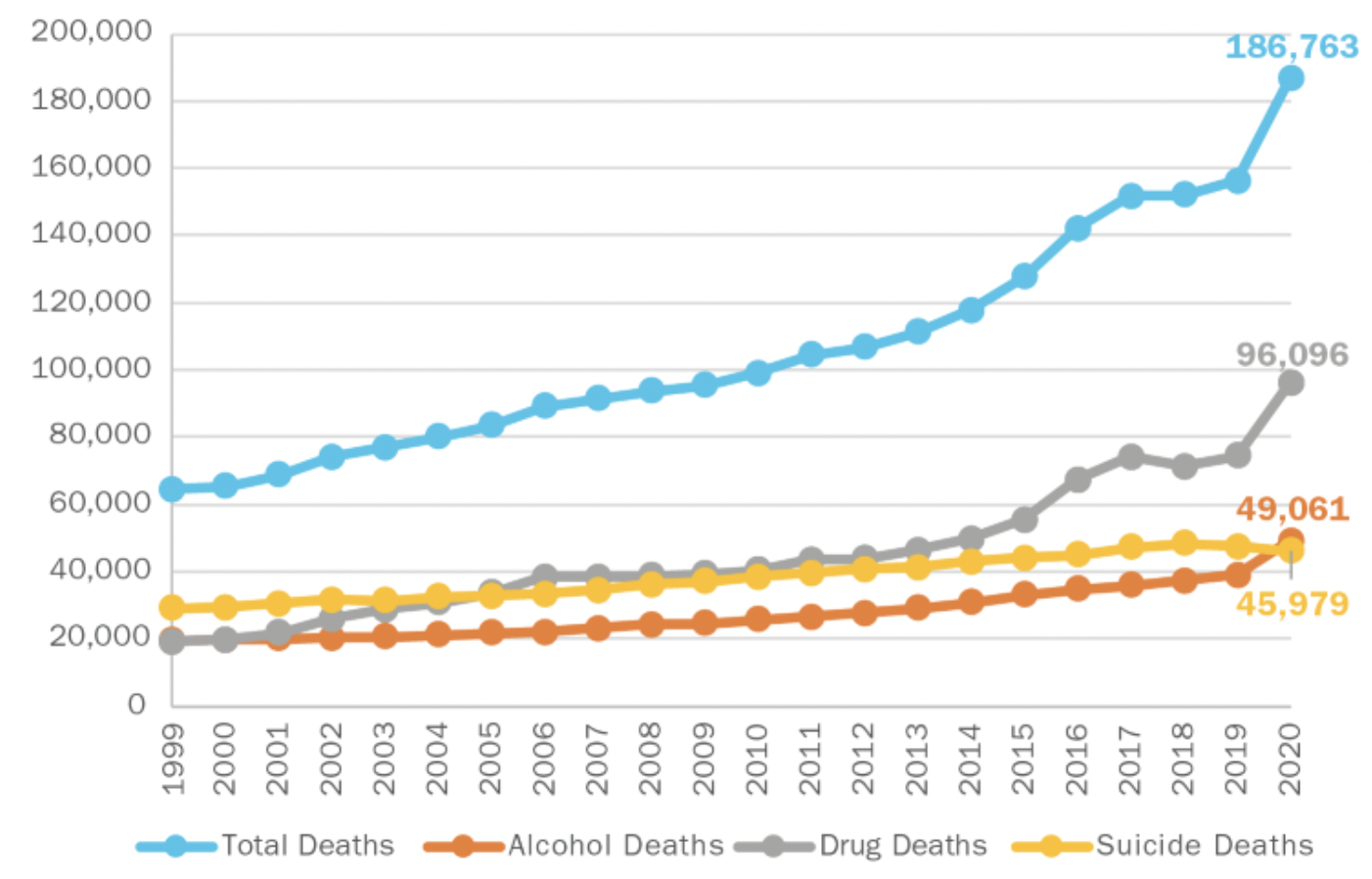
Annual deaths from alcohol, drugs and suicide in the United States, 1999-2020
(Chart by Trust for America's Health and Well Being Trust; click on the image to enlarge it.)

So-called deaths of despair—those related to alcohol, drugs, and suicide—hit an all-time high in 2020, claiming the lives of nearly 182,000 Americans, according to the Trust for America's Health and Well Being Trust. The 2020 total is 20 percent more than 2019, and mark the highest number of substance-misuse-related deaths recorded in any year; 2020 was dominated by the pandemic.

"While alcohol, drug, and suicide deaths have been increasing for decades, the 2020 increase was unprecedented and driven by a 30 percent increase in the rate of drug-induced deaths and a 27 percent increase in the rate of alcohol-induced deaths," Rhea Farberman and Amy Shields report for the Trust. "Combined rates of alcohol, drug, and suicide deaths increased in all 50 states except New Hampshire, and for the first time two states – West Virginia and New Mexico – surpassed 100 deaths per 100,000 state residents from alcohol, drugs, and suicide combined in a single year."

Synthetic opioids such as fentanyl and psychostimulants drove the increase in substance-misuse deaths. Rates for such deaths increased among all population groups except for people over age 75. People of color, youth aged 17 and under, and people 18-34 years old saw particularly high increases, as well as people who live in the South and West, the report says.

Fentanyl-related deaths have at least doubled in every state in the nation during the pandemic, and the report projects that such deaths will continue to rise. One big problem is that most people who overdose from fentanyl had no intention of taking it. Street drugs are often cut with fentanyl to stretch them further and make dealers more money, but the synthetic opioid is so potent that even adding a tiny bit more to a pill can be lethal. Teens often score fentanyl-laced drugs on social media.

The report calls for a comprehensive nationwide strategy that focuses on prevention, early identification of mitigating factors, harm reduction, and effective treatment.

Thursday, June 10, 2021

Public-health experts warn against conservatives' efforts to get local officials to shutter syringe-exchange programs

A large crowd watched commissioners in Scott County, Indiana, vote last week to end their rural county's syringe exchange by the end of the year, despite objections from public-health experts. (Photo from Louisville Courier Journal)

"Recent efforts to shutter needle exchanges in Republican-led areas could indicate renewed GOP backlash to the controversial programs aimed at preventing outbreaks of HIV and hepatitis, public health experts are increasingly warning," Dan Goldberg reports for Politico. "The pushback against needle exchanges, which allow people using drugs to receive clean syringes without fear of arrest, is happening at a perilous moment for the nation’s long-running drug epidemic. Overdose deaths over the past year have climbed to record levels, exacerbated by a pandemic that has pushed the drug crisis from the headlines. HIV outbreaks spurred by use of injectable drugs are also plaguing major American cities, and rates of hepatitis, which often spreads through injection drug use, were climbing before the Covid-19 pandemic."

Many Republican lawmakers say such "harm reduction programs" encourage addiction, but years of studies show they reduce infectious disease transmission rates and do not promote drug use. "Their opposition softened in the last decade as the opioid epidemic devastated communities and Trump pledged to defeat the crisis," Goldberg reports. "But public-health experts fear the country is witnessing the start of a broader Republican rebellion against these programs — one that’s partly fueled by anti-science backlash to Covid restrictions."

In Southern Indiana, Scott County commissioners voted 2-1 this month to close a syringe exchange that quelled an internationally recognized rural HIV outbreak in 2016. Commissioner Mike Jones said, “I know people who are alcoholics, and I don’t buy them a bottle of whiskey. And I know people who want to kill themselves, and I don't buy them a bullet for their gun.”

"Commissioners rejected pleas of local law enforcement, state officials and former Trump administration Surgeon General Jerome Adams in voting to shutter the exchange," reports Chris Kenning of the Louisville Courier Journal. "The move comes amid a nationwide increase in drug overdoses attributed to the pandemic, leading supporters to argue there could scarcely be a worse time to abandon the harm-reduction program serving a one-time epicenter of the U.S. opioid crisis."

Monday, April 08, 2019

Addict in recovery resumes writing column for Appalachian newspapers after relapsing and going into treatment

Lee's book
A recovering drug addict who writes a column for newspapers in Appalachian Kentucky and Tennessee, and published a book, has relapsed, gone back into treatment and resumed his column.

Phillip Lee's return column for the Clinton County News in Albany emphasizes the nature of addiction as a chronic, relapsing disease; the humanity of those suffering it, and the promise of treatment. Kentucky Health News has a report.

Friday, March 15, 2019

Experts: Obama administration didn't do enough to curb fentanyl epidemic, now leading cause of opioid deaths

Opioid deaths in the U.S. (Washington Post chart)
Deaths from the powerful synthetic opioid fentanyl have been skyrocketing since 2013, but experts say the Obama administration did not take the threat seriously despite warnings and a mounting death toll.

Eleven national health experts wrote a private letter to high-ranking Obama administration officials in May 2016, begging them to declare fentanyl a national public health emergency. That would have given the administration more funding, resources and flexibility in targeting the problem, but it didn't act, Scott Higham, Sari Horwitz and Katie Zezima report for The Washington Post.

"The decision was one in a series of missed opportunities, oversights and half-measures by federal officials who failed to grasp how quickly fentanyl was creating another — and far more fatal — wave of the opioid epidemic," the Post reports. "Fentanyl has played a key role in reducing the overall life expectancy for Americans. If current trends continue, the annual death toll from fentanyl will soon approach those from guns or traffic accidents."

The numbers are sobering: more than 67,000 people died of synthetic opioid-related overdoses between 2013 and 2017, most related to fentanyl. "In 2017, synthetic opioids were to blame for 28,869 out of the overall 47,600 opioid overdoses, a 46.4 percent increase over the previous year, when fentanyl became the leading cause of overdose deaths in America for the first time," the Post reports.

Part of the problem was that federal officials didn't realize fentanyl needed different strategies to fight it, rather than being lumped in with all anti-opioid efforts. It was also difficult to understand the current scope of the epidemic since Centers for Disease Control and Prevention data collection lags at least a year. Also, it was relatively easy for foreign countries like Mexico and China to sneak fentanyl into the country: U.S. Customs and Border Protection didn't have enough staff or equipment to catch fentanyl shipments, and until 2018, the U.S. Postal Service didn't require monitoring of international packages, the Post reports.

"This is a massive institutional failure, and I don’t think people have come to grips with it,” John P. Walters, chief of the White House Office of National Drug Control Policy between 2001 and 2009, told the Post. "This is like an absurd bad dream and we don’t know how to intervene or how to save lives." The Post package provides a comprehensive history of the issue and includes excellent multimedia features.

Wednesday, October 31, 2018

Feds release tools to help rural areas fight opioid epidemic

The federal government has created a resource to help rural communities find funding to fight the opioid epidemic. The Rural Opioid Federal Interagency Working Group created the Rural Resource Guide to Help Communities Address Substance Use Disorder and Opioid Misuse, "a first-of-its-kind, one-stop-shop for rural leaders looking for federal funding and partnership opportunities," the High Plains Journal reports. The Working Group is co-chaired by the U.S. Department of Agriculture and Office of National Drug Control Policy.

Rural areas have been particularly hard-hit by the opioid epidemic; the Centers for Disease Control and Prevention reported last year that death rates from drug overdoses in rural areas have surpassed rates in urban areas. And cash-strapped communities often have a hard time dealing with such a surge, and don't have the human resources to find and apply for grants that could help, the High Plains Journal reports.

The Rural Resource Guide is the second tool for fighting the opioid epidemic that the federal government has released this month. Earlier this month the Agriculture Department launched the Community Assessment Tool, an interactive database that helps community leaders figure out how and why the opioid epidemic is hurting their areas.

In addition to the USDA and Office of National Drug Control Policy, the working group that created the Rural Resource Guide had representatives from the departments of Commerce, Education, Health and Human Services, Housing, Justice, Labor, Transportation, and Veterans Affairs; the Corporation for National and Community Service; and the Appalachian Regional Commission.

Thursday, August 23, 2018

After rural opioid roundtables, USDA official sees need for creativity, use of assets, small actions that can turn big

Anne Hazlett
Since March, U.S. Department of Agriculture officials have held roundtables with state and local leaders in seven largely-rural states to learn more about the impact of the opioid epidemic. Assistant to the Secretary for Rural Development Anne Hazlett, who led these roundtables, spoke with Kay Temple of the The Rural Monitor about what she learned from the tour through Pennsylvania, Utah, Nevada, Kentucky, Oklahoma, Missouri and Maine.

"One key lesson is that an effective response in rural America takes creativity in harnessing existing community assets, and limited resources mean we have to get creative. For example, in the context of prevention, we can’t always just turn to school districts or sheriff’s deputies who already have strapped resources and are stretched thin," Hazlett told Temple. "What are the assets in a community that can be used as a platform for prevention? It’s the 'who': those who are already touching the lives of people living and working in rural America. When we take that creative lens, the sky is the limit in these rural areas. There are opportunities in churches, in the Cooperative Extension, in the Rotary, in the Lions Club."

Another thing Hazlett saw was how small actions can have a big impact in a way that wouldn't happen in a larger community. One example she saw was in Talbot County, Maryland: the county launched a campaign called "Talbot Goes Purple" in which community leaders and organizations partnered to use the color purple everywhere possible as a message of support to families hurt by substance abuse. Stigma is a powerful barrier to getting help in rural communities, but the campaign helped reduce that and let people know it's okay to get help, Temple reports.

Hazlett's final takeaway was that rural communities must become more prosperous to fight the opioid epidemic and keep people from becoming addicted. "This rural epidemic has been fueled by hopelessness and despair, stemming through lack of economic opportunity, feelings of isolation, and so to remedy that we can’t just look at prevention, treatment, and recovery," Hazlett said. "Rural leaders really need to double down on addressing some of these deeper, systemic issues in rural communities — things like lack of broadband and the need to improve the quality of life, develop the next generation of the workforce, drive innovation, and increase economic development." 

Hazlett acknowledged that rural broadband access is a critical ingredient in rural prosperity, and touted the USDA's $600 million broadband pilot program. The program has not yet been implemented, but is open to public comment until Sept. 10.

Thursday, November 30, 2017

DEA targets opioid abuse in Appalachia with new Louisville office to handle Ky., Tenn., W.Va.

The U.S. Drug Enforcement Administration is targeting the opioid epidemic in Appalachia by establishing a new field office in Louisville on Jan. 1. Louisville already has a district office, one of 222 across the country, but it and the rest of Kentucky were part of the Detroit division, while West Virginia was part of the Washington, D.C., division and Tennessee was part of the Atlanta division. DEA hopes a field office for the three states will better organize efforts to tackle a crisis that has hit Appalachia particularly hard.

"The Appalachian region has been ground zero for the opioid problem in recent years," Dylan Lovan notes for The Associated Press. "Overdose deaths were 65 percent higher among people in Appalachia than in the rest of the country in 2015, a recent Appalachian Regional Commission study found. The study, Appalachian Diseases of Despair, reported that nearly 70 percent of the overdose deaths in the Appalachian region in 2015 were caused by opioids. West Virginia had the highest opioid overdose mortality rates with 52.8 deaths per 100,000 people."

Attorney General Jeff Sessions said at a Nov. 29 press conference that this is the first restructuring of DEA's field offices since the creation of the El Paso Division in 1998. The Louisville office will have 150 positions with 90 special agents in the three states. D. Christopher Evans, an associate agent who helps lead the Detroit field office, will lead the Louisville office.
The old DEA divisions with field offices; click on the image to enlarge it. (DEA map)

Tuesday, November 28, 2017

Farm Bureau, Extension Service and FFA find ways to fight the opioid epidemic in rural Ohio

State officials, farm-oriented groups and private citizens are finding novel ways to attack the opioid epidemic in rural Ohio. These programs could work in other rural areas; overdose death rates are rising fastest in states with large rural populations like West Virginia, Kentucky and New Hampshire. "The CDC goes so far as to say that the combination of living in a rural area and having a low income is proven to increase your risk of prescription-opioid abuse and overdose," Karen Bernick reports for Successful Farming.

Ohio has been hit hard in recent years: It consistently ranks at the top of overdose-death statistics and had more than 4,100 deaths from overdoses in 2016, a 26 percent jump from 2015. Much of the state's opioid woes began with prescription "pill mills" that helped thousands become (or stay) addicted, Bernick notes.

Deterra pouches
Christmas-tree farmer Kathi Albertson began a Farm Bureau program in Guernsey County to prevent unused prescription opioids from circulating in the community. The idea came to her last year when she was prescribed Percocet after shoulder surgery. "I didn't want the pills sitting around my house," she told Bernick, so she shared her concerns with her pharmacist. He gave her a small plastic pouch called a Deterra Drug Deactivation System and told her to add water to it, shake it up, then throw it out. The pouch contains a charcoal-based material that neutralizes about 98 percent of the medication.

"The simple solution gave Albertson an idea to help prevent volumes of pills from circulating in her county," Bernick reports. "She worked with her local Farm Bureau to purchase 200 Deterra bags and they also obtained 1,000 more bags through a grant program by Mallinckrodt Pharmaceuticals. They enlisted a local anti-addiction organization called CHOICES to help get the word out they had bags available." They held pill-disposal drives and dropped off the bags to local organizations and businesses that could distribute them in the community.

Michele Specht, director for the Ohio Farm Bureau in four Eastern Ohio counties, began working on preventing addiction in rural youth last year. She and local Farm Bureaus brought photo booths to county fairs and other events where 4-H, Future Farmers of America and Farm Bureau youths gather, and encouraged the kids to take pictures with their advisers, teachers, friends, and parents. The youth were encouraged to tape the pictures to their dresser or bathroom mirror to remind them who they could turn to instead of drugs.

Theresa Ferrari, a 4-H Extension specialist in youth development and associate professor at Ohio State University, has been working on youth addiction awareness and prevention. She and 4-H leaders designed an educational booth county fairs with a medicine cabinet filled with pill bottles, each with a label with facts about addiction to remind people that it often starts in homes. "Looking into a bathroom mirror is a powerful image because this issue can affect anyone," Ferrari told Bernick. "No one wakes up in the morning and says, 'I think I’ll become a heroin addict,' but it often starts with a person standing over their bathroom sink."

Ferrari and Specht are on the planning committee of a statewide teen forum on the opioid epidemic called "Hope for Ohio" Dec. 2 at the Nationwide and Ohio Farm Bureau 4-H Center in Columbus.

Friday, August 04, 2017

Rural teachers fight opioid epidemic by using best-selling book Dreamland to teach about it

Scioto County, Ohio
(Wikipedia map)
Lawmakers and communities all over the country, especially in rural areas, are scrambling to find ways to combat the opioid epidemic. One teacher in southeast Ohio had a novel solution: teach high-school students about the crisis to forewarn and forearm them. When history teacher Cyndy Hykes read Sam Quinones' book Dreamland: The True Tale of America's Opioid Epidemic, which includes much reporting from their region, she immediately saw its potential as a cross-curricular teaching tool. "She thought it provided valuable insight about the outside forces shaping the opioid crisis in their community and explained why the author deemed Appalachia the canary in our societal coal mine for opioids," Martin Blank writes for The Huffington Post. Black is the director of the Coalition for Community Schools, based at the Institute for Educational Leadership.

In fall 2016, Hykes and an English teacher colleague, Judy Ellsesser, began teaching the material to students at South Webster Junior-Senior High, a school of 650 students in Scioto County. "During English class, Ellsesser worked through the text with the students, thinking critically about the information. Then with Hykes in history, the students learned more about the political side of the crisis and the policies affecting the epidemic; they also learned about how they could get involved. The math teacher, Matthew Whitt, was also involved. He helped students analyze and understand the statistical information in the book documenting opioid use and deaths," Black reports.

The teachers also brought in guest speakers such as a judge who spoke about the spike in foster care and babies born addicted, as well as current efforts to focus on rehabilitation instead of punishment for drug offenders. U.S. Rep. Bill Johnson and Sen. Rob Portman of Ohio talked to the kids about how politics and government affect the area's opioid epidemic, and encouraged students to speak up on issues to their representatives.

The students became heavily engaged in the project, creating public service announcements and volunteering at the local hospital to hold babies born with an addiction. The teachers report that the project was a success with high community support, and that they intend to teach it again. "It is real-life stuff that shows students how these things shape their life and how they can have a role in it," Hykes told Black.

Friday, May 12, 2017

Sessions seeks more 'severe penalties' for drug offenders, reversing Obama-era policy

Jeff Sessions Thursday at the University of
Charleston
(Gazette-Mail photo by Kenny Kemp)
Attorney General Jeff Sessions wants federal prosecutors to charge drug offenders "with the most serious, provable crimes carrying the most severe penalties," Sari Horwitz and Matt Zapotosky report for The Washington Post. There had been a push in recent years to direct some defendants towards treatment, rather than incarceration, or lesser sentences. Also, prisons in many states have struggled with overcrowding.

In 2013, then-Attorney General Eric H. Holder Jr. "instructed his prosecutors to avoid charging certain defendants with drug offenses that would trigger long mandatory minimum sentences," reports the Post. "Defendants who met a set of criteria such as not belonging to a large-scale drug trafficking organization, gang or cartel, qualified for lesser charges—and in turn less prison time—under Holder’s policy. But Sessions’s new charging policy, sent to more than 5,000 assistant U.S. attorneys, orders prosecutors to 'charge and purse the most serious, readily provable offense' and rescinds Holder’s policy immediately."

Sessions memo stated: "By definition, the most serious offenses are those that carry the most substantial guidelines sentence, including mandatory minimum sentences. There will be circumstances in which good judgment would lead a prosecutor to conclude that a strict application of the above charging policy is not warranted. In that case, prosecutors should carefully consider whether an exception may be justified.”

Sessions said on Thursday in West Virginia, which leads the nation in deaths from the disproportionately rural opioid epidemic, that the growing push to step away from intensifying criminal prosecution of drug criminals misses the point, Eric Eyre and Jake Zuckerman report for the Charleston Gazette-Mail. Sessions said, “They would say, which is pretty much true, ‘We can’t arrest our way out of this problem,’ and that is true, we can’t. But it is a big political part of it, and people should not diminish the power and effectiveness of good law enforcement. But prevention, I truly believe, is the greatest part of our challenge and, over time, prevention will be the most effective.”

Eyre and Zuckerman note that although Sessions advocated for drug abuse prevention, he was speaking at an event co-hosted by the Drug Enforcement Administration Community and the Anti-Drug Coalition of America, which is funded by the Office of National Drug Control Policy. Trump's budget would cut the office 95 percent.

Wednesday, May 10, 2017

Heart infection on the rise among intravenous drug users in Central Appalachia

Ohio Valley Resource graphic; click on it for large version
A rising number of intravenous drug users in Central Appalachia are contracting a form of heart infection called endocarditis that requires costly, repeated surgery, Mary Meehan reports for Ohio Valley Resource. The endocarditis rate has doubled in the past decade, leading to annual Medicaid spending on treatment of $700 million, according to the Centers for Disease Control and Prevention.

"Endocarditis is a result of bacteria accumulating around and infecting a heart valve. It can appear initially as mild, flu-like symptoms or chest pains and extreme discomfort," Meehan writes. "Emergency surgery to replace heart valves is required in the most extreme cases, but standard treatment involves weeks of sustained doses of antibiotics to make sure the infection is completely cleared."

The CDC says "addicts with endocarditis are 10 times more likely than other patients to die or require a second surgery months after initially leaving the hospital," Meehan writes. "Research has also shown that addicts tend to leave the hospital more often before the weeks-long series of antibiotics that is necessary to complete treatment. In many cases, the patients are in withdrawal from opiate addiction during treatment." Dr. Saritha Gomadam, an infectious disease specialist at the University of Kentucky, told Meehan, "The intense atmosphere of post-surgery care only amplifies the anxiety and pain of withdrawal from opiates."

Monday, May 08, 2017

States increase efforts to slow down deaths from opioids; fatality toll keeps rising

Sign in Frederick County, Maryland, where
 the landscape is mostly rural (Stateline photo)
States are increasing their efforts to curb opioid deaths, fatal overdoses, especially those involving fentanyl, after earlier measures have failed to stem increases, Christine Vestal reports for Stateline. Fentanyl killed 5,000 people in 2014, 10,000 in 2015, and data for 2016, which will be released in January, is expected to show another steep increase. Opioids have been a particular problem in rural areas, especially Appalachia.

Fentanyl continues to spread to more states, mainly because it's cheap and easy to produce, Vestal notes. It's also 50 times stronger than heroin and is often used with other drugs, such as heroin, to intensify the high. "Even in hard hit states that have been battling fentanyl for more than three years, the death toll continues to spike. Connecticut, Illinois, Maine, Massachusetts, New Hampshire, New York, Ohio, Tennessee, West Virginia and Rhode Island were among the states hit hard by fentanyl as early as 2013."

Some states are resorting to any means necessary to educate the public about the dangers of fentanyl, including billboards and radio and television advertisements, Vestal writes. "And standardized approaches to detecting the presence of the deadly drug and communicating its dangers—to drug users, people in treatment or recently released from prison or jail, and their friends, family and advocates—also are beginning to emerge."

Not much is working to slow down fentanyl overdose deaths, Vestal notes. Dr. Alex Walley, director of an addiction medicine fellowship at Boston Medical Center, told her, “What’s so concerning is that in Massachusetts, where, probably more than any other state, we’ve implemented all of the recommended strategies to address the opioid epidemic, overdose deaths are still surging, largely driven by fentanyl."

Vestal writes, "In general, the U.S. Department of Health and Human Services has recommended that states take three major steps to stem opioid overdose deaths: reduce unsafe prescribing of prescription painkillers, widely distribute the overdose rescue drug naloxone, and provide greater access to opioid-addiction treatment using medications approved by the U.S. Food and Drug Administration."

Thursday, May 04, 2017

Rise of drug-treatment centers brings Georgia traffic from out of state; new law will limit clinics

Georgia Gov. Nathan Deal said he will sign a bill today for stricter regulations of drug-treatment centers, which have been popping up in rural towns in the northwestern part of the state and are drawing large numbers of people from neighboring Tennessee, Ezra Kaplan reports from Ringgold for The Associated Press. The bill also limits the number of treatment centers that can open in a specific area. Georgia leads the South with the most drug treatment centers, at 71, two more than Florida, which has twice the population.

Relaxed rules in Georgia and stricter regulations in Tennessee have led to an increase in recent years of privately owned treatment centers in Georgia for heroin and prescription painkiller addicts, Kaplan reports. Data from the Georgia Department of Behavioral Health and Developmental Disabilities shows that last year one in five people treated at an opioid treatment center in Georgia came from out of state. In Northwest Georgia, which borders Chattanooga, two of three patients are from out of state.

Complaints from local residents led state Sen. Jeff Mullis, who represents much of the northwest, to lead a push this year "to pass a new set of statewide regulations on the industry," Kaplan writes. "The new rules will require programs to demonstrate a need for their services, similar to the certificate of need licensing program already used in Tennessee. Previously, open competition was really the only constraint on the number of clinics in Georgia. Mullis's bill also limits the number of centers that can open in newly established regions around the state. His region will already be at capacity as soon as the bill is signed." (Read more)