Showing posts with label accidents. Show all posts

Thursday, November 30, 2023

When this rancher was gored by a bison, ambulance telehealth helped save his life

Video systems on ambulances let medics get help from more
advanced providers. (Photo by Arielle Zionts, KFF HN)

When severe ranch injuries happen, having experienced medical care on hand can mean the difference between life and death. But in many cases, rural medics don't often treat life-threatening wounds. Some ingenious South Dakotans figured out how to overcome that dangerous knowledge gap.

"Rural medics who rescued rancher Jim Lutter after he was gored by a bison didn't have much experience handling such severe wounds," reports Arielle Zionts of KFF Health News. "But the medics did have a doctor looking over their shoulders inside the ambulance as they rushed Lutter to a hospital. The emergency medicine physician sat 140 miles away in a Sioux Falls, South Dakota, office building. She participated in the treatment via a video system recently installed in the ambulance."

Ed Konechne, a volunteer emergency medical technician with the Kimball Ambulance District, told Zionts, "I firmly believe that Jim had the best care anyone has ever received in the back of a basic life support ambulance." Zionts adds, "The ambulance service received its video system through an initiative from the South Dakota Department of Health. The project, Telemedicine in Motion, helps medics across the state, especially in rural areas."

The pandemic years helped Telehealth become more accepted, and the "technology is starting to spread to ambulances. Similar programs recently launched in regions of Texas and Minnesota, but South Dakota officials say their partnership with Avel eCare — a Sioux Falls-based telehealth company — appears to be the nation's only statewide effort," Zionts reports. "Rural medics often have less training and experience than their urban counterparts, Konechne said. Speaking with a more experienced provider via video gives him peace of mind, especially in uncommon situations. Konechne said the Kimball ambulance service sees only about three patients a year with injuries as bad as Jim Lutter's."

Katie DeJong was the emergency medicine physician at Avel eCare's telehealth center "who took the ambulance crew's video call," Zionts writes. "After speaking with the medics and viewing Lutter's injuries, she realized the rancher had life-threatening injuries, especially to his airway. . . . . DeJong called the emergency department at the hospital in Wessington Springs — 25 miles from Gann Valley — to let its staff know how to prepare. DeJong also arranged for a helicopter to fly Lutter from the rural hospital to a Sioux Falls medical center, where trauma specialists could treat his wounds."

To read more about Lutter's rescue or how South Dakota is funding its program, click here.

Monday, September 11, 2023

Overdose is now the No. 1 cause of death for people under 40 in most states. Street fentanyl is mostly to blame


In most states, the number of Americans under 40 who died from accidental drug overdoses has exceeded any other cause of death. "It's now the top cause in 37 states," a new Stateline analysis shows. Death rates for Americans under 40 "were up by nearly a third in 2021 over 2018, and last year were still 21% higher," reports Tim Henderson of Stateline. "Covid-19 was a small part of the increase, causing about 23,000 deaths total between 2018 and 2022 in the age group. . . . Vehicle accidents and suicide (about 96,000 each) and gun homicide (about 65,000) all took a cumulative toll from 2018 to 2022, according to a Stateline analysis of federal Centers for Disease Control and Prevention data. . . . Overdose deaths, however, took almost 177,000 lives in that time."

A lethal dose of fentanyl
(FDA fentanyl fact sheet photo)
The number of unintentional overdose deaths shows fentanyl's deadly presence in U.S. street drugs. The "fresh wave of overdose deaths is different from the first three," Henderson writes, . . ."driven by drugs spiked with powerful fentanyl." Daliah Heller, vice president of drug use initiatives at Vital Strategies, an international advocacy group that works on strengthening public health, told Henderson: "Somebody might think they're getting a Xanax [for anxiety], or methamphetamine or cocaine. . . They have no experience with opioids; it's not what they're expecting, and now they have a much higher risk of overdose and death." According to the Food and Drug Administration, fentanyl is approximately 100 times more potent than morphine and 50 times more potent than heroin.

To lessen fentanyl's impact, states "are responding with 'harm reduction' strategies that can include warning of the new danger of recreational drugs laced with deadly fentanyl, training and equipping people to counteract overdoses when they see them," Henderson explains. "Nationally, accidental overdoses dominated the increase in deaths in residents under 40 across racial and urban-rural divides, but many disparities exist. The increase in young overdose death rates was 154% for Black Americans, 122% for Hispanic residents and 37% for white people, yet even for white residents, they represented the largest increase. . . The largest urban areas saw increases in overdose death rates of 70%, and rural areas 64%—the largest increases in both areas for any cause of death."

Monday, April 17, 2023

Animal vs. vehicle usually ends badly; pilot program aims to build more wildlife crossings; 60% of funding to be rural

Photo by Travis Essinger, Unsplash
In animal vs. vehicle, animal rarely wins. "More than one million animals and 200 people are killed in wildlife-vehicle collisions every year, according to Department of Transportation estimates. The property damage from these collisions is estimated to cost $2 billion," reports Claire Carlson of The Daily Yonder. "The DOT announced a new pilot program that will allocate $350 million for wildlife crossing projects on roads, specifically in rural communities where vehicle collisions with animals are most common. . . . At least 60% of the funds must go to projects in rural areas. . . . Program administrators hope to target rural areas that have previously been overlooked during federally managed infrastructure projects."

While the funding is considered a positive start, "experts say a lot more work – and money – is needed to significantly decrease the number of animals killed on the nation's roads," Carlson adds. Dividing it among 50 states will lessen the impact. Mike Leahy, director of wildlife, hunting, and fishing policy for the National Wildlife Federation, told Carlson, "Rural states like Montana or West Virginia are high on the list of highest wildlife-vehicle collision state. And a lot of that is because you have cars moving pretty fast down two-lane or smaller highways where there's a lot of wildlife around, including big game that can be crossing the road at any time."

Carlson reports, "The area where animals can move around uninterrupted by roads has shrunk tremendously over the past century. For some animals, this has become a serious problem: In California, mountain lions whose territory is constricted by newer six-lane highways inbreed, causing health issues. . . .The agency's new wildlife crossings program is one of several initiatives to increase animal safety on roads. . . . The goal is to reduce habitat fragmentation that prevents animals from traveling throughout their natural environments, which should fight biodiversity loss."

"These efforts are a good step, according to Fraser Shilling, director of the Road Ecology Center at the University of California-Davis, but without addressing the other causes for wildlife mortality like threats from invasive species and disease, pollution, and climate change, biodiversity loss will continue," Carlson reports. "Habitat fragmentation is just one part of the problem, he said." Shilling told her, "[Wildlife] crossings… have an important ecological function in terms of restoration, but without taking care of the other things, they also have decreased utility."

"The $350 million will be released in segments, starting this year. Applicants have until August 1 to submit project proposals," Carlson adds. "Two more funding rounds will be opened in 2024 and 2025 before the program’s expiration in 2026." Leahy told her, “There’s a lot of demand out there already and a lot of excitement around the country within the states, with tribes, with conservationists. . . . I think the demand will probably exceed the level of funding…. I think there’s a good chance Congress renews the program after the pilot program expires.”

Monday, February 27, 2023

A Walmart parking lot pole in Maine has become famous. Why? Because drivers keep hitting it.

The Walmart pole in Auburn, Maine (Photos by Makayla Irene Roberts and Lexi Doak)

There's just no explaining why cats purr, what causes lightning strikes, and why drivers keep hitting this pole in a Walmart parking lot in Maine, reports Steve Annear of The Boston Globe. "One theory is that the bright yellow pole is secretly a magnet, using its powers to pull cars directly into a collision course. Others have suggested that the ordinary stop sign bollard would make a perfect plot for a Stephen King novel, given its location in his home state of Maine, about an object possessed by the spirit of a disgruntled driver seeking revenge."

True, the actual reason "people have repeatedly hit the notorious road marker are probably more mundane: poor design, distracted and impatient drivers, motorists miscalculating a turn," Annear opines. "But that’s poor fodder for the memes, jokes, and buzz surrounding the Pine Tree State’s newest — if unofficial — tourist attraction. . . .The pole stands in a parking lot near the front of a Walmart store in Auburn."

There's also no explaining the creative things humans do. "People are now driving to the sign, hopefully without incident, to take selfies with it. A 9-year-old girl went viral after asking her mother to make a pit stop at Walmart for her birthday and sharing a picture online," Annear adds. "Someone made a five-minute YouTube documentary about the history of the many collisions. And a Facebook group dutifully documenting the crashes, appropriately named 'The Auburn Walmart Pole Strikes Again,' has ballooned to more than 7,000 fans and followers."

Even in death, the pole gets attention. "The pole’s treacherous reputation even earned it a mention in a Maine woman’s obituary," Annear writes. "When Janet Morse died in 2021, her family didn’t ask for floral arrangements. Instead, friends were directed to 'donate to the removal of the notorious Auburn Walmart pole that has led to the needless destruction of countless vehicles.'”

Auburn Police Chief Jason Moen told Annear that police have responded to an astounding 130 crashes at the scene since 2020. And like many villains, "the infamous Walmart pole" has an accomplice. Moen said there is actually a second pole that has also been involved in crashes. Both are at the end of parking rows near the front of the store. Moen told Annear, "We’ve had cars roll on their side after hitting the pole, somehow one car ended up on top of the pole (we could never figure out how that one actually happened.) . . . Their magnetic pull is apparently too strong."

Annear continues, "The poles have been painted bright yellow, and surrounded by concrete barriers. According to News Center Mainebright red-and-white lights were added to the stop signs. . . . Some are skeptical it will help. Nothing seems to, after all. . . . Just a few days later, someone reportedly smashed into the Jersey barriers surrounding one of the poles. The pole itself, now capable of causing damage without sustaining it, appeared unharmed."

And finally, "A manager at the store contacted by the Globe said they couldn’t talk about the sign’s apparent powers of attraction," Annear added. "And referred a reporter to Walmart’s media relations team, which did not return a request for comment."

Wednesday, December 21, 2022

K.C. Star investigation lays out the dangers of railroads and their unwillingness to fix things without taxpayer money

Wreckage of Billy Barton's dump truck (Kansas City Star photo)
On June 27, 2022, an Amtrak train approached a crossing near Mendon, Missouri, pop. 271. The crossing was "like other crossings across the country; it had no gates or lights; brush along the tracks reduced visibility; and a steep approach could bottom-out a truck or trailer," reports The Kansas City Star. "On the tracks that day was a 2007 Kenworth dump truck driven by 54-year-old Billy Barton II of Brookfield, Missouri. . . . The high-speed collision killed Barton and three passengers on board the Amtrak and about 150 people were injured."

After the collision, the Star began investigating railroad safety, a major concern in rural areas. It found that many people had told railroad companies about dangers, and that the rail lines had refused to act unless improvements were funded by taxpayers. It also revealed:

Dangerous crossings: What happened near Mendon is not unique. Hundreds of unprotected crossings across the country have raised the fears of residents and been put on lists for safety improvements that, tragically, sometimes come too late. The Star spoke with families of victims. 

Blocked crossings cost lives: Trains don’t have to be in motion to cause deaths. States can’t limit how long a train can block motor vehicle and pedestrian traffic at public crossings, the courts have said. The results have been deadly for people like Gene Byrd, who died after a train blocked EMTs’ access to his Oklahoma house. The problem is only getting worse.

Workers endangered on the job: Railroad workers, in the news lately because of a possible strike, worry that changes in the industry are making their jobs even more dangerous. Companies have slashed their workforces and in their pursuit of profits have cut back on safety training and, employees say, equipment maintenance. Trains have gotten longer and crews smaller. Employees share their stories.

Worry about rail companies' merger: In towns up and down rail lines where a merged Kansas City Southern-Canadian Pacific Railroad would operate, residents fear the increased traffic and longer trains the deal would bring. The merger, which could come early next year, forever change the way of life in small towns like Camanche, Iowa, along the Mississippi River, the Star reports.

Monday, March 21, 2022

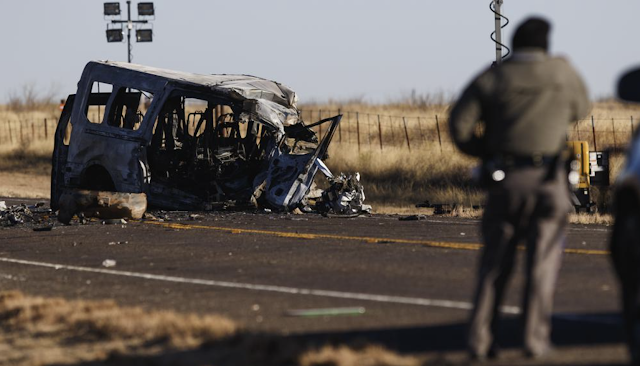
Deadly Texas crash with 13-year-old driver draws attention to rural custom of allowing young teens behind the wheel

Texas state troopers survey the wreckage from a fatal March 16 crash in west Texas caused by a 13-year-old driver. (Associated Press photo by Eli Hartman)

A deadly crash is drawing renewed attention to the common rural practice of allowing young teenagers and even younger children to drive. Nine people died in West Texas last week when a 13-year-old driving a pickup truck blew a tire and overcorrected, striking a van carrying members of the men's and women's golf teams of the University of the Southwest, a private Christian school in Hobbs, N.M. The teen and his 38-year-old father were killed, along with a golf coach and six students, Gene Johnson reports for The Associated Press. The crash occurred in Andrews County, about 30 miles east of the New Mexico border.

"At a news conference in Odessa, Texas, on Thursday, National Transportation Safety Board Vice Chairman Bruce Landsberg said the dangers of underage driving put it on the agency’s 'most-wanted list'," Johnson reports. "Along with drunk and distracted driving, Landsberg said 'youthful driving' and excessive speed on rural roads are among the problems that make highway driving the most dangerous form of transit in the United States."

In 2020 alone, drivers aged 13 and under were involved in 47 fatal crashes and 1,057 crashes that caused injuries, according to National Highway Traffic Safety Administration data. And though there aren't specific statistics on where such underage drivers live, rural roads are nearly twice as deadly overall: "In 2019, the fatality rate per 100 million vehicle miles traveled was 1.9 times higher in rural areas than in urban areas," Johnson reports. Put another way: nearly half the nation's traffic fatalities in 2019 happened on rural roads, though less than one-fifth of the population is rural.

There were other risk factors: The crash happened at night, on a road with a 75 mile-per-hour speed limit, the tire that blew was a spare not meant for high-speed use, and the driver was a teenage male—one of the highest-risk segments of the driving population, Johnson reports. Several people he interviewed recalled learning to drive on the family farm when they were as young as 10, but also said their parents emphasized safety and refused to let them to drive on public roads until they were legally allowed. One man observed that the road where the crash happened had heavy traffic from nearby oil fields, and said no 13-year-old should have been driving on it to begin with.

William Van Tassel, who manages the American Automobile Association's driver training programs, told Johnson that, while rural teens frequently start driving at a younger age than their suburban and urban peers, that doesn't mean they're ready to hit the highway: "When it comes to public roads, the laws are pretty clear: You can’t be out there until you’re legally eligible."

Thursday, December 09, 2021

Though traffic was down in 2020 due to the pandemic, deaths in auto accidents hit the highest number since 2007

Even as  pandemic restrictions drastically reduced traffic, 2020 saw 38,680 deaths on U.S. roadways, the most since 2007. Road fatalities were up in rural and metropolitan areas, on all types of roads, at all times of day, and in every age group of drivers, according to the most recent figures from the Transportation Department's National Highway Traffic Safety Administration.

"The latest evidence suggests that after decades of safety gains, the pandemic has made U.S. drivers more reckless — more likely to speed, drink or use drugs and leave their seatbelts unbuckled," Emily Baumgaertner and Russ Mitchell report for the Los Angeles Times. "The rise in motor vehicle deaths lines up with other pandemic-era trends: Alcohol sales have soared, drug overdoses have set new records, and homicides have seen their biggest increase on record."

Some researchers believe pandemic depression is the culprit, and note that car accident deaths for Black people were more than triple the overall death rate. The disparity "could reflect a deeper sense of despair in the poorer communities hit hardest by the pandemic," Baumgaertner and Mitchell report.

However, Shannon Frattaroli, a researcher at Johns Hopkins' Bloomberg School of Public Health, wondered if the disparity "was related to a disproportionate number of Black people in the essential workforce, including delivery drivers who are 'paid by how fast you can move'," Baumgaertner and Mitchell report.

Jonathan Adkins, director of the nonprofit Governors Highway Safety Association, told the Times the trend indicates "aggressive" and "very selfish" behavior. Many governors offices, he said, have told the organization that the increase in crashes is "a symptom and a sign of the overall lack of consideration we’re showing for other citizens, whether it be wearing masks, or not getting vaccinated, or how we drive."

Monday, July 05, 2021

Trump boat parades last summer resulted in injuries and accidents; some boaters want to organize more this summer

A 2020 rally at Lake Travis in Texas, where five boats capsized
(Photo by Bob Daemmerich)
Trump supporters across the nation staged many boat parades in lakes and rivers last summer, but law-enforcement officials, rally organizers and boaters say the events were often disorganized and a major source of boating accidents, Jose Pagliery reports for The Daily Beast. That could happen again this summer.

"In Tennessee alone, the state’s database shows that Trump flotillas made up a third of all 'congested water' accidents there last year," Pagliery reports. "National figures aren’t available that identify events as Trump flotillas, but a state-by-state review of incident reports in Minnesota, Wisconsin, Oklahoma, Oregon, and Texas showed that most accidents never made the news." 

It's been difficult to find information on Trump boat parade accidents because "some government agencies claim to be missing records of publicly reported disasters. One docked boat sank into the St. Croix River in Wisconsin during a Labor Day weekend parade there, according to the local CBS Minnesota station, but the state’s Natural Resources Department said it has no log of an incident there that day," Pagliery reports. "The vast majority of the parades we reviewed took place on dammed bodies of water managed by the U.S. Army Corps of Engineers, which issues permits. But it did not respond to questions or provide data."

Inexperienced or inattentive boaters were a big part of the problem, according to Rob Crafa, the waterfront director at the State University of New York’s Maritime College. "When you have boat parades like rallies, the energy there creates a different vibe," Crafa told Pagliery. "People standing in parts of the boat where they’re not supposed to, flags that may limit visibility for the operator of the boat, and if there’s loud music, bright sun, maybe alcohol involved … all these factors contributed to dangerous situations."

The choppiness of the water is another culprit, said George Birdwell, an investigator with Tennessee's Wildlife Resources Agency. "Big boats show up, and they try to go slow. But they’re still throwing a big wake, and small boats show up too, and they have to deal with those large wakes," he told Pagliery. That has caused injuries—some requiring hospitalization—and damage to boats. 

The boat parades, which President Trump reportedly loves, are still happening and may continue. Every Trump boater Pagliery interviewed said they're working on bringing them back.

Tuesday, June 01, 2021

Summer safety tips for rural children, at work or at home

This summer, many rural youngsters will be working on farms, caring for younger siblings, or just staying home alone as parents work. The Progressive Agriculture Foundation offers some health and safety tips:

  • Parents must establish safety rules and boundaries for children who are old enough to stay home alone. That includes being careful about what they share on social media, since posts may alert others that they're home alone.
  • Make sure teens who are babysitting younger siblings know what to do in an emergency.
  • Identify a trusted neighbor who can stop in periodically and check in on kids at home.
  • If children will be preparing meals while parents are away, make sure they understand how to safely use kitchen appliances such as the stove, the microwave, and knives. Adults should also make sure kids know how to prevent fires and burns and what to do if one should occur.
  • Kids also need to be reminded about the risks and safety precautions involved with farming equipment, how to appropriately use personal protective equipment while completing some tasks, and the importance of staying hydrated and taking breaks on hot days.
  • Adults should warn youth of the dangers of "cutting corners" to get a task finished more quickly, or looking at one's phone while working.
  • No matter what youth are doing outside, adults should remind them to wear sunscreen and reapply every two hours, or more often if swimming or sweating.
PAF runs a program called Safety Day, the largest rural health-and-safety program in North America. Click here to see if a Safety Day workshop is happening soon near you.

Monday, December 07, 2020

Less highway traffic in pandemic may have boosted rural car-wreck mortality rate by encouraging speeding

There were fewer traffic fatalities in 2020's second quarter than in 2019's, but that's because fewer vehicles were on the road during the pandemic. The traffic fatality rate, however, has increased. 

According to recent state and national data compiled by the National Highway Traffic Safety Administration, several factors contributed to the fatality-rate increase. "First, there is evidence of an increase in ejection rates among people who were in crashes, suggesting a decrease in the seat-belt use rate of vehicle occupants. This increase was heavily tilted toward males, people 18 to 34 years old, and people in rural areas," the report says. "Second, according to state data and other reports, speeding was more prevalent on the roads. The reduction in traffic volume coupled with community efforts to reduce law enforcement personnel exposure by implementing changes in law enforcement activity provided drivers a greater opportunity to speed."

Moreover, there is evidence of higher usage of alcohol and drugs such as marijuana and opioids among 2020 crash victims compared to those who died in 2019. Survey research indicates that this may be because many people have begun to use such substances or increased their use to cope with pandemic-related stress, the report says.

Wednesday, November 04, 2020

Difference in rural and urban mortality rates will be topic of Nov. 16 webinar

On Monday, Nov. 16, the Rural Health Information Hub will host a webinar with a panel of experts discussing National Center for Health Statistics research on rural-urban differences in mortality, including suicide, alcohol-related deaths, motor vehicle traffic deaths, and drug overdose deaths. the webinar will also feature insights from a program to reduce substance-use mortality in rural Pennsylvania.

The webinar will begin at 3 p.m. ET and will last about an hour. Admission is free, but registration is required. If you're unable to attend, a recording will be made available afterward. Click here for more information, including a list of featured speakers.

Tuesday, October 13, 2020

Harvest a particularly dangerous time of year for drivers on rural roads; follow safety tips

"Harvest is a high-risk time for crashes on public roads. The sun sets earlier each night and slow-moving farm equipment may not be well-marked or visible, sometimes lacking lights and reflective tape. Speed adds to the danger for motorists and farmers. Additionally, as ownership of agricultural land continues to consolidate, farmers are on the road more hours and driving equipment longer distances, towing implements and products between field and farmstead," according to the National Children's Center for Rural and Agricultural Health and Safety.

Farm equipment collisions with motor vehicles on public roads have caused at least 240 deaths and 135 non-fatal injuries since 2015, according to the AgInjuryNews.org database (which is thorough, but not exhaustive, so the total is likely higher).

Read here for tips on how to stay safe on the roads this time of year.

Thursday, August 06, 2020

Study: Surge in child ATV injuries likely linked to pandemic

An increase in all-terrain-vehicle injuries among children is likely linked to more of them being out of school during the pandemic, according to a study by the Injury Free Coalition for Kids.

Dr. Charles Jennissen, a pediatric emergency physician and University of Iowa professor who led the study, compared ATV injuries during the pandemic to a year ago. “Clearly, we are seeing more injuries, including of ATVs,” Jennissen told the National Children's Center for Rural and Agricultural Health and Safety. "Overall injuries are probably four to five times higher because many don’t go to the ER, he added. In the US, about 40,000 children under the age of 16 are treated in emergency departments for ATV-related injuries each year, according to the American Academy of Pediatrics."

For information about child ATV accidents in your area, check AgInjuryNews.org, a project launched by the NCCRAHS and the Marshfield Clinic Research Institute. The open-access online database catalogs agricultural injury reports, including ATV accidents, from news stories and other sources.

Part of the problem, Jennissen said, is that younger children are allowed to drive ATVs, even though the American Academy of Pediatrics recommends that only people ages 16 and older operate them. “More kids in the U.S. under 16 die from ATVs than bicycle crashes," Jennissen told NCCRAHS. "We talk a lot about bicycle safety for kids, but this is a bigger killer, and we need to protect our children."

Thursday, September 19, 2019

Deadliest rural N.Y. wrecks involve tractors, combines, etc.

In rural New York state, wrecks involving farm vehicles were five times more likely to be fatal than other collisions, and more severe overall in terms of injuries and number of vehicles, according to a newly published study by the New York Center for Agricultural Medicine and Health.

The researchers studied motor vehicle crash data from 2010 to 2012 from the state Department of Motor Vehicles, and were able to pick out agriculture-related crashes by selecting for vehicle registration type and vehicle body type. Of the 203 ag-related crashes, which involved 381 vehicles and 482 people, 91.6 percent caused property damage and 36% caused injury, according to the report.

"Accidents involving tractors and other ag-related equipment on rural roads occurred most often on straightaways with a grade, according to the data analyzed. Erika Scott, the center’s deputy director, speculates that this is due to motorists attempting to pass slower-moving tractors or agricultural machinery," The Altamont Enterprise reports.

Rural roads are overall more dangerous than suburban or urban roadways: though less than 20% of the population lives in rural areas, more than half of all fatal road accidents happen in rural areas. Perhaps related: "The Centers for Disease Control and Prevention data have shown that agriculture, forestry, and fishing as an occupational group has the third highest rate of work-related roadway crashes," the Enterprise reports.

Thursday, August 01, 2019

Pipeline that blew up, killing one, has exploded before; it remains a threat, says lawyer who settled suit with company


Lexington Herald-Leader drone video by Alex Slitz shows scene of Thursday's explosion

The natural-gas pipeline that blew up Thursday in Central Kentucky, killing one person and injuring several, has blown up several times -- and remains a threat to people living near it from Texas to New York, says a lawyer who negotiated a confidential settlement for a Pennsylvania woman injured in one blast, Valarie Honeycutt Spears and Beth Musgrave report for the Lexington Herald-Leader.

Alfred Miler of the Louisville Courier Journal reports that since 2011, the pipeline has has 29 "significant incidents," according to the federal Pipeline and Hazardous Materials Safety Administration. In 1985, an explosion on the line about 70 miles southwest killed five people.

The line, owned by Enbridge Inc., exploded Jan. 21 in Noble County, Ohio, injuring two and destroying two homes, the Herald-Leader reports, adding: "In 2016, an explosion at a Greensburg, Pa., on the [same] Texas Eastern Transmission pipeline burned one person and prompted evacuation of the area about 30 miles east of Pittsburgh." In 1986-87, the line blew up in three places in Kentucky in 10 months, and the last one, just a few miles from Thursday's blast site, "prompted revisions in federal operating regulations for all pipeline companies. . . . The probable cause of the explosion was corrosion. A federal investigation later showed the company had known for about five months that the line was badly corroded but failed to repair it."

Enbridge Inc. map via Lexington Herald-Leader
Minnesota lawyer Fred Pritzker, who represented the victim in the 2016 Pennsylvania case, "said in that case and many other pipeline failure incidents, corrosion is the problem," the Herald-Leader reports, quoting him: “With the rate of corrosion on this pipeline, there are many sections of the pipeline that are essentially a ticking time bomb. These pipelines are not supposed to suddenly blow apart. When they do blow apart, it’s usually because of internal and external corrosion which eats away at the pipe wall to the point where the pipeline is no longer capable of withstanding . . . the pressure and it basically just blows it apart, the gas rushes out and it’s ignited by a spark."

Enbridge spokesman Michael Barnes told the Herald-Leader that Enbridge has owned the pipeline since February 2017. "He said he was unaware of the problems that occurred more than 30 years ago but would look into the history," the paper reports. "Barnes said a variety of things can cause a pipeline rupture, including land moving because of rain. He said the investigations could take months."

Administration poised to relax truck driver safety rules; critics say deadly truck crashes up 40% since 2009

The Trump administration is expected to relax trucking safety rules that many drivers see as too restrictive, but safety advocates disagree and point to a sharp rise in deadly truck crashes in the past decade, Frank Morris reports for NPR.

The Federal Motor Carrier Safety Administration is expected to issue a notice that “will open a two month comment period on hours of service changes. Then the administration can move forward with new rules,” Morris reports. The agency is considering exceptions to the rule that caps driving time at 11 hours a day and requires at least 30 minutes of rest during that time. If the changes go through, the government would ease some regulations, including allowing drivers to break up their required sleep time.

Driver Michael Whitaker told Morris that tweaks in the regulations would make it easier for drivers to avoid rush-hour traffic. "We don't want to interact with cars during rush hour traffic. We want to stay as far away from you all as possible," he said.

Another driver, Carmen Anderson, said, “It's kind of like when you're in kindergarten and they're sitting there saying, OK, it's nap time. You have to take a nap.” Recalling a time when she was stranded in an industrial area, Anderson said she once spent 17 hours parked in a spot with no restrooms and no security because she had no flexibility in the regulations for hours of service.

Safety advocates disagree with the proposed changes. Dawn King, volunteer president of the Truck Safety Coalition, told Morris that the trucking industry has not produced data to show relaxed standards would increase safety. King said her father was killed by a tired trucker in 2004.

"We really should not be considering weakening the regulations we should be considering enhancing them," said Cathy Chase, president of Advocates for Highway and Auto Safety. "The safety of everyone traveling on our roads is at stake." Chase said deadly truck crashes are up 40 percent since 2009.

Thursday, January 17, 2019

New report shows rural-urban divide in speed-related traffic fatalities

GHSA chart; click to enlarge it
A new report from the Governors Highway Safety Association quantifies rural-urban differences in speed-related car crash deaths. Here are some of the highlights from Speeding Away from Zero: Rethinking a Forgotten Traffic Safety Challenge:

  • Speeding-related traffic fatalities account for about a third of all U.S. road deaths. In 2017 there were 9,717 speeding-related fatalities in the U.S. 
  • Speeding fatalities are associated with behaviors such as driving under the influence, not using a seatbelt, driving conditions, and the way the road is built/maintained.
  • Curvy roads--which are more common in rural areas--are a frequent factor in speeding-related crashes. A higher percentage of fatal curve-related crashes happen on rural roads.
  • Fatal speeding-related crashes happen most often on non-interstate roads in both rural and urban areas, but total fatality rates on rural roads are more than twice that of urban roads. 
  • Non-interstate rural roads have the highest incidence of speeding-related fatalities, which could be because of several factors: higher incidence of curved roads, higher speed limits, longer distances to drive with less traffic, less traffic enforcement, fewer traffic calming features (such as rumble strips), and fewer pedestrians and bicyclists. 
  • In 2016 there were 5,013 speeding related fatalities on all rural roadways compared to 4,660 on urban roadways (interstate and non-interstate).

Thursday, August 23, 2018

Volunteer firefighter says controlling traffic after a wreck can be scarier than fighting fires, gives tips for motorists

Firefighters and deputies clean off a road after an accident.
(Photo by Donna Kallmer)
Rural areas often depend on volunteer firefighters to battle the blazes spreading over the western and southern U.S. this summer, but that's not all they do. According to Donna Kallner in an essay for The Daily Yonder, she and her fellow rural volunteer firefighters also play a vital part in helping EMTs, sheriff's departments and professional firefighters respond to car wrecks. That includes not just cleaning up the roadway afterward so it's safe for traffic, but sometimes controlling traffic. That can be scarier than fighting a fire:

"Traffic control takes grit, whether you’re a Good Samaritan with an angel on your shoulder or a trained volunteer. Believe me, it’s scary out there. Folks who are good about pulling over for emergency vehicles running with lights and sirens can’t resist taking a quick peek as they drive past the scene of a wreck. They want to see what happened, what’s happening now, if anyone they know is involved. It’s human nature. But it’s scary to be on an accident scene trying to do your job when motorists are moving through with their heads on full swivel," Kallner writes. "It’s even scarier to be the person holding a sign on a pole a quarter mile away trying to stop traffic before it reaches a scene. You’d be surprised how many people don’t seem to notice the flashing lights, the high-visibility gear, or the person holding the sign who looks like he’s ready to dive for the ditch — which he is."

Kallner wants readers to keep three things in mind if they approach a roadside emergency, for the safety of first responders and drivers: First: there's often very little room to maneuver past a wreck on a country road, so drive carefully and watch for first responders and their vehicles. Second: resist the urge to rubberneck and pay attention to first responders' signs and directions to avoid getting into a secondary accident. Third: remember that the scene of a wreck is very loud, what with idling diesel trucks, sirens, and radios, so don't assume a first responder can hear your vehicle approaching.

"As a passing motorist, you have an important role on the scene," Kallner writes. "We need you to watch out for any and all unexpected movement, and be prepared to stop on a dime or move along briskly if you’re waved at to do so. We’re counting on you. And if you happen to be stopped by traffic control on a hot day and you happen to have a cold bottle of water or Gatorade handy, pass one out the window to the person doing the scariest and most thankless job. They like cookies, too."

Wednesday, April 18, 2018

Index of readiness for disasters and health emergencies has regional differences; report has detailed profiles for states

2018 National Health Security Preparedness Index
The Robert Wood Johnson Foundation's annual report on the nation's readiness to manage disasters, disease outbreaks and other health emergencies shows significant improvements over the past five years, but adds that "deep regional differences" persist.

“Five years of continuous gains in health security nationally is remarkable progress,” Glen Mays, who leads the research at the University of Kentucky in developing the index, said in a news release. “But achieving equal protection across the U.S. population remains a critical unmet priority.”

The 2018 National Health Security Preparedness Index found that overall, the U.S. scored a 7.1 on a 10-point scale for preparedness for 2017. That was nearly 3 percent higher than in 2016 and a gradual improvement of nearly 11 percent since 2013.

Eighteen states had preparedness levels that exceeded the national average, and 21 states were below the national average. Eleven states were more or less average. Maryland scored highest, at 8.0; Alaska and Nevada were lowest at 6.4.

The report gives a detailed health security profile for each state. The index analyzes 140 measures, such as the number of pediatricians, flu-vaccination rates, bridge safety and food and water safety, to calculate a composite score of health security for each state and the nation as a whole.

Suggestions from the report to to improve health security include: improving data sources and metrics; strengthening networks and coalitions; improving workforce policies, such as offering paid leave and health insurance; improving health-care delivery preparedness; assuring a dedicated and adequately resourced health-security emergency response is in place; assuring adequate funding for an established health security infrastructure; and flexibility in health-security funding.

Friday, February 02, 2018

Recent accidents prompt more debate about whether children should operate heavy farm equipment

Kholer Schachtschneider, 8, operates a skid steer on his family farm.
(New York Times photo by Alyssa Schukar)
Kids helping their parents on the family farm is an age-old tradition, but a string of grisly injuries has sparked intense discussion among farm safety groups and in rural communities about when and whether it's safe for children to operate or play near heavy equipment such as tractors or skid steers.

A child younger than 16 dies every three days in an agriculture-related accident, and lack of age restrictions on farm equipment are a key factor, according to the National Center for Rural Agriculture Health and Safety. That's a higher number of youth fatalities than in all other industries combined.

President Obama's administration proposed a law to keep kids from operating heavy equipment, but farmers and rural lawmakers decried the move as a nanny state overreach, though the proposal would have exempted children working on their parents' farms. Federal law says children of any age can do any job on their parents' farms at any time.

Farming parents say teaching their children the family business "is a way of passing on lessons about hard work, responsibility and the pulse of the land that their children will some day take over," Jack Healy reports for The New York Times. And with so many family farms barely making a profit, the whole family has to pitch in to help make ends meet.

But an accident can cause financial problems for farmers too, as it did for the Schachtschneider family when 6-year-old Cullen shredded his left leg in a skid steer last year. The Wisconsin family had to apply for a low-income health insurance program for him, and faces a mountain of bills. But Cullen's 9-year-old brother Maric and his 8-year-old brother Kholer are still driving the skid loader because the work still needs to be done.