Showing posts with label timber. Show all posts

Tuesday, April 28, 2026

Timber giant doubles down on AI expansion plans to maximize profits

Weyerhaeuser plants more than 190 seedlings a 
minute. (Photo by Steven Kamenar, Unsplash)
Weyerhaeuser plans to use AI to amplify its forestry knowledge, building forests with greater scientific accuracy to maximize tree harvests and profits with fewer employees.

With AI efficiencies, company executives aim to "boost annual profits by $1 billion — roughly double 2025’s — by the end of the decade, independent of any increase in lumber prices," reports Ryan Dezember of The Wall Street Journal.

The AI rollout may sound like a science fiction novel written by a tree farmer, but Weyerhaeuser has already launched AI initiatives that will create a digital version of its "timberlands" with the help of satellites and drones. Dezember explains, "It will let Weyerhaeuser know the size and species of each tree, and how far it is from others."

The digital map will help manage tree growth and planned thinning. Dezember reports, "Weyerhaeuser trained an AI model to pore over drone footage and calculate seedling survival rates," replacing work that foresters would normally do. "For a company that plants more than a $100 million seedlings a year, or 190 a minute, the savings add up."

Another initiative will deploy autonomous skidders that drag felled trees with the help of a remote-working employee. "It isn’t just skidders heading toward autonomy," Dezember writes, "The whole logging process — from feller-bunchers that cut and stack tree trunks to delimbers that shear off the branches — could be operated by one person on-site with remote help from others."

Friday, October 03, 2025

Iowa Trappists incorporate land stewardship and casket-making into their spiritual vocations

An aerial view of a creek flanked by prairie buffer owned by the
New Melleray Abbey. (Photo by (Nick Rohlman, The Gazette)

Trappist monks living at New Melleray Abbey in Peosta, Iowa, fulfill part of their vocation through land conservation efforts, such as dam and prairie restoration, working with timber and crafting sustainably made caskets," reports Olivia Cohen for the Gazette, which serves central-eastern Iowa.

The New Melleray property encompasses approximately 1,400-acres of land, which includes numerous creeks. The Abbey’s full-time forester, John Schroeder, and volunteers have made several dams that "mimic a natural beaver dam, slowing the water, tapping sediment and fostering a healthy wetland habitat," Cohen explains.

The monks have also built prairies "throughout the property, which act as a buffer for the nutrient runoff that comes from their neighbors, who farm the land with more traditional agricultural practices," Cohen adds. The prairies have brought ring-necked pheasants, turkey vultures and bald eagles back to the area.

The monks use the timber from their land to craft handmade caskets, which are shipped around the world. "Since its inception in 1999, Trappist Caskets has produced about 2,000 high-quality, handmade wooden caskets built from sustainably harvested wood from their forest each year," Cohen reports. Casket sales are the group's primary source of income.

Schroeder said that "forestry and monastery labor work well together because they are both 'focused on the long term,'" Cohen writes. "It 'makes forestry a natural fit for the Trappists.'"

Tuesday, July 29, 2025

Northwestern timber industry hopes to revive as Trump administration eyes tariffs, more logging in national forests

Northwestern timber looks for a comeback.
(Photo by Spurwing, Unsplash)
Despite decades of decline, the U.S. northwestern lumber industry is hoping that changes under the Trump administration will revive the industry. "Sawmills have been closing across the Pacific Northwest over the past 30 years," reports Ryan Dezember of The Wall Street Journal. "Owners of the remaining mills have high hopes that President Trump will deliver relief by increasing logging in national forests and raising trade protections against Canadian exports."

Historically, northwestern timber harvesting has been a boom or bust industry for more than a century, with the government stepping in at times to prevent overlogging. In 1994, President Bill Clinton helped pass the Northwest Forest Plan, which "reduced logging on federal lands. In practice, there has been even less logging than the plan prescribed," Dezember explains. "Owners of the remaining mills have high hopes that President Trump will deliver relief by increasing logging in national forests."

Along with harvesting restrictions, cheaper Canadian lumber imports added to the region's timber decline, which has the Trump administration considering timber tariffs. Even if those specific tariffs aren't levied, an ongoing trade dispute is expected to increase Canadian lumber duties to "more than double in the coming weeks to about 34% for most producers," Dezember explains. 

Location of Skamania County in 
Washington. (Wikipedia photo)
While the anticipated duties on Canadian timber or even additional tariffs on its imports can help the area's lumber companies over the next few months, changing federal logging restrictions will take time and planning. "Boosting the federal timber harvest could take years and be impeded by litigation and red tape," Dezember reports. "Regional Forest Service supervisors have been directed to map five-year plans to contribute to a 25% increase in the overall volume of timber harvested from national forests to satisfy Trump’s call for greater wood production."

The slow bleed of logging jobs from the region hasn't just meant lost incomes; it has translated into community budget cuts. Skamania County, Washington, serves as an example. The county is "80% federal forestland and a further 10% or so is controlled by the state," Dezember writes. "That means that the county earns tax revenue on most of its territory from timber receipts, which have slowed to a drip. Recent budget cuts forced the local school district to lay off teachers and close two of its four schools."

Friday, December 20, 2024

Southern timber owners could benefit from plan to create electricity and carbon credits by burning wood chips

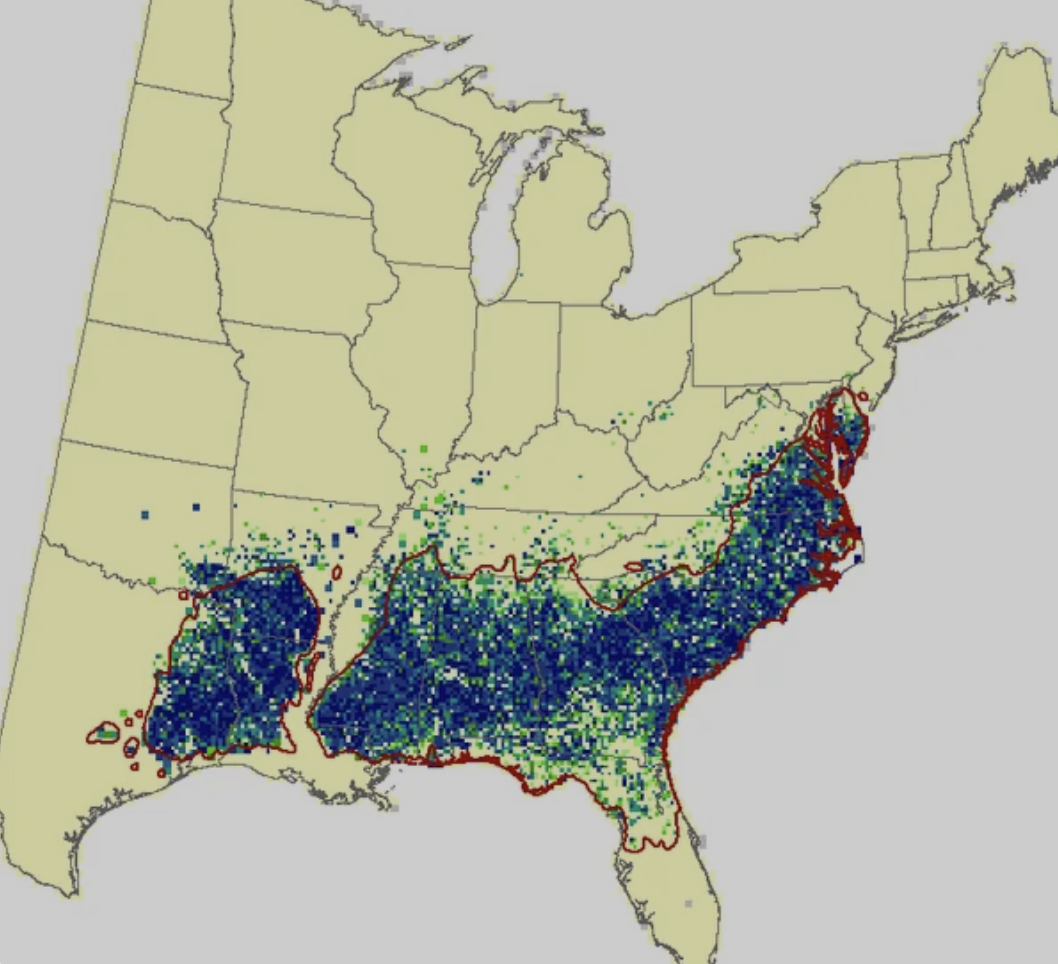
The U.S. Pine Belt is filled with fast-growing Loblolly
pines. (Reddit map)
 
United Kingdom power producer Drax is scouting locations in America's Pine Belt to "build electricity generators fueled by burning wood chips," reports Ryan Dezember of The Wall Street Journal. "The plants’ exhaust will be piped underground instead of out of smokestacks, which generates lucrative carbon credits for which Drax is already lining up buyers." The company plans to sell its electricity to data center companies looking to fuel their artificial intelligence operations.

The plan could be an economic game changer for the U.S. South "where pulp and paper mills have closed and left timber growers without buyers for those trees unfit for making lumber or poles," Dezember explains. "Biomass power has long been dangled before Southern timberland owners as a potential solution to the glut of pine that has depressed prices and complicated harvests."

Drax's UK facility "burns pellets of compressed sawdust in a converted coal-fueled power plant," which fuels roughly 5% of the country's electricity. It already runs several U.S. pellet mills that fuel its UK operation, Dezember writes. The planned U.S. plant will be a BECCS, short for bioenergy with carbon capture and storage. The company plans to provide 24/7 renewable energy for AI data centers.

Drax is pinpointing locations that have all the elements it needs, which include a "confluence of carbon dioxide pipelines, pine plantations and a short wait to connect to the grid," Dezember reports. "It has options on properties and expects to announce a location for the first plant in 2025."

The company has sought timber managers who will manage forests without stressing their ecosystems, and it "plans to buy wood only from properties managed for timber production, not old-growth stands," Dezember explains. "Nor will the plants need the wood to be ground down to dust and pressed into pellets, which are made to facilitate ocean shipping. The U.S. power plants will only need the wood chipped into small pieces."

Tuesday, May 28, 2024

More than 100 years of trying hasn't produced a reliable paper bottle. Why is it so challenging?

Inventing a reliable paper bottle has proved 'curiously
complicated.' (Adobe Stock photo)
The search for a non-leaking, carbonation-protecting paper bottle continues. "For more than a century, businesses have struggled to solve a curiously complicated challenge: How to make a paper bottle that doesn't get soggy and keeps drinks fresh. . . . Now they say they are the closest they have ever been," reports Saabira Chaudhuri of The Wall Street Journal. Diageo, Pernod Ricard and Procter & Gamble are "testing paper-bottle designs. . . (to) help their brands stand out on shelves, woo consumers concerned about plastic and cut carbon emissions associated with glass."

Creating a paper bottle has presented companies with a series of obstacles. For instance, they've had to use plastic liners to keep bottles from leaking. Also, paper-only bottles can fail to keep flavors "intact and stop fizzy drinks from going flat," Chaudhuri explains. Even though the public may prefer paper over plastic, "There isn't an all-paper bottle on the market. . . . Consumer-products companies are plowing ahead. . . . [seeking] a paper bottle that is easy to recycle, avoids fossil fuel-based plastic, and ultimately boosts sales."

Companies want to use paper bottles for everything from skin cream to drinks to fabric softeners, but the elusive all-paper container has yet to be invented. Currently, versions of almost-all-paper containers are being made for testing. Chaudhuri reports: "Test batches allow companies to determine the answers to the many unknowns. Will consumers mind if paper shampoo bottles are water-stained? How will paper impact supply chains when the bottles don't keep products fresh for as long as glass and plastic? Will drinkers miss the click of glass bottles when they cheer with them?"

For now, testing batches of almost-all-paper bottles contain a plastic liner, with some companies focusing on reducing the size of the liner. Chaudhuri writes, "Spirits maker Diageo sees paper bottles as a way to use less glass without diminishing the luxury aspect of its brands." Dave Lütkenhaus, Diageo's breakthrough innovation director, told Chaudhuri: "It has proved much more challenging than we anticipated to keep a complex liquid like whisky in paper. It's not just cracking one problem; we are trying to crack all these problems as they come along."

Bottle tops aren't made of paper, but companies are working on the challenge, too. "Paboco promised to use paper caps by 2023 but missed its deadline," Chaudhuri explains. "The obstacle: Paper fibers swell in moist conditions, meaning the caps weren't a reliable fit."

Tuesday, July 11, 2023

A town of 400 in the Southern Cascades buys surrounding forest for wildfire protection, tourism, and to set an example

100-year-old Douglas firs in the Butte Falls Community Forest
(Photo by Amanda Loman via Columbia Insight)
The small town of Butte Falls, Oregon, decided to purchase its surrounding timber -- not to sell it, but to create an older, more wildfire-protected forest that also serves as recreational tourist destination, reports Grant Stringer for Columbia Insight, a Pacific Northwest environmental news source. "With a population of just 400 people, Butte Falls is a speck in an ocean of remote timberland, much of it burned. . . . Conventional wisdom in the region would have Butte Falls try to reclaim its former glory as a logging hub. . . . But community leaders plan to protect their future by looking to the forest itself. . . . Locals want to grow an older and biodiverse forest that they say will better protect the town from wildfires while attracting outdoor tourism."

Butte Falls' town leadership is onto something. "Conservationists and the state's top politicos say the small project playing out in a remote corner of Pacific Northwest forest can teach other communities how to adapt to climate disasters and hard times," Stringer writes. "It's a strategy some environmentalists want to implement across U.S. forests to sequester carbon, promote biodiversity and blunt severe wildfires. . . . In the new Butte Falls Community Forest, local foresters could build a trail network and recreation amenities near a roaring waterfall to bring outdoor tourism to the town, providing incomes without relying on dwindling timber jobs."

Map by Mackenzie Miller, Columbia Insight
The idea for a community forest came to Linda Spencer following the 2018 Camp Fire that destroyed Paradise, Calif., 250 milkes south. The blaze was "a wake-up call for Spencer, who was the mayor of Butte Falls at the time. . . . When the Seattle-based timber giant Weyerhaeuser informed the Butte Falls City Hall of plans to clear-cut and sell the cleared parcels surrounding the town, likely to another timber company, Spencer jumped at the opportunity to create a community-owned forest instead. . . [she saw] the project as a way for the community to assert control of a resource that is critical to the town's future and the quality of its environment." Spencer told Stringer: "We didn't want someone else managing the forest around us. We wanted to manage it ourselves."

Stringer reports, "Climate science is unpopular in Butte Falls, which is staunchly conservative, says Mike Smeltz, a local forester. . . . But when a group of locals visited the new community forest on a recent Saturday, there was broad agreement that the climate is less hospitable for certain conifers than it once was. . . . . If Butte Falls can weather this fire season, Smeltz will lead efforts to thin the forest by cutting down young trees and dead limbs. . . . That will help the largest trees, including mighty ponderosa pines towering above the thicket, to continue flourishing. According to Smeltz, the town already secured $450,000 from the Oregon Department of Forestry and another $450,000 from the Federal Emergency Management Agency for this work."

Tuesday, April 18, 2023

Weyerhauser, our largest landowner, uses carbon offsets to boost its stock and real estate; logging practices remain

Weyerhaeuser Co. says trees in its Northern timberlands are harvested at 54 years of age, which on average
is 25 years older than fast-growing pine trees in the South. (Photo by Tristan Spinski, The Wall Street Journal)

Faster than any beaver, Weyerhaeuser Co. "has cut down more trees than any other American company . . . Environmentalists have long treated it as an enemy. . . . The new math of carbon emissions enables the lumber producer to cast itself as something quite different: a force for environmental good," reports Ryan Dezember of The Wall Street Journal in a story headlined, "America’s Most Prolific Logger Recasts Itself as Environmental Do-Gooder."

Weyerhauser's "10.6 million acres of U.S. timberland act as a giant sponge for carbon dioxide, which Weyerhaeuser says more than compensates for the greenhouse gases it emits by felling trees, sawing them into lumber and distributing wood products." The Arbor Day Foundation says that in one year, a mature tree will absorb more than 48 pounds of carbon dioxide from the atmosphere and release oxygen in exchange. With that in mind, even though "Weyerhaeuser plans to increase lumber production 5 percent in the next few years, it says its net carbon footprint is negative—so much so that it is offering carbon-dioxide storage capacity to other companies," Dezember writes.

Not everyone accepts Weyerhaeuser's calculations. "Corporate executives and scientists who have criticized the carbon-offset market say the offsets sold by timberland owners allow other companies to pay a relatively small price to avoid reducing their emissions," Dezember explains. "They also say forest-preservation pacts that produce offsets often don't substantially change logging practices, which means they essentially pay timberland owners for behaving as they would anyway. . . . Potential buyers have begun demanding that offsets represent actual reductions in planned tree-cutting, and sellers want higher prices to justify lost logging income."

To put the company in perspective, Dezember reports, "Weyerhaeuser is America's largest private landowner. . . . Altogether, its trees cover an area roughly twice the size of New Jersey. Weyerhaeuser says those trees remove about 14 million metric tons of carbon dioxide from the atmosphere each year. . . . Weyerhaeuser produces about 950,000 miles of lumber a year . . . . The company takes credit for an additional 11 million tons of carbon held in lumber ... which wouldn't be the case if a tree fell and decayed on the forest floor."

The company wants such good to increase its value. "A recent corporate reorganization at Weyerhaeuser created a 'Natural Climate Solutions' unit," Dezember reports. "Weyerhaeuser hopes its climate unit will persuade investors that its land—and its shares—should be valued higher and that it is an attractive stock for investors motivated by environmental concerns. . . . Albert Chu, a portfolio manager at Newton Investment Management who specializes in natural resources, said the firm's stock pickers are rethinking how they value timberlands and trees. He said carbon values will become a bigger part of the equation, but for now, decisions to invest in forestry stocks remain based on wood demand."

Dezember reports, "Jerry Franklin, professor emeritus at University of Washington's School of Environmental and Forest Sciences, reviewed Weyerhaeuser's carbon disclosures and said the company doesn't grow trees long enough to maximize carbon sequestration and that its single-species tree farms in the Northwest and South don't offer the same environmental benefits as natural forest ecosystems." Franklin told him, "What they would like to do is to be paid additionally for what they're doing already."

Friday, January 13, 2023

Born to chop and saw, he dissed it; now he aims to be king of lumberjacks in 'original extreme sport' sort of like golf

Jason Lentz (Photo by Natalie Ivis, The New York Times)
How can a man can fall into a life he never wanted? Jason Lentz didn't want the life of a competitive lumberjack when his family tried to thrust upon him: "He certainly fought against it," reports Reid Forgrave of The New York Times. "His father and his grandfather and his great-grandfather, who had worked the Great Depression-era logging camps in Oregon, were all elite lumberjacks. And Jason didn’t want to do it. In fact, he hated it."

Growing up in Webster County, West Virginia, Lentz saw how lumberjacking hurt his family: "Jason hated that lumberjacking took his dad [Mel] away for as many as 11 months a year, barnstorming the country and world in search of competitions and their measly winner’s checks. He could make $500 or $1,000 at a show, but the winnings didn’t amount to much when set beside the cost of equipment and travel," Forgrave writes. "For a time, Mel worked a lumberjack show at Sea World Ohio, while Jason, his mother and his little sister scraped by in West Virginia. Jason blamed the sport for his growing up poor — poor even by the standards of one of the poorest counties in one of America’s poorest states." Jason told the Times, "I didn't want to be anything like him."

Right out of high school Jason dissed lumberjacking and focused on basketball, Forgrave reports, but when his post-college overseas basketball opportunity vanished, Jason was poor and lost. "Then his father put him in touch with a friend who had a job for Jason doing lumberjack exhibitions at Chimelong Paradise, an amusement park in Guangzhou, China," Forgrave notes. "Reluctant to follow in his dad’s steps but out of options, he flew to the other side of the world. There, out from under Mel’s shadow, Jason Lentz was free to find his own path. It led him right back to his father."

In China and then around the world, Lentz found his place as powerhouse lumberjack, "That brute strength is the advantage that Lentz, who is roughly the size of an NFL tight end, holds over virtually all his opponents in the Stihl Timbersports Series, which are the biggest-money events in the sport," Forgave reports. Stihl series calls lumberjacking "the original extreme sport." And for those who may think it's all about brute strength, Forgrave explains: "Lentz and other lumberjacks often compare their sport to golf: Power comes from hip torque instead of arm strength; precision comes from producing a repeatable swing. As in golf, the difference between really good and a champion often depends on mental strength: being able to forget one bad swing and move on to the next."

Mel and Jason Lentz (Natalie Ivis, NYT)
Forgrave recounts Jason's progress and regress: "Lentz did not do well at the 2022 Stihl Timbersports U.S. Championships in Little Rock, Ark. In 2021, he established himself as the best lumberjack in the world, winning pretty much every big event, including his first Stihl world title (which his dad won six times). He has a plan for 2023. He plans to head to Australia in January, where he will spend a few months training. . . . . The Australia portion of his 2023 season will end in April at the Sydney Royal Easter Show, known as the 'Wimbledon of Woodchop.' He thinks he has a chance to win the single-buck title in Australia. Only one American has ever won that title in Sydney: Mel Lentz."

Jason Lentz, 37, told Forgrave, “It’s the maturity thing. It’s like golf. My next 10 years, 13 years — those are going to be my prime.”

Tuesday, January 10, 2023

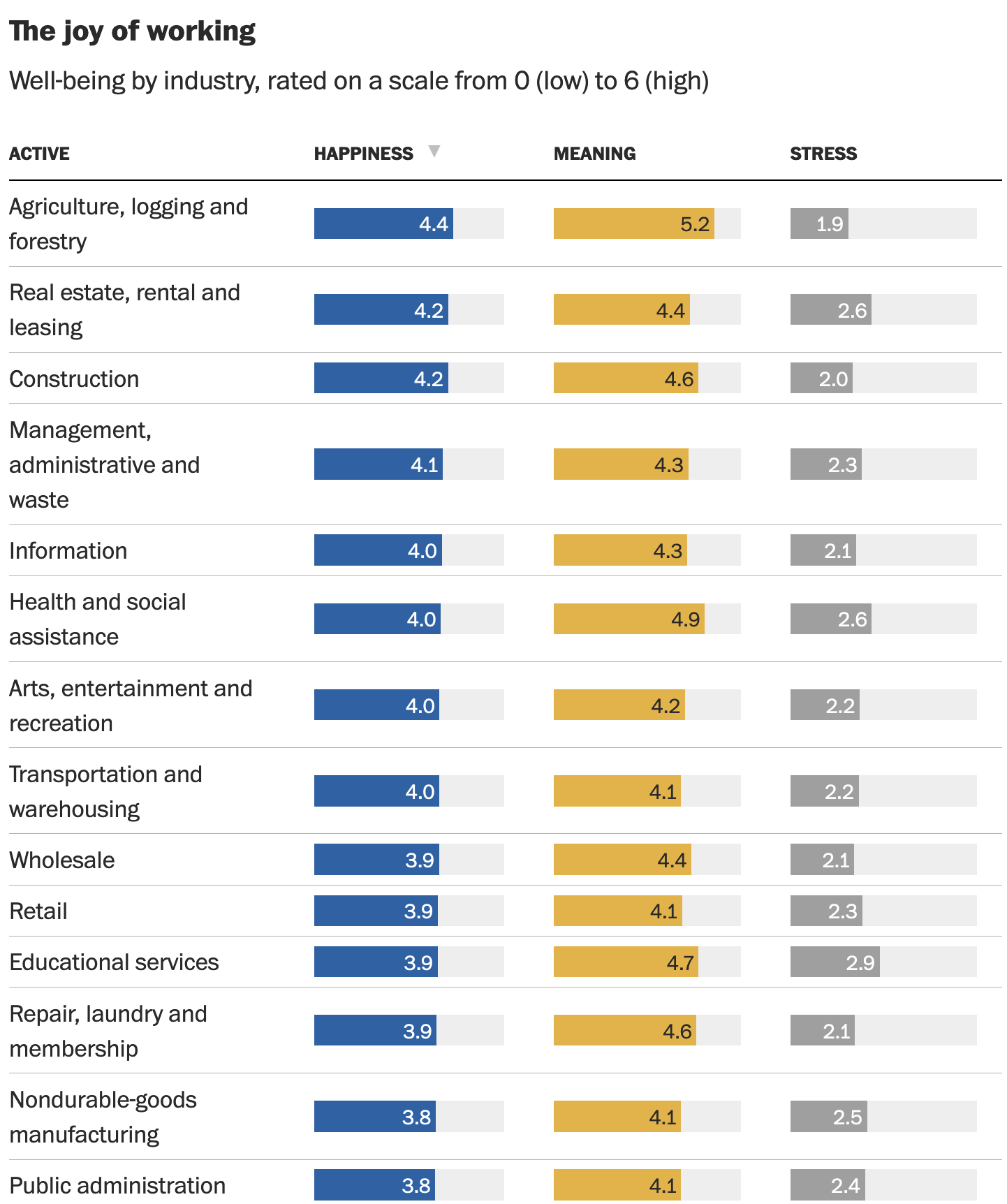
America's forests and its farms are where you find the nation's happiest, least stressful, most meaningful jobs

(Graph by The Washington Post, data from Bureau of Labor Statistics)
Naturalist and ecological thinker John Muir wrote, “The clearest way into the universe is through a forest wilderness.” A new analysis agrees: "Envy the lumberjacks, for they perform the happiest, most meaningful work on earth. Or at least they think they do. Farmers, too," writes Andrew Van Dam of The Washington Post. "Agriculture, logging and forestry have the highest levels of self-reported happiness — and lowest levels of self-reported stress — of any major industry category, according to our analysis of thousands of time journals from the Bureau of Labor Statistics’ American Time Use Survey."

Why would bonding with trees create joy? Van Dam explains: "Researchers across the social and medical sciences have found a strong link between mental health and green space or being outdoors. Even seeing a tree out your window can help you recover from illness faster. So imagine the boost you get from being right next to said tree — even if, like our friend the lumberjack, you’re in the process of chopping it down."

The Post's analysis compares being at work with being in nature: "We found that while your workplace looms as the single most stressful place in the universe," Van Dam writes. "The great outdoors ranks in the top three for both happiness and meaning — only your place of worship consistently rates higher."

Leslie Boby, whose work supports forest-focused outreach across 13 Southern states, told Van Dam that a forester's sense of fulfillment comes from more than being outside: "There’s a point where you are now planting trees that you are not going to see harvested. It speaks to something larger than yourself. … Your work is living on, and someone else will benefit from your efforts in a tangible way.”

Thursday, December 08, 2022

It's cardboard season; ever wonder where it all comes from?

A machine the size of a football field makes paper that becomes boxes. (Photo by Christopher Payne, The New York Times)
The people of Windsor, Wisconsin, pop. 8,000, rejoiced when the village's newsletter announced it would have a separate bin for cardboard recycling, all the more important when more Christmas gifts are bought online and shipped. But where does all that cardboard come from?

The corrugated-paper industry runs trees through a marathon of steps before a nifty box emerges, writes Matthew Shaer of The New York Times: "Before it was the cardboard on your doorstep, it was coarse brown paper, and before it was paper, it was a river of hot pulp, and before it was a river, it was a tree. Probably a Pinus taeda, or loblolly pine, a slender conifer native to the Southeastern United States." 

Shaer met up with Alex Singleton, a manager for International Paper, which produces a third of U.S. boxes. His mission "is to source enough loblollies to help keep IP’s production lines humming." He told Shaer, “You’re sort of always in a race. You learn to get creative.” Singleton manages a group of foresters who "spend much of their time zipping around the Southeast by pickup, using a proprietary smartphone app to monitor tracts of harvestable woodland," Shaer writes.

In the woodyard, the creation begins: "A crane was removing timber from a log truck and feeding it into the bladed mouth of a cylindrical machine known as a debarking drum. . . . It churned and chewed and spit the denuded trees from its rear end," Shaer writes. "Another masticating machine, this one a steel chipper. In went the debarked trees, out came a spray of loblolly pine. . . . chips from the woodyard were entering what’s known as the kraft process (the German word for 'strength')."

Shaer describes the 'paper machine,' which "stretched across almost the entire mill floor and trembled like a space shuttle just before liftoff. . . . Pulp sluiced in and cascaded onto the 'former,' where it was flattened into a paper-like consistency." There are more steps, and the end product is corrugated: "If you’ve stopped to look at an individual panel of corrugate and noticed its resemblance to a deli sandwich. There’s a top and a bottom, and between them is a bunch of ridged or diagonally reinforced filler called 'fluting.' That fluting is what gives a cardboard box its protective quality; without its flutes, corrugate wouldn’t be corrugate at all — it would just be containerboard."

The corrugated cardboard industry is booming, Shaer reports: "In 2021, Amazon shipped $470 billion of goods globally, in an estimated 7.7 billion packages." Happy unpacking!

Monday, August 29, 2022

Carbon market opening up for smaller forest landowmners

Forester Sarah Hall-Bagdonas talks with Sara Velazquez and Dan
Nelson. (Reuters photo by Carey Biron via The Daily Yonder)
Major rural landowners and philanthropies such as The Nature Conservancy are active players in the carbon market, which pays them for not cutting trees, which use carbon dioxide, the leading greenhouse gas. That's been more difficult for small landowners, but now the American Forest Foundation has a landowners with as little as 30 acres, and such programs are likely to be boosted by the climate bill recently signed by President Biden, reports Carey Biron for the Thomson Reuters Foundation.

Two landowners in the Family Forest Carbon Program are Sara Velasquez and Dan Nelson, who bought 55 acres of forest in northeast Pennsylvania to build their home. "Just after they purchased the land in 2019, however, the pandemic forced them both out of work, raising concerns about how to pay the annual taxes on the land," Biron reports. Neighbors who see logging as "free money up in the woods" asked them about that, but "Now they think they have found a different solution."

The credits that Velasquez and Nelson get under a 20-year contract for preventing "climate-changing emissions will in turn be sold to help corporations such as outdoor outfitter REI move toward their 'net zero' emissions goals," Biron writes. "Velazquez and Nelson, in turn, receive cash that helps them cover their tax payments, plan for revitalizing the forest and, for now, stay away from logging."

Private companies are also in the game. "NCX, which uses satellite imagery and artificial intelligence to gauge carbon-storage potential on small land holdings. It then sells carbon credits," Biron reports. "Since last year, the company has enrolled nearly 2,500 U.S. landowners who hold over 4 million acres, with a median size of around 200 to 400 acres per landowner, it said."

The climate bill has "$450 million to push private landowners toward forest-management practices with climate benefits, according to the nonprofit American Forests. The bill includes a particular focus on underserved communities and family forest owners," Biron notes.

Wednesday, October 13, 2021

Next week is National Forest Products Week; bourbon's one

Oct. 17-23 is National Forest Products Week, designated by Congress in 1960 as the third week of October as to recognize the value of American forests and the products they create. "It also acknowledges the value of woodlands, commitment to good stewardship and conservation practices," says a news release from the University of Kentucky, a state more heavily forested than most.

A forest product, imparting color and flavor (Distiller.com photo)
Forests provide timber, water, wildlife habitat, opportunities for recreational activities, take carbon dioxide from the atmosphere and add back oxygen. In Kentucky, "Forests provide white-oak wood for [charred] barrels, which impart 70 percent of the flavor and all of the color in bourbon," the release says, giving you a reason to observe National Forest Products Week that may not have occurred to you.

"We see it as a time to recognize and support how important forest and forest products are not to just our daily lives, but to our future," says ForestProud.org, which says it is "committed to making choices that keep forests as forests. . . . By offering renewable, sustainable, plant-based alternatives to plastics, concrete, and fossil fuels, forests and forest products provide some of the most innovative and powerful solutions we have to climate change. And we think that that is something worth supporting."

Friday, September 03, 2021

Quick hits: Meatpackers rely more on special-visa workers; pastor's book calls for different thinking about rural churches

Here's a roundup of stories with rural resonance; if you do or see similar work that should be shared on The Rural Blog, email heather.chapman@uky.edu.

A pastor's new book challenges readers to change the way they think about rural churches: "Look at the assets of rural churches and encourage congregations to build on them on their own terms, not on the terms imposed by others." Read more here.

Prison populations have long been used to artificially bump up rural population counts (which increases their political power and sometimes brings in more state and federal spending). Before the 2020 census, only two states (Maryland and New York) outlawed the practice. But now seven other states have joined them. That could have big implications as state legislatures begin redrawing political maps. Read more here.

A new fall foliage prediction map will help you plan your leaf-peeping. Read more here.

"It's been a slow death": Guests on CBS's "60 Minutes" describe cutting ties with parents and siblings over QAnon conspiracy theories. Read more here.

Meatpacking plants have long relied on immigrant labor. Now, some are turning to foreign workers with visas. Read more here.

From his porch in rural Missouri, a Congressional aide is helping interpreters escape Afghanistan. Read more here.

The Agriculture Department is giving up to $200 million in pandemic assistance to timber harvesters and haulers. Read more here.


Wednesday, June 23, 2021

Fed chair and other economists point to falling lumber prices as evidence that inflation isn't a big threat to the economy

Lumber prices skyrocketed over the past year, with futures exceeding $1,600 per thousand board feet in early May. "But since then, the prices of those same plywood sheets and pressure-treated planks have tumbled, as mills restarted or ramped up production and some customers put off their purchases until prices came down," Matt Phillips reports for The New York Times. Lumber futures "are down more than 45 percent from their peak, slipping below $1,000 for the first time in months. That’s still high — between 2009 and 2019, prices averaged less than $400 per thousand board feet — but the sell-off has been gaining momentum over the last few weeks. The price has fallen in 11 of the last 12 trading sessions, including a 0.5 percent drop to settle at $900.80 on Friday."

Federal Reserve Chair Jerome Powell and other economists say the lumber market illustrates why they're not worried about sustained price increases for other goods such as cars and groceries. Jan Hatzius, chief economist at Goldman Sachs, told Phillips: "Many of the extreme price spikes we’ve seen in recent months are likely to reverse for Econ 101 reasons."

The lumber market's cooling off "offers lessons that are likely to guide policymakers as they run the economy at full throttle, accepting what they regard as a temporary bout of inflation in hopes of generating more than 10 million new jobs," David Lynch reports for The Washington Post. "Lumber’s wild gyrations show that today’s hiring troubles and shipping delays reflect short-term reopening kinks, not a lasting shift that will push prices higher and higher."

Tuesday, May 18, 2021

High lumber prices lead to tree poaching in Canada and do-it-yourself sawmills in Alaska

Sky-high lumber prices during the pandemic have prompted creative responses — some of them illegal — among would-be builders. It may be happening in your area too.

The high prices have led some Alaskans to buy or build their own sawmills, Emily Schwing reports for Alaska Public Media. And on Vancouver Island in British Columbia, officials say at least 100 trees have been illegally cut down, Leyland Cecco reports for The Guardian in a story supported by the Society for Environmental Journalists.

Monday, April 12, 2021

High lumber prices, which stem mostly from the pandemic and a pest, aren't helping many timber cutters, landowners

Lumber prices have skyrocketed over the past year, due to scarcity caused by tariffs and a Canadian beetle infestation, but the higher prices aren't necessarily being passed on to timber producers. In the U.S., lumber costs 180 percent more right now than it did in April 2020, according to the National Association of Home Builders. The Federal Reserve Board says it's "the sharpest rise since 1946, when the post-World War II housing boom kicked in," David Brooks reports for the Concord Monitor.

The increase has in turn raised the cost of building the average single-family home by almost $24,000, and nearly 81,000 new homes across the U.S. are awaiting construction partly because of the cost of materials. Samanth Subramanian reports for Quartz.

The pandemic is largely to blame. "Early in 2020, sawmills first ground to a halt, anticipating a crash in demand. Then it turned out that people still wanted wood—to repair or renovate their homes during lockdown, or to build new homes outside cities," Subramanian reports. "Interest rates were, and continue to be, low; it was a good time to finance and construct new houses. So the sawmills started up again around July." But many mills had to shut down after employees were exposed to or sickened by the coronavirus, which in turn slowed lumber output and caused shortages.

The high prices have been "a boon for lumber mills, although the pandemic has complicated their ability to take advantage," Brooks reports. "But issues from the global supply chain to manpower limits to tree-species distribution means the benefit so far has been spotty at best, especially for landowners," at least in New England.

Part of the problem is that New Hampshire, and many parts of New England, are home to hardwood trees like cedar. The construction industry uses mostly fast-growing softwoods like pine, including pressure-treated softwoods that can resist rot. With pine in short supply, builders turned to cedar, but cedar mills are running at top capacity and it can take a year and a half to add significant processing capacity, according to industry consultant Eric Kinglsey. Many mill owners are hesitant to add such capacity, he told Brooks, because it may not pay off if the current boom fizzles out too quickly.

Canadian lumber once provided a pressure-relief valve, with the pine forests of British Columbia providing 15% to 17% of the lumber for U.S. markets. These days it's more like 10% or less, due to the mountain pine beetle. Cold winters once kept its population in check, but a warming climate allowed it to live longer and reproduce more quickly starting in the late 1990s, and the insect has destroyed hundreds of millions of acres of forest in British Columbia, Subramanian reports.

That capacity will take decades to rebuild, and the softwood tariff on Canada, which President Trump imposed in 2017, doesn't help matters, says the Wall Street Journal editorial board: "The Commerce Department cut the levy to 9% from 20% in December. But as long as the orders are in place, this lower rate—what importers are mandated to pay in 'duty'—is merely a cash deposit for what is due next year. Lumber buyers know Commerce can make a new finding of a higher duty, which would apply retroactively on Canadian lumber they have already imported. This backward-looking assignment of duties introduces enormous uncertainty, creating an incentive to rely on domestic supply."

In the meantime, the U.S. must find more wood somewhere. One option "is to import more lumber, particularly from Europe, which has stock in surplus," Subramanian reports. "Over the past five years, Austria, Germany and the Czech Republic have had to harvest nearly 250 million cubic meters of spruce damaged by another bark beetle infestation, this too brought on by the warming climate. Ironically, if one beetle has depressed wood supplies to the US, another may yet elevate it."

Thursday, March 25, 2021

USDA announces $12 billion agriculture aid program; aims to reach smaller producers overlooked in previous aid

The Agriculture Department has announced a program to distribute more than $12 billion to farmers from the relief-and-stimulus bill passed at the end of December. USDA said the Pandemic Assistance for Producers program is meant to "reach a broader set of producers" than previous pandemic aid has.

"Most of the nearly $24 billion in coronavirus aid during the Trump administration was funneled toward big farmers and major commodities. White farmers collected almost 97 percent of the cash in the first round, said the Environmental Working Group, based on a review of USDA data. Advocates for small farmers and producers who sell their crops and livestock locally also said they had been given short shrift," Chuck Abbott reports for the Food and Environment Reporting Network. "Along with dedicating at least $6 billion to new forms of coronavirus relief, USDA said it would put a greater emphasis on reaching out to small and socially disadvantaged producers, specialty crop and organic producers, and timber harvesters, among others." Click here for an in-depth breakdown of how the money will be apportioned.

Agriculture Secretary Tom Vilsack told Laura Reiley of The Washington Post that 0.1% of overall pandemic relief for agriculture went to Black farmers. "Of the 3.4 million farmers in the United States today, only 45,000 — 1.3% — are Black," Reiley writes, introducing an interview. "Vilsack said the Biden administration would be focused on closing those inequalities. USDA will battle three systemic problems concurrently, he said: a broken farm system, food insecurity and a health-care crisis." 

"Where statutory authority allows, the old programs will be refined," Natalina Sents reports for Successful Farming. "CFAP 2 sign-up will be reopened for at least 60 days beginning April 5, 2021. The [Farm Service Agency] has committed at least $2.5 million to improve outreach for this program and will partner with organizations to ensure socially disadvantaged communities are informed and aware of the application process."

Friday, March 05, 2021

Quick hits: Solutions needed for overdue utility bills; Maine 'hackathon' aims to boost rural economic recovery . . .

Here's a roundup of stories with rural resonance; if you do or see similar work that should be shared on The Rural Blog, email us at heather.chapman@uky.edu.

Abandoned oil wells are polluting air and groundwater; who's going to clean it up? Read more here.

Maine and six North Atlantic countries are hosting a 48-hour virtual brainstorming competition offering cash and business-development opportunities for big ideas related to rural economic recovery. Read more here.

Medicare Advantage enrollees living in rural areas are more than twice as likely to switch to traditional Medicare as urban dwellers, according to a new study. Read more here.

Commentary: As Americans, especially poor and people of color, struggle to pay water bills, solutions are past due—especially since utility shutoff moratoriums expire soon. Read more here.

A report from a nonprofit discusses how to attract young people to rural upstate New York (and, by extrapolation, many other areas with similar economies). Read more here.

Scientists are testing a novel treatment that could help fight citrus greening. Read more here.

A federal proposal to change how the federal government classifies metropolitan and nonmetropolitan counties could have big economic implications for rural America. Read more here.

Study: people who live near fracking wells are routinely exposed to harmful chemicals. Read more here.

U.S. agriculture faces new international trade challenges. Read more here.

Oregon's logging industry says it can't afford new taxes, but lumber prices and profits are soaring. Read more here.

Monday, January 18, 2021

On way out, feds make environmental rollbacks: cut spotted-owl habitat, opened conservation lands to development, etc.

A northern spotted owl chases a mouse in Oregon's Deschutes National Forest. (Don Ryan, The Associated Press)

"The Trump administration has gone on a spree of environmental rollbacks in its final days, loosening standards for equipment Americans use to heat their homes, reducing protected habitat for the northern spotted owl and opening conservation lands in California and Utah to development," report Juliet Eilperin of The Washington Post.

"Every president rushes to lock in his agenda before leaving office: Bill Clinton protected tens of millions of acres of national forest from logging just before stepping down, and Barack Obama finalized a slew of rules on everything from energy efficiency to the disposal of toxic waste by dental offices. But Trump has managed to usher through an unusually large number of energy and environmental policies in just a single term, according to a Washington Post analysis, and has finalized more than two dozen since he lost the election in November." Several will help fossil-fuel, logging and mining industries.

The moves set up a clash with the incoming administration of Joe Biden, the reporters write: "As the president-elect gears up to cut greenhouse-gas emissions and put more land off limits to development, his aides will have to spend months unwinding these policies unless congressional Democrats or federal judges overturn them."

Among other things in the past week, the administration has reduced critical habitation for the northern spotted owl, which faces extinction, by 3.4 million acres. "Fish and Wildlife Service officials determined last month that the Pacific Northwest’s iconic bird should be upgraded from threatened to endangered under the Endangered Species Act. But the agency declined to do that, citing resource constraints," the Post reports. Also, the administration overturned an Obama-era rule that required oil, gas and coal companies to pay more federal royalties; "and approved a four-lane highway through Utah’s Red Cliffs National Conservation Area, which had been permanently protected as a wildlife reserve 25 years ago."

Friday, January 15, 2021

Quick hits: minor-league baseball getting squeezed by majors; FCC seeks input on pandemic telehealth program

Here's a roundup of stories with rural resonance; if you do or see similar work that should be shared on The Rural Blog, email us at heather.chapman@uky.edu.

In an echo of rural-urban tensions, minor-league baseball teams are getting squeezed by their major-league counterparts. Read more here.

The myth of the "real American" stems partly from rural homogeneity, and it feeds the growing political rural-urban political polarization, writes a political educator and writer in an op-ed. Read more here.

New study, no surprise: Republicans who relied mostly on Trump for news are more concerned than other conservatives about election fraud. Read more here.

A former supervisor at a Western Kentucky coal mine has pleaded guilty to helping with a scheme to hide the threat of black-lung disease from federal safety inspectors. Read more here.

Rural communities in Oregon paid millions of dollars for clean, safe drinking water because the state didn’t protect their watersheds from logging-related contamination. Read more here.

A Michigan judge nullified a critical permit for an open-pit mining project that's been debated for nearly two decades. Read more here.

A free, online webinar series aims to help rural grocery store owners plan ahead so their store can stay open after they retire. Read more here.

The Federal Communications Commission seeks public input on administering the second round of its pandemic telehealth program. Read more here.

The Low Income Housing Tax Credit plays an outsized role in poverty-stricken rural areas, writes columnist. Read more here.

How will Joe Biden's Pentagon handle extreme right-wing news media? Read more here.