Showing posts with label corruption. Show all posts

Thursday, January 11, 2024

Finally Friday quick hits: America's last lighthouse keeper; no electricity bills; some good things just keep going

Sally Snowman was America's last lighthouse keeper.
(Photo by Seth Szilagyi, CBS Boston)
America's last lighthouse keeper has left her post, closing the door on an era," reports Emilee Coblentz of USA Today. "Sally Snowman, 72, became the guardian of the historic Boston Light, constructed in 1716, in 2002. She is its 70th keeper. 'The first 69 were all men,' she proudly told CBS News. . . . In a quick-changing society where technology is projected to replace many jobs across industries, the disappearance of one so rooted in our country's founding deserves pause."

If you hate paying your electric bill and like warm weather, you may want to consider relocating to Hunters Point, Florida where "no one pays an electricity bill," reports Nicolás Rivero of The Washington Post. "Hunters Point is the first residential development in the world to get a LEED Zero Energy certification, according to the U.S. Green Building Council, which means the entire community produces more electricity than it consumes.

The original cash register at Rock Dell Cooperative
Creamery (Photo by Noah Fish, AgWeek)
Nothing good lasts forever -- or does it? In Bryon, Minnesota, the Rock Dell Cooperative Creamery just turned 135 years old and is still buying milk. "Times are different today, and the creamery that was buying milk from producers across five counties in 1889 is now only buying milk from a single farm," reports Noah Fish of AgWeek. "The creamery is still owned by the patrons who sell milk or have equity in the business." The Creamery sells animal feed, cheese, ice cream and butter to loyal customers.

Chuttersnap photo, Unsplash
When it comes to its transition to green energy, the United States is on the proverbial struggle bus. "The U.S. is racing to overhaul how it powers its cars, trucks, buildings and industries. It has a long way to go," reports Shane Shifflett of The Wall Street Journal. "Wind and solar energy production are ramping up, but fossil fuels still provide a majority of the country's power." Shifflett provides five charts that show where the transition is now compared to the target goals.

Congress put billions of dollars into a program to help state and local governments build electric vehicle charging stations. However, getting the stations built will take much more than funding. "There's not nearly enough understanding from federal, state or local policymakers on how dysfunctional municipal permitting systems and utility connection processes are today," reports Catherine Geanuracos of Route Fifty. "For a program that's already been slow to launch, it's about to slam into systems that are already struggling, even before we need to dramatically ramp up capacity."
Image by Mariano Pascual, The Economist

How would you describe America's health care system? Bizarre? Infuriating? Dysfunctional? "The country spends about $4.3 (trillion) a year on keeping citizens in good nick [health]. . . twice as much as the average in other rich economies. And yet American adults live shorter lives, and American infants die more often than in similarly affluent places," reports The Economist. "Pharmaceutical firms and hospitals attract much of the public ire for the inflated costs. Much less attention is paid to a small number of middlemen who extract far bigger rents from the system's complexity." Want to know "Who profits most from America's baffling health care system?" Read here.

Monday, November 06, 2023

When it comes to the economy, many rural Americans feel left out of the conversation, study groups suggest

When it comes to the economy, rural Americans tend to
feel unheard. (The Daily Yonder photo)
When news outlets claim the U.S. economy has shown "surprising resilience" or robust job growth, their analysis often neglects rural Americans, leaving people feeling more marginalized and unheard, The Daily Yonder polling found. Daily Yonder Publisher Dee Davis outlines their research efforts and gives voice to some rural experiences and needs. Below is a condensed version of his commentary based on the polling and discussions with rural residents.

"For the last couple of years, we have been working with groups around the country to get a sense of what rural communities were feeling about the economy. Are country people hurting? Are they optimistic? Is it the same old up one day and down the next? As part of our research, we have commissioned polling, conducted eight focus groups in four states, and shared what we have found with policy professionals and political analysts. As the fog begins to lift, here is what I see.

"My uncle used to tell me he was too poor to pay attention. News that the economy is rip-roaring, with crashing unemployment and rising wages, is lost on most rural Americans we surveyed right now, even with those who say they are better off than before. The price of things — a gallon of gas, a dozen of eggs — has knocked rural communities off course and money is not what it used to be.

"And a measurable part of the rural population is pissed. They have had it with oil companies, drug makers, and distant corporations who care not a whit what country people are going through. Rural people are of two minds about government in that, one, they want it out of the way, and two, they want it to intervene to create new jobs in rural America.

The following are comments made by participants in the focus group sessions. "Focus group participant from Wisconsin: 'It's really difficult not to fall into the trap . . . where you really do start to internalize it and think 'Well I must be a failure, because I don't have what my parents had. I certainly don't have what my grandparents had.'. . . A participant from Kentucky: 'I'm in survival mode every day.'. . . Participant from Ohio: "I'm really worried about the kids because it's way worse than a lot of people realize. Like so many of them are depressed and anxious and don't know what to do. Losing hope, being suicidal. I mean children, like little children even, we are not even talking teenagers. And they need hope. They need to see something get better. Some reason to become an adult.'

"Our analysis of these rural focus groups showed us:
  • People want to share their stories and be heard, but they often feel ignored: misunderstood and maligned by the media.
  • People are struggling with loss — loss of status, wealth, a valued role — but they try not to give in to despair.
  • People will act out of hope in situations where they can receive and offer community support. Being of service to others is a valued purpose.
  • People in our groups want to push back against partisan politics and culture war rhetoric."

Go here to read the about the complete polling analysis.

Report: Former Meta employee says Instagram executives knew their platform hurt children. Now he's telling Congress.

Meta ignored its own research and continued business
as usual. (Image by Taylor Callery, WSJ)
Instagram executives knew their platform was dangerous to children and young adults, especially teen girls, long before whistleblowers came forward. "When a Meta security expert Arturo Bejar told Mark Zuckerberg that Instagram's approach to protecting teens wasn't working, the CEO didn't reply," reports Jeff Horwitz of The Wall Street Journal. "Now the former insider is set to tell Congress about the predatory behavior."

As an employee and a consultant, Bejar had a long history with Facebook, now Meta. He started with the company in 2009, and he left Facebook in 2015 for personal reasons. By then, Instagram was a powerful audience engagement arm for the company. When Bejar's 14-year-old daughter shared a vulgar Instagram posting she received, that's when "The trouble began," Horwitz writes. Bejar's daughter reported the comment to Instagram. "A few days later, the platform got back to her: The insult didn't violate its community guidelines."

"Bejar was floored — all the more so when he learned that virtually all of his daughter's friends had been subjected to similar harassment," Horwitz reports, "Instagram acted so rarely on reports of such behavior that the girls no longer bothered reporting them. Bejar began peppering his former colleagues at Facebook with questions about what they were doing to address such misbehavior. The company responded by offering him a two-year consulting gig."

Back on the company's campus, Bejar described its approach to addressing harassment complaints as almost entirely automated and "while users could still flag things that upset them, Meta shifted resources away from reviewing them," Horwitz explains. "To discourage users from filing reports, internal documents from 2019 show, Meta added steps to the reporting process. . . . statistics rules were written narrowly enough to ban only unambiguously vile material. Meta's rules didn't clearly prohibit adults from flooding the comments section on a teenager's posts with kiss emojis or posting pictures of kids in their underwear, inviting their followers to 'see more' in a private Facebook Messenger group."

Bejar was tasked with addressing some of these issues. His team "built a new questionnaire called BEEF, short for 'Bad Emotional Experience Feedback.' A recurring survey of issues 238,000 users had experienced over the past seven days, the effort identified problems with prevalence from the start: Users were 100 times more likely to tell Instagram they'd witnessed bullying in the last week than Meta's bullying-prevalence statistics indicated they should," Horwitz reports. "Among users under the age of 16, 26% recalled having a bad experience in the last week due to witnessing hostility against someone based on their race, religion or identity. More than a fifth felt worse about themselves after viewing others' posts, and 13% had experienced unwanted sexual advances in the past seven days."

Bejar was under a time crutch, "With just weeks left at the company, Bejar emailed Zuckerberg, Chief Operating Officer Sheryl Sandberg. . . . Blending the findings from BEEF with highly personal examples of how the company was letting down users like his own daughter," Horwitz notes. "In response to Bejar's email, Sandberg sent a note to Bejar only, not the other executives. . . . He says he never heard back from Zuckerberg."

Bejar left Meta in 2021. He told the Journal, that any effort to change Meta "would have to come from the outside. He began consulting with a coalition of state attorneys general who filed suit against the company, alleging that the company had built its products to maximize engagement at the expense of young users' physical and mental health," Horwitz adds. "Bejar also got in touch with members of Congress about where he believes the company's user-safety efforts fell short." He's scheduled to testify in front of a Senate subcommittee on Tuesday.

Thursday, November 02, 2023

As access to public records erodes, more records are deliberately concealed from the public

Successful efforts to obtain public records are
down 18%. (Photo by Wesley Tingey, Unsplash)
While Florida's change in public records access may be more dramatic than some, it marks "a steady erosion of public records laws in a number of states," report Katherine Barrett and Richard Greene of Route Fifty. "North Carolina’s budget bill, for example, recently included language that changes previous open records laws to exempt current and former legislators from any requirements to share documents they create while in office and to give lawmakers the power to decide whether a record should be made public, archived, destroyed or sold."

"The ability of people to get records that are supposed to be made publicly available has been 'deteriorating terribly,' according to David Cuillier, director of the Brechner Freedom of Information Project at the University of Florida," Route Fifty reports. "In fact, a nonprofit organization called MuckRock, which consults with people and organizations in their efforts to get public records, has found that about 10 years ago such efforts were successful about half the time. Today, that’s down to about 18%." Megan Rhyne, executive director of the Virginia Coalition for Open Government, told Route Fifty: "There has been a consistent move to conceal more and more records from the public. Some states have done so at a different rate than others, but we see this in many of them.”

The lack of access isn't limited to journalists "who have historically been able to serve as watchdogs over government by making Freedom of Information Act requests to get the documents necessary to fully report an article," Barrett and Greene write. “Though journalists often use FOIA, the majority of requesters are not reporters." Michael Morisy, co-founder and chief executive officer of MuckRock, told Route Fifty: “In many places, they are commercial requesters, like businesses that need information in order to make informed proposals for procurement. Then there are think tanks and universities."

Often referred to as "sunshine laws," most states have open records laws, but they can be weakened through exemptions. Barrett and Greene explain: "This has been the case in Florida, which long had a reputation as one of the most open states in the country. Its first sunshine laws were enacted in 1909, one of the first such pieces of legislation in the country. That law has been chipped away with increasing speed since the mid-1990s, and today it has about 1,200 exemptions and at least a dozen more are added almost every year. Of course, some of the exemptions, like access to individuals’ Social Security numbers, make good sense, but many are far more troublesome, like those protecting the governor’s past travel records."

Thursday, July 20, 2023

N.Y. Times and Mississippi's forever investigative reporter, Jerry Mitchell, spotlight a second sheriff's abusive record

Sheriff Eddie Scott is a popular and powerful public figure in Clay
County, Mississippi. (Photo by Rory Doyle, The New York Times)

A second Mississippi sheriff is under investigation for repeated acts of sexual harassment, coercion, and abuse of power.

In 11 years in office, Eddie Scott, sheriff of Clay County, "has repeatedly been accused of using the power of his position to harass women, coerce them into sex and retaliate against those who criticize him or allege abuse," report Ilyssa Daly of The New York Times and Jerry Mitchell of the Mississippi Center for Investigative Reporting, which has joined the nonprofit newsroom Mississippi Today

"In rural communities like Clay County — dominated by farmland and economic hardship — some sheriffs rule like kings. They can arrest anyone they choose, smear reputations and hand out reprieves and other favors," Daly and Mitchell write. "They have enormous latitude to hold people in jail as long as they please, and they answer to no one, typically facing little press or prosecutorial scrutiny."

The sheriffs' counties
Scott is not the first sheriff to be investigated by this team, a Times investigative fellow and Mississippi's leading investigative reporter for decades. They note, "Three months ago, the Times and Mississippi Today told the story of another sheriff's office less than 40 miles away. Former Noxubee County Sheriff Terry Grassaree rose in the ranks of his Mississippi department and kept his elected office for years despite similar accusations of abuse. He was voted out in 2019 and now faces federal charges of bribery. But in Clay County, Scott remains in power even after repeated allegations of misconduct."

Since 2012, multiple women have submitted court filings alleging Scott's coercion and harassment. No amount of evidence prompted court officials to open a serious investigation. Scott has pursued his victims at will and used his position to punish his accusers, the story reports: "At least five people who accused the sheriff of misconduct, or who were potential witnesses in the cases, said he had retaliated against them, efforts they believe were intended to silence them or discredit their allegations."

The pattern has continued, with a series of complaints in 2017, and in 2021, Caitlyn Wilson, a former Clay County investigative assistant, filed an Equal Employment Opportunity Commission complaint "that said Sheriff Scott had made sexual advances toward her and threatened to fire her after she rebuked him," Mitcell and Daly report. "She made reference to other women whose similar experiences had not yet been made public. . . . 'It appears to be well-known within the County that the Sheriff suffers from a sexual addiction,' her complaint said. The EEOC did not weigh in on the merits of Wilson's complaint, but determined she had the right to sue. Scott has yet to face any criminal charges. "

In 2021, the FBI opened an investigation. "They interviewed nearly a dozen witnesses, including Scott and staff members in his office. No charges have been filed," Daly and Mitchell write. Scott, 58, has professed his innocence. " He said he has had to defend his reputation from 'con artists' and 'drug users' who were inventing accusations to avoid jail time or somehow benefit financially."

Scott is a popular figure in Clay County. "On the 137-acre spread where his family once raised cows, he hosts fish fries and crawfish boils, where he swaps stories and swigs cold beer with fellow law enforcement officers and some of the county's most powerful officials," the story says.

Scott “believes that he will be vindicated and that voters will see through the allegations to re-elect him in the deciding Democratic primary election on Aug. 8. . . . He will leave office on his own terms, regardless of what becomes of the accusations against him. He said he believes the federal investigation is over." Scott told the Times: "I wasn't going to let a bunch of drug heads run me out of office."

Sunday, July 02, 2023

CBS spotlights Charleston newspaper's award-winning collaborations with smaller papers in South Carolina

Owner Pierre Manigault talks with Ted Koppel. (CBS image)
At a time when the nation is losing two newspapers a week, "Some papers are finding a new way forward," host Jane Pauley said in introducing special correspondent Ted Koppel's report on "CBS Sunday Morning" about The Post and Courier's award-winning collaborations with smaller newspapers in South Carolina.

Fourth-generation owner “Pierre Manigault is bucking the trend, hiring more staff, expanding digitally across the state and investing heavily, of all things in a state-of-the-art printing press,” Koppel reports. Manigault acknowledged that he's no longer publishing to make money, but to serve Charleston -- and the rest of South Carolina, where 10 papers stopped in the pandemic year of 2020: “It’s important to have not just a newspaper, but a very good newspaper.”

When The Post and Courier appealed to readers for donations to support its investigative journalism in 2020, it set a goal to get $100,000 in 100 days, but $500,000 came in. The total so far is $1.7 million. Special Projects Editor Glenn Smith and lead project reporter Tony Bartelme thought some of it could be used “to collaborate to everyone’s mutual benefit” around the state, Koppel reports.

Travis Jenkins speaks with Ted Koppel. (CBS image)
The first paper they approached was the Chester News and Reporter, edited by Travis Jenkins, who told Koppel, "We kind of pride ourselves on doing more deep-dig, heavy-lift investigative pieces that a lot of papers our size aren't able to do anymore: when a county supervisor's indicted for trafficking meth, the sheriff is indicted and removed on corruption charges, a councilman is removed from office by a judge for having a past criminal record he didn't disclose." Asked how he and reporter Brian Garner have time to do that, Jenkins replied, "It's difficult."

Enter The Post and Courier, which shared with Jenkins its investigation that led to the sheriff's indictment. The papers began collaborating, and “The pieces we shared were so much better for the collaboration,” Smith told Koppel. "I don't know some of these towns. I don't know anything about them. But these people do. Then why don't you take the best of both worlds, put 'em together? We all get good content, raise the alarm and hopefully make our state a better place." Bartelme said the project has been "a cululative effort that creates that culture of deterrence that prvents future misconduct."

Barbara Ball edits and delivers her newspaper. (CBS image)
The other example in Koppel's report is The Voice of Blythewood, owned by Barbara Ball. When school officials tried to charge her $300 for the superintendent's spending records, The Post and Courier offered to pay, and "They ended up just giving it to us when we got behind her," Smith said. "And got a really good story out of it." Ball said having a story on the Charleston paper's front page "substantitated that we're a good newspaper, that we turn out good work."

And her readers appreciate it. “I will get checks from people; I’ve gotten a thousand dollars,” Ball told Koppel. “I think most people realize that we don’t make a lot of money.”

The Post and Courier received a National Headliner Award for "Undercover," its collaborative series with 18 other papers that exposed government corruption and misconduct, but not everyone likes aggressive local newspapers. Jenkins recalled a note written by a reader who refused to subscribe, saying the News and Reporter was "the most up-in-everybody’s-bleeping-business bleeping newspaper I've ever seen." Jenkins said, "That's the best compliment anybody's ever paid us."

Manigault told Koppel that with advertising largely gone, “You have to go back to what the roots of journalism are, and that's content and information that people can't get anywhere else. . . . I think there’s a second life for newspapers. I think we'll survive this. It's an evolution. Newspapers just need to evolve to the new digital world and I think we're well on the way to doing that.”

Monday, May 08, 2023

Alabama produces three Pulitzer Prizes, including two by a news outlet that's now online-only, and a book of history

The winner of the Fiction prize,
Appalachia's first since 1958
Two online-only publications covering Alabama and Mississippi, including the states' rural areas, were among Monday's winners of Pulitzer Prizes in journalism. In prizes for books, one on a rural Alabama county won the prize for History, and the Fiction prize went to Barbara Kingsolver's latest book based in rural Appalachia.

The top Pulitzer, for Public Service, went to The Associated Press for its coverage of the besieged Ukrainian city of Mariupol, and the finalists were the Austin American Statesman for its coverage of the school massacre in Uvalde, Texas, and The Washington Post for its investigation of the fentanyl crisis. Perhaps indicating how close the Austin paper came to winning, the Uvalde shooting was mentioned among major news events in the script introducing the announcement of the prizes. 

The prize for Local Reporting was shared by two online-only publications: Mississippi Today, for Anna Wolfe's investigation that revealed how a governor steered millions of  "welfare dollars to benefit his family and friends, including NFL quarterback Brett Favre," and AL.com, for the series by John Archibald, Ashley Remkus, Ramsey Archibald (John's son) and Challen Stephens that revealed "how the police force in the town of Brookside preyed on residents to inflate revenue, coverage that prompted the resignation of the police chief, four new laws and a state audit," the announcement says.

AL.com is owned by the Newhouse family's Advance Publications, which stopped printing its newspapers in Birmigham, Mobile and Huntsville this year. It won another Pulitzer, for Commentary, Kyle Whitmire's  "measured and persuasive columns that document how Alabama's Confederate heritage still colors the present with racism and exclusion, told through tours of its first capital, its mansions and monuments – and through the history that has been omitted."

Barbour County (Wikipedia)
A book about a southeast Alabama county, Freedom’s Dominion: A Saga of White Resistance to Federal Power, by Jefferson Cowie of Vanderbilt University, won the History prize. The announcement said Barbour County, where George C. Wallace was born and raised, was "shaped by settler colonialism and slavery," and the book "illustrates the evolution of white supremacy by drawing powerful connections between anti-government and racist ideologies."

The Fiction prize was shared by Kingsolver for Demon Copperhead, "a masterful recasting of David Copperfield, narrated by an Appalachian boy whose wise, unwavering voice relates his encounters with poverty, addiction, institutional failures and moral collapse–and his efforts to conquer them," and Hernan Diaz for Trust, "a riveting novel set in a bygone America that explores family, wealth and ambition through linked narratives rendered in different literary styles, a complex examination of love and power in a country where capitalism is king." Kingsolver lives in southwest Virginia and grew up in Kentucky; her Fiction prize was the first to go to an Appalachian writer since James Agee of Knoxville won it for A Death in the Family in 1958, reports Lilly Knoepp of Blue Ridge Public Radio.

Race and ethnicity figured in other rural-oriented prizes. The Audio Reporting prize went to the staff of Gimlet Media, "notably Connie Walker, whose investigation into her father’s troubled past revealed a larger story of abuse of hundreds of Indigenous children at an Indian residential school in Canada, including other members of Walker’s extended family, a personal search for answers expertly blended with rigorous investigative reporting."

African American banjo and fiddle player Rhiannon Giddens, a native of North Carolina, and Michael Abels won the Music prize for "Omar," an opera "about enslaved people brought to North America from Muslim countries," the announcement says, adding that the work "respectfully represents African as well as African American traditions, expanding the language of the operatic form while conveying the humanity of those condemned to bondage." For the full list of prizes, click here.

Friday, November 18, 2022

Editor who backed him says Trump's remarks confuse his voters, but naming of special counsel could help them stick

Gary Abernathy on "PBS NewsHour" Friday
One of the few newspaper editors who endorsed Donald Trump for president in 2016 says Trump proved this week that even his base voters can no longer trust him. But with Trump now the target of a Justice Department special counsel, Gary Abernathy wonders if that challenge might redound to his benefit.

Abernathy, now retired but still living in southern Ohio, wrote in The Washington Post that part of Trump's base sticks with him because, as comedian Dave Chappelle said on NBC's "Saturday Night Live," he is "an honest liar." Abernathy said Chappelle meant that "Trump’s appeal was admitting to the 'commoners' that their suspicions about how the rich play the system were true. 'We’re doing everything that you think we are doing,' he paraphrased Trump as acknowledging, like an insider sharing trade secrets with the masses."

But recently, "Trump seems to be turning his gifts for gaming the system against his allies — something that’s beginning to dawn on his voters," Abernathy wrote, citing Trump's remarks about potential rivals, Govs. Ron DeSantis of Florida and Glenn Youngkin of Virginia while taking credit for their elections. "Trump voters are understandably confused. . . . If Trump will turn on his proteges, his followers are realizing, he’ll turn on any of his acolytes. Even his base can’t trust him now. The separation is happening fast. The divorce will follow."

Those words were published Wednesday. On Friday, Attorney General Merrick Garland named a special counsel to pick up the investigations of Trump, and Abernathy was asked on "PBS NewsHour" if Trump should keep running for president if he is charged with a crime. "I don't know," he said, "but if there's a way to bring Trump's base back to him just at a moment when it seem like maybe they have a reason to separate, this is the type of thing that seems to do just that."

Asked if Republicans will stand by Trump as as the probe moves forward, Abernathy said, "I don't think Republican leaders will coalesce so much behind him. . . . It just seems like anytime Trump comes under attack, the base just wraps itself around him again, like a wall of protection."

Sunday, October 23, 2022

As Media Literacy Week begins, consider this: U.S. sees mainstream media as more threat to democracy than Trump

By Al Cross
Director and Professor, Institute for Rural Journalism and Community Issues, University of Kentucky

This is Media Literacy Week, an observance established in 2015 to promote education in media literacy, which can be defined as an understanding of media, their role in society and the ability to analyze messages and the media outlets that produce them. It seems needed more than ever.

The latest evidence is The New York Times-Siena College poll of 792 registered voters Oct. 9-12. One of its main questions was, "Which comes closest to your views, even if neither is exactly right: American democracy is currently under threat, or American democracy is not currently under threat?"

The results: 74 percent said democracy is under threat and 20% said it isn't. Those who said it is under threat were asked, "What one or two words do you think summarize the current threat to democracy?" The leading response, from 13%, was "the government," "government corruption" and non-specific politicians or leaders; 10% said Donald Trump; 9% said societal divisions, political divisions or polarization; 6% or less named other politicians, political parties or movements such as nationalism, white nationalism or right-wing extremism, which collectively were named by 5%.

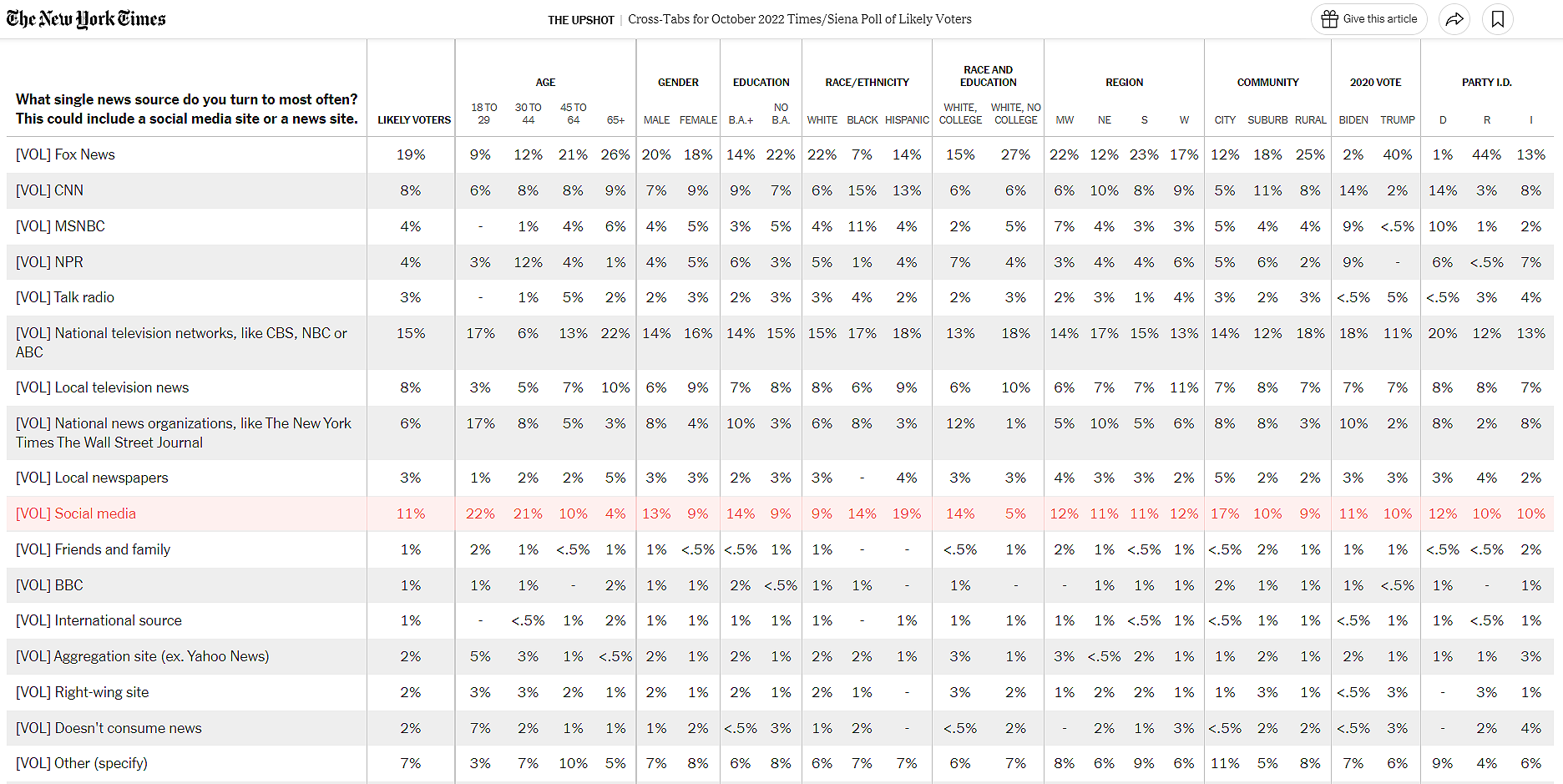
"The media" was named by less than half of 1%, but when asked, "Do you think each of the following is a major threat, minor threat or not a threat to democracy?" and given a list of choices, "the mainstream media" were identified as the leading major threat, by 59%; another 24% called them a minor threat, and only 16% said they are not a threat.

Rural Blog table, from New York Times-Siena College poll data
Perhaps those of us in the news media can take solace in the fact that hardly any voters first volunteered "media" as a threat, but media are not on top of voters' minds. When reminded of us, they reflect the concerns like those seen in the latest Gallup poll about trust and confidence in "the mass media, such as newspapers, TV and radio." It found that for the first time, a plurality of Americans say they have no confidence in the mass media "when it comes to reporting the news fully, accurately and fairly."

Rural news media might say, "This isn't about us," and to a limited extent that's true. A March poll of 1,000 adults for the National Newspaper Association, in ZIP codes where NNA members publish, asked "how much you trust" what various sources "say when it comes to learning about candidates for public office." On a scale of 1 to 10, local newspapers scored 7.38, TV stations 6.45, radio news 5.58, mail from candidates or parties 4.63 and social media 2.65. But how much do voters really discern among sources of information when they're not being asked questions about them? A lot less than we might hope, I suspect. Editors and publishers all over the nation have told me they're being tarred with the brushes that both ends of the political spectrum use to smear news media.

Notice I wrote "news media," not just "media," a distinction that too many news media fail to make (as well as failing to render the word as plural). In a saturated media environment, more and more people have difficulty distinguishing among types of media, and between fact and opinion, and news media need to remind them of some basic principles. It can be put pretty simply:

News media pay for journalism, which practices a discipline of verification; we tell you how we know something, or we attribute information to someone. We're mainly about fact, not opinion. Social media are mainly about opinion, not fact, and have little is any discipline or verification. Which do you trust?
Screenshot of New York Times-Siena College poll table, with social media line highlighted; to enlarge, click on it.

Wednesday, October 12, 2022

Kentucky newspaper offers $3,000 for proof of vote buying

A newspaper in an Eastern Kentucky county that has been notorious for vote buying is offering a cash reward of $3,000 for evidence of the illegal act. The weekly Salyersville Independent made the offer in a full-page ad last week.

"Owner Ritt Mortimer says it wasn’t a decision he came to lightly," reports Kelsey Souto of WKYT-TV in Lexington.

Mortimer told Souto, “It’s of my opinion that every election of my 51 years has involved vote buying in Magoffin County, either to a small or very large degree at times, depending on the races involved, the money, the other factors.”

Souto reports, "He says new technology is making it easier than ever to record video or audio that could be used to prosecute individuals. It’s his way of trying to protect democracy in his hometown, but it will take a committed effort from everyone."

Typically, votes in rural Kentucky are bought through use of mailed absentee ballots, and sometimes through machine absentee voting that can be subject to manipulation. Magoffin County has long been a leader in the use of absentee voting; in the 2010 primary election, 17 percent of the vote came from absentee ballots; 7.7% of the total came from mailed-in absentees. The statewide shares were 4.3% and 1.6%, respectively.

Friday, September 23, 2022

Quick hits: Earmarks return; flooded post offices may not; pipelines leak carcinogens; a monk unites a community . . .

The return of congressional earmarks, with more transparency, is a boon to the selected local governments and their citizens, Route Fifty reports.

Kentucky communities worry the July flood will make them lose their post offices, the Jackson-Breathitt County Times-Voice reports.

How a solitary monk, known for his soup, united a rural community, from The Washington Post.

"A rural doctor gave her all, then her heart broke," from The New York Times.

The Associated Press has a feature story on the Ojibwe of Minnesota harvesting wild rice, imperiled by climate change.

A former county clerk in northeast Arkansas was sentenced to 57 months in prison for stealing more than $1.5 million in the first six months of 2020. He's 34 years old and was already in state prison serving a 10-year term, The Jonesboro Sun reports.

The University of Kentucky has established a center to research medical use of cannabis, following a law passed after a medical-marijuana law couldn't pass the legislature. Read about it here.

A study called "first of its kind" documents carcinogenic emissions from gas pipelines. Read it here.

A rural Virginia county considers deeding a Confederate statue and its plot to a private group in order to fend off possible attempts to remove it, The Washington Post reports.

Tuesday, December 14, 2021

Investigation: S.C.'s poor ethical oversight has let small-town corruption flourish, especially in news deserts

This February, The Post and Courier partnered with dozens of smaller South Carolina newspapers for a yearlong project aimed at filling gaps in public accountability, especially those left by expanding local news deserts. The latest entry in the "Uncovered" series shows how the Charleston paper partnered with 17 community papers to expose how the state's inadequate ethical oversight system has allowed corruption to flourish in small towns, especially those with poor news coverage. Examples: 
  • A rural school superintendent had an expensive travel habit, spending thousands of dollars without the school board's permission on out-of-state trips with student groups.
  • Mysterious health problems made residents in Summerton afraid to drink the tap water. It turns out the local water tank was slowly filling with sludge because it hadn't been cleaned in years, and no one in charge noticed. A town council member's company was meant to be working on the system, but he didn't notify colleagues or publicly disclose his ties, and allegedly falsified logbooks and allowed equipment to fall into disrepair.
  • A convicted felon was improperly elected to city council, then kept collecting a salary and traveling using local government funding even after he had been suspended from office. His travels came at a time when the city could barely afford to cover payroll.

Tuesday, June 01, 2021

Stories for S.C. accountability journalism project uncover corruption, misspending in local governments

Two rural South Carolina dailies have exposed questionable local tax expenditures; the stories are the latest products of an investigative reporting partnership with The Post and Courier in Charleston and 16 rural newsrooms across the state. 

The first story digs into questionable spending by the Wagener fire department that has prompted investigations by county and state officials as well as federal scrutiny. As part of a larger investigation into the town's mismanagement of taxpayer money, the Aiken Standard "has uncovered hundreds of pages of records that shed fresh light on money issues that have roiled Wagener’s fire department and divided the town," Dede Biles reports for the Standard, which is owned by The Post and Courier. "The fire department dispute is just the latest in a string of controversies arising from the town’s finances in recent years. Among other things, the town has found itself on the defensive for failing to properly insure town hall, neglecting to pay Wagener’s federal taxes on time and improperly using state money intended for crime victims to shore up other budget holes."

The second story details how local officials charged with renovating a rural school "flouted South Carolina procurement law while awarding hundreds of thousands of dollars in work, keeping the public, potential contractors and even state regulators in the dark," Matthew Hensley reports for the Index-Journal in Greenwood.

The Post and Courier launched the "Uncovered" project in February, noting that expanding rural news deserts and weak ethics laws have allowed local-government corruption to go undetected.

Monday, June 29, 2020

Pennsylvania attorney general releases 'scathing' grand jury report on state fracking industry, regulatory industry

"Pennsylvania Attorney General Josh Shapiro on Thursday released a scathing grand jury report on the state’s Marcellus Shale natural gas industry that not only outlines health and safety issues caused by hydraulic fracturing, but also takes to task the chief agency in charge of enforcing regulations on the industry," Frank Kummer reports for The Philadelphia Inquirer.

At a press conference, Shapiro described a "revolving door relationship between the state’s Department of Environmental Protection and the industry, saying officials from the agency 'repeatedly failed to exercise their duties and responsibilities,'" Kummer reports. He characterized their relationship as "too cozy" and said DEP officials who testified to the grand jury were repeating fracking industry talking points. He also noted that an energy company hired seven former DEP employees from the same office.

"The grand jury report was the result of a two-year investigation that included 287 hours of testimony. It examined an industry that has drilled over 12,000 unconventional wells, as well as what the jurors called a 'chemical cover-up' that allows companies to keep secret complex chemical compounds used in the fracking process," Kummer reports.

A 2017 study linked low birth weight and other health problems for infants who lived near fracking wells. 

Thursday, March 26, 2020

Trump administration shielded Walmart from criminal prosecution over opioid prescriptions, investigation finds

A ProPublica investigation has found that top Department of Justice officials shielded Walmart from criminal prosecution in 2018 for allowing suspicious opioid prescriptions to be filled over the objections of thousands of Walmart pharmacists. This happened as the Trump administration told the public it would crack down on those responsible for the opioid epidemic, Jesse Eisinger and James Bandler report. Their blockbuster report is based on Walmart internal emails and documents, legal correspondence, and interviews with nine people familiar with the investigation.

Joe Brown, U.S. attorney for the Eastern District of Texas, and a team of employees including Heather Rattan, who has spent most of her career prosecuting drug cartels, began investigating Walmart in 2016. According to the evidence they gathered, Walmart pharmacists in Texas and other states reported hundreds of thousands of suspicious or inappropriate opioid prescriptions to their supervisors. They knew these opioids were being prescribed by "pill mill" doctors, and begged the corporate office to allow them to refuse to honor such prescriptions. Some of the doctors had been banned from sending prescriptions to all of Walmart's major competitors.

Walmart corporate officials didn't take broad action in response to these claims at the time, even though some customers who got those prescriptions died from overdose. The company said it could not cut off a doctor entirely, and that each prescription must be evaluated individually, the Texas prosecutors found. Some doctors were only banned after prosecutors began investigating Walmart, Eisinger and Bandler report. But pharmacists in some states had limited power to block individual doctors because of protective measures by state boards of pharmacy and medical boards.

The company appeared primarily concerned with the profitability of such opioid prescriptions: "An opioid compliance manager told an executive in an email, gathered during the inquiry and viewed by ProPublica, that Walmart’s focus should be on 'driving sales'," Eisinger and Bandler report.

It wasn't the first time Walmart had gotten in trouble for failing to vet opioid prescriptions; in 2011 the company entered into a secret settlement with the Drug Enforcement Administration in a similar case and promised to make greater efforts to curb improper filling of opioid prescriptions, admitting no wrongdoing. That settlement has not been previously reported. "Walmart had repeatedly run afoul of the Controlled Substances Act," Eisinger and Bandler report. " The company had received more than 50 'Letters of Admonition' from the DEA for its prescribing practices from 2000 to 2018, according to records obtained by ProPublica."

In 2018, Rattan, the federal prosecutor in East Texas, told Walmart she was going to indict it for violating the act, an unheard-of step against a Fortune 500 company, for failing to properly track and report suspicious opioid prescriptions.   Walmart had admitted to mistakes and appeared open to a civil settlement, but stopped cooperating with prosecutors in mid-2018. Through law firm Jones Day, which has deep ties throughout the government, Walmart "added a Trumpian tactic: At a moment when the president had established a habit of attacking the investigators in his own government, the company followed a similarly aggressive approach," Eisinger and Bandler report. "Walmart lawyers complained to Washington about the Texas prosecutors, accusing them of seeking to 'embarrass' the company while using the threat of criminal charges to extort a larger civil fine. Criminal and civil investigations can run in parallel, but it’s an ethical violation for prosecutors to use the threat of criminal penalties to generate a higher civil settlement."

A Walmart lawyer also said in a letter to a Justice Department official that criminally convicting Walmart could harm millions of senior citizens and low-income people who rely on federal programs for food and medicine, since a convicted corporation might be barred from participating in such programs. As prosecutors continued their chase, "Walmart exercised its PR and political muscle," Eisinger and Bandler report: In May 2018, the company announced it would limit first-time opioid prescriptions to no more than a seven-day supply.

Walmart got high-ranking Justice employees to intervene, and the department informed Walmart that it would decline to prosecute. The prosecutors didn't give up, and in October 2018 got a sympathetic ear from acting DEA Director Uttam Dhillon. They all headed to Main Justice to meet with Deputy Attorney General Rod Rosenstein. He refused to revive the criminal case, and suggested prosecution of individual employees. But Justice blocked that too, and Trump appointees in the department consistently sided with Walmart when the team filed a civil case, Eisinger and Bandler report. One of the Texas prosecutors resigned in protest in October 2019.

Tuesday, January 21, 2020

Paper's investigation nails rural S.C. sheriff on corruption

A South Carolina grand jury recently indicted a rural sheriff on a series of charges related to corruption, some of which mirror the findings from an investigative report last year by The Post and Courier in Charleston.

The Post and Courier's investigation is an increasingly rare example of the kind of watchdog reporting by metropolitan papers in surrounding rural areas. The paper also produced an outstanding multimedia piece in December about a deadly prison riot in rural South Carolina.

Monday, September 16, 2019

Tribal journalists severely limited in freedom of press

American Indian Media Today graphic; click on to enlarge.
Journalists on many Native American reservations face severe limits in freedom of the press, since tribal governments own (and many exert considerable control over) 72% of tribal newspapers and radio stations. The problem is even worse since there is often no other media outlet that covers local news, including government accountability reporting.

"As past president of the Native American Journalist’s Association, I witnessed many of my colleagues working for tribal press who were fired for performing even the basic journalistic duties such as publishing the tribal police blotter," Mary Annette Pember reports for The Daily Yonder. "One colleague was fired for reporting that a tribal council member was arrested for drunk driving; the editor was also fired for allowing her to report the fact."

Because tribes are sovereign nations, they're not governed by laws that guarantee American reporters access to open records or freedom of the press; many choose not to enact such laws for their tribal press, and those that have such laws sometimes don't abide by them, Pember writes. Tribal journalists who get stonewalled don't have much recourse, since tribes are immune to judicial proceedings without their consent or a Congressional waiver.

"Although the Indian Civil Rights Act of 1968 guarantees tribal citizens a free press immune from government influence, tribal governments' control of media’s purse strings acts as a potent deterrent to journalists looking to report the truth," Pember writes. Tribal newspapers might have more freedom from repercussions if they were financially independent, but some tribal leaders have found ways to retaliate or keep control of papers through withholding advertising. Since reservations are often remote, the tribal government can be a major customer and losing its ads could devastate a paper's bottom line.

Still, financial independence is possible, as the Navajo Times proves. Tom Arviso worked hard to help make it that way; when the paper was owned by the tribe, Arviso got fired for reporting on corruption within the tribal leadership, Pember writes. In 2004, the Times achieved independence from the tribe, and still publishes today.

Indian Country Today is another source of independent tribal news, but on a national level. The publication shut down in September 2017 because of financial pressures but rebooted in February 2018 with Mark Trahant of the Shoshone Bannock tribe as the editor. "Native people are eager for Indian Country Today’s survival for the simple reason that we desperately need authentic, informed coverage of Indian Country," Pember writes.

Thursday, April 25, 2019

Column: W.Va. town suffered after paper closed and local officials weren't held accountable during flood recovery

Andy Prutsok
Andy Prutsok, publisher of the Miles City Star in Montana, wrote a column recently with a cautionary tale about how towns suffer when no local newspaper keeps officials accountable.

Prutsok's first newspaper job after college was with the News Leader in Richwood, West Virginia. Once a booming lumber town, by the time Prutsok got there in 1984, fewer than 2,000 people lived there and the town was "already a shell of its former self," he writes. The decline continued after Prutsok left, and in the late 1990s the News Leader closed.

After disastrous flooding in 2016, Richwood residents pitched in to clean up and rebuild, aided by $3.1 million in funding from the Federal Emergency Management Agency. But the state auditor found that city leaders used that disaster funding to hire themselves and friends for flood relief jobs and otherwise wasted most of the money. "As a result, the mayor, the former mayor and the city recorder are charged with embezzlement,: Prutsok writes. "The town’s police chief is accused of mishandling his state purchasing card and was fired and the town council asked the mayor to resign. The town might have to pay back over $2 million of the money received."

Though it's unclear whether the problem was corruption, or honest but overwhelmed leaders, Prutsok says the underlying problem was the absence of a local newspaper. If the News Leader were still around, and sending a reporter to cover city council, "someone, working on behalf of the citizens, would have been in attendance as these decisions were being discussed and enacted, reporting all of it to the public," Prutsok writes.

As more and more small local papers close, "considering the recent raging floods taking place in the Midwest, how many more Richwoods are going to happen?" Prutsok writes.

Thursday, March 28, 2019

Interior secretary nominee blocked pesticide-study release

David Bernhardt
(AP photo by David Zalubowski)
David Bernhardt, President Trump's nominee to lead the Interior Department, blocked a Fish and Wildlife Service study in late 2017 that could have led to tighter restrictions on two widely used pesticides.

Of the three pesticides studied, the FWS analysis "found that two of the pesticides, malathion and chlorpyrifos, were so toxic that they 'jeopardize the continued existence' of more than 1,200 endangered birds, fish and other animals and plants, a conclusion that could lead to tighter restrictions on use of the chemicals," Eric Lipton reports for The New York Times.

Just before the report's planned release in November 2017, Bernhardt led a team that blocked it and launched a new process that required the pesticides to meet a much narrower standard in order to be considered dangerous. The approach was one that pesticide makers and users had lobbied "intensively" to promote, Lipton reports. Bernhardt is a former lobbyist and petroleum-industry lawyer who frequently worked on endangered-species issues.

Dow AgroSciences (recently renamed Corteva) manufactures chlorpyrifos. It donated $1 million to Trump's inauguration committee. "EPA and Interior Department records show that top pesticide industry executives had regular access to senior agency officials, pressing them to reconsider the way the federal government evaluates the threat pesticides cause to endangered species," Lipton reports.

The Times and the Center for Biological Diversity unearthed Bernhardt's move after obtaining more than 84,000 pages of documents from Interior and the Environmental Protection Agency through a Freedom of Information Act request. "The documents provide a case study of how the Trump administration has been using its power to second-guess or push aside conclusions reached by career professionals, particularly in the area of public health and the environment," Lipton reports.

Saturday, December 15, 2018

Embattled Interior Secretary Ryan Zinke is out

President Trump said in tweets Saturday morning that Interior Secretary Ryan Zinke will resign and he will appoint a replacement next week. Here's the first tweet:
Ryan Zinke (Photo by Greg Lindstrom, Flathead Beacon)
"Zinke’s personal conduct and management decisions have spurred at least 15 investigations, several of which have been closed, The Washington Post notes. "The most serious one, which the Interior Department’s acting inspector general referred to the Justice Department, focuses on whether the secretary used his office for personal gain in connection with a land deal he forged in Whitefish, Mont., with Halliburton Chairman David Lesar and other investors." Zinke is from Whitefish.

The Post adds, "While the former Navy SEAL and Montana congressman worked aggressively to promote Trump’s agenda of expanding domestic energy production, administration officials concluded weeks ago that he ranked as the Cabinet member most vulnerable to congressional investigations once Democrats took control of Congress in January. . . . The White House had been pushing Zinke to resign for weeks, administration officials said. Last month, these officials said, Zinke was told he had until the end of the year to exit or be fired."

The Post story concludes, "The secretary’s final public appearance was Thursday night at his Christmas party, which he told White House staffers he wanted to have before his dismissal. He invited lobbyists and conservative activists to his executive suite, where he posed for photos in front of a large stuffed polar bear wearing a Santa cap, according to an attendee."